CUET 2026 Syllabus Agriculture (Code 302)
Finished viewing? Save it for later —
Download CUET 2026 Syllabus Agriculture (Code 302) (PDF · 4 pages)About CUET 2026 Syllabus Agriculture (Code 302)
CUET 2026 Syllabus Agriculture (Code 302) is available here for free download. Published by NTA for Common University Entrance Test, this syllabus can be viewed online or downloaded as a PDF (4 pages). Candidates preparing for Common University Entrance Test can use CUET 2026 Syllabus Agriculture (Code 302) to understand the exam pattern, the type of questions asked, and the overall difficulty level.
Frequently Asked Questions
How can I download CUET 2026 Syllabus Agriculture (Code 302)?
Open this page and click the Download button to save CUET 2026 Syllabus Agriculture (Code 302) as a PDF. It is completely free on AglaSem Docs.
Is CUET 2026 Syllabus Agriculture (Code 302) free to download?
Yes. CUET 2026 Syllabus Agriculture (Code 302) can be viewed online and downloaded as a PDF free of cost on AglaSem Docs.
How many pages does CUET 2026 Syllabus Agriculture (Code 302) have?
CUET 2026 Syllabus Agriculture (Code 302) contains 4 pages, which you can read online or download together as a single PDF.
Where can I find more Common University Entrance Test study material?
You can find more Common University Entrance Test question papers, sample papers, syllabus, and answer keys on AglaSem Docs.
CUET 2026 Syllabus Agriculture (Code 302) – Text
Read the full text of this syllabus below — useful to quickly search, copy and reference the content online without downloading the PDF.
📄 View text version (4 pages)
Page 1
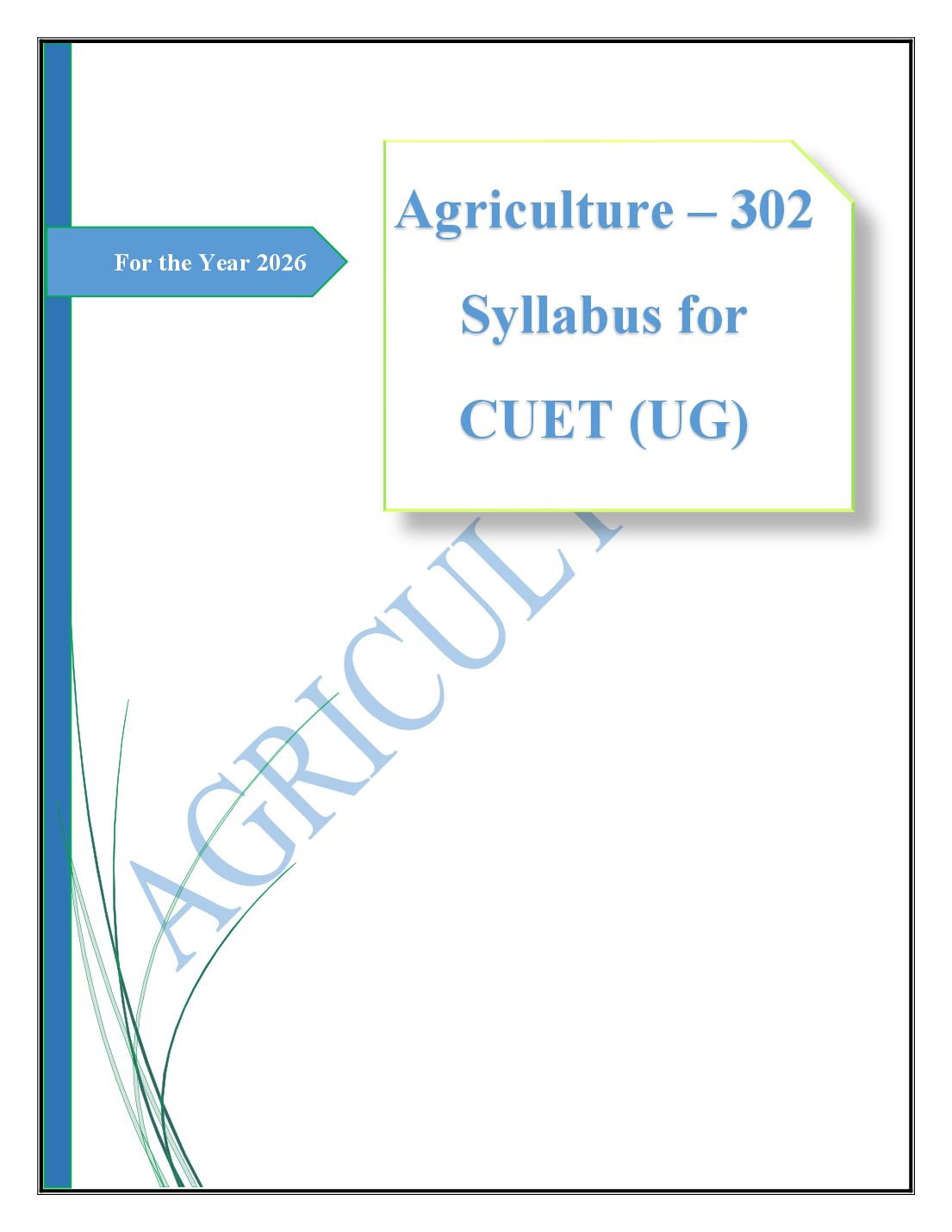
For the Year 2026
Syllabus for
CUET (UG)
Page 2
Microbiology
1. Agrometeorology: Elements of Weather-rainfall, temperature, humidity, wind velocity,
Sunshine weather forecasting, climate change in relation to crop production, climate
classification; Monsoon in India.
2. Genetics & Plant Breeding:
(a) Cell and its structure, cell division-mitosis and meiosis and their significance.
(b) Organization of the genetic materials in chromosomes, DNA, and RNA.
(c) Mendel’s laws of inheritance. Reasons for the success of Mendel in his experiments,
Absence of linkage in Mendel’s experiments.
(d) Quantitative inheritance, continuous and discontinuous variation in plants.
(e) Monogenic and polygenic inheritance.
(f) Role of Genetics in Plant breeding, self and cross-pollinated crops, methods of breeding
in field crops-introduction, selection, hybridization, mutation and polyploidy, tissue and
cell culture.
(g) History and importance of plant breeding, objective and role of plant breeding,
Breeding methods in self and cross-pollinated crops.
(h) Plant Biotechnology-definition and scope in crop production, Biotechnology of plant
breeding.
3. Biochemistry: pH and buffers, Classification and nomenclature of carbohydrates; proteins;
lipids; vitamins, and enzymes; Nucleic acids
4. Microbiology: Microbial cell structure, Micro-organisms- Algae, Bacteria, Fungi,
Actinomycetes, Protozoa and Viruses. Role of micro-organisms in respiration, fermentation,
and organic matter decomposition; Soil flora and fauna
5. Seed Science: Seed structure of monocots and dicots, mode of reproduction, pollination,
fertilization, Seed dormancy, types of seeds.
Unit-2: Livestock Production
1. Scope and importance:
(a) Importance of livestock in agriculture and industry, White revolution in India.
(b) Important breeds Indian and exotic, distribution of cows, buffaloes, goats, sheeps and
poultry in India.
2. Care and management:
(a) Systems of cattle and poultry housing.
(b) Principles of feeding, and feeding practices.
(c) Balanced ration definition and ingredients.
(d) Management of calves, bullocks, pregnant and milch animals as well as chicks’
1|P a g e
Page 3
(e) Signs of sick animals, symptoms of common diseases in cattle and poultry,
Rinderpest, black quarter, foot and mouth, mastitis and haemorrhagic septicaemia
coccidiosis, Fowl pox and Ranikhet disease, their prevention, and control.
3. Artificial Insemination: Reproductive organs, collection, dilution, and preservation of semen
and artificial insemination, role of artificial insemination in cattle improvement.
4. Livestock Products: Processing and marketing of milk and Milk products.
5. Fisheries: Definition of fish, fisheries, aquaculture; General characteristics of fish, types of
fishes.
Unit-3: Crop Production
1. Introduction:
(a) Targets and achievements in foodgrain production in India since independence and its
future projections, sustainable crop production, commercialization of agriculture and
its scope in India.
(b) Classification of field crops based on their utility-cereals, pulses, oils seeds, fibre,
sugar, and forage crops.
2. Soil, Soil fertility, Fertilizers, and Manures:
(a) Soil, soil pH, Soil texture, soil structure, soil organisms, soil tilth, soil fertility, and soil
health.
(b) Essential plant nutrients, their functions, and deficiency symptoms.
(c) Soil types of India and their characteristics.
(d) Organic manure, common fertilizers including straight, complex, fertilizer mixtures
and biofertilizers, integrated nutrient management system.
(e) Problem soils, soil erosion, soil pollution.
(f) Soil analysis for nutrient availability.
3. Irrigation and Drainage:
(a) Sources of irrigation (rain, canals, tanks, rivers, wells, tubewells).
(b) Scheduling of irrigation based on critical stages of growth, time interval, soil moisture
content, and weather parameters.
(c) Water requirement of crops.
(d) Methods of irrigation and drainage.
(e) Watershed management.
(f) Irrigation water quality.
2|P a g e
Page 4
methods of weed control (cultural, mechanical, chemical, biological, and Integrated weed
management).
5. Crops: Seedbed preparation, seed treatment, time and method of sowing/planting, seed rate;
dose, method, and time of fertilizer application, irrigation, intercultural and weed control;
common pests and diseases, caused by bacteria, fungi viruses, and nematode and their control,
integrated pest management, harvesting, threshing, post-harvest technology: storage,
processing, and marketing of major field crops-Rice, wheat, maize, sorghum, pearl millet,
groundnut, mustard, pigeon-pea, gram, sugarcane, cotton, and berseem. Millets and their
importance.
6. Modern agriculture: Challenges in modern agriculture; conservation agriculture; precision
agriculture; natural farming; organic farming; remote sensing in agriculture.
Unit-4: Horticulture
(a) Importance of fruits and vegetables in the human diet, Crop diversification & processing
Industry.
(b) Orchard- location and layout, ornamental gardening, and kitchen garden.
(c) Planting system, training, pruning, intercropping, protection from frost and sunburn.
(d) Trees, shrubs, climbers, annuals, perennials-definition and examples. Propagation by seed,
cutting, budding, layering, and grafting.
(e) Cultivation practices, processing, and marketing of
(i) Fruits - mango, papaya, banana, guava, citrus, grapes.
(ii) Vegetables - Radish, carrot, potato, onion, cauliflower, brinjal, tomato, spinach, and
cabbage.
(iii) Flowers - Gladiolus, canna, chrysanthemums, roses and marigold.
(f) Principles and methods of fruit and vegetable preservation.
(g) Preparation of jellies, jams, ketchup, chips and their packing.
3|P a g e
Document Details
| Board / Org | NTA |
| Exam | Common University Entrance Test |
| Type | Syllabus |
| Pages | 4 |
| Language | english |
| Updated | 24 Sep 2026 |