CUSAT CAT 2023 Question Paper Physics Chemistry Maths Shift III
Finished viewing? Save it for later —
Download CUSAT CAT 2023 Question Paper Physics Chemistry Maths Shift III (PDF · 53 pages)About CUSAT CAT 2023 Question Paper Physics Chemistry Maths Shift III
CUSAT CAT 2023 Question Paper Physics Chemistry Maths Shift III is available here for free download. Published by Cochin University for CUSAT Common Admission Test, this question paper can be viewed online or downloaded as a PDF (53 pages). Candidates preparing for CUSAT Common Admission Test can use CUSAT CAT 2023 Question Paper Physics Chemistry Maths Shift III to understand the exam pattern, the type of questions asked, and the overall difficulty level.
Frequently Asked Questions
How can I download CUSAT CAT 2023 Question Paper Physics Chemistry Maths Shift III?
Open this page and click the Download button to save CUSAT CAT 2023 Question Paper Physics Chemistry Maths Shift III as a PDF. It is completely free on AglaSem Docs.
Is CUSAT CAT 2023 Question Paper Physics Chemistry Maths Shift III free to download?
Yes. CUSAT CAT 2023 Question Paper Physics Chemistry Maths Shift III can be viewed online and downloaded as a PDF free of cost on AglaSem Docs.
How many pages does CUSAT CAT 2023 Question Paper Physics Chemistry Maths Shift III have?
CUSAT CAT 2023 Question Paper Physics Chemistry Maths Shift III contains 53 pages, which you can read online or download together as a single PDF.
Where can I find more CUSAT Common Admission Test study material?
You can find more CUSAT Common Admission Test question papers, sample papers, syllabus, and answer keys on AglaSem Docs.
CUSAT CAT 2023 Question Paper Physics Chemistry Maths Shift III – Text
Read the full text of this question paper below — useful to quickly search, copy and reference the content online without downloading the PDF.
📄 View text version (53 pages)
Page 1
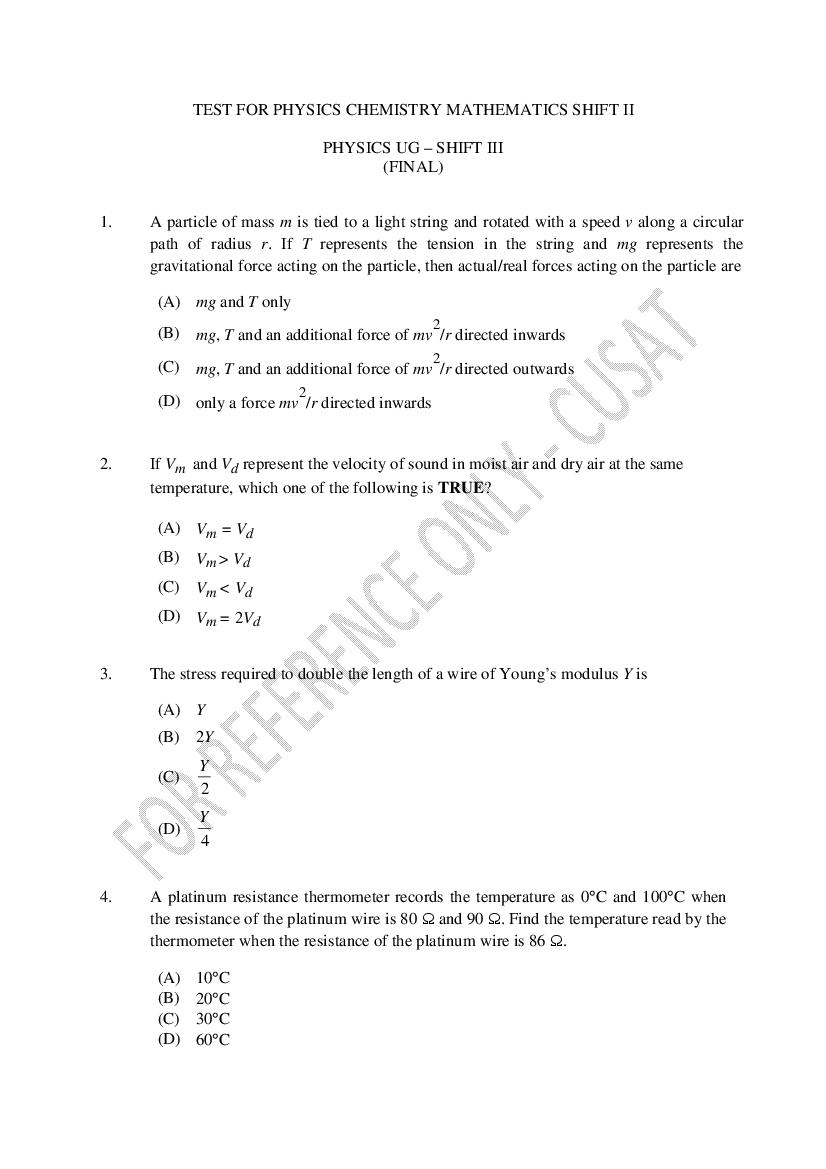
PHYSICS UG – SHIFT III
(FINAL)
1. A particle of mass m is tied to a light string and rotated with a speed v along a circular
path of radius r. If T represents the tension in the string and mg represents the
gravitational force acting on the particle, then actual/real forces acting on the particle are
(A) mg and T only
2
(B) mg, T and an additional force of mv /r directed inwards
2
(C) mg, T and an additional force of mv /r directed outwards
2
(D) only a force mv /r directed inwards
2. If Vm and Vd represent the velocity of sound in moist air and dry air at the same
temperature, which one of the following is TRUE?
(A) Vm = Vd
(B) Vm > Vd
(C) Vm < Vd
(D) Vm = 2Vd
3. The stress required to double the length of a wire of Young’s modulus Y is
(A) Y
(B) 2Y
Y
(C)
2
Y
(D)
4
4. A platinum resistance thermometer records the temperature as 0°C and 100°C when
the resistance of the platinum wire is 80 Ω and 90 Ω. Find the temperature read by the
thermometer when the resistance of the platinum wire is 86 Ω.
(A) 10°C
(B) 20°C
(C) 30°C
(D) 60°C
Page 2
(A) Kelvin
(B) Fahrenheit
(C) Celcius
(D) Reaumur
6. A real gas behaves as an ideal gas at
(A) very low pressure and high temperature
(B) high pressure and low temperature
(C) high pressure and high temperature
(D) low pressure and low temperature
7. Which one of the following is the defining equation for uniform circular motion?
(Symbols have usual meaning.)
(A) V = ω r
ω
(B) V =
r
(C) V = ω 2 r
r
(D) V =
ω
8. Which one of the following is TRUE for a conductor?
(A) The resistivity of a conducting wire is proportional to its length
(B) The resistivity of a conducting wire is inversely proportional to its area of cross
section
(C) The resistivity of a conducting wire is dependent both on its length and area of
cross section
(D) The resistivity is a property of the material which does not depend on
dimensions of the conductor but depends on nature and temperature of the
conductor
9. The magnetic flux (in Webers) linked with a coil is given by the equation
2
φ = 3t + 4t + 9. Then the magnitude of the induced emf at time t = 2s will be
(A) 2V
(B) 4V
(C) 8V
(D) 16 V
Page 3
positive x direction. The instantaneous oscillating electric field of this wave is along the
+y direction. Then the direction of the oscillating magnetic field of the wave will be
(A) –y direction
(B) +z direction
(C) –z direction
(D) –x direction
11. A common emitter transistor amplifier has a current gain of 50. If the input resistance
and the load resistance of the amplifier circuit are 500 Ω and 4 kΩ respectively, the
voltage gain of the amplifier is
(A) 100
(B) 200
(C) 300
(D) 400
12. In the following nuclear reaction
7 4
p + 3Li → 2 2He
if the binding energy per nucleon of the Li and He nuclei are 5.6 and 7.06 MeV,
estimate what must be the energy of the proton?
(A) 39.2 MeV
(B) 28.24 MeV
(C) 17.28 MeV
(D) 1.46 MeV
13. A double convex lens of focal length 20 cm with same radius of curvature for both the
faces needs to manufactured. If the refractive index of the glass is 1.55, the radius of
curvature required will be
(A) 10 cm
(B) 17.5 cm
(C) −17.5 cm
(D) 22 cm
Page 4
dimension of ‘c’?
(A) T −2
(B) L2
(C) LT −4
(D) LT −5
15. A man of weight W = mg is standing on a lift which is moving upward with an
a
acceleration . If g is the acceleration due to gravity, the apparent weight of the man is
2
a
(A) W 1 +
g
a
(B) W 1 −
g
a
(C) W 1 +
2g
a
(D) W 1 −
2g
16. The centripetal force acting on a coin weighing 0.1 kg place 0.1 m from the centre of
a disc rotating at 600 rpm is
π2
(A) N
2
(B) 2π 2 N
π2
(C) N
4
(D) 4π 2 N
17. Bernoulli theorem represents the law of conservation of
(A) mass
(B) momentum
(C) energy
(D) angular momentum
Page 5
18. If the Young’s modulus of the material of a rod is 1.5 × 10 n/m and its density is
−3
6000 kg m , the time taken by a sound wave to traverse 1 m of the rod will be
(A) 2 × 10⁻⁴ s
(B) 2 × 10⁻² s
(C) 10−4 s
(D) 10−2 s
19. Two spherical rain drops reach the surface of the earth with terminal velocities having
ratio 16 : 9. The ratio of their surface area is
(A) 4:3
(B) 16 : 9
(C) 9 : 16
(D) 3:4
20. In Carnot’s engine, efficiency is 50% at hot reservoir temperature T. For efficiency
40%, what will be the temperature of hot reservoir?
2T
(A)
5
(B) 6T
6T
(C)
5
5T
(D)
6
21. A parallel plate capacitor is made by stacking 5 identical equally spaced metallic
plates having the same dielectric between the plates. The alternate plates are then
connected. If the capacitor formed by two neighbouring plates has a capacitance C,
the total capacitance of the combination is
(A) 5 C
(B) 4 C
C
(C)
5
C
(D)
4
Page 6
at –173°C will be
(A) 0.0150
(B) 0.0075
(C) 0.0045
(D) 0.0030
23. When a charged particle moves perpendicular to a uniform magnetic field, its
(A) energy changes but momentum remains unchanged
(B) momentum changes but energy remains unchanged
(C) energy and momentum both remain unchanged
(D) both energy and momentum are changed
24. When a wave travels from air into glass, there is no change in its
(A) frequency
(B) velocity
(C) amplitude
(D) wavelength
27 64
25. If the radius of nucleus of Al is 3.6 Fermi, the approximate nuclear radius of Cu
in Fermi is
(A) 1.2
(B) 2.4
(C) 3.6
(D) 4.8
26. The earth’s magnetic field is approximately
5
(A) 2 × 10 T
(B) 2 × 10⁻⁵ T
(C) 4 × 10⁻⁵ T
(D) 8 × 10⁻⁵ T
27. The frequency of rotation of water molecules is about
(A) 2.45 GHz
(B) 2.45 MHz
(C) 2.45 Hz
(D) 0.245 Hz
Page 7
has a focal length of 1 cm. The magnifying power of this telescope is
(A) 100
(B) 200
(C) 10
(D) 5
29. In the hydrogen spectrum, Paschen and Brackett series are
(A) infrared region
(B) UV region
(C) visible region
(D) microwave region
30. 1 curie is equal to
10
(A) 3.7 × 10 Bq
8
(B) 2.7 × 10 Bq
6
(C) 1.7 × 10 Bq
(D) 3.7 × 10⁻¹⁰ Bq
31. A pair of forces of equal magnitude but acting in opposite directions with different
lines of action is known as a
(A) stretching
(B) compression
(C) torque
(D) bending
32. What is the length of a simple pendulum?
(A) 1m
(B) 0.5 m
(C) 0.25 m
(D) 0.125 m
Page 8
The ball loses its velocity on bouncing by a factor of
3
(A)
5
2
(B)
5
16
(C)
25
9
(D)
25
34. The pulleys and strings shown below are smooth and of negligible mass. For the
system to remain in equilibrium, the angle of θ should be
(A) 30°
(B) 45°
(C) 90°
(D) 60°
35. Which of the following methods can be used to measure the speed of light in
laboratory?
(A) Roemer method
(B) Fizeau method
(C) Foucault method
(D) Michelson method
36. A ballet dancer stretches her hands out for a slowing down; this is based on the
principle of
(A) conservation of force
(B) conservation of energy
(C) conservation of linear momentum
(D) conservation of angular momentum
Page 9
(A) continuously increases
(B) continuously decreases
(C) decreases then increases
(D) increases then decreases
38. Which wavelength of the radiation from sun is used for conversion into electrical
energy?
(A) Radio waves
(B) Infrared waves
(C) Visible light
(D) Micro waves
39. In the electric network shown, when no current flows through the 4 Ω resistor in the
arm EB the potential difference between the points A and D will be
(A) 6V
(B) 3V
(C) 5V
(D) 4V
40. Two balls each of radius R, equal mass and density are placed in contact, then the
force of gravitation between them is proportional to
1
(A) F∝
R2
(B) F∝R
(C) F ∝ R4
1
(D) F∝
R
Page 10
surface becomes 70 V. The potential at the centre of the sphere is
(A) 100 V
(B) 35 V
(C) 70 V
(D) 7V
42. Emission of β rays in radioactive decay results in the change of
(A) mass but not in charge
(B) charge but not in mass
(C) both mass and charge
(D) either mass or charge
43. When you make ice cubes, the entropy of water
(A) increases
(B) decreases
(C) does not change
(D) either increase or decrease depending on the process
44. A steel ball weighing 1 Kg is dropped from the Leaning tower of Pisa. It starts form
2
rest and falls freely. The position after 1 sec is (g is 9.8 m/s )
(A) 4.9 m
(B) −9.8 m
(C) −4.9 m
(D) 19.6 m
45. Kinetic energy of a body of mass m and momentum p is given by
(A) p 2m
m2
(B)
2p
(C) mp
p2
(D)
2m
Page 11
coefficient). When it is heated from 300 K to 600 K then average kinetic energy of
helium atoms will be
(A) Half
(B) unchanged
(C) two times
(D) 2 times
47. The frequency of LC circuit is
1
(A) LC
2π
1
(B)
2π LC
1 L
(C)
2π C
1 1
(D)
2π LC
48. If the horizontal and vertical components of the earth’s magnetic field are equal at a
certain place, then the angle of dip at that place will be
(A) 90°
(B) 60°
(C) 45°
(D) 0°
49. If in a moving coil galvanometer, a current i produces a deflection θ, then
(A) i is proportional to tan θ
(B) i is proportional to θ
(C) i is proportional to θ 2
(D) i is proportional to θ
50. An achromatic combination of lenses is formed by joining
(A) 2 convex lenses
(B) 2 concave lenses
(C) 1 convex and 1 concave lens
(D) 1 convex lens and a plane mirror
Page 12
(A) an insulator
(B) a semiconductor
(C) a metal
(D) a superconductor
52. For the photoelectric effect, the maximum kinetic energy KE of the emitted
photoelectrons is plotted against the frequency ν of the incident photons as shown in
the figure below. The slope of the curve gives
(A) charge of the electron
(B) work function of the metal
(C) Plank’s constant
(D) ratio of the Plank’s constant to electronic charge
53. A particle starts with an initial velocity 2.50 m/s along the positive x direction and
2
it accelerates uniformly at the rate 0.50 m/s . The distance traveled by it in the first
2 seconds is
(A) 2.0 m
(B) 4.0 m
(C) 6.0 m
(D) 8.0 m
54. A toy car of 1 kg mass moves with circular speed in a horizontal circular groove, with
vertical side walls, of radius 25 cm. The toy car takes 2.0 seconds to complete one
round. The normal contact force by the side wall of the groove is
(A) 0.025 N
(B) 0.247 N
(C) 2.47 N
(D) 24.7 N
Page 13
F = −(50 N/m)x. If it crosses the centre of oscillation with the speed of 10 m/s,
find the amplitude of the motion.
(A) 0.5 m
(B) 1m
(C) 5m
(D) 50 m
56. The displacement of a particle of a string carrying a travelling wave is
y = (3.0 cm) sin 6.28(0.50 x – 50 t), where x is in centimetre and t is in
second. The speed of the wave is
(A) 100 m/s
(B) 10 m/s
(C) 100 cm/s
(D) 10 cm/s
3
57. A vessel of volume 2000 cm contains 0.1 mole of oxygen and 0.2 mole of carbon
dioxide. If the temperature of the mixture is 300 K, find its pressure.
5
(A) 1.25 × 10 Pa
5
(B) 2.50 × 10 Pa
5
(C) 3.75 × 10 Pa
5
(D) 7.50 × 10 Pa
58. A resistor develops 400 J of thermal energy in 10 s when a current of 2 A is passed
through it. Find its resistance.
(A) 10 Ω
(B) 20 Ω
(C) 200 Ω
(D) 400 Ω
59. A transistor is used in common-emitter mode in an amplifier circuit. When a signal of
20 mV is added to the base-emitter voltage, the base current changes by 20 µA and
the collector current changes by 2 mA. If the load resistance is 5 kΩ, find the β factor.
(A) 1
(B) 10
(C) 100
(D) 1000
Page 14
friction in 10 seconds. Assuming the force of friction to be a constant, it is
(A) −0.41 N
(B) 0.41 N
(C) −0.82 N
(D) 0.82 N
61. Regarding diffraction and interference phenomena consider the following statements:
(i) In diffraction phenomena, the interfering beams originate from a continuous
distribution of sources and interference phenomena, the interfering beams
originate from a discrete number of sources.
(ii) In the far-field (or Fraunhofer) diffraction as the viewing screen is moved
relative to the aperture, the size of the diffraction scales uniformly, but the
shape of the diffraction pattern does not change.
(iii) In the near field (or Fresnel) diffraction both the shape and size of the
diffraction pattern depend on the distance between the aperture and the screen.
As the screen is moved away from the aperture, the image of the aperture
passes through the forms predicted in turn by geometrical optics, near-field
diffraction and far-field diffraction
(A) (i) only is correct
(B) (i), (ii) only are correct
(C) (ii), (iii) only are correct
(D) (i), (ii), (iii) are correct
62. A battery of emf E and negligible internal resistance is connected to a resistor R.
Taking the heating effect of current and its further effects on circuit into the
considerations, indicate which of the plots shown in figure best represents the rate of
production of thermal energy in the resistor.
P
A
B
C
D
t
(A) A
(B) B
(C) C
(D) D
Page 15
experiences
(A) an upward force
(B) a downward force
(C) an accelerated force
(D) no force
64. Two pure inductors each of self inductance L are connected in series, the net
inductance is
(A) L
(B) 2 L
L
(C)
2
L
(D)
4
−7
65. What is the force between two charged spheres having charges of 2 × 10 C and
−7
3 × 10 C placed 30 cm apart in air?
4
(A) 6 × 10 N
(B) 6 × 10⁻³ N
(C) 4 × 10⁻⁴ N
(D) 4 × 10⁻³ N
66. The ratio of contributions made by electric field and magnetic field components to the
intensity of an electromagnetic wave is, (c being the velocity of light)
(A) 1 : 1
(B) c : 1
2
(C) c : 1
(D) c:1
67. A transverse wave travels along the z-axis. The particles of the medium must move
(A) along the z-axis
(B) along the y-axis
(C) along the x-axis
(D) in the x-y plane
Page 16
(A) conservation of energy
(B) conservation of linear momentum
(C) conservation of angular momentum
(D) conservation of mass
69. A reverse bias PN junction has
(A) very narrow depletion layer
(B) almost no current
(C) very low resistance
(D) large current flow
70. The moment of inertia of a uniform semicircular wire of mass M and radius r about
a line passing through its ends is
(A) Mr 2
1
(B) Mr 2
2
1
(C) Mr 2
4
2
(D) Mr 2
5
71. A particle is moving in a circle with uniform speed. Its motion is
(A) not periodic
(B) periodic and simple harmonic
(C) periodic but not simple harmonic
(D) simple harmonic
72. Analogue of mass in rotational motion is
(A) moment of inertia
(B) torque
(C) radius of gyration
(D) angular momentum
73. The displacement of a particle in simple harmonic motion is always measured from
(A) extreme position
(B) mean position
(C) midpoint of mean and extreme position
(D) yield point
Page 17
(A) Yes
(B) No
(C) Can be liquefied at low pressure
(D) Can be liquefied at high temperature
75. Specific resistance is numerically equal to the resistance offered by
(A) 1 cm length of a conductor
(B) A conductor of unit cross-section
2
(C) 1 cm length of conductor of 1 cm of cross-section
3
(D) 1 cm of a conductor
Page 18
(FINAL)
76. A mixture of 2 moles of carbon monoxide and one mole of oxygen in a closed vessel
is ignited to convert carbon monoxide to carbon dioxide. If ∆H if the enthalpy change
and ∆U is the change in internal energy, then
(A) ∆H > ∆U
(B) ∆H < ∆U
(C) ∆H = ∆U
(D) ∆U = ∆H = 0
77. The decay of a radioactive element exhibits the characteristics of a reaction of
(A) Zero order
(B) First order
(C) Second order
(D) Fractional order
78. Two platinum electrodes were immersed in a solution of copper sulphate and electric
current was passed till copper sulphate is completely electrolysed. The resultant
solution contains
(A) Platinum sulphate
(B) Copper hydroxide
(C) Only water
(D) Dilute sulphuric acid
79. For a spontaneous reaction, the Gibbs free energy change (∆G), the equilibrium
constant (K) and E ocell will be respectively
(A) −ve, > 1, +ve
(B) +ve, > 1, −ve
(C) −ve, < 1, −ve
(D) −ve, > 1, −ve
80. A pressure cooker reduces cooking time for food because
(A) heat is more easily distributed in the cooking space
(B) the higher pressure inside the cooker crushes the food material
(C) boiling point of water involved in cooking is increased
(D) cooking involves chemical changes helped by a rise in temperature
Page 19
−1 2 −1
126.45, 426.16 and 91 Ohm cm mol , respectively. The molar conductance of
acetic acid at infinite dilution is
−1 2 −1
(A) 590.71 ohm cm mol
−1 2 −1
(B) 698.28 ohm cm mol
−1 2 −1
(C) 217.45 ohm cm mol
(D) 390.71 ohm−1 cm2 mol−1
82. In salt bridge, KCl is used because
(A) KCl is present in the calomel electrode
+ −
(B) K and Cl ions have same transport number
+ −
(C) K and Cl ions are isoelectronic
(D) KCl is a strong electrolyte
83. Eo + =0.80 V and E o 2+ =-0.25 V. The EMF of the cell Ni-Ag is
Ag Ag Ni Ni
(A) +0.21 V
(B) +1.05 V
(C) −2.10 V
(D) −1.05 V
84. For a first order reaction, t0.75 is 138.6 sec. Its specific rate constant (in sec) is
−2
(A) 10
−4
(B) 10
−5
(C) 10
−6
(D) 10
3
85. The number of atoms in 100 g of fcc crystal with density d = 10 g cm and cell edge
equal to 100 pm is
25
(A) 4 × 10
25
(B) 3 × 10
25
(C) 2 × 10
25
(D) 1 × 10
Page 20
the solution is
(A) 9.0
(B) 10.0
(C) 11.0
(D) 12.0
87. Out of Cu, Ag, Fe and Zn, the metal which can displace all others from salt solution is
(A) Ag
(B) Cu
(C) Zn
(D) Fe
88. Electrode potentials are reported with reference to
(A) standard hydrogen electrode
(B) normal calomel electrode
(C) glass electrode
(D) silver-silver chloride electrode
89. The value of diffusion coefficient of methane at a given temperature is half of a gas
X. The molecule weight of X is
(A) 4
(B) 32
(C) 8
(D) 64
90. An electrochemical cell can behave like an electrolytic cell when
(A) Ecell = 0
(B) Ecell > Eext
(C) Eext > Ecell
(D) Ecell = Eext
91. A current of 9.65 A flowing for 10 min deposits 3.0 g of a metal. The equivalent of
the metal is
(A) 10
(B) 30
(C) 50
(D) 96.5
Page 21
substance B is added to the solvent its vapour pressure drops to 0.40 atm. What is the
mole fraction of B in solution?
(A) 0.50
(B) 0.28
(C) 0.75
(D) 0.40
93. If the rate of reaction is equal to the rate constant, the order of the reaction is
(A) 0
(B) 1
(C) 2
(D) 3
94. What is the molar solubility, s, of Ba3(PO4)2 in terms of Ksp?
1/2
(A) s = Ksp
1/5
(B) s = Ksp
1/5
(C) s = [Ksp/27]
1/5
(D) s = [Ksp/108]
95. The region at which the probability density function reduces to zero is called as
(A) Density region
(B) Nodal surfaces
(C) Orientation surfaces
(D) Wave function
2 3
96. Identify the compound having sp, sp and sp hybridized carbons.
(A) 2,3-pentadiene
(B) 1,3-butadiene
(C) 2-heptyne
(D) phenylacetylene
Page 22
OH OH
Conc H2SO4 Br2 H2O/H+ Br
SO3
X AcOH
Y
OH OH
SO3H SO3H
(A) X= Y=
Br
OH OH
Br
(B) X= Y=
SO3H SO3H
OH OH
Br
(C) X= Y=
SO3H SO3H
OH OH
Br
(D) X= Y=
SO3H SO3H
98. What is the main chemical component of oil of wintergreen?
(A) Methyl salicylate
(B) Menthol
(C) Benzaldehyde
(D) Camphor
99. Lindlar Catalyst is
(A) NaBH4
(B) NH2NH2
(C) HCl/ZnCl2
(D) Pd/BaSO4 poisoned with Quinoline
100. Which among the following methods is NOT suitable for preparing phenol under
mild conditions?
(A) Treatment of chlorobenzene with NaOH in water
(B) Hydrolysis of phenyl acetate
(C) Treatment of methoxybenzene (anisole) with 57% HI
(D) Treatment of cumene hydroperoxide with dil. HCl
Page 23
example for
OH O
N
thionyl chloride C Ph
C Ph N
Ph Ph
H
(A) Hofmann rearrangement
(B) Curtius rearrangement
(C) Schmidt rearrangement
(D) Beckmann rearrangement
102. Among the following, the amino acid which does not have aromatic/heteroaromatic
ring residue is
(A) Tyrosine
(B) Asparagine
(C) Tryptophan
(D) Histidine
103. IUPAC name for the following compound is
(A) 2-methoxy-4-ethoxy-3-pentanone
(B) 2-ethoxy-4-methoxy-3-pentanone
(C) 2-ethoxy-3-methoxy-3-pentanone
(D) None of the above
104. In the following sequence of reactions, the product ‘D’ is
(A) Ethanol
(B) Ethyne
(C) Ethylamine
(D) Ethene
Page 24
(A) treatment with bromine water
(B) conversion to acetanilide by treatment with acetic anhydride followed by
bromination and hydrolysis
(C) treatment with bromine in the presence of a halogen carrier
(D) treatment with bromine in CCl4 in the presence of light
106. Maltose is a disaccharide made up of
(A) α-D-glucose only
(B) one each of α- and β-D-glucose units
(C) β-D-glucose and D-fructose
(D) two D-fructose units only
107. Dynel, polymer used for hair wigs, is a
(A) copolymer of butadiene and styrene
(B) copolymer of vinyl chloride and acrylonitrile
(C) polyamide resin
(D) cross linked polystyrene
108. Which among the following statements is incorrect about Hunsdiecker reaction?
(A) It proceeds through a carbocation intermediate
(B) Silver salts of carboxylic acids are used in this reaction
(C) One equivalent of CO2 is liberated in this reaction
(D) It is not suitable for the generation of alkyl fluoride
109. In the following reaction sequence, the major product ‘Z’ is
(A) toluene
(B) biphenyl
(C) 4-chlorotoluene
(D) N-methylaniline
Page 25
(A) Ammonical silver nitrate
(B) Br2/CCl4
(C) Anhy. ZnCl2/conc. HCl
(D) Alk. KMnO4
111. The following reaction is called
(A) Wurtz reaction
(B) Kolbe’s reaction
(C) Reimer-Tiemann reaction
(D) Schotten-Baumann reaction
112. A 1 : 1 mixture of benzaldehyde and formaldehyde on heating with concentrated aq NaOH
solution gives
(A) sodium benzoate and methyl alcohol
(B) methyl benzoate
(C) disodium salt of phthalic acid
(D) benzyl alcohol and sodium formate
113. Reaction of CH3-CH2-CH2-Cl with KCN in acetonitrile to give CH3-CH2-CH2-CN
proceeds predominantly by
(A) Nucleophilic Substitution bimolecular
(B) Nucleophilic Substitution unimolecular
(C) Radical Substitution bimolecular
(D) Radical Substitution unimolecular
114. Oxides of nitrogen and sulphur, formed by burning fossil fuels, combine with
oxygen in the presence of sun light to form
(A) dioxins
(B) thiourea
(C) smog
(D) ammonium sulphate nano particles
Page 26
(A) SN1 and SN2 substitution reaction
(B) E1 and E2 elimination reaction
(C) SN2 substitution and E2 elimination
(D) SN1 substitution and E1 elimination
116. Which is the correct order of second ionization potential of C, N, O, and F in the
following?
(A) O>N>F>C
(B) O>F>N>C
(C) F>O>N>C
(D) C>N>O>F
117. In the following the correct bond order sequence is
2− + −
(A) O2 > O2 > O2 > O2
+ − 2−
(B) O2 > O2 > O2 > O2
+ − 2−
(C) O2 > O2 > O2 > O2
(D) O2 > O2− > O22− > O2+
118. Which of the following ions has the lowest ionic conductivity in aqueous solution?
+
(A) Na
+
(B) Rb
+
(C) Li
+
(D) K
119. The element that shows greater ability to form pπ-pπ multiple bonds, is
(A) Sn
(B) C
(C) Ge
(D) Si
120. The form of iron obtained from blast furnace is
(A) Steel
(B) Cast iron
(C) Pig iron
(D) Wrought iron
Page 27
(A) Nickel
(B) Zinc
(C) Tin
(D) Gallium
122. XeF6 on partial hydrolysis with water produces a compound ‘x’. The same compound
‘x’ is formed when XeF6 reacts with silica. The compound ‘x’ is
(A) XeF2
(B) XeF4
(C) XeOF4
(D) XeO3
123. Which of the following arrangements does NOT represent the correct order of the
property stated against it?
2+ 2+ 2+ 2+
(A) V < Cr < Mn < Fe : paramagnetic behaviour
2+ 2+ 2+
(B) Ni < Co < Fe2+ < Mn : ionic size
3+ 3+ 3+ 3+
(C) Co < Fe < Cr < Sc : stability in aqueous solution
(D) Sc < Ti < Cr < Mn : number of oxidation states
124. The correct order of atomic radii is
(A) Nd > Dy > Ce > Yb
(B) Nd > Ce > Dy > Yb
(C) Ce > Dy > Yb > Nd
(D) Ce > Nd > Dy > Yb
125. Photon of which light has maximum energy?
(A) Red
(B) Blue
(C) Violet
(D) Green
Page 28
hybridisation of central atom and shape of the molecule?
2
(A) CO2, sp , bent
2
(B) H2O , sp , bent
2
(C) BeCl2, sp , linear
3
(D) H2O, sp , bent
127. The covalent energy is maximised in
(A) Heteronuclear molecule of AB type
+ −
(B) Heteronuclear molecule of A B type
(C) Homonuclear diatomic molecule
(D) None of the above
128. Which one of the following characteristics of the transition metals is associated with
higher catalytic activity?
(A) High enthalpy of atomisation
(B) Paramagnetic behaviour
(C) Colour of hydrate ions
(D) Variable oxidation states
129. The oxidation number of cobalt in K[Co(CO)4] is
(A) +1
(B) +3
(C) −1
(D) −3
+3
130. The correct electronic configuration and spin only magnetic moment of Gd are
7
(A) [Xe] 4f and 7.9BM
7
(B) [Xe] 4f and 8.9BM
6 1
(C) [Xe] 4f 5d and 7.9BM
7
(D) [Xe] 5f and 7.9BM
Page 29
water?
(A) 1.25 moles
(B) 2.5 moles
(C) 5.0 moles
(D) 3.5 moles
132. Orbital angular momentum depends on the quantum number/s
(A) l
(B) n and l
(C) n and m
(D) m and s
133. Crystal field stabilization energy (CFSE) of a high spin octahedral iron(III) complex
(atomic number of iron = 26)
(A) −20 Dq
(B) 0
(C) −6 Dq
(D) −4 Dq
134. What is the most important factor which makes Li strong reducing agent?
(A) Sublimation energy
(B) Ionization energy
(C) Hydration energy
(D) Electron gain enthalpy
135. Which of the following complex of M (atomic number 26) will be most stable?
(A) [M(CO)5]
(B) [M(CO)4]
(C) [M(CO)5]−
(D) [M(CO)6]
Page 30
(SHIFT – III FINAL)
136. Nishi has 5 coins each of the different denomination. The number of different sums
of money, she can form, is
(A) 25
(B) 30
(C) 31
(D) 32
137. The number of ordered pairs (m, n) , m, n ∈ {1, 2,..., 50} such that 6n + 9m is a multiple
of 5, is
(A) 2500
(B) 1500
(C) 1250
(D) 750
138. In a decimal system of numeration, the number of exactly 6-digit numbers in which
the sum of the digits is divisible by 5 is
(A) 180000
(B) 210000
(C) 360000
(D) 540000
2 1 3 4 3 −4
139. Let A = , B= and C = . Then
4 1 2 3 −2 3
ABC A( BC )2 A( BC )3
tr ( A) + tr + tr + tr + ...∞ where tr ( A) is the trace of A,
2 4 8
is equal to
(A) 6
(B) 9
(C) 12
(D) 16
Page 31
140. The determinant −b c bα + c = 0 , if
aα + b bα + c 0
(A) b3 = ac
(B) ab = c3
(C) x − α is a factor of bx 2 + 2ax + c
(D) x − α is a factor of ax 2 + 2bx + c
2 4 6
141. + + + ... will be equal to
3! 5! 7!
(A) 2e −2
(B) e−2
(C) e−1
(D) 2e−1
4 8 16
142. If x = 1 + 2 + + + + ..., then x −1 is equal to
2! 3! 4!
(A) e−2
(B) e2
1
(C) e 2
−1
(D) e 2
1
143. Let f ( x) = where { . } and [ . ] respectively denote the fractional part and
sin{x}
greatest integer. Then range of f is
(A) real numbers
(B) negative integers
(C) natural numbers
(D) rationals
Page 32
Then the probability that this point lies inside or on the region bounded by x + y ≤ 3 is
2
(A)
14
3
(B)
14
1
(C)
12
4
(D)
14
145. A pair of fair dice is thrown independently three times. The probability of getting a
score of exactly a twice is
8
(A)
9
1
(B)
729
8
(C)
243
8
(D)
729
146. If sin θ = n ( sin(θ + 2α ) ) , then tan(θ + α ) is equal to
(A) n tan α
1− n
(B) tan α
1+ n
(C) tan α
1+ n
(D) tan α
1− n
Page 33
147. If S = cos 2 + cos 2 + ... + cos 2 , then S is equal to
n n n
n(n + 1)
(A)
2
1
(B) (n − 1)
2
1
(C) (n − 2)
2
n
(D)
2
9
148. If cosec A + cot A = , then tan A is
2
77
(A)
36
36
(B)
77
18
(C)
77
77
(D)
72
149. If tan 2 x + sec x − a = 0 has atleast one solution, then the complete set of values of ' a ' is
(A) (−∞ , 2)
(B) (−1, 1)
(C) [ −1, 1]
(D) [ −1, ∞ )
Page 34
possesses a solution, lies in
(A) [ −3, − 1]
(B) [ −3, − 2]
(C) [ 0, 2]
(D) ( 0, 3)
π
151. Let sin −1 x − cos −1 x = . Then x is
6
1
(A)
2
3
(B)
2
1
(C) −
2
3
(D)
4
152. The sum of 10 terms is 12 and the sum of their squares is 17. Then the standard
deviation will be
3
(A) −
5
6
(B)
5
3
(C)
5
4
(D)
5
153. If the circle x 2 + y 2 + 4 x + 22 y + c = 0 bisects the circumference of the circle
x 2 + y 2 − 2 x + 8 y − d = 0, then c + d is equal to
(A) 60
(B) 40
(C) 80
(D) 50
Page 35
154. The second order derivative of a sin 3 t with respect to a cos3 t at t = is
4
4 2
(A)
3a
2
(B)
3a
4
(C)
3a
4
(D)
a 2
π x πx
155. The period of the function f ( x) = cos − sin is
n! (n + 1)!
(A) 2n !
(B) n!
(C) 2(n + 1)!
(D) (n + 1)!
sin(cos x) − cos x
, x ≠π
2 2
156. If f ( x) = (π − 2 x) is continuous at x = π then k =
2
k , x =π
2
(A) 0
1
(B)
2
(C) 1
(D) −1
Page 36
1
(A)
4
(B) 0
1
(C)
2
1
(D)
3
2 2
158. Solutions of the equation 3x − x + 4 x − x = 25 are
(A) −1, −2
(B) −1, 2
(C) 1, −2
(D) 1, 2
π 2
∫ ( x + x cos x + tan x + 1) dx =
3 5
159.
−π 2
(A) 0
(B) 2
(C) π
(D) 1
160. If ai > 0 for i = 1, 2,..., n and a1a2 ...an = 1, then the minimum value of
(1 + a1 )(1 + a2 ) ... (1 + an ) is
(A) 2n 2
(B) 2n
(C) 22 n
(D) 1
Page 37
1
(A)
2a + 1
1
(B)
2b + 1
(C) 2ab + 1
1
(D)
2ab − 1
1 1 1
162. ( a
)
For positive numbers a, b, c, the least value of a 2 + b 2 + c 2 2 + 2 + 2 is
b c
(A) 3
(B) 9
27
(C)
4
27
(D)
2
334 365
1 3 1 3
163. The value of 4 + 5 − + i − 3 + i is equal to
2 2 2 2
(A) 1 − i 3
(B) −1 + i 3
(C) 4 3i
(D) −i 3
164. For the equation 3x 2 + px + 3 = 0, p > 0, if one of the root is square of the other, then
p is equal to
1
(A)
3
(B) 1
(C) 3
2
(D)
3
Page 38
(A) q 3 = p 3r
(B) p 3 = q 3r
(C) pq = r
(D) pr = q
1 1 3 5 2n − 1
166. If H n = 1 + + ... , then the value of 1 + + + ... + is
2 n 2 3 n
(A) Hn + n
(B) 2n − H n
(C) (n − 1) + H n
(D) H n + 2n
167. A student read common difference of an A.P. as −3 instead of 3 and obtained the sum
of first 10 terms as −30 . Then, the actual sum of the first 10 terms is equal to
(A) 120
(B) 240
(C) 180
(D) 300
168. If the roots of the equation x 2 − 2kx + k 2 + k − 3 = 0 are real and less than 3, then
(A) k >4
(B) 2≤k ≤3
(C) 3< k ≤ 4
(D) k<2
1 2
169. Let x = 2 + 2 3 + 2 3. Then the value of x3 − 6 x 2 + 6 x is
(A) 1
(B) 3
(C) 2
(D) 4
Page 39
respectively, is 30. If the age of B is exactly 5 more than that of A, then the minimum
possible value of z is
(A) 31
(B) 33
(C) 35
(D) 37
171. If the median of 21 observations is 40 and if the observations greater than the median
are increased by 5, then the median of the new data will be
(A) 45
(B) 40
50
(C) 40 +
21
50
(D) 40 −
21
172. Let a, b, c, be positive numbers such that a + b + c = 1 and
(1 − a)(1 − b)(1 − c) ≥ kxyz. Then k is equal to
(A) 4
(B) 8
(C) 6
(D) 0
2 2
173. The inverse of the point (1, 2) with respect to the circle x + y − 4x − 6y + 9 = 0, is
1
(A) 1,
2
(B) (2, 1)
(C) (0, 1)
(D) (1, 0)
Page 40
dy
2 dy 2
2
(A) y − = a 1 +
dx dx
dy
2 dy 2
2
(B) y − x = a 1 +
dx dx
dy 2 dy
(C) y − x = a 1 +
dx dx
dy 2 dy
(D) y − = a 1 −
dx dx
175. If f ( x) = x − 2 and g ( x) = f [ f ( x) ] , then g '( x) for x > 20 is
(A) ∞
(B) 1
(C) 2
(D) −1
176. The complex number z satisfying the equations z − 4 = z − i − z − 5i = 0 is
(A) 3 −i
(B) 2 3
(C) −2 3 − 2i
(D) 0
177. An ellipse has OB as semi-minor axis, F and F ' its foci and the angle FBF ' is a right
angle. Then, the eccentricity of the ellipse is
1
(A)
3
1
(B)
4
1
(C)
2
1
(D)
2
Page 41
178. If ∫ e x dx = a, then the value of ∫ loge x dx is
1 e
(A) e4 − e
(B) e4 − a
(C) 2e4 − a
(D) 2e4 − e − a
2 2 2 2
179. Given that the curves x + y + kx + 4y + 2 = 0 and 2(x + y ) − 4x − 3y + k = 0 cut
orthogonally. Then the value of k is
(A) 1
1
(B)
3
10
(C)
3
10
(D) −
3
180. Let a, b, c be three positive real numbers such that a + b ≥ c. Then
a b c
(A) + ≥
1+ a 1+ b 1+ c
a b c
(B) + <
1+ a 1+ b 1+ c
a b 1+ c
(C) + >
1+ a 1+ b c
a b 1+ c
(D) + ≤
1+ a 1+ b c
181. The centre of a regular hexagon is at the point z = i. If one of the vertices is at 2 + i,
then the adjacent vertices of 2 + i are at the points
(A) 1 ± 2i
(B) i +1± 3
(C) 2 + i + (1 ± 3)
(D) 1 + i (1 ± 3)
Page 42
dx dy
182. If y = f (t ) sin t + f '(t ) cos t and x = f (t ) cos t − f '(t )sin t , then + is
dt dt
equal to
2
(A) [ f (t ) − f ''(t )]
2
(B) [ f (t ) + f ''(t )]
2
(C) [ f (t ) + f '(t )]
2
(D) [ f (t ) − f '(t )]
sin nx
183. The value of integer n for which the function f ( x) = has 4π as its period is
x
sin
n
(A) 2
(B) 3
(C) 4
(D) 5
3 2
184. If f(x) = 2x + 9x + λx + 20 is a decreasing function of x in the largest possible
interval (−2,−1), then λ is equal to
(A) 6
(B) −6
(C) 12
(D) −12
185. A seven digit number made up of all distinct digits 8, 7, 6, 4, 2, x and y is divisible by
3. Then possible number of ordered pair (x, y) is
(A) 2
(B) 4
(C) 6
(D) 8
Page 43
186. If X follows a binomial distribution with parameters n = 100 and p = , then P(X = r)
3
is maximum when r is equal to
(A) 16
(B) 32
(C) 33
(D) 44
− 3
187. ( )
The value of sin tan −1 − 3 + cos −1 is
2
(A) ∞
(B) −1
(C) 0
(D) 1
188. The slopes of the lines represented by x 2 + 2hxy + 2 y 2 = 0 are in the ratio 1 : 2. Then
the value of h is
3
(A) ±
2
(B) ±3
(C) ±1
2
(D) ±
3
189. The equation of the sphere described on the line joining the points (2, −1, 4) and
(−2, 2, −2) as diameter is
(A) 2 x2 − x + z = 0
(B) x2 + y2 + z 2 + x − y + z + 7 = 0
(C) x 2 + y 2 + z 2 − y − 2 z − 14 = 0
(D) x2 + y2 + z 2 = 0
Page 44
the minimum distance from the origin to the circle is
(A) 5 2 −2
(B) 5 2
(C) 34
(D) 54
191. Given that two roots of the nonlinear equation x3 − 6 x 2 + 11x − 6 = 0 are 1 and 3. The
third root will be
(A) j
(B) − j
(C) 2
(D) −2
2 3
192. Let A = . If the eigen values of A are 4 and 8, then (x, y) =
x y
(A) (4,10)
(B) (5,8)
(C) (−3,9)
(D) (−4,10)
z2 + 8
193. The value of ∫ dz , where j = −1 and C is described by x 2 + y 2 = 16, is
C 0.5 z − 1.5 j
(A) 4π j
(B) −4π j
(C) 2π j
(D) −2π j
194. If r = xi + yj + zk , then ( div r , curl r ) is
(A) (0, 1)
(B) (3, 0)
(C) (3, 1)
(D) (1, 3)
Page 45
(A) 3
(B) 6
(C) −4
(D) 2
196. The minimum height from any point on the curve y = x 2 − 4 x + 6 to the x-axis is
(A) 6
(B) 4
(C) 1
(D) 2
50
197. If ( 8 + i ) = 349 ( a + ib ) , then the value of a2 + b2 is
(A) 3
(B) 9
(C) 27
(D) 81
198. If 4 x + 3 y = y, then y as a function of x is
(A) not continuous at x = 0
(B) not defined for all real x
dy 1
(C) = for x < 0
dx 2
(D) differentiable at x = 0
199. If f ( x) be a differentiable function such that f ( xy ) = f ( x) + f ( y ) for all x and y,
1
then f (e) + f =
e
(A) 1
(B) 0
(C) −1
(D) ∞
Page 46
dy 1 dy 1 dy 1 dy
200. The order of differential equation x = 1 + + + + ... is
dx 2! dx 3! dx n ! dx
(A) 3
(B) 1
(C) n
(D) not defined
201. ( )
If a straight line through C − 8, 8 making an angle of 135° with the x-axis and
cuts the circle x = 5cos θ , y = 5sin θ at points A and B, then the length of AB is
(A) 3
(B) 7
(C) 10
(D) 5
202. If 25% of the items are less than 20 and 25% are more than 40, the quartile deviation is
(A) 20
(B) 30
(C) 40
(D) 10
203.
(
The function f ( x) = sec log x + 1 + x 2 is
)
(A) even
(B) odd
(C) constant
(D) periodic
204. If x 2 − x + 1 = 0 , then the value of x3n is
(A) 0
(B) −1
(C) 1
(D) n
Page 47
(A) 1
(B) 2
(C) 3
(D) 4
206. If a, b, c are positive numbers in A.P. such that their product is 64, then the minimum
value of b is
(A) 6
(B) 4
(C) 2
(D) 1
207. The number of zeros in the product 56 ⋅ 67 ⋅ 78 ⋅ 89 ⋅ 910 ⋅⋅⋅⋅3031 is
(A) 130
(B) 132
(C) 137
(D) 136
208. The number of ways in which the number 94864 can be resolved as a product of two
factors
(A) 22
(B) 24
(C) 23
(D) 26
209. The maximum number of different elements required to form a symmetric matrix of
order 12 is
(A) 72
(B) 78
(C) 75
(D) 70
210. In a group of 8 girls, two girls are sisters. The number of ways in which the girls can
sit so that two sisters are not sitting together, is
(A) 48200
(B) 14106
(C) 28300
(D) 30240
Page 48
211. If a 2 − 2a cos x + 1 = 674 and tan = 7 then the integral value of a is
2
(A) 25
(B) 49
(C) 67
(D) 74
1
212. If the length of the semi major axis of an ellipse is 68 and the eccentricity is then
2
the area of the rectangle formed by joining the vertices of the latera recta of the ellipse
is equal to
(A) 6846
(B) 6936
(C) 6676
(D) 7244
3 3 2 2
213. If A and B are two distinct matrices such that A = B and A B = B A,
3 3
then det (A + B ) is equal to
(A) 1
(B) 2
(C) 0
(D) −1
214. If the point (3, 4) lies on the locus of the point of intersection of the lines
x cos α + y sin α = a and x sin α − y cos α = b, ( α is a variable), and the point (a, b)
lies on the line 3x − 4y = 0, then 9a 4 + 16b 4 + 34 is equal to
(A) 3634
(B) 3684
(C) 3845
(D) 3874
215. If A denotes the area enclosed by 3 x + 4 y ≤ 12, then 4 A2 + A + 1 is equal to
(A) 2341
(B) 2329
(C) 2420
(D) 2429
Page 49
216. Suppose a matrix A satisfies A − 5A + 7I = 0 . If A = aA + bI , then a =
(A) 1265
(B) 5299
(C) 1259
(D) 5432
1
217. The largest term in the expansion of (3 + 2 x)50 , where x = is
5
(A) 5th
(B) 6th
(C) 8th
(D) 9th
218. If log 3 x + log3 y = 2 + log3 2 and log 3 ( x + y ) = 2, then
(A) x = 1, y = 8
(B) x = 1, y = 1
(C) x = 3, y = 6
(D) x = 9, y = 3
219. The equation of the circle which passes through the origin has its centre on the line
x + y = 4 and cuts the circle x 2 + y 2 − 4 x + 2 y + 4 orthogonally, is
(A) x2 + y2 − 2 x − 6 y = 0
(B) x2 + y2 − 6 x − 3 y = 0
(C) x2 + y2 − 4 x − 4 y = 0
(D) x2 + y2 + 4 x + 4 y = 0
220. The number of integral roots of the equation x 4 + x 4 + 20 = 22 is
(A) 0
(B) 2
(C) 4
(D) 8
Page 50
corresponding pair of tangents is
(A) 9 x 2 − 8 y 2 + 18 x − 9 = 0
(B) 9 x 2 − 8 y 2 − 18 x + 9 = 0
(C) 9 x 2 − 8 y 2 − 18 x − 9 = 0
(D) 9 x 2 − 8 y 2 + 18 x + 9 = 0
222. The lines joining the origin to the points of intersection of x 2 + y 2 + 2 gx + c = 0 and
x 2 + y 2 + 2 fy − c = 0 are at right angles. Then
(A) g2 + f 2 = c
(B) g2 − f 2 = c
(C) g 2 − f 2 = 2c
(D) g 2 + f 2 = c2
223. If m is a natural number such that m ≤ 5, then the probability that the quadratic
1 m
equation x 2 + mx + + = 0 has real roots is
2 2
1
(A)
5
2
(B)
3
3
(C)
5
4
(D)
5
Page 51
y3 − xy 2 − 14 x 2 y + 24 x3 = 0 at the points A, B, C. If O is the origin,
then OA2 + OB 2 + OC 2 is equal to
22
(A)
9
85
(B)
72
181
(C)
72
221
(D)
72
225. By definition a ∗ b = b ∗ a = 1, ∀ a, b ∈ R. Also (a ∗ b) ∗ c = (1 ∗ c) =1 and
a ∗ (b ∗ c) = a ∗ (1) = 1, ∀ a, b, c ∈ R. Then R is
(A) only commutative
(B) only associative
(C) reflexive and commutative
(D) commutative and associative
Page 52
TEST FOR PHYSICS CHEMISTRY MATHEMATICS SHIFT III
SI No. Key SI No. Key SI No. Key SI No. Key SI No. Key
1 A 31 C 61 C 91 C 121 B
2 B 32 A 62 D 92 A 122 C
3 A 33 B 63 D 93 A 123 A
4 D 34 B 64 B 94 D 124 D
5 A 35 C 65 B 95 B 125 C
6 A 36 D 66 A 96 A 126 D
7 A 37 D 67 D 97 B 127 C
8 D 38 B 68 C 98 A 128 D
9 D 39 C 69 B 99 D 129 C
10 B 40 C 70 B 100 A 130 A
11 D 41 C 71 C 101 D 131 B
12 C 42 B 72 A 102 B 132 A
13 D 43 B 73 B 103 D 133 B
14 D 44 C 74 B 104 B 134 C
15 C 45 D 75 C 105 B 135 A
16 D 46 C 76 B 106 A 136 C
17 C 47 D 77 B 107 B 137 C
18 A 48 C 78 D 108 A 138 A
19 B 49 B 79 A 109 A 139 A
20 D 50 C 80 C 110 C 140 D
21 B 51 C 81 D 111 D 141 C
22 A 52 C 82 B 112 D 142 A
23 B 53 C 83 B 113 A 143 C
24 A 54 C 84 A 114 C 144 C
25 D 55 B 85 A 115 D 145 C
26 C 56 C 86 B 116 B 146 D
27 A 57 C 87 C 117 C 147 C
28 A 58 A 88 A 118 C 148 B
29 A 59 C 89 A 119 B 149 D
30 A 60 A 90 C 120 C 150 B
Page 53
151 B 181 D 211 A
152 C 182 B 212 B
153 D 183 A 213 C
154 A 184 C 214 A
155 C 185 D 215 B
156 A 186 C 216 A
157 A 187 D 217 B
158 B 188 A 218 C
159 C 189 C 219 C
160 B 190 A 220 B
161 D 191 C 221 B
162 B 192 D 222 C
163 C 193 B 223 C
164 C 194 B 224 D
165 A 195 A 225 D
166 B 196 D
167 B 197 B
168 D 198 C
169 C 199 B
170 B 200 B
171 B 201 C
172 B 202 D
173 C 203 A
174 B 204 C
175 B 205 A
176 C 206 B
177 D 207 C
178 D 208 C
179 D 209 B
180 A 210 D
Document Details
| Board / Org | Cochin University |
| Exam | CUSAT Common Admission Test |
| Type | Question Paper |
| Pages | 53 |
| Updated | 22 Jul 2026 |