CBSE Class 10 Learning Outcomes for Mathematics Syllabus 2021-22
Finished viewing? Save it for later —
Download CBSE Class 10 Learning Outcomes for Mathematics Syllabus 2021-22 (PDF · 4 pages)About CBSE Class 10 Learning Outcomes for Mathematics Syllabus 2021-22
CBSE Class 10 Learning Outcomes for Mathematics Syllabus 2021-22 is available here for free download. Published by CBSE for Class 10, this syllabus can be viewed online or downloaded as a PDF (4 pages). Candidates preparing for Class 10 can use CBSE Class 10 Learning Outcomes for Mathematics Syllabus 2021-22 to understand the exam pattern, the type of questions asked, and the overall difficulty level.
Frequently Asked Questions
How can I download CBSE Class 10 Learning Outcomes for Mathematics Syllabus 2021-22?
Open this page and click the Download button to save CBSE Class 10 Learning Outcomes for Mathematics Syllabus 2021-22 as a PDF. It is completely free on AglaSem Docs.
Is CBSE Class 10 Learning Outcomes for Mathematics Syllabus 2021-22 free to download?
Yes. CBSE Class 10 Learning Outcomes for Mathematics Syllabus 2021-22 can be viewed online and downloaded as a PDF free of cost on AglaSem Docs.
How many pages does CBSE Class 10 Learning Outcomes for Mathematics Syllabus 2021-22 have?
CBSE Class 10 Learning Outcomes for Mathematics Syllabus 2021-22 contains 4 pages, which you can read online or download together as a single PDF.
Where can I find more Class 10 study material?
You can find more Class 10 question papers, sample papers, syllabus, and answer keys on AglaSem Docs.
CBSE Class 10 Learning Outcomes for Mathematics Syllabus 2021-22 – Text
Read the full text of this syllabus below — useful to quickly search, copy and reference the content online without downloading the PDF.
📄 View text version (4 pages)
Page 1
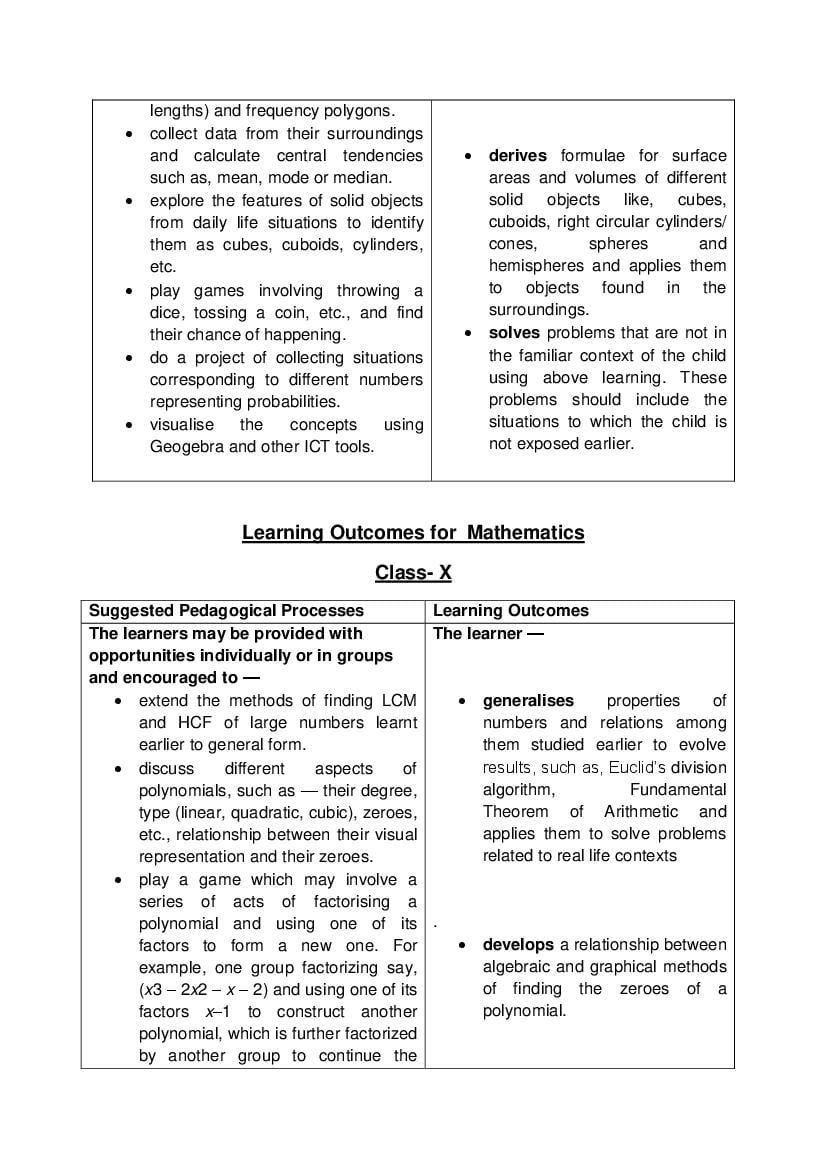
collect data from their surroundings
and calculate central tendencies derives formulae for surface
such as, mean, mode or median. areas and volumes of different
explore the features of solid objects solid objects like, cubes,
from daily life situations to identify cuboids, right circular cylinders/
them as cubes, cuboids, cylinders, cones, spheres and
etc. hemispheres and applies them
play games involving throwing a to objects found in the
dice, tossing a coin, etc., and find surroundings.
their chance of happening. solves problems that are not in
do a project of collecting situations the familiar context of the child
corresponding to different numbers using above learning. These
representing probabilities. problems should include the
visualise the concepts using situations to which the child is
Geogebra and other ICT tools. not exposed earlier.
Learning Outcomes for Mathematics
Class- X
Suggested Pedagogical Processes Learning Outcomes
The learners may be provided with The learner —
opportunities individually or in groups
and encouraged to —
extend the methods of finding LCM generalises properties of
and HCF of large numbers learnt numbers and relations among
earlier to general form. them studied earlier to evolve
discuss different aspects of results, such as, Euclid’s division
polynomials, such as — their degree, algorithm, Fundamental
type (linear, quadratic, cubic), zeroes, Theorem of Arithmetic and
etc., relationship between their visual applies them to solve problems
representation and their zeroes. related to real life contexts
play a game which may involve a
series of acts of factorising a
polynomial and using one of its .
factors to form a new one. For develops a relationship between
example, one group factorizing say, algebraic and graphical methods
(x3 – 2x2 – x – 2) and using one of its of finding the zeroes of a
factors x–1 to construct another polynomial.
polynomial, which is further factorized
by another group to continue the
Page 2
use quadratic equations to solve real finds solutions of pairs of linear
life problems through different equations in two variables using
strategies, such as, making a perfect graphical and different algebraic
square, quadratic formula, etc. methods.
discuss different aspects of linear demonstrates strategies of
equations by engaging students in finding roots and determining the
the activities of the following nature: nature of roots of a quadratic
one group may ask another to equation.
form linear equation in two develops strategies to apply the
variables with coefficients concept of A.P. to daily life
from a particular number situations.
system, i.e., natural numbers works out ways to differentiate
or numbers that are not between congruent and similar
integers, etc. figures.
graphically representing a
linear equation in 1D or 2D
and try to explain the
difference in their nature. establishes properties for
encouraging students to similarity of two triangles
observe identities and logically using different
equations and segregate geometric criteria established
them. earlier such as, Basic
use graphical ways to visualise Proportionality Theorem, etc.
different aspects of linear equations,
such as, visualising linear equations
in two variables or to find their
solution.
observe and analyse patterns in their
daily life situations to check if they
form an Arithmetic Progression and,
if so, find rule for getting their nth
term and sum of n terms. The
situations could be — our savings or
pocket money, games such as,
playing cards and snakes and
ladders, etc.
analyse and compare different
geometrical shapes, charts, and
models made using paper folding and
tell about their similarity and
congruence.
discuss in groups different situations,
Page 3
which the concepts of trigonometry relations for geometrical shapes
are used. in the context of a coordinate
work in projects related to heights plane, such as, finding the
and distances, that may include distance between two given
situations in which methods have to points, to determine the
be devised for measuring the angle coordinates of a point between
of inclination of the top of a building any two given points, to find the
and their own distance from the area of a triangle, etc.
building. determines all trigonometric
devise ways to find the values of ratios with respect to a given
different trigonometric ratios for a acute angle (of a right triangle)
given value of a trigonometric ratio. and uses them in solving
observe shapes in the surroundings problems in daily life contexts
that are a combination of shapes like finding heights of different
studied so far, such as, cone, structures or distance from them.
cylinder, cube, cuboid, sphere, derives proofs of theorems
hemisphere, etc. They may work in related to the tangents of circles
groups and may provide formulas for
different aspects of these combined
shapes. constructs —
determine areas of various materials, a triangle similar to a
objects, and designs around them for given triangle as per a
example design on a handkerchief, given scale factor.
design of tiles on the floor, geometry a pair of tangents from an
box, etc. external point to a circle
discuss and analyse situations and justify the
related to surface areas and volumes procedures.
of different objects, such as, (a) given examines the steps of
two boxes of a certain shape with geometrical constructions and
different dimensions, if one box is to reason out each step
be changed exactly like another box,
which attribute will change, its
surface area or volume? (b) By what finds surface areas and
percent will each of the dimensions of volumes of objects in the
one box have to be changed to make surroundings by visualising them
it exactly of same size as the other as a combination of different
box? solids like cylinder and a cone,
discuss and analyse the chance of cylinder and a hemisphere,
happening of different events through combination of different cubes,
simple activities like tossing a coin, etc.
throwing two dices simultaneously,
picking up a card from a deck of 52
Page 4
generalise the formulas of mean,
median and mode read in the earlier
classes by providing situations for
these central tendencies.
collect data from their surroundings
and calculate the central tendencies. calculates mean, median and
to draw tangents to a circle from a mode for different sets of data
point which lies outside and a point related with real life contexts.
which lies inside the circle. They may
be motivated to evolve different ways
to verify the properties of such determines the probability of an
tangents. event and applies the concept in
solving daily life problems.
Suggested Pedagogical Processes in an Inclusive Setup
Children with special needs to be taken along the class and keeping in view the
learning objectives, similar to those of the others, appropriate activities may be
designed. The teacher should take into account the specific problem of the child and
plan alternate strategies for teaching-learning process. A healthy inclusive classroom
environment provides equal opportunity to all the students; to those with and without
learning difficulties. The measures to be adopted may include:
developing process skills through group activities and using ICT for
simulation, repeated practice and evaluation.
assessing learning progress through different modes taking cognizance of the
learner’s response.
observing the child’s engagement in multiple activities, through varied ways
and levels of involvement.
using of embossed diagram in the pedagogical process and learning
progress.
using of adapted equipment (large print materials, adapted text materials with
simple language, more pictures and examples, etc.) in observation and
exploration (for example: visual output devices should have aural output and
vice versa) during the teaching-learning process.
using multiple choice questions to get responses from children who find it
difficult to write or explain verbally.
Document Details
| Board / Org | CBSE |
| Exam | Class 10 |
| Type | Syllabus |
| Pages | 4 |
| Updated | 22 Jul 2026 |