MBOSE Class 11 Question Paper 2020 for Music
Finished viewing? Save it for later —
Download MBOSE Class 11 Question Paper 2020 for Music (PDF · 6 pages)About MBOSE Class 11 Question Paper 2020 for Music
MBOSE Class 11 Question Paper 2020 for Music is available here for free download. Published by Meghalaya Board for Class 11, this question paper can be viewed online or downloaded as a PDF (6 pages). Candidates preparing for Class 11 can use MBOSE Class 11 Question Paper 2020 for Music to understand the exam pattern, the type of questions asked, and the overall difficulty level.
Frequently Asked Questions
How can I download MBOSE Class 11 Question Paper 2020 for Music?
Open this page and click the Download button to save MBOSE Class 11 Question Paper 2020 for Music as a PDF. It is completely free on AglaSem Docs.
Is MBOSE Class 11 Question Paper 2020 for Music free to download?
Yes. MBOSE Class 11 Question Paper 2020 for Music can be viewed online and downloaded as a PDF free of cost on AglaSem Docs.
How many pages does MBOSE Class 11 Question Paper 2020 for Music have?
MBOSE Class 11 Question Paper 2020 for Music contains 6 pages, which you can read online or download together as a single PDF.
Where can I find more Class 11 study material?
You can find more Class 11 question papers, sample papers, syllabus, and answer keys on AglaSem Docs.
MBOSE Class 11 Question Paper 2020 for Music – Text
Read the full text of this question paper below — useful to quickly search, copy and reference the content online without downloading the PDF.
📄 View text version (6 pages)
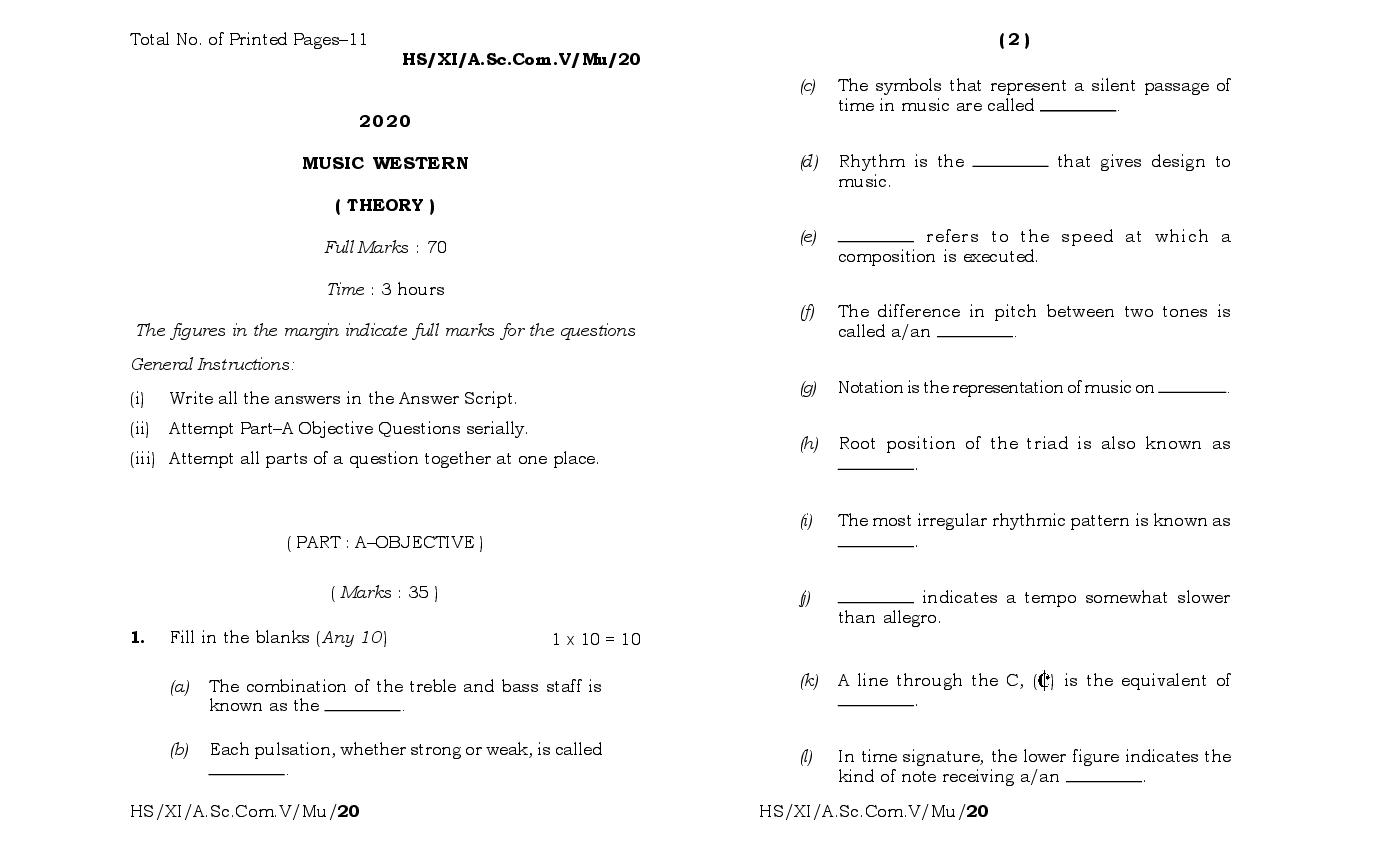
Page 1
HS/XI/A.Sc.Com.V/Mu/20
(c) The symbols that represent a silent passage of
time in music are called .
2020
MUSIC WESTERN (d) Rhythm is the that gives design to
music.
( THEORY )
(e) refers to the speed at which a
Full Marks : 70
composition is executed.
Time : 3 hours
(f) The difference in pitch between two tones is
The figures in the margin indicate full marks for the questions called a/an .
General Instructions:
(g) Notation is the representation of music on .
(i) Write all the answers in the Answer Script.
(ii) Attempt Part–A Objective Questions serially.
(h) Root position of the triad is also known as
(iii) Attempt all parts of a question together at one place. .
(i) The most irregular rhythmic pattern is known as
( PART : A–OBJECTIVE ) .
( Marks : 35 ) (j) indicates a tempo somewhat slower
than allegro.
1. Fill in the blanks (Any 10 ) 1 x 10 = 10
(a) The combination of the treble and bass staff is (k) A line through the C, ( ) is the equivalent of
known as the . .
(b) Each pulsation, whether strong or weak, is called (l) In time signature, the lower figure indicates the
. kind of note receiving a/an .
HS/XI/A.Sc.Com.V/Mu/20 HS/XI/A.Sc.Com.V/Mu/20
Page 2
(m) The pitch is determined by the number of (g) Every scale is divisible into two equal parts called
per second. tetrachords.
(n) The first phrase is called the antecedent and the
second phrase is called . (h) The tonic is the tone that begins the scale.
(o) Each of the several voices and instruments has
its own distinctive tone colour or . (i) A triad with a major third on the bottom and a
minor third above it is called major.
2. State whether the following statements are True or
False: (Any 10) 1 x 10 = 10
(j) Assymetrical meters contain an irregular number
of beats.
(a) Four tones (re, fa, la, ti) are called active tones.
(b) Chroma means colour in Greek.
(k) The interval fourth, fifth and octave are referred
to as perfect intervals.
(c) Forte means very loud.
(d) When the phrase ends on the tonic chord, the (l) G clef is sometimes called the bass staff.
close is known as half cadence.
(e) When the minor scale has the same tonic as the (m) The interval from E to F is M2.
major, the scales are said to be contrary.
(f) The repetition of a strong weak pulsation (n) Tonic means a different key signature but the
produces duple meter, meaning two.
same key tone.
HS/XI/A.Sc.Com.V/Mu/20 HS/XI/A.Sc.Com.V/Mu/20
Page 3
3. Multiple Choice Questions. (Any 5) 1x5=5 (d) Fermata is the Italian term for the sign , in English
usually called a
(a) Augmented interval is: (i) Detached
(i) Half step higher than minor interval (ii) Hold
(ii) Half step higher than major interval (iii) Breathe
(iii) Half step lower than minor interval (iv) Rest.
(iv) Half step lower than major interval
(e) Dolce means
(b) The abbreviation for damper pedal on the piano (i) playfully
is indicated by the symbol:
(ii) connected
(i) Fp
(iii) attached
(ii) p
(iv) sweetly
(iii) Ped
(iv) Damp
(f) The letter C is often used instead of its equivalent
(i) 3
(c) Which of the following note is equal to two count? 4
(i) Full note 2
(ii) 2
(ii) Half note
4
(iii) 4
(iii) Quarter note
(iv) Sixteenth note (iv) 5
8
HS/XI/A.Sc.Com.V/Mu/20 HS/XI/A.Sc.Com.V/Mu/20
Page 4
(g) The staff may be extended when needed by adding (c) Define measure.
short lines called:
(d) What is a pentatonic scale?
(i) appended lines
(e) Write the difference between the tie and a dot?
(ii) extended lines (f) What do you mean by Dal Segno al Fine?
(iii) extra lines (g) What are the dynamics?
(iv) ledger lines. (h) What are the principal triads of a key?
(h) The result of regular vibrations:
( PART : B – DESCRIPTIVE )
(i) Tone
( Marks : 35 )
(ii) Beat
Attempt any two questions from each unit :
(iii) Note
(iv) Noise UNIT–I
(i) The other name for unison is: 5. (a) What is tone? Mention the four characteristics
of a musical tone. 1+1= 2
(i) similar
(b) What is a simple meter? 1.5
(ii) prime
(iii) choir
6. (a) Name the notes that fall on the spaces of the
(iv) united bass staff. 2
(b) What are the three different positions of triads? 1.5
4. Short answer type questions : (any 5 ) 2 x 5 = 10
(a) What is a fundamental tone. 7. (a) What is the difference between a sharp (#) and a
flat ( )? 2
(b) What is a cadence? Name the different types of
cadences. (b) What is time signature? 1.5
HS/XI/A.Sc.Com.V/Mu/20 HS/XI/A.Sc.Com.V/Mu/20
Page 5
8. (a) Write down notes and rests symbols. 1.5 UNIT – III
(b) What does the bar line represent in staff? How 13. (a) What is a dominant seventh chord? How is the
many beats are there in duple time? 2 dominant seventh of G major constructed? 2
(b) What are triplets? 1.5
UNIT – II 14. (a) Construct primary triads in the following major
keys. 2
9. (a) Draw the following symbols.
2
(i) Quarter rest (i)
(ii) Eighth rest
I63
(b) What is a clef? 1.5
(ii)
10. (a) What does the signs ( ) and ( ) indicate? 2
(b) Draw the key signature of F major in the trebble
clef. 1.5 V46
11. (a) What is a musical phrase? 2 (b) Write all the notes of D natural minor scale
marking the sharp or flat notes that may occur. 1.5
(b) What are paired phrases? 1.5
15. (a) How many flats are there in A major scale? What
12. (a) Construct an A Harmonic minor scale in the bass are they? 2
clef, naming each tone. 1.5
(b) Write all the notes of C pentatonic scale in G clef (b) Define a relative minor. What is the relative minor
in descending mode. 2 of B major? 1.5
HS/XI/A.Sc.Com.V/Mu/20 HS/XI/A.Sc.Com.V/Mu/20
Page 6
UNIT – IV
16. (a) What are the three basic elements of music? 1.5
(b) What is a compound meter? 2
17. (a) Write the full cadence progression in F Major
Scale in G clef. Use key signature. 1.5
(b) What is a double bar? When is it used? 2
18. (a) Write three dynamics accents? 1.5
(b) Write the difference between lento and piacere. 2
UNIT – V
19. (a) Write the difference between major and minor
intervals. 2
(b) Write down a melodic minor scale of any Key. 1.5
20. (a) Write the difference between perfect consonants
and imperfect consonants. 2
(b) What is a syncopation? 1.5
21. Draw the conducting beat patterns of the following. 3.5
2
(a)
4
4
(b)
4
3
(c)
4
6
(d)
8
HS/XI/A.Sc.Com.V/Mu/20
Document Details
| Board / Org | Meghalaya Board |
| Exam | Class 11 |
| Type | Question Paper |
| Pages | 6 |
| Updated | 30 Apr 2026 |