HBSE Class 12 Question Paper 2021 Chemistry
Finished viewing? Save it for later —
Download HBSE Class 12 Question Paper 2021 Chemistry (PDF · 15 pages)About HBSE Class 12 Question Paper 2021 Chemistry
HBSE Class 12 Question Paper 2021 Chemistry is available here for free download. Published by Haryana Board for Class 12, this question paper can be viewed online or downloaded as a PDF (15 pages). Candidates preparing for Class 12 can use HBSE Class 12 Question Paper 2021 Chemistry to understand the exam pattern, the type of questions asked, and the overall difficulty level.
Frequently Asked Questions
How can I download HBSE Class 12 Question Paper 2021 Chemistry?
Open this page and click the Download button to save HBSE Class 12 Question Paper 2021 Chemistry as a PDF. It is completely free on AglaSem Docs.
Is HBSE Class 12 Question Paper 2021 Chemistry free to download?
Yes. HBSE Class 12 Question Paper 2021 Chemistry can be viewed online and downloaded as a PDF free of cost on AglaSem Docs.
How many pages does HBSE Class 12 Question Paper 2021 Chemistry have?
HBSE Class 12 Question Paper 2021 Chemistry contains 15 pages, which you can read online or download together as a single PDF.
Where can I find more Class 12 study material?
You can find more Class 12 question papers, sample papers, syllabus, and answer keys on AglaSem Docs.
HBSE Class 12 Question Paper 2021 Chemistry – Text
Read the full text of this question paper below — useful to quickly search, copy and reference the content online without downloading the PDF.
📄 View text version (15 pages)
Page 1
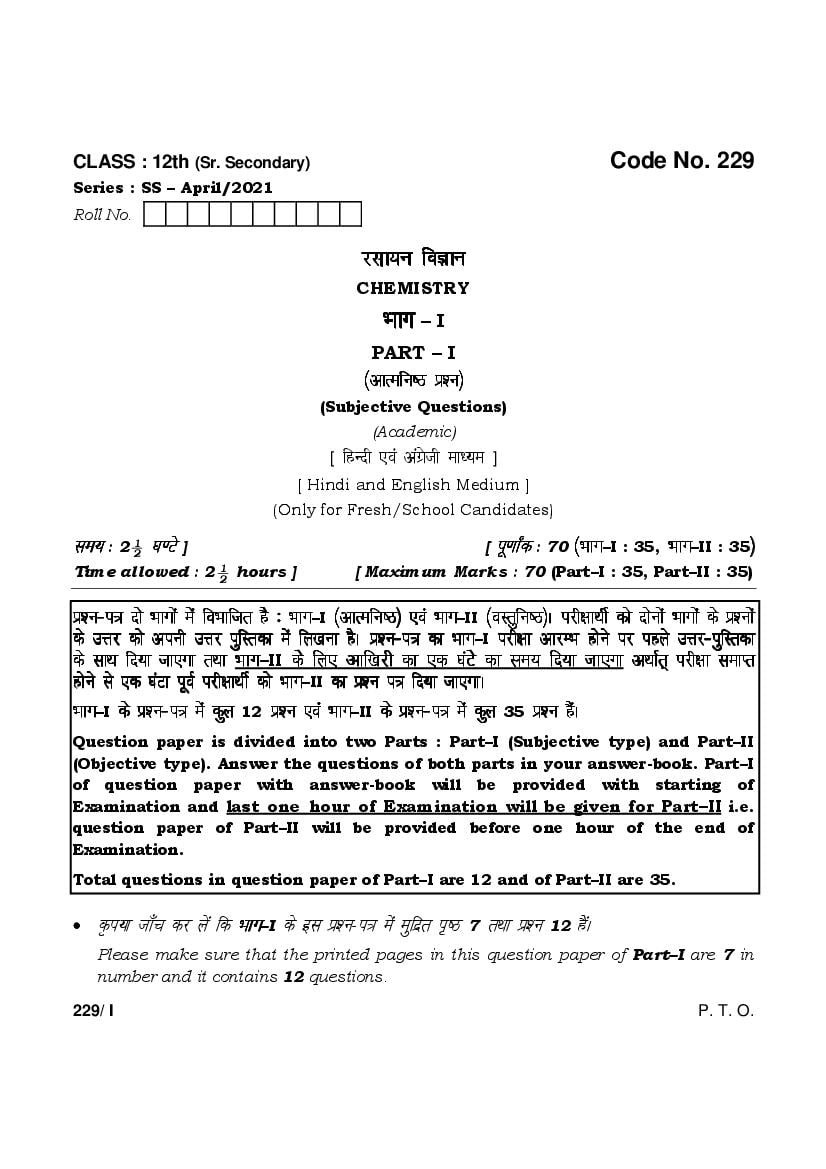
Series : SS – April/2021
Roll No.
jlk;u foKku
CHEMISTRY
Hkkx – I
PART – I
¼vkRefu"B iz'u½
(Subjective Questions)
(Academic)
[ fgUnh ,oa vaxzsth ek/;e ]
[ Hindi and English Medium ]
(Only for Fresh/School Candidates)
le; : 2 21 ?k.Vs ] [ iw.kk±d : 70 ¼Hkkx–I : 35, Hkkx–II : 35½
Time allowed : 2 21 hours ] [ Maximum Marks : 70 (Part–I : 35, Part–II : 35)
iz'u&i= nks Hkkxkas eas foHkkftr gS % Hkkx–I ¼vkRefu"B½ ,oa Hkkx
Hkkx–II ¼oLrqfu"B½A ijh{kkFkhZ dks nksuksa Hkkxkas ds iz'ukas
ds mÙkj dks viuh mÙkj iqfLrdk eas fy[kuk gSA iz'u&i= dk Hkkx–I ijh{kk vkjEHk gksus ij igys mÙkj&iqfLrdk
ds lkFk fn;k tk,xk rFkk Hkkx–II ds fy, vkf[kjh dk ,d ?kaVs dk le; fn;k tk,xk vFkkZr~ ijh{kk lekIr
gksus ls ,d ?kaVk iwoZ ijh{kkFkhZ dks Hkkx–II dk iz'u i= fn;k tk,xkA
Hkkx–I ds iz'u&i= esa dqy 12 iz'u ,oa Hkkx–II ds iz'u&i= eas dqy 35 iz'u gSaA
Question paper is divided into two Parts : Part–I (Subjective type) and Part–II
(Objective type). Answer the questions of both parts in your answer-book. Part–I
of question paper with answer-book will be provided with starting of
Examination and last one hour of Examination will be given for Part–II i.e.
question paper of Part–II will be provided before one hour of the end of
Examination.
Total questions in question paper of Part–I are 12 and of Part–II are 35.
• Ñi;k tk¡p dj ysa fd Hkkx–I ds bl iz'u-i= esa eqfnzr i`"B 7 rFkk iz'u 12 gSaA
Please make sure that the printed pages in this question paper of Part–I are 7 in
number and it contains 12 questions.
229/ I P. T. O.
Page 2
• iz'u-i= esa nkfgus gkFk dh vksj fn;s x;s dksM uEcj dks Nk= mÙkj-iqfLrdk ds eq[;-i`"B ij fy[ksaA
The Code No. on the right side of the question paper should be written by the
candidate on the front page of the answer-book.
• Ñi;k iz'u dk mÙkj fy[kuk 'kq: djus ls igys] iz'u dk Øekad vo'; fy[ksaA
Before beginning to answer a question, its Serial Number must be written.
• mÙkj-iqfLrdk ds chp esa [kkyh iUuk / iUus u NksMsa+A
Don’t leave blank page/pages in your answer-book.
• mÙkj-iqfLrdk ds vfrfjDr dksbZ vU; 'khV ugha feysxhA vr% vko';drkuqlkj gh fy[ksa vkSj fy[kk mÙkj u
dkVsaA
Except answer-book, no extra sheet will be given. Write to the point and do not
strike the written answer.
• ijh{kkFkhZ viuk jksy ua0 iz'u&i= ij vo'; fy[ksaA
Candidates must write their Roll Number on the question paper.
• d`i;k iz'uksa dk mÙkj nsus lss iwoZ ;g lqfuf'pr dj ysa fd iz'u-i= iw.kZ o lgh gS] ijh{kk ds mijkUr bl
lEcU/k esa dksbZ Hkh nkok Lohdkj ugha fd;k tk;sxkA
Before answering the question, ensure that you have been supplied the correct and
complete question paper, no claim in this regard, will be entertained after
examination.
lkekU; funsZ'k %
General Instructions :
(i) lHkh iz'u vfuok;Z gSaA
All questions are compulsory.
229/ I
Page 3
(ii) izR;sd iz'u ds vad mlds lkeus n'kkZ;s x, gSaA
Marks of each question are indicated against it.
(iii) vkids mÙkj vadkuqlkj gksus pkfg,A
Your answer should be according to marks.
[ vfr y?kq mÙkjh; iz'u ]
[Very Short Answer Type Questions ]
1. ,d ;kSfxd nks rÙoksa M vkSj N ls cuk gSA rRo N, CCP lajpuk cukrk gS vkSj M ds ijek.kq
prq"Qydh; fjfDr;ksa ds 1 Hkkx dks v/;kflr djrs gSA ;kSfxd dk lw= D;k gS \ 2
3
A compound is formed by two elements M and N. The element N forms CCP
1
and atoms of M occupy of tetrahedral voids. What is the formula of
3
compound ?
2. iz;ksx'kkyk dk;Z ds fy, iz;ksx esa yk;s tkus okys lkanz HNO 3 nzO;eku dh n`f"V ls HNO 3 dk 68%
tyh; foy;u gSa ;fn bl foy;u dk ?kuRo 1.504 gm L−1 gks] rks vEy ds bl uewus dh eksyjrk
D;k gksxh \ 2
Concentrated HNO 3 used in laboratory work is 68% HNO 3 by mass in aqueous
solution. What should be the molarity of such a sample of acid if density of
solution is 1.504 gm L−1 ?
3. 114g vkWDVsu esa fdlh vok"i'khy foys; (eksyj nzO;eku 40 g mol −1 ) dh fdruh ek=k ?kksyh tk, fd
vkWDVsu dk ok"i nkc ?kV dj ewy dk 80% jg tk,A 2
Calculate the mass of a non-volatile (Molar-mass 40 g mol −1 ) which should be
dissolved in 114 g octane to reduce its vapour pressure to 80%.
229/ I P. T. O.
Page 4
4. izFke dksfV dh vfHkfØ;kvksa ds osx fLFkjkad 500 sec−1 ls v/kkZ;q dh x.kuk dhft,A 2
Calculate the half life of a first order reaction from rate constant 500 sec −1 .
5. gkWQeku czksekekbM fuEuhdj.k vfHkfØ;k D;k gS \ 2
What is Hoffmann bromamide degradation reaction ?
[ y?kq mÙkjh; iz'u ]
[ Short Answer Type Questions ]
6. CuSO 4 ds foy;u dks 1.5 ,sfEi;j dh /kkjk ls 10 feuV rd oS|qr vi?kfVr fd;k x;kA dSFkksM ij
fu{ksfir dkWij dk nzO;eku D;k gksxk \ ( Cu 63.5 ) 3
A solution of CuSO 4 is electrolysed for 10 minutes with a current of 1.5
amperes. What is mass of copper deposited at Cathode ? ( Cu 63.5 )
7. cgqv.kqd ,oa o`gnk.kqd dksykWbM esa D;k vUrj gS \ izR;sd dk ,d-,d mnkgj.k nhft,A 3
What is difference between multimolecular and macromolecular colloids ? Give
one example of each.
8. dkj.k nsrs gq, Li"V dhft, laØe.k /kkrq,a rFkk buds vusd ;kSfxd mÙke mRizsjd dk dk;Z djrs gSA 3
Explain giving reasons transition metals and their many compounds act as
good catalyst.
229/ I
Page 5
9. D;k gksrk gS] tc % 3
(A) ,fFky DyksjkbM dh vfHkfØ;k tyh; KOH ls gksrh gS \
(B) 'kq"d bZFkj dh mifLFkfr esa esfFky czksekbM dh vfHkfØ;k lksfM;e ls gksrh gS \
(C) esfFky DyksjkbM dh vfHkfØ;k KCN ls gksrh gS \
What happens, when :
(A) Ethyl Chloride is treated with aqueous KOH
(B) Methyl bromide is treated with Na in presence of dry ether.
(C) Methyl Chloride is treated with KCN.
10. ,Fkhu ds ty;kstu ls ,FksukWy izkIr djus dh fØ;kfof/k fyf[k,A 3
Write the Mechanism of hydration of ethene to yield ethanol.
[ nh?kZ mÙkjh; iz'u ]
[ Long Answer Type Questions ]
11. (i) H 2S ] H 2Te dh vis{kk de vEyh; D;ksa gS \ 1
H 2S is less acidic than H 2Te . Why ?
(ii) veksfu;k dh yfC/k dks c<+kus ds fy, vko';d fLFkfr;ksa dk o.kZu dhft,A 2
Mention the conditions required to Maximise the yield of ammonia.
229/ I P. T. O.
Page 6
(iii) vkWDlhtu ds vlkekU; O;ogkj dh O;k[;k dhft,A 2
Describe anomalous behaviour of Oxygen.
vFkok
OR
(i) lYQj dk dkSu-lk :i vuqpqacdh; O;ogkj iznf'kZr djrk gS \ 2
Which form of sulphur shows paramagnetic behaviour ?
(ii) fuEufyf[kr lehdj.kksa dks iwjk dhft, % 3
Complete the following equations :
(a) Cu + 4HNO 3 →
(Conc.)
(b) 2NaOH + SO 2 →
(c) NH 3 + 3Cl 2 (excess) →
12. (i) 4-vkWDlksisUVsuSy dh lajpuk cukb;saA 1
Draw structure of 4-Oxopentanal.
(ii) gsyQksykMZ tsfyaLdh vfHkfØ;k dh O;k[;k dhft,A 2
Describe Hell-Volhard-Zelinsky reaction.
(iii) ,sYMksy la?kuu vfHkfØ;k dk o.kZu dhft,A 2
Describe Aldol condensation reaction.
229/ I
Page 7
vFkok
OR
(i) csUthu dks ,slhVksQhukWu esa ifjofrZr dhft,A 1
Convert Benzene to acetophenone.
(ii) izksisuksu dks izksihu esa ifjofrZr dhft,A 2
Convert Propanone to Propene
(iii) ,sFksukWy dks 3- gkbMªkWDlhC;wVsuSy esa ifjofrZr dhft,A 2
Convert Ethanol to 3-Hydroxybutanal.
S
229/ I P. T. O.
Page 8
Series : SS – April/2021
Roll No.
jlk;u foKku
CHEMISTRY
Hkkx – II
PART – II
¼oLrqfu"B iz'u½
(Objective Questions)
(Academic)
[ fgUnh ,oa vaxzsth ek/;e ]
[ Hindi and English Medium ]
(Only for Fresh/School Candidates)
• Ñi;k tk¡p dj ysa fd Hkkx–II ds bl iz'u-i= esa eqfnzr i`"B 8 rFkk iz'u 35 gSaA
Please make sure that the printed pages in this question paper of Part-II are 8 in
number and it contains 35 questions.
• ijh{kkFkhZ viuk jksy ua0 iz'u&i= ij vo'; fy[ksaA
Candidates must write their Roll Number on the question paper.
• d`i;k iz'uksa dk mÙkj nsus lss iwoZ ;g lqfuf'pr dj ysa fd iz'u-i= iw.kZ o lgh gS] ijh{kk ds mijkUr bl
lEcU/k esa dksbZ Hkh nkok Lohdkj ugha fd;k tk;sxkA
Before answering the question, ensure that you have been supplied the correct and
complete question paper, no claim in this regard, will be entertained after
examination.
lkekU; funsZ'k %
General Instructions :
(i) lHkh iz'u vfuok;Z gSaA
All questions are compulsory.
229/ II P. T. O.
Page 9
(ii) iz'u Øekad 1 ls 35 rd oLrqfu"B iz'u gSaA izR;sd iz'u 1 vad dk gSA
Questions from 1 to 35 are objective type questions. Each question is of
1 mark.
1. BCC O;oLFkk esa [kkyh txg fdrus izfr'kr gS \ 1
(A) 74% (B) 68%
(C) 32% (D) 26%
Percentage of empty space in a BCC arrangement is :
(A) 74% (B) 68%
(C) 32% (D) 26%
2. 'kq) ty dh eksyyrk gS % 1
(A) 20 (B) 18
(C) 10 (D) 55.5
The molality of pure water is :
(A) 20 (B) 18
(C) 10 (D) 55.5
3. Cu /Cu 2 + // Ag + / Ag lsy vfHkfØ;k ds fy, % 1
(A) dSFkksM ds :i esa Cu (B) dSFkksM ds :i esa Ag
(C) Ag ,d vkWDlhdj.k dkjd gS (D) mijksDr esa ls dksbZ ugha
For the given cell reaction : Cu /Cu 2 + // Ag + / Ag
(A) Cu as cathode (B) Ag as cathode
(C) Ag as oxidising agent (D) None of the above
229/ II
Page 10
4. fuEufyf[kr osx fLFkjkad ls vfHkfØ;k dh dksfV Kkr dhft, K = 2.6 ×10 −4 mol L−1S −1 1
(A) izFke (B) 'kwU;
(C) f}rh; (D) dksbZ Hkh ugha
Identify the order of reaction from given rate constant K = 2.6 × 10 −4 mol L−1S −1
(A) First (B) Zero
(C) Second (D) None of these
5. gkMhZ-'kqYts fu;e ds vuqlkj fuEu esa ls fdldh Å.kZu {kerk lokZf/kd gS \ 1
(A) Al 3 + (B) Ba 2 +
(C) Na + (D) K+
According to Hardy-Schulze rule, which of the following has highest
flocculating power ?
(A) Al 3 + (B) Ba 2 +
(C) Na + (D) K+
6. fuEufyf[kr ;kSfxdks esa lcls de DoFkukad fdldk gS \ 1
(A) H 2Se (B) H 2Te
(C) H 2O (D) H 2S
In the following compounds which has minimum boiling point ?
(A) H 2Se (B) H 2Te
(C) H 2O (D) H 2S
7. fuEu esa izcy vipk;d gS % 1
(A) PH 3 (B) BiH 3
(C) SbH 3 (D) AsH 3
In the following strongest reducing agent is :
(A) PH 3 (B) BiH 3
(C) SbH 3 (D) AsH 3
229/ II P. T. O.
Page 11
8. fuEufyf[kr vk;u esa dkSu-lk tyh; foy;u esa jaxghu gS \ 1
(A) Fe 2 + (B) Mn 2 +
(C) Ti 3 + (D) Sc 3 +
Which of the following ion is colourless in aqueous solution ?
(A) Fe 2 + (B) Mn 2 +
(C) Ti 3 + (D) Sc 3 +
9. fdl /kkrq dk ?kuRo lcls T;knk gksxk \ 1
(A) Pt (B) Os
(C) W (D) Hg
Which Metal has highest density ?
(A) Pt (B) Os
(C) W (D) Hg
10. ;kSfxd [Co(NH 3 )6 ]Cl 3 esa milgla;kstu D;k gksxh \ 1
(A) 3 (B) 4
(C) 6 (D) 2
What is the Co-ordination number in the [Co(NH 3 )6 ]Cl 3 Compound ?
(A) 3 (B) 4
(C) 6 (D) 2
11. [Cr (H 2O )6 ]Cl 3 esa Øksfe;e dh vkWDlhdj.k la[;k gS % 1
(A) +4 (B) +3
(C) –3 (D) +2
The Oxidation number of chromium in [Cr (H 2O )6 ]Cl 3 is :
(A) +4 (B) +3
(C) –3 (D) +2
229/ II
Page 12
12. dkcZfud ;kSfxd tks S N 2 fØ;k esa iw.kZ LVhfj;ksdsfedy bUolZu n'kkZrk gS % 1
(A) CH 3 − Cl (B) (CH 3 )2 CH − Cl
(C) (CH 3 )3 C − Cl (D) mijksDr esa ls dksbZ ugha
Organic compound which shows complete stereochemical inversion during
S N 2 reaction :
(A) CH 3 − Cl (B) (CH 3 )2 CH − Cl
(C) (CH 3 )3 C − Cl (D) None of the above
13. fuEufyf[kr esa dkSu vf/kd vEyh; gS \ 1
(A) csfUty ,sYdksgy (B) lkbDyksgsDlsukWy
(C) QhukWy (D) M-DyksjksQhukWy
Which of the following is most acidic ?
(A) Benzylalcohol (B) Cyclohexanol
(C) Phenol (D) M-Chlorophenol
14. fofy;Elu la'ys"k.k fuEufyf[kr esa fdldks cukus dh fof/k gS \ 1
(A) ,sYdksgkWy (B) ,sehu
(C) dhVksu (D) bZFkj
Williamson Synthesis is used to prepare :
(A) Alcohol (B) Amine
(C) Ketone (D) Ether
15. ,sflfVd vEy dk IUPAC uke gS % 1
(A) bFksuksbd vEy (B) feFksuy
(C) 2-isUVkuksu (D) feFksuksbd vEy
IUPAC name of Acetic acid :
(A) Ethanoic acid (B) Methanal
(C) 2-Pentanone (D) Methanoic acid
229/ II P. T. O.
Page 13
16. fuEufyf[kr esa 3o ,sehu dkSu-lh gS \ 1
(A) esfFky,sehu (B) Vªkb,fFky ,sehu
(C) ,fFky,sehu (D) t-C;wfVy,sehu
Which of the following is a 3 o -amine ?
(A) Methylamine (B) Triethyl amine
(C) Ethylamine (D) t-butylamine
17. fuEufyf[kr esa ls dkSu-lk {kkjd DNA esa gS vkSj RNA esa ugha \ 1
(A) Fkk;ehu (B) lkbVkslhu
(C) ;wjsfly (D) Xokuhu
Which base is present in DNA but not in RNA ?
(A) Thyamine (B) Cytosine
(C) Uracil (D) Guanine
18. fuEufyf[kr esa eksukslsdsjkbM 'kdZjk dkSu ugha gS \ 1
(A) Xyqdkst (B) ÝDVkst
(C) eSukst (D) ekYVkst
In the following which is not a Monosaccharide sugar ?
(A) Glucose (B) Fructose
(C) Mannose (D) Maltose
19. 'kkWV~dh nks"k D;k gS \ 1
What is Schottky defect ?
20. ,sYdksgkWy ,oa ty ds ,d foy;u esa vkf.od vU;ksU;fØ;k dh D;k Hkwfedk gS \ 1
What role does the Molecular interaction play in a solution of alcohol and
water ?
229/ II
Page 14
21. nqcZy oS|qr vi?kV~; D;k gS \ 1
What is a weak electrolyte ?
22. la?kV~V vko`fr dks ifjHkkf"kr dhft,A 1
Define collision frequency.
23. dksykWbMh lkWy esa ls fo|qr /kkjk izokfgr dh tkrh gS] rks D;k izs{k.k gksxk \ 1
What is observed when electric current passed through a colloidal sol.
24. fyxUM D;k gS \ 1
What are ligands ?
25. Mkb,stksdj.k vfHkfØ;k D;k gS \ 1
What is Diazotisation reaction ?
26. lwØksl ds ty vi?kVu ls fdu mRiknksa ds cuus dh vis{kk djrs gS \ 1
What are the expected products of hydrolysis of Sucrose ?
27. Bkslksa dk vk;ru ……………. rFkk vkÑfr ……………. gksrk gSA 1
Solids have ………………. volume and ……….. shape.
28. fdlh vfHkfØ;k ds osx fu;e O;atd esa iz;qDr lkanzrkvksa ds ?kkrkadksa dk ;ksx ……………. dgykrk gSA
1
The sum of the powers of the concentration of the reactants in rate law
called ………………
29. lkekU; :i ls vkarj laØe.k rRoksa dk bysDVªkfud foU;kl ……………. gSA 1
The general electronic configuration of inner transition elements is …………..
30. K 4 [Fe (CN )6 ] ladqy ;kSfxd esa ……………. vk;u iSnk gksrs gSA 1
……………. ions produced from complex compound K 4 [Fe (CN )6 ] ?
229/ II P. T. O.
Page 15
31. CH 3 Br + AgF → ..................... + AgBr 1
H 2 SO4
32. CH 3CH 2 OH → ....... 1
413K
33. CH 3CH (CH 3 )CH 2CH 2CHO ;kSfxd dk IUPAC uke ……………. gSA 1
………………. is the IUPAC name of the compound CH 3CH (CH 3 )CH 2CH 2CHO .
34. K 3 [Cr (C 2O 4 )3 ] ladqy ;kSfxd dk IUPAC uke ……………. gSA 1
……………… is the IUPAC name of the complex compound K 3 [Cr (C 2O 4 )3 ] .
35. foVkfeu ^Mh* dh deh ls gksus okyk jksx ……………. gSA 1
……………………. is the deficiency disease of Vitamin 'D'.
S
229/ II
Document Details
| Board / Org | Haryana Board |
| Exam | Class 12 |
| Type | Question Paper |
| Pages | 15 |
| Updated | 22 Jul 2026 |