CBSE Class 10 Learning Outcomes for Arts Syllabus 2021-22
Finished viewing? Save it for later —
Download CBSE Class 10 Learning Outcomes for Arts Syllabus 2021-22 (PDF · 5 pages)About CBSE Class 10 Learning Outcomes for Arts Syllabus 2021-22
CBSE Class 10 Learning Outcomes for Arts Syllabus 2021-22 is available here for free download. Published by CBSE for Class 10, this syllabus can be viewed online or downloaded as a PDF (5 pages). Candidates preparing for Class 10 can use CBSE Class 10 Learning Outcomes for Arts Syllabus 2021-22 to understand the exam pattern, the type of questions asked, and the overall difficulty level.
Frequently Asked Questions
How can I download CBSE Class 10 Learning Outcomes for Arts Syllabus 2021-22?
Open this page and click the Download button to save CBSE Class 10 Learning Outcomes for Arts Syllabus 2021-22 as a PDF. It is completely free on AglaSem Docs.
Is CBSE Class 10 Learning Outcomes for Arts Syllabus 2021-22 free to download?
Yes. CBSE Class 10 Learning Outcomes for Arts Syllabus 2021-22 can be viewed online and downloaded as a PDF free of cost on AglaSem Docs.
How many pages does CBSE Class 10 Learning Outcomes for Arts Syllabus 2021-22 have?
CBSE Class 10 Learning Outcomes for Arts Syllabus 2021-22 contains 5 pages, which you can read online or download together as a single PDF.
Where can I find more Class 10 study material?
You can find more Class 10 question papers, sample papers, syllabus, and answer keys on AglaSem Docs.
CBSE Class 10 Learning Outcomes for Arts Syllabus 2021-22 – Text
Read the full text of this syllabus below — useful to quickly search, copy and reference the content online without downloading the PDF.
📄 View text version (5 pages)
Page 1
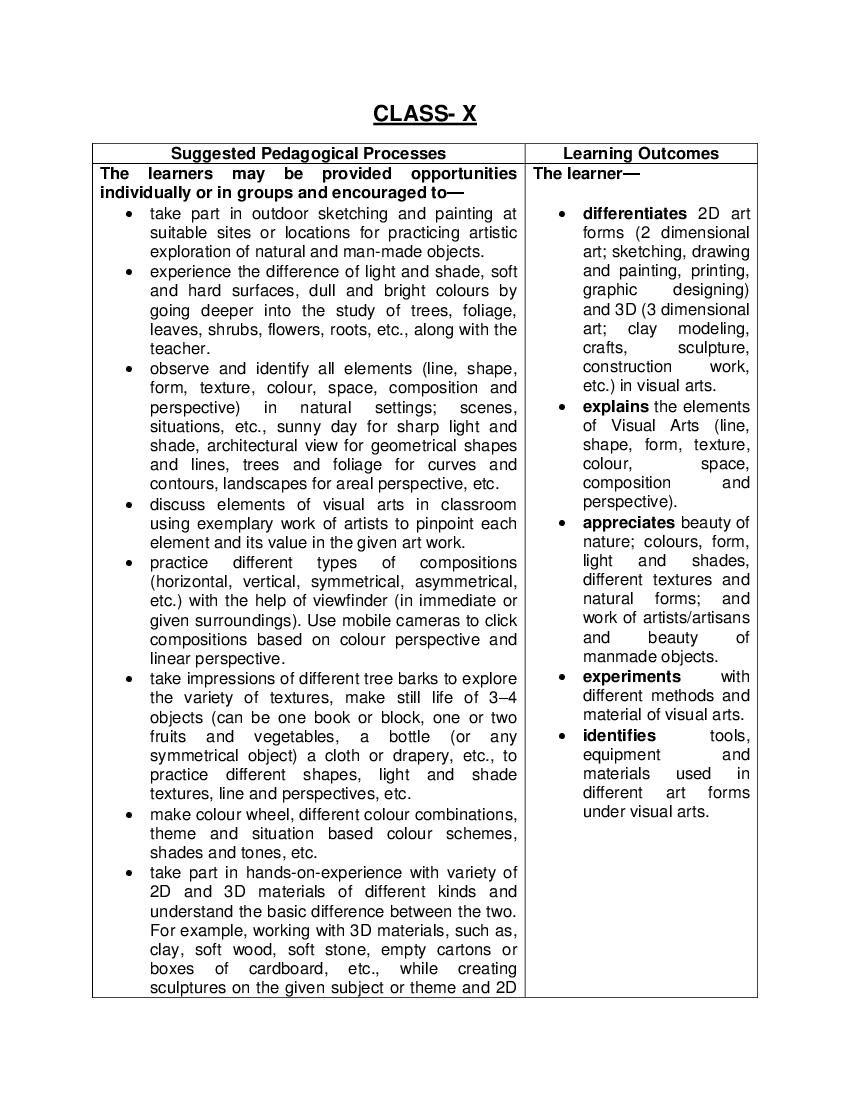
Suggested Pedagogical Processes Learning Outcomes
The learners may be provided opportunities The learner—
individually or in groups and encouraged to—
take part in outdoor sketching and painting at differentiates 2D art
suitable sites or locations for practicing artistic forms (2 dimensional
exploration of natural and man-made objects. art; sketching, drawing
experience the difference of light and shade, soft and painting, printing,
and hard surfaces, dull and bright colours by graphic designing)
going deeper into the study of trees, foliage, and 3D (3 dimensional
leaves, shrubs, flowers, roots, etc., along with the art; clay modeling,
teacher. crafts, sculpture,
observe and identify all elements (line, shape, construction work,
form, texture, colour, space, composition and etc.) in visual arts.
perspective) in natural settings; scenes, explains the elements
situations, etc., sunny day for sharp light and of Visual Arts (line,
shade, architectural view for geometrical shapes shape, form, texture,
and lines, trees and foliage for curves and colour, space,
contours, landscapes for areal perspective, etc. composition and
discuss elements of visual arts in classroom perspective).
using exemplary work of artists to pinpoint each appreciates beauty of
element and its value in the given art work. nature; colours, form,
practice different types of compositions light and shades,
(horizontal, vertical, symmetrical, asymmetrical, different textures and
etc.) with the help of viewfinder (in immediate or natural forms; and
given surroundings). Use mobile cameras to click work of artists/artisans
compositions based on colour perspective and and beauty of
linear perspective. manmade objects.
take impressions of different tree barks to explore experiments with
the variety of textures, make still life of 3–4 different methods and
objects (can be one book or block, one or two material of visual arts.
fruits and vegetables, a bottle (or any identifies tools,
symmetrical object) a cloth or drapery, etc., to equipment and
practice different shapes, light and shade materials used in
textures, line and perspectives, etc. different art forms
make colour wheel, different colour combinations, under visual arts.
theme and situation based colour schemes,
shades and tones, etc.
take part in hands-on-experience with variety of
2D and 3D materials of different kinds and
understand the basic difference between the two.
For example, working with 3D materials, such as,
clay, soft wood, soft stone, empty cartons or
boxes of cardboard, etc., while creating
sculptures on the given subject or theme and 2D
Page 2
water or poster colours, etc., and with non-
conventional lowcost regional materials of
painting and sculpture.
take part in classroom viewing of video clips,
slide shows on different methods and materials in
visual arts, like, drawing, painting, pencil and
charcoal sketching, oil-pastel and coloured chalk
drawing, block printing, print making, wall painting
and mural making, making of comic strips, clay
modeling, terracotta and pottery. Sculpture
making with soft wood, plaster of paris and soft
stone, construction of 3D forms with mixed
medium, designing of new utility products as
crafts, etc.
discuss the 2D and 3D work done by different
artists with clear mention of their characteristics
and reasons behind grouping them in the specific
category. Create figurative compositions with 2D
and 3D methods and material.
discuss various social themes and issues and
take part in painting composition on the social
theme of their choice and create awareness
about them.
experience that all 3D work of art can be felt and
understood with closed eyes, while working,
experimenting with sculpture, clay modeling,
terracotta, pottery, relief work, etc. Relate that
Braille also works on the same principle and that
visually impaired learners can enjoy and
understand the 3D work of art and can also
create and express through 3D art materials.
make catalogue(s) on tools, equipment and
materials of any one art form in groups. Different
teams can be given different tasks for better
results. Explore all possibilities (books, Internet,
art teachers, artists, experts, etc.) to find out
traditional as well as modern tools, equipment
and materials for the selected art form(s).
view exemplary art work (from art exhibitions or
from selected pictures) followed by classroom
discussions (facilitated by the teacher).
Classroom viewing of selected digital images of
known artists to experience their aesthetics value
and use of techniques.
meet and interact with visual artists and artisans
Page 3
their styles, and what motivated them to continue
with their practice, etc., and do art stories in
team.
make and present short report (audio video,
and/or written form) of visit(s) event(s),
exhibition(s), etc., in small teams of 2–3 students.
Make scrap book(s) on different art forms with
mention of art work of great artists in the relevant
field. Classroom sharing through presentation, recognises the
(use of mobile, camera and ICT can be promoted contemporary,
for such activities). Share reports and art stories traditional, folk and
in print media as well as on social media regional styles in
platforms for wider publicity and promotion of arts visual art forms.
and artists. appreciates different
visit different places of artistic and historical art forms; painting,
importance (museums, galleries, art-studios, sculpture, prints,
heritage sites, monuments, melas or fairs, photographs,
exhibitions; observe festivals, ceremonies and graphics, crafts, etc.
celebrations, Haat and Bazar, etc.) for gaining reflects on work of
firsthand experience of places, situations, people artists and artisans
and cultural heritage for visual richness and critically.
originality in their artistic expression. Make
classroom narration and presentation and to
share presentation(s) on social media after
discussing with teacher(s)
discuss and find out the salient features of explains the beauty
traditional, contemporary and folk paintings. of man-made designs
make paintings while practicing traditional style of objects.
(for example; Rajasthani miniature, Pahari documents visit(s) to
miniature, Mughal miniature) and folk styles of the museums, artist
painting (for example; Madhubani, Gond, Warli, studios, and galleries,
etc.) on contemporary topics. interactions with the
use ICT in planning, production and publicity of artists and artisans
art work; find avenues to promote their art work and their live
through print media (poster wall magazine school performances and
bulletin and school magazine), and through social exhibitions, fairs and
media platforms, like art blogs, etc. festivals.
express and showcase their artistic talent on appreciates and
different platforms, such as, in Kala Utsav of applies painting skills
Ministry of Human Resource Development, and styles of
painting competitions organised by the Ministry of traditional and folk
Power and by many other departments and painters to create new
Ministries, in competitions organised by known paintings.
organisations like, Shankar’s International
Children’s Competition and others can encourage
Page 4
deeper in to the subject.
give observations on their own work of art and
those done by their peers as a periodic exercise
of self and peer evaluation of art activities.
paint, sculpt and construct freely using different
mediums and maintain a folder or portfolio of the
work done.
put up an art display or/and exhibition (at least
once a year) at school level with a specific theme,
where students are given responsibility to
organise display, installations, organise
resources (in consultation with teachers), prepare
catalogues, make posters to advertise the event,
invitation card for the parents, community and
officials, curate the show and make a report (print
and video) of the event while recording
expression of students, staff and community on uses creative skills
the show. while planning an art
take part in art events, exhibitions and activity, identifying
competitions (inter-school at different levels) to resources and
share their expressions and view points with composing art
larger community, to understand multiple expressions.
viewpoints on the same subject or theme, creates art work and
experience work of other students and enhance communicates
their general sense of art appreciation. emotions skillfully and
display on classroom boards and on school artistically through
boards by rotation, plan beautification of the selected medium of
school campus, paint school wall(s) with different art.
themes, make placards, posters and banners for applies artistic and
school campaigns, awareness campaigns, etc. aesthetic sensibility in
practice and showcase artistic skills in daily day-to-day life
activities of classroom organisation, change in
seating arrangement, in storing materials, tools
and equipment, maintain artefacts and keep the
surroundings clean and beautiful.
clean and maintain tools, equipment, and
materials used during the art activities, pick up
the skill of preserving art products created by
them.
organise artistic display of art work in classroom,
on display boards on regular intervals to practice
the skill of presenting art works.
make their own colours, brushes and handmade
papers, experiments with non-traditional
materials for their projects and activities in team
Page 5
products created in the process.
practice desired values with interest and
understanding during classroom activities,
appreciate and cooperate peers in practicing
values, display team spirit as team leaders and
followers, and respect for sharing tools and
materials.
draw and paint nature with understanding of its
value for life on earth and spread awareness
through art. Share concern through posters,
slogans, picture captions, etc. Take part in
planning art campaigns for observing safe
environmental practices and conservation of displays concern for
natural resources in daily life and make safe use and
presentation(s). maintenance of tools
do art project(s) on animals and birds to create and equipment.
awareness about their importance for the maintains art
ecological harmony, to explore beauty of birds materials, art works
and animals by making posters, cards, masks and artefacts with
and painting. Make designs for t-shirts, badges, sensitivity.
etc., with interesting information on birds and
animals.
read and narrate stories from the lives of great
artists and their respect for art and human values. demonstrates
promote values by appreciating and different values, such
acknowledging positive behaviour of peers with as, cooperation, team
the help of teachers for reinforcing regular work, caring and
practice and use of life-skills and values sharing, discipline,
intentionally. compassion for nature
get acquainted with the diversity of Indian culture, and animals, respect
its beauty with clear artistic examples of art for others, and
elements used in them, classroom discussions on appreciation for
heritage arts and crafts through slideshows or cultural diversity and
through actual art work for explaining their cultural heritage.
relationship with Indian ecosystem.
Document Details
| Board / Org | CBSE |
| Exam | Class 10 |
| Type | Syllabus |
| Pages | 5 |
| Updated | 22 Jul 2026 |