CUSAT CAT 2023 Question Paper Zoology
Finished viewing? Save it for later —
Download CUSAT CAT 2023 Question Paper Zoology (PDF · 27 pages)About CUSAT CAT 2023 Question Paper Zoology
CUSAT CAT 2023 Question Paper Zoology is available here for free download. Published by Cochin University for CUSAT Common Admission Test, this question paper can be viewed online or downloaded as a PDF (27 pages). Candidates preparing for CUSAT Common Admission Test can use CUSAT CAT 2023 Question Paper Zoology to understand the exam pattern, the type of questions asked, and the overall difficulty level.
Frequently Asked Questions
How can I download CUSAT CAT 2023 Question Paper Zoology?
Open this page and click the Download button to save CUSAT CAT 2023 Question Paper Zoology as a PDF. It is completely free on AglaSem Docs.
Is CUSAT CAT 2023 Question Paper Zoology free to download?
Yes. CUSAT CAT 2023 Question Paper Zoology can be viewed online and downloaded as a PDF free of cost on AglaSem Docs.
How many pages does CUSAT CAT 2023 Question Paper Zoology have?
CUSAT CAT 2023 Question Paper Zoology contains 27 pages, which you can read online or download together as a single PDF.
Where can I find more CUSAT Common Admission Test study material?
You can find more CUSAT Common Admission Test question papers, sample papers, syllabus, and answer keys on AglaSem Docs.
CUSAT CAT 2023 Question Paper Zoology – Text
Read the full text of this question paper below — useful to quickly search, copy and reference the content online without downloading the PDF.
📄 View text version (27 pages)
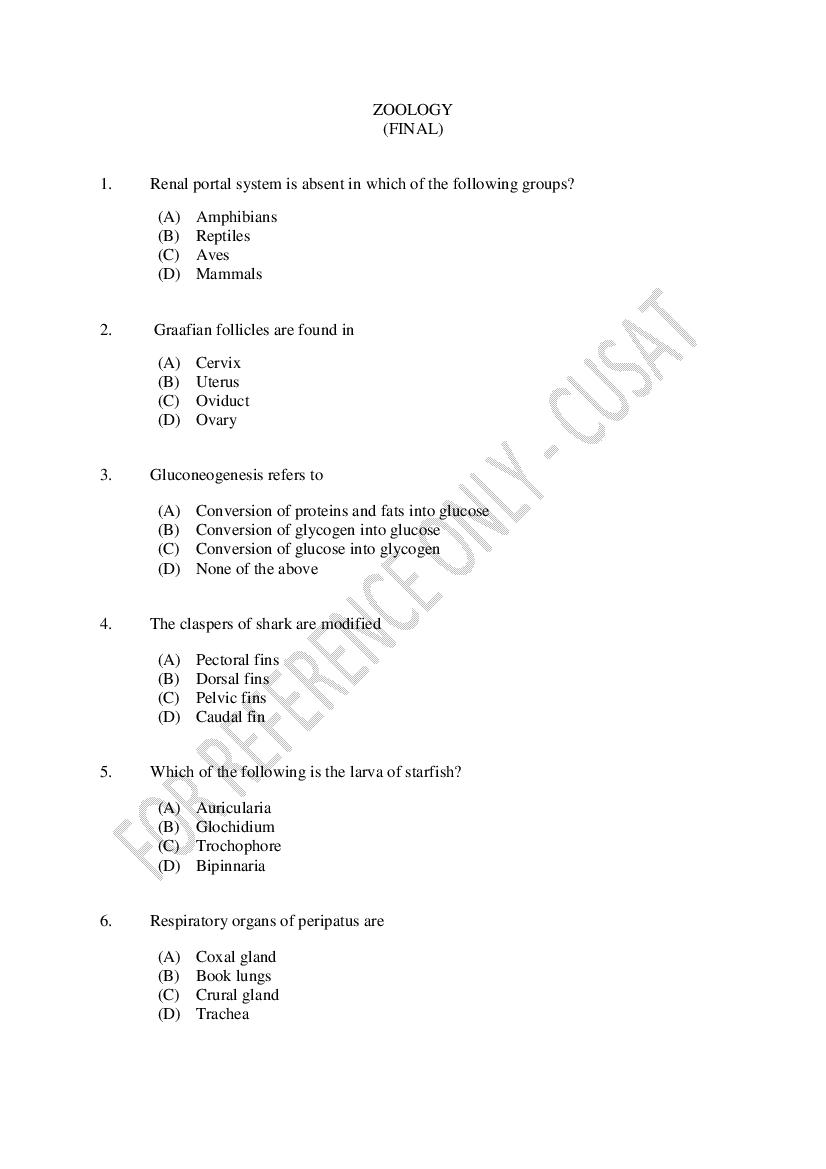
Page 1
(FINAL)
1. Renal portal system is absent in which of the following groups?
(A) Amphibians
(B) Reptiles
(C) Aves
(D) Mammals
2. Graafian follicles are found in
(A) Cervix
(B) Uterus
(C) Oviduct
(D) Ovary
3. Gluconeogenesis refers to
(A) Conversion of proteins and fats into glucose
(B) Conversion of glycogen into glucose
(C) Conversion of glucose into glycogen
(D) None of the above
4. The claspers of shark are modified
(A) Pectoral fins
(B) Dorsal fins
(C) Pelvic fins
(D) Caudal fin
5. Which of the following is the larva of starfish?
(A) Auricularia
(B) Glochidium
(C) Trochophore
(D) Bipinnaria
6. Respiratory organs of peripatus are
(A) Coxal gland
(B) Book lungs
(C) Crural gland
(D) Trachea
Page 2
(A) Pancreas
(B) Gastric glands
(C) Intestinal glands
(D) Salivary glands
8. Initiation codons for protein synthesis are
(A) UUU and GGG
(B) AUG and GUA
(C) AAU and UAA
(D) GUG and AUG
9. In eukaryotes, a DNA sequence for a functional gene is called
(A) Exon
(B) Muton
(C) Intron
(D) Cistron
10. Hemophilia and Colour blindness are
(A) Sex-linked dominant traits
(B) Sex-linked recessive traits
(C) Autosomal dominant traits
(D) Sex-limited traits
11. During cell division, nuclear membrane is formed by
(A) Endoplasmic reticulum
(B) Plasma membrane
(C) Nucleolus
(D) Ribosome
12. The type of chromosome in which centromere is located at the tip is called
(A) Telocentric
(B) Sub-metacentric
(C) Acrocentric
(D) Metacentric
Page 3
(A) National Ethological and Ecological Research Institute
(B) National Eugenics and Ecological Research Institute
(C) National Environmental and Engineering Research Institute
(D) National Ethological and Environment Research Institute
14. Synecology deals with
(A) Ecology of species
(B) Ecology of Communities
(C) Ecology of populations
(D) None of the above
15. Name the proteins present in silk
(A) Actin and Myosin
(B) Fibrin and Fibrinogen
(C) Fibroin and Sericin
(D) None of the above
16. Which type of canal system is found in Leucosolenia?
(A) Ascon
(B) Leucon
(C) Rhagon
(D) Syconoid
17. The term “shell-fish” includes
(A) Prawns and lobsters
(B) Crabs and oysters
(C) Clams and mussels
(D) All of the above
18. The sequence of origin of life is
(A) Amino acids-proteins-chlorophyll
(B) Chlorophyll-Starch-Glycogen
(C) Nucleic acid-amino acids-chlorophyll
(D) Chlorophyll-Nucleic acid-amino acid
Page 4
(A) Adrenal medulla
(B) Thyroid
(C) Adrenal cortex
(D) Ovary
20. Which of the following is not a catfish?
(A) Clarius batrachus
(B) Channa stratus
(C) Wallago attu
(D) Labeo rohita
21. Respiratory acidosis results from
(A) Low levels of CO2 in the blood
(B) High levels of CO2 in the blood
(C) High levels of lactate in the blood
(D) Low levels of lactate in the blood
22. Which of the following processes is active in fasting state?
(A) Gluconeogenesis
(B) Lipogenesis
(C) Glycogenesis
(D) Ketogenesis
23. Major aerosol pollutant generated by refrigerators is
(A) SO2
(B) CH4
(C) CCl4
(D) CFCs
24. Which of the following is an example of ex-situ conservation?
(A) Wild life sanctuaries
(B) Sacred grooves
(C) Seed bank
(D) National park
Page 5
(A) Flying dinosaur
(B) Armoured dinosaur
(C) Horned Dinosaur
(D) Apatosaurus
26. Which of the following is a limbless amphibian?
(A) Ichthyophis
(B) Proteus
(C) Salamander
(D) Ambystoma
27. Jacobson’s organ is concerned with
(A) Smell
(B) Touch
(C) Hearing
(D) Sight
28. Which of the following is a fungal disease of silkworm?
(A) Flacherie
(B) Muscardine
(C) Grasserie
(D) Pebrine
29. How many cervical vertebrae are present in mammals?
(A) 16
(B) 10
(C) 12
(D) 7
30. Which of the following is a homeothermic animal?
(A) Fish
(B) Frog
(C) Lizard
(D) None of the above
Page 6
(A) Transcriptase
(B) Restriction Endonuclease
(C) Reverse transcriptase
(D) Transferase
32. Which of the following is a freshwater form?
(A) Mytilus
(B) Sepia
(C) Unio
(D) Loligo
33. DNA finger-printing was developed by
(A) Fredrick Sanger
(B) James D. Watson
(C) Alec J. Jaffery
(D) Thomas H. Morgan
34. Acromegaly is caused by
(A) Excess of somatotrophic hormone
(B) Deficiency of thyroxin
(C) Excess of corticotrophin
(D) Excess of adrenaline
35. In pancreas, the cells that secrete digestive enzymes are arranged in clusters called
(A) Islets
(B) Crypts
(C) Acini
(D) Delta cells
36. Which of the following is a true coelomate?
(A) Roundworm
(B) Tapeworm
(C) Hookworm
(D) Earthworm
Page 7
(A) Petromyzon
(B) Balanoglossus
(C) Branchiostoma
(D) Hippocampus
38. The color of oxygenated haemocyanin, a respiratory pigment in mollusks, is
(A) Red
(B) Green
(C) Blue
(D) Colorless
39. Which one of the following is not a mammalian character in Platypus?
(A) Presence of mammary glands
(B) Presence of cloaca
(C) Presence of sebaceous glands
(D) Presence of hair
40. Podocyte cells are found in
(A) Ducts of Bellini
(B) Glomeruli
(C) Bowman’s Capsule
(D) Distal convoluted tubule
41. Amphioxus (Branchiostomata) belongs to the group
(A) Hemichordate
(B) Cephalochordata
(C) Urochordata
(D) Vertebrata
42. The “Red Data Book” is published by
(A) Convension on International Trade in Endangered Species of Wild Fauna and
Flora
(B) International Union for Conservation of Nature and Natural Recourses
(C) National Wild Life Plan
(D) National Environmental Engineering Research Institute
Page 8
(A) Mineral salts
(B) Dissolved Hydrogen
(C) Dissolved Oxygen
(D) Dissolved Nitrates
44. The tendency of two genes remaining together on a chromosome during crossing over
is known as
(A) Gene mapping
(B) Recombination
(C) Linkage
(D) Genotype
45. Alzheimer’s disease in humans is associated with the deficiency of
(A) Acetylcholine
(B) GABA
(C) Glutamic acid
(D) Dopamine
46. The fins in Ichthyosaurus and dolphin represent
(A) Convergent evolution
(B) Microevolution
(C) Divergent evolution
(D) Co-evolution
47. Transition zone between two ecosystems is
(A) Ecotype
(B) Niche
(C) Ecotone
(D) Biome
48. Muga silk is produced by
(A) Bombyx mori
(B) Antheraea mylitta
(C) Antheraea assamensis
(D) Antheraea pernyi
Page 9
(A) Deletion
(B) Translocation
(C) Duplication
(D) Inversion
50. Migration of fish from sea to freshwater for spawning is known as
(A) Anadromous migration
(B) Catadromous migration
(C) Omnidromous migration
(D) Amphidromous migration
51. Suicide bags of the eukaryotic cells are
(A) Golgi bodies
(B) Endoplasmic reticulum
(C) Mitochondria
(D) Lysosomes
52. Aurelia belongs to the class
(A) Scyphozoa
(B) Anthozoa
(C) Hydrozoa
(D) Sporozoan
53. The venom glands of a snake are modified
(A) Buccal glands
(B) Parotid glands
(C) Palatine glands
(D) Lacrimal glands
54. Which of the following glands is related with immunity?
(A) Pineal
(B) Adrenal
(C) Thyroid
(D) Thymus
Page 10
(A) Nereis
(B) Aphrodita
(C) Polynoe
(D) Terebella
56. The theory of inheritance of acquired characters was proposed by
(A) Darwin
(B) Lamarck
(C) De Vries
(D) Weismann
57. Which of the following is commonly known as ‘Portuguese man of war’?
(A) Obelia
(B) Hydra
(C) Aurelia
(D) Physalia
58. In molluscs, the radula is related to the
(A) Digestive system
(B) Respiratory system
(C) Excretory system
(D) Reproductive system
59. The father of white revolution in India is
(A) Salim Ali
(B) Birbal Sahani
(C) Varghese Kurien
(D) Sunderlal Hora
60. PCR – Polymerase chain reaction – is useful in
(A) Cutting a specific segment of DNA
(B) Amplifying a specific segment of DNA
(C) Splicing a specific segment of DNA
(D) All of the above
Page 11
(A) Sickle cell anaemia
(B) Bleeder’s disease
(C) Proton defect
(D) Haemolytic disease of the new-born
62. Scientific name of our National bird is
(A) Pavo cristatus
(B) Columba livia
(C) Gallus gallus
(D) Corvus spledens
63. The process of digestion proceeds in the order
(A) Digestion → Ingestion → Solution → Absorption → Egestion
(B) Ingestion → Digestion → Absorption → Assimilation → Egestion
(C) Ingestion → Solution→ Absorption → Accumulation → Egestion
(D) Ingestion → Digestion → Absorption → Solution → Egestion
64. Which of the following is a living fossil?
(A) Euglena
(B) Sycon
(C) Limulus
(D) Balanoglossus
65. In birds, the flight muscles are attached to the
(A) Synsacrum
(B) Pygostyle
(C) Sternum
(D) Thoracic mass
66. Both Polyp and medusa are found in
(A) Hydrozoans
(B) Schyphozoans
(C) Anthozoans
(D) All coelenterates
Page 12
(A) Analogous organs
(B) Homologous organs
(C) Vestigial organs
(D) Divergent evolution
68. Which of the following organs synthesizes urea?
(A) Duodenum
(B) Kidney
(C) Liver
(D) Pancreas
69. Gills are covered by operculum in
(A) Cartilaginous fishes only
(B) Bony fishes only
(C) Both Cartilaginous fishes and bony fishes
(D) Fishes and aquatic reptiles
70. Which of the following statements is correct about frog?
(A) Adults are ammonotelic and larvae are ureotelic
(B) Larvae are ammonotelic and adults are ureotelic
(C) Both adult and larva are ammonotelic
(D) Both adult and larva are ureotelic
71. The number and sequence of amino acids in a protein molecule are determined by the
(A) DNA molecule
(B) mRNA molecule
(C) Enzymes involved in the process of translation
(D) rRNA molecule
72. ABO – blood grouping in man is controlled by
(A) Multiple alleles
(B) Multiple genes
(C) Sex – linked genes
(D) Y- linked genes
Page 13
(A) Glycosidic bond
(B) Ester bond
(C) Hydrogen bond
(D) Phosphodiester bond
74. Acrosome is derived from the
(A) Mitochondria
(B) Golgi apparatus
(C) Ribosomes
(D) Lysosomes
75. Calcium levels decrease in blood due to hyposecretion of
(A) Parathyroid hormone
(B) Calcitonin
(C) Thyroxine
(D) Adrenaline
76. Pyridoxal phosphate serves as transient carriers of
(A) Electrons
(B) Acyl groups
(C) Hydrides
(D) Amino groups
77. Glycolytic pathway occurs in
(A) Chloroplast
(B) Glyoxysomes
(C) Mitochondria
(D) Cytosol
78. Number of maximum possible isomers for fructose is
(A) 4
(B) 8
(C) 16
(D) 32
Page 14
called
(A) Necroptosis
(B) Anoikis
(C) Extravasation
(D) Metastasis
80. It is the only class of intercellular junctions in plants that directly connect the
cytoplasm of adjacent cells
(A) Connexin
(B) Plasmodesmata
(C) ICAM
(D) Selectin
81. Which anti-cancer drug interferes with breakdown of microtubules required for cell
division?
(A) Methotrexate
(B) Etoposide
(C) 5-fluorouracil
(D) Paclitaxel
82. If a Drosophila embryo doesn’t have head and thorax, it is due to the absence of the
gene
(A) Torso
(B) Vasa
(C) Oskar
(D) Bicoid
83. Cells that are able to self-renew by dividing and developing into the three primary
groups of cells that make up a human body
(A) Pluripotent
(B) Totipotent
(C) Determined
(D) Differentiated
Page 15
molecules to induce the dorsal organizer in early embryonic development?
(A) Brachet’s cleft
(B) Nieuwkoop center
(C) Spemann’s organizer
(D) Hensen’s node
85. Which of the following methods is involved in randomly breaking up the genome into
small DNA fragments that are sequenced individually?
(A) Shot gun sequencing
(B) Illumina sequencing
(C) 454 sequencing
(D) Sequencing of BAC libraries
86. Which type of immunological application is used for either monoclonal or polyclonal
antibodies?
(A) ELISA
(B) Bacterial agglutination
(C) Diagnostic tissue typing
(D) None of the above
87. RACE method is used for
(A) DNA-protein interaction
(B) FAM
(C) Determining the ends of mRNA
(D) Construction of synthetic DNA
88. Which one of the following techniques is used to study the RNA?
(A) Northern blotting
(B) In situ hybridization
(C) Southern blotting
(D) Western blotting
89. A researcher would like to purify specific cell populations based on phenotypes
detected by flow cytometry. Which one of the following methods would be best suited
for the purpose?
(A) Immunofluorescence microscopy
(B) Fluorescence in situ hybridization
(C) Enzyme linked immunosorbent assay
(D) Fluorescence activated cell sorting
Page 16
(A) Standard deviation
(B) Coefficient variation
(C) Chi-square test
(D) t-Test
91. Who is regarded as the father of biostatistics?
(A) Fischer
(B) Karl pearson
(C) Francis Galton
(D) Francis Bacon
92. A bag contains 10 black and 20 white balls, a ball is drawn at random. What is the
probability that it is black?
(A) 1/2
(B) 1/3
(C) 0
(D) 3
93. Which of the following is a neurotransmitter and a modulator of pain perception by
altering cellular signaling pathway?
(A) Neurotensin
(B) Eukephalin
(C) Serotonin
(D) Substance P
94. Which one of the following converts polypeptide to amino acids?
(A) Erepsin
(B) Steapsin
(C) Pepsin
(D) Enterokinase
95. Which one of the following stimulates melanocytes to produce melanin?
(A) Adrenocorticotropic hormone
(B) β-lipotropin
(C) α-melanocyte-stimulating hormone
(D) β-endotropin
Page 17
recycling and iron balance?
(A) Cobalophilin
(B) Hephaestin
(C) Hepcidin
(D) Na+-cotransporter
97. Which of the following plays a central role in the coagulation cascade at the point of
convergence of the intrinsic and extrinsic pathways?
(A) Albumin
(B) Stuart-Prower factor
(C) Antihemophilic factor
(D) Hageman factor
98. Which of the following is responsible for allowing you to feel pleasure, satisfaction
and motivation?
(A) Epinephrine
(B) Acetylcholine
(C) Dopamine
(D) Norepinephrine
99. A molecule capable of eliciting an immune response by an organism’s immune
system is called
(A) Carrier
(B) Antigen
(C) Hapten
(D) Immunogen
100. A lipid mediator that plays a pivotal role in acute and chronic inflammation and
allergic diseases is
(A) Thromboxane
(B) Leukotriene
(C) TGFβ
(D) Chondroitin
101. …………. brings changes on bacterial surface by making it more gram positive
(A) Phagocytosis
(B) Release of antibodies like IgG
(C) Antibody mediated agglutination
(D) Anti-microbial peptides
Page 18
(A) Interferon lamda
(B) Peroxynitrite
(C) Lysozyme
(D) Granzyme
103. The phagocytes were discovered by
(A) Edward Jenner
(B) Elie Metchnikoff
(C) Louis Pasteur
(D) Robert Koch
104. Which one is the primary inhibitory neurotransmitter for the central nervous system?
(A) Serotonin
(B) GABA
(C) Dopamine
(D) IL 8
105. An association between two organisms in which one benefits and the other derives
neither benefit nor harm is
(A) Parasitism
(B) Mutualism
(C) Competition
(D) Commensalism
106. A state characterised by low metabolic process in animals during summer is
(A) Aestivation
(B) Concealment
(C) Mimicry
(D) Hibernation
107. Re-establishment in a devastated forest over a long time proceeds in the order
(A) Grasses → herbs and shrubs → woody trees
(B) Herbs and shrubs → grasses → woody trees
(C) Herbs and shrubs → woody trees → grasses
(D) Grasses → woody trees → herbs and shrubs
Page 19
higher trophic level by means of
(A) Bottom-up control
(B) Eutrophication
(C) Top-down control
(D) Trophic pyramid
109. Place of a living organism in the biotic environment and its relation to food and
enemies is called
(A) Niche
(B) Biotas
(C) Trophic level
(D) Habitat
110. Which of the following describes the situation in which co-occurring species share
parts of their niche space with each other?
(A) Niche differentiation
(B) Niche complementarity
(C) Niche overlap
(D) Amount of limiting resource is greater than the number of species
111. Modern fauna diversification occurred during
(A) Cenozoic
(B) Cretaceous
(C) Paleozoic
(D) Quaternary
112. The environmental agreement on the control of transboundary movement of
hazardous wastes and their disposal is
(A) Basel convention
(B) Cartagena protocol
(C) Kyoto protocol
(D) Stockholm convention
113. The key protected animal present in Jaldapara National Park, West Bengal is
(A) Indian Rhinoceros
(B) Hangul
(C) Feral Horse
(D) Asiatic Lion
Page 20
(A) White bellied Heron
(B) Ganges river dolphin
(C) Gaur
(D) Clouded leopard
115. Who said “Earth’s geology and natural history have been shaped by periods of
catastrophic extinction and new creations”?
(A) Wallace
(B) Lyell
(C) Lamark
(D) Cuvier
116. The change in frequency of an existing gene variant in the population due to random
chance is called
(A) Mutation
(B) Random mating
(C) Genetic drift
(D) Natural selection
117. Aposematism in animals is
(A) Acquiring food
(B) Avoiding predation
(C) Territory defence
(D) Thermoregulation
118. ……………refers to the same or similar characters or phenotypes produced by
species from independent lineages under similar selective pressures
(A) Adaptive convergence
(B) Parallel evolution
(C) Adaptive radiation
(D) Co-adaptation
119. Individual behavior where fitness of other increases at the expense of self
(A) Agonistic behavior
(B) Hierarchical behavior
(C) Altruistic behavior
(D) Cooperative behavior
Page 21
(A) Fruits
(B) Insects
(C) Nectar
(D) Seeds
121. Which rule/effect states that body form or shape is linear in warm climates and more
rounded and compact in cold climates?
(A) Allen’s rule
(B) Bergmann’s rule
(C) Allee effect
(D) Hamilton’s rule
122. A specific type of natural selection that actively selects against the intermediate in a
population, favoring both extremes of the spectrum is called
(A) Neutral selection
(B) Disruptive selection
(C) Directional selection
(D) Stabilizing selection
123. Maximum number of animal species belong to
(A) Mammalia
(B) Aves
(C) Pisces
(D) Arthropoda
124. The web of the spider is made up of
(A) Carbohydrate polymers
(B) Proteins
(C) Lipids
(D) Polysaccharides
125. Which of the following is an example of bilaterally symmetrical and triploblastic
animal?
(A) Cnidarians
(B) Sponges
(C) Ctenophores
(D) Round worms
Page 22
presence of
(A) Nematocysts
(B) Flame cells
(C) Hermaphroditism
(D) Polymorphism
127. Cnidarians, which exhibit only the polyp body form are
(A) Cubozoa
(B) Scyphozoa
(C) Anthozoa
(D) Hydrozoa
128. The group of molluscs, which possess eyes similar to vertebrates is
(A) Bivalvia
(B) Gastropoda
(C) Cephalopoda
(D) Pelecypoda
129. Excretion is performed by ………….. in flatworms
(A) Protonephridia
(B) Flame cells
(C) Green cells
(D) Malpighian tubules
130. Phylum Annelida is NOT characterised by
(A) Segmentation
(B) Closed circulatory system
(C) Pseudocoelom
(D) Ventral nerve cord
131. Prawns and butterflies belong to the same phylum because of the presence of
(A) Bilateral symmetry
(B) Jointed legs
(C) Antennae
(D) Segmented body
Page 23
(A) Cattle egret and cattle
(B) A hermit crab and an empty seashells
(C) A spider on a tree
(D) Tapeworm in host’s stomach
133. The notochord is a ……………. structure in vertebrate embryos that lies under the
……………, and is flanked by …………..
(A) Mesodermal, neural tube, somites
(B) Endodermal, mesoderm, the gut
(C) Ectodermal, neural tube, mesoderm
(D) Mesodermal, ectoderm, endoderm
134. Centrum, pre and post-zygapophysis and transverse process are parts of
(A) Skull of frog
(B) Vertebrae of frog
(C) Sternum of frog
(D) Pectoral girdle of frog
135. Petromyzon is a connecting link between
(A) Balanoglossus and Amphioxus
(B) Amphioxus and cyclostomata
(C) Cyclostoma and pisces
(D) Pisces and amphibians
136. Ancestors of Cyclostomes are
(A) Myxinoides
(B) Arthropods
(C) Ostracoderms
(D) Urochordates
137. Spinal deformities in farmed fish occur due to the deficiency of
(A) Vitamin A
(B) Vitamin C
(C) Vitamin B
(D) Vitamin D
Page 24
(A) Mn
(B) Cu
(C) Mg
(D) Bo
139. The method of rearing Daphnia in a culture medium made up of soil, manure and
water is known as
(A) Autotrophic
(B) Detrital
(C) Xenic
(D) Axenic
140. In India, the peak breeding season of common carp is
(A) Summer
(B) Winter
(C) Monsoon
(D) None of the above
141. Free swimming larvae of ………….. feed on mucous of their parents
(A) Angel
(B) Severum
(C) Goldfish
(D) Discus
142. Adults of Lates calcarifer migrate towards …………… for spawning
(A) River
(B) Estuary
(C) Sea
(D) Origin of river
143. Paddle wheel aerator is an example of …………… type of aerator
(A) Diffuser
(B) Gravity
(C) Surface
(D) Turbine
Page 25
(A) India
(B) China
(C) Thailand
(D) Taiwan
145. Aphids-small, sap-sucking insects - show
(A) Ovipary
(B) Vivipary
(C) Paedogenesis
(D) Parthenogenesis
146. Which of the following insects is an efficient pollinator?
(A) Apis cerana
(B) Syrphus sp.
(C) Bumble bee
(D) Hawk moth
147. Which of the following pests is believed to be migrated from India?
(A) Rhizopertha dominica
(B) Callosobrochus chinensis
(C) Tribolium castaneum
(D) Sitophilus oryzae
148. Wing is the lateral extension of
(A) Integument
(B) Cuticle
(C) Basement membrane
(D) Epidermis
149. Wota trap is used for
(A) Stored grain pests
(B) Groundnut leaf miner
(C) Coffee berry borer
(D) Mosquito and flies
Page 26
(A) Melittophily
(B) Myophily
(C) Cantharophily
(D) Myrmecophily
Page 27
Subject Name: ZOOLOGY
SI No. Key SI No. Key SI No. Key SI No. Key SI No. Key
1 D 31 C 61 D 91 C 121 A
2 D 32 C 62 A 92 B 122 B
3 A 33 C 63 B 93 D 123 D
4 C 34 A 64 C 94 A 124 B
5 D 35 C 65 C 95 B 125 D
6 D 36 D 66 A 96 C 126 A
7 B 37 A 67 A 97 B 127 C
8 D 38 C 68 C 98 C 128 C
9 A 39 B 69 B 99 D 129 B
10 B 40 C 70 B 100 B 130 C
11 A 41 B 71 B 101 D 131 B
12 A 42 B 72 A 102 D 132 D
13 C 43 C 73 A 103 B 133 A
14 B 44 C 74 B 104 B 134 B
15 C 45 A 75 A 105 D 135 B
16 A 46 A 76 D 106 A 136 C
17 D 47 C 77 D 107 A 137 B
18 A 48 C 78 B 108 A 138 C
19 A 49 C 79 C 109 A 139 B
20 D 50 A 80 B 110 C 140 B
21 B 51 D 81 D 111 C 141 D
22 A 52 A 82 D 112 A 142 C
23 D 53 B 83 A 113 A 143 C
24 C 54 D 84 B 114 A 144 B
25 B 55 D 85 A 115 D 145 B
26 A 56 B 86 B 116 C 146 C
27 A 57 D 87 C 117 B 147 D
28 B 58 A 88 A 118 A 148 A
29 D 59 C 89 D 119 C 149 B
30 D 60 B 90 C 120 B 150 C
Document Details
| Board / Org | Cochin University |
| Exam | CUSAT Common Admission Test |
| Type | Question Paper |
| Pages | 27 |
| Updated | 09 Jun 2026 |