ACET Jan 2026 Question Paper
Finished viewing? Save it for later —
Download ACET Jan 2026 Question Paper (PDF · 18 pages)About ACET Jan 2026 Question Paper
ACET Jan 2026 Question Paper is available here for free download. Published by Actuaries India for ACET, this question paper can be viewed online or downloaded as a PDF (18 pages). Candidates preparing for ACET can use ACET Jan 2026 Question Paper to understand the exam pattern, the type of questions asked, and the overall difficulty level.
Frequently Asked Questions
How can I download ACET Jan 2026 Question Paper?
Open this page and click the Download button to save ACET Jan 2026 Question Paper as a PDF. It is completely free on AglaSem Docs.
Is ACET Jan 2026 Question Paper free to download?
Yes. ACET Jan 2026 Question Paper can be viewed online and downloaded as a PDF free of cost on AglaSem Docs.
How many pages does ACET Jan 2026 Question Paper have?
ACET Jan 2026 Question Paper contains 18 pages, which you can read online or download together as a single PDF.
Where can I find more ACET study material?
You can find more ACET question papers, sample papers, syllabus, and answer keys on AglaSem Docs.
ACET Jan 2026 Question Paper – Text
Read the full text of this question paper below — useful to quickly search, copy and reference the content online without downloading the PDF.
📄 View text version (18 pages)
Page 1
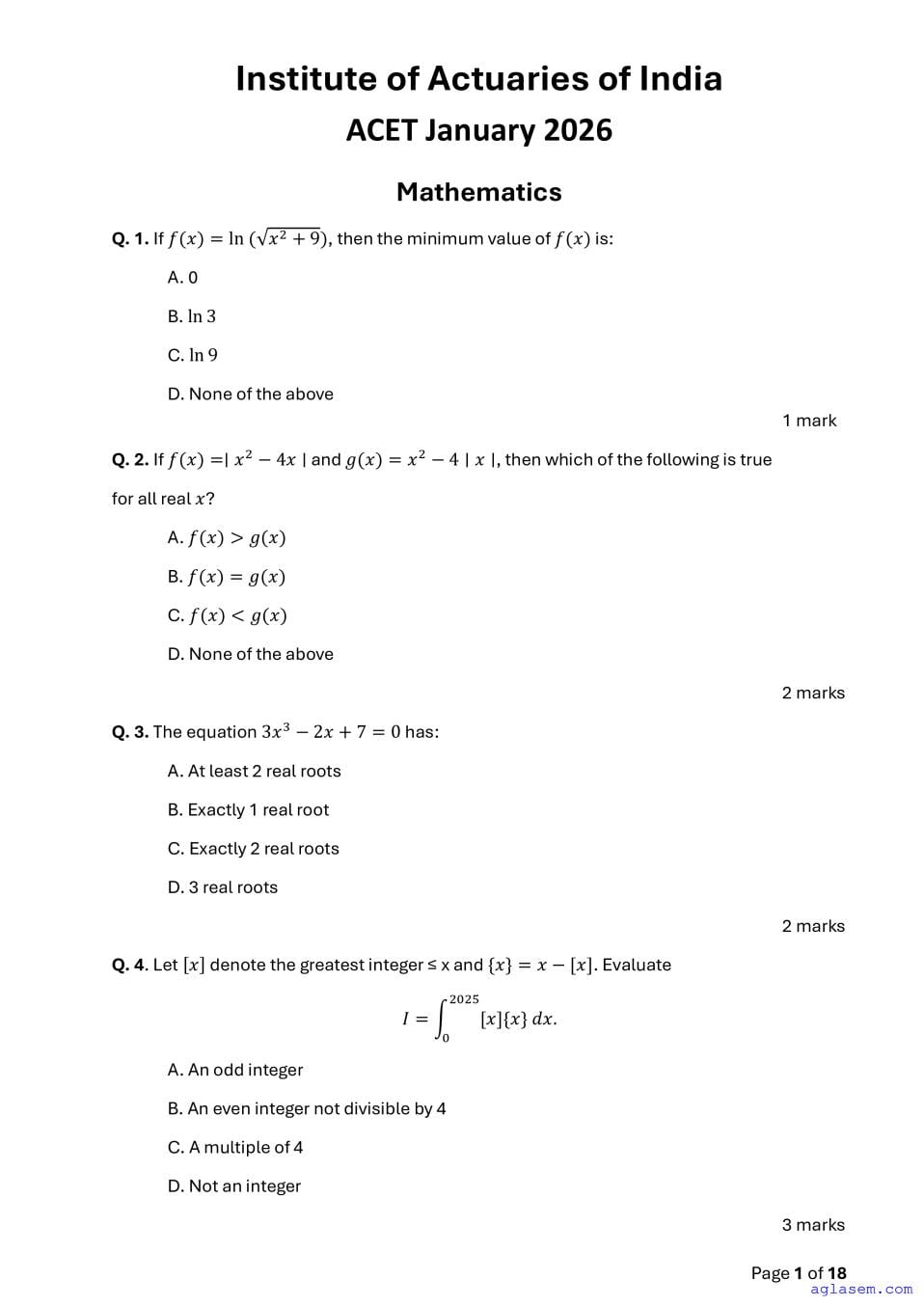
ACET January 2026
Mathematics
Q. 1. If 𝑓(𝑥) = ln(√𝑥 2 + 9), then the minimum value of 𝑓(𝑥) is:
A. 0
B. ln 3
C. ln 9
D. None of the above
Q. 2. If 𝑓(𝑥) =∣ 𝑥 2 − 4𝑥 ∣ and 𝑔(𝑥) = 𝑥 2 − 4 ∣ 𝑥 ∣, then which of the following is true
for all real 𝑥?
A. 𝑓(𝑥) > 𝑔(𝑥)
B. 𝑓(𝑥) = 𝑔(𝑥)
C. 𝑓(𝑥) < 𝑔(𝑥)
D. None of the above
Q. 3. The equation 3𝑥 3 − 2𝑥 + 7 = 0 has:
A. At least 2 real roots
B. Exactly 1 real root
C. Exactly 2 real roots
D. 3 real roots
Q. 4. Let [𝑥] denote the greatest integer ≤ x and {𝑥} = 𝑥 − [𝑥]. Evaluate
2025
𝐼=∫ [𝑥]{𝑥} 𝑑𝑥.
0
A. An odd integer
B. An even integer not divisible by 4
C. A multiple of 4
D. Not an integer
3 marks
Page 1 of 18
Page 2
𝑥 2 − (𝑎 + 𝑏)𝑥 + 𝑎𝑏 = 0
are:
A. 𝑎, 𝑏
B. 𝑎2 , 𝑏 2
C. 1/𝑎, 1/𝑏
D. None of the above
Q. 6. Evaluate
tan(7𝑥) − tan(3𝑥)
lim
𝑥→0 𝑥
A. 4
B. 10
C. 7
D. None of the above
Q. 7. A geometric progression (𝑎𝑛 ) satisfies 𝑎5 = 48 and 𝑎10 = 3.
Let 𝑘 be the smallest integer > 10 such that 𝑎𝑘 is an integer. Then 𝑘 + 𝑎𝑘 equals:
A. 18
B. 19
C. 20
D. None of the above
3 marks
Q. 8. If 𝑣⃗ = 6i − 8j, then a unit vector in the direction of 𝑣⃗ is:
3 4
A. 5 i − 5 j
4 3
B. 5 i − 5 j
7 3
C. 10 i − 10 j
D. None of the above
Q. 9. Which of the following statements is/are true?
Page 2 of 18
Page 3
A. Both X and Y
B. Neither X nor Y
C. X but not Y
D. Y but not X
Q. 10. If 𝐴 is a 3 × 3 matrix with ∣ 𝐴 ∣= 5, then ∣ 𝐴−1 ∣ equals:
A. 1/5
B. 5
C. 25
D. None of the above
Q. 11. For a 2 × 2 matrix 𝑀, adj(adj(𝑀)) equals:
A. 𝑀
B. ∣ 𝑀 ∣ 𝑀
C. 𝐼
D. None of the above
Q. 12. Evaluate
1
∫ 𝑒 2𝑥 (1 + 𝑥) 𝑑𝑥.
0
A. 𝑒 2 − 1
𝑒 2 +1
B. 2
C. 2𝑒 2 − 1
D. None of the above
3 marks
𝑑𝑦
Q. 13. If 𝑒 𝑥 = tan 𝑦, then 𝑑𝑥 at 𝑥 = 0 equals:
A. 1
1
B. 2
C. sec2 (0)
Page 3 of 18
Page 4
Q. 14. The function 𝑓(𝑥) = 𝑥 3 − 3𝑥 2 + 2 is strictly increasing in:
A. (−∞, 1)
B. (2, ∞)
C. (−∞, 0)𝑈(2, ∞)
D. (0, 2)
Q. 15. The coefficient of 𝑥12 in (𝑥 3 −2)8 is:
A. (84)(−2)4
B. (83)(−2)5
C. (82)(−2)6
D. None of the above
Q. 16. The value of
2024
1
∑
𝑛(𝑛 + 1)
𝑛=1
is:
A. Less than 1
B. Between 1 and 2
C. Between 2 and 3
D. More than 3
Q. 17. Using the Trapezoidal rule with ℎ = 0.25, the nearest value to
1
∫ ( 𝑥 2 + 1) 𝑑𝑥
0
is:
A. 1.25
B. 1.33
C. 1.50
Page 4 of 18
Page 5
Q. 18. Using Newton–Raphson method to solve 𝑒 𝑥 = 5𝑥 with initial guess 𝑥0 = 1, the value of
𝑥1 is:
A. 0.5
B. 1.2
C. 0.8
D. None of the above
Q. 19. If 𝜔 is a complex cube root of unity (other than 1), then
𝜔2025 + 𝜔2027
equals:
A. 0
B. 1
C. 𝜔
D. None of the above
3−4𝑖
Q. 20. If 𝑧 = 1+2𝑖, then ∣ 𝑧 ∣ equals:
A. 1
B. 2
C. √5
D. None of the above
Statistics
Q. 21. A biased 3-sided spinner has outcomes {0, 1, 2}. The probability of outcome j is
proportional to 𝑗 + 1. Let N be the outcome. The median of N is:
A. 0
B. 1
C. 2
Page 5 of 18
Page 6
Q. 22. Five students have heights ℎ1 ≤ ℎ2 ≤ ℎ3 ≤ ℎ4 ≤ ℎ5 . Their average height is 170 cm. All (53)
possible 3-student groups are formed and their mean heights calculated. The smallest and
largest of these 3-student means are 162 cm and 176 cm respectively. The median height ℎ3 is:
A. 164 cm
B. 168 cm
C. 172 cm
D. 170 cm
Q. 23. A club has 8 engineers and 5 economists. A 6-member committee must be formed with
at least 2 economists and more engineers than economists. The number of possible committees
is:
A. 350
B. 420
C. 490
D. 700
Q. 24. Two batches of students appear for the same exam. Batch A has 40 students with mean
65 and variance 16. Batch B has n students with mean 75. The combined mean of A + B is 70. If
all Batch B students have the same mark, then the size n of Batch B is:
A. 10
B. 20
C. 30
D. 40
Q. 25.For two events A and B with 𝑃(𝐴) = 0.3, 𝑃(𝐵) = 0.5and 𝑃(𝐴 ∣ 𝐵) = 0.4.
Then 𝑃(𝐵 ∣ 𝐴)equals:
A. 0.4
B. 0.6
2
C. 3
Page 6 of 18
Page 7
Q. 26. A fair 6-sided die is rolled once. If it shows n, a fair coin is tossed n times and X is the
number of heads. The probability that 𝑋 = 0 equals:
21
A. 128
7
B. 64
7
C. 96
1
D. 12
Q. 27.Let 𝑋 ∼ Uniform(0,2). Define 𝑌 = 5𝑋 − 3. The interquartile range (IQR) of Y is:
A. 2.5
B. 5
C. 7.5
D. 10
Q. 28. A lifetime T (in years) has an exponential distribution with mean 4. Given that the item has
already survived 3 years, the probability that it survives at least 5 more years is:
A. 𝑒 −5/4
B. 𝑒 −5/2
C. 𝑒 −2
D. None of the above
Q. 29. If 𝑋 ∼ 𝑁(10,9)and 𝑌 = 2𝑋 − 5, then the variance of Y equals:
A. 9
B. 18
C. 36
D. 81
Q. 30. A Binomial(𝑛, 𝑝) distribution is symmetric about its mean when:
A. 𝑛 = 2
1
B. 𝑝 = 2
Page 7 of 18
Page 8
D. n is even
Q. 31. For a Poisson(𝜆) random variable X, it is known that 𝑃(𝑋 = 3) = 2 ⋅ 𝑃(𝑋 = 4).
Then 𝜆 equals:
A. 2
B. 2.5
C. 3
D. 4
Q. 32. Let 𝑋have an exponential distribution with mean 𝜃. It is known that
𝑃(𝑋 > 2)
= 𝑒.
𝑃(𝑋 > 5)
Then the variance of X is:
A. 1
B. 3
C. 4
D. 9
Q. 33. A discrete random variable X takes values 0, 1, 2, 3, 4 and has CDF:
• 𝐹(𝑥) = 0 for 𝑥 < 0
• 𝐹(𝑥) = 0.2 for 0 ≤ 𝑥 < 1
• 𝐹(𝑥) = 0.5 for 1 ≤ 𝑥 < 2
• 𝐹(𝑥) = 0.8 for 2 ≤ 𝑥 < 3
• 𝐹(𝑥) = 0.95 for 3 ≤ 𝑥 < 4
• 𝐹(𝑥) = 1 for 𝑥 ≥ 4
The probability that X is odd is:
A. 0.30
B. 0.45
C. 0.50
D. 0.55 1 mark
Q. 34. A discrete random variable X takes values 0, 1, 2, 3, 4 and has CDF:
• 𝐹(𝑥) = 0 for 𝑥 < 0
• 𝐹(𝑥) = 0.2 for 0 ≤ 𝑥 < 1
Page 8 of 18
Page 9
• 𝐹(𝑥) = 0.8 for 2 ≤ 𝑥 < 3
• 𝐹(𝑥) = 0.95 for 3 ≤ 𝑥 < 4
• 𝐹(𝑥) = 1 for 𝑥 ≥ 4
For X, let m be the mean and M be the median of X. Then ∣ 𝑚 − 𝑀 ∣ is:
A. Less than 0.25
B. Between 0.25 and 0.5
C. Between 0.5 and 1
D. 1 or more
Q. 35. The stem-and-leaf plot below shows scores (out of 50) in a test:
Stem | Leaves
2|14
3|0338
4|02557
5|01344
Which of the following statements is true?
A. The dataset has a unique mode, which is 33.
B. The dataset has a unique mode, which is 45.
C. The dataset has more than one mode.
D. The dataset has no mode.
Q. 36. For variables X and Y, the regression line of X on Y is 4𝑋 − 3𝑌 + 10 = 0. The sample
standard deviations are 𝑠𝑋 = 2, 𝑠𝑌 = 4. Assuming these are valid regression and standard
deviation values, which of the following is true about the correlation coefficient 𝜌 between X and
Y?
3
A. 𝜌 = 2
3
B. 𝜌 = 4
C. ∣ 𝜌 ∣> 1, so the given information cannot all be correct.
D. 𝜌 = 0
3 marks
Q. 37. For two variables X and Y, the regression of X on Y is 𝑋 − 2𝑌 + 1 = 0, and the regression of
Y on X is 3𝑋 − 𝑌 − 2 = 0. Which of the following is true?
Page 9 of 18
Page 10
A. The correlation coefficient is 2.
√6
B. The correlation coefficient is .
2
C. The correlation coefficient is negative.
D. 𝜌2 >1, hence these two lines cannot both be valid regression lines for the same pair
(X, Y).
Q. 38. Let X be the outcome of a fair 4-sided die taking values {1, 2, 3, 4}. Define 𝑌 = 𝑋 2 . The
covariance Cov(X, Y) is:
A. 0
B. 3.5
C. 5
D. 6.25
Q. 39. A fair coin is tossed once. If it shows heads, a fair 6-sided die is rolled once and the
outcome is recorded as Z. If it shows tails, the same die is rolled twice and the two outcomes are
added to give Z. The expected value 𝐸[𝑍]is:
A. 4.5
B. 5.25
C. 7
D. 8.75
3 marks
Q. 40. Events A and B satisfy 𝑃(𝐴) = 0.4, 𝑃(𝐵) = 0.7, 𝑃(𝐴 ∩ 𝐵) = 0.28. Which of the following
statements is true?
X: A and B are independent. Y: A and 𝐵 𝑐 are independent.
A. Both X and Y
B. Only X
C. Only Y
D. Neither X nor Y
Page 10 of 18
Page 11
Q. 41. What is the total revenue of the company in 2023 from all four products together?
A. ₹120 lakhs
B. ₹130 lakhs
C. ₹140 lakhs
D. ₹150 lakhs
Q. 42. Which product shows the largest absolute increase in revenue from 2023 to 2024?
A. Product A
B. Product B
C. Product C
D. Product D 2 marks
Q. 43. Using the 2024 revenues and profit margins, what is the total profit in 2024 (in ₹ lakhs)
from all four products combined?
A. 28.75
B. 29
C. 30.25
D. 31
Page 11 of 18
Page 12
A. Product A
B. Product B
C. Product C
D. Product D
Q. 45. In which year is the gap between Product R and Product S the smallest?
A. 2016
B. 2019
C. 2021
D. 2022
Q. 46. In which year does Product S first exceed Product R in output?
A. 2016
B. 2017
C. 2018
D. 2019
Q. 47. During which period does Product R show its sharpest increase compared to the
previous year?
Page 12 of 18
Page 13
B. 2018–2019
C. 2019–2020
D. 2021–2022
Q. 48. In which year is the combined output of Product R and Product S visually the highest?
A. 2017
B. 2020
C. 2021
D. 2022
Q. 49. Which department had the highest average attendance over the four months?
A. Physics
B. Chemistry
C. Biology
D. Mathematics
Q. 50. In which month was the difference between the highest and lowest attendance the
biggest?
A. January
B. February
C. March
D. April
Q. 51. Which department showed the most consistent attendance (i.e., the smallest range
between highest and lowest monthly percentages)?
Page 13 of 18
Page 14
B. Chemistry
C. Biology
D. Mathematics
English
Q. 52. Choose the word that best completes the sentence:
The research team was appreciated for its ______ preparation before starting the
experiment.
A. careless
B. meticulous
C. reckless
D. haphazard
Q. 53. Choose the word closest in meaning to “prudent”.
A. foolish
B. cautious
C. lazy
D. indifferent
Q. 54. Choose the word that is the opposite of “seldom”.
A. rarely
B. occasionally
C. frequently
D. hardly
Q. 55. “She did not knew that the meeting had been postponed.” Identify the error in the
sentence.
A. She did not
B. knew
C. that the meeting
D. had been postponed 1 mark
Q. 56. “The principal refused to ______ the rude behaviour of the students.”
A. except
B. accept
C. expect
D. access
Page 14 of 18
Page 15
A. biologist
B. bibliophile
C. philatelist
D. dramatist
Q. 58. A student who is very nervous before an exam can be said to have “butterflies in their
_____”.
A. head
B. stomach
C. throat
D. mind
Q. 59. Artist : Painting :: Architect : ?
A. Machines
B. Buildings
C. Medicines
D. Poems
Q. 60. Read the passage below and answer the question:
Many cities are encouraging people to use bicycles for short trips. Dedicated cycling lanes
have been built on busy roads, and several offices now provide parking spaces for cycles.
Although some residents still prefer cars for convenience, an increasing number of
commuters say that cycling saves time during traffic jams and helps them stay fit.
Which of these is NOT a valid inference from the passage above?
A. Some people choose bicycles to avoid getting stuck in traffic.
B. At least a few offices support employees who cycle to work.
C. Everyone in the city has completely stopped using cars for short trips.
D. Cycling is promoted as both a transport and health-friendly option.
Q. 61. The following sentences are jumbled up. Choose the correct sequence.
I. Over months and years, these choices gradually shape a person’s life.
II. At first, a single decision may seem small and unimportant.
III. Yet each decision adds to a pattern of behaviour.
IV. That pattern becomes easier to repeat every time we follow it.
A. II, III, IV, I
B. II, IV, III, I
Page 15 of 18
Page 16
D. IV, II, III, I
Q. 62. Consider the following set of sentences:
I. She is senior than me by three years.
II. Please explain me this concept again.
III. He enjoys to play football in the evening.
Of these, the sentences that are erroneous are:
A. I and II
B. I and III
C. II and III
D. I, II and III 1 mark
Logical Reasoning
Q. 63. Today is 10th March 2026 and it falls on a Tuesday. In which of the following years will
10th March again fall on a Tuesday?
A. 2037
B. 2031
C. 2032
D. 2030
Q. 64. Between 3:00 p.m. and 4:00 p.m., the minute hand and hour hand of a clock form a
right angle (90°). How many times does this happen in that one-hour interval?
A. 0
B. 1
C. 2
D. 3
Q. 65. A solid cube is painted on the outside and then broken into many identical small cubes.
Which of the following statements is always correct?
A. The cubes at the corners all have paint on three faces
B. The cubes along the edges have paint on only one face
C. The cubes in the middle have paint on one or more faces
D. The number of painted cubes depends on how many pieces the cube is cut into
Q. 66. If A is B’s father’s sister’s son, then B is A’s:
Page 16 of 18
Page 17
B. Cousin brother / sister
C. Nephew / niece
D. Son / daughter
Q. 67. Five friends — A, B, C, D, and E — are seated in a row, all facing north.
• C is sitting immediately to the left of D.
• E is sitting at the right end of the row.
• B is sitting somewhere to the left of C.
Which of the following must be true?
A. A is sitting immediately next to C
B. C is sitting at the left end
C. A is sitting to the right of D
D. B is not sitting next to D
Q. 68. Statements:
1. All doctors are graduates.
2. Some graduates are artists.
3. No artist is a pilot.
Which of the following is definitely true?
A. Some doctors are pilots.
B. Some graduates are not pilots.
C. All graduates are doctors.
D. No graduate is a pilot.
Q. 69. Arrange in a logical sequence:
I = Interview, A = Application, S = Selection, J = Job Offer
A. A, I, S, J
B. I, A, S, J
C. A, S, I, J
D. S, A, I, J
Q. 70. Find the wrong number in the series:
Page 17 of 18
Page 18
A. 18
B. 40
C. 78
D. 158
****************
Page 18 of 18
Document Details
| Board / Org | Actuaries India |
| Exam | ACET |
| Type | Question Paper |
| Pages | 18 |
| Updated | 24 Sep 2026 |