NEET 2018 Question Paper (Gujarati)
Finished viewing? Save it for later —
Download NEET 2018 Question Paper (Gujarati) (PDF · 44 pages)About NEET 2018 Question Paper (Gujarati)
NEET 2018 Question Paper (Gujarati) is available here for free download. Published by NTA for National Eligibility cum Entrance Test (Undergraduate), this question paper can be viewed online or downloaded as a PDF (44 pages). Candidates preparing for National Eligibility cum Entrance Test (Undergraduate) can use NEET 2018 Question Paper (Gujarati) to understand the exam pattern, the type of questions asked, and the overall difficulty level.
Frequently Asked Questions
How can I download NEET 2018 Question Paper (Gujarati)?
Open this page and click the Download button to save NEET 2018 Question Paper (Gujarati) as a PDF. It is completely free on AglaSem Docs.
Is NEET 2018 Question Paper (Gujarati) free to download?
Yes. NEET 2018 Question Paper (Gujarati) can be viewed online and downloaded as a PDF free of cost on AglaSem Docs.
How many pages does NEET 2018 Question Paper (Gujarati) have?
NEET 2018 Question Paper (Gujarati) contains 44 pages, which you can read online or download together as a single PDF.
Where can I find more National Eligibility cum Entrance Test (Undergraduate) study material?
You can find more National Eligibility cum Entrance Test (Undergraduate) question papers, sample papers, syllabus, and answer keys on AglaSem Docs.
NEET 2018 Question Paper (Gujarati) – Text
Read the full text of this question paper below — useful to quickly search, copy and reference the content online without downloading the PDF.
📄 View text version (44 pages)
Page 1
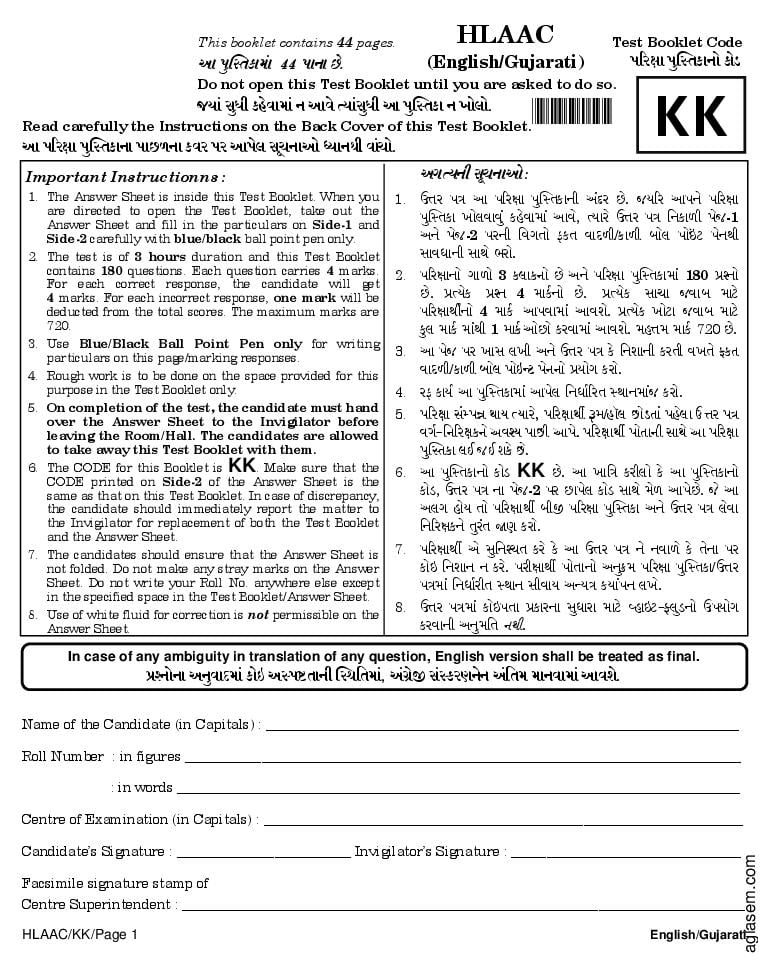
Ap ‘y[õsL$pdp„ 44 ‘p“p R>¡. (English/Gujarati) ‘qfnp ‘y[õsL$p“p¡ L$p¡X$
Do not open this Test Booklet until you are asked to do so.
S>ep„ ky^u L$l¡hpdp„ “ Aph¡ Ðep„ky^u Ap ‘y[õsL$p “ Mp¡gp¡.
Read carefully the Instructions on the Back Cover of this Test Booklet.
Ap ‘qfnp ‘y[õsL$p“p ‘pR>m“p L$hf ‘f Ap‘¡g k|Q“pAp¡ Ýep“’u hp„Qp¡.
*0KKG* KK
Important Instructionns : ANÐe“u k|Q“pAp¡ :
1. The Answer Sheet is inside this Test Booklet. When you 1. DÑf ‘Ó Ap ‘qfnp ‘y[õsL$p“u A„v$f R>¡. S>eqf Ap‘“¡ ‘qfnp
are directed to open the Test Booklet, take out the
Answer Sheet and fill in the particulars on Side-1 and
‘y[õsL$p Mp¡ghphy„ L$l¡hpdp„ Aph¡, Ðepf¡ DÑf ‘Ó r“L$pmu ‘¡S>-1
Side-2 carefully with blue/black ball point pen only. A“¡ ‘¡S>-2 ‘f“u rhNsp¡ aL$s hpv$mu/L$pmu bp¡g ‘p¡HV$ ‘¡“’u
2. The test is of 3 hours duration and this Test Booklet kph^p“u kp’¡ cfp¡.
contains 180 questions. Each question carries 4 marks. 2. ‘qfnp“p¡ Npmp¡ 3 L$gpL$“p¡ R>¡ A“¡ ‘qfnp ‘y[õsL$pdp„ 180 âí“p¡
For each correct response, the candidate will get
4 marks. For each incorrect response, one mark will be R>¡. âÐe¡L$ âí“ 4 dpL®$“p¡ R>¡. âÐe¡L$ kpQp S>hpb dpV¡$
deducted from the total scores. The maximum marks are ‘qfnp’u®“p¡ 4 dpL®$ Ap‘hpdp„ Aphi¡. âÐe¡L$ Mp¡V$p S>hpb dpV¡$
720. Ly$g dpL®$ dp„’u 1 dpL® Ap¡R>p¡ L$fhpdp„ Aphi¡. dlÑd dpL®$ 720 R>¡.
3. Use Blue/Black Ball Point Pen only for writing
particulars on this page/marking responses. 3. Ap ‘¡S> ‘f Mpk gMu A“¡ DÑf ‘Ó L¡$ r“ip“u L$fsu hMs¡ aL$s
4. Rough work is to be done on the space provided for this hpv$mu/L$pmu bp¡g ‘p¡BÞV$ ‘¡““p¡ âep¡N L$fp¡.
purpose in the Test Booklet only. 4. fa L$pe® Ap ‘y[õsL$pdp„ Ap‘¡g r“^p®qfs õ’p“dp„S> L$fp¡.$
5. On completion of the test, the candidate must hand
5. ‘qfnp k„ç‘ß ’pe Ðepf¡, ‘qfnp’u® ê$d/lp¸g R>p¡X$sp„ ‘l¡gp DÑf ‘Ó
over the Answer Sheet to the Invigilator before
leaving the Room/Hall. The candidates are allowed hN®-r“qfnL$“¡ Ahíe ‘pR>u Ap‘¡. ‘qfnp’} ‘p¡sp“u kp’¡ Ap ‘qfnp
to take away this Test Booklet with them. ‘y[õsL$p gC S>C iL¡$ R>¡.
6. The CODE for this Booklet is KK. Make sure that the 6. Ap ‘y[õsL$p“p¡ L$p¡X$ KK R>¡. Ap MprÓ L$fugp¡ L¡$ Ap ‘y[õsL$p“p¡
CODE printed on Side-2 of the Answer Sheet is the
same as that on this Test Booklet. In case of discrepancy, L$p¡X$, DÑf ‘Ó “p ‘¡S>-2 ‘f R>p‘¡g L$p¡X$ kp’¡ d¡m Ap‘¡R>¡. S>¡ Ap
the candidate should immediately report the matter to AgN lp¡e sp¡ ‘qfnp’} buÆ ‘qfnp ‘y[õsL$p A“¡ DÑf ‘Ó g¡hp
the Invigilator for replacement of both the Test Booklet r“qfnL$“¡ syf„s ÅZ L$fp¡.
and the Answer Sheet.
7. The candidates should ensure that the Answer Sheet is 7. ‘qfnp’} A¡ kyr“íQs L$f¡ L¡$ Ap DÑf ‘Ó “¡ “hpm¡ L¡$ s¡“p ‘f
not folded. Do not make any stray marks on the Answer L$p¡B r“ip“ “ L$f¡. ‘funp’} ‘p¡sp“p¡ A“y¾$d ‘qfnp ‘y[õsL$p/DÑf
Sheet. Do not write your Roll No. anywhere else except ‘Ódp„ r“^p®fus õ’p“ kuhpe AÞeÓ L$ep„‘“ gM¡.
in the specified space in the Test Booklet/Answer Sheet.
8. DÑf ‘Ódp„ L$p¡B‘sp âL$pf“p ky^pfp dpV¡$ ìlpBV$-ãgyX$“p¡ D‘ep¡N
8. Use of white fluid for correction is not permissible on the
Answer Sheet. L$fhp“u A“ydrs “’u.
In case of any ambiguity in translation of any question, English version shall be treated as final.
âí“p¡“p A“yhpv$dp„ L$p¡B Aõ‘ô$sp“u [õ’rsdp„, A„N°¡Æ k„õL$fZ“¡“ A„rsd dp“hpdp„ Aphi¡.
Name of the Candidate (in Capitals) : ____________________________________________________________________
Roll Number : in figures ________________________________________________________________________________
: in words _________________________________________________________________________________
Centre of Examination (in Capitals) : _____________________________________________________________________
Candidate’s Signature : _________________________ Invigilator’s Signature : _________________________________
Facsimile signature stamp of
Centre Superintendent : _________________________________________________________________________________
HLAAC/KK/Page 1 SPACE FOR ROUGH WORK English/Gujarati
Page 2
orbit about the Sun, at positions A, B and C are C [õ\rs `f NrsEÅ® ¾$di: KA, KB A_¡ KC R>¡.
KA, KB and KC, respectively. AC is the major
ApL©$rsdp„ bspìep âdpZ¡, AC dy¿e-An R>¡ A_¡ SB A¡
axis and SB is perpendicular to AC at the
position of the Sun S as shown in the figure.
k|e®_u [õ\rs S `f AC D`f_p¡ g„b R>¡. sp¡
Then
(1) KA > KB > K C
(1) KA > KB > K C (2) KB < KA < K C
(2) KB < KA < K C (3) KA < KB < K C
(3) KA < KB < K C (4) KB > KA > K C
(4) KB > KA > K C
2. A¡L$ O_ Np¡mp¡ NbX$su Nrsdp„ R>¡. NbX$rs Nrs (gp¡V$Z
2. A solid sphere is in rolling motion. In rolling Nrs) dp„ `v$p\® õ\p_p„sqfs NrsEÅ® (Kt) A_¡ c°drZe
motion a body possesses translational kinetic
energy (Kt) as well as rotational kinetic energy NrsEÅ® (Kr) A¡L$ kp\¡ ^fph¡ R>¡. Ap Np¡mp dpV¡$
(Kr) simultaneously. The ratio Kt : (Kt + Kr) for Kt : (Kt + Kr) _p¡ NyZp¡Ñf R>¡
the sphere is (1) 5:7
(1) 5 : 7
(2) 10 : 7
(2) 10 : 7
(3) 7 : 10 (3) 7 : 10
(4) 2 : 5 (4) 2:5
3. A solid sphere is rotating freely about its
symmetry axis in free space. The radius of the 3. dy¼s AhL$pidp„ A¡L$ O_ Np¡mp¡ s¡_u k„rds An_¡
sphere is increased keeping its mass same. A_ygrn_¡ c°dZ L$f¡ R>¡. Ap Np¡mp_u rÓÄep s¡_„y Öìedp_
Which of the following physical quantities would
remain constant for the sphere ?
kdp_ fpMu_¡ h^pfhpdp„ Aph¡ R>¡. _uQ¡dp„\u L$C cp¥rsL$
(1) Moment of inertia
fpri Ap Np¡mpdpV¡$ AQm fli¡ ?
(2) Rotational kinetic energy (1) S>X$Ðh_u QpL$dpÓp
(3) Angular velocity (2) c°dZue NrsEÅ®
(4) Angular momentum (3) L$p¡Zue h¡N
4. If the mass of the Sun were ten times smaller (4) L$p¡Zue h¡Ndp_
and the universal gravitational constant were
ten times larger in magnitude, which of the 4. Å¡ k|e®_„y Öìedp_ v$k NÏ„_p_y„ lp¡s A_¡ NyfyÐhpL$j®Z_p¡
following is not correct ? kph®rÓL$ AQmp„L$ dp_dp„ v$k NZp¡ dp¡V$p¡ lp¡s sp¡ _uQ¡dp„\u
(1) Walking on the ground would become more L$ey„ kpQy„ _\u ?
difficult.
(1) cp¢Qsrmep `f Qpghy„ h^y dyíL¡$g b_s.
(2) Time period of a simple pendulum on the
Earth would decrease. (2) `©Õhu `f kpv$p gp¡gL$_p¡ Aphs®L$pm ^fs.
(3) Raindrops will fall faster. (3) hfkpv$_p V¡$`p„ TX$`u `X$s.
(4) ‘g’ on the Earth will not change. (4) `©Õhu `f ‘g’ bv$gps _lu.
HLAAC/KK/Page 2 SPACE FOR ROUGH WORK English/Gujarati
Page 3
5. A toy car with charge q moves on a frictionless 5. kdp_ rhÛysn¡Ó E _u Akf _uQ¡ kdrnsuS q
horizontal plane surface under the influence of a rhS>cpqfs A¡L$ fdL$X$p_u L$pf Oj®Z frls k`pV$
uniform electric field E . Due to the force q E , >kdsg`f$ Nrs L$f¡R>¡. bm q E _p L$pfZ¡ A¡L$ k¡L$ÞX$_p
its velocity increases from 0 to 6 m/s in one Npmpdp„ s¡_p¡ h¡N 0 \u 6 m/s h^¡ R>¡. Ap nZ¡ Ap n¡Ó_u
second duration. At that instant the direction of qv$ip DgV$phhpdp„ Aph¡ R>¡. Ap n¡Ó_u Akfdp„ Ap L$pf b¡
the field is reversed. The car continues to move
k¡L$ÞX$ Nrs L$fhp_y„ Qpgy fpM¡ R>¡. 0 \u 3 k¡L$ÞX$ hÃQ¡
for two more seconds under the influence of this
kdL$X$p_u Ap L$pf_p¡ kf¡fpi h¡N A_¡ kf¡fpi TX$` R>¡
field. The average velocity and the average speed
(1) 1 m/s, 3 m/s
of the toy car between 0 to 3 seconds are (2) 1 m/s, 3·5 m/s
respectively (3) 2 m/s, 4 m/s
(1) 1 m/s, 3 m/s (4) 1·5 m/s, 3 m/s
(2) 1 m/s, 3·5 m/s
(3) 2 m/s, 4 m/s
6. ApL©$rsdp„ bspìep âdpZ¡ _d_ ^fphsp A¡L$ gukp
(4) 1·5 m/s, 3 m/s Y$msp `pqV$ep ABC `f m Öìedp__p¡ A¡L$ ågp¡L$ dyL¡$g
6. A block of mass m is placed on a smooth inclined R>¡. Ap Y$msp„`pqV$ep_¡ S>dZu sfa ‘a’ âh¡N Ap`hpdp„
wedge ABC of inclination as shown in the Aph¡ R>¡. Ap Y$p¡m `pqV$ep `f Ap ågp¡L$ [õ\f fl¡ s¡ dpV¡$
figure. The wedge is given an acceleration ‘a’
towards the right. The relation between a and a A_¡ hÃQ¡_p¡ k„b„^ R>¡
for the block to remain stationary on the wedge
is
g
(1) a=
sin
g
(1) a= (2) a = g cos
sin
g
(2) a = g cos (3) a=
g cosec
(3) a= (4) a = g tan
cosec
7. tbvy$ (2, – 2, – 2) _¡ A_ygnu_¡ tbvy$ (2, 0, – 3) `f bm
(4) a = g tan ^ ^ ^
^ ^ ^ F = 4 i + 5 j – 6 k _u QpL$dpÓp_¡ Ap`hpdp„ Aph¡ R>¡
7. The moment of the force, F = 4 i + 5 j – 6 k at
(2, 0, – 3), about the point (2, – 2, – 2), is given by ^ ^ ^
(1) – 4 i – j – 8k
^ ^ ^ ^ ^ ^
(1) – 4 i – j – 8 k (2) – 7 i – 8 j – 4k
^ ^ ^ ^ ^ ^
(2) – 7 i – 8 j – 4 k (3) – 8 i – 4 j – 7k
^ ^ ^ ^ ^ ^
(3) – 8 i – 4 j – 7 k (4) – 7 i – 4 j – 8k
^ ^ ^
(4) – 7 i – 4 j – 8 k 8. 0.001 cm gOysd dp` i[¼s_p A¡L$ õ¾y$ N¡S>_u dv$v$\u
8. A student measured the diameter of a small steel L$p¡C A¡L$ rhÛp\} [õL$g_p _p_p v$X$p (R>fp) A_p¡ ìepk
ball using a screw gauge of least count
0·001 cm. The main scale reading is 5 mm and dp`¡ R>¡. dy¿e õL¡$g_y„ hp„Q_ 5 mm R>¡ A_¡ hsy®mpL$pf
zero of circular scale division coincides with õL¡$g_p¡ i|Þe cpN k„v$c®L$p`p\u 25 L$p`p D`f R>¡. Å¡ Ap
25 divisions above the reference level. If screw õ¾y$ N¡S>_u i|Þe ÓyqV$ – 0.004 cm R>¡, sp¡ Ap v$X$p (R>fp)
gauge has a zero error of – 0·004 cm, the correct
diameter of the ball is _p¡ kpQp¡ ìepk R>¡
(1) 0·525 cm
(1) 0·525 cm
(2) 0·053 cm (2) 0·053 cm
(3) 0·521 cm (3) 0·521 cm
(4) 0·529 cm (4) 0·529 cm
HLAAC/KK/Page 3 SPACE FOR ROUGH WORK English/Gujarati
Page 4
its temperature (T), as shown in the graph. The
Apg¡Mdp„ v$ip®ìep âdpZ¡ bv$gpe R>¡. Äepf¡ s¡ s¡_u
ratio of work done by the gas, to the heat
absorbed by it, when it undergoes a change from Ahõ\p A _u Ahõ\p B dp„ a¡fapf L$f¡ R>¡ Ðepf¡ hpey hX¡$
state A to state B, is \sy„ L$pe® A_¡ s¡_p hX¡$ ip¡jpr_ Dódp_p¡ NyZp¡Ñf R>¡
2 2
(1) (1)
3 3
1 1
(2) (2)
3 3
2 2
(3) (3)
5 5
2 2
(4) (4)
7 7
10. The fundamental frequency in an open organ 10. A¡L$ My‰u _mu_u dymc|s Aph©rÑ L$p¡C A¡L$ b„^ _mu_p
pipe is equal to the third harmonic of a closed
rÓÅ lpdp£r_L$_p bfpbf R>¡. Å¡ b„^ _mu_u g„bpC 20 cm
organ pipe. If the length of the closed organ pipe
is 20 cm, the length of the open organ pipe is R>¡, sp¡ My‰u _mu_u g„bpC R>¡
(1) 8 cm (1) 8 cm
(2) 12·5 cm (2) 12·5 cm
(3) 13·2 cm (3) 13·2 cm
(4) 16 cm (4) 16 cm
11. At what temperature will the rms speed of 11. L$ep sp`dp_¡ Ap¡[¼kS>_ AÏAp¡_u hN® dpÝe d|g (rms)
oxygen molecules become just sufficient for
escaping from the Earth’s atmosphere ? TX$` `©Õhu `f\u hpeyd„X$g r_ó¾$dZ dpV¡ âÐepÐe S>i¡ ?
(Given : (Ap`¡g R>¡ :
Mass of oxygen molecule (m) = 2·76 10
–26
kg Ap¡[¼kS>_ AÏ_y„ Öìedp_ (m) = 2·76 10–26 kg
Boltzmann’s constant kB = 1·38 10
–23
JK )
–1
bp¡ëV$Tdp_ AQmp„L$ kB = 1·38 10–23 J K –1)
4 4
(1) 8·360 10 K (1) 8·360 10 K
4 4
(2) 5·016 10 K (2) 5·016 10 K
4 4
(3) 2·508 10 K (3) 2·508 10 K
4 4
(4) 1·254 10 K (4) 1·254 10 K
12. The efficiency of an ideal heat engine working 12. `pZu_p W$pfZ-tbvy$ A_¡ DÐL$g_-tbvy$ hÃQ¡ L$pe® L$fsp„
between the freezing point and boiling point of
water, is
A¡L$ Apv$i® Dódp-e„Ó_u L$pe®ndsp R>¡
(1) 20%
(1) 20%
(2) 6·25%
(2) 6·25%
(3) 26·8%
(3) 26·8%
(4) 12·5% (4) 12·5%
HLAAC/KK/Page 4 SPACE FOR ROUGH WORK English/Gujarati
Page 5
with rings of different colours for its AgN f„Np¡\u hgep¡ L$fhp_p R>¡. sp¡ hZ®-k„L¡$s (colour
identification. The colour code sequence will be
code) _p¡ ¾$d \i¡
(1) Yellow – Violet – Orange – Silver
(1) `ump¡ – Å„bgu – _pf„Nu – ê$`¡fu
(2) Yellow – Green – Violet – Gold
(2) `ump¡ – gugp¡ – Å„bgu – kp¡_¡fu
(3) Violet – Yellow – Orange – Silver
(3) Å„bgu – `ump¡ – _pf„Nu – ê$`¡fu
(4) Green – Orange – Violet – Gold
(4) gugp¡ – _pf„Nu – Å„bgu – kp¡_¡fu
14. A set of ‘n’ equal resistors, of value ‘R’ each, are
connected in series to a battery of emf ‘E’ and 14. ‘E’ emf _u A_¡ ‘R’ Ap„sqfL$ Ahfp¡^ ^fph_u A¡L$ b¡V$fu
internal resistance ‘R’. The current drawn is I.
kp\¡ S>¡ v$f¡L$_y„ dyëe ‘R’ R>¡ s¡hp ‘n’ kfMp Ahfp¡^p¡
Now, the ‘n’ resistors are connected in parallel to
the same battery. Then the current drawn from
î¡Zudp„ Å¡X¡$g R>¡. b¡V$fu\u guO¡gu ^pfp I R>¡. lh¡ Ap ‘n’
battery becomes 10 I. The value of ‘n’ is Ahfp¡^p¡_¢ Ap b¡V$fu kp\¡ kdp„sf Å¡X$hpdp„ Aph¡ R>¡, Ðepf¡
(1) 11
b¡V$fu\u guO¡gu ^pfp R>¡ 10 I. Ap ‘n’ _y„ d|ëe R>¡
(1) 11
(2) 20
(2) 20
(3) 10
(3) 10
(4) 9
(4) 9
15. A battery consists of a variable number ‘n’ of
identical cells (having internal resistance ‘r’ 15. A¡L$ b¡V$fu bv$gpsu k„¿ep ‘n’ _p kdp_ L$p¡jp¡ (v$f¡L$_p¡
each) which are connected in series. The
Ap„sqfL$ Ahfp¡^ ‘r’) ^fph¡ R>¡ S>¡ î¡Zudp„ Å¡X¡$g R>¡. Ap
terminals of the battery are short-circuited and
the current I is measured. Which of the graphs
b¡V$fu_p V$rd®_ëk ip¡V®$-kqL®$V$ L$fu_¡ âhpl I dp`hpdp„ Aph¡
shows the correct relationship between I and n ? R>¡. L$ep¡ Apg¡M I A_¡ n hÃQ¡_p¡ kpQp¡ k„b^„ v$ip®h¡ R>¡ ?
HLAAC/KK/Page 5 SPACE FOR ROUGH WORK English/Gujarati
Page 6
16. An em wave is propagating in a medium with a 16. A¡L$ rhÛys QyçbL$ue sf„N h¡N V = V ^i kp\¡ L$p¡C A¡L$
^
velocity V = V i . The instantaneous oscillating dpÝeddp„ âkpfZ `pd¡ R>¡. Ap rhÛys QyçbL$ue sf„N_y„
electric field of this em wave is along +y axis. sÐL$pgu_ v$p¡rgs rhÛys n¡Ó + y An sfa R>¡. sp¡ Ap
Then the direction of oscillating magnetic field of rhÛys QyçbL$ue sf„N_p v$p¡rgs Qy„bqL$e n¡Ó_u qv$ip li¡
the em wave will be along (1) + z qv$ip
(1) + z direction (2) – y qv$ip
(2) – y direction
(3) – z qv$ip
(3) – z direction
(4) – x qv$ip
(4) – x direction
17. The refractive index of the material of a prism is
17. L$p¡C A¡L$ râTd_p Öìe_p¡ hq¾$ch_p„L$ 2 R>¡ A_¡ râTd
2 and the angle of the prism is 30. One of the L$p¡Z 30 R>¡. Ap râTd_u b¡ dp„\u A¡L$ hq¾$cys k`pV$u_¡
two refracting surfaces of the prism is made a Qp„v$u_p¡ W$p¡m QY$phu_¡ Aqfkp¡ b_phhpdp„ Aph¡ R>¡. A¡L$
mirror inwards, by silver coating. A beam of f„rNe âL$pi `y„S> s¡_u buÆ k`pV$udp„\u râTddp„ v$pMg
monochromatic light entering the prism from the \pe (ê$`¡fu k`pV$u `f\u `fphrs®s \C_¡) s¡ S> `\ `f
other face will retrace its path (after reflection `pR>p¡ L$f¡, Å¡ s¡_p¡ râTd `f_p¡ Ap`ps L$p¡Z lp¡e
from the silvered surface) if its angle of incidence
(1) 45
on the prism is
(2) 30
(1) 45
(3) 60
(2) 30
(3) 60
(4) iyÞe
(4) zero
18. 15 cm L¡$ÞÖ g„bpC_p A¡L$ Ap„sfNp¡m Aqfkp\u 40 cm
18. An object is placed at a distance of 40 cm from a `f A¡L$ hõsy dyL¡g R>¡. Å¡ Ap hõsy_¡ 20 cm Ap Aqfkp
concave mirror of focal length 15 cm. If the object sfa Mk¡X$hpdp„ Aph¡, sp¡ ârstbb_y„ õ\p_p„sf li¡
is displaced through a distance of 20 cm towards
(1) Aqfkp\u 36 cm vy$f
the mirror, the displacement of the image will be
(2) 30 cm Aqfkp sfa
(1) 36 cm away from the mirror
(2) 30 cm towards the mirror (3) Aqfkp\u 30 cm vy$f
(3) 30 cm away from the mirror (4) 36 cm Aqfkp sfa
(4) 36 cm towards the mirror
19. Äepf¡ L$p¡C Qp¡½$k CÞX$L$V$fdp„ âhpl, 60 mA lp¡e R>¡ Ðepf¡
19. The magnetic potential energy stored in a certain
inductor is 25 mJ, when the current in the
Ap CÞX$¼V$fdp„ k„N°plpsu Qy„bqL$e [õ\rs EÅ® 25 mJ R>¡.
inductor is 60 mA. This inductor is of inductance Ap CÞX$¼V$f_p¡ CÞX$¼V$Þk R>¡
(1) 138·88 H (1) 138·88 H
(2) 1·389 H (2) 1·389 H
(3) 0·138 H (3) 0·138 H
(4) 13·89 H (4) 13·89 H
HLAAC/KK/Page 6 SPACE FOR ROUGH WORK English/Gujarati
Page 7
20. An electron of mass m with an initial velocity 20. V = V0 ^i (V0 > 0) âpf„rcL$ h¡N ^fphsp¡ m Öìedp__p¡
^
V = V0 i (V0 > 0) enters an electric field A¡L$ Cg¡L$V²$p¡_ rhÛysn¡Ó E = – E0 ^i (E0 = AQm > 0)
^
E = – E0 i (E0 = constant > 0) at t = 0. If 0 is dp„ t = 0 âh¡i¡ R>¡. âpf„cdp„ s¡_u Cg¡¼V²$p¡__u v$¡$-b°p¡Águ
its de-Broglie wavelength initially, then its sf„N g„bpC 0 R>¡, sp¡ kde t `f A¡_u v$¡$-b°p¡Águ sf„N
de-Broglie wavelength at time t is g„bpC R>¡
eE0
(1) 0 1 t eE0
mV0 (1) 0 1 t
mV0
(2) 0 t
(2) 0 t
0 0
(3) (3)
eE0
1 t eE0
mV0 1 t
mV0
(4) 0 (4) 0
21. For a radioactive material, half-life is
21. L$p¡C A¡L$ f¡qX$ep¡A¡L$qV$h Öìe dpV¡$ A^®Apey 10 rd_V$ R>¡. Å¡
10 minutes. If initially there are 600 number of
nuclei, the time taken (in minutes) for the âpf„cdp„ Þe|¼guekp¡_u k„¿ep 600 R>¡, sp¡
disintegration of 450 nuclei is 450 Þe|[¼gekp¡_p nedpV¡$ bpNsp¡ kde (rd_V$ dp„) R>¡
(1) 10 (1) 10
(2) 30 (2) 30
(3) 20 (3) 20
(4) 15 (4) 15
22. The ratio of kinetic energy to the total energy of 22. lpCX²$p¡S>_ `fdpÏ_u bp¡lf-L$np_p A¡L$ Cg¡¼V²$p¡__u Nrs
an electron in a Bohr orbit of the hydrogen atom,
EÅ® A_¡ Ly$g DÅ®_p¡ NyZp¡Ñf R>¡
is
(1) 1:–1
(1) 1:–1
(2) 2:–1
(2) 2:–1
(3) 1:1 (3) 1:1
(4) 1:–2 (4) 1:–2
23. When the light of frequency 2v0 (where v0 is 23. Äepf¡ 2v0 Aph©rs_p¡ âL$pi (S>ep„ v0 \°¡kp¡g Aph©rÑ R>¡)
threshold frequency), is incident on a metal ^psy_u A¡L$ àg¡V$ `f Ap`ps \pe R>¡, sp¡ DÐkÅ®sp
plate, the maximum velocity of electrons emitted Cg¡¼V²$p¡Þk_p¡ dlÑd h¡N v1 R>¡. Äepf¡ Ap`ps rhqL$fZp¡_u
is v1. When the frequency of the incident
radiation is increased to 5v0, the maximum
Aph©rÑ h^pfu_¡ 5v0 L$fhpdp„ Aph¡, sp¡ Ap àg¡V$ hX¡$
velocity of electrons emitted from the same plate DÐkÅ®sp Cg¡¼V²$p¡Þk_p¡ dlÑd h¡N v2 R>¡. v1 \u v2 _p¡
is v2. The ratio of v1 to v2 is NyZp¡Ñf R>¡
(1) 1:4 (1) 1:4
(2) 4:1 (2) 4:1
(3) 1:2 (3) 1:2
(4) 2:1 (4) 2:1
HLAAC/KK/Page 7 SPACE FOR ROUGH WORK English/Gujarati
Page 8
surface of a material of refractive index ‘’. At a
lhpdp„\u A^yrhcys âL$pi Ap`ps \pe R>¡. L$p¡C Qp¡½$k
particular angle of incidence ‘i’, it is found that
the reflected and refracted rays are
Ap`ps L$p¡Z ‘i’ `f A¡d Å¡hp dþeyL¡$ `fphrs®s A_¡
perpendicular to each other. Which of the hq¾$cys qL$fZp¡ A¡L$ buÅ_¡ g„b R>¡. Ap `qf[õ\rs dpV¡$
following options is correct for this situation ? _uQ¡_p rh^p_p¡ dp„\u L$ey„ kpQy R>¡ ?
(1) Reflected light is polarised with its electric (1) Ap`ps kdsg_¡ s¡_p¡ rhÛys kqv$i g„b fl¡ s¡d
vector perpendicular to the plane of
`fphrs®s âL$pi ^°yrhcys \pe R>¡
incidence
–1 1
–1 1 (2) i = sin
(2) i = sin
(3) Ap`ps kdsg_¡ s¡_p¡ rhÛys kqv$i kdp„sf fl¡ s¡d
(3) Reflected light is polarised with its electric
vector parallel to the plane of incidence
`fphrs®s âL$pi ^°yrhcys \pe R>¡
–1 1
–1 1 (4) i = tan
(4) i = tan
25. An astronomical refracting telescope will have
25. L$p¡C MNp¡rme hq¾$cys vy$frb__¡ dp¡Vy„$ L$p¡rZe rhh^®_ A_¡
large angular magnification and high angular DÃQ L$p¡Zue rhc¡v$_ li¡ Äepf¡ s¡_p¡ hõsy L$pQ
resolution, when it has an objective lens of
(1) dp¡V$u L¡$ÞÖg„bpC A_¡ _p_p ìepk_p¡ lp¡e
(1) large focal length and small diameter
(2) dp¡V$p¡ L¡$ÞÖg„bpC A_¡ dp¡V$p ìepk_p¡ lp¡e
(2) large focal length and large diameter
(3) small focal length and large diameter (3) _p_u L¡$ÞÖg„bpC A_¡ dp¡V$p ìepk_p¡ lp¡e
(4) small focal length and small diameter (4) _p_u L¡$ÞÖg„bpC A_¡ _p_p ìepk_p¡ lp¡e
26. In Young’s double slit experiment the separation 26. e„N_p X$bg-[õgV$_p âep¡Ndp„ [õgV$ hÃQ¡_y„ A„sf d A¡
d between the slits is 2 mm, the wavelength of 2 mm, D`ep¡Ndp„ g¡hp_p„ âL$pi_u sf„N g„bpC A¡
the light used is 5896 Å and distance D between
5896 Å A_¡ `X$v$p A_¡ [õgV$ hÃQ¡_y„ A„sf D A¡
the screen and slits is 100 cm. It is found that the
100 cm R>¡. A¡d Å¡hp dþey„ L¡$ igpL$pAp¡_u L$p¡Zue
angular width of the fringes is 0·20. To increase
the fringe angular width to 0·21 (with same `lp¡mpC 0.20 R>¡. Ap igpL$pAp¡_u L$p¡Zue `lp¡mpC
and D) the separation between the slits needs to h^pfu_¡ 0.21 L$fhp dpV¡$ ( A_¡ D bv$ëep hNf) Ap
be changed to
[õgV$k hÃQ¡_y„ A„sf fpMhy„ S>ê$fu R>¡
(1) 1·9 mm
(1) 1·9 mm
(2) 2·1 mm
(2) 2·1 mm
(3) 1·8 mm
(3) 1·8 mm
(4) 1·7 mm
(4) 1·7 mm
HLAAC/KK/Page 8 SPACE FOR ROUGH WORK English/Gujarati
Page 9
voltage Vi is 20 V, VBE = 0 and VCE = 0. The VBE = 0 A_¡ VCE = 0 R>¡. IB, IC A_¡ _p dyëep¡
values of IB, IC and are given by Ap`hpdp„ Aph¡ R>¡
(1) IB = 25 A, IC = 5 mA, = 200 (1) IB = 25 A, IC = 5 mA, = 200
(2) IB = 20 A, IC = 5 mA, = 250 (2) IB = 20 A, IC = 5 mA, = 250
(3) IB = 40 A, IC = 10 mA, = 250 (3) IB = 40 A, IC = 10 mA, = 250
(4) IB = 40 A, IC = 5 mA, = 125 (4) IB = 40 A, IC = 5 mA, = 125
28. In a p-n junction diode, change in temperature 28. A¡L$ p-n S>„¼i_ X$pep¡X$dp„, Nfd L$fsp„ \sp„ sp`dp__p¡
due to heating
a¡fapf
(1) affects only forward resistance
(1) aL$s ap¡fhX®$ Ahfp¡^_¡ Akf L$f¡ R>¡.
(2) does not affect resistance of p-n junction
(2) p-n S>„L$i__p Ahfp¡^_¡ Akf L$fsp¡ _\u.
(3) affects only reverse resistance
(3) aL$s qfhk® Ahfp¡^_¡ Akf L$f¡ R>¡.
(4) affects the overall V – I characteristics of
(4) p-n S>„¼i__u kdN° V – I gpnrZL$spAp¡_¡ Akf
p-n junction
L$f¡ R>¡.
29. In the combination of the following gates the
output Y can be written in terms of inputs A and 29. _uQ¡ Ap`¡g N¡V$k_u Np¡W$hZdp„, C_-`|V$k A A_¡ B _p
B as `v$p¡dp„ ApDV$-`|V$ Y _¡ gMu iL$pe R>¡
– – – –
(1) A. B + A .B (1) A. B + A .B
(2) A.B +A.B (2) A.B +A.B
(3) A.B (3) A.B
(4) AB (4) AB
HLAAC/KK/Page 9 SPACE FOR ROUGH WORK English/Gujarati
Page 10
glass tube. The length of the air column in this
tube can be adjusted by a variable piston. At
R>¡. Qrgs r`õV$_ Üpfp Ap _mudp„ lhp_p õs„c_u g„bpC
room temperature of 27C two successive Np¡W$hu iL$pe R>¡ 27C Ap¡fX$p_p sp`dp_¡ b¡ ¾$rdL$
resonances are produced at 20 cm and 73 cm of A_y_pv$p¡ 20 cm A_¡ 73 cm õs„c g„bpC `f DÐ`_ \pe
column length. If the frequency of the tuning fork R>¡. Ap Ýhr_-rQ`uep_u Aph©rÑ 320 Hz R>¡, sp¡ hpeydp„
is 320 Hz, the velocity of sound in air at 27C is
27C `f Ýhr__p¡ h¡N R>¡
(1) 339 m/s
(1) 339 m/s
(2) 350 m/s
(2) 350 m/s
(3) 330 m/s
(3) 330 m/s
(4) 300 m/s
(4) 300 m/s
31. The electrostatic force between the metal plates
of an isolated parallel plate capacitor C having a 31. Q rhS> cpf ^fphsp„ A_¡ n¡Óam A hpmp AgN L$f¡g
charge Q and area A, is kdp„sf àg¡V$k L¡$`¡rkV$f C _u ^psy_u àg¡V$k hÃQ¡_p¡ [õ\s
(1) linearly proportional to the distance rhÛys bm R>¡
between the plates.
(1) Ap àg¡V$k hÃQ¡_p A„sf_p kyf¡M âdpZdp„ Qg¡ R>¡.
(2) proportional to the square root of the
distance between the plates. (2) Ap àg¡V$k hÃQ¡_p A„sf_p hN®d|m_p âdpZdp„ Qg¡
(3) independent of the distance between the
R>¡.
plates. (3) Ap àg¡V$k hÃQ¡_p A„sf `f Ap^pqfs _\u.
(4) inversely proportional to the distance (4) Ap àg¡V$k hÃQ¡_p A„sf_p ìeõs âdpZdp„ Qg¡ R>¡.
between the plates.
32. A¡L$ kdp_ A_¡ DÝh®qv$ipdp„ D`f_u sfa qv$ip_rhs rhÛys
32. An electron falls from rest through a vertical
distance h in a uniform and vertically upward n¡Ó E dp„ A¡L$ Cg¡¼V²$p¡_ [õ\f Ahõ\pdp„\u rifp¡g„b h
directed electric field E. The direction of electric A„sf _uQ¡ `X¡$ R>¡. lh¡ Ap rhÛys n¡Ó_u qv$ip s¡_y„ dp_
field is now reversed, keeping its magnitude the kdp_ fpMu J^u L$fhpdp„ Aph¡ R>¡. Ap rifp¡g„b A„sf h
same. A proton is allowed to fall from rest in it `f_u [õ\f âp¡V$p¡__¡ s¡dp„ `X$hp v$¡hpdp„ Aph¡ R>¡. âp¡V$p¡__¡
through the same vertical distance h. The time of
fall of the electron, in comparison to the time of
`X$sp gpNsp kde_u kfMpdZudp„ Cg¡¼V²$p¡__¡ `X$sp„
fall of the proton is gpNsp¡ kde R>¡
(1) 5 times greater (1) 5 NZp¡ dp¡V$p¡
(2) 10 times greater (2) 10 NZp¡ dp¡V$p¡
(3) smaller (3) _p_p¡
(4) equal (4) kfmp¡
33. A pendulum is hung from the roof of a
33. A¡L$ `ep®às JQpC_p dL$p__u R>s `f\u A¡L$ gp¡gL$
sufficiently high building and is moving freely to
and fro like a simple harmonic oscillator. The
gV$L$ph¡g R>¡ S>¡ kpv$p Aphs® v$p¡gL$_u S>¡d kfmsp\u
acceleration of the bob of the pendulum is ApNm-`pR>m Nrs L$fu iL¡$ R>¡. s¡_u kf¡fpi [õ\rs_u
2 2
20 m/s at a distance of 5 m from the mean 5 m A„sf¡ Ap gp¡gL$_p v$X$p_p¡ âh¡N 20 m/s R>¡. Ap
position. The time period of oscillation is v$p¡g__p¡ Aphs®L$pm R>
(1) s (1) s
(2) 2s (2) 2s
(3) 2 s (3) 2 s
(4) 1s (4) 1s
HLAAC/KK/Page 10 SPACE FOR ROUGH WORK English/Gujarati
Page 11
–1
0·5 kg m is lying horizontally on a smooth `pqV$ep `f, 0.5 kg m–1 Öìedp_ ârs g„bpC ^fphsp¡
inclined plane which makes an angle of 30 with ^psy_p¡ A¡L$ krmep¡ kdrnrsS> fl¡gp¡ R>¡. Ap krmepdp„
the horizontal. The rod is not allowed to slide
âhpl âkpf L$fu DÝh® qv$idp„ 0.25 T _y„ Qy„bqL$e n¡Ó â¡qf
down by flowing a current through it when a
magnetic field of induction 0·25 T is acting on it
Ap krmep_¡ _uQ¡ kfL$hp v$¡hpdp„ Aphsp¡ _\u. Ap
in the vertical direction. The current flowing in krmep_p¡ [õ\f fpMhp krhepdp„ hl¡sp¡ âhpl R>¡
the rod to keep it stationary is (1) 5·98 A
(1) 5·98 A (2) 14·76 A
(2) 14·76 A (3) 7·14 A
(3) 7·14 A (4) 11·32 A
(4) 11·32 A
35. A¡L$ Qrgs N|„Qgp N¡ëh¡_p¡ duV$f_u âhpl k„h¡rlsp
35. Current sensitivity of a moving coil galvanometer
5 div/mA R>¡ A_¡ hp¡ëV¡$S> k„h¡rv$sp (L$p¡Zue Aphs®_ ârs
is 5 div/mA and its voltage sensitivity (angular
deflection per unit voltage applied) is 20 div/V.
A¡L$u Ap`¡g hp¡ëV¡$S>) 20 div/V R>¡. Ap N¡ëh¡_p¡ duV$f_p¡
The resistance of the galvanometer is Ahfp¡^ R>¡
(1) 25 (1) 25
(2) 250 (2) 250
(3) 40 (3) 40
(4) 500 (4) 500
36. A thin diamagnetic rod is placed vertically
36. A¡L$ rhÛysQy„bL$ _p ^°yhp¡ hÃQ¡ A¡L$ `psmp X$pepd¡Á_¡V$uL$
between the poles of an electromagnet. When the
current in the electromagnet is switched on, then
krmep_¡ Dcp¡ fpMhpdp„ Aph¡ R>¡. Äepf¡ Ap rhÛys
the diamagnetic rod is pushed up, out of the Qy„bL$dp„ âhpl Qpgy L$fhpdp„ Aph¡ R>¡, Ðepf¡ Ap
horizontal magnetic field. Hence the rod gains X$pepd¡Á_¡V$uL$ krmep¡ kdrnrsS> Qy„bqL$e n¡Ódp„ D`f sfa
gravitational potential energy. The work ^L¡$gpe R>¡. s¡\u Ap krmep¡ NyfyÐh-[õ\rs EÅ® âpàs L$f¡
required to do this comes from R>¡. Ap dpV¡$ L$fhy„ `X$sy„ S>ê$fu L$pe® Aph¡ R>¡
(1) the magnetic field (1) Qy„bqL$e n¡Ódp„\u
(2) the lattice structure of the material of the
(2) Ap krmep_p g¡qV$k b„^pfZdp„\u
rod
(3) the current source (3) âhpl DØNd dp„\u
(4) the induced electric field due to the (4) bv$gpsp„ Qy„bqL$e n¡Ó_p gu^¡ â¡qfs rhÛys n¡Ódp„\u
changing magnetic field
37. V = 10 sin 314 t, emf _p A¡L$ DØNd_¡ kdp„sf 20 mH
37. An inductor 20 mH, a capacitor 100 F and a
_p¡ A¡L$ CÞX$¼V$f, 100 F _p¡ A¡L$ L¡$`prkV$f A_¡ 50 _p¡
resistor 50 are connected in series across a
A¡L$ Ahfp¡^ î¡Zudp„ Å¡X¡$g R>¡. Ap `qf`\_p¡ `phf-ìee
source of emf, V = 10 sin 314 t. The power loss in
the circuit is
R>¡
(1) 0·43 W (1) 0·43 W
(2) 2·74 W (2) 2·74 W
(3) 0·79 W (3) 0·79 W
(4) 1·13 W (4) 1·13 W
HLAAC/KK/Page 11 SPACE FOR ROUGH WORK English/Gujarati
Page 12
radiates maximum energy at wavelength, 0. If sf„Ng„bpC `f dlÑd EÅ® DÐkÆ®s L$f¡ R>¡. Å¡ A¡ Ap
the temperature of the black body is now L$pmp-`v$p\®_y„ sp`dp_ bv$ghpdp„ Aph¡ L¡$ S>¡\u s¡ 3 0
4
changed so that it radiates maximum energy at sf„Ng„bpC `f dlÑd EÅ® DÐkÆ®s L$f¡, sp¡ s¡_p Üpfp
3
wavelength , the power radiated by it DÐkÆ®s `phf nP \pe R>¡. Ap n _y„ dyëe R>¡
4 0
becomes nP. The value of n is 4
(1)
4 3
(1)
3 256
(2)
256 81
(2)
81 3
(3)
3 4
(3)
4 81
(4)
81 256
(4)
256 39. b¡ spfp¡ kdp_ Öìe_p b_¡gp R>¡ A_¡ kfMy„ L$v$ ^fph¡ R>¡.
39. Two wires are made of the same material and `l¡gp spf_p ApX$R>¡v$_y„ n¡Óam A R>¡ A_¡ buÅ spf_p
have the same volume. The first wire has ApX$R>¡v$_y„ n¡Óam 3A R>¡. F S>¡V$gy„ bm Ap`u_¡ `l¡gp
cross-sectional area A and the second wire has spf_u g„bpCdp„ l _p¡ h^pfp¡ L$fhpdp„ Aph¡ R>¡ sp¡ buÅ
cross-sectional area 3A. If the length of the first
wire is increased by l on applying a force F, spf M¢Qu_¡ s¡_u g„bpCdp„ ApV$gp¡ S> h^pfp¡ L$fhp dpV¡$
how much force is needed to stretch the second L¡$V$gp S>Õ\p_y„ bm Å¡CA¡ ?
wire by the same amount ? (1) 6F
(1) 6 F (2) 4F
(2) 4 F (3) 9F
(3) 9 F (4) F
(4) F
40. ‘r’ rÓÄep_p¡ A¡L$ _p_p¡ Np¡mp¡ [õ\f [õ\rsdp„\u A¡L$ [õ_Á^
40. A small sphere of radius ‘r’ falls from rest in a
viscous liquid. As a result, heat is produced due âhprldp„ `X¡$ R>¡. [õ_Á^ bm_p `qfZpd¡ Dódp DÐ`_
to viscous force. The rate of production of heat \pe R>¡. Äepf¡ Ap Np¡mp¡ s¡_u V$rd®_g h¡N âpàs L$fi¡
when the sphere attains its terminal velocity, is Ðepf¡ Dódp DÐ`_ \hp_p¡ v$f ___________ _¡ Qg¡ R>¡.
proportional to 2
(1) r
2
(1) r 5
5 (2) r
(2) r 3
3 (3) r
(3) r 4
4 (4) r
(4) r
41. A sample of 0·1 g of water at 100C and normal
41. kpdpÞe v$bpZ¡ (1·013 105 Nm–2) A_¡ 100C `f
5 –2
pressure (1·013 10 Nm ) requires 54 cal of
`pZu_p A¡L$ _dy_p_¡ 100C `f 0.1 g hfpmdp„ a¡fhhp
heat energy to convert to steam at 100C. If the dpV¡$ 54 cal Dódp EÅ®_u S>ê$f `X¡$ R>¡. Å¡ DÐ`ß \su
volume of the steam produced is 167·1 cc, the hfpm_y„ L$v$ 167.1 cc R>¡, sp¡ Ap _dy_p_u Ap„sqfL$ EÅ®dp„
change in internal energy of the sample, is \sp¡ a¡fapf R>¡
(1) 208·7 J (1) 208·7 J
(2) 42·2 J (2) 42·2 J
(3) 104·3 J (3) 104·3 J
(4) 84·5 J (4) 84·5 J
HLAAC/KK/Page 12 SPACE FOR ROUGH WORK English/Gujarati
Page 13
frictionless track from a height h (as shown in
`v$p\® _uQ¡_u sfa kfL¡$ R>¡ A_¡ ìepk AB = D ^fphsy„
the figure) just completes a vertical circle of
diameter AB = D. The height h is equal to A¡L$ D^®hsy®m `yfy L$f¡ R>¡. Ap JQpC h R>¡
(1) D (1) D
7 7
(2) D (2) D
5 5
3 3
(3) D (3) D
2 2
5 5
(4) D (4) D
4 4
43. Three objects, A : (a solid sphere), B : (a thin 43. kdp_ Öìedp_ M A_¡ kdp_ rÓÄep R ^fphsu ÓZ
circular disk) and C : (a circular ring), each have hõsyAp¡ A : (A¡L$ O_ Np¡mp¡), B : (A¡L$ `psmu hsy®mpL$pf
the same mass M and radius R. They all spin
with the same angular speed about their own
sL$su) A_¡ C : (A¡L$ hsy®mpL$pf f]N) R>¡. s¡Ap¡ kdp_
symmetry axes. The amounts of work (W) L$p¡Zue TX$` kp\¡ `p¡sp_u k„rdsdp\u afs¡ c°dZ L$f¡
required to bring them to rest, would satisfy the R>¡. s¡Ap¡_¡ [õ\f L$fhp S>ê$fu L$pe®_p¡ (W) S>Õ\p¡ L$ep¡ k„b„^
relation k„sp¡j¡ R>¡ ?
(1) WA > WB > WC (1) WA > WB > WC
(2) WB > WA > WC (2) WB > WA > WC
(3) WC > WB > WA (3) WC > WB > WA
(4) WA > WC > WB (4) WA > WC > WB
44. A moving block having mass m, collides with
another stationary block having mass 4m. The 44. m Öìedp__p¡ A¡L$ Nrsdp_ ågp¡L$ buÅ A¡L$ 4m
lighter block comes to rest after collision. When Öìedp__p [õ\f ågp¡L$ kp\¡ A\X$pe R>¡. Ap A\X$pdZ
the initial velocity of the lighter block is v, then bpv$ lgL$p¡ ågp¡L$ [õ\f Ahõ\pdp \p„e R>¡. Å¡ lgL$p
the value of coefficient of restitution (e) will be
ågp¡L$_p¡ âpf„rcL$ h¡N v R>¡, sp¡ `|_:õ\p`L$ NyZp„L$ (e) _y„
(1) 0·25
dyëe li¡
(2) 0·8
(1) 0·25
(3) 0·5 (2) 0·8
(4) 0·4 (3) 0·5
45. Which one of the following statements is (4) 0·4
incorrect ?
(1) Limiting value of static friction is directly 45. _uQ¡ Ap`¡g rh^p_p¡dp„\u L$ey„ A¡L$ rh^p_ AkÐe R>¡ ?
proportional to normal reaction. (1) [õ\s Oj®Z_y„ rkrds-dyëeA¡ kpdpÞe ârsq¾$ep_p
(2) Frictional force opposes the relative motion. kdâdpZ Qg¡ R>¡.
(3) Rolling friction is smaller than sliding (2) Oj®Z bm A¡ kp`¡n Nrs_p¡ rhfp¡^ L$f¡ R>¡.
friction.
(3) NbX$s„y Oj®Z A¡ kfL$sp„ Oj®Z L$fsp„ _p_y„ R>¡.
(4) Coefficient of sliding friction has
dimensions of length. (4) kfL$sp„ Oj®Z_p¡ NyZp„L$_p¡ g„bpC_p `qfdpZ R>¡.
HLAAC/KK/Page 13 SPACE FOR ROUGH WORK English/Gujarati
Page 14
spin magnetic moments of the ions given in
Ape_p¡_u õ`u_ Qy„bL$ue QpL$dpÓpAp¡ kp\¡ Å¡X$u A_¡ kpQp¡
Column II and assign the correct code :
L$p¡X$ apmhp¡ :
Column I Column II
L$p¡gd I L$p¡gd II
3+
a. Co i. 8 B.M. 3+
a. Co i. 8 B.M.
3+
b. Cr ii. 35 B.M. 3+
b. Cr ii. 35 B.M.
3+
c. Fe iii. 3 B.M. 3+
c. Fe iii. 3 B.M.
2+
d. Ni iv. 24 B.M. 2+
d. Ni iv. 24 B.M.
v. 15 B.M.
v. 15 B.M.
a b c d
a b c d
(1) i ii iii iv
(1) i ii iii iv
(2) iv i ii iii (2) iv i ii iii
(3) iv v ii i (3) iv v ii i
(4) iii v i ii (4) iii v i ii
47. Iron carbonyl, Fe(CO)5 is 47. Ape®_ L$pbp¡_ug Fe(CO)5 iy„ R>¡ ?
(1) mononuclear (1) A¡L$ L¡$ÞÖue
(2) trinuclear
(2) rÓL¡$ÞÖue
(3) tetranuclear
(3) V¡$V²$p L¡$ÞÖue
(4) dinuclear
(4) qÜL¡$ÞÖue
48. The type of isomerism shown by the complex
[CoCl2(en)2] is 48. k„L$uZ® [CoCl2(en)2] _u kdOV$L$sp _p¡ âL$pf v$ip®hg¡ R>¡
(1) Coordination isomerism
S>¡ ip¡^p¡
(2) Ionization isomerism (1) L$p¡-Ap¡qX®$_¡i_ kdOV$L$sp
(3) Geometrical isomerism (2) Ape_ue kdOV$L$sp
(4) Linkage isomerism (3) cp¥rdrsL$ kdOV$L$sp
(4) b„^_ue kdOV$L$sp
49. Which one of the following ions exhibits
d-d transition and paramagnetism as well ? 49. _uQ¡ Ap`¡gp `¥L$u L$ep¡ A¡L$ Ape_ d-d k„¾$p„rs s¡dS>
2– A_yQy„bL$uesp âv$ri®s L$f¡ R>¡ ?
(1) Cr2O7
2–
– (1) Cr2O7
(2) MnO 4
–
2– (2) MnO 4
(3) CrO 4
2–
2– (3) CrO 4
(4) MnO 4
2–
(4) MnO 4
50. The geometry and magnetic behaviour of the
complex [Ni(CO)4] are 50. k„L$uZ® [Ni(CO)4] _u c|rdrs A_¡ Qy„bL$ue hs®Z|„L$ ip¡^p¡.
(1) tetrahedral geometry and diamagnetic (1) kdQsyóagL$ue c|rdrs A_¡ ârsQy„bL$ue
(2) kdsgue kdQp¡fk c|rdrs A_¡ A_yQy„bL$ue
(2) square planar geometry and paramagnetic
(3) square planar geometry and diamagnetic (3) kdsgue kdQp¡fk c|rdrs A_¡ ârsQy„bL$ue
(4) tetrahedral geometry and paramagnetic (4) kdQsyóagL$ue c|rdrs A_¡ A_yQy„bL$ue
HLAAC/KK/Page 14 SPACE FOR ROUGH WORK English/Gujarati
Page 15
acid is treated with conc. H2SO4. The evolved A¡L$ rdîZ_u kp„Ö H2SO4 kp\¡ âq¾$ep L$fhpdp„ Aph¡ R>¡.
gaseous mixture is passed through KOH pellets. DÐ`ß \sp hpeyde rdîZ _¡ KOH V$uL$X$uAp¡ (pellets)
Weight (in g) of the remaining product at STP dp„\u `kpf L$fhpdp„ Aph¡ R>¡. STP `f bpL$u fl¡su _u`S>
will be _y„ hS>_ (g) iy„ li¡ ?
(1) 3·0 (1) 3·0
(2) 2·8 (2) 2·8
(3) 1·4 (3) 1·4
(4) 4·4 (4) 4·4
52. The difference between amylose and amylopectin 52. A¡dpegp¡T A_¡ A¡dpegp¡`¡L$V$u_ hÃQ¡ _p¡ saphs iy„ R>¡ ?
is (1) A¡dpegp¡T 1 4 -Å¡X$pZ (linkage) A_¡
(1) Amylose have 14 -linkage and 1 6 -Å¡X$pZ ^fph¡ R>¡
1 6 -linkage
(2) A¡dpegp¡`¡¼V$u_ 1 4 -Å¡X$pZ 1 6
(2) Amylopectin have 1 4 -linkage and -Å¡X$pZ ^fph¡ R>¡
1 6 -linkage
(3) A¡dpegp¡`¡¼V$u_ 1 4 -Å¡X$pZ A_¡ 1 6
(3) Amylopectin have 1 4 -linkage and -Å¡X$pZ ^fph¡ R>¡
1 6 -linkage
(4) A¡dpegp¡T A¡ ÁgyL$p¡T A_¡ N¡g¡¼V$p¡T dp„\u b_¡gp¡ R>¡
(4) Amylose is made up of glucose and
galactose 53. rdîb„r^s A\hp Åmuv$pf blºgL$p¡_p k„v$c®dp„ _uQ¡
53. Regarding cross-linked or network polymers,
Ap`¡gp rh^p_p¡ `¥L$u L$ey„ Mp¡Vy„$ R>¡ ?
which of the following statements is incorrect ? (1) s¡Ap¡ bpe (qÜ) A_¡ V²$pe (rÓ)-q¾$epiug dp¡_p¡df
(1) They are formed from bi- and tri-functional dp„\u b_¡ R>¡.
monomers. (2) b¡L¡$gpCV$, d¡gpdu_ Dv$plfZp¡ R>¡.
(2) Examples are bakelite and melamine. (3) Sy>v$p Sy>v$p f¡Mue blºgL$ i©„MgpAp¡ hÃQ¡ s¡Ap¡
(3) They contain covalent bonds between klk„ep¡S>L$ b„^p¡ ^fph¡ R>¡.
various linear polymer chains.
(4) s¡Ap¡ s¡d_p blºgL$ i©„MgpAp¡dp„ âbm klk„ep¡S>L$
(4) They contain strong covalent bonds in their
polymer chains.
b„^p¡ ^fph¡ R>¡.
54. Nitration of aniline in strong acidic medium also
54. âbm A¡rkqX$L$ dpÝeddp„ A¡r_rg_ _y„ _pCV²¡$i_ L$fsp„ s¡
gives m-nitroaniline because m-_pCV²$p¡A¡r_rg_ Ap`¡ R>¡ L$pfZ L¡$
(1) In electrophilic substitution reactions (1) Cg¡¼V²$p¡_ A_yfpNu rhõ\p`_ âq¾$epAp¡dp„ A¡rd_p¡
amino group is meta directive. kd|l A¡ m-r_v$£iL$ R>¡.
(2) In absence of substituents nitro group (2) rhõ\p`L$p¡ _u N¡flpS>fudp„ _pCV²$p¡ kd|l L$ped
always goes to m-position. m-õ\p_dp„ S> Åe R>¡.
(3) In spite of substituents nitro group always (3) rhõ\p`L$p¡ lp¡hp R>Ñp _pCV²$p¡ kd|l L$ped aL$s
goes to only m-position. m-õ\p_dp„ S> Åe R>¡.
(4) In acidic (strong) medium aniline is present (4) A¡rkqX$L$ (âbm) dpÝeddp„ A¡r_rg_ A¡
as anilinium ion. A¡r_rgr_ed Ape_ sfuL¡$ lpS>f lp¡e R>¡.
55. Which of the following oxides is most acidic in 55. _uQ¡ Ap`¡gp Ap¡L$kpCX$ `¥L$u L$ep¡ h^y (most) A¡rkqX$L$
nature ?
õhcph ^fph¡ R>¡ ?
(1) BeO (1) BeO
(2) BaO (2) BaO
(3) MgO (3) MgO
(4) CaO (4) CaO
HLAAC/KK/Page 15 SPACE FOR ROUGH WORK English/Gujarati
Page 16
the electrophile involved is
L$ep¡ Cg¡¼V²$p¡_ A_yfpNu cpN g¡ R>¡ ?
(1) formyl cation ( CHO )
(1) ap¡dp®Cg L¡$V$pe_ ( CHO )
(2) dichloromethyl anion ( ) (2) X$pe¼gp¡fp¡rd\pCg A¡_pe_ ( )
(3) dichloromethyl cation ( CHCl 2 ) (3) X$pe¼gp¡fp¡rd\pCg L¡$V$pe_ ( CHCl 2 )
(4) dichlorocarbene (:CCl2)
(4) X$pe¼gp¡fp¡L$pb}_ (:CCl2)
57. L$pbp£[¼krgL$ A¡rkX$p¡ _p DÐL$g_ tbvy$Ap¡ ApëX$ulpCX$,
57. Carboxylic acids have higher boiling points than
aldehydes, ketones and even alcohols of
qL$V$p¡_ A_¡ kfMpdZu \C iL¡$ s¡hp ApÎhue v$m hpmp
comparable molecular mass. It is due to their ApëL$p¡lp¡g L$fsp„ `Z KQp lp¢e R>¡ s¡d_y„ s¡ L$pfZ
(1) formation of carboxylate ion _uQ¡_pdp„\u ip¡^p¡.
(2) more extensive association of carboxylic (1) L$pbp£[¼kg¡V$ Ape_ b_¡ R>¡
acid via van der Waals force of attraction
(2) hpÞX$f hpëk¹ ApL$j®Zbmp¡ _¡ gu^¡ L$pbp£[¼krgL$
(3) formation of intramolecular H-bonding A¡rkX$_„y h^y dpÓpÐdL$ kyep¡S>_ \pe R>¡
(4) formation of intermolecular H-bonding
(3) Ap„s:ApÎhue H-b„^ b_¡ R>¡
(4) Ap„sf ApÎhue H-b„^ b_¡ R>¡
58. Compound A, C8H10O, is found to react with
NaOI (produced by reacting Y with NaOH) and 58. k„ep¡S>_ A, C8H10O L¡$ S>¡ NaOI (NaOH kp\¡ Y _u
yields a yellow precipitate with characteristic âq¾$ep\u DÐ`ß \pe R>¡) kp\¡ _u`S> sfuL¡$ gpnrZL$ N„^
smell.
kp\¡ `ump Ahn¡` Ap`¡ R>¡.
A and Y are respectively
A A_¡ Y A_y¾$d¡ ip¡^p¡.
HLAAC/KK/Page 16 SPACE FOR ROUGH WORK English/Gujarati
Page 17
and with PCl5 gives C. B and C react together to PCl5 kp\¡ C Ap`¡ R>¡. B A_¡ C A¡L$buÅkp\¡ âq¾$ep
give diethyl ether. A, B and C are in the order L$fu_¡ X$peC\pCg C\f Ap`¡ R>¡. A, B A_¡ C _p¡ ¾$d
(1) C2H5OH, C2H5Cl, C2H5ONa ip¡^p¡
(2) C2H5Cl, C2H6, C2H5OH (1) C2H5OH, C2H5Cl, C2H5ONa
(3) C2H5OH, C2H6, C2H5Cl (2) C2H5Cl, C2H6, C2H5OH
(4) C2H5OH, C2H5ONa, C2H5Cl (3) C2H5OH, C2H6, C2H5Cl
(4) C2H5OH, C2H5ONa, C2H5Cl
60. Which oxide of nitrogen is not a common
pollutant introduced into the atmosphere both
60. hpeyd„X$gdp„ Ly$v$fsu A_¡ dp_hue âh©rÑ b„ß¡ _¡ L$pfZ¡
due to natural and human activity ?
_pCV²$p¡S>_ _p L$ep Ap¡¼kpCX$ _¡ hpsphfZdp„ kpdpÞe
(1) NO2
âv|$jL$ sfuL¡$ kpd¡g L$fhpdp„ Aphsp¡ _\u ?
(2) N2O (1) NO2
(3) N2O5 (2) N2O
(4) NO (3) N2O5
61. Hydrocarbon (A) reacts with bromine by (4) NO
substitution to form an alkyl bromide which by
Wurtz reaction is converted to gaseous 61. lpCX²$p¡L$pb®_ (A) _u b°p¡rd_ kp\¡ rhõ\p`_ âq¾$ep \C _¡
hydrocarbon containing less than four carbon ApëL$pCg b°p¡dpCX$ b_¡ R>¡ L¡$ S>¡_y„ hyV®$T âq¾$ep hX¡$ Qpf
atoms. (A) is L$pb®_ `fdpÏAp¡ L$fsp Ap¡R>p lp¡e s¡hp hpeyde
(1) CH2 = CH2 lpCX²$p¡L$pb®_dp„ ê$`p„sf \pe R>¡. (A) ip¡^p¡.
(2) CH3 – CH3 (1) CH2 = CH2
(2) CH3 – CH3
(3) CH CH
(4) CH4 (3) CH CH
62. The compound C7H8 undergoes the following (4) CH4
reactions :
62. k„ep¡S>_ C7H8 _uQ¡ âdpZ¡ âq¾$epdp„\u `kpf \pe R>¡ :
The product ‘C’ is
_u`Q ‘C’ ip¡^p¡
(1) o-bromotoluene
(1) o-b°p¡dp¡V$p¡ëeyC_
(2) 3-bromo-2,4,6-trichlorotoluene
(2) 3-b°p¡dp¡-2,4,6-V²$pe¼gp¡fp¡ V$p¡ëeyC_
(3) m-bromotoluene (3) m-b°p¡dp¡V$p¡ëeyC_
(4) p-bromotoluene (4) p-b°p¡dp¡V$p¡ëeyC_
HLAAC/KK/Page 17 SPACE FOR ROUGH WORK English/Gujarati
Page 18
be most stable ? A`¡rns L$fu iL$pe ?
64. rhõ\p`L$p¡_u – I Akf _p k„v$c®dp„ _uQ¡ Ap`¡gpdp„\u L$ey„
64. Which of the following is correct with respect to
kpQy„ R>¡ ? (R = ApëL$pCg)
– I effect of the substituents ? (R = alkyl) (1) – NR2 < – OR < – F
(1) – NR2 < – OR < – F (2) – NH2 > – OR > – F
(2) – NH2 > – OR > – F (3) – NH2 < – OR < – F
(3) – NH2 < – OR < – F (4) – NR2 > – OR > – F
(4) – NR2 > – OR > – F
65. X$pbp \u S>dZp `fdpÏAp¡ sfa S>sp _uQ¡ Ap`¡gp
65. Which of the following molecules represents the
2 2 AÏAp¡dp„ k„L$fZ _p¡ ¾$d sp2, sp2, sp, sp v$ip®h¡ R>¡. S>¡
order of hybridisation sp , sp , sp, sp from left to
right atoms ? _uQ¡_pdp„\u ip¡^p¡.
(1) CH2 = CH – C CH (1) CH2 = CH – C CH
(2) CH2 = CH – CH = CH2
(2) CH2 = CH – CH = CH2
(3) HC C – C CH (3) HC C – C CH
(4) CH3 – CH = CH – CH3 (4) CH3 – CH = CH – CH3
HLAAC/KK/Page 18 SPACE FOR ROUGH WORK English/Gujarati
Page 19
following sequence of reactions : A_¡ R Ap¡mMu b_php¡ :
67. Which of the following compounds can form a
zwitterion ?
67. _uQ¡ Ap`¡gp k„ep¡S>L$_p¡dp„\u L$ep¡ [ÈhV$f Ape_ b_phu
iL¡$ R>¡ ?
(1) Acetanilide
(1) A¡rkV¥$ r_gpCX$
(2) Benzoic acid
(2) b¡ÞTp¡CL$ A¡rkX$
(3) Aniline
(3) A¡r_rg_
(4) Glycine (4) Ágpeku_
HLAAC/KK/Page 19 SPACE FOR ROUGH WORK English/Gujarati
Page 20
different volumes of NaOH and HCl of different
Sy>v$u Sy>v$u kp„ÖspAp¡ hpmp ÖphZ b_phhpdp„ Apìep :
concentrations :
M M
M M a. 60 mL HCl + 40 mL NaOH
a. 60 mL HCl + 40 mL NaOH 10 10
10 10
M M
M M b. 55 mL HCl + 45 mL NaOH
b. 55 mL HCl + 45 mL NaOH 10 10
10 10
M M
M M c. 75 mL HCl + 25 mL NaOH
c. 75 mL HCl + 25 mL NaOH 5 5
5 5
M M
M M d. 100 mL HCl + 100 mL NaOH
d. 100 mL HCl + 100 mL NaOH 10 10
10 10
pH of which one of them will be equal to 1 ? s¡Ap¡dp„\u L$ep A¡L$_u pH, 1 _¡ bfpbf \i¡ ?
(1) a (1) a
(2) d (2) d
(3) b (3) b
(4) c (4) c
69. On which of the following properties does the
coagulating power of an ion depend ?
69. A¡L$ Ape__u õL„$v$_ i[¼s (coagulating power) _uQ¡
Ap`¡gp NyZ^dp£dp„\u L$ep _u D`f Ap^pqfs R>¡ ?
(1) Size of the ion alone
(1) A¡L$gp Ape_ _y„ L$v$
(2) Both magnitude and sign of the charge on
the ion (2) Ape_ D`f cpf _u dpÓp A_¡ rQÞl (kpC_) b„ß¡
(3) The magnitude of the charge on the ion (3) A¡L$gp Ape_ D`f _p cpf _u dpÓp
alone (4) A¡L$gp Ape_ D`f _p cpf_y„ rQÞl (kpC_)
(4) The sign of charge on the ion alone
70. NH3, H2, O2 A_¡ CO2 _p hpÞX$f hpg AQmp„L$ A_y¾$d¡
70. Given van der Waals constant for NH3, H2, O2
4.17, 0.244, 1.36 A_¡ 3.59 Ap`¡g R>¡. _uQ¡ Ap`¡gp
and CO2 are respectively 4·17, 0·244, 1·36 and
3·59, which one of the following gases is most
hpeyAp¡dp„\u L$ep„ A¡L$ _y„ kp¥\u h^y kfmsp\u âhpluL$fZ
easily liquefied ?
\i¡ ?
(1) H2 (1) H2
(2) O2
(2) O2
(3) NH3 (3) NH3
(4) CO2
(4) CO2
71. The solubility of BaSO4 in water is 71. 298 K `f, BaSO4 _u `pZudp„ Öpìesp
–3 –1
2·42 10
–3
gL
–1
at 298 K. The value of its 2·42 10 gL R>¡. sp¡ s¡_p Öpìesp NyZpL$pf (Ksp) _y„
solubility product (Ksp) will be d|ëe iy„ li¡ ?
(Given molar mass of BaSO4 = 233 g mol )
–1 (BaSO4 _y„ dp¡gf v$m = 233 g mol–1 Ap`¡g R>¡)
–12 2 –2
(1) 1·08 10
–12
mol L
2 –2 (1) 1·08 10 mol L
–14 2 –2 –14 2 –2
(2) 1·08 10 mol L (2) 1·08 10 mol L
–10 2 –2 –10 2 –2
(3) 1·08 10 mol L (3) 1·08 10 mol L
–8 2 –2 –8 2 –2
(4) 1·08 10 mol L (4) 1·08 10 mol L
HLAAC/KK/Page 20 SPACE FOR ROUGH WORK English/Gujarati
Page 21
are in the ratio of 1 : 0·5 : 1. H for the formation 1 : 0.5 : 1 R>¡. XY _p kS>®_ \hp dpV¡$_p¡ H A¡
–1
of XY is – 200 kJ mol . The bond dissociation – 200 kJ mol–1 R>¡. sp¡ X2 _u b„^rhep¡S>_ DÅ® iy„
energy of X2 will be li¡ ?
–1
(1) 100 kJ mol (1) 100 kJ mol
–1
–1 –1
(2) 800 kJ mol (2) 800 kJ mol
–1 –1
(3) 200 kJ mol (3) 200 kJ mol
–1 –1
(4) 400 kJ mol (4) 400 kJ mol
73. When initial concentration of the reactant is 73. Äepf¡ âq¾$eL$ _u âpf„rcL$ kp„Ösp bdZu L$fhpdp„ Ap`¡g
doubled, the half-life period of a zero order
reaction
lp¡e Ðepf¡, i|Þe ¾$d_u âq¾$ep _p¡ A^®-Apey kde ip¡^p¡.
(1) is doubled (1) bdZp¡ R>¡
(2) is tripled (2) ÓZ NZp¡ R>¡
(3) is halved (3) AX$^p¡ R>¡
(4) remains unchanged (4) a¡fapf \i¡ _l]
74. For the redox reaction 74. f¡X$p¡n âq¾$ep dpV¡$,
– + 2+
Mn O 4– + C2 O42
– +
+ H Mn
2+
+ CO2 + H2O Mn O 4– + C2 O42 + H Mn + CO2 + H2O
the correct coefficients of the reactants for the k„syrgs âq¾$ep dpV¡$ âq¾$eL$p¡_p kpQp NyZp„L$p¡
balanced equation are (coefficients) ip¡^p¡.
+ +
Mn O 4– C 2O 2 – H Mn O 4– C 2O 2 – H
4 4
(1) 2 5 16 (1) 2 5 16
(2) 2 16 5 (2) 2 16 5
(3) 16 5 2 (3) 16 5 2
(4) 5 16 2
(4) 5 16 2
75. Which one of the following conditions will favour
maximum formation of the product in the
75. Ap`¡g âq¾$epdp„, dlÑd _u`S> b_hp dpV¡$ _uQ¡ Ap`¡g
reaction, `qf[õ\rsAp¡ dp„\u LC A_yL|$m \i¡
A2 (g) + B2 (g)
X2 (g) rH = – X kJ ? A2 (g) + B2 (g) X2 (g) rH = – X kJ ?
(1) Low temperature and low pressure (1) _uQy„ sp`dp_ A_¡ _uQy„ v$bpZ
(2) High temperature and high pressure
(2) EQy„ sp`dp_ A_¡ EQy„ v$bpZ
(3) Low temperature and high pressure
(3) _uQy„ sp`dp_ A_¡ EQy„ v$bpZ
(4) High temperature and low pressure
(4) EQy„ sp`dp_ A_¡ _uQy„ v$bpZ
76. The correction factor ‘a’ to the ideal gas equation
corresponds to 76. Apv$i®hpey kduL$fZdp„ ky^pf¡g Aheh ‘a’ _uQ¡_pdp„\u
(1) volume of the gas molecules A¡L$ kp\¡ k„L$mpe¡g R>¡ S>¡ ip¡^p¡.
(2) electric field present between the gas (1) hpey AÏAp¡_„y L$v$
molecules
(2) hpey AÏAp¡_u hÃQ¡ rhÛysn¡Ó_u lpS>fu
(3) density of the gas molecules
(3) hpey AÏAp¡_u O_sp
(4) forces of attraction between the gas
molecules (4) hpey AÏAp¡_u hÃQ¡ ApL$j®Z bmp¡
HLAAC/KK/Page 21 SPACE FOR ROUGH WORK English/Gujarati
Page 22
decreasing order of oxidation states is
kpQp¡ ¾$d _uQ¡_pdp„\u ip¡^p¡.
(1) HNO3, NO, NH4Cl, N2
(1) HNO3, NO, NH4Cl, N2
(2) HNO3, NH4Cl, NO, N2 (2) HNO3, NH4Cl, NO, N2
(3) HNO3, NO, N2, NH4Cl (3) HNO3, NO, N2, NH4Cl
(4) NH4Cl, N2, NO, HNO3 (4) NH4Cl, N2, NO, HNO3
78. Which one of the following elements is unable to
3–
78. _uQ¡ Ap`¡gp `¥L$u L$ey„ A¡L$ sÐh MF63 – Ape_ b_phu
form MF6 ion ? iL$s„y _\u ?
(1) Al (1) Al
(2) B (2) B
(3) Ga (3) Ga
(4) In (4) In
79. Considering Ellingham diagram, which of the 79. A¡tgOd ApL©$rs_¡ Ýep_dp„ g¡sp _uQ¡ Ap`¡gpdp„\u L$C ^psy
following metals can be used to reduce alumina ? A¡ëeydu_p _p qfX$¼i_ dpV¡$ D`ep¡N L$fu iL$pe R>¡ ?
(1) Zn (1) Zn
(2) Mg (2) Mg
(3) Fe (3) Fe
(4) Cu (4) Cu
80. The correct order of atomic radii in group 13 80. kd|l 13 dp„ sÐhp¡ _u `fdpÎhue rÓÄep _p¡ kpQp¡¾$d
elements is
ip¡^p¡.
(1) B < Al < Ga < In < Tl
(1) B < Al < Ga < In < Tl
(2) B < Ga < Al < Tl < In
(2) B < Ga < Al < Tl < In
(3) B < Al < In < Ga < Tl (3) B < Al < In < Ga < Tl
(4) B < Ga < Al < In < Tl (4) B < Ga < Al < In < Tl
81. Which of the following statements is not true for
halogens ?
81. l¡gp¡S>_p¡ dpV¡$ _uQ¡ Ap`¡gp rh^p_p¡dp„\u L$ey„ kpQy„ _\u ?
(1) b^p S> Ap¡[¼kX¡$i_ L$sp® âq¾$eL$ R>¡.
(1) All are oxidizing agents.
(2) b^p `Z ãgp¡qf_ ^_ Ap¡[¼kX¡$i_ Ahõ\pAp¡
(2) All but fluorine show positive oxidation
states.
b_ph¡ R>¡.
(3) b^p S> dp¡_p¡b¡rTL$ Ap¡[¼kA¡rkX$p¡ b_ph¡ R>¡.
(3) All form monobasic oxyacids.
(4) ¼gp¡qf_ _u kp¥\u h^pf¡ Cg¡¼V²$p¡_ âpràs A¡Þ\pë`u
(4) Chlorine has the highest electron-gain
enthalpy.
R>¡.
82. In the structure of ClF3, the number of lone pairs 82. ClF3 _p b„^pfZdp„ dÝeõ\ `fdpÏ ‘Cl’ D`f Ab„^L$pfL$
of electrons on central atom ‘Cl’ is Cg¡¼V²$p¡_ eyÁdp¡_u k„¿ep ip¡^p¡.
(1) two (1) b¡
(2) four (2) Qpf
(3) one (3) A¡L$
(4) three (4) ÓZ
HLAAC/KK/Page 22 SPACE FOR ROUGH WORK English/Gujarati
Page 23
second-order reactions is that
ip¡^p¡
(1) the half-life of a first-order reaction does not
depend on [A]0; the half-life of a (1) â\d ¾$d âq¾$ep _p¡ A^®-Apeyóe A¡ [A]0 `f
second-order reaction does depend on [A]0
Ap^pqfs _\u; qÜrse ¾$d âq¾$ep_p¡ A^®-Apeyóe
[A]0 `f Ap^pqfs R>¡
(2) a first-order reaction can be catalyzed; a
(2) â\d ¾$d âq¾$ep DØu`L$ue \C iL¡$ R>¡; qÜsue ¾$d
second-order reaction cannot be catalyzed
âq¾$ep DØu`L$ue \C iL$su _\u
(3) the rate of a first-order reaction does not
depend on reactant concentrations; the rate (3) â\d ¾$d âq¾$ep _p¡ h¡N âq¾$eL$_u kp„ÖspAp¡ D`f
of a second-order reaction does depend on Ap^pqfs _\u; qÜrse ¾$d _p¡ h¡N âq¾$eL$_u
reactant concentrations kp„ÖspAp¡ D`f Ap^pqfs R>¡
(4) the rate of a first-order reaction does (4) â\d ¾$d âq¾$ep_p¡ h¡N âq¾$eL$_u kp„ÖspAp¡ D`f
depend on reactant concentrations; the rate Ap^pqfs R>¡; qÜrse¾$d _p¡ h¡N âq¾$eL$_u kp„ÖspAp¡
of a second-order reaction does not depend D`f Ap^pqfs _\u
on reactant concentrations
84. Ap`¡g CaH2, BeH2, BaH2 _u Aper_L$ âL©$rs _p¡ ¾$d
84. Among CaH2, BeH2, BaH2, the order of ionic
ip¡^p¡.
character is
(1) CaH2 < BeH2 < BaH2
(1) CaH2 < BeH2 < BaH2
(2) BeH2 < BaH2 < CaH2
(2) BeH2 < BaH2 < CaH2
(3) BeH2 < CaH2 < BaH2
(3) BeH2 < CaH2 < BaH2
(4) BaH2 < BeH2 < CaH2
(4) BaH2 < BeH2 < CaH2
85. _uQ¡ Ap`¡gp L$ep„ L¡$k (Dv$plfZ) dp„ `pZu_p AÏAp¡_u
85. In which case is the number of molecules of water
maximum ? k„¿ep dlÑd R>¡ ?
(1) 0·18 g of water (1) `pZu_p 0.18 g
(2) 0·00224 L of water vapours at 1 atm and (2) 273 K A_¡ 1 atm `f `pZu_u bpó`_p
273 K 0.00224 L
(3) 18 mL of water (3) `pZu_p 18 mL
–3 –3
(4) 10 mol of water (4) `pZu_p 10 dp¡g
86. Consider the change in oxidation state of 86. b°p¡rd__u bv$gpsu Ap¡[¼kX¡$i_ Ahõ\pAp¡_¡ kyk„Ns Sy>v$u
Bromine corresponding to different emf values as Sy>v$u emf qL„„$dsp¡ S>¡ _uQ¡ v$ip®hg¡ kdS|>su-rQÓdp„
shown in the diagram below : (diagram) Ap`¡g R>¡ S>¡_¡ Ýep_dp„ gp¡ :
Then the species undergoing disproportionation sp¡ õ`ukuT _y„ rhjdâdpZ (disproportionation) \pe
is (AâdpZkfue) R>¡ S>¡ ip¡^p¡
(1) Br O 4– (1) Br O 4–
(2) Br2 (2) Br2
(3) Br O 3– (3) Br O 3–
(4) HBrO (4) HBrO
HLAAC/KK/Page 23 SPACE FOR ROUGH WORK English/Gujarati
Page 24
+ – + –
CN , CN , NO and CN CN , CN , NO A_¡ CN
Which one of these will have the highest bond
order ?
Ap b^pdp„\u L$ep A¡L$ _p¡ kp¥\u h^pf¡ b„^¾$dp„L$ li¡ ?
–
– (1) CN
(1) CN
+
+ (2) CN
(2) CN
(3) NO
(3) NO
(4) CN
(4) CN
88. L$ey„ A¡L$ rh^p_ Mp¡Vy„$ R>¡ ?
88. Which one is a wrong statement ?
(1) A¡L$ L$nL$ _¡ ÓZ ¼hp¡ÞV$d Ap„L$p¡\u r_qv$®ô$
(1) An orbital is designated by three quantum
(designated) L$fhpdp„ Aph¡ R>¡ Äepf¡ `fdpÏdp„
numbers while an electron in an atom is
designated by four quantum numbers.
fl¡gp A¡L$ Cg¡¼V²$p¡_ _¡ Qpf ¼hp¡ÞV$d Ap„L$p¡ hX¡$ r_qv$®ô$
L$fhpdp„ Aph¡ R>¡.
(2) The electronic configuration of N atom is
(2) N `fdpÏ dpV¡$_u Cg¡¼V²$p¡_ue fQ_p
(3) Total orbital angular momentum of electron R>¡.
in ‘s’ orbital is equal to zero. (3) ‘s’ L$nL$ dp„ _p Cg¡¼V²$p¡_ _y„ Ly$g L$nL$ue L$p¡Zue
(4) The value of m for d z 2 is zero. h¡Ndp_ Tufp¡ _¡ kdp_ R>¡.
(4) d z 2 dpV¡$ m _u qL„$ds Tufp¡ R>¡.
89. Iron exhibits bcc structure at room temperature.
Above 900C, it transforms to fcc structure. The
89. Ap¡fX$p_p sp`dp_¡ Ape®_ bcc b„^pfZ v$ip®h¡ R>¡. 900C
ratio of density of iron at room temperature to \u D`f s¡_y„ fcc b„^pfZdp„ ê$`p„sf \pe R>¡ Ap¡fX$p_p
that at 900C (assuming molar mass and atomic sp`dp_¡ \u 900C `f Ape®_ _u O_sp_p¡ NyZp¡Ñf
radii of iron remains constant with temperature) (Ape®__y„ dp¡gf v$m A_¡ `fdpÎhue rÓÄep Ap¡fX$p_p
is sp`dp_ kp\¡ AQm R>¡ s¡ ^pfu gp¡) ip¡^p¡
4 3 4 3
(1) (1)
3 2 3 2
3 3 3 3
(2) (2)
4 2 4 2
3 3
(3) (3)
2 2
1 1
(4) (4)
2 2
90. Magnesium reacts with an element (X) to form an 90. d¡Á_¡ried A¡L$ sÐh (X) kp\¡ âq¾$ep L$fu_¡ Aper_L$
ionic compound. If the ground state electronic k„ep¡S>_ b_ph¡ R>¡ Å¡ (X) _u c|rd Ahõ\p_u Cg¡¼V²$p¡_ue
2 2 3
configuration of (X) is 1s 2s 2p , the simplest fQ_p 1s2 2s2 2p3 lp¡e sp¡ Ap k„ep¡S>__y„ kp¥\u kpvy$ k|Ó
formula for this compound is
ip¡^p¡.
(1) MgX2 (1) MgX2
(2) Mg2X (2) Mg2X
(3) Mg2X3 (3) Mg2X3
(4) Mg3X2 (4) Mg3X2
HLAAC/KK/Page 24 SPACE FOR ROUGH WORK English/Gujarati
Page 25
liquid nitrogen having a temperature of
sp`dp_¡ k„N°lu iL$pe
(1) – 80C
(1) – 80C
(2) – 196C (2) – 196C
(3) – 120C (3) – 120C
(4) – 160C (4) – 160C
92. Oxygen is not produced during photosynthesis by
92. âL$pik„ïg¡jZ v$fçep_, i¡_p Üpfp Ap¸¼kuS>_ DÐ`ß _\u
(1) Nostoc
\sp¡ ?
(2) Cycas
(1) _p¸õV$p¡L$
(3) Green sulphur bacteria (2) kpeL$k
(4) Chara (3) gugp këaf b¡L$V¡$fuAp
93. What is the role of NAD
+
in cellular (4) L$pfp
respiration ? 93. NAD+ _p¡ L$p¡jue ðk_dp„ iy„ apmp¡ R>¡ ?
(1) It functions as an electron carrier. (1) s¡ rhÅÏ hplL sfuM¡ L$pe® L$f¡ R>¡.$
(2) It is a nucleotide source for ATP synthesis. (2) s¡ ATP _p k„ïg¡jZ dpV¡$ Þey¼guAp¡V$pCX$_p¡ öp¡s
(3) It functions as an enzyme. R>¡.
(4) It is the final electron acceptor for anaerobic (3) s¡ DÐk¡QL$ sfuM¡ L$pe® L$f¡ R>¡.
respiration.
(4) s¡ AÅfL$ ðk_ dpV¡$ R>¡hV$_y„ rhÅÏ N°plL$ R>¡.
94. Which of the following elements is responsible for
maintaining turgor in cells ? 94. _uQ¡ `¥L$u L$ey„ Öìe L$p¡jp¡dp„ Api|_v$pb dpV¡$ S>hpbv$pf R>¡ ?
(1) Sodium (1) kp¡X$ued
(2) Potassium (2) `p¡V¡$iued
(3) Magnesium (3) d¡Á_¡iued
(4) Calcium (4) L¡$ëiued
95. Which one of the following plants shows a very 95. _uQ¡ `¥L$u L$eu h_õ`rs, aºv¹$p_u A¡L$ Års kp\¡ Or_›$
close relationship with a species of moth, where k„b^„ v$ip®h¡ R>¡, Äep„, b¡dp„\u A¡L$`Z kÆh, `p¡sp_y
none of the two can complete its life cycle without
the other ?
Æh_Q¾$ buÅ hNf `|fy _\u L$fu iL$sy ?
(1) Yucca (1) ey½$p
(2) Banana (2) L¡$mp
(3) Hydrilla (3) lpCX²$ugp
(4) Viola (4) hpep¡gp
96. In which of the following forms is iron absorbed 96. _uQ¡ `¥L$u L$ep õhê$`dp„ Ape_® _y„ h_õ`rsdp„ Arcip¡jZ
by plants ? \pe R>¡ ?
(1) Ferrous (1) a¡fk
(2) Free element (2) dy¼s sÐh
(3) Ferric (3) a¡fuL$
(4) Both ferric and ferrous (4) a¡fuL$ A_¡ a¡fk b„_¡
97. Double fertilization is 97. b¡hXy„$ ag_ A¡V$g¡
(1) Fusion of one male gamete with two polar
(1) A¡L$ _fS>Þey_y„, b¡ ^°yhue L$p¡jL¡$ÞÖp¡ kp\¡ Å¡X$phy
nuclei
(2) b¡ _fS>ÞeyAp¡_y„, A¡L$ A„X$L$ kp\¡ Å¡X$phy„
(2) Fusion of two male gametes with one egg
(3) Fusion of two male gametes of a pollen tube (3) `fpN _rgL$p_p b¡ _fS>ÞeyAp¡_y„, b¡ Sy>v$p A„X$L$p¡ kp\¡
with two different eggs Å¡X$phy„
(4) Syngamy and triple fusion (4) k„eyÁd_ A_¡ rÓL$ue Å¡X$pZ
HLAAC/KK/Page 25 SPACE FOR ROUGH WORK English/Gujarati
Page 26
company, though such varieties have been
d¡mhu, L¡$ S>¡ D`Års cpfsdp„ S|>_p S>dp_p\u lpS>f R>¡.
present in India for a long time. This is related to
Ap hps, S>¡_u bpbs¡ R>¡, s¡
(1) Sharbati Sonora
(1) ifbsu kp¡_p¡fp
(2) Lerma Rojo
(2) gfdp fp¡Å¡
(3) Co-667
(4) Basmati (3) Co-667
(4) bpkdsu
99. In India, the organisation responsible for
assessing the safety of introducing genetically 99. cpfsdp„, kph®S>r_L$ D`ep¡Ndp„ S>¡ S>_u_-`qfhrs®s
modified organisms for public use is kÆhp¡_¡ g¡hp_p lp¡e, s¡d_p h`fpi_u kgpdsu_u
(1) Council for Scientific and Industrial QL$pkZu dpV¡$, Ap k„õ\p_ S>hpbv$pf R>¡
Research (CSIR)
(1) L$pDÞkug ap¡f kpeÞV$uauL$ A¡ÞX$ CÞX$õV²$ueg fukQ®
(2) Research Committee on Genetic (CSIR)
Manipulation (RCGM)
(3) Indian Council of Medical Research (ICMR)
(2) fukQ® L$duV$u Ap¸_ Æ_¡V$uL$ d¡_uàeyg¡i_ (RCGM)
(4) Genetic Engineering Appraisal Committee
(3) IX$ue_ L$pDÞkug ap¡f d¡X$uL$g fukQ® (ICMR)
(GEAC) (4) S>¡_¡V$uL$ A¢Æ_uef]N Aâ¡Ckg L$duV$u (GEAC)
100. Which of the following is commonly used as a 100. _uQ¡ `¥L$u L$ey„, dp_h grkL$pÏdp„, DNA _p¡ Vy$L$X$p¡ v$pMg
vector for introducing a DNA fragment in human L$fhp dpV¡$ kpdpÞes: h`fpsy hplL$ R>¡ ?
lymphocytes ? (1) Ti àgpõduX$
(1) Ti plasmid (2) a¡S>
(2) phage (3) `ðrhjpÏ (f¡V²$p¡hpCfk)
(3) Retrovirus (4) pBR 322
(4) pBR 322
101. blºfpô²$ue L„$`_uAp¡ A_¡ k„õ\p_p¡ Üpfp S>¡-s¡ fpô²$_u A_¡
101. Use of bioresources by multinational companies
and organisations without authorisation from the
s¡_u hkrs_u `fhp_Nu hNf, s¡_p S>¥höp¡sp¡_p
concerned country and its people is called rb_Ar^L©$s h`fpi_¡ Ap L$l¡hpe
(1) Biopiracy (1) S>¥h sõL$fu (bpep¡ `pCfku)
(2) Biodegradation (2) S>¥h rhOV$_ (bpep¡ X$uN°¡X¡$i_)
(3) Bio-infringement (3) S>¥h D‰„O_ (bpep¡ C_äuS>d¡ÞV$)
(4) Bioexploitation (4) S>¥h ip¡jZ (bpep¡ A¡L$kàgp¡CV¡$i_)
`p¡gudf¡T Q¡C_ fuA¡L$i_ (PCR) dp„ sb½$pAp¡_p¡ kpQp¡
102. The correct order of steps in Polymerase Chain 102.
Reaction (PCR) is ¾$d Ap R>¡
(1) Annealing, Extension, Denaturation (1) sp`dp_yris, rhõs©rsL$fZ, rh_¥kN}L$fZ
(2) Denaturation, Extension, Annealing
(2) rh_¥kN}L$fZ, rhõs©rsL$fZ, sp`dp_yris
(3) Extension, Denaturation, Annealing
(3) rhõs©rsL$fZ, rh_¥kN}L$fZ, sp`dp_yris
(4) Denaturation, Annealing, Extension
(4) rh_¥kN}L$fZ, sp`dp_yris, rhõs©rsL$fZ
103. Select the correct match :
103. kpQy„ Å¡X$Ly$ `k„v$ L$fp¡ :
(1) F2 Recessive parent – Dihybrid cross (1) F2 âR>ß R>p¡X$ – qÜk„L$fZ âep¡N
(2) T.H. Morgan – Transduction (2) V$u.A¡Q. dp¡N®_ – `fp„sfZ (V²$pÞkX$¼i_)
(3) Ribozyme – Nucleic acid (3) fubp¡TpCd – ÞeyL$guL$ A¡kuX$
(4) G. Mendel – Transformation (4) Æ. d¡ÞX$g – ê$`p„sfZ
HLAAC/KK/Page 26 SPACE FOR ROUGH WORK English/Gujarati
Page 27
(1) the physical space where an organism lives (1) S>¡ fus¡ kÆh A¡_p fl¡W$pZp„ Aph¡g cp¥rsL$ A_¡
(2) the range of temperature that the organism S>¥rhL$ Ahõ\pAp¡_p¡ D`ep¡N L$f¡ R>¡
needs to live
(2) kÆh_¡ Æhhp dpV¡$ S>ê$fu sp`dp__p¡ Npmp¡
(3) all the biological factors in the organism’s
(3) kÆh_p `ep®hfZdp„ lpS>f lf¡L$ S>¥rhL$ A_¡ cp¥rsL$
environment
`qfbmp¡
(4) the functional role played by the organism
where it lives (4) kÆh, S>ep„ fl¡sy lp¡e Ðep„ s¡_p¡ q¾$epÐdL$ cpN
105. _uQ¡ `¥L$u L$ey„ qÜsue âv|$jL$ R>¡ ?
105. Which of the following is a secondary pollutant ?
(1) CO2
(1) CO2
(2) SO2
(2) SO2
(3) CO
(3) CO
(4) O3
(4) O3
106. _¡V$prgV$u A¡V$g¡
106. Natality refers to
(1) S>Þdv$f
(1) Birth rate
(2) L$p¡C fl¡W$pZ-r_hpkõ\p_ _¡ R>p¡X$u S>sp ìe[¼sAp¡_u
(2) Number of individuals leaving the habitat
k„¿ep
(3) Death rate
(3) d©Ðeyv$f
(4) Number of individuals entering a habitat
(4) L$p¡C fl¡W$pZ-r_hpkõ\p_dp„ v$pMg \sp ìe[¼sAp¡_u
107. World Ozone Day is celebrated on k„¿ep
st rhð Ap¡Tp¡_ qv$hk Ap spfuM¡ d_phpe R>¡
107.
(1) 21 April
th (1) 21_u A¡âug
(2) 16 September
(2) 16_u kàV¡$çbf
th
(3) 5 June (3) 5_u S|>_
nd (4) 22_u A¡âug
(4) 22 April
108. What type of ecological pyramid would be 108. _uQ¡ Ap`¡g dprlsudp„\u L$C Ås_p¡ `qf[õ\rsL$ue r`fpduX$
obtained with the following data ? d¡mhpi¡ ?
Secondary consumer : 120 g qÜsue D`cp¡NuAp¡ : 120 g
Primary consumer : 60 g âp\duL$ D`cp¡NuAp¡ : 60 g
Primary producer : 10 g âp\duL$ DÐ`pv$L$p¡ : 10 g
(1) Pyramid of energy (1) i[¼s_p¡ r`fprdX$
(2) Upright pyramid of numbers
(2) k„¿ep_p¡ ku^p¡ r`fprdX$
(3) Inverted pyramid of biomass
(3) S>¥hcpf_p¡ K^p¡ r`fprdX$
(4) Upright pyramid of biomass
(4) S>¥hcpf_p¡ ku^p¡ r`fprdX$
109. In stratosphere, which of the following elements
acts as a catalyst in degradation of ozone and
109. õV²¡$V$p¡kauAfdp„, Ap¡Tp¡_ rhOV$_ L$fu ApÎhuL$ Ap¸¼kuS>_
release of molecular oxygen ? R>p¡X$hpdp„, _uQ¡ `¥L$u L$ey sÐh DØu`L$ sfuM¡ L$pe® L$f¡ R>¡ ?
(1) Cl (1) Cl
(2) Fe (2) Fe
(3) Carbon (3) L$pb®_
(4) Oxygen (4) Ap¸¼kuS>_
HLAAC/KK/Page 27 SPACE FOR ROUGH WORK English/Gujarati
Page 28
matched ? (1) ABO ê$r^f Sy>\ : klâcprhsp
(1) ABO blood grouping : Co-dominance (2) XO âL$pf_y„ tgN : suX$ (N°pklp¡`f)
(2) XO type sex : Grasshopper r_ïQe_
determination (3) hV$pZpdp„ õV$pQ®_y„ : blºrhL$ë`u L$pfL$p¡
(3) Starch synthesis in pea : Multiple alleles k„ïg¡jZ
(4) T.H. Morgan : Linkage (4) V$u.A¡Q. dp¡N®_ : klgÁ_sp
111. Select the correct statement : 111. kpQy rh^p_ `k„v$ L$fp¡ :
(1) Punnett square was developed by a British (1) `_¡V$ õL$h¡f, A¡L$ b°uV$ui h¥opr_L$ Üpfp rhL$kphhpdp„
scientist. Aph¡g.
(2) Spliceosomes take part in translation. (2) cpjp„ sf (V²$pÞkg¡i_dp„) dp„, õàgukuAp¡kp¡çk cpN
(3) Franklin Stahl coined the term ‘‘linkage’’. g¡ R>¡.
(4) Transduction was discovered by S. Altman. (3) ä¡ ÞL$gu_ ëV$pg¡, ‘‘guL¡$S>’’ iåv$ Apàep¡.
112. The experimental proof for semiconservative (4) A¡k. ApëV$d¡_ Üpfp V²$pÞkX$L$i_ (`fp„sfZ)
replication of DNA was first shown in a ip¡^phpdp„ Apìey„.
(1) Bacterium 112. DNA _p A^®ê$qY$Ns õhe„S>__ _u âpep¡rNL$ Mpsfu kp¥
(2) Plant â\d Apdp„ v$ip®hhpdp„ Aph¡g
(3) Fungus (1) ÆhpÏ (b¡¼V¡$qfed)
(4) Virus (2) h_õ`rs
(3) aºN
113. Select the correct match :
(4) rhjpÏ
(1) Alfred Hershey and – TMV
Martha Chase 113. kpQy„ Å¡X$Ly$ `k„v$ L$fp¡ :
(2) Matthew Meselson – Pisum sativum (1) Apëä¡X$ li} A_¡ dp\p® Q¡T – V$u.A¡d.hu.
and F. Stahl (2) d¡Õey duk¡gk_ A_¡ A¡a. õV$pg – `pCkd
(3) Alec Jeffreys – Streptococcus k¡V$pChd
pneumoniae (3) A¡g¡L$ S>¥äuk – õV²¡$àV$p¡L$p¡L$k
(4) Francois Jacob and – Lac operon Þe|dp¡_u
Jacques Monod (4)äp„L$p¡Ck S>¡L$b A_¡ A¡L$ dp¡_p¡X$ –g¡L$ Ap¸`f¡ p¡_
114. Offsets are produced by 114. ‘c|õsqfL$pAp¡’ (Ap¡ak¥V¹$k) Ap_p Üpfp DÐ`ß \pe R>¡
(1) Mitotic divisions (1) kdcpS>_
(2) Parthenocarpy (2) Ar_j¡L$ag_
(3) Meiotic divisions (3) A^}L$fZ
(4) Parthenogenesis (4) Ar_j¡L$S>__
115. _uQ¡ `¥L$u L$ey„, s¡_p Æh_Npmp `e¯s dpÓ A¡L$S> hpf
115. Which of the following flowers only once in its
life-time ? `yó`p¡v¹$ch L$f¡ R>¡ ?
(1) Jackfruit (1) S>¡L$äºV$ (aZk)
(2) Mango (2) d¢Np¡ (L¡$fu)
(3) Bamboo species (3) bpçby Års (hpk _u Års)
(4) Papaya (4) ``¥ey
116. Which of the following has proved helpful in 116. `fpN fS> _¡ A[íd sfuM¡ kpQhhp, _uQ¡ `¥L$u L$ey„ dv$v$ê$`
preserving pollen as fossils ? kprbs \ey„ R>¡ ?
(1) Cellulosic intine (1) k¡ëeygp¡Tey¼s A„s:Qp¡g
(2) Oil content (2) s¥g OV$L$
(3) Pollenkitt (3) `p¡g_ L$uV$
(4) Sporopollenin (4) õ`p¡fp¡`p¡g¡_u_
HLAAC/KK/Page 28 SPACE FOR ROUGH WORK English/Gujarati
Page 29
produced by
DÐ`ß \pe R>¡
(1) Vascular cambium
(1) `ygue A¡^p
(2) Phellogen
(2) a¡gp¡S>_-Ðhn¥^p
(3) Apical meristems
(3) AN°õ\ h^®_iug`¡iu
(4) Axillary meristems (4) L$nue h^®_iug`¡iu
118. Plants having little or no secondary growth are 118. S>¡ h_õ`rsAp¡_¡ M|b Ap¡R>u qÜsue h©[Ý^ lp¡e L¡$ rbgLy$g
(1) Deciduous angiosperms _ lp¡e
(2) Conifers (1) Aph©s buS>^pfuAp¡
(3) Grasses (2) i„Ly$h©np¡ (L$p¡_uak®)
(4) Cycads (3) Opk (N°pkuk)
(4) kpeL¡$X$k
119. Sweet potato is a modified
(1) Adventitious root 119. õhuV`p¡V¡$V$p¡-i½$qfey„, A¡, Ap_y„ ê$`p„sf R>¡
(2) Tap root (1) A`õ\pr_L$ d|m
(3) Stem (2) kp¡V$ud|m
(4) Rhizome (3) Np„W$pd|mu
(4) âL$p„X
120. Pneumatophores occur in
120. ðk_d|m, i¡dp„ Å¡hp dm¡ R>¡ ?
(1) Free-floating hydrophytes
(2) Carnivorous plants (1) dy¼s-sfsu S>gS> h_õ`rsAp¡
(3) Halophytes (2) dp„kcnu h_õ`rsAp¡
(3) ghZp¡v¹$rcv¹$ h_õ`rsAp¡
(4) Submerged hydrophytes
(4) r_dˆ>-X|$b¡gu S>gS> h_õ`rsAp¡
121. Casparian strips occur in
(1) Pericycle 121. L¡$õ`¡fuA_ `Ë$uAp¡ Apdp„ Å¡hpdm¡ R>¡
(1) `qfQ¾$
(2) Cortex
(2) bpüL$ (L$p¡fV¡$L$k)
(3) Epidermis
(3) Ar^õsf
(4) Endodermis
(4) A„s:õsf
122. Which of the following statements is correct ? 122. _uQ¡ `¥L$u L$ey„ rh^p_ kpQy„ R>¡ ?
(1) Selaginella is heterosporous, while Salvinia (1) k¡gpÆ_¡gp rhjdeyÁdu R>¡, Äepf¡ kpëhu_uAp
is homosporous. kdeyÁdu R>¡.
(2) Horsetails are gymnosperms. (2) lp¡k®V¡$Cëk A¡ A_ph©sbuS>^pfu R>¡.
(3) Ovules are not enclosed by ovary wall in (3) A_ph©s buS>^pfuAp¡dp„ A„X$L$p¡, buÅie qv$hpghX¡$
gymnosperms. Aphfus _\u lp¡sp.
(4) Stems are usually unbranched in both (4) kpeL$k A_¡ k¡X²$k, b„_¡dp„ kpdpÞefus¡ âL$p„X$
Cycas and Cedrus. AiprMs lp¡e R>¡.
123. Select the wrong statement : 123. Mp¡Vy„$ rh^p_ _½$u L$fp¡ :
(1) Mushrooms belong to Basidiomycetes. (1) diê$çk, A¡ b¡kuX$uAp¡dpek¡V$uk dp„ Aph¡g R>¡.
(2) Pseudopodia are locomotory and feeding (2) buÅÏÆhuAp¡dp„ L|$V$hpv$p¡ âQg_ A_¡ A„i_
structures in Sporozoans. (auX$]N) _y„ L$pe® L$f¡ R>¡.
(3) Cell wall is present in members of Fungi (3) aŸN A_¡ h_õ`rsk©rô$_p kæep¡dp„ L$p¡jqv$hpg lpS>f
and Plantae. lp¡e R>¡.
(4) Mitochondria are the powerhouse of the cell (4) k©rô$ dp¡_¡fp rkhpe, v$f¡L$ k©rô$dp„ L$Zpck|Óp¡ L$p¡j_p
in all kingdoms except Monera. i[¼sOf lp¡e R>¡.
HLAAC/KK/Page 29 SPACE FOR ROUGH WORK English/Gujarati
Page 30
Column II and select the correct option given dp„\u kpQp¡ rhL$ë` `k„v$ L$fp¡ :
below : L$p¡gd I L$p¡gd II
Column I Column II
a. lfb¡qfed i. `qffrns h_õ`rs A_¡
a. Herbarium i. It is a place having a âpZuAp¡_p k„N°l_¡ fpMhp_y„
collection of preserved õ\p_.
plants and animals.
b. Key ii. A list that enumerates
b. L$u/Qphu ii. L$p¡C rhõspfdp„ Aph¡g âÐe¡L$
methodically all the Års_¡ Ap¡mMhpdp„ dv$v$ê$`
species found in an area `Ùrskf V|„$Ly$ rhhfZ
with brief description v$ip®hsu epv$u.
aiding identification. c. çeyTued iii. A¡ S>Áep, Äep„ k|L$hu_¡ â¡k
c. Museum iii. Is a place where dried and L$f¡gp h_õ`rs_p _d|_p
pressed plant specimens
mounted on sheets are
`¡`fiuV$ `f gNphu_¡ d|¼ep
kept. lp¡e.
d. Catalogue iv. A booklet containing a list d. L¡$V$gp¡N iv. A¡L$ `y[õsL$p, S>¡dp„ Sy>v$p-Sy>v$p
of characters and their hN®L$p¡_¡ Ap¡mMphpdp„ dv$v$ê$`
alternates which are A¡hp gnZp¡ A_¡ rhL$ë`p¡
helpful in identification of
various taxa.
kdprhô$ lp¡e.
a b c d
a b c d
(1) iii ii i iv
(1) iii ii i iv
(2) ii iv iii i
(2) ii iv iii i
(3) i iv iii ii
(3) i iv iii ii
(4) iii iv i ii
(4) iii iv i ii
125. L¡$ÞÖL$ k„ge_ (L¡$fuAp¡N¡du) A_¡ A^®k|ÓurhcpS>_ bpv$,
125. After karyogamy followed by meiosis, spores are
Apdp„, buÅÏAp¡ brlÅ®sue fus¡ DÐ`ß \pe R>¡
produced exogenously in
(1) Alternaria
(1) Ap¸ëV$f_pfuAp
(2) Agaricus (2) A¡N¡fuL$k
(3) Neurospora (3) Þeyfp¡õ`p¡fp
(4) Saccharomyces (4) k¡L¡$fp¡dpekuk
126. Winged pollen grains are present in 126. k`n `fpN fÅ¡, Apdp„ Aph¡g lp¡e R>¡
(1) Cycas (1) kpeL$k
(2) Mango (2) d¢Np¡
(3) Mustard (3) dõV$pX®$
(4) Pinus
(4) `pC_k
127. Which one is wrongly matched ? 127. _uQ¡ `¥L$u L$ey„ Mp¡V$u fus¡ Å¡X$pey„ R>¡ ?
(1) Biflagellate zoospores – Brown algae (1) qÜL$ip^pfu Ag¦rNL$ QgbuÅÏ – L$Õ\C gug
(2) Gemma cups – Marchantia (2) L|$X$^p_uAp¡ – dpL£$ÞiuAp
(3) Uniflagellate gametes – Polysiphonia (3) A¡L$L$ip^pfu S>ÞeyAp¡ – `p¡rgkpCap¡_uAp
(4) Unicellular organism – Chlorella (4) A¡½$p¡jue kÆh – ¼gp¡f¡gp
HLAAC/KK/Page 30 SPACE FOR ROUGH WORK English/Gujarati
Page 31
sugars are
(1) L$pbp£_ug A_¡ du\pCg
(1) carbonyl and methyl
(2) L$pbp£_ug A_¡ ap¡õa¡V$
(2) carbonyl and phosphate
(3) lpCX²$p¡¼kug A_¡ du\pCg
(3) hydroxyl and methyl
(4) L$pbp£_ug A_¡ lpCX²$p¡¼kug
(4) carbonyl and hydroxyl
129. _uQ¡ `¥L$u L$ey„ âL$pik„ïg¡jZ_u âL$pi âq¾$ep _u r_`S>
129. Which of the following is not a product of light
reaction of photosynthesis ? _\u ?
(1) NADH (1) NADH
(2) NADPH (2) NADPH
(3) ATP (3) ATP
(4) Oxygen (4) Oxygen
130. Which among the following is not a prokaryote ? 130. _uQ¡ `¥L$u L$ey„ Apqv$L$p¡jL¡$ÞÖu _\u ?
(1) Mycobacterium (1) dpeL$p¡b¡¼V¡$fued
(2) Nostoc (2) _p¡õV$p¡L$
(3) Saccharomyces (3) k¡L¡$fp¡dpekuk
(4) Oscillatoria (4) Ap¡kug¡V$p¡fuAp
131. Stomatal movement is not affected by hpeyf„^°p¡_u DOpX$-b„^, Ap_p\u Akf _\u `pdsu ?
131.
(1) Light (1) âL$pi
(2) O2 concentration (2) O2 kp„Ösp
(3) Temperature (3) sp`dp_
(4) CO2 concentration (4) CO2 kp„Ösp
132. The Golgi complex participates in 132. Np¡gÆ k[çdî i¡dp„ cpN g¡ R>¡ ?
(1) Formation of secretory vesicles (1) öphu `yqV$L$pAp¡_p r_dp®Zdp„
(2) Respiration in bacteria (2) b¡L¡$V$fuApdp„ ðk_ dpV¡$
(3) Fatty acid breakdown
(3) d¡v$ue Açgp¡ (a¡V$u A¡kuX$k¹) _¡ sp¡X$hpdp„
(4) Activation of amino acid
(4) A¡du_p¡ A¡kuX$k¹ _¡ kq¾$e L$fhpdp„
133. Which of the following is true for nucleolus ?
133. L$p¡jL¡$ÞÖuL$p_¡ A_ygnu_¡, _uQ¡ `¥L$u L$ey„ kpQy„ R>¡ ?
(1) It is a membrane-bound structure.
(1) s¡ A¡L$-`V$g \u Aphqfs fQ_p R>¡.
(2) It takes part in spindle formation.
(2) s¡ ÓpL$ r_dp®Zdp„ cpN g¡ R>¡.
(3) Larger nucleoli are present in dividing cells.
(4) It is a site for active ribosomal RNA (3) rhcpS>_ `pdsp L$p¡jp¡dp„ dp¡V$u L$p¡jL¡$ÞÖuL$pAp¡ Aph¡g
synthesis. lp¡e R>¡.
(4) s¡ kq¾$e fubp¡Tp¡dg RNA k„ïg¡jZ_y„ õ\p_ R>¡.
134. The stage during which separation of the paired
homologous chromosomes begins is 134. Ap sb½¡$ eyÁdu kdd|gL$ (kdÅs) f„Nk|Óp¡ AgN `X¡$ R>¡
(1) Diplotene (1) X$uàgp¡V$u_
(2) Diakinesis (2) X$peL$pC_¡kuk
(3) Pachytene (3) `¡L$uV$u_
(4) Zygotene (4) TpeNp¡V$u_
135. Stomata in grass leaf are 135. Opk_p `Z®dp„ hpeyf„^°p¡ L¡$hp lp¡e R>¡ ?
(1) Kidney shaped (1) h©½$pL$pf
(2) Rectangular (2) g„bQp¡fk
(3) Dumb-bell shaped (3) X„$b¡g ApL$pf
(4) Barrel shaped (4) `u` ApL$pf
HLAAC/KK/Page 31 SPACE FOR ROUGH WORK English/Gujarati
Page 32
(1) DNA and RNA (1) DNA A_¡ RNA
(2) Nucleic acids and SER (2) Þey[¼gL$ A¡rkX¹$k A_¡ SER
(3) Proteins and lipids
(3) âp¡V$uÞk A_¡ rg`uX¹$k
(4) Free ribosomes and RER
(4) dy¼s fubp¡Tp¡çk A_¡ RER
137. Which of these statements is incorrect ?
137. Ap `¥L$u_y„ L$ey„ rh^p_ Mp¡Vy„$ R>¡ ?
(1) Glycolysis occurs in cytosol.
(1) ÁgpeL$p¡rgrkk L$p¡jfk Ap^pfL$dp„ \pe R>¡.
(2) Glycolysis operates as long as it is supplied
with NAD that can pick up hydrogen atoms. (2) lpCX²$p¡S>_ _¡ N°lZ L$fsp„ NAD S>ep„ ky^u `yfp
(3) Enzymes of TCA cycle are present in
`pX$hpdp„ Aph¡ Ðep„ ky^u ÁgpeL$p¡rgkuk Qpëep L$f¡
mitochondrial matrix.
R>¡.
(3) TCA Q¾$ dpV¡$_p DÒk¡QL$p¡ L$ZpckyÓue Ap^pfL$dp„
(4) Oxidative phosphorylation takes place in
outer mitochondrial membrane.
Aph¡gp lp¡e R>¡.
(4) L$ZpckyÓ_p bpü`V$gdp„ Ap¡[¼kX¡$V$uh
138. Which of the following terms describe human ap¡õap¡fpeg¡i_ \pe R>¡.
dentition ?
(1) Thecodont, Diphyodont, Heterodont 138. _uQ¡ `¥L$u_p L$ep iåv$p¡ dp_hu_p¡ v$„srhÞepk hZ®h¡ R>¡ ?
(2) Pleurodont, Monophyodont, Homodont (1) L|$`v$„su, qÜhpfv$„su, rhjdv$„su
(3) Thecodont, Diphyodont, Homodont (2) `pïh®v$„su, A¡L$hpfv$„su, kdv$„su
(4) Pleurodont, Diphyodont, Heterodont (3) L|$`v$„su, qÜhpfv$„su, kdv$„su
(4) `pïh®v$„su, qÜhpfv$„su, rhjdv$„su
139. Select the incorrect match :
(1) Allosomes – Sex chromosomes 139. Mp¡Vy„$ Å¡X$Ly„$ `k„v$ L$fp¡ :
(2) Submetacentric – L-shaped chromososmes (1) A¡gp¡Tp¡çk – tgNu f„NkyÓp¡
chromosomes (2) kb d¡V$pk¡[ÞV²$L$ f„Nk|Óp¡ – L-ApL$pf_p f„NkyÓp¡
(3) Lampbrush – Diplotene bivalents (3) g¡ç`b°i f„NkyÓp¡ – X$uàgp¡V$u_ qÜkyÓu
chromosomes
(4) `p¡guV$u_ f„NkyÓp¡ – DceÆhuAp¡_p
(4) Polytene – Oocytes of amphibians A„X$L$p¡jp¡
chromosomes
140. Which of the following events does not occur in
140. MfbQX$u A„s:L$p¡jfkÅmdp„ (RER) _uQ¡ `¥L$u_u L$C
rough endoplasmic reticulum ? OV$_p OV$su _\u ?
(1) Protein glycosylation (1) âp¡V$u_ ÁgpeL$p¡kpeg¡i_
(2) Cleavage of signal peptide (2) rkÁ_g `¡àV$pCX¹$k_y„ rhcpS>_ (¼guh¡S>)
(3) Protein folding (3) âp¡V$u_ ap¡ëX$]N
(4) Phospholipid synthesis (4) ap¡õap¡ rg`uX$_y„ k„ïg¡jZ
141. Many ribosomes may associate with a single 141. A¡L$u kde¡ `p¡gu`¡àV$pCX$ i©„MgpAp¡_u A_¡L$ L©$rsAp¡
mRNA to form multiple copies of a polypeptide
simultaneously. Such strings of ribosomes are
b_phhp dpV¡$ A¡L$S> mRNA kp\¡ A_¡L$ fubp¡Tp¡çk Å¡X$pe
termed as R>¡. fubp¡Tp¡çk_u Aphu i©„Mgp dpV¡$ Ap L$l¡hpdp„ Aph¡ R>¡.
(1) Polyhedral bodies (1) `p¡gul¡X²$g bp¡X$uT
(2) Plastidome (2) àgpõV$uX$p¡d
(3) Polysome (3) `p¡gukp¡d
(4) Nucleosome (4) Þey[¼gAp¡kp¡d
HLAAC/KK/Page 32 SPACE FOR ROUGH WORK English/Gujarati
Page 33
(1) structural genes (1) b„^pfZue S>_u_
(2) an enhancer (2) A¡ÞlpÞkf (h^pfp¡ â¡f_pf)
(3) an operator
(3) Ap¡`f¡V$f
(4) a promoter
(4) âdp¡V$f
143. A woman has an X-linked condition on one of her
X chromosomes. This chromosome can be
143. A¡L$ õÓu X-k„gÁ_ [õ\rs s¡_p L$p¡C A¡L$ X f„NkyÓ `f
inherited by
^fph¡ R>¡. Ap f„NkyÓ Ap_p Üpfp hpfkpdp„ d¡mhpe R>¡.
(1) Only sons (1) dpÓ `yÓp¡
(2) Only grandchildren (2) dpÓ `p¥Ó s¡dS> `p¥ÓuAp¡
(3) Only daughters (3) dpÓ `yÓuAp¡
(4) Both sons and daughters (4) `yÓp¡ s¡dS> `yÓuAp¡ bß¡
144. According to Hugo de Vries, the mechanism of 144. üyNp¡ v$h°uT_p ds¡ DØrhL$pk_u âq¾$ep
evolution is
(1) kp¸ëV¡$i_ R>¡
(1) Saltation
(2) õhê$` âL$pfdp„ rcßsp R>¡
(2) Phenotypic variations
(3) Multiple step mutations (3) blºsb½$ue rhL©$rsAp¡ R>¡
(4) Minor mutations (4) _p_u rhL©$rsAp¡ R>¡
145. AGGTATCGCAT is a sequence from the coding 145. S>_u__u A¡L$ i©„Mgp `f AGGTATCGCAT b¡T ¾$d R>¡
strand of a gene. What will be the corresponding sp¡ âÐep„qL$s mRNA i©„Mgp `f_p¡ `|fL$ ¾$d iy„ li¡ ?
sequence of the transcribed mRNA ? (1) UGGTUTCGCAT
(1) UGGTUTCGCAT (2) ACCUAUGCGAU
(2) ACCUAUGCGAU (3) AGGUAUCGCAU
(3) AGGUAUCGCAU
(4) UCCAUAGCGUA
(4) UCCAUAGCGUA
146. Match the items given in Column I with those in
146. L$p¡gd I A_¡ L$p¡gd II kp\¡ ep¡Áe fus¡ Å¡X$u _uQ¡ Ap`¡gp
Column II and select the correct option given dp„\u kpQp¡ rhL$ë` `k„v$ L$fp¡ :
below : L$p¡gd I L$p¡gd II
Column I Column II
a. âõaºqfs (âp¡rgaf¡V$uh) i. Ncp®ie_p A„s:õsf_y
a. Proliferative Phase i. Breakdown of sb½$p¡ syV$hy
endometrial
lining b. öphu sb½$p¡ ii. ap¡gu¼eygf sb½$p¡
b. Secretory Phase ii. Follicular Phase c. F>syöph iii. r`s`]X$ âphõ\p
c. Menstruation iii. Luteal Phase
(d¡ÞõV³$A¡i_) (ëeyqV$eg sb½$p¡)
a b c
a b c
(1) i iii ii (1) i iii ii
(2) ii iii i (2) ii iii i
(3) iii ii i (3) iii ii i
(4) iii i ii (4) iii i ii
HLAAC/KK/Page 33 SPACE FOR ROUGH WORK English/Gujarati
Page 34
interactions is widely used in medical science for `¥L$u_p L$ep hkrs Ap„sf k„b^„ p¡ dp¡V¡$ `pe¡ h`fpe R>¡ ?
the production of antibiotics ?
(1) `fõ`fsp
(1) Mutualism
(2) `fp¡`Æhusp
(2) Parasitism
(3) klcp¡Æsp
(3) Commensalism
(4) ârsÆh_
(4) Amensalism
148. A¡L$ rkhpe _uQ¡_p b^p„_p¡ kdph¡i ‘_h õ\p_ k„fnZ’
148. All of the following are included in ‘Ex-situ (ex-situ conservation) dp„ \pe R>¡.
conservation’ except (1) S>„Ngdp„ Aph¡gu `rhÓ _p_u S>ÁepAp¡ (k¡¾¡$X$ N°p¡h)
(1) Sacred groves (2) h_õ`rs DÛp_
(2) Botanical gardens (3) hÞeÆh kapfu `pL®$
(3) Wildlife safari parks (4) buS> r_^u
(4) Seed banks
149. L$p¡gd I A_¡ L$p¡gd II kp\¡ ep¡Áe fus¡ Å¡X$u _uQ¡ Ap`¡gp
149. Match the items given in Column I with those in dp„\u kpQp¡ rhL$ë` `k„v$ L$fp¡ :
Column II and select the correct option given L$p¡gd I L$p¡gd II
below : a. ky`p¡jL$spL$fZ i. UV-B rhqL$fZ
Column I Column II (eyV²$p¡qaL¡$i_)
a. Eutrophication i. UV-B radiation b. k¡_¡V$fu g¡ÞX$ aug ii. X$uap¡f¡õV¡$i_ (h_rh_pi)
b. Sanitary landfill ii. Deforestation c. õ_p¡ ågpCÞX$_¡k iii. `p¡jL$sÒhp¡_u
c. Snow blindness iii. Nutrient NyZhspdp„ h^pfp¡
enrichment d. Sy>d L$ëV$uh¡i_ iv. L$Qfp_p¡ r_L$pk
d. Jhum cultivation iv. Waste disposal (õ\p_p„sfu L©$rj)
a b c d a b c d
(1) i iii iv ii (1) i iii iv ii
(2) iii iv i ii (2) iii iv i ii
(3) ii i iii iv (3) ii i iii iv
(4) i ii iv iii (4) i ii iv iii
150. In a growing population of a country,
A¡L$ v$¡i_u hkrsdp„ h^pfp¡\sp¡ lp¡e Ðepf¡
150.
(1) âS>__he S|>\hpmu ìe[¼sAp¡ `ïQ âS>__he
(1) reproductive individuals are less than the
post-reproductive individuals.
S|>\hpmu ìe[¼sAp¡\u Ap¡R>u lp¡e R>¡.
(2) âS>__he S|>\ A_¡ `|h® âS>__he S|>\ – bß¡_p
(2) reproductive and pre-reproductive
individuals are equal in number.
ìe[¼sAp¡ kdp_ k„¿epdp„ lp¡e R>¡.
(3) `|h® âS>__he S|>\hpmu ìe[¼sAp¡, âS>__he
(3) pre-reproductive individuals are more than
the reproductive individuals. S|>\hpmu ìe[¼sAp¡\u h^y lp¡e R>¡.
(4) pre-reproductive individuals are less than (4) `| h® âS>__he S|>\hpmu ìe[¼sAp¡, âS>__he
the reproductive individuals. S|>\hpmu ìe[¼sAp¡\u Ap¡R>u lp¡e R>¡.
151. ‘‘õd¡L$’’ v$hpAp¡ d¡mhhp dpV¡$ `p¡`u h_õ`rs_p¡ L$ep¡ cpN
151. Which part of poppy plant is used to obtain the
drug ‘‘Smack’’ ? D`ep¡Ndp„ g¡hpe R>¡ ?
(1) Latex (1) nuf (g¥V¡$¼k)
(2) Roots (2) d|m
(3) Flowers (3) `yó`p¡
(4) Leaves (4) `Zp£
HLAAC/KK/Page 34 SPACE FOR ROUGH WORK English/Gujarati
Page 35
divergent evolution, select the incorrect option : Dv$plfZp¡ `¥L$u Mp¡V$p¡ rhL$ë` `k„v$ L$fp¡.
(1) Heart of bat, man and cheetah
(1) QpdprQX$uey„, d_yóe A_¡ rQÑp_y„ ùv$e
(2) Brain of bat, man and cheetah
(2) QpdprQX$uey„, d_yóe A_¡ rQÑp_y„ dNS>
(3) Forelimbs of man, bat and cheetah
(3) d_yóe, QpdprQX$uey„ A_¡ rQÑp_p AN° D`p„Np¡
(4) Eye of octopus, bat and man
(4) Ap¸¼V$p¡`k, QpdprQX$uey„ A_¡ d_yóe_u Ap„M
153. Which of the following is not an autoimmune
153. _uQ¡ `¥L$u_p¡ L$ep¡ fp¡N Ap¡V$p¡ Cçey_ qX$rkT _\u ?
disease ?
(1) Rheumatoid arthritis (1) ê$d¡V$p¡CX$ Ap\®fpCqV$k (k„r^hp)
(2) Alzheimer’s disease (2) AëTpCdk® qX$kuT
(3) Psoriasis (3) kp¡fueprkk
(4) Vitiligo (4) hpCV$uguNp¡
154. In which disease does mosquito transmitted 154. L$ep fp¡Ndp„ dÃR>f Üpfp a¡gpsp fp¡NL$pfL$ kÆhp¡ (`¡\p¡S>_)
pathogen cause chronic inflammation of grkL$phprl_udp„ v$uO®L$pgu_ kp¡ÅAp¡ â¡f¡ R>¡ ?
lymphatic vessels ? (1) A¡õL¡$qfA¡rkk
(1) Ascariasis (2) f]N hd® qX$TuT
(2) Ringworm disease (3) A¡guaÞV$prkk
(3) Elephantiasis (4) A¡dubpep¡rkk
(4) Amoebiasis 155. v|$^dp„\u v$tl b_sp s¡_u `p¥rô$L$spdp„ \sp¡ h^pfp¡ Ap_y„
155. Conversion of milk to curd improves its âdpZ h^hp\u \pe R>¡.
nutritional value by increasing the amount of (1) rhV$pdu_ A
(1) Vitamin A (2) rhV$pdu_ B12
(2) Vitamin B12
(3) rhV$pdu_ D
(3) Vitamin D (4) rhV$pdu_ E
(4) Vitamin E
156. OZp `©›$hi „ uAp¡dp„ AN° D`p„N_p lpX$L$pAp¡_u kpçesp A¡
156. The similarity of bone structure in the forelimbs Ap_y„ Dv$plfZ R>¡.
of many vertebrates is an example of
(1) rhjddygL$sp
(1) Analogy
(2) Arckpfu DØrhL$pk (L$ÞhS>®ÞV$ Chp¡ëeyi_)
(2) Convergent evolution
(3) kddygL$sp
(3) Homology
(4) A_yL|$rgs rhqL$fZ
(4) Adaptive radiation
157. _uQ¡ `¥L$u_u L$C gpnrZL$spAp¡ d_yóedp„ ‘ê$r^fSy>\_p„
157. Which of the following characteristics represent
‘Inheritance of blood groups’ in humans ? hpfkpNd__y„’ ârsr_r^Ðh L$f¡ R>¡.
a. Dominance a. âcysp
b. Co-dominance b. kl âcysp
c. Multiple allele c. blºh¥L$[ë`L$ L$pfL$p¡
d. Incomplete dominance d. A`yZ® âcysp
e. Polygenic inheritance e. blºS>_ur_L$ Ap_yh„riL$sp
(1) a, b and c (1) a, b A_¡ c
(2) b, d and e (2) b, d A_¡ e
(3) b, c and e (3) b, c A_¡ e
(4) a, c and e (4) a, c A_¡ e
HLAAC/KK/Page 35 SPACE FOR ROUGH WORK English/Gujarati
Page 36
pregnancy are öhsp A„s:öphp¡ Ap R>¡
(1) hCG, hPL, estrogens, relaxin, oxytocin
(1) hCG, hPL, CõV²$p¡S>_, qfg¡¼ku_, Ap¡[¼kV$p¡rk_ R>¡
(2) hCG, hPL, progestogens, estrogens
(2) hCG, hPL, âp¡S>¡õV$p¡S>¡Þk, CõV²$p¡S>Þk R>¡
(3) hCG, hPL, progestogens, prolactin
(4) hCG, progestogens, estrogens, (3) hCG, hPL, âp¡S>¡õV$p¡S>¡Þk, âp¡g¡¼V$u_ R>¡
glucocorticoids
(4) hCG, âp¡S>¡õV$p¡S>¡Þk, CõV²$p¡S>¡Þk, ÁgyL$p¡L$p¡qV®$L$p¡CX¹$k R>¡
159. The contraceptive ‘SAHELI’
159. Nc®r_fp¡^L$ ‘kl¡gu’ (SAHELI)
(1) increases the concentration of estrogen and
prevents ovulation in females. (1) CõV²$p¡S>__y„ âdpZ h^pf¡ R>¡ A_¡ dpv$pdp„ A„X$`ps
(2) is an IUD. AV$L$ph¡ R>¡.
(3) blocks estrogen receptors in the uterus, (2) s¡ IUD R>¡.
preventing eggs from getting implanted.
(3) Ncp®iedp„ CõV²$p¡S>_ N°plL$p¡_¡ ågp¡L$ L$f¡ R>¡, A„X$L$_y„
(4) is a post-coital contraceptive.
õ\p`_ AV$L$ph¡ R>¡.
160. The amnion of mammalian embryo is derived (4) s¡ `ïQ k„cp¡Nue Nc®r_fp¡^ R>¡.
from
(1) endoderm and mesoderm 160. kõs_p¡_p Nc®_y„ Dëh Apdp„\u DØch `pd¡ R>¡.
(2) mesoderm and trophoblast (1) A„s:õsf A_¡ dÝeõsf
(3) ectoderm and mesoderm
(2) dÝeõsf A_¡ V²$p¡ap¡ågpõV$
(4) ectoderm and endoderm
(3) bpüõsf A_¡ dÝeõsf
161. The difference between spermiogenesis and (4) bpüõsf A_¡ A„s:õsf
spermiation is
(1) In spermiogenesis spermatozoa are formed, 161. $õ`d}Ap¡Æ_¡rkk (âiy¾$L$p¡jp¡_y„ ê$`p„sfZ) A_¡ õ`d}A¡i_
while in spermiation spermatids are
_u hÃQ¡_p¡ c¡v$ Ap R>¡.
formed.
(2) In spermiogenesis spermatozoa from sertoli (1) õ`d}Ap¡Æ_¡rkkdp„ iy¾$L$p¡jp¡_y„ r_dp®Z \pe R>¡ Äepf¡
cells are released into the cavity of õ`d}A¡i_dp„ âiy¾$L$p¡jp¡_y„ r_dp®Z \pe R>¡.
seminiferous tubules, while in spermiation
(2) õ`d}Ap¡Æ_¡rkkdp„ kV$p£gu L$p¡jp¡dp„\u iy¾$L$p¡jp¡
spermatozoa are formed.
iy¾$p¡Ð`pv$L$ _rgL$p_p `p¡gpZdp„ dy¼s \pe R>¡, Äepf¡
(3) In spermiogenesis spermatids are formed,
õ`d}A¡i_dp„ iy¾$L$p¡jp¡_y„ r_dp®Z \pe R>¡.
while in spermiation spermatozoa are
formed. (3) õ`d}Ap¡Æ_¡rkkdp„ âiy¾$L$p¡jp¡_y„ r_dp®Z lp¡e R>¡
(4) In spermiogenesis spermatozoa are formed, Äepf¡ õ`d}A¡i_dp„ iy¾$L$p¡jp¡_„y r_dp®Z \pe R>¡.
while in spermiation spermatozoa are
(4) õ`d}Ap¡Æ_¡rikdp„ iy¾$L$p¡jp¡_„y r_dp®Z \pe R>¡ Äepf¡
released from sertoli cells into the cavity of
seminiferous tubules.
õ`d}A¡i_dp„ kV$p£gu L$p¡jp¡dp„\u iy¾$p¡Ð`pv$L$ $
_rgL$pAp¡dp„ iy¾$L$p¡jp¡ dy¼s \pe R>¡.
HLAAC/KK/Page 36 SPACE FOR ROUGH WORK English/Gujarati
Page 37
hormone ?
R>¡ ?
(1) Ecdysone (1) A¡L$X$pekp¡_
(2) Estradiol (2) CõV²$pX$pep¡g (A¡õV²$pX$pep¡g)
(3) Epinephrine (3) A¡`u_¡qä_
(4) Estriol (4) C[õV²$Ap¡g (A¡[õV²$Ap¡g)
163. Which of the following structures or regions is 163. _uQ¡ `¥L$u_u L$C fQ_p L¡$ rhõspf s¡_p L$pe® kp\¡ Mp¡V$u fus¡
incorrectly paired with its function ? Å¡X$udp„ dyL¡$g R>¡.
(1) Limbic system : consists of fibre (1) rgçbuL$ s„Ó : s„syAp¡_y b_¡g R>¡ L¡$ S>¡
tracts that dNS>_p rhrh^ cpNp¡_¡
interconnect
different regions of
A¡L$buÅ kp\¡ kp„L$m¡ R>¡; lg_
brain; controls Qg__y r_e„ÓZ L$f¡ R>¡.
movement. (2) lpC`p¡\¡g¡dk : qfguT]N lp¡dp£Þk_y„ r_dp®Z
(2) Hypothalamus : production of A_¡ sp`dp_, cyM A_¡
releasing hormones sfk_y„ r_ed_.
and regulation of
temperature, (3) g„b dˆ> : ðk_, ê$r^fprckfZ s„Ó,
hunger and thirst. `fphs} q¾$epAp¡_y„ r_ed_
(3) Medulla oblongata : controls respiration L$f¡ R>¡.
and cardiovascular (4) L¡$gp¡kd L$pe : s„syAp¡_p `v$pAp¡ L¡$ S>¡ X$pbp
reflexes.
A_¡ S>dZp b©Ù d[õsóL$
(4) Corpus callosum : band of fibers Np¡mp^®_¡ Å¡X¡$ R>¡.
connecting left and
right cerebral 164. d_yóe_u Ap„Mdp„ `pfv$i®L$ _¡ÓdrZ_¡ s¡_u ep¡Áe õ\p_¡ Ap
hemispheres.
S>L$X$u fpM¡ R>¡.
164. The transparent lens in the human eye is held in (1) L$_ur_L$p kp\¡ õ_peyb„^ Å¡X$pe¡gp R>¡
its place by (2) L$_ur_L$p kp\¡ gukp õ_peyAp¡ Å¡X$pe¡gp R>¡
(1) ligaments attached to the iris
(3) rkrgefu L$pe kp\¡ õ_peyb„^ Å¡X$pe¡gp R>¡
(2) smooth muscles attached to the iris
(4) rkrgefuL$pe kp\¡ gukp õ_peyAp¡ Å¡X$pe¡gp R>¡
(3) ligaments attached to the ciliary body
(4) smooth muscles attached to the ciliary body
165. Ap¡[õV$Ap¡`p¡fp¡kukdp„ _uQ¡ `¥L$u_p¡ L$ep¡ A„s:öph dlÒh_p¡
165. Which of the following hormones can play a
cpN cS>h¡ R>¡ ?
significant role in osteoporosis ? (1) âp¡S>¡õV¡$fp¡_ A_¡ ApëX$p¡õV¡$fp¡_
(1) Progesterone and Aldosterone
(2) CõV²$p¡S>_ A_¡ `¡fp\pCfp¸CX$_p¡ A„s:öph
(2) Estrogen and Parathyroid hormone
(3) ApëX$p¡õV¡$fp¡_ A_¡ âp¡g¡[¼V$_
(3) Aldosterone and Prolactin
(4) Parathyroid hormone and Prolactin (4) `¡fp\pCfp¸CX$_p A„s:öph A_¡ âp¡g¡[¼V$_
HLAAC/KK/Page 37 SPACE FOR ROUGH WORK English/Gujarati
Page 38
represents the lung conditions in asthma and
emphysema, respectively ? dp„ a¡akp„_u [õ\rs_¡ kpQu fus¡ fSy> L$f¡ R>¡ ?
(1) Increased number of bronchioles; Increased (1) ðpkhprlL$p_u k„¿epdp„ h^pfp¡; ðk_ k`pV$udp„
respiratory surface h^pfp¡
(2) Increased respiratory surface;
Inflammation of bronchioles (2) ðk_ k`pV$udp„ h^pfp¡; ðpkhprlL$pAp¡dp„ kp¡Å
(3) Inflammation of bronchioles; Decreased (3) ðpkhprlL$pAp¡dp„ kp¡Å; ðk_ k`pV$udp„ OV$pX$p¡
respiratory surface
(4) ðk_ k`pV$udp„ OV$pX$p¡; ðpkhprlL$pAp¡dp„ kp¡Å
(4) Decreased respiratory surface;
Inflammation of bronchioles
167. L$p¡gd I A_¡ L$p¡gd II kp\¡ ep¡Áe fus¡ Å¡X$u _uQ¡ Ap`¡gp
167. Match the items given in Column I with those in dp„\u kpQp¡ rhL$ë` `k„v$ L$fp¡ :
Column II and select the correct option given
below :
L$p¡gd I L$p¡gd II
Column I Column II a. rÓv$g hpëh i. X$pbp L$Z®L$ A_¡ X$pbp
a. Tricuspid valve i. Between left atrium n¡`L$_u hÃQ¡
and left ventricle b. qÜv$g hpëh ii. S>dZp n¡`L$ A_¡
b. Bicuspid valve ii. Between right aºàaºkue ^d_u hÃQ¡
ventricle and
c. buS> QÞÖpL$pf iii. S>dZp L$Z®L$ A_¡
pulmonary artery
hpëh S>dZp n¡`L$ hÃQ¡
c. Semilunar valve iii. Between right
atrium and right a b c
ventricle (1) i iii ii
a b c
(2) i ii iii
(1) i iii ii
(3) iii i ii
(2) i ii iii
(3) iii i ii (4) ii i iii
(4) ii i iii
168. L$p¡gd I A_¡ L$p¡gd II kp\¡ ep¡Áe fus¡ Å¡X$u _uQ¡ Ap`¡gp
168. Match the items given in Column I with those in dp„\u kpQp¡ rhL$ë` `k„v$ L$fp¡ :
Column II and select the correct option given
below : L$p¡gd I L$p¡gd II
Column I Column II a. V$pCX$g hp¡ëeyd i. 2500 – 3000 mL
a. Tidal volume i. 2500 – 3000 mL b. CÞõ`uf¡V$fu qfTh® ii. 1100 – 1200 mL
b. Inspiratory Reserve ii. 1100 – 1200 mL hp¡ëeyd
volume
c. A¡¼õ`uf¡V$fu qfTh® iii. 500 – 550 mL
c. Expiratory Reserve iii. 500 – 550 mL
hp¡ëeyd
volume
d. Residual volume iv. 1000 – 1100 mL
d. f¡rkX$éyAg hp¡ëeyd iv. 1000 – 1100 mL
a b c d a b c d
(1) iii i iv ii (1) iii i iv ii
(2) i iv ii iii (2) i iv ii iii
(3) iii ii i iv (3) iii ii i iv
(4) iv iii ii i (4) iv iii ii i
HLAAC/KK/Page 38 SPACE FOR ROUGH WORK English/Gujarati
Page 39
help in erythropoiesis ? s„Ó_p L$p¡jp¡) ApX$L$sfu fus¡ fL$sL$Z r_dp®Z
(1) Mucous cells (Cqf\°p¡`p¡A¡rkk) dp„ dv$v$ê$` \pe R>¡ ?
(2) Goblet cells (1) ïg¡ód L$p¡jp¡
(3) Chief cells (2) Np¡åg¡V$ L$p¡jp¡
(4) Parietal cells (3) â^p_ L$p¡jp¡
170. Match the items given in Column I with those in (4) `¡fpCV$g L$p¡jp¡
Column II and select the correct option given
170. L$p¡gd I A_¡ L$p¡gd II kp\¡ ep¡Áe fus¡ Å¡X$u _uQ¡ Ap`¡gp
below :
dp„\u kpQp¡ rhL$ë` `k„v$ L$fp¡ :
Column I Column II
L$p¡gd I L$p¡gd II
a. Fibrinogen i. Osmotic balance
a. apCrb°_p¡S>¡_ i. Apk©rse k„syg_
b. Globulin ii. Blood clotting
c. Albumin iii. Defence mechanism
b. Ágp¡åeyrg_ ii. êy$r^f N„W$phhy
c. Apëåeyrd_ iii. fnZpÐdL$ q¾$eprh^u
a b c
(1) i ii iii
(X$ua¡Þk rdL¡$r_Td)
a b c
(2) i iii ii
(1) i ii iii
(3) iii ii i
(2) i iii ii
(4) ii iii i
(3) iii ii i
171. Which of the following is an occupational (4) ii iii i
respiratory disorder ?
(1) Silicosis 171. _uQ¡ `¥L$u_p¡ L$ep¡ ìehkpe k„b„^u ðk_s„Ó_p¡ fp¡N R>¡ ?
(2) Botulism (1) rkguL$p¡rkk
(3) Anthracis (2) bp¡Vy$rgTd
(4) Emphysema (3) A¡Þ\°prkk
(4) A¡[çak¡dp
172. Calcium is important in skeletal muscle
contraction because it 172. L„$L$pgõ_peyAp¡_p ApLy„$Q_dp„ L¡$[ëied dlÒh_y R>¡. L$pfZ L¡$
(1) activates the myosin ATPase by binding to s¡
it.
(1) dpep¡ku_ ATPA¡T kp\¡ Å¡X$pC s¡_¡ kq¾$e b_ph¡
(2) detaches the myosin head from the actin R>¡.
filament.
(2) A¡L$V$u_ s„sy\u dpep¡rk__p iuj® cpN_¡ Ry>Vy„$ `pX¡$ R>¡.
(3) binds to troponin to remove the masking of
active sites on actin for myosin. (3) dpep¡rk_ dpV¡$ q¾$epÐdL$ õ\p_p¡_¡ Myëgp L$fhp
Öp¡`u_u_ kp\¡ Å¡X$pe R>¡.
(4) prevents the formation of bonds between
the myosin cross bridges and the actin (4) A¡L$V$u_ s„syAp¡ A_¡ dpep¡rk_ ¾$p¡kb°uS> (k¡sy) hÃQ¡
filament. b„^ fQpsp AV$L$ph¡ R>¡.
HLAAC/KK/Page 39 SPACE FOR ROUGH WORK English/Gujarati
Page 40
Column II and select the correct option given dp„\u kpQp¡ rhL$ë` `k„v$ L$fp¡ :
below :
L$p¡gd I L$p¡gd II
Column I Column II
a. ÁgpeL$p¡kyqfep i. kp„^pAp¡dp„ eyqfL$
a. Glycosuria i. Accumulation of uric
acid in joints A¡rkX$_„y S>dp \hy„
b. Gout ii. Mass of crystallised b. NpDV$ ii. dyÓt`X$dp„ õaqV$L$
salts within the kidney
õhê$`¡ npfp¡_p¡ S>Õ\p¡
c. Renal calculi iii. Inflammation in
glomeruli
c. fu_g L¥$g¼e|gpC iii. ê$r^fL¡$riL$pNyÃR>dp„
d. Glomerular iv. Presence of glucose in kp¡Å Aphhp/aºguS>hy„
nephritis urine d. Ágp¡d¡ê$gf _¡äpCqV$k iv. dyÓdp„ ÁgyL$p¡T_u
a b c d lpS>fu
(1) i ii iii iv
a b c d
(2) ii iii i iv
(1) i ii iii iv
(3) iii ii iv i
(2) ii iii i iv
(4) iv i ii iii
(3) iii ii iv i
174. Match the items given in Column I with those in (4) iv i ii iii
Column II and select the correct option given
below :
Column I Column II 174. L$p¡gd I A_¡ L$p¡gd II kp\¡ ep¡Áe fus¡ Å¡X$u _uQ¡ Ap`¡gp
(Function) (Part of Excretory dp„\u kpQp¡ rhL$ë` `k„v$ L$fp¡ :
System) L$p¡gd I L$p¡gd II
a. Ultrafiltration i. Henle’s loop (L$pe®) (DÐkS>®_ s„Ó_u cpN)
b. Concentration ii. Ureter a. kyÿd NpmZ i. l¡Þg¡_p¡ `pi
of urine
b. dyÓ_u kp„Ösp ii. dyÓhprl_u
c. Transport of iii. Urinary bladder
urine c. dyÓ_y hl_ iii. dyÓpie L$p¡\mu
d. Storage of urine iv. Malpighian d. dyÓ_p¡ k„Qe iv. dp[ëL$Æe_L$pe L$rZL$p
corpuscle
v. r_L$V$hs} Ny„Qmpv$pf
v. Proximal
_rgL$p
convoluted tubule
a b c d
a b c d
(1) iv i ii iii
(1) iv i ii iii
(2) v iv i ii (2) v iv i ii
(3) iv v ii iii (3) iv v ii iii
(4) v iv i iii (4) v iv i iii
HLAAC/KK/Page 40 SPACE FOR ROUGH WORK English/Gujarati
Page 41
a male cockroach from a female cockroach ?
Ap¡mMhp dpV¡$ D`ep¡Ndp„ g¡hpe R>¡ ?
(1) Presence of caudal styles
(1) `yÃR> L„$qV$L$p_u lpS>fu
(2) Forewings with darker tegmina
(2) AN°`p„Mp¡ O¡fu V¡$Ádu_p R>¡
(3) Presence of a boat shaped sternum on the
th (3) 9dp Dv$fue M„X$ `f lp¡X$u ApL$pf_p Dfp¡[õ\_u
9 abdominal segment
D`[õ\su
(4) Presence of anal cerci
(4) `yÃR> i|m_u lpS>fu
176. Identify the vertebrate group of animals
characterized by crop and gizzard in its digestive
176. `pQ_ s„Ódp„ k„N°lpie A_¡ `¡jZu S>¡hu gpnrZL$spAp¡
system. ^fphsp L$p` A_¡ NuÅX®$ Üpfp ApâpZu_¡ Ap¡mMp¡.
(1) Reptilia (1) kqfk©` (f¡àV$urgep)
(2) Aves (2) rhl„N (A¡huS>)
(3) Amphibia (3) DceÆhu (A¡[çabuep)
(4) Osteichthyes (4) A[õ\dÐõe (Ap¡[õV$L$\uS>)
177. Which one of these animals is not a 177. Ap `¥L$u_y L$ey„ âpZu kdsp`u _\u ?
homeotherm ?
(1) Chelone
(1) L$ugp¡_
(2) Camelus
(2) L¡$d¡gk
(3) Macropus
(3) d¡¾$p¡`k
(4) Psittacula (4) rkV$p¼eygp
178. Which of the following organisms are known as 178. dlpkpNfp¡dp„ _uQ¡ `¥L$u_y„ L$ey„ kÆh dy¿e DÐ`pv$L$p¡ sfuL¡$
chief producers in the oceans ? ÅrZsy„ R>¡ ?
(1) Diatoms (1) X$pe¡V$çk
(2) Cyanobacteria (2) kpe¡_p¡b¡¼V¡$qfep
(3) Dinoflagellates (3) qÜL$ip^pfuAp¡
(4) Euglenoids
(4) eyrÁg_p¡CX¹$k
179. Which of the following animals does not undergo
metamorphosis ?
179. _uQ¡ `¥L$u_y„ L$ey„ âpZu ê$`p„sfZ v$ip®hsy„ _\u ?
(1) V$éyr_L¡$V$
(1) Tunicate
(2) Moth (2) aºv$p„
(3) Earthworm (3) Amrkey
(4) Starfish (4) spfpdÐõe (õV$pfaui)
180. Ciliates differ from all other protozoans in 180. `ÿd^pfuAp¡ AÞe âÆhp¡\u L$C bpbsdp„ Sy>v$p `X¡$ R>¡ ?
(1) having a contractile vacuole for removing (1) h^pfp_p `pZu_p r_L$pg dpV¡$ ApLy„$QL$ fk^p_u ^fph¡
excess water R>¡
(2) using pseudopodia for capturing prey (2) cÿe_¡ `L$X$hp dpV¡$ Mp¡V$p `Np¡_p¡ D`ep¡N L$f¡ R>¡
(3) using flagella for locomotion (3) âQg_ dpV¡$ L$ip_p¡ D`ep¡N L$f¡ R>¡
(4) having two types of nuclei (4) b¡ âL$pf_p L$p¡jL¡$ÞÖp¡ ^fph¡ R>¡
HLAAC/KK/Page 41 SPACE FOR ROUGH WORK English/Gujarati
Page 42
HLAAC/KK/Page 42 SPACE FOR ROUGH WORK English/Gujarati
Page 43
HLAAC/KK/Page 43 SPACE FOR ROUGH WORK English/Gujarati
Page 44
1. Each candidate must show on demand his/her 1. âÐe¡L$ ‘funp’}A¡, r“funL$ “p dpÁep dyS>b ‘p¡sp“p¡
Admit Card to the Invigilator.
âh¡i-L$pX®$ v$¡MpX$hp¡.
2. No candidate, without special permission of
the Superintendent or Invigilator, would
2. A^unL$ A’hp r“funL$ “u rhriô$ A“ydrs hNf
leave his/her seat. L$p¡B ‘Z ‘funp’}A¡ ‘p¡sp“p¡ õ’p“ R>p¡X$hy “rl.
3. The candidates should not leave the 3. L$pe®fs r“funL$ “¡ ‘psp“p¡ DÑf ‘Ó Apàep hNf
Examination Hall without handing over their A“¡ lprS>fu-‘Ó dp„ afuhpf klu L$ep® hNf
Answer Sheet to the Invigilator on duty and
‘funp’}Ap¡ ‘funp lp¸g R>p¡X$hp¡ “rl. Å¡ ‘funp’}A¡
sign the Attendance Sheet twice. Cases
where a candidate has not signed the
buÆ hpf klu “rl L$fu lp¡e s¡ A¡ dp“hp dp„ Aphi¡ L¡$
Attendance Sheet second time will be s¡“¡ DÑf ‘Ó ‘pR>p¡ Apàep¡ “’u, A“¡ Ap“¡ A“yrQs
deemed not to have handed over the kp^“ “p¡ dpdgp¡ dp“hpdp„ Aphi¡.
Answer Sheet and dealt with as an
unfair means case. 4. Bg¡¼V²$p¡r“L$ / lõsQprgs ‘qfL$gL$ “p¡ D‘ep¡N hrS>®s
R>¡.
4. Use of Electronic/Manual Calculator is
prohibited. 5. ‘funp lp¸g dp„ ‘p¡sp“p ApQfZ (ìehlpf) dpV¡$
5. The candidates are governed by all Rules and ‘funp’} ‘funp“p b^pS> r“edp¢ A“¡ rhr“edp¢
Regulations of the examination with regard to kp’¡ b„^pe¡gp¡ R>¡. A“yrQs kp^“p¢ “p b^pS>
their conduct in the Examination Hall. All dpdgp¡ “p r“Z®e ‘funp“p r“edp¢ A“¡ rhr“edp¢
cases of unfair means will be dealt with as per
Rules and Regulations of this examination.
“p A“ykpf¡ S> ’i¡.
6. No part of the Test Booklet and Answer Sheet
6. DÑf ‘Ó A“¡ ‘funp ‘y[õsL$p “p¡ L$p¡B ‘Z cpN Nd¡
shall be detached under any circumstances. s¡hu ‘qf[õ’rsdp„ Sy>v$p¡ L$hp¡ “rl.
7. The candidates will write the Correct Test 7. ‘qfnp ‘y[õsL$p/DÑf ‘Ó dp„ Ap‘¡g ‘qfnp
Booklet Code as given in the Test ‘y[õsL$p“p¡ L$p¡X$ “¡ ‘funp’}A¡ DrQs ê$‘¡ lprS>fu-‘Ó
Booklet/Answer Sheet in the Attendance
dp„ gMhy„.
Sheet.
HLAAC/KK/Page 44 SPACE FOR ROUGH WORK English/Gujarati
Document Details
| Board / Org | NTA |
| Exam | National Eligibility cum Entrance Test (Undergraduate) |
| Type | Question Paper |
| Pages | 44 |
| Updated | 30 Apr 2026 |