HBSE Class 12 English Special Question Paper 2017 Set D
Finished viewing? Save it for later —
Download HBSE Class 12 English Special Question Paper 2017 Set D (PDF · 3 pages)About HBSE Class 12 English Special Question Paper 2017 Set D
HBSE Class 12 English Special Question Paper 2017 Set D is available here for free download. Published by Haryana Board for Class 12, this question paper can be viewed online or downloaded as a PDF (3 pages). Candidates preparing for Class 12 can use HBSE Class 12 English Special Question Paper 2017 Set D to understand the exam pattern, the type of questions asked, and the overall difficulty level.
Frequently Asked Questions
How can I download HBSE Class 12 English Special Question Paper 2017 Set D?
Open this page and click the Download button to save HBSE Class 12 English Special Question Paper 2017 Set D as a PDF. It is completely free on AglaSem Docs.
Is HBSE Class 12 English Special Question Paper 2017 Set D free to download?
Yes. HBSE Class 12 English Special Question Paper 2017 Set D can be viewed online and downloaded as a PDF free of cost on AglaSem Docs.
How many pages does HBSE Class 12 English Special Question Paper 2017 Set D have?
HBSE Class 12 English Special Question Paper 2017 Set D contains 3 pages, which you can read online or download together as a single PDF.
Where can I find more Class 12 study material?
You can find more Class 12 question papers, sample papers, syllabus, and answer keys on AglaSem Docs.
HBSE Class 12 English Special Question Paper 2017 Set D – Text
Read the full text of this question paper below — useful to quickly search, copy and reference the content online without downloading the PDF.
📄 View text version (3 pages)
Page 1
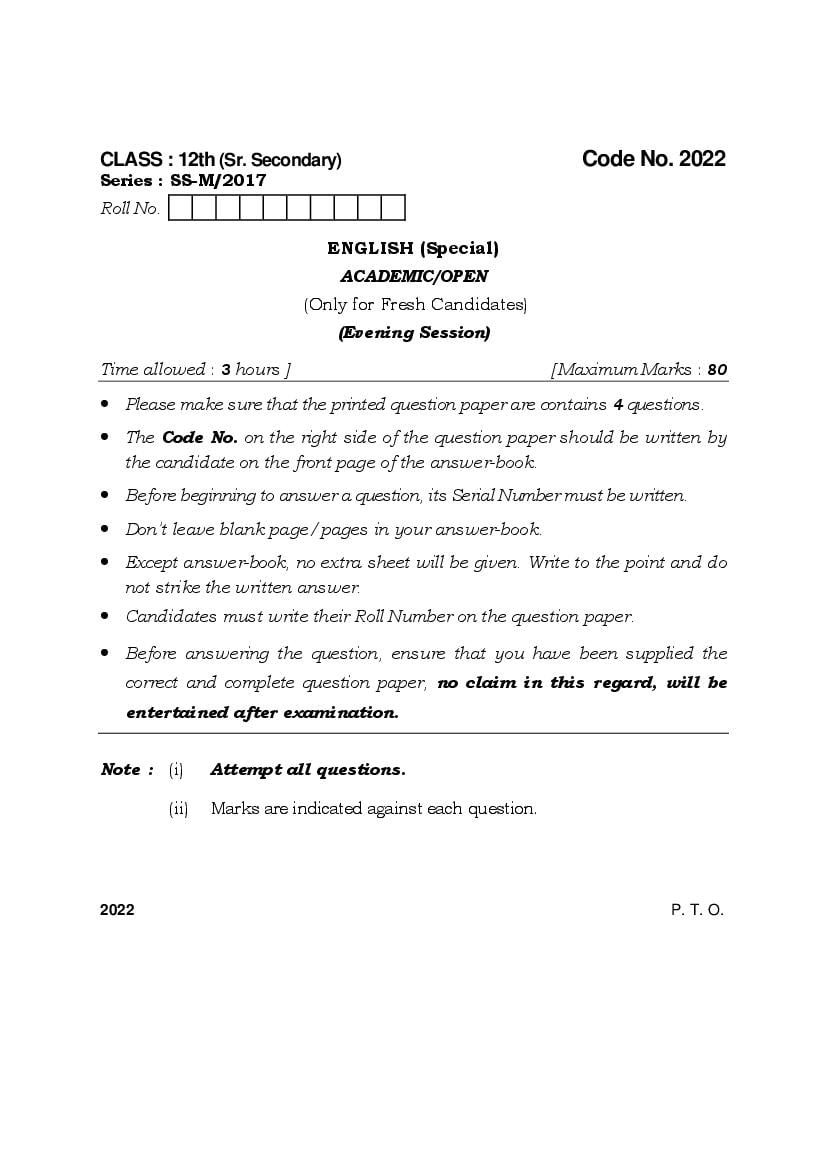
Series : SS-M/2017
Roll No.
ENGLISH (Special)
ACADEMIC/OPEN
(Only for Fresh Candidates)
(Evening Session)
Time allowed : 3 hours ] [ Maximum Marks : 80
• Please make sure that the printed question paper are contains 4 questions.
• The Code No. on the right side of the question paper should be written by
the candidate on the front page of the answer-book.
• Before beginning to answer a question, its Serial Number must be written.
• Don’t leave blank page / pages in your answer-book.
• Except answer-book, no extra sheet will be given. Write to the point and do
not strike the written answer.
• Candidates must write their Roll Number on the question paper.
• Before answering the question, ensure that you have been supplied the
correct and complete question paper, no claim in this regard, will be
entertained after examination.
Note : (i) Attempt all questions.
(ii) Marks are indicated against each question.
2022 P. T. O.
Page 2
1. Write a letter to a friend describing the celebration of Diwali Festival.
15
OR
Write a letter to your MC complaining about the supply of dirty
drinking water.
2. Write a paragraph in about 100 words on any one of the following : 15
(a) Role of education in poverty alleviation.
(b) Need for a systemic change in administration.
(c) Rat race for materialism.
(d) Your views about a modern society.
3. Write a paragraph in about 100 words on any one of the following : 15
(a) Too wrongs don't make a right.
(b) A golden key can open any door.
(c) A journey of a thousand miles begins with a step.
(d) A leopard cannot change its spots.
4. Make a precis of the following passage in about one-third of its original
length and suggest a suitable title : 35
2022
Page 3
What is the future which awaits our children ? The underlying
assumption of the question that Indian children have a common future
is itself dubious. It can legitimately be asked whether a student who is
well-fed, attending a boarding school in a city, and learning to use
computers has any future in common with a mal nourished child who
goes to a school with no black-boards, if indeed he goes to school. The
latter may have no worthwhile future at all. And it might be worthwhile
to analyse the significance of this marginalization of more than 75 per
cent of the children of this country.
The failure to provide an infrastructure for primary education in
the villages of India more than 60 years after Independence is in sharp
contrast with the sophisticated institutions, for technical institutes of
higher learning are funded by government with the money coming from
taxes –– both direct and indirect. Hence this financial burden is borne
by all the people. According to L. K. Jha, 25 paise of every rupee spent
on educating an IIT student comes from the pockets of those whose
children may never enter a proper classroom.
s
2022 P. T. O.
Document Details
| Board / Org | Haryana Board |
| Exam | Class 12 |
| Type | Question Paper |
| Pages | 3 |
| Updated | 22 Jul 2026 |