NCERT Book Class 12 Business Studies Chapter 6 Staffing
Finished viewing? Save it for later —
Download NCERT Book Class 12 Business Studies Chapter 6 Staffing (PDF · 30 pages)About NCERT Book Class 12 Business Studies Chapter 6 Staffing
NCERT Book Class 12 Business Studies Chapter 6 Staffing is available here for free download. Published by NCERT for Class 12, this books can be viewed online or downloaded as a PDF (30 pages). Candidates preparing for Class 12 can use NCERT Book Class 12 Business Studies Chapter 6 Staffing to understand the exam pattern, the type of questions asked, and the overall difficulty level.
Frequently Asked Questions
How can I download NCERT Book Class 12 Business Studies Chapter 6 Staffing?
Open this page and click the Download button to save NCERT Book Class 12 Business Studies Chapter 6 Staffing as a PDF. It is completely free on AglaSem Docs.
Is NCERT Book Class 12 Business Studies Chapter 6 Staffing free to download?
Yes. NCERT Book Class 12 Business Studies Chapter 6 Staffing can be viewed online and downloaded as a PDF free of cost on AglaSem Docs.
How many pages does NCERT Book Class 12 Business Studies Chapter 6 Staffing have?
NCERT Book Class 12 Business Studies Chapter 6 Staffing contains 30 pages, which you can read online or download together as a single PDF.
Where can I find more Class 12 study material?
You can find more Class 12 question papers, sample papers, syllabus, and answer keys on AglaSem Docs.
NCERT Book Class 12 Business Studies Chapter 6 Staffing – Text
Read the full text of this books below — useful to quickly search, copy and reference the content online without downloading the PDF.
📄 View text version (1 page)
Page 1
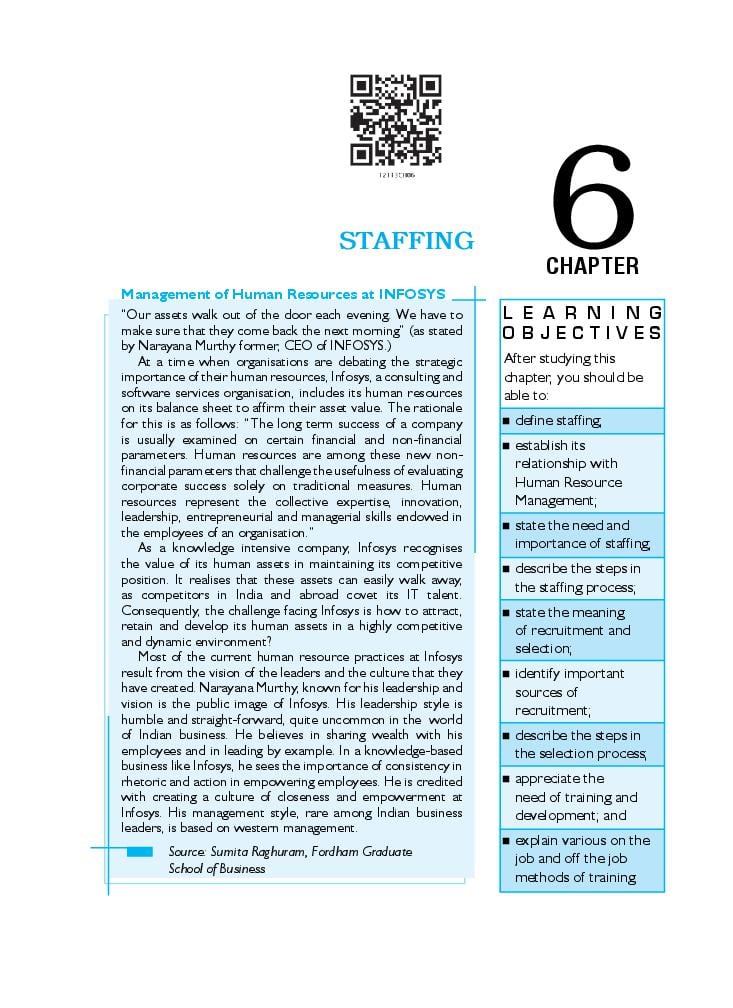
STAFFING
“Our assets walk out of the door each evening. We have to
6
CHAPTER
L E A R N I N G
make sure that they come back the next morning” (as stated OBJECTIVES
by Narayana Murthy former, CEO of INFOSYS.)
At a time when organisations are debating the strategic After studying this
importance of their human resources, Infosys, a consulting and chapter, you should be
software services organisation, includes its human resources able to:
on its balance sheet to affirm their asset value. The rationale
for this is as follows: “The long term success of a company n define staffing;
is usually examined on certain financial and non-financial n establish its
parameters. Human resources are among these new non-
financial parameters that challenge the usefulness of evaluating relationship with
corporate success solely on traditional measures. Human Human Resource
resources represent the collective expertise, innovation, Management;
leadership, entrepreneurial and managerial skills endowed in
n state the need and
the employees of an organisation.”
As a knowledge intensive company, Infosys recognises importance of staffing;
the value of its human assets in maintaining its competitive n describe the steps in
position. It realises that these assets can easily walk away,
as competitors in India and abroad covet its IT talent.
the staffing process;
Consequently, the challenge facing Infosys is how to attract, n state the meaning
retain and develop its human assets in a highly competitive of recruitment and
and dynamic environment?
selection;
Most of the current human resource practices at Infosys
result from the vision of the leaders and the culture that they n identify important
have created. Narayana Murthy, known for his leadership and sources of
vision is the public image of Infosys. His leadership style is
recruitment;
humble and straight-forward, quite uncommon in the world
of Indian business. He believes in sharing wealth with his n describe the steps in
employees and in leading by example. In a knowledge-based the selection process;
business like Infosys, he sees the importance of consistency in
rhetoric and action in empowering employees. He is credited n appreciate the
with creating a culture of closeness and empowerment at need of training and
Infosys. His management style, rare among Indian business development; and
leaders, is based on western management.
n explain various on the
Source: Sumita Raghuram, Fordham Graduate
job and off the job
School of Business
methods of training.
Showing the first page only. Download the PDF above for the complete document.
Document Details
| Board / Org | NCERT |
| Exam | Class 12 |
| Type | Books |
| Pages | 30 |
| Updated | 29 Aug 2026 |