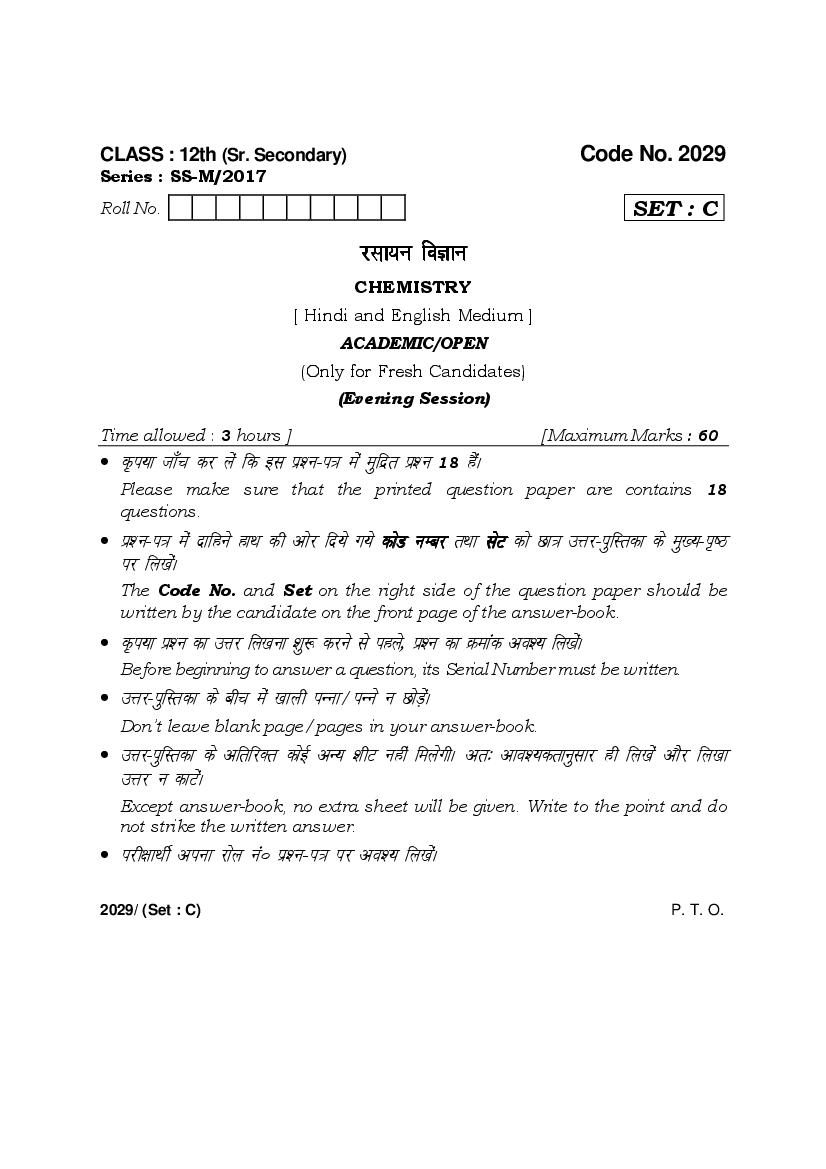
HBSE Class 12 Chemistry Question Paper 2017 Set C
Finished viewing? Save it for later —
Download HBSE Class 12 Chemistry Question Paper 2017 Set C (PDF · 13 pages)About HBSE Class 12 Chemistry Question Paper 2017 Set C
HBSE Class 12 Chemistry Question Paper 2017 Set C is available here for free download. Published by Haryana Board for Class 12, this question paper can be viewed online or downloaded as a PDF (13 pages). Candidates preparing for Class 12 can use HBSE Class 12 Chemistry Question Paper 2017 Set C to understand the exam pattern, the type of questions asked, and the overall difficulty level.
Frequently Asked Questions
How can I download HBSE Class 12 Chemistry Question Paper 2017 Set C?
Open this page and click the Download button to save HBSE Class 12 Chemistry Question Paper 2017 Set C as a PDF. It is completely free on AglaSem Docs.
Is HBSE Class 12 Chemistry Question Paper 2017 Set C free to download?
Yes. HBSE Class 12 Chemistry Question Paper 2017 Set C can be viewed online and downloaded as a PDF free of cost on AglaSem Docs.
How many pages does HBSE Class 12 Chemistry Question Paper 2017 Set C have?
HBSE Class 12 Chemistry Question Paper 2017 Set C contains 13 pages, which you can read online or download together as a single PDF.
Where can I find more Class 12 study material?
You can find more Class 12 question papers, sample papers, syllabus, and answer keys on AglaSem Docs.
HBSE Class 12 Chemistry Question Paper 2017 Set C – Text
Read the full text of this question paper below — useful to quickly search, copy and reference the content online without downloading the PDF.
📄 View text version (13 pages)
Page 1
Series : SS-M/2017
Roll No. SET : C
jlk;u foKku
CHEMISTRY
[ Hindi and English Medium ]
ACADEMIC/OPEN
(Only for Fresh Candidates)
(Evening Session)
Time allowed : 3 hours ] [ Maximum Marks : 60
• d`i;k tk¡p dj ysa fd bl iz'u-i= esa eqfnzr iz'u 18 gSaA
Please make sure that the printed question paper are contains 18
questions.
• iz'u-i= esa nkfgus gkFk dh vksj fn;s x;s dksM uEcj rFkk lsV dks Nk= mÙkj-iqfLrdk ds eq[;-i`"B
ij fy[ksaA
The Code No. and Set on the right side of the question paper should be
written by the candidate on the front page of the answer-book.
• d`i;k iz'u dk mÙkj fy[kuk 'kq: djus ls igys] iz'u dk Øekad vo'; fy[ksaA
Before beginning to answer a question, its Serial Number must be written.
• mÙkj-iqfLrdk ds chp esa [kkyh iUuk / iUus u NksMsa+A
Don’t leave blank page / pages in your answer-book.
• mÙkj-iqfLrdk ds vfrfjDr dksbZ vU; 'khV ugha feysxhA vr% vko';drkuqlkj gh fy[ksa vkSj fy[kk
mÙkj u dkVsaA
Except answer-book, no extra sheet will be given. Write to the point and do
not strike the written answer.
• ijh{kkFkhZ viuk jksy ua0 iz'u-i= ij vo'; fy[ksaA
2029/ (Set : C) P. T. O.
Page 2
Candidates must write their Roll Number on the question paper.
• d`i;k iz'uksa dk mÙkj nsus lss iwoZ ;g lqfuf'pr dj ysa fd iz'u-i= iw.kZ o lgh gS] ijh{kk ds
mijkUr bl lEcU/k esa dksbZ Hkh nkok Lohdkj ugha fd;k tk;sxkA
Before answering the question, ensure that you have been supplied the
correct and complete question paper, no claim in this regard, will be
entertained after examination.
lkekU;
lk ekU; funsZ'k %
(i) LkHkh iz'u vfuok;Z gSaA
(ii) izR;sd iz'u ds vad mlds lkeus n'kkZ, x, gSaA
(iii) ç'u la[;k 1 esa ckjg (i - xii) cgqfodYih; iz'u gSaA izR;sd 1 vad dk gSA ftuds lgh
mÙkj viuh mÙkj&iqfLrdk esa fy[kus gSaA
(iv) ç'u la[;k 2 ls 10 rd vfry?kq mÙkjh; ç'u gSaA çR;sd 2 vadksa dk gSA izR;sd iz'u
dk mÙkj yxHkx 30 'kCnksa esa nhft,A
(v) ç'u la[;k 11 ls 15 rd y?kq mÙkjh; ç'u gSaA çR;sd ç'u 3 vadksa dk gSA izR;sd iz'u
dk mÙkj yxHkx 40 'kCnksa esa nhft,A
(vi) ç'u la[;k 16 ls 18 rd nh?kZ mÙkjh; ç'u gSaA çR;sd ç'u 5 vadksa dk gSA izR;sd
iz'u dk mÙkj yxHkx 70 'kCnksa esa nhft,A
(vii) iz'u-i= esa lexz :i ls dksbZ fodYi ugha gSA rFkkfi 5 vadksa okys lHkh nh?kZ mÙkjh;
iz'uksa esa vkarfjd p;u iznku fd;k x;k gSA ,sls iz'uksa esa ls vkidks dsoy ,d gh iz'u
djuk gSA
General Instructions :
(i) All questions are compulsory.
(ii) Marks for each question are indicated against it.
(iii) Question Number 1 consists of twelve (i-xii) multiple choice questions
carrying 1 mark each. Candidates have to write the correct answer
in their answer-book.
2029/ (Set : C)
Page 3
(iv) Question Numbers 2 to 10 are very short answer type questions of 2
marks each. Answer these in about 30 words each.
(v) Question Numbers 11 to 15 are short answer type questions of 3
marks each. Answer these in about 40 words each.
(vi) Question Numbers 16 to 18 are long answer type questions of 5
marks each. Answer these in about 70 words each.
(vii) There is no over all choice. However, internal choice is given in all
long answer type questions of 5 marks each. You have to attempt
only one of the given choice in such questions.
1. (i) DoFkukad mUu;u fLFkjkad dh bdkbZ gS % 1
(A) K kg mol −1
(B) mol kg K −1
(C) K mol kg −1
(D) mijksDr esa ls dksbZ ugha
The unit of ebullioscopic constant is :
s(A) K kg mol −1
(B) mol kg K −1
(C) K mol kg −1
(D) None of the above
(ii) Al 2O 3 ls 1 eksy Al izkIr djus esa fdruh ek=k pktZ pkfg, \ 1
2029/ (Set : C) P. T. O.
Page 4
(A) 1F (B) 6F
(C) 3F (D) 2F
The quantity of charge required to obtain 1 mol of Al from
Al 2O 3 :
(A) 1F (B) 6F
(C) 3F (D) 2F
(iii) fuEu esa dkSu&lk dFku lR; gS \ 1
(A) ruq NaOH ds oS|qrvi?kVu ls dSFkksM ij H 2 rFkk ,suksM ij O 2 A
(B) H 2SO 4 ds oS|qrvi?kVu ls dSFkksM ij H 2 rFkk ,suksM ij O 2 A
(C) tyh; KF ds oS|qrvi?kVu ls dSFkksM ij F2 A
(D) mijksDr esa ls dksbZ ugha
Which of following statement is correct ?
(A) Electrolysis of dil NaOH gives H2 at cathode & O2 at anode.
(B) Electrolysis of H 2SO 4 gives H2 at cathode & O2 at anode.
(C) Electrolysis of aq KF solution gives F2 at cathode.
(D) None of the above
(iv) vkjsfu;l lehdj.k n'kkZbZ tkrh gS % 1
2029/ (Set : C)
Page 5
Ea / RT
(A) K = Ae
(B) K = Ae −Ea / RT
(C) t½ = 0.693 /K
(D) mijksDr esa ls dksbZ ugha
Arrhenius equation is represented by :
(A) K = Ae Ea / RT
(B) K = Ae −Ea / RT
(C) t½ = 0.693 /K
(D) None of the above
(v) dksykbMksa dk dkSu&lk xq.k pktZ ij fuHkZj ugha djrk \ 1
(A) dks,sX;wys'ku (B) bysDVªksvkleksfll
(C) fV.My izHkko (D) buesa ls dksbZ ugha
Which property of colloids is not dependent on the charge on
colloidal particles ?
(A) Coagulation (B) Electro-osmosis
(C) Tyndal effect (D) None of these
(vi) ukbVªkstu dh vf/kdre la;kstdrk gS % 1
(A) 3 (B) 5
2029/ (Set : C) P. T. O.
Page 6
(C) 4 (D) 6
Maximum covalency of Nitrogen is :
(A) 3 (B) 5
(C) 4 (D) 6
(vii) dkWij lYQsV vf/kd ek=k esa KCN esa ?kqydj cukrk gS %
1
(A) [Cu(CN )4 ]3 − (B) [Cu(CN )4 ] 2 −
(C) CuCN (D) [Cu(CN )2 ]
Copper sulphate dissolves in excess of KCN to give :
(A) [Cu(CN )4 ]3 − (B) [Cu(CN )4 ] 2 −
(C) CuCN (D) [Cu(CN )2 ]
(viii) ,Ydksgy dh fdlds lkFk fØ;k djds ,Ydkby gsykbM curs gSa \ 1
(A) HCl + ZnCl 2
(B) H 2SO 4 + KI
(C) NaCl + H 2SO 4
(D) mijksDr esa ls dksbZ ugha
Alkyl halides are prepared from alcohol by treating with :
(A) HCl + ZnCl 2
2029/ (Set : C)
Page 7
(B) H 2SO 4 + KI
(C) NaCl + H 2SO 4
(D) None of the above
(ix) dkcZfud ;kSfxd tks SN 2 fØ;k esa iw.kZ LVhfj;ksdsfedy bUolZu n'kkZrk gS %
1
(A) CH 3Cl
(B) (CH 3 )2CH − Cl
(C) (CH 3 )3 C − Cl
(D) mijksDr esa ls dksbZ ugha
Organic compound which shows complete stereochemical
inversion during SN 2 reaction :
(A) CH 3Cl
(B) (CH 3 )2CH − Cl
(C) (CH 3 )3 C − Cl
(D) None of the above
(x) bZFkj dk vkf.od lw= gS % 1
(A) Cn H 2n +1O (B) Cn H 2n O
(C) Cn H 2n + 2O (D) mijksDr esa ls dksbZ ugha
Molecular formula of Ethers is :
(A) Cn H 2n +1O (B) Cn H 2n O
2029/ (Set : C) P. T. O.
Page 8
(C) Cn H 2n + 2O (D) None of these
(xi) gkWQesu czksesekbM vi?kVu vfHkfØ;k esa gksrk gS % 1
(A) Ar − NH 2 (B) Ar − CONH 2
(C) Ar − NO 2 (D) buesa ls dksbZ ugha
Hoffman Bromamide degradation reaction involve :
(A) Ar − NH 2 (B) Ar − CONH 2
(C) Ar − NO 2 (D) None of these
(xii) vk;MksQkWeZ VsLV ugha nsrk gS % 1
(A) 2-isUVsuksu (B) 3-isUVsuksu
(C) ,FksukWy (D) ,FksuSy
Iodoform test is not given by :
(A) 2-Pentanone (B) 3-Pentanone
(C) Ethanol (D) Ethanal
2. izfrpqEcdRo D;k gS \ ,d mnkgj.k nhft,A 2
What is paramagnetism ? Give one example.
3. ,d FCC fØLVy esa d.kksa dh la[;k dh x.kuk dhft,A 2
2029/ (Set : C)
Page 9
Calculate number of particles per unit cell in a FCC crystal.
4. esVSfyd rFkk bysDVªksfyfVd pkyd esa nks vUrj nhft,A 2
Give two differences between metallic and electrolytic conductors.
5. /kukRed rFkk _.kkRed mRizsjdrk dh ifjHkk"kk nhft,A 2
Define positive and negative catalysis .
6. /kzqo.k leko;ork D;k gS \ ,d mnkgj.k lfgr O;k[;k dhft,A 2
What is optical isomerism ? Explain with one example.
7. oqV~tZ vfHkfØ;k D;k gS \ 2
What is Wurtz reaction ?
8. VkWywbZu dk ukbVªs'ku csUthu dh vis{kk vklkuh ls gksrk gSA O;k[;k dhft,A 2
Toluene is more easily nitrated than benzene. Explain.
9. ck;ksfMxzsMscy cgqyd D;k gS \ ,d mnkgj.k nhft,A 2
What is biodegradable polymer ? Give one example.
2029/ (Set : C) P. T. O.
Page 10
10. iwfrjks/kh rFkk folaØkeh dks ifjHkkf"kr dhft,A 2
Define antiseptics and disinfectants.
11. DoFkukad ds mUu;u dh la{ksi esa O;k[;k dhft,A 3
Briefly discuss elevation in boiling point.
12. izFke dksfV vfHkfØ;k ds fy, lekdfyr lehdj.k dh O;qRifÙk dhft,A 3
Derive the integrated rate equation for first order reaction.
13. v;Ldksa dk izlk/ku D;k gS \ Qsu Iyou fof/k dh O;k[;k dhft,A 3
What is benefaction of the Ores ? Explain froth floatation process.
14. fjej&fVeku vfHkfØ;k D;k gS \ 3
What is Reimer-Tiemann reaction ?
15. izksVhu ds fMuspqj's ku ij laf{kIr fVIi.kh fyf[k,A 3
Write short note on denaturation of proteins.
16. ,fDVukW;M rFkk ySUFksukW;M Js.kh ds rRoksa dh] fuEu ds lanHkZ esa jlk;u dh rqyuk dhft, % 5
Compare the chemistry of actinoids with that of lanthanoids with
special reference to :
2029/ (Set : C)
Page 11
(i) ijek.oh; vkdkj
Atomic sizes
(ii) jklk;fud vfHkfØ;k'khyrk
Chemical reactivity
vFkok
OR
fuEu ds fy, vki x.kuk dSls djsaxs \
How would you account for the following ?
(i) laØe.k /kkrq,¡ vPNh mRizsjd gSaA 3
Transition metals acts as good catalysts.
(ii) laØe.k /kkrq,¡ jaxhu ;kSfxd cukrh gSaA 2
Transition metal forms coloured compounds.
17. (a) PH 3 dk DoFkukad NH 3 dh vis{kk de gksrk gSA D;ksa \
3
PH3 has lower boiling point than NH3, explain why ?
2029/ (Set : C) P. T. O.
Page 12
(b) PCl 3 ueh esa /kwe D;ksa nsrk gS \ 2
Why does PCl 3 fumes in moisture ?
vFkok
OR
(a) H 2O ,d nzo rFkk H 2S xSl D;ksa gS \ 3
Why is H 2O a liquid and H 2S a gas ?
(b) Cl 2 ds fojatd fØ;k dh O;k[;k dhft,A 2
Explain the bleaching action of Cl 2 .
18. (a) fuEu dh dkcksZfuy xzqi ds lkFk jklk;fud vfHkfØ;k fyf[k, % 3
(i) H 2O
(ii) HCN
(iii) Na + HSO 3−
Write the chemical reaction of carbonyl group with :
(i) H 2O
(ii) HCN
(iii) Na + HSO 3−
2029/ (Set : C)
Page 13
(b) gsy oksykMZ ftysUldh vfHkfØ;k D;k gS \ 2
What is Hell Vohlard Zelinsky reaction ?
vFkok
OR
(a) fÝMy ØkW¶V ,Ydkbys'ku vfHkfØ;k dh O;k[;k dhft,A 3
Discuss the Friedel Crafts alkylation reaction.
(b) dkcksZfDlfyd vEy ds nks egÙoiw.kZ mi;ksx nhft,A 2
Give two important uses of carboxylic acids.
S
2029/ (Set : C) P. T. O.
Document Details
| Board / Org | Haryana Board |
| Exam | Class 12 |
| Type | Question Paper |
| Pages | 13 |
| Updated | 22 Jul 2026 |