JKBOSE Class 10 Syllabus 2025
Finished viewing? Save it for later —
Download JKBOSE Class 10 Syllabus 2025 (PDF · 92 pages)About JKBOSE Class 10 Syllabus 2025
JKBOSE Class 10 Syllabus 2025 is available here for free download. Published by JKBOSE for Class 10, this syllabus can be viewed online or downloaded as a PDF (92 pages). Candidates preparing for Class 10 can use JKBOSE Class 10 Syllabus 2025 to understand the exam pattern, the type of questions asked, and the overall difficulty level.
Frequently Asked Questions
How can I download JKBOSE Class 10 Syllabus 2025?
Open this page and click the Download button to save JKBOSE Class 10 Syllabus 2025 as a PDF. It is completely free on AglaSem Docs.
Is JKBOSE Class 10 Syllabus 2025 free to download?
Yes. JKBOSE Class 10 Syllabus 2025 can be viewed online and downloaded as a PDF free of cost on AglaSem Docs.
How many pages does JKBOSE Class 10 Syllabus 2025 have?
JKBOSE Class 10 Syllabus 2025 contains 92 pages, which you can read online or download together as a single PDF.
Where can I find more Class 10 study material?
You can find more Class 10 question papers, sample papers, syllabus, and answer keys on AglaSem Docs.
JKBOSE Class 10 Syllabus 2025 – Text
Read the full text of this syllabus below — useful to quickly search, copy and reference the content online without downloading the PDF.
📄 View text version (92 pages)
Page 1
ACADEMIC SESSION
2024-25
for U.T of J&K
and U.T of Ladakh
Page 2
1 Scheme of Studies 3
2 Structure of Scheme of Assessment 4-7
3 General English 8-14
4 Hindi 15-18
5 Urdu (From Right to Left) 19-24
6 Mathematics 25-28
7 Social Science (History, Political Science, Geography, Economics, 29-38
Disaster Management and Road Safety Education)
8 Science (Physics, Chemistry, Biology) 39-47
9 Computer Science 48-51
10 Dogri 52
11 Sanskrit 53-54
12 Bhoti 55-59
13 Punjabi 60-62
14 Persian (From Right to Left) 63-64
15 Arabic 65-66
16 Kashmiri (From Right to Left) 67-70
17 Health and Physical Education 71-78
18 Art Education 79
19 Painting 80-81
20 Music 82-83
21 Home Science 84-86
22 Art and Drawing 87-88
23 Work Experience 89-90
24 Vocational Subjects Available on
website
1
Page 3
Page 4
Every candidate shall be required to take up all the compulsory five subjects to pass/ qualify
Class X from the course listed below.
(A) Compulsory Subjects:
General English
Urdu or Hindi
Mathematics
Social Science (History, Political Science, Geography, Economics, Disaster Management
and Road Safety Education)
Science (Physics, Chemistry, Biology)
In addition, Student can also opt one Additional/ Optional language subject from the following:
(B) Additional / Optional language Subjects:
1. Urdu 2. Kashmiri
3. Arabic 4. Persian
5. Hindi 6. Dogri
7. Sanskrit 8. Bhoti
9. Punjabi
Note: No repetition of compulsory language/ subject is allowed while opting for Additional/ Optional
language/ subject.
Student can opt one additional/ optional subject from the following:
(C) Additional/ Optional Subjects
Vocational Subjects
Computer Science (Non- Vocational)
(D) Activity Related Areas:
Work Experience
Health and Physical Education
Art Education
(E) Choice of Subjects for Children with Special Needs (CWSN):
Apart from General English as Compulsory Subject, CWSN can opt for Alternative Courses from the list given
below
Painting
Music
Art and Drawing
Home Science
Computer Science
Note: The CWSN candidate can opt either for Painting or Art and Drawing subject.
3
Page 5
The Assessment scheme for all the compulsory/main subjects carrying 100 Marks shall have an
80 marks component for Board Examination as per the assessment scheme and a 20 marks
component for Internal Assessment.
Assessment Structure for Internal Assessment of 20 marks
Learner assessment is a continuous process and an integral part of teaching learning. The purpose
of internal assessment is to improve the learning levels of the children and decrease the examination fear
that haunts a good number of children, if not completely defeated. The Assessment should be
competency-based, which promotes learning and produce holistic development of students, and tests
higher-order skills, such as inference and interpretation analysis, critical thinking, and conceptual clarity.
Teachers must assess learners at each stage of the learning process which will help them to focus
on individual needs of learners for better performance. In order to empower schools and the teachers by
providing some kind of autonomy in the assessment process, JKBOSE has decided to give internal
weightage of 20 Marks for all the main compulsory subjects offered at Secondary Level. The locus is
school and focus shall be teaching-learning. The school-based assessment will play the dual role of
providing a complete picture of students’ abilities or progress towards fulfilling the aims of education and
informing the teachers of student’s progress and therefore supporting classroom learning. It shall also
inform the learners about their progress over a period of time enabling them to develop strategies to
improve learning.
The teachers should use different assessment strategies that connect teaching, learning and
assessment to real life situation to assess and provide feedback on activities, surveys, demonstrations, role
plays, project works, assignments, presentations, innovations etc. in such a way that the learner doesn’t
feel that his/ her performance is being evaluated.
In order to carry the said assessment in effective and desired manner, the following scheme for the same
shall be followed:
Internal assessment shall carry 20 marks comprising the following parts:
1. Periodic Assessment
2. Portfolio
3. Subject Enrichment Activity
1) Periodic Assessment
The periodic assessment shall carry 10 marks.
These 10 marks shall further be divided into two parts
(I) Pen and Paper Assessment
(II) Multiple Assessment
4
Page 6
This involves the pen & paper class evaluation. The exam shall be taken by the concerned subject teacher
of the concerned subject during class room transaction. The questions should be mainly short answer type.
The student shall maintain separate test notebooks, which shall be kept as a record in the school after they
are shown to the students and parents for transparency.
The teachers should mark the test copies and declare the result not later than 4 days from the test. It will
be the Teachers duty to supervise and keep the records.
The result should be communicated to the students and parents through a report card (School Based
Evaluation Card). The schools shall be closely monitored with regard to school based assessment. The
tests may cover the topics covered in each subject during the period in question as per the unit-wise
division of syllabus.
[Note: Average of the tests would be taken and reduced to the weightage of only 5 marks for final
submission of marks).
(II) Multiple Assessments (5 Marks)
Multiple assessments approach relevant to particular learning results are advised throughout the curriculum
transaction. The teacher can make use of Quizzes, Oral Tests, Class discussions, Field-work, Visual
Representation, Concept Maps, Exit Cards, and Visual Expression etc.
2. PORTFOLIO (5 Marks)
The portfolio is proposed to broaden the scope of learning and achieve learning outcomes by
examining a range of children’s performances and abilities. Its use is being recommended as a support to
the new instructional approaches that emphasize student’s role in constructing knowledge and
understanding.
A portfolio is generally a collection of purposely chosen work showing a range of performances
that are collected over time and that represents the efforts, progress, growth and accomplishment
in key areas learning outcomes.
Suggested elements to judge portfolio
Organisation - Neatness and Visual Appeal
Completion of guided work focussed on specific curricular objectives
Evidence growth
Inclusion of all relevant work (Completeness)
5
Page 7
Tools
S.No. Apr May Jun July Aug Sept Oct. Nov Dec Jan Feb Mar
A*/B*/C* A/B/C A/B/C A/B/C
1 Worksheets
2 Essays
3 Projects
4 Models
5 Map work
6 Observation
7 Pictures
8 Experiences
9 Anecdotal
records
*A, *B, *C depicts grades
Note: Portfolios should be developed in an easy way. They should be meaningful, though,
simple and easily accessible and should not be a burden on students- both in terms of cost and
time.
3. SUBJECT ENRICHMENT (5 Marks)
The Subject Enrichment Activities must be conducted with rigor and focus on the below
suggested as follows:
Languages provide ample space and autonomy to subject teachers to develop relevant listening
and speaking skills. Teachers need to use this opportunity to full advantage and use excerpts from
relevant suitable literature to develop vocabulary and heighten students’ awareness and sensitivity.
The specified activities in practical work in Science and Mathematics need to be conducted in
the investigatory spirit incongruence to the spirit of the subject. The focus must shift from
confirmatory nature of lab experiments to explorations that focus on the development of science
processes.
Students need to be encouraged to raise questions, generate hypotheses, experiment, innovate and
find solutions to questions/problems encountered.
The discipline of Social Science puts the responsibility on concerned teachers to help students to
design and execute related projects, relevant to the social context, and development of Life
Skills.
6
Page 8
The Internal Assessment will have the following three grading scale
MARKS RANGE GRADE
14-20 A
7-13 B
Below 7 C ( To improve)
Note:
The concerned head of the Institution / subject teacher shall ensure to maintain the complete
record of the internal parameter-wise components of all the students individually for any future
clarifications.
7
Page 9
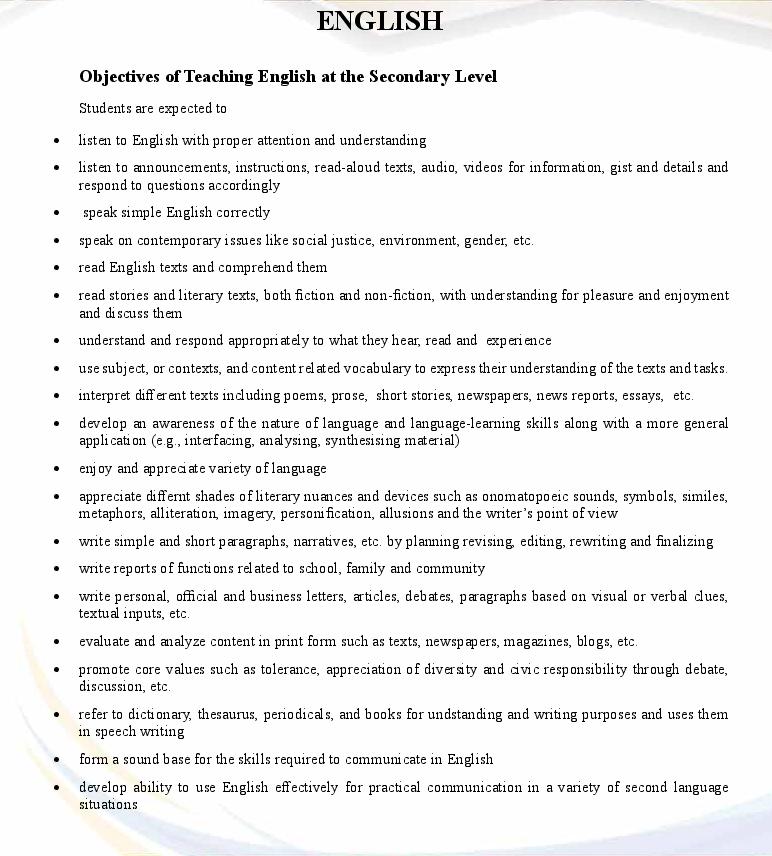
Objectives of Teaching English at the Secondary Level
Students are expected to
listen to English with proper attention and understanding
listen to announcements, instructions, read-aloud texts, audio, videos for information, gist and details, and
respond to questions accordingly
speak simple English correctly
speak on contemporary issues like social justice, environment, gender, etc.
read English texts and comprehend them
read stories and literary texts, both fiction and non-fiction, with understanding for pleasure and enjoyment
and discuss them
understand and respond appropriately to what they hear, read and experience
use subject, or contexts, and content related vocabulary to express their understanding of the texts and tasks.
interpret different texts including poems, prose, short stories, newspapers, news reports, essays, etc.
develop an awareness of the nature of language and language-learning skills along with a more general
application (e.g., interfacing, analysing, synthesising material)
enjoy and appreciate variety of language
appreciate different shades of literary nuances and devices such as onomatopoeic sounds, symbols,
similes, metaphors, alliteration, imagery, personification, allusions and the writer’s point of view
write simple and short paragraphs, narratives, etc. by planning revising, editing, rewriting and finalizing
write reports of functions related to school, family and community
write personal, official and business letters, articles, debates, paragraphs based on visual or verbal clues,
textual inputs, etc.
evaluate and analyze content in print form such as texts, newspapers, magazines, blogs, etc.
promote core values such as tolerance, appreciation of diversity and civic responsibility through debate,
discussion, etc.
refer to dictionary, thesaurus, periodicals, and books for understanding and writing purposes and uses
themin speech writing
form a sound base for the skills required to communicate in English
develop ability to use English effectively for practical communication in a variety of second language
situations
8
Page 10
Listening
Speaking
Reading
Writing
Listening
While listening students should be able to
comprehend discourse such as lectures, conversations, interviews, and discussions
make notes and use them in answering questions about the passage
distinguish relevant from irrelevant information
identify the topic and the main idea in it
comprehend relationships between ideas
make inferences about spoken discourse
Speaking
Speaking should enable students to
produce appropriate vocabulary
day-to-day conversation in English
produce accurate grammatical forms
give an oral presentation in class using effective delivery strategies.
present facts, ideas or opinions in an orderly sequence.
make relevant comments on what is heard, seen or read
describe experience in simple and express intelligibly what is thought or imagined
respond appropriately in a particular situation.
speak audibly with appropriate tone, intonation and pace
develop adequate speaking skills to communicate effectively to get engaged in meaningful
conversations
Reading / Writing: Only a few tasks shall be set to test the reading skill. The skills of reading and writing shall be
tested in an integrated manner to reflect the way in which language is actually used. This is to allow writing tasks
to be stimulated by authentic reading texts rather than seeing the two activities as diverse elements. However, a
few tasks may be set to test the reading skill exclusively.
Reading
Reading should enable students to
scan for and extract specific information from different texts (at least from the prescribed textbooks)
organise the relevant information and present it in a logical manner/ given format
identify the main idea(s) in the text
identify specific details
discern main idea(s) from given information
9
Page 11
draw inferences based on information in the text
decode meanings of words in context
understand meanings of unfamiliar words
identify author’s purpose and tone
Writing
The skill of writing should enable students to
write in a simple way
learn to use words economically
write sentences with simplicity and clarity
organise ideas and write short and coherent paragraphs
write texts, such as writing an essay, short letters, outline of short stories, paragraphs, reports,
articles, speech, etc.
paraphrase and summarise in an appropriate form in response to a written- stimulus
use words in their proper contexts
use appropriate vocabulary
use a variety of accurate sentence structures;
use accurate grammatical structures
Assessment in Listening and Speaking Skills Guidelines for
Internal Assessment 20 Marks
Apart from the prescribed textbook, the subject teachers can plan their own activities and create their own
material for assessing the listening and speaking skills.
Language learning projects / activities should not be confined to classroom teaching only but
should enable the students to engage with real life situations. The format and the variety of
activitiesshould be extensive.
The internal assessment based on different activities should be evaluated by the teacher
throughout the academic session. It may be preserved for three months after the declaration of
results for checking by the Board
Suggested Activities
The suggested activities aim to improve the communication skills and personality of the students. These
should be followed by individual, peer and group talk.
10
Page 12
films
Listening to phone calls
Model Reading by teacher
Storytelling
Narrating incidents
Interviews
Group Discussions and Talk Shows
Role plays
Debates / Presentations
Convening meetings/talks in informal situations such as going to the shopkeeper, describing real
time events like festivals and matches, picnics, vacations and travelogue
Assessment
Learner assessment is a continuous process and an integral part of teaching learning. The purpose of internal
assessment is that the learning levels of the children improves the examination scare that haunts a good number of
children is decreased if not completely defeated. The Assessment should be competency-based, promotes learning
and development for students, and tests higher-order skills, such as analysis, critical thinking, and conceptual
clarity
The teachers should use different assessment strategies that connect teaching, learning and assessment to real life
settings and to assess and provide feedback on activities, surveys, demonstrations, role plays, project works,
assignments, presentations, innovations etc. in such a way that the learner doesn’t feel that his/ her performance is
being evaluated. Please refer to the structure of assessment given in the preliminary pages. Points related to
English language learning be also assessed.
Parameters for Assessment
Interactive competence (initiation, turn taking, relevance to the topic)
Use and delivery of words and expressions (coherence and speed of delivery)
Vocabulary and Grammar (clarity, simplicity and precision)
Pronunciation (accent, fluency)
11
Page 13
Page 14
Theory Paper= 80 Marks
Internal Assessment= 20 Marks
Tulip Series Book X, A Textbook of English for Class X
Section A
Reading Comprehension 15 Marks
1. One seen stanza from the poems to be attempted followed by MCQs based on comprehension, literary devices,
inference, etc. from the prescribed text. 1 x 5 = 5 Marks
2. One unseen passage of about 400 to 500 words to be attempted followed by MCQs, comprehension questions (SA or
VSA), providing suitable title to the passage, one-word substitution, vocabulary, inference, analysis, etc
1x 5= 5 Marks
3. One question based on pictures/statistical data/bar graphs/pie charts/ histograms to be attempted followed by MCQs
and SA/VSA questions based on inference, analysis, evaluation, etc. 1x5= 5 Marks
Section B
Grammar 10 Marks
Modals, Articles, Relative Clauses, Tenses, Narration, Punctuation
• One passage with blanks to be filled by using appropriate articles, modals, relative pronouns etc.
3 Marks
• One passage given in direct/indirect speech to be converted inversely. 3 Marks
• One contextualized passage/ story/ paragraph to be edited testing the use of tenses, punctuation,
articles, pronouns, spellings etc 4 Marks
Section C
Writing Skills 25 Marks
• Create/Write dialogues on given situation with the help of hints. 4 Marks
• One question to be attempted on notice writing with the help of hints. (50 words). 3 Marks
• One question to be attempted on message writing with the help of hints (50words). 2 Marks
• One letter to be attempted out of the given two (formal/informal). 5 Marks
• One speech/ article /paragraph to be attempted on a given topic out of two.
The hint words will be given. (80 -100 words) 5 marks
• A creative story to be developed out of the given hints and also to suggest a suitable title. 6 marks
1213
Page 15
Page 16
15
Page 17
Page 18
17
Page 19
18
Page 20
Page 21
Page 22
Page 23
Page 24
Page 25
Page 26
Total Marks 100 Time: 3 Hours
(External 80 Marks)
(Internal 20 Marks)
Unit :- I Number Systems 06 Marks
Unit : II Algebra 20 Marks
Unit : III Coordinate Geometry 06 Marks
Unit :IV Geometry 15 Marks
Unit :V Trigonometry 12 Marks
Unit :VI Mensuration 10 Marks
Unit :VII Statistics and Probability 11 Marks
TOTAL 80 Marks
UNIT 1:- NUMBER SYSTEMS
1. REAL NUMBER (15) Periods
Fundamental Theorem of Arithmetic - statements after reviewing work done earlier and after illustrating and
motivating through examples, Proofs of irrationality of
UNIT II: ALGEBRA
1. POLYNOMIALS (8) Periods
Zeros of a polynomial. Relationship between zeros and coefficients of quadratic polynomials.
2. PAIR OF LINEAR EQUATIONS IN TWO VARIABLES (15) Periods
Pair of linear equations in two variables and graphical method of their solution, consistency/inconsistency.
Algebraic conditions for number of solutions. Solution of a pair of linear equations in two variables algebraically –
by substitution, by elimination. Simple situational problems.
3. QUADRATIC EQUATIONS (15) Periods
2
Standard form of a quadratic equation ax + bx + c = 0, Solutions of quadratic equations (only real roots) by
factorization, and by using quadratic formula. Relationship between discriminant and nature of roots. Situational
problems based on quadratic equations related to day to day activities to be incorporated.
4. ARITHMETIC PROGRESSIONS (10) Periods
Motivation for studying Arithmetic Progression Derivation of the nth term and sum of the first n terms of A.P. and
their application in solving daily life problems.
25
Page 27
Coordinate Geometry (15) Periods
Review: Concepts of coordinate geometry, graphs of linear equations. Distance formula. Section formula (internal
division).
UNIT IV: GEOMETRY
1. TRIANGLES (15) Periods
Definitions, examples, counter examples of similar triangles.
1. (Prove) If a line is drawn parallel to one side of a triangle to intersect the other two sides in distinct points, the other
two sides are divided in the same ratio.
2. (Motivate) If a line divides two sides of a triangle in the same ratio, the line is parallel to the third side.
3. (Motivate) If in two triangles, the corresponding angles are equal, their corresponding sides are proportional and the
triangles are similar.
4. (Motivate) If the corresponding sides of two triangles are proportional, their corresponding angles are equal and the
two triangles are similar.
5. (Motivate) If one angle of a triangle is equal to one angle of another triangle and the sides including these angles are
proportional, the two triangles are similar.
2. CIRCLES (10) Periods
Tangent to a circle at, point of contact
1. (Prove) The tangent at any point of a circle is perpendicular to the radius through the point of contact.
2. (Prove) The lengths of tangents drawn from an external point to a circle are equal.
UNIT V: TRIGONOMETRY
1. INTRODUCTION TO TRIGONOMETRY (10) Periods
Trigonometric ratios of an acute angle of a right-angled triangle. Proof of their existence (well defined); motivate the
ratios whichever are defined at 0o and 90o. Values of the trigonometric ratios of 30o, 450 and 600. Relationships between
the ratios.
2. TRIGONOMETRIC IDENTITIES (15) Periods
Proof and applications of the identity sin2A + cos2A = 1. Only simple identities to be given.
26
Page 28
Angle of elevation, Angle of Depression. Simple problems on heights and distances. Problems should not involve more
than two right triangles. Angles of elevation / depression should be only 30°,45°, and 60°.
UNIT VI: MENSURATION
1. AREAS RELATED TO CIRCLES (12) Periods
Area of sectors and segments of a circle. Problems based on areas and perimeter / circumference of the above said plane
figures. (In calculating area of segment of a circle, problems should be restricted to central angle of 60°, 90° and 120°
only.
2. SURFACE AREAS AND VOLUMES (12) Periods
Surface areas and volumes of combinations of any two of the following: cubes, cuboids, spheres, hemispheres and right
circular cylinders/cones.
UNIT VII: STATISTICS AND PROBABILITY
1. STATISTICS (18) Periods
Mean median and mode of grouped data (bimodal situation to be avoided).
2. PROBABILITY (10) Periods
Classical definition of probability. Simple problems on finding the probability of an event.
27
Page 29
QUESTION PAPER DESIGN
CLASS 10TH
Time: 3 Hours M. Marks: 80
S. No. Typology of Questions %
Total
Weightage
Marks
(approx.)
Remembering: Exhibit memory of previously learned material by
recalling facts, terms, basic concepts, and answers.
43 54
1
Understanding: Demonstrate understanding of facts and ideas by
organizing, comparing, translating, interpreting, giving descriptions, and
stating main ideas
Applying: Solve problems to new situations by applying acquired 19 24
2
knowledge, facts, techniques and rules in a different way.
Analysing :
Examine and break information into parts by identifying motives or causes.
Make inferences and find evidence to support generalizations
Evaluating:
Present and defend opinions by making judgments about information,
validity of ideas, or quality of work based on a set of criteria. 18 22
3
Creating:
Compile information together in a different way by combining elements in
a new pattern or proposing alternative solutions
80 100
Total
INTERNAL ASSESSMENT 20 MARKS
Pen Paper Test and Multiple Assessment (5+5) 10 Marks
Portfolio 05 Marks
Lab Practical (Lab activities to be done from the prescribed books) 05 Marks
28
Page 30
Total Marks 100 Time: 3 Hours
(External 80 Marks)
(Internal 20 Marks)
S.No Titles Periods Theory Internal Assessment
(Marks) (Marks)
1. India and the Contemporary World – II 65 25
(HISTORY)
2 Contemporary India –II 55 20
(GEOGRAPHY)
3 Democratic Politics – II 40 20
(POLITICAL SCIENCE ) 20
4 Economics, 40 15
Disaster Management and Road Safety Education
. 200 80
Title 1: India and the Contemporary World – II (HISTORY)
Themes Learning Objectives Total Total
Periods Marks
65 25
Breakup of Breakup of
periods marks
Section 1: Events and Processes:
14 06
A. The Rise of Nationalism in Europe: Enable the learners to
identify and comprehend
the forms in which
The French Revolution and the Idea of the Nation
nationalism developed
The Making of Nationalism in Europe along with the formation of
The Age of Revolutions:1830-1848 nation states in Europe in
The Making of Germany and Italy the post-1830period.
Visualizing the Nation Establish the relationship
and bring out the difference
Nationalism and Imperialism between European
nationalism and anti
colonial nationalisms.
Understand the way
the idea of nationalism
emerged and led to the
formation of nation states in
Europe and elsewhere.
29
Page 31
Recognize the 10 05
The First World War, Khilafat and Non – characteristics of Indian
Cooperation nationalism through
Differing Strands within the Movement a case study of Non-
Non-Cooperation Movement in Jammu and Cooperation and Civil
Kashmir Disobedience Movement
Towards Civil Disobedience Analyze the nature
The Sense of Collective Belonging of the diverse social
Cultural awakening and Growth of nationalism in
movements of the time.
Jammu & Kashmir Region.
Familiarize with the
writings and ideals of
different political groups
and individuals.
Section 2: Livelihoods, Economies and Societies: Appreciate the ideas 13 06
Any one of the following: promoting Pan Indian
A. The Making of a Global World: belongingness.
The Pre-modern world Show that globalization
The Nineteenth Century (1815-1914) has a long history and
The Case of Begar (Forced Labour in Kashmir) point to the shifts within
The Inter war Economy the process.
Rebuilding a World Economy: The Post- War Analyze the implication
Era of globalization for local
economies.
OR Discuss how
globalization is
B. The Age of Industrialization: experienced differently 11
Before the Industrial Revolution by different social
Hand Labour and Steam Power groups.
Industrialization in the colonies Familiarize with the Pro-
Factories Come Up to Industrial phase and
Growth of Industries in Jammu and Kashmir Early – factory system.
The Peculiarities of Industrial Growth Familiarize with
Market for Goods the process of
industrialization and its
impact on labour class.
Enable them
to understand
industrialization in the
colonies with reference
to Textile industries.
30
Page 32
A. Print Culture and the Modern World: print culture and the 05
12
The First Printed Books circulation of ideas.
Print Comes to Europe Familiarize with pictures,
The Print Revolution and its Impact cartoons, extracts from
The Reading Mania propaganda literature
The Nineteenth Century and newspaper debates on
India and the World of Print important events and
Vibrant manuscript culture and Print technology in issues in the past.
J&K under the Dogra Ruler Maharaja Ranbir Understand that forms of
Singh writing have a specific
Religious Reform and Public Debates history and that they
New Forms of Publication reflect historical changes
Portrayal of Women in J&K within society and shape
Print and Censorship the forces of change.
Growth of Press in J&K
Section 4: Modernisation
Modernization of Erstwhile Jammu & To understand the impact
Kashmir State. about various initiatives 05 03
taken in different fields in
A. Post Independence Era :Jammu and Kashmir on Post Independence Era.
the path of Modernisation To analyze the impact of
different initiatives taken
First Phase (1947-1965)
Second Phase (1965- 1982)
Third Phase
Title 2: Contemporary India – II (GEOGRAPHY) Total Total
Periods Marks
55 20
Themes Learning Objectives Breakup of Breakup of
Periods Marks
1. Resources and Development: Understand the valueof 09 05
Development of Resources resources and
Resource Planning in India the need for their
Land Resources judicious utilization and
Land Utilization conservation
Land Use Pattern in India
Land Degradation and Conservation Measures
Soil as a Resource
Classification of Soils
Soil Erosion and Soil Conservation
(Excluded Topic: Types of Resources)
31
Page 33
(To be assessed in Periodic tests) importance of forests
Types of Resources Biodiversity or Biological and wild life in one
Diversity environment as well as
Vanishing Forests develop concept towards
Asiatic Cheetah: Where did they go? depletion of resources
Conservation of forest & wildlife in India
Project Tiger
Types and distribution of forests and wildlife
resources
Community and Conservation
(Excluded Topics: Flora and Fauna in India, The
Himalayan Yew in Trouble)
3. Water Resources: * Comprehend the 07
(To be assessed in Periodic tests) importance of water
Water Scarcity and The Need for Water as a resource as well
Conservation and Management as develop awareness
Multi-Purpose River Projects and Integrated towards its judicious use
Water Resources Management and conservation.
Rainwater Harvesting
4. Agriculture: Identify various types 11 05
Types of farming of farming and discuss
Cropping Pattern the various farming
Major Crops methods; describe the
Technological and Institutional Reforms spatial distribution of
major crops as well
(Excluded Topics: Contribution of agriculture to the as understand the
national economy, employment and output, Impact of relationship between
globalisation on agriculture)
rainfall regimes and
cropping pattern.
Explain various
government policies for
institutional as well as
technological reforms
since independence.
32
Page 34
What is a mineral? Identify different types
Mode of occurrence of Minerals of minerals and energy 09 04
Ferrous and Non-Ferrous Minerals resources and places of
Non-Metallic Minerals their availability
Rock Minerals Feel the need for their
Conservation of Minerals judicious utilization
Energy Resources
Conventional and Non- Conventional
Conservation of Energy Resources
6. Manufacturing Industries: Bring out the importance
Importance of manufacturing of industries in the
Industrial Location national economy as 07 03
Classification of Industries well as understand the
Spatial distribution regional disparities
Industrial pollution and environmental which resulted due
degradation. to concentration of
Control of environmental degradation. industries in some areas.
Discuss the need for
Excluded Topics a planned industrial
(Contribution of industry to national economy, development and
paragraphs from cotton textiles, Jute textiles, Sugar
industry, Iron Steel industry, Cement industry)
debate over the role of
government towards
sustainable development.
7. Life Lines of National Economy: Explain the importance 06 03
Transport, Roadways, Railways, Pipelines, of transport and
Waterways, Airways communication in the
Communication ever- shrinking world.
International Trade
Understand the role of
Tourism as a Trade
trade and tourism in the
economic development
of a country.
33
Page 35
Themes Learning Objectives Breakup of Periods Breakup of
Marks
1. Power Sharing: Familiarize with the 07 05
Case Studies of Belgium and Sri Lanka centrality of power sharing
Why power sharing is desirable? in a democracy.
Forms of Power Sharing Understand the working
of spatial and social power
sharing mechanisms
2. Federalism: Analyse federal provisions 07 05
What is Federalism? and institutions.
What make India a Federal Country? Explain decentralization
How is Federalism practiced? in rural and urban areas.
Decentralization in India
3. Gender, Religion and Caste: Identify and analyse 07 03
Gender and Politics the challenges posed by
Religion, Communalism and Politics communalism to Indian
Caste and Politics Democracy.
Recognize the enabling
and disabling effects of
caste and ethnicity in
politics.
Develop a gender
perspective on politics
4.Political Parties: Analyse party systems in 07 03
democracies.
Why do we need Political Parties? Introduction to major
How many Parties should we have? political parties,
National Political Parties
State Parties challenges faced by
Challenges to Political Parties them and reforms in the
How can Parties be reformed? country.
5. Outcomes of Democracy: Evaluate the functioning 06 02
How do we assess democracy’s of democracies in
Outcomes? comparison to alternative
Accountable, responsive and forms of governments.
legitimate government
Economic growth and development Understand the causes
Reduction of inequality and poverty for continuation of
Accommodation of social diversity democracy in India.
Dignity and freedom of the citizens Distinguish between
sources of
Strengths and weaknesses
of Indian democracy.
34
Page 36
The Jammu and Kashmir Reorganization organization Act, 2019
Act, 2019 Knowledge about the
different provisions of the
act
Cooperative Movement Analyse and identify 03
(To be accessed in Periodic Tests only) the various issues and
Overview challenges faced by
Issues and Challenges faced by Cooperative Sector.
Cooperative sector Recognise the role of
Ways to strengthen the Cooperative government in
sector. strengthening and
Role of Government in nurturing
nurturing the
Cooperative movement.
Cooperative
Success story of Amul.
movement.
35
Page 37
Periods Marks(15)
40
Themes Learning Objectives Breakup of Breakup
Periods of Marks
Unit 1: Understanding J & K Economy Concept of GDP and the 09 05
Contribution of Major Sectors in the contribution of various
J and K sectors to GDP
Economic Importance of Primary Sector
Agriculture Allied Sectors, Majors Crops , Concept and
Live Stock, Horticulture Understanding of different
Fisheries, Forest, Mining, Quarrying Sectors of Economy
Economic Importance of Secondary Sector Major issues in Economic
Economic Importance of Tertiary Sector Development
Hurdles in Economic Development
Unit 2: Employment Generation 08 05
Potential and Scope for Employment
generation Significance of
Special Industry Initiative (SII J&K) Employment generation.
Towards Employment Initiative To Understand
Sectoral Initiatives taken by the How Different Initiatives
Government for employment taken to boost the
Economy
Unit 3. Financial Literacy The learner should be 04
Stock market operations able to understand
(To be assessed in periodic how the stock markets
tests.) operate.
Unit 4. Protecting Ourselves from 09 05
Disasters*
Understanding of Role and
Survival Skills: Search and Rescue Skills Responsibilities during the
Safe Construction Practices: Various Disasters.
Structural Safety Measures taken up for Promotion of Skills by
Constructing Disaster Resistant Building Active and Participatory
Emergency Communication during a Approach in Management
Disaster of Disasters.
Sharing Responsibility :Role of
Individual, Community NGOs, Local and
State Bodies
Ill effects of Polythene
36
Page 38
(to be assessed in periodic tests.) Understanding about the
Road Mishaps and the 10
Introduction Preventive Measures about
Why do Children have Accidents Accidents
Who can Prevent Accidents Knowledge about the
Road Safety : Motor Vehicle different Provisions and
(Amendment) Bill 2016 the Acts of Road Safety.
Traffic Authorities in India
Traffic Offence and Penalties in India
4Es to prevent Accidents
Road Safety Education Examples of
Good Practices
Suggestive Projects
1. Eminent women freedom fighters from different parts of India and present information through
photographs, illustrations, writings, speeches, etc.
2. Collect information on the conditions of the peasantry, city dwellers, kings and nobility before
the revolution and the kinds of inhuman practices that were followed in France/German
3. Make a survey report on challenges faced by the Roadways and railway Sectors in J&K.
4. Prepare the following documents to organize a session of Parliament for a Parliamentary
democracy.
a. Officials required – Composition of the House.
b. Seating plan diagram
c. A Bill on any current economic or social value, for example child labour laws, women’s
reservation, free medical care bill.
d. Documents on procedures
e. A debate/speech on any issue either from the government or opposition side.
5. Write a report on how man’s interaction with nature has resulted in different hazardous situations
such as
a. Deforestation and soil erosion causing floods and droughts.
b. Faulty constructional practices leading to disastrous impact on life and property during
cyclones and earthquakes.
c. Water scarcity in rural and urban areas.
d. Uncontrolled growth of settlements on hazardous hill slopes causing landslides.
6. Design posters/slogans/skits/songs for generating awareness about Road Safety among other
school children.
37
Page 39
Disaster Management:
Senior District Magistrate
Additional District Magistrate
Sarpanch
Head of any NGO – dealing in Disaster Management
Police inspector,
Superintendent of Police
Civil Defence Warden.
Prescribed Textbooks:
1- A textbook of History for Class 10th (India and the Contemporary World-II)
2- A textbook of Geography for Class 10th (Contemporary India-II)
3- A textbook of Political Science for Class 10th (Democratic Politics-II)
4- A textbook of Economics, Disaster Management, and Road Safety Education for Class 10th
Published by Jammu & Kashmir Board of School Education.
38
Page 40
OBJECTIVES:
The objective of teaching science to Class X students is to:
1. Provide, through well designed studies of the experimental and practical science, a worthwhile
educational experience for all students, whether or not they intend to study science beyond the
secondary stage. In particular, it aims at enabling them to acquire sufficient understanding and
knowledge to:
1.1 Become confident citizens in a technological world, and enable them to take active interest in
matters of scientific importance
1.2 Recognize the usefulness and limitations of scientific method and to appreciate its applicability in
other disciplines and in everyday life.
1.3 Be suitably prepared for studies beyond the secondary stage in pure sciences or in applied sciences or
in science – dependent courses.
2. Develop abilities and skills that:
2.1 are relevant to the study and practice of science.
2.2 are useful in everyday life.
2.3 encourage efficient and safe practice.
2.4 encourage effective communication.
3. Develop Attitude relevant to science such as:
3.1 concern for accuracy and precision.
3.2 objectivity
3.3 integrity
3.4 enquiry
3.5 initiatives
3.6 inventiveness/ innovation.
4. Stimulate interest in and care for the environment
5. Promote awareness that:
5.1 Scientific theories and methods have developed and continue to do so as a result of cooperative
activities of groups and individuals.
5.2 The study and practice of science are subject to social, economic, technological ethical and
cultural influences and limitations.
5.3 The application of science may be both beneficial and detrimental to the individual, the community
and the environment.
39
Page 41
applied is universal
Domains
The three domains in Science (Physics, Chemistry and Biology) are:
(a) Knowledge with understanding.
(b) Handling information and solving problems.
(c) Experimental skills and investigations.
Description of each domain is given below.
(a) Knowledge with understanding
1. Scientific phenomena, facts, laws, definitions, concepts, theories.
2. Scientific vocabulary, terminology, conventions (including symbols, quantities and units).
3. Scientific instruments and apparatus including techniques of operation and aspects of safety.
4. Scientific quantities and their determination.
5. Scientific and technological applications with their social, economic and environmental
implications.
The curriculum objectives define the factual material that candidates may be required to recall and
explain. Question testing these objectives will often begin with one of the following words; define state,
describe, explain or outline etc.
(b) Handling Information and Solving Problems
Students should be able, in words or using other written forms of presentation (i.e. symbolic, graphical
and numerical) to:
1. locate, select, organize and present information from a variety of sources;
2. translate information from one to another;
3. manipulate numerical and other data;
4. use information to identify patterns, report trends and draw inferences;
5. present reasoned explanations for – phenomena, patterns and relationships;
6. make predictions and hypotheses;
7. solve problems;
These skills cannot be precisely specified in the curriculum objectives because the questions testing such
skills are often based on information which is unfamiliar to the candidate. In answering such questions,
candidates are required to use principles and concepts that are within the syllabus and apply them in a
logical, deductive manner to a novel situation.
The questions for testing these skills, will often begin with one of the following words; Discuss,
predict, suggest, calculate or determine etc.
40
Page 42
Students should be able to
1. use techniques, apparatus and materials;
2. make and record observations, measurements and estimates;
3. interpret and evaluate experimental observations and date;
4. plan, investigate and/or evaluate methods and suggest possible improvements (including the
selection of techniques, apparatus and materials).
Scheme of Assessment
Board Examination
Theory
Theory paper of Science shall have 80 marks spread over one single question paper containing three
sections, viz, Section – I based on the syllabus of Physics and Section – II based on the syllabus of
Chemistry and Section – III based on the syllabus of Biology having a weightage of 80 marks and 3 hours
duration.
Section I (Physics) : 26 marks
Section II (Chemistry) : 26 marks
Section III (Biology) : 28 marks
Each section shall contain
(i) 03 long answer questions with internal choice each of 05 marks 3 x 5 = 15 marks
(ii) 09 short answer questions with internal choice each of 03 marks 9 x 3 = 27 marks
(iii) 10 very short answer question each of 02 marks 10 x 2 = 20 marks
(iv) 18 multiple choice questions each of 01 mark 18 x 1 = 18 marks
Total marks for Physics, Chemistry and Biology Sections: 80 marks
PRACTICAL:
41
Page 43
Theory Marks: 80 (Physics + Chemistry + Biology: 26+26+28) Time allotted: 3 hrs
Internal Assessment: 20 Marks
Section I (Physics)
Unit 1:- Light- Reflection and Refraction Marks 08
Reflection of light, spherical mirrors; image formation; use of spherical mirrors.
Sign conventions for spherical mirrors; relation between focal length and radius of curvature;
mirror formula (only relation) (Numerical Problems); magnification.
Refraction of light, refraction through a glass slab, refractive index, Conditions for no refraction.
Spherical lenses, image formation, sign conventions, lens formula (only relation) (Numerical
Problems), Magnification (Numerical Problems), Power of a lens (Numerical Problems).
Unit 2: The Human Eye and the Colorful World Marks 05
Human eye; power of accommodation; defects of vision and their correction.
Glass prism (refraction and dispersion).
Atmospheric refraction twinkling of stars and color of sun at sunrise and sunset.
Unit 3 :-Electricity Marks 06
Concept of electric charge;
Electric current; electric potential and potential difference;
law and experimental verification; resistance and its dependence; combination of resistances
(series and parallel) (Numerical Problems)
Heating effect of current Electric power and energy (Numerical Problems)
Unit 4: Magnetic Effects of Current Marks 07
Experiment; Magnetic field and field lines.
Magnetic field due to a current carrying conductor- Straight, coil (loop) and solenoid
(qualitativeonly).
Force on a current carrying conductor in a magnetic field.
Domestic electric circuits.
42
Page 44
SECTION – II (CHEMISTRY)
Unit 1: Chemical Reactions and Equation Unit-1 Marks 06
Chemical equation, writing of chemical equation; Balancing chemical equations.
Types of chemical reactions, viz. Combination reactions; Decomposition reactions; Displacement
reactions; Double displacement reactions; Oxidation and reduction.
Effects of oxidation and reduction reactions in everyday life, viz, corrosion and rancidity.
Unit-2
Unit 2:- Carbon and its Compounds Marks 08
Bonding in Carbon, Covalent bond, Allotropes of carbon;
Versatile nature of carbon; Saturated and unsaturated hydrocarbons; chains; branches and rings,
homologous series and its characteristics; nomenclature of Carbon compounds.
Chemical properties of carbon compounds viz. combustion; oxidation; addition and substitution
reactions.
Important Carbon compounds like Ethanol and Ethanoic acid. Properties of Ethanol and
Ethanoic acid.
Soaps and Detergents.
Unit-3
Unit 3: Metals and Non-metals Marks 07
Physical properties of metals and non- metals.
Chemical properties of metals like action of water, air, acids, salts; Reactivity series of metals.
Cause of reactivity of metals and non- metals. Properties of Ionic compounds.
Occurrence of metals; their extraction, enrichment of ores. Extraction of metals in accordance
with activity series; refining of metals.
Corrosion of metals and its prevention.
Unit-4
Unit 5: Acids, Bases and Salts Marks 05
Idea about acids and bases; chemical properties of acids and bases viz. Action of metals, metal
carbonates, metal hydrogen carbonates (only in case of acids), metallic acids; non- metallic acids
and bases.
Similarities in acids and bases; reaction of acids and bases with water.
Strength of acid and base solutions; pH, its importance.
Idea of salts, their family and pH.Chemicals from common salts like Sodium hydroxide, Baking
soda and Washing soda; Hydrated salts Plaster of Paris.
43
Page 45
Unit 1: - Life Processes Marks 08
What are life Processes?
Nutrition – Autotrophic Nutrition, Heterotrophic Nutrition. How do animals obtain their nutrition?
Nutrition in Human beings.
Respiration.
Transportation: Transportation in Plants.
Excretion: Excretion in Human beings, Excretion in Plants.
Unit 2:- Control and Co-ordination Marks 06
Animals – Nervous System, What happens in Reflex Action? Human Brain; How are these tissues
protected? How does Nervous tissue cause action?
Coordination in Plants, immediate response to stimulus, movements due to growth.
Hormones in Animals.
Unit 3 :- How do Organism Reproduce Marks 06
Do organisms create exact copies of themselves? The importance of variation.
Modes of reproduction used by unicellular organisms. Fission. Fragmentation, Regeneration.
Vegetative Propagation, Budding, Spore Formation.
Sexual Reproduction: Why the sexual mode of reproduction? Sexual reproduction in flowering
plants, Reproduction in human Beings. Male Reproductive System, Female Reproductive System.
What happens when the egg is not fertilized? Reproductive Health.
Unit 4: Heredity Marks 03
Accumulation of variation during reproduction.
Heredity: Inherited traits, Rules for the inheritance of traits, Mendel’s contribution. How do
thesetraits get expressed? Sex determination.
Unit 5: Our Environment
Unit V: - Our Environment Marks 05
What happens when we add our waste to the Environment?
Ecosystem – What are its components? Food chains and Webs.
How do our activities effect the environment? Ozone layer and how it is getting depleted. Managing
the garbage we produce.
44
Page 46
Section – I
(PHYSICS)
List of Practicals
Section 1
1. Verify the laws of reflection using mirror strips.
2. Verify the laws of refraction using glass slab, and find the refractive index of the material.
3. Show that the image is as far behind the plane mirror as the object is in front of it.
4. Trace the path of rays through a glass prism and measure the angle of deviation. (2 obs).
5. Using a glass prism, Prove that
6. Find the focal length of convex mirror using the candle wire gauge and screen.
7. Trace the path of a ray of light through a glass slab and show that the angle of incidence is equal
to the angle of emergence.
8. Verify Ohm’s law (3 observations).
9. Prepare an electromagnet and observe the relation between the direction of current and polarity of
the electromagnet.
10. Draw the magnetic lines for a bar magnet using a compass needle.
Project work
1. To construct an Astronomical Telescope using two convex lenses.
2. Prepare a model showing the production of thermo electric energy.
3. To generate wind energy using a wind mill.
4. Prepare an electromagnet.
5. To prepare a model to demonstrate Oersted’s experiment.
45
Page 47
(CHEMISTRY)
1. Determine the pH of water obtained from different sources (at least four)
2. Determine the pH of juice obtained from different fruits.
3. Simple volumetric acid – base titrations.
4. Preparation of soap.
5. Preparations of hydrogen gas by the action of diluted sulphuric acid oil and study the properties.
6. To test the conductivity of various salt solutions.
Project work
1. Make a list that contains.
Five elements in the free state and
Five elements in the combined state.
2. To frame modern periodic table.
3. To make models of alkanes.
46
Page 48
(BIOLOGY)
1. Identification of organs through charts/ Models of the following.
a. Digestive system in humans.
b. Circulatory system in humans.
c. Nervous system in human beings.
d. Respiratory system in human beings.
2. To study the reproductive organs of a flower.
3. To measure the body temperature and observe pulse rate.
4. To measure the blood pressure using sphagnometer.
5. To show that green plants synthesize carbohydrates.
6. To prepare and study the temporary mount of Lactobacillus.
7. To study the microorganism in stagnant water under microscope.
8. To study Mendelian ratios using pea seeds.
Project work
a. Preparation of vermin-compost (earth worms).
b. Making a herbarium (At least 10 aquatic and 10 terrestrial plants).
c. Effects of water pollution
Or
Air Pollution
Or
Noise pollution
Prescribed Textbook:
A Textbook of Science for Class X Published by J&K Board of School Education.
47
Page 49
Maximum : 100 Marks
Theory : 60 marks
Practical (Internal) : 40 Marks
Time : 2 Hours
Unit – I: IT Basics 10 Marks
Internet World Wide Web, Web Servers, Web Browsers, HTML, Web address, e-mail address,
URI, HTTP.
Services available on Internet: Information retrieval, Electronic Mails, Locating sites using search
engines and finding people on the net, Chat, Video Conferencing FTP, downloading and Uploading files
from or to remote site, Newsgroup.
Unit – II: IT TOOLS
MS-Access 10 Marks
Basic concepts and need for a database. Creating a database, Setting the Primary Key Inserting
data into a database, Inserting and deleting fields. Inserting and deleting Records, Data Validation: Field
Size, Default Value, Validation Rule, Validation Text, Required, Allow Zero length.
Unit-III: HYPER TEXT MARKUP LANGUAGE 20 Marks
Basic Concept of Web Browsers with emphasis on popular browsers, Internet Explorer and
Netscape navigator.
HTML Fundamentals:
Introduction to Web Page Designing using HTML, Creating and saving an HTML document, elements in
HTML container and Empty elements, Designing Web pages using the following elements.
HTML, HEAD, TITLE, BODY (Attributes: BACKGROUND, BGCOLOR, TEXT, LINK, ALINK, VLINK,
LEFTMARGIN, TOPMARGIN), FONT (Attributes: COLOR, SIZE, FACE), BASEFONT
(Attributes: COLOR, SIZE FACE), CENTER, BR (Break) HR, (Horizontal Rule. Attributes: SIZE, WIDTH,
ALIGN, NOSHADE, COLOR), COMMENTS; for comments, H1, H6 (Heading), P (Paragraph).B (Bold), I (Italics),
U (Underline), UL & OL (Unordered list & Ordered List Attributes: TYPE, START, LI (List Item), Insertion of
images using the element IMG (Attributes: SRC, WIDTH, HEIGHT, ALT ALIGN)
48
Page 50
NAME, HREF, TITLE, ALT)
Unit IV – IT Applications 20 Marks
Students are suggested to work on the following areas using Access and HTML on topics
implementing the tools covered in the course.
Domains:
Database
Personal Data Management System
Employee Payroll
Stock Inventory
Website Designing
Travel and Tourism
Rule India
Environment and Pollution.
Note:
1. Teachers are requested to demonstrate some other popular software for word processing.
Presentation, Spreadsheet, Database management, System which supports Hindi and/ or some
other Indian Language (s). (Leap, Office is an example of Office suit with Indian Language
support).
2. Students are suggested to prepare some documents/ presentations of their IT Application report
file, in Indian Language (s).
PRACTICALS
Internal Practical Paper : 40 Marks
Duration of examination : 3 hours
Distribution of Marks
49
Page 51
(i) Using Internet : 05 Marks
(ii) MS- Access : 05 Marks
(b) IT Application Report File : 05 Marks
(c) Viva- voce : 05 Marks
(B) (a) Hands on Experience (2 Exercises)
(i) Using Internet 04 Marks
(ii) HTML 06 Marks
(b) IT Application Report File 05 Marks
(c ) Viva 05 Marks
Design of Practical Question Paper
There is no pre- set question paper provided by the Board for conducting practical examination. This
flexibility has been provided to the examiners for the improvement of practical examination, keeping in view the
resources and other facilities available in the laboratory of the School. However, detailed instruction on the basis
of syllabus, distribution of marks and conduction of practical examination has been provided. Examiners can
set the question paper according to the prescribedcurriculum and distribution of marks.
(A) (a) Hands on Experience 10 Marks
(i) Using Internet 05 Marks
A problem using Internet
Send e- mail
(ii) MS- Access 05 Marks
A problem in MS Access related to some of the tools given below to be tested during Examination.
Creating an entering data into a database
Setting the primary key.
Data Validation.
Note: Printouts of the documents should be attached with the answer sheets
Note:-Printouts of the documents should be attached with the answer sheets.
(b) IT Application Report file: Students are supposed to marks a IT Application Report File containing
real life assignment using.
MS – Access
Documents of MS Access (At least 5) 05 Marks
(c ) Viva – voce 05 Marks
50
Page 52
(i) Using Internet 04 Marks
A problem using internet.
Searching pm a given topic and collecting relevant information.
(ii) HTML 06 Marks
A problem on Web page designing (Minimum 2 pages) to be given which will cover some of the
following HTML elements:
HTML, HEAD, TITLE, BODY 02 Marks
FONT
CENTER, BR, HR, B,I,U,P
Comments
The students are supposed to know the tools and style for designing the real life applications.
Designing Web Pages for their School.
Designing Web Pages for their personal interest.
Break up of Marks (HTML)
Visual effect : 2 Marks
Linking : 2 Marks
Tools used : 2 Marks
Note: Printouts of the documents should be attached with the answer sheets.
(b) IT Application Report File 05 Marks
Students are supposed to mark a IT application Report File containing real life presentations.
Report File must have printouts of the following.
HTML source code along with browsers view (at least 10)
Web Pages (Minimum 5) designed for the school (Both HTML code and the browser view).
(c ) Viva 05 Marks
For CWSN (Children with Special Needs)
Internal assessment 40 Marks
a. Activities and Project Work 24 Marks
b. Periodic Tests, Portfolio and Viva-voce 10 Marks
c. Note-book and Attendance 06 Marks
51
Page 53
52
बोर्ड
52
Page 54
Page 55
Page 56
Page 57
Page 58
Page 59
58
Page 60
Page 61
Page 62
Page 63
Page 64
63
Page 65
Page 66
Page 67
Page 68
Page 69
Page 70
Page 71
Page 72
SPECIFIC OBJECTIVES:
Health Education
1) To develop favourable attitude towards good health habits.
2) To prepare the individual for contribution towards the solution of common health problems.
3) To prepare the individual to contribute to environmental hygiene.
4) To develop active in good posture, exercise, rest, sleep, & food.
5) To develop favourable for participating in immunization programmes.
6) To develop favourable attitude to observe safety rules in and out of home.
7) To develop favourable attitudes towards health living through observance of health habits and such
practices that contributes to good health.
8) To acquaint the individual with harmful effects of smoking, drinking and abuse of drugs.
9) To develop favourable attitude to cooperate with health, police and other organizations in the interest
of efficient service to the community.
10) To enable the individual to make right decision relating to principles and practices of consumer health.
11) To enable the individual to practice and acceptable health habit and shun from practices and habits,
like smoking, drinking etc.
Physical Education
1) To promote physical fitness and organic efficiency.
2) To develop awareness regarding importance of physical fitness and organic efficiency in individual
and social life.
3) To develop awareness regarding transfer of fundamental process to physical activities of one’s
choice.
4) To develop interest in exercise, sports and games for self- satisfaction in present later life.
5) To enable an individual to give evidence of talent and such traits as self- mastery, discipline,
courage, confidence and efficiency.
6) To enable an individual to display sense of responsibility, patriotism, self- sacrifice and service to
the community in a better way.
7) To develop awareness to good posture so that one may strive to maintain good posture.
8) To enable an individual to lead an enthusiastic and active life.
9) To enable an individual to practise socially acceptable behaviour pattern in an impressive manner.
71
Page 73
There shall be one paper of 100 Marks.
(The teacher will evaluate the students throughout the academic session)
1. Personal Health
Signs and symptoms of diseases, desirable practices to prevent diseases AIDS and Venerable
diseases.
2. Environment Health
(i) Protection of water against contamination.
(ii) Use of water for drinking and cooking.
(iii) Air; factors of air pollution.
3. Food and Nutrition
Balanced diet from locally available food; food habits; healthy cooking practices; food preservation
and conservation.
4. Control of Diseases
Participating in popularization of immunized programme, precautions against communicable
diseases and epidemics, participating in naturalization of natural calamities like floods, droughts,
cyclones, etc.
5. Consumer Education
Making wise decision in respect of various consumer products on the basis of their claims the form
of advertisement; developing skills of distinguishing between a quack and a medical practitioner.
6. First – Aid Home Nursing
Various steps of safety, first – aid home nursing.
(a) Organisation of first – aid teams.
(b) Preparing and using first – aid kit.
(c) Participation in safety measure against fire, air- aids and other measures. Knowledge of causes
and condition of athletic injuries and developing code of conduct for safety and safety measures.
7. Physical Education
1. Athletics
a) Repetition of skills & techniques of the events learnt in the previous class.
b) Hurdles – 11o m. Low (3 height), Warming up exercises, running over the sticks, setting
leading action.
c) Conditioning Specializing; Sprints; endurance run jumps, throw.
72
Page 74
1. Badminton
(a) Repetition of skill learnt in the previous class.
(b) Drills to develop techniques of spin service, flat Service; floating; pushing; drop.
(c) Game practice.
2. Basket – Ball
(a) Repetition of skills learnt in the previous class.
(b) Practicing drills and offensive and defensive.
(c) Positional play.
(d) Training for endurance and speed.
3. Cricket
(a) Repetition of skills learnt in the previous class.
(b) Specific drills to develop offensive and defensive tactics.
(c) Training – Endurance
(d) Practice matches.
4. Foot – Ball
(a) Repetition of skills learnt in the previous class.
(b) Specific drills to develop techniques kicking; Trapping, Shooting into goal, Dribbling, Goal
Keeping.
(c) Position play pushing, Kicking, Dribbling, Scooping, Goal Keeping, Goal Shooting.
(d) Positional play.
(e) Offensive and defensive tactics- Training- Endurance, Speed & Moves.
(f) Training for endurance and speed.
(g) Regulation.
5. Hand Ball
(a) Repetition of skills learnt in the previous class.
(b) Specific drills to develop techniques- passing, Shooting, Goalkeeping, Blocking.
(c) Offensive and defensive tactics.
(d) Positional play.
(e) Training to develop different moves, speed and endurance.
(f) Regulation games.
73
Page 75
(a) Repetition of skills learnt in the previous class.
(b) Specific drills to develop Techniques, Passing, Hitting.
7. Kabaddi
(a) Repetition of skills learnt in the previous class.
(b) Specific drills to develop techniques.
(c) Offensive and defensive tactics.
(d) Regulation game.
8. Kho – Kho
(a) Repetition of skills learnt in the previous class.
(b) Skills – single and double chain dodging.
(c) Practice of skills.
(d) Regulation game.
9. Volley- Ball
(a) Repetition of skills learnt in the previous class.
(b) Skills – Passing
(i) Upper hands pass and turn.
(ii) Upper hands pass with back and side roll.
(iii) Blocking.
(c) Positional play.
(d) Offensive and defensive tactics.
(e) Regulation game.
BOYS
II. Gymnastics:
Repetition of skills learnt in the previous class:
A. Skills part
Floor Exercises:
1. Combination of previously learnt exercises.
2. Flip – flop through teaching stages with the help of a teacher.
3. Forward salto with take – off from the spring board.
Note: Skill No 2 & 3 should only be taught keeping in view the capability of an individual.
74
Page 76
(i) Upper arm swing.
(ii) Back upraise.
(iii) Up start.
(iv) Swing in support position.
Vaulting Horse
(i) Mastery over the teaching stage of straddle vault on long Horse.
(ii) Complete straddle vault on long Horse.
Horizontal Bar
(i) One leg up- start.
(ii) One leg circle backward.
C. Conditioning Exercises
This aspect should in include various exercises to develop strength, endurance, speed, agility, flexibility
and coordination.
GIRLS
Gymnastics:
Repetition of skills learned in the previous class.
A. Skill Part
Floor Exercises
1) Mastery over the previously learnt skills with emphasis on dancing movements incorporating with
music.
2) Flic- flac through various teaching stage keeping in view the capability of an individual.
Balancing Beams
1) Combination of various movements.
2) Various kinds of jumps on balancing beam.
3) Straddle legs sitting on balancing beam.
Vaulting Horse
1. Mastery over the various stages of handspring.
2. Complete handspring, keeping in view the capability of an individual.
75
Page 77
This aspect should include various exercises to develop strength, endurance, speed, flexibility agility,
rhythm and coordination.
III. Yogic Exercises
1. Shalabhasan
2. Garabhasan
3. Naukasan
4. Shirshasan
5. Hjoolasan
6. Brishabhasan
7. Oordh Sarvangasan
8. Hast-Padangushasan
9. Uttan-Kooramasan
10. Surya–Namaskarm
IV. Combative
A. Wrestling
1. Repeating the previous skills learnt in the previous classes.
2. Pinning holds.
(a) Single arm roll
(b) Single arm roll with one leg.
(c) Double arm roll from underneath.
(d) Cradle.
(e) Crought lift.
(f) Break down and counter for above holds
3. Regulation Bouts
I. B. Dagger Fight (Jambia)
(a) Repetition on the strokes and defense skills learnt in the previous class.
(b) Stroke to a part of the body and defense. Fight after dagger release.
(c) Repetition on the strokes and defense skills learnt in the previous class.
(d) Stroke to a part of the body and defense.
(e) Fight after dagger release.
(f) Demonstration fight.
76
Page 78
1. History and its Developments.
2. Rules of the Judo.
3. Conditioning.
4. Purpose & methods of Randori/ Yakshoku- Rensho.
Skills
1. Thanai Goshi (Spring Hip Throw)
2. Tato Otoshi (Body Drop)
3. Koshi Gurma (Hip Wheel)
4. Satomaki Komi (Outside Drop)
5. Akuti Eri Jime (Sliding Lapel Check)
6. UdeGarami and Gatani
7. Hand Spring
8. Counter Techniques and Contests.
Terminology
Ippon Pull Point
Wazzari Almost Ippon
Yuko Almost Wazzari
Koka Almost Yuku
Shido Note
Chui Chuation
Keikoku Warming up
Hikwake Draw
Osackomi Holding
Toketa Hold Broken
Newaza Ground Technique
Matte Maitta Wait
Sonamama Don’t move
Yoshi Start Again
77
Page 79
1. Repeat the skills learnt earlier
2. Develop the skills of the entire four stroke.
3. Simple ways of entry in the water (life/ saving)
4. Release from the victim.
5. Simple method of carry – Head Cross Chest.
6. Methods of resuscitation.
78
Page 80
There shall be one paper of 100 marks.
(The teacher will evaluate the students throughout the academic session)
1. Two Dimensional or Pictorial Activities.
(i) Study of visual resources and their expression.
(ii) Study of line, strokes, marks, tones, textures, etc., While organizing two dimensional spaces with
2 dimensional and 3 dimensional shapes and forms.
(iii) Creative use of perspective in spatial relationship.
(iv) Creative use of colour to show space, atmosphere, etc.
(v) Use of contrast as an expressive element of art.
2. Study and use of various media and techniques to the extent of their availability.
(i) Crayon, charcoal pencil colours and gouacha, acryline colour and other unconventional source of
colours and tools on various surfaces such as papers, canvases, hard- board, simple marking
cloth pasted on paper etc.
(ii) Collage and mosaic work with coloured papers
3. Group Activities
(i) Organizing display and exhibitions of student’s periodical and sessional work.
(ii) Organizing inter-school art exhibitions (not with a view to competition and prize distribution but
with a view to widen interaction).
(iii) Planning and arranging cultural evenings, musical concerts, film shows and other performances
(including other regional and folk community art forms).
(iv) Participating in study trips to museums, botanical, gardens, zoological gardens, and art galleries
and art institution etc. for greater awareness of the environment & cultural varieties.
4. Theoretical understanding of Art
(i) Short notes with suitable reproductions on important aspects of Indian Art and Culture.
(ii) Important contemporary Artists and Art movements.
79
Page 81
Page 82
Page 83
Page 84
Page 85
Page 86
Page 87
Page 88
Page 89
Page 90
M. Marks: 100
(The teacher will evaluate the students throughout the academic session)
The nature of essential activities at the secondary stage (Classes IX – X) will remain the same as
proposed for class VI to VIII. However, their complexity will increase by adding more dimensions with a
definite prevocational focus and on the job work.
1) Use of bus and railway time tables.
2) Milking of dairy animals.
3) Reception work in school.
4) Preparation & distribution of midday meal/snacks in composite schools.
5) Preparation of teaching aids preferable low cost/ no cost teaching/ learning material and equipment
for self and lower classes.
6) Helping school authorities in organizing exhibitions, picnics, tour and excursions etc.
7) First aid activities like counting of pulse, taking of temperature and bandaging of wounds after
their cleaning.
8) Helping traffic police regulation of traffic.
9) Plantation of shady/ fuel, ornamental/avenue trees.
10) Preparation of family budget and maintenance of daily household accounts
11) Acquaintance with common fertilizers and practices and their application with appropriate
equipment.
12) Acquaintance with common pests and plant diseases and use of simple chemical and plant
protection equipment.
13) Handling farm animals for feeding, washing or general examination.
14) Preparation of soak- pit for collecting liquid from the cattle shed.
15) Studying the nutrition and health status of people in a village/city, slum/tribal area.
16) Helping in community programmes and enhancing the nutrition. Health and environmental status of
the community through door-to-door contact programmes.
17) Digging branch latrines during festivals and maintaining them hygienically.
18) Participation in adult literacy programmes.
19) Helping in child- care.
20) Volunteer work in hospital and fairs, floods and famines and in an accident, etc
Note: Work practice at this stage may also take the form of project with sequential activities relating to vocations in
production or services sector. Each student should be required to take two projects in and outside the school, depending
upon the availability of resources and time. Students should be required in and outside the school depending upon the
89
69
Page 91
The projects should provide vocational orientation.
A list of projects is given below
1. Raising of flowers, vegetables, plants and their seedlings in nurseries.
2. Repair and maintenance of equipment for plant protection.
3. Prefabrication of irrigation channels.
4. Developing plants by vegetative propagation- budding, grafting, cutting, layering, etc.
5. Raising poultry birds (1) for eggs, (2) for table purposes.
6. Making bakery and confectionery products.
7. Food preservation – making of jam, jelly, tomato, ketchup – pickles.
8. Project relating to non-conventional sources of energy – Sun, wind, tides, bio-gas, etc.
9. Cookery skills.
10. Bee – keeping, bottling and marketing of honey.
11. Silkworm rearing for sale or yarn making.
12. Mushroom cultivation for consumption, preservation or sale.
13. Fish rearing in small ponds.
14. Post – harvest technology and safe storage of food grains.
15. Use of bacterial fertilizers.
16. Preparation of milk products.
17. Plant protection against pests and diseases.
18. Soil testing reclamation measures.
19. Preparation of stationery items such as files, file- boards, registers, writing pads, stamping ink, etc.
20. Toeing and dyeing and screen- printing as commercial ventures.
21. Garment making
22. Repair and maintenance of domestic electrical gadgets.
23. Preparing electric extension boards for use in home/school or for sale.
24. Motor – winding as trade.
25. Photography- commercial.
26. Preparation of decoration pieces of a more sophisticated nature out of Plaster of Paris.
27. Mat and carpet weaving.
28. Doll- making.
29. Hand embroidery.
30. Typewriting with adequate proficiency.
90
70
Page 92
Srinagar Kashmir