MBOSE Class 11 Question Paper 2023 for Biology
Finished viewing? Save it for later —
Download MBOSE Class 11 Question Paper 2023 for Biology (PDF · 4 pages)About MBOSE Class 11 Question Paper 2023 for Biology
MBOSE Class 11 Question Paper 2023 for Biology is available here for free download. Published by Meghalaya Board for Class 11, this question paper can be viewed online or downloaded as a PDF (4 pages). Candidates preparing for Class 11 can use MBOSE Class 11 Question Paper 2023 for Biology to understand the exam pattern, the type of questions asked, and the overall difficulty level.
Frequently Asked Questions
How can I download MBOSE Class 11 Question Paper 2023 for Biology?
Open this page and click the Download button to save MBOSE Class 11 Question Paper 2023 for Biology as a PDF. It is completely free on AglaSem Docs.
Is MBOSE Class 11 Question Paper 2023 for Biology free to download?
Yes. MBOSE Class 11 Question Paper 2023 for Biology can be viewed online and downloaded as a PDF free of cost on AglaSem Docs.
How many pages does MBOSE Class 11 Question Paper 2023 for Biology have?
MBOSE Class 11 Question Paper 2023 for Biology contains 4 pages, which you can read online or download together as a single PDF.
Where can I find more Class 11 study material?
You can find more Class 11 question papers, sample papers, syllabus, and answer keys on AglaSem Docs.
MBOSE Class 11 Question Paper 2023 for Biology – Text
Read the full text of this question paper below — useful to quickly search, copy and reference the content online without downloading the PDF.
📄 View text version (4 pages)
Page 1
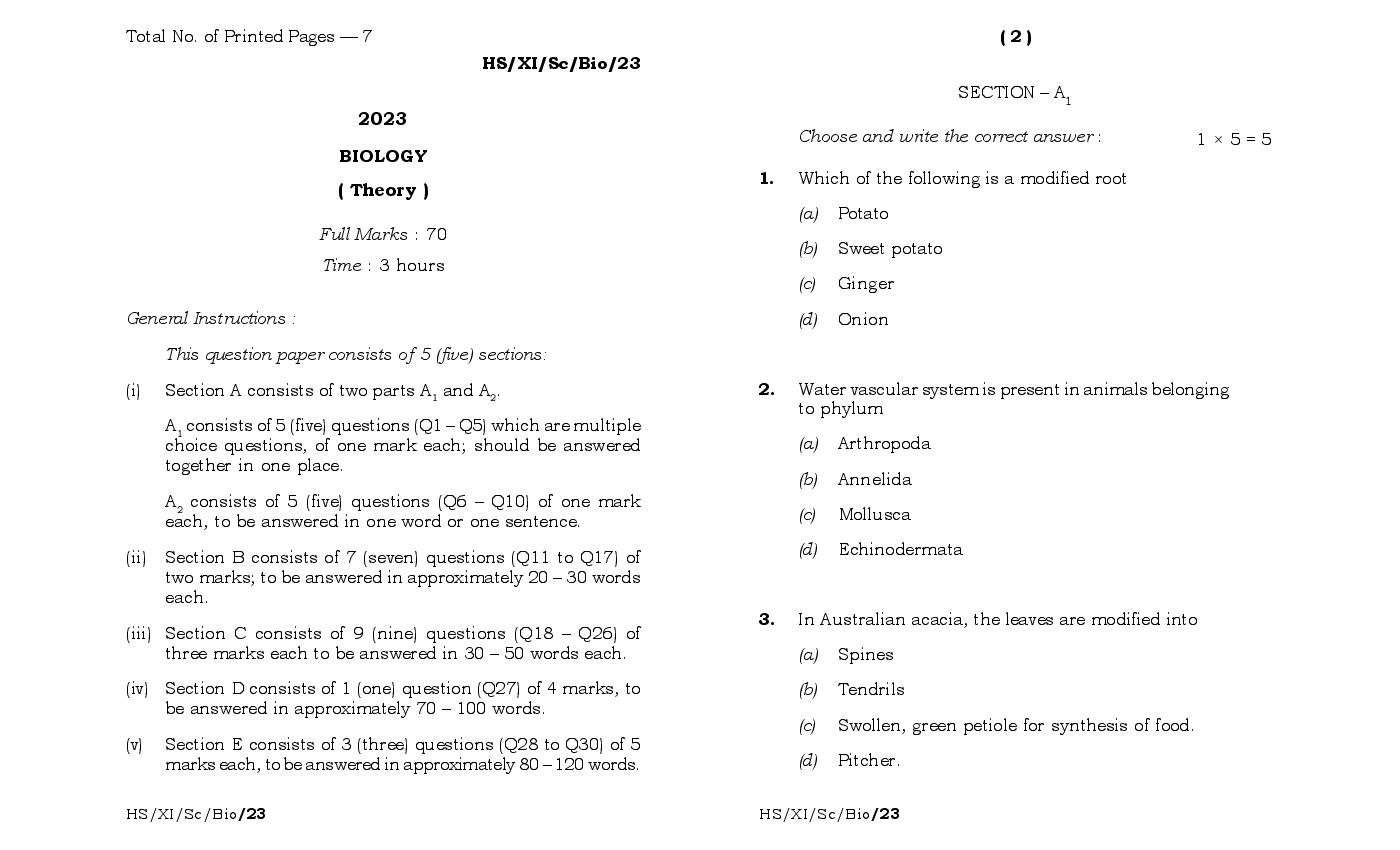
SECTION – A1
2023
Choose and write the correct answer : 1 5=5
BIOLOGY
1. Which of the following is a modified root
( Theory )
(a) Potato
Full Marks : 70
(b) Sweet potato
Time : 3 hours
(c) Ginger
General Instructions : (d) Onion
This question paper consists of 5 (five) sections:
(i) Section A consists of two parts A1 and A2. 2. Water vascular system is present in animals belonging
to phylum
A1 consists of 5 (five) questions (Q1 – Q5) which are multiple
choice questions, of one mark each; should be answered (a) Arthropoda
together in one place.
(b) Annelida
A2 consists of 5 (five) questions (Q6 – Q10) of one mark
each, to be answered in one word or one sentence. (c) Mollusca
(ii) Section B consists of 7 (seven) questions (Q11 to Q17) of (d) Echinodermata
two marks; to be answered in approximately 20 – 30 words
each.
3. In Australian acacia, the leaves are modified into
(iii) Section C consists of 9 (nine) questions (Q18 – Q26) of
three marks each to be answered in 30 – 50 words each. (a) Spines
(iv) Section D consists of 1 (one) question (Q27) of 4 marks, to (b) Tendrils
be answered in approximately 70 – 100 words.
(c) Swollen, green petiole for synthesis of food.
(v) Section E consists of 3 (three) questions (Q28 to Q30) of 5
marks each, to be answered in approximately 80 – 120 words. (d) Pitcher.
HS/XI/Sc/Bio/23 HS/XI/Sc/Bio/23
Page 2
4. In which cell organelles synthesis of protein takes place SECTION – B
(a) Golgi complex ( Short answer – I ) 2 7 = 14
(b) Ribosomes
11. Why are bryophytes called as “Amphibians” of the
(c) Mitochondria 2
plant kingdom?
(d) Plastids
Or
5. The hormone secreted by pineal gland is Define Binomial Nomenclature. Give one example.
1+1=2
(a) Melanin
12. Why are Deuteromycetes called as “Imperfect fungi”? 2
(b) Melatonin
(c) Melanocytes
13. What are viruses? Who discovered virus? 1+1=2
(d) Calcitonin.
14. Draw a labelled diagram of a human heart. 2
SECTION – A2
15. Define biomacromolecules. Give an example. 1+1=2
( Very short answer ) 1 5=5
16. State the “Law of Limiting Factors”. 2
6. Where is the hunger centre located in the human brain? 1
7. What are pneumatophores? 1 17. Name the protective covering of the brain. 2
Or
8. Name the end product of Glycolysis. 1
Old people usually suffer from inflamed and stiff joints.
9. Which hormone acts as a stress hormone? 1 What is this condition called? State the reasons for
the symptoms. 1+1=2
10. Name the protein-rich layer found in Euglenoids. 1
HS/XI/Sc/Bio/23 HS/XI/Sc/Bio/23
Page 3
SECTION –– C 24. Give the importance of Liver, Lungs and Skin in
excretion. 3
( Short answer – II ) 3 9 = 27
25. Explain the mechanism of coagulation of blood. 3
18. On what criteria is the five kingdom classification of
organisms based? 3 26. Draw a labelled diagram of location of Endocrine glands
in human body. 3
Or
Mention the important characteristics of Gymnosperms. 3 Or
Why Pituitary gland is called as “Master gland”? 3
19. Describe the structure of mitochondria with the help
of a diagram. 2+1=3
SECTION – D
20. Differentiate between plant cells and animal cells. 3
27. Describe the mechanism of Urine formation in humans.
1+3=4
Or
21. Why photorespiration does not take place in C4 plants?
Explain. 3 Describe the different types of phyllotaxy with suitable
diagrams. 3+1=4
22. Explain the mechanism of enzyme action. 3
SECTION – E
( Long answer type )
23. Briefly describe the phases of growth with the help of
a growth curve. 2+1=3
28. Explain conduction of nerve impulse along a nerve
fibre. 5
Or
Or
Define inflorescence. Differentiate between the
racemose and cymose type of inflorescence. 1+2=3 Draw and explain the Tricarboxylic acid cycle (Kreb’s
cycle) 1+4=5
HS/XI/Sc/Bio/23 HS/XI/Sc/Bio/23
Page 4
29. Describe the process of digestion in Frogs with the
help of a diagram. 4+1=5
Or
Define muscle. Name the different type of muscles
based on their location. Differentiate between straited
muscle and Non-straited muscle. 1+1+3=5
30. Define mitosis. Describe the different phases of mitosis
with well labelled diagrams. ½ + 2½ + 2 = 5
Or
With a labelled diagram describe the internal
structures of a dorsiventral leaf. 1+4=5
Document Details
| Board / Org | Meghalaya Board |
| Exam | Class 11 |
| Type | Question Paper |
| Pages | 4 |
| Updated | 22 Jul 2026 |