UGC NET 2021 Question Paper Arab Culture and Islamic Studies Shift 2
Finished viewing? Save it for later —
Download UGC NET 2021 Question Paper Arab Culture and Islamic Studies Shift 2 (PDF · 50 pages)About UGC NET 2021 Question Paper Arab Culture and Islamic Studies Shift 2
UGC NET 2021 Question Paper Arab Culture and Islamic Studies Shift 2 is available here for free download. Published by NTA for UGC National Eligibility Test, this question paper can be viewed online or downloaded as a PDF (50 pages). Candidates preparing for UGC National Eligibility Test can use UGC NET 2021 Question Paper Arab Culture and Islamic Studies Shift 2 to understand the exam pattern, the type of questions asked, and the overall difficulty level.
Frequently Asked Questions
How can I download UGC NET 2021 Question Paper Arab Culture and Islamic Studies Shift 2?
Open this page and click the Download button to save UGC NET 2021 Question Paper Arab Culture and Islamic Studies Shift 2 as a PDF. It is completely free on AglaSem Docs.
Is UGC NET 2021 Question Paper Arab Culture and Islamic Studies Shift 2 free to download?
Yes. UGC NET 2021 Question Paper Arab Culture and Islamic Studies Shift 2 can be viewed online and downloaded as a PDF free of cost on AglaSem Docs.
How many pages does UGC NET 2021 Question Paper Arab Culture and Islamic Studies Shift 2 have?
UGC NET 2021 Question Paper Arab Culture and Islamic Studies Shift 2 contains 50 pages, which you can read online or download together as a single PDF.
Where can I find more UGC National Eligibility Test study material?
You can find more UGC National Eligibility Test question papers, sample papers, syllabus, and answer keys on AglaSem Docs.
UGC NET 2021 Question Paper Arab Culture and Islamic Studies Shift 2 – Text
Read the full text of this question paper below — useful to quickly search, copy and reference the content online without downloading the PDF.
📄 View text version (50 pages)
Page 1
Topic:‐ GP_20NOV_A_SH1
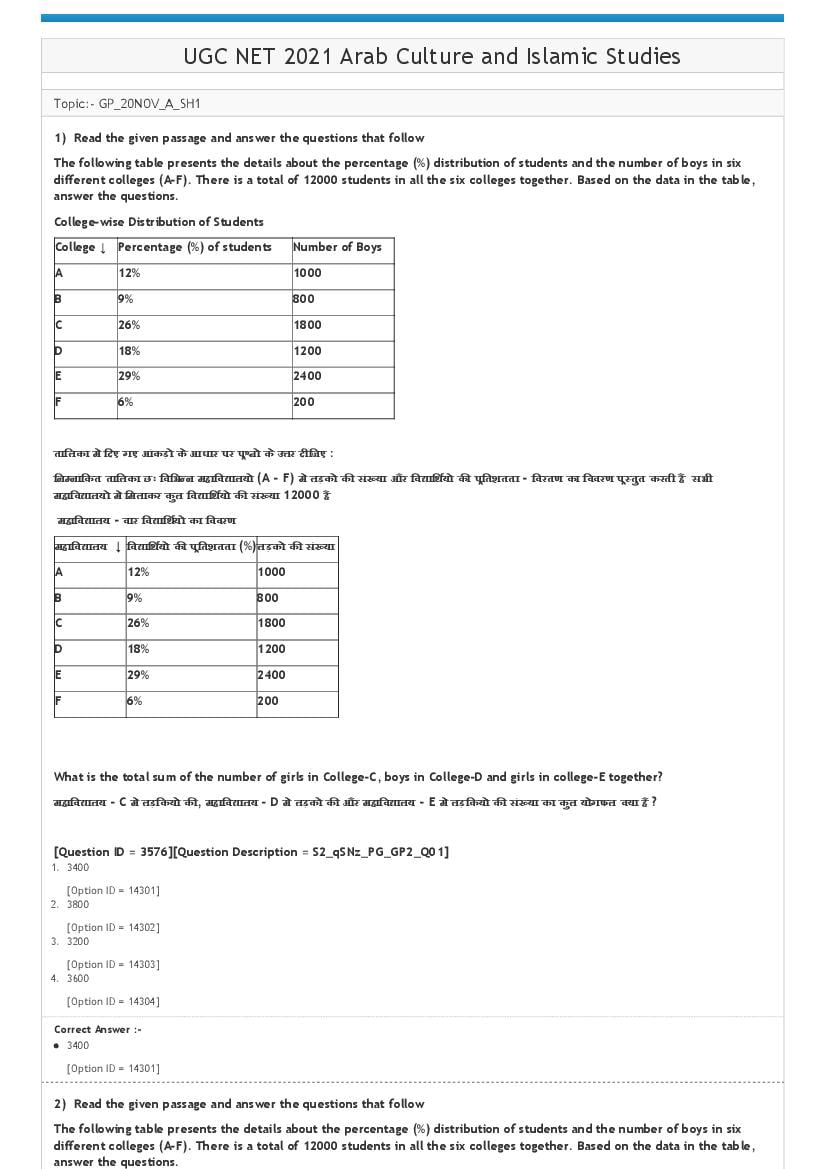
1) Read the given passage and answer the questions that follow
The following table presents the details about the percentage (%) distribution of students and the number of boys in six
different colleges (A‐F). There is a total of 12000 students in all the six colleges together. Based on the data in the table,
answer the questions.
College‐wise Distribution of Students
College Percentage (%) of students Number of Boys
A 12% 1000
B 9% 800
C 26% 1800
D 18% 1200
E 29% 2400
F 6% 200
तािलका म िदए गए आंकड़ के आधार पर प के उ र दीिजए :
िन नांिकत तािलका छः िविभ न महािव ालय (A ‐ F) म लड़क क सं या और िव ािथय क पितशतता ‐ िवरतण का िववरण प तुत करती है सभी
महािव ालय म िमलाकर कुल िव ािथय क सं या 12000 है
महािव ालय ‐ वार िव ािथय का िववरण
महािव ालय िव ािथय क पितशतता (%)लड़क क सं या
A 12% 1000
B 9% 800
C 26% 1800
D 18% 1200
E 29% 2400
F 6% 200
What is the total sum of the number of girls in College‐C, boys in College‐D and girls in college‐E together?
महािव ालय ‐ C म लड़िकय क , महािव ालय ‐ D म लड़क क और महािव ालय ‐ E म लड़िकय क सं या का कुल योगफल या है ?
[Question ID = 3576][Question Description = S2_qSNz_PG_GP2_Q01]
1. 3400
[Option ID = 14301]
2. 3800
[Option ID = 14302]
3. 3200
[Option ID = 14303]
4. 3600
[Option ID = 14304]
3400
[Option ID = 14301]
2) Read the given passage and answer the questions that follow
The following table presents the details about the percentage (%) distribution of students and the number of boys in six
different colleges (A‐F). There is a total of 12000 students in all the six colleges together. Based on the data in the table,
answer the questions.
Page 2
College Percentage (%) of students Number of Boys
A 12% 1000
B 9% 800
C 26% 1800
D 18% 1200
E 29% 2400
F 6% 200
तािलका म िदए गए आंकड़ के आधार पर प के उ र दीिजए :
िन नांिकत तािलका छः िविभ न महािव ालय (A ‐ F) म लड़क क सं या और िव ािथय क पितशतता ‐ िवरतण का िववरण प तुत करती है सभी
महािव ालय म िमलाकर कुल िव ािथय क सं या 12000 है
महािव ालय ‐ वार िव ािथय का िववरण
महािव ालय िव ािथय क पितशतता (%)लड़क क सं या
A 12% 1000
B 9% 800
C 26% 1800
D 18% 1200
E 29% 2400
F 6% 200
What is the respective ratio of the number of boys in College‐C, the number of girls in College‐B and the total number of
students in College‐E?
महािव ालय ‐ C म लड़क क सं या, महािव ालय ‐ B म लड़िकय क सं या और महािव ालय ‐ E म कुल िव ािथय क सं या का कमशः अनुपात या है ?
[Question ID = 3577][Question Description = S2_qSNz_PG_GP2_Q02]
1. 45:7:97
[Option ID = 14305]
2. 43:9:97
[Option ID = 14306]
3. 45:7:87
[Option ID = 14307]
4. 43:9:87
[Option ID = 14308]
45:7:97
[Option ID = 14305]
3) Read the given passage and answer the questions that follow
The following table presents the details about the percentage (%) distribution of students and the number of boys in six
different colleges (A‐F). There is a total of 12000 students in all the six colleges together. Based on the data in the table,
answer the questions.
College‐wise Distribution of Students
College Percentage (%) of students Number of Boys
A 12% 1000
B 9% 800
C 26% 1800
D 18% 1200
E 29% 2400
F 6% 200
Page 3
तािलका म िदए गए आंकड़ के आधार पर प के उ र दीिजए :
िन नांिकत तािलका छः िविभ न महािव ालय (A ‐ F) म लड़क क सं या और िव ािथय क पितशतता ‐ िवरतण का िववरण प तुत करती है सभी
महािव ालय म िमलाकर कुल िव ािथय क सं या 12000 है
महािव ालय ‐ वार िव ािथय का िववरण
महािव ालय िव ािथय क पितशतता (%)लड़क क सं या
A 12% 1000
B 9% 800
C 26% 1800
D 18% 1200
E 29% 2400
F 6% 200
What is the difference between the number of boys in College‐E and the total number of students in College‐F?
महािव ालय ‐ E म लड़क क सं या और महािव ालय ‐ F म कुल िव ािथय क सं या के बीच या अंतर है ?
[Question ID = 3578][Question Description = S2_qSNz_PG_GP2_Q03]
1. 1640
[Option ID = 14309]
2. 1760
[Option ID = 14310]
3. 1720
[Option ID = 14311]
4. 1680
[Option ID = 14312]
1640
[Option ID = 14309]
4) Read the given passage and answer the questions that follow
The following table presents the details about the percentage (%) distribution of students and the number of boys in six
different colleges (A‐F). There is a total of 12000 students in all the six colleges together. Based on the data in the table,
answer the questions.
College‐wise Distribution of Students
College Percentage (%) of students Number of Boys
A 12% 1000
B 9% 800
C 26% 1800
D 18% 1200
E 29% 2400
F 6% 200
तािलका म िदए गए आंकड़ के आधार पर प के उ र दीिजए :
िन नांिकत तािलका छः िविभ न महािव ालय (A ‐ F) म लड़क क सं या और िव ािथय क पितशतता ‐ िवरतण का िववरण प तुत करती है सभी
महािव ालय म िमलाकर कुल िव ािथय क सं या 12000 है
महािव ालय ‐ वार िव ािथय का िववरण
महािव ालय िव ािथय क पितशतता (%)लड़क क सं या
A 12% 1000
Page 4
B 9% 800
C 26% 1800
D 18% 1200
E 29% 2400
F 6% 200
In which of the following colleges is the total number of students equal to the number of girls in College‐E?
िन नांिकत िकस महािव ालय म िव ािथय क कुल सं या, महािव ालय ‐ E क लड़िकय क सं या के बराबर है ?
[Question ID = 3579][Question Description = S2_qSNz_PG_GP2_Q04]
1. A
[Option ID = 14313]
2. B
[Option ID = 14314]
3. C
[Option ID = 14315]
4. D
[Option ID = 14316]
A
[Option ID = 14313]
5) Read the given passage and answer the questions that follow
The following table presents the details about the percentage (%) distribution of students and the number of boys in six
different colleges (A‐F). There is a total of 12000 students in all the six colleges together. Based on the data in the table,
answer the questions.
College‐wise Distribution of Students
College Percentage (%) of students Number of Boys
A 12% 1000
B 9% 800
C 26% 1800
D 18% 1200
E 29% 2400
F 6% 200
तािलका म िदए गए आंकड़ के आधार पर प के उ र दीिजए :
िन नांिकत तािलका छः िविभ न महािव ालय (A ‐ F) म लड़क क सं या और िव ािथय क पितशतता ‐ िवरतण का िववरण प तुत करती है सभी
महािव ालय म िमलाकर कुल िव ािथय क सं या 12000 है
महािव ालय ‐ वार िव ािथय का िववरण
महािव ालय िव ािथय क पितशतता (%)लड़क क सं या
A 12% 1000
B 9% 800
C 26% 1800
D 18% 1200
E 29% 2400
F 6% 200
The number of girls in College‐A is approximately what percentage of the total number of students in College‐B?
महािव ालय ‐ A म लड़िकय क सं या, महािव ालय ‐ B म िव ािथय क कुल सं या का लगभग िकतना पितशत है ?
Page 5
1. 50
[Option ID = 14317]
2. 35
[Option ID = 14318]
3. 45
[Option ID = 14319]
4. 40
[Option ID = 14320]
50
[Option ID = 14317]
Topic:‐ GP_20NOV_B_SH1
1) Which parenting style is the one in which parents seem cool and controlling their interactions with their children (low
warmth, high control):
िन निलिखत म से वह कौन सी पैतृक (पेरटल) शैली है िजसम माता ‐ िपता अपने ब च के साथ अपनी अंतःिकया म भाव ‐ शू य और िनयंतक पतीत होते ह :
(िन न गमजोशी, उ च िनयंतण) :
[Question ID = 3581][Question Description = S2_qSNz_PG_GP2_Q06]
1. Authoritative parents/पािधका रक माता ‐ िपता [Option ID = 14321]
2. Authoritarian parents/आिधका रक माता ‐ िपता [Option ID = 14322]
3. Permissive parents/अनु ापक माता ‐ िपता [Option ID = 14323]
4. Rejecting/Neglecting/Uninvolved parents/अ वीकार करने वाले / उपे ा करने वाले / अंतभािवत न होने वाले माता ‐ िपता [Option ID = 14324]
Authoritative parents/पािधका रक माता ‐ िपता [Option ID = 14321]
2) Which of the following assessment methods provides feedback, that is non‐evaluative, occurs before or during
instruction, and guides teachers in planning and improving instruction?
िन निलिखत िकस मू यांकन प ित म फ डबैक पदान िकया जाता है, जो गैर ‐ मू यांकन परक होती है, अनुदेशन से पूव या उसके दौरान घिटत होती है और
अनुदेशन संबंधी योजना बनाने और इसम सुधार लाने म अ यापक का मागदशन करती है :
[Question ID = 3582][Question Description = S2_qSNz_PG_GP2_Q07]
1. Summative/योगा मक [Option ID = 14325]
2. Criterion‐referenced/संदिभत कसौटी [Option ID = 14326]
3. Formative/िनमाणा मक [Option ID = 14327]
4. Norm referenced/संदिभत मानक [Option ID = 14328]
Summative/योगा मक [Option ID = 14325]
3) Given below are two statements
Statement I: Parents and teachers have a highly significant impact on the maturation aspect of cognitive development
Statement II: Schemes are an organised system of actions or thought that allow us to mentally represent or "think about" the
objects and events in our world
In light of the above statements, choose the correct answer from the options given below
नीचे दो कथन िदए गए ह :
कथन ‐ I : सं ाना मक िवकास के प रप वन पहलू पर माता ‐ िपता और िश क का बहत ही मह वपूण पभाव पड़ता है
कथन ‐ II : योजनाएं िक याओं या िवचार क संगिठत यव थाएं होती ह जो हम हमारी दुिनया क व तु ओ ं और घटनाओं को मानिसक प से पितिनिध व करने या
''सोचने'' क अनुमित देता है
उपरो कथन के आलोक म, नीचे िदए गए िवक प म से सही उ र का चयन क िजए :
[Question ID = 3583][Question Description = S2_qSNz_PG_GP2_Q08]
1. Both Statement I and Statement II are true/कथन I और II दोन स य ह [Option ID = 14329]
2. Both Statement I and Statement II are false/कथन I और II दोन अस य ह [Option ID = 14330]
3. Statement I is true but Statement II is false/कथन I स य है , िक तु कथन II अस य है [Option ID = 14331]
4. Statement I is false but Statement II is true/कथन I अस य है, िक तु कथन II स य है [Option ID = 14332]
Page 6
4) Identify the types of cognitive load that make demands during learning
A. Intrinsic
B. Gestalt
C. Extraneous
D. Extinction
E. Germane
Choose the correct answer from the options given below:
उस सं ाना मक भार के पकार क पहचान कर जो अिधगम के समय मांग रखते ह :
A. आतं रक
B. ग टॉ ट
C. बा
D. िवलोप
E. संगत
नीचे िदए गए िवक प म से सही उ र का चयन क िजए :
[Question ID = 3584][Question Description = S2_qSNz_PG_GP2_Q09]
1. A, B and C only/केवल A, B और C [Option ID = 14333]
2. B, C and D only/केवल B, C और D [Option ID = 14334]
3. A, C and E only/केवल A, C और E [Option ID = 14335]
4. C, D and E only/केवल C, D और E [Option ID = 14336]
A, B and C only/केवल A, B और C [Option ID = 14333]
5) Match List I with List II
List I List II
Erik's stages of Psychosocial Approximate
Development Age
I. Young
A. Basic trust versus Basic mistrust
adulthood
II. Late
B. Initiative versus Guilt
adulthood
C. Intimacy versus Isolation III. 3 to 6 years
IV. Birth to 12‐
D. Ego integrity versus Despair
18 months
Choose the correct answer from the options given below:
सूची ‐I को सूची ‐II से सुमेिलत क िजए :
सूची ‐I सूची ‐II
(ए रक के मनोसामािजक िवकास के चरण) (सि नकट आयु )
A. मौिलक िव ास बनाम मौिलक अिव ास I. पूव वय कता
B. पहल बनाम दोष II. बाद क वय कता
C. अतरंगता बनाम एकाक करण III. 3 से 6 वष
D. अहम् स यिन ा बनाम भ नाशा IV. ज म के 12 ‐ 18 महीने
नीचे िदए गए िवक प म से सही उ र चुिनए :
[Question ID = 3585][Question Description = S2_qSNz_PG_GP2_Q10]
1. A ‐lV, B ‐lll, C ‐l, D ‐ll
[Option ID = 14337]
2. A ‐lll, B ‐l, C ‐ll, D ‐lV
Page 7
3. A ‐l, B ‐ll, C ‐lV, D ‐lll
[Option ID = 14339]
4. A ‐ll, B ‐lV, C ‐lll, D ‐l
[Option ID = 14340]
A ‐lV, B ‐lll, C ‐l, D ‐ll
[Option ID = 14337]
6) When we design the experiment in such a way that the variations caused by extraneous factors can all be combined
under the general concept of "chance", it represents which principle?
जब हम िकसी परी ण (ए सपे रमट) का िनमाण इस पकार करते ह िक बा कारक ारा उ प न िविभ नताओं (वे रएशंस) को संयोग (चांस) क सामा य
अवधारणा के अंतगत संयोिजत िकया जा सकता है, तो यह िकस िस ांत का िन पण करता है ?
[Question ID = 3586][Question Description = S2_qSNz_PG_GP2_Q11]
1. Principle of randomization/या ि छक करण का िस ांत (िपिं सपल ऑफ रे डमाइझेशन) [Option ID = 14341]
2. Principle of replication/पुनरावृि का िस ांत (िपिं सपल ऑफ रे लीकेशन) [Option ID = 14342]
3. Principle of local control/ थानीय िनयंतण का िस ांत (िपिं सपल ऑफ लोकल कंटोल) [Option ID = 14343]
4. Principle of operational control/संिकया मक िनयंतण का िस ांत (िपिं सपल ऑफ ऑपरेशन कंटोल) [Option ID = 14344]
Principle of randomization/या ि छक करण का िस ांत (िपिं सपल ऑफ रे डमाइझेशन) [Option ID = 14341]
7) Positivism as an epistemological program is characteristic of
ानमीमांसा कायकम के प म प य वाद िकसक िवशेषता है ?
[Question ID = 3587][Question Description = S2_qSNz_PG_GP2_Q12]
1. Social sciences/सामािजक िव ान [Option ID = 14345]
2. Performing Arts/पदशन कलाय [Option ID = 14346]
3. Natural sciences/पाकृितक िव ान [Option ID = 14347]
4. Legal studies/िविधक अ ययन [Option ID = 14348]
Social sciences/सामािजक िव ान [Option ID = 14345]
8) Identify the CORRECT sequence of empirical steps in the linear model of the research process
शोध पिकया के रैिखक पितमान म आनुभािवक चरण के सही अनुकम क पहचान क िजए :
[Question ID = 3588][Question Description = S2_qSNz_PG_GP2_Q13]
1. Sampling → theory → interpretation → collection → validation → hypotheses/पितचयन → िस ांत → िनवचन → संगहण → पमाणीकरण → पा क पना [Option ID
= 14349]
2. Theory → hypotheses → sampling → collection → interpretation → validation/िस ांत → पा क पना → पितचयन → संगहण → िनवचन → पमाणीकरण [Option ID
= 14350]
3. Validation → theory → hypotheses → collection → sampling → interpretation/पमाणीकरण → िस ांत → पा क पना → संगहण → पितचयन → िनवचन [Option ID =
14351]
4. Collection → sampling → hypotheses → theory → interpretation → operationalization/संगहण → पितचयन → पा क पना → िस ांत → िनवचन →
सिकया मक करण (आपरेशनलाइजेशन) [Option ID = 14352]
Sampling → theory → interpretation → collection → validation → hypotheses/पितचयन → िस ांत → िनवचन → संगहण → पमाणीकरण → पा क पना [Option ID
= 14349]
9) Which of the below mentioned approaches fall under the Quantitative Approach?
A. Simulation approach
B. Projective technique
C. Inferential approach
D. Depth interview
E. Experimental approach
Choose the correct answer from the options given below:
िन निलिखत म से कौन से अिभगम माता मक अिभगम के अंतगत ह ?
A. अनुकरण अिभगम (साइमुलेशन एपोच)
B. प ेपी तकनीक (पोजेि टव टे नीक)
C. आनुमािनक अिभगम (इ फेरेनिशयल एपोच)
Page 8
E. पायोिगक अिभगम
नीचे िदए गए िवक प म से सही उ र का चयन क िजए :
[Question ID = 3589][Question Description = S2_qSNz_PG_GP2_Q14]
1. A, C and E only/केवल A, C और E [Option ID = 14353]
2. B, C and E only/केवल B, C और E [Option ID = 14354]
3. B, C and D only/केवल B, C और D [Option ID = 14355]
4. A, B and C only/केवल A, B और C [Option ID = 14356]
A, C and E only/केवल A, C और E [Option ID = 14353]
10) Match List I with List II
List I List II
A. Ex post facto I. Finding a solution for an immediate problem facing a society or an industrial/business
Research organisation
B. Applied Research II. Related to some abstract idea(s) or theory
C. Conceptual Research III. Development of hypotheses rather than their testing
D. Exploratory Research IV. No control over variables, reports only what has happened or what is happening
Choose the correct answer from the options given below:
सूची ‐I को सूची ‐II से सुमेिलत क िजए :
सूची ‐I सूची ‐II
A. काय र I. िकसी समाज अथवा औ ोिगक / यावसाियक संगठन के सम
शोध उपि थत ता कािलक सम या का समाधान ढूंढना
B. अनुपयु
II. िकसी अपूत िवचार (िवचार ) अथवा िस ांत से स बंिधत
शोध
C.
संप यया मक III. परी ण के थान पर पा क पना का िवकास
शोध
D. सम वेषी IV. चर पर कोई िनयंतण नह , केवल उसी क जानकारी देता है जो हो चुका
शोध है अथवा हो रहा है
नीचे िदए गए िवक प म से सही उ र चुिनए :
[Question ID = 3590][Question Description = S2_qSNz_PG_GP2_Q15]
1. A ‐lV, B ‐l, C ‐lll, D ‐ll [Option ID = 14357]
2. A ‐III, B ‐II, C ‐I, D ‐IV [Option ID = 14358]
3. A ‐IV, B ‐I, C ‐II, D ‐III [Option ID = 14359]
4. A ‐I, B ‐III, C ‐II, D ‐IV [Option ID = 14360]
A ‐lV, B ‐l, C ‐lll, D ‐ll [Option ID = 14357]
11) Peer‐to‐peer communication is
समक से समक का स पेषण है :
[Question ID = 3591][Question Description = S2_qSNz_PG_GP2_Q16]
1. Horizontal/ िै तज
[Option ID = 14361]
2. Convoluted/संविलत
[Option ID = 14362]
3. Non‐transactional/गैर ‐ सं यवहा रक
[Option ID = 14363]
4. Authoritarian/अिधकारवादी
[Option ID = 14364]
Horizontal/ िै तज
[Option ID = 14361]
12) The main challenges of grapevine communication are:
A. Its formal nature
B. Distortion
C. Misunderstanding
Page 9
E. Conformity
Choose the correct answer from the options given below:
जनपवाद स पेषण क मु य चुनौितयां ह ?
A. इसक औपचा रक पवृि
B. िव पण
C. गलतफहमी
D. सोत अनाम व
E. अनु पता
नीचे िदए गए िवक प म से सही उ र का चयन क िजए :
[Question ID = 3592][Question Description = S2_qSNz_PG_GP2_Q17]
1. A, B and C only/केवल A, B और C [Option ID = 14365]
2. B, C and D only/केवल B, C और D [Option ID = 14366]
3. C, D and E only/केवल C, D और E [Option ID = 14367]
4. A, C and D only/केवल A, C और D [Option ID = 14368]
A, B and C only/केवल A, B और C [Option ID = 14365]
13) Given below are two statements, one is labelled as Assertion A and the other is labelled as Reason R
Assertion A: Students do not form part of the media audience
Reason R: Due to the all‐pervasive digital technology, students have become interactive media users
In light of the above statements, choose the correct answer from the options given below
नीचे दो कथन िदए गए ह : एक अिभकथन (Assertion A) के प म और दूसरा उसके कारण (Reason R) के पम:
अिभकथन (A) : िव ाथ , मीिडया ‐ शोता के भाग नह ह
कारण (R) : सव ‐ यापक िडिजटल पौ ोिगक के फल व प िव ाथ अ तः िकयाशील मीिडया पयोगकता बन गए ह
उपरो कथन के आलोक म, नीचे िदए िवक प म से सही उ र का चयन क िजए :
[Question ID = 3593][Question Description = S2_qSNz_PG_GP2_Q18]
1. Both A and R are true and R is the correct explanation of A/(A) और (R) दोन स य ह और (R), (A) क सही या या है [Option ID = 14369]
2. Both A and R are true but R is NOT the correct explanation of A/(A) और (R) स य सही ह पर तु (R), (A) क सही या या नह है [Option ID = 14370]
3. A is true but R is false/(A) स य है, लेिकन (R) अस य है [Option ID = 14371]
4. A is false but R is true/(A) अस य है, लेिकन (R) स य है [Option ID = 14372]
Both A and R are true and R is the correct explanation of A/(A) और (R) दोन स य ह और (R), (A) क सही या या है [Option ID = 14369]
14) Identify the CORRECT sequence of the following communication forms:
A. Mass
B. Public
C. Group
D. Inter‐personal
E. Intra‐personal
Choose the correct answer from the options given below
िन नांिकत स पेषण ‐ व प के सही अनुकम क पहचान क िजए :
A. जन ‐ समूह
B. जनता
C. समूह
D. अंतर ‐ वैयि क
E. अ तः ‐ वैयि क
नीचे िदए गए िवक प म से सही उ र का चयन क िजए :
Page 10
1. A, D, E, B, C [Option ID = 14373]
2. D, E, B, C, A [Option ID = 14374]
3. E, D, C, B, A [Option ID = 14375]
4. B, C , A, D, E [Option ID = 14376]
A, D, E, B, C [Option ID = 14373]
15) Match List I with List II
List I List II
Types of noise in communicationCharacteristic feature
A. Physical I. Barriers within the sender or receiver
B. Physiological II. Wandering thoughts
C. Psychological III. Use of jargon
D. Semantic IV. Mechanical distortion
Choose the correct answer from the options given below:
सूची ‐I को सूची ‐II से सुमेिलत क िजए :
सूची ‐I सूची ‐II
(स पेषण म शोर के पकार) (अिभला िणक िवशेषताएं)
A. शारी रक I. पेषक या गहणकता के म य अवरोध
B. शरीर िकया मक II. भमणशील िवचार
C. मनोिव ािनक III. िविश ‐ श दावली का पयोग
D. श दाथिव ान IV. याि तक िव पण
नीचे िदए गए िवक प म से सही उ र चुिनए :
[Question ID = 3595][Question Description = S2_qSNz_PG_GP2_Q20]
1. A ‐IV, B ‐I, C ‐II, D ‐III [Option ID = 14377]
2. A ‐I, B ‐II, C ‐III, D ‐IV [Option ID = 14378]
3. A ‐III, B ‐IV, C ‐I, D ‐II [Option ID = 14379]
4. A ‐II, B ‐III, C ‐IV, D ‐I [Option ID = 14380]
A ‐IV, B ‐I, C ‐II, D ‐III [Option ID = 14377]
16) The incomes of Ravi and Kavita are in the ratio 2:3 and their expenditures are in the ratio 3:5. If each saves ₹ 100,
then Ravi's income is
रिव और किवता क आय 2 : 3 के अनुपात म है और उनके यय का अनुपात 3 : 5 है अगर प येक ₹ 100 बचत करते ह तो रिव क आय है :
[Question ID = 3596][Question Description = S2_qSNz_PG_GP2_Q21]
1. ₹ 200
[Option ID = 14381]
2. ₹ 600
[Option ID = 14382]
3. ₹ 400
[Option ID = 14383]
4. ₹ 100
[Option ID = 14384]
₹ 200
[Option ID = 14381]
17) The new cost of a mobile which has been discounted by 15% is ₹ 3230. What was the cost of the mobile originally?
15 पितशत क छूट के साथ मोबाइल का नया मू य ₹ 3230 है मोबाइल का पारंिभक मू य या था ?
[Question ID = 3597][Question Description = S2_qSNz_PG_GP2_Q22]
1. ₹ 3675
[Option ID = 14385]
2. ₹ 3650
[Option ID = 14386]
3. ₹ 3600
[Option ID = 14387]
4. ₹ 3800
[Option ID = 14388]
Page 11
[Option ID = 14385]
18) The product of two positive consecutive odd integers is 1 less than six times their sum. One of the integers is
दो घना मक कमागत िवषय पूणाक का गुणनफल, उनके योगफल के 6 ‐ गुणा से 1 कम है दोन म से एक पूणाक है :
[Question ID = 3598][Question Description = S2_qSNz_PG_GP2_Q23]
1. 7
[Option ID = 14389]
2. 9
[Option ID = 14390]
3. 15
[Option ID = 14391]
4. 13
[Option ID = 14392]
7
[Option ID = 14389]
19) Given below are two statements
Statement I: A number that has factors other than 1 and itself is called a composite number
Statement II: 23 is the only odd prime number
In light of the above statements, choose the correct answer from the options given below
नीचे दो कथन िदए गए ह :
कथन ‐ I : एक सं या, िजसका 1 और वहसं या वयं ही अपवतक होते ह, एक यौिगक सं या या संयु सं या कही जाती है
कथन ‐ II : केवल 23 ही एकमात िवषम ढ़ सं या है
उपरो कथन के आलोक म, नीचे िदए गए िवक प म से सही उ र का चयन क िजए :
[Question ID = 3599][Question Description = S2_qSNz_PG_GP2_Q24]
1. Both Statement I and Statement II are true/कथन I और II दोन स य ह
[Option ID = 14393]
2. Both Statement I and Statement II are false/कथन I और II दोन अस य ह
[Option ID = 14394]
3. Statement I is true but Statement II is false/कथन I स य है, लेिकन कथन II अस य है
[Option ID = 14395]
4. Statement I is false but Statement II is true/कथन I अस य है, लेिकन कथन II स य है
[Option ID = 14396]
Both Statement I and Statement II are true/कथन I और II दोन स य ह
[Option ID = 14393]
20) Match List I with List II
List I List II
Three numbers Their average
A. 40, 32, 33 I. 38
B. 35, 36, 40 II. 36
C. 33, 36, 39 III. 35
D. 30, 38, 46 IV. 37
Choose the correct answer from the options given below:
सूची ‐I को सूची ‐II से सुमेिलत क िजए :
सूची ‐I सूची ‐II
(तीन सं याएं) (उनका औसत (सं या))
A. 40, 32, 33 I. 38
B. 35, 36, 40 II. 36
C. 33, 36, 39 III. 35
D. 30, 38, 46 IV. 37
Page 12
[Question ID = 3600][Question Description = S2_qSNz_PG_GP2_Q25]
1. A ‐ IV, B ‐ I, C ‐ II, D ‐ III
[Option ID = 14397]
2. A ‐ II, B ‐ IV, C ‐ I, D ‐ III
[Option ID = 14398]
3. A ‐ III, B ‐ IV, C ‐ II, D ‐ I
[Option ID = 14399]
4. A ‐ IV, B ‐ II, C ‐ III, D ‐ I
[Option ID = 14400]
A ‐ IV, B ‐ I, C ‐ II, D ‐ III
[Option ID = 14397]
21) Advertising "Testimonials" are frequent instances of this fallacy
'पमाण' का िव ापन करना िन निलिखत म से िकस दोष के बहदा होने वाले उदाहरण ह ?
[Question ID = 3601][Question Description = S2_qSNz_PG_GP2_Q26]
1. Argumentum ad ignorantiam (ignorance)/आ यूमे टम एड इ नोरेि टअम (अ ानता)
[Option ID = 14401]
2. Argumentum ad Misericordiam (appeal to pity)/आ यूमे टम एड िमज रकािडयन (दया का आगह)
[Option ID = 14402]
3. Argumentum ad Populum/आ यूमे टम एड पापूलम
[Option ID = 14403]
4. Argumentum ad Verecundiam (authority)/आ यूमे टम एड वेरक
े ि डयम (पािधकार)
[Option ID = 14404]
Argumentum ad ignorantiam (ignorance)/आ यूमे टम एड इ नोरेि टअम (अ ानता)
[Option ID = 14401]
22) If 'some women are writers is true, which of the following codes are CORRECT
A. 'All women are writers' false
B. 'All women are writers' is true
C. 'No women are writers' is false
D. 'Some women are not writers' is undetermined
Choose the correct answer from the options given below:
यिद ' कुछ मिहलाएं लेिखकाएं ह' स य है, तो िन निलिखत म से कौन से कूट सही ह ?
A. 'सभी मिहलाएं लेिखकाएं ह' अस य है
B. 'सभी मिहलाएं लेिखकाएं ह' स य है
C. 'कोई मिहला लेिखका नह ह' अस य है
D. 'कुछ मिहलाएं लेिखकाएं नह ह' अिनधा रत है
नीचे िदए गए िवक प म से सही उ र का चयन क िजए :
[Question ID = 3602][Question Description = S2_qSNz_PG_GP2_Q27]
1. A and B only/केवल A और B
[Option ID = 14405]
2. B and C only/केवल B और C
[Option ID = 14406]
3. C and D only/केवल C और D
[Option ID = 14407]
4. B and D only/केवल B और D
[Option ID = 14408]
A and B only/केवल A और B
[Option ID = 14405]
Page 13
No musicians are Italians
All barbers are Musicians
Therefore, No barbers are Italians
Choose the correct answer from the options given below
िन निलिखत म से कौन सा कूट तक के आकार तथा पकार का सही िन पण करता है?
कोई संगीतकार इटली का नह है
सभी नाई संगीतकार ह
अतः कोई नाई इटली का नह है
[Question ID = 3603][Question Description = S2_qSNz_PG_GP2_Q28]
1. E A E ‐ I/ई ए ई ‐ I
[Option ID = 14409]
2. E A E ‐ II/ई ए ई ‐ II
[Option ID = 14410]
3. E A E ‐ III/ई ए ई ‐ III
[Option ID = 14411]
4. E A E ‐ IV/ई ए ई ‐ IV
[Option ID = 14412]
E A E ‐ I/ई ए ई ‐ I
[Option ID = 14409]
24) If a jar is temporarily removed from its locus the non‐existence of the jar on the floor is
यिद िकसी मतबान (जार) को अ थाई पसे अपने थान (लोकस) से हटा िदया जाए तो फश पर मतबान का अनि त व है :
[Question ID = 3604][Question Description = S2_qSNz_PG_GP2_Q29]
1. Upamana (Comparison)/उपमान (तुलना) (क पे रजन)
[Option ID = 14413]
2. Arthapatti (Implication)/अथापि (िनिहताथ) (इ लीकेशन)
[Option ID = 14414]
3. Anumana (Inference)/अनुमान (इ फ़ेरस)
[Option ID = 14415]
4. Anuplabdhi (Non‐cognition)/अनुपलि ध (नन ‐ कि नशन)
[Option ID = 14416]
Upamana (Comparison)/उपमान (तुलना) (क पे रजन)
[Option ID = 14413]
25) The knowing self knows objects through the instrumentality of the Indriyas and the existence of the Indriya, is proved
by
ाता ारा व तु ओ ं को इि दय के साधन ारा जाना जाता है और इि दय का अि त व पमािणत िकया जाता है
[Question ID = 3605][Question Description = S2_qSNz_PG_GP2_Q30]
1. Arthapatti/अथापि ारा
[Option ID = 14417]
2. Anuplabdhi/अनुपलि ध ारा
[Option ID = 14418]
3. Anumana/अनुमान ारा
[Option ID = 14419]
4. Upamana/उपमान ारा
[Option ID = 14420]
Arthapatti/अथापि ारा
[Option ID = 14417]
26) Match List I with List II
List I List II
Page 14
A. Recording a song to play on an iPod I. .zip
B. Saving a video II. .mp3
C. Sending a photo to someone using your mobileIII. .mp4
D. Compressing a folder of files IV. .jpeg
Choose the correct answer from the options given below:
सूची ‐I को सूची ‐II से सुमेिलत क िजए :
सूची ‐I सूची ‐II
(िकया ‐ कलाप) (फाइल के पकार)
A. एक आई पॉड पर गीत बजाने के िलए रकॉड करता I. .जेड आई पी
B. एक वीिडयो रि त करना II. .एम पी 3
C. अपने मोबाइल का पयोग करते हए िकसी को फोटो भेजना III. .एम पी 4
D. एक फाईल के फो डर को क पेस करना IV. .जे पी इ जी
नीचे िदए गए िवक प म से सही उ र चुिनए :
[Question ID = 3606][Question Description = S2_qSNz_PG_GP2_Q31]
1. A ‐ II, B ‐ III, C ‐ I, D ‐ IV
[Option ID = 14421]
2. A ‐ IV, B ‐ III, C ‐ II, D ‐ I
[Option ID = 14422]
3. A ‐ III, B ‐ II, C ‐ IV, D ‐ I
[Option ID = 14423]
4. A ‐ II, B ‐ III, C ‐ IV, D ‐ I
[Option ID = 14424]
A ‐ II, B ‐ III, C ‐ I, D ‐ IV
[Option ID = 14421]
27) Kavita uses a Wifi adapter to connect the computer to an interactive whiteboard.
Which one of these statements is false?
किवता एक वाई ‐ फाई एडै टर का पयोग क यूटर को एक अ यो यिकयाशील ाइटबोड से जोड़ने म करती है िन नांिकत कथन म से कौन अस य है ?
[Question ID = 3607][Question Description = S2_qSNz_PG_GP2_Q32]
1. Wifi has a greater range than Bluetooth/ ाइट बोड का रज लू टूथ से यादा होता है
[Option ID = 14425]
2. Wifi signals are capable of passing through solid objects/वाई फाई के िस नल ठोस पदाथ के बीच से भी पार करने म समथ ह
[Option ID = 14426]
3. Bluetooth has a greater range than Wifi/ लूटूथ का रज वाई ‐ फाई से यादा होता है
[Option ID = 14427]
4. Bluetooth signals are capable of passing through solid objects/ लू टूथ के िस नल ठोस पदाथ के बीच से भी पार करते म समथ ह
[Option ID = 14428]
Wifi has a greater range than Bluetooth/ ाइट बोड का रज लू टूथ से यादा होता है
[Option ID = 14425]
28) Given below are two statements, one is labelled as Assertion A and the other is labelled as Reason R
Assertion A: The Internet is very beneficial to students in all aspects
Reason R: The Internet opens doorways to a wealth of information, knowledge and educational resources thereby increasing
opportunities for learning in and beyond the classroom
In light of the above statements, choose the correct answer from the options given below
नीचे दो कथन िदए गए ह : एक अिभकथन (Assertion A) के प म और दूसरा उसके कारण (Reason R) के पम:
अिभकथन (A) : इंटरनेट िव ाथ य के िलए सभी ि कोण से बहत यादा लाभकारी है
कारण (R) : इंटरनेट सूचनाओं, ान और शै िणक ‐ संसाधन क पचुरता का ार उ ािटत करता है िजससे क ा के अंदर या उससे परे अिधगम के बढ़ने के
अवसर पा होते ह
उपरो कथन के आलोक म, नीचे िदए िवक प म से सही उ र का चयन क िजए :
Page 15
1. Both A and R are true and R is the correct explanation of A/(A) और (R) दोन स य ह और (R), (A) क सही या या है
[Option ID = 14429]
2. Both A and R are true but R is NOT the correct explanation of A/(A) और (R) दोन स य ह पर तु (R), (A) क सही या या नह है
[Option ID = 14430]
3. A is true but R is false/(A) स य है, लेिकन (R) अस य है
[Option ID = 14431]
4. A is false but R is true/(A) अस य है, लेिकन (R) स य है
[Option ID = 14432]
Both A and R are true and R is the correct explanation of A/(A) और (R) दोन स य ह और (R), (A) क सही या या है
[Option ID = 14429]
29) Identify the CORRECT order of the following data transfer rates measured in bits per second (bps) ranked from largest
to smallest
A. 1500 kbps
B. 1500 Mbps
C. 1 Mbps
D. 1 Gbps
Choose the correct answer from the options given below
िब स पित सेकड (बी पी एस) म मापे गए डेटा ‐ अ तरण ‐ दर के बड़े से छोटे सही कम क पहचान क िजए :
A. 1500 के बी पी एस
B. 1500 एम बी पी एस
C. 1 एम बी पी एस
D. 1 जी बी पी एस
नीचे िदए गए िवक प म से सही उ र का चयन क िजए :
[Question ID = 3609][Question Description = S2_qSNz_PG_GP2_Q34]
1. D, B, A, C
[Option ID = 14433]
2. B, D, C, A
[Option ID = 14434]
3. B, A, D, C
[Option ID = 14435]
4. B, D, A, C
[Option ID = 14436]
D, B, A, C
[Option ID = 14433]
30) Given below are two statements
Statement I: You can add attachments of any file size to an email.
Statement II: You can only send emails from a laptop computer.
In light of the above statements, choose the correct answer from the options given below
नीचे दो कथन िदए गए ह :
कथन ‐ I : आप िकसी भी फाईल साइज को इमेल म अटैचम ट के प म जोड़ सकते ह
कथन ‐ II : आप केवल लै प ‐ टॉप क यूटर से ही इमेल भेज सकते ह
उपरो कथन के आलोक म, नीचे िदए िवक प म से सही उ र का चयन क िजए :
[Question ID = 3610][Question Description = S2_qSNz_PG_GP2_Q35]
1. Both Statement I and Statement II are true/कथन I और II दोन स य ह
[Option ID = 14437]
2. Both Statement I and Statement II are false/कथन I और II दोन अस य ह
[Option ID = 14438]
Page 16
[Option ID = 14439]
4. Statement I is false but Statement II is true/कथन I अस य है, लेिकन कथन II स य है
[Option ID = 14440]
Both Statement I and Statement II are true/कथन I और II दोन स य ह
[Option ID = 14437]
31) What are essential for the formation of photochemical smog?
A. Oxides of sulphur
B. Oxides of Nitrogen
C. Volatile Organic Compounds
D. Water Vapour
E. Sunlight
Choose the correct answer from the options given below:
पकाश ‐ रासायिनक धूम ‐ कोहरे के बनने के िलए कौन से आव यक ह ?
A. स फर के ऑ साइड
B. नाइटोजन के ऑ साइड
C. बा पशील काबिनक यौिगक
D. जलवा प
E. सूय ‐ पकाश
नीचे िदए गए िवक प म से सही उ र का चयन क िजए :
[Question ID = 3611][Question Description = S2_qSNz_PG_GP2_Q36]
1. A, B and C only/केवल A, B और C
[Option ID = 14441]
2. A, B, C and D only/केवल A, B, C और D
[Option ID = 14442]
3. B, C, D and E only/केवल B, C, D और E
[Option ID = 14443]
4. B, C and E only/केवल B, C और E
[Option ID = 14444]
A, B and C only/केवल A, B और C
[Option ID = 14441]
32) What is the CORRECT sequence of occurrence of various atmospheric layers from earth's surface?
A. Thermosphere
B. Stratosphere
C. Mesosphere
D. Troposphere
Choose the correct answer from the options given below
ं लीय परत क उपि थित का सही कम या है ?
पृ वी क सतह से ऊपर िविभ न वायुमड
A. तापम डल
B. समतापम डल
C. म यम डल
D. ोभम डल
नीचे िदए गए िवक प म से सही उ र का चयन क िजए :
[Question ID = 3612][Question Description = S2_qSNz_PG_GP2_Q37]
1. D, B, A, C
[Option ID = 14445]
Page 17
[Option ID = 14446]
3. B, D, C, A
[Option ID = 14447]
4. C, B, D, A
[Option ID = 14448]
D, B, A, C
[Option ID = 14445]
33) Which one of the following climate change proxies is not the terrestrial biotic climatic proxy?
िन निलिखत म से कौन जलवायु प रवतन पितपती, पािथव जैव जलवायु पितपती नह है ?
[Question ID = 3613][Question Description = S2_qSNz_PG_GP2_Q38]
1. Boreholes/िब ‐ िछद (बोर ‐ हो स)
[Option ID = 14449]
2. Leaf physiology/पत ‐ काियक
[Option ID = 14450]
3. Tree ring/वृ ‐ वलय
[Option ID = 14451]
4. Pollen and spore analysis/परागकण एवं बीजाणु िव ेषण
[Option ID = 14452]
Boreholes/िब ‐ िछद (बोर ‐ हो स)
[Option ID = 14449]
34) A high amount of BOD (Biochemical Oxygen Demand) in a water body represents
A. Highly Polluted Water
B. Presence of a large amount of organic materials
C. Presence of good amount dissolved oxygen
D. Severely limited aquatic life
Choose the correct answer from the options given below:
एक जलाशय म बी ओ डी (जैवरासायिनक ‐ ऑ सीजन ‐ माँग) क अिधक माता पदिशत करती है :
A. अ यिधक पदूिषत जल
B. काबिनक पदाथ क यादा माता क उपि थित
C. िवलियत ऑ सीजन क अ छी माता क उपि थित
D. अ यिधक सीिमत जलीय जीवन
नीचे िदए गए िवक प म से सही उ र का चयन क िजए :
[Question ID = 3614][Question Description = S2_qSNz_PG_GP2_Q39]
1. A, B, C and D only/A, B, C और D
[Option ID = 14453]
2. B, C and D only/केवल B, C और D
[Option ID = 14454]
3. A, C and D only/केवल A, C और D
[Option ID = 14455]
4. A, B and D only/केवल A, B और D
[Option ID = 14456]
A, B, C and D only/A, B, C और D
[Option ID = 14453]
35) Which one of the following is a component of a Sewage Treatment Plant (STP)?
िन निलिखत म से कौन एक मलजल ‐ िन पण ‐ संयंत (एस टी पी) का एक घटक है ?
[Question ID = 3615][Question Description = S2_qSNz_PG_GP2_Q40]
1. UV source/यू . वी. सोत
Page 18
2. Ion exchanger/आयन ए सचजर
[Option ID = 14458]
3. Grit chamber/बालुकण ‐ पको
[Option ID = 14459]
4. Cyclone/साइ लॉन
[Option ID = 14460]
UV source/यू . वी. सोत
[Option ID = 14457]
36) According to the NEP‐ 2020, a Master's Programme may be of:
A. one‐year duration
B. two‐year duration
C. three‐year duration
D. four‐year duration
E. five‐year duration
Choose the correct answer from the options given below:
एन. इ. पी. ‐ 2020 के अनुसार, नातको र पा यकम हो सकता है :
A. एक वष क अविध का
B. दो वष क अविध का
C. तीन वष क अविध का
D. चार वष क अविध का
E. पाँच वष क अविध का
नीचे िदए गए िवक प म से सही उ र का चयन क िजए :
[Question ID = 3616][Question Description = S2_qSNz_PG_GP2_Q41]
1. A, B and E only/केवल A, B और E
[Option ID = 14461]
2. A, B and C only/केवल A, B और C
[Option ID = 14462]
3. B, C and E only/केवल B, C और E
[Option ID = 14463]
4. B and D only/केवल B और D
[Option ID = 14464]
A, B and E only/केवल A, B और E
[Option ID = 14461]
37) According to NEP‐2020, the Higher Education Commission of India (HECI) will be set up:
A. to replace the UGC for maintaining quality and standard in higher education institutions
B. as an umbrella institution to look into regulation accreditation, funding and academic standard
C. as a regulatory authority to maintain quality and standard
D. to maintain academic standard of higher education institutions
Choose the correct answer from the options given below:
एन. इ. पी. 2020 के अनुसार, भारत का उ च िश ा आयोग थािपत िकया जाएगा :
A. यू.जी.सी. का उ च शै िणक सं थाओं म गुणव ा एवं तर बनाए रखने के िलए पित थापन
B. िविनयमन, प यायन, िनिधयन और शै िणक तर क देखभाल हेतु छतक सं था के पम
C. एक िविनयामक स ा के प म गुणव ा एवं तर बनाए रखने के िलए
D. उ च शै िणक सं थाओं के शै िणक तर को बनाए रखने के िलए
नीचे िदए गए िवक प म से सही उ र का चयन क िजए :
Page 19
1. A and B only/केवल A और B
[Option ID = 14465]
2. B, C and D only/केवल B, C और D
[Option ID = 14466]
3. A, C and D only/केवल A, C और D
[Option ID = 14467]
4. A, B, C and D/A, B, C और D
[Option ID = 14468]
A and B only/केवल A और B
[Option ID = 14465]
38) Match List I with List II
List I List II
Regulatory institutions as per NEP‐2020 Responsibilities
A. NHERC I. Academic standards
B. NAC II. Accreditation
C. HEGC III. Regulation
D. GEC IV. Financing
Choose the correct answer from the options given below:
सूची ‐I को सूची ‐II से सुमेिलत क िजए :
सूची ‐I सूची ‐II
(एन. इ. पी. के अनुसार िविनया मक सं थाय) (दािय व)
A. एन.एच.इ.आर.सी. I. शै िणक ‐ तर
B. एन.ए.सी. II. प यायन
C. एच.इ.जी.सी. III. िविनयमन
D. जी.इ.सी IV. िनिधयन
नीचे िदए गए िवक प म से सही उ र चुिनए :
[Question ID = 3618][Question Description = S2_qSNz_PG_GP2_Q43]
1. A ‐ III, B ‐ II, C ‐ I, D ‐ IV
[Option ID = 14469]
2. A ‐ II, B ‐ III, C ‐ IV, D ‐ I
[Option ID = 14470]
3. A ‐ III, B ‐ II, C ‐ IV, D ‐ I
[Option ID = 14471]
4. A ‐ IV, B ‐ II, C ‐ III, D ‐ I
[Option ID = 14472]
A ‐ III, B ‐ II, C ‐ I, D ‐ IV
[Option ID = 14469]
39) According to NEP‐2020, National Research Foundation (NRF) may be established to
एन.इ.पी. 2020 के अनुसार, रा ीय अनुस धान पित ान (एन.आर.एफ.) थािपत िकया जा सकता है :
[Question ID = 3619][Question Description = S2_qSNz_PG_GP2_Q44]
1. Promote doctoral/post‐doctoral research/डॉ टरेट और पो ट डॉ टरेट शोध के पो साहन हेतु
[Option ID = 14473]
2. Promote fundamental scientific research/आधारभूत वै ािनक शोध को पो सािहत करना
[Option ID = 14474]
3. Enable universities to establish research laboratories/िव िव ालय को शोध ‐ पयोगशालाओं क थापना के यो य बनाने म
[Option ID = 14475]
4. Enable a culture of research to permeate through universities/िव िव ालय म शोध सं कृित के या होने के िलए उ ह स म बनाना
[Option ID = 14476]
Promote doctoral/post‐doctoral research/डॉ टरेट और पो ट डॉ टरेट शोध के पो साहन हेतु
[Option ID = 14473]
40) Given below are two statements, one is labelled as Assertion A and the other is labelled as Reason R
Page 20
Reason R: The research and innovation investment in India is only 0.69% of GDP
In light of the above statements, choose the most appropriate answer from the options given below
नीचे दो कथन िदए गए ह : एक अिभकथन (Assertion A) के प म और दूसरा उसके कारण (Reason R) के पम:
अिभकथन (A) : भारत म उ च ‐ िश ा क सीिमत पहच
ँ है िवशेषकर सामािजक ‐ आिथक वंिचत ेत म
कारण (R) : भारत म शोध और नवाचार िनवेश सकल घरेलु उ पाद (जी.डी.पी.) का केवल 0.69% है
उपरो कथन के आलोक म, नीचे िदए िवक प म से सही उ र का चयन क िजए :
[Question ID = 3620][Question Description = S2_qSNz_PG_GP2_Q45]
1. Both A and R are correct and R is the correct explanation of A/(A) और (R) दोन सही ह और (R), (A) क सही या या है
[Option ID = 14477]
2. Both A and R are correct but R is NOT the correct explanation of A/(A) और (R) दोन सही ह पर तु (R), (A) क सही या या नह है
[Option ID = 14478]
3. A is correct but R is not correct/(A) सही है पर तु (R) सही नह है
[Option ID = 14479]
4. A is not correct but R is correct/(A) सही नह है पर तु (R) सही है
[Option ID = 14480]
Both A and R are correct and R is the correct explanation of A/(A) और (R) दोन सही ह और (R), (A) क सही या या है
[Option ID = 14477]
Topic:‐ GP_20NOV_C_SH1
1)
Read the given passage and answer the questions that follow
Early feminist theory had emphasised the commonalities of women's oppression, neglecting profound differences between
women in terms of class, age, religion, race and nation. As its exclusionary nature became evident, the collective 'we' of
feminism was called into question. The inadequacies of feminist theorising that conflated the condition of white, middle
class women with the condition of all women were highlighted in North America by black and Latin feminists, and in Britain
by black and Asian feminists. Such critiques evoked the concepts of 'inter‐locking identities' and inter‐locking oppressions'.
Related and more radical analyses came from feminist scholars in the Third world, where quite different agendas were
called for. These critiques heightened the irrelevance of western feminism's analytical frameworks to the lives of most
women around the world and attempted to reposition feminist debate within broader social, economic and cultural
contexts of analysis advocated by scholars such as Janus. Such critiques spoke from a post‐colonial position, in which the
self‐assumed authority of western feminists to speak about or indeed for others was disputed and decentered. Influential
accounts of the tendencies of masculinist imperialist ideological formation to construct a 'monolithic Third world' woman',
discursively constituted as the universal victim of Third world patriarchy, challenged feminists to "unlearn" their privilege
and to deconstruct their own authority as intellectuals. These positions appeared to question the legitimacy of outside
intervention of any kind, whether intellectual or political. Although subsequently attempted by the Third world scholars
anxious to move beyond standpoints that threatened to mark all feminist politics as either inauthentic or unnecessary,
they were enduringly influential in highlighting the questions identity and authority in feminist studies.
नीचे िदए गए ग ांश को यानपूवक पढ़ और प के उ र द :
पारंिभक नारीवादी िस ांत म वग, आयु, धम, पजाित और रा क ि से मिहलाओं के बीच गहरी िभ नताओं को नजरअंदाज करते हए मिहलाओं के दमन क
सामा यताओं पर बल िदया गया था जब इसक अपवजक पकृित प हो गई तो नारीवाद के सामूिहक 'हम' पर प िच लग गया नारीवादी िस ांत क
अपया ताओं, िज ह ने त े , म यमवग य मिहलाओं क ि थित को सभी मिहलाओं क ि थित से िमला िदया था, को उ री अमे रका म अ ेत और लातीनी
नारीवािदय ने उजागर िकया तथा िबटेन म अ ेत और एिशयाई नारीवािदय ने उजागर िकया ऐसे आलोचक ने 'इंटरलॉिकंग आइिडंिटटीज' और 'इंटरलॉिकंग'
ऑपरेशंस' क िवचारधाराओं का पितपादन िकया इससे संबंिधत और अिधक अितवादी िव ष े ण तीसरी दुिनया के नारीवादी िव ान ारा िकया गया जहाँ िब कुल ही
िभ न एजडा क मांग हई इन आलोचक ने दुिनया क अिधकांश मिहलाओं के जीवन के संबंध म पा ा य नारीवािदय के िव ष े णा मक ढांच क अपासंिगकता को
उजागर िकया तथा जॉनस जैसे िव ान ारा समिथत िव ष े ण के यापक सामािजक, आिथक और सां कृितक संदभ के दायरे म नारीवादी बहस को पुनः थािपत
करने का पयास िकया ऐसे आलोचक ने उ र ‐ औपिनवेिशक ि थित म आवाज को मुखर िकया, िजसम पि मी नारीवािदय के दूसर के बारे म बोलने के वघोिषत
अिधकार का िवरोध और िवके दीकरण िकया गया पु षवादी सामा यवादी पवृितय क िवचारधारा के पभावी वृ ांत म एक ''अख डा मक 'तीसरी' दुिनया क
मिहला'' संबंधी िवचार का िनमाण करने के िलए यह तक िदया गया िक तीसरी दुिनया क सभी मिहलाएं िपतृस ा से पीिड़त ह इनम नारीवािदय को अपने
िवशेषािधकार को ''भूलने'' और बुि जीिवय के प म अपने अिधकार को छोड़ने क चुनौती दी इन ि थितय से िकसी पकार के बा ह त ेप, बौि क या
राजनीितक वैधता को चुनौती िमलने लगी हालांिक कालांतर म तीसरी दुिनया के िव ान उन ि कोण से परे जाने को उ सुक थे िज ह ने संपूण नारीवादी राजनीित
को अपामािणक और अनाव यक बताया था इस पकार के नारीवादी अ ययन क पहचान और अिधकार से संबंिधत सवाल को लगातार उजागर कर रहे थे
Page 21
पारंिभक नारीवाद के िस ांत म मिहलाओं के िन निलिखत म से िकस मु े को नजरंदाज कर िदया गया ?
[Question ID = 3621][Question Description = S2_qSNz_PG_GP2_Q46]
1. Enduring commonalities/सतत सामा यताएँ
[Option ID = 14481]
2. Significant differences/मह वपूण िभ नताय
[Option ID = 14482]
3. Inclusive factors/समावेशी कारक
[Option ID = 14483]
4. Oppressive elements/दमनकारी त व
[Option ID = 14484]
Enduring commonalities/सतत सामा यताएँ
[Option ID = 14481]
2)
Read the given passage and answer the questions that follow
Early feminist theory had emphasised the commonalities of women's oppression, neglecting profound differences between
women in terms of class, age, religion, race and nation. As its exclusionary nature became evident, the collective 'we' of
feminism was called into question. The inadequacies of feminist theorising that conflated the condition of white, middle
class women with the condition of all women were highlighted in North America by black and Latin feminists, and in Britain
by black and Asian feminists. Such critiques evoked the concepts of 'inter‐locking identities' and inter‐locking oppressions'.
Related and more radical analyses came from feminist scholars in the Third world, where quite different agendas were
called for. These critiques heightened the irrelevance of western feminism's analytical frameworks to the lives of most
women around the world and attempted to reposition feminist debate within broader social, economic and cultural
contexts of analysis advocated by scholars such as Janus. Such critiques spoke from a post‐colonial position, in which the
self‐assumed authority of western feminists to speak about or indeed for others was disputed and decentered. Influential
accounts of the tendencies of masculinist imperialist ideological formation to construct a 'monolithic Third world' woman',
discursively constituted as the universal victim of Third world patriarchy, challenged feminists to "unlearn" their privilege
and to deconstruct their own authority as intellectuals. These positions appeared to question the legitimacy of outside
intervention of any kind, whether intellectual or political. Although subsequently attempted by the Third world scholars
anxious to move beyond standpoints that threatened to mark all feminist politics as either inauthentic or unnecessary,
they were enduringly influential in highlighting the questions identity and authority in feminist studies.
नीचे िदए गए ग ांश को यानपूवक पढ़ और प के उ र द :
पारंिभक नारीवादी िस ांत म वग, आयु, धम, पजाित और रा क ि से मिहलाओं के बीच गहरी िभ नताओं को नजरअंदाज करते हए मिहलाओं के दमन क
सामा यताओं पर बल िदया गया था जब इसक अपवजक पकृित प हो गई तो नारीवाद के सामूिहक 'हम' पर प िच लग गया नारीवादी िस ांत क
अपया ताओं, िज ह ने त े , म यमवग य मिहलाओं क ि थित को सभी मिहलाओं क ि थित से िमला िदया था, को उ री अमे रका म अ ेत और लातीनी
नारीवािदय ने उजागर िकया तथा िबटेन म अ ेत और एिशयाई नारीवािदय ने उजागर िकया ऐसे आलोचक ने 'इंटरलॉिकंग आइिडंिटटीज' और 'इंटरलॉिकंग'
ऑपरेशंस' क िवचारधाराओं का पितपादन िकया इससे संबंिधत और अिधक अितवादी िव ष े ण तीसरी दुिनया के नारीवादी िव ान ारा िकया गया जहाँ िब कुल ही
िभ न एजडा क मांग हई इन आलोचक ने दुिनया क अिधकांश मिहलाओं के जीवन के संबंध म पा ा य नारीवािदय के िव ष े णा मक ढांच क अपासंिगकता को
उजागर िकया तथा जॉनस जैसे िव ान ारा समिथत िव ष े ण के यापक सामािजक, आिथक और सां कृितक संदभ के दायरे म नारीवादी बहस को पुनः थािपत
करने का पयास िकया ऐसे आलोचक ने उ र ‐ औपिनवेिशक ि थित म आवाज को मुखर िकया, िजसम पि मी नारीवािदय के दूसर के बारे म बोलने के वघोिषत
अिधकार का िवरोध और िवके दीकरण िकया गया पु षवादी सामा यवादी पवृितय क िवचारधारा के पभावी वृ ांत म एक ''अख डा मक 'तीसरी' दुिनया क
मिहला'' संबंधी िवचार का िनमाण करने के िलए यह तक िदया गया िक तीसरी दुिनया क सभी मिहलाएं िपतृस ा से पीिड़त ह इनम नारीवािदय को अपने
िवशेषािधकार को ''भूलने'' और बुि जीिवय के प म अपने अिधकार को छोड़ने क चुनौती दी इन ि थितय से िकसी पकार के बा ह त ेप, बौि क या
राजनीितक वैधता को चुनौती िमलने लगी हालांिक कालांतर म तीसरी दुिनया के िव ान उन ि कोण से परे जाने को उ सुक थे िज ह ने संपूण नारीवादी राजनीित
को अपामािणक और अनाव यक बताया था इस पकार के नारीवादी अ ययन क पहचान और अिधकार से संबंिधत सवाल को लगातार उजागर कर रहे थे
Initially, the feminist theory veered around the problems of
आरंभ म नारीवादी िस ांत िन निलिखत म से िकस सम या के इद िगद घूम रहा था ?
Page 22
1. Feminists around the world/िव भर के नारीवादी
[Option ID = 14485]
2. North‐American middle class white women/उ री अमे रका के म यम वग क त
े मिहलाएं
[Option ID = 14486]
3. Blacks and Latinos/अ त
े और लातीनी मिहलाय
[Option ID = 14487]
4. Identified women groups in different places/िभ न ‐ िभ न थान पर िचि त मिहला समूह
[Option ID = 14488]
Feminists around the world/िव भर के नारीवादी
[Option ID = 14485]
3)
Read the given passage and answer the questions that follow
Early feminist theory had emphasised the commonalities of women's oppression, neglecting profound differences between
women in terms of class, age, religion, race and nation. As its exclusionary nature became evident, the collective 'we' of
feminism was called into question. The inadequacies of feminist theorising that conflated the condition of white, middle
class women with the condition of all women were highlighted in North America by black and Latin feminists, and in Britain
by black and Asian feminists. Such critiques evoked the concepts of 'inter‐locking identities' and inter‐locking oppressions'.
Related and more radical analyses came from feminist scholars in the Third world, where quite different agendas were
called for. These critiques heightened the irrelevance of western feminism's analytical frameworks to the lives of most
women around the world and attempted to reposition feminist debate within broader social, economic and cultural
contexts of analysis advocated by scholars such as Janus. Such critiques spoke from a post‐colonial position, in which the
self‐assumed authority of western feminists to speak about or indeed for others was disputed and decentered. Influential
accounts of the tendencies of masculinist imperialist ideological formation to construct a 'monolithic Third world' woman',
discursively constituted as the universal victim of Third world patriarchy, challenged feminists to "unlearn" their privilege
and to deconstruct their own authority as intellectuals. These positions appeared to question the legitimacy of outside
intervention of any kind, whether intellectual or political. Although subsequently attempted by the Third world scholars
anxious to move beyond standpoints that threatened to mark all feminist politics as either inauthentic or unnecessary,
they were enduringly influential in highlighting the questions identity and authority in feminist studies.
नीचे िदए गए ग ांश को यानपूवक पढ़ और प के उ र द :
पारंिभक नारीवादी िस ांत म वग, आयु, धम, पजाित और रा क ि से मिहलाओं के बीच गहरी िभ नताओं को नजरअंदाज करते हए मिहलाओं के दमन क
सामा यताओं पर बल िदया गया था जब इसक अपवजक पकृित प हो गई तो नारीवाद के सामूिहक 'हम' पर प िच लग गया नारीवादी िस ांत क
अपया ताओं, िज ह ने त े , म यमवग य मिहलाओं क ि थित को सभी मिहलाओं क ि थित से िमला िदया था, को उ री अमे रका म अ ेत और लातीनी
नारीवािदय ने उजागर िकया तथा िबटेन म अ ेत और एिशयाई नारीवािदय ने उजागर िकया ऐसे आलोचक ने 'इंटरलॉिकंग आइिडंिटटीज' और 'इंटरलॉिकंग'
ऑपरेशंस' क िवचारधाराओं का पितपादन िकया इससे संबंिधत और अिधक अितवादी िव ष े ण तीसरी दुिनया के नारीवादी िव ान ारा िकया गया जहाँ िब कुल ही
िभ न एजडा क मांग हई इन आलोचक ने दुिनया क अिधकांश मिहलाओं के जीवन के संबंध म पा ा य नारीवािदय के िव ष े णा मक ढांच क अपासंिगकता को
उजागर िकया तथा जॉनस जैसे िव ान ारा समिथत िव ष े ण के यापक सामािजक, आिथक और सां कृितक संदभ के दायरे म नारीवादी बहस को पुनः थािपत
करने का पयास िकया ऐसे आलोचक ने उ र ‐ औपिनवेिशक ि थित म आवाज को मुखर िकया, िजसम पि मी नारीवािदय के दूसर के बारे म बोलने के वघोिषत
अिधकार का िवरोध और िवके दीकरण िकया गया पु षवादी सामा यवादी पवृितय क िवचारधारा के पभावी वृ ांत म एक ''अख डा मक 'तीसरी' दुिनया क
मिहला'' संबंधी िवचार का िनमाण करने के िलए यह तक िदया गया िक तीसरी दुिनया क सभी मिहलाएं िपतृस ा से पीिड़त ह इनम नारीवािदय को अपने
िवशेषािधकार को ''भूलने'' और बुि जीिवय के प म अपने अिधकार को छोड़ने क चुनौती दी इन ि थितय से िकसी पकार के बा ह त ेप, बौि क या
राजनीितक वैधता को चुनौती िमलने लगी हालांिक कालांतर म तीसरी दुिनया के िव ान उन ि कोण से परे जाने को उ सुक थे िज ह ने संपूण नारीवादी राजनीित
को अपामािणक और अनाव यक बताया था इस पकार के नारीवादी अ ययन क पहचान और अिधकार से संबंिधत सवाल को लगातार उजागर कर रहे थे
The analytical frameworks of western feminists were critiqued by Third world scholars as:
पा ा य नारीवािदय के िव ष
े णा मक ढांच क समी ा तीसरी दुिनया के िव ान ारा िकस प म क गई ?
[Question ID = 3623][Question Description = S2_qSNz_PG_GP2_Q48]
1. they had different societal agendas/िभ न ‐ िभ न समाज संबध
ं ी कायकम
[Option ID = 14489]
2. radical and irrelevant/अितवादी और अपासंिगक प म
Page 23
3. they had to be repositioned in different contexts/िविभ न संदभ म पुनः थापन करने के िलए
[Option ID = 14491]
4. they had to fit in a discursive discourse/िववेकशील पवचन के यो य
[Option ID = 14492]
they had different societal agendas/िभ न ‐ िभ न समाज संबध
ं ी कायकम
[Option ID = 14489]
4)
Read the given passage and answer the questions that follow
Early feminist theory had emphasised the commonalities of women's oppression, neglecting profound differences between
women in terms of class, age, religion, race and nation. As its exclusionary nature became evident, the collective 'we' of
feminism was called into question. The inadequacies of feminist theorising that conflated the condition of white, middle
class women with the condition of all women were highlighted in North America by black and Latin feminists, and in Britain
by black and Asian feminists. Such critiques evoked the concepts of 'inter‐locking identities' and inter‐locking oppressions'.
Related and more radical analyses came from feminist scholars in the Third world, where quite different agendas were
called for. These critiques heightened the irrelevance of western feminism's analytical frameworks to the lives of most
women around the world and attempted to reposition feminist debate within broader social, economic and cultural
contexts of analysis advocated by scholars such as Janus. Such critiques spoke from a post‐colonial position, in which the
self‐assumed authority of western feminists to speak about or indeed for others was disputed and decentered. Influential
accounts of the tendencies of masculinist imperialist ideological formation to construct a 'monolithic Third world' woman',
discursively constituted as the universal victim of Third world patriarchy, challenged feminists to "unlearn" their privilege
and to deconstruct their own authority as intellectuals. These positions appeared to question the legitimacy of outside
intervention of any kind, whether intellectual or political. Although subsequently attempted by the Third world scholars
anxious to move beyond standpoints that threatened to mark all feminist politics as either inauthentic or unnecessary,
they were enduringly influential in highlighting the questions identity and authority in feminist studies.
नीचे िदए गए ग ांश को यानपूवक पढ़ और प के उ र द :
पारंिभक नारीवादी िस ांत म वग, आयु, धम, पजाित और रा क ि से मिहलाओं के बीच गहरी िभ नताओं को नजरअंदाज करते हए मिहलाओं के दमन क
सामा यताओं पर बल िदया गया था जब इसक अपवजक पकृित प हो गई तो नारीवाद के सामूिहक 'हम' पर प िच लग गया नारीवादी िस ांत क
अपया ताओं, िज ह ने त े , म यमवग य मिहलाओं क ि थित को सभी मिहलाओं क ि थित से िमला िदया था, को उ री अमे रका म अ ेत और लातीनी
नारीवािदय ने उजागर िकया तथा िबटेन म अ ेत और एिशयाई नारीवािदय ने उजागर िकया ऐसे आलोचक ने 'इंटरलॉिकंग आइिडंिटटीज' और 'इंटरलॉिकंग'
ऑपरेशंस' क िवचारधाराओं का पितपादन िकया इससे संबंिधत और अिधक अितवादी िव ष े ण तीसरी दुिनया के नारीवादी िव ान ारा िकया गया जहाँ िब कुल ही
िभ न एजडा क मांग हई इन आलोचक ने दुिनया क अिधकांश मिहलाओं के जीवन के संबंध म पा ा य नारीवािदय के िव ष े णा मक ढांच क अपासंिगकता को
उजागर िकया तथा जॉनस जैसे िव ान ारा समिथत िव ष े ण के यापक सामािजक, आिथक और सां कृितक संदभ के दायरे म नारीवादी बहस को पुनः थािपत
करने का पयास िकया ऐसे आलोचक ने उ र ‐ औपिनवेिशक ि थित म आवाज को मुखर िकया, िजसम पि मी नारीवािदय के दूसर के बारे म बोलने के वघोिषत
अिधकार का िवरोध और िवके दीकरण िकया गया पु षवादी सामा यवादी पवृितय क िवचारधारा के पभावी वृ ांत म एक ''अख डा मक 'तीसरी' दुिनया क
मिहला'' संबंधी िवचार का िनमाण करने के िलए यह तक िदया गया िक तीसरी दुिनया क सभी मिहलाएं िपतृस ा से पीिड़त ह इनम नारीवािदय को अपने
िवशेषािधकार को ''भूलने'' और बुि जीिवय के प म अपने अिधकार को छोड़ने क चुनौती दी इन ि थितय से िकसी पकार के बा ह त ेप, बौि क या
राजनीितक वैधता को चुनौती िमलने लगी हालांिक कालांतर म तीसरी दुिनया के िव ान उन ि कोण से परे जाने को उ सुक थे िज ह ने संपूण नारीवादी राजनीित
को अपामािणक और अनाव यक बताया था इस पकार के नारीवादी अ ययन क पहचान और अिधकार से संबंिधत सवाल को लगातार उजागर कर रहे थे
Post‐colonial, western feminists were asked to
उ र ‐ औपिनवेिशक पा ा य नारीवािदय से या कहा गया ?
[Question ID = 3624][Question Description = S2_qSNz_PG_GP2_Q49]
1. Free themselves from masculinist ideologies/पु षवादी िस ांत से वयं को मु करने के िलए
[Option ID = 14493]
2. Disengage themselves from the idea of 'Third world woman'./ वयं को तीसरी दुिनया क मिहलाओं से अलग करने के िलए
[Option ID = 14494]
3. Challenge the Third world patriarchy/तीसरी दुिनया क िपतृस ा मकता को चुनौती देने के िलए
[Option ID = 14495]
4. Deconstruct their status as intellectuals/बुि जीवी के प म अपनी ि थित को समा करने के िलए
[Option ID = 14496]
Page 24
[Option ID = 14493]
5)
Read the given passage and answer the questions that follow
Early feminist theory had emphasised the commonalities of women's oppression, neglecting profound differences between
women in terms of class, age, religion, race and nation. As its exclusionary nature became evident, the collective 'we' of
feminism was called into question. The inadequacies of feminist theorising that conflated the condition of white, middle
class women with the condition of all women were highlighted in North America by black and Latin feminists, and in Britain
by black and Asian feminists. Such critiques evoked the concepts of 'inter‐locking identities' and inter‐locking oppressions'.
Related and more radical analyses came from feminist scholars in the Third world, where quite different agendas were
called for. These critiques heightened the irrelevance of western feminism's analytical frameworks to the lives of most
women around the world and attempted to reposition feminist debate within broader social, economic and cultural
contexts of analysis advocated by scholars such as Janus. Such critiques spoke from a post‐colonial position, in which the
self‐assumed authority of western feminists to speak about or indeed for others was disputed and decentered. Influential
accounts of the tendencies of masculinist imperialist ideological formation to construct a 'monolithic Third world' woman',
discursively constituted as the universal victim of Third world patriarchy, challenged feminists to "unlearn" their privilege
and to deconstruct their own authority as intellectuals. These positions appeared to question the legitimacy of outside
intervention of any kind, whether intellectual or political. Although subsequently attempted by the Third world scholars
anxious to move beyond standpoints that threatened to mark all feminist politics as either inauthentic or unnecessary,
they were enduringly influential in highlighting the questions identity and authority in feminist studies.
नीचे िदए गए ग ांश को यानपूवक पढ़ और प के उ र द :
पारंिभक नारीवादी िस ांत म वग, आयु, धम, पजाित और रा क ि से मिहलाओं के बीच गहरी िभ नताओं को नजरअंदाज करते हए मिहलाओं के दमन क
सामा यताओं पर बल िदया गया था जब इसक अपवजक पकृित प हो गई तो नारीवाद के सामूिहक 'हम' पर प िच लग गया नारीवादी िस ांत क
अपया ताओं, िज ह ने त े , म यमवग य मिहलाओं क ि थित को सभी मिहलाओं क ि थित से िमला िदया था, को उ री अमे रका म अ ेत और लातीनी
नारीवािदय ने उजागर िकया तथा िबटेन म अ ेत और एिशयाई नारीवािदय ने उजागर िकया ऐसे आलोचक ने 'इंटरलॉिकंग आइिडंिटटीज' और 'इंटरलॉिकंग'
ऑपरेशंस' क िवचारधाराओं का पितपादन िकया इससे संबंिधत और अिधक अितवादी िव ष े ण तीसरी दुिनया के नारीवादी िव ान ारा िकया गया जहाँ िब कुल ही
िभ न एजडा क मांग हई इन आलोचक ने दुिनया क अिधकांश मिहलाओं के जीवन के संबंध म पा ा य नारीवािदय के िव ष े णा मक ढांच क अपासंिगकता को
उजागर िकया तथा जॉनस जैसे िव ान ारा समिथत िव ष े ण के यापक सामािजक, आिथक और सां कृितक संदभ के दायरे म नारीवादी बहस को पुनः थािपत
करने का पयास िकया ऐसे आलोचक ने उ र ‐ औपिनवेिशक ि थित म आवाज को मुखर िकया, िजसम पि मी नारीवािदय के दूसर के बारे म बोलने के वघोिषत
अिधकार का िवरोध और िवके दीकरण िकया गया पु षवादी सामा यवादी पवृितय क िवचारधारा के पभावी वृ ांत म एक ''अख डा मक 'तीसरी' दुिनया क
मिहला'' संबंधी िवचार का िनमाण करने के िलए यह तक िदया गया िक तीसरी दुिनया क सभी मिहलाएं िपतृस ा से पीिड़त ह इनम नारीवािदय को अपने
िवशेषािधकार को ''भूलने'' और बुि जीिवय के प म अपने अिधकार को छोड़ने क चुनौती दी इन ि थितय से िकसी पकार के बा ह त ेप, बौि क या
राजनीितक वैधता को चुनौती िमलने लगी हालांिक कालांतर म तीसरी दुिनया के िव ान उन ि कोण से परे जाने को उ सुक थे िज ह ने संपूण नारीवादी राजनीित
को अपामािणक और अनाव यक बताया था इस पकार के नारीवादी अ ययन क पहचान और अिधकार से संबंिधत सवाल को लगातार उजागर कर रहे थे
The passage speaks of
यह ग ांश िकससे संबंिधत है ?
[Question ID = 3625][Question Description = S2_qSNz_PG_GP2_Q50]
1. Identity issues in feminist studies/नारीवादी अ ययन म पहचान संबध
ं ी मु े
[Option ID = 14497]
2. Authority of western feminist scholars/पा ा य नारीवादी िव ान का पािधकार
[Option ID = 14498]
3. Experience of Third world feminists/तीसरी दुिनया के नारीवािदय का अनुभव
[Option ID = 14499]
4. Ideological constructs all over the world/पूरी दुिनया म वैचा रक िनिमितयां
[Option ID = 14500]
Identity issues in feminist studies/नारीवादी अ ययन म पहचान संबध
ं ी मु े
[Option ID = 14497]
Topic:‐ ArabCulture_A
1) One of the following was among the six members of the Committee to appoint the third Caliph
Page 25
[Question ID = 3676][Question Description = S2_qSNz_PG_ARBC_Q01]
1. Talha ibn Ubayd Allah/तलहा इ न उबैद अ लाह [Option ID = 14701]
2. Sufyan ibn Abd Allah/सूिफयान इबन अ दअ लाह [Option ID = 14702]
3. Abu Musa Abd Allah/अबू मूसा अ दअ लाह [Option ID = 14703]
4. Al‐Mughira ibn Shuba/अल ‐ मुग़ीरा इ न शुबा [Option ID = 14704]
Talha ibn Ubayd Allah/तलहा इ न उबैद अ लाह [Option ID = 14701]
2) The Prophet was abused and driven away when he visited
ँ े थे ‐
पैग़ बर को गािलयाँ दी गई और उ ह भगा िदया गया जब वे पहच
[Question ID = 3677][Question Description = S2_qSNz_PG_ARBC_Q02]
1. Hīra/हीरा [Option ID = 14705]
2. Taif/ताईफ़ [Option ID = 14706]
3. Busra/बुसरा [Option ID = 14707]
4. Syria/सी रया [Option ID = 14708]
Hīra/हीरा [Option ID = 14705]
3) "... One of the two, when they were in the cave and he [i.e. Muhammad] said to his companion,"Do not grieve; indeed
Allah is with us." The companion mentioned in the verse is:
''.... दोन म से एक, जब वे गुफ़ा म थे और उ ह ने (मुह मद) अपने साथी से कहा, '' दुख मत करो, अ लाह हमारे साथ है '' पंि य म उि लिखत है (या पंि य
म िजस सहयोगी का िज़क है) , वह है ‐
[Question ID = 3678][Question Description = S2_qSNz_PG_ARBC_Q03]
1. Umar/उमर [Option ID = 14709]
2. Uthman/उसमान [Option ID = 14710]
3. Ali/अली [Option ID = 14711]
4. Abu Bakr/अबू बकर [Option ID = 14712]
Umar/उमर [Option ID = 14709]
4) The Prophet (SAW) termed Ahl al‐Ṣuffah as
पैग बर (SAW) ने अहल ‐ अल ‐ सुफ़फ़ा को कहा
[Question ID = 3679][Question Description = S2_qSNz_PG_ARBC_Q04]
1. Ahl al‐Hilyah/अहल ‐ अल ‐ िह याह [Option ID = 14713]
2. Awfad/औफ़ाद [Option ID = 14714]
3. Ahl al‐Zuhd/अहल ‐ अल ‐ ज़ुहद [Option ID = 14715]
4. Ahl al‐Wafa/अहल ‐ अल ‐ वफ़ा [Option ID = 14716]
Ahl al‐Hilyah/अहल ‐ अल ‐ िह याह [Option ID = 14713]
5) Al‐Hudaybiyah is known at the present time as
अल ‐ हदैिबया को मौजूदा व त म जाना जाता है :
[Question ID = 3680][Question Description = S2_qSNz_PG_ARBC_Q05]
1. Al‐Shumaysī/अल‐शोमैसी [Option ID = 14717]
2. Rabigh/रािबग़ [Option ID = 14718]
3. Mahd al Thahab/महद अल जहब [Option ID = 14719]
4. Yanbu/या बू [Option ID = 14720]
Al‐Shumaysī/अल‐शोमैसी [Option ID = 14717]
6) The ruler of Egypt to whom the Prophet wrote a letter was
िमस का वः शासक िजसे पैग़ बर ने पत िलखा था ‐
[Question ID = 3681][Question Description = S2_qSNz_PG_ARBC_Q06]
1. Muqawqis/मुक़ौिक़स [Option ID = 14721]
2. Heraclius/हेरा लुस [Option ID = 14722]
3. Chosroes/ख़ुसरो [Option ID = 14723]
4. Negus/िनजाशी [Option ID = 14724]
Muqawqis/मुक़ौिक़स [Option ID = 14721]
Page 26
''सात मुअ लक़ात'' के महशूर किवय म से एक था ‐
[Question ID = 3682][Question Description = S2_qSNz_PG_ARBC_Q07]
1. Imru’‐al‐Qays/इम ‐अल ‐ क़ैस [Option ID = 14725]
2. Ibn‐Abi‐Rabīāh/इ न ‐ अबी ‐ रिबआ [Option ID = 14726]
3. Al‐Farazdaq/अल ‐ फरज़दक [Option ID = 14727]
4. Al‐Akhtal/अल ‐ अख़तल [Option ID = 14728]
Imru’‐al‐Qays/इम ‐अल ‐ क़ैस [Option ID = 14725]
8) The real founder of the Lakhmid Kingdom was
लखिमद रा य का असली सं थापक था ‐
[Question ID = 3683][Question Description = S2_qSNz_PG_ARBC_Q08]
1. Harith ibn‐Hilliza/ह रस इ न िहि लज़ा [Option ID = 14729]
2. Tarafah ibn‐al‐Ábd/तरफ़ा इ न अल अ द [Option ID = 14730]
3. Mundhir/मुिं ज़र [Option ID = 14731]
4. Ámr ibn‐Ádi ibn‐Nasr/अम इ न अिद इ न नस [Option ID = 14732]
Harith ibn‐Hilliza/ह रस इ न िहि लज़ा [Option ID = 14729]
9) The rule of the Marwānid branch of the Umayyad dynasty began after the rule of
उमै यद वंश क मरवािनद शाखा का शासन इनके बाद शु हआ
[Question ID = 3684][Question Description = S2_qSNz_PG_ARBC_Q09]
1. Hisham/िहशाम [Option ID = 14733]
2. Muāwiyah II/मुआिवया [Option ID = 14734]
3. Sulayman/सुलमै ान [Option ID = 14735]
4. Walid/वलीद [Option ID = 14736]
Hisham/िहशाम [Option ID = 14733]
10) Who among the following was NOT born in Madinah?
इनम से कौन मदीना म पैदा नह हआ था ‐
[Question ID = 3685][Question Description = S2_qSNz_PG_ARBC_Q10]
1. Sulayman ibn Abd al‐Malik/सुलम
ै ान इ न अ द अल मिलक [Option ID = 14737]
2. Mu'āwiya ibn Abi Sufyan/मुआिवया इ न अबी सू यान [Option ID = 14738]
3. Abd al‐Malik ibn Marwan/अ द अल मिलक इ न मरवान [Option ID = 14739]
4. Umar ibn Abd al‐Aziz/उमर इ न अ द अल अज़ीज़ [Option ID = 14740]
Sulayman ibn Abd al‐Malik/सुलम
ै ान इ न अ द अल मिलक [Option ID = 14737]
11) The Diyār Rabī'ah was established along the Tigris by
ितग रस (दजला) के साथ िदयार रािबया क थापना हई थी :
[Question ID = 3686][Question Description = S2_qSNz_PG_ARBC_Q11]
1. South Arabian tribes/दि णी अरब कबीले ारा [Option ID = 14741]
2. East Arabian tribes/पूव अरब कबीले ारा [Option ID = 14742]
3. West Arabian tribes/पि मी अरब कबीले ारा [Option ID = 14743]
4. North Arabian tribes/उ री अरब कबीले ारा [Option ID = 14744]
South Arabian tribes/दि णी अरब कबीले ारा [Option ID = 14741]
12) Mu'āwiya established naval industry (dar al‐sinā'ah), at
मुआिवया ने जहाँ समुदी जहाज़ का कारखाना (दार अल ‐ िसनाअह) थािपत िकया ‐
[Question ID = 3687][Question Description = S2_qSNz_PG_ARBC_Q12]
Page 27
2. Cyprus/साइपस [Option ID = 14746]
3. Rhodes/रो स [Option ID = 14747]
4. Arwad/अरवाद [Option ID = 14748]
Akka/अ का [Option ID = 14745]
13) The man accused of having changed the Khilafat al‐nubū'ah to a mulk was
ु को बादशाहत म त दील करने का आरोप लगा ‐
वह शख़स िजस पर िख़लाफ़त अल नुबआ
[Question ID = 3688][Question Description = S2_qSNz_PG_ARBC_Q13]
1. Abd al‐Rahman ibn Mu'āwiyah/अ द अल रहमान इ न मुआिवया [Option ID = 14749]
2. Hakam I/हकम I [Option ID = 14750]
3. Hajib al‐Mansur/हजीब अल मंसरू [Option ID = 14751]
4. Mu'āwiyah/मुआिवया [Option ID = 14752]
Abd al‐Rahman ibn Mu'āwiyah/अ द अल रहमान इ न मुआिवया [Option ID = 14749]
14) One of the true statesmen of the banu‐Umayyah was
बनू उ मैया के स चे राजमम म से एक था ‐
[Question ID = 3689][Question Description = S2_qSNz_PG_ARBC_Q14]
1. Ibrahim/इबािहम [Option ID = 14753]
2. Al‐Walid II/अल ‐ वलीद II [Option ID = 14754]
3. Yazid III/यजीद III [Option ID = 14755]
4. Hisham/िहशाम [Option ID = 14756]
Ibrahim/इबािहम [Option ID = 14753]
15) The Umayyad ruler who is mainly credited with arabicization of the state was
उमवी शासक िजसे रा य के अरबीकरण का मु य शेय जाता है :
[Question ID = 3690][Question Description = S2_qSNz_PG_ARBC_Q15]
1. Umar II/उमर II [Option ID = 14757]
2. Mu'āwiya II/मुआिवया II [Option ID = 14758]
3. Abd‐al‐Malik/अ द ‐ अल ‐ मिलक [Option ID = 14759]
4. Ibrahim/इबािहम [Option ID = 14760]
Umar II/उमर II [Option ID = 14757]
16) Baghdad's other name is:
बगदाद का दूसरा नाम है :
[Question ID = 3691][Question Description = S2_qSNz_PG_ARBC_Q16]
1. Madinah al Salam/मदीना अल ‐ सलाम [Option ID = 14761]
2. Madinah al‐Ilm/मदीना अल ‐ इ म [Option ID = 14762]
3. Madinah Fazilah/मदीना फ़ािज़ला [Option ID = 14763]
4. Madinah al‐Fazi/मदीना अल ‐ फ़ाजी [Option ID = 14764]
Madinah al Salam/मदीना अल ‐ सलाम [Option ID = 14761]
17) Al‐Kindi is known as
अल िक दी को जाना जाता है बतौर :
[Question ID = 3692][Question Description = S2_qSNz_PG_ARBC_Q17]
1. Philosopher of the Arabs/अरब का दाशिनक [Option ID = 14765]
2. Geographer of the Arabs/अरब का भूगोल िवशेष [Option ID = 14766]
3. Botanist of the Arabs/अरब का वन पितशा ती [Option ID = 14767]
4. Mathematician of the Arabs/अरब का गिणत [Option ID = 14768]
Philosopher of the Arabs/अरब का दाशिनक [Option ID = 14765]
18) The father of Arabic Al‐Chemi was
अरबी अल ‐ केमी का जनक था ‐
[Question ID = 3693][Question Description = S2_qSNz_PG_ARBC_Q18]
Page 28
2. Abu Nuwās/अबू नूवास [Option ID = 14770]
3. Jabir ibn Hayyan/जािबर इ न है यान [Option ID = 14771]
4. Khalid ibn Yazeed/ख़ािलद इ न यज़ीद [Option ID = 14772]
Umar Khayyam/उमर ख़ै याम [Option ID = 14769]
19) The foundation stone of Baghdad was laid by
बग़दाद का िशला यास िकया :
[Question ID = 3694][Question Description = S2_qSNz_PG_ARBC_Q19]
1. Al‐Mahdi/अल‐महदी [Option ID = 14773]
2. Al‐Muktafi/अल ‐ मु फ़ [Option ID = 14774]
3. Al‐Mansur/अल ‐ मंसरू [Option ID = 14775]
4. Al‐Muqtadir/अल मु तिदर [Option ID = 14776]
Al‐Mahdi/अल‐महदी [Option ID = 14773]
20) The Caliph credited with new soap and glass factories in Baghdad and Samarra was
ख़लीफ़ा िजसे बग़दाद और सामरा म साबुन और शीशे के नए कारख़ाने शु करने का शेय जाता है :
[Question ID = 3695][Question Description = S2_qSNz_PG_ARBC_Q20]
1. Al‐Mamun/अल मामून [Option ID = 14777]
2. Harun al‐Rashid/हा न अल ‐ शिशद [Option ID = 14778]
3. Al‐Amin/अल ‐ अमीन [Option ID = 14779]
4. Al‐Mu'tasim/अल ‐ मुतािसम [Option ID = 14780]
Al‐Mamun/अल मामून [Option ID = 14777]
21) The royal library of Cordova was started by
कोरदोवा के राजक य पु तकालय क शु आत क ‐
[Question ID = 3696][Question Description = S2_qSNz_PG_ARBC_Q21]
1. Muhammad I/मुह मद I ने [Option ID = 14781]
2. Al‐Hakam/अल हकम ने [Option ID = 14782]
3. Abd al‐Rahman/अ द अल ‐ रहमान ने [Option ID = 14783]
4. Hajib al‐Mansur/हािजब अल मंसरू ने [Option ID = 14784]
Muhammad I/मुह मद I ने [Option ID = 14781]
22) Ibn Khaldun lectured at Al‐Azhar and was appointed Malekite Qazi of Cairo by
इ न ख दून ने अल ‐ अज़हर म भाषण िदया और वे कायर के मािलक क़ाजी िनयु िकए गए :
[Question ID = 3697][Question Description = S2_qSNz_PG_ARBC_Q22]
1. Al‐Nasir/अल ‐ नािसर ारा [Option ID = 14785]
2. Al‐Zahir Barquq/अल ‐ ज़ािहर बरक़ुक़ ारा [Option ID = 14786]
3. Abd al‐Rahman III/अ द ‐ अल ‐ रहमान III ारा [Option ID = 14787]
4. Muhammad III/मुह मद III ारा [Option ID = 14788]
Al‐Nasir/अल ‐ नािसर ारा [Option ID = 14785]
23) Abu al‐Qasim Al‐Zahrawi was a/an
अबू अल क़ािसम अल ज़हरावी था एक :
[Question ID = 3698][Question Description = S2_qSNz_PG_ARBC_Q23]
1. Andalusian surgeon/अ दलूसी सजन [Option ID = 14789]
2. African botanist/अ क वन पितशा ती [Option ID = 14790]
3. Ottoman General/ओ ोमन जनरल [Option ID = 14791]
4. Safavid Architect/सफ़वी वा तुिश पी [Option ID = 14792]
Andalusian surgeon/अ दलूसी सजन [Option ID = 14789]
24) Al‐Kulliyat fi al‐Tibb was authored by
अल कुि लयत िफआल ितब के लेखक थे :
[Question ID = 3699][Question Description = S2_qSNz_PG_ARBC_Q24]
Page 29
2. Ibn Bajjah/इ न बा जाह [Option ID = 14793]
3. Ibn Sina/इ न सीना [Option ID = 14794]
4. Ibn Tufayl/इ न तुफ़ल
ै [Option ID = 14795]
Ibn Bajjah/इ न बा जाह [Option ID = 14793]
25) Ibn Arabi, a great mystic, was born in Murcia and died in
इ न अरबी, एक महान साधक का ज म मुिसया म हआ था और उनक मृ यु हई थी :
[Question ID = 3700][Question Description = S2_qSNz_PG_ARBC_Q25]
1. Baghdad/बग़दाद म [Option ID = 14797]
2. Al‐Hashimiya/अल ‐ हाशिमया [Option ID = 14798]
3. Damascus/दिम क [Option ID = 14799]
4. Cairo/कायरो [Option ID = 14800]
Baghdad/बग़दाद म [Option ID = 14797]
26) Saljuqs dynasty lasted between
सलजूक़ राजवंश का शासनकाल था ‐
[Question ID = 3701][Question Description = S2_qSNz_PG_ARBC_Q26]
1. 1037 AD ‐ 1194 AD/1037 ई वी ‐ 1194 ई वी [Option ID = 14801]
2. 1025 AD ‐ 1180 AD/1025 ई वी ‐ 1180 ई वी [Option ID = 14802]
3. 1050 AD ‐ 1190 AD/1050 ई वी ‐ 1190 ई वी [Option ID = 14803]
4. 1105 AD ‐ 1190 AD/1105 ई वी ‐ 1190 ई वी [Option ID = 14804]
1037 AD ‐ 1194 AD/1037 ई वी ‐ 1194 ई वी [Option ID = 14801]
27) Poet Rudki belonged to the
दक किव िकस के शासन काल म थे
[Question ID = 3702][Question Description = S2_qSNz_PG_ARBC_Q27]
1. Fatimids/फ़ाितमी [Option ID = 14805]
2. Mamluks/ममलूक [Option ID = 14806]
3. Samanids/सामानी [Option ID = 14807]
4. Saljuqs/सलजूक़ [Option ID = 14808]
Fatimids/फ़ाितमी [Option ID = 14805]
28) The Capital of Fatimid dynasty during the 985 AD
985 ई. म फ़ाितमी हकूमत क राजधानी थी ‐
[Question ID = 3703][Question Description = S2_qSNz_PG_ARBC_Q28]
1. Mahdiya/महिदया [Option ID = 14809]
2. Tripoli/ितपोली [Option ID = 14810]
3. Cairo/कािहरा [Option ID = 14811]
4. Damascus/दिम क़ [Option ID = 14812]
Mahdiya/महिदया [Option ID = 14809]
29) The Cyprus was conquered by the Mamluk Sultan
साइप स पर िवजय िकस ममलूक सुलतान ारा पा क गई ?
[Question ID = 3704][Question Description = S2_qSNz_PG_ARBC_Q29]
1. Al‐Nasir/अल ‐ नािसर [Option ID = 14813]
2. Baybars/बैबरस [Option ID = 14814]
3. Al‐Zahir Sayf al Din/अल ‐ ज़ािहर सै फ़ अल ‐दीन [Option ID = 14815]
4. Barsbāy/बासबाए [Option ID = 14816]
Al‐Nasir/अल ‐ नािसर [Option ID = 14813]
30) The Hamadanids belonged to the tribe of
हमदानी िकस कबीले से संबंिधत थे ?
[Question ID = 3705][Question Description = S2_qSNz_PG_ARBC_Q30]
Page 30
2. Banu Taghlib/बनु तग़िलब [Option ID = 14818]
3. Banu Adi/बनु अदी [Option ID = 14819]
4. Banu Sād/बनु साद [Option ID = 14820]
Banu Tamin/बनु तमीम [Option ID = 14817]
31) The capital of Idrisids dynasty was
इद रसी राजवंश क राजधानी थी :
[Question ID = 3706][Question Description = S2_qSNz_PG_ARBC_Q31]
1. Fās/फ़ास [Option ID = 14821]
2. Fustat/फ़ु तात [Option ID = 14822]
3. Qatai/क़तई [Option ID = 14823]
4. Qayrawan/कैरवान [Option ID = 14824]
Fās/फ़ास [Option ID = 14821]
32) The Tulunid ruled between
ू ी राजवंश का शासनकाल था ‐
तुलन
[Question ID = 3707][Question Description = S2_qSNz_PG_ARBC_Q32]
1. 860 AD ‐ 902 AD/860 ई वी से 902 ई वी तक [Option ID = 14825]
2. 868 AD ‐ 905 AD/868 ई वी से 905 ई वी तक [Option ID = 14826]
3. 876 AD ‐ 910 AD/876 ई वी से 910 ई वी तक [Option ID = 14827]
4. 885 AD ‐ 915 AD/885 ई वी से 915 ई वी तक [Option ID = 14828]
860 AD ‐ 902 AD/860 ई वी से 902 ई वी तक [Option ID = 14825]
33) The Ayyubids era was
अ युबी राजवंश का शासनकाल था ‐
[Question ID = 3708][Question Description = S2_qSNz_PG_ARBC_Q33]
1. 1100 AD ‐ 1190 AD/1100 ई वी से 1190 ई वी तक [Option ID = 14829]
2. 1169 AD ‐ 1252 AD/1169 ई वी से 1252 ई वी तक [Option ID = 14830]
3. 1179 AD ‐ 1260 AD/1179 ई वी से 1260 ई वी तक [Option ID = 14831]
4. 1189 AD ‐ 1270 AD/1189 ई वी से 1270 ई वी तक [Option ID = 14832]
1100 AD ‐ 1190 AD/1100 ई वी से 1190 ई वी तक [Option ID = 14829]
34) Independence from the Samanid empire was proclaimed by:
सामानी सामा य से अलग एक वतंत रा य क घोषणा िकसने क थी ?
[Question ID = 3709][Question Description = S2_qSNz_PG_ARBC_Q34]
1. Sabuktigin/सुबु जीन [Option ID = 14833]
2. Muhammad Ghaznavi/मुह मद गज़नवी [Option ID = 14834]
3. Mehmood Ghaznavi/महमूद ग़ज़नवी [Option ID = 14835]
4. Murad I/मुराद ‐ पथम [Option ID = 14836]
Sabuktigin/सुबु जीन [Option ID = 14833]
35) The capital of Aghlabi dynasty was
अग़लबी रा य क राजधानी थी ‐
[Question ID = 3710][Question Description = S2_qSNz_PG_ARBC_Q35]
1. Qayrawan/क़ैरवान [Option ID = 14837]
2. Aleppo (Halb)/अले पो (ह ब) [Option ID = 14838]
3. Cairo/क़ािहरा [Option ID = 14839]
4. Tripoli/ितपोली [Option ID = 14840]
Qayrawan/क़ैरवान [Option ID = 14837]
36) The great poet, sufi and religious scholar Shaikh Haji Bayram Wali is buried in the city of
महान किव, सूफ और धािमक िव ान शैख़ हाजी बैरम वली को दफ़नाया गया शहर ‐
[Question ID = 3711][Question Description = S2_qSNz_PG_ARBC_Q36]
Page 31
2. Istanbul/इ तांबल
ु म [Option ID = 14842]
3. Konya/को या म [Option ID = 14843]
4. Bursa/बुरसा म [Option ID = 14844]
Ankara/अंकरा म [Option ID = 14841]
37) The Janissary Army (Yeni Cheri) was destroyed by Sultan Mahmut II in the year
जािन सरी सेना (येनी चेरी) को सु तान महमूत II ारा न िकया गया वष ‐
[Question ID = 3712][Question Description = S2_qSNz_PG_ARBC_Q37]
1. 1826/1826 म [Option ID = 14845]
2. 1830/1830 म [Option ID = 14846]
3. 1835/1835 म [Option ID = 14847]
4. 1839/1839 म [Option ID = 14848]
1826/1826 म [Option ID = 14845]
38) The Qizilbash Army was constituted by
िक़िज़ल बाश गिठत क गई थी :
[Question ID = 3713][Question Description = S2_qSNz_PG_ARBC_Q38]
1. Shah Ismail/शाह इ माइल के ारा [Option ID = 14849]
2. Shah Tahmasp/शाह तहमा प [Option ID = 14850]
3. Murad/मुराद [Option ID = 14851]
4. Bayazid/बायज़ीद [Option ID = 14852]
Shah Ismail/शाह इ माइल के ारा [Option ID = 14849]
39) Mulla Sadra thrived during the rule of
मु ला सदा इस शासन के दौरान फले ‐ फूले ‐
[Question ID = 3714][Question Description = S2_qSNz_PG_ARBC_Q39]
1. The Safavids/सफ़वी [Option ID = 14853]
2. The Ottomans/ओ ोमन [Option ID = 14854]
3. The Mughals/मुग़ल [Option ID = 14855]
4. The Fatimids/फ़ाितमी [Option ID = 14856]
The Safavids/सफ़वी [Option ID = 14853]
40) Necmettin Erbakan was associated with
नजमु ीन एरबाकन संबंिधत था ‐
[Question ID = 3715][Question Description = S2_qSNz_PG_ARBC_Q40]
1. Nationa Peace Party/नेशनल पीस पाट [Option ID = 14857]
2. National Justice Party/नेशनल जि टस पाट [Option ID = 14858]
3. National Salvation Party/नेशनल सा वेशन पाट [Option ID = 14859]
4. National Peoples Party/नेशनल पीपु स पाट [Option ID = 14860]
Nationa Peace Party/नेशनल पीस पाट [Option ID = 14857]
41) Bosnia was acquired by the Ottomans as a state in the year
ओ ोमन ारा एक रा य के प म बोि नया पर क ज़ा िकया गया वष ‐
[Question ID = 3716][Question Description = S2_qSNz_PG_ARBC_Q41]
1. 1456/1456 म [Option ID = 14861]
2. 1462/1462 म [Option ID = 14862]
3. 1465/1465 म [Option ID = 14863]
4. 1468/1468 म [Option ID = 14864]
1456/1456 म [Option ID = 14861]
42) Shah Ismail was defeated by the Ottoman Sultan Salim in the year
शाह इ माइल को ओ ोमन सु तान सलीम ने हराया ‐
[Question ID = 3717][Question Description = S2_qSNz_PG_ARBC_Q42]
Page 32
2. 1517 AD/1517 ई वी म [Option ID = 14866]
3. 1521 AD/1521 ई वी म [Option ID = 14867]
4. 1519 AD/1519 ई वी म [Option ID = 14868]
1514 AD/1514 ई वी म [Option ID = 14865]
43) Arabic word "Ma'bar" (crossing) was being used by Arab traders and sailers for the:
अरब यापारी और नािवक अरबी श द माबर का उपयोग िकसके िलए करते थे ?
[Question ID = 3718][Question Description = S2_qSNz_PG_ARBC_Q43]
1. Coromandel coast of Southern India/दि ण भारत का कोरोमंडल तट [Option ID = 14869]
2. Coastal areas of Bangal/बंगाल का तटवत इलाक़ा [Option ID = 14870]
3. Coastal areas of Bahrain/बहरैन का तटवत इलाक़ा [Option ID = 14871]
4. Coastal areas of Sind/िसंध का तटवत इलाक़ा [Option ID = 14872]
Coromandel coast of Southern India/दि ण भारत का कोरोमंडल तट [Option ID = 14869]
44) Sind was conquered by Muhammad bin Qasim during the reign of the Umayyid caliph:
िकस उमवी ख़लीफ़ा के शासनकाल म मुह मद िबन क़ािसम ने िसंध को जीता था ?
[Question ID = 3719][Question Description = S2_qSNz_PG_ARBC_Q44]
1. Yazid bin Muawiya/यज़ीद िबन मुआिवया [Option ID = 14873]
2. Abd al‐Malik bin Marwan/अ दुल मिलक िबन मरवान [Option ID = 14874]
3. Walid bin Abd al‐Malik/वलीद िबन अ दुल मिलक [Option ID = 14875]
4. Umar bin Abd al‐Aziz/उमर िबन अ दुल अज़ीज़ [Option ID = 14876]
Yazid bin Muawiya/यज़ीद िबन मुआिवया [Option ID = 14873]
45) Madrasa‐i‐Nasiri, an educational institution to look after the needs of the people was built during the reign of:
लोग क शैि क आव यकताओं को पूरा करने के िलए मदरसा ‐ ए नािसरी का िनमाण िकनके शासनकाल म हआ?
[Question ID = 3720][Question Description = S2_qSNz_PG_ARBC_Q45]
1. Mohammad bin Qasim/मुह मद िबन क़ािसम [Option ID = 14877]
2. Iltutmish/इ तुतिमश [Option ID = 14878]
3. Alauddin Khalji/अलाउ ीन िखलजी [Option ID = 14879]
4. Sikander Lodi/िसकंदर लोदी [Option ID = 14880]
Mohammad bin Qasim/मुह मद िबन क़ािसम [Option ID = 14877]
46) Ibn Battuta was sent on a diplomatic mission to China by the Indian ruler
इ न बतूता को िकस भारतीय शासक ने दूत बनाकर चीन भेजा था ?
[Question ID = 3721][Question Description = S2_qSNz_PG_ARBC_Q46]
1. Iltutmish/इ तुतिमश [Option ID = 14881]
2. Balban/बलबन [Option ID = 14882]
3. Muhammad Tughluq/मुह मद तुग़लक़ [Option ID = 14883]
4. Bahlul Lodi/बहलोल लोदी [Option ID = 14884]
Iltutmish/इ तुतिमश [Option ID = 14881]
47) Portuguese admiral Vasco da Gama, guided by the Arab pilot Ahmad bin Majid, appeared before Calicut in the year
1498 during
अरब नािवक अहमद िबन मािजद के सहयोग से पुतगाली वा को डी गामा के 1498 म कालीकट पहच
ं ने के समय भारत म िकसका शासन था ?
[Question ID = 3722][Question Description = S2_qSNz_PG_ARBC_Q47]
1. Mamluks' rule/ममलूक वंश [Option ID = 14885]
2. Tughluqs' rule/तुग़लक़ वंश [Option ID = 14886]
3. Lodis' rule/लोदी वंश [Option ID = 14887]
4. Mughas' rule/मुग़ल वंश [Option ID = 14888]
Mamluks' rule/ममलूक वंश [Option ID = 14885]
48) "Ibadat Khana", the house of worship, was built by Akbar in:
अकबर ने ''इबादतख़ाना'' का िनमाण िकस थान म िकया था ?
[Question ID = 3723][Question Description = S2_qSNz_PG_ARBC_Q48]
Page 33
2. Fatehpur Sikri/फतेहपुर िसकरी [Option ID = 14890]
3. Delhi/िद ली [Option ID = 14891]
4. Lahore/लाहौर [Option ID = 14892]
Sirhind/सरिह द [Option ID = 14889]
49) The origin of Mughal dynasty was
मुग़ल राजवंश का उ म कहां से हआ ?
[Question ID = 3724][Question Description = S2_qSNz_PG_ARBC_Q49]
1. Arab/अरब [Option ID = 14893]
2. Turkish/तुक [Option ID = 14894]
3. Afghan/अफगान [Option ID = 14895]
4. Berbar/बबर [Option ID = 14896]
Arab/अरब [Option ID = 14893]
50) The chief architect of the Taj Mahal was
ताजमहल का मु य वा तुिश पी था :
[Question ID = 3725][Question Description = S2_qSNz_PG_ARBC_Q50]
1. Ustad Isa/उ ताद ईसा [Option ID = 14897]
2. Ustad Muhandis/उ ताद मुहिं दस [Option ID = 14898]
3. Ustad Bismillah/उ ताद िबि म ला [Option ID = 14899]
4. Ustad Yusuf/उ ताद यूसुफ़ [Option ID = 14900]
Ustad Isa/उ ताद ईसा [Option ID = 14897]
51) The committee constituted to compile the Quran during Abu Bakr's caliphate was headed by
अबू बकर ख़लीफ़ा के शासनकाल म कुरान के संकलन के िलए गिठत सिमित का नेतृ व िकया था :
[Question ID = 3726][Question Description = S2_qSNz_PG_ARBC_Q51]
1. Umar bin Khattab/उमर िबन ख़ ाब [Option ID = 14901]
2. Umm‐i‐Warqah/उ मे ‐ वरक़ा [Option ID = 14902]
3. Uthman bin Affan/उ मान िबन अ फान [Option ID = 14903]
4. Zaid bin Thabit/ज़ै द िबन थािबत [Option ID = 14904]
Umar bin Khattab/उमर िबन ख़ ाब [Option ID = 14901]
52) Oldest complete translation of Quran is in
कुरान का सबसे पुराना संपूण अनुवाद िकस भाषा म ह :
[Question ID = 3727][Question Description = S2_qSNz_PG_ARBC_Q52]
1. Hebrew/इबानी [Option ID = 14905]
2. Persian/फ़ारसी [Option ID = 14906]
3. Turkish/तुक [Option ID = 14907]
4. Greek/यूनानी [Option ID = 14908]
Hebrew/इबानी [Option ID = 14905]
53) 'Tafsir al‐Manar' was authored by
''तफ सीर अल मनार'के लेखक ह :
[Question ID = 3728][Question Description = S2_qSNz_PG_ARBC_Q53]
1. Muhammad bin Abdul Wahab/मुह मद िबन अ दुल वहाब [Option ID = 14909]
2. Jamaluddin Afghani/जमालु ीन अफ़गानी [Option ID = 14910]
3. Hasan Al‐Banna/हसन अल ‐ ब ना [Option ID = 14911]
4. Rashid Rida/रशीद रज़ा [Option ID = 14912]
Muhammad bin Abdul Wahab/मुह मद िबन अ दुल वहाब [Option ID = 14909]
54) Maududi's Tafhim al Quran was authored between
मौदूदी ारा तफ़हीम अल कुरान क रचना क गई थी
[Question ID = 3729][Question Description = S2_qSNz_PG_ARBC_Q54]
Page 34
2. 1925 ‐ 1932 AD/1925 ‐ 1932 इ वी के बीच [Option ID = 14914]
3. 1942 ‐ 1972 AD/1942 ‐ 1972 इ वी के बीच [Option ID = 14915]
4. 1973 ‐ 1979 AD/1973 ‐ 1979 इ वी के बीच [Option ID = 14916]
1922 ‐ 1927 AD/1922 ‐ 1927 इ वी के बीच [Option ID = 14913]
55) "Sunan Ibn Majah" was compiled by
'सुनन इ न माजा' का संकलन िकया गया था :
[Question ID = 3730][Question Description = S2_qSNz_PG_ARBC_Q55]
1. Sulaiman bin Ashath/सुलम
ै ान िबन असद के ारा [Option ID = 14917]
2. Muhammad bin Yazid/मुह मद िबन यज़ीद के ारा [Option ID = 14918]
3. Muhammad bin Ismail/मुह मद िबन इ माइल के ारा [Option ID = 14919]
4. Muhammad bin Isa/मुह मद िबन ईसा के ारा [Option ID = 14920]
Sulaiman bin Ashath/सुलम
ै ान िबन असद के ारा [Option ID = 14917]
56) One of the primary source books of Maliki fiqh is:
'मािलक िफ़ ह' का मूल शोत पु तक इनम से एक है :
[Question ID = 3731][Question Description = S2_qSNz_PG_ARBC_Q56]
1. Kitab al‐Asl/िकताबुल अ ल [Option ID = 14921]
2. Al‐Risala/अल ‐ रसाला [Option ID = 14922]
3. Mudawwana/मुद वना [Option ID = 14923]
4. Musawwa/मुस वा [Option ID = 14924]
Kitab al‐Asl/िकताबुल अ ल [Option ID = 14921]
57) The first extant book on "Usul al‐Fiqh" (Principles of jurisprudence) 'al‐Risala' was authored by
'उसूल अल िफ़ ह' क पहली मौजूद िकताब 'अल रसाला क रचना' िकसके ारा क गई :
[Question ID = 3732][Question Description = S2_qSNz_PG_ARBC_Q57]
1. Muhammad bin Idrees/मुह मद िबन इदरीस [Option ID = 14925]
2. Rabi bin Sulaiman/रबी िबन सुलम
े ान [Option ID = 14926]
3. Ibrahim bin Ahmad/इबािहम िबन अहमद [Option ID = 14927]
4. Imam al‐Harmain/इमाम अल हरमैन [Option ID = 14928]
Muhammad bin Idrees/मुह मद िबन इदरीस [Option ID = 14925]
58) The Bektashi Sufi order was abolished by
बकतीशी सूफ परंपरा िकसके ारा समा क गई :
[Question ID = 3733][Question Description = S2_qSNz_PG_ARBC_Q58]
1. Sultan Abd al‐Aziz/सु तान अ दुल अज़ीज़ [Option ID = 14929]
2. Sultan Abd al‐Mejid/सु तान अ दुल मजीद [Option ID = 14930]
3. Sultan Mahmud II/सु तान महमूद II [Option ID = 14931]
4. Sultan Murat V/सु तान मुराद V [Option ID = 14932]
Sultan Abd al‐Aziz/सु तान अ दुल अज़ीज़ [Option ID = 14929]
59) 'Awarif al‐Ma'arif' was authored by the founder of
अवा रफुल मआ रफ़ िकस सूफ परंपरा के सं थापक के ारा िलखी गई :
[Question ID = 3734][Question Description = S2_qSNz_PG_ARBC_Q59]
1. Suhrawardi order/सोहरविदया [Option ID = 14933]
2. Chishtiyya order/िचि तया [Option ID = 14934]
3. Naqshbandi order/नक़शबंदी [Option ID = 14935]
4. Qadiri order/क़ादरी [Option ID = 14936]
Suhrawardi order/सोहरविदया [Option ID = 14933]
Page 35
िचिक सा िव ान का सबसे पुराना अरबी संकलन 'िफरदौस अल ‐ िहकमा' िकसका योगदान है :
[Question ID = 3735][Question Description = S2_qSNz_PG_ARBC_Q60]
1. Al‐Razi/अल‐राजी [Option ID = 14937]
2. Al‐Majusi/अल ‐ मजूसी [Option ID = 14938]
3. Al‐Tabari/अल ‐ तबरी [Option ID = 14939]
4. Al‐Kindi/अल ‐ िकंदी [Option ID = 14940]
Al‐Razi/अल‐राजी [Option ID = 14937]
61) 'Tarikh al‐Rasul wa‐al Muluk' was authored by
'तारीख अल सूल व ‐ अल मुलक
ु ' िकसके ारा िलखी गई है :
[Question ID = 3736][Question Description = S2_qSNz_PG_ARBC_Q61]
1. Muhammad ibn Muslim al‐Dinawari/मुह मद िबन मुि लम अल िदनावरी [Option ID = 14941]
2. Hamzah al‐Isfahani/हमजा अल इ फ़हानी [Option ID = 14942]
3. Ibn al‐Muqaffah/इ न अल ‐ मुक़ फा [Option ID = 14943]
4. Abu Jafar Muhammad ibn Jarir al‐Tabari/अबू जाफ़र मुह मद इ न जरीर अल ‐ तबरी [Option ID = 14944]
Muhammad ibn Muslim al‐Dinawari/मुह मद िबन मुि लम अल िदनावरी [Option ID = 14941]
62) Abd al‐Rahman ibn Khaldun was born in the year
अ दुरहमान इ न ख़ दून का ज म िकस वष हआ ?
[Question ID = 3737][Question Description = S2_qSNz_PG_ARBC_Q62]
1. 1321 AD/1321 ई. [Option ID = 14945]
2. 1332 AD/1332 ई. [Option ID = 14946]
3. 1406 AD/1406 ई. [Option ID = 14947]
4. 1432 AD/1432 ई. [Option ID = 14948]
1321 AD/1321 ई. [Option ID = 14945]
63) Amongst the following persons, who held the doctrine of "al‐Manzila bayn al‐Manzilatayn"
िन निलिखत म से िकनके ारा ''अल ‐ मनिजला बैन अल मनिज़लतैन'' का पितपादन िकया गया
[Question ID = 3738][Question Description = S2_qSNz_PG_ARBC_Q63]
1. Ghaylan al‐Dimashqi/ग़ैलान अल िदम क़ [Option ID = 14949]
2. Wasil b. Ata/वािसल िबन अता [Option ID = 14950]
3. Hasan al Basri/हसन अल बसरी [Option ID = 14951]
4. Abu'l Hasan al‐Ashari/अबुल हसन अल अशारी [Option ID = 14952]
Ghaylan al‐Dimashqi/ग़ैलान अल िदम क़ [Option ID = 14949]
64) Imam Ghazali's critique of philosophers is known as
इमाम ग़ज़ाली ारा िलिखत दाशिनक क आलोचना संबंधी िकताब को िकस नाम से जाना जाता है :
[Question ID = 3739][Question Description = S2_qSNz_PG_ARBC_Q64]
1. Tanqid al‐Falasifah/तनक़ द अल ‐ फलािसफह [Option ID = 14953]
2. Tardid al‐Falasifah/तरिदद अल ‐ फलािसफह [Option ID = 14954]
3. Tahafut al‐Falasifah/तहाफुत अल ‐ फलािसफह [Option ID = 14955]
4. Tadhmin al‐Falasifah/तजमीन अल ‐ फलािसफह [Option ID = 14956]
Tanqid al‐Falasifah/तनक़ द अल ‐ फलािसफह [Option ID = 14953]
65) Who among the following Sufi saints is known as 'Data Ganj Bakhsh'
िन निलिखत सूफ संत म से िक ह 'दातागंज ब श' के नाम से जाना जाता है :
[Question ID = 3740][Question Description = S2_qSNz_PG_ARBC_Q65]
1. Abu Ishaq Shami/अबू इसहाक शामी [Option ID = 14957]
2. Al‐Hujwiri/अल ‐ हजवीरी [Option ID = 14958]
3. Nizamuddin Awliya/िनज़ामु ीन औिलया [Option ID = 14959]
4. Shaykh Bahauddin Zakariyya/शेख बहाउ ीन जका रया [Option ID = 14960]
Abu Ishaq Shami/अबू इसहाक शामी [Option ID = 14957]
66) Saddam Husain the former President of Iraq was associated with
Page 36
[Question ID = 3741][Question Description = S2_qSNz_PG_ARBC_Q66]
1. National Demmocratic Party/नेशनल डेमोक ेिटकपाट [Option ID = 14961]
2. Worker's Communist Party/वकस क युिन ट पाट [Option ID = 14962]
3. Popular Unity Party/पॉपुलर यूिनटी पाट [Option ID = 14963]
4. Arab Socialist Bath Party/अरब सोशिल ट बास पाट [Option ID = 14964]
National Demmocratic Party/नेशनल डेमोक ेिटकपाट [Option ID = 14961]
67) Jamal al‐Din al‐Afghani had visited the Indian city of
जमालु ीन अल ‐ अफ़गानी ने िकस भारतीय शहर क याता क थी ?
[Question ID = 3742][Question Description = S2_qSNz_PG_ARBC_Q67]
1. Delhi/िद ली [Option ID = 14965]
2. Lucknow/लखनऊ [Option ID = 14966]
3. Burhanpur/बुरहानपुर [Option ID = 14967]
4. Hyderabad/हैदराबाद [Option ID = 14968]
Delhi/िद ली [Option ID = 14965]
68) Observe the following personalities with their dates of death. Which one is correct?
िन नांिकत यि य म िकसका मृ युवष ठीक है ?
[Question ID = 3743][Question Description = S2_qSNz_PG_ARBC_Q68]
1. Ahmad Kasravi Tabrezi ‐ 1946/अहमद कसरवी तबरेज़ी ‐ 1946 [Option ID = 14969]
2. Ali Shariati ‐ 1966/अली श रयाती ‐ 1966 [Option ID = 14970]
3. Ali Abd al‐Raziq ‐ 1887/अली अ दुल रािज़क़ ‐ 1887 [Option ID = 14971]
4. Fazlur Rahman ‐ 1980/फ़ज़लुरहमान ‐ 1980 [Option ID = 14972]
Ahmad Kasravi Tabrezi ‐ 1946/अहमद कसरवी तबरेज़ी ‐ 1946 [Option ID = 14969]
69) The capital of the first Wahabi state was
पथम वहाबी सामा य क राजधानी थी :
[Question ID = 3744][Question Description = S2_qSNz_PG_ARBC_Q69]
1. Uyayna/ओयैना [Option ID = 14973]
2. Riyadh/ रयाद [Option ID = 14974]
3. Diri'yya/िद रया [Option ID = 14975]
4. Jeddah/जददा [Option ID = 14976]
Uyayna/ओयैना [Option ID = 14973]
70) The modern Iraqi state came into existence in the year
आधुिनक इराक़ कब अि त व म आया ?
[Question ID = 3745][Question Description = S2_qSNz_PG_ARBC_Q70]
1. 1920 AD/1920 ई. [Option ID = 14977]
2. 1932 AD/1932 ई. [Option ID = 14978]
3. 1958 AD/1958 ई. [Option ID = 14979]
4. 2004 AD/2004 ई. [Option ID = 14980]
1920 AD/1920 ई. [Option ID = 14977]
71) Shaikh Abdul Reman al‐Kawakibi originally belonged to
शेख अ दुल रहमान अल कवािकबी मूलतः कहां के थे ?
[Question ID = 3746][Question Description = S2_qSNz_PG_ARBC_Q71]
1. Egypt/िमस [Option ID = 14981]
2. Syria/सी रया [Option ID = 14982]
3. Yamen/यमन [Option ID = 14983]
4. Iraq/इराक़ [Option ID = 14984]
Egypt/िमस [Option ID = 14981]
72) Read the following
A. The mother of Mu'āwiyah ibn Abi Sufyan was Hind
Page 37
C. Marwan I was the father of Al‐Hakam
D. Yazid I was the son of Mu'âwiyah II
E. Marwan II conquered the battle of Zâb
Choose the correct answer from the options given below:
िन निलिखत को पढ़े :
A. मुआिवयाह इ न अबी सू यान क माँ िहंद थी
B. िहंद का िपता उ बा बद के यु म मारा गया
C. मरवान I अल ‐ हकम का िपता था
D. यािज़द I मुआिवयाह का पुत था
E. मरवान II ने ज़ाब क लड़ाई जीती
नीचे िदए गए िवक प म से सही उ र चुन :
[Question ID = 3747][Question Description = S2_qSNz_PG_ARBC_Q72]
1. A and E only/केवल A और E [Option ID = 14985]
2. B and D only/केवल B और D [Option ID = 14986]
3. A and B only/केवल A और B [Option ID = 14987]
4. C and E only/केवल C और E [Option ID = 14988]
A and E only/केवल A और E [Option ID = 14985]
73) Match List I with List II
List I List II
A. Jamalud‐din‐Afghani I. 1857 AD
B. Hasan al‐Banna II. 1903 AD
C. Shibli Nomani III. 1839 AD
D. Abul‐Ala‐Maududi IV. 1906 AD
Choose the correct answer from the options given below:
सूची ‐I को सूची ‐II से सुमेिलत क िजए :
सूची ‐I सूची ‐II
A. जमालु ीन अफ़गानी I. 1857 ई.
B. हसन अल ब ना II. 1903 ई.
C. िश ली नोमानी III. 1839 ई.
D. अबुल आला मौदूदी IV. 1906 ई.
नीचे िदए गए िवक प म से सही उ र चुिनए :
[Question ID = 3748][Question Description = S2_qSNz_PG_ARBC_Q73]
1. A ‐ II, B ‐ IV, C ‐ III, D ‐ I [Option ID = 14989]
2. A ‐ III, B ‐ IV, C ‐ I, D ‐ II [Option ID = 14990]
3. A ‐ I, B ‐ II, C ‐ III, D ‐ IV [Option ID = 14991]
4. A ‐ IV, B ‐ III, C ‐ II, D ‐ I [Option ID = 14992]
A ‐ II, B ‐ IV, C ‐ III, D ‐ I [Option ID = 14989]
74) Match List I with List II
List I List II
A. Muhammad bin Ismail I. d. 273 AH
B. Muslim bin Hajjaj II. d. 256 AH
C. Muhammad bin Yazid III. d. 261 AH
D. Muhammad bin Isa IV. d. 279 AH
Choose the correct answer from the options given below:
सूची ‐I को सूची ‐II से सुमेिलत क िजए :
सूची ‐I सूची ‐II
A. मुह मद िबन इ माइल I. 273 िह.
B. मुि लम िबन हजजाज II. 256 िह.
Page 38
D. मुह मद िबन ईसा IV. 279 िह.
नीचे िदए गए िवक प म से सही उ र चुिनए :
[Question ID = 3749][Question Description = S2_qSNz_PG_ARBC_Q74]
1. A ‐ I, B ‐ II, C ‐ III, D ‐ IV [Option ID = 14993]
2. A ‐ II, B ‐ III, C ‐ I, D ‐ IV [Option ID = 14994]
3. A ‐ III, B ‐ IV, C ‐ II, D ‐ I [Option ID = 14995]
4. A ‐ II, B ‐ I, C ‐ IV, D ‐ III [Option ID = 14996]
A ‐ I, B ‐ II, C ‐ III, D ‐ IV [Option ID = 14993]
75) Match List I with List II
List I List II
A. Jami al‐Bayan fi Tafsir al‐Quran I. Ibn Jarir Tabari
B. Bahr al‐Uloom II. Abu Ishaq Tha'alabi
C. Al‐Kashf wa al‐Bayan an Tafsir al‐Quran III. Abu al‐Laith Samarqandi
D. Ma'alim al‐Tanzil IV. Abu Muhammad Husain Baghvi
Choose the correct answer from the options given below:
सूची ‐I को सूची ‐II से सुमेिलत क िजए :
सूची ‐I सूची ‐II
A. जामे अल बयान फ तफ़सीर अल कुरान I. इ न जरीर तबरी
B. बहर अल उलूम II. अबू इसहाक़ सआलबी
C. अल कशफ‐व ‐ अल ‐ बयान अन तफ़सीर अल कुरान III. अबू अल लै स समरक़ंदी
D. मआिलम अल तनज़ील IV. अबू मुह मद हसैन बग़वी
नीचे िदए गए िवक प म से सही उ र चुिनए :
[Question ID = 3750][Question Description = S2_qSNz_PG_ARBC_Q75]
1. A ‐ I, B ‐ II, C ‐ III, D ‐ IV [Option ID = 14997]
2. A ‐ III, B ‐ II, C ‐ IV, D ‐ I [Option ID = 14998]
3. A ‐ II, B ‐ I, C ‐ IV, D ‐ III [Option ID = 14999]
4. A ‐ I, B ‐ III, C ‐ II, D ‐ IV [Option ID = 15000]
A ‐ I, B ‐ II, C ‐ III, D ‐ IV [Option ID = 14997]
76) Match List I with List II
List I List II
A. Ottomans I. Abdallah I b. Ibrahim
B. Hamadanids II. Mustafa II
C. Fatimids III. Abd Allah b. Hatim
D. Aghlabids IV. Abd Allah b. Husayn
Choose the correct answer from the options given below:
सूची ‐I को सूची ‐II से सुमेिलत क िजए :
सूची ‐I सूची ‐II
A. औटोमन I. अ दु लाह I िबन इबािहम
B. हमदानी II. मु तफ़ा II
C. फ़ितमी III. अ द अ लाह िबन हाितम
D. अग़लबी IV. अ द अ लाह िबन हसैन
नीचे िदए गए िवक प म से सही उ र चुिनए :
[Question ID = 3751][Question Description = S2_qSNz_PG_ARBC_Q76]
1. A ‐ I, B ‐ II, C ‐ III, D ‐ IV [Option ID = 15001]
2. A ‐ II, B ‐ I, C ‐ IV, D ‐ III [Option ID = 15002]
3. A ‐ III, B ‐ I, C ‐ II, D ‐ IV [Option ID = 15003]
4. A ‐ II, B ‐ III, C ‐ IV, D ‐ I [Option ID = 15004]
A ‐ I, B ‐ II, C ‐ III, D ‐ IV [Option ID = 15001]
77) Match List I with List II
List I List II
A. Idrisids I. 935 AD ‐ 969 AD
Page 39
C. Ikhshidids III. 1077 AD ‐ 1231 AD
D. Khwarazmi IV. 1779 AD ‐ 1925 AD
Choose the correct answer from the options given below:
सूची ‐I को सूची ‐II से सुमेिलत क िजए :
सूची ‐I सूची ‐II
A. इदरीसी I. 935 ई. से 969 ई. तक
B. क़ाचार II. 789 ई. से 985 ई. तक
C. इ शीदी III. 1077 ई. से 1231 ई. तक
D. वार मी IV. 1779 ई. से 1925 ई. तक
नीचे िदए गए िवक प म से सही उ र चुिनए :
[Question ID = 3752][Question Description = S2_qSNz_PG_ARBC_Q77]
1. A ‐ II, B ‐ IV, C ‐ I, D ‐ III [Option ID = 15005]
2. A ‐ III, B ‐ IV, C ‐ II, D ‐ I [Option ID = 15006]
3. A ‐ I, B ‐ II, C ‐ IV, D ‐ III [Option ID = 15007]
4. A ‐ IV, B ‐ III, C ‐ I, D ‐ II [Option ID = 15008]
A ‐ II, B ‐ IV, C ‐ I, D ‐ III [Option ID = 15005]
78) Match List I with List II
List I List II
A. Harb al‐Basūs I. 'Abs and Dhubyan
B. Bu'ath war II. Kinānah and Hawazin
C. Harb al‐Fijar III. Banu Bakr and Banu Taghlib
D. Dahis and al‐Ghabra IV. The Aws and the Khazraj
Choose the correct answer from the options given below:
सूची ‐I को सूची ‐II से सुमेिलत क िजए :
सूची ‐I सूची ‐II
A. हब अल बसूस I. अ स और ज़ु यान
B. बुआस यु II. िकनाना और हवािज़न
C. हब अल ‐ िफ़जार III. बनु बकर और बनु तग़िलब
D. दाहीस और अल ग़बरा IV. अ स और ख़ज़रज
नीचे िदए गए िवक प म से सही उ र चुिनए :
[Question ID = 3753][Question Description = S2_qSNz_PG_ARBC_Q78]
1. A ‐ II, B ‐ I, C ‐ III, D ‐ IV [Option ID = 15009]
2. A ‐ III, B ‐ IV, C ‐ II, D ‐ I [Option ID = 15010]
3. A ‐ IV, B ‐ II, C ‐ I, D ‐ III [Option ID = 15011]
4. A ‐ IV, B ‐ I, C ‐ II, D ‐ III [Option ID = 15012]
A ‐ II, B ‐ I, C ‐ III, D ‐ IV [Option ID = 15009]
79) Match List I with List II
List I List II
A. Ibn Sina I. Al‐Madinah al‐Fadilah
B. Al‐Ghazali II. Ihya Uloom al‐Din
C. Al‐Farabi III. Al. Qanun fi al‐Tibb
D. Al‐Khwarizmi IV. Hisab al‐Jabr wa al‐Muqabalah
Choose the correct answer from the options given below:
सूची ‐I को सूची ‐II से सुमेिलत क िजए :
सूची ‐I सूची ‐II
A. इ ने सीना I. अल मदीना अल फ़ािज़ला
B. अल ग़ज़ाली II. इहथा उलूम अलदीन
C. अल फाराबी III. अल क़ानून फ अलितब
D. अल खवा र म IV. िहसाब अल जब अल मुकािबला
नीचे िदए गए िवक प म से सही उ र चुिनए :
[Question ID = 3754][Question Description = S2_qSNz_PG_ARBC_Q79]
1. A ‐ III, B ‐ II, C ‐ I, D ‐ IV [Option ID = 15013]
Page 40
3. A ‐ IV, B ‐ I, C ‐ II, D ‐ III [Option ID = 15015]
4. A ‐ I, B ‐ II, C ‐ III, D ‐ IV [Option ID = 15016]
A ‐ III, B ‐ II, C ‐ I, D ‐ IV [Option ID = 15013]
80) Match List I with List II
List I List II
A. Muhammad ibn Hasan al‐Shaibani I. Ahkam al‐Suq
B. Abu Bakr al‐Khallad II. Kitab al‐Amwal
C. Abu Ubaid al Qasim bin Sallam III. Kitab al‐Kasb
D. Yahya bin Umar al‐Kinani IV. Islah al Mal
Choose the correct answer from the options given below:
सूची ‐I को सूची ‐II से सुमेिलत क िजए :
सूची ‐I सूची ‐II
A. मुह मद इबन हसन अल ‐ शैबानी I. अहकाम अल सूक़
B. अबुबकर अल ‐ ख़ लाद II. िकताब अल ‐ अमवाल
C. अबू उबेद अल ‐ क़ािसम िबन स लाम III. िकताब ‐ अल ‐ क ब
D. यहया िबन उमर अल िकनानी IV. इसलाह अल ‐ माल
नीचे िदए गए िवक प म से सही उ र चुिनए :
[Question ID = 3755][Question Description = S2_qSNz_PG_ARBC_Q80]
1. A ‐ II, B ‐ IV, C ‐ I, D ‐ III [Option ID = 15017]
2. A ‐ III, B ‐ IV, C ‐ II, D ‐ I [Option ID = 15018]
3. A ‐ I, B ‐ II, C ‐ III, D ‐ IV [Option ID = 15019]
4. A ‐ IV, B ‐ III, C ‐ I, D ‐ II [Option ID = 15020]
A ‐ II, B ‐ IV, C ‐ I, D ‐ III [Option ID = 15017]
81) Arrange the following Umayyad amirs of Cordova in chronological order
A. Abdullah
B. Abd‐al‐Rahman‐I
C. Muhammad‐I
D.Al‐Hakam‐I
E. Hisham‐I
Choose the correct answer from the options given below
िन निलिखत कुरतुबा के उमवी अमीर को कालानुसार कमब क िजए :
A. अ दु लाह
B. अ द अल रहमान‐I
C. मुह मद‐I
D. अल‐हकम‐I
E. िहशाम‐I
नीचे िदए गए िवक प म से सही उ र चुन :
[Question ID = 3756][Question Description = S2_qSNz_PG_ARBC_Q81]
1. A, B, C, D, E [Option ID = 15021]
2. C, D, B, A, E [Option ID = 15022]
3. B, E, D, C, A [Option ID = 15023]
4. E, B, C, D, A [Option ID = 15024]
A, B, C, D, E [Option ID = 15021]
82) Arrange the following Ottoman rulers in chronological order
A. Murad I
B. Muhammad I
Page 41
D. Abdul Hamid I
Choose the correct answer from the options given below
िन निलिखत ओटोमन शासक को कमानुसार लगाइए :
A. मुराद ‐ I
B. मुह मद ‐ I
C. सलीम ‐ I
D. अ दुल हमीद ‐ I
नीचे िदए गए िवक प म से सही उ र चुन :
[Question ID = 3757][Question Description = S2_qSNz_PG_ARBC_Q82]
1. A, B, C, D [Option ID = 15025]
2. B, C, D, A [Option ID = 15026]
3. C, D, A, B [Option ID = 15027]
4. D, C, A, B [Option ID = 15028]
A, B, C, D [Option ID = 15025]
83) Arrange the following in chronological order
A. Fatimids
B. Hamadanids
C. Tulunids
D. Aghlabids
E. Ikhshidids
Choose the correct answer from the options given below
िन निलिखत को कालकमानुसार रख :
A. फ़ितमी
B. हमदानी
C. तुलन
ू ी
D. अग़लबी
E. इ शीदी
नीचे िदए गए िवक प म से सही उ र चुन :
[Question ID = 3758][Question Description = S2_qSNz_PG_ARBC_Q83]
1. A, C, D, B, E [Option ID = 15029]
2. B, D, C, E, A [Option ID = 15030]
3. D, C, A, B, E [Option ID = 15031]
4. C, A, E, D, B [Option ID = 15032]
A, C, D, B, E [Option ID = 15029]
84) Arrange the following Abbasid Caliphs chronologically :
A. Al‐Mutawakkil
B. Al‐Mamun
C. Al‐Hadi
D. Al‐Mansur
E. Al‐Rashid
Choose the correct answer from the options given below
िन नांिकत अ बासी खलीफाओं का कम या है ?
A. अल मुतावािकल
Page 42
C. अल हदी
D. अल मंसरू
E. अल रािशद
नीचे िदए गए िवक प म से सही उ र चुन :
[Question ID = 3759][Question Description = S2_qSNz_PG_ARBC_Q84]
1. D, C, E, B, A [Option ID = 15033]
2. A, B, C, D, E [Option ID = 15034]
3. E, D, C, B, A [Option ID = 15035]
4. B, A, E, D, C [Option ID = 15036]
D, C, E, B, A [Option ID = 15033]
85) Arrange the following Umayyad rulers in chronological order
A. Sulayman
B. Umar II
C. Abd al‐Malik
D. Al‐Walid I
E. Hisham
Choose the correct answer from the options given below
िन निलिखत उमवी शासक को कालकमानुसार बनाइए ‐
A. सुलैमान
B. उमर ि तीय
C. अ द अल ‐ मिलक
D. अल ‐ वलीद पथम
E. िहशाम
नीचे िदए गए िवक प म से सही उ र चुन :
[Question ID = 3760][Question Description = S2_qSNz_PG_ARBC_Q85]
1. A, B, C, D, E [Option ID = 15037]
2. C, D, A, B, E [Option ID = 15038]
3. E, D, A, B, C [Option ID = 15039]
4. C, B, A, E, D [Option ID = 15040]
A, B, C, D, E [Option ID = 15037]
86) Arrange the following Indian rulers in chronological order
A. Firoz Shah
B. Sher Shah
C. Aram Shah
D. Bahadur Shah
Choose the correct answer from the options given below
िन निलिखत भारतीय शासक को कालानुसार कमब क िजए :
A. िफ़रोज़ शाह
B. शेर शाह
C. आराम शाह
D. बहादुर शाह
नीचे िदए गए िवक प म से सही उ र चुन :
[Question ID = 3761][Question Description = S2_qSNz_PG_ARBC_Q86]
1. A, B, C, D [Option ID = 15041]
2. B, A, C, D [Option ID = 15042]
Page 43
4. A, C, B, D [Option ID = 15044]
A, B, C, D [Option ID = 15041]
87) Arrange the following philosophers chronologically, in accordance with their dates of death
A. Ibn Sina
B. Al‐Razi
C. Al‐Tabari
D. Al‐Majusi
Choose the correct answer from the options given below
िन निलिखत दाशिनको को उनक मृ यु क ितिथ के अनुसार कमब क िजए :
A. इबन सीना
B. अल ‐ राज़ी
C. अल ‐ तबरी
D. अल ‐ मजूसी
नीचे िदए गए िवक प म से सही उ र चुन :
[Question ID = 3762][Question Description = S2_qSNz_PG_ARBC_Q87]
1. A, B, C, D [Option ID = 15045]
2. C, B, D, A [Option ID = 15046]
3. B, C, D, A [Option ID = 15047]
4. D, C, A, B [Option ID = 15048]
A, B, C, D [Option ID = 15045]
88) Given below are two statements
Statement I: "Arab Muslims first settled on the Malabar coast about the end of the sixth century AD".
Statement II: "The famous traveller Masudi visited India at the beginning of the tenth century AD".
In light of the above statements, choose the most appropriate answer from the options given below
नीचे दो कथन िदए गए ह :
कथन ‐ I : ''अरब मुि लम सबसे पहले छठी शता दी के अंत म मालाबार तट पर आकर बसे ''
कथन ‐ II : ''पिस याती मसूदी ने दसव सदी के पारंभ म भारत क याता क ''
उपरो कथन के आलोक म, नीचे िदए गए िवक प म से सबसे उपयु उ र का चयन क िजए :
[Question ID = 3763][Question Description = S2_qSNz_PG_ARBC_Q88]
1. Both Statement I and Statement II are correct/कथन I और II दोन सही ह [Option ID = 15049]
2. Both Statement I and Statement II are incorrect/कथन I और II दोन गलत ह [Option ID = 15050]
3. Statement I is correct but Statement II is incorrect/कथन I सही है , िक तु कथन II गलत है [Option ID = 15051]
4. Statement I is incorrect but Statement II is correct/कथन I गलत है , िक तु कथन II सही है [Option ID = 15052]
Both Statement I and Statement II are correct/कथन I और II दोन सही ह [Option ID = 15049]
89) Given below are two statements
Statement I: Abu Bakr ibn Abi Qahafa was a member of the clan of Taym of the Quraysh.
Statement II: Most Shi'ite scholars are in agreement that Ali was buried in Ghari, west of Kufa at the site of present‐day
Najaf
In light of the above statements, choose the correct answer from the options given below
नीचे दो कथन िदए गए ह :
कथन ‐ I : अबू बक़र इ न अबी क़हाफ़ा कुरश
ै क़बीले के तैम वंश के सद य थे
कथन ‐ II : अिधकांश िशया िव ान इस बात पर सहमत ह िक अली को कुफ़ा के पि म ग़ारी म दफ़नाया गया जो वतमान म नजफ़ के नाम से जाना जाता है
उपरो कथन के आलोक म, नीचे िदए गए िवक प म से सबसे उपयु उ र का चयन क िजए :
Page 44
1. Both Statement I and Statement II are true/कथन I और II दोन सही ह [Option ID = 15053]
2. Both Statement I and Statement II are false/कथन I और II दोन गलत ह [Option ID = 15054]
3. Statement I is true but Statement II is false/कथन I सही है , िक तु कथन II गलत है [Option ID = 15055]
4. Statement I is false but Statement II is true/कथन I गलत है , िक तु कथन II सही है [Option ID = 15056]
Both Statement I and Statement II are true/कथन I और II दोन सही ह [Option ID = 15053]
90) Given below are two statements
Statement I: The murder of the third caliph did not inaugurate the series of bitter conflicts within the Muslim community
that are collectively known as the 'most organised and consolidated empire".
Statement II: Abu Bakr's first challenge was to subdue rebellious tribes to secure the future of the nascent caliphate.
In light of the above statements, choose the most appropriate answer from the options given below
नीचे दो कथन िदए गए ह :
कथन ‐ I : तीसरे ख़लीफ़ा क ह या ने मुि लम समुदाय के भीतर तीखे िववाद क शृख
ं ला / कड़ी क शु आत नह क , िजसे आमतौर पर 'सबसे संगिठत और
मजबूत सामा य' के प म जाना जाता है
कथन ‐ II : अबू बकर क पहली चुनौती नई िख़लाफ़त के भिव य को सुरि त करने के िलए िवदोही क़बील को अपने अधीन करने क थी
उपरो कथन के आलोक म, नीचे िदए गए िवक प म से सबसे उपयु उ र का चयन क िजए :
[Question ID = 3765][Question Description = S2_qSNz_PG_ARBC_Q90]
1. Both Statement I and Statement II are correct/कथन I और II दोन सही ह [Option ID = 15057]
2. Both Statement I and Statement II are incorrect/कथन I और II दोन गलत ह [Option ID = 15058]
3. Statement I is correct but Statement II is incorrect/कथन I सही है , िक तु कथन II गलत है [Option ID = 15059]
4. Statement I is incorrect but Statement II is correct/कथन I गलत है , िक तु कथन II सही है [Option ID = 15060]
Both Statement I and Statement II are correct/कथन I और II दोन सही ह [Option ID = 15057]
Topic:‐ ArabCulture_B
1) Read the following passage and answer the questions which follows
The first systematic formulation of sociology as a distinct field of inquiry is found in the work of the 14th century North
African historian and philosopher Ibn Khaldun. Wali al‐Din Abd al‐Rahman Ibn Khaldun was born in Tunis in 1332 CE in an
Arab family. His fame rests on a monumental history of mankind, known as Kitab al‐Ibar.
Ibn Khaldun's observations and reflections on themes that are distinctly sociological are found in the Muqaddimah, or
Prolegomena, which forms the first part of Kitab al‐Ibar. In the Prolegomena, Ibn Khaldun discusses a wide range of
subjects, including the influence of environmental conditions on society and human character, different forms of political
organization and government, differences between rural and urban populations, kinship, social solidarity, and the interplay
between economic conditions and social organization. His analyses and conclusions were informed by textual sources as well
as his personal observations and experiences.
Ibn Khaldun is relatively well‐known in Western scholarship. De Slane translated the Muqaddimah in French in 1863 and
Franz Rosenthal published an English translation in 1958.
H. E. Barnes and Howard Becker, in their authoritative history of sociology, hailed Ibn Khaldun as "the greatest of early
modern sociologists" (Barnes and Becker 1938:266). Ernest Gellner, a well‐known British sociologist, has described Ibn
Khaldun as a superb deductive sociologist, a pioneering advocate of the method of ideal types and the greatest sociologist of
Islam (Gellner 1984: 16, 88).
िन निलिखत ग ांश को पिढ़ए और नीचे िदए गए पांच प के उ र दीिजए :
14 व शता दी के उ र अफीक इितहासकार और दाशिनक इ न ख दून क कृती म ान के िवशेष ेत के तौर पर समाजशा त के किमक िनयनमन का सबसे
पहले पमाण िमलता है वलीउ ीन अ दुर रहमान इ न ख दून का ज म 1332 ई वी म यूिनस के अरब प रवार म हआ था उनक पिसि मूलतः मानव इितहास क
िवशाल रचना 'िकताबुल इबर' पर आधा रत है िकताबुल इबर के पथम भाग, प तावना या 'मुक़ि मह' म इ न ख दून क ी और उनके िवचार समाजशा त के
िविश ेत के िवषय म य िकए गए ह प तावना म इ न ख दून ने समाज और मानव च रत पर प रवेश संबंधी पभाव, राजनीितक संगठन और सरकार के
िविभ न व प गामीण और शहरी आबादी के बीच अंतर, र तेदारी और आिथक ि थित एवं सामािजक संगठन के पर पर संबंध सिहत अनेक िवषय पर चचा क है
उनका िवशेषण और िन कष पु तक और यि गत ि कोण तथा अनुभव पर आधा रत है
पा ा य िव ान म इ न ख दून एक सुपिस िव ान ह डी. लेन ने उनक प तावना 'मुक़ ीमह' का 1863 म फ च भाषा म अनुवाद िकया और फांज रोजे थल ने
1958 म इसका अंगेजी सं करण पकािशत िकया एच.ई. बानस और होवड बेकर ने अपने समाजशा त पमािणक इितहास म इ न ख दून को ''महानतम आधुिनक
समाजशा ती'' (बानस और बेकर 1938 : 266) बताया है सुपिस िबिटश समाजशा ती अन ट गेलनर ने इ न ख दून को बेहतरीन िनगमना मक समाजशा ती
आदश व प और महानतम इ लामी सं कृित के समाजशा ती (गेलनर 1984 : 16, 88) बताया है
Page 45
उपरो ग ांश के अनुसार इ न ख दून का ज म कहाँ हआ था :
[Question ID = 3766][Question Description = S2_qSNz_PG_ARBC_Q91]
1. Tunis/ यूिनस [Option ID = 15061]
2. Cairo/क़ािहरा [Option ID = 15062]
3. Baghdad/बगदाद [Option ID = 15063]
4. Damascus/दिम क [Option ID = 15064]
Tunis/ यूिनस [Option ID = 15061]
2) Read the following passage and answer the questions which follows
The first systematic formulation of sociology as a distinct field of inquiry is found in the work of the 14th century North
African historian and philosopher Ibn Khaldun. Wali al‐Din Abd al‐Rahman Ibn Khaldun was born in Tunis in 1332 CE in an
Arab family. His fame rests on a monumental history of mankind, known as Kitab al‐Ibar.
Ibn Khaldun's observations and reflections on themes that are distinctly sociological are found in the Muqaddimah, or
Prolegomena, which forms the first part of Kitab al‐Ibar. In the Prolegomena, Ibn Khaldun discusses a wide range of
subjects, including the influence of environmental conditions on society and human character, different forms of political
organization and government, differences between rural and urban populations, kinship, social solidarity, and the interplay
between economic conditions and social organization. His analyses and conclusions were informed by textual sources as well
as his personal observations and experiences.
Ibn Khaldun is relatively well‐known in Western scholarship. De Slane translated the Muqaddimah in French in 1863 and
Franz Rosenthal published an English translation in 1958.
H. E. Barnes and Howard Becker, in their authoritative history of sociology, hailed Ibn Khaldun as "the greatest of early
modern sociologists" (Barnes and Becker 1938:266). Ernest Gellner, a well‐known British sociologist, has described Ibn
Khaldun as a superb deductive sociologist, a pioneering advocate of the method of ideal types and the greatest sociologist of
Islam (Gellner 1984: 16, 88).
िन निलिखत ग ांश को पिढ़ए और नीचे िदए गए पांच प के उ र दीिजए :
14 व शता दी के उ र अफीक इितहासकार और दाशिनक इ न ख दून क कृती म ान के िवशेष ेत के तौर पर समाजशा त के किमक िनयनमन का सबसे
पहले पमाण िमलता है वलीउ ीन अ दुर रहमान इ न ख दून का ज म 1332 ई वी म यूिनस के अरब प रवार म हआ था उनक पिसि मूलतः मानव इितहास क
िवशाल रचना 'िकताबुल इबर' पर आधा रत है िकताबुल इबर के पथम भाग, प तावना या 'मुक़ि मह' म इ न ख दून क ी और उनके िवचार समाजशा त के
िविश ेत के िवषय म य िकए गए ह प तावना म इ न ख दून ने समाज और मानव च रत पर प रवेश संबंधी पभाव, राजनीितक संगठन और सरकार के
िविभ न व प गामीण और शहरी आबादी के बीच अंतर, र तेदारी और आिथक ि थित एवं सामािजक संगठन के पर पर संबंध सिहत अनेक िवषय पर चचा क है
उनका िवशेषण और िन कष पु तक और यि गत ि कोण तथा अनुभव पर आधा रत है
पा ा य िव ान म इ न ख दून एक सुपिस िव ान ह डी. लेन ने उनक प तावना 'मुक़ ीमह' का 1863 म फ च भाषा म अनुवाद िकया और फांज रोजे थल ने
1958 म इसका अंगेजी सं करण पकािशत िकया एच.ई. बानस और होवड बेकर ने अपने समाजशा त पमािणक इितहास म इ न ख दून को ''महानतम आधुिनक
समाजशा ती'' (बानस और बेकर 1938 : 266) बताया है सुपिस िबिटश समाजशा ती अन ट गेलनर ने इ न ख दून को बेहतरीन िनगमना मक समाजशा ती
आदश व प और महानतम इ लामी सं कृित के समाजशा ती (गेलनर 1984 : 16, 88) बताया है
The second paragraph of the above passage says that the Muqaddimah is the first part of
उपरो ग ांश के दूसरे पैरा म कहा गया है िक मुकि मह ‐ पथम भाग है :
[Question ID = 3767][Question Description = S2_qSNz_PG_ARBC_Q92]
1. Kitab al‐Hind/िकताबुल िहंद [Option ID = 15065]
2. Kitab al‐Ibar/िकताबुल इबर [Option ID = 15066]
3. Kitab al‐Ilm/िकताबुल इ म [Option ID = 15067]
4. Kitab al‐Salah/िकताबुल सबाह [Option ID = 15068]
Kitab al‐Hind/िकताबुल िहंद [Option ID = 15065]
3) Read the following passage and answer the questions which follows
The first systematic formulation of sociology as a distinct field of inquiry is found in the work of the 14th century North
African historian and philosopher Ibn Khaldun. Wali al‐Din Abd al‐Rahman Ibn Khaldun was born in Tunis in 1332 CE in an
Arab family. His fame rests on a monumental history of mankind, known as Kitab al‐Ibar.
Ibn Khaldun's observations and reflections on themes that are distinctly sociological are found in the Muqaddimah, or
Prolegomena, which forms the first part of Kitab al‐Ibar. In the Prolegomena, Ibn Khaldun discusses a wide range of
subjects, including the influence of environmental conditions on society and human character, different forms of political
Page 46
between economic conditions and social organization. His analyses and conclusions were informed by textual sources as well
as his personal observations and experiences.
Ibn Khaldun is relatively well‐known in Western scholarship. De Slane translated the Muqaddimah in French in 1863 and
Franz Rosenthal published an English translation in 1958.
H. E. Barnes and Howard Becker, in their authoritative history of sociology, hailed Ibn Khaldun as "the greatest of early
modern sociologists" (Barnes and Becker 1938:266). Ernest Gellner, a well‐known British sociologist, has described Ibn
Khaldun as a superb deductive sociologist, a pioneering advocate of the method of ideal types and the greatest sociologist of
Islam (Gellner 1984: 16, 88).
िन निलिखत ग ांश को पिढ़ए और नीचे िदए गए पांच प के उ र दीिजए :
14 व शता दी के उ र अफीक इितहासकार और दाशिनक इ न ख दून क कृती म ान के िवशेष ेत के तौर पर समाजशा त के किमक िनयनमन का सबसे
पहले पमाण िमलता है वलीउ ीन अ दुर रहमान इ न ख दून का ज म 1332 ई वी म यूिनस के अरब प रवार म हआ था उनक पिसि मूलतः मानव इितहास क
िवशाल रचना 'िकताबुल इबर' पर आधा रत है िकताबुल इबर के पथम भाग, प तावना या 'मुक़ि मह' म इ न ख दून क ी और उनके िवचार समाजशा त के
िविश ेत के िवषय म य िकए गए ह प तावना म इ न ख दून ने समाज और मानव च रत पर प रवेश संबंधी पभाव, राजनीितक संगठन और सरकार के
िविभ न व प गामीण और शहरी आबादी के बीच अंतर, र तेदारी और आिथक ि थित एवं सामािजक संगठन के पर पर संबंध सिहत अनेक िवषय पर चचा क है
उनका िवशेषण और िन कष पु तक और यि गत ि कोण तथा अनुभव पर आधा रत है
पा ा य िव ान म इ न ख दून एक सुपिस िव ान ह डी. लेन ने उनक प तावना 'मुक़ ीमह' का 1863 म फ च भाषा म अनुवाद िकया और फांज रोजे थल ने
1958 म इसका अंगेजी सं करण पकािशत िकया एच.ई. बानस और होवड बेकर ने अपने समाजशा त पमािणक इितहास म इ न ख दून को ''महानतम आधुिनक
समाजशा ती'' (बानस और बेकर 1938 : 266) बताया है सुपिस िबिटश समाजशा ती अन ट गेलनर ने इ न ख दून को बेहतरीन िनगमना मक समाजशा ती
आदश व प और महानतम इ लामी सं कृित के समाजशा ती (गेलनर 1984 : 16, 88) बताया है
According to the above passage, the Muqaddimah was translated in French by
उपरो ग ांश के अनुसार 'मुक़ि मह' का फ च भाषा म अनुवाद िकया गया :
[Question ID = 3768][Question Description = S2_qSNz_PG_ARBC_Q93]
1. De Silva/डी. िस वा [Option ID = 15069]
2. De Gaule/डी. गौल [Option ID = 15070]
3. Abu Faris/अबू फा रस [Option ID = 15071]
4. De Slane/डी. लेन [Option ID = 15072]
De Silva/डी. िस वा [Option ID = 15069]
4) Read the following passage and answer the questions which follows
The first systematic formulation of sociology as a distinct field of inquiry is found in the work of the 14th century North
African historian and philosopher Ibn Khaldun. Wali al‐Din Abd al‐Rahman Ibn Khaldun was born in Tunis in 1332 CE in an
Arab family. His fame rests on a monumental history of mankind, known as Kitab al‐Ibar.
Ibn Khaldun's observations and reflections on themes that are distinctly sociological are found in the Muqaddimah, or
Prolegomena, which forms the first part of Kitab al‐Ibar. In the Prolegomena, Ibn Khaldun discusses a wide range of
subjects, including the influence of environmental conditions on society and human character, different forms of political
organization and government, differences between rural and urban populations, kinship, social solidarity, and the interplay
between economic conditions and social organization. His analyses and conclusions were informed by textual sources as well
as his personal observations and experiences.
Ibn Khaldun is relatively well‐known in Western scholarship. De Slane translated the Muqaddimah in French in 1863 and
Franz Rosenthal published an English translation in 1958.
H. E. Barnes and Howard Becker, in their authoritative history of sociology, hailed Ibn Khaldun as "the greatest of early
modern sociologists" (Barnes and Becker 1938:266). Ernest Gellner, a well‐known British sociologist, has described Ibn
Khaldun as a superb deductive sociologist, a pioneering advocate of the method of ideal types and the greatest sociologist of
Islam (Gellner 1984: 16, 88).
िन निलिखत ग ांश को पिढ़ए और नीचे िदए गए पांच प के उ र दीिजए :
14 व शता दी के उ र अफीक इितहासकार और दाशिनक इ न ख दून क कृती म ान के िवशेष ेत के तौर पर समाजशा त के किमक िनयनमन का सबसे
पहले पमाण िमलता है वलीउ ीन अ दुर रहमान इ न ख दून का ज म 1332 ई वी म यूिनस के अरब प रवार म हआ था उनक पिसि मूलतः मानव इितहास क
िवशाल रचना 'िकताबुल इबर' पर आधा रत है िकताबुल इबर के पथम भाग, प तावना या 'मुक़ि मह' म इ न ख दून क ी और उनके िवचार समाजशा त के
िविश ेत के िवषय म य िकए गए ह प तावना म इ न ख दून ने समाज और मानव च रत पर प रवेश संबंधी पभाव, राजनीितक संगठन और सरकार के
िविभ न व प गामीण और शहरी आबादी के बीच अंतर, र तेदारी और आिथक ि थित एवं सामािजक संगठन के पर पर संबंध सिहत अनेक िवषय पर चचा क है
उनका िवशेषण और िन कष पु तक और यि गत ि कोण तथा अनुभव पर आधा रत है
Page 47
1958 म इसका अंगेजी सं करण पकािशत िकया एच.ई. बानस और होवड बेकर ने अपने समाजशा त पमािणक इितहास म इ न ख दून को ''महानतम आधुिनक
समाजशा ती'' (बानस और बेकर 1938 : 266) बताया है सुपिस िबिटश समाजशा ती अन ट गेलनर ने इ न ख दून को बेहतरीन िनगमना मक समाजशा ती
आदश व प और महानतम इ लामी सं कृित के समाजशा ती (गेलनर 1984 : 16, 88) बताया है
The above passage describes Ernest Gellner as
अन ट गेलन को उपरो ग ांश म िकस तौर पर विणत िकया गया है :
[Question ID = 3769][Question Description = S2_qSNz_PG_ARBC_Q94]
1. German anthropologist/जमन मानवशा ती [Option ID = 15073]
2. British sociologist/िबिटश समाजशा ती [Option ID = 15074]
3. Australian historian/आ टिे लयाई इितहासकार [Option ID = 15075]
4. French botanist/फांसीसी बन पितशा ती [Option ID = 15076]
German anthropologist/जमन मानवशा ती [Option ID = 15073]
5) Read the following passage and answer the questions which follows
The first systematic formulation of sociology as a distinct field of inquiry is found in the work of the 14th century North
African historian and philosopher Ibn Khaldun. Wali al‐Din Abd al‐Rahman Ibn Khaldun was born in Tunis in 1332 CE in an
Arab family. His fame rests on a monumental history of mankind, known as Kitab al‐Ibar.
Ibn Khaldun's observations and reflections on themes that are distinctly sociological are found in the Muqaddimah, or
Prolegomena, which forms the first part of Kitab al‐Ibar. In the Prolegomena, Ibn Khaldun discusses a wide range of
subjects, including the influence of environmental conditions on society and human character, different forms of political
organization and government, differences between rural and urban populations, kinship, social solidarity, and the interplay
between economic conditions and social organization. His analyses and conclusions were informed by textual sources as well
as his personal observations and experiences.
Ibn Khaldun is relatively well‐known in Western scholarship. De Slane translated the Muqaddimah in French in 1863 and
Franz Rosenthal published an English translation in 1958.
H. E. Barnes and Howard Becker, in their authoritative history of sociology, hailed Ibn Khaldun as "the greatest of early
modern sociologists" (Barnes and Becker 1938:266). Ernest Gellner, a well‐known British sociologist, has described Ibn
Khaldun as a superb deductive sociologist, a pioneering advocate of the method of ideal types and the greatest sociologist of
Islam (Gellner 1984: 16, 88).
िन निलिखत ग ांश को पिढ़ए और नीचे िदए गए पांच प के उ र दीिजए :
14 व शता दी के उ र अफीक इितहासकार और दाशिनक इ न ख दून क कृती म ान के िवशेष ेत के तौर पर समाजशा त के किमक िनयनमन का सबसे
पहले पमाण िमलता है वलीउ ीन अ दुर रहमान इ न ख दून का ज म 1332 ई वी म यूिनस के अरब प रवार म हआ था उनक पिसि मूलतः मानव इितहास क
िवशाल रचना 'िकताबुल इबर' पर आधा रत है िकताबुल इबर के पथम भाग, प तावना या 'मुक़ि मह' म इ न ख दून क ी और उनके िवचार समाजशा त के
िविश ेत के िवषय म य िकए गए ह प तावना म इ न ख दून ने समाज और मानव च रत पर प रवेश संबंधी पभाव, राजनीितक संगठन और सरकार के
िविभ न व प गामीण और शहरी आबादी के बीच अंतर, र तेदारी और आिथक ि थित एवं सामािजक संगठन के पर पर संबंध सिहत अनेक िवषय पर चचा क है
उनका िवशेषण और िन कष पु तक और यि गत ि कोण तथा अनुभव पर आधा रत है
पा ा य िव ान म इ न ख दून एक सुपिस िव ान ह डी. लेन ने उनक प तावना 'मुक़ ीमह' का 1863 म फ च भाषा म अनुवाद िकया और फांज रोजे थल ने
1958 म इसका अंगेजी सं करण पकािशत िकया एच.ई. बानस और होवड बेकर ने अपने समाजशा त पमािणक इितहास म इ न ख दून को ''महानतम आधुिनक
समाजशा ती'' (बानस और बेकर 1938 : 266) बताया है सुपिस िबिटश समाजशा ती अन ट गेलनर ने इ न ख दून को बेहतरीन िनगमना मक समाजशा ती
आदश व प और महानतम इ लामी सं कृित के समाजशा ती (गेलनर 1984 : 16, 88) बताया है
In the last paragraph of the above passage, Ibn Khaldun is described as
उपरो ग ांश म इ न ख दून को बताया गया है :
[Question ID = 3770][Question Description = S2_qSNz_PG_ARBC_Q95]
1. Spanish sociologist/ पैिनश समाजशा ती [Option ID = 15077]
2. Analytical sociologist/िव ष
े णा मक समाजशा ती [Option ID = 15078]
3. Deductive sociologist/िनगमना मक समाजशा ती [Option ID = 15079]
4. Arab sociologist/अरब समाजशा ती [Option ID = 15080]
Spanish sociologist/ पैिनश समाजशा ती [Option ID = 15077]
Topic:‐ ArabCulture_C
1) Read the following passage and answer the five questions which follow
The Ottomans, a group of Turkic tribesmen, established a small principality in northwestern Anatolia, crossed into Europe in
Page 48
Ankara in 1402, they conquered Constantinople in 1453, making it their new capital of Istanbul. With the conquest of Egypt
and Syria in 1517, the Ottomans established a large Sunni empire over Anatolia, the Balkans, and the regions of the eastern
and southern Mediterranean. Constantly engaged in warfare with European powers, they suffered a decisive defeat at
Lepanto in 1571 and failed to take Vienna in 1683. Increasingly weakened during the 18th and 19th centuries, they
acceded to the rule of Muhammad 'Ali (r. 1805‐48) as governor of Egypt in 1805. The Ottoman Empire officially
disappeared from the geopolitical map when Atatürk abolished the sultanate in 1922 and founded modern Turkey in 1923.
िन नांिकत ग ांश को पढ़ और नीचे िदए गए प के उ र द :
तुक के क़बायली लोग के समूह ऑटोमन ने उ र‐पि मी अनातोिलया म एक छोटे ‐ से प देश क थापना क और 1357 म यूरोप पारकर बा कन ेत पर िनयंतण
करते हए 1336 म बरसा से हटकर एिडन को अपनी राजधानी बनाया 1402 म अंकारा म तैमूर ारा परािजत िकए जाने के बावजूद उ ह ने 1453 म कु तुंतुिनया
पर िवजय पा क और इ तांबुल को नई राजधानी बनाया 1517 म िमस और सी रया पर जीत के साथ ही ऑटोमन ने अनातोिलया, बा कन ेत और पूव तथा
दि णी भूम यसागरीय ेत पर एक िवशाल सु नी सामा य थािपत िकया यूरोपीय शि य के साथ िनरंतर यु करते हए वे 1571 म लेपांटो म िनणायक प से
परा त हए और 1683 म िवयना पर िवजय म िवफल रह 18 व और 19 व सदी म उनक ि थित और अिधक कमजोर हई िक तु 1805 म िमस के गवनर के प
म मुह मद अली का शासन (1805 ‐ 48) रहा अतातुक ारा 1922 म स तनत के ख़ा मे और 1923 म आधुिनक तुक क थापना के साथ ही ऑटोमन
सामा य का भू ‐ राजिनितक मानिचत से अि त व समा हो गया
The Ottamans crossed into Europe in 1357 and took control of
ऑटोमन ने यूरोप म दािखल होकर 1357 म िकस पर िनयंतण िकया ?
[Question ID = 3771][Question Description = S2_qSNz_PG_ARBC_Q96]
1. France/ ांस [Option ID = 15081]
2. Germany/जमनी [Option ID = 15082]
3. The Balkans/बा कन [Option ID = 15083]
4. Spain/ पेन [Option ID = 15084]
France/ ांस [Option ID = 15081]
2) Read the following passage and answer the five questions which follow
The Ottomans, a group of Turkic tribesmen, established a small principality in northwestern Anatolia, crossed into Europe in
1357, and took control of the Balkans, moving their capital from Bursa to Edirne in 1366. Although defeated by Timur at
Ankara in 1402, they conquered Constantinople in 1453, making it their new capital of Istanbul. With the conquest of Egypt
and Syria in 1517, the Ottomans established a large Sunni empire over Anatolia, the Balkans, and the regions of the eastern
and southern Mediterranean. Constantly engaged in warfare with European powers, they suffered a decisive defeat at
Lepanto in 1571 and failed to take Vienna in 1683. Increasingly weakened during the 18th and 19th centuries, they
acceded to the rule of Muhammad 'Ali (r. 1805‐48) as governor of Egypt in 1805. The Ottoman Empire officially
disappeared from the geopolitical map when Atatürk abolished the sultanate in 1922 and founded modern Turkey in 1923.
िन नांिकत ग ांश को पढ़ और नीचे िदए गए प के उ र द :
तुक के क़बायली लोग के समूह ऑटोमन ने उ र‐पि मी अनातोिलया म एक छोटे ‐ से प देश क थापना क और 1357 म यूरोप पारकर बा कन ेत पर िनयंतण
करते हए 1336 म बरसा से हटकर एिडन को अपनी राजधानी बनाया 1402 म अंकारा म तैमूर ारा परािजत िकए जाने के बावजूद उ ह ने 1453 म कु तुंतुिनया
पर िवजय पा क और इ तांबुल को नई राजधानी बनाया 1517 म िमस और सी रया पर जीत के साथ ही ऑटोमन ने अनातोिलया, बा कन ेत और पूव तथा
दि णी भूम यसागरीय ेत पर एक िवशाल सु नी सामा य थािपत िकया यूरोपीय शि य के साथ िनरंतर यु करते हए वे 1571 म लेपांटो म िनणायक प से
परा त हए और 1683 म िवयना पर िवजय म िवफल रह 18 व और 19 व सदी म उनक ि थित और अिधक कमजोर हई िक तु 1805 म िमस के गवनर के प
म मुह मद अली का शासन (1805 ‐ 48) रहा अतातुक ारा 1922 म स तनत के ख़ा मे और 1923 म आधुिनक तुक क थापना के साथ ही ऑटोमन
सामा य का भू ‐ राजिनितक मानिचत से अि त व समा हो गया
In 1366, the Ottomans shifted their capital from Bursa to
1366 म ऑटोमन ने बरसा क जगह इसे अपनी राजधानी बनाया
[Question ID = 3772][Question Description = S2_qSNz_PG_ARBC_Q97]
1. Ankara/अंकारा [Option ID = 15085]
2. Edirne/एिडन [Option ID = 15086]
3. Istanbul/इ तांबल
ु [Option ID = 15087]
4. Konya/को या [Option ID = 15088]
Page 49
3) Read the following passage and answer the five questions which follow
The Ottomans, a group of Turkic tribesmen, established a small principality in northwestern Anatolia, crossed into Europe in
1357, and took control of the Balkans, moving their capital from Bursa to Edirne in 1366. Although defeated by Timur at
Ankara in 1402, they conquered Constantinople in 1453, making it their new capital of Istanbul. With the conquest of Egypt
and Syria in 1517, the Ottomans established a large Sunni empire over Anatolia, the Balkans, and the regions of the eastern
and southern Mediterranean. Constantly engaged in warfare with European powers, they suffered a decisive defeat at
Lepanto in 1571 and failed to take Vienna in 1683. Increasingly weakened during the 18th and 19th centuries, they
acceded to the rule of Muhammad 'Ali (r. 1805‐48) as governor of Egypt in 1805. The Ottoman Empire officially
disappeared from the geopolitical map when Atatürk abolished the sultanate in 1922 and founded modern Turkey in 1923.
िन नांिकत ग ांश को पढ़ और नीचे िदए गए प के उ र द :
तुक के क़बायली लोग के समूह ऑटोमन ने उ र‐पि मी अनातोिलया म एक छोटे ‐ से प देश क थापना क और 1357 म यूरोप पारकर बा कन ेत पर िनयंतण
करते हए 1336 म बरसा से हटकर एिडन को अपनी राजधानी बनाया 1402 म अंकारा म तैमूर ारा परािजत िकए जाने के बावजूद उ ह ने 1453 म कु तुंतुिनया
पर िवजय पा क और इ तांबुल को नई राजधानी बनाया 1517 म िमस और सी रया पर जीत के साथ ही ऑटोमन ने अनातोिलया, बा कन ेत और पूव तथा
दि णी भूम यसागरीय ेत पर एक िवशाल सु नी सामा य थािपत िकया यूरोपीय शि य के साथ िनरंतर यु करते हए वे 1571 म लेपांटो म िनणायक प से
परा त हए और 1683 म िवयना पर िवजय म िवफल रह 18 व और 19 व सदी म उनक ि थित और अिधक कमजोर हई िक तु 1805 म िमस के गवनर के प
म मुह मद अली का शासन (1805 ‐ 48) रहा अतातुक ारा 1922 म स तनत के ख़ा मे और 1923 म आधुिनक तुक क थापना के साथ ही ऑटोमन
सामा य का भू ‐ राजिनितक मानिचत से अि त व समा हो गया
The Ottomans were defeated at Ankara by
अंकारा म ऑटोमन को िकसने परा त िकया ?
[Question ID = 3773][Question Description = S2_qSNz_PG_ARBC_Q98]
1. Muhammad Ali Pasha/मुह मद अली पाशा [Option ID = 15091]
2. The Byzantines/बाइज़ैनटाइन [Option ID = 15092]
3. Timur/तैमूर [Option ID = 15089]
4. The Safavids/सफ़िवद [Option ID = 15090]
Timur/तैमूर [Option ID = 15089]
4) Read the following passage and answer the five questions which follow
The Ottomans, a group of Turkic tribesmen, established a small principality in northwestern Anatolia, crossed into Europe in
1357, and took control of the Balkans, moving their capital from Bursa to Edirne in 1366. Although defeated by Timur at
Ankara in 1402, they conquered Constantinople in 1453, making it their new capital of Istanbul. With the conquest of Egypt
and Syria in 1517, the Ottomans established a large Sunni empire over Anatolia, the Balkans, and the regions of the eastern
and southern Mediterranean. Constantly engaged in warfare with European powers, they suffered a decisive defeat at
Lepanto in 1571 and failed to take Vienna in 1683. Increasingly weakened during the 18th and 19th centuries, they
acceded to the rule of Muhammad 'Ali (r. 1805‐48) as governor of Egypt in 1805. The Ottoman Empire officially
disappeared from the geopolitical map when Atatürk abolished the sultanate in 1922 and founded modern Turkey in 1923.
िन नांिकत ग ांश को पढ़ और नीचे िदए गए प के उ र द :
तुक के क़बायली लोग के समूह ऑटोमन ने उ र‐पि मी अनातोिलया म एक छोटे ‐ से प देश क थापना क और 1357 म यूरोप पारकर बा कन ेत पर िनयंतण
करते हए 1336 म बरसा से हटकर एिडन को अपनी राजधानी बनाया 1402 म अंकारा म तैमूर ारा परािजत िकए जाने के बावजूद उ ह ने 1453 म कु तुंतुिनया
पर िवजय पा क और इ तांबुल को नई राजधानी बनाया 1517 म िमस और सी रया पर जीत के साथ ही ऑटोमन ने अनातोिलया, बा कन ेत और पूव तथा
दि णी भूम यसागरीय ेत पर एक िवशाल सु नी सामा य थािपत िकया यूरोपीय शि य के साथ िनरंतर यु करते हए वे 1571 म लेपांटो म िनणायक प से
परा त हए और 1683 म िवयना पर िवजय म िवफल रह 18 व और 19 व सदी म उनक ि थित और अिधक कमजोर हई िक तु 1805 म िमस के गवनर के प
म मुह मद अली का शासन (1805 ‐ 48) रहा अतातुक ारा 1922 म स तनत के ख़ा मे और 1923 म आधुिनक तुक क थापना के साथ ही ऑटोमन
सामा य का भू ‐ राजिनितक मानिचत से अि त व समा हो गया
The above passage says that in 1453 the Ottomans conquered
उ ग ांश के अनुसार, 1453 म ऑटोमन ने िकस पर िवजय पा क ?
[Question ID = 3774][Question Description = S2_qSNz_PG_ARBC_Q99]
1. Damascus/दिम क [Option ID = 15093]
2. Cairo/कैरो [Option ID = 15094]
3. Samarqand/समरकंद [Option ID = 15095]
4. Constantinople/क तुत ं िु नया [Option ID = 15096]
Page 50
5) Read the following passage and answer the five questions which follow
The Ottomans, a group of Turkic tribesmen, established a small principality in northwestern Anatolia, crossed into Europe in
1357, and took control of the Balkans, moving their capital from Bursa to Edirne in 1366. Although defeated by Timur at
Ankara in 1402, they conquered Constantinople in 1453, making it their new capital of Istanbul. With the conquest of Egypt
and Syria in 1517, the Ottomans established a large Sunni empire over Anatolia, the Balkans, and the regions of the eastern
and southern Mediterranean. Constantly engaged in warfare with European powers, they suffered a decisive defeat at
Lepanto in 1571 and failed to take Vienna in 1683. Increasingly weakened during the 18th and 19th centuries, they
acceded to the rule of Muhammad 'Ali (r. 1805‐48) as governor of Egypt in 1805. The Ottoman Empire officially
disappeared from the geopolitical map when Atatürk abolished the sultanate in 1922 and founded modern Turkey in 1923.
िन नांिकत ग ांश को पढ़ और नीचे िदए गए प के उ र द :
तुक के क़बायली लोग के समूह ऑटोमन ने उ र‐पि मी अनातोिलया म एक छोटे ‐ से प देश क थापना क और 1357 म यूरोप पारकर बा कन ेत पर िनयंतण
करते हए 1336 म बरसा से हटकर एिडन को अपनी राजधानी बनाया 1402 म अंकारा म तैमूर ारा परािजत िकए जाने के बावजूद उ ह ने 1453 म कु तुंतुिनया
पर िवजय पा क और इ तांबुल को नई राजधानी बनाया 1517 म िमस और सी रया पर जीत के साथ ही ऑटोमन ने अनातोिलया, बा कन ेत और पूव तथा
दि णी भूम यसागरीय ेत पर एक िवशाल सु नी सामा य थािपत िकया यूरोपीय शि य के साथ िनरंतर यु करते हए वे 1571 म लेपांटो म िनणायक प से
परा त हए और 1683 म िवयना पर िवजय म िवफल रह 18 व और 19 व सदी म उनक ि थित और अिधक कमजोर हई िक तु 1805 म िमस के गवनर के प
म मुह मद अली का शासन (1805 ‐ 48) रहा अतातुक ारा 1922 म स तनत के ख़ा मे और 1923 म आधुिनक तुक क थापना के साथ ही ऑटोमन
सामा य का भू ‐ राजिनितक मानिचत से अि त व समा हो गया
The above passage says that in 1683 the Ottomans failed to conquer
ग ांश के अनुसार, 1683 म ऑटोमन िकसे जीतने म नाकाम रहे ?
[Question ID = 3775][Question Description = S2_qSNz_PG_ARBC_Q100]
1. London/लंदन [Option ID = 15097]
2. Paris/पे रस [Option ID = 15098]
3. Vienna/िवयना [Option ID = 15099]
4. Berlin/बिलन [Option ID = 15100]
London/लंदन [Option ID = 15097]
Document Details
| Board / Org | NTA |
| Exam | UGC National Eligibility Test |
| Type | Question Paper |
| Pages | 50 |
| Updated | 22 Jul 2026 |