MBOSE Class 11 Question Paper 2020 for Psychology
Finished viewing? Save it for later —
Download MBOSE Class 11 Question Paper 2020 for Psychology (PDF · 3 pages)About MBOSE Class 11 Question Paper 2020 for Psychology
MBOSE Class 11 Question Paper 2020 for Psychology is available here for free download. Published by Meghalaya Board for Class 11, this question paper can be viewed online or downloaded as a PDF (3 pages). Candidates preparing for Class 11 can use MBOSE Class 11 Question Paper 2020 for Psychology to understand the exam pattern, the type of questions asked, and the overall difficulty level.
Frequently Asked Questions
How can I download MBOSE Class 11 Question Paper 2020 for Psychology?
Open this page and click the Download button to save MBOSE Class 11 Question Paper 2020 for Psychology as a PDF. It is completely free on AglaSem Docs.
Is MBOSE Class 11 Question Paper 2020 for Psychology free to download?
Yes. MBOSE Class 11 Question Paper 2020 for Psychology can be viewed online and downloaded as a PDF free of cost on AglaSem Docs.
How many pages does MBOSE Class 11 Question Paper 2020 for Psychology have?
MBOSE Class 11 Question Paper 2020 for Psychology contains 3 pages, which you can read online or download together as a single PDF.
Where can I find more Class 11 study material?
You can find more Class 11 question papers, sample papers, syllabus, and answer keys on AglaSem Docs.
MBOSE Class 11 Question Paper 2020 for Psychology – Text
Read the full text of this question paper below — useful to quickly search, copy and reference the content online without downloading the PDF.
📄 View text version (3 pages)
Page 1
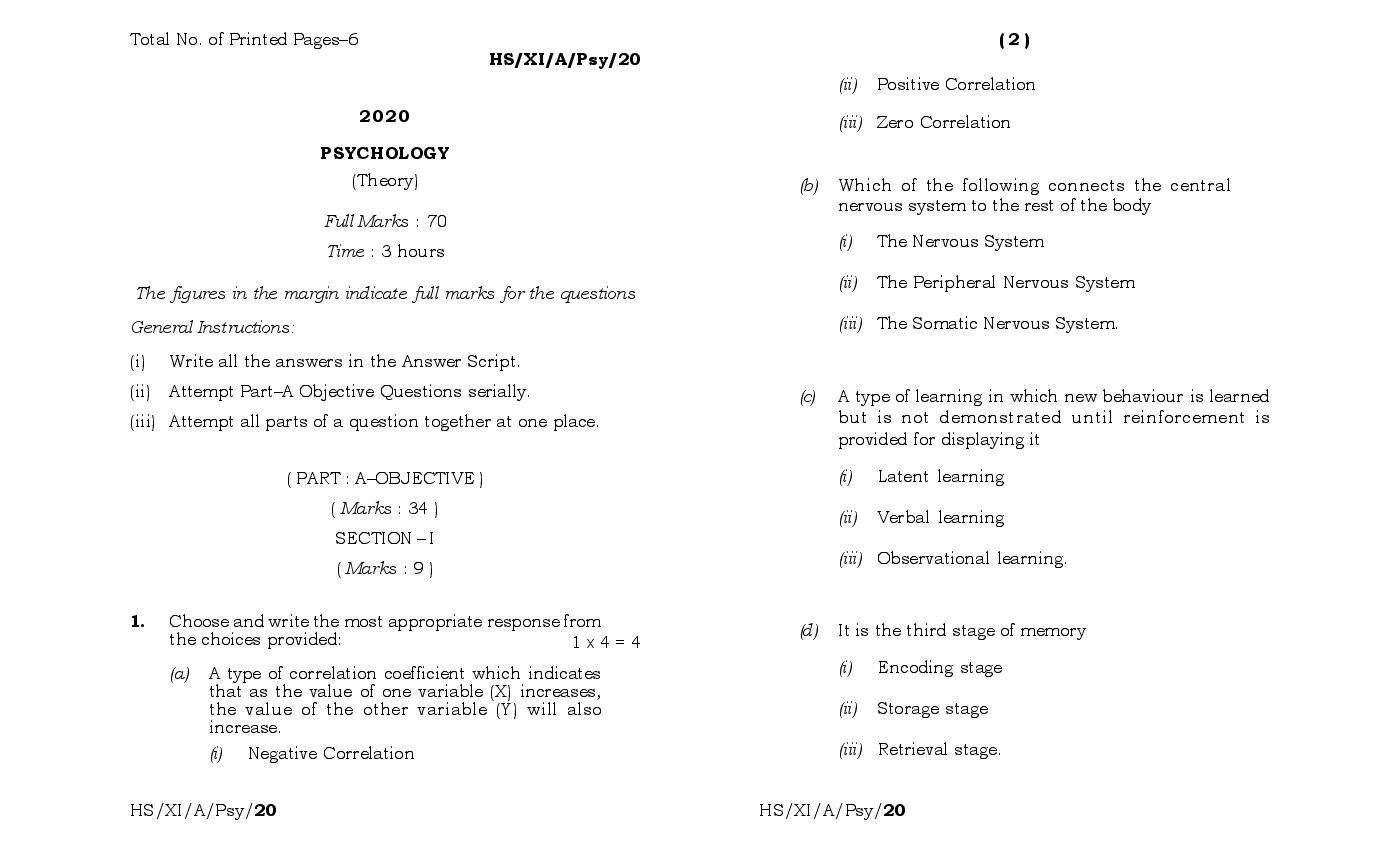
HS/XI/A/Psy/20
(ii) Positive Correlation
2020 (iii) Zero Correlation
PSYCHOLOGY
(Theory) (b) Which of the following connects the central
nervous system to the rest of the body
Full Marks : 70
(i) The Nervous System
Time : 3 hours
(ii) The Peripheral Nervous System
The figures in the margin indicate full marks for the questions
General Instructions: (iii) The Somatic Nervous System.
(i) Write all the answers in the Answer Script.
(ii) Attempt Part–A Objective Questions serially. (c) A type of learning in which new behaviour is learned
(iii) Attempt all parts of a question together at one place. but is not demonstrated until reinforcement is
provided for displaying it
( PART : A–OBJECTIVE ) (i) Latent learning
( Marks : 34 )
(ii) Verbal learning
SECTION – I
(iii) Observational learning.
( Marks : 9 )
1. Choose and write the most appropriate response from
(d) It is the third stage of memory
the choices provided: 1x4=4
(a) A type of correlation coefficient which indicates (i) Encoding stage
that as the value of one variable (X) increases,
the value of the other variable (Y) will also (ii) Storage stage
increase.
(i) Negative Correlation (iii) Retrieval stage.
Page 2
2. Fill in the blanks : 1x5=5 SECTION – III
( Marks : 15 )
(a) A tentative statement of the relationship between
variables as answers to the research question is
4. Write short notes on any 5 (five) of the following.
called a ________.
3 x 5 = 15
(b) The process by which we recognise, interpret or
give meaning to information provided by sense (a) Differences between speed test and power test.
organ is called ________. (b) Meaning of Development.
(c) _______ is a realistic thinking process that draws (c) Learning Styles.
a conclusion from a set of facts.
(d) Verbal Learning.
(d) _______ motives focuses on the innate, biological
causes of motivation. (e) Sensory Memory.
(e) _______ is the first stage of the creative thinking (f) Short Term Memory.
process.
(g) Mental Set.
SECTION – II
PART B – DESCRIPTIVE
( Marks : 10 )
( Marks : 36 )
3. Answer the following questions in 2 or 3 sentences
only. 2 x 5 = 10
5. Answer the following questions in 2 – 3 paragraphs.
(a) What is cultural psychology?
4 x 6 = 24
(b) What is pre-operational stage in Piaget’s Stages (a) Describe any two goals of psychological enquiry.
of Cognitive Development?
Or
(c) What is need for achievement?
Distinguish between experimental group and
(d) What is self actualisation? control group with the help of an example.
(e) What is motion parallax?
Page 3
(b) What are reflexes? Briefly explain the three major 6. Answer the following questions in 200 words: 6 x 2 = 12
reflexes in the newborn.
(a) Briefly explain some of the major schools of
Or psychological thought.
What is Identity? What are the two major factors
Or
that influences the formation of Identity during
adolescence. Describe any four branches of Psychology.
(c) Briefly explain the factors that affect Selective (b) Give a description of the four major parts of the
Attention. forebrain.
Or Or
Briefly explain the factors that influences
Describe the role of parents, schools and peer
Sustained Attention.
groups in the socialisation process.
(d) What is Classical Conditioning?
Or
What is Operant Conditioning?
(e) Distinguish between Maintenance Rehearsal and
Elaborative Rehearsal.
Or
Briefly explain Trace Decay Theory of forgetting.
(f) Briefly explain James Lange Theory of Emotion.
Or
Briefly explain Cannon-Bard Theory of Emotion.
HS/XI/A/Psy/20 HS/XI/A/Psy/20
Document Details
| Board / Org | Meghalaya Board |
| Exam | Class 11 |
| Type | Question Paper |
| Pages | 3 |
| Updated | 30 Apr 2026 |