MBOSE Class 11 Question Paper 2020 for Sociology
Finished viewing? Save it for later —
Download MBOSE Class 11 Question Paper 2020 for Sociology (PDF · 4 pages)About MBOSE Class 11 Question Paper 2020 for Sociology
MBOSE Class 11 Question Paper 2020 for Sociology is available here for free download. Published by Meghalaya Board for Class 11, this question paper can be viewed online or downloaded as a PDF (4 pages). Candidates preparing for Class 11 can use MBOSE Class 11 Question Paper 2020 for Sociology to understand the exam pattern, the type of questions asked, and the overall difficulty level.
Frequently Asked Questions
How can I download MBOSE Class 11 Question Paper 2020 for Sociology?
Open this page and click the Download button to save MBOSE Class 11 Question Paper 2020 for Sociology as a PDF. It is completely free on AglaSem Docs.
Is MBOSE Class 11 Question Paper 2020 for Sociology free to download?
Yes. MBOSE Class 11 Question Paper 2020 for Sociology can be viewed online and downloaded as a PDF free of cost on AglaSem Docs.
How many pages does MBOSE Class 11 Question Paper 2020 for Sociology have?
MBOSE Class 11 Question Paper 2020 for Sociology contains 4 pages, which you can read online or download together as a single PDF.
Where can I find more Class 11 study material?
You can find more Class 11 question papers, sample papers, syllabus, and answer keys on AglaSem Docs.
MBOSE Class 11 Question Paper 2020 for Sociology – Text
Read the full text of this question paper below — useful to quickly search, copy and reference the content online without downloading the PDF.
📄 View text version (4 pages)
Page 1
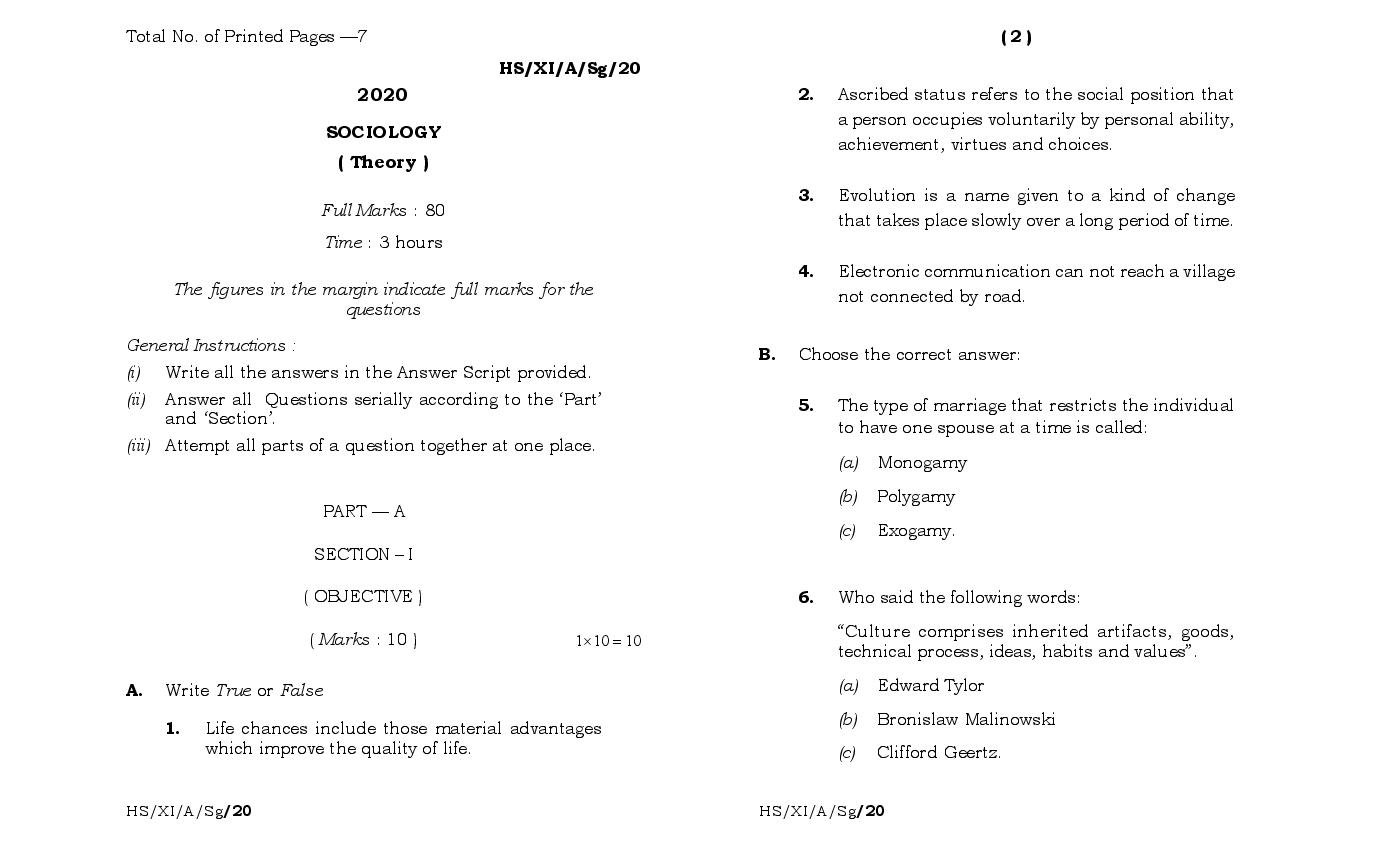
2020 2. Ascribed status refers to the social position that
a person occupies voluntarily by personal ability,
SOCIOLOGY
achievement, virtues and choices.
( Theory )
3. Evolution is a name given to a kind of change
Full Marks : 80
that takes place slowly over a long period of time.
Time : 3 hours
4. Electronic communication can not reach a village
The figures in the margin indicate full marks for the not connected by road.
questions
General Instructions :
B. Choose the correct answer:
(i) Write all the answers in the Answer Script provided.
(ii) Answer all Questions serially according to the ‘Part’ 5. The type of marriage that restricts the individual
and ‘Section’.
to have one spouse at a time is called:
(iii) Attempt all parts of a question together at one place.
(a) Monogamy
(b) Polygamy
PART –– A
(c) Exogamy.
SECTION – I
( OBJECTIVE ) 6. Who said the following words:
“Culture comprises inherited artifacts, goods,
( Marks : 10 ) 110 10
technical process, ideas, habits and values”.
A. Write True or False (a) Edward Tylor
(b) Bronislaw Malinowski
1. Life chances include those material advantages
which improve the quality of life. (c) Clifford Geertz.
HS/XI/A/Sg/20 HS/XI/A/Sg/20
Page 2
7. Which one of the following method is often called 2. What is a quasi group?
‘Field work’?
(a) Interview method
3. What is ‘power’?
(b) Participant method
(c) Historical method. 4. According to Durkheim, what is mechanical solidarity?
5. What is urbanization?
C. Fill in the blank with a suitable word.
8. Mahatma Gandhi broke the salt law of the British 6. Who are the street people?
government at .
7. What is ‘Ecology’?
9. Organic solidarity characterises modern society
8. What is ‘Greenhouse effect’?
and is based on of its members.
9. What is civil right?
10. was among the first to discuss the special
and complex kind of ‘objectivity’.
SECTION – I I I
( SHORT ANSWER )
SECTION – I I
( VERY SHORT ANSWER ) ( Marks : 28 )
( Marks : 18 ) Answer the following questions in not more
than six sentences each. 4 7 28
Answer the following questions in not more than five
sentences each. 2 9 18 1. What is the difference between In-groups and
Out-groups? 4
1. What is competition?
2. Write on the division of labour in modern society. 4
HS/XI/A/Sg/20 HS/XI/A/Sg/20
Page 3
3. (a) What is social rights? 4 PART –– B
Or ( DESCRIPTIVE )
(b) What is material aspect of culture? 4
( Marks : 24 )
Answer the following questions : 6 4 24
4. (a) Write on family as an agent of socialization. 4
Or 1. (a) Discuss the changes in caste system in modern
India.
(b) According to Max Weber, what is Ideal Type? 4
Or
(b) Highlight the relation between status and role.
5. (a) Why change is slower in villages than in towns? 4
Or 2. (a) What are the differences between caste and class?
(b) What is authority? 4 Or
(b) Discuss the several levels of alienation according
6. (a) What is social stratification? 4 to Karl Marx.
Or
3. (a) What is social order and how is it maintained?
(b) What are the differences between micro and macro
method in sociological research? 4 Or
(b) What does it mean when we say “We live in risk
societies”?
7. (a) Explain stateless societies. 4
Or 4. Read the following passage carefully and answer the
questions given below:
(b) What is work? 4 Cultural change is the way in which societies
change their patterns of culture. The impetus for
HS/XI/A/Sg/20 HS/XI/A/Sg/20
Page 4
change can be internal or external. In regard to
internal causes, for instance, new methods of farming
or agriculture can boost agricultural production, which
can transform the nature of food consumption and
quality of life of an agrarian community. On the other
hand external intervention in the form of conquest or
colonization can also affect deep seated changes in
the cultural practices and behaviour of a society.
Cultural change can occur through changes in
the natural environment, contact with other cultures
or processes of adaptation. Changes in the natural
environment or ecology can drastically alter the way
of life of the people. When forest dwelling communities
are deprived of access to the forest and its produce
either because of legal restrictions or due to its
decimation, it can have disastrous effects on the
dwellers and their way of life. Tribal communities in
North East India as well as in middle India have been
the worst affected by the loss of forest resources.
(i). What can boost the agricultural production? 1
(ii). What is the impact of external intervention? 1
(iii). How does cultural change occur? 1
(iv). What is the effect of natural environmental
change? 1
(v). What are the causes of disasters of the forest
dwellers? 1
(vi). Who are the worst affected by the loss of forest
resources? 1
Document Details
| Board / Org | Meghalaya Board |
| Exam | Class 11 |
| Type | Question Paper |
| Pages | 4 |
| Updated | 30 Apr 2026 |