UGC NET 2021 Question Paper Adult Education Shift 1
Finished viewing? Save it for later —
Download UGC NET 2021 Question Paper Adult Education Shift 1 (PDF · 79 pages)About UGC NET 2021 Question Paper Adult Education Shift 1
UGC NET 2021 Question Paper Adult Education Shift 1 is available here for free download. Published by NTA for UGC NET, this question paper can be viewed online or downloaded as a PDF (79 pages). Candidates preparing for UGC NET can use UGC NET 2021 Question Paper Adult Education Shift 1 to understand the exam pattern, the type of questions asked, and the overall difficulty level.
Frequently Asked Questions
How can I download UGC NET 2021 Question Paper Adult Education Shift 1?
Open this page and click the Download button to save UGC NET 2021 Question Paper Adult Education Shift 1 as a PDF. It is completely free on AglaSem Docs.
Is UGC NET 2021 Question Paper Adult Education Shift 1 free to download?
Yes. UGC NET 2021 Question Paper Adult Education Shift 1 can be viewed online and downloaded as a PDF free of cost on AglaSem Docs.
How many pages does UGC NET 2021 Question Paper Adult Education Shift 1 have?
UGC NET 2021 Question Paper Adult Education Shift 1 contains 79 pages, which you can read online or download together as a single PDF.
Where can I find more UGC NET study material?
You can find more UGC NET question papers, sample papers, syllabus, and answer keys on AglaSem Docs.
UGC NET 2021 Question Paper Adult Education Shift 1 – Text
Read the full text of this question paper below — useful to quickly search, copy and reference the content online without downloading the PDF.
📄 View text version (79 pages)
Page 1
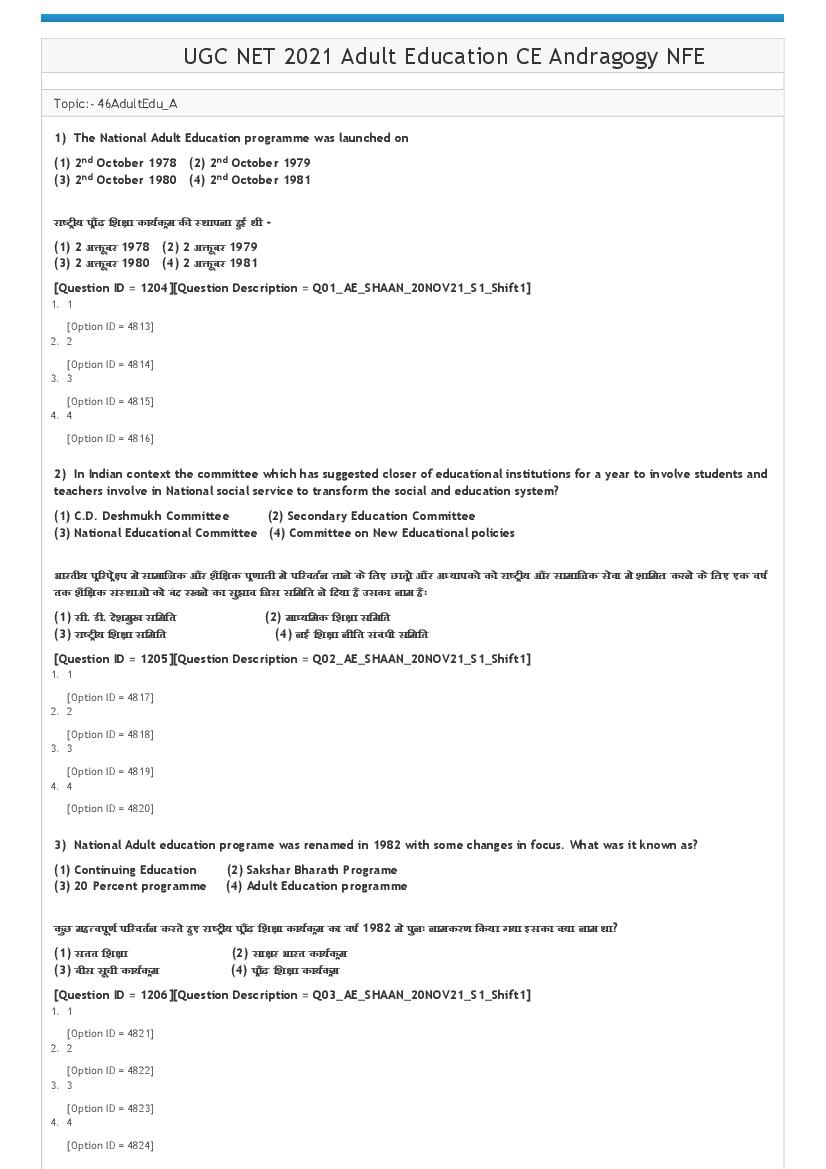
Topic:‐ 46AdultEdu_A
1) The National Adult Education programme was launched on
(1) 2n d October 1978 (2) 2n d October 1979
(3) 2n d October 1980 (4) 2n d October 1981
रा ीय पौढ़ िश ा कायकम क थापना हई थी ‐
(1) 2 अ ूबर 1978 (2) 2 अ ूबर 1979
(3) 2 अ ूबर 1980 (4) 2 अ ूबर 1981
[Question ID = 1204][Question Description = Q01_AE_SHAAN_20NOV21_S1_Shift1]
[Option ID = 4813]
[Option ID = 4814]
[Option ID = 4815]
[Option ID = 4816]
2) In Indian context the committee which has suggested closer of educational institutions for a year to involve students and
teachers involve in National social service to transform the social and education system?
(1) C.D. Deshmukh Committee (2) Secondary Education Committee
(3) National Educational Committee (4) Committee on New Educational policies
भारतीय प रपे प म सामािजक और शैि क पणाली म प रवतन लाने के िलए छात और अ यापक को रा ीय और सामािजक सेवा म शािमल करने के िलए एक वष
तक शैि क सं थाओं को बंद रखने का सुझाव िजस सिमित ने िदया है उसका नाम हैः
(1) सी. डी. देशमुख सिमित (2) मा यिमक िश ा सिमित
(3) रा ीय िश ा सिमित (4) नई िश ा नीित संबंधी सिमित
[Question ID = 1205][Question Description = Q02_AE_SHAAN_20NOV21_S1_Shift1]
[Option ID = 4817]
[Option ID = 4818]
[Option ID = 4819]
[Option ID = 4820]
3) National Adult education programe was renamed in 1982 with some changes in focus. What was it known as?
(1) Continuing Education (2) Sakshar Bharath Programe
(3) 20 Percent programme (4) Adult Education programme
कुछ मह वपूण प रवतन करते हए रा ीय पौढ़ िश ा कायकम का वष 1982 म पुनः नामकरण िकया गया इसका या नाम था?
(1) सतत िश ा (2) सा र भारत कायकम
(3) बीस सूची कायकम (4) पौढ़ िश ा कायकम
[Question ID = 1206][Question Description = Q03_AE_SHAAN_20NOV21_S1_Shift1]
[Option ID = 4821]
[Option ID = 4822]
[Option ID = 4823]
[Option ID = 4824]
Page 2
broad areas of
(1) National curriculum frame work for A.E
(2) International commission of A.E
(3) Adult education policy of USA
(4) NCERT
आधा रक सा रता और सं या मकता, मह वपूण जीवन कौशल, यावसाियक कौशल, बुिनयादी िश ा और सतत िश ा यापक ेत ह :
(1) ए.ई. के िलए रा ीय पाठ्यचया
(2) ए. ई. का अ तरा ीय आयोग
(3) संयु रा य अमे रका क पौढ़ िश ा नीित
(4) रा ीय शैि क अनुसंधान पिश ण प रषद (एन सी ई आर टी)
[Question ID = 1207][Question Description = Q04_AE_SHAAN_20NOV21_S1_Shift1]
[Option ID = 4825]
[Option ID = 4826]
[Option ID = 4827]
[Option ID = 4828]
5) Identify the item from the following which is not a character of learning society?
(1) Learning is a continuing activity through out the life
(2) Learners take responsibility for their own progress
(3) Assessment confirms progress rather than failure
(4) Learners learn uniformally
िन निलिखत मद म से उस मद क पहचान कर जो िश ाथ समाज क िवशेषता है :
(1) सीखना जीवन‐पयत जारी रहने वाली सतत गितिवधी है
(2) िश ाथ अपनी पगित क िज मेदारी लेते ह
(3) मू यांकन, असफलता क तुलना म पगित क पुि करता है
(4) िश ाथ एक समान प से सीखते ह
[Question ID = 1208][Question Description = Q05_AE_SHAAN_20NOV21_S1_Shift1]
[Option ID = 4829]
[Option ID = 4830]
[Option ID = 4831]
[Option ID = 4832]
6) Alternative Education, also known as
(1) Family education (2) Non‐Traditional Education
(3) Traditional Education (4) Non‐Family education
वैकि पक िश ा इस प म भी जानी जाती है
(1) परीवार िश ा (2) गैर परंपरागत िश ा
(3) परंपरागत िश ा (4) गैर पा रवा रक िश ा
[Question ID = 1209][Question Description = Q06_AE_SHAAN_20NOV21_S1_Shift1]
[Option ID = 4833]
Page 3
[Option ID = 4835]
[Option ID = 4836]
7) The use of word andragogy has been traced back as far as to
(1) Early Ninteenth century (2) Late Ninteenth century
(3) Early Twentieth century (4) Late Twentieth century
पौ◌़ढ िश ा शा त श द का पयोग आरंभ हआ‐
(1) उ नीसव सदी के आरंभ म (2) उ नीसव सदी के उ राध म
(3) बीसव सदी के आरंभ म (4) बीसव सदी के उ राध म
[Question ID = 1210][Question Description = Q07_AE_SHAAN_20NOV21_S1_Shift1]
[Option ID = 4837]
[Option ID = 4838]
[Option ID = 4839]
[Option ID = 4840]
8) Andragogy is also referred to as
(1) Compressed theory of adult learning
(2) Comprehensive theory of adult learning
(3) Continued theory of adult learning
(4) Condensed theory of adult learning
एंडागॉजी का उ लेख इस पकार भी होता है
(1) पौ◌़ढ अिधगम का संि िस ांत
(2) पै◌़ढ अिधगम का िव तृत िस ांत
(3) पौ◌़ढ अिधगम का सतत् िस ांत
(4) पौ◌़ढ अिधगम का सघन िस ांत
[Question ID = 1211][Question Description = Q08_AE_SHAAN_20NOV21_S1_Shift1]
[Option ID = 4841]
[Option ID = 4842]
[Option ID = 4843]
[Option ID = 4844]
9) He is generally credited with the popularization of the term “Andragogy”
(1) Freire (2) Knowles
(3) Miller (4) Marx
पौ◌़ढ अ ययन शा त श द को लोकिपय बनाने से आम तौर से संबंिधत है ‐
(1) फ े र े (2) नौलस
(3) िमलर (4) मा स
[Question ID = 1212][Question Description = Q09_AE_SHAAN_20NOV21_S1_Shift1]
[Option ID = 4845]
[Option ID = 4846]
Page 4
[Option ID = 4848]
10) The phrase “The Millstone of Pedagogy” was used by
(1) Knowels (2) Freire
(3) Illich (4) Russo
"द िमल टोन ऑफ पेडागॉजी'' कथन पयु िकया गया ‐
(1) नो स (2) फ े रoे
(3) इि लच (4) सो
[Question ID = 1213][Question Description = Q10_AE_SHAAN_20NOV21_S1_Shift1]
[Option ID = 4849]
[Option ID = 4850]
[Option ID = 4851]
[Option ID = 4852]
11) “Eight ages of man” provided by‐
(1) Erik Erikson (2) Carl Jung
(3) Abraham Maslow (4) Carl Rogers
'एट एजेस ऑफ मैन' (िस ांत) िकसने दी है ‐
(1) ए रक ए र सन (2) काल जंग
(3) अबाहम मे लो (4) काल रोजस
[Question ID = 1214][Question Description = Q11_AE_SHAAN_20NOV21_S1_Shift1]
[Option ID = 4853]
[Option ID = 4854]
[Option ID = 4855]
[Option ID = 4856]
12) The sub titles such as “Farewell to Pedagogy” was used by
(1) Miller (2) Knowles
(3) Brecht (4) Marx
"फेयरवेल टू पेडागॉजी'' जैसे उपशीषक का पयोग िकसने िकया?
(1) िमलर (2) नो स
(3) बे त/ब े (4) मा स
[Question ID = 1215][Question Description = Q12_AE_SHAAN_20NOV21_S1_Shift1]
[Option ID = 4857]
[Option ID = 4858]
[Option ID = 4859]
[Option ID = 4860]
13) Abraham Maslow (1972) placed special emphasis on:
(1) The role of safety (2) The readiness of learning
(3) The structure of self (4) The latency
Page 5
(1) सुर ा क भूिमका (2) अिधगम क त परता
(3) आ म क संरचना (4) अ य ता
[Question ID = 1216][Question Description = Q13_AE_SHAAN_20NOV21_S1_Shift1]
[Option ID = 4861]
[Option ID = 4862]
[Option ID = 4863]
[Option ID = 4864]
14) The art and science of helping adults learning is known as
(1) Pedagogy (2) Self‐Directed learning
(3) Andragogy (4) Demagogy
पौ◌़ढ यि य को िश ा पदान करने म सहायता देने वाले कला और िव ान को कहा जाता हैः
(1) िश ण शा त (2) व‐िनदिशत िश ण
(3) एंडागॉजी (पौ◌़ढ अ ययन शा त) (4) जनो जे न
[Question ID = 1217][Question Description = Q14_AE_SHAAN_20NOV21_S1_Shift1]
[Option ID = 4865]
[Option ID = 4866]
[Option ID = 4867]
[Option ID = 4868]
15) Sustainable Development Goals (SDGs) of UNDP listed as number
(1) 17 (2) 08
(3) 10 (4) 05
यू. एन. डी. पी. का दीघकािलक िवकास ल य (SDGs) सूिचत है बतौर सं या ‐
(1) 17 (2) 08
(3) 10 (4) 05
[Question ID = 1218][Question Description = Q15_AE_SHAAN_20NOV21_S1_Shift1]
[Option ID = 4869]
[Option ID = 4870]
[Option ID = 4871]
[Option ID = 4872]
16) Discussion of desirable society was initiated by
(1) Mahatma Gandhi (2) Pandit Jawharlal Nehru
(3) Lajpat Rai (4) Vallabh Bhai Patel
वांछनीय समाज क चचा िन निलिखत यि ारा शु क गई थी
(1) महा मा गाँधी (2) पंिडत जवाहर लाल नेह
(3) लाजपत राय (4) व लभ भाई पटेल
[Question ID = 1219][Question Description = Q16_AE_SHAAN_20NOV21_S1_Shift1]
[Option ID = 4873]
[Option ID = 4874]
Page 6
[Option ID = 4876]
17) Which of the following devices is required to connect a computer to the internet?
(1) Pen drive (2) Mouse
(3) DVD (4) Modem
िन निलिखत म से कौन सा उपकरण कं पूटर को इंटरनेट से जो◌़डने के िलए आव यक है?
(1) पेन डाइव (2) माउस
(3) डी. वी. डी (4) मोडम
[Question ID = 1220][Question Description = Q17_AE_SHAAN_20NOV21_S1_Shift1]
[Option ID = 4877]
[Option ID = 4878]
[Option ID = 4879]
[Option ID = 4880]
18) Full form of VIRUS is
(1) Versatile information Research under seige
(2) Vital information Research under seige
(3) Volume of information Research under seige
(4) Video information Research under seige
वायरस (वायरस) का िव तृत प हैः
(1) वसटाइल इनफामशन रसच अंडर सीज
(2) वाइरल इनफामशन िसरोस अंडर सीज
(3) वा यूम आफ इनफामशन रसोस अंडर सीज
(4) वीिडयो इनफामशन िसरोस अंडर सीज
[Question ID = 1221][Question Description = Q18_AE_SHAAN_20NOV21_S1_Shift1]
[Option ID = 4881]
[Option ID = 4882]
[Option ID = 4883]
[Option ID = 4884]
19) The Full form of MOOC is
(1) Massive Open Optional Course (2) Massive open online course
(3) Multimedia open online course (4) Multimedia open optional course
मूक (MOOC) का पूण प है ‐
(1) मैिसव ओपेन आ सनल कोस (2) मैिसव ओपेन ऑनलाईन कोस
(3) म टीमीिडया ओपेन ऑनलाईन कोस (4) म टीमीिडया ओपेन ऑ सनल कोस
[Question ID = 1222][Question Description = Q19_AE_SHAAN_20NOV21_S1_Shift1]
[Option ID = 4885]
[Option ID = 4886]
[Option ID = 4887]
Page 7
20) ‘Swayam’ is very much important in
(1) Agriculture (2) Sports
(3) Education (4) Health
" वयम्' िन निलिखत म बहत मह वपूण हैः
(1) कृिष (2) खेलकूद
(3) िश ा (4) वा य
[Question ID = 1223][Question Description = Q20_AE_SHAAN_20NOV21_S1_Shift1]
[Option ID = 4889]
[Option ID = 4890]
[Option ID = 4891]
[Option ID = 4892]
21) What is elaboration of “Cc” in an email?
(1) Close circuit (2) Carbon copy
(3) Close contact (4) Concealed contact
एक हमेल “Cc” म का िव तृत प हैः
(1) लोज सिकट (2) काबन कापी
(3) लोज कंटट (4) कंसी ड कंटट
[Question ID = 1224][Question Description = Q21_AE_SHAAN_20NOV21_S1_Shift1]
[Option ID = 4893]
[Option ID = 4894]
[Option ID = 4895]
[Option ID = 4896]
22) URL means
(1) Uniform Resource Locator (2) University Resource Library
(3) Uniform Repository Locator (4) Universal Repository Location
यू आर एल का अिशपाय है‐
(1) यूनीफॉम रसोस लोकेटर (2) यूनीवािसटी रसोस लाइबेरी
(3) यूनीफॉम रेपोिजटरी लोकेटर (4) सूनीवसल रेपोिजटरी लोकेशन
[Question ID = 1225][Question Description = Q22_AE_SHAAN_20NOV21_S1_Shift1]
[Option ID = 4897]
[Option ID = 4898]
[Option ID = 4899]
[Option ID = 4900]
23) One of these is not a basic term associated with computers
(1) Hardware (2) Software
(3) Data (4) Plagiarism
इनम से एक कं यूटर से जु◌़डा मूल श द नह है ‐
Page 8
(3) डाटा (4) लेग र म
[Question ID = 1226][Question Description = Q23_AE_SHAAN_20NOV21_S1_Shift1]
[Option ID = 4901]
[Option ID = 4902]
[Option ID = 4903]
[Option ID = 4904]
24) ‘Living today’ A radio programme broad casted to enhance the community Development in adult education programme
is from
(1) United Kingdom
(2) India
(3) United States of America
(4) Tanzania
पौ◌़ढ िश ा कायकम म सामुदािदयक िवकास म वृि करने के पसा रत िकया जानेवाला रेिडयो कायकम "लीिवंग टु◌़डे' कहाँ का है?
(1) यूनाइटेड िकंगडम
(2) भारत
(3) संयु रा य अमे रका
(4) तंजािनया
[Question ID = 1227][Question Description = Q24_AE_SHAAN_20NOV21_S1_Shift1]
[Option ID = 4905]
[Option ID = 4906]
[Option ID = 4907]
[Option ID = 4908]
25) As per New National Education Policy 2020 which of the following is newly integral part of school education?
(1) Early childhood care and education
(2) Sports education
(3) Agriculture Education
(4) Professional Education
नई रा ीय िश ा नीित, 2020 के अनुसार िन निलिखत म से िकसे कूल िश ा का अिभ न अंग बनाया गया है?
(1) आरंिभक िशशु देखभाल और िश ा
(2) खेलकूद िश ा
(3) कृिष िश ा
(4) पेशव
े र िश ा
[Question ID = 1228][Question Description = Q25_AE_SHAAN_20NOV21_S1_Shift1]
[Option ID = 4909]
[Option ID = 4910]
[Option ID = 4911]
[Option ID = 4912]
Page 9
Statement II: In future, there has to be a blend of online and offline teaching which has to be achieved in next five years
In the light of the above statements, Choose the correct answer from the options given below
(1) Both Statement I and Statement II are true
(2) Both Statement I and Statement II are false
(3) Statement I is true but Staement II is false
(4) Statement I is false but Staement II is true
नीचे दो कथन िदए गए ह :
कथन (I) : कोरोना महामारी के कारण, पूरे देश ने ऑनलाइन िश ण म अभूतपूव वृ िध देखी
कथन (II) : भािव य म, ऑलाइन और ऑफलाइन िश ण का एक िमशण होगा जो अगले पाँच साल म पा हो जाएगा
उपयु कथन के आलोक म, नीचे िदए गए िवक प म से सही उ र का चयन क िजए :
(1) कथन (I) और (II ) दोन स य ह
(2) कथन (I) और (II) दोन अस य ह
(3) कथन (I) स य है, लेिकन कथन (II) अस य है
(4) कथन (I) अस य है, लेिकन कथन (II) स य है
[Question ID = 1229][Question Description = Q26_AE_SHAAN_20NOV21_S1_Shift1]
[Option ID = 4913]
[Option ID = 4914]
[Option ID = 4915]
[Option ID = 4916]
27) Given below are two statements: One is labeled as Assertion A and the other is labeled as Reason R
Assertion (A): With the development of science and technology, the forms and ways of communication have become more
specialised and there is an increasing use of social media as the new methods of communication
Reasons (R): In the socities of today, the communication process is more complex and indirect because of the use of modern
gadgets in which the individuals do not interact face to face
In the light of the above staements, Choose the correct answer from the options given below:
(1) Both (A) and (R) are true and (R) is the correct explanation of (A)
(2) Both (A) and (R) are true and (R) is the NOT correct explanation of (A)
(3) (A) is true but (R) is false
(4) (A) is false but (R) is true
नीचे दो कथन िदए गए ह : एक अिभकथन Assertion(A) के प म िलिखत है तो दूसरा उसके कारण Reason(R) के पम:
अिभकथन (A): िव ान और पौ ोिगक के िवकास के साथ‐साथ संचार के व प और तरीके अिधक िवशेष तायु हो गए ह और संचार के नए तरीक के पम
सोशल मीिडया का अिधक पयोग िकया जा रहा हैŸ
कारण (R): आज के समाज म आधुिनक उपकराण (गैजेट) के पयोग, िजसम यि आमने‐ सामने संवाद नह करते, के कारण संचार क पिकया अिधक जिटल
और अप य हैŸ
उपरो कथन के आलोक म, नीचे िदए गए िवक प म से सही उ र का चयन क िजए :
(1) (A) और (R) दोन स य ह और (R), (A) क सही या या है
(2) (A) और (R) दोन स य ह, लेिकन (R), (A) क सही या या नह है
(3) (A) स य है, लेिकन (R) अस य है
(4) (A) अस य है, लेिकन (R) स य है
[Question ID = 1230][Question Description = Q27_AE_SHAAN_20NOV21_S1_Shift1]
[Option ID = 4917]
Page 10
[Option ID = 4919]
[Option ID = 4920]
28) Given below are two statements: One is labeled as Assertion A and the other is labeled as Reason R
Assertion (A) : Human resource development plays a critical role in the socio‐economic development of a country
Reasons (R) : The welfare and development of the weaker sections of the society largely depend upon suitable policy
directions executed through appropriate programmed and strategies
In the light of the above staements, Choose the most appropriate answer from the options given below:
(1) Both (A) and (R) are true and (R) is the correct explanation of (A)
(2) Both (A) and (R) are true and (R) is the NOT correct explanation of (A)
(3) (A) is true but (R) is false
(4) (A) is false but (R) is true
नीचे दो कथन िदए गए ह : एक अिभकथन Assertion (A) के प म िलिखत है तो दूसरा उसके कारण Reason (R) के पम
अिभकथन (A) : मानव संसाधन िवकास देश के सामािजक‐आिथक िवकास म मह वपूण भूिमका अदा करता है
कारण (R) : समाज के कमज़ारे वग को क याण और िवकास मोटे तौरपर उपयु नीित िनदशन तथा उिचत कायकम और रणनीितय के ारा उनके िकया वयन
पर िनभर करता है
उपरो कथन के आलोक म, नीचे िदए गए िवक प म से सबसे उपयुº उ र का चयन क िजए
(1) (A) और (R) दोन सही ह और (R), (A) क सही या या है
(2) (A) और (R) दोन सही ह, लेिकन (R), (A) क सही या या नह है
(3) (A) सही है, लेिकन (R) सही नह है
(4) (A) सही नह है लेिकन (R) सही है
[Question ID = 1231][Question Description = Q28_AE_SHAAN_20NOV21_S1_Shift1]
[Option ID = 4921]
[Option ID = 4922]
[Option ID = 4923]
[Option ID = 4924]
29) Given below are two statements: One is labeled as Assertion A and the other is labeled as Reason R
Assertion (A): Education is a life long activity which begins at birth and continues till one dies It does not terminate at the
end of formal schooling but is a lifelong process
Reasons (R): Life long education covers the entire life span of an individual and includes formal, non‐formal needs of an
individuals
In the light of the above statement, choose the correct answer from the given below:
(1) Both (A) and (R) are true and (R) is the correct explanation of (A)
(2) Both (A) and (R) are true and (R) is the NOT correct explanation of (A)
(3) (A) is true but (R) is false
(4) (A) is false but (R) is true
नीचे दो कथन िदए गए ह : एक अिभकथन Assertion (A) के प म िलिखत है तो दूसरा उसके कारण Reason (R) के पम:
अिभकथन (A): िश ा एक जीवन‐पयत चलने वाली पिकया है जो ज म के समय से आरंभ होकर मृ यु‐ पयत जारी रहती हैŸ यह औपचा रक कूल िश ा के समा
होने पर समा नह होती है परँतु जीवनपयत चलने वाली पिकया है
कारण (R): जीवन‐पयत िश ा म यि के संपूण जीवन क अविध शािमल होती है और इसम यि क औपचा रक, गैर‐औपचा रक ज रत आती ह
उपरो कथन के आलोक म, नीचे िदए गए िवक प म से सही उ र का चयन क िजए :
(1) (A) और (R) दोन स य ह और (R), (A) क सही या या है
(2) (A) और (R) दोन स य ह, लेिकन (R), (A) क सही या या नह है
(3) (A) स य है, लेिकन (R) अस य है
(4) (A) अस य है, लेिकन (R) स य है
Page 11
[Option ID = 4925]
[Option ID = 4926]
[Option ID = 4927]
[Option ID = 4928]
30) Given below are two statements: One is labeled as Assertion A and the other is labeled as Reason R
Assertion (A) : The caste system is unique to India and is also the basis of stratification in our country. The caste is an
inseparable aspect of Indian society in which all the castes in all the four major religions‐ Hindu, Muslim, Sikh, Christian ‐ are
living peacefully with each other
Reasons (R) : The caste system with all its pecularities is unique to India and hence it is not universal
In the light of the above staements, Choose the correct answer from the options given below:
(1) Both (A) and (R) are true and (R) is the correct explanation of (A)
(2) Both (A) and (R) are true and (R) is the NOT correct explanation of (A)
(3) (A) is true but (R) is false
(4) (A) is false but (R) is true
नीचे दो कथन िदए गए ह : एक अिभकथन Assertion (A) के प म िलिखत है तो दूसरा उसके कारण Reason (R) के पम:
अिभकथन (A) : जाितपथा भारत क अि तीय पथा है और यह हमारे देश म तर‐िव यास का आधार भी है जाित, भारतीय समाज का अिवभा प पहलू है िजसम चार
पमुख धम ‐िह दू, मुि लम, िस ख, ईसाई क सभी जाितयाँ एक दूसरे के साथ शाँितपूण ढंग से रह रही ह
कारण (R) : अपनी सभी िविश ताओं के साथ जाित पथा भारत क अि तीय पथा है और इसिलए यह सवाभौिमक नह है
उपरो कथन के आलोक म, नीचे िदए गए िवक प म से सही उ र का चयन क िजए :
(1) (A) और (R) दोन स य ह और (R), (A) क सही या या है
(2) (A) और (R) दोन स य ह, लेिकन (R), (A) क सही या या नह है
(3) (A) स य है, लेिकन (R) अस य है
(4) (A) अस य है, लेिकन (R) स य है
[Question ID = 1233][Question Description = Q30_AE_SHAAN_20NOV21_S1_Shift1]
[Option ID = 4929]
[Option ID = 4930]
[Option ID = 4931]
[Option ID = 4932]
31) In which year India implemented the National Family Planning Programme?
(1) 1951 (2) 1952
(3) 1953 (4) 1954
भारत ने िकस वष म रा ीय प रवार िनयोजन कायकम लागू िकया?
(1) 1951 (2) 1952
(3) 1953 (4) 1954
[Question ID = 1234][Question Description = Q31_AE_SHAAN_20NOV21_S1_Shift1]
[Option ID = 4933]
[Option ID = 4934]
[Option ID = 4935]
[Option ID = 4936]
Page 12
(1) Youth (2) Farmers
(3) Handicapped (Divyang) (4) Sr. Citizen
रा ीय कौशल िवकास नीित मु य प से है ‐
(1) युवाओं के िलए (2) िकसान के िलए
(3) िद यांग के िलए (4) व र नाग रक के िलए
[Question ID = 1235][Question Description = Q32_AE_SHAAN_20NOV21_S1_Shift1]
[Option ID = 4937]
[Option ID = 4938]
[Option ID = 4939]
[Option ID = 4940]
33) The term Entrpreneurship refers to
(1) Person (2) Product
(3) Process (4) Output
उ मशीलता पद का अथ हैः
(1) यि (2) उ पाद
(3) पिकया (4) उ पादन (आउटपुट)
[Question ID = 1236][Question Description = Q33_AE_SHAAN_20NOV21_S1_Shift1]
[Option ID = 4941]
[Option ID = 4942]
[Option ID = 4943]
[Option ID = 4944]
34) Which of the following is connected to self help group?
(1) NLM (2) MPFL
(3) SEWA (4) ICDS
वयं‐ सहायता समूह का एक सवशे उदाहरण है –
(1) एन. एल. एम. (NLM) (2) एम. पी. एफ. एल. (MPFL)
(3) एस. ई. ड यू. ए. (SEWA) (4) आई. सी. डी. एस. (ICDS)
[Question ID = 1237][Question Description = Q34_AE_SHAAN_20NOV21_S1_Shift1]
[Option ID = 4945]
[Option ID = 4946]
[Option ID = 4947]
[Option ID = 4948]
35) Innovation and incubation centres set up by State Governments under ministry of
(1) Higher and technical education
(2) Sports and youth affairs
(3) Social welfare
(4) Skill Development and Entrepreneurship
Page 13
(1) उ च और तकनीक िश ा
(2) खेल एंव युवा मामले
(3) समाज क या
(4) कौशल िवकास एवं उ िमता
[Question ID = 1238][Question Description = Q35_AE_SHAAN_20NOV21_S1_Shift1]
[Option ID = 4949]
[Option ID = 4950]
[Option ID = 4951]
[Option ID = 4952]
36) Data collection by other agencies and made readily available to reasearcher, is referred as
(1) Primary data
(2) Secondary data
(3) Readymade data
(4) Raw data
अ य एजिसय के ारा आँक़ड को एकत करना और उ ह शोधािथय को आसानी से उपल ध कराने को कहते ह ‐
(1) पाथिमक आँक़डे
(2) सहायक/गौण आँक़डे
(3) तैयार आँक़डे
(4) क चे आँक़डे
[Question ID = 1239][Question Description = Q36_AE_SHAAN_20NOV21_S1_Shift1]
[Option ID = 4953]
[Option ID = 4954]
[Option ID = 4955]
[Option ID = 4956]
37) The analysis of Latin squire Research [LS Design] is similar to
(1) Two way Anova Techiniques
(2) U Test
(3) H Test
(4) Spearman Rank Correlation
लैिटन वायर रसच (एल एस िडजाइन) का िव े ण िकस के समान है?
ष
(1) टू वे एनोवा टेकनी स
(2) यू टे ट
(3) एच टे ट
(4) ि पयरपैमन रक को रलेशन
[Question ID = 1240][Question Description = Q37_AE_SHAAN_20NOV21_S1_Shift1]
[Option ID = 4957]
[Option ID = 4958]
[Option ID = 4959]
Page 14
38) When observations of researcher is processed then it refers?
(1) Information
(2) Knowledge
(3) Data
(4) Evidance
जब शोधाथ ारा पा त य पर कायवाही क जाती है, उसका अथ होता है ‐
(1) सूचना
(2) ान
(3) आँक़डे
(4) सबूत
[Question ID = 1241][Question Description = Q38_AE_SHAAN_20NOV21_S1_Shift1]
[Option ID = 4961]
[Option ID = 4962]
[Option ID = 4963]
[Option ID = 4964]
39) One of these is NOT the characteristics of life long learning who have achieved success:
(1) Reading and thinking
(2) Bursting fixed mindsets
(3) Overconfidence and arrogance
(4) Experimental and creation
इनम से एक उन लोग क जीवन‐पयत िश ा क िवशेषता नह है िज ह ने सफलता पा क हैः
(1) पठन और िचंतन
(2) बंद िदमाग को खोलना
(3) अित िव ास और अहंकार
(4) अयोग और सृजन
[Question ID = 1242][Question Description = Q39_AE_SHAAN_20NOV21_S1_Shift1]
[Option ID = 4965]
[Option ID = 4966]
[Option ID = 4967]
[Option ID = 4968]
40) When data are collected on the entire population rather than a sample this is reffered to as a?
(1) Sample
(2) Population
(3) Universe
(4) Census
जब सपल के बजाय समूची आबादी के आधार पर आँक़डे एकत िकए जाते ह तो उ ह कहा जाता है‐
(1) सपल
Page 15
(3) समि
(4) जनगणना
[Question ID = 1243][Question Description = Q40_AE_SHAAN_20NOV21_S1_Shift1]
[Option ID = 4969]
[Option ID = 4970]
[Option ID = 4971]
[Option ID = 4972]
41) The process of selecting people or elements from a population for inclusion in a research study it refers?
(1) Population (2) Universe
(3) Sampling (4) Census
एक शोध अ ययन मं समावेशन के उ े य से एक आबादी से लोग अथवा त व के चयन क पिकया का संबध है ‐
(1) जनसं या से (2) समि से
(3) सपिलंग से (4) जनगणना से
[Question ID = 1244][Question Description = Q41_AE_SHAAN_20NOV21_S1_Shift1]
[Option ID = 4973]
[Option ID = 4974]
[Option ID = 4975]
[Option ID = 4976]
42) The adults differ from children in learning
(A) Validate their beliefs and values based on the information
(B) Learning to be useful in their long term future
(C) Expect that learning should be useful immediately
(D) Accept the information presented to them
Choose the most appropriate answer from the options given below :
(1) (A) and (B) only
(2) (A) and (D) only
(3) (A) and (C) only
(4) (B) and (C) only
िश ण म पौ◌़ढ ब च से इस मामले म िभ न ह:
(A) अपनी जानकारी के आधार पर अपने िव ास और मू य दो िविधभा य करते ह
(B) उनके दीघकािलक भिव य म िश ा उपयोगी होती है
(C) आपे ा करते ह िक िश ा तुरत
ं उपयोगी हो
(D) अनको प तुत क गई जानकारी को वीकार करते ह
नीचे िदए गए िवक प म से सबसे उपयु उ र का चयन क िजए:
(1) केवल (A) और (B)
(2) केवल (A) और (D)
(3) केवल (A) और (C)
(4) केवल (B) और (C)
[Question ID = 1245][Question Description = Q42_AE_SHAAN_20NOV21_S1_Shift1]
[Option ID = 4977]
Page 16
[Option ID = 4979]
[Option ID = 4980]
43) Which of the following were part of the broad objectives of Sakshar Bharat Mission?
(A) Promote a learning society
(B) Impart non and neo‐literates skills to non and neoliterates to improve their earnings and living condition
(C) Intensive combing of drop cuts to enroll them in sexual education
(D) Impart functional literacy and numeracy to non literates and non‐numerate adults
Choose the most appropriate answer from the options given below :
(1) (A), (B), (C) only
(2) (B), (C), (D) only
(3) (A), (C), (D) only
(4) (A), (B), (C), (D) only
िन निलिखत म से या‐ या सा र भारत िमशन के यापक उ े य म सि मिलत थे?
(A) अिधगम‐बहल समाज को ढावा देना
(B) िनर र और नव‐सा र यि य को उनक आय और उनके जीवन तर म सुधार लाने के िलए िनरभर और नवरा र कौशल पदान करना
(C) बीच म ढाई छो◌़डने वाले ब च क गहन तलाश करना और कूली िश ा म उ ह पवेश देना
(D) िनर र और सं या ान रिहत पौ◌़ढ को पकाया मकसा रता और सं या ान पदान करना
नीचे िदए गए िवक प म से सबसे उपयु उ र का चयन क िजए :
(1) केवल (A), (B), (C)
(2) केवल (B), (C), (D)
(3) केवल (A), (C), (D)
(4) केवल (A), (B), (C), (D)
[Question ID = 1246][Question Description = Q43_AE_SHAAN_20NOV21_S1_Shift1]
[Option ID = 4981]
[Option ID = 4982]
[Option ID = 4983]
[Option ID = 4984]
44) Identify following which are the stakeholder in higher education
(A) Student
(B) Teacher
(C) Administrator
(D) Computer
Choose the most appropriate answer from the options given below :
(1) (A) and (B) only
(2) (B) and (D) only
(3) (C) and (D) only
(4) (A) and (D) only
िन निलिखत म कौन उ च िश ा म िहतधारक होते ह?
(A) िव ाथ
(B) अ यापक
(C) पशासक
Page 17
नीचे िदए गए िवक प म से सबसे उपयु उ र का चयन क िजए :
(1) केवल (A) और (B)
(2) केवल (B) और (D)
(3) केवल (C) और (D)
(4) केवल (A) और (D)
[Question ID = 1247][Question Description = Q44_AE_SHAAN_20NOV21_S1_Shift1]
[Option ID = 4985]
[Option ID = 4986]
[Option ID = 4987]
[Option ID = 4988]
45) Gestalt psychology emphasized on:
(A) Organizational experiences
(B) Internal and External factors
(C) Relationship between part and whole
(D) Wholeness of behaviour
Choose the most appropriate answer from the options given below:
(1) (A) , (B) and (C) only
(2) (A) , (C) and (D) only
(3) (B) , (C) and (D) only
(4) (B) and (C) only
जे टो ट मनोिव ान ज़ोर देता हैः
(A) संगठना मक अनुभव पर
(B) आंत रक एवं बा कारक $
(C) अंगी‐अंग संबंध
(D) यवहार क संपूणता
नीचे िदए गए िवक प म से सबसे उपयु उ र का चयन क िजए :
(1) केवल (A), (B) और (C)
(2) केवल (A), (C) और (D)
(3) केवल (B), (C) और (D)
(4) केवल (B) और (C)
[Question ID = 1248][Question Description = Q45_AE_SHAAN_20NOV21_S1_Shift1]
[Option ID = 4989]
[Option ID = 4990]
[Option ID = 4991]
[Option ID = 4992]
46) Terminological variety of many terms similar to distance education which have been widely accepted are
(A) Flexi study
(B) Open learning
(C) On campus learning
(D) Independent learning
Choose the most appropriate answer from the options given below :
Page 18
(2) (A), (C) and (D) only
(3) (B), (C) and (D) only
(4) (A), (B), (C) and (D) only
दूर थ िश ा से िमलने जुलने बहत से पद को यापक वीकृित िमल गई है; उ ह िच ांिकत क िजएः
(A) ले सी अ ययन
(B) मु अिधगम
(C) प रसर के भीतर अिधगम (ऑन कै पसलिनग)
(D) वतंत अिधगम
नीचे िदए गए िवक प म से सबसे उपयु उ र का चयन क िजए :
(1) केवल (A), (B), (D)
(2) केवल (A), (C), (D)
(3) केवल (B), (C), (D)
(4) केवल (A), (B), (C) और (D)
[Question ID = 1249][Question Description = Q46_AE_SHAAN_20NOV21_S1_Shift1]
[Option ID = 4993]
[Option ID = 4994]
[Option ID = 4995]
[Option ID = 4996]
47) What are the major criteria for effectively organized group of learning experiences?
(A) Sequence
(B) Integration
(C) Evaluation
(D) Continuity
Choose the most appropriate answer from the options given below:
(1) (A), (B) and (D) only
(2) (B), (C) and (D) only
(3) (C), (D) and (A) only
(4) (B), (A), and (C) only
पभावी ढंग से आयोिजत िश ण अनुभव समूह के िलए पमुख मानदंड या है?
(A) अनुकम
(B) समेकन
(C) मू यांकन
(D) िनरंतरता
नीचे िदए गए िवक प म से सबसे उपयु उ र का चयन क िजए :
(1) केवल (A), (B) और (D)
(2) केवल (B), (C) और (D)
(3) केवल (C), (D) और (A)
(4) केवल (B), (A) और (C)
[Question ID = 1250][Question Description = Q47_AE_SHAAN_20NOV21_S1_Shift1]
[Option ID = 4997]
[Option ID = 4998]
Page 19
[Option ID = 5000]
48) Sustainable development goals in education is to ensure inclusive and equitable quality education and promote life long
opportunities for all includes
(A) Global power play
(B) Cultural appreciation
(C) Gender equality
(D) Climate change and production
Choose the most appropriate answer from the options given below:
(1) (A) and (B) only
(2) (A) and (C) only
(3) (B) and (C) only
(4) (B) and (D) only
िश ा संबंधी दीघकािलक िवकास ल य, समावेशी और समान गुणव ा वाली िश ा सुिनि त करते ह और सभी के िलए जीवन‐पयात अवसर उपल ध करवाते ह,
इनम शािमल ह :
(A) वैि क शि खेल
(B) सां कृितक पशंसा
(C) लिगक समानता
(D) जलवायु प रवतन और उ पादन
नीचे िदए गए िवक प म से सही उ र का चयन क िजए :
(1) केवल (A) और (B)
(2) केवल (A) और (C)
(3) केवल (B) और (C)
(4) केवल (B) और (D)
[Question ID = 1251][Question Description = Q48_AE_SHAAN_20NOV21_S1_Shift1]
[Option ID = 5001]
[Option ID = 5002]
[Option ID = 5003]
[Option ID = 5004]
49) According to Candy; Which of the following are the characteristics of autonomy of learners?
(A) Exercise freedom of choice and action
(B) Monitoring by learner
(C) Have self‐mastery
(D) Follow goals and objectives
Choose the most appropriate answer from the options given below:
(1) (A) and (B) only
(2) (B) and (C) only
(3) (C) and (D) only
(4) (A) and (C) only
कडी के अनुसार िन निलिखत म से कौन सा अिधगमकता क वाय ता क िवशेषताएँ ह?
(A) चुनाव और िकया क वतंतता का आ यास
(B) अिधगमकताओं ारा अनुशवण
(C) वपवीण होना
(D) ल य और उ े य का अनुगमन
Page 20
(1) केवल (A) और (B)
(2) केवल (B) और (C)
(3) केवल (C) और (D)
(4) केवल (A) और (C)
[Question ID = 1252][Question Description = Q49_AE_SHAAN_20NOV21_S1_Shift1]
[Option ID = 5005]
[Option ID = 5006]
[Option ID = 5007]
[Option ID = 5008]
50) Vocational education is for
(A) Manual work
(B) Livelihood
(C) Occupational knowledge
(D) Researcher worker
Choose the most appropriate answer from the options given below:
(1) (D), (C) and (A) only
(2) (B), (C) and (D) only
(3) (A) and (B) only
(4) (A), (B) and (C) only
यावसाियक िश ा है ‐
(A) ह तकम के िलए
(B) आजीिवका के िलए
(C) पेशव
े र / यावसाियक ान के िलए
(D) शोध काय के िलए
नीचे िदए गए िवक प म से सबसे उपयु उ र का चयन क िजए :
(1) केवल (D), (C) और (A)
(2) केवल (B), (C) और (D)
(3) केवल (A) और (B)
(4) केवल (A), (B) और (C)
[Question ID = 1253][Question Description = Q50_AE_SHAAN_20NOV21_S1_Shift1]
[Option ID = 5009]
[Option ID = 5010]
[Option ID = 5011]
[Option ID = 5012]
51) Arrange the following different levels of competence have been designed in National Vocational qualifications in order
to sequencial manner.
(A) Responsibility and autonomy of individual work activities
(B) Complex technical and specialized professional activities
(C) Apply fundamental principles and techniques
(D) Complex skilled performance of activities
(E) Performance of routine and predictable work activities
Page 21
(1) (B), (C), (A), (E), (D)
(2) (E), (A), (D), (B), (C)
(3) (E), (A), (B), (D), (C)
(4) (A), (B), (D), (C), (E)
स मता के िभ न‐िभ न तर , िज ह रा ीय यावसाियक अह ताओं म रखा गया है, को अनुकम म यवि थत कर :
(A) वैयि क काय गितिविधय क िज मेदारी और वाय ता
(B) जिटल तकनीक और िवशेष तायु पेशव े र गितिविधयाँ
(C) मूल िस ांत और तकनीक का अनुपयोग करना
(D) गितिविधय का जिटल कौशलयु िन पादन
(E) नेमी और भिव य सूचक गितिवध का िन पादन
नीचे िदए गए िवक प म से सही उ र का चयन क िजए :
(1) (B), (C), (A), (E), (D)
(2) (E), (A), (D), (B), (C)
(3) (E), (A), (B), (D), (C)
(4) (A), (B), (D), (C), (E)
[Question ID = 1254][Question Description = Q51_AE_SHAAN_20NOV21_S1_Shift1]
[Option ID = 5013]
[Option ID = 5014]
[Option ID = 5015]
[Option ID = 5016]
52) Arrange the following elements of the romantic curriculum in sequencial order
(A) Real life topics and proposals
(B) Cooperation
(C) Self‐assessment
(D) Involvement
(E) Living attitudes of values
Choose the correct answer from the options given below :
(1) (C), (A), (E), (B), (D)
(2) (A), (E), (C), (B), (D)
(3) (D), (B), (A), (C), (E)
(4) (E), (A), (D), (B), (C)
मानी (रोमिटक) पा यचया के िन निलिखत कारक को अनुकम म यवि थत कर :
(A) वा तिवक जीवन के िवषय और प ताव
(B) सहयोग
(C) व‐मू यांकन
(D) आवे न
(E) जीवंत ि कोण और मू य
नीचे िदए गए िवक प म से सही उ र का चयन क िजए :
(1) (C), (A), (E), (B), (D)
(2) (A), (E), (C), (B), (D)
(3) (D), (B), (A), (C), (E)
(4) (E), (A), (D), (B), (C)
[Question ID = 1255][Question Description = Q52_AE_SHAAN_20NOV21_S1_Shift1]
Page 22
[Option ID = 5018]
[Option ID = 5019]
[Option ID = 5020]
53) Broadly agreed upon components of continuing education are
(A) Continous part time education
(B) Continous full time education
(C) Not connected to vocational and nonvocational study
(D) Intermittent education
(E) Recurrent education
Choose the most appropriate answer from the options given below :
(1) (A), (B), (C), (D) only
(2) (B), (C), (D), (E) only
(3) (A), (B), (D), (E) only
(4) (A), (C), (D), (E) only
मोटे तौर पर सतत िश ा के वीकृत घटक ह :
(A) सतत अंशकािलक िश ा
(B) सतत पूणकािलक िश ा
(C) यावसाियक और गैर यावसाियक अ ययन से असंस
(D) अिनयिमत िश ा
(E) पुनरावृितक िश ा
नीचे िदए गए िवक प म से सही उ र का चयन क िजए :
(1) केवल (A), (B), (C), (D)
(2) केवल (B), (C), (D), (E)
(3) केवल (A), (B), (D), (E)
(4) केवल (A), (C), (D), (E)
[Question ID = 1256][Question Description = Q53_AE_SHAAN_20NOV21_S1_Shift1]
[Option ID = 5021]
[Option ID = 5022]
[Option ID = 5023]
[Option ID = 5024]
54) Group Behaviour contributes for
(A) Conflict with group objectives
(B) Individual contributes to the group performance
(C) Low individual performance
(D) Identify with the group
(E) Spirit of social awareness through group activity
Choose the correct answer from the options given below :
(1) (B), (D) and (E)
(2) (A), (B) and (E)
(3) (B), (C) and (D)
(4) (C), (D) and (E)
Page 23
(A) समूह ल य के साथ बदलाव
(B) यि समूह के काय‐िन पादन म योगदान देता है
(C) यि गत काय‐िन पादन का िन न तर
(D) समूह के साथ एकाल महसूस करना
(E) समूह गितिविध के मा यम से सामािजक चेतना क भावना
नीचे िदए गए िवक प म से सही उ र का चयन क िजए :
(1) केवल (B), (D) और (E)
(2) केवल (A), (B) और (E)
(3) केवल (B), (C) और (D)
(4) केवल (C), (D) और (E)
[Question ID = 1257][Question Description = Q54_AE_SHAAN_20NOV21_S1_Shift1]
[Option ID = 5025]
[Option ID = 5026]
[Option ID = 5027]
[Option ID = 5028]
55) Information education enables an individual to acquire all that education is expected to give viz.
(A) Information
(B) Knowledge
(C) Wisdom
(D) Arrogance
(E) Iliteracy
Choose the correct answer from the options given below :
(1) (A), (B) and (E) only
(2) (B), (E) and (D) only
3) (A), (B), (C) only
(4) (C), (D) and (E) only
सूचनापरक िश ा एक यि को इसके िलए स य बनाती है िक वह वो सबकुछ अिजत कर सके जो िश ा के ारा अपेि त है, िजनम ह ‐
(A) सूचना
(B) ान
(C) िववेक
(D) दंभ / घमंड
(E) असा रता
नीचे िदए गए िवक प म से सही उ र का चयन क िजए :
(1) केवल (A), (B) और (E)
(2) केवल (B), (E) और (D)
(3) केवल (A), (B), (C)
(4) केवल (C), (D) और (E)
[Question ID = 1258][Question Description = Q55_AE_SHAAN_20NOV21_S1_Shift1]
[Option ID = 5029]
[Option ID = 5030]
[Option ID = 5031]
Page 24
56) Thorndike developed laws of learning that are:
(A) The law of re‐enforcement
(B) The law of effect
(C) The law of readiness
(D) The law of motivation
(E) The laws of exercise
Choose the correct answer from the options given below :
(1) (A), (B) and (E) only
(2) (B), (C) and (E) only
(3) (C), (D) and (B) only
(4) (D), (B) and (C) only
थानडाइक ारा िवकिसत अिधगम के िनयम ह‐
(A) पबलन का िनयम
(B) पभाव का िनयम
(C) त परता का िनयम
(D) अिभपेण का िनयम
(E) अ यास का िनयम
नीचे िदए गए िवक प म से सही उ र का चयन क िजए :
(1) केवल (A), (B) और (E)
(2) केवल (B), (C) और (E)
(3) केवल (C), (D) और (B)
(4) केवल (D), (B) और (C)
[Question ID = 1259][Question Description = Q56_AE_SHAAN_20NOV21_S1_Shift1]
[Option ID = 5033]
[Option ID = 5034]
[Option ID = 5035]
[Option ID = 5036]
57) Which of the following are the approaches to distance learning?
(A) The multiple media model
(B) The classroom based learning model
(C) The correspondence education model
(D) The teacher centric learning model
(E) The network based distance education model
Choose the most appropriate answer from the options given below :
(1) (A), (B) and (C) only
(2) (C), (D) and (E) only
(3) (A), (C) and (E) only
(4) (B), (C) and (D) only
िन न म से कौन‐से दूर थ िश ा के उपागम ह?
(A) बह मीिडया मॉडल
(B) क ा‐आधा रत िश ा मॉडल
(C) पताचार िश ा मॉडल
(D) िश क‐किदत िश ा मॉडल
(E) नेटवक आधा रत दूर थ िश ा पिबिध
Page 25
(1) केवल (A), (B) और (C)
(2) केवल (C), (D) और (E)
(3) केवल (A), (C) और (E)
(4) केवल (B), (C) और (D)
[Question ID = 1260][Question Description = Q57_AE_SHAAN_20NOV21_S1_Shift1]
[Option ID = 5037]
[Option ID = 5038]
[Option ID = 5039]
[Option ID = 5040]
58) Types of computer networks include
(A) Local Area Network (LAN)
(B) Metro Area Network (MAN)
(C) Wide Area Network (WAN)
(D) Internet
(E) Wireless Area Network (WAN)
Choose the correct answer from the options given below :
(1) (A), (B), (D), (E) only
(2) (B), (C), (D), (E) only
(3) (A), (B), (C), (D) only
(4) (A), (C), (D), (E) only
कं यूटर नेटवक के पकार म शािमल है
(A) लोकल ए रया नेटवक (लैन)
(B) मेटो ए रया नेटवक (गैन)
(C) वाइड ए रया नेटवक (वैन)
(D) इंटरनेट
(E) वायरलैस ए रया नेटवक (वैन)
नीचे िदए गए िवक प म से सही उ र का चयन क िजए :
(1) केवल (A), (B), (D), (E)
(2) केवल (B), (C), (D), (E)
(3) केवल (A), (B), (C), (D)
(4) केवल (A), (C), (D), (E)
[Question ID = 1261][Question Description = Q58_AE_SHAAN_20NOV21_S1_Shift1]
[Option ID = 5041]
[Option ID = 5042]
[Option ID = 5043]
[Option ID = 5044]
59) What are the types of assessment?
(A) Self
(B) Summative
(C) Formative
(D) Synthetic
Page 26
Choose the correct answer from the options given below :
(1) (C), (D), and (E) only
(2) (A), (B), and (C) only
(3) (D), (E), and (A) only
(4) (B), (C), and (D) only
मू यिनधारण के पकार या ह?
(A) वयं
(B) संकलना मक
(C) रचना मक
(D) िसंथेिटक
(E) अ वेषणा मक
नीचे िदए गए िवक प म से सही उ र का चयन क िजए :
(1) केवल (C), (D) और (E)
(2) केवल (A), (B) और (C)
(3) केवल (D), (E) और (A)
(4) केवल (B), (C) और (D)
[Question ID = 1262][Question Description = Q59_AE_SHAAN_20NOV21_S1_Shift1]
[Option ID = 5045]
[Option ID = 5046]
[Option ID = 5047]
[Option ID = 5048]
60) What are the general principles in selecting the learning experience?
(A) Scientific teaching approaches
(B) An opportunity to practice
(C) Experiences bring about several out comes
(D) Satisfactions
(E) Systematic Evaluations
Choose the correct answer from the options given below :
(1) (A), (B), and (C) only
(2) (C), (D), and (E) only
(3) (A), (D), and (C) only
(4) (B), (C), and (D) only
िश ण अनुभव के चयन म आय िस ांत या ह?
(A) वै ािनक िश ण अिभगम
(B) यव त करने का अवसर
(C) अनुभव के कई पकार के प रणाम होते ह
(D) संतोष
(E) यवि थत मू यांकन
नीचे िदए गए िवक प म से सही उ र का चयन क िजए :
(1) केवल (A), (B) और (C)
(2) केवल (C), (D) और (E)
Page 27
(4) केवल (B), (C) और (D)
[Question ID = 1263][Question Description = Q60_AE_SHAAN_20NOV21_S1_Shift1]
[Option ID = 5049]
[Option ID = 5050]
[Option ID = 5051]
[Option ID = 5052]
61) The objectives of Rashtriya Kishor Swasthya Karyakam include
(A) Improve nutrition
(B) Enable sexual and reproductive health
(C) Provide vocational skills to adolescents
(D) Prevent injuries and violence
(E) Enhance the oratory skills of youth
Choose the correct answer from the options given below :
(1) (A), (B), (D) only
(2) (A), (C), (D) only
(3) (B), (D), (E) only
(4) (B), (C), (E) only
रा ीय िकशोर वा य कायकम के उ े य म सि मिलत हैः
(A) पोषण म सुधार लाना
(B) यौन और पजनक वा य म सहयोग पदान करना
(C) िकशोर को यावसाियक कौशल पदान करना
(D) आघात और िहंसा का िनवारण
(E) युवक / युवितय के व ृ व कौशल म अिभवृि
नीचे िदए गए िवक प म से सही उ र का चयन क िजए :
(1) केवल (A), (B), (D)
(2) केवल (A), (C), (D)
(3) केवल (B), (D), (E)
(4) केवल (B), (C), (E)
[Question ID = 1264][Question Description = Q61_AE_SHAAN_20NOV21_S1_Shift1]
[Option ID = 5053]
[Option ID = 5054]
[Option ID = 5055]
[Option ID = 5056]
62) Identify from following, target specific programme initiated under National Literacy Mission:
(A) Equalency Programme
(B) Rural Functional Literacy Programme
(C) Individual Interest Programme
(D) Income Generating Programme
(E) State Functional Literacy Programme
Choose the most appropriate answer from the options given below :
(1) (A), (D) and (E) only
Page 28
(3) (B), (D) and (E) only
(4) (A), (C) and (D) only
िन न म से रा ीय सा रता िमशन के अंतगत शु िकया गया ल य‐किदत कायकम को पहचािनएः
(A) इ येलसी कायकम
(B) गामीण पकाया मक सा रता कायकम
(C) यि गत िच कायकम
(D) आय उ पादक कायकम
(E) रा य पकाया मक सा रतास
नीचे िदए गए िवक प म से सही उ र का चयन क िजए :
(1) केवल (A), (D) और (E)
(2) केवल (B), (C) और (E)
(3) केवल (B), (D) और (E)
(4) केवल (A), (C) और (D)
[Question ID = 1265][Question Description = Q62_AE_SHAAN_20NOV21_S1_Shift1]
[Option ID = 5057]
[Option ID = 5058]
[Option ID = 5059]
[Option ID = 5060]
63) Higher education includes:
(A) Tertiary, third stage
(B) Senior Secondary Education
(C) Post Secondary Education
(D) Junior Colleges
(E) Secondary Education
Choose the correct answer from the options given below :
(1) (A) and (C) only
(2) (B) and (D) only
(3) (C) and (E) only
(4) (A) and (B) only
उ च िश ा को और िकस नाम से पुकारा जाता है?
(A) तृतीयक, तीसरा चरण
(B) विश मा यिमक िश ा
(C) उ र‐मा यिमक िश ा
(D) किन कॉलेज
(E) मा यिमक िश ा
नीचे िदए गए िवक प म से सबसे उपयु उ र का चयन क िजए :
(1) केवल (A) और (C)
(2) केवल (B) और (D)
(3) केवल (C) और (E)
(4) केवल (A) और (B)
[Question ID = 1266][Question Description = Q63_AE_SHAAN_20NOV21_S1_Shift1]
[Option ID = 5061]
Page 29
[Option ID = 5063]
[Option ID = 5064]
64) Which of the following are the sources of primary data
(A) Intercept interview
(B) Cognative pretesting
(C) New papers
(D) Reports
(E) Web sites
Choose the correct answer from the options given below :
(1) (A) and (C) only
(2) (A) and (B) only
(3) (C) and (D) only
(4) (D) and (E) only
िन निलिखत म से कौन सा पाथिमक आँक़डे का सोत है ‐
(A) अपरोधक सा ा कार
(B) सं ानातमक पूव परी ण
(C) समाचार पत
(D) रपोट
(E) वेबसाइ स
नीचे िदए गए िवक प म से सही उ र का चयन क िजए :
(1) केवल (A) और (C)
(2) केवल (A) और (B)
(3) केवल (C) और (D)
(4) केवल (D) और (E)
[Question ID = 1267][Question Description = Q64_AE_SHAAN_20NOV21_S1_Shift1]
[Option ID = 5065]
[Option ID = 5066]
[Option ID = 5067]
[Option ID = 5068]
65) National Education Policy 2020 views which of the following as basic rights of every citizen
(A) Education
(B) Livelihood
(C) Vocational training
(D) Foundational literacy
(E) Economic literacy
Choose the correct answer from the options given below :
(1) (A), (B) and (C) only (2) (B), (C) and (D) only
(3) (A), (B) and (D) only (4) (C), (D) and (E) only
रा ीय शी ा 2020 नीित िन न म से िकसे प येक नाग रक का मौिलक अिधकार मानती है?
(A) िश ा
(B) आजीिवका
(C) यावसाियक प र ण
(D) आधारपरक सा रता
Page 30
(1) केवल (A), (B) और (C) (2) केवल (B), (C) और (D)
(3) केवल (A), (B) और (D) (4) केवल (C), (D) और (E)
[Question ID = 1268][Question Description = Q65_AE_SHAAN_20NOV21_S1_Shift1]
[Option ID = 5069]
[Option ID = 5070]
[Option ID = 5071]
[Option ID = 5072]
66) Match List I with List II
List I List II
(A) Swami Vivekananda (I) Pedagogy of the oppressed
(B) Mahatma Gandhi (II) Active Communion with nature
(C) Rabindranath Tagore (III) Character formation
(D) Freire (IV) Nai Taleem
Choose the correct answer from the options given below
(1) (A)‐(III), (B)‐(IV), (C)‐(II), (D)‐(I)
(2) (A)‐(II), (B)‐(III), (C)‐(IV), (D)‐(I)
(3) (A)‐(II), (B)‐(IV), (C)‐(III), (D)‐(I)
(4) (A)‐(I), (B)‐(III), (C)‐(IV), (D)‐(II)
सूची‐I के साथ सूची‐II का िमलान क िजए :
सूची‐I सूची‐II
(A) वामी िववेकानंद (I) उ पीिड़त का िश ाशा त
(B) महा मा गाँधी (II) पकृित के साथ सािकय संपेषण
(C) रबी दनाथ टैगोर (III) च रत िनमाण
(D) फरेे (IV) नईं तालीम
नीचे िदए गए िवक प म से सही उ र का चयन क िजए :
(1) (A)‐(III), (B)‐(IV), (C)‐(II), (D)‐(I)
(2) (A)‐(II), (B)‐(III), (C)‐(IV), (D)‐(I)
(3) (A)‐(II), (B)‐(IV), (C)‐(III), (D)‐(I)
(4) (A)‐(I), (B)‐(III), (C)‐(IV), (D)‐(II)
[Question ID = 1269][Question Description = Q66_AE_SHAAN_20NOV21_S1_Shift1]
[Option ID = 5073]
[Option ID = 5074]
[Option ID = 5075]
[Option ID = 5076]
67) Match List I with List II
List I List II
(I) Application Technology of
(A) Extension
Education
(B) CAL (II) Literacy and Numeracy
(C) JSS (III) Third dimension of university
Page 31
Choose the correct answer from the options give below:
(1) (A)‐(III), (B)‐(II), (C)‐(IV), (D)‐(I)
(2) (A)‐(II), (B)‐(III), (C)‐(I), (D)‐(IV)
(3) (A)‐(II), (B)‐(III), (C)‐(IV), (D)‐(I)
(4) (A)‐(III), (B)‐(I), (C)‐(IV), (D)‐(II)
सूची‐I के साथ सूची‐II का िमलान क िजए :
सूची‐I सूची‐II
(A) पसार (I) िश ा क अनुपयोग पौ ोिगक
(B) सी ए एल (II) सा रता और सं यांकन
(C) जे एस एस (III) िव िव ालय का तीसरा आयाम
(D) टी एल सी (IV) यवसाियक कौशल
नीचे िदए गए िवक प म से सही उ र का चयन क िजए :
(1) (A)‐(III), (B)‐(II), (C)‐(IV), (D)‐(I)
(2) (A)‐(II), (B)‐(III), (C)‐(I), (D)‐(IV)
(3) (A)‐(II), (B)‐(III), (C)‐(IV), (D)‐(I)
(4) (A)‐(III), (B)‐(I), (C)‐(IV), (D)‐(II)
[Question ID = 1270][Question Description = Q67_AE_SHAAN_20NOV21_S1_Shift1]
[Option ID = 5077]
[Option ID = 5078]
[Option ID = 5079]
[Option ID = 5080]
68) Match List I with List II
List I List II
(A) The Open University (I) Iran
(B) Everyman University (II) Israil
(C) Free University (III) Japan
(D) University of the Air (IV) UK
Choose the correct answer from the options give below:
(1) (A)‐(I), (B)‐(II), (C)‐(III), (D)‐(IV)
(2) (A)‐(III), (B)‐(II), (C)‐(I), (D)‐(IV)
(3) (A)‐(II), (B)‐(III), (C)‐(IV), (D)‐(I)
(4) (A)‐(IV), (B)‐(II), (C)‐(I), (D)‐(III)
सूची‐I के साथ सूची‐II का िमलान क िजए :
सूची‐I सूची‐II
(A) िद ओपन यूिनविसटी (I) ईरान
(B) एवरीमैन यूिनविसटी (II) इजराल
(C) फी यूिनविसटी (III) जापान
(D) यूिनविसटी आफ िद एयर (IV) यू के
नीचे िदए गए िवक प म से सही उ र का चयन क िजए :
(1) (A)‐(I), (B)‐(II), (C)‐(III), (D)‐(IV)
(2) (A)‐(III), (B)‐(II), (C)‐(I), (D)‐(IV)
(3) (A)‐(II), (B)‐(III), (C)‐(IV), (D)‐(I)
(4) (A)‐(IV), (B)‐(II), (C)‐(I), (D)‐(III)
Page 32
[Option ID = 5081]
[Option ID = 5082]
[Option ID = 5083]
[Option ID = 5084]
69) Match List I with List II
List I List II
(A) Mass Approach (I) DPEP
(B) The Selective Approach (II) TLC
(C) Area Based Approach (III) NAEP
(D) Centre Based Approach (IV) FFLP
Choose the correct answer from the options give below:
(1) (A)‐(IV), (B)‐(III), (C)‐(II), (D)‐(I)
(2) (A)‐(II), (B)‐(IV), (C)‐(I), (D)‐(III)
(3) (A)‐(II), (B)‐(I), (C)‐(III), (D)‐(IV)
(4) (A)‐(III), (B)‐(II), (C)‐(I), (D)‐(IV)
सूची‐I के साथ सूची‐II का िमलान क िजए :
सूची‐I सूची‐II
(A) मास एपोच (I) डी पी ई पी
(B) िद सेलेि टव एपोच (II) टी एल सी
(C) ए रया बे ड एपोच (III) एन ए ई पी
(D) सटर बे ड एपोच (IV) एफ एफ एल पी
नीचे िदए गए िवक प म से सही उ र का चयन क िजए :
(1) (A)‐(IV), (B)‐(III), (C)‐(II), (D)‐(I)
(2) (A)‐(II), (B)‐(IV), (C)‐(I), (D)‐(III)
(3) (A)‐(II), (B)‐(I), (C)‐(III), (D)‐(IV)
(4) (A)‐(III), (B)‐(II), (C)‐(I), (D)‐(IV)
[Question ID = 1272][Question Description = Q69_AE_SHAAN_20NOV21_S1_Shift1]
[Option ID = 5085]
[Option ID = 5086]
[Option ID = 5087]
[Option ID = 5088]
70) Match List I with List II
List I List II
(A) The mature mind (I) Knowles (1950)
(B) Informal Adult Education (II) Bruner (1959)
(C) An overview of Adult Education
(III) Kidd (1973)
Research
(D) How Adult learn (IV) Harry Overstreets (1949)
Choose the correct answer from the options give below:
(1) (A)‐(I), (B)‐(II), (C)‐(IV), (D)‐(III)
Page 33
(3) (A)‐(III), (B)‐(IV), (C)‐(I), (D)‐(II)
(4) (A)‐(II), (B)‐(I), (C)‐(III), (D)‐(IV)
सूची‐I के साथ सूची‐II का िमलान क िजए :
सूची‐I सूची‐II
(A) िद मै योर माइंड (I) नोव स (1950)
(B) इनफामल एड ट एजूकेशन (II) बनर (1959)
(C) एन ओवर यू आफ एड ट एजूकेशन रसच (III) िकड (1973)
(D) हाऊ एड ट लन (IV) हैरी ओवर ती स (1949)
नीचे िदए गए िवक प म से सही उ र का चयन क िजए :
(1) (A)‐(I), (B)‐(II), (C)‐(IV), (D)‐(III)
(2) (A)‐(IV), (B)‐(I), (C)‐(II), (D)‐(III)
(3) (A)‐(III), (B)‐(IV), (C)‐(I), (D)‐(II)
(4) (A)‐(II), (B)‐(I), (C)‐(III), (D)‐(IV)
[Question ID = 1273][Question Description = Q70_AE_SHAAN_20NOV21_S1_Shift1]
[Option ID = 5089]
[Option ID = 5090]
[Option ID = 5091]
[Option ID = 5092]
71) Match List I with List II
List I List II
(A) Recapitulation (I) Thorndike
(B) Connetionism (II) Dewey
(C) Pragmatism (III) Judd
(D) Functionalism (IV) Hull
Choose the correct answer from the options give below:
(1) (A)‐(I), (B)‐(II), (C)‐(III), (D)‐(IV)
(2) (A)‐(IV), (B)‐(I), (C)‐(II), (D)‐(III)
(3) (A)‐(III), (B)‐(II), (C)‐(I), (D)‐(IV)
(4) (A)‐(IV), (B)‐(II), (C)‐(I), (D)‐(III)
सूची‐I के साथ सूची‐II का िमलान क िजए :
सूची‐I सूची‐II
(A) पुनरावतन (I) थॉनडाइक
(B) संयोजनवाद (II) डूयूई
(C) यवहारवाद (III) जड
(D) पकायवाद (IV) हल
नीचे िदए गए िवक प म से सही उ र का चयन क िजए :
(1) (A)‐(I), (B)‐(II), (C)‐(III), (D)‐(IV)
(2) (A)‐(IV), (B)‐(I), (C)‐(II), (D)‐(III)
(3) (A)‐(III), (B)‐(II), (C)‐(I), (D)‐(IV)
(4) (A)‐(IV), (B)‐(II), (C)‐(I), (D)‐(III)
[Question ID = 1274][Question Description = Q71_AE_SHAAN_20NOV21_S1_Shift1]
Page 34
[Option ID = 5094]
[Option ID = 5095]
[Option ID = 5096]
72) Match List I with List II
List I List II
(A) School Chalein Hum (I) Polio eradication compaign
(B) Bell Bajao (II) Corona pandemic
(C) Ek Boond Zindagi ki (III) Sarv Shiksha Abhiyaan
(D) Jab Tak Dawai nahin, tab tak
(IV) Domestic Violence
Dhilai Nahin
Choose the correct answer from the options give below:
(1) (A)‐(III), (B)‐(II), (C)‐(IV), (D)‐(I)
(2) (A)‐(III), (B)‐(IV), (C)‐(I), (D)‐(II)
(3) (A)‐(II), (B)‐(III), (C)‐(IV), (D)‐(I)
(4) (A)‐(IV), (B)‐(III), (C)‐(I), (D)‐(II)
सूची‐I के साथ सूची‐II का िमलान क िजए :
सूची‐I सूची‐II
(A) कूल चल हम (I) पोिलयो उ मूलन अिभयान
(B) बेल बजाओ (II) कोरोना महामारी
(C) एक बूदँ िजंदगी क (III) सविश ा अिभयान
(D) जब तक दवाई नह तब तक िढलाई नह (IV) घरेलू िहंसा
नीचे िदए गए िवक प म से सही उ र का चयन क िजए :
(1) (A)‐(III), (B)‐(II), (C)‐(IV), (D)‐(I)
(2) (A)‐(III), (B)‐(IV), (C)‐(I), (D)‐(II)
(3) (A)‐(II), (B)‐(III), (C)‐(IV), (D)‐(I)
(4) (A)‐(IV), (B)‐(III), (C)‐(I), (D)‐(II)
[Question ID = 1275][Question Description = Q72_AE_SHAAN_20NOV21_S1_Shift1]
[Option ID = 5097]
[Option ID = 5098]
[Option ID = 5099]
[Option ID = 5100]
73) Match List I with List II
List I List II
(I) Ministry of Social Justice
(A) MGNREGA
and Empowerment
(B) NSTFDC (II) Ministry of Tribal Welfare
(III) Ministry of Minority Development
(C) NSFDC
Corporation
(D) NMFDC (IV) Ministry of Rural Development
Choose the correct answer from the options give below:
(1) (A)‐(II), (B)‐(IV), (C)‐(III), (D)‐(I)
(2) (A)‐(I), (B)‐(II), (C)‐(IV), (D)‐(III)
Page 35
(4) (A)‐(IV), (B)‐(III), (C)‐(I), (D)‐(II)
सूची‐I के साथ सूची‐II का िमलान क िजए :
सूची‐I सूची‐II
(A) मनरेगा (I) सामािजक याय और रोजगार मंतालय
(B) एन एस टी एफ डी सी (II) जनजातीय क याण मंतालय
(C) एन एस एफ डी सी (III) अ पसं यक िवकास िनगम मंतालय
(D) एन एम एफ डी सी (IV) गामीण िवकास मंतालय
नीचे िदए गए िवक प म से सही उ र का चयन क िजए :
(1) (A)‐(II), (B)‐(IV), (C)‐(III), (D)‐(I)
(2) (A)‐(I), (B)‐(II), (C)‐(IV), (D)‐(III)
(3) (A)‐(IV), (B)‐(II), (C)‐(I), (D)‐(III)
(4) (A)‐(IV), (B)‐(III), (C)‐(I), (D)‐(II)
[Question ID = 1276][Question Description = Q73_AE_SHAAN_20NOV21_S1_Shift1]
[Option ID = 5101]
[Option ID = 5102]
[Option ID = 5103]
[Option ID = 5104]
74) Match List I with List II
List I List II
(A) Deductive; test theory (I) Design
(B) Uses standardized instruments (II) Purpose
(C) To study relationships, cause and
(III) Approach
effect
(D) Developed prior to study (IV) Tools
Codes:
(1) (A)‐(II), (B)‐(III), (C)‐(I), (D)‐(IV)
(2) (A)‐(I), (B)‐(III), (C)‐(II), (D)‐(IV )
(3) (A)‐(II), (B)‐(IV), (C)‐(III), (D)‐(I)
(4) (A)‐(III), (B)‐(IV), (C)‐(II), (D)‐(I)
सूची‐I के साथ सूची‐II का िमलान क िजए :
सूची‐I सूची‐II
(A) िनगमना मक; परी ा िस ांत (I) िडज़ाइन
(B) मानक कृत उपकरण का पयोग करता है (II) ल य
(C) संबंध एवं कायकारण संबंध का अ ययन
(III) अिभगम
करना
(D) टडी से पूव िवकिसत (IV) उपादान
नीचे िदए गए िवक प म से सही उ र का चयन क िजए :
(1) (A)‐(II), (B)‐(III), (C)‐(I), (D)‐(IV)
(2) (A)‐(I), (B)‐(III), (C)‐(II), (D)‐(IV)
(3) (A)‐(II), (B)‐(IV), (C)‐(III), (D)‐(I)
(4) (A)‐(III), (B)‐(IV), (C)‐(II), (D)‐(I)
[Question ID = 1277][Question Description = Q74_AE_SHAAN_20NOV21_S1_Shift1]
Page 36
[Option ID = 5106]
[Option ID = 5107]
[Option ID = 5108]
75) Match List I with List II
List I List II
(A) Devid Kolb (I) Communities of practice
(B) Etienne Wenger (II) Cognitive development
(C) Knud Illeris (III) Experiential Learning
(D) Jean Piaget (IV) Three Dimensions of learning
Codes:
(1) (A)‐(I), (B)‐(III), (C)‐(IV), (D)‐(II)
(2) (A)‐(II), (B)‐(IV), (C)‐(III), (D)‐(I)
(3) (A)‐(III), (B)‐(I), (C)‐(IV), (D)‐(II)
(4) (A)‐(IV), (B)‐(II), (C)‐(I), (D)‐(III)
सूची‐I के साथ सूची‐II का िमलान क िजए :
सूची‐I सूची‐II
(I) यवहार के समुदाय (क यूिनटीज ऑफ
(A) डेिवड को ब
पैि टस)
(B) एिटन वजर (II) सं ाना मक िवकास (कौि नटीव डेव पमट)
(C) नूड इल रस (III) पायोिगक अिधगम (इं सपे रमेटल लिनग)
(IV) अिधगम के तीन आयाम (थी डाइमशन ऑफ
(D) जीन िपयाजे
लिनग)
नीचे िदए गए िवक प म से सही उ र का चयन क िजए :
(1) (A)‐(I), (B)‐(III), (C)‐(IV), (D)‐(II)
(2) (A)‐(II), (B)‐(IV), (C)‐(III), (D)‐(I)
(3) (A)‐(III), (B)‐(I), (C)‐(IV), (D)‐(II)
(4) (A)‐(IV), (B)‐(II), (C)‐(I), (D)‐(III)
[Question ID = 1278][Question Description = Q75_AE_SHAAN_20NOV21_S1_Shift1]
[Option ID = 5109]
[Option ID = 5110]
[Option ID = 5111]
[Option ID = 5112]
76) Arrange the following developmental programmes in order these were started :
(A) Sakshar Bharat
(B) National Extension service
(C) National Adult Education programme
(D) Community Development programme
(E) National literacy mission
Choose the correct answer from the options given below :
(1) (A), (B), (D), (C), (E) (2) (B), (C), (A), (D), (E)
(3) (C), (A), (D), (B), (E) (4) (D), (B), (C), (E), (A)
Page 37
(A) सा र भारत
(B) रा ीय पसार सेवा
(C) रा ीय पौ◌़ढ िश ा कायकम
(D) सामुदाियक िवकास कायकम
(E) रा ीय सा रता िमशन
नीचे िदए गए िवक प म से सही उ र का चयन क िजए :
(1) (A), (B), (D), (C), (E) (2) (B), (C), (A), (D), (E)
(3) (C), (A), (D), (B), (E) (4) (D), (B), (C), (E), (A)
[Question ID = 1279][Question Description = Q76_AE_SHAAN_20NOV21_S1_Shift1]
[Option ID = 5113]
[Option ID = 5114]
[Option ID = 5115]
[Option ID = 5116]
77) Arrange the following for starting Adult Education centre :
(A) Aquiring teaching learning material
(B) Infrastructure physical facilities
(C) Survey of location
(D) Selection of the venue
(E) Initiation of teaching
Choose the correct answer from the options given below
(1) (C), (D), (B), (A), (E)
(2) (D), (C), (B), (A), (E)
(3) (C), (D), (A), (E), (B)
(4) (B), (C), (A), (E), (D)
पौ◌़ढ िश ा के द क थापना के िलए िन निलिखत को कमब क िजए :
(A) िश ण अिधगम सामगी आिजत करना
(B) भौितक सुिवधाओं क आधारभूत संरचना
(C) थान का सव ण
(D) िश ण का आरंभ
नीचे िदए गए िवक प म से सही उ र का चयन क िजए :
(1) (C), (D), (B), (A), (E)
(2) (D), (C), (B), (A), (E)
(3) (C), (D), (A), (E), (B)
(4) (B), (C), (A), (E), (D)
[Question ID = 1280][Question Description = Q77_AE_SHAAN_20NOV21_S1_Shift1]
[Option ID = 5117]
[Option ID = 5118]
[Option ID = 5119]
[Option ID = 5120]
78) Identify the features of a good research design
Page 38
(B) Long duration
(C) Inconsistency
(D) Efficient
(E) Economical
Choose the correct answer from the options given below
(1) (A), (B) and (E) only
(2) (A), (C) and (E) only
(3) (A), (C) and (D) only
(4) (A), (D) and (E) only
उ म अनुसंधान अिभक पना क िवशेषताओं को िचि त कर :
(A) लचीली
(B) दीघकािलक
(C) सुसंगत
(D) कायकुशल
(E) िकफायती
नीचे िदए गए िवक प म से सही उ र का चयन क िजए :
(1) केवल (A), (B) और (E)
(2) केवल (A), (C) और (E)
(3) केवल (A), (C) और (D)
(4) केवल (A), (D) और (E)
[Question ID = 1281][Question Description = Q78_AE_SHAAN_20NOV21_S1_Shift1]
[Option ID = 5121]
[Option ID = 5122]
[Option ID = 5123]
[Option ID = 5124]
79) Who is the father of demography?
(1) John Grant (2) Cary Grant
(3) John Cena (4) John Lewis
जनसांि यक का जनक िकसे कहा जाता है?
(1) जॉन गांट (2) कैरी गांट
(3) जॉन केना (4) जॉन लेिवस
[Question ID = 1282][Question Description = Q79_AE_SHAAN_20NOV21_S1_Shift1]
[Option ID = 5125]
[Option ID = 5126]
[Option ID = 5127]
[Option ID = 5128]
80) SCERT means
(1) Society for Continuing Educational Research and Training
(2) Special Commission of Educational Research and Training
(3) State Commission of Educational Research and Training
(4) State Council of Educational Research and Training
Page 39
(1) सतत िश ा अनुसंधान और पिश ण सोसाइटी
(2) िश ा अनुसंधान और पिश ण संबंधी िवशेष उपयोग
(3) िश ा अनुसंधान और पिश ण संबंधी रा य आयोग
(4) रा य शैि क अनुसंधान और पिश ण पारीषद
[Question ID = 1283][Question Description = Q80_AE_SHAAN_20NOV21_S1_Shift1]
[Option ID = 5129]
[Option ID = 5130]
[Option ID = 5131]
[Option ID = 5132]
81) Arrange the following elements of the classical curriculum in order of sequencial maner
(A) Didactic instruction
(B) Objectives
(C) Evaluation
(D) Content
Choose the correct answer from the options given below
(1) (A), (B), (C), (D)
(2) (B), (D), (C), (A)
(3) (D), (A), (B), (C)
(4) (B), (D), (A), (C)
शा तीय पा यकम के िन न त व को कमानुसार यवि थत क िजए :
(A) उपदेशा मक अनुदेश
(B) उ े य
(C) मू यांकन
(D) िवषयव तु
नीचे िदए गए िवक प म से सही उ र का चयन क िजए :
(1) (A), (B), (C), (D)
(2) (B), (D), (C), (A)
(3) (D), (A), (B), (C)
(4) (B), (D), (A), (C)
[Question ID = 1284][Question Description = Q81_AE_SHAAN_20NOV21_S1_Shift1]
[Option ID = 5133]
[Option ID = 5134]
[Option ID = 5135]
[Option ID = 5136]
82) Arrange the following needs in order to Maslow’s hierarchy of needs
(A) Physiological
(B) Love and Belonging
(C) Safety
(D) Self esteem
Page 40
Choose the correct answer from the options given below
(1) (C), (B), (D), (A), (E) (2) (A), (B), (C), (D), (E)
(3) (E), (C), (B), (A), (D) (4) (A), (C), (B), (D), (E)
मै लो क आव यकता सोपािनक के आधार पर िन निलिखत आव यकताओं को यवि थत क िजए :
(A) शारी रक संबंधी
(B) पम
े और अपन व
(C) सुर ा
(D) आ म स मान
(E) आ म प य ीकरण
नीचे िदए गए िवक प म से सही उ र का चयन क िजए :
(1) (C), (B), (D), (A), (E) (2) (A), (B), (C), (D), (E)
(3) (E), (C), (B), (A), (D) (4) (A), (C), (B), (D), (E)
[Question ID = 1285][Question Description = Q82_AE_SHAAN_20NOV21_S1_Shift1]
[Option ID = 5137]
[Option ID = 5138]
[Option ID = 5139]
[Option ID = 5140]
83) Arrange the following steps in order to intreprete coefficient
(A) A one‐unit increase in the independent variable means going from the reference category to the indicator category
(B) Identify the indicator category
(C) The coefficient B the difference on average between the indicator and reference category of the dependent variable
(D) Identify the dependant variable and its units
(E) Identify the reference category
Choose the correct answer from the options given below
(1) (E), (A), (B), (C), (D) (2) (B), (C), (D), (A), (E)
(3) (B), (E), (A), (D), (C) (4) (A), (C), (B), (D), (E)
गुणांक को प रभािषत करने वाले चरण को कमानुसार यवि थत क िजए :
(A) एक एकल इकाई का वतंत चर के प म ढने का अथ है संदभ शेणी से सूचक शेणी म जाना
(B) संकते क शेणी क पहचान क िजए
(C) गुणांक औसत प से िनभर चर के सूचक और संदभ शेणी के बीच एक अंतर है
(D) िनभर चर और इसक इकाइय क पहचान क िजए
(E) संदभ शेणी क पहचान क िजए
नीचे िदए गए िवक प म से सही उ र का चयन क िजए :
(1) (E), (A), (B), (C), (D) (2) (B), (C), (D), (A), (E)
(3) (B), (E), (A), (D), (C) (4) (A), (C), (B), (D), (E)
[Question ID = 1286][Question Description = Q83_AE_SHAAN_20NOV21_S1_Shift1]
[Option ID = 5141]
[Option ID = 5142]
[Option ID = 5143]
[Option ID = 5144]
84) Arrange the following tasks for collecting the data
Page 41
(B) Collecting sensitive items
(C) Quantifying the information
(D) Finalizing the tool
(E) Canvasing the tool
Choose the correct answer from the options given below
(1) (A), (B), (C), (D), (E)
(2) (A), (B), (C), (E), (D)
(3) (A), (B), (D), (E), (C)
(4) (C), (D), (E), (A), (B)
आँक़डे एकत करने हेतु िन न को यवि थत क िजए :
(A) ट ज ट क पहचान करना
(B) अतंितम मद को एकत करना
(C) सूचनाओं को प रमािणत करना
(D) उपकरण को अंितम प देना
(E) उपकरण का पचार करना
नीचे िदए गए िवक प म से सही उ र का चयन क िजए :
(1) (A), (B), (C), (D), (E)
(2) (A), (B), (C), (E), (D)
(3) (A), (B), (D), (E), (C)
(4) (C), (D), (E), (A), (B)
[Question ID = 1287][Question Description = Q84_AE_SHAAN_20NOV21_S1_Shift1]
[Option ID = 5145]
[Option ID = 5146]
[Option ID = 5147]
[Option ID = 5148]
85) Arrange the following in order to a learning cycle
(A) Agencies of transmission sending data about global/local culture
(B) Individual integrates learning into biography and may act on outcomes
(C) Person receives and processes data
(D) Global local culture changing at varying speeds
Choose the correct answer from the options given below
(1) (D), (A), (C), (B)
(2) (A), (C), (D), (B)
(3) (B), (A), (D), (C)
(4) (C), (D), (B), (A)
िन निलिखत को अिधगम चक के प म यवि थत क िजए :
(A) वैि क/ थानीय सं कृित से स ब आँक़डे भेजने वाले संचरण
(B) यि अिधगम को जीवन च रत से जो◌़डते ह और प रणाम पर काम कर सकते ह
(C) यि ऑक़डे पा करते ह और पसं करण करते ह
(D) वैि क / थानीय सं कृित िभन‐ िभन गितय से प रवितत हो रही है
नीचे िदए गए िवक प म से सही उ र का चयन क िजए :
(1) (D), (A), (C), (B)
Page 42
(3) (B), (A), (D), (C)
(4) (C), (D), (B), (A)
[Question ID = 1288][Question Description = Q85_AE_SHAAN_20NOV21_S1_Shift1]
[Option ID = 5149]
[Option ID = 5150]
[Option ID = 5151]
[Option ID = 5152]
86) Arrange stages of memory processing in correct sequence
(A) Storage
(B) Process
(C) Retrieval
(D) Encoding
Choose the correct answer from the options given below
(1) (B), (C), (A), (D)
(2) (A), (B), (C), (D)
(3) (D), (B), (A), (C)
(4) (D), (A), (B), (C)
मृित पसं करण के चरण को सही कम म लगाइएः
(A) भंडारण
(B) पिकया
(C) उपयोजन
(D) कोडीकरण
नीचे िदए गए िवक प म से सही उ र का चयन क िजए :
(1) (B), (C), (A), (D)
(2) (A), (B), (C), (D)
(3) (D), (B), (A), (C)
(4) (D), (A), (B), (C)
[Question ID = 1289][Question Description = Q86_AE_SHAAN_20NOV21_S1_Shift1]
[Option ID = 5153]
[Option ID = 5154]
[Option ID = 5155]
[Option ID = 5156]
87) The stages associated with the knowledge and behaviour comprise of following. Arrange there in a sequence of their
occurrence
(A) Knowledge
(B) Group behaviour
(C) Attitude
(D) Information
(E) Behaviour
Choose the correct answer from the options given below
Page 43
(3) (D), (A), (C), (E), (B) (4) (D), (C), (E), (A), (B)
ान और यवहार से संयोिजत पकय म िन निलिखत सि मिलत है इ ह उनके घिटत होने के आधार पर कम से यवि थत क िजए :
(A) ान
(B) सामूिहक यवहार
(C) अिभवृि
(D) सूचना
(E) यवहार
नीचे िदए गए िवक प म से सही उ र का चयन क िजए :
(1) (A), (B), (C), (D), (E) (2) (B), (C), (D), (A), (E)
(3) (D), (A), (C), (E), (B) (4) (D), (C), (E), (A), (B)
[Question ID = 1290][Question Description = Q87_AE_SHAAN_20NOV21_S1_Shift1]
[Option ID = 5157]
[Option ID = 5158]
[Option ID = 5159]
[Option ID = 5160]
88) Arrange the following phases as the instructional process in order to sequencial manner
(A) Attentiveness
(B) Coding
(C) Storage entry
(D) Expectancy
(E) Selective perception
Choose the correct answer from the options given below
(1) (B), (C), (D), (E), (A) (2) (D), (A), (E), (B), (C)
(3) (A), (B), (E), (D), (C) (4) (B), (A), (D), (E), (C)
िन निलिखत अनुदेश पिकया‐चरण को उिचत कम म यवि थत क िजए :
(A) सतकता
(B) कूटिनमाण (कोिडंग)
(C) संधारण पिवि
(D) प याशा
(E) चयना मक अवबोध
नीचे िदए गए िवक प म से सही उ र का चयन क िजए :
(1) (B), (C), (D), (E), (A) (2) (D), (A), (E), (B), (C)
(3) (A), (B), (E), (D), (C) (4) (B), (A), (D), (E), (C)
[Question ID = 1291][Question Description = Q88_AE_SHAAN_20NOV21_S1_Shift1]
[Option ID = 5161]
[Option ID = 5162]
[Option ID = 5163]
[Option ID = 5164]
89) Given below are two statements :
Statement I : People are motivated to learn if it can satisfy a basic need such as desire for new experience, security
affection, recognition, growth etc
Page 44
over confidence about themselves
In the light of the above statements, choose the most appropriate answer from the options given below
(1) Both statement I and Statement II are correct
(2) Both statement I and statement II are incorrect
(3) Statement I is correct but statement II is correct
(4) Statement I is incorrect but statement II is cढ
नीचे दो कथन िदए गए ह :
कथन (I) : लोग सीखने के पित पे रत होते ह अगर वह उनक बुिनयादी आव यकता क पूित करता है, जैस‐े नया अनुभव, सुर ा, लगाव, मा यता, िवकास आिद
क आकां ा / चाह
कथन (II) : पौ◌़ढ िश ाथ तब सवशे सीखते ह जब उनके सम प ल य के साथ सीखने क ढ़ इ छा होती है और जो वयं के बारे म अितआरंभिव ासी
होते ह
उपयु कथन के आलोक म, नीचे िदए गए िवक प म से सबसे उपयु उ र का चयन क िजए :
(1) कथन (I) और (II) दोन सही ह
(2) कथन (I) और (II) दोन गलत ह
(3) कथन (I) सही है, लेिकन कथन (II) गलत है
(4) कथन (I) गलत है, लेिकन कथन (II) सही है
[Question ID = 1292][Question Description = Q89_AE_SHAAN_20NOV21_S1_Shift1]
[Option ID = 5165]
[Option ID = 5166]
[Option ID = 5167]
[Option ID = 5168]
90) The First shramik vidyapeeth was established in
(1) Mumbai (2) Pune
(3) Delhi (4) Madras (Chennai)
पथम शि िव ापीक थािपत हई
(1) मुब
ं ई (2) पूणे
(3) िद ली (4) मदास (चे नई)
[Question ID = 1293][Question Description = Q90_AE_SHAAN_20NOV21_S1_Shift1]
[Option ID = 5169]
[Option ID = 5170]
[Option ID = 5171]
[Option ID = 5172]
Topic:‐ 46AdultEdu_B
1) Read the passage carefully and answer the following question :
The more rapidly knowledge changes the more the recipients have to learn and the more society emphasizes this need to
learn. The learning society – as a concept – is therefore the inevitable outcome of societies focusing on both information and
knowledge.
The learning society, however is both a confused and a confusing idea that requires some explication, but in this instance
the learning society is associated with social change. The more prevalent or profound the changes that occur in a society,
the greater the likelihood that it will be regarded as a learning society because its members have to learn in order to keep
abreast with structural and work‐based changes. There is a clear sense that there are two different types of knowledge:
that necessary for social and cultural life, which once we have learned we can take for granted; and that which is work‐
based in order to increase consumption or that which is necessary for the military defence of the people. Knowledge
necessary for social and cultural life often changes very slowly, a feature that is essential for social stability, whereas the
demands of capitalism require new knowledge so that the latter changes very rapidly, thereby demanding a greater
emphasis on learning. There must be both learning and non‐learning in social living. To some extent, traditional society is
Page 45
learning societies have emerged.
As per the text addition of new knowledge has warranted
(1) Unlearning (2) Resistence
(3) Ignoring (4) Learning
िन निलिखत ग ांश को सावधानीपूवक ढ और नीचे िदए गए प का उ र द :
ान के ेत म िजतनी तेजी से प रवतन आता है, ान पा करने वाल को उतना ही अिधक सीखना डता है और इसको सीखने क आव यकता पर समाज उतना
ही अिधक बल देता है सीखने वाला समाज ‐ अवधारणा के प म ‐ इसिलए उन समाज का अप रहाय प रणाम होता है जो सूचना और ान दोन पर बल देते ह
तथािप, सीखनेवाला समाज भांत और भांत िवचारधारा दोन होता है िजसके िलए प ीकरण क आव यकता होती है परंतु इस ांत म सीखनेवाला समाज,
सामािजक प रवतन से जु◌़डा है समाज म होने वाला प रवतन िजतना अिधक यापक और गहन होता है, इस बात क संभावना उतनी अिधक होती है िक उस समाज
को सीखने वाला समाज माना जाएगा य िक इसके सद य को संरचना मक और काय‐आधा रत प रवतन क जानकारी भलीभाँित रखने के िलए सीखना डता है
यह त य प है िक ान के दो अलग‐अलग पकार होते ह : एक तो वह जो सामािजक और सां कृितक जीवन के िलए आव यक है, िजसे हमने कभी सीखा है और
िजसे हम मानकर चलते ह, और वह जो खपत ढाने के िलए काय पर आधा रत ह वह जो लोग क सै य र ा के िलए ज री है सामािजक और सां कृितक जीवन
के िलए आव यक ान म अ सर डी धीमी गित से प रवतन होता है, यही वह िवशेषता है जो सामािजक ि थरता के िलए आव यक होती है जबिक पूज
ँ ीवाद क माँग
के िलए नए ान क आव यकता होती है य िक इसके डी तेजी से परोवतन आता है िजससे सीखने पर बहत अिधक बल िदया जाता है सामािजक जीवन म
िश ण और गैर‐िश ण दोन शािमल होना चािहए कुछ सीमा तक परंपरागत समाज गैर‐िश ण पर आधा रत होता है य िक हम चाहते ह िक ि थित पूववत बनी रहे
जबिक आधुिनक समाज म बहत तेजी से प रवतन होता है इसिलए सीखने वाले समाज का उदय हआ है
पाठ के अनुसार नए ान क वृि के िलए िन निलिखत क आव यकता होती है
(1) गैर‐िश ण (अनलिनग) (2) पितरोध
(3) नजरंदाज करना (4) िश ण
[Question ID = 1294][Question Description = Q91_AE_SHAAN_20NOV21_S1_Shift1]
[Option ID = 5173]
[Option ID = 5174]
[Option ID = 5175]
[Option ID = 5176]
2) Read the passage carefully and answer the following question :
The more rapidly knowledge changes the more the recipients have to learn and the more society emphasizes this need to
learn. The learning society – as a concept – is therefore the inevitable outcome of societies focusing on both information and
knowledge.
The learning society, however is both a confused and a confusing idea that requires some explication, but in this instance
the learning society is associated with social change. The more prevalent or profound the changes that occur in a society,
the greater the likelihood that it will be regarded as a learning society because its members have to learn in order to keep
abreast with structural and work‐based changes. There is a clear sense that there are two different types of knowledge:
that necessary for social and cultural life, which once we have learned we can take for granted; and that which is work‐
based in order to increase consumption or that which is necessary for the military defence of the people. Knowledge
necessary for social and cultural life often changes very slowly, a feature that is essential for social stability, whereas the
demands of capitalism require new knowledge so that the latter changes very rapidly, thereby demanding a greater
emphasis on learning. There must be both learning and non‐learning in social living. To some extent, traditional society is
premised on non‐learning because we expect things to remain the same, whereas modern societies change rapidly and so
learning societies have emerged.
What is true about the text?
(1) The idea of learning society is abstract (2) The idea of learning society is confused
(3) The idea of learning society is spatial (4) The idea of learning society is not identified
िन निलिखत ग ांश को सावधानीपूवक ढ और नीचे िदए गए प का उ र द :
ान के ेत म िजतनी तेजी से प रवतन आता है, ान पा करने वाल को उतना ही अिधक सीखना डता है और इसको सीखने क आव यकता पर समाज उतना
ही अिधक बल देता है सीखने वाला समाज ‐ अवधारणा के प म ‐ इसिलए उन समाज का अप रहाय प रणाम होता है जो सूचना और ान दोन पर बल देते ह
तथािप, सीखनेवाला समाज भांत और भांत िवचारधारा दोन होता है िजसके िलए प ीकरण क आव यकता होती है परंतु इस ांत म सीखनेवाला समाज,
सामािजक प रवतन से जु◌़डा है समाज म होने वाला प रवतन िजतना अिधक यापक और गहन होता है, इस बात क संभावना उतनी अिधक होती है िक उस समाज
को सीखने वाला समाज माना जाएगा य िक इसके सद य को संरचना मक और काय‐आधा रत प रवतन क जानकारी भलीभाँित रखने के िलए सीखना डता है
यह त य प है िक ान के दो अलग‐अलग पकार होते ह : एक तो वह जो सामािजक और सां कृितक जीवन के िलए आव यक है, िजसे हमने कभी सीखा है और
Page 46
के िलए आव यक ान म अ सर डी धीमी गित से प रवतन होता है, यही वह िवशेषता है जो सामािजक ि थरता के िलए आव यक होती है जबिक पूज
ँ ीवाद क माँग
के िलए नए ान क आव यकता होती है य िक इसके डी तेजी से परोवतन आता है िजससे सीखने पर बहत अिधक बल िदया जाता है सामािजक जीवन म
िश ण और गैर‐िश ण दोन शािमल होना चािहए कुछ सीमा तक परंपरागत समाज गैर‐िश ण पर आधा रत होता है य िक हम चाहते ह िक ि थित पूववत बनी रहे
जबिक आधुिनक समाज म बहत तेजी से प रवतन होता है इसिलए सीखने वाले समाज का उदय हआ है
पाठ के िवषय म या स य है?
(1) सीखने वाले समाज का िवचार अमूत है (2) सीखने वाले समाज का िवचार भांत है
(3) सीखनेवाले समाज का िवचार आकाशीय है (4) सीखने वाले समाज का िवचार िचि त नह है
[Question ID = 1295][Question Description = Q92_AE_SHAAN_20NOV21_S1_Shift1]
[Option ID = 5177]
[Option ID = 5178]
[Option ID = 5179]
[Option ID = 5180]
3) Read the passage carefully and answer the following question :
The more rapidly knowledge changes the more the recipients have to learn and the more society emphasizes this need to
learn. The learning society – as a concept – is therefore the inevitable outcome of societies focusing on both information and
knowledge.
The learning society, however is both a confused and a confusing idea that requires some explication, but in this instance
the learning society is associated with social change. The more prevalent or profound the changes that occur in a society,
the greater the likelihood that it will be regarded as a learning society because its members have to learn in order to keep
abreast with structural and work‐based changes. There is a clear sense that there are two different types of knowledge:
that necessary for social and cultural life, which once we have learned we can take for granted; and that which is work‐
based in order to increase consumption or that which is necessary for the military defence of the people. Knowledge
necessary for social and cultural life often changes very slowly, a feature that is essential for social stability, whereas the
demands of capitalism require new knowledge so that the latter changes very rapidly, thereby demanding a greater
emphasis on learning. There must be both learning and non‐learning in social living. To some extent, traditional society is
premised on non‐learning because we expect things to remain the same, whereas modern societies change rapidly and so
learning societies have emerged.
The text points towards two different types of knowledge but the one requiring for continuation of social and cultural life is
a feature of
(1) Progressive society (2) Traditional society
(3) Learning society (4) Ancient society
िन निलिखत ग ांश को सावधानीपूवक ढ और नीचे िदए गए प का उ र द :
ान के ेत म िजतनी तेजी से प रवतन आता है, ान पा करने वाल को उतना ही अिधक सीखना डता है और इसको सीखने क आव यकता पर समाज उतना
ही अिधक बल देता है सीखने वाला समाज ‐ अवधारणा के प म ‐ इसिलए उन समाज का अप रहाय प रणाम होता है जो सूचना और ान दोन पर बल देते ह
तथािप, सीखनेवाला समाज भांत और भांत िवचारधारा दोन होता है िजसके िलए प ीकरण क आव यकता होती है परंतु इस ांत म सीखनेवाला समाज,
सामािजक प रवतन से जु◌़डा है समाज म होने वाला प रवतन िजतना अिधक यापक और गहन होता है, इस बात क संभावना उतनी अिधक होती है िक उस समाज
को सीखने वाला समाज माना जाएगा य िक इसके सद य को संरचना मक और काय‐आधा रत प रवतन क जानकारी भलीभाँित रखने के िलए सीखना डता है
यह त य प है िक ान के दो अलग‐अलग पकार होते ह : एक तो वह जो सामािजक और सां कृितक जीवन के िलए आव यक है, िजसे हमने कभी सीखा है और
िजसे हम मानकर चलते ह, और वह जो खपत ढाने के िलए काय पर आधा रत ह वह जो लोग क सै य र ा के िलए ज री है सामािजक और सां कृितक जीवन
के िलए आव यक ान म अ सर डी धीमी गित से प रवतन होता है, यही वह िवशेषता है जो सामािजक ि थरता के िलए आव यक होती है जबिक पूज
ँ ीवाद क माँग
के िलए नए ान क आव यकता होती है य िक इसके डी तेजी से परोवतन आता है िजससे सीखने पर बहत अिधक बल िदया जाता है सामािजक जीवन म
िश ण और गैर‐िश ण दोन शािमल होना चािहए कुछ सीमा तक परंपरागत समाज गैर‐िश ण पर आधा रत होता है य िक हम चाहते ह िक ि थित पूववत बनी रहे
जबिक आधुिनक समाज म बहत तेजी से प रवतन होता है इसिलए सीखने वाले समाज का उदय हआ है
इस पाठ म दो अलग‐अलग पकार के े िकया गया है परंतु इनम एक सामािजक और सां कृितक जीवन को जारी रखने के िलए आव यक है,
ान क ओर संकत
िन निलिखत क िवशेषता है
(1) पगितशील समाज (2) परंपरागत समाज
(3) सीखने वाला समाज (4) पाचीन समाज
[Question ID = 1296][Question Description = Q93_AE_SHAAN_20NOV21_S1_Shift1]
[Option ID = 5181]
Page 47
[Option ID = 5183]
[Option ID = 5184]
4) Read the passage carefully and answer the following question :
The more rapidly knowledge changes the more the recipients have to learn and the more society emphasizes this need to
learn. The learning society – as a concept – is therefore the inevitable outcome of societies focusing on both information and
knowledge.
The learning society, however is both a confused and a confusing idea that requires some explication, but in this instance
the learning society is associated with social change. The more prevalent or profound the changes that occur in a society,
the greater the likelihood that it will be regarded as a learning society because its members have to learn in order to keep
abreast with structural and work‐based changes. There is a clear sense that there are two different types of knowledge:
that necessary for social and cultural life, which once we have learned we can take for granted; and that which is work‐
based in order to increase consumption or that which is necessary for the military defence of the people. Knowledge
necessary for social and cultural life often changes very slowly, a feature that is essential for social stability, whereas the
demands of capitalism require new knowledge so that the latter changes very rapidly, thereby demanding a greater
emphasis on learning. There must be both learning and non‐learning in social living. To some extent, traditional society is
premised on non‐learning because we expect things to remain the same, whereas modern societies change rapidly and so
learning societies have emerged.
The text points toward a distiction among society’s is based on urge to
(1) Change (2) No change
(3) Changes without learning (4) Changes driven by learning
िन निलिखत ग ांश को सावधानीपूवक ढ और नीचे िदए गए प का उ र द :
ान के ेत म िजतनी तेजी से प रवतन आता है, ान पा करने वाल को उतना ही अिधक सीखना डता है और इसको सीखने क आव यकता पर समाज उतना
ही अिधक बल देता है सीखने वाला समाज ‐ अवधारणा के प म ‐ इसिलए उन समाज का अप रहाय प रणाम होता है जो सूचना और ान दोन पर बल देते ह
तथािप, सीखनेवाला समाज भांत और भांत िवचारधारा दोन होता है िजसके िलए प ीकरण क आव यकता होती है परंतु इस ांत म सीखनेवाला समाज,
सामािजक प रवतन से जु◌़डा है समाज म होने वाला प रवतन िजतना अिधक यापक और गहन होता है, इस बात क संभावना उतनी अिधक होती है िक उस समाज
को सीखने वाला समाज माना जाएगा य िक इसके सद य को संरचना मक और काय‐आधा रत प रवतन क जानकारी भलीभाँित रखने के िलए सीखना डता है
यह त य प है िक ान के दो अलग‐अलग पकार होते ह : एक तो वह जो सामािजक और सां कृितक जीवन के िलए आव यक है, िजसे हमने कभी सीखा है और
िजसे हम मानकर चलते ह, और वह जो खपत ढाने के िलए काय पर आधा रत ह वह जो लोग क सै य र ा के िलए ज री है सामािजक और सां कृितक जीवन
के िलए आव यक ान म अ सर डी धीमी गित से प रवतन होता है, यही वह िवशेषता है जो सामािजक ि थरता के िलए आव यक होती है जबिक पूज
ँ ीवाद क माँग
के िलए नए ान क आव यकता होती है य िक इसके डी तेजी से परोवतन आता है िजससे सीखने पर बहत अिधक बल िदया जाता है सामािजक जीवन म
िश ण और गैर‐िश ण दोन शािमल होना चािहए कुछ सीमा तक परंपरागत समाज गैर‐िश ण पर आधा रत होता है य िक हम चाहते ह िक ि थित पूववत बनी रहे
जबिक आधुिनक समाज म बहत तेजी से प रवतन होता है इसिलए सीखने वाले समाज का उदय हआ है
े करता है जो िन निलिखत आगह पर आधा रत ह :
यह पाठ, समाज म भेद क ओर संकत
(1) प रवतन (2) प रवतन नह
(3) िश ण के िबना प रवतन (4) िश ण के ारा िनदिशत प रवतन
[Question ID = 1297][Question Description = Q94_AE_SHAAN_20NOV21_S1_Shift1]
[Option ID = 5185]
[Option ID = 5186]
[Option ID = 5187]
[Option ID = 5188]
5) Read the passage carefully and answer the following question :
The more rapidly knowledge changes the more the recipients have to learn and the more society emphasizes this need to
learn. The learning society – as a concept – is therefore the inevitable outcome of societies focusing on both information and
knowledge.
The learning society, however is both a confused and a confusing idea that requires some explication, but in this instance
the learning society is associated with social change. The more prevalent or profound the changes that occur in a society,
the greater the likelihood that it will be regarded as a learning society because its members have to learn in order to keep
abreast with structural and work‐based changes. There is a clear sense that there are two different types of knowledge:
Page 48
based in order to increase consumption or that which is necessary for the military defence of the people. Knowledge
necessary for social and cultural life often changes very slowly, a feature that is essential for social stability, whereas the
demands of capitalism require new knowledge so that the latter changes very rapidly, thereby demanding a greater
emphasis on learning. There must be both learning and non‐learning in social living. To some extent, traditional society is
premised on non‐learning because we expect things to remain the same, whereas modern societies change rapidly and so
learning societies have emerged.
The text points to a set of knowledge which is not taken for granted is
(A) That which were structuring long back (B) That which enlightens the people
(C) That which is work based (D) That which necessitates continuation of life
Choose the most appropriate answer from the options given below :
(1) (A), (B) and (C) (2) (B), (C) and (D)
(3) (A), (B) and (D) (4) (A), (C) and (D)
िन निलिखत ग ांश को सावधानीपूवक ढ और नीचे िदए गए प का उ र द :
ान के ेत म िजतनी तेजी से प रवतन आता है, ान पा करने वाल को उतना ही अिधक सीखना डता है और इसको सीखने क आव यकता पर समाज उतना
ही अिधक बल देता है सीखने वाला समाज ‐ अवधारणा के प म ‐ इसिलए उन समाज का अप रहाय प रणाम होता है जो सूचना और ान दोन पर बल देते ह
तथािप, सीखनेवाला समाज भांत और भांत िवचारधारा दोन होता है िजसके िलए प ीकरण क आव यकता होती है परंतु इस ांत म सीखनेवाला समाज,
सामािजक प रवतन से जु◌़डा है समाज म होने वाला प रवतन िजतना अिधक यापक और गहन होता है, इस बात क संभावना उतनी अिधक होती है िक उस समाज
को सीखने वाला समाज माना जाएगा य िक इसके सद य को संरचना मक और काय‐आधा रत प रवतन क जानकारी भलीभाँित रखने के िलए सीखना डता है
यह त य प है िक ान के दो अलग‐अलग पकार होते ह : एक तो वह जो सामािजक और सां कृितक जीवन के िलए आव यक है, िजसे हमने कभी सीखा है और
िजसे हम मानकर चलते ह, और वह जो खपत ढाने के िलए काय पर आधा रत ह वह जो लोग क सै य र ा के िलए ज री है सामािजक और सां कृितक जीवन
के िलए आव यक ान म अ सर डी धीमी गित से प रवतन होता है, यही वह िवशेषता है जो सामािजक ि थरता के िलए आव यक होती है जबिक पूज
ँ ीवाद क माँग
के िलए नए ान क आव यकता होती है य िक इसके डी तेजी से परोवतन आता है िजससे सीखने पर बहत अिधक बल िदया जाता है सामािजक जीवन म
िश ण और गैर‐िश ण दोन शािमल होना चािहए कुछ सीमा तक परंपरागत समाज गैर‐िश ण पर आधा रत होता है य िक हम चाहते ह िक ि थित पूववत बनी रहे
जबिक आधुिनक समाज म बहत तेजी से प रवतन होता है इसिलए सीखने वाले समाज का उदय हआ है
इस पाठ म ान के ऐसे‐ समु चय (सेट) क ओर संकत
े िकया गया है िजसे वत: होना वीकार नह िकया जाता वह है :
(A) िजसे काफ समय पूव संरिचत िकया गया था (B) जो लोग को पबु बनाता है
(C) जो काय आधा रत होता है (D) जो जीवन क िनरंतरता को आव यक बनाता है
नीचे िदए गए िवक प म से सही उ र का चयन क िजए :
(1) (A), (B) और (C) (2) (B), (C) और (D)
(3) (A), (B) और (D) (4) (A), (C) और (D)
[Question ID = 1298][Question Description = Q95_AE_SHAAN_20NOV21_S1_Shift1]
[Option ID = 5189]
[Option ID = 5190]
[Option ID = 5191]
[Option ID = 5192]
Topic:‐ 46AdultEdu_C
1) Read the passage carefully and answer the following question :
After the national Adult Education programme and the Rural functional literacy programme, the India ‘Adult Education’
programme tended to degenerate into a ‘mere literacy’ programme. It entered the phase of hastily‐planned and poorly‐
executed phase of National Literacy Mission and Total literacy Campaigns based on inappropriate high literacy districts model
and unsuccessfully imposed on the low literacy districts in India.
A post‐independence view of the progress of literacy programmes in India appears to indicate that it has gone through
several planning “hesitations, rethinks, shift in emphasis, and general management and technocratic failure”. The country
mounted several literacy and adult education programmes with varying emphasis in terms of goals and populations; it also
created in the process a set of technical resource support institutions that received varying levels of trust and confidence of
the authorities at different points of time.
The universities and colleges took to literacy and adult education largely because “Education of the people” offered them
an opportunity for one kind of “Extension” activity.
Page 49
an Area Development Approach to concurrently establish both Adult Education centres and each one, Teach one
programme. Apart from literacy and adult education, these institutions propagated a more development‐oriented
framework by introducing population education, legal literacy, parental education for better management of elementary
education, continuing education for senior citizens, environmental education and science for the people programmes.
‘Mere literacy’ in the text as referred the authors means
(1) Exclussion of literary from Adult Education (2) Renaming only the programme
(3) Reorienting the emphasis (4) Reenerging the Adult Education
िन निलिखत ग ांश को यानपूवक िप◌़ढए और प प ात् िदए गए प का उ र दीिजए:
रा ीय पौ◌़ढ िश ा कायकम तथा गामीण पकाया मक सा रता कायकम के प ात् भारतीय पौ◌़ढ िश ा कायकम का ‘मात सा रता' कायकम म हास हो गया वह
अनुिचत उ च सा रता िज़ल के मॉडल पर आधा रत रा ीय सा रता िमशन और पूण सा रता अिभदान के ज दबाज़ी म िनयोिजत और बुरी तरह से कायाि वत चरण
म पवेश कर गया और उसे भारत के िन न सा रता िज़ल पर असफलतापूवक लागू दर िदया गया भारत म सा रता कायकम क पगित को वातं यो र ि से
े िमलता है िक वह, ‘योजना से संब ', िहचिकचाहट , पुनिवचार , म प रवतन और आय पबंधन एवं टे नोक ैिटक असफलताओं' के अनेक चरण
देखने पर यह संकत
से िनकल चुका है देश ने िभ न िभ न ल य एवं जनसं याओं पर ज़ोर देने वाले अनेक सा रता एवं पौ◌़ढ िश ा कायकम को शु िकया; देश ने इस पिकया के
दौरान तकनीक संसाधन समथन सं थाओं के एक सेट क भी रचना क िजसे अलग‐अलग समय पर पािधका रक से अलग‐अलग तर का भरोसा या िव ास पा
हआ
िव िव ालय और कॉलेज ने सा रता एवं पौ◌़ढ िश ा को मु य प से इसिलए अपनाया चूिँ क ‘जनता क िश ा से उ हे एक पकार क ' िव तार गितिविध का
अवसर पा हआ इस सं थाओं ने पौ◌़ढ िश ा कद एवं ‘ईच वन, टीच वन' कायकम को साथ‐साथ थािपत करने के पित ेत िवकास ि कोण क वकालत
करके राि य सा रता िमशन के कायकम से बहत डी असहमित यº क सा रता एवं पौ◌़ढ िश ा के अलावा इन सं थाओं ने जनसं या िश ा, कानूनी सा रता,
पाथिमक िश ा के बेहतर पबंधन हेतु माता‐िपता क िश ा व र नाग रक हेतु सतत् िश ा, पयावरणगत िश ा, एवं जनता के िलए िव ान कायकम को शु
करके एक अिधक िवकासो मुख फ े म वक का पितपादन िकया
लेखक ने पाठ म िजसे "मात सा रता” कहा है उसका अथ है :
(1) पौ◌़ढ िश ा से सा रता का यावतन (2) केवल कायकम का नया नामकरण करना
(3) कदीयता का पुनरिथिव यास (4) पौ◌़ढ िश ा का पुन फूत करण
[Question ID = 1299][Question Description = Q96_AE_SHAAN_20NOV21_S1_Shift1]
[Option ID = 5193]
[Option ID = 5194]
[Option ID = 5195]
[Option ID = 5196]
2) Read the passage carefully and answer the question following :
After the national Adult Education programme and the Rural functional literacy programme, the India ‘Adult Education’
programme tended to degenerate into a ‘mere literacy’ programme. It entered the phase of hastily‐planned and poorly‐
executed phase of National Literacy Mission and Total literacy Campaigns based on inappropriate high literacy districts model
and unsuccessfully imposed on the low literacy districts in India.
A post‐independence view of the progress of literacy programmes in India appears to indicate that it has gone through
several planning “hesitations, rethinks, shift in emphasis, and general management and technocratic failure”. The country
mounted several literacy and adult education programmes with varying emphasis in terms of goals and populations; it also
created in the process a set of technical resource support institutions that received varying levels of trust and confidence of
the authorities at different points of time.
The universities and colleges took to literacy and adult education largely because “Education of the people” offered them
an opportunity for one kind of “Extension” activity.
These institutions expressed sharp disagreement with the programme thrust of the National Literacy Mission by advocating
an Area Development Approach to concurrently establish both Adult Education centres and each one, Teach one
programme. Apart from literacy and adult education, these institutions propagated a more development‐oriented
framework by introducing population education, legal literacy, parental education for better management of elementary
education, continuing education for senior citizens, environmental education and science for the people programmes.
Author is indicating that there were some disagreement of universities with NLM programmes in terms of
(1) Approach (2) Programme
(3) Participation (4) Exclusion
िन निलिखत ग ांश को यानपूवक िप◌़ढए और प प ात् िदए गए प का उ र दीिजए:
Page 50
पर आधा रत रा ीय सा रता िमशन और पूण सा रता अिभदान के ज दबाज़ी म िनयोिजत और बुरी तरह से कायाि वत चरण म पवेश कर गया और उसे भारत के िन न सा रता िज़ल पर असफलतापूवक
लागू दर िदया गया भारत म सा रता कायकम क पगित को वातं यो र ि से देखने पर यह संकेत िमलता है िक वह, ‘योजना से संब ', िहचिकचाहट , पुनिवचार , म प रवतन और आय पबंधन एवं
टे नोक ै ि टक असफलताओं' के अनेक चरण से िनकल चुका है देश ने िभ न िभ न ल य एवं जनसं याओं पर ज़ोर देने वाले अनेक सा रता एवं पौ◌़ढ िश ा कायकम को शु िकया; देश ने इस पिकया
के दौरान तकनीक संसाधन समथ न सं थाओं के एक से ट क भी रचना क िजसे अलगअलग समय पर पािधका रक से अलगअलग तर का भरोसा या िव ास पा हआ
िव िव ालय और कॉलेज ने सा रता एवं पौ◌़ढ िश ा को मु य प से इसिलए अपनाया चूिँ क ‘जनता क िश ा से उ हे एक पकार क ' िव तार गितिविध का अवसर पा हआ इस सं थाओं ने पौ◌़ढ
िश ा कद एवं ‘ईच वन, टीच वन' कायकम को साथसाथ थािपत करने के पित ेत िवकास ि कोण क वकालत करके राि य सा रता िमशन के कायकम से बहत डी असहमित यº क
सा रता एवं पौ◌़ढ िश ा के अलावा इन सं थाओं ने जनसं या िश ा, कानूनी सा रता, पाथिमक िश ा के बेहतर पबंधन हेतु मातािपता क िश ा व र नाग रक हेतु सतत् िश ा, पयावरणगत िश ा,
एवं जनता के िलए िव ान कायकम को शु करके एक अिधक िवकासो मुख फ े म वक का पितपादन िकया
े कर रहा है एन. एल. एम. कायकम का िव िव ालय से िन न म से िकसी एक चीज़ को लेकर असहमित है, वह चीज़ या है?
लेखक इस बात क ओर संकत
(1) ि कोण (2) कायकम
(3) भागीदारी (4) बिह करण
[Question ID = 1300][Question Description = Q97_AE_SHAAN_20NOV21_S1_Shift1]
[Option ID = 5197]
[Option ID = 5198]
[Option ID = 5199]
[Option ID = 5200]
3) Read the passage carefully and answer the question following :
After the national Adult Education programme and the Rural functional literacy programme, the India ‘Adult Education’
programme tended to degenerate into a ‘mere literacy’ programme. It entered the phase of hastily‐planned and poorly‐
executed phase of National Literacy Mission and Total literacy Campaigns based on inappropriate high literacy districts model
and unsuccessfully imposed on the low literacy districts in India.
A post‐independence view of the progress of literacy programmes in India appears to indicate that it has gone through
several planning “hesitations, rethinks, shift in emphasis, and general management and technocratic failure”. The country
mounted several literacy and adult education programmes with varying emphasis in terms of goals and populations; it also
created in the process a set of technical resource support institutions that received varying levels of trust and confidence of
the authorities at different points of time.
The universities and colleges took to literacy and adult education largely because “Education of the people” offered them
an opportunity for one kind of “Extension” activity.
These institutions expressed sharp disagreement with the programme thrust of the National Literacy Mission by advocating
an Area Development Approach to concurrently establish both Adult Education centres and each one, Teach one
programme. Apart from literacy and adult education, these institutions propagated a more development‐oriented
framework by introducing population education, legal literacy, parental education for better management of elementary
education, continuing education for senior citizens, environmental education and science for the people programmes.
Author is indicating of transition of NAEP to other programme was :
(1) An administrative one (2) A continuation one
(3) An improvement (4) A dilution of the programmer
िन निलिखत ग ांश को यानपूवक िप◌़ढए और प प ात् िदए गए प का उ र दीिजए:
रा ीय पौ◌़ढ िश ा कायकम तथा गामीण पकाया मक सा रता कायकम के प ात् भारतीय पौ◌़ढ िश ा कायकम का ‘मात सा रता' कायकम म हास हो गया वह अनुिचत उ च सा रता िज़ल के मॉडल
पर आधा रत रा ीय सा रता िमशन और पूण सा रता अिभदान के ज दबाज़ी म िनयोिजत और बुरी तरह से कायाि वत चरण म पवेश कर गया और उसे भारत के िन न सा रता िज़ल पर असफलतापूवक
लागू दर िदया गया भारत म सा रता कायकम क पगित को वातं यो र ि से देखने पर यह संकेत िमलता है िक वह, ‘योजना से संब ', िहचिकचाहट , पुनिवचार , म प रवतन और आय पबंधन एवं
टे नोक ै ि टक असफलताओं' के अनेक चरण से िनकल चुका है देश ने िभ न िभ न ल य एवं जनसं याओं पर ज़ोर देने वाले अनेक सा रता एवं पौ◌़ढ िश ा कायकम को शु िकया; देश ने इस पिकया
के दौरान तकनीक संसाधन समथ न सं थाओं के एक से ट क भी रचना क िजसे अलगअलग समय पर पािधका रक से अलगअलग तर का भरोसा या िव ास पा हआ
िव िव ालय और कॉलेज ने सा रता एवं पौ◌़ढ िश ा को मु य प से इसिलए अपनाया चूिँ क ‘जनता क िश ा से उ हे एक पकार क ' िव तार गितिविध का अवसर पा हआ इस सं थाओं ने पौ◌़ढ
िश ा कद एवं ‘ईच वन, टीच वन' कायकम को साथसाथ थािपत करने के पित ेत िवकास ि कोण क वकालत करके राि य सा रता िमशन के कायकम से बहत डी असहमित यº क
सा रता एवं पौ◌़ढ िश ा के अलावा इन सं थाओं ने जनसं या िश ा, कानूनी सा रता, पाथिमक िश ा के बेहतर पबंधन हेतु मातािपता क िश ा व र नाग रक हेतु सतत् िश ा, पयावरणगत िश ा,
एवं जनता के िलए िव ान कायकम को शु करके एक अिधक िवकासो मुख फ े म वक का पितपादन िकया
लेखक इस बात क ओर संकत
े कर रहा है िक एन. ए. ई. पी का अ य कायकम म पांतरण :
(1) पशासिनक था (2) सात यपरक था
Page 51
[Question ID = 1301][Question Description = Q98_AE_SHAAN_20NOV21_S1_Shift1]
[Option ID = 5201]
[Option ID = 5202]
[Option ID = 5203]
[Option ID = 5204]
4) Read the passage carefully and answer the question following :
After the national Adult Education programme and the Rural functional literacy programme, the India ‘Adult Education’
programme tended to degenerate into a ‘mere literacy’ programme. It entered the phase of hastily‐planned and poorly‐
executed phase of National Literacy Mission and Total literacy Campaigns based on inappropriate high literacy districts model
and unsuccessfully imposed on the low literacy districts in India.
A post‐independence view of the progress of literacy programmes in India appears to indicate that it has gone through
several planning “hesitations, rethinks, shift in emphasis, and general management and technocratic failure”. The country
mounted several literacy and adult education programmes with varying emphasis in terms of goals and populations; it also
created in the process a set of technical resource support institutions that received varying levels of trust and confidence of
the authorities at different points of time.
The universities and colleges took to literacy and adult education largely because “Education of the people” offered them
an opportunity for one kind of “Extension” activity.
These institutions expressed sharp disagreement with the programme thrust of the National Literacy Mission by advocating
an Area Development Approach to concurrently establish both Adult Education centres and each one, Teach one
programme. Apart from literacy and adult education, these institutions propagated a more development‐oriented
framework by introducing population education, legal literacy, parental education for better management of elementary
education, continuing education for senior citizens, environmental education and science for the people programmes.
Universities and colleges went for literary and Adult Education because they considered it as:
(1) An innovative programme (2) An additional programme
(3) An extension programme (4) A reinforcing programme
िन निलिखत ग ांश को यानपूवक िप◌़ढए और प प ात् िदए गए प का उ र दीिजए:
रा ीय पौ◌़ढ िश ा कायकम तथा गामीण पकाया मक सा रता कायकम के प ात् भारतीय पौ◌़ढ िश ा कायकम का ‘मात सा रता' कायकम म हास हो गया वह अनुिचत उ च सा रता िज़ल के मॉडल
पर आधा रत रा ीय सा रता िमशन और पूण सा रता अिभदान के ज दबाज़ी म िनयोिजत और बुरी तरह से कायाि वत चरण म पवेश कर गया और उसे भारत के िन न सा रता िज़ल पर असफलतापूवक
लागू दर िदया गया भारत म सा रता कायकम क पगित को वातं यो र ि से देखने पर यह संकेत िमलता है िक वह, ‘योजना से संब ', िहचिकचाहट , पुनिवचार , म प रवतन और आय पबंधन एवं
टे नोक ै ि टक असफलताओं' के अनेक चरण से िनकल चुका है देश ने िभ न िभ न ल य एवं जनसं याओं पर ज़ोर देने वाले अनेक सा रता एवं पौ◌़ढ िश ा कायकम को शु िकया; देश ने इस पिकया
के दौरान तकनीक संसाधन समथ न सं थाओं के एक से ट क भी रचना क िजसे अलगअलग समय पर पािधका रक से अलगअलग तर का भरोसा या िव ास पा हआ
िव िव ालय और कॉलेज ने सा रता एवं पौ◌़ढ िश ा को मु य प से इसिलए अपनाया चूिँ क ‘जनता क िश ा से उ हे एक पकार क ' िव तार गितिविध का अवसर पा हआ इस सं थाओं ने पौ◌़ढ
िश ा कद एवं ‘ईच वन, टीच वन' कायकम को साथसाथ थािपत करने के पित ेत िवकास ि कोण क वकालत करके राि य सा रता िमशन के कायकम से बहत डी असहमित यº क
सा रता एवं पौ◌़ढ िश ा के अलावा इन सं थाओं ने जनसं या िश ा, कानूनी सा रता, पाथिमक िश ा के बेहतर पबंधन हेतु मातािपता क िश ा व र नाग रक हेतु सतत् िश ा, पयावरणगत िश ा,
एवं जनता के िलए िव ान कायकम को शु करके एक अिधक िवकासो मुख फ े म वक का पितपादन िकया
िव िव ालय एवं कॉलेज ने सा रता एवं पौ◌़ढ िश ा को इसिलए अपनाया य िक वे इसे :
(1) एक नवो पाद कायकम समझते थे (2) एक अित र कायकम समझते थे
(3) एक िव तार कायकम समझते थे (4) एक पुनबिलत कायकम समझते थे
[Question ID = 1302][Question Description = Q99_AE_SHAAN_20NOV21_S1_Shift1]
[Option ID = 5205]
[Option ID = 5206]
[Option ID = 5207]
[Option ID = 5208]
5) Read the passage carefully and answer the question following :
Page 52
programme tended to degenerate into a ‘mere literacy’ programme. It entered the phase of hastily‐planned and poorly‐
executed phase of National Literacy Mission and Total literacy Campaigns based on inappropriate high literacy districts model
and unsuccessfully imposed on the low literacy districts in India.
A post‐independence view of the progress of literacy programmes in India appears to indicate that it has gone through
several planning “hesitations, rethinks, shift in emphasis, and general management and technocratic failure”. The country
mounted several literacy and adult education programmes with varying emphasis in terms of goals and populations; it also
created in the process a set of technical resource support institutions that received varying levels of trust and confidence of
the authorities at different points of time.
The universities and colleges took to literacy and adult education largely because “Education of the people” offered them
an opportunity for one kind of “Extension” activity.
These institutions expressed sharp disagreement with the programme thrust of the National Literacy Mission by advocating
an Area Development Approach to concurrently establish both Adult Education centres and each one, Teach one
programme. Apart from literacy and adult education, these institutions propagated a more development‐oriented
framework by introducing population education, legal literacy, parental education for better management of elementary
education, continuing education for senior citizens, environmental education and science for the people programmes.
As per the author ‘Area development programme’ offered an approach which was
(1) Simplified (2) Multipronged
(3) Focussed (4) Intuitive
िन निलिखत ग ांश को यानपूवक िप◌़ढए और प प ात् िदए गए प ो का उ र दीिजए:
रा ीय पौ◌़ढ िश ा कायकम तथा गामीण पकाया मक सा रता कायकम के प ात् भारतीय पौ◌़ढ िश ा कायकम का ‘मात सा रता' कायकम म हास हो गया वह अनुिचत उ च सा रता िज़ल के मॉडल
पर आधा रत रा ीय सा रता िमशन और पूण सा रता अिभदान के ज दबाज़ी म िनयोिजत और बुरी तरह से कायाि वत चरण म पवेश कर गया और उसे भारत के िन न सा रता िज़ल पर असफलतापूवक
लागू दर िदया गया भारत म सा रता कायकम क पगित को वातं यो र ि से देखने पर यह संकेत िमलता है िक वह, ‘योजना से संब ', िहचिकचाहट , पुनिवचार , म प रवतन और आय पबंधन एवं
टे नोक ै ि टक असफलताओं' के अनेक चरण से िनकल चुका है देश ने िभ न िभ न ल य एवं जनसं याओं पर ज़ोर देने वाले अनेक सा रता एवं पौ◌़ढ िश ा कायकम को शु िकया; देश ने इस पिकया
के दौरान तकनीक संसाधन समथ न सं थाओं के एक से ट क भी रचना क िजसे अलगअलग समय पर पािधका रक से अलगअलग तर का भरोसा या िव ास पा हआ
िव िव ालय और कॉलेज ने सा रता एवं पौ◌़ढ िश ा को मु य प से इसिलए अपनाया चूिँ क ‘जनता क िश ा से उ हे एक पकार क ' िव तार गितिविध का अवसर पा हआ इस सं थाओं ने पौ◌़ढ
िश ा कद एवं ‘ईच वन, टीच वन' कायकम को साथसाथ थािपत करने के पित ेत िवकास ि कोण क वकालत करके राि य सा रता िमशन के कायकम से बहत डी असहमित यº क
सा रता एवं पौ◌़ढ िश ा के अलावा इन सं थाओं ने जनसं या िश ा, कानूनी सा रता, पाथिमक िश ा के बेहतर पबंधन हेतु मातािपता क िश ा व र नाग रक हेतु सतत् िश ा, पयावरणगत िश ा,
एवं जनता के िलए िव ान कायकम को शु करके एक अिधक िवकासो मुख फ े म वक का पितपादन िकया
लेखक के अनुसार " ेत िवकास अिभगम" एक ऐसा अिभगम देता है जो
(1) सरलीकृत है (2) बहआयामी है
(3) किदत है (4) अंत:प ा मक है
[Question ID = 1303][Question Description = Q100_AE_SHAAN_20NOV21_S1_Shift1]
[Option ID = 5209]
[Option ID = 5210]
[Option ID = 5211]
[Option ID = 5212]
Topic:‐ General Paper_Set1_A
1)
Page 53
(1) 6.39 lakhs (2) 4.69 lakhs
(3) 5.96 lakhs (4) 7.48 lakhs
[Question ID = 2007][Question Description = Q01_GP_20NOV_S1_SHAAN]
1. 1 [Option ID = 8025]
2. 2 [Option ID = 8026]
3. 3 [Option ID = 8027]
4. 4 [Option ID = 8028]
2)
Page 54
sector?
(1) 330% (2) 318%
(3) 320% (4) 80%
[Question ID = 2008][Question Description = Q02_GP_20NOV_S1_SHAAN]
1. 1 [Option ID = 8029]
2. 2 [Option ID = 8030]
3. 3 [Option ID = 8031]
4. 4 [Option ID = 8032]
3)
Page 55
workforce in PT sector?
(1) 82% (2) 87%
(3) 89% (4) 85%
[Question ID = 2009][Question Description = Q03_GP_20NOV_S1_SHAAN]
1. 1 [Option ID = 8033]
2. 2 [Option ID = 8034]
3. 3 [Option ID = 8035]
4. 4 [Option ID = 8036]
4)
Page 56
in PT sector is :
(1) 5.1 lakhs (2) 7.5 lakhs
(3) 5.7 lakhs (4) 13.2 lakhs
[Question ID = 2010][Question Description = Q04_GP_20NOV_S1_SHAAN]
1. 1 [Option ID = 8037]
2. 2 [Option ID = 8038]
3. 3 [Option ID = 8039]
4. 4 [Option ID = 8040]
5)
What is the ratio of the number of female workforce in CM sector compared to the number of male workforce in PR and OT
sectors put together?
(1) 17 : 39 (2) 16 : 37
(3) 16 : 35 (4) 16 : 39
Page 57
1. 1 [Option ID = 8041]
2. 2 [Option ID = 8042]
3. 3 [Option ID = 8043]
4. 4 [Option ID = 8044]
Topic:‐ General Paper_Set1_B
1) In which level of teaching, the main focus is laid on capturing and systematic presentation of ideas and information?
(1) Memory level (2) Understanding level
(3) Reflective level (4) Autonomous development level
[Question ID = 2012][Question Description = Q06_GP_20NOV_S1_SHAAN]
[Option ID = 8045]
[Option ID = 8046]
[Option ID = 8047]
[Option ID = 8048]
2) The following is a list of some basic teaching competencies identified through various researches on teaching. Which
among of them fall in the domain of behavioural competencies?
(A) Self efficacy
(B) Planning
(C) Locus of control
(D) Communicating
(E) Flexibility
Choose the correct answer from the options given below :
(1) (A) and (B)
(2) (B) and (C)
(3) (D) and (E)
(4) (B) and (D)
Page 58
[Option ID = 8049]
[Option ID = 8050]
[Option ID = 8051]
[Option ID = 8052]
3) Match List I with List II
. List I gives the methods of teaching in Institutions of higher learning while List II provides the techniques of increasing
effectiveness of the method.
List I List II
Methods of teaching Techniques for increasing effectiveness
(A) Face to face interactive method (I) Using Swayam and Moocs
(B) Open and distance learning method (II) Programmed instructional packages
(C) Individualized method of teaching (III) Modular instructional material
(D) Online methods of teaching (IV) Reflective questions coupled with discussion
Choose the correct answer from the option given below :
(1) (A)‐(I), (B)‐(II), (C)‐(III), (D)‐(IV)
(2) (A)‐(III), (B)‐(IV), (C)‐(I), (D)‐(II)
(3) (A)‐(IV), (B)‐(III), (C)‐(II), (D)‐(I)
(4) (A)‐(II), (B)‐(I), (C)‐(IV), (D)‐(III)
[Question ID = 2014][Question Description = Q08_GP_20NOV_S1_SHAAN]
1. 1 [Option ID = 8053]
2. 2 [Option ID = 8054]
3. 3 [Option ID = 8055]
4. 4 [Option ID = 8056]
4) Given below are two statements
Statement (I) : Achievement and aptitude tests are designed to assess the upper limits of the examinees’ knowledge and
abilities.
Statement (II) : Objective personality tests and projective personality tests are designed to measure the typical behaviour
and characteristics of examinees.
In the light of the above statements, choose the most appropriate answer from the options given below:
(1) Both Statement (I) and Statement (II) are correct
(2) Both Statement (I) and Statement (II) are incorrect
(3) Statement (I) is correct but Statement (II) is incorrect
(4) Statement (I) is incorrect but Statement (II) is correct
Page 59
1. 1 [Option ID = 8057]
2. 2 [Option ID = 8058]
3. 3 [Option ID = 8059]
4. 4 [Option ID = 8060]
5) Given below are two statements : One is labelled as Assertion (A) and the other is labelled as Reason (R).
Assertion (A) : The purpose underlying modern and ICT based support system in teaching is to optimise learning outcomes.
Reasons (R) : An effective instructional support system has to be linked with enhancement of learning conditions.
In the light of the above statements, choose the correct answer from the options given below
(1) Both (A) and (R) are true and (R) is the correct explanation of (A)
(2) Both (A) and (R) are true but (R) is NOT the correct explanation of (A)
(3) (A) is true but (R) is false
(4) (A) is false but (R) is true
[Question ID = 2016][Question Description = Q10_GP_20NOV_S1_SHAAN]
1. 1 [Option ID = 8061]
2. 2 [Option ID = 8062]
3. 3 [Option ID = 8063]
4. 4 [Option ID = 8064]
6) Which type of research encourages participant's perspective?
(1) Ethnographic method (2) Historical research
(3) Exegetic research (4) Experimental research
[Question ID = 2017][Question Description = Q11_GP_20NOV_S1_SHAAN]
1. 1 [Option ID = 8065]
Page 60
3. 3 [Option ID = 8067]
4. 4 [Option ID = 8068]
7) Hypothesis testing which results into either affirmation or disaffirmation is the explicit concern in which methods of
research?
(A) Descriptive method
(B) Experimental method
(C) Ex Post Facto method
(D) Historical method
(E) Exegetical method
Choose the correct answer from the options given below :
(1) (A) and (B)
(2) (B) and (C)
(3) (C) and (D)
(4) (D) and (E)
[Question ID = 2018][Question Description = Q12_GP_20NOV_S1_SHAAN]
1. 1 [Option ID = 8069]
2. 2 [Option ID = 8070]
3. 3 [Option ID = 8071]
4. 4 [Option ID = 8072]
8) Match List I with List II. List I gives steps of research while List II provides techniques used.
List I List II Steps of research Techniques used
(A) Problem formulation (I) Tabular and graphical representation of data
(B) Hypothesis making (II) Drawing a subset from a larger set
(C) Selecting a sampling procedure (III) Raising pivotal question in a field of enquiry
(D) Data Analysis (IV) Setting up relationship among variables of research
Choose the correct answer from the option given below :
(1) (A)‐(III), (B)‐(IV), (C)‐(II), (D)‐(I)
(2) (A)‐(I), (B)‐(II), (C)‐(III), (D)‐(IV)
(3) (A)‐(II), (B)‐(III), (C)‐(I), (D)‐(IV)
(4) (A)‐(III), (B)‐(I), (C)‐(II), (D)‐(IV)
Page 61
1. 1 [Option ID = 8073]
2. 2 [Option ID = 8074]
3. 3 [Option ID = 8075]
4. 4 [Option ID = 8076]
9) Given below are two statements
Statement (I) : There is no difference between format and styles of writing and referencing in a thesis and a research
article.
Statement (II) : Research ethics and its observance is mandatory for all researches.
In the light of the above statements, choose the correct answer from the options given below:
(1) Both Statement (I) and Statement (II) are true
(2) Both Statement (I) and Statement (II) are false
(3) Statement (I) is true but Statement (II) is false
(4) Statement (I) is false but Statement (II) is true
[Question ID = 2020][Question Description = Q14_GP_20NOV_S1_SHAAN]
1. 1 [Option ID = 8077]
2. 2 [Option ID = 8078]
3. 3 [Option ID = 8079]
4. 4 [Option ID = 8080]
10) Given below are two statements : One is labelled as Assertion (A) and the other is labelled as Reason (R).
Assertion (A) : A research hypothesis (H1), has to be tested with the help of a Null hypothesis called (H0).
Reasons (R) : Tenability of research hypothesis (H1) cannot be directly affirmed.
In the light of the above statements, choose the most appropriate answer from the options given below
(1) Both (A) and (R) are correct and (R) is the correct explanation of (A)
(2) Both (A) and (R) are correct but (R) is NOT the correct explanation of (A)
(3) (A) is correct but (R) is not correct
(4) (A) is not correct but (R) is correct
Page 62
1. 1 [Option ID = 8081]
2. 2 [Option ID = 8082]
3. 3 [Option ID = 8083]
4. 4 [Option ID = 8084]
11) Every year Press Council of India celebrates the National Press‐Day on :
(1) January 30 (2) May 30
(3) October 15 (4) November 15
[Question ID = 2022][Question Description = Q16_GP_20NOV_S1_SHAAN]
1. 1 [Option ID = 8085]
2. 2 [Option ID = 8086]
3. 3 [Option ID = 8087]
4. 4 [Option ID = 8088]
12) Which Newspaper logo bears ‘‘Let Truth prevail’’?
(1) The Statesman (2) Times of India
(3) The Tribune (4) The Hindu
[Question ID = 2023][Question Description = Q17_GP_20NOV_S1_SHAAN]
1. 1 [Option ID = 8089]
2. 2 [Option ID = 8090]
3. 3 [Option ID = 8091]
4. 4 [Option ID = 8092]
13) Given below are two statements : One is labelled as Assertion (A) and the other is labelled as Reason (R).
Assertion (A) : The more performative broadcast is also more cohesive and popular, but owing to new media its effect is
decreasing.
Reasons (R) : Internet is tending to eclipse broadcast media.
In the light of the above statements, choose the most appropriate answer from the options given below
(1) Both (A) and (R) are correct and (R) is the correct explanation of (A)
(2) Both (A) and (R) are correct but (R) is NOT the correct explanation of (A)
(3) (A) is correct but (R) is not correct
(4) (A) is not correct but (R) is correct
Page 63
1. 1 [Option ID = 8093]
2. 2 [Option ID = 8094]
3. 3 [Option ID = 8095]
4. 4 [Option ID = 8096]
14) For emerging field of mass communication researcher Paul Lazarsfeld proved to be seminal thinker and researcher in
what way?
(A) For exploring the potential of Social Science methods.
(B) For providing training with a high level of entrepreneurial skill.
(C) For raising the standard of American Education System.
(D) For making assumptions that media have limited direct effect.
Choose the most appropriate answer from the options given below :
(1) (A) and (B) only
(2) (B) and (C) only
(3) (C) and (D) only
(4) (A) and (D) only
[Question ID = 2025][Question Description = Q19_GP_20NOV_S1_SHAAN]
1. 1 [Option ID = 8097]
2. 2 [Option ID = 8098]
3. 3 [Option ID = 8099]
4. 4 [Option ID = 8100]
15) From the list given below, identify the Psychological barriers to communication
(A) Noise
(B) Invisibility
(C) Prejudice
(D) Disinterest
(E) Inattention
Choose the most appropriate answer from the options given below :
(1) (A), (B) and (C) only
(2) (B), (C) and (D) only
(3) (C), (D) and (E) only
(4) (A), (C) and (D) only
Page 64
1. 1 [Option ID = 8101]
2. 2 [Option ID = 8102]
3. 3 [Option ID = 8103]
4. 4 [Option ID = 8104]
16) The average monthly expenditure of a family was Rs. 4,000/‐ for the first 3 months; Rs. 4,500/‐ for the next 4 months
and Rs. 5,000/‐ for the last 5 months of a year. If the total saving during the year was Rs. 5,000, find the average monthly
income of the family
(1) Rs. 3,000/‐ (2) Rs. 4,000/‐
(3) Rs. 5,000/‐ (4) Rs. 6,000/‐
[Question ID = 2027][Question Description = Q21_GP_20NOV_S1_SHAAN]
1. 1 [Option ID = 8105]
2. 2 [Option ID = 8106]
3. 3 [Option ID = 8107]
4. 4 [Option ID = 8108]
17) Find the average of all prime numbers between 70 to 90
(1) 76.5 (2) 98.25
(3) 55.75 (4) 56.75
[Question ID = 2028][Question Description = Q22_GP_20NOV_S1_SHAAN]
1. 1 [Option ID = 8109]
2. 2 [Option ID = 8110]
3. 3 [Option ID = 8111]
4. 4 [Option ID = 8112]
18) By selling 33 litres of milk, one gains the selling price of 11 litres. Find the gain in percentage :
(1) 25% (2) 50%
(3) 70% (4) 80%
Page 65
1. 1 [Option ID = 8113]
2. 2 [Option ID = 8114]
3. 3 [Option ID = 8115]
4. 4 [Option ID = 8116]
19) If the cost price is 95% of the selling price, then what is the profit in percentage?
(1) 4.26% (2) 5.26%
(3) 5% (4) 7.2%
[Question ID = 2030][Question Description = Q24_GP_20NOV_S1_SHAAN]
1. 1 [Option ID = 8117]
2. 2 [Option ID = 8118]
3. 3 [Option ID = 8119]
4. 4 [Option ID = 8120]
20) If someone sells an item at a cost of Rs. 1,200/‐ with a loss of 25%, at what cost she/he should have sold it to get a
profit of 30%?
(1) Rs. 1,600/‐ (2) Rs. 2,000/‐
(3) Rs. 2,080/‐ (4) Rs. 1,560/‐
[Question ID = 2031][Question Description = Q25_GP_20NOV_S1_SHAAN]
1. 1 [Option ID = 8121]
2. 2 [Option ID = 8122]
3. 3 [Option ID = 8123]
4. 4 [Option ID = 8124]
21) Which one of the following sources of knowledge (pramāna) in classical Indian Philosophy is based on similarity of the
unobserved object with a known object?
(1) Arthāpatti (2) Anumāna
(3) Upamāna (4) Unuplabdhi
[Question ID = 2032][Question Description = Q26_GP_20NOV_S1_SHAAN]
1. 1 [Option ID = 8125]
2. 2 [Option ID = 8126]
3. 3 [Option ID = 8127]
4. 4 [Option ID = 8128]
22) What is the correct sequence of steps in case of inference according to Indian Logic?
(A) Statement of similarity/applicability of the example to case in consideration (upanaya)
(B) Statement of Reason (hetu)
(C) Affirmation of the thesis as proved (nigmana)
(D) Statement of thesis (Pratijñā)
(E) Giving an example of the underlying rule (udāharana)
Choose the correct answer from the options given below :
(1) (D), (E), (A), (C), (B)
(2) (D), (C), (B), (A), (E)
(3) (D), (B), (E), (A), (C)
(4) (D), (E), (A), (B), (C)
Page 66
1. 1 [Option ID = 8129]
2. 2 [Option ID = 8130]
3. 3 [Option ID = 8131]
4. 4 [Option ID = 8132]
23)
Page 67
1. 1 [Option ID = 8133]
2. 2 [Option ID = 8134]
3. 3 [Option ID = 8135]
4. 4 [Option ID = 8136]
24) Given below are two statements
Statement (I) : According to classical Indian Logic the psychological sequence also corresponds to the logical sequence.
Statement (II) : The logical structure represents not how we ought to infer, but how, as a matter of fact, we do infer.
In the light of the above statements, choose the correct answer from the options given below:
(1) Both Statement (I) and Statement (II) are true
(2) Both Statement (I) and Statement (II) are false
(3) Statement (I) is true but Statement (II) is false
(4) Statement (I) is false but Statement (II) is true
[Question ID = 2035][Question Description = Q29_GP_20NOV_S1_SHAAN]
[Option ID = 8137]
[Option ID = 8138]
[Option ID = 8139]
[Option ID = 8140]
25) Match List I with List II
List I List II
Steps of Argument Propositions
(A) Affirmation of the thesis as proven (I) Wherever there is smoke, there is fire as in the kitchen
(B) Statement of reason (II) There is fire on the hill
(C) Giving an example of underlying rule (III) Therefore there is fire on the hill
(D) Statement of thesis to be established (IV) Becuase there is smoke
Page 68
1. 1 [Option ID = 8141]
2. 2 [Option ID = 8142]
3. 3 [Option ID = 8143]
4. 4 [Option ID = 8144]
26) An IT Company has recently produced a new laptop model that uses less power, is smaller in size and weighs less than
previous laptop models.
The technology that has been used to accomplish this, is :
(1) Faster RAM (2) Blu‐Ray Drive
(3) Solid State Hard Drive (4) LCD Technology
[Question ID = 2037][Question Description = Q31_GP_20NOV_S1_SHAAN]
1. 1 [Option ID = 8145]
2. 2 [Option ID = 8146]
3. 3 [Option ID = 8147]
4. 4 [Option ID = 8148]
27) Given below are two statements : One is labelled as Assertion (A) and the other is labelled as Reason (R).
Assertion (A) : Every general‐purpose computer must have an Operating System (OS) installed on it.
Reasons (R) : Man and Computer cannot communicate directly.
In the light of the above statements, choose the correct answer from the options given below
(1) Both (A) and (R) are true and (R) is the correct explanation of (A)
(2) Both (A) and (R) are true but (R) is NOT the correct explanation of (A)
(3) (A) is true but (R) is false
(4) (A) is false but (R) is true
[Question ID = 2038][Question Description = Q32_GP_20NOV_S1_SHAAN]
1. 1 [Option ID = 8149]
Page 69
3. 3 [Option ID = 8151]
4. 4 [Option ID = 8152]
28) Identify the correct order of the following storage capacities ranked from largest to smallest capacity
(A) 1500 M Bytes
(B) 5 K Bytes
(C) 1 G Bytes
(D) 2 T Bytes
Choose the correct answer from the option given below :
(1) (D), (A), (C), (B)
(2) (A), (D), (C), (B)
(3) (A), (B), (C), (D)
(4) (D), (C), (A), (B)
[Question ID = 2039][Question Description = Q33_GP_20NOV_S1_SHAAN]
1. 1 [Option ID = 8153]
2. 2 [Option ID = 8154]
3. 3 [Option ID = 8155]
4. 4 [Option ID = 8156]
29) Given below are two statements regarding a smartphone that has both Bluetooth and Wi‐Fi technology :
Statement (I) : Wi‐Fi has a shorter range than Bluetooth.
Statement (II) : Wi‐Fi can transmit data at a faster rate than Bluetooth.
In the light of the above statements, choose the correct answer from the options given below:
(1) Both Statement (I) and Statement (II) are true
(2) Both Statement (I) and Statement (II) are false
(3) Statement (I) is true but Statement (II) is false
(4) Statement (I) is false but Statement (II) is true
Page 70
1. 1 [Option ID = 8157]
2. 2 [Option ID = 8158]
3. 3 [Option ID = 8159]
4. 4 [Option ID = 8160]
30) Match List I with List II :
[Question ID = 2041][Question Description = Q35_GP_20NOV_S1_SHAAN]
[Option ID = 8161]
[Option ID = 8162]
[Option ID = 8163]
[Option ID = 8164]
31) Which of the following is an ozone depleting substance?
(1) Sulphur dioxide (2) Methyl chloride
(3) Carbon dioxide (4) Methane
Page 71
1. 1 [Option ID = 8165]
2. 2 [Option ID = 8166]
3. 3 [Option ID = 8167]
4. 4 [Option ID = 8168]
32) Which of the following sources of energy is not a form of solar power?
(1) Tidal Power (2) Wind Power
(3) Coal (4) Hydro Power
[Question ID = 2043][Question Description = Q37_GP_20NOV_S1_SHAAN]
1. 1 [Option ID = 8169]
2. 2 [Option ID = 8170]
3. 3 [Option ID = 8171]
4. 4 [Option ID = 8172]
33) Which of the following natural hazards is characterized by progressive occurrence and multicausality?
(1) Earthquake (2) Volcanic eruption
(3) Epidemic (4) Storm
[Question ID = 2044][Question Description = Q38_GP_20NOV_S1_SHAAN]
1. 1 [Option ID = 8173]
2. 2 [Option ID = 8174]
3. 3 [Option ID = 8175]
4. 4 [Option ID = 8176]
34) The abbreviation NMSHE, in the context of Climate Action Plan of Govt. of India, stands for
(1) National Mission on Solar‐Hydro Energy
(2) National Mission on Sustaining Himalayan Ecosystem
(3) National Mission on Sustainable Hydrogen Energy
(4) National Mission on Survey of Himalayan Ecosystem
[Question ID = 2045][Question Description = Q39_GP_20NOV_S1_SHAAN]
1. 1 [Option ID = 8177]
2. 2 [Option ID = 8178]
3. 3 [Option ID = 8179]
4. 4 [Option ID = 8180]
35) Which of the following pollutants have adverse implications for human health as well as climate change?
(A) Nitrogen dioxide
(B) Particulate matter (PM2.5)
(C) Ozone
(D) Methane
(E) Nitrous oxide
Choose the correct answer from the options given below :
(1) (B), (C) and (D) only
(2) (A), (B) and (C) only
Page 72
(4) (B) and (C) only
[Question ID = 2046][Question Description = Q40_GP_20NOV_S1_SHAAN]
1. 1 [Option ID = 8181]
2. 2 [Option ID = 8182]
3. 3 [Option ID = 8183]
4. 4 [Option ID = 8184]
36) In context of Higher Education, Hon’ble Supreme Court directed which of the following national body/organisation to
frame and prescribe a course in Environment Education?
(1) UGC ; ; (2) NCTE
(3) NCERT ; ; (4) AICTE
[Question ID = 2047][Question Description = Q41_GP_20NOV_S1_SHAAN]
1. 1 [Option ID = 8185]
2. 2 [Option ID = 8186]
3. 3 [Option ID = 8187]
4. 4 [Option ID = 8188]
37) Match List I with List II. List I names various organizations while List II gives their location :
List I ; ; ; ; List II
(A) NAAC ; ; (I) Delhi
(B) NIEDA ; ; (II) Bengaluru
(C) NDRI ; ; (III) Lucknow
(D) CDRI ; ; (IV) Karnal
Page 73
1. 1 [Option ID = 8189]
2. 2 [Option ID = 8190]
3. 3 [Option ID = 8191]
4. 4 [Option ID = 8192]
38) NEP‐2020 proposes to establish NETF. What are the stipulated functions of this body?
(A) Articulate new directions for research and innovation in technology.
(B) Provide a platform for free exchange of ideas on use of technology to understand learning.
(C) Engage multilingual experts to help promotion of all Indian Languages.
(D) Advancing international research efforts to address global challenges in healthcare agriculture and climate change using
AI (Artificial Intelligence).
(E) Build intellectual and institutional capacities in Educational technology.
Choose the correct answer from the options given below :
(1) (A), (D), (E) only
(2) (A), (B), (E) only
(3) (B), (D), (E) only
(4) (A), (C), (D) only
[Question ID = 2049][Question Description = Q43_GP_20NOV_S1_SHAAN]
1. 1 [Option ID = 8193]
2. 2 [Option ID = 8194]
3. 3 [Option ID = 8195]
4. 4 [Option ID = 8196]
39) Which of the following are e‐learning platforms?
(A) SWAYAM
(B) PARAKH
(C) SWAYAMPRABHA
(D) DIKSHA
(E) MOOC
Choose the correct answer from the options given below :
(1) (A), (B), (E) only
(2) (A), (C), (D) only
(3) (B), (C), (D) only
(4) (C), (D), (E) only
Page 74
1. 1 [Option ID = 8197]
2. 2 [Option ID = 8198]
3. 3 [Option ID = 8199]
4. 4 [Option ID = 8200]
40) Which among the following goals adopted by the UN member States in 2015 is related to SDG‐4?
(1) Good health and well being (2) Quality education
(3) Poverty alleviation (4) Industry innovation and infrastructure
[Question ID = 2051][Question Description = Q45_GP_20NOV_S1_SHAAN]
1. 1 [Option ID = 8201]
2. 2 [Option ID = 8202]
3. 3 [Option ID = 8203]
4. 4 [Option ID = 8204]
Topic:‐ General Paper_Set1_C
1)
Page 75
(1) Industrial (2) Technological
(3) Communication (4) Health
[Question ID = 2052][Question Description = Q46_GP_20NOV_S1_SHAAN]
1. 1 [Option ID = 8205]
2. 2 [Option ID = 8206]
3. 3 [Option ID = 8207]
4. 4 [Option ID = 8208]
2)
Page 76
(1) Social (2) Economic
(3) Travel and tourism (4) Telecommunication
[Question ID = 2053][Question Description = Q47_GP_20NOV_S1_SHAAN]
1. 1 [Option ID = 8209]
2. 2 [Option ID = 8210]
3. 3 [Option ID = 8211]
4. 4 [Option ID = 8212]
3)
Page 77
(1) Asia (2) North America
(3) Australia (4) Antarctica
[Question ID = 2054][Question Description = Q48_GP_20NOV_S1_SHAAN]
1. 1 [Option ID = 8213]
2. 2 [Option ID = 8214]
3. 3 [Option ID = 8215]
4. 4 [Option ID = 8216]
4)
Page 78
(1) UNDP (2) UNICEF
(3) UN‐GHRP (4) UNSC
[Question ID = 2055][Question Description = Q49_GP_20NOV_S1_SHAAN]
1. 1 [Option ID = 8217]
2. 2 [Option ID = 8218]
3. 3 [Option ID = 8219]
4. 4 [Option ID = 8220]
5)
In the wake of COVID‐19 which of the following organisations/establishments will have least chances of closure?
(1) Tourism industry (2) Health care centres
(3) Industrial establishments (4) Educational institutions
Page 79
1. 1 [Option ID = 8221]
2. 2 [Option ID = 8222]
3. 3 [Option ID = 8223]
4. 4 [Option ID = 8224]
Document Details
| Board / Org | NTA |
| Exam | UGC NET |
| Type | Question Paper |
| Pages | 79 |
| Updated | 22 Jul 2026 |