UGC NET 2021 Question Paper Arab Culture and Islamic Studies Shift 1
Finished viewing? Save it for later —
Download UGC NET 2021 Question Paper Arab Culture and Islamic Studies Shift 1 (PDF · 74 pages)About UGC NET 2021 Question Paper Arab Culture and Islamic Studies Shift 1
UGC NET 2021 Question Paper Arab Culture and Islamic Studies Shift 1 is available here for free download. Published by NTA for UGC NET, this question paper can be viewed online or downloaded as a PDF (74 pages). Candidates preparing for UGC NET can use UGC NET 2021 Question Paper Arab Culture and Islamic Studies Shift 1 to understand the exam pattern, the type of questions asked, and the overall difficulty level.
Frequently Asked Questions
How can I download UGC NET 2021 Question Paper Arab Culture and Islamic Studies Shift 1?
Open this page and click the Download button to save UGC NET 2021 Question Paper Arab Culture and Islamic Studies Shift 1 as a PDF. It is completely free on AglaSem Docs.
Is UGC NET 2021 Question Paper Arab Culture and Islamic Studies Shift 1 free to download?
Yes. UGC NET 2021 Question Paper Arab Culture and Islamic Studies Shift 1 can be viewed online and downloaded as a PDF free of cost on AglaSem Docs.
How many pages does UGC NET 2021 Question Paper Arab Culture and Islamic Studies Shift 1 have?
UGC NET 2021 Question Paper Arab Culture and Islamic Studies Shift 1 contains 74 pages, which you can read online or download together as a single PDF.
Where can I find more UGC NET study material?
You can find more UGC NET question papers, sample papers, syllabus, and answer keys on AglaSem Docs.
UGC NET 2021 Question Paper Arab Culture and Islamic Studies Shift 1 – Text
Read the full text of this question paper below — useful to quickly search, copy and reference the content online without downloading the PDF.
📄 View text version (74 pages)
Page 1
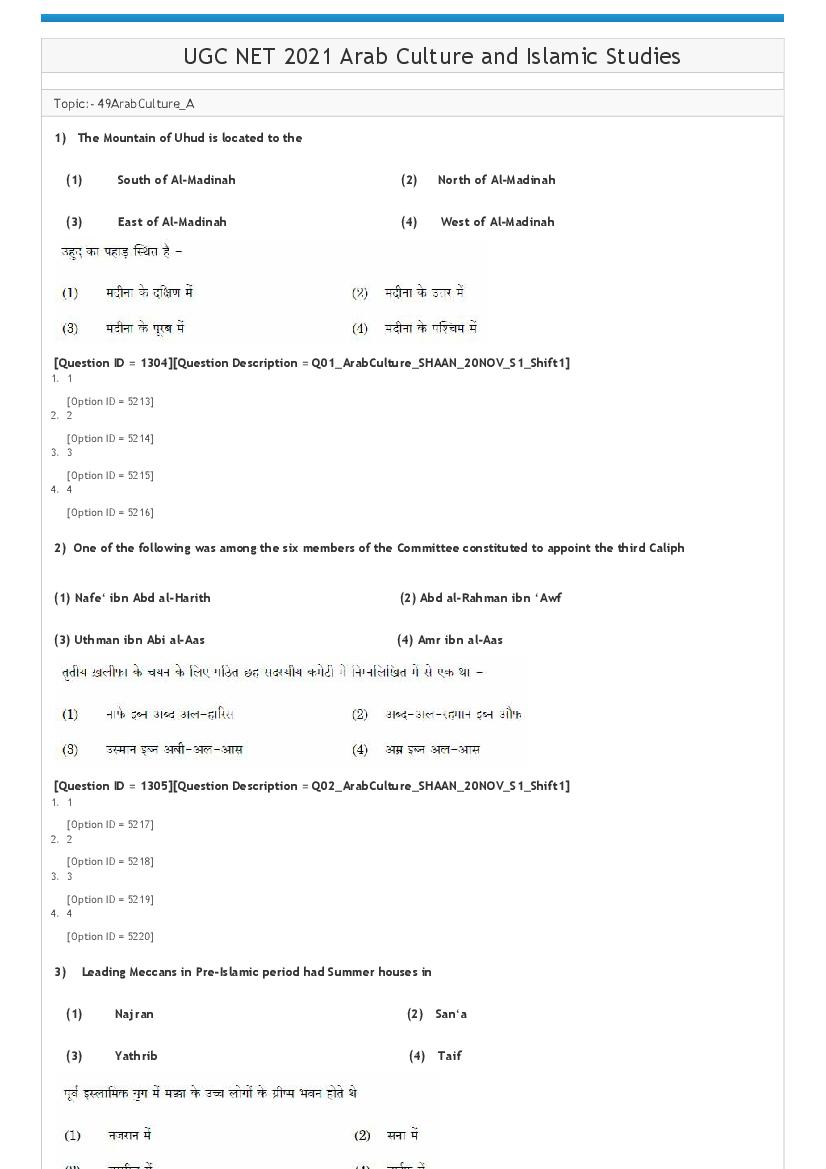
Topic:‐ 49ArabCulture_A
1) The Mountain of Uhud is located to the
(1) South of Al‐Madinah (2) North of Al‐Madinah
(3) East of Al‐Madinah (4) West of Al‐Madinah
[Question ID = 1304][Question Description = Q01_ArabCulture_SHAAN_20NOV_S1_Shift1]
[Option ID = 5213]
[Option ID = 5214]
[Option ID = 5215]
[Option ID = 5216]
2) One of the following was among the six members of the Committee constituted to appoint the third Caliph
(1) Nafe‘ ibn Abd al‐Harith (2) Abd al‐Rahman ibn ‘Awf
(3) Uthman ibn Abi al‐Aas (4) Amr ibn al‐Aas
[Question ID = 1305][Question Description = Q02_ArabCulture_SHAAN_20NOV_S1_Shift1]
[Option ID = 5217]
[Option ID = 5218]
[Option ID = 5219]
[Option ID = 5220]
3) Leading Meccans in Pre‐Islamic period had Summer houses in
(1) Najran (2) San‘a
(3) Yathrib (4) Taif
Page 2
[Option ID = 5221]
[Option ID = 5222]
[Option ID = 5223]
[Option ID = 5224]
4) Bay‘at al‐Ridwan was held at
(1) Badr (2) Tabūk
(3) Al‐ Ḥudaybiyah (4) Khaybar
[Question ID = 1307][Question Description = Q04_ArabCulture_SHAAN_20NOV_S1_Shift1]
[Option ID = 5225]
[Option ID = 5226]
[Option ID = 5227]
[Option ID = 5228]
5) Dāhis and al‐Ghabrā war was fought between
(1) Kinānah and Hawāzin (2) Banu Bakr and Banu Taghlib
(3) ‘Abs and Dhubyān (4) Qaynqa and Qurayza
[Question ID = 1308][Question Description = Q05_ArabCulture_SHAAN_20NOV_S1_Shift1]
[Option ID = 5229]
[Option ID = 5230]
[Option ID = 5231]
[Option ID = 5232]
6) Imru’‐al‐Qays I was one of the
(1) Sasanid kings (2) Lakhmid kings
(3) Abyssinian kings (4) Minaean kings
Page 3
[Option ID = 5233]
[Option ID = 5234]
[Option ID = 5235]
[Option ID = 5236]
7) The capital of the Lakhmid Kingdom was
(1) Yamamah (2) Najrān
(3) Ma‘rib (4) Al‐Hīrah
[Question ID = 1310][Question Description = Q07_ArabCulture_SHAAN_20NOV_S1_Shift1]
[Option ID = 5237]
[Option ID = 5238]
[Option ID = 5239]
[Option ID = 5240]
8) Yazid’s contingent that laid siege to Constantinople included the legendary hero
(1) Abu‐Ayyūb Ansari (2) Zubayr ibn al Awwam
(3) Talha ibn ‘Ubayd Allah (4) Mu‘āz ibn Jabal
[Question ID = 1311][Question Description = Q08_ArabCulture_SHAAN_20NOV_S1_Shift1]
[Option ID = 5241]
[Option ID = 5242]
[Option ID = 5243]
[Option ID = 5244]
9) Hibr al‐ummah (the sage of the community) was the title of
(1) Abdullah ibn Umar (2) Abdullah ibn Masud
Page 4
[Question ID = 1312][Question Description = Q09_ArabCulture_SHAAN_20NOV_S1_Shift1]
[Option ID = 5245]
[Option ID = 5246]
[Option ID = 5247]
[Option ID = 5248]
10) The Shattariyya Sufi order was founded in India by
(1) Shah Abdullah (2) Sultan Ghayasuddui Shah
(3) Muhammad Ghauth (4) Shaykh Ahmad Sirhindi
[Question ID = 1313][Question Description = Q10_ArabCulture_SHAAN_20NOV_S1_Shift1]
[Option ID = 5249]
[Option ID = 5250]
[Option ID = 5251]
[Option ID = 5252]
11) Marwan II was defeated and later killed after the
(1) Battle of Harrah (2) Tragedy of Karbala
(3) Battle of Marj Rāhit (4) Battle of Zāb
[Question ID = 1314][Question Description = Q11_ArabCulture_SHAAN_20NOV_S1_Shift1]
[Option ID = 5253]
[Option ID = 5254]
[Option ID = 5255]
[Option ID = 5256]
Page 5
(1) Marwan I (2) Al‐Walid I
(3) Sulayman (4) Abd al‐Malik
[Question ID = 1315][Question Description = Q12_ArabCulture_SHAAN_20NOV_S1_Shift1]
[Option ID = 5257]
[Option ID = 5258]
[Option ID = 5259]
[Option ID = 5260]
13) The Diyār Muḍar was established along the Euphrates by
(1) North Arabian tribes (2) South Arabian tribes
(3) East Arabian tribes (4) West Arabian tribes
[Question ID = 1316][Question Description = Q13_ArabCulture_SHAAN_20NOV_S1_Shift1]
[Option ID = 5261]
[Option ID = 5262]
[Option ID = 5263]
[Option ID = 5264]
14) The first ruler to institute a royal throne ( al‐mulk) was
(1) Yazid I (2) Abd al‐Malik
(3) Mu ‘āwiyah (4) Hisham
[Question ID = 1317][Question Description = Q14_ArabCulture_SHAAN_20NOV_S1_Shift1]
[Option ID = 5265]
[Option ID = 5266]
[Option ID = 5267]
Page 6
15) One of the true statesmen of the Banu‐Umayyah was
(1) Marwan II (2) Ibrahim
(3) ‘Abd‐al‐Malik (4) Yazid II
[Question ID = 1318][Question Description = Q15_ArabCulture_SHAAN_20NOV_S1_Shift1]
[Option ID = 5269]
[Option ID = 5270]
[Option ID = 5271]
[Option ID = 5272]
16) The Umayyad ruler who is credited with arabicization of the state was
(1) Al‐Walid (2) Mu ‘āwiya III
(3) Ibrahim (4) Yazid II
[Question ID = 1319][Question Description = Q16_ArabCulture_SHAAN_20NOV_S1_Shift1]
[Option ID = 5273]
[Option ID = 5274]
[Option ID = 5275]
[Option ID = 5276]
17) The Moorish traveller who visited Baghdad in 1327 was
(1) Ibn Battuta (2) Vasco De Gama
(3) Al‐Masoodi (4) Al‐Beruni
[Question ID = 1320][Question Description = Q17_ArabCulture_SHAAN_20NOV_S1_Shift1]
[Option ID = 5277]
[Option ID = 5278]
Page 7
[Option ID = 5280]
18) Wadi al‐Sughd (the valley of Sogdiana) is located between
(1) Basra and Baghdad (2) Samarqand and Bukhara
(3) Halb and Damascus (4) Aleppo and Istanbul
[Question ID = 1321][Question Description = Q18_ArabCulture_SHAAN_20NOV_S1_Shift1]
[Option ID = 5281]
[Option ID = 5282]
[Option ID = 5283]
[Option ID = 5284]
19) Caliph Al‐Muktafi appointed Ahmad ibn Buwayh as his
(1) Amir al‐Umara (2) Grand Vizir
(3) Qadhi al‐Qudhat (4) Amir al‐Bahr
[Question ID = 1322][Question Description = Q19_ArabCulture_SHAAN_20NOV_S1_Shift1]
[Option ID = 5285]
[Option ID = 5286]
[Option ID = 5287]
[Option ID = 5288]
20) Tarikh al‐Rusul Wa al‐Mulūk was written by
(1) Khatib al‐Baghdadi (2) Al‐Tabari
(3) Ibn Asir (4) Al‐Masoodi
[Question ID = 1323][Question Description = Q20_ArabCulture_SHAAN_20NOV_S1_Shift1]
[Option ID = 5289]
[Option ID = 5290]
[Option ID = 5291]
Page 8
21) Al‐Farabi is also called
(1) Arabian intellectual (2) The poet Laureate
(3) The Desert warrior (4) The Second Teacher
[Question ID = 1324][Question Description = Q21_ArabCulture_SHAAN_20NOV_S1_Shift1]
[Option ID = 5293]
[Option ID = 5294]
[Option ID = 5295]
[Option ID = 5296]
22) The conqueror of Africa and Spain, Musa ibn Nusayr was seen begging in
(1) Wadi al‐Qura (2) Damascus
(3) Madinah (4) Wadi al‐Zahra
[Question ID = 1325][Question Description = Q22_ArabCulture_SHAAN_20NOV_S1_Shift1]
[Option ID = 5297]
[Option ID = 5298]
[Option ID = 5299]
[Option ID = 5300]
23) On July 19, 711 Tariq ibn Ziyad defeated the strong army of
(1) Queen Elizabeth (2) King Ferdinand
(3) King Julian (4) King Roderick
[Question ID = 1326][Question Description = Q23_ArabCulture_SHAAN_20NOV_S1_Shift1]
[Option ID = 5301]
[Option ID = 5302]
[Option ID = 5303]
Page 9
24) The Spanish people who adopted the Arab culture were called
(1) The Anti‐Islam Spaniards (2) Christian Mercenaries
(3) Mozarabs (4) Converts to Islam
[Question ID = 1327][Question Description = Q24_ArabCulture_SHAAN_20NOV_S1_Shift1]
[Option ID = 5305]
[Option ID = 5306]
[Option ID = 5307]
[Option ID = 5308]
25) Al‐Hambra (Al‐Hamra) was built by
(1) Abd al‐Rahman (2) Muhammad Al‐Ghalib
(3) Al‐Hakam II (4) Al‐Mansur
[Question ID = 1328][Question Description = Q25_ArabCulture_SHAAN_20NOV_S1_Shift1]
[Option ID = 5309]
[Option ID = 5310]
[Option ID = 5311]
[Option ID = 5312]
26) The Muslim rule in Spain ended in
(1) October 1491 (2) December 1495
(3) March 1490 (4) January 1492
[Question ID = 1329][Question Description = Q26_ArabCulture_SHAAN_20NOV_S1_Shift1]
[Option ID = 5313]
[Option ID = 5314]
[Option ID = 5315]
Page 10
27) Umar Khayyam belonged to the dynasty of
(1) Samanids (2) Saljuqs
(3) Ghaznavids (4) Fatimids
[Question ID = 1330][Question Description = Q27_ArabCulture_SHAAN_20NOV_S1_Shift1]
[Option ID = 5317]
[Option ID = 5318]
[Option ID = 5319]
[Option ID = 5320]
28) Samanid dynasty was established in the year
(1) 870 A.D. (2) 874 A.D.
(3) 880 A.D. (4) 871 A.D.
[Question ID = 1331][Question Description = Q28_ArabCulture_SHAAN_20NOV_S1_Shift1]
[Option ID = 5321]
[Option ID = 5322]
[Option ID = 5323]
[Option ID = 5324]
29) The Hamadanid dynasty was established in the year
(1) 910 A.D. (2) 915 A.D.
(3) 919 A.D. (4) 929 A.D.
[Question ID = 1332][Question Description = Q29_ArabCulture_SHAAN_20NOV_S1_Shift1]
[Option ID = 5325]
[Option ID = 5326]
[Option ID = 5327]
[Option ID = 5328]
Page 11
(1) Hamadanids (2) Fatimids
(3) Idrisids (4) Buwayhids
[Question ID = 1333][Question Description = Q30_ArabCulture_SHAAN_20NOV_S1_Shift1]
[Option ID = 5329]
[Option ID = 5330]
[Option ID = 5331]
[Option ID = 5332]
31) The founder of Tulunid dynasty “Ahmad Ibn Tulun” was
(1) Arab (2) Turk
(3) Iranian (4) Berber
[Question ID = 1334][Question Description = Q31_ArabCulture_SHAAN_20NOV_S1_Shift1]
[Option ID = 5333]
[Option ID = 5334]
[Option ID = 5335]
[Option ID = 5336]
32)
[Question ID = 1335][Question Description = Q32_ArabCulture_SHAAN_20NOV_S1_Shift1]
[Option ID = 5337]
[Option ID = 5338]
[Option ID = 5339]
[Option ID = 5340]
Page 12
(1) The Arabs (2) The Turks
(3) The Kurds (4) The Berbers
[Question ID = 1336][Question Description = Q33_ArabCulture_SHAAN_20NOV_S1_Shift1]
[Option ID = 5341]
[Option ID = 5342]
[Option ID = 5343]
[Option ID = 5344]
34) The founder of Aghlabi dynasty Ibrahim bin Aghlab was appointed Governor of Africa by
(1) Al‐Hadi (2) Al‐Ameen
(3) Haroon Rashid (4) Mamoon Rashid
[Question ID = 1337][Question Description = Q34_ArabCulture_SHAAN_20NOV_S1_Shift1]
[Option ID = 5345]
[Option ID = 5346]
[Option ID = 5347]
[Option ID = 5348]
35) Shaikh Haji Bayram Wali was the teacher and advisor to the Sultan
(1) Salim I (2) Bayazid I
(3) Mehmet Fatih (4) Sulayman the magnificent
[Question ID = 1338][Question Description = Q35_ArabCulture_SHAAN_20NOV_S1_Shift1]
[Option ID = 5349]
[Option ID = 5350]
[Option ID = 5351]
[Option ID = 5352]
36) The Fifth ruler of the Safavid dynasty was
Page 13
(3) Shah Abbas (4) Shah Ismail II
[Question ID = 1339][Question Description = Q36_ArabCulture_SHAAN_20NOV_S1_Shift1]
[Option ID = 5353]
[Option ID = 5354]
[Option ID = 5355]
[Option ID = 5356]
37) The fourth ruler of the Safawid Dynasty was
(1) Muhammad Khodabanda (2) Abbas I
(3) Ismail II (4) Tahmasp II
[Question ID = 1340][Question Description = Q37_ArabCulture_SHAAN_20NOV_S1_Shift1]
[Option ID = 5357]
[Option ID = 5358]
[Option ID = 5359]
[Option ID = 5360]
38) The flower that was the popular symbol of the Ottoman Empire and stood for the perfection and beauty in the
Modern Turkey
(1) Rose (2) Lily
(3) Daffodil (4) Tulip
[Question ID = 1341][Question Description = Q38_ArabCulture_SHAAN_20NOV_S1_Shift1]
[Option ID = 5361]
[Option ID = 5362]
[Option ID = 5363]
[Option ID = 5364]
39) The Unit of Currency of the Ottoman Empire was the
(1) Para (2) Akça
Page 14
[Question ID = 1342][Question Description = Q39_ArabCulture_SHAAN_20NOV_S1_Shift1]
[Option ID = 5365]
[Option ID = 5366]
[Option ID = 5367]
[Option ID = 5368]
40) Sultan Salim conclusively defeated Shah Ismail in the battle of
(1) Chaldiran (2) Sivas
(3) Warna (4) Farghana
[Question ID = 1343][Question Description = Q40_ArabCulture_SHAAN_20NOV_S1_Shift1]
[Option ID = 5369]
[Option ID = 5370]
[Option ID = 5371]
[Option ID = 5372]
41) The Idea of reforms conceived by Sultan Mahmud and later implemented by Sultan Abd
al‐Majid were known as
(1) Hatt‐i‐Uthmani (2) Hatt‐i‐Humayun
(3) Hatt‐i‐Sharif Gulhane (4) Hatt‐i‐Sulayman
[Question ID = 1344][Question Description = Q41_ArabCulture_SHAAN_20NOV_S1_Shift1]
[Option ID = 5373]
[Option ID = 5374]
[Option ID = 5375]
[Option ID = 5376]
42) Majma al‐Bahrain was authored by
Page 15
(3) Dara Shikoh (4) Sarmad
[Question ID = 1345][Question Description = Q42_ArabCulture_SHAAN_20NOV_S1_Shift1]
[Option ID = 5377]
[Option ID = 5378]
[Option ID = 5379]
[Option ID = 5380]
43) The Islamic academic curriculum, known as ‘Dars‐i‐Nizami’ – was begun in the reign of
(1) Jahangir (2) Shah Jahan
(3) Aurangzeb (4) Shah Alam
[Question ID = 1346][Question Description = Q43_ArabCulture_SHAAN_20NOV_S1_Shift1]
[Option ID = 5381]
[Option ID = 5382]
[Option ID = 5383]
[Option ID = 5384]
44) The author of Muntakhab‐al‐Tawarikh is
(1) Abdul Qadir Badauni (2) Fathullah Shirazi
(3) Abul Fazl (4) Minhaj Siraj
[Question ID = 1347][Question Description = Q44_ArabCulture_SHAAN_20NOV_S1_Shift1]
[Option ID = 5385]
[Option ID = 5386]
[Option ID = 5387]
[Option ID = 5388]
45) The smallest unit in the Sher Shah’s administration was
Page 16
(3) Pargana (4) Gaun
[Question ID = 1348][Question Description = Q45_ArabCulture_SHAAN_20NOV_S1_Shift1]
[Option ID = 5389]
[Option ID = 5390]
[Option ID = 5391]
[Option ID = 5392]
46) The first Afghan ruler in India was
(1) Muhammad Bin Qasim (2) Qutbuddin Aibak
(3) Bahlol Lodi (4) Babur
[Question ID = 1349][Question Description = Q46_ArabCulture_SHAAN_20NOV_S1_Shift1]
[Option ID = 5393]
[Option ID = 5394]
[Option ID = 5395]
[Option ID = 5396]
47) Ethnically the Khaljis were
(1) Arabs (2) Mongols
(3) Turks (4) Berbars
[Question ID = 1350][Question Description = Q47_ArabCulture_SHAAN_20NOV_S1_Shift1]
[Option ID = 5397]
[Option ID = 5398]
[Option ID = 5399]
[Option ID = 5400]
48) Hauz‐i‐Shamsi, a large water reservoir was constructed to meet the needs of Delhi citizens by
(1) Iltutmish (2) Sikander Lodi
Page 17
[Question ID = 1351][Question Description = Q48_ArabCulture_SHAAN_20NOV_S1_Shift1]
[Option ID = 5401]
[Option ID = 5402]
[Option ID = 5403]
[Option ID = 5404]
49) Origin of Mappilla Muslim community of Kerala is
(1) Conversion of Local upper caste
(2) Settlements of Arab traders
(3) Marriages of Arab Muslims with upper caste Nair women
(4) Sayyids of Arabia
[Question ID = 1352][Question Description = Q49_ArabCulture_SHAAN_20NOV_S1_Shift1]
[Option ID = 5405]
[Option ID = 5406]
[Option ID = 5407]
[Option ID = 5408]
50) Noted Muslim Sufi Scholar Muhibbullah Allahabadi belonged to the
(1) Qadri sufi order (2) Suharwardi Sufi order
(3) Chishti sufi order (4) Naqshbandi sufi order
[Question ID = 1353][Question Description = Q50_ArabCulture_SHAAN_20NOV_S1_Shift1]
[Option ID = 5409]
[Option ID = 5410]
[Option ID = 5411]
[Option ID = 5412]
Page 18
extant in
(1) Makkah and Madina (2) Tashkent and Istanbul
(3) Istanbul and Cairo (4) Cairo and Damascus
[Question ID = 1354][Question Description = Q51_ArabCulture_SHAAN_20NOV_S1_Shift1]
[Option ID = 5413]
[Option ID = 5414]
[Option ID = 5415]
[Option ID = 5416]
52) Tadabbur‐e‐Quran is originally based on the thoughts of
(1) Shah Waliullah (2) Sir Syed Ahmad Khan
(3) Jamaluddin Afghani (4) Hamiduddin Farahi
[Question ID = 1355][Question Description = Q52_ArabCulture_SHAAN_20NOV_S1_Shift1]
[Option ID = 5417]
[Option ID = 5418]
[Option ID = 5419]
[Option ID = 5420]
53) Sahifa Hammam ibn Munabbih, a manuscript of Hadith, was discovered and edited in the modern time by the noted
scholar
(1) Dr. Mustafa al‐Azmi (2) Dr. Muhammad Hamidullah
(3) Dr. Zia al‐Rahman al‐Azmi (4) Maulana Habib al‐Rahman al‐Azmi
[Question ID = 1356][Question Description = Q53_ArabCulture_SHAAN_20NOV_S1_Shift1]
[Option ID = 5421]
[Option ID = 5422]
[Option ID = 5423]
Page 19
54) The one who was not a student of Imam Malik
(1) Muhammad bin Ahmad bin Rushd (2) Abdullah bin Wahb
(3) Asad bin Furat (4) Abdur Rahman bin Qasim
[Question ID = 1357][Question Description = Q54_ArabCulture_SHAAN_20NOV_S1_Shift1]
[Option ID = 5425]
[Option ID = 5426]
[Option ID = 5427]
[Option ID = 5428]
55) Burhanuddin al‐Marghinani is the author of
(1) Kitab al Khiraj (2) Kitab al Amwal
(3) Al‐Hidayah fi Sharh‐i‐Bidayah al‐Mubtadi (4) Bidayah al Mujtahid
[Question ID = 1358][Question Description = Q55_ArabCulture_SHAAN_20NOV_S1_Shift1]
[Option ID = 5429]
[Option ID = 5430]
[Option ID = 5431]
[Option ID = 5432]
56) ‘Fatawa Tatar Khaniya’ was authored by
(1) Tatar Khan (2) Sharaf Muhammad Atai
(3) Alim bin Ala Indrpati (4) Ziauddin Barni
[Question ID = 1359][Question Description = Q56_ArabCulture_SHAAN_20NOV_S1_Shift1]
[Option ID = 5433]
[Option ID = 5434]
[Option ID = 5435]
Page 20
57) The prefixal name of the renowned philosopher al‐Farabi is
(1) Abu Hamid (2) Ali ibn Ahmad
(3) Abul Farid Ahmad (4) Abu Nasr
[Question ID = 1360][Question Description = Q57_ArabCulture_SHAAN_20NOV_S1_Shift1]
[Option ID = 5437]
[Option ID = 5438]
[Option ID = 5439]
[Option ID = 5440]
58) The great philosophical work ‘al‐Siyasah al‐Madaniya’ was written by
(1) Ibn Sina (2) al‐Majusi
(3) al‐Razi (4) al‐Farabi
[Question ID = 1361][Question Description = Q58_ArabCulture_SHAAN_20NOV_S1_Shift1]
[Option ID = 5441]
[Option ID = 5442]
[Option ID = 5443]
[Option ID = 5444]
59) The scholar whose translation of the Hindu works was responsible for making the numerals known to Islam was
(1) al‐Khwarizmi (2) al‐Fazari
(3) Jarir ibn Hayyan (4) Abul Qasim al‐Iraqi
[Question ID = 1362][Question Description = Q59_ArabCulture_SHAAN_20NOV_S1_Shift1]
[Option ID = 5445]
[Option ID = 5446]
[Option ID = 5447]
[Option ID = 5448]
Page 21
(1) Dar al‐Hikmah (2) Bayt al‐Hikmah
(3) Dar al‐Hijrah (4) Dar al‐Nadwa
[Question ID = 1363][Question Description = Q60_ArabCulture_SHAAN_20NOV_S1_Shift1]
[Option ID = 5449]
[Option ID = 5450]
[Option ID = 5451]
[Option ID = 5452]
61) The book ‘Minhaj al‐Sunna al‐Nabawiyya’ was written in opposition to Imam theologian Allama al‐Hilli
(1) Imam Bukhari (2) Al‐Maturidi
(3) Ibn Taymiyya (4) Al‐Mawardi
[Question ID = 1364][Question Description = Q61_ArabCulture_SHAAN_20NOV_S1_Shift1]
[Option ID = 5453]
[Option ID = 5454]
[Option ID = 5455]
[Option ID = 5456]
62) The Suhrawardi Sufi order was established in India by
(1) Moinuddin Chishti (2) Abu Ishaq Shami
(3) Nizamuddin Awliya (4) Shaykh Bahauddin Zakariyya
[Question ID = 1365][Question Description = Q62_ArabCulture_SHAAN_20NOV_S1_Shift1]
[Option ID = 5457]
[Option ID = 5458]
[Option ID = 5459]
[Option ID = 5460]
Page 22
(1) Astronomy (2) Mathematics
(3) Geography (4) Chemistry
[Question ID = 1366][Question Description = Q63_ArabCulture_SHAAN_20NOV_S1_Shift1]
[Option ID = 5461]
[Option ID = 5462]
[Option ID = 5463]
[Option ID = 5464]
64) The founder of the ‘Batiniyya Sect’ was
(1) Hasan al‐Sabah (2) Abdallah ibn Maymun al‐Qaddah
(3) Hamadan Qarmat (4) Adallah b. Azraq
[Question ID = 1367][Question Description = Q64_ArabCulture_SHAAN_20NOV_S1_Shift1]
[Option ID = 5465]
[Option ID = 5466]
[Option ID = 5467]
[Option ID = 5468]
65) The famous book ‘Social Justice in Islam’ was authored by
(1) Ali Shariati (2) Ahmad Amin
(3) Sayyid Qutb (4) Qasim Amin
[Question ID = 1368][Question Description = Q65_ArabCulture_SHAAN_20NOV_S1_Shift1]
[Option ID = 5469]
[Option ID = 5470]
[Option ID = 5471]
[Option ID = 5472]
Page 23
(1) 1760 A.D. (2) 1769 A.D.
(3) 1775 A.D. (4) 1780 A.D.
[Question ID = 1369][Question Description = Q66_ArabCulture_SHAAN_20NOV_S1_Shift1]
[Option ID = 5473]
[Option ID = 5474]
[Option ID = 5475]
[Option ID = 5476]
67) Who coined the term ‘Gharabzadgi’?
(1) Jalal al‐e Ahmad (2) Ayatollah Khomeini
(3) Ali Shariati (4) Kasravi Tabrezi
[Question ID = 1370][Question Description = Q67_ArabCulture_SHAAN_20NOV_S1_Shift1]
[Option ID = 5477]
[Option ID = 5478]
[Option ID = 5479]
[Option ID = 5480]
68) Shaikh Badiuzzama Nursi was a/an
(1) Arab (2) Turk
(3) Kurd (4) Iranian
[Question ID = 1371][Question Description = Q68_ArabCulture_SHAAN_20NOV_S1_Shift1]
[Option ID = 5481]
[Option ID = 5482]
[Option ID = 5483]
[Option ID = 5484]
69) Muhammad Abduh was born in the year
Page 24
(3) 1849 A.D. (4) 1859 A.D.
[Question ID = 1372][Question Description = Q69_ArabCulture_SHAAN_20NOV_S1_Shift1]
[Option ID = 5485]
[Option ID = 5486]
[Option ID = 5487]
[Option ID = 5488]
70) Observe the following statements :
(A) Abd al‐Rahman al‐Kawakibi stood for the separation between religion and state
(B) ‘Tahrir al‐Mar‘a’ was written by Sayyid Qutb
(C) Muhammad b. Abd al‐Wahhab was born in 1800 A.D.
(D) The book ‘Asar al‐Sanādīd’ was written by Sir Syed Ahmad Khan
Choose the correct answer from the options given below:
(1) (A) and (B) Only (2) (B) and (D) Only
(3) (A) and (D) Only (4) (C) and (D) Only
[Question ID = 1373][Question Description = Q70_ArabCulture_SHAAN_20NOV_S1_Shift1]
[Option ID = 5489]
[Option ID = 5490]
[Option ID = 5491]
[Option ID = 5492]
Page 25
(A) Tafsir al‐Quran by Syed Ahmad Khan
(B) Tafhim al‐Quran by Abul Aala Maududi
(C) Tarjuman al‐Quran by Abul Kalam Azad
(D) Tadabbur‐e‐Quran by Amin Ahsan Islahi
(E) Tafsir al‐Manar by Rashid Rida
Choose the correct answer from the options given below:
(1) (A), (B), (C) Only
(2) (A), (C), (E) Only
(3) (B), (C), (D) Only
(4) (A), (D), (E) Only
[Question ID = 1374][Question Description = Q71_ArabCulture_SHAAN_20NOV_S1_Shift1]
[Option ID = 5493]
[Option ID = 5494]
[Option ID = 5495]
[Option ID = 5496]
72) Read the following :
(A) Marwan I was the son of Abd al‐Malik
(B) Abu Sufyan’s wife was Hind bint of Utba
(C) Damascus was the capital of Abdullah ibn Zubayr’s rule
(D) Hind’s son Hanzalah was killed at the battle of Badr
(E) The mother of Abdullah ibn Zubayr was Asma
Choose the correct answer from the options given below:
(1) (B), (D) and (E) Only
(2) (A), (C) and (E) Only
(3) (B) and (C) Only
Page 26
[Question ID = 1375][Question Description = Q72_ArabCulture_SHAAN_20NOV_S1_Shift1]
[Option ID = 5497]
[Option ID = 5498]
[Option ID = 5499]
[Option ID = 5500]
73) Match List I with List II :
List I List II
(A) Shah Waliallah (I) Al‐Saequl al‐Islami
(B) Abdur Rehman al‐Kawakibi (II) Tafseer al‐Manar
(C) Rashid Rida (III) Al‐Fauzul Kabir
(D) Badiuzzama Said Nursi (IV) Ummul Qura
Choose the correct answer from the options given below:
(1) (A)‐(II), (B)‐(III), (C)‐(IV), (D)‐(I)
(2) (A)‐(IV), (B)‐(II), (C)‐(III), (D)‐(I)
(3) (A)‐(III), (B)‐(IV), (C)‐(II), (D)‐(I)
(4) (A)‐(I), (B)‐(III), (C)‐(IV), (D)‐(II)
Page 27
[Option ID = 5501]
[Option ID = 5502]
[Option ID = 5503]
[Option ID = 5504]
74) Match List I with List II :
List I List II
(A) Jami al‐Bayan fi uloom al‐Quran (I) Muhammad bin Umar bin Hasan
(B) Mafatih al‐Ghaib (II) Muhammad bin Jarir bin Yazid
(C) Anwar al‐Tanzil wa Asrar al‐
(III) Mahmud bin Umar
Tawil
(IV) Abdullah bin Umar bin
(D) Al‐Kashshaf an Haqaiq al‐Tanzil
Muhammad
Choose the correct answer from the options given below:
(1) (A)‐(II), (B)‐(I), (C)‐(IV), (D)‐(III)
(2) (A)‐(II), (B)‐(IV), (C)‐(I), (D)‐(III)
(3) (A)‐(III), (B)‐(I), (C)‐(II), (D)‐(IV)
(4) (A)‐(I), (B)‐(III), (C)‐(IV), (D)‐(II)
[Question ID = 1377][Question Description = Q74_ArabCulture_SHAAN_20NOV_S1_Shift1]
Page 28
[Option ID = 5506]
[Option ID = 5507]
[Option ID = 5508]
75) Match List I with List II :
List I List II
(A) Husayn b. Sulayman (I) Fatimids
(B) Abdallah b. Yusuf (II) Ayyubids
(C) al‐Malik al‐Nasir (III) Idrisids
(D) Yahya b. Muhammad (IV) Safavids
Choose the correct answer from the options given below:
(1) (A)‐(IV), (B)‐(I), (C)‐(II), (D)‐(III)
(2) (A)‐(I), (B)‐(III), (C)‐(II), (D)‐(IV)
(3) (A)‐(III), (B)‐(IV), (C)‐(II), (D)‐(I)
(4) (A)‐(II), (B)‐(I), (C)‐(III), (D)‐(IV)
सूची‐I के साथ सूची‐II का िमलान क िजए :
सूची‐I सूची‐II
(A) हसैन िबन सुलैमान (I) फ़ाितमी
(B) अ दुला िबन युसूफ़ (II) अ यूबी
(C) अल‐मिलक अल‐नािसर (III) इद रसी
(D) यहया िबन मुह मद (IV) सफ़वी
नीचे िदए गए िवक प म से सही उ र का चयन क िजए :
(1) (A)‐(IV), (B)‐(I), (C)‐(II), (D)‐(III)
(2) (A)‐(I), (B)‐(III), (C)‐(II), (D)‐(IV)
(3) (A)‐(III), (B)‐(IV), (C)‐(II), (D)‐(I)
(4) (A)‐(II), (B)‐(I), (C)‐(III), (D)‐(IV)
[Question ID = 1378][Question Description = Q75_ArabCulture_SHAAN_20NOV_S1_Shift1]
[Option ID = 5509]
[Option ID = 5510]
[Option ID = 5511]
[Option ID = 5512]
76) Match List I with List II :
List I List II
(A) Samanids (I) 868 A.D. – 905 A.D.
(B) Aghlabids (II) 974 A.D. – 999 A.D.
(C) Tulunids (III) 800 A.D. – 909 A.D.
(D) Ayyubids (IV) 1169 A.D. – 1252 A.D.
Choose the correct answer from the options given below:
(1) (A)‐(I), (B)‐(II), (C)‐(III), (D)‐(IV)
Page 29
(3) (A)‐(III), (B)‐(II), (C)‐(IV), (D)‐(I)
(4) (A)‐(IV), (B)‐(III), (C)‐(II), (D)‐(I)
सूची‐I के साथ सूची‐II का िमलान क िजए :
सूची‐I सूची‐II
(A) सामानी (I) 868 ई. से 905 ई. तक
(B) अग़लबी (II) 974 ई. से 999 ई. तक
(C) तुलन
ू ी (III) 800 ई. से 909 ई. तक
(D) अयूबी (IV) 1169 ई. से 1252 ई. तक
नीचे िदए गए िवक प म से सही उ र का चयन क िजए :
(1) (A)‐(I), (B)‐(II), (C)‐(III), (D)‐(IV)
(2) (A)‐(II), (B)‐(III), (C)‐(I), (D)‐(IV)
(3) (A)‐(III), (B)‐(II), (C)‐(IV), (D)‐(I)
(4) (A)‐(IV), (B)‐(III), (C)‐(II), (D)‐(I)
[Question ID = 1379][Question Description = Q76_ArabCulture_SHAAN_20NOV_S1_Shift1]
[Option ID = 5513]
[Option ID = 5514]
[Option ID = 5515]
[Option ID = 5516]
77) Match List I with List II :
List I List II
(A) Sayyids (I) 1290 – 1320 A.D.
(B) Tughlaqs (II) 1451 – 1526 A.D.
(C) Khaljis (III) 1320 – 1413 A.D.
(D) Lodis (IV) 1414 – 1451 A.D.
Choose the correct answer from the options given below:
(1) (A)‐(II), (B)‐(IV), (C)‐(III), (D)‐(I)
(2) (A)‐(I), (B)‐(III), (C)‐(II), (D)‐(IV)
(3) (A)‐(IV), (B)‐(III), (C)‐(II), (D)‐(I)
(4) (A)‐(IV), (B)‐(III), (C)‐(I), (D)‐(II)
सूची‐I के साथ सूची‐II का िमलान क िजए :
सूची‐I सूची‐II
(A) सैयद शासन (I) 1290 – 1320 ई.
(B) तुग़लक शासन (II) 1451 – 1526 ई.
(C) िख़लजी शासन (III) 1320 – 1413 ई.
(D) लोदी शासन (IV) 1414 – 1451 ई.
नीचे िदए गए िवक प म से सही उ र का चयन क िजए :
(1) (A)‐(II), (B)‐(IV), (C)‐(III), (D)‐(I)
(2) (A)‐(I), (B)‐(III), (C)‐(II), (D)‐(IV)
(3) (A)‐(IV), (B)‐(III), (C)‐(II), (D)‐(I)
Page 30
[Question ID = 1380][Question Description = Q77_ArabCulture_SHAAN_20NOV_S1_Shift1]
[Option ID = 5517]
[Option ID = 5518]
[Option ID = 5519]
[Option ID = 5520]
78) Match List I with List II :
List I List II
(A) Jalauddin Rumi (I) Al‐Itqan fi Ulum al Quran
(B) Ibn al‐Arabi (II) Al‐Fawz al‐Kabir fi usul‐al‐Tafsir
(C) Jalauddin al‐Suyuti (III) Masnavi
(D) Shah Waliullah (IV) Futuhat – Makkiyya
Choose the correct answer from the options given below:
(1) (A)‐(I), (B)‐(II), (C)‐(III), (D)‐(IV)
(2) (A)‐(IV), (B)‐(III), (C)‐(II), (D)‐(I)
(3) (A)‐(III), (B)‐(IV), (C)‐(I), (D)‐(II)
(4) (A)‐(II), (B)‐(IV), (C)‐(I), (D)‐(III)
सूची‐I के साथ सूची‐II का िमलान क िजए :
सूची‐I सूची‐II
(A) जलालु ीन मी (I) अल इतक़ान फ़ उलूम अल कुरआन
(B) इ नुल अरबी (II) अल फौज़ुल कबीर फ़ उसूल तफ़सीर
(C) जलाल अल सुयूती (III) मसनवी
(D) शाह वली उ लाह (IV) फुतहू ात मि कया
नीचे िदए गए िवक प म से सही उ र का चयन क िजए :
(1) (A)‐(I), (B)‐(II), (C)‐(III), (D)‐(IV)
(2) (A)‐(IV), (B)‐(III), (C)‐(II), (D)‐(I)
(3) (A)‐(III), (B)‐(IV), (C)‐(I), (D)‐(II)
(4) (A)‐(II), (B)‐(IV), (C)‐(I), (D)‐(III)
[Question ID = 1381][Question Description = Q78_ArabCulture_SHAAN_20NOV_S1_Shift1]
[Option ID = 5521]
[Option ID = 5522]
[Option ID = 5523]
[Option ID = 5524]
79) Match List I with List II :
List I List II
(A) “Farewell” Pilgramage (I) 656 – 661 A.D.
(B) Battle of Uhud (II) 610 A.D.
(C) Madinah is abandoned as capital (III) 625 A.D.
(D) Muhammad has first revelation
(IV) 632 A.D.
(Wahy)
Page 31
(1) (A)‐(I), (B)‐(II), (C)‐(III), (D)‐(IV)
(2) (A)‐(II), (B)‐(I), (C)‐(IV), (D)‐(III)
(3) (A)‐(IV), (B)‐(III), (C)‐(I), (D)‐(II)
(4) (A)‐(III), (B)‐(IV), (C)‐(II), (D)‐(I)
सूची‐I के साथ सूची‐II का िमलान क िजए :
सूची‐I सूची‐II
(A) ख़ुतबा ह जतुल िवदा (I) 656 – 661 ई.
(B) उहद यु (II) 610 ई.
(C) मदीने का राजधानी प समापत होना (III) 625 ई.
(D) मुह मद (स.) पर पथम ‘वही’ (IV) 632 ई.
नीचे िदए गए िवक प म से सही उ र का चयन क िजए :
(1) (A)‐(I), (B)‐(II), (C)‐(III), (D)‐(IV)
(2) (A)‐(II), (B)‐(I), (C)‐(IV), (D)‐(III)
(3) (A)‐(IV), (B)‐(III), (C)‐(I), (D)‐(II)
(4) (A)‐(III), (B)‐(IV), (C)‐(II), (D)‐(I)
[Question ID = 1382][Question Description = Q79_ArabCulture_SHAAN_20NOV_S1_Shift1]
[Option ID = 5525]
[Option ID = 5526]
[Option ID = 5527]
[Option ID = 5528]
80) Arrange the following travellers, who visited India, in chronological order
(A) Abd al‐Razzak
(B) Abu al‐Fida
(C) Ibn Battuta
(D) Masudi
Choose the correct answer from the options given below:
(1) (A), (B), (C), (D)
(2) (C), (D), (A), (B)
(3) (B), (A), (D), (C)
(4) (D), (B), (C), (A)
िन नांिकत याितयोको भारत आगमन के कम म यवि थत क िजए:
(A) अ दुल र ज़ाक
(B) अबुल िफदा
(C) इ नबतूता
(D) मसूदी
नीचे िदए गए िवक प म से सही उ र का चयन क िजए :
(1) (A), (B), (C), (D)
(2) (C), (D), (A), (B)
(3) (B), (A), (D), (C)
(4) (D), (B), (C), (A)
Page 32
[Option ID = 5529]
[Option ID = 5530]
[Option ID = 5531]
[Option ID = 5532]
81) Arrange the following Ottoman rulers in chronological order
(A) Bayazid I
(B) Muhammad II
(C) Selim II
(D) Sulayman the Magnificent
Choose the correct answer from the options given below:
(1) (A), (B), (C), (D)
(2) (A), (B), (D), (C)
(3) (B), (D), (C), (A)
(4) (B), (C), (D), (A)
[Question ID = 1384][Question Description = Q81_ArabCulture_SHAAN_20NOV_S1_Shift1]
[Option ID = 5533]
[Option ID = 5534]
[Option ID = 5535]
[Option ID = 5536]
82) Arrange the following in chronological order
(A) Idrisids
(B) Ayyubids
(C) Ghaznavids
(D) Mamluks
Page 33
Choose the correct answer from the options given below:
(1) (A), (B), (C), (D), (E) (2) (A), (C), (E), (B), (D)
(3) (B), (C), (D), (E), (A) (4) (C), (D), (E), (A), (B)
[Question ID = 1385][Question Description = Q82_ArabCulture_SHAAN_20NOV_S1_Shift1]
[Option ID = 5537]
[Option ID = 5538]
[Option ID = 5539]
[Option ID = 5540]
83) Arrange the following authors of Tafsir in chronological order
(A) Rashid Rida
(B) Syed Ahmad Khan
(C) Syed Qutb
(D) Abul Kalam Azad
Choose the correct answer from the options given below:
(1) (A), (B), (D), (C) (2) (B), (A), (D), (C)
(3) (D), (C), (A), (B) (4) (C), (A), (B), (D)
Page 34
[Option ID = 5541]
[Option ID = 5542]
[Option ID = 5543]
[Option ID = 5544]
84) Arrange the following Umayyd rulers of Spain in chronological order
(A) Muhammad I
(B) Abd al‐Rahman al‐Dakhil
(C) Al‐Hakam I
(D) Abd al‐Rahman II
Choose the correct answer from the options given below:
(1) (B), (C), (D), (A)
(2) (D), (A), (C), (B)
(3) (B), (D), (C), (A)
(4) (C), (B), (A), (D)
[Question ID = 1387][Question Description = Q84_ArabCulture_SHAAN_20NOV_S1_Shift1]
[Option ID = 5545]
[Option ID = 5546]
[Option ID = 5547]
Page 35
85) Arrange the following early jurists in chronological order
(A) Ali bin Hazm
(B) Abdullah bin Masood
(C) Ahmad bin Hanbal
(D) Numan bin Thabit
Choose the correct answer from the options given below:
(1) (B), (D), (C), (A)
(2) (C), (D), (A), (B)
(3) (D), (C), (B), (A)
(4) (B), (C), (D), (A)
[Question ID = 1388][Question Description = Q85_ArabCulture_SHAAN_20NOV_S1_Shift1]
[Option ID = 5549]
[Option ID = 5550]
[Option ID = 5551]
[Option ID = 5552]
86) Arrange the following Umayyad Caliph in chronological order
(A) Al‐Walid II
(B) Umar II
(C) Marwan
(D) Abd al‐Malik
(E) Mu’āwiyah II
Choose the correct answer from the options given below:
(1) (E), (C), (D), (B), (A)
(2) (A), (B), (C), (D), (E)
(3) (B), (C), (A), (D), (E)
Page 36
[Question ID = 1389][Question Description = Q86_ArabCulture_SHAAN_20NOV_S1_Shift1]
[Option ID = 5553]
[Option ID = 5554]
[Option ID = 5555]
[Option ID = 5556]
87) Arrange the following dynasties in order they appeared
(A) Nasirids
(B) Abbādids
(C) Al‐Muwahhids
(D) Al‐Murabits
Choose the correct answer from the options given below:
(1) (A), (B), (C), (D)
(2) (D), (A), (C), (B)
(3) (D), (B), (A), (C)
(4) (B), (D), (C), (A)
Page 37
[Option ID = 5557]
[Option ID = 5558]
[Option ID = 5559]
[Option ID = 5560]
88) Statement I : In form, materials and decoration, the Dome of the Rock belongs to the tradition of late Antique and
Byzantine architecture.
Statement II : The greatest Umayyad builder was Mu’āwiyah II, son of Yazid I, whose rule was one of the comparative peace
and opulence.
In the light of the above statements, choose the correct answer from the options given below:
(1) Both Statement I and Statement II are true (2) Both Statement I and Statement II are false
(3) Statement I is true but Statement II is false (4) Statement I is false but Statement II is true
[Question ID = 1391][Question Description = Q88_ArabCulture_SHAAN_20NOV_S1_Shift1]
[Option ID = 5561]
[Option ID = 5562]
[Option ID = 5563]
[Option ID = 5564]
89) Statement I : The story that by the caliph’s order ‘Amr for six long months fed the numerous bath furnaces of the city
with the volumes of Alexandrian library is one of those tales that make good fiction but bad history.
Statement II : The great Ptolemaic Library was burn as early as 48 B.C. by Julius Caesar.
In the light of the above statements, choose the most appropriate answer from the options given below:
(1) Both Statement I and Statement II are correct (2) Both Statement I and Statement II are incorrect
(3) Statement I is correct but Statement II is incorrect (4) Statement I is incorrect but Statement II is correct
Page 38
[Option ID = 5565]
[Option ID = 5566]
[Option ID = 5567]
[Option ID = 5568]
90) Statement I : In 610, the Prophet met at ‘Aqabah, on the pilgrimage with a handful of converts from Yathrib; the next
year they returned with a few more and not only declared themselves Muslims but pledged themselves to Obey Muhammad
in any wholesome command.
Statement II : In 628, the Prophet entered peacefully at the head of the annual Pilgrimage into his new religious capital,
Makkah. This proved his last visit and was therefore styled “The Farewell Pilgrimage”.
In the light of the above statements, choose the correct answer from the options given below:
(1) Both Statement I and Statement II are true (2) Both Statement I and Statement II are false
(3) Statement I is true but Statement II is false (4) Statement I is false but Statement II is true
[Question ID = 1393][Question Description = Q90_ArabCulture_SHAAN_20NOV_S1_Shift1]
Page 39
[Option ID = 5570]
[Option ID = 5571]
[Option ID = 5572]
Topic:‐ 49ArabCulture_B
1) Read the following passage and answer the five question which follow :
The Andalusian scientist ibn Rumiyah undertook extensive journeys in search of plants and herbs which were not found in
his native land. He travelled to Egypt, Syria, and Iraq in the course of his itinerary and carefully recorded his observations.
Ibn al‐Baytar (d. 646/1248) travelled far and wide and collected botanical specimens from different parts of the world. He
compared the flora of India and Persia with those of Greece and Spain. His work Al‐Jami al‐Mufradat al‐Adwiyah wal‐
Aghziyah, which describes fourteen hundred plants, has been acclaimed by Western scholars as a “monument of industry”.
Al‐Ghafiqi wrote an important work in botany, known as Kitab al‐Adwiyah al‐Mufradah. Ibn al‐Jazzar (d. 370/980) wrote an
important book Al‐Itimad fil‐Adwiyah al‐Mufradah, which discussed 278 simple methods of preparing medicaments and
compounds from vegetable, animal and mineral sources. The Latin translation of the book was used in medical teaching in
European universities for several centuries.
Abu Hanifah al‐Dinawari (d. 282/895) compiled a comprehensive botanical lexicon known as Kitab al‐Nabat (The Book of
Plants), much before Greek works on the subject were translated into Arabic. It far surpasses the works of Greek scientists,
such as Dioscorides and Theophrastus, on the subject.
According to the above passage The scientist who compared the flora of India and Persia with those of Greece and Spain
was
(1) Ibn al‐Baytar (2) Al‐Ghafiqi
(3) Al‐Waqidi (4) Ibn Zuhr
[Question ID = 1394][Question Description = Q91_ArabCulture_SHAAN_20NOV_S1_Shift1]
[Option ID = 5573]
[Option ID = 5574]
[Option ID = 5575]
Page 40
2) Read the following passage and answer the five question which follow :
The Andalusian scientist ibn Rumiyah undertook extensive journeys in search of plants and herbs which were not found in
his native land. He travelled to Egypt, Syria, and Iraq in the course of his itinerary and carefully recorded his observations.
Ibn al‐Baytar (d. 646/1248) travelled far and wide and collected botanical specimens from different parts of the world. He
compared the flora of India and Persia with those of Greece and Spain. His work Al‐Jami al‐Mufradat al‐Adwiyah wal‐
Aghziyah, which describes fourteen hundred plants, has been acclaimed by Western scholars as a “monument of industry”.
Al‐Ghafiqi wrote an important work in botany, known as Kitab al‐Adwiyah al‐Mufradah. Ibn al‐Jazzar (d. 370/980) wrote an
important book Al‐Itimad fil‐Adwiyah al‐Mufradah, which discussed 278 simple methods of preparing medicaments and
compounds from vegetable, animal and mineral sources. The Latin translation of the book was used in medical teaching in
European universities for several centuries.
Abu Hanifah al‐Dinawari (d. 282/895) compiled a comprehensive botanical lexicon known as Kitab al‐Nabat (The Book of
Plants), much before Greek works on the subject were translated into Arabic. It far surpasses the works of Greek scientists,
such as Dioscorides and Theophrastus, on the subject.
In his book, al‐Jami al‐Mufradat al‐Adwiya Wal‐Aghziyah, Ibn Baytar has described
(1) 1400 plants (2) 1850 plants
(3) 1757 plants (4) 500 plants
[Question ID = 1395][Question Description = Q92_ArabCulture_SHAAN_20NOV_S1_Shift1]
[Option ID = 5577]
[Option ID = 5578]
[Option ID = 5579]
[Option ID = 5580]
3) Read the following passage and answer the five question which follow :
The Andalusian scientist ibn Rumiyah undertook extensive journeys in search of plants and herbs which were not found in
his native land. He travelled to Egypt, Syria, and Iraq in the course of his itinerary and carefully recorded his observations.
Ibn al‐Baytar (d. 646/1248) travelled far and wide and collected botanical specimens from different parts of the world. He
compared the flora of India and Persia with those of Greece and Spain. His work Al‐Jami al‐Mufradat al‐Adwiyah wal‐
Aghziyah, which describes fourteen hundred plants, has been acclaimed by Western scholars as a “monument of industry”.
Page 41
important book Al‐Itimad fil‐Adwiyah al‐Mufradah, which discussed 278 simple methods of preparing medicaments and
compounds from vegetable, animal and mineral sources. The Latin translation of the book was used in medical teaching in
European universities for several centuries.
Abu Hanifah al‐Dinawari (d. 282/895) compiled a comprehensive botanical lexicon known as Kitab al‐Nabat (The Book of
Plants), much before Greek works on the subject were translated into Arabic. It far surpasses the works of Greek scientists,
such as Dioscorides and Theophrastus, on the subject.
The above passage says that Abu Hanifah al‐Dinawari had compiled
(1) Kitab al‐Maghazi (2) Kitab al‐Ashjar
(3) Masalik al‐Absar (4) Kitab al‐Nabat
[Question ID = 1396][Question Description = Q93_ArabCulture_SHAAN_20NOV_S1_Shift1]
[Option ID = 5581]
[Option ID = 5582]
[Option ID = 5583]
[Option ID = 5584]
4) Read the following passage and answer the five question which follow :
The Andalusian scientist ibn Rumiyah undertook extensive journeys in search of plants and herbs which were not found in
his native land. He travelled to Egypt, Syria, and Iraq in the course of his itinerary and carefully recorded his observations.
Ibn al‐Baytar (d. 646/1248) travelled far and wide and collected botanical specimens from different parts of the world. He
compared the flora of India and Persia with those of Greece and Spain. His work Al‐Jami al‐Mufradat al‐Adwiyah wal‐
Aghziyah, which describes fourteen hundred plants, has been acclaimed by Western scholars as a “monument of industry”.
Al‐Ghafiqi wrote an important work in botany, known as Kitab al‐Adwiyah al‐Mufradah. Ibn al‐Jazzar (d. 370/980) wrote an
important book Al‐Itimad fil‐Adwiyah al‐Mufradah, which discussed 278 simple methods of preparing medicaments and
compounds from vegetable, animal and mineral sources. The Latin translation of the book was used in medical teaching in
European universities for several centuries.
Abu Hanifah al‐Dinawari (d. 282/895) compiled a comprehensive botanical lexicon known as Kitab al‐Nabat (The Book of
Plants), much before Greek works on the subject were translated into Arabic. It far surpasses the works of Greek scientists,
such as Dioscorides and Theophrastus, on the subject.
As per the above passage Al‐Itimad fi al‐Adwiyyah al‐Mufradah was written by
Page 42
(3) Ibn Hajr (4) Ibn Abbas
[Question ID = 1397][Question Description = Q94_ArabCulture_SHAAN_20NOV_S1_Shift1]
[Option ID = 5585]
[Option ID = 5586]
[Option ID = 5587]
[Option ID = 5588]
5) Read the following passage and answer the five question which follow :
The Andalusian scientist ibn Rumiyah undertook extensive journeys in search of plants and herbs which were not found in
his native land. He travelled to Egypt, Syria, and Iraq in the course of his itinerary and carefully recorded his observations.
Ibn al‐Baytar (d. 646/1248) travelled far and wide and collected botanical specimens from different parts of the world. He
compared the flora of India and Persia with those of Greece and Spain. His work Al‐Jami al‐Mufradat al‐Adwiyah wal‐
Aghziyah, which describes fourteen hundred plants, has been acclaimed by Western scholars as a “monument of industry”.
Al‐Ghafiqi wrote an important work in botany, known as Kitab al‐Adwiyah al‐Mufradah. Ibn al‐Jazzar (d. 370/980) wrote an
important book Al‐Itimad fil‐Adwiyah al‐Mufradah, which discussed 278 simple methods of preparing medicaments and
compounds from vegetable, animal and mineral sources. The Latin translation of the book was used in medical teaching in
European universities for several centuries.
Abu Hanifah al‐Dinawari (d. 282/895) compiled a comprehensive botanical lexicon known as Kitab al‐Nabat (The Book of
Plants), much before Greek works on the subject were translated into Arabic. It far surpasses the works of Greek scientists,
such as Dioscorides and Theophrastus, on the subject.
According to the above passage Ibn Rumiya was
(1) An Arab Scientist (2) A Greek Scientist
(3) An Andalusian Scientist (4) A Syrian Scientist
Page 43
[Option ID = 5589]
[Option ID = 5590]
[Option ID = 5591]
[Option ID = 5592]
Topic:‐ 49ArabCulture_C
1) Read the following passage and answer the question which follow :
Some of the early Arab historians have made detailed references to archaeological sites, ruins, and ancient inscriptions
belonging to the people of antiquity. The most comprehensive works in this field are Sifat Jazirah al‐Arab and al‐Iklil by al‐
Hamadani and Kitab al‐Tijan by ibn Ishaq. In addition, Yaqut al Hamawi (d. 623/1226) in his Mujam al‐Buldan, Nuwayri in his
Masalik al‐Absar, and al‐Maqdisi (d. 375/985) in his Ahsan al‐Taqasim fi Marifah al‐Aqalim provide valuable information
which has a bearing on Quranic archaeology.Significant information on Quranic archaeology is also available in Hadith
literature, especially in some of the detailed commentaries on Hadith, such as ibn Hajar's Fath al‐Bari, which is a
commentary on Imam al‐Bukhari’s al‐Sahih. Ibn Kathir’s commentary on the Quran is also a valuable source of Quranic
archaeology. Ibn Khaldun deals with some aspects of Quranic archaeology in his Muqaddimah.
Some of the latter‐day commentaries on the Quran in English, Arabic, Turkish, and Urdu touch upon the subject of Quranic
archaeology. Mention may be made of Qasas al‐Anbiya (Arabic) by Abd al‐Wahhab al‐Najjar, the commentaries on the Quran
by Maulana Abul Kalam Azad (Urdu), Abdul Majid Daryabadi (English and Urdu), and Abul Ala Maududi (Urdu). Another
important work on the subject is Ard al‐Quran. in Urdu, by Sayyid Sulayman Nadwi. The existing literature on the subject of
Quranic archaeology has been supplemented in recent years by a series of highly promising archaeological excavations in
Yaman, Saudi Arabia, Syria, Jordan, Israel, and Egypt.
According to the above passage Kitab al‐Tijan was written by
(1) Ibn Rushd (2) Ibn al‐Arabi
(3) Ibn Ishaq (4) Ibn Hisham
Page 44
[Option ID = 5593]
[Option ID = 5594]
[Option ID = 5595]
[Option ID = 5596]
2) Read the following passage and answer the question which follow :
Some of the early Arab historians have made detailed references to archaeological sites, ruins, and ancient inscriptions
belonging to the people of antiquity. The most comprehensive works in this field are Sifat Jazirah al‐Arab and al‐Iklil by al‐
Hamadani and Kitab al‐Tijan by ibn Ishaq. In addition, Yaqut al Hamawi (d. 623/1226) in his Mujam al‐Buldan, Nuwayri in his
Masalik al‐Absar, and al‐Maqdisi (d. 375/985) in his Ahsan al‐Taqasim fi Marifah al‐Aqalim provide valuable information
which has a bearing on Quranic archaeology. Significant information on Quranic archaeology is also available in Hadith
literature, especially in some of the detailed commentaries on Hadith, such as ibn Hajar's Fath al‐Bari, which is a
commentary on Imam al‐Bukhari’s al‐Sahih. Ibn Kathir’s commentary on the Quran is also a valuable source of Quranic
archaeology. Ibn Khaldun deals with some aspects of Quranic archaeology in his Muqaddimah.
Some of the latter‐day commentaries on the Quran in English, Arabic, Turkish, and Urdu touch upon the subject of Quranic
archaeology. Mention may be made of Qasas al‐Anbiya (Arabic) by Abd al‐Wahhab al‐Najjar, the commentaries on the Quran
by Maulana Abul Kalam Azad (Urdu), Abdul Majid Daryabadi (English and Urdu), and Abul Ala Maududi (Urdu). Another
important work on the subject is Ard al‐Quran. in Urdu, by Sayyid Sulayman Nadwi. The existing literature on the subject of
Quranic archaeology has been supplemented in recent years by a series of highly promising archaeological excavations in
Yaman, Saudi Arabia, Syria, Jordan, Israel, and Egypt.
The above passage says that Ibn Hajar’s Fath at Bari is a commentary on
(1) Sahih Muslim (2) Al‐Sahih by al‐Bukhari
(3) Sunan Ibn Mājah (4) Muwatta Imam Malik
Page 45
[Option ID = 5597]
[Option ID = 5598]
[Option ID = 5599]
[Option ID = 5600]
3) Read the following passage and answer the question which follow :
Some of the early Arab historians have made detailed references to archaeological sites, ruins, and ancient inscriptions
belonging to the people of antiquity. The most comprehensive works in this field are Sifat Jazirah al‐Arab and al‐Iklil by al‐
Hamadani and Kitab al‐Tijan by ibn Ishaq. In addition, Yaqut al Hamawi (d. 623/1226) in his Mujam al‐Buldan, Nuwayri in his
Masalik al‐Absar, and al‐Maqdisi (d. 375/985) in his Ahsan al‐Taqasim fi Marifah al‐Aqalim provide valuable information
which has a bearing on Quranic archaeology.Significant information on Quranic archaeology is also available in Hadith
literature, especially in some of the detailed commentaries on Hadith, such as ibn Hajar's Fath al‐Bari, which is a
commentary on Imam al‐Bukhari’s al‐Sahih. Ibn Kathir’s commentary on the Quran is also a valuable source of Quranic
archaeology. Ibn Khaldun deals with some aspects of Quranic archaeology in his Muqaddimah.
Some of the latter‐day commentaries on the Quran in English, Arabic, Turkish, and Urdu touch upon the subject of Quranic
archaeology. Mention may be made of Qasas al‐Anbiya (Arabic) by Abd al‐Wahhab al‐Najjar, the commentaries on the Quran
by Maulana Abul Kalam Azad (Urdu), Abdul Majid Daryabadi (English and Urdu), and Abul Ala Maududi (Urdu). Another
important work on the subject is Ard al‐Quran. in Urdu, by Sayyid Sulayman Nadwi. The existing literature on the subject of
Quranic archaeology has been supplemented in recent years by a series of highly promising archaeological excavations in
Yaman, Saudi Arabia, Syria, Jordan, Israel, and Egypt.
According to the above passage Abdul Majid Daryabadi wrote commentaries on the Quran both in
(1) English – Urdu (2) Persian – Hindi
(3) Urdu – Persian (4) Sindhi – Pushto
Page 46
[Option ID = 5601]
[Option ID = 5602]
[Option ID = 5603]
[Option ID = 5604]
4) Read the following passage and answer the question which follow :
Some of the early Arab historians have made detailed references to archaeological sites, ruins, and ancient inscriptions
belonging to the people of antiquity. The most comprehensive works in this field are Sifat Jazirah al‐Arab and al‐Iklil by al‐
Hamadani and Kitab al‐Tijan by ibn Ishaq. In addition, Yaqut al Hamawi (d. 623/1226) in his Mujam al‐Buldan, Nuwayri in his
Masalik al‐Absar, and al‐Maqdisi (d. 375/985) in his Ahsan al‐Taqasim fi Marifah al‐Aqalim provide valuable information
which has a bearing on Quranic archaeology. Significant information on Quranic archaeology is also available in Hadith
literature, especially in some of the detailed commentaries on Hadith, such as ibn Hajar's Fath al‐Bari, which is a
commentary on Imam al‐Bukhari’s al‐Sahih. Ibn Kathir’s commentary on the Quran is also a valuable source of Quranic
archaeology. Ibn Khaldun deals with some aspects of Quranic archaeology in his Muqaddimah.
Some of the latter‐day commentaries on the Quran in English, Arabic, Turkish, and Urdu touch upon the subject of Quranic
archaeology. Mention may be made of Qasas al‐Anbiya (Arabic) by Abd al‐Wahhab al‐Najjar, the commentaries on the Quran
by Maulana Abul Kalam Azad (Urdu), Abdul Majid Daryabadi (English and Urdu), and Abul Ala Maududi (Urdu). Another
important work on the subject is Ard al‐Quran. in Urdu, by Sayyid Sulayman Nadwi. The existing literature on the subject of
Quranic archaeology has been supplemented in recent years by a series of highly promising archaeological excavations in
Yaman, Saudi Arabia, Syria, Jordan, Israel, and Egypt.
The above passage says that Nuwayri is the author of
(1) Ard al‐Quran (2) Al‐Tasrif
(3) Masalik al‐Absar (4) Mu’jam al‐Buldan
Page 47
[Option ID = 5605]
[Option ID = 5606]
[Option ID = 5607]
[Option ID = 5608]
5) Read the following passage and answer the question which follow :
Some of the early Arab historians have made detailed references to archaeological sites, ruins, and ancient inscriptions
belonging to the people of antiquity. The most comprehensive works in this field are Sifat Jazirah al‐Arab and al‐Iklil by al‐
Hamadani and Kitab al‐Tijan by ibn Ishaq. In addition, Yaqut al Hamawi (d. 623/1226) in his Mujam al‐Buldan, Nuwayri in his
Masalik al‐Absar, and al‐Maqdisi (d. 375/985) in his Ahsan al‐Taqasim fi Marifah al‐Aqalim provide valuable information
which has a bearing on Quranic archaeology. Significant information on Quranic archaeology is also available in Hadith
literature, especially in some of the detailed commentaries on Hadith, such as ibn Hajar's Fath al‐Bari, which is a
commentary on Imam al‐Bukhari’s al‐Sahih. Ibn Kathir’s commentary on the Quran is also a valuable source of Quranic
archaeology. Ibn Khaldun deals with some aspects of Quranic archaeology in his Muqaddimah.
Some of the latter‐day commentaries on the Quran in English, Arabic, Turkish, and Urdu touch upon the subject of Quranic
archaeology. Mention may be made of Qasas al‐Anbiya (Arabic) by Abd al‐Wahhab al‐Najjar, the commentaries on the Quran
by Maulana Abul Kalam Azad (Urdu), Abdul Majid Daryabadi (English and Urdu), and Abul Ala Maududi (Urdu). Another
important work on the subject is Ard al‐Quran. in Urdu, by Sayyid Sulayman Nadwi. The existing literature on the subject of
Quranic archaeology has been supplemented in recent years by a series of highly promising archaeological excavations in
Yaman, Saudi Arabia, Syria, Jordan, Israel, and Egypt.
The above passage says that Yaqut al‐Hamawi died in
(1) 623 AH (2) 640 AH
(3) 375 AH (4) 444 AH
Page 48
[Option ID = 5609]
[Option ID = 5610]
[Option ID = 5611]
[Option ID = 5612]
Topic:‐ General Paper_Set1_A
1)
What is the average number of male workforce in all the sectors put together? (rounded‐off to two decimal places)
(1) 6.39 lakhs (2) 4.69 lakhs
(3) 5.96 lakhs (4) 7.48 lakhs
[Question ID = 2007][Question Description = Q01_GP_20NOV_S1_SHAAN]
1. 1 [Option ID = 8025]
Page 49
3. 3 [Option ID = 8027]
4. 4 [Option ID = 8028]
2)
The number of female workforce in SE and PR sectors put together is what percent of the number of male workforce in CM
sector?
(1) 330% (2) 318%
(3) 320% (4) 80%
[Question ID = 2008][Question Description = Q02_GP_20NOV_S1_SHAAN]
1. 1 [Option ID = 8029]
2. 2 [Option ID = 8030]
3. 3 [Option ID = 8031]
4. 4 [Option ID = 8032]
3)
Page 50
workforce in PT sector?
(1) 82% (2) 87%
(3) 89% (4) 85%
[Question ID = 2009][Question Description = Q03_GP_20NOV_S1_SHAAN]
1. 1 [Option ID = 8033]
2. 2 [Option ID = 8034]
3. 3 [Option ID = 8035]
4. 4 [Option ID = 8036]
4)
Page 51
in PT sector is :
(1) 5.1 lakhs (2) 7.5 lakhs
(3) 5.7 lakhs (4) 13.2 lakhs
[Question ID = 2010][Question Description = Q04_GP_20NOV_S1_SHAAN]
1. 1 [Option ID = 8037]
2. 2 [Option ID = 8038]
3. 3 [Option ID = 8039]
4. 4 [Option ID = 8040]
5)
Page 52
sectors put together?
(1) 17 : 39 (2) 16 : 37
(3) 16 : 35 (4) 16 : 39
[Question ID = 2011][Question Description = Q05_GP_20NOV_S1_SHAAN]
1. 1 [Option ID = 8041]
2. 2 [Option ID = 8042]
3. 3 [Option ID = 8043]
4. 4 [Option ID = 8044]
Topic:‐ General Paper_Set1_B
1) In which level of teaching, the main focus is laid on capturing and systematic presentation of ideas and information?
(1) Memory level (2) Understanding level
(3) Reflective level (4) Autonomous development level
[Question ID = 2012][Question Description = Q06_GP_20NOV_S1_SHAAN]
[Option ID = 8045]
[Option ID = 8046]
[Option ID = 8047]
[Option ID = 8048]
2) The following is a list of some basic teaching competencies identified through various researches on teaching. Which
among of them fall in the domain of behavioural competencies?
(A) Self efficacy
(B) Planning
(C) Locus of control
(D) Communicating
(E) Flexibility
Choose the correct answer from the options given below :
Page 53
(2) (B) and (C)
(3) (D) and (E)
(4) (B) and (D)
[Question ID = 2013][Question Description = Q07_GP_20NOV_S1_SHAAN]
[Option ID = 8049]
[Option ID = 8050]
[Option ID = 8051]
[Option ID = 8052]
3) Match List I with List II
. List I gives the methods of teaching in Institutions of higher learning while List II provides the techniques of increasing
effectiveness of the method.
List I List II
Methods of teaching Techniques for increasing effectiveness
(A) Face to face interactive method (I) Using Swayam and Moocs
(B) Open and distance learning method (II) Programmed instructional packages
(C) Individualized method of teaching (III) Modular instructional material
(D) Online methods of teaching (IV) Reflective questions coupled with discussion
Choose the correct answer from the option given below :
(1) (A)‐(I), (B)‐(II), (C)‐(III), (D)‐(IV)
(2) (A)‐(III), (B)‐(IV), (C)‐(I), (D)‐(II)
(3) (A)‐(IV), (B)‐(III), (C)‐(II), (D)‐(I)
(4) (A)‐(II), (B)‐(I), (C)‐(IV), (D)‐(III)
Page 54
1. 1 [Option ID = 8053]
2. 2 [Option ID = 8054]
3. 3 [Option ID = 8055]
4. 4 [Option ID = 8056]
4) Given below are two statements
Statement (I) : Achievement and aptitude tests are designed to assess the upper limits of the examinees’ knowledge and
abilities.
Statement (II) : Objective personality tests and projective personality tests are designed to measure the typical behaviour
and characteristics of examinees.
In the light of the above statements, choose the most appropriate answer from the options given below:
(1) Both Statement (I) and Statement (II) are correct
(2) Both Statement (I) and Statement (II) are incorrect
(3) Statement (I) is correct but Statement (II) is incorrect
(4) Statement (I) is incorrect but Statement (II) is correct
[Question ID = 2015][Question Description = Q09_GP_20NOV_S1_SHAAN]
1. 1 [Option ID = 8057]
2. 2 [Option ID = 8058]
3. 3 [Option ID = 8059]
4. 4 [Option ID = 8060]
5) Given below are two statements : One is labelled as Assertion (A) and the other is labelled as Reason (R).
Assertion (A) : The purpose underlying modern and ICT based support system in teaching is to optimise learning outcomes.
Reasons (R) : An effective instructional support system has to be linked with enhancement of learning conditions.
In the light of the above statements, choose the correct answer from the options given below
(1) Both (A) and (R) are true and (R) is the correct explanation of (A)
(2) Both (A) and (R) are true but (R) is NOT the correct explanation of (A)
(3) (A) is true but (R) is false
(4) (A) is false but (R) is true
Page 55
1. 1 [Option ID = 8061]
2. 2 [Option ID = 8062]
3. 3 [Option ID = 8063]
4. 4 [Option ID = 8064]
6) Which type of research encourages participant's perspective?
(1) Ethnographic method (2) Historical research
(3) Exegetic research (4) Experimental research
[Question ID = 2017][Question Description = Q11_GP_20NOV_S1_SHAAN]
1. 1 [Option ID = 8065]
2. 2 [Option ID = 8066]
3. 3 [Option ID = 8067]
4. 4 [Option ID = 8068]
7) Hypothesis testing which results into either affirmation or disaffirmation is the explicit concern in which methods of
research?
(A) Descriptive method
(B) Experimental method
(C) Ex Post Facto method
(D) Historical method
(E) Exegetical method
Choose the correct answer from the options given below :
(1) (A) and (B)
(2) (B) and (C)
(3) (C) and (D)
(4) (D) and (E)
Page 56
1. 1 [Option ID = 8069]
2. 2 [Option ID = 8070]
3. 3 [Option ID = 8071]
4. 4 [Option ID = 8072]
8) Match List I with List II. List I gives steps of research while List II provides techniques used.
List I List II Steps of research Techniques used
(A) Problem formulation (I) Tabular and graphical representation of data
(B) Hypothesis making (II) Drawing a subset from a larger set
(C) Selecting a sampling procedure (III) Raising pivotal question in a field of enquiry
(D) Data Analysis (IV) Setting up relationship among variables of research
Choose the correct answer from the option given below :
(1) (A)‐(III), (B)‐(IV), (C)‐(II), (D)‐(I)
(2) (A)‐(I), (B)‐(II), (C)‐(III), (D)‐(IV)
(3) (A)‐(II), (B)‐(III), (C)‐(I), (D)‐(IV)
(4) (A)‐(III), (B)‐(I), (C)‐(II), (D)‐(IV)
[Question ID = 2019][Question Description = Q13_GP_20NOV_S1_SHAAN]
1. 1 [Option ID = 8073]
2. 2 [Option ID = 8074]
3. 3 [Option ID = 8075]
4. 4 [Option ID = 8076]
9) Given below are two statements
Statement (I) : There is no difference between format and styles of writing and referencing in a thesis and a research
article.
Statement (II) : Research ethics and its observance is mandatory for all researches.
In the light of the above statements, choose the correct answer from the options given below:
(1) Both Statement (I) and Statement (II) are true
(2) Both Statement (I) and Statement (II) are false
(3) Statement (I) is true but Statement (II) is false
(4) Statement (I) is false but Statement (II) is true
Page 57
1. 1 [Option ID = 8077]
2. 2 [Option ID = 8078]
3. 3 [Option ID = 8079]
4. 4 [Option ID = 8080]
10) Given below are two statements : One is labelled as Assertion (A) and the other is labelled as Reason (R).
Assertion (A) : A research hypothesis (H1), has to be tested with the help of a Null hypothesis called (H0).
Reasons (R) : Tenability of research hypothesis (H1) cannot be directly affirmed.
In the light of the above statements, choose the most appropriate answer from the options given below
(1) Both (A) and (R) are correct and (R) is the correct explanation of (A)
(2) Both (A) and (R) are correct but (R) is NOT the correct explanation of (A)
(3) (A) is correct but (R) is not correct
(4) (A) is not correct but (R) is correct
[Question ID = 2021][Question Description = Q15_GP_20NOV_S1_SHAAN]
1. 1 [Option ID = 8081]
2. 2 [Option ID = 8082]
3. 3 [Option ID = 8083]
4. 4 [Option ID = 8084]
11) Every year Press Council of India celebrates the National Press‐Day on :
(1) January 30 (2) May 30
(3) October 15 (4) November 15
[Question ID = 2022][Question Description = Q16_GP_20NOV_S1_SHAAN]
1. 1 [Option ID = 8085]
2. 2 [Option ID = 8086]
3. 3 [Option ID = 8087]
4. 4 [Option ID = 8088]
12) Which Newspaper logo bears ‘‘Let Truth prevail’’?
(1) The Statesman (2) Times of India
(3) The Tribune (4) The Hindu
Page 58
1. 1 [Option ID = 8089]
2. 2 [Option ID = 8090]
3. 3 [Option ID = 8091]
4. 4 [Option ID = 8092]
13) Given below are two statements : One is labelled as Assertion (A) and the other is labelled as Reason (R).
Assertion (A) : The more performative broadcast is also more cohesive and popular, but owing to new media its effect is
decreasing.
Reasons (R) : Internet is tending to eclipse broadcast media.
In the light of the above statements, choose the most appropriate answer from the options given below
(1) Both (A) and (R) are correct and (R) is the correct explanation of (A)
(2) Both (A) and (R) are correct but (R) is NOT the correct explanation of (A)
(3) (A) is correct but (R) is not correct
(4) (A) is not correct but (R) is correct
[Question ID = 2024][Question Description = Q18_GP_20NOV_S1_SHAAN]
1. 1 [Option ID = 8093]
2. 2 [Option ID = 8094]
3. 3 [Option ID = 8095]
4. 4 [Option ID = 8096]
14) For emerging field of mass communication researcher Paul Lazarsfeld proved to be seminal thinker and researcher in
what way?
(A) For exploring the potential of Social Science methods.
(B) For providing training with a high level of entrepreneurial skill.
(C) For raising the standard of American Education System.
(D) For making assumptions that media have limited direct effect.
Choose the most appropriate answer from the options given below :
(1) (A) and (B) only
(2) (B) and (C) only
(3) (C) and (D) only
(4) (A) and (D) only
Page 59
1. 1 [Option ID = 8097]
2. 2 [Option ID = 8098]
3. 3 [Option ID = 8099]
4. 4 [Option ID = 8100]
15) From the list given below, identify the Psychological barriers to communication
(A) Noise
(B) Invisibility
(C) Prejudice
(D) Disinterest
(E) Inattention
Choose the most appropriate answer from the options given below :
(1) (A), (B) and (C) only
(2) (B), (C) and (D) only
(3) (C), (D) and (E) only
(4) (A), (C) and (D) only
[Question ID = 2026][Question Description = Q20_GP_20NOV_S1_SHAAN]
1. 1 [Option ID = 8101]
2. 2 [Option ID = 8102]
3. 3 [Option ID = 8103]
4. 4 [Option ID = 8104]
16) The average monthly expenditure of a family was Rs. 4,000/‐ for the first 3 months; Rs. 4,500/‐ for the next 4 months
and Rs. 5,000/‐ for the last 5 months of a year. If the total saving during the year was Rs. 5,000, find the average monthly
income of the family
(1) Rs. 3,000/‐ (2) Rs. 4,000/‐
(3) Rs. 5,000/‐ (4) Rs. 6,000/‐
Page 60
1. 1 [Option ID = 8105]
2. 2 [Option ID = 8106]
3. 3 [Option ID = 8107]
4. 4 [Option ID = 8108]
17) Find the average of all prime numbers between 70 to 90
(1) 76.5 (2) 98.25
(3) 55.75 (4) 56.75
[Question ID = 2028][Question Description = Q22_GP_20NOV_S1_SHAAN]
1. 1 [Option ID = 8109]
2. 2 [Option ID = 8110]
3. 3 [Option ID = 8111]
4. 4 [Option ID = 8112]
18) By selling 33 litres of milk, one gains the selling price of 11 litres. Find the gain in percentage :
(1) 25% (2) 50%
(3) 70% (4) 80%
[Question ID = 2029][Question Description = Q23_GP_20NOV_S1_SHAAN]
1. 1 [Option ID = 8113]
2. 2 [Option ID = 8114]
3. 3 [Option ID = 8115]
4. 4 [Option ID = 8116]
19) If the cost price is 95% of the selling price, then what is the profit in percentage?
(1) 4.26% (2) 5.26%
(3) 5% (4) 7.2%
[Question ID = 2030][Question Description = Q24_GP_20NOV_S1_SHAAN]
1. 1 [Option ID = 8117]
2. 2 [Option ID = 8118]
3. 3 [Option ID = 8119]
4. 4 [Option ID = 8120]
20) If someone sells an item at a cost of Rs. 1,200/‐ with a loss of 25%, at what cost she/he should have sold it to get a
profit of 30%?
(1) Rs. 1,600/‐ (2) Rs. 2,000/‐
(3) Rs. 2,080/‐ (4) Rs. 1,560/‐
[Question ID = 2031][Question Description = Q25_GP_20NOV_S1_SHAAN]
1. 1 [Option ID = 8121]
2. 2 [Option ID = 8122]
3. 3 [Option ID = 8123]
4. 4 [Option ID = 8124]
Page 61
unobserved object with a known object?
(1) Arthāpatti (2) Anumāna
(3) Upamāna (4) Unuplabdhi
[Question ID = 2032][Question Description = Q26_GP_20NOV_S1_SHAAN]
1. 1 [Option ID = 8125]
2. 2 [Option ID = 8126]
3. 3 [Option ID = 8127]
4. 4 [Option ID = 8128]
22) What is the correct sequence of steps in case of inference according to Indian Logic?
(A) Statement of similarity/applicability of the example to case in consideration (upanaya)
(B) Statement of Reason (hetu)
(C) Affirmation of the thesis as proved (nigmana)
(D) Statement of thesis (Pratijñā)
(E) Giving an example of the underlying rule (udāharana)
Choose the correct answer from the options given below :
(1) (D), (E), (A), (C), (B)
(2) (D), (C), (B), (A), (E)
(3) (D), (B), (E), (A), (C)
(4) (D), (E), (A), (B), (C)
[Question ID = 2033][Question Description = Q27_GP_20NOV_S1_SHAAN]
1. 1 [Option ID = 8129]
2. 2 [Option ID = 8130]
3. 3 [Option ID = 8131]
4. 4 [Option ID = 8132]
23)
Page 62
1. 1 [Option ID = 8133]
2. 2 [Option ID = 8134]
3. 3 [Option ID = 8135]
4. 4 [Option ID = 8136]
24) Given below are two statements
Statement (I) : According to classical Indian Logic the psychological sequence also corresponds to the logical sequence.
Statement (II) : The logical structure represents not how we ought to infer, but how, as a matter of fact, we do infer.
In the light of the above statements, choose the correct answer from the options given below:
(1) Both Statement (I) and Statement (II) are true
(2) Both Statement (I) and Statement (II) are false
(3) Statement (I) is true but Statement (II) is false
(4) Statement (I) is false but Statement (II) is true
Page 63
[Option ID = 8137]
[Option ID = 8138]
[Option ID = 8139]
[Option ID = 8140]
25) Match List I with List II
List I List II
Steps of Argument Propositions
(A) Affirmation of the thesis as proven (I) Wherever there is smoke, there is fire as in the kitchen
(B) Statement of reason (II) There is fire on the hill
(C) Giving an example of underlying rule (III) Therefore there is fire on the hill
(D) Statement of thesis to be established (IV) Becuase there is smoke
[Question ID = 2036][Question Description = Q30_GP_20NOV_S1_SHAAN]
1. 1 [Option ID = 8141]
2. 2 [Option ID = 8142]
3. 3 [Option ID = 8143]
4. 4 [Option ID = 8144]
26) An IT Company has recently produced a new laptop model that uses less power, is smaller in size and weighs less than
previous laptop models.
The technology that has been used to accomplish this, is :
(1) Faster RAM (2) Blu‐Ray Drive
(3) Solid State Hard Drive (4) LCD Technology
[Question ID = 2037][Question Description = Q31_GP_20NOV_S1_SHAAN]
1. 1 [Option ID = 8145]
2. 2 [Option ID = 8146]
Page 64
4. 4 [Option ID = 8148]
27) Given below are two statements : One is labelled as Assertion (A) and the other is labelled as Reason (R).
Assertion (A) : Every general‐purpose computer must have an Operating System (OS) installed on it.
Reasons (R) : Man and Computer cannot communicate directly.
In the light of the above statements, choose the correct answer from the options given below
(1) Both (A) and (R) are true and (R) is the correct explanation of (A)
(2) Both (A) and (R) are true but (R) is NOT the correct explanation of (A)
(3) (A) is true but (R) is false
(4) (A) is false but (R) is true
[Question ID = 2038][Question Description = Q32_GP_20NOV_S1_SHAAN]
1. 1 [Option ID = 8149]
2. 2 [Option ID = 8150]
3. 3 [Option ID = 8151]
4. 4 [Option ID = 8152]
28) Identify the correct order of the following storage capacities ranked from largest to smallest capacity
(A) 1500 M Bytes
(B) 5 K Bytes
(C) 1 G Bytes
(D) 2 T Bytes
Choose the correct answer from the option given below :
(1) (D), (A), (C), (B)
(2) (A), (D), (C), (B)
(3) (A), (B), (C), (D)
(4) (D), (C), (A), (B)
[Question ID = 2039][Question Description = Q33_GP_20NOV_S1_SHAAN]
1. 1 [Option ID = 8153]
Page 65
3. 3 [Option ID = 8155]
4. 4 [Option ID = 8156]
29) Given below are two statements regarding a smartphone that has both Bluetooth and Wi‐Fi technology :
Statement (I) : Wi‐Fi has a shorter range than Bluetooth.
Statement (II) : Wi‐Fi can transmit data at a faster rate than Bluetooth.
In the light of the above statements, choose the correct answer from the options given below:
(1) Both Statement (I) and Statement (II) are true
(2) Both Statement (I) and Statement (II) are false
(3) Statement (I) is true but Statement (II) is false
(4) Statement (I) is false but Statement (II) is true
[Question ID = 2040][Question Description = Q34_GP_20NOV_S1_SHAAN]
1. 1 [Option ID = 8157]
2. 2 [Option ID = 8158]
3. 3 [Option ID = 8159]
4. 4 [Option ID = 8160]
30) Match List I with List II :
Page 66
[Option ID = 8161]
[Option ID = 8162]
[Option ID = 8163]
[Option ID = 8164]
31) Which of the following is an ozone depleting substance?
(1) Sulphur dioxide (2) Methyl chloride
(3) Carbon dioxide (4) Methane
[Question ID = 2042][Question Description = Q36_GP_20NOV_S1_SHAAN]
1. 1 [Option ID = 8165]
2. 2 [Option ID = 8166]
3. 3 [Option ID = 8167]
4. 4 [Option ID = 8168]
32) Which of the following sources of energy is not a form of solar power?
(1) Tidal Power (2) Wind Power
(3) Coal (4) Hydro Power
[Question ID = 2043][Question Description = Q37_GP_20NOV_S1_SHAAN]
1. 1 [Option ID = 8169]
2. 2 [Option ID = 8170]
3. 3 [Option ID = 8171]
4. 4 [Option ID = 8172]
33) Which of the following natural hazards is characterized by progressive occurrence and multicausality?
(1) Earthquake (2) Volcanic eruption
(3) Epidemic (4) Storm
[Question ID = 2044][Question Description = Q38_GP_20NOV_S1_SHAAN]
1. 1 [Option ID = 8173]
2. 2 [Option ID = 8174]
3. 3 [Option ID = 8175]
4. 4 [Option ID = 8176]
Page 67
(1) National Mission on Solar‐Hydro Energy
(2) National Mission on Sustaining Himalayan Ecosystem
(3) National Mission on Sustainable Hydrogen Energy
(4) National Mission on Survey of Himalayan Ecosystem
[Question ID = 2045][Question Description = Q39_GP_20NOV_S1_SHAAN]
1. 1 [Option ID = 8177]
2. 2 [Option ID = 8178]
3. 3 [Option ID = 8179]
4. 4 [Option ID = 8180]
35) Which of the following pollutants have adverse implications for human health as well as climate change?
(A) Nitrogen dioxide
(B) Particulate matter (PM2.5)
(C) Ozone
(D) Methane
(E) Nitrous oxide
Choose the correct answer from the options given below :
(1) (B), (C) and (D) only
(2) (A), (B) and (C) only
(3) (B) and (D) only
(4) (B) and (C) only
[Question ID = 2046][Question Description = Q40_GP_20NOV_S1_SHAAN]
1. 1 [Option ID = 8181]
2. 2 [Option ID = 8182]
3. 3 [Option ID = 8183]
4. 4 [Option ID = 8184]
36) In context of Higher Education, Hon’ble Supreme Court directed which of the following national body/organisation to
frame and prescribe a course in Environment Education?
(1) UGC ; ; (2) NCTE
(3) NCERT ; ; (4) AICTE
[Question ID = 2047][Question Description = Q41_GP_20NOV_S1_SHAAN]
1. 1 [Option ID = 8185]
Page 68
3. 3 [Option ID = 8187]
4. 4 [Option ID = 8188]
37) Match List I with List II. List I names various organizations while List II gives their location :
List I ; ; ; ; List II
(A) NAAC ; ; (I) Delhi
(B) NIEDA ; ; (II) Bengaluru
(C) NDRI ; ; (III) Lucknow
(D) CDRI ; ; (IV) Karnal
[Question ID = 2048][Question Description = Q42_GP_20NOV_S1_SHAAN]
1. 1 [Option ID = 8189]
2. 2 [Option ID = 8190]
3. 3 [Option ID = 8191]
4. 4 [Option ID = 8192]
38) NEP‐2020 proposes to establish NETF. What are the stipulated functions of this body?
(A) Articulate new directions for research and innovation in technology.
(B) Provide a platform for free exchange of ideas on use of technology to understand learning.
(C) Engage multilingual experts to help promotion of all Indian Languages.
(D) Advancing international research efforts to address global challenges in healthcare agriculture and climate change using
AI (Artificial Intelligence).
(E) Build intellectual and institutional capacities in Educational technology.
Choose the correct answer from the options given below :
(1) (A), (D), (E) only
(2) (A), (B), (E) only
(3) (B), (D), (E) only
(4) (A), (C), (D) only
Page 69
1. 1 [Option ID = 8193]
2. 2 [Option ID = 8194]
3. 3 [Option ID = 8195]
4. 4 [Option ID = 8196]
39) Which of the following are e‐learning platforms?
(A) SWAYAM
(B) PARAKH
(C) SWAYAMPRABHA
(D) DIKSHA
(E) MOOC
Choose the correct answer from the options given below :
(1) (A), (B), (E) only
(2) (A), (C), (D) only
(3) (B), (C), (D) only
(4) (C), (D), (E) only
[Question ID = 2050][Question Description = Q44_GP_20NOV_S1_SHAAN]
1. 1 [Option ID = 8197]
2. 2 [Option ID = 8198]
3. 3 [Option ID = 8199]
4. 4 [Option ID = 8200]
40) Which among the following goals adopted by the UN member States in 2015 is related to SDG‐4?
(1) Good health and well being (2) Quality education
(3) Poverty alleviation (4) Industry innovation and infrastructure
[Question ID = 2051][Question Description = Q45_GP_20NOV_S1_SHAAN]
1. 1 [Option ID = 8201]
2. 2 [Option ID = 8202]
Page 70
4. 4 [Option ID = 8204]
Topic:‐ General Paper_Set1_C
1)
The major crisis faced by the world since World War II is in which area?
(1) Industrial (2) Technological
(3) Communication (4) Health
[Question ID = 2052][Question Description = Q46_GP_20NOV_S1_SHAAN]
1. 1 [Option ID = 8205]
2. 2 [Option ID = 8206]
3. 3 [Option ID = 8207]
4. 4 [Option ID = 8208]
2)
Page 71
(1) Social (2) Economic
(3) Travel and tourism (4) Telecommunication
[Question ID = 2053][Question Description = Q47_GP_20NOV_S1_SHAAN]
1. 1 [Option ID = 8209]
2. 2 [Option ID = 8210]
3. 3 [Option ID = 8211]
4. 4 [Option ID = 8212]
3)
Page 72
(1) Asia (2) North America
(3) Australia (4) Antarctica
[Question ID = 2054][Question Description = Q48_GP_20NOV_S1_SHAAN]
1. 1 [Option ID = 8213]
2. 2 [Option ID = 8214]
3. 3 [Option ID = 8215]
4. 4 [Option ID = 8216]
4)
Page 73
(1) UNDP (2) UNICEF
(3) UN‐GHRP (4) UNSC
[Question ID = 2055][Question Description = Q49_GP_20NOV_S1_SHAAN]
1. 1 [Option ID = 8217]
2. 2 [Option ID = 8218]
3. 3 [Option ID = 8219]
4. 4 [Option ID = 8220]
5)
Page 74
(1) Tourism industry (2) Health care centres
(3) Industrial establishments (4) Educational institutions
[Question ID = 2056][Question Description = Q50_GP_20NOV_S1_SHAAN]
1. 1 [Option ID = 8221]
2. 2 [Option ID = 8222]
3. 3 [Option ID = 8223]
4. 4 [Option ID = 8224]
Document Details
| Board / Org | NTA |
| Exam | UGC NET |
| Type | Question Paper |
| Pages | 74 |
| Updated | 22 Jul 2026 |