ISC Class 11 Specimen Paper for Psychology
Finished viewing? Save it for later —
Download ISC Class 11 Specimen Paper for Psychology (PDF · 3 pages)About ISC Class 11 Specimen Paper for Psychology
ISC Class 11 Specimen Paper for Psychology is available here for free download. Published by CISCE for Class 11, this sample paper can be viewed online or downloaded as a PDF (3 pages). Candidates preparing for Class 11 can use ISC Class 11 Specimen Paper for Psychology to understand the exam pattern, the type of questions asked, and the overall difficulty level.
Frequently Asked Questions
How can I download ISC Class 11 Specimen Paper for Psychology?
Open this page and click the Download button to save ISC Class 11 Specimen Paper for Psychology as a PDF. It is completely free on AglaSem Docs.
Is ISC Class 11 Specimen Paper for Psychology free to download?
Yes. ISC Class 11 Specimen Paper for Psychology can be viewed online and downloaded as a PDF free of cost on AglaSem Docs.
How many pages does ISC Class 11 Specimen Paper for Psychology have?
ISC Class 11 Specimen Paper for Psychology contains 3 pages, which you can read online or download together as a single PDF.
Where can I find more Class 11 study material?
You can find more Class 11 question papers, sample papers, syllabus, and answer keys on AglaSem Docs.
ISC Class 11 Specimen Paper for Psychology – Text
Read the full text of this sample paper below — useful to quickly search, copy and reference the content online without downloading the PDF.
📄 View text version (3 pages)
Page 1
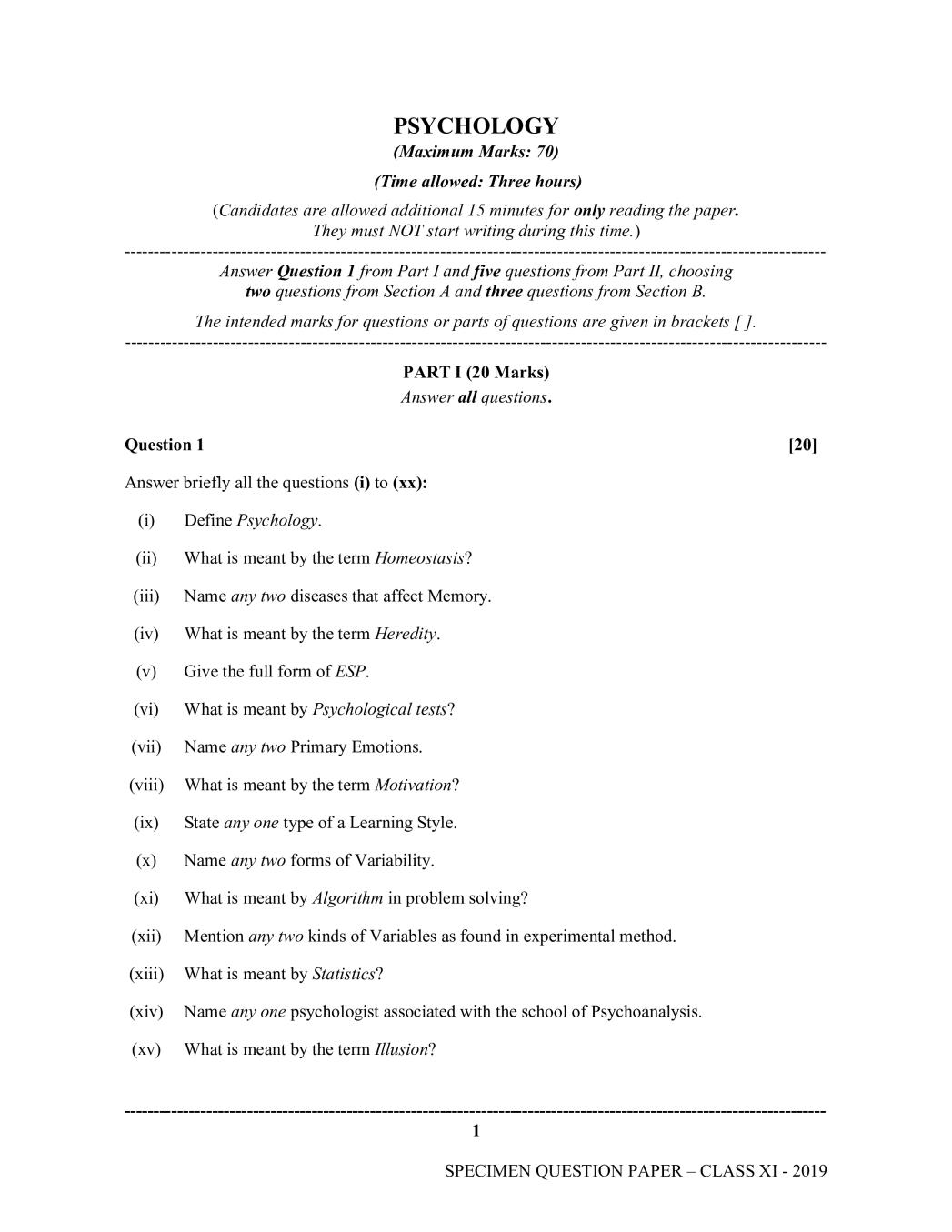
(Maximum Marks: 70)
(Time allowed: Three hours)
(Candidates are allowed additional 15 minutes for only reading the paper.
They must NOT start writing during this time.)
Answer Question 1 from Part I and five questions from Part II, choosing
two questions from Section A and three questions from Section B.
The intended marks for questions or parts of questions are given in brackets [ ].
PART I (20 Marks)
Answer all questions.
Question 1 [20]
Answer briefly all the questions (i) to (xx):
(i) Define Psychology.
(ii) What is meant by the term Homeostasis?
(iii) Name any two diseases that affect Memory.
(iv) What is meant by the term Heredity.
(v) Give the full form of ESP.
(vi) What is meant by Psychological tests?
(vii) Name any two Primary Emotions.
(viii) What is meant by the term Motivation?
(ix) State any one type of a Learning Style.
(x) Name any two forms of Variability.
(xi) What is meant by Algorithm in problem solving?
(xii) Mention any two kinds of Variables as found in experimental method.
(xiii) What is meant by Statistics?
(xiv) Name any one psychologist associated with the school of Psychoanalysis.
(xv) What is meant by the term Illusion?
1
Page 2
(xvii) What is meant by the term Random Sampling?
(xviii) Mention any two attributes of Colour.
(xix) State any one Binocular cue in depth perception.
(xx) Briefly explain the term Semantic Memory.
PART II (50 Marks)
SECTION A
Answer any two questions.
Question 2
(a) Explain the main features of the school of Behaviourism. [5]
(b) Describe how Psychology can be applied in any five fields. [5]
Question 3
(a) Describe the Observational method of Psychology. [5]
(b) Explain the different measures of Central Tendency along with one use for each of [5]
them.
Question 4
(a) Discuss any five Organizational Principles of Perceptual Processes. [5]
(b) Describe any five outer determinants of Attention. [5]
SECTION B
Answer any three questions.
Question 5
(a) Examine the Schachter and Singer Theory of Emotion. [5]
(b) What is meant by the term frustration. Explain the different types of conflicts of [5]
motivation, with examples.
Question 6
(a) Explain the experiment on Classical Conditioning along with its principles. [5]
(b) What are Learning Disabilities? Define Dyslexia and Dyscalculia with two [5]
2
Page 3
Question 7
(a) Describe the Atkinson and Shiffrin Model for processing memory. [5]
(b) Explain any five ways by which memory can be improved. [5]
Question 8
(a) What is meant by the term Thinking? Explain any three elements of Thinking. [4]
(b) What is Creative Thinking? Discuss the stages of Creative Thinking. [6]
Question 9
Write short notes for any two of the following: [5 × 2]
(a) Interference theory of Forgetting.
(b) Trial and Error method of Learning.
(c) Achievement Motivation.
3