HBSE Class 12 English Core Question Paper 2018 Set C
Finished viewing? Save it for later —
Download HBSE Class 12 English Core Question Paper 2018 Set C (PDF · 12 pages)About HBSE Class 12 English Core Question Paper 2018 Set C
HBSE Class 12 English Core Question Paper 2018 Set C is available here for free download. Published by Haryana Board for Class 12, this question paper can be viewed online or downloaded as a PDF (12 pages). Candidates preparing for Class 12 can use HBSE Class 12 English Core Question Paper 2018 Set C to understand the exam pattern, the type of questions asked, and the overall difficulty level.
Frequently Asked Questions
How can I download HBSE Class 12 English Core Question Paper 2018 Set C?
Open this page and click the Download button to save HBSE Class 12 English Core Question Paper 2018 Set C as a PDF. It is completely free on AglaSem Docs.
Is HBSE Class 12 English Core Question Paper 2018 Set C free to download?
Yes. HBSE Class 12 English Core Question Paper 2018 Set C can be viewed online and downloaded as a PDF free of cost on AglaSem Docs.
How many pages does HBSE Class 12 English Core Question Paper 2018 Set C have?
HBSE Class 12 English Core Question Paper 2018 Set C contains 12 pages, which you can read online or download together as a single PDF.
Where can I find more Class 12 study material?
You can find more Class 12 question papers, sample papers, syllabus, and answer keys on AglaSem Docs.
HBSE Class 12 English Core Question Paper 2018 Set C – Text
Read the full text of this question paper below — useful to quickly search, copy and reference the content online without downloading the PDF.
📄 View text version (12 pages)
Page 1
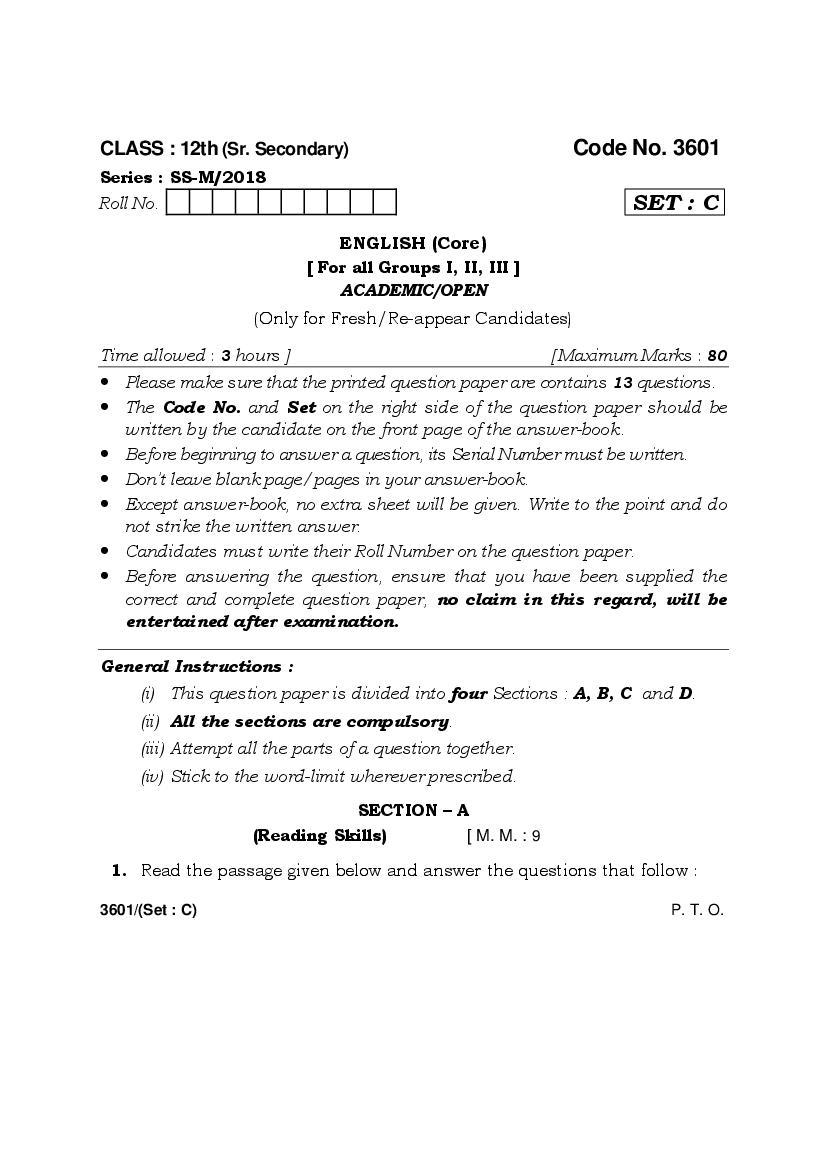
Series : SS-M/2018
Roll No. SET : C
ENGLISH (Core)
[ For all Groups I, II, III ]
ACADEMIC/OPEN
(Only for Fresh/Re-appear Candidates)
Time allowed : 3 hours ] [ Maximum Marks : 80
• Please make sure that the printed question paper are contains 13 questions.
• The Code No. and Set on the right side of the question paper should be
written by the candidate on the front page of the answer-book.
• Before beginning to answer a question, its Serial Number must be written.
• Don’t leave blank page / pages in your answer-book.
• Except answer-book, no extra sheet will be given. Write to the point and do
not strike the written answer.
• Candidates must write their Roll Number on the question paper.
• Before answering the question, ensure that you have been supplied the
correct and complete question paper, no claim in this regard, will be
entertained after examination.
General Instructions :
(i) This question paper is divided into four Sections : A, B, C and D.
(ii) All the sections are compulsory.
(iii) Attempt all the parts of a question together.
(iv) Stick to the word-limit wherever prescribed.
SECTION – A
(Reading Skills) [ M. M. : 9
1. Read the passage given below and answer the questions that follow :
3601/(Set : C) P. T. O.
Page 2
What would we do without humour ? How would we enjoy talks
with others if we did not use humour to invite a smile or a laugh ? And
how would we manage the times when we feel sad and alone ? With
humour we lighten up each day, and we find common ground with
others. We build healthy relationships with others by knowing what to
say and to do that helps, and what hinders, a conversation. Humour
often takes us to the edge of uncertainty when we exaggerate, or tease
others to make our point. When humour is successful, we build trust
and cooperation. We discover that we are not alone, we learn to accept
our mistakes, and we look for the good in others and in ourselves. Most
importantly, we create common ground. However, when we lose our
sense of humour, we often get critical or defensive, and, we often get
critical of ourselves for what was said, and how it was said. Humour is
an essential skill needed to communicate well with others. A few well
chosen words get the attention of others and make a serious point
without their getting defensive. Whether we prefer to be the centre of
attention or shy and quiet, humour can be adjusted to suit our
personality. The challenge for everyone is to become more aware of how
to add humour, and when to avoid it. Too much humour, like too much
spice often annoys others. Humour that is perceived as insensitive
often leads others to shut down, or become argumentative. But when
we each maintain our sense of humour, we look for the good in others
and in ourselves. To ensure that our humour is welcomed by others, we
need to combine our humour with speaking clearly and listening
effectively. Have you ever noticed that successful individuals use self-
deprecating humour to humble themselves, without putting themselves
down ? These individuals understood that every person has strengths
and weaknesses and that self deprecating humour invites others to feel
more confident and equal. Having humour helps us keep our
perspective, stay responsive to others, and resolve differences. Do you
already have some things that you say to diffuse tension ? Words like
"At times like this, my uncle used to say ... " can help the conversation
3601/(Set : C)
Page 3
to become less confrontational. If you can't think of a humourous
comment that will be helpful, you can try looking for clarification by
mirroring back their words and clarifying their point. Assume that
there is always something that you can find to appreciate when you are
looking for common ground. Focus on preventing an argument.
Remember, humour is often not the best choice to handle conflict.
Opportunities to add a touch of humour happen all of the time. In
December when I visited my friend Tim in the hospital, I came wearing
antlers from the Dollar Store. And when I was accepted into the
graduate programme at the University of Waterloo, I wrote my
acceptance letter as a poem. In each situation my small change from
the everyday stirred others to smile, and expect positive conversations
in the future. Much of our humour comes from reconnecting to our
playful inner child. For many of us, it only takes a Playful voice tone,
wearing a funny hat, or holding a stuffed toy to get started. Take a risk.
Add a bit more humour, and do it in the way that is right for you.
Questions : 1×4=4
(i) Humour helps us :
(a) to find common ground with others
(b) lighten up each day
(c) exaggerate
(d) both (a) and (b)
(ii) When we lose humour we :
(a) often get critical
(b) often get defensive
(c) often get critical for what was said
(d) all of these
(iii) Humour is not the best tool to :
(a) resolve a conflict
3601/(Set : C) P. T. O.
Page 4
(b) be a successful conversationalist
(c) to find common ground
(d) stay responsive to others
(iv) The writer gives the example of wearing a funny hat to exemplify
that :
(a) humour comes from reconnecting with our inner child
(b) opportunities to add humour are always present
(c) humour requires common ground
(d) humour involves risk
OR
Russia in the late nineteenth and early twentieth centuries was a
massive empire, stretching from Poland to the Pacific, and home in
1914 to 165 million people of many languages, religions and cultures.
Ruling such a massive state was difficult, and the long term problems
within Russia were eroding the Romanov monarchy. In 1917 this decay
finally produced a revolution which swept the old system away. Several
key fault lines can be identified as long term causes, while the short
term trigger is accepted as being World War - I. It's important to
remember Tsarist Russia collapsed under its own flaws, with the top
rending, not by an attack from people at the bottom, e.g. workers. That
(and Lenin) would come later in 1917, when the Tsar was gone. The
revolution was also not inevitable: the Tsars could have reformed, but
the last ones didn't want to and went backwards. It cost them their
lives. In theory their life had improved in 1861, before which they were
serfs who were owned and could be traded by their landowners. The
year 1861 saw the serfs freed and issued with small amounts of land,
but in return they had to pay back a sum to the government, and the
result was a mass of small farms deeply in debt. The state of
agriculture in Russia was poor, using techniques deeply out of date and
with little hope of improving thanks to the widespread illiteracy and no
capital to invest. Families lived just above the subsistence level,
and around 50% of the families had a member who had left the village
3601/(Set : C)
Page 5
to find other work, often in the towns. As the central Russian
population boomed, land became scarce. Their life was in sharp
contrast to the rich landowners, who held 20% of the land in large
estates and were often members of the Russian upper class. The
western and southern reaches of the massive Russian Empire were
slightly different, with a larger number of better off peasants and large
commercial farms. The result was, by 1917, a central mass of
disaffected peasants were angry at increased attempts to control them,
and at people who profited from the land without directly working on it.
The common peasant mindset was firmly against developments outside
the village, and desired autonomy.
Oddly, although the vast majority of Russia in population was rural
peasants, and urban ex-
peasants, the upper and the middle classes knew little of real peasant
life, but a lot about myths: of down to earth, angelic, pure commercial
life, etc. Legally, culturally, socially, the peasants in over half a million
settlements were organised by centuries of community rule, the mirs,
which were separate from elites and the middle class. But this was not
a joyous, lawful commune, it was a desperate struggling system fuelled
with the human weakness of rivalry, violence and theft, and everywhere
was run by elder patriarchs. A break was occurring among the
peasants between the elders and a large number of young literate
peasants, due to the culture of deeply ingrained and frequent violence.
The peasants were not without a world view, and it was a mixture of
odd folk memory, custom, and opposition to the interference of the Tsar
– Inside vs outside. Stolypin's lands reforms of the years before 1917
attacked peasant concept of family ownership and tried to capitalise it;
revolutionary peasants often went back to communal systems. This
wasn't so much class but a view based on justice of poor vs strong. In
central Russia, the peasant population was rising and land was
running out, so eyes were on the elites who were forcing the debt-
ridden peasants to sell land for commercial use. Even more peasants
travelled to the cities in search of work. There they urbanised and
looked negatively on the peasants left behind.
Questions : 1×4=4
3601/(Set : C) P. T. O.
Page 6
(i) The decay that caused the Russian revolution was due to :
(a) massive empire
(b) failure of the czars to reform themselves
(c) world War-I
(d) all of the above
(ii) The agriculture was in bad condition as :
(a) farmers were in debt
(b) techniques were outdated
(c) both (a) and (b)
(d) serfs could be traded by their landowners
(iii) Which of the following was the trigger for the revolution ?
(a) World War - I
(b) urbanisation of the peasants
(c) break between the elders and the young
(d) excessive control of the upper classes
(iv) The peasants were organised into communes by :
(a) mirs
(b) farmers
(c) middle classes
(d) elites
2. Read the following passage carefully and make notes on it using
headings and sub headings. Supply an appropriate title also : 4 + 1 = 5
I remember my childhood as being generally happy and can recall
experiencing some of the most carefree times of my life. But I can also
remember, even more vividly, moments of being deeply frightened. As a
child, I was truly terrified of the dark and getting lost. These fears were
very real and caused me some extremely uncomfortable moments.
Maybe it was the strange way things looked and sounded in my familiar
room at night that scared me so much. There was never total darkness,
but a street light or passing car lights made clothes hung over a chair
take on the shape of an unknown beast. Out of the corner of my eye, I
saw curtains move when there was no breeze. A tiny creak in the floor
would sound a hundred times louder than in the daylight and my
3601/(Set : C)
Page 7
imagination would take over creating burglars and monsters. Darkness
always made me feel helpless. My heart would pound and I would lie
very still so that 'the enemy' wouldn't discover me. Another childhood
fear of mine was that I would get lost, especially on my way home from
school. Every morning, I got on the school bus right near my home –
that was no problem. After school, when all the buses were lined up
along the curve, I was terrified that I would get on the wrong one and
be taken to some unfamiliar neighbourhood. I would scan the bus for
the faces of my friends, make sure that the bus driver was the same
one that had been there in the morning, and even then ask the others
over and over again to be sure that I was in the right bus. On school or
family trips to an amusement park or a museum, I wouldn't let the
leaders out of my sight. And of course, I was never very adventurous
when it came to taking walks or hikes because I would go only where I
was sure I would never get lost. Perhaps, one of the worst fears I had as
a child was that of not being liked or accepted by others. First of all, I
was quite shy. Secondly, I worried constantly about my looks, thinking
people wouldn't like me because I was too fat or wore braces. I tried to
wear 'the right clothes' and had intense arguments with my mother
over the importance of wearing flats instead of saddled shoes to school.
Being popular was very important to me then and the fear of not being
liked was a powerful one. One of the processes of evolving from a child
to an adult is being able to recognize and overcome our fears. I have
learnt that darkness does not have to take on a life of own, that others
can help me when I am lost and that friendliness and sincerity will
encourage people to like me. Understanding the things that scare us as
children helps to cope with our lives as adult.
SECTION – B
(Grammar/Writing Skills) [ M. M. : 26
3. Attempt any two from each sub-part :
(a) Change the form of narration : 1×2=2
(i) He said, "I like the book."
(ii) I said, "I agree to what he said."
(iii) I asked him, "Are you happy ?"
(b) Supply articles wherever necessary : 1 × 2 = 2
(i) …………… girl in red dress is my sister.
3601/(Set : C) P. T. O.
Page 8
(ii) He gave me ..………. one rupee note.
(iii) He plays ………. cricket.
(c) Fill in the blanks with suitable modal auxiliary verbs given in the
brackets : 1×2=2
(i) He …….. not talk to you. (dare/used)
(ii) We ……… drive carefully. (would/must)
(iii) You are quite well. You ……… not go to the doctor.
(need/should)
(d) Change the following sentences into passive voice : 1 ×
2=2
(i) Has he done his work.
(ii) This mango tastes great.
(iii) Someone types the letters.
(e) Use the correct form of verb given in the brackets : 1 ×
2=2
(i) Either my brothers or my father ………… responsible.
(to be)
(ii) Water …….... at 100°. (to boil)
(iii) It started to rain while we ………… tennis. (to play)
4. Attempt any two of the following : 3×2=6
(a) Draft a notice informing students of classes XI - XII about a poster
making competition. Invent all necessary details. You are Sonia,
President, Art Club, Model Senior Secondary School, Jhajjar.
(b) You want to sell your car as you are shifting from Bangalore to
Delhi. Draft a suitable
advertisement to be published in 'The Times of India'. Give
necessary details of the car. You are Prateek/Reena, 240, Sector –
4, Sonipat.
(c) Design a Poster on the theme of Tilak Holi, in order to save water.
5. Attempt any one of the following : 5
3601/(Set : C)
Page 9
(a) Write a report in not more than 125 words on a road accident you
witnessed on your way to school. Sign as Meena/Mahesh.
(b) Write a paragraph of about 100 words on 'Morning Walk'.
6. Write an application to the Principal of your school requesting her to
remit your fine for being absent from school. Sign as Roma/Rajiv of
class XII. 5
SECTION – C
(A) Main Reader [ Prose ] [ M. M. : 20
7. Read the passage given below and answer the questions that follow :
Poor man ! It was in honour of this last lesson that he had put on
his fine Sunday clothes, and now I understood why the old men of the
village were sitting there in the back of the room. It was because they
were sorry, too, that they had not gone to school more. It was their way
of thanking our master for his forty years of faithful service and of
showing their respect for the country that was theirs no more.
Questions : 1×5=5
(i) Name the chapter from which the above lines have been taken.
(ii) Name the author of the chapter.
(iii) What were the old men of the village sorry about ?
(iv) Why was 'their country theirs no more' ?
(v) Why was the man in fine Sunday clothes ?
OR
My introduction to the Y.M.C.A. swimming pool revived unpleasant
memories and stirred childhood fears. But in a little while I gathered
confidence. I paddled with my new water wings, watching the other
boys and trying to learn by aping them. I did this two or three times on
different days and was just beginning to feel at ease in the water when
the misadventure happened.
Questions : 1×5=5
(i) Name the chapter from which the above lines have been taken.
3601/(Set : C) P. T. O.
Page 10
(ii) Name the author of the chapter.
(iii) What stirred childish fears in the author ?
(iv) What did the author do two or three times ?
(v) When did the misadventure happen ?
8. Answer any one of the following : 5
(a) How did the Tiger King bribe the British officer to save his kingdom
? How do you view this act ?
(b) How did Doctor Sadao help the 'PoW' to escape ? What human
values do you find in his act ?
9. Answer any five of the following : 2 × 5 = 10
(i) What did the blacksmith say to Franz ?
(ii) How can Mukesh realise his dream ?
(iii) Why is Mukesh's father a failed man ?
(iv) What kind of person is William Douglas ?
(v) Why was the crofter so talkative and friendly with the peddler ?
(vi) Why did Gandhiji chide the lawyers ?
(vii) What did Lewis Carroll have a horror of ?
SECTION – C
(B) Main Reader [ Poetry ] [ M. M. : 11
10. Read the stanza given below and answer the questions that follow :
At back of the dim class
One unnoted, sweet and young. His eyes live in
a dream,
Of squirrel's game, in the tree room, other than
this.
Questions : 1×5=5
(i) Name the poem.
(ii) Name the poet.
(iii) Why is the class dim ?
(iv) Why is the child called 'sweet and young' ?
(v) What does the child want to enjoy ?
3601/(Set : C)
Page 11
OR
And such too is the grandeur of the dooms
We have imagined for the mighty dead;
All lovely tales that we have heard or read:
An endless fountain of immortal drink,
Pouring unto us from the heaven's brink.
Questions : 1×5=5
(i) Name the poem.
(ii) Name the poet.
(iii) Who are the 'mighty dead' referred to here ?
(iv) What is the endless fountain of immortal drink ?
(v) What does the word 'brink' mean ?
11. Answer any two of the following : 3×2=6
(i) Why are Aunt Jennifer's hands terrified ?
(ii) Why has the poet brought in the image of merry children 'spilling
out of their homes' ?
(iii) What symbol from nature does the poet use to prove that keeping
quiet is not a total inactivity ?
SECTION – D
(Supplementary Reader) [ M. M. : 14
12. Answer any one of the following : 5
(a) Who was Tiger King ? How did he get that name ?
(b) "The world's geological history is trapped in Antarctica." How is the
study of this region useful to us ?
13. Answer any three of the following : 3×3=9
(i) Why did the dewan think of procuring a tiger ?
(ii) Why was Dr. Sadao kept in Japan and not sent abroad with the
troops ?
3601/(Set : C) P. T. O.
Page 12
(iii) What explanation did Mcleery give for carrying the rubber tube in
Evans' Cell ?
(iv) What is it that draws Derry towards Mr. Lamb ?
S
3601/(Set : C)
Document Details
| Board / Org | Haryana Board |
| Exam | Class 12 |
| Type | Question Paper |
| Pages | 12 |
| Updated | 22 Jul 2026 |