HBSE Class 12 English Core Question Paper 2018 Set B
Finished viewing? Save it for later —
Download HBSE Class 12 English Core Question Paper 2018 Set B (PDF · 12 pages)About HBSE Class 12 English Core Question Paper 2018 Set B
HBSE Class 12 English Core Question Paper 2018 Set B is available here for free download. Published by Haryana Board for Class 12, this question paper can be viewed online or downloaded as a PDF (12 pages). Candidates preparing for Class 12 can use HBSE Class 12 English Core Question Paper 2018 Set B to understand the exam pattern, the type of questions asked, and the overall difficulty level.
Frequently Asked Questions
How can I download HBSE Class 12 English Core Question Paper 2018 Set B?
Open this page and click the Download button to save HBSE Class 12 English Core Question Paper 2018 Set B as a PDF. It is completely free on AglaSem Docs.
Is HBSE Class 12 English Core Question Paper 2018 Set B free to download?
Yes. HBSE Class 12 English Core Question Paper 2018 Set B can be viewed online and downloaded as a PDF free of cost on AglaSem Docs.
How many pages does HBSE Class 12 English Core Question Paper 2018 Set B have?
HBSE Class 12 English Core Question Paper 2018 Set B contains 12 pages, which you can read online or download together as a single PDF.
Where can I find more Class 12 study material?
You can find more Class 12 question papers, sample papers, syllabus, and answer keys on AglaSem Docs.
HBSE Class 12 English Core Question Paper 2018 Set B – Text
Read the full text of this question paper below — useful to quickly search, copy and reference the content online without downloading the PDF.
📄 View text version (12 pages)
Page 1
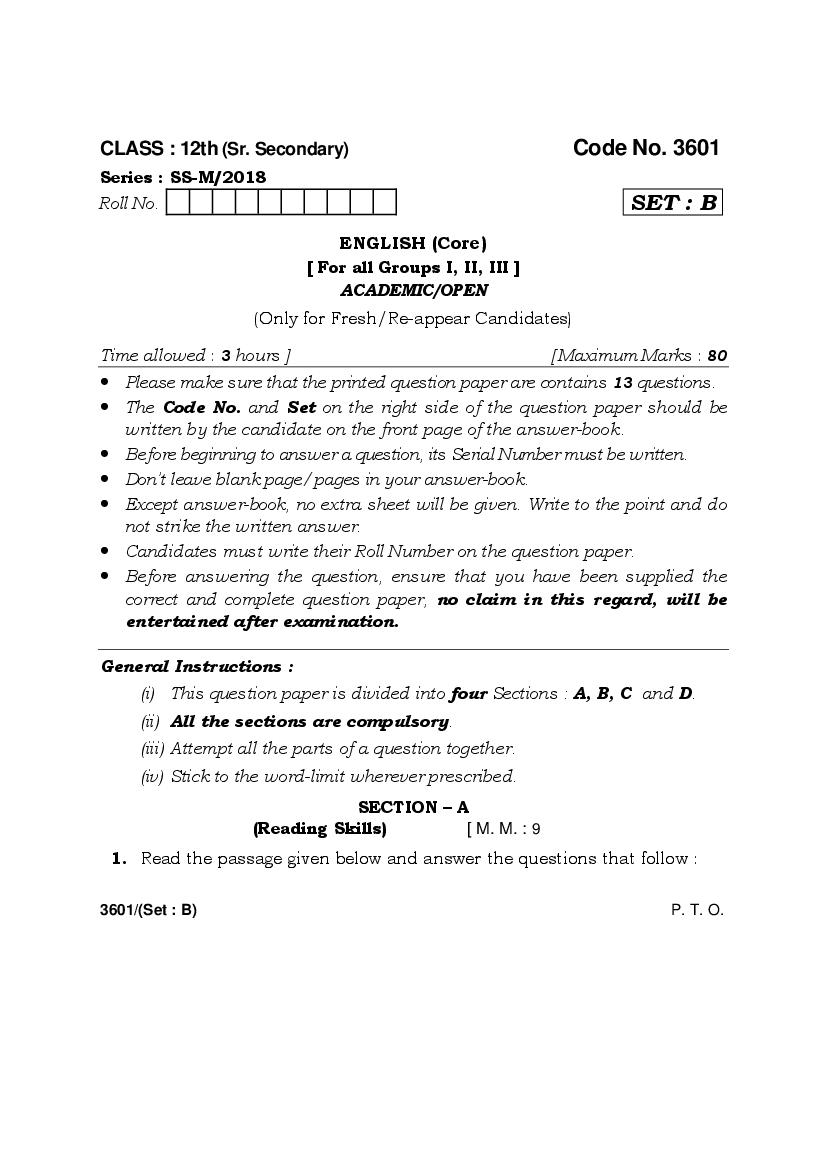
Series : SS-M/2018
Roll No. SET : B
ENGLISH (Core)
[ For all Groups I, II, III ]
ACADEMIC/OPEN
(Only for Fresh/Re-appear Candidates)
Time allowed : 3 hours ] [ Maximum Marks : 80
• Please make sure that the printed question paper are contains 13 questions.
• The Code No. and Set on the right side of the question paper should be
written by the candidate on the front page of the answer-book.
• Before beginning to answer a question, its Serial Number must be written.
• Don’t leave blank page / pages in your answer-book.
• Except answer-book, no extra sheet will be given. Write to the point and do
not strike the written answer.
• Candidates must write their Roll Number on the question paper.
• Before answering the question, ensure that you have been supplied the
correct and complete question paper, no claim in this regard, will be
entertained after examination.
General Instructions :
(i) This question paper is divided into four Sections : A, B, C and D.
(ii) All the sections are compulsory.
(iii) Attempt all the parts of a question together.
(iv) Stick to the word-limit wherever prescribed.
SECTION – A
(Reading Skills) [ M. M. : 9
1. Read the passage given below and answer the questions that follow :
3601/(Set : B) P. T. O.
Page 2
For four days, I walked through narrow lanes of the old city,
enjoying the romance of being in a city where history still lives - in its
cobblestone streets and in its people riding asses, carrying
vine leaves and palm as they once did during the time of Christ. This is
Jerusalem, home to the
sacred sites of Christianity, Islam and Judaism. This is the place that
houses the church of the
Holy Sepulchre, the place where Jesus was finally laid to rest. This is
also the site of Christ's
crucifixion, burial and resurrection. Built by the Roman Emperor
Constantine at the site of an
earlier temple to Aphrodite, it is the most venerated Christian shrine in
the world. And justifiably so. Here, within the church, are the last five
stations of the cross, the 10th station where Jesus was stripped of his
clothes, the 11th where he was nailed to the cross, the 12th where he
died on the cross, and the 13th where the body was removed from the
cross, and the
th
14 , his tomb. For all this weighty tradition, the approach and
entrance to the church is
nondescript. You have to ask for directions. Even to the devout
Christian pilgrims walking
along the Via Dolorosa – the Way of Sorrows - first nine stations look
clueless. Then a
courtyard appears, hemmed in by other buildings and a doorway to one
side. This leads to a vast area of huge stone architecture. Immediately
inside the entrance is your first stop. It's the stone of anointing: this is
the place, according to Greek tradition, where Christ was removed from
the cross. The Roman Catholics, however, believe it to be the spot
where Jesus's body was prepared for burial by Joseph. What happened
next ? Jesus was buried. He was taken to a place outside the city of
Jerusalem where other graves existed and there, he was buried in a
cave. However, all that is long gone, destroyed by continued attacks
and rebuilding; what remains is the massive – and impressive –
Rotunda (a round building with a dome) that Emperor Constantine
built. Under this, and right in the centre of the Rotunda, is the
structure that contains the Holy Sepulchre.
"How do you know this is Jesus's tomb ?" I asked one of the
pilgrims standing next to me. He was clueless, more interested, like the
3601/(Set : B)
Page 3
rest of them, in the novelty of it all and in photographing it, than in its
history or tradition. At the start of the first century, the place was a
disused quarry outside the city walls. According to the gospels, Jesus'
crucifixion occurred 'at a place outside the city walls with graves
nearby ..... '. Archaeologists have discovered tombs from that era, so
the site is compatible with the biblical period. The structure at the site
is a marble tomb built over the original burial chamber. It has two
rooms, and you enter four at a time into the first of these, the Chapel of
the Angel. Here the angel is supposed to have sat on a stone to recount
Christ's resurrection. A low door made of white marble, partly worn
away by pilgrims hands, leads to a smaller chamber inside. This is the
'room of the tomb', the place where Jesus was buried. We entered in a
single file. On my right was a large marble slab that covered the
original rock bench on which the body of Jesus was laid. A woman
knelt and prayed. Her eyes were wet with tears. She pressed her face
against the slab to hide them, but it only made it worse.
Questions : 1×4=4
(i) How did Jerusalem still retain the charm of the ancient era ?
(a) There are narrow lanes
(b) Roads are paved with cobblestone
(c) People can be seen riding asses
(d) All of the above
(ii) Holy Sepulchre is sacred to :
(a) Christianity
(b) Islam
(c) Judaism
(d) Both (a) and (c)
(iii) Why does one have to constantly ask for directions to the church ?
(a) Its lanes are narrow
(b) Entrance to the church is nondescript
(c) People are not tourist-friendly
(d) Everyone is lost in enjoying the romance of the place
3601/(Set : B) P. T. O.
Page 4
(iv) Where was Jesus buried ?
(a) In a cave
(b) At a place outside the city
(c) In the Holy Sepulchre
(d) Both (a) and (b)
OR
"It is impossible to think about the welfare of the world unless the
condition of women is improved. It is impossible for a bird to fly on only
one wing."
– Swami Vivekananda
Women are not born, but made. What is better than India to exemplify
this statement by
Simone de Beauvoir. With the whole world celebrating International
Women's Day with great pomp and show, it would be only apt to
analyse the position and space Indian women occupy today, and
comparing it to the times 60 years ago when the country had just
gained independence. With the women participating in nationalist
movements to being pushed into domestic household place, to their
resurgence as the super-women today, women in our country have
seen it all. There have been innumerable debates about gender in India
over the years. Much of it includes women's position in society, their
education, health, economic position, gender equality, etc. What one
can conclude from such discussions is that women have always held a
certain paradoxical position in our developing country. On the one
hand, the country has seen an increased percentage of literacy among
women, and women are allowed to enter into professional fields, while
on the other hand the practices of female infanticide, poor health
conditions and lack of education still persist. Even the patriarchal
ideology of the home being a woman's real domain and marriage being
her ultimate destiny hasn't changed much. The matrimonial
advertisements, demanding girls of the same caste, with fair skin and
slim figure, or the much criticized fair and lovely ads, are indicators of
the slow changing social mores. If one looks at the status of women
3601/(Set : B)
Page 5
then and now, one has to look at two sides of the coin; one side which
is promising, and one side which is bleak. When our country got its
independence, the participation of women nationalists was widely
acknowledged. When the Indian Constitution was formulated, it
granted equal rights to women, considering them legal citizens of the
country and as an equal to men in terms of freedom and opportunity.
The sex ratio of women at that time was slightly better than what it is
today, standing at 945 females per 1000 males. Yet the conditions of
women screamed a different reality.
They were relegated to their households, and made to submit to the
male-dominated society,
as has always been prevalent in our country. Indian women, who
fought as an equal to men in
the nationalist struggle, were not given that free public space anymore.
They became homemakers, and were mainly meant to build a strong
home to support their men who were
to build the new independent country. Women were reduced to being
secondary citizens. The
national female literacy rate was an alarmingly low 8.9 percent. The
Gross Enrollment Ratio
(GER) for girls was 24.8 percent at primary level and 4.6 percent at the
upper primary level (in
the 11 - 14 years age group). There existed insoluble social and cultural
barriers to education of women and access to organised schooling.
Questions : 1×4=4
(i) The writer says that the women have seen it all because :
(a) They participated in the nationalist movements.
(b) They were pushed into household space.
(c) They have become superwomen today.
(d) All of the above.
(ii) Pick one statement which brings out the paradoxical nature of
women's position in society today :
3601/(Set : B) P. T. O.
Page 6
(a) They are entering professional fields and becoming literate.
(b) They lack education and female infanticide is still rampant.
(c) They are still victims of patriarchal mindset.
(d) While they are allowed to enter professional fields they are still
victims of patriarchal mindsets.
(iii) The Indian Constitution did not ensure :
(a) that women get equal rights.
(b) that they were considered equal to men.
(c) that the sex ratio would be 945 females to 1000 males.
(d) that they were legal citizens of India.
(iv) Despite the provisions of the constitution :
(a) women were relegated to the household.
(b) women were not allowed free space.
(c) women were dictated by patriarchy.
(d) all of the above.
2. Read the following passage carefully and make notes on it using
headings and sub headings. Supply an appropriate title also : 4 + 1 = 5
In a very short period of time the internet has had a profound
impact on the way we live. Since the internet was made operational in
1983, it has lowered both the costs of communication and the barriers
to creative expression. It has challenged old business models and
enabled new ones. It has provided access to information on a scale
never before achievable. It succeeded because we designed it to be
flexible and open. These two features have allowed it to accommodate
innovation without massive changes to its infrastructure. An open,
borderless and standardised platform means that barriers to entry are
low, competition
is high, interchangeability is assured and innovation is rapid. The
beauty of an open platform is that there are no gatekeepers. For
centuries, access to and creation of information was controlled by the
few. The internet has changed that and is rapidly becoming the
platform for everyone, by everyone. Of course, it still has a way to go.
Today there are only about 2.3 billion internet users, representing
3601/(Set : B)
Page 7
roughly 30% of the world's population. Much of the information that
they can access online is in English, but this is changing rapidly. The
technological progress of the internet has also set social change in
motion. As with other enabling inventions before it, from the telegraph
to television, some will worry about the effects of
broader access to information - the printing press and the rise in
literacy that it affected were, after all, long seen as destabilising.
Similar concerns about the internet are occasionally raised, but if we
take a long view, I'm confident that its benefits far outweigh the
discomforts of
learning to integrate into our lives. The internet and the world wide web
are what they are
because literally millions of people have made it so. It is a grand
collaboration. It would be
foolish not to acknowledge that the openness of the internet has had a
price. Security is an increasingly important issue and cannot be
ignored. If there is an area of vital research and
development for the internet, this is one of them. I am increasingly
confident, however, that
techniques and practice exist to make the internet safer and more
secure while retaining its essentially open quality. After working on the
internet and its predecessors for over decades,
I'm more optimistic about its promise than I have ever been. We are all
free to innovate on the net everyday. The internet is tool of the people,
built by the people and it must stay that way.
SECTION – B
(Grammar/Writing Skills) [ M. M. : 26
3. Attempt any two from each sub-part :
(a) Change the form of narration : 1×2=2
(i) Mohan said, "I am an early riser."
(ii) He said to Meena, "I have passed the test."
(iii) She said to me, "Do you know her ?"
(b) Supply articles wherever necessary : 1 × 2 = 2
(i) You can take ….…… Rajdhani Express to Delhi.
(ii) ………. gold you buy here is of excellent quality.
3601/(Set : B) P. T. O.
Page 8
(iii) She heard an old tale about ………. unicorn.
(c) Fill in the blanks with suitable modal auxiliary verbs given in the
brackets : 1×2=2
(i) You …….. pay all your taxes.
(must/might)
(ii) He ……… play football when he was young.
(will/used to)
(iii) If I were rich I ……… buy a car.
(would/shall)
(d) Change the following sentences into passive voice : 1 ×
2=2
(i) He killed a snake.
(ii) I can answer the question.
(iii) He must fill in the form.
(e) Use the correct form of the verb given in the brackets :
1×2=2
(i) The Mayor as well as his brothers ……. going to prison.
(to be)
(ii) There …….... the bell. (to go)
(iii) They ………… Panchkula yesterday.
(to burn)
4. Attempt any two of the following : 3×2=6
(a) You are Sports Secretary of Govt. Senior Secondary School,
Panchkula. Draft a notice in not more than 50 words for the school
notice board asking the students to give their names for
participation in various events likely to be held on the Annual
Sports Day of your school. Sign as Suman/Suresh.
(b) You are looking for a second hand car. Draft an advertisement for a
newspaper specifying your requirements.
(c) Design a Poster on the theme of Eco-friendly Diwali.
5. Attempt any one of the following : 5
3601/(Set : B)
Page 9
(a) Write a report in not more than 125 words on the Cultural Week
celebrated in your school. You are Shalini/Shekhar, Cultural
Secretary of your school.
(b) Write a paragraph of about 100 words on 'A Day in a Village'.
6. Write an application to the Principal of your school requesting her to
grant you one day's leave. Sign as Kanika/Kunal of class XII. 5
SECTION – C
(A) Main Reader [ Prose ] [ M. M. : 20
7. Read the passage given below and answer the questions that follow :
While I was wondering about it all, M. Hamel mounted his chair,
and in the same grave and
gentle tone which he had used to me, said, "My children, this is the last
lesson I shall give you.
The order has come from Berlin to teach only German in the schools of
Alsace and Lorraine.
The new master comes tomorrow. This is your last French lesson. I
want you to be very attentive."
Questions : 1×5=5
(i) Name the chapter from which the above lines have been taken.
(ii) Name the author of the chapter.
(iii) How did the teacher speak to the students ?
(iv) When was the new master coming ?
(v) What did the teacher want the students to do ?
OR
Saheb too is wearing tennis shoes that look strange over his
discoloured shirt and shorts.
"Someone game them to me," he says in the manner of an explanation.
The fact that they are
discarded shoes of some rich boy, who perhaps refused to wear them
because of a hole in one
3601/(Set : B) P. T. O.
Page 10
of them, does not bother him. For one who had walked barefoot, even
shoes with a hole is a dream come true. But the game he is watching so
intently is out of his reach.
Questions : 1×5=5
(i) Name the chapter from which the above lines have been taken.
(ii) Name the author of the chapter.
(iii) What looks strange ?
(iv) Why did some rich boy discard the shoes ?
(v) What is a dream come true for Saheb ?
8. Answer any one of the following : 5
(a) Do you think truth prevails against all odds ? Why do you think
Gandhiji considered the Champaran episode to be a turning point
in his life ?
(b) Sophie's dreams and disappointments are all in her mind. Why or
Why not ?
9. Answer any five of the following : 2 × 5 = 10
(i) Did M. Hamel get angry with Franz for being late ?
(ii) What is Saheb looking for in the garbage dumps ?
(iii) Why was Douglas determined to get over his fear of water ?
(iv) What doubts did Elda have about the peddler ?
(v) Why did Shukla meet Gandhi ?
(vi) Who was Subbu's Principal ?
(vii) How does Eco find time to write so much ?
SECTION – C
(B) Main Reader [ Poetry ] [ M. M. : 11
10. Read the stanza given below and answer the questions that follow :
Now we will count to twelve
and we will all keep still.
For once on the face of the Earth
3601/(Set : B)
Page 11
let's not speak in any language,
let's stop for one second,
and not move our arms so much.
Questions : 1×5=5
(i) Name the poem.
(ii) Name the poet.
(iii) What is the significance of the number "twelve" ?
(iv) Which two activities does the poet want us to stop ?
(v) What does the poet mean by 'let's not speak in any language" ?
OR
…………………. I saw my mother
Beside me,
Doze, open mouthed, her face
Ashen like that
Of a corpse and realised with
Pain ………………...
Questions : 1×5=5
(i) Name the poem.
(ii) Name the poet.
(iii) Who is 'I' ?
(iv) What did 'I' realise with pain ?
(v) Why was the realisation painful ?
11. Answer any two of the following : 3×2=6
(i) What does the poem 'Keeping Quiet' teach us ?
(ii) What symbol from nature does the poet involve to say that there
can be life under
apparent stillness ?
(iii) What or whom is Aunt Jennifer terrified with in the third stanza ?
SECTION – D
(Supplementary Reader) [ M. M. : 14
12. Answer any one of the following : 5
3601/(Set : B) P. T. O.
Page 12
(a) How did Jack end Roger Skunk story ? How and why did Jo want to
change it ?
(b) What change took place in Derry when he met Mr. Lamb ?
13. Answer any three of the following : 3×3=9
(i) How did the dewan procure the hundredth tiger for the Tiger King ?
(ii) What is it that draws Derry towards Mr. Lamb ?
(iii) What was Sadao's father's chief concern about Dr. Sadao ?
(iv) Who was Evans ? Describe his true characteristics.
S
3601/(Set : B)
Document Details
| Board / Org | Haryana Board |
| Exam | Class 12 |
| Type | Question Paper |
| Pages | 12 |
| Updated | 22 Jul 2026 |