HBSE Class 12 Question Paper 2021 Philosophy
Finished viewing? Save it for later —
Download HBSE Class 12 Question Paper 2021 Philosophy (PDF · 12 pages)About HBSE Class 12 Question Paper 2021 Philosophy
HBSE Class 12 Question Paper 2021 Philosophy is available here for free download. Published by Haryana Board for Class 12, this question paper can be viewed online or downloaded as a PDF (12 pages). Candidates preparing for Class 12 can use HBSE Class 12 Question Paper 2021 Philosophy to understand the exam pattern, the type of questions asked, and the overall difficulty level.
Frequently Asked Questions
How can I download HBSE Class 12 Question Paper 2021 Philosophy?
Open this page and click the Download button to save HBSE Class 12 Question Paper 2021 Philosophy as a PDF. It is completely free on AglaSem Docs.
Is HBSE Class 12 Question Paper 2021 Philosophy free to download?
Yes. HBSE Class 12 Question Paper 2021 Philosophy can be viewed online and downloaded as a PDF free of cost on AglaSem Docs.
How many pages does HBSE Class 12 Question Paper 2021 Philosophy have?
HBSE Class 12 Question Paper 2021 Philosophy contains 12 pages, which you can read online or download together as a single PDF.
Where can I find more Class 12 study material?
You can find more Class 12 question papers, sample papers, syllabus, and answer keys on AglaSem Docs.
HBSE Class 12 Question Paper 2021 Philosophy – Text
Read the full text of this question paper below — useful to quickly search, copy and reference the content online without downloading the PDF.
📄 View text version (12 pages)
Page 1
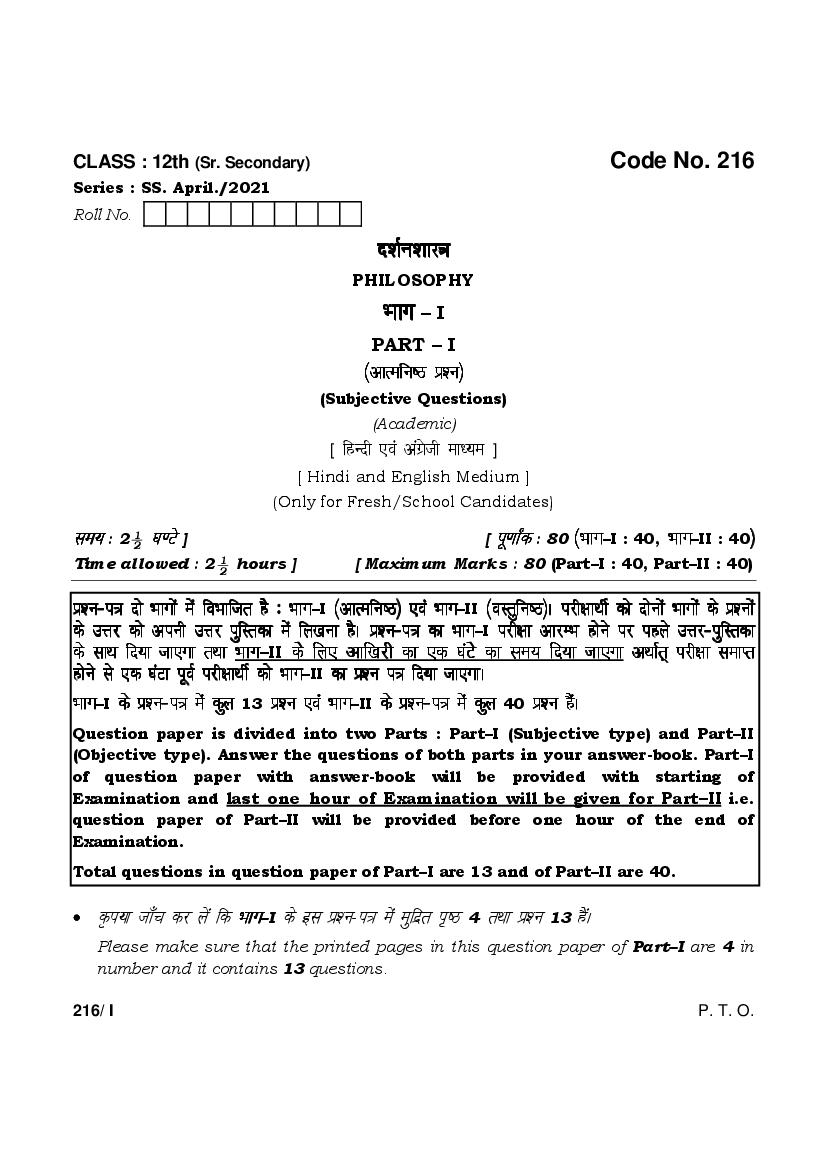
Series : SS. April./2021
Roll No.
n'kZu'kkL=
PHILOSOPHY
Hkkx – I
PART – I
¼vkRefu"B iz'u½
(Subjective Questions)
(Academic)
[ fgUnh ,oa vaxzsth ek/;e ]
[ Hindi and English Medium ]
(Only for Fresh/School Candidates)
le; : 2 21 ?k.Vs ] [ iw.kk±d : 80 ¼Hkkx–I : 40, Hkkx–II : 40½
Time allowed : 2 21 hours ] [ Maximum Marks : 80 (Part–I : 40, Part–II : 40)
iz'u&i= nks Hkkxkas eas foHkkftr gS % Hkkx–I ¼vkRefu"B½ ,oa
,oa Hkkx–II ¼oLrqfu"B½A ijh{kkFkhZ dks nksuksa Hkkxkas ds iz'ukas
ds mÙkj dks viuh mÙkj iqfLrdk eas fy[kuk gSA iz'u&i= dk Hkkx–I ijh{kk vkjEHk gksus ij igys mÙkj&iqfLrdk
ds lkFk fn;k tk,xk rFkk Hkkx–II ds fy, vkf[kjh dk ,d ?kaVs dk le; fn;k tk,xk vFkkZr~ ijh{kk ijh{kk lekIr
gksus ls ,d ?kaVk iwoZ ijh{kkFkhZ dks Hkkx–II dk iz'u i= fn;k tk,xkA
Hkkx–I ds iz'u&i= esa dqy 13 iz'u ,oa Hkkx–II ds iz'u&i= eas dqy 40 iz'u gSaA
Question paper is divided into two Parts : Part–I (Subjective type) and Part–II
(Objective type). Answer the questions of both parts in your answer-book. Part–I
of question paper with answer-book will be provided with starting of
Examination and last one hour of Examination will be given for Part–II i.e.
question paper of Part–II will be provided before one hour of the end of
Examination.
Total questions in question paper of Part–I are 13 and of Part–II are 40.
• Ñi;k tk¡p dj ysa fd Hkkx–I ds bl iz'u-i= esa eqfnzr i`"B 4 rFkk iz'u 13 gSaA
Please make sure that the printed pages in this question paper of Part–I are 4 in
number and it contains 13 questions.
216/ I P. T. O.
Page 2
• iz'u-i= esa nkfgus gkFk dh vksj fn;s x;s dksM uEcj dks Nk= mÙkj-iqfLrdk ds eq[;-i`"B ij fy[ksaA
The Code No. on the right side of the question paper should be written by the
candidate on the front page of the answer-book.
• Ñi;k iz'u dk mÙkj fy[kuk 'kq: djus ls igys] iz'u dk Øekad vo'; fy[ksaA
Before beginning to answer a question, its Serial Number must be written.
• mÙkj-iqfLrdk ds chp esa [kkyh iUuk / iUus u NksMsa+A
Don’t leave blank page/pages in your answer-book.
• mÙkj-iqfLrdk ds vfrfjDr dksbZ vU; 'khV ugha feysxhA vr% vko';drkuqlkj gh fy[ksa vkSj fy[kk mÙkj u
dkVsaA
Except answer-book, no extra sheet will be given. Write to the point and do not
strike the written answer.
• ijh{kkFkhZ viuk jksy ua0 iz'u&i= ij vo'; fy[ksaA
Candidates must write their Roll Number on the question paper.
• d`i;k iz'uksa dk mÙkj nsus lss iwoZ ;g lqfuf'pr dj ysa fd iz'u-i= iw.kZ o lgh gS] ijh{kk ds mijkUr bl
lEcU/k esa dksbZ Hkh nkok Lohdkj ugha fd;k tk;sxkA
Before answering the question, ensure that you have been supplied the correct and
complete question paper, no claim in this regard, will be entertained after
examination.
lkekU; funsZ'k %
General Instructions :
(i) lHkh iz'u vfuok;Z gSaA
All questions are compulsory.
(ii) izR;sd iz'u ds vad mlds lkeus n'kkZ;s x, gSaA
Marks of each question are indicated against it.
(iii) vkids mÙkj vadkuqlkj gksus pkfg,A
Your answer should be according to marks.
216/ I
Page 3
[k.M – v
SECTION – A
¼fucU/kkRed iz'u½
(Essay Type Questions)
uksV % iz'u la[;k 1 ls 3 rd fucU/kkRed iz'u gSa izR;sd iz'u 5 vad dk gSA
Question No. 1 to 3 are essay type questions. Each question carries 5 Marks.
1. Hkkjrh; n'kZu ds ^/keZ vkSj eks{k* iq#"kkFkks± dh O;k[;k dhft,A 5
Explain 'Dharma and Mokchha ' Purusharthas of Indian philosophy.
2. ckSn/~ k n'kZu ds ^e/;e ekxZ* dh O;k[;k dhft,A 5
Explain 'Middle Path' of Buddhist Philosophy.
vFkok
OR
oS'ksf"kd n'kZu ds ^nzO; inkFkZ* dh O;k[;k dhft,A
Explain 'Substance category' of Vaisesika Philosophy.
3. tSu n'kZu ds ^L;knokn* ds fl)kUr dh O;k[;k dhft,A 5
Explain 'Syadvada' concept of Jaina Philosophy.
vFkok
OR
iratfy ;ksx ds ^vkB vaxka*s dh O;k[;k dhft,A
Explain 'Eight Steps' of Patanjali Yoga.
[k.M – c
SECTION – B
¼y?kq mÙkjh; iz'u½
(Short Answer Type Questions)
uksV % iz'u la[;k 4 ls 8 rd y?kq mÙkjh; iz'u gSa izR;sd iz'u dk mÙkj 4-5 iafDr;ksa esa nsaA izR;sd iz'u 3
vad dk gSA
Question No. 4 to 8 are short answer type questions. Each answer should be
given in 4 to 5 lines. Each question carries 3 marks.
216/ I P. T. O.
Page 4
4. iq#"kkFkZ D;k gS \ 3
What is Purushartha ?
5. pkj vk;ZlR;ksa ds uke crkb;sA 3
State the names of four Noble Truths.
6. n.M ds fuorZukRed fl)kUr dh laf{kIr O;k[;k dhft,A 3
Explain in short the 'Preventive Theory' of punishment.
7. xhrk esa ^ldke deZ* dk D;k vFkZ gS \ 3
What is the meaning of 'Sakama Karma in Gita.
8. bZ'oj ds vfLrRo ds fy, D;k ;qfDr;k¡ gSa \ 3
What are the arguments for the existence of God ?
[k.M – l
SECTION – C
¼vfry?kq mÙkjh; iz'u½
(Very Short Answer Type Questions)
uksV % iz'u la[;k 9 ls 13 rd vfry?kq mÙkjkRed iz'u gSa izR;sd iz'u dk mÙkj 2-3 iafDr;ksa esa nhft,A
izR;sd iz'u 2 vad dk gSA
Question No. 9 to 13 are very short answer type questions. Each answer to be
given in 2-3 lines. Each question carries 2 marks.
9. n.M ds fl)kUr crkb;sA 2
State theories of Punishment.
10. ;ksx esa ^;e* ds fdrus izdkj gSa \ 2
What are the types of 'Yama' in Yoga ?
11. oS'ksf"kd n'kZu esa xq.kksa dh la[;k fdruh gS \ 2
How many numbers of Gunas in Vaisesika Philosophy ?
12. xhrk dk mins'k fdlus fn;k Fkk \ 2
Who has preached Gita ?
13. D;k xhrk egkHkkjr dk ,d va'k gS \ 2
Is Gita a part of Mahrbharta ?
S
216/ I
Page 5
Series : SS. April./2021
Roll No.
n'kZu'kkL=
PHILOSOPHY
Hkkx – II
PART – II
¼oLrqfu"B iz'u½
(Objective Questions)
(Academic)
[ fgUnh ,oa vaxzsth ek/;e ]
[ Hindi and English Medium ]
(Only for Fresh/School Candidates)
• Ñi;k tk¡p dj ysa fd Hkkx–II ds bl iz'u-i= esa eqfnzr i`"B 8 rFkk iz'u 40 gSaA
Please make sure that the printed pages in this question paper of Part-II are 8 in
number and it contains 40 questions.
• ijh{kkFkhZ viuk jksy ua0 iz'u&i= ij vo'; fy[ksaA
Candidates must write their Roll Number on the question paper.
• d`i;k iz'uksa dk mÙkj nsus lss iwoZ ;g lqfuf'pr dj ysa fd iz'u-i= iw.kZ o lgh gS] ijh{kk ds mijkUr bl
lEcU/k esa dksbZ Hkh nkok Lohdkj ugha fd;k tk;sxkA
Before answering the question, ensure that you have been supplied the correct and
complete question paper, no claim in this regard, will be entertained after
examination.
lkekU; funsZ'k %
General Instructions :
(i) lHkh iz'u vfuok;Z gSaA
All questions are compulsory.
216/ II P. T. O.
Page 6
(ii) iz'u Øekad 1 ls 40 rd oLrqfu"B iz'u gSaA izR;sd iz'u 1 vad dk gSA lgh mÙkj viuh
mÙkj&iqfLrdk eas fyf[k,A
Questions from 1 to 40 are objective type questions. Each question is of
1 mark. Write correct answer in your answer-book.
1. Hkkjrh; n'kZu vk/;kfRed gSA (lR;@vlR;)
Indian Philosophy is spiritualistic. (True/False)
2. eks{k iq#"kkFkZ ugha gSA (lR;@vlR;)
Mokchha is not purushartha. (True/False)
3. U;k;n'kZu vkfLrd gSA (lR;@vlR;)
Nyaya Philosophy is Aastika. (True/False)
4. pkokZd Hkkjrh; nk'kZfud gSA (lR;@vlR;)
Carvaka is an Indian Philosopher. (True/False)
5. Hkkjrh; n'kZu esa ckSn/~ k n'kZu dj laLFkkid dkSu gS \ (egf"kZ iratfy@egkRek cq))
Who is the founder of Buddhist Philosophy in Indian Philosophy ?
(Maharishi Patanjali/ Mahatma Buddha)
216/ II
Page 7
6. egkohj tSu n'kZu ds vfUre rhFk±dj FksA (lR;@vlR;)
Mahavir was the last teacher of Jaina Philosophy. (True/False)
7. ckSn/~ k n'kZu dk igyk vk;ZlR; dgrk gSa fd ^lc dqN nq%[k gS*A (lR;@vlR;)
Ist Noble Truth of Buddhist Philosophy says 'All is suffering'. (True/False)
8. L;knokn ds lkr izdkj gSaA (lR;@vlR;)
Syadvada has seven types. (True/False)
9. U;k;n'kZu ds izorZd dkSu Fks \ (d.kkn@xkSre)
Who was the founder of Nyaya Philosophy ? (Kanada/Gautam)
10. oS'ksf"kd n'kZu esa inkFkZ lkr gSaA (lR;@vlR;)
Categories are seven in Vaisesika Philosophy. (True/False)
11. oS'ksf"kd n'kZu egf"kZ d.kkn us fn;k Fkk A (lR;@vlR;)
Vaisesika Philosophy was given by Maharishi Kanada. (True/False)
12. oS'ksf"kd n'kZu esa ^vHkko* dks ,d inkFkZ ds rkSj ij Lohdkj fd;k x;k gSA (lR;@vlR;)
Non-Being is accepted as a category in Vaisesika Philosophy. (True/False)
216/ II P. T. O.
Page 8
13. U;k;n'kZu osnksa dks udkjrk gSA (lR;@vlR;)
Nyaya Philosophy rejects Vedas. (True/False)
14. lka[; n'kZu egf"kZ dfiy esa fn;k FkkA (lR;@vlR;)
Sankhay Philosophy was given by Maharishi Kapil. (True/False)
15. izÑfr lka[;-n'kZu dk fl)kUr gSA (lR;@vlR;)
Prakriti is a concept of Sankhya Philosophy. (True/False)
16. lka[; n'kZu bZ'ojoknh gSA (lR;@vlR;)
Sankhya Philosophy is Godism Philosophy. (True/False)
17. lRoxq.k vPNkbZ vkSj vkuUn dk izrhd gSA (lR;@vlR;)
Satva Guna is a symbol of Goodness and Joyness. (True/False)
18. egf"kZ iratfy ;ksx n'kZu ds izoÙkZd FksA (lR;@vlR;)
Maharishi Patanjali was the founder of Yoga Philosophy. (True/False)
19. ;ksx dk vFkZ gS ^fpÙko`fÙk;ksa dk fojks/k*A (lR;@vlR;)
Yoga means to stop all the modifications of mind. (True/False)
216/ II
Page 9
20. ;ksx LokLFk; ds fy, ykHkizn gSA (lR;@vlR;)
Yoga is useful to health. (True/False)
21. Hkxon~xhrk deZ dh ckr djrh gSA (lR;@vlR;)
Bhagvadgita talks about Karma. (True/False)
22. xhrk ds n'kZu dh dksbZ egÙkk ugha gSA (lR;@vlR;)
Philosophy of Gita has no importance. (True/False)
23. deZ;ksx xhrk dk n'kZu gSA (lR;@vlR;)
Karmyoga is the Philosophy of Gita. (True/False)
24. ldke deZ cU/ku dk dkj.k gSA (lR;@vlR;)
Sakama Karma is a cause of bondage. (True/False)
25. ……………. vuqHkookn ds firk gSaA (dk.V@tkWu ykWd)
………………is a father of Empiricism. (Kant/John Locke)
216/ II P. T. O.
Page 10
26. cqf)okn ds vuqlkj Kku ……………. ij vk/kkfjr gSA (bfUnz;-vuqHko@cqf))
According to 'Rationalism' knowledge is based upon ……………….. .
(Sense Experience/Reason)
27. ……………. ,d cqf)oknh nk'kZfud FkkA (áwe@nsdkrZ)
…………………. was rationalistic philosopher. (Hume/Descartes)
28. bfUnz;-izR;{k oLrqokn dk vk/kkj gSA (lR;@vlR;)
Sense-Perception is the ground of 'Realism'. (True/False)
29. izR;;okn ds vuqlkj oLrq dk Kku Kkrk ij fuHkZj djrk gSA (lR;@vlR;)
According to 'Idealism' knowledge of an object depends upon knower.
(True/False)
30. ^oLrqokn* ds vuqlkj oLrq ;FkkFkZ gSA (lR;@vlR;)
According to 'Realism' an object is real. (True/False)
31. nsdkrZ ,d ik'pkR; nk'kZfud FkkA (lR;@vlR;)
Descartes was an Western Philosopher. (True/False)
216/ II
Page 11
32. bZ'oj ds vfLrRo ds fy, rhu izeq[k izek.k gSA (lR;@vlR;)
There are three main proofs for the existence of God. (True/False)
33. l`f"Vewyd ;qfDr bZ'oj ds vfLrRo dks fln~/k djrh gSA (lR;@vlR;)
Cosmological argument proves the existence of God. (True/False)
34. nsdkrZ bZ'oj dks vfLrRo dks fln~/k ugha djrs gSA (lR;@vlR;)
Descartes does not prove the existence of God. (True/False)
35. nsdkrZ ds vuqlkj bZ'oj fopkj tUetkr gSA (lR;@vlR;)
According to Descartes idea of God is innate. (True/False)
36. D;k iz;kstuewyd ;qfDr bZ'oj ds vfLrRo dks fln~/k djrh gS \ (gk¡@ugha)
Is teleological argument proves the existence of God ? (Yes/No)
37. fLiukstk bZ'oj esa fo'okl djrk gSA (lR;@vlR;)
Spinoza beleives in God. (True/False)
38. n.M dk dkSu-lk fl)kUr ^vnys dk cnyk* pkgrk gS \ (izfrdkjokn@lq/kkjokn)
Which theory of Punishment wants 'Tit for Tat' ? (Retributive/Reformative)
216/ II P. T. O.
Page 12
39. n.M ds ……………. fl)kUr gSA (pkj@rhu)
Theories of Punishment are ………………. . (Four/Three)
40. ……………. lekt esa fu;e vkSj O;oLFkk cuk, j[kus ds fy, vfuok;Z gSA ([email protected])
………………… is necessary to maintain law and order in society.
(Prize/Punishment)
S
216/ II
Document Details
| Board / Org | Haryana Board |
| Exam | Class 12 |
| Type | Question Paper |
| Pages | 12 |
| Updated | 22 Jul 2026 |