DU SOL B.Com 2nd Year Business Mathematics and Statistics Set 1 Question Paper 2018 B-101 G-I
Finished viewing? Save it for later —
Download DU SOL B.Com 2nd Year Business Mathematics and Statistics Set 1 Question Paper 2018 B-101 G-I (PDF · 8 pages)About DU SOL B.Com 2nd Year Business Mathematics and Statistics Set 1 Question Paper 2018 B-101 G-I
DU SOL B.Com 2nd Year Business Mathematics and Statistics Set 1 Question Paper 2018 B-101 G-I is available here for free download. Published by Default for DU SOL, this question paper can be viewed online or downloaded as a PDF (8 pages). Candidates preparing for DU SOL can use DU SOL B.Com 2nd Year Business Mathematics and Statistics Set 1 Question Paper 2018 B-101 G-I to understand the exam pattern, the type of questions asked, and the overall difficulty level.
Frequently Asked Questions
How can I download DU SOL B.Com 2nd Year Business Mathematics and Statistics Set 1 Question Paper 2018 B-101 G-I?
Open this page and click the Download button to save DU SOL B.Com 2nd Year Business Mathematics and Statistics Set 1 Question Paper 2018 B-101 G-I as a PDF. It is completely free on AglaSem Docs.
Is DU SOL B.Com 2nd Year Business Mathematics and Statistics Set 1 Question Paper 2018 B-101 G-I free to download?
Yes. DU SOL B.Com 2nd Year Business Mathematics and Statistics Set 1 Question Paper 2018 B-101 G-I can be viewed online and downloaded as a PDF free of cost on AglaSem Docs.
How many pages does DU SOL B.Com 2nd Year Business Mathematics and Statistics Set 1 Question Paper 2018 B-101 G-I have?
DU SOL B.Com 2nd Year Business Mathematics and Statistics Set 1 Question Paper 2018 B-101 G-I contains 8 pages, which you can read online or download together as a single PDF.
Where can I find more DU SOL study material?
You can find more DU SOL question papers, sample papers, syllabus, and answer keys on AglaSem Docs.
DU SOL B.Com 2nd Year Business Mathematics and Statistics Set 1 Question Paper 2018 B-101 G-I – Text
Read the full text of this question paper below — useful to quickly search, copy and reference the content online without downloading the PDF.
📄 View text version (8 pages)
Page 1
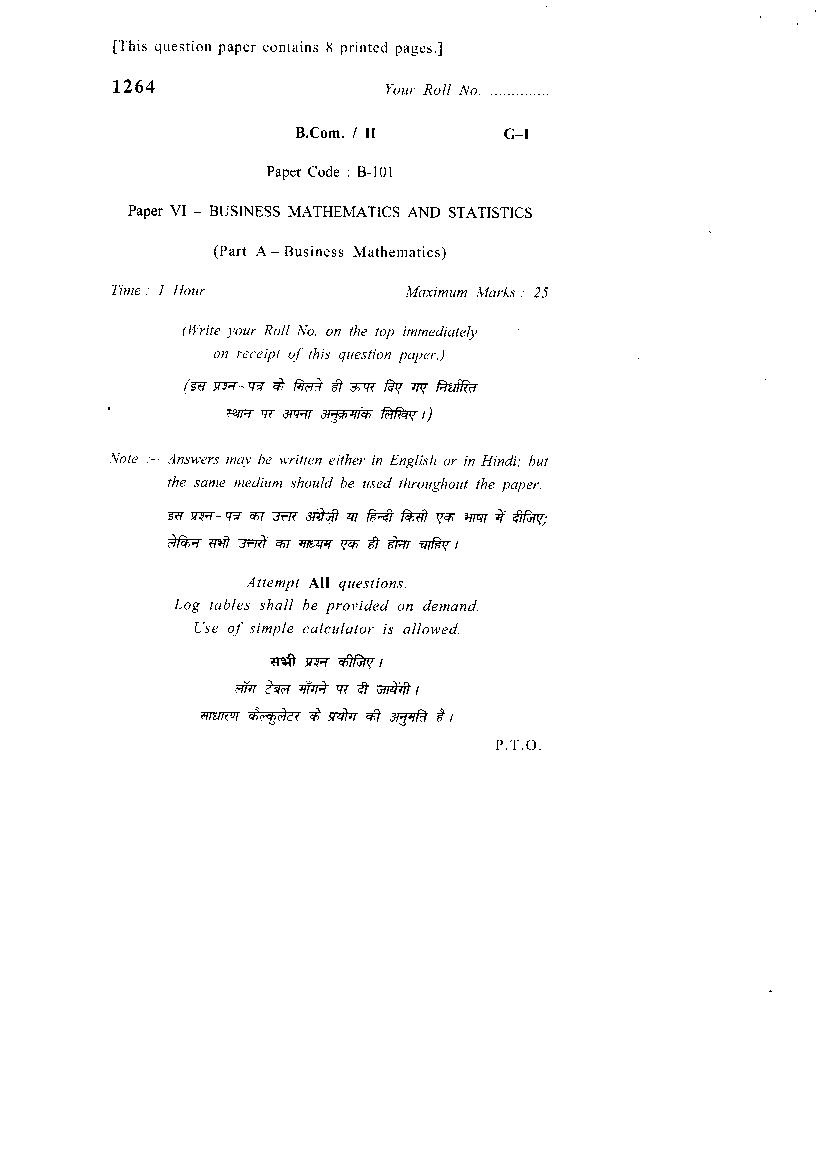
1264 Your Rott No. ..............
B.Com. / II G_I
Paper Code : B-l0l
PApeT VI - BUSINESS MATHEMATICS AND STATISTICS
(Part A-Business Mathematics)
Time: I Hour Maximum Marks : 25
(IVrite your Roll |ttro. on the top immediately
on receipt of this question paper.)
(w vzq-w + ffi A a-sr Ag trc furffu
etFr w 3rs4r wff4r6 fufuv r)
Note :- Answ,ers ma1, be w,ritten either in English or in Hindi; but
the same medium should be used throughout the pctper.
ffi ffi g'm ryqr i flfu;
tr€ Yw-w w -.rc "?lti-ffi qT
+/Ar aefi a.r0 *l TEwr y6 f +{r qEv r
.4ttenpt All questions.
Log tables shall be provided on demand.
L'se of simple calculator is allowed.
qS rr+ +?r?r, r
drhdffiwfrar1'fit
drzrrcaT 4+€rfu" + yd.T d a3'vr? * I
Page 2
l. The following matrtx grves the number
of units of three
hour on
products (P,, P, and Pr) that can be processed Per
three machines (M,, M, and Mr)
M' M. M3
l-- t2;ln'
lt, 11 20lP,
I t, 18 t4l
P,
many units of each
Determine by using matrix algebra' how
on machines
product can be produced, if the hours available
Mi, M2 and M, are 54, 46 and 48 respectively'
OR
Rs' 45000
A firm owns two machines M, and Mt costing
and Rs. 30000. Both machines have
five year lives with a
scrap value NIL. Calculate depreciation
of each machine
for each year using matrix notations when -
(i) Both are depreciated by Sum of the years digit method
(ii) Both bY Straight Line Method.
(iii) If first machine is depreciated bY sum of the Years
digit method and second bY straight fine method'
(7)
Page 3
ffiR{d *Fw c-{ fr{ 3-nrd (P,,p, fr r,) m $-d qr
ri€qr +fr e frTfir trT qrt+ (M,, M, c*r tut.) qt yR q-cr c-s-qqr
fr-qr vr vq-f,r *,
Ml M2 M3
tll ro- t2 ril n
I13 ll 20 lP,
I'Lr6 18 r4l B
+fffi ftrrrFre qT c+rr qr'+ ftfRil mRq fr r+fi ysrs fr
ffi 1[d +1 iqR frqr -II RtF-flI * uR M,, M, tr tyt, rfi-if-
qr Bqcrer q,q q<* + Era firr{r: s4. ao *t as * r
Srqert
T*. s-{ + RrR-€ n A qfr+ M, fr M2 + ffi drqd 4s000
irtr soooo r. * r *fr rrfi*- or fi-+++ro s eS * *t c+*.r dc
g
{i{T {3 , v$q. qfr+ +r cfr sd {s-qir€ e'r, tffi qr r*rr
q-.+ qRmr{ frFqg ws:
(i) ffi qr Ts qim ssJ + sr+] m ds frh ara frqr qnr
BI
(ii) ffi qr ftft tisr frfu + frqr vror * r
(iii) zrR' Tnfr ryftt or ssT + rd m d9 fr'h em {€ {rrt
iFTriIr \'fiifl * Bfu qst 6T ftft trsr ftb tr
Page 4
1264
glven
a particular product is
2. (a) The total cost in rupees for
by
x represents the
fC(x)=xi - 2lx2 +360x+3025' where
Determine
number of units produced'
unit'
(i) The marginal cost of the tenth
the marginal cost is
(ii) The uumber of units for which
minimum'
(iii) The minimum marginal cost'
cost for the number of units
Tl-re total cost and average
which minimizes the marginal cost'
OR
For the demand function
x=(u/p)-b ' verify that its
: R/(an-MR)'
price elasticity of demand
(b) A firm's price function
is P = 50iJX with the average
cost function AC(X)
: 0.50 + 1000/x. Find the price
and quantity where its
profit is maximum' Also find
maximised Profit'
OR
an item consists of Rs'
1000
The cost of manufacturing
Rs' 2 per unit and the labour
as overheads, material costs
Page 5
costs Rs. x2l90 for x units produced. Find the level of
output where per unit cost is minimum and the minimized
per unit cost.
(c) The rnarginal revenue function of a product is MR(X)
: l4l(2x+3)'l - l. Find the corresponding total revenue
function and the demand function.
OR
The marginal cost function of a product is MC(X) = 4 *
2x * x2. Find the corresponding total and average cost
functions if total cost at zero level is Rs. 100.
(4,4,4)
(o.) v+. frfrq ysn * frrq dcd- n Ef, flrlrf, ssA vr< +ft i
rc(x)=x3 -21x2 +360x +3025, wd x gf,I-t m Er+
ffi {R.a fr vcqr 61 ffi( q-tar * r
fiutiur frRs:
(i) ETei {R-c fr fut errc
(ii) ttrA * vrqr, ftil-{+ frq fud errro q+cq *
(iii) q{dq fuo arro
$-d +t T{qr + frq E-d drrrd *t iilrn arrrf, d fu{
arrre e1 qft-fd q-rft t r
Page 6
STqAt
d-Ir q.-i1-{ x + ftq =(ulp)*b, wsrfra dfrq fr fq fr
fr{tr +q = an/(an-MR) r
(ts) go .n"'{ oT fiq6 q6a p = 50/jX erh 3ils-d n|rrkT sFFr
AC(X): 0.50 r 1000/X. eftq-d ft qrer e1 an Sfrq R(
rR FtTrT 3{Rrs-{q I r wq * sffisil mT 6} S mr
dfrq r
BT TGTT
vdfi snlr{T + ffiq fr errra i rooo t ;qFqq + {nfr-m
e ifu lrr{fr drrri z r. yfr $-c ath nc dm-+' x2l90 fun
qil rd x 1trd qt sn$ d r .rsre+ tn.i RR an dfrq
ftffi
vr cR thc mrm qa-ffi i 3{lr yR {trc orrro qfi-*-r fr
rr$dr
(.r) v.r 3l-+rfE w frin-o 11w€ rhFm z16 ?:
MR(X):l4t(2x+3)'l-l
Br-{6ff EiT {vr€E q-arr *t d-{r sRT nrr frfrq r
Page 7
Ydfi'YflrE 6r frqrfr drrrd E-f,{ T6 * MC(X) :4 -2x+ xz
u--ftt Ed *i 3ikt drirf, .h-d-+ ft} nrc dfrq uR qu
RR q{ Ed firlrd roo n * r
3. (a) A machine costing Rs. 80,000 would reduce to
Rs.20,000 in 8 years. Find the rate of yearly
depreciation, given that depreciation is calculated using
diminishing balance method.
OR
State the relationship between nominal and effective
rate of interest (i) If compounding is n times in a year;
(ii) If compounding is continous.
(b) How much should be invested at 6o/a p.a. so that after
4 years the amount will be Rs. 25000 when the interest
is compounded (i) quarterly; (ii) Semi-annually.
OR
A sum of money is invested at 20%o p.a. for two years.
It would yield Rs. 482 more if interest were payable
semi-annually instead of annually. Find the sum.
(3,3)
Page 8
(o) gfi qfi{ +1 orrro 80,000 r. d *h. qe -FT e qff i
20,000 t ra vn'fr r qr&6131 q11.q +1er am !frhq ssF'
frq rrqr i fr tq qftT 6r qFsfrr qrmcm fu Ffu o.r y*rr
q..*frcrqm*r
3Te[atT
sRR *{ yEnft qre tlr $ Tqrr q-dr{q cR (i) Tm-gE s{
i qn sR fr ur-fr + (ii) qffi-Ek 3TRBe w t fr qrfr
*r
(iE) 6% yR e{ R fr-o} r+ mr frisr +-rqr ilRq ilh qn ed
qrE q-F nRt zsooo t d qrqrft
uFr dlrtT fr qffi-gE (i) ffi
nq $ efu (ii) sri{rNo. sc + q;1 qrft t r
STelrIt
frffi ffir d a s{ + frq 20% yh s{ qt fiafrrc fr-qr
vrer * r gq+ aez n qr srEr*. frTrT yTRt *rn cR qra qrfo.
w i q tfi srffiq' nq i tq * r rRr an frfrq r
(40,000)
Document Details
| Board / Org | Default |
| Exam | DU SOL |
| Type | Question Paper |
| Pages | 8 |
| Updated | 15 Jul 2026 |