MBOSE Class 11 Question Paper 2023 for Economics
Finished viewing? Save it for later —
Download MBOSE Class 11 Question Paper 2023 for Economics (PDF · 5 pages)About MBOSE Class 11 Question Paper 2023 for Economics
MBOSE Class 11 Question Paper 2023 for Economics is available here for free download. Published by Meghalaya Board for Class 11, this question paper can be viewed online or downloaded as a PDF (5 pages). Candidates preparing for Class 11 can use MBOSE Class 11 Question Paper 2023 for Economics to understand the exam pattern, the type of questions asked, and the overall difficulty level.
Frequently Asked Questions
How can I download MBOSE Class 11 Question Paper 2023 for Economics?
Open this page and click the Download button to save MBOSE Class 11 Question Paper 2023 for Economics as a PDF. It is completely free on AglaSem Docs.
Is MBOSE Class 11 Question Paper 2023 for Economics free to download?
Yes. MBOSE Class 11 Question Paper 2023 for Economics can be viewed online and downloaded as a PDF free of cost on AglaSem Docs.
How many pages does MBOSE Class 11 Question Paper 2023 for Economics have?
MBOSE Class 11 Question Paper 2023 for Economics contains 5 pages, which you can read online or download together as a single PDF.
Where can I find more Class 11 study material?
You can find more Class 11 question papers, sample papers, syllabus, and answer keys on AglaSem Docs.
MBOSE Class 11 Question Paper 2023 for Economics – Text
Read the full text of this question paper below — useful to quickly search, copy and reference the content online without downloading the PDF.
📄 View text version (5 pages)
Page 1
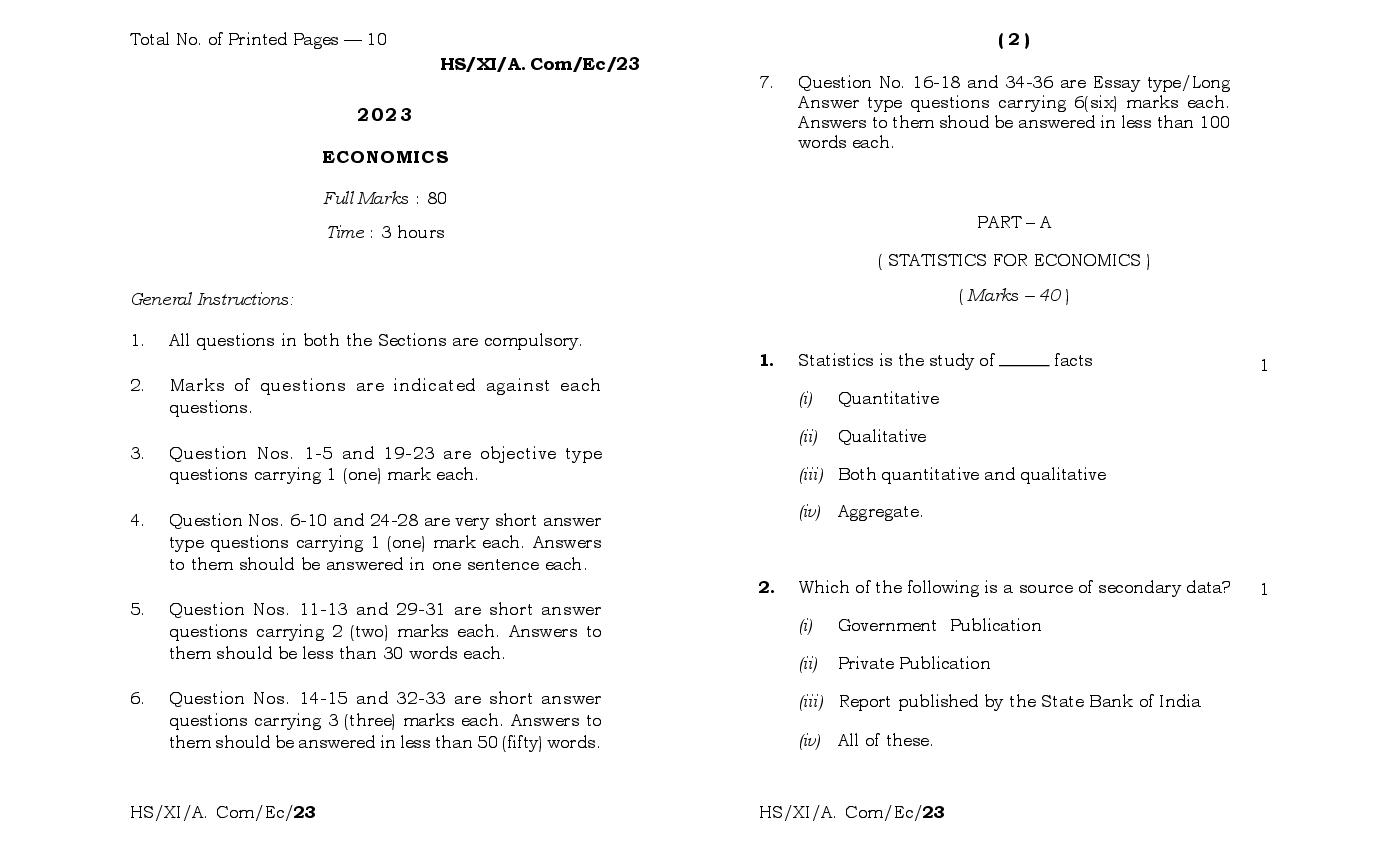
HS/XI/A. Com/Ec/23
7. Question No. 16-18 and 34-36 are Essay type/Long
Answer type questions carrying 6(six) marks each.
2023 Answers to them shoud be answered in less than 100
words each.
ECONOMICS
Full Marks : 80
PART – A
Time : 3 hours
( STATISTICS FOR ECONOMICS )
General Instructions: ( Marks – 40 )
1. All questions in both the Sections are compulsory.
1. Statistics is the study of facts 1
2. Marks of questions are indicated against each
(i) Quantitative
questions.
(ii) Qualitative
3. Question Nos. 1-5 and 19-23 are objective type
questions carrying 1 (one) mark each. (iii) Both quantitative and qualitative
(iv) Aggregate.
4. Question Nos. 6-10 and 24-28 are very short answer
type questions carrying 1 (one) mark each. Answers
to them should be answered in one sentence each.
2. Which of the following is a source of secondary data? 1
5. Question Nos. 11-13 and 29-31 are short answer
questions carrying 2 (two) marks each. Answers to (i) Government Publication
them should be less than 30 words each.
(ii) Private Publication
6. Question Nos. 14-15 and 32-33 are short answer (iii) Report published by the State Bank of India
questions carrying 3 (three) marks each. Answers to
them should be answered in less than 50 (fifty) words. (iv) All of these.
HS/XI/A. Com/Ec/23 HS/XI/A. Com/Ec/23
Page 2
3. Which of the following is a correct expression of 6. What are the two main sources of data? 1
arithmetic Mean for discrete series. 1
X 7. What is Economics? 1
(i)
f
fX
(ii) 8. Mention two uses of Statistics in Economics. 1
f
fm
(iii) 9. Why is ogive curve also called cumulative frequency
f curve? 1
(iv) fX. f OR
What is a questionaire?
4. Consumer price index is also known as 1
(i) Industrial Production Index 10. What is an index number? 1
(ii) Cost of Living Index
(iii) Wholesale Price Index 11. Distinguish between sample and census methods. 2
(iv) None of these.
12. Mention the four kinds of classification used in
tabulation. 2
OR
5. The range of simple correlation Coefficient is: 1
(i) O to infinity What are the merits of primary data? 2
(ii) –1 and 1
13. What are the different methods of finding correlation? 2
(iii) Minus infinity to infinity
(iv) None of these. 14. What are the uses of wholesale price index? 3
HS/XI/A. Com/Ec/23 HS/XI/A. Com/Ec/23
Page 3
15. Give the merits and demerits of Spearman’s Rank 17. Calculate arithmetic mean using Step-Deviation
Correlation Method. 3 Method from the following table. 6
OR Marks : 0-10 10-20 20-30 30-40 40-50
No. of Students: 20 24 40 36 20
Explain the relationship between Mean, Median and
Mode. 3
18. Construct index number of Industrial production from
the following data: 6
16. Construct a ‘less than’ and ‘more than’ Ogive from
the following frequency distribution of marks: OUTPUT
6
Industry Base Current Weights Units
Marks : 0-20 20-40 40-60 60-80 80-100 year year
Manufacturing Mill
No. of Students : 6 5 33 14 6 122 300 85
Production Tonnes
Electrical Th.
OR 203 400 5
Product Tonnes
Mining Mill
The following table shows the estimated sectoral real 65 87 10
Tonnes
growth rates (percentage change over the previous
year) in GDP at factor cost. 6
Year Agriculture and Industry Services
allied sectors PART – B
1994-95 5.0 9.2 7.0 ( INTRODUCTORY MICROECONOMICS )
1995-96 –0.9 11.8 10.3
( Marks – 40 )
1996-97 9.6 6.0 7.1
1997-98 –1.9 5.9 9.0 19. A statement which does not offer any suggestion is
1998-99 7.2 4.0 8.3 known as: 1
1999-2000 0.8 6.9 8.2 (i) Positive statement
Represent the data as multiple time series graphs. (ii) Normative statement
HS/XI/A. Com/Ec/23 HS/XI/A. Com/Ec/23
Page 4
(iii) Both (i) and (ii) 22. If TVC is 100 and TFC is 350, what will be the value
of TC ? 1
(iv) None of these.
(i) 380
(ii) 400
20. When total utility is maximum, marginal utility (iii) 450
becomes: 1
(iv) 550.
(i) Zero
(ii) Unity 23. Price ceiling means fixing price ______ the equilibrium
price. 1
(iii) Positive (i) Equal to
(iv) Negative. (ii) Above
(iii) Below
(iv) None of these.
21. The demand function of a good X is given as :
Dx = 10 – 2Px . The demand at price of 4 will be: 1
24. What is an economy? 1
(i) 6
(ii) 2
25. Define Production function. 1
(iii) 10
26. Mention any two factors affecting price elasticity of
(iv) 4
demand. 1
HS/XI/A. Com/Ec/23 HS/XI/A. Com/Ec/23
Page 5
27. When is a procducer said to be in equilibrium? 1 What is total cost? Represent the relationship between
TVC and TFC by means of a diagram. 1+1+1=3
28. Represent increase in supply by means of a diagram. 1
33. Explain any three features of perfect competition. 3
OR
What is meant by decrease in supply? 1 34. Explain the measurement of Price elasticity of demad
with the help of total expenditure method. 6
29. Mention any two properties of production possibility
curve (PPC). 2 35. Explain the properties of indifference curve. 6
OR
30. Explain the relationship between Marginal revenue
and Total revenue. 2 Explain how a consumer attains equilibrium in the
case of one commodity. 6
OR
Find MU from the following schedule : 2
36. State and explain the law of supply with the help of a
Quantity 1 2 3 4 5 6 7
(Consumed) hypothetical schedule and diagram. 6
TU (Utils) 10 16 19 21 22 22 20
31. Why is a seller under Perfect Competition called price
taker? 2
32. Explain the relationship between average product and
marginal product. 3
OR
HS/XI/A. Com/Ec/23 HS/XI/A. Com/Ec/23
Document Details
| Board / Org | Meghalaya Board |
| Exam | Class 11 |
| Type | Question Paper |
| Pages | 5 |
| Updated | 22 Jul 2026 |