AP DEECET 2020 Question Paper Physical Science (Telugu)
Finished viewing? Save it for later —
Download AP DEECET 2020 Question Paper Physical Science (Telugu) (PDF · 48 pages)About AP DEECET 2020 Question Paper Physical Science (Telugu)
AP DEECET 2020 Question Paper Physical Science (Telugu) is available here for free download. Published by APSCHE for Andhra Pradesh Diploma in Elementary Education Common Entrance Test, this question paper can be viewed online or downloaded as a PDF (48 pages). Candidates preparing for Andhra Pradesh Diploma in Elementary Education Common Entrance Test can use AP DEECET 2020 Question Paper Physical Science (Telugu) to understand the exam pattern, the type of questions asked, and the overall difficulty level.
Frequently Asked Questions
How can I download AP DEECET 2020 Question Paper Physical Science (Telugu)?
Open this page and click the Download button to save AP DEECET 2020 Question Paper Physical Science (Telugu) as a PDF. It is completely free on AglaSem Docs.
Is AP DEECET 2020 Question Paper Physical Science (Telugu) free to download?
Yes. AP DEECET 2020 Question Paper Physical Science (Telugu) can be viewed online and downloaded as a PDF free of cost on AglaSem Docs.
How many pages does AP DEECET 2020 Question Paper Physical Science (Telugu) have?
AP DEECET 2020 Question Paper Physical Science (Telugu) contains 48 pages, which you can read online or download together as a single PDF.
Where can I find more Andhra Pradesh Diploma in Elementary Education Common Entrance Test study material?
You can find more Andhra Pradesh Diploma in Elementary Education Common Entrance Test question papers, sample papers, syllabus, and answer keys on AglaSem Docs.
AP DEECET 2020 Question Paper Physical Science (Telugu) – Text
Read the full text of this question paper below — useful to quickly search, copy and reference the content online without downloading the PDF.
📄 View text version (48 pages)
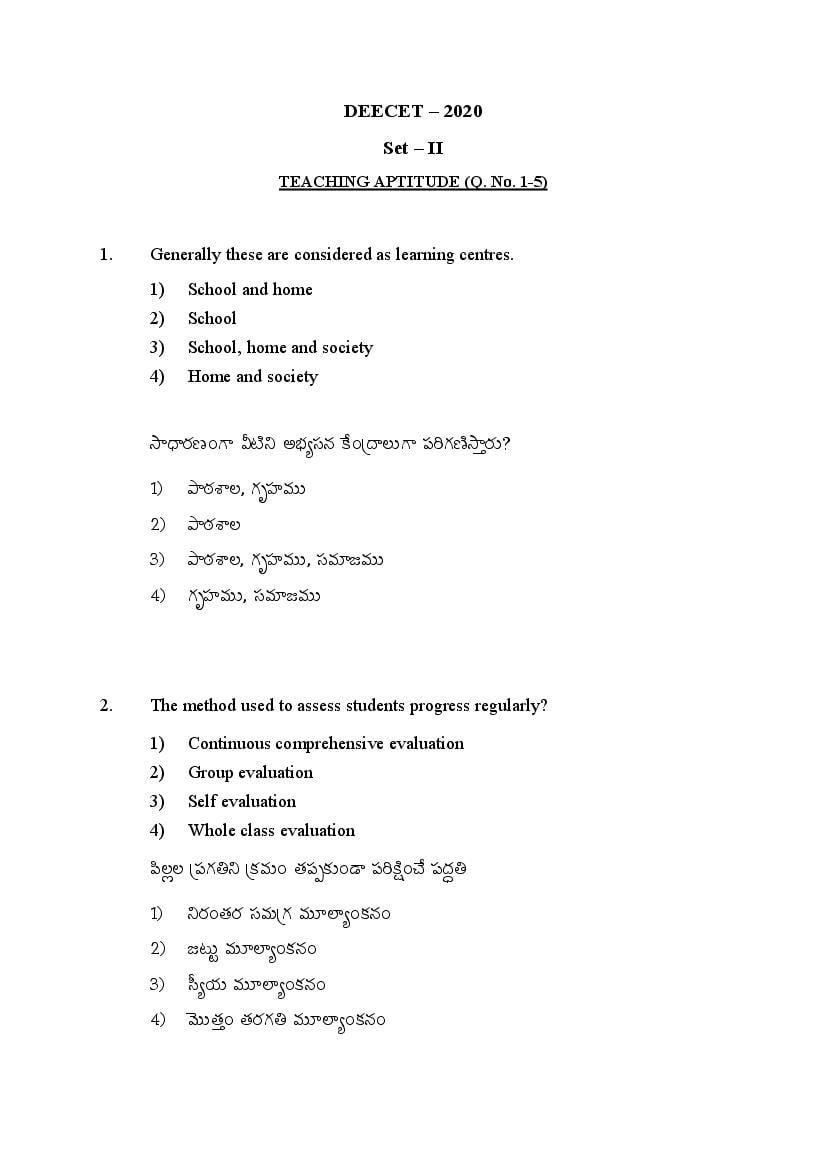
Page 1
Set – II
TEACHING APTITUDE (Q. No. 1-5)
1. Generally these are considered as learning centres.
1) School and home
2) School
3) School, home and society
4) Home and society
kÍ<ósÁD+>± M{ì nuó« dq ¿¹ +ç<\T>± |]>·Dkì ÍïsTÁ ?
1) bÍsÄXÁ æ\, >·V²eTT
2) bÍsÄÁXæ\
3) bÍsÄÁXæ\, >·V²eTT, deÖÈeTT
4) >·V²eTT, deÖÈeTT
2. The method used to assess students progress regularly?
1) Continuous comprehensive evaluation
2) Group evaluation
3) Self evaluation
4) Whole class evaluation
|¾\\¢ ç|>Ü
· ç¿£eT+ Ôá|Πţ+& |]¿ì+ #û |<Ü
Æ
1) sÁ+ÔásÁ deTç>· eTÖý²«+¿£q+
2) ȳT¼ eTÖý²«+¿£q+
3) dÓ«jáT eTÖý²«+¿£q+
4) yîTTÔá+ï Ôás>Á Ü
· eTÖý²«+¿£q+
Page 2
than in the classroom through
1) Internet and mass media
2) Television and movies
3) Whats APP and You Tube
4) Computer and C.Ds
sÃE\ýË $<«sÁT\Æ Å£ Ôás>Á Ü
· ýË ¿£+fñ Ôás>Á Ü
·
jáT³ M{ì <Çs HûsÁTÌ¿Ãe&¿ì mHÃ ne¿±Xæ\T
HsTT.
1) n+Ôás¨\+, ç|kÍsÁeÖ<ó« eÖ\T
2) fÉ*$ÈH, #á\qºçÔ\T/d¾eÖ\T
3) y³à|t, jáTT³Ö«uÙ
4) ¿£+|P«³sY, d¾&\ T
4. The teacher has to encourage the bright students of the class by preparing them
for
1) Final examinations
2) Sports meet
3) Cultural competitions
4) Competitive tests
Ôás>Á Ü
· ýË ç|Üuó >·\ $<«sÁT\Æ qT çbþÔáàV¾²+#áT³Å£
bÍ<ó«jáTT&T y] M{ì ¿Ãd+ d¾<|Æ s #Á *
1) n+Ôá« |¯¿£\Å£
2) ç¿¡& bþ{¡\Å£
3) kÍ+dØÜ¿£ bþ{¡\Å£
4) bþ{¡ |¯¿£\Å£
Page 3
1) Test items
2) Curricular areas
3) Co-curricular areas
4) Play items
bÍsÄXÁ æ\ýË Hûs¹ Î ³\T, bͳ\T, u¤eT\T ^jáT&+ yîTT<ýqÕÉ $ $uó²>·+
¿ì+~¿ì ekÍïsTT.
1) |¯¿±+Xæ\T
2) bÍsÄ«+Xæ\T
3) dV²bÍsÄ«+Xæ\T
4) ç¿¡&+Xæ\T
Page 4
6. Indian National Flag was designed by
1) Duggirala Gopalakrishnaiah
2) Paidamarri Venkata Subbarao
3) Pingali Venkayya
4) Damerla Ramarao
uó²sÁÔá C²rjáT |Ô¿£ sÁÖ|¿s£ ïÁ
1) <TÐZs\ >ÃbÍ\¿£wjáT«
2) |Õ&eTç] yî+¿£³dTu²ÒseÚ
3) |¾+>·[ yî+¿£jáT«
4) <yîTsÁ¢ seÖseÚ
7. 2019 world badminton championship winner
1) P.V. Sindhu
2) Saina Nehwal
3) Karolina Marin
4) Deepa Karmakar
2019 ç||+ #á u²&+³H #+|¾jTá H w¾|t $CñÔá
1) |¾.$. d¾+<óT
2) dÕH HîVäÇýÙ
3) ¿£sÃ*H eÖ]H
4) BbÍ¿£s¿£sY
Page 5
1) Pune
2) Bengaluru
3) Hyderabad
4) Mumbai
+&jÖá ýË m\翱¼¿ù q>·s+Á >± |s= +~q q>·s+Á
1) |PDÉ
2) uÉ+>·TÞøSsY
3) VÕ²<su²<
4) eTT+sTT
9. Book written by Kodavatiganti Kutumbarao was
1) Chaduvu
2) Amrutham kurisina ratri
3) Maha Prastanam
4) Rajasekhara Charitram
¿= &e{ì >·+{ì Å£³T+seÚ sÁº+ºq |Úd¿ï +£
1) #á<T eÚ
2) neTÔá+ Å£]d¾q sçÜ
3) eTVäç|kÍÆq+
4) sÈXâKsÁ #á]çÔáeTT
Page 6
1) SHAR
2) ISRO
3) PSLV
4) SSRC
uó²sÁÔá n+Ôá]¿£ |]XË<óH d+dÆ qT ý² |¾\TkÍïsTÁ
1) SHAR
2) ISRO
3) PSLV
4) SSRC
Page 7
11. Ramaiah is a centenarian. His age is …………..
Choose the word / phrase to complete the sentence.
1. above hundred years
2. above one fifty years
3. below 50 years
4. below hundred years
12. Sujatha had arrived at the station …………….. the train came.
Choose the correct linker to complete the sentence.
1. after
2. before
3. but
4. whoever
13. Choose the compound sentence from the following.
1. She was unhappy or she was upset.
2. She was too unhappy to be upset.
3. If she was unhappy, she was upset.
4. She was unhappy when she was upset.
Page 8
1. hesitate
2. hesitated
3. hesitation
4. hesitates
15. The children liked him.
Choose the passive voice of the sentence above.
1. He likes the children.
2. He is liked by the children.
3. The children were liked by him.
4. He was liked by the children.
Page 9
16. ¿ì+~ y{ìýË d+jáTT¿±ï¿s£ +Á >·\ |< >·T]ï#+á &
1) eTç]
2) sÁ«
3) ¿±sÁ+
4) <T:K+
17. »»HûqT C²ÔásýÁ Ë mçsÁ >±E\T ¿=HqTµµ - y¿£«+ýË $XâwD
+
1) C²ÔásÁ
2) mçsÁ
3) >±E\T
4) ¿=HqT
18. »»dT$TçÔá V²Å£Ø\ ....................... eÖ{²¢&+ ~µµ - U²°ýË ds qÕ |< |P]+#á+&
1) >·T]+º
2) ýË
3) ýË|\
4) q+<T
19. »»¥ejáT« ç<bþÔáTH&Tµµ - y¿±«¿ì e«Ü¹s¿£ nsÁ+ #ûÌÛ y¿£«+
1) ¥ejáT« ç<bþÔ&T
2) ¥ejáT« ç<bþjáÖ&T
3) ¥ejáT« ç<bþe&+ ýñ<T
4) ¥ejáT« ç<bþ&T
Page 10
1) e
2) sÁ
3) q
4)
Page 11
21. »»Ôá$µµ - nsÁ+
1) Xø¯sÁ+
2) yûTqT
3) Ôá|¾ï
4) ÔÃ&T
22. »»¿£$çV², uój
Tá ¿£$ $TçÔáT&Tµµ nHû _sÁT<T\ >·\ ¿£$
1) <îÝq
2) d¾+>·q
3) qqjáT
4) Ü¿£Øq
23. »»Ð¯Xæµµ - |<¿ì >·TsÁT\|T TeÚ\qT >·T]ï+#á+&
1) UUU
2) IUU
3) UII
4) IIU
24. »»CËd|t ¹s|Ú $ÈjáTy& yîÞ²ï&Tµµ - y¿£«ýË ¿±\+
1) uó$w«ÔY ¿±\+
2) uóÖÔ῱\+
3) esÁïeÖq ¿±\+
4) Ôá<ÆósÁ ¿±\+
Page 12
1) MqT\ $+<T
2) #î$\T¢ ¿£³T¼¿=bþsÁT
3) #î${ìy eTT+<T Xø+KeTÖ~q³T¢
4) |&#î$q|³T¼
26. »»¿£qT|]ï \¿£ eTµµ >±] ¿£\+ |sÁT
1) \ý²¢ <û$
2) ©ý²eÜ
3) nÈ+Ô
4) mýË¢s
27. »»yûT~µµ - |<¿ì |s«jáT|<\T
1) uóÖ $T, n¿±Xø+
2) ¿±Xø+, n+sÁ+
3) uóÖ$T, eXø<ó
4) n+T<+, yûT|T +
28. »»dyîT®K«µµ - |< $&BjáT>± eºÌq sÁÖ|+
1) deTG@¿£
2) dyTî G® @¿£«
3) dyîT®G׿£«
4) deTG׿£«
Page 13
1) $<ÇH $XøÇ+
2) d¾. HsjáTDÂs&¦
3) seP] uósÁ<ÇÈ
4) |Ú*¿£+{ì ¿£cÍs &¦
30. »»ncͼ<Xø Xø¿ìï |ÓsÄ\Tµµ - deÖd |<¿ì $ç>·V² y¿£«+
1) m$T~ d+K« >·\ Xø¿ïì |ÓsÄ \T
2) mquóÕÉ d+K« >·\ Xø¿ïì |ÓsÄ\T
3) |<Ýî $T~ d+K«>·\ Xø¿ïì |ÓsÄ \T
4) qÖ³ m$T~ d+K« >·\ Xø¿ïì |ÓsÄ \T
Page 14
31. Which of the following is irrational
1)
√
2)
√
3) √81
4) √11
¿ì+~ yýË ¿£sÁD¡jáT d+K«
1)
√
2)
√
3) √81
4) √11
32. The degree of the polynomial (x3+8) (5-x2) is
1) 2
2) 3
3) 5
4) 6
(x3+8) (5-x2) VQ|~ |]eÖD+
1) 2
2) 3
3) 5
4) 6
Page 15
then the area of the triangle is (in sq.cm)
1) 30
2) 32.5
3) 60
4) 65
ÿ¿£ çÜuóT È+ jîTT¿£Ø s +&T uóT C²\T 5 d+.MT eT]jáTT 13 d+.MT eT]jáTT <
#áT³T¼¿=\Ôá 30 d+.MT nsTTq çÜuóT È yîXÕ æ\«+ (#áööd+.MT ýË)
1) 30
2) 32.5
3) 60
4) 65
34. The height of a cone whose diameter 10 cm and slant height 13 cm is
(in cm)
1) 12
2) 13
3) √69
4) √194
uóÖ y«d+ 10d+.MT eT]jáTT @³y\T mÔáTï 13 d+.MT >·\ Xø+KTeÚ mÔáTï
(d+.MT ýË)
1) 12
2) 13
3) √69
4) √194
Page 16
ration 3:7:6:4 then ABCD is
1) rhombus
2) parallelogram
3) trapezium
4) kite
ÿ¿£ #áÔTá sÁTÒÛÈ+ýË ç¿£eT+ýË rdT¿= q ¿ÃD²\T A, B, C eT]jáTT D \ wÎÜï
3:7:6:4 nsTTq ABCD #áÔTá sÁTÒÛÈeTT ÿ¿£
1) deT#áÔTá sÁTÒÛÈ+
2) deÖ+ÔásÁ #áÔáTsÁTÒÛÈ+
3) deT\+ #áÔTá sÁTÒÛÈ+
4) >±*|³+
36. The mean of five numbers is 30 if one number is excluded, their mean
becomes 28 then the excluded number is
1) 28
2) 30
3) 35
4) 38
×<T d+K«\ n+¿£ eT<ó« eTeTT 30. n+<TýË ÿ¿£ d+K«qT $TqVäsTT+#á>± $TÐ*q
d+K«\ n+¿£eT<ó« eT+ 28 nsTTq $TqVäsTT+ºq d+K«
1) 28
2) 30
3) 35
4) 38
Page 17
1) -2 3
2) 2
3) 4
4) 4- √3
x = 2 + √3 nsTTq x + $\Te
1) -2 3
2) 2
3) 4
4) 4- √3
38. If sinθ – cosθ = 0 then the value of sin4θ + cos4 θ is
A)
B)
C)
D) 1
If sinθ – cosθ = 0 nsTTq sin4θ + cos4 θ $\Te
A)
B)
C)
D) 1
Page 18
discount percentage is
1) 4%
2) 5%
3) 10%
4) 95%
ÿ¿£ edTeï Ú ç|¿{
£ Ô
ì á yî\ sÁÖ.80 eT]jáTT < n$Tq yî\ sÁÖ. 76 nsTTq sÁTdTeTT
XæÔá+
1) 4%
2) 5%
3) 10%
4) 95%
40. The lengths of the diagonals of a rhombus are 16cm and 12cm then the
length of the side of the rhombus is (in cm)
1) 8
2) 9
3) 10
4) 20
s+dt jîTT¿£Ø ¿£s\T 16 d+.MT eT]jáTT 12 d+.MT nsTTq < uóT È+
(d+.MT\ ýË)
1) 8
2) 9
3) 10
4) 20
Page 19
41. Natural magnet is
1) bar magnet
2) lode stone
3) disc magnet
4) ring magnet
~ dV² È njáTkÍØ+Ôá+
1) u²sY eÖ>·{Ù
2) ýË& kþ¼H
3) &dtØ eÖ>·{Ù
4) ]+>´ eÖ>·{Ù
42. It is a fixed joint
1) upper jaw
2) lower jaw
3) neck
4) knee
~ ¿£<\ ¿¡\T
1) |Õ <e&
2) ¿ì+~ <e&
3) yîT&
4) yîÖ¿±\T
Page 20
1) 0ºC
2) 98ºC
3) 100ºC
4) 10ºC
ú{ì uó²wÓÎuóeq cþç>·Ôá
1) 0ºC
2) 98ºC
3) 100ºC
4) 10ºC
44. Which is correct
a. Potato : New plants grow from eyes in the tuber
b. Sugarcane : Stem grows roots at the nodes
1) a only
2) b only
3) a and b
4) None of these
@~ ds qÕ ~
a. +>±Þø<T +| : <T+||Õ ¿£qT\ uó²>±\ qT+& ¿=Ôáï yîTT¿£Ø\T ekÍïsTT
b. #îsÅÁ £ : ¿±+&+ ¿£DT|Ú\ qT+& ¿=Ôáy
ï Tî T¿£Ø\T ekÍïsTT
1) a eÖçÔáyTû
2) b eÖçÔáyTû
3) a eT]jáTT b
4) |Õ yûM¿±<T
Page 21
1) from 5.5 to 7.5
2) below pH 7
3) above pH 7
4) No pH
eT+º dÇuó²e+ >·\ Hû\ pH
1) 5.5 qT& 7.5 esÁÅ£
2) pH 7 ¿£H ÔáÅ£Øe
3) pH 7 ¿£H mÅ£Øe
4) pH +&<T
46. Father of white revolution
1) J.K. Kurion
2) Edward Jenner
3) Alexandar Flemming
4) Jonas salk
XâÇÔá$|e¢ |¾ÔeTVQ&T
1) J.K. Å£]jáTH
2) m&ÇsY¦ CÉqsY
3) nýÉ>±¨+&sY |$¢ T+>´
4) CËHdt kÍ¿ù
Page 22
1) ovule
2) Synergids
3) anti podals
4) male gamete nuclei
|s>· HÞø+ýË ¿£D²\T
1) n+&+
2) dVä jáT ¿£D²\T
3) ç|ÜbÍ<¿£ ¿£D²\T
4) |ÚsÁTw;È ¿¹ +ç<¿±\T
48. Water passing down through the soil particles is called
1) percolation
2) crystallization
3) distillation
4) sublimation
úsÁT eT{ì¼ nDTeÚ\ >·T+& ç|jáÖDì+º ¿ì+~¿ì #ûsÁ&
1) |s= ØýñwH
2) ç¿ìd¼ýÉÕCñwH
3) &d¾¼ýñwH
4) d_¢yûTwH
Page 23
Producer in food chain is
1) fox
2) carrot
3) rabbit
4) none of these
¿±«Âs{Ù g Å£+<û\T g q¿£Ø
VäsÁ|Ú >=\TdTýË ÔáÎÜï <sÁT
1) q¿£Ø
2) ¿±«sÁ{Ù
3) Å£+<û\T
4) |Õy$û ¿±<T
50. Example of Dicotyledons
1) maize
2) paddy
3) finger millets
4) groundnut
~Ç<Þø ;C²\Å£ <V²sÁD
1) C¤q
2) e]
3) s>·T\T
4) yûsÁTXøq>·
Page 24
51. Kautilya wrote the famous book Ardhasastra, it explains about
1) how to conquer and rule kingdoms
2) how to read inscriptions
3) how to learn Sanskrit
4) how to perform rituals
¿{ì\T«&T sÁº+ºq nsÁX æd+ï nHû ç|d~¾ Ý #î+~q |Úd¿ï +£ B >·T]+º $e]dT+ï ~
1) sC²«\qT ÈsTT+#áT³ eT]jáTT |]bÍ*+#áT³
2) XædH\qT #á<e &+
3) d+dØÔá+ HûsTÁ Ì¿=qT³
4) ¿£sÁ ¿±+&\T sÁÇV¾²+#áT³
52. A 12th century book in Tamil, describes the religious practices of
hunter-gatherers living near Sri Kalahasti. The name of the book is
1) Shilappadikaram
2) Periyapuranam
3) Sivapuranam
4) Mani Mekhalai
12e XøÔu²Ý¿ì #î+~q ÿ¿£ Ôá$TÞø |Úd¿ï +£ , l¿±ÞøV² d¾¿ï ì dMT|+ýË ed¾dT qï yû³
d¿£sD
Á <sÁT\ eTÔá $XæÇkÍ\qT >·T]+º $e]dT+ï ~. < |sÁT
1) ¥\bÍÎ~¿±sÁ+
2) |]jáT |ÚsD+
3) ¥e|ÚsD+
4) eTDìyTû KýÉÕ
Page 25
1) Eastern Ghats
2) Western Ghats
3) Indo Gangetic plains
4) Himalayas
¿£cÍ, >Ã<e] e+{ì q<T\T .......... qT+º çbÍsÁ+uóe TeÚÔsTT
1) ÔáÖsÁTÎ ¿£qTeT\T
2) |¥ÌeT ¿£qTeT\T
3) >·+>± - d¾+<óÖ yîT<® q+
4) V¾²eÖ\jáÖ\T
54. The invocation part of inscriptions, ‘Prashastis’ were composed by
1) ruling family
2) learned Brahmins
3) soldiers
4) religious priests
XædH\ýË yîTT<{ì uó²>±ýÉqÕ ç|Xdø ï¾ ......... sdysÁT
1) sÈÅ£³T+eTT
2) çu²V²D |+&ÔTá \T
3) dÕÅ£\T
4) eTÔá |<\Ý T
Page 26
and the South Pole. This line is called as
1) Longitude
2) orbit
3) Axis
4) hemisphere
uóÖ $T Ôásï Á <¿D
ì <ó y\ ¿£*| ÿ¿£ }VäÈÔá s¹ K MT< ÜsÁT>·TÔáT+~.
s¹ K ý² |¾\TkÍïeTT.
1) s¹ U²+XøeTT
2) ¿£¿«£
3) n¿£e TT
4) nsÁeÆ Ôáeï TT
56. The largest reserves of barytes mineral in the world, is available in
……..district of AP
1) Ananthapuram
2) Kurnool
3) Kadapa
4) Nellore
ç||+ #á+ýËHû nÜ mÅ£Øe uÉs {
Õ d¡ t \Ç\T +ç<óç |<Xû ýÙ Ë .........................ý²¢ýËHû
\uó« eTeÚÔáTHsTT
1) nq+Ôá|ÚsÁ+
2) ¿£sÁÖýÙ
3) ¿£&|
4) Hî\Ö¢sÁT
Page 27
Inland sea, named
1) Black sea
2) Tethys sea
3) Red sea
4) yellow sea
ý²ÂsüjTá eT]jáTT >= +&ÇH K+&\qT yûsTÁ #ûjTá T#áTq bõ&yqÕî , ýËÔîqÕ deTTç<eTT
1) q\¢ deTTç<eTT
2) fÉ~dó t deTTç<eTT
3) mçsÁ deTTç<eTT
4) |dT |Ú deTTç<eTT
58. Identify the ‘Third order landform’ from the following
1) Oceans
2) continents
3) valleys
4) plateaus
ç¿ì+~ yýË »»eTÖ&e çXâDì uóÖ dÇsÁÖ|+µµ >·T]ï+#á+&
1) eTVädeTTç<\T
2) K+&\T
3) ýËjáT\T
4) |ÓsuÁÄ Öó eTT\T
Page 28
1) Andhra Pradesh, Tamilnadu, Telangana
2) Andhra Pradesh, Karnataka, Telangana
3) Tamilanadu, Telangana
4) Karnataka, Telangana
ÔáT+>·uçó < qB Èý²\qT |+#áTÅ£+³Tq scͼ\T
1) +ç<óç |<Xû ,Ù Ôá$TÞøH&T, Ôî\+>±D²
2) +ç<óç |<Xû ,Ù ¿£s³¿£, Ôî\+>±D²
3) Ôá$TÞøH&T, Ôî\+>±D²
4) ¿£s³¿£, Ôî\+>±D²
60. Muslim league was formed in the year
1) 1906
2) 1927
3) 1920
4) 1909
eTTd¾+¢ ©>´ kÍ|+¾ #á&q d+eÔáàsÁ+
1) 1906
2) 1927
3) 1920
4) 1909
Page 29
PART- B
PHYSICS (Q. No. 61-80)
61. Neutron was discovered by
1) J. J. Thomson
2) James Chadwick
3) Niels Bohr
4) C. V. Raman
qÖ«ç{²HqT $wØ]+ºq~
1) CÉ. CÉ. <¸eTàH
2) CñyT à #&Ç¿ù
3) úýÙà uËsY
4) d¾. $. seTH
62. A vehicle travels half the distance L with speed V1 and the other half with speed
V2 . Its average speed is
1)
( )
2)
3)
( )
4)
ÿ¿£ yV²qeTT L <ÖsÁ+ýË d>± V1 e&ÔÃqT eT]jáTT eTsà d>+· <Ös V2
e&ÔÃqT ç|jÖá DìdT +ï ~. < dsd] e&
1)
( )
2)
3) ( )
4)
Page 30
The magnitude of their resultant
1) 24 units
2) 7 units
3) 25 units
4) 31 units
7 jáTÖ³T¢ eT]jáTT 24 jáTÖ³¢ |]eÖD²\T >·\ s +&T \+¿ÃD d~Xø\T d+jîÖ
>·+ #î+~q|ð&T y{ì |*Ôád~ Xø jîTT¿£Ø |]eÖD+
1) 24 jáTÖ³T¢
2) 7 jáTÖ³T¢
3) 25 jáTÖ³T¢
4) 31 jáTÖ³T¢
64. Change in linear momentum of a body due to force is equal to
1) Kientic energy
2) Accelration
3) Velocity
4) Impulse
\ ç|jîÖ>·+ e\q ÿ¿£ edTïeÚ ¹sFjáT ç<e« yû>·+ýË eÖsÁTÎ B¿ì deÖq+
1) >·ÜXø¿ïì
2) ÔáÇsÁD+
3) yû>·+
4) ç|#Ã<q+
Page 31
period is
1) 0.08 sec
2) 0.8 sec
3) 8 sec
4) 80 sec
eÖqeÚ V²<jTá + $TcÍ¿ì dsd] 75 kÍsÁT¢ ¿= ³T¼¿= +³T< >·eT+#á&y Tî q® ~.
< esÁqï ¿±\+
1) 0.08 sec
2) 0.8 sec
3) 8 sec
4) 80 sec
66. Time period of revolution of a geostationary satellite is
1) 12 hours
2) 24 hours
3) 24 minutes
4) 12 minutes
uóÖ kÍesÁ |ç>·V² + jîTT¿£Ø ¿£¿«£ esÁqï ¿±\+
1) 12 hours
2) 24 hours
3) 24 minutes
4) 12 minutes
Page 32
1) Archimedes Principle
2) Bernoulli’s Principle
3) Torricelli’s Principle
4) Pascal’s Law
VÕ²ç&*¿ù *|¼t eT]jáTT VÕ²ç&*¿ù çuñÅ£ \T ç¿ì+~ dÖçÔá+ |Õ <ósÁ|& T ÔsTT
1) ]ØyîT&dt dÖçÔá+
2) uÉsÁÖ© dÖçÔá+
3) {²]d©¢ jáTeT+
4) bÍdØýÙ jáTeT+
68. Medium need not require in which of modes of heat transfer
1) Radiation
2) Conduction
3) Convection
4) None of the above
@ w¢ ç|kÍsÁ |<Ô
Æ Tá \ýË jáÖq¿£+ neds+Á ýñ<T
1) $¿ìsDÁ +
2) eV²q+
3) d+eV²q+
4) |Õ yû$ ¿±eÚ
Page 33
cold because
1) Isothermal expansions
2) Adiabatic expansion
3) Isothermal compression
4) Adiabatic compression
yûd$ ¿±\+ýË dÕ¿ýì Ù ³Ö«uÙ jîTT¿£Ø y\TÇqT ÔîsºÁ q|ð&T jáT³¿ì e#ûÌ >±* #á\>¢ ±
n|¾dT +ï ~. m+<T¿£+fñ
1) deT cþç>·Ô y«¿Ã#á+
2) d¾s Ãw¿ £ y«¿Ã#á+
3) deT cþç>·Ô d+¿Ã#á+
4) d¾s Ãw¿ £ d+¿Ã#á+
70. A real gas behaves like an ideal gas under which situations:
1) Low pressure and low temperature
2) High pressure and high temperature
3) High pressure and low temperature
4) Low pressure and high temperature
@ |]d¾Ô
Tá ýË¢ ÈyjáTTeÚ <sôÁ yjáTTeÚ\ ç|e]ïdT +ï ~
1) n\Î|Ó&q eTT eT]jáTT n\Î cþç>·Ôá
2) n~ó¿|£ &Ó q eTT eT]jáTT n~ó¿£ cþç>·Ôá
3) n~ó¿|£ &Ó q eTT eT]jáTT n\Î cþç>·Ôá
4) n\Î|Ó&q eTT eT]jáTT n~ó¿£ cþç>·Ôá
Page 34
harmonics ratio is
1) 1 : 1 : 1 …..
2) 2 : 3 : 4 …..
3) 1 : 2 : 3 …..
4) 1 : 3 : 5 …..
s +&Ö yîÕ|Ú \ ÔîsºÁ jáTTq jîTT¿£Ø >= ³¼+ýË >±*d+ï uó² ¿£+|¾+|Cñdq¾ |ð&T @sÁÎ&û
nqTdÇs\ wÎÜï
1) 1 : 1 : 1 …..
2) 2 : 3 : 4 …..
3) 1 : 2 : 3 …..
4) 1 : 3 : 5 …..
72. Current per unit area is
1) Electric flux
2) Current density
3) Electric potential
4) Electric power
@¿±+¿£ yîXÕ æý²«¿ì $<T«ÔY ç|yV²+ B¿ì deÖq+
1) $<T«ÔY n_óyV²+
2) $<T«ÔY kÍ+ç<óÔá
3) $<T«ÔY bõfÉüjáTýÙ
4) $<T«ÔY kÍeTsÁÆ«+
Page 35
speed of light (c) in vacuum is
1) C=
µ ∈
2) C= µ ∈
µ
3) C=
∈
µ
4) C=
∈
Û sá Þø+ jîTT¿£Ø ç|yXû ø o\«Ôá µ0 eT]jáTT |]{ì${ì ∈0
dÇ#ÌÛ+Ô
nsTTÔû XøSq«+ýË ¿±+Ü yû>·+ (c) B¿ì deÖq+
1) C=
µ ∈
2) C= µ ∈
µ
3) C=
∈
µ
4) C=
∈
74. Net magnetic moment per unit volume is called
1) Magnetic susceptibility
2) Magnetic field strength
3) Magnetic permeability
4) Magnetization
@¿±+¿£ |T q|]eÖD²¿ì |* Ôá njáTkÍØ+Ôá çuó²eT¿£+
1) njáTkÍØ+Ôá dd|_¼ *{ì
2) njáTkÍØ+Ôá ¿¹ ç Ôá rçeÔá
3) njáTkÍØ+Ôá ç|yûXøo\«Ôá
4) njáTkÍØ+r¿£sD Á +
Page 36
becomes
1) Gravitational energy
2) Electric energy
3) Light energy
4) Sound energy
@¿£¯Ü njáTkÍØ+Ôá ¿¹ ç Ôá+ýË ÿ¿£ yV²¿± ¿£~*Ìq|ð&T < jáÖ+çÜ¿£X¿ø ïì ý²
eÖsÁTÔáT+~
1) >·TsÁTÔÇ¿£sÁüD Xø¿ìï
2) $<T«ÔY Xø¿ìï
3) ¿±+Ü Xø¿ïì
4) <óÇ Xø¿ïì
76. Working of induction stove is base on
1) Joule’s Law
2) Gauss’s Law
3) Law of electromagnetic induction
4) Coulomb’s Law
+&¿H£ dy¼ |#ûd $<óq+ <ósÁ|& T q~
1) C ýÙ jáTeT+
2) >±dt jáTeT+
3) $<T«<jTá kÍØ+Ôá ç|sÁD jáTeT+
4) Å£\T+uÙ jáTeT+
Page 37
photon is
1) Equal to its initial value
2) Doubled
3) Does not change
4) Reduces to half of its initial value
$<T«<jTá kÍØ+Ôá $¿ìsD
Á + jîTT¿£Ø Ôás+Á >·<sÕî éÁ «+ s {ì+¼ |Ú nsTTÔû bþ{²H Xø¿ïì
1) < Ô=*$\TeÅ£ deÖq+
2) s +&T s ³¢eÚÔáT+~
3) eÖsÁ<T
4) < Ô=*$\TeýË d>±¿ì Ôá>T· Ô
Z Tá +~
78. The concept of nucleus was introduced by
1) Niels Bohr
2) Ruther ford
3) J. J. Thomson
4) John Dalton
¿¹ +ç<¿+£ uó²eqqT ç|yXû ø|{ìq¼ ~
1) úýÙà uËsY
2) sÁÖ<ósY |sY¦
3) CÉ. CÉ. <¸eTàH
4) C²H &\¼H
Page 38
1) 1:1
2) 4:3
3) 3:4
4) 9:4
27 eT]jáTT 64 ç<e«s¥ d+K«\T >·\ ¿¹ +ç<¿±\ jîTT¿£Ø y«kÍs\ wÎÜï
1) 1:1
2) 4:3
3) 3:4
4) 9:4
80. The self inductance plays the roll of which physical quantity in linear motion
1) Inertia
2) Velocity
3) Acceleration
4) Displacement
dÇjáT+ ç|sÁD s¹ FjáT >·eTq+ýË @ uó Ü¿£s¥ bÍçÔáqT bþw¾dT +ï ~?
1) È&ÔáÇ+
2) yû>e· TT
3) ÔáÇsÁD+
4) kÍqçuó+Xø+
Page 39
PART- B
CHEMISTRY (Q. No. 81-100)
81. The C – C Bond length in diamond is
1) 154 pm
2) 134 pm
3) 120 pm
4) 142 pm
eçÈ+ýË C – C +<ó< sÕî éÁ «+
1) 154 pm
2) 134 pm
3) 120 pm
4) 142 pm
82. Covalent bond is formed by
1) Electron transfer
2) Electron sharing
3) Electron donation
4) Electron acceptance
deTjîÖÈújáT +<ó+ @sÁÎ&û $<óq+
1) m\¿±¼H ~© <Çs
2) m\¿±¼H |+#áT¿Ãe&+ <Çs
3) m\¿±¼H <q+ #ûjáTT³ <Çs
4) m\¿±¼H ç>·V¾²+#á³+ <Çs
Page 40
1) Avagadro Number
2) Number of moles
3) Number of gaseous atoms
4) Weight of gas
PV=nRT dMT¿£sD
Á +ýË ‘n’ nq>·
1) ne>±+ç&Ãd+K«
2) yîÖýÙ\ d+K«
3) yjáTT|sÁeÖDeÚ\ d+K«
4) yjáTTeÚ uó²sÁeTT
84. Cathode rays are
1) Protons
2) Neutrons
3) Electrons
4) α - particles
¿±<¸Ã& ¿ìsD
Á ²\T nq>±
1) çbþ{²qT¢
2) qÖ«ç{²qT¢
3) m\¿±¼qT¢
4) α - ¿£D²\T
Page 41
1) Ozone
2) Nitric oxide
3) Acrolein
4) All of the above
¿±+Ü sÁkÍjáTq bõ>·eT+#áTÅ£ eTTK« ¿±sÁ¿±\T
1) zCËH
2) HîçÕ {ì¿ù ¿Õà&
3) mç¿Ã©H
4) |Õeú
86. Paraffins is the earlier name for
1) Alkanes
2) Alkenes
3) Alkynes
4) Arenes
|PsÁÇeTT bÍs|q¾ T¢ nHû |sÁT yû{¿ì ì |jÖî Ð+#ûysÁT
1) ýñØqT\T
2) ©ØqT\T
3) ýÉÕØqT\T
4) m¯H\T
Page 42
1) 1x10-14M2
2) 1x10⁻⁷M
3) 1x10¹⁴M2
4) 1x10⁷M
298K e<Ý ú{ì Kw $\Te m+Ôá
1) 1x10-14M2
2) 1x10⁻⁷M
3) 1x10¹⁴M2
4) 1x10⁷M
88. Aldehydes and Ketones are examples for
1) Chain isomerism
2) Position isomerism
3) Functional isomerism
4) Geometrical isomerism
*¦VÕ²&\T eT]jáTT ¿¡{ËH\T .............. Å£ <V²sÁD
1) Xø+K\ kÍ<ó Xø«eTT
2) kÍq kÍ<ó Xø«eTT
3) ç|yTû jáT kÍ<ó Xø«eTT
4) ¿¹ ç Ôá kÍ<ó Xø«eTT
Page 43
1) Pressure
2) Volume
3) Temperature
4) All of the above
ç¿ì+~ yýË d¾Ü
ç|yTû jáT+
1) |Ó&q eTT
2) |T q |]eÖDeTT
3) cþç>·Ôá
4) |Õeú
90. Liquid NH3 is used as a
1) Catalyst
2) Refrigerant
3) As a solvent
4) All of the above
ç<e NH3 qT @ $<ó+ >± |jÖî ÐkÍïsTÁ
1) çÔûÎsÁ¿+£ >±
2) oÔá©¿£sÁDì
3) ç<eDì>±
4) |Õeú
Page 44
1) Cl- > So-24 > Po-34 > [Fe(CN)6]-4
2) Po-34 > So-24 > Cl- > [Fe(CN)6]-4
3) So-24 > Po-34 > [Fe(CN)6]-4 > Cl-
4) [Fe(CN)6]-4 > Po-34 > So-24 > Cl-
qjáÖq¢ dØ+<q ç|ç¿ìjTá ç¿£eTeTT
1) Cl- > So-24 > Po-34 > [Fe(CN)6]-4
2) Po-34 > So-24 > Cl- > [Fe(CN)6]-4
3) So-24 > Po-34 > [Fe(CN)6]-4 > Cl-
4) [Fe(CN)6]-4 > Po-34 > So-24 > Cl-
92. Amorphous solids are also known as
1) True solids
2) pseudo solids
3) polycrystalline solids
4) None of the above
ndÎ{
Û ¿ì £ |<s\qT $<ó+ >± Å£L& |¾\TkÍïsTÁ
1) È|T q |<s\T
2) $T<¸«|T q |<s\T
3) VQdÎ{ Û ¿ì £ |T q |<s\T
4) |Õy$û ¿±eÚ
Page 45
1) depression of freezing point
2) elevation in the boiling point
3) lowering of vapour pressure
4) Osmotic pressure
ç¿£jîÖkþØ|¾ nHû |<+ <û¿ì |jîÖÐkÍïsÁT
1) |T úuóe q kÍq+ eTÜ
2) u²wÓÎ uóeq cþç>·Ôá qÜ
3) u²wÎ |Ó&q eTÔá
4) ç<y_ódsÁD |Ó&q+
94. Ozone layer protects the earth’s surface from
1) IR radiation
2) UV radiation
3) Visible light
4) x - rays
uóÖ |]Ôáý² zCËH bõsÁ yû qT+& sÁ¿ìdTï+~
1) IR $¿ìsD Á ²\T
2) UV $¿ìsD Á ²\T
3) <>Ã#ásÁ ¿±+Ü
4) x - ¿ìsD
Á ²\T
Page 46
1) He
2) Ne
3) Kr
4) Ar
u¤{²¿£ýÙ Ôó\T eT]jáTT bÍsÁTØ\ýË |jÖî Ð+#û ÔáØw yjáTeÚ
1) He
2) Ne
3) Kr
4) Ar
96. Units of magnetic moment
1) kilo joules
2) Kilo Calories
3) Bohr Magneton
4) None of the above
njáTkÍØ+Ôá çuó²eT¿£+ ç|eÖD²\T
1) ¿ìýËC ýÙà
2) ¿ìýË¿±\¯\T
3) uËsYeÖ>·{²H
4) |Õy$û ¿±eÚ
Page 47
1) CoCl2
2) C10 H5 ClN2
3) C Cl4
4) CH4
ç¿ì+~ yýË jáTT<yÆ jáTTeÚ
1) CoCl2
2) C10 H5 ClN2
3) C Cl4
4) CH4
98. Scurvy is due to the deficiency of the vitamin
1) A
2) B
3) C
4) E
@ $³$TH ýË|+ e\¢ dØ¯Ç y«~ó edT+ï ~
1) A
2) B
3) C
4) E
Page 48
1) -NH2 group
2) -COOH group
3) Both
4) None of the above
mMTHÃ eÖ¢\T ¿£*Ð +&û ç|yTû jáT deTÖV²+
1) -NH2 ç>·Ö|Ú
2) -COOH ç>·Ö|Ú
3) Âs+&Ö
4) |Õy$û ¿±<T
100. One faraday is equal to
1) 6.023x10²³ mol-1
2) 1.6021x10⁻¹⁹ C
3) 96,500 C. mol-1
4) None of the above
ÿ¿£ bÍsÁ&û nq>±
1) 6.023x10²³ mol-1
2) 1.6021x10⁻¹⁹ C
3) 96,500 C. mol-1
4) |Õy$û ¿±eÚ
Document Details
| Board / Org | APSCHE |
| Exam | Andhra Pradesh Diploma in Elementary Education Common Entrance Test |
| Type | Question Paper |
| Pages | 48 |
| Updated | 22 Jul 2026 |