Nagaland B.Ed CET 2027 Sample Paper Social Science
Finished viewing? Save it for later —
Download Nagaland B.Ed CET 2027 Sample Paper Social Science (PDF · 14 pages)About Nagaland B.Ed CET 2027 Sample Paper Social Science
Nagaland B.Ed CET 2027 Sample Paper Social Science is available here for free download. Published by Nagaland Board for Nagaland B.Ed CET, this sample paper can be viewed online or downloaded as a PDF (14 pages). Candidates preparing for Nagaland B.Ed CET can use Nagaland B.Ed CET 2027 Sample Paper Social Science to understand the exam pattern, the type of questions asked, and the overall difficulty level.
Frequently Asked Questions
How can I download Nagaland B.Ed CET 2027 Sample Paper Social Science?
Open this page and click the Download button to save Nagaland B.Ed CET 2027 Sample Paper Social Science as a PDF. It is completely free on AglaSem Docs.
Is Nagaland B.Ed CET 2027 Sample Paper Social Science free to download?
Yes. Nagaland B.Ed CET 2027 Sample Paper Social Science can be viewed online and downloaded as a PDF free of cost on AglaSem Docs.
How many pages does Nagaland B.Ed CET 2027 Sample Paper Social Science have?
Nagaland B.Ed CET 2027 Sample Paper Social Science contains 14 pages, which you can read online or download together as a single PDF.
Where can I find more Nagaland B.Ed CET study material?
You can find more Nagaland B.Ed CET question papers, sample papers, syllabus, and answer keys on AglaSem Docs.
Nagaland B.Ed CET 2027 Sample Paper Social Science – Text
Read the full text of this sample paper below — useful to quickly search, copy and reference the content online without downloading the PDF.
📄 View text version (14 pages)
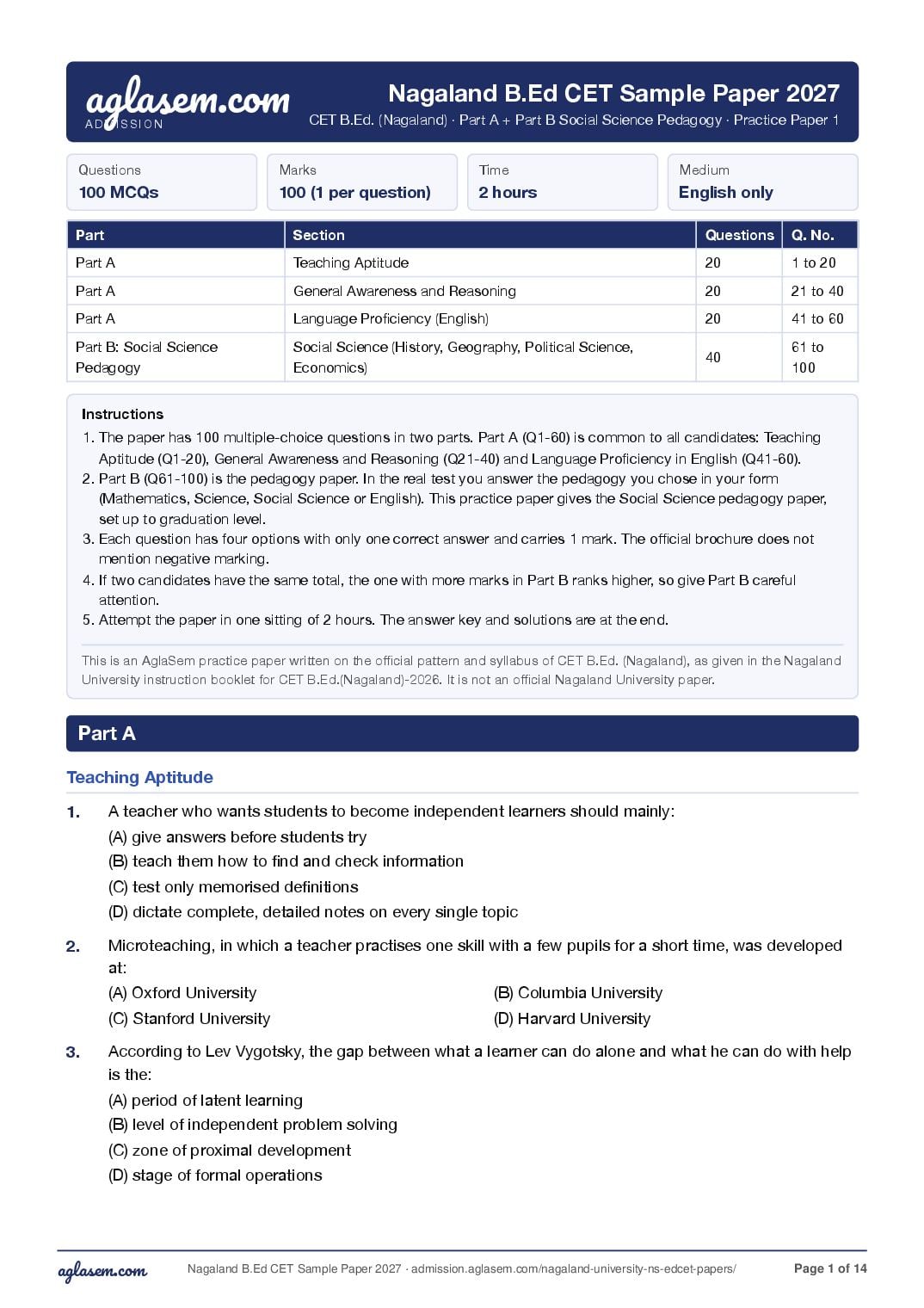
Page 1
Nagaland B.Ed CET Sample Paper 2027
CET B.Ed. (Nagaland) · Part A + Part B Social Science Pedagogy · Practice Paper 1
Questions Marks Time Medium
100 MCQs 100 (1 per question) 2 hours English only
Part Section Questions Q. No.
Part A Teaching Aptitude 20 1 to 20
Part A General Awareness and Reasoning 20 21 to 40
Part A Language Proficiency (English) 20 41 to 60
Part B: Social Science Social Science (History, Geography, Political Science, 61 to
40
Pedagogy Economics) 100
Instructions
1. The paper has 100 multiple-choice questions in two parts. Part A (Q1-60) is common to all candidates: Teaching
Aptitude (Q1-20), General Awareness and Reasoning (Q21-40) and Language Proficiency in English (Q41-60).
2. Part B (Q61-100) is the pedagogy paper. In the real test you answer the pedagogy you chose in your form
(Mathematics, Science, Social Science or English). This practice paper gives the Social Science pedagogy paper,
set up to graduation level.
3. Each question has four options with only one correct answer and carries 1 mark. The official brochure does not
mention negative marking.
4. If two candidates have the same total, the one with more marks in Part B ranks higher, so give Part B careful
attention.
5. Attempt the paper in one sitting of 2 hours. The answer key and solutions are at the end.
This is an AglaSem practice paper written on the official pattern and syllabus of CET B.Ed. (Nagaland), as given in the Nagaland
University instruction booklet for CET B.Ed.(Nagaland)-2026. It is not an official Nagaland University paper.
Part A
Teaching Aptitude
1. A teacher who wants students to become independent learners should mainly:
(A) give answers before students try
(B) teach them how to find and check information
(C) test only memorised definitions
(D) dictate complete, detailed notes on every single topic
2. Microteaching, in which a teacher practises one skill with a few pupils for a short time, was developed
at:
(A) Oxford University (B) Columbia University
(C) Stanford University (D) Harvard University
3. According to Lev Vygotsky, the gap between what a learner can do alone and what he can do with help
is the:
(A) period of latent learning
(B) level of independent problem solving
(C) zone of proximal development
(D) stage of formal operations
Nagaland B.Ed CET Sample Paper 2027 · admission./nagaland-university-ns-edcet-papers/ Page 1 of 14
Page 2
amount during the:
(A) formal operational stage
(B) pre-operational (intuitive) stage
(C) sensorimotor stage
(D) concrete operational stage
5. In the original (1956) Bloom's taxonomy of the cognitive domain, the highest level is:
(A) Synthesis (B) Application
(C) Comprehension (D) Evaluation
6. Formative assessment is carried out mainly to:
(A) rank schools in a district
(B) award final grades and certificates at the end of the year
(C) improve learning while teaching is going on
(D) select pupils for promotion
7. Sentong regularly fails to complete his homework. The teacher's best first step is to:
(A) talk to him and find out the reason
(B) stop checking his notebook
(C) punish him in front of the whole class as a warning
(D) send him out of the classroom
8. A teacher introduces fractions by cutting an orange into equal pieces and sharing them. She is following
the maxim:
(A) from general to particular (B) from complex to simple
(C) from concrete to abstract (D) from abstract to concrete
9. In Edgar Dale's 'Cone of Experience', the base of the cone, which gives the most concrete learning, is:
(A) verbal symbols such as printed words
(B) direct, purposeful experience
(C) still pictures and radio
(D) visual symbols
10. Under the RTE Act, 2009, private unaided schools must admit children from weaker sections and
disadvantaged groups in at least what share of their entry-level seats?
(A) 25 per cent (B) 15 per cent
(C) 10 per cent (D) 50 per cent
11. A 12-year-old pupil scores on an intelligence test like an average 9-year-old. His IQ is:
(A) 133 (B) 75
(C) 108 (D) 90
12. A pupil with low vision is taught in a regular class with large-print books, a front seat and help from the
class teacher. This is an example of:
(A) inclusive education (B) segregated education
(C) residential special schooling (D) home-based schooling
13. Action research is mainly undertaken by a teacher in order to:
(A) frame a new national policy
(B) compare the education of two nations
(C) prove a universal theory of learning valid in all countries
(D) solve a practical problem of his own classroom
Nagaland B.Ed CET Sample Paper 2027 · admission./nagaland-university-ns-edcet-papers/ Page 2 of 14
Page 3
reflection. Such a file is called a:
(A) portfolio (B) anecdotal record
(C) rating scale (D) cumulative record
15. Which of these is an example of intrinsic motivation?
(A) Finishing work to avoid a scolding
(B) Learning a poem to earn a gold star from the teacher
(C) Reading a storybook because it is enjoyable
(D) Studying hard to win a cash prize
16. In a Class 7 group, some pupils finish an exercise in ten minutes while others need help even to begin it.
The teacher should:
(A) make the quick pupils wait silently for the others
(B) give graded tasks and extra support as each pupil needs
(C) send the slower pupils for private tuition only
(D) give the same task to all and move on to the next topic
17. In the Herbartian five formal steps of lesson planning, the last step is:
(A) Application (B) Preparation
(C) Presentation (D) Comparison
18. 'What might happen if all the forests near our village disappeared?' This is an example of:
(A) an open-ended (divergent) question
(B) a yes-or-no question
(C) a rhetorical question
(D) a closed recall question
19. The idea that a response followed promptly by reinforcement is more likely to be repeated was
developed in operant conditioning by:
(A) Jean Piaget (B) Ivan Pavlov
(C) Wolfgang Kohler (D) B.F. Skinner
20. Classroom communication is most effective when it is:
(A) limited to reading from the textbook
(B) one-way, from teacher to learners only
(C) two-way, with learners asking and answering
(D) conducted mostly in writing on the board
General Awareness and Reasoning
21. The Hornbill Festival of Nagaland is held every December at the Naga Heritage Village in:
(A) Tuensang town (B) Chumukedima town
(C) Longwa, in Mon district (D) Kisama, near Kohima
22. The state bird of Nagaland is:
(A) Blyth's tragopan (B) Mrs Hume's pheasant
(C) Hill myna (D) Great hornbill
23. Moatsu, a spring festival marking the end of sowing, is celebrated mainly by the:
(A) Ao Nagas (B) Konyak Nagas
(C) Angami Nagas (D) Sumi Nagas
Nagaland B.Ed CET Sample Paper 2027 · admission./nagaland-university-ns-edcet-papers/ Page 3 of 14
Page 4
(A) Mahatma Gandhi (B) Jawaharlal Nehru
(C) Subhas Chandra Bose (D) Vallabhbhai Patel
25. The McMahon Line is a boundary line between India and:
(A) Bangladesh (B) China
(C) Nepal (D) Myanmar
26. Thimphu is the capital of:
(A) Myanmar (B) Nepal
(C) Bangladesh (D) Bhutan
27. The Kohima War Cemetery honours soldiers who died in a battle fought at Kohima during the:
(A) First World War (B) Second World War
(C) Revolt of 1857 (D) Anglo-Burmese War of 1824
28. Loktak Lake, known for its floating masses of vegetation called phumdis, is in:
(A) Nagaland (B) Tripura
(C) Manipur (D) Mizoram
29. Rusting of iron takes place only when iron is exposed to:
(A) moisture alone, without oxygen (B) oxygen alone, even in dry air
(C) sunlight alone (D) both oxygen and moisture
30. The narrow Siliguri Corridor, called the 'Chicken's Neck', that links the North-Eastern states with the
rest of India, lies in:
(A) Sikkim (B) Assam
(C) Bihar (D) West Bengal
31. If TEACHER is written as VGCEJGT in a code, how is SCHOOL written in that code?
(A) UEJQPN (B) TEJQQN
(C) UEIQQN (D) UEJQQN
32. If 'book' is called 'pen', 'pen' is called 'chalk', 'chalk' is called 'duster' and 'duster' is called 'table', what
does a teacher use to write on a blackboard?
(A) pen (B) table
(C) chalk (D) duster
33. Select the odd one out.
(A) Shillong (B) Dimapur
(C) Kohima (D) Aizawl
34. Find the next number: 2, 3, 5, 9, 17, ?
(A) 33 (B) 31
(C) 34 (D) 25
35. BDF : CEG :: KMO : ?
(A) LMN (B) LNP
(C) KNP (D) JLN
36. Kevi is facing north-east. He turns 135 degrees clockwise. Which direction is he facing now?
(A) South-east (B) South
(C) East (D) South-west
Nagaland B.Ed CET Sample Paper 2027 · admission./nagaland-university-ns-edcet-papers/ Page 4 of 14
Page 5
(A) Grandfather (B) Uncle
(C) Father (D) Brother
38. In a queue, Lima is 9th from the front and 16th from the back. How many people are there in the queue?
(A) 25 (B) 23
(C) 24 (D) 26
39. If 1 January of a non-leap year falls on a Monday, on which day will 1 March of that year fall?
(A) Tuesday (B) Thursday
(C) Friday (D) Wednesday
40. Statements: All roses are flowers. Some flowers fade quickly.
Conclusions: I. All roses fade quickly. II. Some flowers are roses.
(A) Only II follows (B) Neither I nor II follows
(C) Only I follows (D) Both I and II follow
Language Proficiency (English)
Directions: Read the passage carefully and answer the questions that follow.
In many hill villages the forest is not a distant wilderness but a neighbour. It supplies firewood, wild
vegetables, bamboo shoots and the timber for houses, and its springs feed the streams that water the
fields below. For generations, village councils have set rules about when trees may be cut and which
slopes must be left untouched. Such rules were not written in books; they were remembered, repeated
and, above all, respected.
When these customs weaken, the change is gradual at first. A few more trees are felled for sale, a hillside
is cleared a year too early, and the springs begin to run thin in the dry months. By the time the loss is
noticed, it is far harder to repair than it would have been to prevent. Where villages have revived their old
rules, setting aside community reserves and banning hunting in them, the results have often been
encouraging: birds return, springs recover and young people discover that conservation can also be a
source of pride and of income from visitors.
The lesson is simple but easily forgotten. Protecting a forest is not the duty of a distant government office
alone; it is most effective when the people who live beside it see it as their own.
41. According to the passage, the village rules about forests were kept alive mainly because they were:
(A) remembered and respected by the people
(B) printed in books and displayed widely
(C) written down by visiting scholars
(D) enforced by a distant government office
42. What, according to the passage, is an early sign that forest customs are weakening?
(A) Birds return to the reserves
(B) Springs run thin in the dry months
(C) Visitors stop coming to the village
(D) Young people leave for the towns
43. The word 'gradual', as used in the passage, means:
(A) planned in advance
(B) easy to notice
(C) happening slowly, step by step
(D) sudden, violent and without warning
Nagaland B.Ed CET Sample Paper 2027 · admission./nagaland-university-ns-edcet-papers/ Page 5 of 14
Page 6
(A) Hunting has no effect on forests
(B) Forests matter to villagers only as a source of timber
(C) Community reserves always fail
(D) Preventing forest loss is easier than repairing it
45. The most suitable title for the passage is:
(A) The History of Hill Farming (B) The Forest as a Neighbour
(C) Life in a Big City (D) Timber for Sale
46. Choose the word nearest in meaning to METICULOUS.
(A) very careful (B) very proud
(C) very generous (D) very hasty
47. Choose the word nearest in meaning to OBSOLETE.
(A) easily broken (B) brand new
(C) out of date (D) widely used
48. Choose the word opposite in meaning to VAGUE.
(A) unclear (B) doubtful
(C) hazy (D) definite
49. Choose the word opposite in meaning to TIMID.
(A) fearful (B) bold
(C) meek (D) shy
50. Find the part of the sentence that has an error: Neither the teacher nor / the students was / aware of /
the change in the timetable.
(A) Neither the teacher nor (B) the students was
(C) aware of (D) No error
51. Find the part of the sentence that has an error: She is senior / than me / by two years / in the school.
(A) She is senior (B) than me
(C) by two years (D) No error
52. Find the part of the sentence that has an error: The committee has / finally announced / its decision /
after a long meeting.
(A) The committee has (B) finally announced
(C) its decision (D) No error
53. Fill in the blank: The match was called off ______ the heavy rain.
(A) instead of (B) in spite of
(C) in case of (D) because of
54. Fill in the blank: She would have caught the bus if she ______ home earlier.
(A) had left (B) leaves
(C) would leave (D) has left
55. Fill in the blank: The doctor advised him to give ______ smoking.
(A) out (B) off
(C) in (D) up
Nagaland B.Ed CET Sample Paper 2027 · admission./nagaland-university-ns-edcet-papers/ Page 6 of 14
Page 7
(A) to feel very angry (B) to take a warm bath
(C) to be in trouble (D) to be very busy
57. The idiom 'to take something with a pinch of salt' means:
(A) to add flavour to food (B) to accept it with joy
(C) to make it more interesting (D) not to believe it completely
58. One word for 'a person who can speak many languages' is:
(A) translator (B) linguist
(C) polyglot (D) orator
59. One word for 'a list of books referred to in a piece of writing' is:
(A) catalogue (B) glossary
(C) biography (D) bibliography
60. Choose the correctly spelt word.
(A) Conscientous (B) Conscientious
(C) Conshientious (D) Consciencious
Part B: Social Science Pedagogy
Social Science (History, Geography, Political Science, Economics)
61. The Harappan city divided into three parts (citadel, middle town and lower town) and famous for its
large water reservoirs is:
(A) Ropar (B) Kalibangan
(C) Banawali (D) Dholavira
62. The script of Ashoka's edicts (Brahmi) was first deciphered in 1837 by:
(A) William Jones (B) Alexander Cunningham
(C) John Marshall (D) James Prinsep
63. The Arthashastra, a treatise on statecraft of the Mauryan period, is attributed to:
(A) Megasthenes (B) Kautilya
(C) Banabhatta (D) Kalidasa
64. The iqta system of assigning land revenue to officers was firmly established in the Delhi Sultanate by:
(A) Firoz Shah Tughlaq (B) Alauddin Khalji
(C) Iltutmish (D) Balban
65. The Ain-i-Akbari, an account of Akbar's administration, was written by:
(A) Abul Fazl (B) Abdul Qadir Badauni
(C) Birbal (D) Faizi
66. The Permanent Settlement of land revenue in Bengal (1793) was introduced by:
(A) Warren Hastings (B) Lord Cornwallis
(C) Lord Dalhousie (D) Lord Wellesley
67. The 'Doctrine of Lapse', under which states without a natural heir were annexed, is associated with:
(A) Lord Dalhousie (B) Lord Ripon
(C) Lord Curzon (D) Lord William Bentinck
Nagaland B.Ed CET Sample Paper 2027 · admission./nagaland-university-ns-edcet-papers/ Page 7 of 14
Page 8
(A) Bihar (B) Assam
(C) Sikkim (D) Tripura
69. The 'Inner Line' that restricts entry of outsiders into certain hill areas of the North-East was created
under the:
(A) Indian Councils Act, 1892
(B) Government of India Act, 1858
(C) Bengal Eastern Frontier Regulation, 1873
(D) Regulating Act, 1773
70. The Naga Club, which submitted a memorandum to the Simon Commission in 1929, was formed in:
(A) 1946 (B) 1935
(C) 1918 (D) 1905
71. The Indian National Congress adopted 'Purna Swaraj' (complete independence) as its goal at its
session held at:
(A) Haripura in 1938 (B) Lucknow in 1916
(C) Lahore in 1929 (D) Calcutta in 1906
72. 'The Social Contract' (1762), which begins with 'Man is born free, and everywhere he is in chains', was
written by:
(A) Jean-Jacques Rousseau (B) John Locke
(C) Voltaire (D) Thomas Hobbes
73. The commercial town of Dimapur in Nagaland lies on the banks of the river:
(A) Tizu (B) Doyang
(C) Dhansiri (D) Dikhu
74. The highest peak of Nagaland, on the Indo-Myanmar border, is:
(A) Mount Tiyi (B) Japfu Peak
(C) Pulie Badze (D) Mount Saramati
75. The 'slash and burn' method of farming, called jhum in North-East India, is a form of:
(A) terrace cultivation (B) mixed farming
(C) shifting cultivation (D) plantation agriculture
76. Lines on a map joining places that receive equal amounts of rainfall are called:
(A) isohyets (B) isobars
(C) isohalines (D) isotherms
77. Because of the Coriolis force, winds in the Northern Hemisphere are deflected towards the:
(A) left of their direction of motion
(B) nearest high-pressure area
(C) Equator in every case
(D) right of their direction of motion
78. Laterite soils are formed mainly by:
(A) intense leaching under high rainfall and temperature
(B) weathering of basalt in dry areas
(C) accumulation of wind-blown sand
(D) deposition of silt by rivers
Nagaland B.Ed CET Sample Paper 2027 · admission./nagaland-university-ns-edcet-papers/ Page 8 of 14
Page 9
(A) trade wind belt (B) roaring forties
(C) doldrums (D) horse latitudes
80. On a map with a representative fraction of 1 : 50,000, a distance of 1 cm stands for:
(A) 50 metres (B) 500 metres
(C) 50 kilometres (D) 5 kilometres
81. In the Demographic Transition Model, the stage with a high birth rate but a rapidly falling death rate,
causing fast population growth, is:
(A) the first stage (B) the fourth stage
(C) the fifth stage (D) the second stage
82. The Standard Meridian of India (82 degrees 30 minutes E) is used to fix Indian Standard Time. IST is
ahead of GMT by:
(A) 5 hours 30 minutes (B) 6 hours
(C) 5 hours (D) 4 hours 30 minutes
83. Special provisions for Nagaland regarding Naga customary law and ownership of land are contained in
Article:
(A) 370 (B) 371G
(C) 371A (D) 371B
84. Nagaland was inaugurated as the 16th state of the Indian Union on:
(A) 1 December 1963 (B) 26 January 1950
(C) 21 January 1972 (D) 15 August 1947
85. The theory of separation of powers was clearly explained by Montesquieu in his book:
(A) The Spirit of the Laws (B) The Prince
(C) Two Treatises of Government (D) Leviathan
86. The 'Republic', which describes an ideal state ruled by philosopher-kings, was written by:
(A) Plato (B) Socrates
(C) Cicero (D) Aristotle
87. The idea of a Concurrent List of subjects in the Indian Constitution was borrowed from the Constitution
of:
(A) Australia (B) Canada
(C) the USA (D) Ireland
88. The writ issued by a court to have a detained person produced before it, so that the legality of the
detention can be examined, is:
(A) quo warranto (B) habeas corpus
(C) mandamus (D) certiorari
89. Under the Indian Constitution, the residuary powers of legislation are vested in:
(A) the Supreme Court (B) the President alone
(C) the State Legislatures (D) Parliament
90. The Chief Minister of a state in India is appointed by the:
(A) Speaker of the Assembly
(B) Governor
(C) Chief Justice of the High Court
(D) President
Nagaland B.Ed CET Sample Paper 2027 · admission./nagaland-university-ns-edcet-papers/ Page 9 of 14
Page 10
(A) one year (B) nine months
(C) six months (D) three months
92. The 'anti-defection' provisions (Tenth Schedule) were added to the Constitution by the:
(A) 42nd Amendment (B) 61st Amendment
(C) 44th Amendment (D) 52nd Amendment
93. As a consumer takes more and more units of a good, the satisfaction from each additional unit falls.
This is the law of:
(A) increasing returns (B) comparative advantage
(C) equi-marginal utility (D) diminishing marginal utility
94. A good whose demand rises when its price rises, because it is an inferior staple of poor consumers, is
called a:
(A) normal good (B) luxury good
(C) Giffen good (D) complementary good
95. When the price elasticity of demand is exactly equal to one, demand is said to be:
(A) perfectly inelastic (B) perfectly elastic
(C) unitary elastic (D) relatively inelastic
96. Net Domestic Product at market price is obtained from Gross Domestic Product at market price by
subtracting:
(A) net indirect taxes (B) net factor income from abroad
(C) depreciation (D) subsidies
97. A market with a few large sellers, whose price decisions affect one another, is called:
(A) perfect competition (B) oligopoly
(C) monopsony (D) monopoly
98. 'An Inquiry into the Nature and Causes of the Wealth of Nations' (1776) was written by:
(A) Alfred Marshall (B) David Ricardo
(C) Adam Smith (D) J.M. Keynes
99. The value of the next best alternative given up when a choice is made is called:
(A) marginal cost (B) opportunity cost
(C) fixed cost (D) sunk cost
100. A tax whose burden is borne by the person on whom it is levied and cannot be shifted to others, such
as income tax, is:
(A) a direct tax (B) an excise duty
(C) a customs duty (D) an indirect tax
Nagaland B.Ed CET Sample Paper 2027 · admission./nagaland-university-ns-edcet-papers/ Page 10 of 14
Page 11
1 B 2 C 3 C 4 D 5 D 6 C 7 A 8 C 9 B 10 A
11 B 12 A 13 D 14 A 15 C 16 B 17 A 18 A 19 D 20 C
21 D 22 A 23 A 24 B 25 B 26 D 27 B 28 C 29 D 30 D
31 D 32 D 33 B 34 A 35 B 36 B 37 B 38 C 39 B 40 A
41 A 42 B 43 C 44 D 45 B 46 A 47 C 48 D 49 B 50 B
51 B 52 D 53 D 54 A 55 D 56 C 57 D 58 C 59 D 60 B
61 D 62 D 63 B 64 C 65 A 66 B 67 A 68 B 69 C 70 C
71 C 72 A 73 C 74 D 75 C 76 A 77 D 78 A 79 C 80 B
81 D 82 A 83 C 84 A 85 A 86 A 87 A 88 B 89 D 90 B
91 C 92 D 93 D 94 C 95 C 96 C 97 B 98 C 99 B 100 A
Solutions
Teaching Aptitude
1. (B) Independent learners need skills of finding, judging and using information; dictation and ready answers make
them dependent.
2. (C) Microteaching was developed by Dwight Allen and colleagues at Stanford University in the early 1960s.
3. (C) Vygotsky called this gap the zone of proximal development; guided help in it is called scaffolding.
4. (D) Conservation of quantity is achieved in the concrete operational stage (about 7 to 11 years).
5. (D) The 1956 order is Knowledge, Comprehension, Application, Analysis, Synthesis and Evaluation. (The 2001
revision ends with Creating.)
6. (C) Formative assessment gives feedback during instruction so that teaching and learning can be adjusted.
7. (A) Understanding the cause (home duties, difficulty, health) comes before any remedy; public punishment harms
the child.
8. (C) Handling real pieces of fruit (concrete) prepares the pupil for the symbol 1/4 (abstract).
9. (B) Dale placed direct, purposeful experience at the broad base and verbal symbols at the narrow, most abstract tip.
10. (A) Section 12(1)(c) of the RTE Act, 2009 requires at least 25 per cent of entry-class seats for such children, with
the State paying the cost.
11. (B) IQ = (mental age / chronological age) x 100 = (9/12) x 100 = 75.
12. (A) Inclusion means educating children with special needs alongside others in ordinary classrooms, with suitable
support.
13. (D) Action research is small-scale, practical research by the practitioner to improve his own practice.
14. (A) A portfolio is a purposeful collection of a learner's work over time; an anecdotal record notes specific incidents
of behaviour.
15. (C) Intrinsic motivation comes from interest in the activity itself; prizes, stars and fear of scolding are external.
16. (B) Recognising individual differences means differentiating tasks and support; the other options ignore one group
or the other.
17. (A) The steps are Preparation, Presentation, Comparison (Association), Generalisation and Application.
18. (A) It allows many reasonable answers and makes pupils think, so it is divergent or open-ended.
19. (D) Skinner's operant conditioning stresses reinforcement; Pavlov studied classical conditioning and Kohler insight
learning.
20. (C) Two-way communication gives the teacher feedback and keeps learners active.
Nagaland B.Ed CET Sample Paper 2027 · admission./nagaland-university-ns-edcet-papers/ Page 11 of 14
Page 12
21. (D) The Naga Heritage Village is at Kisama, about 12 km from Kohima; the festival runs from 1 to 10 December.
22. (A) Blyth's tragopan is Nagaland's state bird; the mithun is its state animal.
23. (A) Moatsu is the Ao festival in the first week of May; Sekrenyi is Angami, Tuluni is Sumi and Aoleang is Konyak.
24. (B) Nehru met her in Shillong jail in 1937 and called her 'Rani' of her people.
25. (B) The McMahon Line (1914, Simla Convention) separates Arunachal Pradesh (India) from the Tibet region of
China.
26. (D) Thimphu is Bhutan's capital; Kathmandu, Nay Pyi Taw and Dhaka are the others.
27. (B) The Battle of Kohima (April to June 1944) was fought between Allied and Japanese forces in the Second World
War.
28. (C) Loktak is the largest freshwater lake of the North-East; Keibul Lamjao National Park floats on its phumdis.
29. (D) Rust (hydrated iron oxide) forms only when both oxygen and water are present; painting or oiling keeps them
away.
30. (D) The Siliguri Corridor is a narrow strip of land in northern West Bengal between Nepal and Bangladesh.
31. (D) Each letter moves 2 places forward: T-V, E-G, A-C ... So S-U, C-E, H-J, O-Q, O-Q, L-N = UEJQQN.
32. (D) One writes on a blackboard with chalk, and chalk is called 'duster'.
33. (B) Kohima, Shillong and Aizawl are state capitals; Dimapur is not.
34. (A) The differences are 1, 2, 4, 8, so the next difference is 16: 17 + 16 = 33.
35. (B) Each letter moves one place forward: K-L, M-N, O-P.
36. (B) Measured clockwise from north, north-east is 45 degrees; 45 + 135 = 180 degrees, which is south.
37. (B) P, Q and R are siblings, and R is S's father, so P (male) is S's father's brother, that is, S's uncle.
38. (C) Total = 9 + 16 - 1 = 24 (Lima is counted in both positions).
39. (B) From 1 January to 1 March is 31 + 28 = 59 days; 59 = 8 weeks + 3 days, so Monday + 3 = Thursday.
40. (A) Since all roses are flowers, some flowers are roses (II follows). The flowers that fade quickly need not include
any rose, so I does not follow.
Language Proficiency (English)
41. (A) The passage says the rules 'were not written in books; they were remembered, repeated and, above all,
respected.'
42. (B) Thinning springs follow the extra felling and early clearing described in the second paragraph.
43. (C) Gradual change happens little by little, which is why the loss is noticed late.
44. (D) The passage says the loss is 'far harder to repair than it would have been to prevent'.
45. (B) The passage is about villagers' close bond with, and duty to protect, the forest beside them.
46. (A) Meticulous means showing great attention to detail, that is, very careful.
47. (C) Obsolete means no longer in use, out of date.
48. (D) Vague means not clearly expressed; its opposite is definite (precise). The other words are synonyms.
49. (B) Timid means easily frightened; its opposite is bold.
50. (B) With 'neither ... nor' the verb agrees with the nearer subject, 'the students', which is plural: 'the students were
aware of'.
51. (B) Words like senior, junior, superior and prior take 'to', not 'than': 'She is senior to me by two years.'
52. (D) The committee acts as one body here, so 'has' and 'its' are correct. There is no error.
53. (D) The rain was the reason, so 'because of' fits; 'in spite of' would show contrast.
54. (A) A third conditional (unreal past) uses 'if + past perfect' with 'would have + past participle'.
55. (D) To give up means to stop doing something; to give in means to surrender.
56. (C) To be in hot water is to be in trouble or difficulty, usually because of something one has done.
Nagaland B.Ed CET Sample Paper 2027 · admission./nagaland-university-ns-edcet-papers/ Page 12 of 14
Page 13
58. (C) A polyglot speaks several languages. A linguist studies language; an orator is a public speaker.
59. (D) A bibliography lists books and sources used; a glossary explains difficult words.
60. (B) Conscientious (careful and dutiful) is spelt c-o-n-s-c-i-e-n-t-i-o-u-s.
Social Science (History, Geography, Political Science, Economics)
61. (D) Dholavira in the Rann of Kutch, Gujarat, had a three-part plan and elaborate water-storage reservoirs.
62. (D) James Prinsep deciphered Brahmi in 1837; Cunningham founded the ASI and Marshall excavated Harappa and
Mohenjo-daro.
63. (B) Kautilya (Chanakya), adviser of Chandragupta Maurya, is credited with the Arthashastra; Megasthenes wrote
Indica.
64. (C) Iltutmish organised the iqta system, granting revenue of territories to officers (iqtadars) in return for service.
65. (A) Abul Fazl wrote the Akbarnama, whose third volume is the Ain-i-Akbari; Badauni wrote the critical Muntakhab-
ut-Tawarikh.
66. (B) Cornwallis fixed the revenue permanently with the zamindars in 1793.
67. (A) Dalhousie (1848-56) annexed Satara, Jhansi, Nagpur and others under the Doctrine of Lapse.
68. (B) By the Treaty of Yandabo, Burma gave up its claims over Assam, Manipur, Arakan and Tenasserim, opening the
North-East to the British.
69. (C) The Bengal Eastern Frontier Regulation, 1873 created the Inner Line; the permit system still applies in
Nagaland.
70. (C) The Naga Club was formed in 1918 by Naga leaders; its 1929 memorandum asked that the Nagas be left out of
the proposed reforms.
71. (C) The Lahore session (December 1929), presided over by Jawaharlal Nehru, adopted the Purna Swaraj resolution.
72. (A) Rousseau wrote The Social Contract; his ideas influenced the French Revolution of 1789.
73. (C) Dimapur lies on the Dhansiri, a tributary of the Brahmaputra; the Doyang flows through Wokha and the Tizu
through Zunheboto and Kiphire.
74. (D) Saramati (about 3,800 m) in Kiphire district is Nagaland's highest peak; Japfu is near Kohima.
75. (C) In jhum a forest patch is cleared and burnt, cropped for a few years and then left fallow while the farmer moves
on.
76. (A) Isohyets join equal rainfall; isobars equal pressure; isotherms equal temperature; isohalines equal salinity.
77. (D) Earth's rotation deflects moving air to the right in the Northern Hemisphere and to the left in the Southern
Hemisphere.
78. (A) Heavy rain leaches away silica and lime, leaving soil rich in iron and aluminium oxides; black soil comes from
basalt.
79. (C) The doldrums lie near the Equator; the horse latitudes are the subtropical high-pressure belts near 30 degrees.
80. (B) 1 cm = 50,000 cm = 500 m on the ground.
81. (D) Stage 2 (early expanding) has falling death rates while birth rates stay high, so population grows fastest.
82. (A) 82.5 degrees x 4 minutes per degree = 330 minutes = 5 hours 30 minutes.
83. (C) Article 371A, added by the 13th Amendment (1962), protects Naga religious and social practices, customary
law and land. 371G is for Mizoram.
84. (A) The State of Nagaland Act, 1962 created the state, which was formally inaugurated on 1 December 1963.
85. (A) Montesquieu wrote The Spirit of the Laws (1748); Leviathan is by Hobbes, The Prince by Machiavelli and Two
Treatises by Locke.
86. (A) Plato wrote the Republic; Aristotle, his pupil, wrote Politics. Socrates left no writings.
87. (A) The Concurrent List came from Australia; the Directive Principles from Ireland and the strong-centre federation
from Canada.
88. (B) Habeas corpus means 'to have the body'; it protects personal liberty against unlawful detention.
Nagaland B.Ed CET Sample Paper 2027 · admission./nagaland-university-ns-edcet-papers/ Page 13 of 14
Page 14
90. (B) Article 164: the Chief Minister is appointed by the Governor, and other ministers on the Chief Minister's advice.
91. (C) Article 85 requires Parliament to meet so that six months do not pass between its last sitting in one session and
the first in the next.
92. (D) The 52nd Amendment (1985) added the Tenth Schedule on disqualification for defection.
93. (D) The law of diminishing marginal utility explains why the demand curve normally slopes downward.
94. (C) A Giffen good is the classic exception to the law of demand: the income effect outweighs the substitution
effect.
95. (C) With unitary elasticity the percentage change in quantity equals the percentage change in price, so total
spending stays the same.
96. (C) NDP at market price = GDP at market price - depreciation (consumption of fixed capital). Net factor income
from abroad converts domestic into national aggregates, and net indirect taxes convert market price into factor cost.
97. (B) Oligopoly has a few interdependent sellers; monopoly has one seller and monopsony one buyer.
98. (C) Adam Smith, the father of economics, wrote the Wealth of Nations; Keynes wrote the General Theory (1936).
99. (B) Opportunity cost is the benefit of the best alternative foregone.
100. (A) Direct taxes (income tax, corporation tax) fall on the payer; indirect taxes (GST, customs, excise) can be
passed on to buyers.
Nagaland B.Ed CET Sample Paper 2027 · admission./nagaland-university-ns-edcet-papers/ Page 14 of 14
Document Details
| Board / Org | Nagaland Board |
| Exam | Nagaland B.Ed CET |
| Type | Sample Paper |
| Pages | 14 |
| Language | english |
| Updated | 27 Oct 2026 |