APJEE 2019 Question Paper
Finished viewing? Save it for later —
Download APJEE 2019 Question Paper (PDF · 18 pages)About APJEE 2019 Question Paper
APJEE 2019 Question Paper is available here for free download. Published by Arunachal Pradesh Exams for APJEE, this question paper can be viewed online or downloaded as a PDF (18 pages). Candidates preparing for APJEE can use APJEE 2019 Question Paper to understand the exam pattern, the type of questions asked, and the overall difficulty level.
Frequently Asked Questions
How can I download APJEE 2019 Question Paper?
Open this page and click the Download button to save APJEE 2019 Question Paper as a PDF. It is completely free on AglaSem Docs.
Is APJEE 2019 Question Paper free to download?
Yes. APJEE 2019 Question Paper can be viewed online and downloaded as a PDF free of cost on AglaSem Docs.
How many pages does APJEE 2019 Question Paper have?
APJEE 2019 Question Paper contains 18 pages, which you can read online or download together as a single PDF.
Where can I find more APJEE study material?
You can find more APJEE question papers, sample papers, syllabus, and answer keys on AglaSem Docs.
APJEE 2019 Question Paper – Text
Read the full text of this question paper below — useful to quickly search, copy and reference the content online without downloading the PDF.
📄 View text version (18 pages)
Page 1
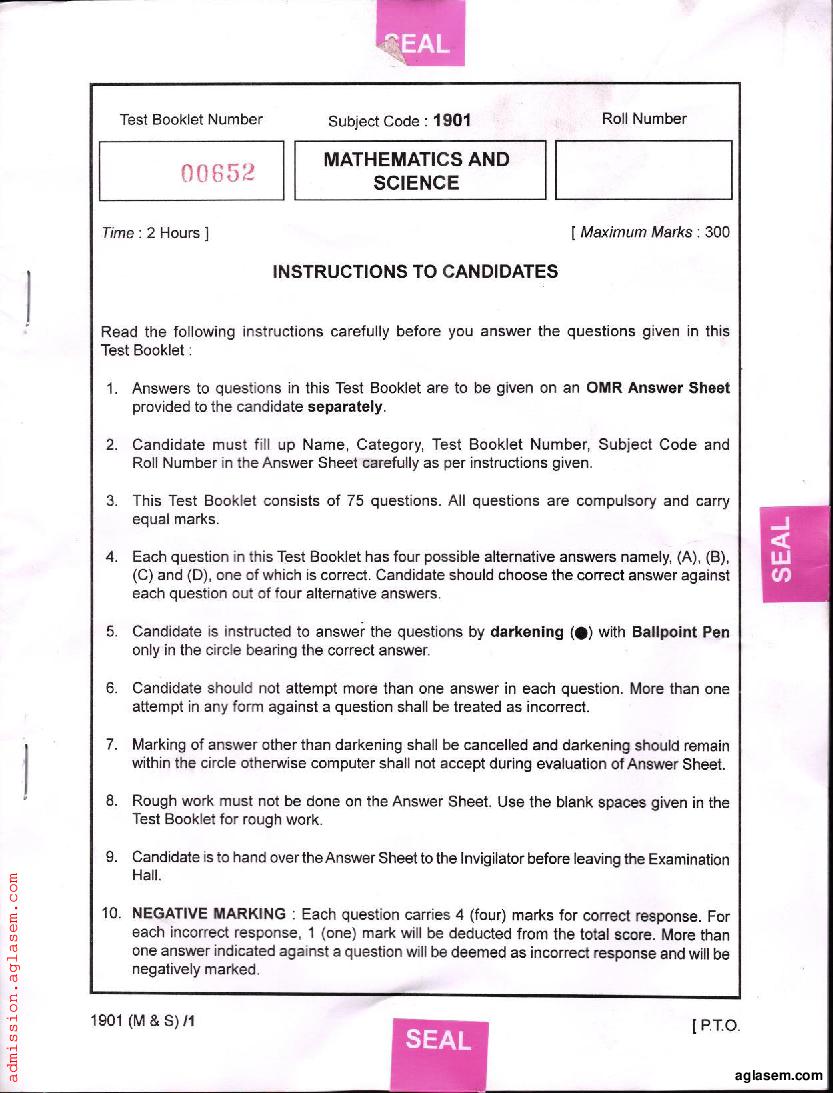
Test Booklet Number Subject Code : 1901 Roll Number
MATHEMATICS AND
00652 SCIENCE
Irme:2Hoursl I Maximum Matus: 3OO
INSTRUCTIONS TO CANDIDATES
Read the following instructions carefully before you answer the questions given in this
Test Booklet :
1. Answers to questions in this Test Booklet are to be given on an OMR Answer Sheet
provided to the candidate separately.
2. Candidate must fill up Name, Category, Test Booklet Number, Subject Code and
Roll Number in the Answer Sheet carefully as per instructions given.
3. This Test Booklet consists of 75 questions. All questions are compulsory and carry
equal marks.
4. Each question in this Test Booklet has four possible alternative answers namely, (A), (B), ul
(C) and (D), one oiwhich is correct. Candidate should choose the correct answer against al,
each question out of four alternative answers.
5. Candidate is instructed to answer the questions by darkening (O) with Ballpoint Pen
only in the circle bearing the correct answer.
6. Candidate should not attempt more than one answer in each question. More than one
attempt in any form against a question shall be treated as incorrect.
7. l\,4arking of answer other than darkening shall be cancelled and darkening should remain
within the circle otherwise computer shall not accept during evaluation ofAnswer Sheet.
8. Rough work must not be done on the Answer Sheet. Use the blank spaces given in the
Test Booklet for rough work.
9. Candidate is to hand overtheAnswer Sheettothe lnvigilator belore teaving the Examination
Hall.
10. NEGATIVE t ARKING ; Each question carries 4 (four) marks for conecl response. For
each incorrect response, 'l (one) mark will be deducted from the total score. More than
one answer indicated against a question will be deemed as incorrect response and will be
negatively marked.
1901 (r\,r & s) /1
I PT.O
SEAL
Page 2
2
Page 3
1. A number when divided by 143 leaves 5. ln the given figure, AB > AC.lf 80 and
31 as remainder. What will be the CO are bisectors of tB and ZC
remainder when the same number is respectively, then
divided by 13?
A
(A) 0 (B) 1
(c) 3 (D) 5
2. lf one factor of yo * y2 20 is y2 +5,
then the other factor is B c
(A) y2 -z (B) y2 -t (A) OB - OC (B) O8 > OC
(C) y2+q (D) y-4 (c) o8<oc (D) OB<2OC
3. lt is given that the difference between
zeroes of 4x2 -8kx+9 is4and k>0, 6. ln the given figure, O is center of a
then the value of k is circle in which IOAB =20. and
1 3 IOCB = 50' , then .AOC is
(A) (B)
2 2
5 7
(c) (D)
, 2
4. ln the given figure, the measure of
a+b+c+d +e+f +g+h+i+ j A ts
is
c
(A) s0' (B) 70.
(c) 60' (D) 20'
7. The adjacent sides of a parallelogram
are 8 cm and g cm. The diagonal joining
the ends of these sides is of length
'13 cm. The area of parallelogram
is
(A) 72cm2 (B) tz.,E5cm2
(A) e00" (B) 720"
(c) 540. (D) 360" (c) o.,65cm2 (D) z+.65cm2
1901 (M & S) /t 3
IPT.O
Page 4
breadth 5 cm is rolled to form a cylinder tangents to the circle with center O,
of height equal to the breadth of the touching it at D, E and F respectively
paper. lts base radius is then
83
(A) - cm (B) O ncm D
c
4 9 A
(c) -cm (D)
-2n
o11
lt B
E
9. The mean ofx, x+3,119,;1/ and
(A) no=ee+ac+ce
x + 10 is 9. The mean of the last three
observations is (B) zeo=ea+BC+cA
(A) 1ol (B) fi?J (c) lAo--ea+BC+cA
J
r1J f?3 (D) !no=na*ectce
(c) (D) 2
13. The sum of the digits of a two-digit
{0. ln the given figure, PQRS is a square, number is 9. lf 27 is added to it, the digits
then the value of x is are reversed. The number is
S R
(A) 25 (B) 72
(r.) oJ (D) 36
o
1
'14. ln the given figure, D is the mkl-point of
o QR and DS is the bisector ot lPDe
and Sf ll QR, then ZSDf is equal to
(A) 60' (B) 110'
(c) 70' (D) 65"
s T
ll. ln what ratio does x-axis divide the ,ioin
ot A(2, -3) and B(5, 6) ? o D R
(A) 2:3 (B) 3: 5 (A) 45' (B) e0'
(c) 1:2 (D) 2:1 (c) 60' (D) 30'
1901 (M & S) /1 4
Page 5
value of tan Scr iS their areas is 1 '16 lr cm, and the distance
between their centers is 6 cm. Radii of
I the circles are
(A)
E
(A) 6 cm and 4 cm
(B) J5
(B) 8 cm and 4 cm
(c) 1
(D) 0 (C) 10 cm and 6 cm
(D) 10 cm and 4 cm
16. lf sino and cose are roots of the
equation ax2 +bx+c=0, then the
19. A hemispherical bowl is made of steel
value of a2 +2ac-b2 is of thickness 0.25 cm. The inner radius
of the bowl is 5 cm. The volume of steel
(A) I used (in cm3) is I use r = 3.14 ]
(B) -1 (A) 42 15
(B) 41 52
1
(c) ;
(c) 41 25
(D) 0
(D) 42 25
17. The sum of n terms of the AP
20. A number x is chosen al random from
the numbers -3,-2,-1,0, 1, 2, 3. The
A,Ja,$B,Jn,. probability that I x | . 2 is
IS
5
(A)
1
n(n +1)
(A)
2
2
(B)
(B) 2n(n + 1) 7
3
n(n+1) (c)
(c)
T 1
(D) I (D)
1
1
1901 (M & S) /l 5
lPr.o
Page 6
21. The given temperature-time graph 23. ln a laboratory, the students were given
shows the heating curve for pure the task of preparing a 40% (mass by
substance. volume) solution of sodium chloride
(NaCl) in water. Which one of the
following will give the desired solution?
t
Temperature
D (A) 4 g of sodium chloride dissolved in
water to make 100 ml of the
solution
Time ->
The physical state of the substances B (B) 4 g of sodium chloride dissolved in
and D respectively be 100 g water
(A) coexist in solid and liquid at point B
(C) a0 g of sodium chloride dissolved
and in liquid and vapour at point D
in 100 ml of water
(B) solid at 8, gaseous at D
(D) 40 g of sodium chloride dissolved
(C) liquid at B and gaseous at D in water to make 100 ml of solution
(D) coexist in solid and liquid at point
D and liquid and gas at point B
24. 6 g of glucose (molar mass-180 g mofl)
is dissolved in 1 8 g of water in a beaker.
22. Which one of the following statements The number of oxygen atoms in the
with respect to liquefaction of gases is solution is
correct?
(A) High pressure brings the particles (A) 7.015
' 1023
of a gas close and high
temperature takes the particles (B) z.1os , 1021
apart. Balance between the two
liquifies gas.
(C) 2.t05,,1023
(B) High pressure brings the particles
of a gas close and low temperature
also brings them close, so the gas (D) 7.0t5,,1021
liquifies.
(C) Low pressure brings the particles 25. Which of the following has maximum
of a gas close and low temperature number of atoms?
also brings them close, so the gas
liquifies. (A) 18 g of H,O
(D) Low pressure brings the particles (B) 18 g of O,
of a gas close and high
temperature takes them apart. (C) 18 g of CO,
Balance between the two liquifies
gas. (D) 18 g of CH.
1901 (M&S)/r 6
Page 7
X is 92 and the numbers of neutrons is
143. Which of the following is the correct
representation of element X? 1 Zn(s)+CuS01(aq) -+
znSQ(aq)+Cu(s)
92 2 Cu(s)+2AgNO.(a9) ->
(A) x Cu(No.),(aq)+2A9(s)
51
3 Fe(s)+CuS04(aq) -)
FeSQ(aq)+Cu(s)
(B) X
s2
4 Zn(s)+FeS9o1sq;
-
ZnSQ(aq)+Fe(s)
143
(c) X What is the correct increasing order of
s2
the reactivity of metals?
(A) Cu <Ag < Fe < Zn
143
(D) X
5
(B) AS.Cu<ZncFe
(C) AS.CU<Fe<Zn
27. Which one of the following is a feasible
reaction? (D) Fe<Zn<Ag<Cu
(A) Cu(s)+MgSOo(ag) -+ 29. Salts of strong acid and weak base and
those of strong base and strong acid
Mg(s)+CuS04(aq) respectively have their pH values
(B) Mg(s)+Na,SOo(aq)-+ (A) less than seven and more than
seven
2Na(s)+Nltg59 13q1
(B) more than seven and less than
(C) Zn(s)+2AgNO.(ag) , > SCVEN
2Ag(s)+Zn(NO,),(aq)
(C) equal to seven and more than
SCVCN
(D) Ba(s)+KrSO.(3q1--1
2K(s)+BaSO4(aq) (D) less than seven and equal to seven
1e01 (M & s)/1 7
lPr.o
Page 8
the gas which evolves when acetic acid obtained by electrolysis oftheir chlorides
is added to sodium hydrogen in molten state?
carbonate?
1. lt has a pungent smell 1. Cu
2. lt turns limewater milky 2. At
3. lt extinguishes a burning splinter 3. Na
4. lt burns with a pop sound 4. Ca
5 It dissolves in a solution of sodium
hydroxide. (A) 2 only
The correct statements are
(B) 3 only
(A) 1, 2 and 4
(B) 2 and 5 (C) 1 and 3
(C) 2,3 and 5
(D) 3 and 4
(D) 1, 3 and 5
31. A metal M is found in nature as
its sulphide X. On heating in air X 33. ln the compound CH3C|, carbon attains
converts into its oxide Y and a gas the electronic configuration of
evolves. On heating X and Ytogethe(
the metal M is obtained. X and Y
respectively are
(A) helium
(A) X = calcium sulphide; Y=calcium
oxide
(B) X= sodium sulphide; Y=sodium (B) neon
oxide
(C) X= cupric sulphide; Y=cupric (C) argon
oxide
(D) X= cuprous sulphide; Y= cuprous
oxide (D) krypton
1901 (M & S) /t 8
Page 9
formula CrHuO. lt does not change the numbers 2, 4,8, 10, 12, 14, 16, 18 and
colour of the litmus paper, but forms gas 20. Which one of the following is a group
bubbles on being treated with sodium of elements of valency two?
metal. This compound is
(A) 4,8, 12
(A) acetaldehyde
(B) 4, 10,20
(B) dimethyl ether
(c) 4, 12,20
(C) ethyl alcohol
(D) 4, 14,20
(D) methyl alcohol
37. Consider the following statements
regarding endoplasmic reticulum :
35. A small portion of the modern periodic
table is given below in which elements 1 It can be the site of energy
are represented by English alphabets : generation.
Groups
Peiod 2 It can be the site for some
1 2 13 14 15
biochemical activities of the cell.
1 A
B D E F
3. lt transports materials between
various regions in cytoplasm.
3 (J
4. lt behaves as a transport channel
Which one of the following decreasing for proteins between nucleus and
orders of atomic radii is correct? cytoplasm.
(A) GrE>D>C
The correct statements are
(A) 1,2 and 3
(B) G>D>C>E
(B) 2 and 3
(C) ErD>C>G
(C) 3 and 4
(D) GrC>D>E (D) 2, 3 and 4
1901 (M & S) /1 9
lPr.o
Page 10
juice from the following :
functions of endoplasmic reticulum?
1. To helP in the manufacture of (A) Trypsin digests proteins and lipase
protein molecules. digests carbohYdrates
2. To helP in the manufacture of
energy currency. (B) Trypsin digests emulsified fats and
lipase digests Proteins
3. To help in detoxifying many poisons
and drugs.
(C) Trypsin and liPase digest fats
4. To help in the storage, modification
and packaging of Products in (D) Trypsin digests proteins and lipase
vesicles. digests emulsified fats
(A) I and 2
(B) 1 and 3
42. Algae differ from fungi in being
(C) 3 and 4
(D) 2 and 4 (A) heterotroPhic
(B) epiphytic
39. ln humans, the unstriated, uninucleate
muscles are Present in
(C) parasitic
(A) the walls of the heart
(B) limbs (D) autotrophic
(C) the walls of alimentarY canal
(D) liver
43. Pancreas secretes pancreatic juice
which contains more than one enzymes.
40. ln an accident, two long bones of a These enzymes are
person are dislocated. The possible
reason of dislocation may be breaking
of (A) pepsin and triPsin
(A) skeletal muscles (B) tripsin and lipase
(B) tendons
(C) lipase and amylase
(C) smooth muscles
(D) ligaments (D) amylase and pepsin
1901 (M & S) /1 10
Page 11
experiment on photosynthesis. He took human body are controlled by
soda water in a glass tumbler and added
chlorophyll extract from freshly crushed
green leaves into the tumbler and kept (A) midbrain and medulla in the fore-
brain
the tumbler exposed to sunlight hoping
that he provided all the necessary
ingredienls for photosynthesis to (B) forebrain and medulla in the hind-
proceed (namely CO,, water, chlorophyll brain
and light). What do you thinkwillhappen
after, say 5 hours of exposure to
sunlight?
(C) hindbrain and medulla in the fore-
brain
(A) Photosynthesis will take place and
starch will be produced which will (D) midbrain and medulla in the hind-
turn the mixture turbid brain
(B) Photosynthesis will take place and
glucose will be produced and the 47. The timing and the amount of hormones
mixture will become sweet released jn humans js regulated by
(C) Photosynthesis will not take place (A) reflex action
because CO, dissolved in soda
waterescapes jnto the atmosphere
(B) control and coordination
(D) Photosynthesis will not take place
because intact chloroplasts and (C) feedback mechanism
other conditions needed for the
process are not available
(D) externalstimuli
45. The rate of breathing in aquatic animals 48. Which among the following statements
is much faster in comparison to the are true for unisexual flowers?
terrestrial animals because 1. They exhibit setf-pollination.
(A) aquatic animals have very low 2. They possess either stamen or
metabolic rate pistil.
(B) the amount of dissolved oxygen in
3. Theyexhibitcross-pollination.
water is low in comparison to that 4. Unisexual flowers possessing only
in air stamen cannot produce fruits.
(A) I and 4
(C) amount of dissolved CO, is high in
water in comparison to that in air (B) 2, 3 and 4
(D) it is quite cool in water in (C) 3 and 4
comparison to air (D) 1,2and4
1901 (M & S) /t 11
I PT.O.
Page 12
functions of testes at pubertY? dwarf pea plants (tt). All F1 plants
shaved tall phenotype. Which one
of the following correctly defines a test-
1. Secretion of testosterone cross?
2. Secretion of estrogen
(A) (rt) x (rt)
3. Development of placenta
4. Formation of gametes (germ-cells) (B) (rr) x (rt)
(A) 1 and 4
(B) 2 and 3 (c) (rt) x (tt)
(C) 1,2 and 3
(D) (tt) x (rt)
(D) 1, 3 and 4
50. A list of analogous and homologous
organs in animals is given below:
52. The velocity of a moving object at t = 0
1. Wings of a bird and wings of a bat is 16 ms-1. lf the object slows down at
an acceleration of -0'5 ms-2, the
2. Hindlimb of a frog and that of a displacement of the object at f = 4 s
human would be
3. Wings of birds and that of
butterflies
(A) 60 m
4 Flippers of a whale and wings of a
bird
Analogous organs in the above list are (B) 196 m
(A) l and2
(B) 1 and 3 (C) 256 m
(C) 1 and 4
(D) only 1 (D) 512 m
1901 (M & S) /1 12
a-
Page 13
uniform speed of 30 kmh I and returns Earth takes atime of50 sto falla cerlain
back with a speed of 20 kmhi. The
height h. lf the same object is dropped
average speed of the motion is
on the surface of a planet whose mass
and radius are twice that oI the Earth,
how long would the object take to fall
(A) 24 kmhi through the same height?
(B) 25 kmhi (A) 100 s
(C) 26 kmh ' (B) so,E s
(D) 27 kmhi (C) 50 s
50
(D)
.E s
54. A bus of mass M and a car of mass m
are moving side by side on a highway
with the same velocity y. Drivers ofboth
vehicles apply brakes simultaneously on
seeing a checkpost at a distance s. lf
56. A beaker partially filled with a tiquid is
both the vehicles are brought to rest in
put on a platform balance which is then
same time and if M > m, then they wi
set to zero. An object of mass 750 g is
have same
fully immersed in the liquid filled in the
beaker using a spring balance. lf the
spring balance now reads 150 g, the
reading on the platform balance would
(A) initial momentum
be
(B) rate of change of momentum (A) zero
(B) 150 g
(C) retardation force applied by their
engines
(c) 600 g
(D) deceleration while they come to
stop (D) 750 g
1901 (M & S)/1 13
IPT.O
Page 14
straight path with a velocity u collides
and heard the echo after 3 s. The
distance of the cliff from the person is
with a heavier mass M and gets (speed of sound in air is 3'l2 ms-t)
embedded into it. lf the comPound
system keeps moving in the same
direction, then select the correct
(A) 171 m
statement from the following :
(A) Kinetic energy before the collision =
kinetic energy after the collision (B) 513 m
(B) The kinetic energy after collision
I M2 +m2 (C) 684 m
i, ll+m J,,
(D) 1026 m
(C) There will be a loss of kinetic
1 m2u2
energy equal to,
tU * A
(D) There will be a loss of kinetic
1Mm 2 60. A parallel beam of light coflEgps at a
energy equal lo ,
W -. ilu distance 10 cm infront of a concave
mirror. The position of the ottiecf to get
an image of same size as thd d oblect
will be
58. A car of mass 1 metric tonne is moving
on a level road with a speed of 10 msi.
lf the speed of the car is increased to
20 msr the work done bY the engine of (A) 15 cm, infront of the mhu
the car (neglecting frictional forces)
would be
(A) 400 kJ
(B) 10 cm, infront of the minor
(B) 300 kJ
(C) infinity, infront of the minor
(c) 200 kJ
(D) 150 kJ (D) 20 cm, infront of the minor
1901 (M & S)/1 14
I
Page 15
distance of 60 cm infront of a concave stand at a distance of 40 cm from a
lens of focal length 30 cm. Which one notice board to see distinc y an
of the following sets gives the correct important information posted on it. A
values of the image distance (y) and the person with normal vision can see it
height of the image (h') formed by the distinctly from a distance of 2.0 m.
lens? Which one of the following lenses may
be used in his spectacles to correct the
defective vision of the person?
(A) v = -20 cmi h' = -2 cm
(A) A convex lens of power 2.0 D
(B) r = -30 cm; h'=-3 cm
(C) v = -30 cm; h' = +3 cm (B) A concave lens of power 2.0 D
(D) rz = -20 cm; h' = +2 cm
(C) A concave lens of power 1 .0 D
62. Refractive indices of water, sulphuric (D) A concave lens of power 0.5 D
acid, glass and carbon disulphide are
1 .33, 1 .43, 1 53 and 1 .63 respectively.
The decreasing order of speed of light
in there media would be
64. The phenomenon which is responsible
for Tyndall effect and blue colour of clear
(A) water > sulphuric acid > glass > sky is
carbon disulphide
(A) refraction of tight
(B) carbon disulphide > glass >
sulphuric acid > water
(B) dispersion of tight
(C) water > carbon disulphide >
sulphuric acid > glass
(C) scattering of light
(D) water > sulphuric acid >
carbon disulphide > glass (D) reflection of tight
1901 (M & S) /1 t5
lPr.o
Page 16
connected between A and I as shown. in the plane of paper as shown in the
lf the potential ditference between A
and B is 10 V, the ammeter reading figure. P and Q are two points at
would be distance r,, and r, (r,t, rz) from the
straight conductor. The magnetic field
10() 10f) at these points be Bp and Bo
A 10o B
+
respectively, which of the following is
Ammeter true?
10f) 10f)
(A) 0.2 A X
(B) 0.54
P
(c) 1.04 o
l2
(D) 2.0 A
66. A hot plate of an electric oven connected
to220 V line has two resistance coils A
and 8, each of resistance 24 O, current
flowing through coils is found to be 1,,
I, and .I. when used separately, in
series and in parallelrespectively. Which (A) B, is vertically inward. % is
of the following is correct? vertically outward and $ >ft
(A) I1> 12 > 13 (B) B" is vertically outward. Ih is
vertically inward and $ < fo
(B) 11 <12<13
(C) B, is vertically inward. ft is
(c) 13 > I1> 12
vertically outward and $ < ft
(D) B, is vertically outward. It is
(D) 11> 13 > 12 vertically inward and 8, > 8"
1901 (M & S) /1 16
Page 17
where no life is known to exist, the
amounl of carbon dioxrde (CO,) rn the
(A) Dengue fever atmosphere is close to
(A) 50%
lB) Kala-azat (B) 66%
(c) 87yo
(C) Acne
(D) 96%
(D) Typhoid
71. Consider the following statements
1. Cross between plants of two
species js called as inter_varietal
hybridisation.
69. Which among the fo owing is a
set of sexually transmitted disease 2. lntroducing new genes of desired
(STD)?
character lnto a plant gives
genetically modified (GM) crop.
3. Cross between two varieties is
called interspecific hybridisalion.
(A) conorrhea, Hepatitis, Syphitis
4 Crossing between geneticallv
dissimtlar varieties of a plant i;
termed as hybridisation.
(B) Hepatitis, HIV/AtDS, Syphitis
The correct statement(s) is/are
(A) 2 only
(C) HIV/AIDS, conorrhea, Syphitis
(B) 'l and 2 only
(C) 2and4onty
(D) conorrhea, H|V/A|DS, Hepatitis
(D) 2, 3 and 4
1901 (M & S)/t
17
I Pr.o
Page 18
Grass -+ Grasshopper + Frog -+
(A) Jersey and Brown Swiss Snake -r Hawk
Suppose in this food chain amount of
energy available to hawk is 10 kJ, the
energy available to grasshopper is
(B) Red Sindhi and Sahiwal
(A) 10s kJ
(C) Jersey and Red Sindhi
(B) 104 kJ
(c) 103 kJ
(D) Brown Swiss and Sahiwal
(D) 40 kJ
73. The best form of energy which leads to 75. The pH of water collected from a river
least environmental pollution in the was found to be in the range of
process of harnessing and utilization 3.5-4 5. lt was observed that on the
globally is banks of the river several factories were
discharging untreated efnuents into it.
The effluents of which factory are the
(A) thermal energy most likely cause for this range of pH of
the river water?
(B) geothermal energy (A) Plastic cup manufacturing factory
(B) Soap manufacturing factory
(C) solar energy
(C) Alcohol distillery
(D) nuclear energy (D) Lead battery manufacturing factory
1e01 (M & S) /1 't8
AglaSem Earn while Learn Program. Send your papers and get paid.
Contact: support@
Document Details
| Board / Org | Arunachal Pradesh Exams |
| Exam | APJEE |
| Type | Question Paper |
| Pages | 18 |
| Updated | 22 Jul 2026 |