MBOSE Class 11 Question Paper 2019 for Psychology
Finished viewing? Save it for later —
Download MBOSE Class 11 Question Paper 2019 for Psychology (PDF · 3 pages)About MBOSE Class 11 Question Paper 2019 for Psychology
MBOSE Class 11 Question Paper 2019 for Psychology is available here for free download. Published by Meghalaya Board for Class 11, this question paper can be viewed online or downloaded as a PDF (3 pages). Candidates preparing for Class 11 can use MBOSE Class 11 Question Paper 2019 for Psychology to understand the exam pattern, the type of questions asked, and the overall difficulty level.
Frequently Asked Questions
How can I download MBOSE Class 11 Question Paper 2019 for Psychology?
Open this page and click the Download button to save MBOSE Class 11 Question Paper 2019 for Psychology as a PDF. It is completely free on AglaSem Docs.
Is MBOSE Class 11 Question Paper 2019 for Psychology free to download?
Yes. MBOSE Class 11 Question Paper 2019 for Psychology can be viewed online and downloaded as a PDF free of cost on AglaSem Docs.
How many pages does MBOSE Class 11 Question Paper 2019 for Psychology have?
MBOSE Class 11 Question Paper 2019 for Psychology contains 3 pages, which you can read online or download together as a single PDF.
Where can I find more Class 11 study material?
You can find more Class 11 question papers, sample papers, syllabus, and answer keys on AglaSem Docs.
MBOSE Class 11 Question Paper 2019 for Psychology – Text
Read the full text of this question paper below — useful to quickly search, copy and reference the content online without downloading the PDF.
📄 View text version (3 pages)
Page 1
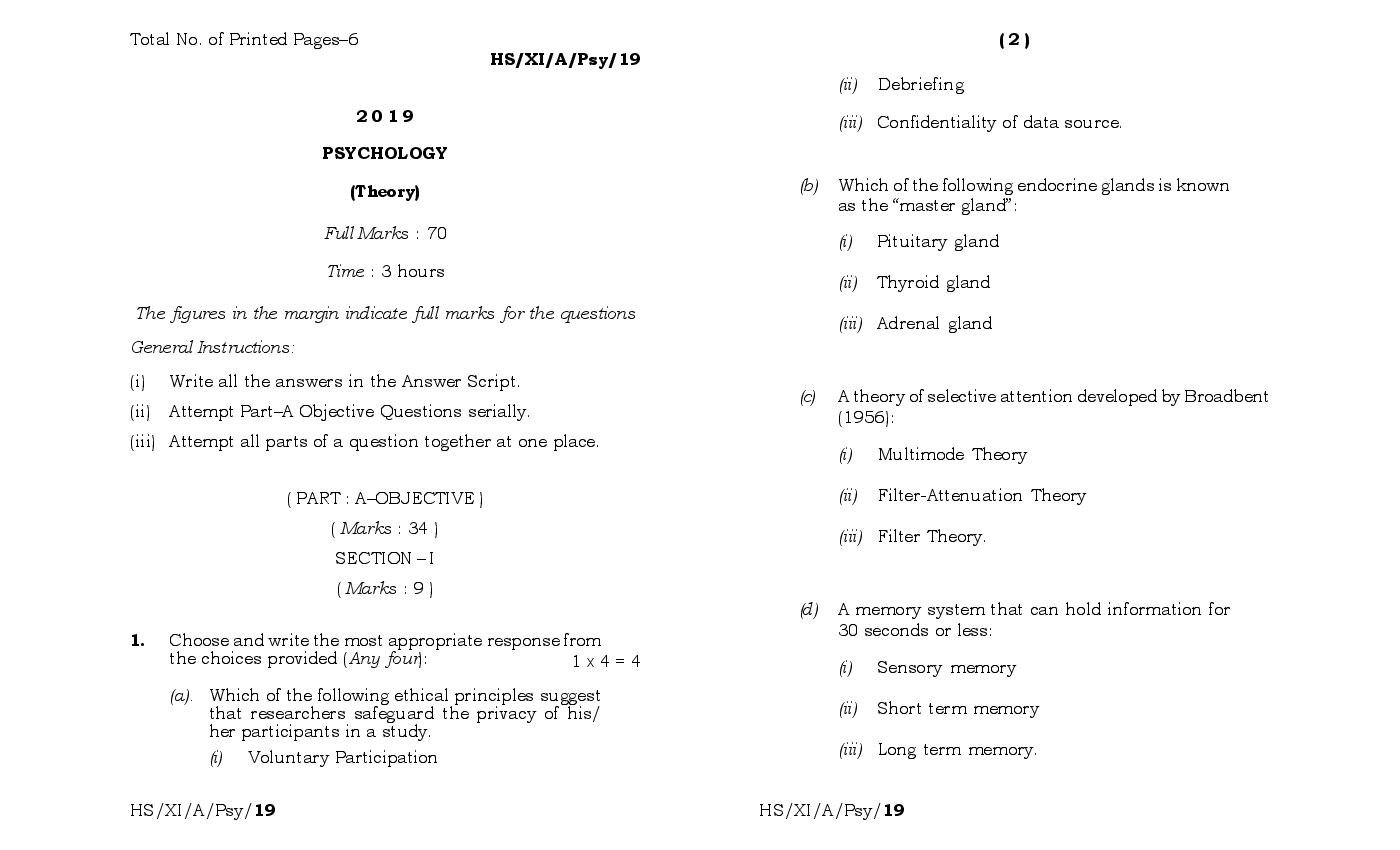
HS/XI/A/Psy/19
(ii) Debriefing
2019 (iii) Confidentiality of data source.
PSYCHOLOGY
(Theory) (b) Which of the following endocrine glands is known
as the “master gland”:
Full Marks : 70
(i) Pituitary gland
Time : 3 hours
(ii) Thyroid gland
The figures in the margin indicate full marks for the questions
(iii) Adrenal gland
General Instructions:
(i) Write all the answers in the Answer Script.
(c) A theory of selective attention developed by Broadbent
(ii) Attempt Part–A Objective Questions serially. (1956):
(iii) Attempt all parts of a question together at one place.
(i) Multimode Theory
( PART : A–OBJECTIVE ) (ii) Filter-Attenuation Theory
( Marks : 34 )
(iii) Filter Theory.
SECTION – I
( Marks : 9 )
(d) A memory system that can hold information for
30 seconds or less:
1. Choose and write the most appropriate response from
the choices provided (Any four): 1x4=4 (i) Sensory memory
(a). Which of the following ethical principles suggest
that researchers safeguard the privacy of his/ (ii) Short term memory
her participants in a study.
(i) Voluntary Participation (iii) Long term memory.
HS/XI/A/Psy/19 HS/XI/A/Psy/19
Page 2
(e) The ability to produce many ideas for a given task or (b) What is Perception?
a problem is
(c) What is Thinking?
(i) Fluency
(ii) Flexibility (d) What is Biological Motivation?
(iii) Originality.
(e) What are Emotions?
2. Indicate whether the following statements are ‘True’
or ‘False’: 1x5=5 SECTION – III
( Marks : 15 )
(a) The independent variable and the dependent
variable are independent of each other.
4. Write short notes on any 5 (five) of the following.
(b) Each of our sense organ is known as a sense
3 x 5 = 15
modality.
(a) Participant observation as a method used in
(c) Behavioural changes that occur due to learning psychological studies.
are temporary.
(b) Objectivity in psychological testing.
(d) The kind of reasoning that begins with an
assumption is called deductive reasoning. (c) Meaning of Human Development as a process.
(e) Emotions do not have physiological bases.
(d) Features of learning.
(e) Chunking.
SECTION – II
( Marks : 10 ) (f) Obstacles to solving problems.
3. Answer the following questions in 2 or 3 sentences
(g) Differences between primary reinforcers and
only. 2 x 5 = 10
secondary reinforcers.
(a) What do you understand by the term ‘Behaviour’?
HS/XI/A/Psy/19 HS/XI/A/Psy/19
Page 3
PART B – DESCRIPTIVE (e) What is memory? Explain the concept of
encoding, storage and retrieval in memory.
( Marks : 36 )
5. Answer the following questions in 2 – 3 paragraphs. Or
4 x 6 = 24 What is forgetting? Describe Ebbinghaus’s Curve
(a) Briefly explain any 4(four) control techniques of forgetting.
used by experimenters to control extraneous
variables in experimental studies.
Or (f) Explain anxiety as a negative emotion. What are
some of the ways of managing anxiety?
What is a variable? Explain briefly with the help
of examples the two types of variables used in Or
experimental studies. What are positive emotions? Describe the various
ways for enhancing positive emotions.
(b) Briefly explain how moral development takes
place in children. 6. Answer the following questions in 200 words: 6 x 2 = 12
Or (a) Elucidate the evolution of psychology from any 3
Describe Bronfenbrenner’s contextual view of (three) perspectives. 6
development.
Or
Describe any 4 (four) psychological attributes on
(c) Briefly explain how expectations and cultural the basis of which individuals vary from each
background influence our perceptions. other. 6
Or
What is selective attention? Describe the Filter
Theory of selective attention. (b) Distinguish between Enculturation and
Socialisation. 3+3=6
Or
(d) Distinguish between relational style of learning
and analytical style of learning. What is a cerebral cortex? Describe in brief the
Or functions of the four lobes of the cerebral cortex.
2+4=6
Distinguish between classical conditioning and
operant conditioning.
HS/XI/A/Psy/19 HS/XI/A/Psy/19
Document Details
| Board / Org | Meghalaya Board |
| Exam | Class 11 |
| Type | Question Paper |
| Pages | 3 |
| Updated | 30 Apr 2026 |