MBOSE Class 11 Question Paper 2019 for Sociology
Finished viewing? Save it for later —
Download MBOSE Class 11 Question Paper 2019 for Sociology (PDF · 4 pages)About MBOSE Class 11 Question Paper 2019 for Sociology
MBOSE Class 11 Question Paper 2019 for Sociology is available here for free download. Published by Meghalaya Board for Class 11, this question paper can be viewed online or downloaded as a PDF (4 pages). Candidates preparing for Class 11 can use MBOSE Class 11 Question Paper 2019 for Sociology to understand the exam pattern, the type of questions asked, and the overall difficulty level.
Frequently Asked Questions
How can I download MBOSE Class 11 Question Paper 2019 for Sociology?
Open this page and click the Download button to save MBOSE Class 11 Question Paper 2019 for Sociology as a PDF. It is completely free on AglaSem Docs.
Is MBOSE Class 11 Question Paper 2019 for Sociology free to download?
Yes. MBOSE Class 11 Question Paper 2019 for Sociology can be viewed online and downloaded as a PDF free of cost on AglaSem Docs.
How many pages does MBOSE Class 11 Question Paper 2019 for Sociology have?
MBOSE Class 11 Question Paper 2019 for Sociology contains 4 pages, which you can read online or download together as a single PDF.
Where can I find more Class 11 study material?
You can find more Class 11 question papers, sample papers, syllabus, and answer keys on AglaSem Docs.
MBOSE Class 11 Question Paper 2019 for Sociology – Text
Read the full text of this question paper below — useful to quickly search, copy and reference the content online without downloading the PDF.
📄 View text version (4 pages)
Page 1
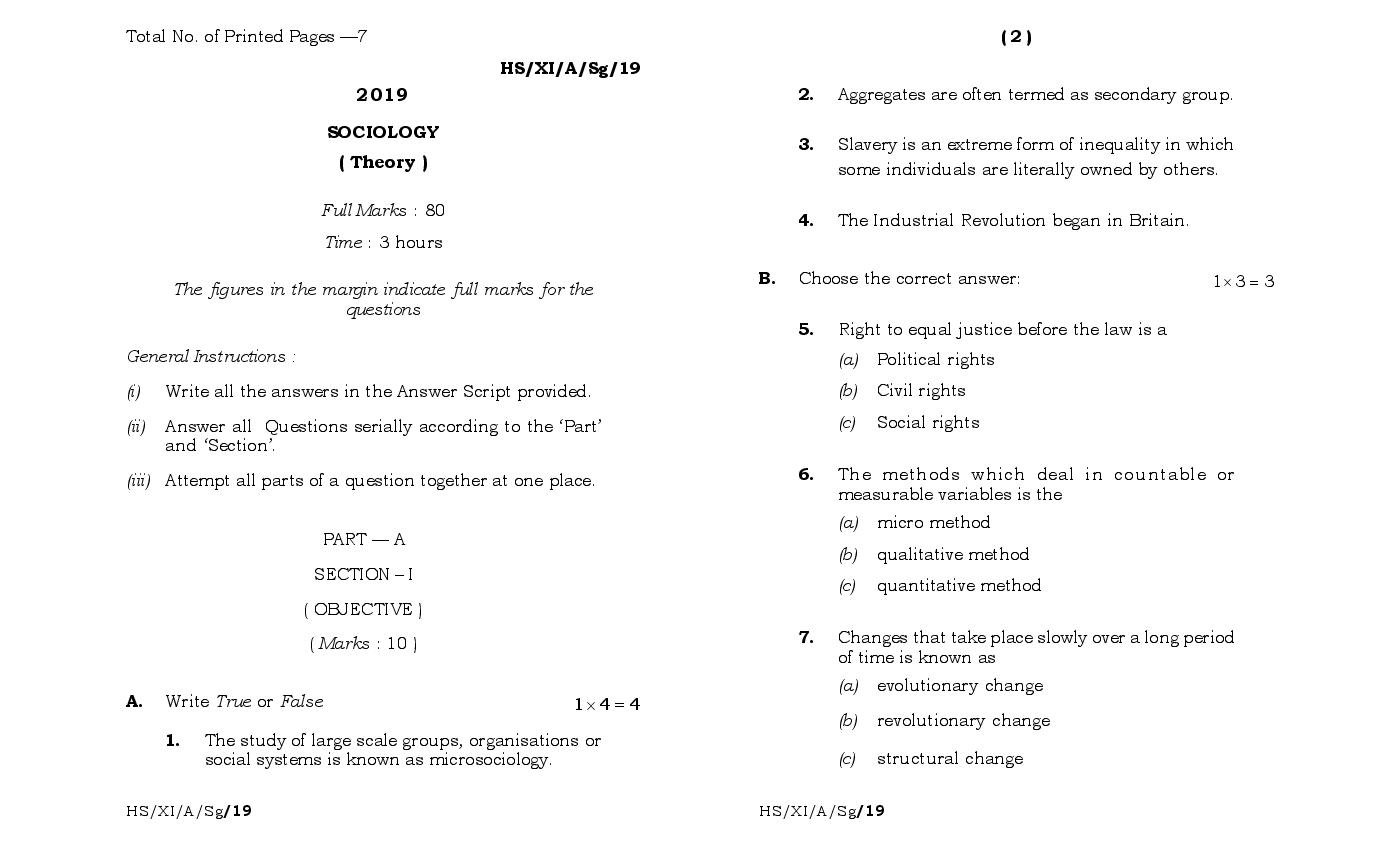
2019 2. Aggregates are often termed as secondary group.
SOCIOLOGY
3. Slavery is an extreme form of inequality in which
( Theory ) some individuals are literally owned by others.
Full Marks : 80
4. The Industrial Revolution began in Britain.
Time : 3 hours
B. Choose the correct answer: 1 3 3
The figures in the margin indicate full marks for the
questions
5. Right to equal justice before the law is a
General Instructions : (a) Political rights
(i) Write all the answers in the Answer Script provided. (b) Civil rights
(ii) Answer all Questions serially according to the ‘Part’ (c) Social rights
and ‘Section’.
(iii) Attempt all parts of a question together at one place. 6. The methods which deal in countable or
measurable variables is the
(a) micro method
PART –– A
(b) qualitative method
SECTION – I
(c) quantitative method
( OBJECTIVE )
( Marks : 10 ) 7. Changes that take place slowly over a long period
of time is known as
(a) evolutionary change
A. Write True or False 1 4 4
(b) revolutionary change
1. The study of large scale groups, organisations or
social systems is known as microsociology. (c) structural change
Page 2
C. Fill in the blanks : 1 3 3 4. What is the relationship between sociology and social
anthropology?
8. groups are friendship groups of children 5. Explain the term objectivity and subjectivity in
of a similar age. sociology.
6. What is social change?
9. like society is a term used frequently and
sometimes vaguely. 7. Define authority according to Max Weber.
8. What are the different stages of human society
10. The kin who are related through blood are called according to Karl Marx?
.
9. What is living tradition according to D.P. Mukherji?
SECTION – I I
SECTION – I I I
( VERY SHORT ANSWER )
( SHORT ANSWER )
( Marks : 18 )
( Marks : 28 )
Answer the following questions in not more than five
sentences each. 2 9 18
Answer the following questions in not more
than six sentences each. 4 7 28
1. Define bureaucracy.
1. Why is sociology sometimes called the child of the age
of revolution? 4
2. What are the characteristics that all religions seem to
share?
2. (a) What are the different uses of genetic modification? 4
3. What is serial monogamy? Or
Page 3
(b) What are the three basic forms of advantages PART –– B
which privileged people may enjoy. 4
( DESCRIPTIVE )
3. What are the characteristics of a social group? 4 ( Marks : 24 )
Answer the following questions : 6 4 24
4. (a) What is the difference between ethnocentrism and
cosmopolitanism? 4
1. (a) Explain the features of caste according to
Or G.S. Ghurye. 6
Or
(b) Explain the two types of social control. 4
(b) Discuss the concept of village according to Srinivas. 6
5. What are the two concepts which are critical to the
understanding of political institution? 4
2. (a) Explain the three dimensions of culture. 6
Or
6. Differentiate between role conflict and role
stereotyping. 4
(b) Explain Darwin’s theory of social change. 6
7. (a) Explain the ideal type as a methodological tool
3. (a) What are the weaknesses of participant
for doing sociology according to Max Weber 4
observation? 6
Or Or
(b) What are the sources or causes of social change?
(b) Write a note on water pollution. 4
Explain them. 6
HS/XI/A/Sg/19 HS/XI/A/Sg/19
Page 4
4. Read the following passage carefully and answer the
questions given below: 6
The concept of competition often proceed with
the idea that competition is universal and natural. In
the contemporary world, however, competition is the
dominant norm and practice. Classical social thinkers
such as Emile Durkheim and Karl Marx have noted
the growth of individualism and competition
respectively in modern societies. Both developments
are intrinsic to the way modern capitalist society
functions. The stress is on greater efficiency and greater
profit maximisation. The underlying assumption of
capitalism are expansion of trade, division of labour,
specialisation and hence rising productivity. And these
processes of self-sustaining growth are fuelled by the
central theme of capitalism : rational individuals in
free competition in the market place, each striving to
maximise profits. The ideology of competition is the
dominant ideology in capitalism. The logic of this
ideology is that the market operates in a manner that
ensures greatest efficiency.
1. What did Karl Marx note in the modern societies? 1
2. What is the function of modern capitalist society? 1
3. What are the underlying assumption of
capitalism? 1
4. What contributes to the processes of self -
sustaining growth? 1
5. What is the central theme of capitalism? 1
6. What is the logic of capitalism? 1
Document Details
| Board / Org | Meghalaya Board |
| Exam | Class 11 |
| Type | Question Paper |
| Pages | 4 |
| Updated | 30 Apr 2026 |