GATE 2018 Biochemistry(XL-Q) Question Paper with Answer
Finished viewing? Save it for later —
Download GATE 2018 Biochemistry(XL-Q) Question Paper with Answer (PDF · 10 pages)About GATE 2018 Biochemistry(XL-Q) Question Paper with Answer
GATE 2018 Biochemistry(XL-Q) Question Paper with Answer is available here for free download. Published by IIT for Graduate Aptitude Test in Engineering, this question paper can be viewed online or downloaded as a PDF (10 pages). Candidates preparing for Graduate Aptitude Test in Engineering can use GATE 2018 Biochemistry(XL-Q) Question Paper with Answer to understand the exam pattern, the type of questions asked, and the overall difficulty level.
Frequently Asked Questions
How can I download GATE 2018 Biochemistry(XL-Q) Question Paper with Answer?
Open this page and click the Download button to save GATE 2018 Biochemistry(XL-Q) Question Paper with Answer as a PDF. It is completely free on AglaSem Docs.
Is GATE 2018 Biochemistry(XL-Q) Question Paper with Answer free to download?
Yes. GATE 2018 Biochemistry(XL-Q) Question Paper with Answer can be viewed online and downloaded as a PDF free of cost on AglaSem Docs.
How many pages does GATE 2018 Biochemistry(XL-Q) Question Paper with Answer have?
GATE 2018 Biochemistry(XL-Q) Question Paper with Answer contains 10 pages, which you can read online or download together as a single PDF.
Where can I find more Graduate Aptitude Test in Engineering study material?
You can find more Graduate Aptitude Test in Engineering question papers, sample papers, syllabus, and answer keys on AglaSem Docs.
GATE 2018 Biochemistry(XL-Q) Question Paper with Answer – Text
Read the full text of this question paper below — useful to quickly search, copy and reference the content online without downloading the PDF.
📄 View text version (10 pages)
Page 1
Q. 1 – Q. 10 carry one mark each & Q.11 - Q.20 carry two marks each.
Q.1 To which one of the following classes of enzymes does chymotrypsin belong?
(A) Oxidoreductase (B) Hydrolase (C) Transferase (D) Isomerase
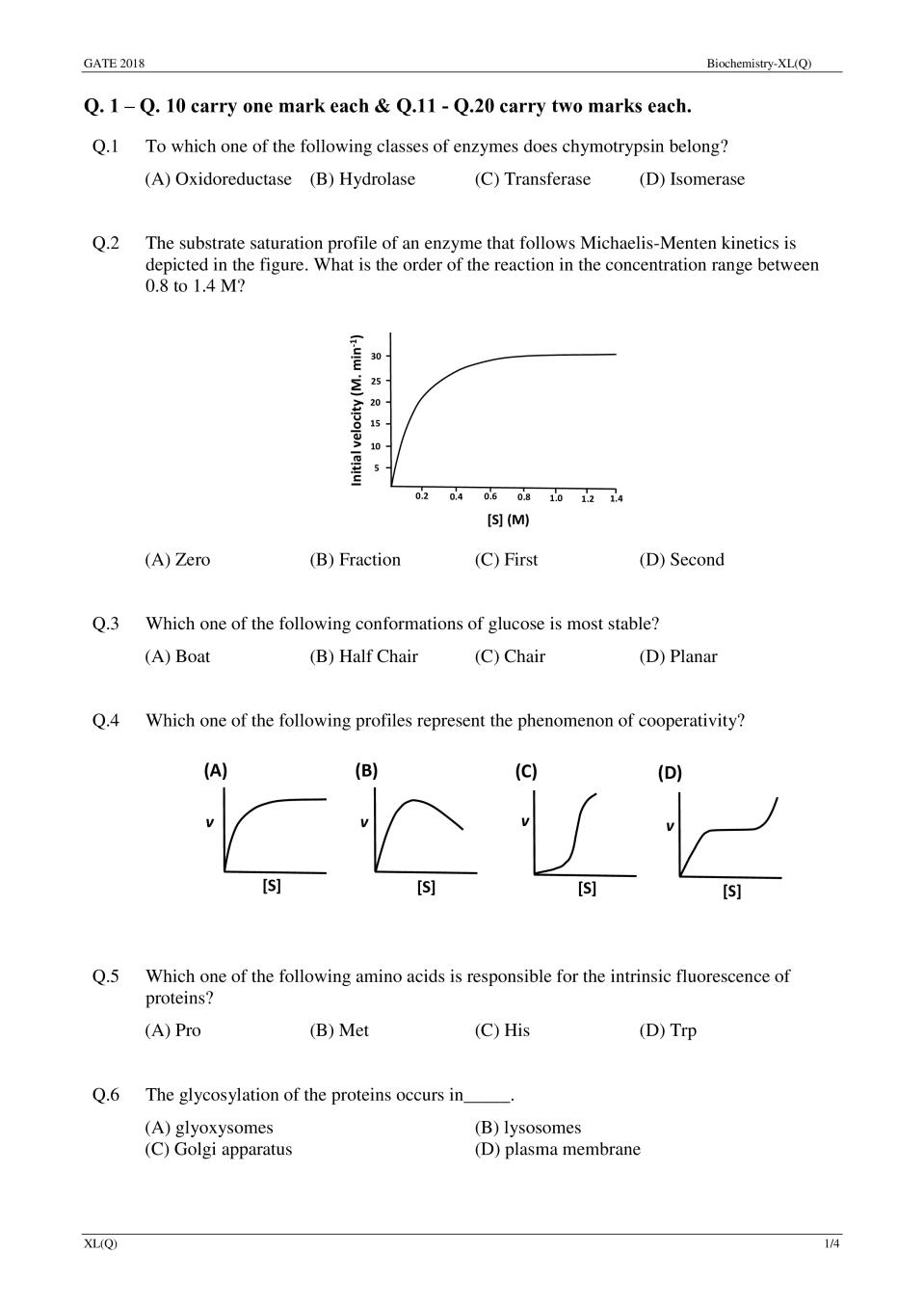
Q.2 The substrate saturation profile of an enzyme that follows Michaelis-Menten kinetics is
depicted in the figure. What is the order of the reaction in the concentration range between
0.8 to 1.4 M?
Initial velocity (M. min-1) 30
25
20
15
10
5
0.2 0.4 0.6 0.8 1.0 1.2 1.4
[S] (M)
(A) Zero (B) Fraction (C) First (D) Second
Q.3 Which one of the following conformations of glucose is most stable?
(A) Boat (B) Half Chair (C) Chair (D) Planar
Q.4 Which one of the following profiles represent the phenomenon of cooperativity?
(A) (B) (C) (D)
v v v v
[S] [S] [S] [S]
Q.5 Which one of the following amino acids is responsible for the intrinsic fluorescence of
proteins?
(A) Pro (B) Met (C) His (D) Trp
Q.6 The glycosylation of the proteins occurs in_____.
(A) glyoxysomes (B) lysosomes
(C) Golgi apparatus (D) plasma membrane
XL(Q) 1/4
Page 2
Q.7 Which one of the following properties of the myeloma cells is used in the hybridoma
technology to generate monoclonal antibody?
(A) lack of thymidylate synthase
(B) over-expression of hypoxanthine-guanine phosphoribosyl transferase
(C) over-expression of inosine 5´-monophosphate cyclohydrolase
(D) lack of hypoxanthine-guanine phosphoribosyl transferase
Q.8 The movement of protons through the FoF1-ATPase during mitochondrial respiration is
required for ____
(A) the increase in pH of mitochondrial matrix.
(B) changing the conformation of FoF1-ATPase to expel the ATP.
(C) importing Pi from inter membrane space.
(D) decreasing the affinity of ADP to FoF1-ATPase.
Q.9 The number of NADP+ molecules required to completely oxidize one molecule of glucose
to CO2 through pentose phosphate pathway is ____ (correct to integer number).
Q.10 Measurement of the absorbance of a solution containing NADH in a path length of 1cm
cuvette at 340 nm shows the value of 0.31. The molar extinction coefficient of NADH is
6200 M-1 cm-1. The concentration of NADH in the solution is ___ µM (correct to integer
number).
Q. 11 – Q. 20 carry two marks each.
Q.11 Among the reagents given below which one of the combination of reagents will NOT
break the disulphide bonds in the immunoglobulin molecules?
(P) Reduced glutathione (Q) Dithiothritol
(R) Sodium dodecyl sulphate (S) Methionine
(A) R&S (B) P&R (C) P&S (D) Q&R
Q.12 Match the protein elution condition given in Group I with the appropriate chromatography
matrices from Group II.
Group I Group II
P Increasing concentration of sodium chloride i Phenyl-Sepharose
Q Increasing concentration of histidine ii Chromatofocusing
R Decreasing concentration of ammonium sulphate iii DEAE-Sephacryl
S Decreasing concentration of H+ iv Ni-NTA
(A) P-iii; Q-iv; R-i; S-ii (B) P-ii; Q-iv; R-i; S-iii
(C) P-i; Q-ii; R-iii; S-iv (D) P- iv; Q-ii; R-iii; S-i
XL(Q) 2/4
Page 3
Q.13 Which one of the following is NOT a neurotransmitter?
(A) Adrenaline (B) Glutamate (C) Histamine (D) Histidine
Q.14 The type-II hypersensitivity reaction is mainly mediated by____.
(A) IgE (B) IgM (C) IgA (D) T cells
Q.15 Which one the following reaction mechanisms drives the conversion of low energy 3-
phosphoglyceraldehyde to high energy 1,3-bisphosphoglycerate?
(A) Oxidation without anhydride bond formation
(B) Oxidation coupled with anhydride bond formation
(C) Substrate level phosphorylation
(D) Formation of carboxylate
Q.16 A polymerase reaction is carried out for 10 cycles in a volume of 1 ml with 5 molecules of
template DNA. Assuming that the efficiency of the reaction is 100 %, the number of
molecules of DNA present in 100 l at the end of the reaction is ___ (correct to integer
number).
Q.17 The secondary structure topology diagram of 400 amino acid long “Protein-X” is depicted
in the figure. The start and end amino acid residue numbers of each -helix are marked.
The percentage (correct to integer number) of residues forming -helix is____.
21 70 225 249 320 324
1
N -helix -helix -helix 400
C
Q.18 An enzyme follows Michaelis-Menten kinetics with substrate S. The fraction of the
maximum velocity (Vmax) will be observed with the substrate concentration [S] = 4Km is
_____ (correct to one decimal place). (Km is Michaelis-Menten constant)
Q.19 The mass spectrum of benzoic acid will generate the fragment as a base peak (100%
relative abundance) of m/z (mass to charge ratio) at ____ (correct to integer number).
XL(Q) 3/4
Page 4
Q.20 The standard free energyG´) values of reactions catalyzed by citrate lyase and citrate
synthetase are -670 and -8192 cal/mol, respectively.
Citrate lyase
Citrate Acetate + Oxaloacetate G1´ = -670 cal/mole
Citrate synthetase
Acetyl-CoA + Oxaloacetate + H2O Citrate + CoA G2´ = -8192 cal/mole
The standard free energy (in cal/mol) of acetyl-CoA hydrolysis is ___ (correct to integer
number).
END OF THE QUESTION PAPER
XL(Q) 4/4
Page 5
1 MCQ GA A 1
2 MCQ GA C 1
3 MCQ GA B 1
4 MCQ GA B 1
5 MCQ GA B 1
6 MCQ GA A 2
7 MCQ GA D 2
8 MCQ GA D 2
9 MCQ GA B 2
10 MCQ GA C 2
1 MCQ XL‐P A 1
2 MCQ XL‐P D 1
3 MCQ XL‐P D 1
4 NAT XL‐P 11 to 11 1
5 NAT XL‐P 4 to 4 1
6 MCQ XL‐P D 2
7 MCQ XL‐P D 2
8 MCQ XL‐P A 2
9 MCQ XL‐P D 2
10 MCQ XL‐P A 2
11 MCQ XL‐P C 2
12 MCQ XL‐P B 2
13 NAT XL‐P 1.39 to 1.43 2
Page 6
14 NAT XL‐P 7.39 to 7.54 2
15 NAT XL‐P ‐13.40 to ‐13.36 2
1 MCQ XL‐Q B 1
2 MCQ XL‐Q A 1
3 MCQ XL‐Q C 1
4 MCQ XL‐Q C 1
5 MCQ XL‐Q D 1
6 MCQ XL‐Q C 1
7 MCQ XL‐Q D 1
8 MCQ XL‐Q B 1
9 NAT XL‐Q 12 to 12 1
10 NAT XL‐Q 50 to 50 1
11 MCQ XL‐Q A 2
12 MCQ XL‐Q A 2
13 MCQ XL‐Q D 2
14 MCQ XL‐Q B 2
15 MCQ XL‐Q B 2
16 NAT XL‐Q 512 to 512 2
17 NAT XL‐Q 20 to 20 2
18 NAT XL‐Q 0.8 to 0.8 2
19 NAT XL‐Q 77 to 77 2
20 NAT XL‐Q ‐8862 to ‐8862 2
1 MCQ XL‐R A 1
Page 7
2 MCQ XL‐R B 1
3 MCQ XL‐R C 1
4 MCQ XL‐R D 1
5 MCQ XL‐R B 1
6 MCQ XL‐R C 1
7 MCQ XL‐R A 1
8 MCQ XL‐R A 1
9 MCQ XL‐R B 1
10 NAT XL‐R 28.00 to 31.00 1
11 MCQ XL‐R D 2
12 MCQ XL‐R D 2
13 MCQ XL‐R C 2
14 MCQ XL‐R B 2
15 MCQ XL‐R C 2
16 MCQ XL‐R D 2
17 MCQ XL‐R A 2
18 MCQ XL‐R B 2
19 NAT XL‐R 20.25 to 20.25 2
20 NAT XL‐R 11.00 to 12.00 2
1 MCQ XL‐S B 1
2 MCQ XL‐S A 1
3 MCQ XL‐S A 1
4 MCQ XL‐S D 1
Page 8
5 MCQ XL‐S D 1
6 MCQ XL‐S C 1
7 MCQ XL‐S D 1
8 MCQ XL‐S B 1
9 MCQ XL‐S A 1
10 NAT XL‐S 1.38 to1.42 1
11 MCQ XL‐S C 2
12 MCQ XL‐S C 2
13 MCQ XL‐S A 2
14 MCQ XL‐S D 2
15 MCQ XL‐S B 2
16 MCQ XL‐S A 2
17 NAT XL‐S 2.60 to 2.80 2
18 NAT XL‐S 0.5 to 0.5 2
19 NAT XL‐S 45.50 to 46.50 2
20 NAT XL‐S 30.5 to 31.5 2
1 MCQ XL‐T C 1
2 MCQ XL‐T B 1
3 MCQ XL‐T A 1
4 MCQ XL‐T D 1
5 MCQ XL‐T C 1
6 MCQ XL‐T D 1
7 MCQ XL‐T B 1
Page 9
8 MCQ XL‐T A 1
9 MCQ XL‐T A 1
10 MCQ XL‐T C 1
11 MCQ XL‐T B 2
12 MCQ XL‐T D 2
13 MCQ XL‐T C 2
14 MCQ XL‐T C 2
15 MCQ XL‐T B 2
16 MCQ XL‐T D 2
17 MCQ XL‐T C 2
18 MCQ XL‐T A 2
19 NAT XL‐T 5270 to 5310 2
20 NAT XL‐T 0.056 to 0.062 2
1 MCQ XL‐U B 1
2 MCQ XL‐U A 1
3 MCQ XL‐U C 1
4 MCQ XL‐U A 1
5 MCQ XL‐U D 1
6 MCQ XL‐U D 1
7 NAT XL‐U 1.55 to 1.65 1
8 NAT XL‐U 103.0 to 103.2 1
9 NAT XL‐U 54 to 56 1
10 NAT XL‐U 0 to 0 1
Page 10
11 MCQ XL‐U B 2
12 MCQ XL‐U C 2
13 MCQ XL‐U C 2
14 MCQ XL‐U A 2
15 MCQ XL‐U D 2
16 MCQ XL‐U A 2
17 MCQ XL‐U B 2
18 NAT XL‐U 9.8 to 10.2 2
19 NAT XL‐U 1.1 to 1.8 2
20 NAT XL‐U 10 to 10 2
Document Details
| Board / Org | IIT |
| Exam | Graduate Aptitude Test in Engineering |
| Type | Question Paper |
| Pages | 10 |
| Updated | 30 Apr 2026 |