UGC NET 2021 Question Paper Archaeology Shift 2
Finished viewing? Save it for later —
Download UGC NET 2021 Question Paper Archaeology Shift 2 (PDF · 55 pages)About UGC NET 2021 Question Paper Archaeology Shift 2
UGC NET 2021 Question Paper Archaeology Shift 2 is available here for free download. Published by NTA for UGC NET, this question paper can be viewed online or downloaded as a PDF (55 pages). Candidates preparing for UGC NET can use UGC NET 2021 Question Paper Archaeology Shift 2 to understand the exam pattern, the type of questions asked, and the overall difficulty level.
Frequently Asked Questions
How can I download UGC NET 2021 Question Paper Archaeology Shift 2?
Open this page and click the Download button to save UGC NET 2021 Question Paper Archaeology Shift 2 as a PDF. It is completely free on AglaSem Docs.
Is UGC NET 2021 Question Paper Archaeology Shift 2 free to download?
Yes. UGC NET 2021 Question Paper Archaeology Shift 2 can be viewed online and downloaded as a PDF free of cost on AglaSem Docs.
How many pages does UGC NET 2021 Question Paper Archaeology Shift 2 have?
UGC NET 2021 Question Paper Archaeology Shift 2 contains 55 pages, which you can read online or download together as a single PDF.
Where can I find more UGC NET study material?
You can find more UGC NET question papers, sample papers, syllabus, and answer keys on AglaSem Docs.
UGC NET 2021 Question Paper Archaeology Shift 2 – Text
Read the full text of this question paper below — useful to quickly search, copy and reference the content online without downloading the PDF.
📄 View text version (55 pages)
Page 1
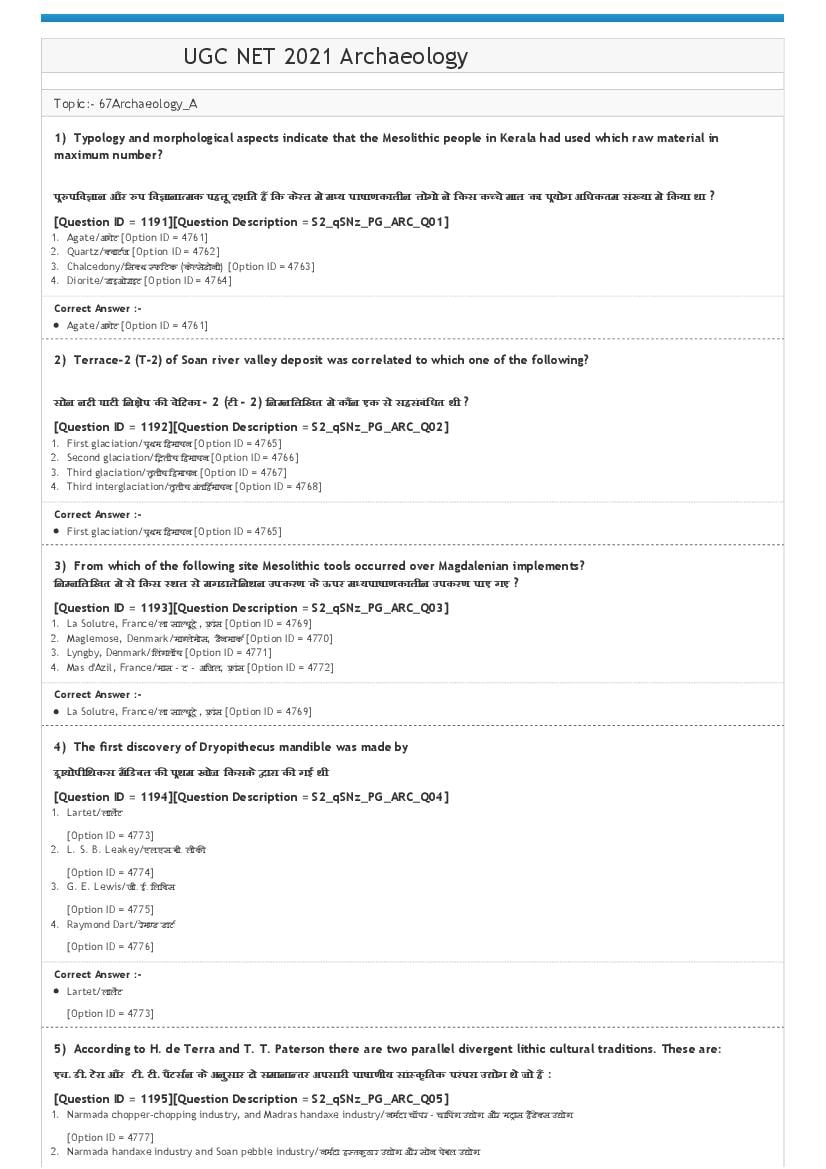
Topic:‐ 67Archaeology_A
1) Typology and morphological aspects indicate that the Mesolithic people in Kerala had used which raw material in
maximum number?
प पिव ान और प िव ाना मक पहलू दशाते ह िक केरल म म य पाषाणकालीन लोग ने िकस क चे माल का पयोग अिधकतम सं या म िकया था ?
[Question ID = 1191][Question Description = S2_qSNz_PG_ARC_Q01]
1. Agate/अगेट [Option ID = 4761]
2. Quartz/ वाटज [Option ID = 4762]
3. Chalcedony/िस थ फिटक (के सेडोनी) [Option ID = 4763]
4. Diorite/डाइओराइट [Option ID = 4764]
Agate/अगेट [Option ID = 4761]
2) Terrace‐2 (T‐2) of Soan river valley deposit was correlated to which one of the following?
सोन नदी घाटी िन ेप क वेिदका ‐ 2 (टी ‐ 2) िन निलिखत म कौन एक से सहसंबंिधत थी ?
[Question ID = 1192][Question Description = S2_qSNz_PG_ARC_Q02]
1. First glaciation/पथम िहमायन [Option ID = 4765]
2. Second glaciation/ि तीय िहमायन [Option ID = 4766]
3. Third glaciation/तृतीय िहमायन [Option ID = 4767]
4. Third interglaciation/तृतीय अंतिहमायन [Option ID = 4768]
First glaciation/पथम िहमायन [Option ID = 4765]
3) From which of the following site Mesolithic tools occurred over Magdalenian implements?
िन निलिखत म से िकस थल से मगडालेिनथन उपकरण के ऊपर म यपाषाणकालीन उपकरण पाए गए ?
[Question ID = 1193][Question Description = S2_qSNz_PG_ARC_Q03]
1. La Solutre, France/ला सा यूटे , ांस [Option ID = 4769]
2. Maglemose, Denmark/मा लेमोस, डैनमाक [Option ID = 4770]
3. Lyngby, Denmark/िलंगलॉय [Option ID = 4771]
4. Mas d'Azil, France/मास ‐ द ‐ अिजल, ांस [Option ID = 4772]
La Solutre, France/ला सा यूटे , ांस [Option ID = 4769]
4) The first discovery of Dryopithecus mandible was made by
डायोपीिथकस मिडबल क पथम खोज िकसके ारा क गई थी
[Question ID = 1194][Question Description = S2_qSNz_PG_ARC_Q04]
1. Lartet/लालट
[Option ID = 4773]
2. L. S. B. Leakey/एल.एस.बी. लीक
[Option ID = 4774]
3. G. E. Lewis/जी. ई. िलिवस
[Option ID = 4775]
4. Raymond Dart/रेम ड डाट
[Option ID = 4776]
Lartet/लालट
[Option ID = 4773]
5) According to H. de Terra and T. T. Paterson there are two parallel divergent lithic cultural traditions. These are:
एच. डी. टेरा और टी. टी. पैटसन के अनुसार दो समाना तर अपसारी पाषाणीय सां कृितक परंपरा उ ोग थे जो है :
[Question ID = 1195][Question Description = S2_qSNz_PG_ARC_Q05]
1. Narmada chopper‐chopping industry, and Madras handaxe industry/नमदा चॉपर ‐ चािपंग उ ोग और मदास हडे स उ ोग
[Option ID = 4777]
2. Narmada handaxe industry and Soan pebble industry/नमदा ह तकुठार उ ोग और सोन पेबल उ ोग
Page 2
3. Narmada handaxe industry and Brahmagiri stone axe industry/नमदा ह तकुठार उ ोग और ब िग र पाषाण कुठार उ ोग सोन पेबल उ ोग और मदास ह त कुठार उ ोग
[Option ID = 4779]
4. Soan pebble industry and Madras handaxe industry/सोन पेबल और मदास ह त कुठार
[Option ID = 4780]
Narmada chopper‐chopping industry, and Madras handaxe industry/नमदा चॉपर ‐ चािपंग उ ोग और मदास हडे स उ ोग
[Option ID = 4777]
6) The first discovery of a Neolithic celt from Kerala was made by:
केरल के नवपाषाणकालीन कु हाड़ी के पथम खोज िकसने क थी :
[Question ID = 1196][Question Description = S2_qSNz_PG_ARC_Q06]
1. K. R. U. Todd/के.आर.यू. टॉड [Option ID = 4781]
2. P. Rajendran/पी. राजे दन [Option ID = 4782]
3. Philip Lake/िफिलप लेक [Option ID = 4783]
4. Thomas Kunnikal/थॉमस कि नकल [Option ID = 4784]
K. R. U. Todd/के.आर.यू. टॉड [Option ID = 4781]
7) Which one of the following industries was the first European industries of the upper palaeolithic?
िन निलिखत म कौन सा एक उ ोग उ च ‐ पुरापाषाण काल के यूरोप का पथम उ ोग है ?
[Question ID = 1197][Question Description = S2_qSNz_PG_ARC_Q07]
1. Aurignacian/ऑंरी नेिशयन [Option ID = 4785]
2. Perigordian/पेरीगािडयन [Option ID = 4786]
3. Solutrean/सॉ युिटयन [Option ID = 4787]
4. Magdalenian/मगदालेिनयन [Option ID = 4788]
Aurignacian/ऑंरी नेिशयन [Option ID = 4785]
8) The first phase of the culture at Chopani Mando is:
चोपानी मा डो क सं कृित का पथम चरण है :
[Question ID = 1198][Question Description = S2_qSNz_PG_ARC_Q08]
1. Middle Palaeolithic/म य पुरापाषािणक [Option ID = 4789]
2. Early Upper Palaeolithic/पारि भक उ च पुरापाषािणक [Option ID = 4790]
3. Epipalaeolithic/अनु पुरापाषािणक [Option ID = 4791]
4. Mesolithic/म य पुरापाषािणक [Option ID = 4792]
Middle Palaeolithic/म य पुरापाषािणक [Option ID = 4789]
9) Middle Palaeolithic site of Baidha is located on
बैधा का म य पुरापाषािणक थल कहाँ पर अवि थत है ?
[Question ID = 1199][Question Description = S2_qSNz_PG_ARC_Q09]
1. Adwa river/अदवा नदी पर [Option ID = 4793]
2. Tons river/टो स नदी पर [Option ID = 4794]
3. Son river/सोन नदी पर [Option ID = 4795]
4. Gopad river/गोपद नदी पर [Option ID = 4796]
Adwa river/अदवा नदी पर [Option ID = 4793]
10) Preservation of fossilized tree fragments at a Lower Palaeolithic site has been reported at:
एक िन न पुरापाषािणक थल से संरि त जीवाि मत वृ का पता चला है :
[Question ID = 1200][Question Description = S2_qSNz_PG_ARC_Q10]
1. Paisra/पैसरा से [Option ID = 4797]
2. Sihawal I/िसहावल ‐ I से [Option ID = 4798]
3. Durkadi/दुरकदी से [Option ID = 4799]
4. Chirki/िचक से [Option ID = 4800]
Paisra/पैसरा से [Option ID = 4797]
11) The stratigraphic sequence at Patne in northern Maharashtra is as:
Page 3
[Question ID = 1201][Question Description = S2_qSNz_PG_ARC_Q11]
1. Lower Palaeolithic, Middle Palaeolithic, Mesolithic/िन न ‐ पुरापाषाणकाल, म य ‐ पुरापाषाणकाल, म य ‐ पाषाण काल [Option ID = 4801]
2. Lower Palaeolithic, Upper Palaeolithic, Mesolithic/िन न ‐ पुरापाषाणकाल, उ च ‐ पुरापाषाणकाल, म यपाषाण काल [Option ID = 4802]
3. Middle Palaeolithic, Early Upper Palaeolithic, Late Upper Palaeolithic and Mesolithic/म य ‐ पुरापाषाणकाल, आरंिभक उ च पुरापाषाणकाल, उ र उ च पुरापाषाण काल
और म य ‐ पाषाण काल [Option ID = 4803]
4. Middle Palaeolithic, Late Upper Palaeolithic, Mesolithic/म य ‐ पुरापाषाणकाल, उ र उ च पुरापाषाणकाल, म य ‐ पाषाण काल [Option ID = 4804]
Lower Palaeolithic, Middle Palaeolithic, Mesolithic/िन न ‐ पुरापाषाणकाल, म य ‐ पुरापाषाणकाल, म य ‐ पाषाण काल [Option ID = 4801]
12) Hokra is a Lower and Middle Palaeolithic site located in:
होकरा, एक िन न और म य पुरापाषाण कालीन थल अवि थत है :
[Question ID = 1202][Question Description = S2_qSNz_PG_ARC_Q12]
1. Madhya Pradesh/म यपदेश म [Option ID = 4805]
2. Rajasthan/राज थान म [Option ID = 4806]
3. Maharashtra/महारा म [Option ID = 4807]
4. Uttar Pradesh/उ रपदेश म [Option ID = 4808]
Madhya Pradesh/म यपदेश म [Option ID = 4805]
13) Bed and Cemented Gravel I of the Seoti, a tributary of Belan is significant for
सेवती नदी जो बेलन क सहायक नदी है, के तल और ग ेवेल पथम का जमाव इसके िलए मह वपूण है :
[Question ID = 1203][Question Description = S2_qSNz_PG_ARC_Q13]
1. Handaxes made on flat chunks/िचपटे चंक पर बने ह तकुठार
[Option ID = 4809]
2. Chopper and Chopping tools/चॉपर और चॉिपंग उपकरण
[Option ID = 4810]
3. Levalloisian flakes/लेवल
े ोिसयन फलक
[Option ID = 4811]
4. Upper Palaeolithic tools/उ च पुरापाषाण कालीन उपकरण
[Option ID = 4812]
Handaxes made on flat chunks/िचपटे चंक पर बने ह तकुठार
[Option ID = 4809]
14) Archaeological deductions were made from the study of which tribe at Paisra?
पैसरा म िकस जनजाित के अ ययन से पुराताि वक िन कष िनकाले गये ?
[Question ID = 1204][Question Description = S2_qSNz_PG_ARC_Q14]
1. Bhils/भील [Option ID = 4813]
2. Kodas/कोडास [Option ID = 4814]
3. Chenchus/च चु [Option ID = 4815]
4. Musahars/मुसहर [Option ID = 4816]
Bhils/भील [Option ID = 4813]
15) A distinctive pottery associated with the growth of towns, trade and metallic currency in northern India in the middle
of the first millennium B.C. is:
उ री भारत म पहली शह ताि द ई. पू. के म य म क ब ; यापार और धातुमदु ां म बुि के साथ िविश मृदभा ड संबंध रखते ह ?
[Question ID = 1205][Question Description = S2_qSNz_PG_ARC_Q15]
1. Black on Red ware/काले और लाल पात परंपरा [Option ID = 4817]
2. Ochre coloured Pottery/गे ए रंग के मृदभा ड [Option ID = 4818]
3. Painted Grey Ware/िचितत ‐ धूसर पात परंपरा [Option ID = 4819]
4. Northern Black Polished Ware/उ री कृ ण मािजत पात परंपरा [Option ID = 4820]
Black on Red ware/काले और लाल पात परंपरा [Option ID = 4817]
Page 4
िन निलिखत सं कृितय म से कौन सी लौह उपकरण और काले और लाल पात परंपरा के इ तेमाल ारा िवशेषीकृत है?
[Question ID = 1206][Question Description = S2_qSNz_PG_ARC_Q16]
1. Ochre Coloured Pottery culture/गे ए रंग के मृदभा ड सं कृित [Option ID = 4821]
2. Painted Grey Ware culture/िचितत ‐ धूसर पात परंपरा सं कृित [Option ID = 4822]
3. Megalithic culture/महापाषाण कालीन सं कृित [Option ID = 4823]
4. Rangmahal culture/रंगमहल सं कृित [Option ID = 4824]
Ochre Coloured Pottery culture/गे ए रंग के मृदभा ड सं कृित [Option ID = 4821]
17) A row of 'seven alters' has been found in the citadel at which of the following Harappan sites?
िन निलिखत िकस हड़ पा थल के दुग त ं प ा हए ह ?
े से एक पंि म सात अि नकुड
[Question ID = 1207][Question Description = S2_qSNz_PG_ARC_Q17]
1. Lothal/लोथल [Option ID = 4825]
2. Kalibangan/कालीबंगा [Option ID = 4826]
3. Dholavira/धौलावीरा [Option ID = 4827]
4. Banawali/बनावली [Option ID = 4828]
Lothal/लोथल [Option ID = 4825]
18) In India, Arretine ware was for the first time, discovered at:
भारत म अरेटाइन मृदभा ड सवपथम कहाँ खोजा गया था ?
[Question ID = 1208][Question Description = S2_qSNz_PG_ARC_Q18]
1. Kanchipuram/कांचीपुरम
[Option ID = 4829]
2. Arikamedu/अ रकामेडू
[Option ID = 4830]
3. Salihundam/सालीहड़ं म
[Option ID = 4831]
4. Uraiyur/उरैयरु
[Option ID = 4832]
Kanchipuram/कांचीपुरम
[Option ID = 4829]
19) In south India, which one of the following Ages emerged straight from the Neolithic stage?
दि ण भारत म िन निलिखत िकस काल से नवपाषाण चरण से सीधे अि त व म आया?
[Question ID = 1209][Question Description = S2_qSNz_PG_ARC_Q19]
1. Bronze Age/काँ य युग [Option ID = 4833]
2. Chalcolithic Age/ताम ‐ पाषाण युग [Option ID = 4834]
3. Iron Age/लौह ‐ युग [Option ID = 4835]
4. Sangam Age/संगम युग [Option ID = 4836]
Bronze Age/काँ य युग [Option ID = 4833]
20) Which technology was primarily responsible for the growth of Second Urbanization in the Ganga Plain?
गंगा के मैदान म ि तीय नगरीकरण के िवकास म कौन ‐ सी तकनीक पमुख प से उ रदायी थी ?
[Question ID = 1210][Question Description = S2_qSNz_PG_ARC_Q20]
1. Stone technology/पाषाण तकनीक [Option ID = 4837]
2. Copper technology/ताम तकनीक [Option ID = 4838]
3. Iron technology/लौह तकनीक [Option ID = 4839]
4. Chalcolithic technology/ताम पाषािणक तकनीक [Option ID = 4840]
Stone technology/पाषाण तकनीक [Option ID = 4837]
21) Which of the following objects usually bear the Harappan script?
िन निलिखत िकस व तु पर हड़ पा िलिप का अंकन है ?
[Question ID = 1211][Question Description = S2_qSNz_PG_ARC_Q21]
Page 5
2. Bricks/ईट [Option ID = 4842]
3. Seals/मुहर [Option ID = 4843]
4. Metal images/धातु क मूितयाँ [Option ID = 4844]
Stone images/प तर िचन [Option ID = 4841]
22) The stone bust of a male figure found at Mohenjodaro has been labelled:
मोहनजोदड़ो से पा पाषाण का पु ष आकृित का धड़ िकसका है ?
[Question ID = 1212][Question Description = S2_qSNz_PG_ARC_Q22]
1. Priest‐King/पुरोिहत ‐ राजा [Option ID = 4845]
2. Proto Shiva/पाकू ‐ िशव [Option ID = 4846]
3. Pashupati/पशुपित [Option ID = 4847]
4. Purander/पुरदं र [Option ID = 4848]
Priest‐King/पुरोिहत ‐ राजा [Option ID = 4845]
23) Which of the following materials has been used for making the sculpture of King/Priest found at Harappa?
हड़ पा म पाये गये राजा / पुजारी क मूित के िलए िकस सामगी का पयोग िकया गया ?
[Question ID = 1213][Question Description = S2_qSNz_PG_ARC_Q23]
1. Copper/ताँबा
[Option ID = 4849]
2. Steatite/सेलखड़ी
[Option ID = 4850]
3. Faience/फयॉ स
[Option ID = 4851]
4. Stone/प थर
[Option ID = 4852]
Copper/ताँबा
[Option ID = 4849]
24) Silver makes its earliest appearance in India in which of the following cultures?
िन निलिखत म िकस सं कृित म चाँदी का आिवभाव िमलता है ?
[Question ID = 1214][Question Description = S2_qSNz_PG_ARC_Q24]
1. Neolithic culture/नवपाषाण कालीन सं कृित [Option ID = 4853]
2. Harappan culture/हड़ पा सं कृित [Option ID = 4854]
3. Chalcolithic culture/तामपाषािणक सं कृित [Option ID = 4855]
4. Vedic culture/वैिदक सं कृित [Option ID = 4856]
Neolithic culture/नवपाषाण कालीन सं कृित [Option ID = 4853]
25) Two fine silver seals with a unicorn motif were discovered at:
ं ी पतीक क दो चांदी क सु दर मुहर िमली ह?
िन निलिखत म से िकस पुरा थल से एकशृग
[Question ID = 1215][Question Description = S2_qSNz_PG_ARC_Q25]
1. Harappa/हड़ पा [Option ID = 4857]
2. Mohenjodaro/मोहनजोदड़ो [Option ID = 4858]
3. Dholavira/धौलावीरा [Option ID = 4859]
4. Kalibangan/कालीबंगा [Option ID = 4860]
Harappa/हड़ पा [Option ID = 4857]
26) Which of the following cities was a thriving centre of Indo‐Roman trade?
िन निलिखत नगर म कौन सा नगर इंडो ‐ रोमन यापार का बड़ा कद था ?
[Question ID = 1216][Question Description = S2_qSNz_PG_ARC_Q26]
1. Korkai/करकैई [Option ID = 4861]
2. Madurai/मदुरई [Option ID = 4862]
3. Arikamedu/अ रकामेडू [Option ID = 4863]
4. Kaveripattinam/कावेरी प नम [Option ID = 4864]
Page 6
27) Where is the site of Adam located?
अदम नामक पुरा थल कहां ि थत है ?
[Question ID = 1217][Question Description = S2_qSNz_PG_ARC_Q27]
1. Rajasthan/राज थान [Option ID = 4865]
2. Gujrat/गुजरात [Option ID = 4866]
3. Maharashtra/महारा [Option ID = 4867]
4. Uttar Pradesh/उ र पदेश [Option ID = 4868]
Rajasthan/राज थान [Option ID = 4865]
28) At which one of the following sites was the Painted Grey Ware noticed first?
िन निलिखत पुरा थल म से कहाँ सबसे पहले िचितत ‐ धूषर मृदभा ड पाया गया था ?
[Question ID = 1218][Question Description = S2_qSNz_PG_ARC_Q28]
1. Atranjikhera/अतरंजीखेड़ा [Option ID = 4869]
2. Ahichchhatra/अिहछत [Option ID = 4870]
3. Bhagwanpura/भगवानपुरा [Option ID = 4871]
4. Jakhera/जखेड़ा [Option ID = 4872]
Atranjikhera/अतरंजीखेड़ा [Option ID = 4869]
29) Who among the following was the first to issue Silver Coins in Western India?
िन निलिखत म से िकसने पि मी भारत म पहली बार चाँदी के िस के जारी िकए ?
[Question ID = 1219][Question Description = S2_qSNz_PG_ARC_Q29]
1. Kumaragupta l/कुमारगु I [Option ID = 4873]
2. Skandagupta/ कंदगु [Option ID = 4874]
3. Chandragupta ll/च द गु II [Option ID = 4875]
4. Bhanugupta/भानुगु [Option ID = 4876]
Kumaragupta l/कुमारगु I [Option ID = 4873]
30) Who among the following fixed the last nail on the theory that wanted to prove the indebtedness of India to Babylon
and Persia for the earliest system of coinage?
िन निलिखत म से िकसने उस िस ांत पर अंितम क ल ठोक जो भारत क पाचीनतम िस का पणाली के िलए उसे बेिबलोन और पिसया का ऋणी सािबत करना
चाहता था :
[Question ID = 1220][Question Description = S2_qSNz_PG_ARC_Q30]
1. A. S. Altekar/ए. एस. अ टेकर [Option ID = 4877]
2. E. Thomas/ई. थॉमस [Option ID = 4878]
3. D. R. Bhandarkar/डी,आर, भंडारकर [Option ID = 4879]
4. E. J. Rapson/ई. जे. रैपसन [Option ID = 4880]
A. S. Altekar/ए. एस. अ टेकर [Option ID = 4877]
31) Which one of the following makes reference to the Asvamedha sacrifice?
िन निलिखत म से िकसम अ मेघ य का उ लेख है ?
[Question ID = 1221][Question Description = S2_qSNz_PG_ARC_Q31]
1. Besnagar Garuda Pillar Inscription/बेसनगर ग ड़ त भ अिभलेख [Option ID = 4881]
2. Nasik cave Inscription of Usavadatta/उसवद का नािसक अिभलेख [Option ID = 4882]
3. Ayodhya Stone Inscription of Dhanadeva/धनदेव का अयो या प तर अिभलेख [Option ID = 4883]
4. Allahabad Stone Pillar Inscription of Samudragupta/समुदगु का इलाहाबाद प तर त भ अिभलेख [Option ID = 4884]
Besnagar Garuda Pillar Inscription/बेसनगर ग ड़ त भ अिभलेख [Option ID = 4881]
Page 7
िन निलिखत म से कौन ‐ सा भारत का पाचीनतम सं कृत अिभलेख है ?
[Question ID = 1222][Question Description = S2_qSNz_PG_ARC_Q32]
1. Ayodhya Stone Inscription of Dhanadeva/धनदेव का अयो या प तर आलेख [Option ID = 4885]
2. Junagarh Rock Inscription of Rudradamana/ ददामन का जूनागढ़ िशलालेख [Option ID = 4886]
3. Andric Stone Inscription of the reign of Rudradamana l/ ददामन I के शासन के अंडास प तर अिभलेख [Option ID = 4887]
4. Allahabad Stone Pillar Inscription of Samudragupta/समुदगु के इलाहाबाद प तर त भ [Option ID = 4888]
Ayodhya Stone Inscription of Dhanadeva/धनदेव का अयो या प तर आलेख [Option ID = 4885]
33) Who among the following had discovered Nickel in the coins of Indo‐Greek Kings Euthydemus, Agathocles, and
Pantaleon?
िन निलिखत म िकस ने इ डोगीक राजाओं युथीडेमंस, अगाथोि लया और पटािलयोन के िस क म िनकेल धातु का पता लगाया ?
[Question ID = 1223][Question Description = S2_qSNz_PG_ARC_Q33]
1. Percy Brown/पस बाउन [Option ID = 4889]
2. John Allan/जॉन अलान [Option ID = 4890]
3. Alexander Cunningham/अले जडर किनंघम [Option ID = 4891]
4. W. R. Sehroff/ड यू. आर. शॉफ [Option ID = 4892]
Percy Brown/पस बाउन [Option ID = 4889]
34) Which of the following inscriptions makes first reference to zero?
िन निलिखत म से िकस िशलालेख म पथम बार शू य का उ लेख िमलता है ?
[Question ID = 1224][Question Description = S2_qSNz_PG_ARC_Q34]
1. Gwalior stone Inscription of Mihirkula/िमिहरकल के वािलयर पाषाण अिभलेख [Option ID = 4893]
2. Two inscriptions of Vailla Bhatta Swami Temple of Gwalior/ वािलयर म वैल भ वामी मंिदर के दो अिभलेख [Option ID = 4894]
3. Gwalior stone inscription of Mihirbhoja/िमिहरभोज के वािलयर पाषाण अिभलेख [Option ID = 4895]
4. Baraha Copper Plate Inscription of Mihirbhoja/िमिहरभोज के बाराह ताम पत अिभलेख [Option ID = 4896]
Gwalior stone Inscription of Mihirkula/िमिहरकल के वािलयर पाषाण अिभलेख [Option ID = 4893]
35) Which Ashokan rock‐edict gives the details of Kalinga War ?
िन निलिखत म से कौन ‐सा िशलालेख किलंग यु का िववरण देता है ?
[Question ID = 1225][Question Description = S2_qSNz_PG_ARC_Q35]
1. XIII
[Option ID = 4897]
2. VI
[Option ID = 4898]
3. II
[Option ID = 4899]
4. I
[Option ID = 4900]
XIII
[Option ID = 4897]
36) To which sect does Ashoka dedicate the cave cut at Barabar hill, near Gaya.
अशोक ने गया के नजदीक बराबर पहाड़ी म कटी गुफा को िकस संपदाय को समिपत िकया है :
[Question ID = 1226][Question Description = S2_qSNz_PG_ARC_Q36]
1. Jains/जैन [Option ID = 4901]
2. Buddhist/बौ [Option ID = 4902]
3. Ajivikas/आजीिवका [Option ID = 4903]
4. Hindu/िह दू [Option ID = 4904]
Jains/जैन [Option ID = 4901]
37) The famous temple at Modhera is dedicated to which deity?
मोढेरा का पिस मंिदर िन निलिखत म से िकस देवता को समिपत है ?
Page 8
1. Brahma/ब ा [Option ID = 4905]
2. Vishnu/िव णु [Option ID = 4906]
3. Surya/सूय [Option ID = 4907]
4. Siva/िशव [Option ID = 4908]
Brahma/ब ा [Option ID = 4905]
38) The Ajanta caves in Maharashtra are dedicated to which religious sect?
महारा म अज ता क गुफाएँ िन निलिखत म से िकस धािमक स पदाय को समिपत ह ?
[Question ID = 1228][Question Description = S2_qSNz_PG_ARC_Q38]
1. Hindu/िह दू [Option ID = 4909]
2. Jains/जैन [Option ID = 4910]
3. Ajivikas/आजीिवका [Option ID = 4911]
4. Buddhist/बौ [Option ID = 4912]
Hindu/िह दू [Option ID = 4909]
39) Who is the author of the famous book, Man Makes Himself?
'मैन मे स िहमसे फ' नामक पिस पु तक का लेखक कौन है ?
[Question ID = 1229][Question Description = S2_qSNz_PG_ARC_Q39]
1. David. L. Clark/डेिवड एल लाक
[Option ID = 4913]
2. A. H. Longhurst/ए. एच. लॉंगह ट
[Option ID = 4914]
3. Gordon Childe/गॉडन चाइ ड
[Option ID = 4915]
4. Graham Clark/गाहम लाक
[Option ID = 4916]
David. L. Clark/डेिवड एल लाक
[Option ID = 4913]
40) Organic materials like charcoal, wood, seeds, plant remains, charred bones, etc. recovered from excavations can be
dated using which method?
खुदाई से पा जैिवक ‐ उ पाद जैसे चारकोल, लकड़ी, बीज, पौधे अवशेष, जली हई हि डय इ यािद का िकस िविध का पयोग करते हए ितिथ िनधारण कर सकते ह
?
[Question ID = 1230][Question Description = S2_qSNz_PG_ARC_Q40]
1. Dendrochronology/डडोकोनोलॉजी [Option ID = 4917]
2. Potassium‐Argon/पोटेिशयम ‐ आगन [Option ID = 4918]
3. Fission track/िफजन ट ैक [Option ID = 4919]
4. Carbon‐14/काबन ‐ 14 [Option ID = 4920]
Dendrochronology/डडोकोनोलॉजी [Option ID = 4917]
41) Which of the following methods are related to absolute dating?
A. Radio Carbon Year Before Present (RCYBP)
B. Fluorine absorption
C. Accelerator Mass Spectrometry (AMS)
D. Obsidian Hydration Dating (DHD)
Choose the correct answer from the options given below:
िन निलिखत म कौन सी िविध िनरपे ितिथ िनधारण (डेिटंग) से संबंिधत है ?
A. रेिडयो काबन ईयर िबफोर पेजट (आर सी वाई बी पी)
Page 9
C. ऐ सीलरेटर मास पे टोमेटो (ए एम एस)
D. ऑ सीिडयन हाइडेशन डेिटंग (ओ एच डी)
नीचे िदए गए िवक प म से सही उ र चुन :
[Question ID = 1231][Question Description = S2_qSNz_PG_ARC_Q41]
1. A, B and C only/केवल A, B और C
[Option ID = 4921]
2. A, B and D only/केवल A, B और D
[Option ID = 4922]
3. B, C and D only/केवल B, C और D
[Option ID = 4923]
4. A, C and D only/केवल A, C और D
[Option ID = 4924]
A, B and C only/केवल A, B और C
[Option ID = 4921]
42) From which of the following mesolithic sites shallow querns and rubbers have been found but no plant remains have as
yet been recovered?
A. Bagor
B. Langhnaj
C. Tilwara
D. Adamgarh
Choose the correct answer from the options given below:
िन निलिखत िकस म यपाषािणक थल से िछछले िसल और लोढ़ा / घषक पाये गए ह लेिकन पौधा अवशेष नह पाया गया है :
A. बागोर
B. लंघनाज
C. ितलवारा
D. आदमगढ़
नीचे िदए गए िवक प म से सही उ र चुन :
[Question ID = 1232][Question Description = S2_qSNz_PG_ARC_Q42]
1. A and B only/केवल A और B
[Option ID = 4925]
2. A and C only/केवल A और C
[Option ID = 4926]
3. A and D only/केवल A और D
[Option ID = 4927]
4. B and D only/केवल B और D
[Option ID = 4928]
A and B only/केवल A और B
[Option ID = 4925]
43) According to H. de Terra and T.T. Paterson the Soan tools obtained from the terraces of Soan valley are associated
with:
A. Abbevillian
B. Clactonian
C. Mousterian
D. Levalloisean
Choose the correct answer from the options given below:
Page 10
A. एबेिविलयन
B. कलै टोिनयन
C. मॉ टे रयन
D. लेवालोिजयन
नीचे िदए गए िवक प म से सही उ र का चयन क िजए :
[Question ID = 1233][Question Description = S2_qSNz_PG_ARC_Q43]
1. A and B only/केवल A और B [Option ID = 4929]
2. A and D only/केवल A और D [Option ID = 4930]
3. B and C only/केवल Bऔर C [Option ID = 4931]
4. B and D only/केवल B और D [Option ID = 4932]
A and B only/केवल A और B [Option ID = 4929]
44) The Bhimbetka paintings have been studied by which of the following scholars?
A. Yashodhar Mathpal
B. A.C.L Carlleyle
C. F. Fawcett
D. Erwin Neumayer
Choose the correct answer from the options given below:
िन निलिखत म से कौन ‐ से िव ान ारा भीमबेटका िचत कलाओं का अ ययन िकया जाता है ?
A. यशोधर मिहपाल
B. ए.सी. एल. कारलाइल
C. एफ. फौसेट
D. इिवन यूमेयर
नीचे िदए गए िवक प म से सही उ र का चयन क िजए :
[Question ID = 1234][Question Description = S2_qSNz_PG_ARC_Q44]
1. A and B only/केवल A और B [Option ID = 4933]
2. B and C only/केवल B और C [Option ID = 4934]
3. C and D only/केवल C और D [Option ID = 4935]
4. A and D only/केवल A और D [Option ID = 4936]
A and B only/केवल A और B [Option ID = 4933]
45) Pottery is absent at most Mesolithic sites, but it occurs at:
A. Langhnaj in Gujarat
B. Birbhanpur in West Bengal
C. Kaimur region of Mirzapur (UP)
D. Didwana in Rajasthan
Choose the correct answer from the options given below:
अिधकांश म य पाषािणक थल से मृदभांड अनुपि थत िमलते ह लेिकन यह घिटत होता है :
A. गुजरात म लंघनाज स
B. पि म बंगाल म बीरभानपुर स
C. मीरजापुर (यू, पी.) के कैमरू ेत स
D. राज थान के डीड़वाना स
नीचे िदए गए िवक प म से सही उ र का चयन क िजए :
[Question ID = 1235][Question Description = S2_qSNz_PG_ARC_Q45]
Page 11
2. A and C only/केवल A और C [Option ID = 4938]
3. A and D only/केवल A और D [Option ID = 4939]
4. B and D only/केवल B और D [Option ID = 4940]
A and B only/केवल A और B [Option ID = 4937]
46) Which of the following excavated sites are located on the banks of a dried oxbow lake, an old course of the Ganga?
A. Mahadaha
B. Bagor
C. Lekhahia
D. Damdama
Choose the correct answer from the options given below:
िन निलिखत म से कौन ‐से उ खिनत थल गंगा के पुराने माग सूखी गोखुर झील के िकनारे अवि थत है ?
A. महादहा
B. बागोर
C. लेखािहया
D. दमदमा
नीचे िदए गए िवक प म से सही उ र का चयन क िजए :
[Question ID = 1236][Question Description = S2_qSNz_PG_ARC_Q46]
1. A and B only/केवल A और B [Option ID = 4941]
2. A and D only/केवल A और D [Option ID = 4942]
3. A and C only/केवल A और C [Option ID = 4943]
4. B and C only/केवल B और C [Option ID = 4944]
A and B only/केवल A और B [Option ID = 4941]
47) Charles Darwin wrote the book/books named
A. In the Age of Mankind
B. The Descent of Man
C. On the Origin of Species
D. Climate of the past: An introduction to Palaeoclimatology
Choose the correct answer from the options given below:
चा स डािवन ने कौन सी पु तक/ पु तक िलख ?
A. इन द एज ऑफ मैन काइ ड
B. द िडसे ट ऑफ मैन
C. ऑन द ओ रिज स ऑफ पीशीज्
D. लाइमेट ऑफ द पा ट : एन इ टोड शन टू पैिलयो लाईमेटोलॉजी
नीचे िदए गए िवक प म से सही उ र का चयन क िजए :
[Question ID = 1237][Question Description = S2_qSNz_PG_ARC_Q47]
1. A and B only/केवल A और B [Option ID = 4945]
2. B and C only/केवल B और C [Option ID = 4946]
3. C and D only/केवल C और D [Option ID = 4947]
4. A and C only/केवल A और C [Option ID = 4948]
A and B only/केवल A और B [Option ID = 4945]
48) Both wild and domestic animals were found from the Mesolithic sites at:
A. Mahadaha
B. Bagor
C. Adamgarh
Page 12
Choose the correct answer from the options given below:
िन निलिखत म से कहां म यपाषािणक थल से जंगली और पालतू जानवर दोन पाए गए :
A. महदहा
B. बागोर
C. आदमगढ़
D. चोपानी मांडो
नीचे िदए गए िवक प म से सही उ र का चयन क िजए :
[Question ID = 1238][Question Description = S2_qSNz_PG_ARC_Q48]
1. A and B only/केवल A और B [Option ID = 4949]
2. B and C only/केवल B और C [Option ID = 4950]
3. C and D only/केवल C और D [Option ID = 4951]
4. A and C only/केवल A और C [Option ID = 4952]
A and B only/केवल A और B [Option ID = 4949]
49) Human skeletons of Loteshwar were buried in which condition?
A. Placed in Urn
B. Extended
C. Twin urn burial
D. Crouched
Choose the correct answer from the options given below:
लोटे र के मानव कंकाल िकस ि थित म दफनाएं गये थे ?
A. कलश म रखकर
B. िव तीण
C. ि कलश शवाधान
D. िनकुिं चत
नीचे िदए गए िवक प म से सही उ र का चयन क िजए :
[Question ID = 1239][Question Description = S2_qSNz_PG_ARC_Q49]
1. A and B only/केवल A और B [Option ID = 4953]
2. B and C only/केवल B और C [Option ID = 4954]
3. C and D only/केवल C और D [Option ID = 4955]
4. B and D only/केवल B और D [Option ID = 4956]
A and B only/केवल A और B [Option ID = 4953]
50) The human skeletons from the following sites were brought to light by Deccan College, Pune
A. Deulga Hills
B. Loteshwar
C. Apegaon
D. Baijapalle
Choose the correct answer from the options given below:
िन निलिखत िकन थल से मानव कंकाल को दे कन कॉलेज ारा पकाश म लाया गया ?
A. देउ गािह स
B. लोटे र
C. अपेगांव
D. बैजाप ले
नीचे िदए गए िवक प म से सही उ र का चयन क िजए :
Page 13
1. B and C only/केवल B और C [Option ID = 4957]
2. C and D only/केवल C और D [Option ID = 4958]
3. A and B only/केवल A और B [Option ID = 4959]
4. B and D only/केवल B और D [Option ID = 4960]
B and C only/केवल B और C [Option ID = 4957]
51) Which of the following sites are associated with the Chambal and Tapi valleys?
A. Hagda
B. Ahar
C. Savalda
D. Lothal
Choose the correct answer from the options given below:
िन न थल म से च बल व तापी घािटय के साथ कौन से थल संबंिधत ह ?
A. ना दा
B. अहार
C. सव दा
D. लोथल
नीचे िदए गए िवक प म से सही उ र का चयन क िजए :
[Question ID = 1241][Question Description = S2_qSNz_PG_ARC_Q51]
1. A and D only/केवल A और D [Option ID = 4961]
2. A and C only/केवल A और C [Option ID = 4962]
3. A and B only/केवल A और B [Option ID = 4963]
4. B and C only/केवल B और C [Option ID = 4964]
A and D only/केवल A और D [Option ID = 4961]
52) Which of the following structures are associated with Nagarjunakonda?
A. Temple of Kartikeya
B. Amphitheater
C. Stupa of Kunal
D. Temple of Shiva
Choose the correct answer from the options given below:
िन निलिखत म से कौन ‐ सी संरचनाएं नागाजुनको डा स संबंिधत ह ?
A. काितकेय का मंिदर
B. ए पीिथयेटर
C. कुनाल का तूप
D. िशव मंिदर
नीचे िदए गए िवक प म से सही उ र का चयन क िजए :
[Question ID = 1242][Question Description = S2_qSNz_PG_ARC_Q52]
1. A and B only/केवल A और B [Option ID = 4965]
2. B and C only/केवल B और C [Option ID = 4966]
3. C and D only/केवल C और D [Option ID = 4967]
4. A and D only/केवल A और D [Option ID = 4968]
A and B only/केवल A और B [Option ID = 4965]
53) Which of the following indicators is used to know the buried features of the soil in photographs?
A. Monuments
B. Water basins
Page 14
D. Crop marks
Choose the correct answer from the options given below:
िन निलिखत म कौन संकत
े क ह िजनसे आकाशीय छायांकन ारा िम ी के नीचे दबी िवशेषताओं को जाना जा सकता है ?
A. मारक
B. जल ‐ नाद
C. छाया िच
D. फसल के िच
नीचे िदए गए िवक प म से सही उ र का चयन क िजए :
[Question ID = 1243][Question Description = S2_qSNz_PG_ARC_Q53]
1. A and B only/केवल A और B [Option ID = 4969]
2. B and C only/केवल B और C [Option ID = 4970]
3. C and D only/केवल C और D [Option ID = 4971]
4. A and D only/केवल A और D [Option ID = 4972]
A and B only/केवल A और B [Option ID = 4969]
54) Which of the following structural remains belong to the site of Kausambi?
A. Warehouse
B. Ghositarma monastery
C. Shyenchiti
D. Stone well
Choose the correct answer from the options given below:
िन निलिखत म कौन ‐ सी संरचनाएँ कौशा बी पुरा थल से संबंिधत है ?
A. गोदाम
B. घोिषताराम िवहार
C. यनिचित
D. प तर िनिमत कुआं
नीचे िदए गए िवक प म से सही उ र का चयन क िजए :
[Question ID = 1244][Question Description = S2_qSNz_PG_ARC_Q54]
1. A and B only/केवल A और B [Option ID = 4973]
2. B and C only/केवल B और C [Option ID = 4974]
3. C and D only/केवल C और D [Option ID = 4975]
4. A and D only/केवल A और D [Option ID = 4976]
A and B only/केवल A और B [Option ID = 4973]
55) Which of the following are the features of early historical period?
A. Punch marked coins
B. Potin coins
C. Russet coated ware
D. Northern Black Polished Ware
Choose the correct answer from the options given below:
िन निलिखत म से कौन ‐ सी िवशेषताएँ पारि भक ऐितहािसक काल से संबंिधत है ?
A. आहत िस क
B. पोटीन के िस क
C. रसेटकोटेड मृदभा ड
D. उ री कृ णमािजत मृदभा ड
Page 15
[Question ID = 1245][Question Description = S2_qSNz_PG_ARC_Q55]
1. A and B only/केवल A और B [Option ID = 4977]
2. B and C only/केवल B और C [Option ID = 4978]
3. C and D only/केवल C और D [Option ID = 4979]
4. A and D only/केवल A और D [Option ID = 4980]
A and B only/केवल A और B [Option ID = 4977]
56) Which of the following structures are located at Sirkap city site (Taxila)?
A. Jandial temple
B. Dharmarajika stupa
C. Temple of Hariti
D. Temple of Shiva
Choose the correct answer from the options given below:
िन निलिखत म से कौन ‐ सी संरचनाएँ िसरकप (त िशला) नगर पुरा थल म ि थत ह ?
A. जंिडयाल मंिदर
B. धमरािजका तूप
C. ह रित का मंिदर
D. िशव मंिदर
नीचे िदए गए िवक प म से सही उ र का चयन क िजए :
[Question ID = 1246][Question Description = S2_qSNz_PG_ARC_Q56]
1. A and B only/केवल A और B [Option ID = 4981]
2. B and C only/केवल B और C [Option ID = 4982]
3. C and D only/केवल C और D [Option ID = 4983]
4. A and D only/केवल A और D [Option ID = 4984]
A and B only/केवल A और B [Option ID = 4981]
57) Early Satavahana king Satakarni is mentioned in epigraphs from these sites
A. Bhaja
B. Naneghat
C. Hatigumpha
D. Sanchi
Choose the correct answer from the options given below:
पारंिभक सातवाहन शासक शतकण पुरािभलेख म इन थल पर अिभलेिखत ह :
A. भाजा
B. नानाघाट
C. हातीगु फा
D. साँची
नीचे िदए गए िवक प म से सही उ र का चयन क िजए :
[Question ID = 1247][Question Description = S2_qSNz_PG_ARC_Q57]
1. A and D only/केवल A और D [Option ID = 4985]
2. B and C only/केवल B और C [Option ID = 4986]
3. B, C and D only/केवल B, C और D [Option ID = 4987]
4. A and B only/केवल A और B [Option ID = 4988]
A and D only/केवल A और D [Option ID = 4985]
58) Which were the sites that were excavated by Mortimer Wheeler?
A. Brahmagiri
Page 16
C. Arikamedu
D. Charsadda
Choose the correct answer from the options given below:
िन निलिखत म से िकन ‐ िकन थल क खुदाई मौिटमर हीलर ारा करायी गई ?
A. जहािगरी
B. अमरावती
C. अ रकामेडु
D. चरस ा
नीचे िदए गए िवक प म से सही उ र का चयन क िजए :
[Question ID = 1248][Question Description = S2_qSNz_PG_ARC_Q58]
1. A, B and C only/केवल A, B और C [Option ID = 4989]
2. A, C and D only/केवल A, C और D [Option ID = 4990]
3. A and C only/केवल A और C [Option ID = 4991]
4. A and D only/केवल A और D [Option ID = 4992]
A, B and C only/केवल A, B और C [Option ID = 4989]
59) Which of the following sites have temples dedicated to Surya or Sun god?
A. Marthand
B. Mahabalipuram
C. Modhera
D. Konark
Choose the correct answer from the options given below:
सूय देवता को समिपत मंिदर िन निलिखत म से कहां है :
A. मात ड
B. महाबलीपुरम्
C. मोदेरा
D. कोणाक
नीचे िदए गए िवक प म से सही उ र का चयन क िजए :
[Question ID = 1249][Question Description = S2_qSNz_PG_ARC_Q59]
1. A, B and C only/केवल A, B और C [Option ID = 4993]
2. A and D only/केवल A और D [Option ID = 4994]
3. B and C only/केवल B और C [Option ID = 4995]
4. A, C and D only/केवल A, C और D [Option ID = 4996]
A, B and C only/केवल A, B और C [Option ID = 4993]
60) At which of the following sites have the Ashokan capital with four lions seated back to back been found?
A. Sanchi
B. Vaishali
C. Nandangarh
D. Sarnath
Choose the correct answer from the options given below:
अशोक तंभ शीष िजसे पर चार शेर एक दूसरे क ओर पीठ िकए हए बैठे ह, कहाँ से पाये गये ह ?
A. साँची
B. वैशाली
C. नंदनगढ़
Page 17
नीचे िदए गए िवक प म से सही उ र का चयन क िजए :
[Question ID = 1250][Question Description = S2_qSNz_PG_ARC_Q60]
1. A and D only/केवल A और D [Option ID = 4997]
2. A, B and D only/केवल A, B और D [Option ID = 4998]
3. A, B, C and D/A, B, C और D [Option ID = 4999]
4. C and D only/केवल C और D [Option ID = 5000]
A and D only/केवल A और D [Option ID = 4997]
61) Which of the following places have yielded Ayagpattas?
A. Amravati
B. Kankali Tila
C. Gandhara
D. Bharhuta
Choose the correct answer from the options given below:
िन निलिखत म से िकस थान से 'अयागप ' पा हआ है
A. अमरावती
B. कंकालीटीला
C. गांधार
D. भारहत
नीचे िदए गए िवक प म से सही उ र चुन :
[Question ID = 1251][Question Description = S2_qSNz_PG_ARC_Q61]
1. A and D only/केवल A और D [Option ID = 5001]
2. B and D only/केवल B और D [Option ID = 5002]
3. A and C only/केवल A और C [Option ID = 5003]
4. B and C only/केवल B और C [Option ID = 5004]
A and D only/केवल A और D [Option ID = 5001]
62) Which two of the following inscriptions make reference to Nahapana?
A. Andhau stone Inscription of the reign of Rudradamana
B. Nasik Cave Inscription of Usavadatta (Regnal year 45)
C. Nasik Cave Inscription of Gautami Balasri
D. Nasik Cave Inscription of Usavadatta (Regnal year 42)
Choose the correct answer from the options given below:
िन निलिखत म से िकन अिभलेख म नहपाण का उ लेख है ?
A. ददामन I के शासन का अंडास िशलािभलेख
B. उसवद का नािसक गुहा अिभलेख
C. गौतमी बालाशी का नािसक गुहा अिभलेख
D. उसवद का नािसक गुहा अिभलेख (रा य वष 42)
नीचे िदए गए िवक प म से सही उ र का चयन क िजए :
[Question ID = 1252][Question Description = S2_qSNz_PG_ARC_Q62]
1. A and D only/केवल A और D [Option ID = 5005]
2. B and D only/केवल B और D [Option ID = 5006]
3. C and D only/केवल C और D [Option ID = 5007]
4. B and C only/केवल B और C [Option ID = 5008]
A and D only/केवल A और D [Option ID = 5005]
63) Who among the following Gupta Kings had issued silver coins?
Page 18
B. Kumaragupta l
C. Samudragupta
D. Chandragupta ll
Choose the correct answer from the options given below:
िन निलिखत म से गु काल के िकस राजा ने चाँदी के िस के जारी िकए थे ?
A. च दगु I
B. कुमारगु I
C. समुदगु
D. च दगु II
नीचे िदए गए िवक प म से सही उ र का चयन क िजए :
[Question ID = 1253][Question Description = S2_qSNz_PG_ARC_Q63]
1. A and D only/केवल A और D [Option ID = 5009]
2. B and D only/केवल B और D [Option ID = 5010]
3. A and C only/केवल A और C [Option ID = 5011]
4. C and D only/केवल C और D [Option ID = 5012]
A and D only/केवल A और D [Option ID = 5009]
64) Which two among the following inscriptions are Saivite?
A. Karamdanda stone Inscription of the time of Kumaragupta l
B. Besnagar Pillar Inscription of Heliodorus
C. Thiruvalangadu Copper Plate Inscription of Rajendra Chola
D. Bhore State Museum Plate Inscription of Dharavarsa Dhruvaraja
Choose the correct answer from the options given below:
िन निलिखत म से कौन से दो अिभलेख शैव परंपरा के ह :
A. कुमारगु I का करमदेड़ा तंभ अिभलेख
B. हेिलयोडोरस का बेसनगर तंभ अिभलेख
C. राजे द चोल का िथ वालंगाडू तामपत अिभलेख
D. धारवष धव
ु राज के भोर टेट युिजयम पत
नीचे िदए गए िवक प म से सही उ र का चयन क िजए :
[Question ID = 1254][Question Description = S2_qSNz_PG_ARC_Q64]
1. A and B only/केवल A और B [Option ID = 5013]
2. B and D only/केवल B और D [Option ID = 5014]
3. A and C only/केवल A और C [Option ID = 5015]
4. C and D only/केवल C और D [Option ID = 5016]
A and B only/केवल A और B [Option ID = 5013]
65) Ashokan inscriptions have been found in which of the following scripts?
A. Greek
B. Kharoshti
C. Prakrit
D. Aramic
Choose the correct answer from the options given below:
िन निलिखत िलिपय म अशोक के अिभलेख पाए गए ह ‐
A. गीक
B. खरो ी
C. पाकृत
Page 19
नीचे िदए गए िवक प म से सही उ र का चयन क िजए :
[Question ID = 1255][Question Description = S2_qSNz_PG_ARC_Q65]
1. A, B and C only/केवल A, B और C [Option ID = 5017]
2. C and D only/केवल C और D [Option ID = 5018]
3. A, B and D only/केवल A, B और D [Option ID = 5019]
4. B and C only/केवल B और C [Option ID = 5020]
A, B and C only/केवल A, B और C [Option ID = 5017]
66) Match List I with List II
List I List II
Deposits of Soan River Valley Glaciation
A. Terrace‐1(T1) I. Fourth glaciation
B. Terrace‐2 (T2) II. Second Interglaciation
C. Terrace‐3 (T3) III. Third Interglaciation
D. Terrace‐4 (T4) IV. Third glaciation
Choose the correct answer from the options given below:
सूची ‐I को सूची ‐II से सुमेिलत क िजए :
सूची ‐I सूची ‐II
(सोन नदी घाटी के िन ेप) (िहमायन)
A. वेिदका ‐ 1 (टी1) I. चतुथ िहमायन
B. वेिदका ‐ 2 (टी2) II. ि तीय अ तिहमायन
C. वेिदका ‐ 3 (टी3) III. तृतीय अ तिहमायन
D. वेिदका ‐ 4 (टी4) IV. तृतीय िहमायन
नीचे िदए गए िवक प म से सही उ र चुिनए :
[Question ID = 1256][Question Description = S2_qSNz_PG_ARC_Q66]
1. A ‐ ll, B ‐ lV, C ‐ l, D ‐ lll [Option ID = 5021]
2. A ‐ lll, B ‐ lV, C ‐ l, D ‐ ll [Option ID = 5022]
3. A ‐ ll, B ‐ lV, C ‐ lll, D ‐ l [Option ID = 5023]
4. A ‐ lV, B ‐ lll, C ‐ ll, D ‐ l [Option ID = 5024]
A ‐ ll, B ‐ lV, C ‐ l, D ‐ lll [Option ID = 5021]
67) Match List I with List II
List I List II
Books Authors
A. Quantifying Archaeology I. L.R. Binford
B. Sampling Archaeology II. David Clark
C. Analytical Archaeology III. Stephen Shennan
D. An Archaeological Perspective IV. Clive Orton
Choose the correct answer from the options given below:
सूची ‐I को सूची ‐II से सुमेिलत क िजए :
सूची ‐I सूची ‐II
(पुःतक) (लेखक)
A. वांटीफाइंग आिकयोलॉजी I. एल. आर. िबनफोड
B. सपिलंग आिकयोलॉजी II. डेिवड़ लाक
C. एनािलिटकल आिकयोलॉजी III. टीफेन शेनन
D. एन आिकयोलॉिजकल पसपेि टव IV. लाइव आटन
नीचे िदए गए िवक प म से सही उ र चुिनए :
[Question ID = 1257][Question Description = S2_qSNz_PG_ARC_Q67]
1. A‐lll, B‐lV, C‐l, D‐ll [Option ID = 5025]
2. A‐lll, B‐lV, C‐ll, D‐l [Option ID = 5026]
3. A‐ll, B‐lll, C‐lV, D‐l [Option ID = 5027]
4. A‐lV, B‐l, C‐ll, D‐lll [Option ID = 5028]
A‐lll, B‐lV, C‐l, D‐ll [Option ID = 5025]
Page 20
List I List II
Authors Books
A. H.D. Sankalia I. Indian Civilization: The Formative Period
B. S.C. Malik II. The Origins of Oriental Civilization
C. W.A. Fairservis, Jr III. The New Archaeology and Aftermath: A View from Outside the Ango‐American World
D. K. Paddayya IV. New Archaeology: Its Scope and Application to India
Choose the correct answer from the options given below:
सूची ‐I को सूची ‐II से सुमेिलत क िजए :
सूची ‐I सूची ‐II
(लेखक) (पु तक)
A. एच. डी. सोकिलया I. इंिडयन िसिवलाइजेशन : द फॉमिटव पी रयड
B. एस. सी. मिलक II. िद ओ रिज स ऑफ ओ रयंटल िसिवलाइजेशन
C. ड यू ए. III. िद यू आिकयोलॉजी एंड आ टरमैथ : ए हीयू फॉम आउटसाइड
फेयरसिवस जूिनयर द एं लो ‐ अमे रकन व ड
D. के. प इया IV. यू आिकयोलॉजी : इ स कोप एंड अ लीकेशन टू इंिडया
नीचे िदए गए िवक प म से सही उ र चुिनए :
[Question ID = 1258][Question Description = S2_qSNz_PG_ARC_Q68]
1. A ‐lll, B ‐l, C ‐ ll, D ‐lV [Option ID = 5029]
2. A ‐l, B ‐lll, C ‐lV, D ‐ll [Option ID = 5030]
3. A ‐lll, B ‐ll, C ‐l, D ‐lV [Option ID = 5031]
4. A ‐lV, B ‐l, C ‐ ll, D ‐lll [Option ID = 5032]
A ‐lll, B ‐l, C ‐ ll, D ‐lV [Option ID = 5029]
69) Match List I with List II
List I List II
Sites Excavators
A. 16R dune site I. Robert Bruce Foote
B. Muchchatla Chintamanu GaviII. V. N. Misra
C. Yedihalli III. K. Paddayya
D. Gulbal IV. M.L.K. Murty
Choose the correct answer from the options given below:
सूची ‐I को सूची ‐II से सुमेिलत क िजए :
सूची ‐I सूची ‐II
( थल) (उ खनक)
A. 16 आर बालू का टीला I. राबट बसू फूट
B. मु छतला िच तामनु गावी II. वी. एन. िमश
C. येिदह ली III. के. पदैया
D. गुलबल IV. एम. एल. के. मूित
नीचे िदए गए िवक प म से सही उ र चुिनए :
[Question ID = 1259][Question Description = S2_qSNz_PG_ARC_Q69]
1. A ‐lV, B ‐ll, C ‐lll, D ‐l [Option ID = 5033]
2. A ‐ll, B ‐lV, C ‐l, D ‐lll [Option ID = 5034]
3. A ‐l, B ‐lll, C ‐ll, D ‐lV [Option ID = 5035]
4. A ‐lll, B ‐l, C ‐lV, D ‐ll [Option ID = 5036]
A ‐lV, B ‐ll, C ‐lll, D ‐l [Option ID = 5033]
70) Match List I with List II
List I List II
A. Banawali I. Manhar Valley
B. Sarai Khola II. Tavi Valley
C. Manda III. Indus Valley
D. Dholavira IV. Ghaggar Valley
Choose the correct answer from the options given below:
सूची ‐I को सूची ‐II से सुमेिलत क िजए :
Page 21
A. बनावली I. मनहर घाटी
B. सरायखोला II. तवी घाटी
C. मांड़ा III. िसंधु घाटी
D. धौलावीरा IV. घ गर घाटी
नीचे िदए गए िवक प म से सही उ र चुिनए :
[Question ID = 1260][Question Description = S2_qSNz_PG_ARC_Q70]
1. A ‐lll, B ‐l, C ‐lV, D ‐ll
[Option ID = 5037]
2. A ‐lV, B ‐lll, C ‐ll, D ‐l
[Option ID = 5038]
3. A ‐l, B ‐lll, C ‐lV, D ‐ll
[Option ID = 5039]
4. A ‐ll, B ‐lV, C ‐lll, D ‐l
[Option ID = 5040]
A ‐lll, B ‐l, C ‐lV, D ‐ll
[Option ID = 5037]
71) Match List I with List II
List I List II
A. Koldihwa I. Yamuni Valley
B. Narhan II. Belan Valley
C. Sonepur III. Mandakini Valley
D. Golbai Sasan IV. Ghaghra Valley
Choose the correct answer from the options given below:
सूची ‐I को सूची ‐II से सुमेिलत क िजए :
सूची ‐I सूची ‐II
A. कोलिडहवा I. यािमनी घाटी
B. नरहन II. बेलन घाटी
C. सोनपुर III. मंदािकनी घाटी
D. गौलबई ससान IV. घागरा घाटी
नीचे िदए गए िवक प म से सही उ र चुिनए :
[Question ID = 1261][Question Description = S2_qSNz_PG_ARC_Q71]
1. A ‐ll, B ‐lV, C ‐l, D ‐lll [Option ID = 5041]
2. A ‐l, B ‐ll, C ‐lll, D ‐lV [Option ID = 5042]
3. A ‐lll, B ‐lV, C ‐ll, D ‐l [Option ID = 5043]
4. A ‐lV, B ‐lll, C ‐ll, D ‐l [Option ID = 5044]
A ‐ll, B ‐lV, C ‐l, D ‐lll [Option ID = 5041]
72) Match List I with List II
List I List II
A. Vishvanath temple, Khajuraho I. Pallava
B. Virupaksha temple, Pattadakal II. Vijayanagar
C. Vitthala temple, Hampi III. Chalukayas
D. Vaikunthaperumal temple, Kanchipuram IV. Chandela
Choose the correct answer from the options given below:
सूची ‐I को सूची ‐II से सुमेिलत क िजए :
सूची ‐I सूची ‐II
A. िव नाथ मंिदर, खजुराहो I. प लव
B. िव पा मंिदर, प ाडकल II. िवजयनगर
C. िव ल मंिदर, ह पी III. चालु य
D. वैकुंठपे मल मंिदर कांचीपुरम IV. चंदेला
नीचे िदए गए िवक प म से सही उ र चुिनए :
Page 22
1. A ‐l, B ‐ll, C ‐lll, D ‐lV [Option ID = 5045]
2. A ‐lV, B ‐lll, C ‐ll, D ‐l [Option ID = 5046]
3. A ‐ll, B ‐l, C ‐lV, D ‐lll [Option ID = 5047]
4. A ‐lll, B ‐lV, C ‐l, D ‐ll [Option ID = 5048]
A ‐l, B ‐ll, C ‐lll, D ‐lV [Option ID = 5045]
73) Match List I with List II
List I List II
A. Matsya avatar I. Ravan
B. Varaha avatar II. Hiranya‐Kasipu
C. Sri Rama avatar III. Hiranyaksha
D. Narasimha avatar IV. Haya‐Griva
Choose the correct answer from the options given below:
सूची ‐I को सूची ‐II से सुमेिलत क िजए :
सूची ‐I सूची ‐II
A. म य अवतार I. रावण
B. वराह अवतार II. िहर यकिशपु
C. शी राम अवतार III. िहर या
D. नरिसंह अवतार IV. हयगीव
नीचे िदए गए िवक प म से सही उ र चुिनए :
[Question ID = 1263][Question Description = S2_qSNz_PG_ARC_Q73]
1. A ‐l, B ‐ll, C ‐lll, D ‐lV [Option ID = 5049]
2. A ‐lV, B ‐lll, C ‐l, D ‐ll [Option ID = 5050]
3. A ‐lV, B ‐l, C ‐ll, D ‐lll [Option ID = 5051]
4. A ‐lV, B ‐lll, C ‐ll, D ‐l [Option ID = 5052]
A ‐l, B ‐ll, C ‐lll, D ‐lV [Option ID = 5049]
74) Match List I with List II
List I List II
A. Skandagupta I. 55% Gold
B. Chandragupta ll II. 80% Gold
C. Kumaragupta l III. 70‐78% Gold
D. Kumaragupta lll IV. 67‐79% Gold
Choose the correct answer from the options given below:
सूची ‐I को सूची ‐II से सुमेिलत क िजए :
सूची ‐I सूची ‐II
A. क दगु I. 55% सोना
B. च दगु II II. 80% सोना
C. कुमारगु I III. 70 ‐ 78% सोना
D. कुमारगु III IV. 67 ‐ 79% सोना
नीचे िदए गए िवक प म से सही उ र चुिनए :
[Question ID = 1264][Question Description = S2_qSNz_PG_ARC_Q74]
1. A ‐ll, B ‐l, C ‐lll, D ‐lV [Option ID = 5053]
2. A ‐lV, B ‐ll, C ‐lll, D ‐l [Option ID = 5054]
3. A ‐lll, B ‐lV, C ‐ll, D ‐l [Option ID = 5055]
4. A ‐l, B ‐lll, C ‐lV, D ‐ll [Option ID = 5056]
A ‐ll, B ‐l, C ‐lll, D ‐lV [Option ID = 5053]
75) Match List I with List II
List I List II
A. Rock Edict lll Girnar version I. Dasavasabhisito
B. Rummindei Pillar Edict II. Dvadasavasabhisitena
C. Rock Edict Vlll Girnar version III.Visativasabhisitena
D. Pillar Edict l Rampurva version IV. Sadvisati vasabhisitena
LIST II spellings not sure, plz confirm
Page 23
सूची ‐I को सूची ‐II से सुमेिलत क िजए :
सूची ‐I सूची ‐II
A. िशलालेख III िगरनार सं करण I. दशवषािभिसतो
B. िमनदेइ त भ II. ादशवषिभिसतेन
C. िशलालेख VIII िगरनार सं करण III. िवंशितवषािभिसतो
D. त भ लेख I रामपूव सं करण IV. षडिवंशितवषािभिसतो
नीचे िदए गए िवक प म से सही उ र चुिनए :
[Question ID = 1265][Question Description = S2_qSNz_PG_ARC_Q75]
1. A ‐ll, B ‐lV, C ‐l, D ‐lll [Option ID = 5057]
2. A ‐lV, B ‐lll, C ‐ll, D ‐l [Option ID = 5058]
3. A ‐ll, B ‐lll, C ‐l, D ‐lV [Option ID = 5059]
4. A ‐lll, B ‐l, C ‐lV, D ‐ll [Option ID = 5060]
A ‐ll, B ‐lV, C ‐l, D ‐lll [Option ID = 5057]
76) Arrange the following books in the CORRECT sequence as per their dates of publication
A. New Archaeology: Its Scope and Application to India by H.D.Sankalia
B. The New Archaeology and Aftermath: A view from Outside the Anglo‐American World by K.Paddayya
C. Indian Civilization: The Formative Period by S.C. Malik
D. The Origins of Oriental Civilization by W.B. Fairservis, Jr.
Choose the correct answer from the options given below
िन निलिखत पु तक को उनके पकाशनकाल के सही कम म यवि थत क िजए :
A. यू आिकयोलॉजी : इ स कोप एंड एि लकेशन टु इंिडया, एच. डी. सांकिलया
B. द यू आिकयोलॉजी एंड आ टरमाथ : ए यु फाम आउटसाइड द एं लो अमे रकन व ड; के. पदैया
C. इंिडयन िसिवलाइजेशन : द फॉरमेिटव पी रयड; एस. सी. मिलक
D. द ओ रिजन ऑफ ओ रएंटल िसिवलाइजेशन, ड यू ए. फेयरसिवस जूिनयर
नीचे िदए गए िवक प म से सही उ र का चयन क िजए :
[Question ID = 1266][Question Description = S2_qSNz_PG_ARC_Q76]
1. A, C, D, B [Option ID = 5061]
2. B, D, C, A [Option ID = 5062]
3. D, C, A, B [Option ID = 5063]
4. C, D, B, A [Option ID = 5064]
A, C, D, B [Option ID = 5061]
77) Arrange the following European cultures in chronological order:
A. Perigordian
B. Acheulian
C. Maglemosian
D. Mousterian
Choose the correct answer from the options given below
िन निलिखत यूरोपीय सं कृित को कालकमानुसार यवि थत क िजए :
A. पे रगॉिडयन
B. अ यूिलयन
C. मा लेमोिजअन
D. माउसटे रयन
नीचे िदए गए िवक प म से सही उ र का चयन क िजए :
[Question ID = 1267][Question Description = S2_qSNz_PG_ARC_Q77]
1. A, C, B, D [Option ID = 5065]
Page 24
3. B, D, A, C [Option ID = 5067]
4. C, D, B, A [Option ID = 5068]
A, C, B, D [Option ID = 5065]
78) Arrange the following life forms in ascending order of their appearance on earth, basis the Geological time scale
A. Reptiles
B. Fish
C. Amphibians
D. Primates
Choose the correct answer from the options given below
भूगभ िव ान क समय मापनी के आधार पर पृ वी पर जीवन के िन निलिखत प को आरोही कम म यवि थत क िजए ?
A. सरीसृप
B. मछली
C. जलथनीय
D. पाइमेट
नीचे िदए गए िवक प म से सही उ र का चयन क िजए :
[Question ID = 1268][Question Description = S2_qSNz_PG_ARC_Q78]
1. D, A, B, C [Option ID = 5069]
2. C, B, A, D [Option ID = 5070]
3. B, A, D, C [Option ID = 5071]
4. B, C, A, D [Option ID = 5072]
D, A, B, C [Option ID = 5069]
79) Arrange the following Mesolithic sites in terms of their area (extension):
A. Damdama
B. Mahadaha
C. Sarai Nahar Rai
D. Bagor
Choose the correct answer from the options given below
िन निलिखत म यपाषािणक थल क ◌ो उनके ेत के संदभ म यवि थत क िजए :
A. दमदमा
B. महदहा
C. सरायनाहर राय
D. बागोर
नीचे िदए गए िवक प म से सही उ र का चयन क िजए :
[Question ID = 1269][Question Description = S2_qSNz_PG_ARC_Q79]
1. D, C, B, A [Option ID = 5073]
2. A, B, C, D [Option ID = 5074]
3. B, D, A, C [Option ID = 5075]
4. D, A, B, C [Option ID = 5076]
D, C, B, A [Option ID = 5073]
80) Arrange the following archaeological sites in chronological order:
A. Sarai Khola
B. Alamgirpur
C. Kili Ghul Mohammad
D. Jakhera
Page 25
िन निलिखत पुराताि वक थल को कालकमानुसार यवि थत क िजए :
A. सरायखोला
B. आलमगीरपुर
C. िकली गुल मोह मद
D. जखेड़ा
नीचे िदए गए िवक प म से सही उ र का चयन क िजए :
[Question ID = 1270][Question Description = S2_qSNz_PG_ARC_Q80]
1. B, C, A, D [Option ID = 5077]
2. C, A, B, D [Option ID = 5078]
3. A, C, D, B [Option ID = 5079]
4. D, B, C, A [Option ID = 5080]
B, C, A, D [Option ID = 5077]
81) Arrange the following in chronological order:
A. Horse bits
B. Iron plough‐share
C. Anthropomorphic figurines
D. Copper arrow‐heads
Choose the correct answer from the options given below
िन निलिखत को कालकमानुसार यवि थत क िजए :
A. घोड़े क लगाम
B. लौह हल का काल
C. मानविवध (ए थोपोमॉरिफक) आकृितयाँ
D. ताम ‐ बाणाग
नीचे िदए गए िवक प म से सही उ र क िजए :
[Question ID = 1271][Question Description = S2_qSNz_PG_ARC_Q81]
1. A, C, B, D [Option ID = 5081]
2. D, C, A, B [Option ID = 5082]
3. C, D, B, A [Option ID = 5083]
4. D, B, A, C [Option ID = 5084]
A, C, B, D [Option ID = 5081]
82) Arrange the following coins in chronological order:
A. Standard Bearer Type coins
B. Chakravikrama Type coins
C. Apratigha Type coins
D. Lion Slayer Type coins
Choose the correct answer from the options given below
िन निलिखत िस क को कालकमानुसार यवि थत क िजए :
A. वजधारी पकार के िस के
B. चकिवकम पकार के िस के
C. अपितघ पकार के िस के
D. िसंह िनह ता पकार के िस के
नीचे िदए गए िवक प म से सही उ र का चयन क िजए :
[Question ID = 1272][Question Description = S2_qSNz_PG_ARC_Q82]
1. A, B, D, C [Option ID = 5085]
Page 26
3. A, B, C, D [Option ID = 5087]
4. B, D, C, A [Option ID = 5088]
A, B, D, C [Option ID = 5085]
83) Arrange the following temples in chronological order:
A. Rudramal Temple at Siddapur
B. Tepala Temple at Mount Abu
C. Sun Temple at Modhera
D. Temple at Sunak
Choose the correct answer from the options given below
िन निलिखत मंिदर को कालकमानुसार यवि थत क िजए ‐
A. िस ापुर म दभाल मंिदर
B. माउंट आबू म तेपाल मंिदर
C. मोदेरा म सूय मंिदर
D. सुनक म मंिदर
नीचे िदए गए िवक प म से सही उ र का चयन क िजए :
[Question ID = 1273][Question Description = S2_qSNz_PG_ARC_Q83]
1. A, C, D, B [Option ID = 5089]
2. B, D, C, A [Option ID = 5090]
3. D, C, A, B [Option ID = 5091]
4. A, B, C, D [Option ID = 5092]
A, C, D, B [Option ID = 5089]
84) Arrange the following Pallava monuments in chronological order:
A. Shore temple, Mahabalipuram
B. Mandagapettu rock‐cut cave
C. Pancha‐Pandava rathas
D. Vaikuntaperumal temple
Choose the correct answer from the options given below
िन निलिखत प लव मारक को कालकमानुसार यवि थत क िजए :
A. समुदतटीय मंिदर, महाबलीपुरम
B. मंडगपे िशलो क ण गुहा
C. पंचपांडव रथ
D. वैकुंठपे मल मंिदर
नीचे िदए गए िवक प म से सही उ र का चयन क िजए :
[Question ID = 1274][Question Description = S2_qSNz_PG_ARC_Q84]
1. D, B, C, A [Option ID = 5093]
2. A, B, C, D [Option ID = 5094]
3. B, C, A, D [Option ID = 5095]
4. C, A, D, B [Option ID = 5096]
D, B, C, A [Option ID = 5093]
85) Arrange the following Avataras of Vishnu in the correct sequence:
A.Varaha
B. Kurma
C. Matsya
D. Narasimha
Page 27
िव णु के िन निलिखत अवतार को कमब क िजए :
A. वराह
B. कुम
C. म य
D. नरिसंह
नीचे िदए गए िवक प म से सही उ र का चयन क िजए :
[Question ID = 1275][Question Description = S2_qSNz_PG_ARC_Q85]
1. C, B, A, D [Option ID = 5097]
2. D, A, B, C [Option ID = 5098]
3. A, B, C, D [Option ID = 5099]
4. B, D, A, C [Option ID = 5100]
C, B, A, D [Option ID = 5097]
86) Given below are two statements, one is labelled as Assertion A and the other is labelled as Reason R
Assertion A: The Neolithic culture marked the transition in human history from nomadic people of hunter‐gatherers to a
sedentary life of agricultural settlements.
Reason R: Studying Catalhyuk has given a better understanding of the transition from a nomadic life of hunting and
gathering to a sedentary lifestyle of agricultural settlements.
In light of the above statements, choose the most appropriate answer from the options given below
नीचे दो कथन िदए गए ह : एक अिभकथन (A) के प म िलिखत है तो दूसरा उसके कारण (R) के पम:
अिभकथन (A) : नवपाषािणक सं कृित मानव इितहास म िशकारी संगाहक के यामावराजन से कृिष आधा रत आिधवासन के आराम ‐ तलब जीवन क ओर
संकमण के प म जाना गया
कारण (R) : सटल ूक के अ ययन म िशकारी और संगाहक के एक यामावरी जीवन से कृिष अिधवासन के आराम ‐ तलब जीवन के बारे म बेहतर समझ िदया गया
है
उपरो कथन के आलोक म, नीचे िदए गए िवक प म से सबसे उपयु उ र का चयन क िजए :
[Question ID = 1276][Question Description = S2_qSNz_PG_ARC_Q86]
1. Both A and R are correct and R is the correct explanation of A/(A) और (R) दोन सही ह और (R), (A) क सही या या है [Option ID = 5101]
2. Both A and R are correct but R is NOT the correct explanation of A/(A) और (R) दोन सही ह पर तु (R), (A) क सही या या नह है [Option ID = 5102]
3. A is correct but R is not correct/(A) सही है पर तु (R) सही नह है [Option ID = 5103]
4. A is not correct but R is correct/(A) सही नह है पर तु (R) सही है [Option ID = 5104]
Both A and R are correct and R is the correct explanation of A/(A) और (R) दोन सही ह और (R), (A) क सही या या है [Option ID = 5101]
87) Given below are two statements, one is labelled as Assertion A and the other is labelled as Reason R
Assertion A: Somewhere on the windswept plains of Africa, our earliest ancestors launched an evolutionary saga.
Reason R: The evolutionary trend did not culminate in the modern‐day man, Homosapiens.
In light of the above statements, choose the correct answer from the options given below
नीचे दो कथन िदए गए ह : एक अिभकथन (A) के प म िलिखत है तो दूसरा उसके कारण (R) के पम:
अिभकथन (A) : अफीका के खुली हवा वाले मैदान पर कह हमारे पाचीनतम पूवज ने िवकासा मक युग क शु आत क
कारण (R) : िवकासा मक पवृि क प रणित आधुिनक मनु य, ानीमानव के प म नह हई
उपरो कथन के आलोक म, नीचे िदए गए िवक प म से सबसे उपयु उ र का चयन क िजए :
[Question ID = 1277][Question Description = S2_qSNz_PG_ARC_Q87]
1. Both A and R are true and R is the correct explanation of A/(A) और (R) दोन स य ह और (R), (A) क सही या या है [Option ID = 5105]
2. Both A and R are true but R is NOT the correct explanation of A/(A) और (R) दोन स य ह पर तु (R), (A) क सही या या नह है [Option ID = 5106]
3. A is true but R is false/(A) स य है, लेिकन (R) अस य है [Option ID = 5107]
4. A is false but R is true/(A) अस य है, लेिकन (R) स य है [Option ID = 5108]
Both A and R are true and R is the correct explanation of A/(A) और (R) दोन स य ह और (R), (A) क सही या या है [Option ID = 5105]
Page 28
Assertion A: The mother goddesses are a characteristic feature of the Baluchi pre‐Harappan.
Reason R: In this period, females too enjoyed a very high social status in the region.
In light of the above statements, choose the most appropriate answer from the options given below
नीचे दो कथन िदए गए ह : एक अिभकथन (A) के प म िलिखत है तो दूसरा उसके कारण (R) के पम:
अिभकथन (A) : मातृ देिवयां बलूची हड़ पा पूव क िविश ताएं ह
कारण (R) : इस ेत म इस अविध के दौरान ना रय को बाहर उ च सामािजक दजा पा था
उपरो कथन के आलोक म, नीचे िदए गए िवक प म से सबसे उपयु उ र का चयन क िजए :
[Question ID = 1278][Question Description = S2_qSNz_PG_ARC_Q88]
1. Both A and R are correct and R is the correct explanation of A/(A) और (R) दोन सही ह और (R), (A) क सही या या है [Option ID = 5109]
2. Both A and R are correct but R is NOT the correct explanation of A/(A) और (R) दोन सही ह पर तु (R), (A) क सही या या नह है [Option ID = 5110]
3. A is correct but R is not correct/(A) सही है पर तु (R) सही नह है [Option ID = 5111]
4. A is not correct but R is correct/(A) सही नह है पर तु (R) सही है [Option ID = 5112]
Both A and R are correct and R is the correct explanation of A/(A) और (R) दोन सही ह और (R), (A) क सही या या है [Option ID = 5109]
89) Given below are two statements, one is labelled as Assertion A and the other is labelled as Reason R
Assertion A: The body of many of the stupas in the Andhra region have spoked‐wheel plan.
Reason R: The spoked‐wheel is a symbol of Buddist Chakra.
In light of the above statements, choose the correct answer from the options given below
नीचे दो कथन िदए गए ह : एक अिभकथन (A) के प म िलिखत है तो दूसरा उसके कारण (R) के पम:
अिभकथन (A) : आ ध ेत म बहत से तूप के व प आरे ‐ दार ‐ पिहया पड़ार पर आधा रत है
कारण (R) : आरे दारे ‐ पिहया बु चक का एक पतीक है
उपरो कथन के आलोक म, नीचे िदए गए िवक प म से सबसे उपयु उ र का चयन क िजए :
[Question ID = 1279][Question Description = S2_qSNz_PG_ARC_Q89]
1. Both A and R are true and R is the correct explanation of A/(A) और (R) दोन स य ह और (R), (A) क सही या या है [Option ID = 5113]
2. Both A and R are true but R is NOT the correct explanation of A/(A) और (R) दोन स य ह पर तु (R), (A) क सही या या नह है [Option ID = 5114]
3. A is true but R is false/(A) स य है, लेिकन (R) अस य है [Option ID = 5115]
4. A is false but R is true/(A) अस य है, लेिकन (R) स य है [Option ID = 5116]
Both A and R are true and R is the correct explanation of A/(A) और (R) दोन स य ह और (R), (A) क सही या या है [Option ID = 5113]
90) Given below are two statements, one is labelled as Assertion A and the other is labelled as Reason R
Assertion A: Jivadamana was the first king/ruler in ancient India to have issued silver dated coins.
Reason R: People in ancient India were not acquainted with numerals.
In light of the above statements, choose the most appropriate answer from the options given below
नीचे दो कथन िदए गए ह : एक अिभकथन (A) के प म िलिखत है तो दूसरा उसके कारण (R) के पम:
अिभकथन (A) : जीवदामन पाचीन भारत का पथम राजा / शासक था िजसने ितिथ यु चाँदी के िस के जारी िकए थे
कारण (R) : पाचीन भारत म लोग सं थाओं से प रिचत नह थे
उपरो कथन के आलोक म, नीचे िदए गए िवक प म से सबसे उपयु उ र का चयन क िजए :
[Question ID = 1280][Question Description = S2_qSNz_PG_ARC_Q90]
1. Both A and R are correct and R is the correct explanation of A/(A) और (R) दोन सही ह और (R), (A) क सही या या है [Option ID = 5117]
2. Both A and R are correct but R is NOT the correct explanation of A/(A) और (R) दोन सही ह पर तु (R), (A) क सही या या नह है [Option ID = 5118]
3. A is correct but R is not correct/(A) सही है पर तु (R) सही नह है [Option ID = 5119]
4. A is not correct but R is correct/(A) सही नह है पर तु (R) सही है [Option ID = 5120]
Both A and R are correct and R is the correct explanation of A/(A) और (R) दोन सही ह और (R), (A) क सही या या है [Option ID = 5117]
Page 29
1) Read the given passage and answer the questions that follow
The transition from nomadic to settled life was largely the result of an economic revolution based on the cultivation of
certain food plants like wheat, barley and rice and the domestication of some animals like cattle, sheep, goat, pig and
buffalo. The step had a profound effect on the history of mankind. The people became sedentary and the assured supply of
food gave rise to a rapid increase in population. Bones bearing cut and charring marks show that pork, beef and other types
of animal food were taken in large quantities. The essential criterion of domestication is that man intends to breed the
captured animals of a certain wild species under artificial conditions. Domestication is both a cultural and biological process.
िदए गए ग ांश को पढ़कर नीचे िदए गए प के उ र दीिजए :
खानाबदोश से ि थर जीवन के िलए बदलाव काफ हद तक गेह,ं जौ और चावल जैसे कुछ खा पौध क कृिष और कुछ पशु ओ ं जैस,े मवेशी, भेड़, बकरी, सुअर और
भ स का पालन करना था, जो आिथक कांित का प रणाम बना इस कदम का मानव जाित के इितहास पर गहरा पभाव पड़ा लोग ि थर हो गए और भोजन क
सुिनि त आपूित ने जनसं या म तेजी से वृि को ज म िदया काटने और जलने के िनशान वाली हि डय से पता चलता है िक पोक, बीफ और अ य पकार के
जानवर के भोजन को बड़ी माता म पागैितहािसक काल से ही िकया जाता था पालतूकरण का अिनवाय मानदंड यह है िक मनु य ारा कृितम प रि थितय म एक
िनि त जंगली पजाती के पकड़े गए पशु ओ ं के पजनन करने का इरादा है पालतूकरण दोन सां कृितक और जैिवक पिकया है
Starting of a sedentary way of life denotes which culture?
जीवन के आरामतलबी तरीके का पारंभ िकस सं कृित को दशाता है ?
[Question ID = 1281][Question Description = S2_qSNz_PG_ARC_Q91]
1. Palaeolithic/पुरापाषािणक
[Option ID = 5121]
2. Mesolithic/म यपाषािणक
[Option ID = 5122]
3. Neolithic/नवपाषािणक
[Option ID = 5123]
4. Chalcolithic/तामपाषािणक
[Option ID = 5124]
Palaeolithic/पुरापाषािणक
[Option ID = 5121]
2) Read the given passage and answer the questions that follow
The transition from nomadic to settled life was largely the result of an economic revolution based on the cultivation of
certain food plants like wheat, barley and rice and the domestication of some animals like cattle, sheep, goat, pig and
buffalo. The step had a profound effect on the history of mankind. The people became sedentary and the assured supply of
food gave rise to a rapid increase in population. Bones bearing cut and charring marks show that pork, beef and other types
of animal food were taken in large quantities. The essential criterion of domestication is that man intends to breed the
captured animals of a certain wild species under artificial conditions. Domestication is both a cultural and biological process.
िदए गए ग ांश को पढ़कर नीचे िदए गए प के उ र दीिजए :
खानाबदोश से ि थर जीवन के िलए बदलाव काफ हद तक गेह,ं जौ और चावल जैसे कुछ खा पौध क कृिष और कुछ पशु ओ ं जैस,े मवेशी, भेड़, बकरी, सुअर और
भ स का पालन करना था, जो आिथक कांित का प रणाम बना इस कदम का मानव जाित के इितहास पर गहरा पभाव पड़ा लोग ि थर हो गए और भोजन क
सुिनि त आपूित ने जनसं या म तेजी से वृि को ज म िदया काटने और जलने के िनशान वाली हि डय से पता चलता है िक पोक, बीफ और अ य पकार के
जानवर के भोजन को बड़ी माता म पागैितहािसक काल से ही िकया जाता था पालतूकरण का अिनवाय मानदंड यह है िक मनु य ारा कृितम प रि थितय म एक
िनि त जंगली पजाती के पकड़े गए पशु ओ ं के पजनन करने का इरादा है पालतूकरण दोन सां कृितक और जैिवक पिकया है
Which of the following factors stressed for sedentary life of man?
िन निलिखत म से िकस कारक ने मनु य के आरामदायक जीवन पर बल िदया ?
[Question ID = 1282][Question Description = S2_qSNz_PG_ARC_Q92]
1. Increase of human population/मानव जनसं या म वृि
[Option ID = 5125]
Page 30
[Option ID = 5126]
3. Knowledge of domestication of animals/पशुओं के पालतुकरण क जानकारी
[Option ID = 5127]
4. Increase of temperature/तापमान म वृि
[Option ID = 5128]
Increase of human population/मानव जनसं या म वृि
[Option ID = 5125]
3) Read the given passage and answer the questions that follow
The transition from nomadic to settled life was largely the result of an economic revolution based on the cultivation of
certain food plants like wheat, barley and rice and the domestication of some animals like cattle, sheep, goat, pig and
buffalo. The step had a profound effect on the history of mankind. The people became sedentary and the assured supply of
food gave rise to a rapid increase in population. Bones bearing cut and charring marks show that pork, beef and other types
of animal food were taken in large quantities. The essential criterion of domestication is that man intends to breed the
captured animals of a certain wild species under artificial conditions. Domestication is both a cultural and biological process.
िदए गए ग ांश को पढ़कर नीचे िदए गए प के उ र दीिजए :
खानाबदोश से ि थर जीवन के िलए बदलाव काफ हद तक गेह,ं जौ और चावल जैसे कुछ खा पौध क कृिष और कुछ पशु ओ ं जैस,े मवेशी, भेड़, बकरी, सुअर और
भ स का पालन करना था, जो आिथक कांित का प रणाम बना इस कदम का मानव जाित के इितहास पर गहरा पभाव पड़ा लोग ि थर हो गए और भोजन क
सुिनि त आपूित ने जनसं या म तेजी से वृि को ज म िदया काटने और जलने के िनशान वाली हि डय से पता चलता है िक पोक, बीफ और अ य पकार के
जानवर के भोजन को बड़ी माता म पागैितहािसक काल से ही िकया जाता था पालतूकरण का अिनवाय मानदंड यह है िक मनु य ारा कृितम प रि थितय म एक
िनि त जंगली पजाती के पकड़े गए पशु ओ ं के पजनन करने का इरादा है पालतूकरण दोन सां कृितक और जैिवक पिकया है
What is domestication in the prehistoric age?
पागैितहािसक युग म पालतुकरण या है ?
[Question ID = 1283][Question Description = S2_qSNz_PG_ARC_Q93]
1. To live with animals/पशुओं के साथ रहना
[Option ID = 5129]
2. Intends to breed the captured animals/पकड़े गए पशुओं के पजनन क मंशा रखना
[Option ID = 5130]
3. Intends to breed the wild animals/जंगली जानवर के पजनन क मंशा
[Option ID = 5131]
4. Use of animals in farming/कृिष म पशुओं का उपयोग
[Option ID = 5132]
To live with animals/पशुओं के साथ रहना
[Option ID = 5129]
4) Read the given passage and answer the questions that follow
The transition from nomadic to settled life was largely the result of an economic revolution based on the cultivation of
certain food plants like wheat, barley and rice and the domestication of some animals like cattle, sheep, goat, pig and
buffalo. The step had a profound effect on the history of mankind. The people became sedentary and the assured supply of
food gave rise to a rapid increase in population. Bones bearing cut and charring marks show that pork, beef and other types
of animal food were taken in large quantities. The essential criterion of domestication is that man intends to breed the
captured animals of a certain wild species under artificial conditions. Domestication is both a cultural and biological process.
िदए गए ग ांश को पढ़कर नीचे िदए गए प के उ र दीिजए :
खानाबदोश से ि थर जीवन के िलए बदलाव काफ हद तक गेह,ं जौ और चावल जैसे कुछ खा पौध क कृिष और कुछ पशु ओ ं जैस,े मवेशी, भेड़, बकरी, सुअर और
भ स का पालन करना था, जो आिथक कांित का प रणाम बना इस कदम का मानव जाित के इितहास पर गहरा पभाव पड़ा लोग ि थर हो गए और भोजन क
सुिनि त आपूित ने जनसं या म तेजी से वृि को ज म िदया काटने और जलने के िनशान वाली हि डय से पता चलता है िक पोक, बीफ और अ य पकार के
जानवर के भोजन को बड़ी माता म पागैितहािसक काल से ही िकया जाता था पालतूकरण का अिनवाय मानदंड यह है िक मनु य ारा कृितम प रि थितय म एक
िनि त जंगली पजाती के पकड़े गए पशु ओ ं के पजनन करने का इरादा है पालतूकरण दोन सां कृितक और जैिवक पिकया है
Page 31
पशु ओ ं क हि डयां कैसे इसके पालतुकरण को दशाती ह ?
[Question ID = 1284][Question Description = S2_qSNz_PG_ARC_Q94]
1. Bones bear cut marks only/कटे को िनशान वाली हि डयां मात
[Option ID = 5133]
2. Bones bear charred marks only/जले के िनशानवाली हि डयां मात
[Option ID = 5134]
3. By Radio dating the bones/हि डय क रेिडयो डेिटंग
[Option ID = 5135]
4. Bones bear both, cut and charred marks/कटे और जले के िनशान वाली हि डयां मात
[Option ID = 5136]
Bones bear cut marks only/कटे को िनशान वाली हि डयां मात
[Option ID = 5133]
5) Read the given passage and answer the questions that follow
The transition from nomadic to settled life was largely the result of an economic revolution based on the cultivation of
certain food plants like wheat, barley and rice and the domestication of some animals like cattle, sheep, goat, pig and
buffalo. The step had a profound effect on the history of mankind. The people became sedentary and the assured supply of
food gave rise to a rapid increase in population. Bones bearing cut and charring marks show that pork, beef and other types
of animal food were taken in large quantities. The essential criterion of domestication is that man intends to breed the
captured animals of a certain wild species under artificial conditions. Domestication is both a cultural and biological process.
िदए गए ग ांश को पढ़कर नीचे िदए गए प के उ र दीिजए :
खानाबदोश से ि थर जीवन के िलए बदलाव काफ हद तक गेह,ं जौ और चावल जैसे कुछ खा पौध क कृिष और कुछ पशु ओ ं जैस,े मवेशी, भेड़, बकरी, सुअर और
भ स का पालन करना था, जो आिथक कांित का प रणाम बना इस कदम का मानव जाित के इितहास पर गहरा पभाव पड़ा लोग ि थर हो गए और भोजन क
सुिनि त आपूित ने जनसं या म तेजी से वृि को ज म िदया काटने और जलने के िनशान वाली हि डय से पता चलता है िक पोक, बीफ और अ य पकार के
जानवर के भोजन को बड़ी माता म पागैितहािसक काल से ही िकया जाता था पालतूकरण का अिनवाय मानदंड यह है िक मनु य ारा कृितम प रि थितय म एक
िनि त जंगली पजाती के पकड़े गए पशु ओ ं के पजनन करने का इरादा है पालतूकरण दोन सां कृितक और जैिवक पिकया है
What is the earliest date of animal domestication in India?
भारत म पालतुकरण क सबसे पारंिभक ितिथ या है ?
[Question ID = 1285][Question Description = S2_qSNz_PG_ARC_Q95]
1. 5th millennium B.C./पांचवी सहसाि द
[Option ID = 5137]
2. 4th millennium B.C./चौथी सहसाि द
[Option ID = 5138]
3. 6th millennium B.C./ ठी सहसाि द
[Option ID = 5139]
4. 2nd millennium B.C./दूसरी सहसाि द
[Option ID = 5140]
5th millennium B.C./पांचवी सहसाि द
[Option ID = 5137]
Topic:‐ 67Archaeology_C
1) Read the given passage and answer the questions that follow
A careful study of the Kushana costumes and weapons represented on Kushana coins shows that Sakas and Kushanas wore
the same dress and fought with the same weapons. The Kushanas have nothing in common with those of Greek, Parthians or
Indians. The long Central Asian coat is worn by Wema Kadphises, as shown by his money. The coin image of Wema Kadphises
served as the model of the monumental statue of Kanishka which was discovered at Mat, near Mathura. Wema Kadphises is
shown on his coins as holding a heavy mace. Kanishka is represented on his coins with a long sword, hanging from his belt
and often with a long lance.
Page 32
कुषाण िस क पर प तुत कुषाण क वेशभूषा और हिथयार का एक सावधानी पूवक अ ययन यह िदखाता है िक कुषाण और शक समान व त पहनते थे और
समान हिथयार के साथ लड़ा करते थे कुषाण का गीक, पािथअन अथवा भारतीय के साथ कुछ भी समान नह था जै स ा िक लंबे म य ‐ एिशयाई कोट को पहने हए
िवम‐कडिफसस ारा उनके मुदा पर िदखाया गया है िवम‐कडिफसस का िस का पितिबंब किन क का मारक य पितमा के माडल प म प तुत है जो मथुरा के
नजदीक माट से खोजा गया था िवम ‐ कडिफसस को उसके िस क पर भारी गदा को धारण िकए हए दशाया गया है किन क को उसके िस क पर बै ट पर
लटकती हई एक ल बी तलवार और पायः एक ल बे भाले के साथ प तुत िकया गया है
Why is Wema Kadphises represented as wearing a long Asian coat?
िवम कडिफसस को लंबे एिशयाई कोट पहनाने के साथ प तुत िकया जाता है ?
[Question ID = 1286][Question Description = S2_qSNz_PG_ARC_Q96]
1. Wema‐Kadphises was a Greek/िवम‐कडिफसस एक यूनानी (गीक) था
[Option ID = 5141]
2. Wema‐Kadphises was an Indian/िवम‐कडिफसस एक भारतीय था
[Option ID = 5142]
3. Wema‐Kadphises hailed from Afghanistan/िवम‐कडिफसस अफगािन तान से आया था
[Option ID = 5143]
4. Wema Kadphises came from Central Asia which had been accustomed to cold/िवम‐कडिफसस म य एिशया से आया जो ठंड मौसम का परम आदी था
[Option ID = 5144]
Wema‐Kadphises was a Greek/िवम‐कडिफसस एक यूनानी (गीक) था
[Option ID = 5141]
2) Read the given passage and answer the questions that follow
A careful study of the Kushana costumes and weapons represented on Kushana coins shows that Sakas and Kushanas wore
the same dress and fought with the same weapons. The Kushanas have nothing in common with those of Greek, Parthians or
Indians. The long Central Asian coat is worn by Wema Kadphises, as shown by his money. The coin image of Wema Kadphises
served as the model of the monumental statue of Kanishka which was discovered at Mat, near Mathura. Wema Kadphises is
shown on his coins as holding a heavy mace. Kanishka is represented on his coins with a long sword, hanging from his belt
and often with a long lance.
िन निलिखत ग ांश को पढ़कर नीचे िदए गए प के उ र दीिजए :
कुषाण िस क पर प तुत कुषाण क वेशभूषा और हिथयार का एक सावधानी पूवक अ ययन यह िदखाता है िक कुषाण और शक समान व त पहनते थे और
समान हिथयार के साथ लड़ा करते थे कुषाण का गीक, पािथअन अथवा भारतीय के साथ कुछ भी समान नह था जै स ा िक लंबे म य ‐ एिशयाई कोट को पहने हए
िवम‐कडिफसस ारा उनके मुदा पर िदखाया गया है िवम‐कडिफसस का िस का पितिबंब किन क का मारक य पितमा के माडल प म प तुत है जो मथुरा के
नजदीक माट से खोजा गया था िवम ‐ कडिफसस को उसके िस क पर भारी गदा को धारण िकए हए दशाया गया है किन क को उसके िस क पर बै ट पर
लटकती हई एक ल बी तलवार और पायः एक ल बे भाले के साथ प तुत िकया गया है
Whom did the Kanishka group of the Kushana dynasty succeed?
किन क ने िकस कुषाण वंश के समूह से उ रािधकार म पा िकया :
[Question ID = 1287][Question Description = S2_qSNz_PG_ARC_Q97]
1. He had succeeded Kanishka I/यह किन क ‐ I से पा िकया
[Option ID = 5145]
2. He succeeded Yue Chi/वह यू ची से उ रािधकार पा िकया
[Option ID = 5146]
3. He succeeded Kujula Kadphises/वह कुजल
ु कड़िफसस से उ रािधकार पा िकया
[Option ID = 5147]
4. He was a successor of Wema‐Kadphises/वह िवम‐कडिफसस का उ रािधकारी था
[Option ID = 5148]
He had succeeded Kanishka I/यह किन क ‐ I से पा िकया
[Option ID = 5145]
3) Read the given passage and answer the questions that follow
A careful study of the Kushana costumes and weapons represented on Kushana coins shows that Sakas and Kushanas wore
the same dress and fought with the same weapons. The Kushanas have nothing in common with those of Greek, Parthians or
Indians. The long Central Asian coat is worn by Wema Kadphises, as shown by his money. The coin image of Wema Kadphises
served as the model of the monumental statue of Kanishka which was discovered at Mat, near Mathura. Wema Kadphises is
shown on his coins as holding a heavy mace. Kanishka is represented on his coins with a long sword, hanging from his belt
and often with a long lance.
िन निलिखत ग ांश को पढ़कर नीचे िदए गए प के उ र दीिजए :
कुषाण िस क पर प तुत कुषाण क वेशभूषा और हिथयार का एक सावधानी पूवक अ ययन यह िदखाता है िक कुषाण और शक समान व त पहनते थे और
समान हिथयार के साथ लड़ा करते थे कुषाण का गीक, पािथअन अथवा भारतीय के साथ कुछ भी समान नह था जै स ा िक लंबे म य ‐ एिशयाई कोट को पहने हए
Page 33
नजदीक माट से खोजा गया था िवम ‐ कडिफसस को उसके िस क पर भारी गदा को धारण िकए हए दशाया गया है किन क को उसके िस क पर बै ट पर
लटकती हई एक ल बी तलवार और पायः एक ल बे भाले के साथ प तुत िकया गया है
Which of the following Kushana features formed an integral part of the Indian culture?
िन निलिखत म से कुषाण क कौन सी िवशेषता भारतीय सं कृित का अिभ न अंग है?
[Question ID = 1288][Question Description = S2_qSNz_PG_ARC_Q98]
1. Kushana gold coins/कुषाण क वण मुदाएं
[Option ID = 5149]
2. Kushana burnt brick size/कुषाण क पक ईं ट का नाप
[Option ID = 5150]
3. Kushana mode of worship/कुषाण क पूजा िविध
[Option ID = 5151]
4. One of the features of Kushana dress/कुषाण के प रधान क एक िवशेषता
[Option ID = 5152]
Kushana gold coins/कुषाण क वण मुदाएं
[Option ID = 5149]
4) Read the given passage and answer the questions that follow
A careful study of the Kushana costumes and weapons represented on Kushana coins shows that Sakas and Kushanas wore
the same dress and fought with the same weapons. The Kushanas have nothing in common with those of Greek, Parthians or
Indians. The long Central Asian coat is worn by Wema Kadphises, as shown by his money. The coin image of Wema Kadphises
served as the model of the monumental statue of Kanishka which was discovered at Mat, near Mathura. Wema Kadphises is
shown on his coins as holding a heavy mace. Kanishka is represented on his coins with a long sword, hanging from his belt
and often with a long lance.
िन निलिखत ग ांश को पढ़कर नीचे िदए गए प के उ र दीिजए :
कुषाण िस क पर प तुत कुषाण क वेशभूषा और हिथयार का एक सावधानी पूवक अ ययन यह िदखाता है िक कुषाण और शक समान व त पहनते थे और
समान हिथयार के साथ लड़ा करते थे कुषाण का गीक, पािथअन अथवा भारतीय के साथ कुछ भी समान नह था जै स ा िक लंबे म य ‐ एिशयाई कोट को पहने हए
िवम‐कडिफसस ारा उनके मुदा पर िदखाया गया है िवम‐कडिफसस का िस का पितिबंब किन क का मारक य पितमा के माडल प म प तुत है जो मथुरा के
नजदीक माट से खोजा गया था िवम ‐ कडिफसस को उसके िस क पर भारी गदा को धारण िकए हए दशाया गया है किन क को उसके िस क पर बै ट पर
लटकती हई एक ल बी तलवार और पायः एक ल बे भाले के साथ प तुत िकया गया है
What is the basis of the assertion that Sakas and Kushanas wore the same dress and fought with the same weapons?
इस कथन का आधार या है िक शक और कुषाण एक समान व त पहनते थे और समान हिथयार के साथ लड़ा करते थे ?
[Question ID = 1289][Question Description = S2_qSNz_PG_ARC_Q99]
1. Sakas were not associated with Kushanas./शक कुषाण से संबिं धत नह थे
[Option ID = 5153]
2. There was a cultural similarity between the Sakas and the Kushanas./शक और कुषाण के बीच सां कृितक समानता थी
[Option ID = 5154]
3. Sakas did not fight any battle./शक ने कोई यु नह लड़ा
[Option ID = 5155]
4. Sakas had not inherited the Kushana traditions./शक ने कुषाण परंपराओं को नह अपनाया
[Option ID = 5156]
Sakas were not associated with Kushanas./शक कुषाण से संबिं धत नह थे
[Option ID = 5153]
5) Read the given passage and answer the questions that follow
A careful study of the Kushana costumes and weapons represented on Kushana coins shows that Sakas and Kushanas wore
the same dress and fought with the same weapons. The Kushanas have nothing in common with those of Greek, Parthians or
Indians. The long Central Asian coat is worn by Wema Kadphises, as shown by his money. The coin image of Wema Kadphises
served as the model of the monumental statue of Kanishka which was discovered at Mat, near Mathura. Wema Kadphises is
shown on his coins as holding a heavy mace. Kanishka is represented on his coins with a long sword, hanging from his belt
and often with a long lance.
िन निलिखत ग ांश को पढ़कर नीचे िदए गए प के उ र दीिजए :
कुषाण िस क पर प तुत कुषाण क वेशभूषा और हिथयार का एक सावधानी पूवक अ ययन यह िदखाता है िक कुषाण और शक समान व त पहनते थे और
समान हिथयार के साथ लड़ा करते थे कुषाण का गीक, पािथअन अथवा भारतीय के साथ कुछ भी समान नह था जै स ा िक लंबे म य ‐ एिशयाई कोट को पहने हए
िवम‐कडिफसस ारा उनके मुदा पर िदखाया गया है िवम‐कडिफसस का िस का पितिबंब किन क का मारक य पितमा के माडल प म प तुत है जो मथुरा के
नजदीक माट से खोजा गया था िवम ‐ कडिफसस को उसके िस क पर भारी गदा को धारण िकए हए दशाया गया है किन क को उसके िस क पर बै ट पर
लटकती हई एक ल बी तलवार और पायः एक ल बे भाले के साथ प तुत िकया गया है
Page 34
किन क के तराशी गई पितमा क मूित िश प के िलए पेरणासोत या था ?
[Question ID = 1290][Question Description = S2_qSNz_PG_ARC_Q100]
1. Statue of Gandhara/गांधार क पितमा
[Option ID = 5157]
2. Statue of Kanishka at Varanasi/वाराणसी क किन क क पितमा
[Option ID = 5158]
3. Coin‐image of Wema‐Kadphises/िवम‐कडिफसस का िस का पितिबंब
[Option ID = 5159]
4. Coin‐image of Kujula Kadphises/कुजल
ु ‐ कडिफसस का िस का पितिबंब
[Option ID = 5160]
Statue of Gandhara/गांधार क पितमा
[Option ID = 5157]
Topic:‐ GP_20NOV_A_SH2
1)
The given table presents the percentage distribution of teachers and ratio of male to female teachers working in a
university in six different subjects (A‐F). There is a total number of 1600 teachers in the University. Based on the data in
the table, answer the questions that follow
Subject‐wise Distribution of Teachers
Subjects Percentage (%) of TeachersRatio of Male to Female Teachers
A 13% 1:7
B 18% 5:3
C 12% 1:3
D 21% 3:4
E 14% 9:5
F 22% 7:9
सारणी म िदए गए आँकड़ के आधार पर प के उ र दीिजए :
िन निलिखत सारणी िकसी िव िव ालय म अलग ‐ अलग िवषय म (ए‐एफ) कायरत अ यापक का पितशत बंटन और अ यापक तथा अ यािपकाओं के अनुपात
को प तुत करती है िव िव ालय म कुल अ यापक क सं या 1600 है सारणी म िदये गये आँकड़ो के आधार पर प 1‐5 तक के उ र द :
अ यापक का िवषयवार बंटन :
िवषय अ यापक क पितशतता (%)अ यापक और अ यािपकाओं क पितशतता
A 13% 1:7
B 18% 5:3
C 12% 1:3
D 21% 3:4
E 14% 9:5
F 22% 7:9
Total number of teachers in Subject‐C is approximately what percent of the total number of female teachers in Subject‐D
and Subject‐A together?
िवषय‐C म अ यापक क कुल सं या, िवषय‐D और िवषय‐A म सि मिलत प से अ यािपकाओं क कुल सं या का पितशत है ?
[Question ID = 3626][Question Description = S2_qSNz_PG_GP4_Q01]
1. 58
[Option ID = 14501]
2. 43
[Option ID = 14502]
3. 47
[Option ID = 14503]
4. 51
[Option ID = 14504]
Page 35
[Option ID = 14501]
2)
The given table presents the percentage distribution of teachers and ratio of male to female teachers working in a
university in six different subjects (A‐F). There is a total number of 1600 teachers in the University. Based on the data in
the table, answer the questions that follow
Subject‐wise Distribution of Teachers
Subjects Percentage (%) of TeachersRatio of Male to Female Teachers
A 13% 1:7
B 18% 5:3
C 12% 1:3
D 21% 3:4
E 14% 9:5
F 22% 7:9
सारणी म िदए गए आँकड़ के आधार पर प के उ र दीिजए :
िन निलिखत सारणी िकसी िव िव ालय म अलग ‐ अलग िवषय म (ए‐एफ) कायरत अ यापक का पितशत बंटन और अ यापक तथा अ यािपकाओं के अनुपात
को प तुत करती है िव िव ालय म कुल अ यापक क सं या 1600 है सारणी म िदये गये आँकड़ो के आधार पर प 1‐5 तक के उ र द :
अ यापक का िवषयवार बंटन :
िवषय अ यापक क पितशतता (%)अ यापक और अ यािपकाओं क पितशतता
A 13% 1:7
B 18% 5:3
C 12% 1:3
D 21% 3:4
E 14% 9:5
F 22% 7:9
What is the difference between the total number of teachers in Subject‐F and the total number of male teachers in
Subject‐A and Subject‐B together?
िवषय‐F म कुल अ यापक क सं या और िवषय‐A तथा िवषय‐B म सि मिलत प से अ यापक क सं या के बीच िकतना अंतर है ?
[Question ID = 3627][Question Description = S2_qSNz_PG_GP4_Q02]
1. 192
[Option ID = 14505]
2. 182
[Option ID = 14506]
3. 146
[Option ID = 14507]
4. 136
[Option ID = 14508]
192
[Option ID = 14505]
3)
The given table presents the percentage distribution of teachers and ratio of male to female teachers working in a
university in six different subjects (A‐F). There is a total number of 1600 teachers in the University. Based on the data in
the table, answer the questions that follow
Subject‐wise Distribution of Teachers
Subjects Percentage (%) of TeachersRatio of Male to Female Teachers
A 13% 1:7
Page 36
C 12% 1:3
D 21% 3:4
E 14% 9:5
F 22% 7:9
सारणी म िदए गए आँकड़ के आधार पर प के उ र दीिजए :
िन निलिखत सारणी िकसी िव िव ालय म अलग ‐ अलग िवषय म (ए‐एफ) कायरत अ यापक का पितशत बंटन और अ यापक तथा अ यािपकाओं के अनुपात
को प तुत करती है िव िव ालय म कुल अ यापक क सं या 1600 है सारणी म िदये गये आँकड़ो के आधार पर प 1‐5 तक के उ र द :
अ यापक का िवषयवार बंटन :
िवषय अ यापक क पितशतता (%)अ यापक और अ यािपकाओं क पितशतता
A 13% 1:7
B 18% 5:3
C 12% 1:3
D 21% 3:4
E 14% 9:5
F 22% 7:9
What is the difference between the number of female teachers in Subject‐F and the number of male teachers in Subject‐
C?
िवषय‐F म अ यािपकाओं क सं या और िवषय‐C म अ यापक क सं या के बीच िकतना अंतर है ?
[Question ID = 3628][Question Description = S2_qSNz_PG_GP4_Q03]
1. 156
[Option ID = 14509]
2. 160
[Option ID = 14510]
3. 150
[Option ID = 14511]
4. 153
[Option ID = 14512]
156
[Option ID = 14509]
4)
The given table presents the percentage distribution of teachers and ratio of male to female teachers working in a
university in six different subjects (A‐F). There is a total number of 1600 teachers in the University. Based on the data in
the table, answer the questions that follow
Subject‐wise Distribution of Teachers
Subjects Percentage (%) of TeachersRatio of Male to Female Teachers
A 13% 1:7
B 18% 5:3
C 12% 1:3
D 21% 3:4
E 14% 9:5
F 22% 7:9
सारणी म िदए गए आँकड़ के आधार पर प के उ र दीिजए :
िन निलिखत सारणी िकसी िव िव ालय म अलग ‐ अलग िवषय म (ए‐एफ) कायरत अ यापक का पितशत बंटन और अ यापक तथा अ यािपकाओं के अनुपात
को प तुत करती है िव िव ालय म कुल अ यापक क सं या 1600 है सारणी म िदये गये आँकड़ो के आधार पर प 1‐5 तक के उ र द :
अ यापक का िवषयवार बंटन :
िवषय अ यापक क पितशतता (%)अ यापक और अ यािपकाओं क पितशतता
Page 37
B 18% 5:3
C 12% 1:3
D 21% 3:4
E 14% 9:5
F 22% 7:9
What is the total number of male teachers in the University?
िव िव ालय म अ यापक क कुल सं या िकतनी है ?
[Question ID = 3629][Question Description = S2_qSNz_PG_GP4_Q04]
1. 696
[Option ID = 14513]
2. 702
[Option ID = 14514]
3. 712
[Option ID = 14515]
4. 668
[Option ID = 14516]
696
[Option ID = 14513]
5)
The given table presents the percentage distribution of teachers and ratio of male to female teachers working in a
university in six different subjects (A‐F). There is a total number of 1600 teachers in the University. Based on the data in
the table, answer the questions that follow
Subject‐wise Distribution of Teachers
Subjects Percentage (%) of TeachersRatio of Male to Female Teachers
A 13% 1:7
B 18% 5:3
C 12% 1:3
D 21% 3:4
E 14% 9:5
F 22% 7:9
सारणी म िदए गए आँकड़ के आधार पर प के उ र दीिजए :
िन निलिखत सारणी िकसी िव िव ालय म अलग ‐ अलग िवषय म (ए‐एफ) कायरत अ यापक का पितशत बंटन और अ यापक तथा अ यािपकाओं के अनुपात
को प तुत करती है िव िव ालय म कुल अ यापक क सं या 1600 है सारणी म िदये गये आँकड़ो के आधार पर प 1‐5 तक के उ र द :
अ यापक का िवषयवार बंटन :
िवषय अ यापक क पितशतता (%)अ यापक और अ यािपकाओं क पितशतता
A 13% 1:7
B 18% 5:3
C 12% 1:3
D 21% 3:4
E 14% 9:5
F 22% 7:9
Which is the ratio of the number of female teachers in Subject‐E to the number of male teachers in Subject‐D?
िवषय‐E म अ यािपकाओं क सं या के पितशत का अनुपात िवषय‐D म अ यापक क सं या का िकतना है ?
[Question ID = 3630][Question Description = S2_qSNz_PG_GP4_Q05]
1. 5 : 9
Page 38
2. 2 : 9
[Option ID = 14518]
3. 3 : 7
[Option ID = 14519]
4. 5 : 3
[Option ID = 14520]
5:9
[Option ID = 14517]
Topic:‐ GP_20NOV_B_SH2
1) The variability or flexibility of delivery during the presentation of a lesson by a teacher is called as
एक अ यापक ारा पाठ के प तुतीकरण के दौरान प तुित के प रवतनशीलता अथवा न यता को िकस प म जाना जाता है ?
[Question ID = 3631][Question Description = S2_qSNz_PG_GP4_Q06]
1. Thinking curriculum/िचंतन पा यकम [Option ID = 14521]
2. Instructional variety/नैिमि क िविवधता [Option ID = 14522]
3. Comprehension/समझ [Option ID = 14523]
4. Procedural knowledge/पिकया मक ान [Option ID = 14524]
Thinking curriculum/िचंतन पा यकम [Option ID = 14521]
2) Ministry of Education, Government of India's, SWAYAM platform for offering MOOCs has how many quadrants for
designing courses?
भारत सरकार के िश ा मंतालय ारा संचािलत एम.ओ.ओ. सी. (MOOCs) पदान करने हेतु वयं (SWAYAM) मंच के कोस को बनाने (िडजाइिनंग) के िलए
िकतने चतुथक है ?
[Question ID = 3632][Question Description = S2_qSNz_PG_GP4_Q07]
1. 2 Quadrants/2 चतुथक [Option ID = 14525]
2. 4 Quadrants/4 चतुथक [Option ID = 14526]
3. 6 Quadrants/6 चतुथक [Option ID = 14527]
4. 8 Quadrants/8 चतुथक [Option ID = 14528]
2 Quadrants/2 चतुथक [Option ID = 14525]
3) Given below are two statements
Statement I: All components of working memory are in place by the age of 4 in a child as a development stage
Statement II: If a child does not continue to pay attention to information, the activation level weakens and finally drops so
low that the information cannot be reactivated and it disappears altogether
In light of the above statements, choose the most appropriate answer from the options given below
नीचे दो कथन िदए गए ह :
कथन ‐ I : िवकास क अव था के प म 4 वष क उम के बालक म िकयाशील मृित के सभी घटक अपने थान पर होते ह
कथन ‐ II : सूचनाओं के पित यिद एक बालक लगातार यान नह देता, तो उ पेरण तर कमजोर होता है और अ त म इतना िगर जाता है िक सूचना को पुनः
उ पे रत नह िकया जा सकता और यह पूण प से िवलु हो जाता है
उपरो कथन के आलोक म, नीचे िदए गए िवक प म से सही उ र का चयन क िजए :
[Question ID = 3633][Question Description = S2_qSNz_PG_GP4_Q08]
1. Both Statement I and Statement II are correct/कथन I और II दोन सही ह [Option ID = 14529]
2. Both Statement I and Statement II are incorrect/कथन I और II दोन गलत ह [Option ID = 14530]
3. Statement I is correct but Statement II is incorrect/कथन I सही है, िक तु कथन II गलत है [Option ID = 14531]
4. Statement I is incorrect but Statement II is correct/कथन I गलत है, िक तु कथन II सही है [Option ID = 14532]
Both Statement I and Statement II are correct/कथन I और II दोन सही ह [Option ID = 14529]
4) Match List I with List II
Neural system of BrainType of Memory
Page 39
B. Unconscious II. Procedural Memory
C. Motor skills III. Explicit Memory
D. Own experiences IV. Episodic Memory
Choose the correct answer from the options given below:
सूची ‐I को सूची ‐II से सुमेिलत क िजए :
सूची ‐I सूची ‐II
(मि त क का यूरॉन संबंधी तंत) ( मृित पकार)
A. चेतन I. अंतिनिहत मृित
B. अचेतन II. कायिविधक मृित
C. पेशीय कौशल (मोटर ि क स) III. सु य मृित
D. आ मानुभव IV. सांयोिगक मृित
नीचे िदए गए िवक प म से सही उ र चुिनए :
[Question ID = 3634][Question Description = S2_qSNz_PG_GP4_Q09]
1. A ‐ IV, B ‐ III, C ‐ I, D ‐ II [Option ID = 14533]
2. A ‐ III, B ‐ I, C ‐ II, D ‐ IV [Option ID = 14534]
3. A ‐ I, B ‐ II, C ‐ IV, D ‐ III [Option ID = 14535]
4. A ‐ II, B ‐ IV, C ‐ III, D ‐ I [Option ID = 14536]
A ‐ IV, B ‐ III, C ‐ I, D ‐ II [Option ID = 14533]
5) Cognitive domain for behavioural objectives comprises which of these objectives?
A. Evaluation
B. Valuing
C. Comprehension
D. Precision
E. Knowledge
Choose the correct answer from the options given below:
यवहारवादी उ े य के िलए सं ाना मक ेत म इन उ े य को समािव िकया जाता है :
A. मू यांकन
B. मू य िनधारण करना
C. समझ
D. यथाथता
E. ान
नीचे िदए गए िवक प म से सही उ र चुन :
[Question ID = 3635][Question Description = S2_qSNz_PG_GP4_Q10]
1. A, B and C only/केवल A, B, C
[Option ID = 14537]
2. B, C and D only/केवल B, C, D
[Option ID = 14538]
3. A, C and E only/केवल A, C, E
[Option ID = 14539]
4. C, D and E only/केवल C, D, E
[Option ID = 14540]
A, B and C only/केवल A, B, C
[Option ID = 14537]
6) During research when we avoid speculative and metaphysical approaches and instead concentrate on studying
observable facts, it is called:
Page 40
:
[Question ID = 3636][Question Description = S2_qSNz_PG_GP4_Q11]
1. Feminism/नारीवाद [Option ID = 14541]
2. Ethnomethodology/नृजाितिव ान [Option ID = 14542]
3. Constructionism/संरचना मकता [Option ID = 14543]
4. Positivism/िन या मकता [Option ID = 14544]
Feminism/नारीवाद [Option ID = 14541]
7) In research, the combination of different methods, study groups, local and temporal settings, and different theoretical
perspectives in dealing with a phenomenon is called:
िकसी प रघटना के संबंध म काय करते समय शोध म िविभ न प ितय , अ ययन समूह थानीय और अ थायी िव यास के संयोजन को कहते ह :
[Question ID = 3637][Question Description = S2_qSNz_PG_GP4_Q12]
1. Triangulation/ितभुजन [Option ID = 14545]
2. Content analysis/िवषय सामगी िव ेषण [Option ID = 14546]
3. Corpus/कापस [Option ID = 14547]
4. Mediation/म य थता [Option ID = 14548]
Triangulation/ितभुजन [Option ID = 14545]
8) Identify the CORRECT sequence of steps for the centroid method of factor analysis
A. Work out the sum of coefficients in each column of the correlation matrix
B. Compute a matrix of correlation
C. Obtain the Sum (T) of columns
D. Divide the sum of each column by the square root of (T)
Choose the correct answer from the options given below
फै टर िव े ण क के दक प ित के िलए कदम के सहीकम क पहचान कर :
ष
A. सहसंबंध मैिट स के प येक कालम म गुणांक का योगफल िनकाल
B. सहसंबंध के मैिट स क गणना कर
C. कालम का योगफल (T) पा कर
D. प येक कालम के योगफल को (T) के वगमूल से िवभािजत कर
नीचे िदए गए िवक प म से सही उ र चुन :
[Question ID = 3638][Question Description = S2_qSNz_PG_GP4_Q13]
1. A, C, D, B [Option ID = 14549]
2. C, B, A, D [Option ID = 14550]
3. B, A, C, D [Option ID = 14551]
4. B, C, A, D [Option ID = 14552]
A, C, D, B [Option ID = 14549]
9) Match List I with List II for scale construction techniques
List I List II
A.
I. Number of individual items are developed into
Arbitrary
a test which is given to a group of respondents
approach
B.
Consensus II. Scale is developed on an ad‐hoc basis
approach
C. Item III. Chosen on the basis of their conforming to
Analysis some ranking of items with ascending and
approach descending discriminating power
D.
IV. Panel of Judges evaluate the items chosen
Cumulative
for inclusion in the instrument
scales
Page 41
सूची ‐I को सूची ‐II से सुमेिलत क िजए :
सूची ‐I सूची ‐II
A. या ि छक I. अलग‐अलग मद क सं या को एक पाठ म िवकिसत िकया जाता है
ि कोण िजसे उ रदाताओं के समूह को िदया जाता है
B. सवस मत
II. तदथ आधार पर पैमाने को िवकिसत िकया जाता है
ि कोण
C. मद िव े ण III. आरोही और अवरोही िवभेदकारी शि
ष सिहत कुछ मद क शेणीकरण
ि कोण क अनु पता के आधार पर चयिनत
D. संचयी IV. िलखत म शािमल करने के िलए चुनी गई मद का मू यांकन करने के
पैमाना िलए िनणायक का पैनल
नीचे िदए गए िवक प म से सही उ र चुिनए :
[Question ID = 3639][Question Description = S2_qSNz_PG_GP4_Q14]
1. A ‐ III, B ‐ II, C ‐ I, D ‐ IV
[Option ID = 14553]
2. A ‐ II, B ‐ IV, C ‐ I, D ‐ III
[Option ID = 14554]
3. A ‐ I, B ‐ III, C ‐ II, D ‐ IV
[Option ID = 14555]
4. A ‐ IV, B ‐ I, C ‐ III, D ‐ II
[Option ID = 14556]
A ‐ III, B ‐ II, C ‐ I, D ‐ IV
[Option ID = 14553]
10) Given below are two statements
Statement I: The base of the binary number system is 2.
Statement II: Binary addition is just like decimal addition except that the rules are much simpler.
In light of the above statements, choose the correct answer from the options given below
नीचे दो कथन िदए गए ह :
कथन ‐ I : ि आधारी सं या पणाली का आधार 2 है
कथन ‐ II : ि आधारी योग, दशमलव जोड़ के समान ही होता है िसवाय इसके िक िनयम काफ सरल ह
उपरो कथन के आलोक म, नीचे िदए गए िवक प म से सही उ र का चयन क िजए :
[Question ID = 3640][Question Description = S2_qSNz_PG_GP4_Q15]
1. Both Statement I and Statement II are true/कथन I और II दोन स य ह [Option ID = 14557]
2. Both Statement I and Statement II are false/कथन I और II दोन अस य ह [Option ID = 14558]
3. Statement I is true but Statement II is false/कथन I स य है , िक तु कथन II अस य है [Option ID = 14559]
4. Statement I is false but Statement II is true/कथन I अस य है , िक तु कथन II स य है [Option ID = 14560]
Both Statement I and Statement II are true/कथन I और II दोन स य ह [Option ID = 14557]
11) More and more informal exchanges within a group to resolve conflicts is an example of
टकराव का समाधान करने के िलए एक समूह के भीतर अिधक से अिधक अनौपचा रक आदान‐पदान उदाहरण है ‐
[Question ID = 3641][Question Description = S2_qSNz_PG_GP4_Q16]
1. Vertical communication/उ वाधर संपषे ण का [Option ID = 14561]
2. Horizontal communication/ िै तज संपष े ण का [Option ID = 14562]
3. Risk communication/जोिखम संपष े ण का [Option ID = 14563]
4. Personal communication/वैयि क संपष े ण का [Option ID = 14564]
Page 42
े ण का [Option ID = 14561]
12) Which of the following are identified as verbal communication skills?
A. Use of aggressive language
B. Assertiveness
C. Opening feedback channels
D. Taking credit for oneself
E. Use of affirmative words
Choose the correct answer from the options given below:
िन निलिखत म से िकसक पहचान वािचक संपेषण कौशल के प म क जाती है
A. आकामक भाषा का पयोग
B. आगिहता
C. फ डबैक के चैनल का पावधान
D. वयं को शेय देना
E. वीकारा मक श द का पयोग
नीचे िदए गए िवक प म से सही उ र चुन :
[Question ID = 3642][Question Description = S2_qSNz_PG_GP4_Q17]
1. A, B and C only/केवल A, B और C [Option ID = 14565]
2. B, C and D only/केवल B, C और D [Option ID = 14566]
3. C, D and E only/केवल C, D और E [Option ID = 14567]
4. B, C and E only/केवल B, C और E [Option ID = 14568]
A, B and C only/केवल A, B और C [Option ID = 14565]
13) Given below are two statements
Statement I: Body language is the basis of deceptive communication.
Statement II: Non‐verbal cues have their own shared meanings.
In light of the above statements, choose the correct answer from the options given below
नीचे दो कथन िदए गए ह :
कथन ‐ I : सांकिे तक भाषा, भामक भाषा का आधार होती है
कथन ‐ II : गैर‐वािचक संकेत का अपना साझा अथ होता है
उपरो कथन के आलोक म, नीचे िदए गए िवक प म से सही उ र का चयन क िजए :
[Question ID = 3643][Question Description = S2_qSNz_PG_GP4_Q18]
1. Both Statement I and Statement II are true/कथन I और II दोन स य ह [Option ID = 14569]
2. Both Statement I and Statement II are false/कथन I और II दोन अस य ह [Option ID = 14570]
3. Statement I is true but Statement II is false/कथन I स य है , िक तु कथन II अस य है [Option ID = 14571]
4. Statement I is false but Statement II is true/कथन I अस य है , िक तु कथन II स य है [Option ID = 14572]
Both Statement I and Statement II are true/कथन I और II दोन स य ह [Option ID = 14569]
14) Identify the CORRECT sequence of categories of grapevine communication
A. Cluster chain
B. Probability chain
C. Gossip chain
D. Single strand chain
Choose the correct answer from the options given below
जनपवाद संपेषण क शेिणय के सही कम क पहचान कर :
A. समूह शख
ंृ ला
B. संभा यता शख
ंृ ला
Page 43
ंृ ला
D. एकल टांड शख
ंृ ला
नीचे िदए गए िवक प म से सही उ र चुन :
[Question ID = 3644][Question Description = S2_qSNz_PG_GP4_Q19]
1. A, B, C, D [Option ID = 14573]
2. B, C, D, A [Option ID = 14574]
3. D, C, B, A [Option ID = 14575]
4. C, D, A, B [Option ID = 14576]
A, B, C, D [Option ID = 14573]
15) Match List I with List II
List I List II
Categories of communication Features
A. Lateral I. Touch communication
B. Haptics II. Between equals
C. Semantics III. Interpretation of signs
D. Semiotics IV. Concerned with meanings
Choose the correct answer from the options given below:
सूची ‐I को सूची ‐II से सुमेिलत क िजए :
सूची ‐I सूची ‐II
(संपेषण शेिणयाँ) (िवशेषताएँ)
A. पाि क I. संपेषण पश
B. पश िव ान II. समक के बीच संपेषण
C. अथपूरक III. संकेत क या या
D. सांकिे तक IV. अथ से संबंिधत
नीचे िदए गए िवक प म से सही उ र चुिनए :
[Question ID = 3645][Question Description = S2_qSNz_PG_GP4_Q20]
1. A ‐ II, B ‐ I, C ‐ IV, D ‐ III [Option ID = 14577]
2. A ‐ III, B ‐ II, C ‐ I, D ‐ IV [Option ID = 14578]
3. A ‐ IV, B ‐ III, C ‐ II, D ‐ I [Option ID = 14579]
4. A ‐ I, B ‐ IV, C ‐ III, D ‐ II [Option ID = 14580]
A ‐ II, B ‐ I, C ‐ IV, D ‐ III [Option ID = 14577]
16) What comes next in the following sequence?
8, 6, 4.5, 3.5, ___
8, 6, 4.5, 3.5 के अनुकम म अगला कौन‐सा अंक होगा ?
[Question ID = 3646][Question Description = S2_qSNz_PG_GP4_Q21]
1. 1/1 [Option ID = 14581]
2. 2/2 [Option ID = 14582]
3. 2.5/2.5 [Option ID = 14583]
4. 3/3 [Option ID = 14584]
1/1 [Option ID = 14581]
17) X has one and a quarter times as many as Y, and Z has one and a quarter times as many as X. Altogether, they have 61.
How many do Z, Y and X have, respectively?
X के पास Y का सवा गुना है और Z के पास X का सवा गुना है ये सभी के पास सि मिलत प से 61 ह Z, Y और X के पास कमशः िकतने ह ?
[Question ID = 3647][Question Description = S2_qSNz_PG_GP4_Q22]
1. 25, 16, 20/25, 16, 20 [Option ID = 14585]
2. 20, 16, 12/20, 16, 12 [Option ID = 14586]
3. 25, 20, 16/25, 20, 16 [Option ID = 14587]
4. 16, 20, 25/16, 20, 25 [Option ID = 14588]
25, 16, 20/25, 16, 20 [Option ID = 14585]
Page 44
How is the man realted to Kavita?
एक फोटो म एक यि को िदखाते हए किवता ने कहा, वह मेरे चाचा क बेटी का भाई है उस यि से किवता का या र ता है ?
[Question ID = 3648][Question Description = S2_qSNz_PG_GP4_Q23]
1. Nephew/भतीजा [Option ID = 14589]
2. Cousin/चचेरा भाई (किजन) [Option ID = 14590]
3. Uncle/चाचा [Option ID = 14591]
4. Son/पुत [Option ID = 14592]
Nephew/भतीजा [Option ID = 14589]
19) Given below are two statements
Statement I: In one minute, the minute hand of a clock gains 5° over the hour hand.
Statement II: If both the minute and hour hands start moving together from the same position, both the hands will coincide
after 64 minutes.
In light of the above statements, choose the correct answer from the options given below
नीचे दो कथन िदए गए ह :
कथन ‐ I : एक िमनट म िकसी दीवार घडी क िमनट क सुई, घंटे क सुई से 5° आगे बढ़ जाती है
कथन ‐ II : यिद िमनट और घंटे क सुइयाँ एक ही ि थित म आगे बढ़ना शु करती ह तो दोन सुइयाँ 64 िमनट बाद एक, दूसरे से िमलगी
उपरो कथन के आलोक म, नीचे िदए गए िवक प म से सही उ र का चयन क िजए :
[Question ID = 3649][Question Description = S2_qSNz_PG_GP4_Q24]
1. Both Statement I and Statement II are true/कथन I और II दोन स य ह [Option ID = 14593]
2. Both Statement I and Statement II are false/कथन I और II दोन अस य ह [Option ID = 14594]
3. Statement I is true but Statement II is false/कथन I स य है , िक तु कथन II अस य है [Option ID = 14595]
4. Statement I is false but Statement II is true/कथन I अस य है , िक तु कथन II स य है [Option ID = 14596]
Both Statement I and Statement II are true/कथन I और II दोन स य ह [Option ID = 14593]
20)
[Question ID = 3650][Question Description = S2_qSNz_PG_GP4_Q25]
1. A and B only/केवल A और B [Option ID = 14597]
2. B and C only/केवल B और C [Option ID = 14598]
3. A and C only/केवल A और C [Option ID = 14599]
4. A only/केवल A [Option ID = 14600]
A and B only/केवल A और B [Option ID = 14597]
21) In the context of uses of language, which of the following is the fallacy that pertains to the relationship between a
person's beliefs and his circumstances?
Page 45
[Question ID = 3651][Question Description = S2_qSNz_PG_GP4_Q26]
1. Argumentum and Baculum (force)/आगुमटम एंड बैकल
ु म (शि ) [Option ID = 14601]
2. Argumentum ad Hominem (circumstantial)/आगुमटम एंड होिमनेम (प रि थितज य) [Option ID = 14602]
3. Argumentum ad lgnorantiam (ignorance)/आगुमटम एंड इ नोरिटयन (अ ानता) [Option ID = 14603]
4. Argumentum ad Verecundiam (authority)/आगुमटम एंडवेरक
े िंु डयन (पािधकार) [Option ID = 14604]
Argumentum and Baculum (force)/आगुमटम एंड बैकल
ु म (शि ) [Option ID = 14601]
22) If 'Some members are not voters' is false in a square of the opposition of proposition, which of the following code can
be correctly picked
A. 'All members are voters' is false
B. 'Some members are voters' is true
C. 'All members are voters' is true
D. 'No members are voters' is true
Choose the correct answer from the options given below:
तक वा य के िवरोधी वग म यिद "कुछ सद य मतदाता नह ह" अस य है, तो िन निलिखत म से िकस कूट को सही माना जा सकता है
A. "सभी सद य मतदाता ह" अस य ह
B. "कुछ सद य मतदाता ह" स य है
C. "सभी सद य मतदाता है" स य है
D. "कोई सद य मतदाता नह ह" स य है
नीचे िदए गए िवक प म से सही उ र चुन :
[Question ID = 3652][Question Description = S2_qSNz_PG_GP4_Q27]
1. A and D only/केवल A और D [Option ID = 14605]
2. A and B only/केवल A और B [Option ID = 14606]
3. B and C only/केवल B और C [Option ID = 14607]
4. C and D only/केवल C और D [Option ID = 14608]
A and D only/केवल A और D [Option ID = 14605]
23) Which of the following codes correctly represents the figure and mood of the argument?
All businessmen are self‐confident
No self‐confident men are religious
Therefore, No religious men are businessmen
Choose the correct answer from the options given below
िन निलिखत कौन‐सा कूट तकवा य के आकार और पकार को सही प म प तुत करता है :
सभी यापारी आ म‐िव ासी होते है
आ म‐िव ास रिहत कोई भी यि धािमक नह होता
इसिलए कोई भी धािमक यि यापारी नह होता
[Question ID = 3653][Question Description = S2_qSNz_PG_GP4_Q28]
1. AEE ‐ I
[Option ID = 14609]
2. AEE ‐ II
[Option ID = 14610]
3. AEE ‐ III
[Option ID = 14611]
4. AEE ‐ IV
[Option ID = 14612]
Page 46
[Option ID = 14609]
24) The knowing self knows objects through the instrumentality of the sense organs (Indriyas) but the existence of Indriya
is proved by
ाता इि दय क सहायता से पदाथ के बारे म जानकारी पा करता है इि दय का अि त व पमािणत िकया जाता है िन न म से िकसके ारा :
[Question ID = 3654][Question Description = S2_qSNz_PG_GP4_Q29]
1. Anumana Pramana/अनुमान पमाण ारा [Option ID = 14613]
2. Śabda pramana/श द पमाण ारा [Option ID = 14614]
3. Arthapatti Pramana/अथापि ारा [Option ID = 14615]
4. Upamana Pramana/उपमान पमाण ारा [Option ID = 14616]
Anumana Pramana/अनुमान पमाण ारा [Option ID = 14613]
25) Which form of knowledge is NOT derived through the instrumentality of other knowledge?
ान के िकस व प को अ य ान क सहायता से पा नह िकया जाता है
[Question ID = 3655][Question Description = S2_qSNz_PG_GP4_Q30]
1. Perception/प य [Option ID = 14617]
2. Inference/अनुमान [Option ID = 14618]
3. Word‐testimony/श द पमाण [Option ID = 14619]
4. Comparison/उपमान [Option ID = 14620]
Perception/प य [Option ID = 14617]
26) In respect of computer software, features of a typical operating system include:
A. The interface‐allowing communication between the user and the computer
B. Memory management‐allocating internal memory (RAM) to programs and data in use and retrieving and storing data on
the external memory devices
C. Resource handling‐controlling peripheral devices (input and output devices) and handling user requests for peripheral
devices
D. Internet access‐providing connectivity to the services on the Internet
Choose the correct answer from the options given below:
कं यूटर सॉ टवेअर के संबंध म िकसी पितिनिधक आपरेिटंग िस टम क िवशेषताओं म िन निलिखत शािमल होते है
A. िद इंटरफेस ‐ पयो ा व कं यूटर के बीच संपेषण क अनुमित देता है
B. मेमोरी पबंधन ‐ पयोग हो रहे पोगाम और आंकड़ के िलए आतं रक मेमोरी (आर ए एम) का आवंटन और बा मेमोरी डेवाइसेस पर आंकड़ क पुनःपाि
व भंडारण
C. संसाधन संभालना ‐ प रधीय डेवाइस (इनपुट व आउटपुट डेवाइस) को िनयंितत करना व प रघीय डेवाइस के िलए पयो ा अनुरोध को संभालना
D. इंटरनेट पहच
ं ‐ इंटरनेट पर से व ाओं के िलये संपक पदान करना
नीचे िदए गए िवक प म से सही उ र चुन :
[Question ID = 3656][Question Description = S2_qSNz_PG_GP4_Q31]
1. A, C and D only/केवल A, C और D [Option ID = 14621]
2. B, C and D only/केवल B, C और D [Option ID = 14622]
3. A, B and C only/केवल A, B और C [Option ID = 14623]
4. A, B and D only/केवल A, B और D [Option ID = 14624]
A, C and D only/केवल A, C और D [Option ID = 14621]
27) Match List I with List II
List I List II
(Description) (Appropriate Technical Term)
A. Authoring language used to create
documents to be viewed on the World I. Browser
Wide Web
Page 47
to provide information and services II. HTTP
over the Internet
C. Defines how messages are
transmitted and formatted over the III. HTML
Internet
D. Software that enables users to
access/view documents and other IV. Internet server
resources on the Internet
Choose the correct answer from the options given below:
सूची ‐I को सूची ‐II से सुमेिलत क िजए :
सूची ‐I सूची ‐II
(िववरण) (उपयु तकनीक पद)
A. डॉ युमट बनाने के िलए ल वेज िलखना िजसे व ड वाइड
I. बाउजर
वेब पर देखा जाए
B. इंटरनेट पर सूचनाएँ एवं सेवाएँ देने के िलए िकए गए आगह
II. एच.टी.टी.पी.
का उ र देने वाले कं यूटर
C. इंटरनेट पर टांसिमट एवं फॉम ट होने वाले मैसेजेज को
III. एच.टी.एम.एल.
प रभािषत करना
D. ऐसा सॉ टवेयर जो पयोगक ा को इंटरनेट पर डॉ यूमट
IV. इंटरनेट सवर
और दूसरे संसाधन को ऐ सेस/देखने के यो य बनाता हो
नीचे िदए गए िवक प म से सही उ र चुिनए :
[Question ID = 3657][Question Description = S2_qSNz_PG_GP4_Q32]
1. A ‐ III, B ‐ IV, C ‐ I, D ‐ II
[Option ID = 14625]
2. A ‐ I, B ‐ IV, C ‐ II, D ‐ III
[Option ID = 14626]
3. A ‐ IV, B ‐ III, C ‐ I, D ‐ II
[Option ID = 14627]
4. A ‐ III, B ‐ IV, C ‐ II, D ‐ I
[Option ID = 14628]
A ‐ III, B ‐ IV, C ‐ I, D ‐ II
[Option ID = 14625]
28) Arrange the following optical storage devices in decreasing order of their storage capacity
A. DVD
B. CD‐ROM
C. Blu‐Ray
Choose the correct answer from the options given below
टोरेज कैपेिसटी के घटते कम म िन नांिकत टोरेज िडवाइसेस को यवि थत क िजए:
A. डी.वी.डी.
B. सी.डी. ‐ रौम
C. लू रे
नीचे िदए गए िवक प म से सही उ र चुन :
[Question ID = 3658][Question Description = S2_qSNz_PG_GP4_Q33]
1. C, B, A [Option ID = 14629]
2. C, A, B [Option ID = 14630]
3. B, C, A [Option ID = 14631]
4. A, C, B [Option ID = 14632]
C, B, A [Option ID = 14629]
Page 48
Statement I: An operating system controls peripherals, and allocates memory and processor time.
Statement II: An operating system provides Internet access.
In light of the above statements, choose the correct answer from the options given below
नीचे दो कथन िदए गए ह :
कथन ‐ I : एक ऑपरेिटंग िस टम पे रफेर स को िनयि तत करता है, और मेमोरी और पोसेसर समय का आवंटन करता है
कथन ‐ II : एक ऑपरेिटंग िस टम इंटरनेट ऐ सेस पदान करता है
उपरो कथन के आलोक म, नीचे िदए गए िवक प म से सही उ र का चयन क िजए :
[Question ID = 3659][Question Description = S2_qSNz_PG_GP4_Q34]
1. Both Statement I and Statement II are true/कथन I और II दोन स य ह [Option ID = 14633]
2. Both Statement I and Statement II are false/कथन I और II दोन अस य ह [Option ID = 14634]
3. Statement I is true but Statement II is false/कथन I स य है , िक तु कथन II अस य है [Option ID = 14635]
4. Statement I is false but Statement II is true/कथन I अस य है , िक तु कथन II स य है [Option ID = 14636]
Both Statement I and Statement II are true/कथन I और II दोन स य ह [Option ID = 14633]
30) Which of the following is the appropriate GUI (Graphical User Interface) component used to select one from multiple
alternatives?
िन नांिकत म से कौन उपयु जी.यू.आई. (गैिफकल यूजर इंटरफेस) घटक है जो बह िवक प म से एक को चुनने म पयोग िकया जाता है
[Question ID = 3660][Question Description = S2_qSNz_PG_GP4_Q35]
1. Scroll bar/ कॉल बार [Option ID = 14637]
2. Push button/पुश बटन [Option ID = 14638]
3. Progress bar/पोगसे बार [Option ID = 14639]
4. Radio button/रेिडयो बटन [Option ID = 14640]
Scroll bar/ कॉल बार [Option ID = 14637]
31) Which one among the following diseases is NOT caused due to exposure to ultra‐violet radiation?
िन निलिखत म से कौन‐सा रोग परा बैगनी िविकरण पभावन के कारण नह होता है ?
[Question ID = 3661][Question Description = S2_qSNz_PG_GP4_Q36]
1. Bronchitis/ ासनली शोथ [Option ID = 14641]
2. Melanoma/मेलानोमा [Option ID = 14642]
3. Ocular damage/नेत ित [Option ID = 14643]
4. Erythema/ वकि मा [Option ID = 14644]
Bronchitis/ ासनली शोथ [Option ID = 14641]
32) Match List I with List II
List I List II
Class of water
Example/Explanation
pollutants
A. Disease‐causing I. Organic wastes decomposed by aerobic
agents bacteria
B. Oxygen depleting
II. Acids, salts, compounds of toxic metals
wastes
C. Inorganic plant
III. Bacteria, protozoa, worms etc.
nutrients
D. Water‐soluble IV. Water‐soluble nitrates and phosphate cause
inorganic chemicals excessive growth of algae etc
Choose the correct answer from the options given below:
सूची ‐I को सूची ‐II से सुमेिलत क िजए :
सूची ‐I सूची ‐II
Page 49
A. रोगजनक कारक I. वायुजीवी जीवाणु ारा िवघिटत काबिनक अपिश
B. ऑ सीजन कम करने वाले
II. अ ल,लवण, िवषा धातु ओ ं के यौिगक
अपिश
C. पौध के अकाबिनक पोषक
III. जीवाणु, पजीवाणु (पोटोजोआ) कृिम इ यािद
तव
D. जल म घुलनशील IV. जल म घुलनशील नाइटेट और फॉ फेट शैवाल इ यािद
अकाबिनक रसायन क अित वृि करते ह
नीचे िदए गए िवक प म से सही उ र चुिनए :
[Question ID = 3662][Question Description = S2_qSNz_PG_GP4_Q37]
1. A ‐ I, B ‐ IV, C ‐ II, D ‐ III
[Option ID = 14645]
2. A ‐ II, B ‐ III, C ‐ I, D ‐ IV
[Option ID = 14646]
3. A ‐ III, B ‐ I, C ‐ IV, D ‐ II
[Option ID = 14647]
4. A ‐ IV, B ‐ II, C ‐ III, D ‐ I
[Option ID = 14648]
A ‐ I, B ‐ IV, C ‐ II, D ‐ III
[Option ID = 14645]
33) Given below are two statements
Statement I: Nitrification results in an increase in effluent ammonia toxicity
Statement II: Denitrification reduces nitrate to nitrogen gas using bacteria
In light of the above statements, choose the most appropriate answer from the options given below
नीचे दो कथन िदए गए ह :
कथन ‐ I : बिहःसाव क अमोिनया िवषा ता म वृि नाइटीकरण का प रणाम है
कथन ‐ II : िवनाइटीकरण म जीवाणु का पयोग कर नाइटेट को नाइटोजन गै स म अपचियत करते ह
उपरो कथन के आलोक म, नीचे िदए गए िवक प म से सही उ र का चयन क िजए :
[Question ID = 3663][Question Description = S2_qSNz_PG_GP4_Q38]
1. Both Statement I and Statement II are correct/कथन I और II दोन सही ह [Option ID = 14649]
2. Both Statement I and Statement II are incorrect/कथन I और II दोन गलत ह [Option ID = 14650]
3. Statement I is correct but Statement II is incorrect/कथन I सही है , िक तु कथन II गलत है [Option ID = 14651]
4. Statement I is incorrect but Statement II is correct/कथन I गलत है , िक तु कथन II सही है [Option ID = 14652]
Both Statement I and Statement II are correct/कथन I और II दोन सही ह [Option ID = 14649]
34) Flotation is a unit operation, used in wastewater treatment to
A. Remove the lighter suspended solids
B. Concentrate biological sludge
C. Remove oil and grease
D. Remove the temporary hardness of the water
Choose the correct answer from the options given below:
लवन एक इकाई िकया है िजसका उपयोग अपिश जल से या शु करने म िकया जाता है:
A. हिषत िनलंिबत ठोस पदाथ को हटाने म
B. सांद जैिवक य गाढ़े क चड़ के िलए
C. तेल और गीस (गीज) को हटाने म
D. जल के अ थायी कठोरता को हटाने म
Page 50
[Question ID = 3664][Question Description = S2_qSNz_PG_GP4_Q39]
1. A, B and C only/केवल A, B और C [Option ID = 14653]
2. B, C and D only/केवल B, C और D [Option ID = 14654]
3. A, B and D only/केवल A, B और D [Option ID = 14655]
4. A, B, C and D/A, B, C और D [Option ID = 14656]
A, B and C only/केवल A, B और C [Option ID = 14653]
35) Match List I with List II
List I List II
Ozone depleting substanceName
A. C3HF7 I. HCFC
B. C2FH3Cl2 II. Halons
C. C2F4Cl2 III. HFC
D. CF3Br IV. CFC
Choose the correct answer from the options given below:
सूची ‐I को सूची ‐II से सुमेिलत क िजए :
सूची ‐I सूची ‐II
ओजोन रत पदाथ नाम
A. C3HF7 I. HCFC
B. C2FH3Cl2 II. हैलो स
C. C2F4Cl2 III. HFC
D. CF3Br IV. CFC
नीचे िदए गए िवक प म से सही उ र चुिनए :
[Question ID = 3665][Question Description = S2_qSNz_PG_GP4_Q40]
1. A ‐ I, B ‐ III, C ‐ II, D ‐ IV [Option ID = 14657]
2. A ‐ III, B ‐ I, C ‐ IV, D ‐ II [Option ID = 14658]
3. A ‐ II, B ‐ IV, C ‐ III, D ‐ I [Option ID = 14659]
4. A ‐ IV, B ‐ II, C ‐ I, D ‐ III [Option ID = 14660]
A ‐ I, B ‐ III, C ‐ II, D ‐ IV [Option ID = 14657]
36) The country which has the highest number of higher education institutions is:
वह देश जहाँ पर उ च िश ा सं थान क सवािधक सं या है :
[Question ID = 3666][Question Description = S2_qSNz_PG_GP4_Q41]
1. India/भारत [Option ID = 14661]
2. China/चीन [Option ID = 14662]
3. USA/यु.एस.ए. [Option ID = 14663]
4. Russia/ स [Option ID = 14664]
India/भारत [Option ID = 14661]
37) Arrange the following in chronological order of their occurrence
A. Hartog Commission
B. Sadler Commission
C. Macaulay's Minutes
D. Sargent plan
E. Wood's Despatch
Choose the correct answer from the options given below
िन निलिखत को उनके गठन कम कालकमानुसार यवि थत क िजए
A. हाट ग आयोग
B. सेडलर आयोग
C. मैकाले कायवृत (िमन स)
D. साजट योजना ( लान)
Page 51
नीचे िदए गए िवक प म से सही उ र चुन :
[Question ID = 3667][Question Description = S2_qSNz_PG_GP4_Q42]
1. C, E, A, B, D [Option ID = 14665]
2. C, E, B, A, D [Option ID = 14666]
3. C, E, B, D, A [Option ID = 14667]
4. C, B, E, A, D [Option ID = 14668]
C, E, A, B, D [Option ID = 14665]
38) Which of the following are NOT statutory bodies?
A. NAAC
B. NMC
C. NCERT
D. AICTE
E. NCTE
Choose the correct answer from the options given below:
िन निलिखत म से कौन से सांिविधक िनकाय ह :
A. NAAC
B. NMC
C. NCERT
D. AICTE
E. NCTE
नीचे िदए गए िवक प म से सही उ र चुन :
[Question ID = 3668][Question Description = S2_qSNz_PG_GP4_Q43]
1. A and B only/केवल A और B [Option ID = 14669]
2. C and D only/केवल C और D [Option ID = 14670]
3. A and C only/केवल A और C [Option ID = 14671]
4. D and E only/केवल D और E [Option ID = 14672]
A and B only/केवल A और B [Option ID = 14669]
39) UGC is established for:
A. Promoting research and innovations in higher education in the country
B. Coordination, determination and maintenance of standards of university education
C. Increasing access to higher education in the country
D. Disbursing grants to the universities and colleges
E. Serving as a vital link between the Union and State governments and institutions of higher learning
Choose the correct answer from the options given below:
यू जी सी क थापना िकस उ े य के िलए हई है ?
A. देश म उ च िश ा म अनुसंधान और नवपवतन को बढ़ावा देना
B. िव िव ालयी िश ा के मानक का सम वयन, िनधारण और देखभाल
C. देश म उ च िश ा तक पहच
ँ को बढ़ाना
D. िव िव ालय और कॉलेज को अनुदान का िवतरण करना
E. संघ तथा रा य सरकार और उ च िश ा अिधगम सं थान के बीच मह वपूण कड़ी के प म सेवा पदान करना
नीचे िदए गए िवक प म से सही उ र का चयन क िजए :
[Question ID = 3669][Question Description = S2_qSNz_PG_GP4_Q44]
1. A, C and E only/केवल A, C और E [Option ID = 14673]
2. A, B and C only/केवल A, B और C [Option ID = 14674]
3. A, B, C and D only/केवल A, B, C और D [Option ID = 14675]
4. B, D and E only/केवल B, D और E [Option ID = 14676]
Page 52
40) Match List I with List II
List I List II
A. AICTE I. Promotes research in Philosophy
B. ICHR II. Promotes research in History
C. ICPR III. Promotion of quality in Technical Education
D. ICSSR IV. Promotes research in Social Sciences
Choose the correct answer from the options given below:
सूची ‐I को सूची ‐II से सुमेिलत क िजए :
सूची ‐I सूची ‐II
A. AICTE I. दशनशा त म अनुसंधान को बढ़ाना
B. ICHR II. इितहास म अनुसंधान को बढ़ाना
C. ICPR III. तकनीक िश ा क गुणव ा को बढ़ावा देना
D. ICSSR IV. सामािजक िव ान म अनुसंधान को बढ़ाना
नीचे िदए गए िवक प म से सही उ र चुिनए :
[Question ID = 3670][Question Description = S2_qSNz_PG_GP4_Q45]
1. A ‐ III, B ‐ II, C ‐ I, D ‐ IV [Option ID = 14677]
2. A ‐ III, B ‐ II, C ‐ IV, D ‐ I [Option ID = 14678]
3. A ‐ II, B ‐ III, C ‐ I, D ‐ IV [Option ID = 14679]
4. A ‐ IV, B ‐ II, C ‐ III, D ‐ I [Option ID = 14680]
A ‐ III, B ‐ II, C ‐ I, D ‐ IV [Option ID = 14677]
Topic:‐ GP_20NOV_C_SH2
1) Read the given passage and answer the questions that follow
Social exclusion is a multi‐dimensional concept conceived to capture different aspects of social disadvantage‐economic,
social, political and cultural‐that exist in multiple variations across nations. Stripped to its essence, the term focuses on the
groups excluded in economic, social and cultural terms as well as on the mechanisms that work to relegate them to the
status of social outsiders. Originating mainly in the writings of French sociologists, the concept is receiving growing scholarly
attention in Western Europe. The emergence of the term, in fact, reflects an attempt to reconceptualise the changing
nature of social disadvantage in post‐industrial societies in the face of major technological change and economic
restructuring. The West, for example, has been experiencing an intensifying process of social integration that is occurring
because of long‐term unemployment, increasing migration and the rolling back of the welfare state. Consequently, new
vulnerable social groups have been emerging and are labelled in different ways: 'the new industrial poor', 'immigrants',
'ethnic groups', 'single parents', among others. Interest in social exclusion has grown in relation to the growth of new social
problems in the west. Two important issues are worth considering here. First, does the concept add anything new which
cannot be provided by analysis within a more conventional framework of, say, poverty, inequality, deprivation and so on.
Second and more important, can this concept be extended beyond a European perspective to a development setting? Can it
be exported from the North to the South, from a situation where the majority are well‐off to a situation where the majority
are poor? Clearly, a great deal of attention has been paid, in development analysis, to related issues such as poverty,
inequality, deprivation, entitlements and capabilities.
िदये गए ग ांश को पढ़ और नीचे िदए गए प के उ र द :
सामािजक बिह कार एक बह ‐ आयामी अवधारणा है जो स पूण देश म िविवध प म अि त ववान आिथक, सामािजक, राजनीितक और सां कृितक ‐ सामािजक
किमय के िविभ न पहलुओं को समािव करने क धारणा है इसके स व के िलए खुले हए; यह श द, उन समूह जो आिथक, सामािजक और सां कृितक प से
बिह कृत समूह पर यान किदत करता है और साथ ही यह श द सामािजक प से बाहरी लोग को उनक ि थित से बाहर िनकालने का काय करने वाले तंत पर
यान किदत करता है फाँस के समाज शाि तय के लेख म मु य प उ ूत यह अवधारणा पि मी यूरोप म बढ़ते हए प म िव ान का यान पा कर रही है इस
श द क उ पि , वा तव म मु य तकनीक बदलाव और आिथक पुनसरचना के चलते उ र ‐ आ ोिगक समाज म सामािजक कमी के बदलते व प को
पुनअवधारणा बनाने के एक पयास को पदिशत करती है उदाहरण के िलए पि म सामािजक िवख डन क एक घनीभूत होती पिकया का अनुभव कर रहा है जो
इसिलए हो रहा है य िक वहां लंबे समय क बेरोजगारी, बढ़ता अपवासन और क याणकारी रा य से पीछे हटने क गितिविधयाँ पायी जा रही है फल व प नये
सुभे सामािजक समूह का उ व हो रहा है और वे दूसर के बीच म िविभ न प म जाने जाते ह; 'नव औ ोिगक गरीब', 'अपवासी', 'नृजातीय समूह', 'एकल
अिभभावक' पि म म नयी सामािजक सम याओं के वृि के संबंध म सामािजक बिह कार म िच बढ़ गयी है यहाँ दो मह वपूण मु े मू यवान िवचार के ह पथम
या अवधारणा म नया शािमल होता है जो िव ष े ण ारा गरीबी, असमानता, वंचन इ यािद के जैसे अिधक परंपरागत फ े म वक के तहत नह पदान िकया जा
सकता दूसरा और अिधक मह वपूण, िक या इस अवधारणा का यूरोपीय प रपे य से िवकास यव था (सेिटंग) के अित र िव ता रत िकया जा सकेगा ? या यह
उ र क तरफ से दि ण क तरफ जा सकेगा, एक ऐसी ि थित िजसम बहसं यक लोग धनी ह से एक ऐसी ि थित िजसम बहसं यक लोग गरीब हो ? प प
से गरीबी, असमानता, वंचन हकदारी और मताओं वाले संबंिधत मु पर िवकास िव ष े ण म यापक प से यान िदया गया है
Page 53
सामािजक बिह कार क अवधारणा िकस कारण से बहआयामी है :
[Question ID = 3671][Question Description = S2_qSNz_PG_GP4_Q46]
1. multiple groups to focus on/िविवध समूह पर किदत [Option ID = 14681]
2. variations in deprivations/वंचना के व प म िभ नता [Option ID = 14682]
3. the prevalent notion about social outsiders/सामािजक प से बाहरी लोग के बारे म पचिलत अवधारणा [Option ID = 14683]
4. social statuses across nations/संपूण देश म सामािजक ि थित [Option ID = 14684]
multiple groups to focus on/िविवध समूह पर किदत [Option ID = 14681]
2) Read the given passage and answer the questions that follow
Social exclusion is a multi‐dimensional concept conceived to capture different aspects of social disadvantage‐economic,
social, political and cultural‐that exist in multiple variations across nations. Stripped to its essence, the term focuses on the
groups excluded in economic, social and cultural terms as well as on the mechanisms that work to relegate them to the
status of social outsiders. Originating mainly in the writings of French sociologists, the concept is receiving growing scholarly
attention in Western Europe. The emergence of the term, in fact, reflects an attempt to reconceptualise the changing
nature of social disadvantage in post‐industrial societies in the face of major technological change and economic
restructuring. The West, for example, has been experiencing an intensifying process of social integration that is occurring
because of long‐term unemployment, increasing migration and the rolling back of the welfare state. Consequently, new
vulnerable social groups have been emerging and are labelled in different ways: 'the new industrial poor', 'immigrants',
'ethnic groups', 'single parents', among others. Interest in social exclusion has grown in relation to the growth of new social
problems in the west. Two important issues are worth considering here. First, does the concept add anything new which
cannot be provided by analysis within a more conventional framework of, say, poverty, inequality, deprivation and so on.
Second and more important, can this concept be extended beyond a European perspective to a development setting? Can it
be exported from the North to the South, from a situation where the majority are well‐off to a situation where the majority
are poor? Clearly, a great deal of attention has been paid, in development analysis, to related issues such as poverty,
inequality, deprivation, entitlements and capabilities.
िदये गए ग ांश को पढ़ और नीचे िदए गए प के उ र द :
सामािजक बिह कार एक बह ‐ आयामी अवधारणा है जो स पूण देश म िविवध प म अि त ववान आिथक, सामािजक, राजनीितक और सां कृितक ‐ सामािजक
किमय के िविभ न पहलुओं को समािव करने क धारणा है इसके स व के िलए खुले हए; यह श द, उन समूह जो आिथक, सामािजक और सां कृितक प से
बिह कृत समूह पर यान किदत करता है और साथ ही यह श द सामािजक प से बाहरी लोग को उनक ि थित से बाहर िनकालने का काय करने वाले तंत पर
यान किदत करता है फाँस के समाज शाि तय के लेख म मु य प उ ूत यह अवधारणा पि मी यूरोप म बढ़ते हए प म िव ान का यान पा कर रही है इस
श द क उ पि , वा तव म मु य तकनीक बदलाव और आिथक पुनसरचना के चलते उ र ‐ आ ोिगक समाज म सामािजक कमी के बदलते व प को
पुनअवधारणा बनाने के एक पयास को पदिशत करती है उदाहरण के िलए पि म सामािजक िवख डन क एक घनीभूत होती पिकया का अनुभव कर रहा है जो
इसिलए हो रहा है य िक वहां लंबे समय क बेरोजगारी, बढ़ता अपवासन और क याणकारी रा य से पीछे हटने क गितिविधयाँ पायी जा रही है फल व प नये
सुभे सामािजक समूह का उ व हो रहा है और वे दूसर के बीच म िविभ न प म जाने जाते ह; 'नव औ ोिगक गरीब', 'अपवासी', 'नृजातीय समूह', 'एकल
अिभभावक' पि म म नयी सामािजक सम याओं के वृि के संबंध म सामािजक बिह कार म िच बढ़ गयी है यहाँ दो मह वपूण मु े मू यवान िवचार के ह पथम
या अवधारणा म नया शािमल होता है जो िव ष े ण ारा गरीबी, असमानता, वंचन इ यािद के जैसे अिधक परंपरागत फ े म वक के तहत नह पदान िकया जा
सकता दूसरा और अिधक मह वपूण, िक या इस अवधारणा का यूरोपीय प रपे य से िवकास यव था (सेिटंग) के अित र िव ता रत िकया जा सकेगा ? या यह
उ र क तरफ से दि ण क तरफ जा सकेगा, एक ऐसी ि थित िजसम बहसं यक लोग धनी ह से एक ऐसी ि थित िजसम बहसं यक लोग गरीब हो ? प प
से गरीबी, असमानता, वंचन हकदारी और मताओं वाले संबंिधत मु पर िवकास िव ष े ण म यापक प से यान िदया गया है
The new reflection on social exclusion has emerged from
सामािजक बिह कार पर नव ‐ िचंतन कहाँ से उ प न हआ है ?
[Question ID = 3672][Question Description = S2_qSNz_PG_GP4_Q47]
1. The industrialisation process in Europe/यूरोप म औ ोगीकरण पिकया [Option ID = 14685]
2. The arrival of new scholarship in sociology/समाजशा त म नये पांिड य ( कालरिशप) का आगमन [Option ID = 14686]
3. The technological impact on societies/समाज पर तकनीक पभाव [Option ID = 14687]
4. The changes in the nature of social inclusion/सामािजक समावेशन के व प म बदलाव [Option ID = 14688]
The industrialisation process in Europe/यूरोप म औ ोगीकरण पिकया [Option ID = 14685]
3) Read the given passage and answer the questions that follow
Social exclusion is a multi‐dimensional concept conceived to capture different aspects of social disadvantage‐economic,
social, political and cultural‐that exist in multiple variations across nations. Stripped to its essence, the term focuses on the
groups excluded in economic, social and cultural terms as well as on the mechanisms that work to relegate them to the
status of social outsiders. Originating mainly in the writings of French sociologists, the concept is receiving growing scholarly
attention in Western Europe. The emergence of the term, in fact, reflects an attempt to reconceptualise the changing
Page 54
restructuring. The West, for example, has been experiencing an intensifying process of social integration that is occurring
because of long‐term unemployment, increasing migration and the rolling back of the welfare state. Consequently, new
vulnerable social groups have been emerging and are labelled in different ways: 'the new industrial poor', 'immigrants',
'ethnic groups', 'single parents', among others. Interest in social exclusion has grown in relation to the growth of new social
problems in the west. Two important issues are worth considering here. First, does the concept add anything new which
cannot be provided by analysis within a more conventional framework of, say, poverty, inequality, deprivation and so on.
Second and more important, can this concept be extended beyond a European perspective to a development setting? Can it
be exported from the North to the South, from a situation where the majority are well‐off to a situation where the majority
are poor? Clearly, a great deal of attention has been paid, in development analysis, to related issues such as poverty,
inequality, deprivation, entitlements and capabilities.
िदये गए ग ांश को पढ़ और नीचे िदए गए प के उ र द :
सामािजक बिह कार एक बह ‐ आयामी अवधारणा है जो स पूण देश म िविवध प म अि त ववान आिथक, सामािजक, राजनीितक और सां कृितक ‐ सामािजक
किमय के िविभ न पहलुओं को समािव करने क धारणा है इसके स व के िलए खुले हए; यह श द, उन समूह जो आिथक, सामािजक और सां कृितक प से
बिह कृत समूह पर यान किदत करता है और साथ ही यह श द सामािजक प से बाहरी लोग को उनक ि थित से बाहर िनकालने का काय करने वाले तंत पर
यान किदत करता है फाँस के समाज शाि तय के लेख म मु य प उ ूत यह अवधारणा पि मी यूरोप म बढ़ते हए प म िव ान का यान पा कर रही है इस
श द क उ पि , वा तव म मु य तकनीक बदलाव और आिथक पुनसरचना के चलते उ र ‐ आ ोिगक समाज म सामािजक कमी के बदलते व प को
पुनअवधारणा बनाने के एक पयास को पदिशत करती है उदाहरण के िलए पि म सामािजक िवख डन क एक घनीभूत होती पिकया का अनुभव कर रहा है जो
इसिलए हो रहा है य िक वहां लंबे समय क बेरोजगारी, बढ़ता अपवासन और क याणकारी रा य से पीछे हटने क गितिविधयाँ पायी जा रही है फल व प नये
सुभे सामािजक समूह का उ व हो रहा है और वे दूसर के बीच म िविभ न प म जाने जाते ह; 'नव औ ोिगक गरीब', 'अपवासी', 'नृजातीय समूह', 'एकल
अिभभावक' पि म म नयी सामािजक सम याओं के वृि के संबंध म सामािजक बिह कार म िच बढ़ गयी है यहाँ दो मह वपूण मु े मू यवान िवचार के ह पथम
या अवधारणा म नया शािमल होता है जो िव ष े ण ारा गरीबी, असमानता, वंचन इ यािद के जैसे अिधक परंपरागत फ े म वक के तहत नह पदान िकया जा
सकता दूसरा और अिधक मह वपूण, िक या इस अवधारणा का यूरोपीय प रपे य से िवकास यव था (सेिटंग) के अित र िव ता रत िकया जा सकेगा ? या यह
उ र क तरफ से दि ण क तरफ जा सकेगा, एक ऐसी ि थित िजसम बहसं यक लोग धनी ह से एक ऐसी ि थित िजसम बहसं यक लोग गरीब हो ? प प
से गरीबी, असमानता, वंचन हकदारी और मताओं वाले संबंिधत मु पर िवकास िव ष े ण म यापक प से यान िदया गया है
The post‐industrial society and economic restructuring have contributed for
उ र ‐ औ ोिगक समाज और आिथक पुनसरचना ने िकसके िलए योगदान िदया है ?
[Question ID = 3673][Question Description = S2_qSNz_PG_GP4_Q48]
1. The reconsideration of employment issue/रोजगार मु े पर पुनिवचार [Option ID = 14689]
2. Strategies aimed at social integration/सामािजक एक करण हेतु लि त रणनीितयाँ [Option ID = 14690]
3. Fragmentation of welfare state/क याणकारी रा य का िबखराव [Option ID = 14691]
4. Social disintegration into new deprived groups/नव वंिचत समूह म सामािजक िवख डन [Option ID = 14692]
The reconsideration of employment issue/रोजगार मु े पर पुनिवचार [Option ID = 14689]
4) Read the given passage and answer the questions that follow
Social exclusion is a multi‐dimensional concept conceived to capture different aspects of social disadvantage‐economic,
social, political and cultural‐that exist in multiple variations across nations. Stripped to its essence, the term focuses on the
groups excluded in economic, social and cultural terms as well as on the mechanisms that work to relegate them to the
status of social outsiders. Originating mainly in the writings of French sociologists, the concept is receiving growing scholarly
attention in Western Europe. The emergence of the term, in fact, reflects an attempt to reconceptualise the changing
nature of social disadvantage in post‐industrial societies in the face of major technological change and economic
restructuring. The West, for example, has been experiencing an intensifying process of social integration that is occurring
because of long‐term unemployment, increasing migration and the rolling back of the welfare state. Consequently, new
vulnerable social groups have been emerging and are labelled in different ways: 'the new industrial poor', 'immigrants',
'ethnic groups', 'single parents', among others. Interest in social exclusion has grown in relation to the growth of new social
problems in the west. Two important issues are worth considering here. First, does the concept add anything new which
cannot be provided by analysis within a more conventional framework of, say, poverty, inequality, deprivation and so on.
Second and more important, can this concept be extended beyond a European perspective to a development setting? Can it
be exported from the North to the South, from a situation where the majority are well‐off to a situation where the majority
are poor? Clearly, a great deal of attention has been paid, in development analysis, to related issues such as poverty,
inequality, deprivation, entitlements and capabilities.
िदये गए ग ांश को पढ़ और नीचे िदए गए प के उ र द :
सामािजक बिह कार एक बह ‐ आयामी अवधारणा है जो स पूण देश म िविवध प म अि त ववान आिथक, सामािजक, राजनीितक और सां कृितक ‐ सामािजक
किमय के िविभ न पहलुओं को समािव करने क धारणा है इसके स व के िलए खुले हए; यह श द, उन समूह जो आिथक, सामािजक और सां कृितक प से
बिह कृत समूह पर यान किदत करता है और साथ ही यह श द सामािजक प से बाहरी लोग को उनक ि थित से बाहर िनकालने का काय करने वाले तंत पर
यान किदत करता है फाँस के समाज शाि तय के लेख म मु य प उ ूत यह अवधारणा पि मी यूरोप म बढ़ते हए प म िव ान का यान पा कर रही है इस
श द क उ पि , वा तव म मु य तकनीक बदलाव और आिथक पुनसरचना के चलते उ र ‐ आ ोिगक समाज म सामािजक कमी के बदलते व प को
पुनअवधारणा बनाने के एक पयास को पदिशत करती है उदाहरण के िलए पि म सामािजक िवख डन क एक घनीभूत होती पिकया का अनुभव कर रहा है जो
Page 55
सुभे सामािजक समूह का उ व हो रहा है और वे दूसर के बीच म िविभ न प म जाने जाते ह; 'नव औ ोिगक गरीब', 'अपवासी', 'नृजातीय समूह', 'एकल
अिभभावक' पि म म नयी सामािजक सम याओं के वृि के संबंध म सामािजक बिह कार म िच बढ़ गयी है यहाँ दो मह वपूण मु े मू यवान िवचार के ह पथम
या अवधारणा म नया शािमल होता है जो िव ष े ण ारा गरीबी, असमानता, वंचन इ यािद के जैसे अिधक परंपरागत फ े म वक के तहत नह पदान िकया जा
सकता दूसरा और अिधक मह वपूण, िक या इस अवधारणा का यूरोपीय प रपे य से िवकास यव था (सेिटंग) के अित र िव ता रत िकया जा सकेगा ? या यह
उ र क तरफ से दि ण क तरफ जा सकेगा, एक ऐसी ि थित िजसम बहसं यक लोग धनी ह से एक ऐसी ि थित िजसम बहसं यक लोग गरीब हो ? प प
से गरीबी, असमानता, वंचन हकदारी और मताओं वाले संबंिधत मु पर िवकास िव ष े ण म यापक प से यान िदया गया है
The scholarship on social exclusion has gone beyond
सामािजक बिह कार पांिड य ( कॉलरिशप) इसके परे जा चुका है :
[Question ID = 3674][Question Description = S2_qSNz_PG_GP4_Q49]
1. The reach of governments/सरकार क पहच ँ [Option ID = 14693]
2. The conventional thinking/परंपरागत सोच [Option ID = 14694]
3. The normal issues of deprivation/वंचना के सामा य मु े [Option ID = 14695]
4. Common perspectives of inclusion/समावेशन के सामा य प रपे य [Option ID = 14696]
The reach of governments/सरकार क पहच
ँ [Option ID = 14693]
5) Read the given passage and answer the questions that follow
Social exclusion is a multi‐dimensional concept conceived to capture different aspects of social disadvantage‐economic,
social, political and cultural‐that exist in multiple variations across nations. Stripped to its essence, the term focuses on the
groups excluded in economic, social and cultural terms as well as on the mechanisms that work to relegate them to the
status of social outsiders. Originating mainly in the writings of French sociologists, the concept is receiving growing scholarly
attention in Western Europe. The emergence of the term, in fact, reflects an attempt to reconceptualise the changing
nature of social disadvantage in post‐industrial societies in the face of major technological change and economic
restructuring. The West, for example, has been experiencing an intensifying process of social integration that is occurring
because of long‐term unemployment, increasing migration and the rolling back of the welfare state. Consequently, new
vulnerable social groups have been emerging and are labelled in different ways: 'the new industrial poor', 'immigrants',
'ethnic groups', 'single parents', among others. Interest in social exclusion has grown in relation to the growth of new social
problems in the west. Two important issues are worth considering here. First, does the concept add anything new which
cannot be provided by analysis within a more conventional framework of, say, poverty, inequality, deprivation and so on.
Second and more important, can this concept be extended beyond a European perspective to a development setting? Can it
be exported from the North to the South, from a situation where the majority are well‐off to a situation where the majority
are poor? Clearly, a great deal of attention has been paid, in development analysis, to related issues such as poverty,
inequality, deprivation, entitlements and capabilities.
िदये गए ग ांश को पढ़ और नीचे िदए गए प के उ र द :
सामािजक बिह कार एक बह ‐ आयामी अवधारणा है जो स पूण देश म िविवध प म अि त ववान आिथक, सामािजक, राजनीितक और सां कृितक ‐ सामािजक
किमय के िविभ न पहलुओं को समािव करने क धारणा है इसके स व के िलए खुले हए; यह श द, उन समूह जो आिथक, सामािजक और सां कृितक प से
बिह कृत समूह पर यान किदत करता है और साथ ही यह श द सामािजक प से बाहरी लोग को उनक ि थित से बाहर िनकालने का काय करने वाले तंत पर
यान किदत करता है फाँस के समाज शाि तय के लेख म मु य प उ ूत यह अवधारणा पि मी यूरोप म बढ़ते हए प म िव ान का यान पा कर रही है इस
श द क उ पि , वा तव म मु य तकनीक बदलाव और आिथक पुनसरचना के चलते उ र ‐ आ ोिगक समाज म सामािजक कमी के बदलते व प को
पुनअवधारणा बनाने के एक पयास को पदिशत करती है उदाहरण के िलए पि म सामािजक िवख डन क एक घनीभूत होती पिकया का अनुभव कर रहा है जो
इसिलए हो रहा है य िक वहां लंबे समय क बेरोजगारी, बढ़ता अपवासन और क याणकारी रा य से पीछे हटने क गितिविधयाँ पायी जा रही है फल व प नये
सुभे सामािजक समूह का उ व हो रहा है और वे दूसर के बीच म िविभ न प म जाने जाते ह; 'नव औ ोिगक गरीब', 'अपवासी', 'नृजातीय समूह', 'एकल
अिभभावक' पि म म नयी सामािजक सम याओं के वृि के संबंध म सामािजक बिह कार म िच बढ़ गयी है यहाँ दो मह वपूण मु े मू यवान िवचार के ह पथम
या अवधारणा म नया शािमल होता है जो िव ष े ण ारा गरीबी, असमानता, वंचन इ यािद के जैसे अिधक परंपरागत फ े म वक के तहत नह पदान िकया जा
सकता दूसरा और अिधक मह वपूण, िक या इस अवधारणा का यूरोपीय प रपे य से िवकास यव था (सेिटंग) के अित र िव ता रत िकया जा सकेगा ? या यह
उ र क तरफ से दि ण क तरफ जा सकेगा, एक ऐसी ि थित िजसम बहसं यक लोग धनी ह से एक ऐसी ि थित िजसम बहसं यक लोग गरीब हो ? प प
से गरीबी, असमानता, वंचन हकदारी और मताओं वाले संबंिधत मु पर िवकास िव ष े ण म यापक प से यान िदया गया है
The concept of social exclusion is now
सामािजक बिह कार क आजकल अवधारणा है :
[Question ID = 3675][Question Description = S2_qSNz_PG_GP4_Q50]
1. The focus theme of Europeans/यूरोपीय लोग पर किदत िवषय (थीम) [Option ID = 14697]
2. An issue of developmental capability/िवकासा मक साम य का मु ा [Option ID = 14698]
3. A commodity for export from the North to the South/उ र से दि ण क तरफ िनयात के िलए व तु [Option ID = 14699]
4. Universal in character, going beyond the western hemisphere/वैि क व प वाली, पि मी गोलाध से बाहर जाती हई [Option ID = 14700]
The focus theme of Europeans/यूरोपीय लोग पर किदत िवषय (थीम) [Option ID = 14697]
Document Details
| Board / Org | NTA |
| Exam | UGC NET |
| Type | Question Paper |
| Pages | 55 |
| Updated | 22 Jul 2026 |