NEET 2018 Question Paper (Assamese)
Finished viewing? Save it for later —
Download NEET 2018 Question Paper (Assamese) (PDF · 44 pages)About NEET 2018 Question Paper (Assamese)
NEET 2018 Question Paper (Assamese) is available here for free download. Published by NTA for National Eligibility cum Entrance Test (Undergraduate), this question paper can be viewed online or downloaded as a PDF (44 pages). Candidates preparing for National Eligibility cum Entrance Test (Undergraduate) can use NEET 2018 Question Paper (Assamese) to understand the exam pattern, the type of questions asked, and the overall difficulty level.
Frequently Asked Questions
How can I download NEET 2018 Question Paper (Assamese)?
Open this page and click the Download button to save NEET 2018 Question Paper (Assamese) as a PDF. It is completely free on AglaSem Docs.
Is NEET 2018 Question Paper (Assamese) free to download?
Yes. NEET 2018 Question Paper (Assamese) can be viewed online and downloaded as a PDF free of cost on AglaSem Docs.
How many pages does NEET 2018 Question Paper (Assamese) have?
NEET 2018 Question Paper (Assamese) contains 44 pages, which you can read online or download together as a single PDF.
Where can I find more National Eligibility cum Entrance Test (Undergraduate) study material?
You can find more National Eligibility cum Entrance Test (Undergraduate) question papers, sample papers, syllabus, and answer keys on AglaSem Docs.
NEET 2018 Question Paper (Assamese) – Text
Read the full text of this question paper below — useful to quickly search, copy and reference the content online without downloading the PDF.
📄 View text version (44 pages)
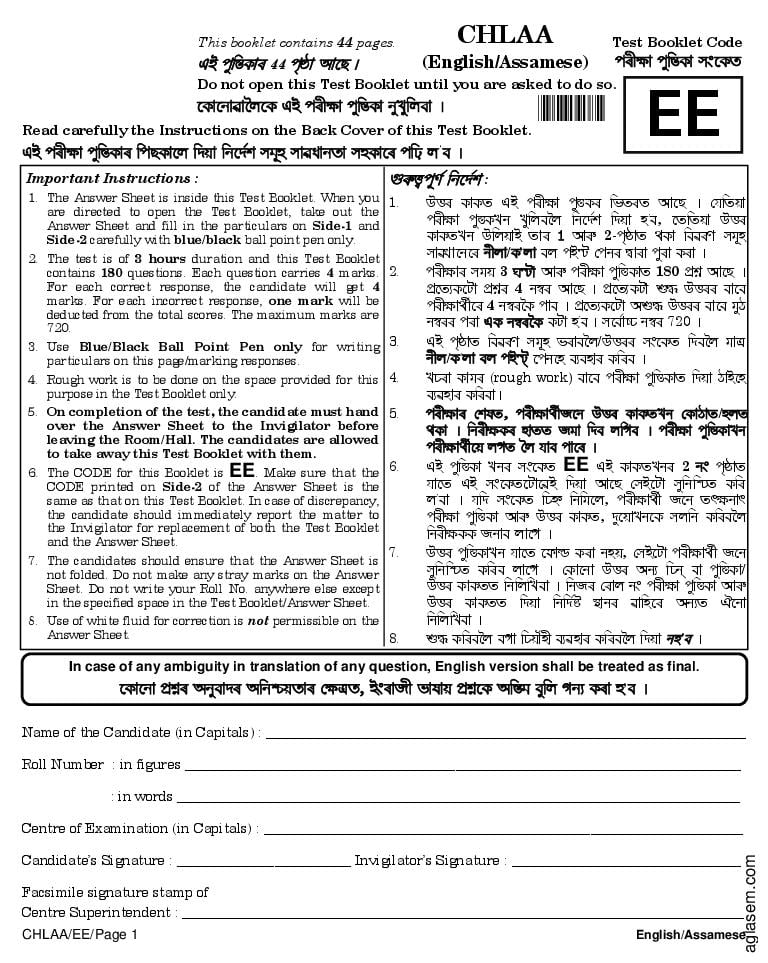
Page 1
&Òü šå[ÑzA¡à¹ 44 šõË¡à "àìá ú (English/Assamese) š¹ãÛ¡à šå[ÑzA¡à Î}ìA¡t¡
EE
Do not open this Test Booklet until you are asked to do so.
ìA¡àì>à¯àîºìA¡ &Òü š¹ãÛ¡à šå[ÑzA¡à >åJå[º¤à ¡ú
Read carefully the Instructions on the Back Cover of this Test Booklet.
*0EE*
&Òü š¹ãÛ¡à šå[ÑzA¡à¹ [šáA¡àìº [ƒÚà [>샢ŠγèÒ Îோà>t¡à ÎÒA¡àì¹ š[Øn¡ º ’¤ ¡ú
Important Instructions : P¡¹ç¡wšèo¢ [>샢Š:
1. The Answer Sheet is inside this Test Booklet. When you 1. l¡üv¡¹ A¡àA¡t¡ &Òü š¹ãÛ¡à šåÑzA¡¹ [®¡t¡¹t¡ "àìá ¡ú ë™[t¡Úà
are directed to open the Test Booklet, take out the
Answer Sheet and fill in the particulars on Side-1 and
š¹ãÛ¡à šåÑzA¡J> Jå[º¤îº [>샢Š[ƒÚà Ò’¤, ìt¡[t¡Úà l¡üv¡¹
Side-2 carefully with blue/black ball point pen only. A¡àA¡t¡J> l¡ü[ºÚàÒü t¡à¹ 1 "à¹ç¡ 2-šõË¡àt¡ =A¡à [¤¯¹o γèÒ
2. The test is of 3 hours duration and this Test Booklet Îோàì>ì¹ >ãºà/A¡’ºà ¤º šÒü@i¡ ëš>¹ ‡à¹à šå¹à A¡¹à ¡ú
contains 180 questions. Each question carries 4 marks. 2. š¹ãÛ¡à¹ Î³Ú 3 Q@i¡à "à¹ç¡ š¹ãÛ¡à šå[ÑzA¡àt¡ 180 šøÅ¥ "àìá ¡ú
For each correct response, the candidate will get 4 šøìt¡¸A¡ìi¡à šøÅ¥¹ 4 >´¬¹ "àìá ú šøìt¡¸A¡i¡à Ç¡‡ý¡ l¡üv¡¹¹ ¤àì¤
marks. For each incorrect response, one mark will be š¹ãÛ¡à=¢ãì¹ 4 >´¬¹îA¡ šà¤ ¡ú šøìt¡¸A¡ìi¡à "Ç¡‡ý¡ l¡üv¡¹¹ ¤àì¤ ³åk¡
deducted from the total scores. The maximum marks are
720. >´¬¹¹ š¹à &A¡ >´¬¹îA¡ A¡i¡à Ò’¤ ú Î줢àZW¡ >´¬¹ 720 ¡ú
3. Use Blue/Black Ball Point Pen only for writing 3. &Òü šõË¡àt¡ [¤¯¹o γèÒ ®¡¹à¤îº/l¡üv¡¹¹ Î}ìA¡t¡ [ƒ¤îº ³ày
particulars on this page/marking responses. >ãº/A¡’ºà ¤º šÒü@iô¡ ìš>ìÒ ¤¸¤Ò๠A¡[¹¤ ¡ú
4. Rough work is to be done on the space provided for this 4. JW¡¹à A¡à³¹ (rough work) ¤àì¤ š¹ãÛ¡à šå[ÑzA¡àt¡ [ƒÚà k¡àÒüìÒ
purpose in the Test Booklet only. ¤¸¯Ò๠A¡[¹¤à¡ú
5. On completion of the test, the candidate must hand 5. š¹ãۡ๠ëÅÈt¡, š¹ãÛ¡à=¢ã\ì> l¡üv¡¹ A¡àA¡t¡J> ëA¡àk¡àt¡/Òºt
over the Answer Sheet to the Invigilator before =A¡à ¡ú [>¹ãÛ¡A¡¹ Òàt¡t¡ \³à [ƒ¤ º[K¤ ¡ú š¹ãÛ¡à šå[ÑzA¡àJ>
leaving the Room/Hall. The candidates are allowed
to take away this Test Booklet with them.
š¹ãÛ¡à=¢ãìÚ ºKt¡ íº ™à¤ šàì¹ ¡ú
6. The CODE for this Booklet is EE. Make sure that the 6. &Òü šå[ÑzA¡à J>¹ Î}ìA¡t¡ EE &Òü A¡àA¡t¡J>¹ 2 >} šõË¡àt¡
CODE printed on Side-2 of the Answer Sheet is the ™àìt¡ &Òü Î}ìA¡t¡ìi¡àì¯Òü [ƒÚà "àìá ëÎÒüìi¡à Îå[>[ÆW¡t¡ A¡[¹
same as that on this Test Booklet. In case of discrepancy, º’¤à ¡ú ™[ƒ Î}ìA¡t¡ [W¡Òû¡ [>[³ìº, š¹ãÛ¡à=¢ã \ì> t¡;Û¡>à;
the candidate should immediately report the matter to š¹ãÛ¡à šå[ÑzA¡à "à¹ç¡ l¡üv¡¹ A¡àA¡t¡, ƒåìÚàJ>ìA¡ κ[> A¡[¹¤îº
the Invigilator for replacement of both the Test Booklet [>¹ãÛ¡A¡A¡ \>ठºàìK ¡ú
and the Answer Sheet.
7. l¡üv¡¹ šå[ÑzA¡àJ> ™àìt¡ ìó¡àÁ¡ A¡¹à >ÒÚ, ëÎÒüìi¡à š¹ãÛ¡à=¢ã \ì>
7. The candidates should ensure that the Answer Sheet is
not folded. Do not make any stray marks on the Answer Îå[>[ÆW¡t¡ A¡[¹¤ ºàìK ¡ú ëA¡àì>à l¡üv¡¹ ">¸ [W¡>ô ¤à šå[ÑzA¡à/
Sheet. Do not write your Roll No. anywhere else except l¡üv¡¹ A¡àA¡t¡t¡ [>[º[J¤à ¡ú [>\¹ ë¹àº >} š¹ãÛ¡à šå[ÑzA¡à "à¹ç¡
in the specified space in the Test Booklet/Answer Sheet. l¡üv¡¹ A¡àA¡t¡t¡ [ƒÚà [>[ƒ¢Ê¡ Ñ‚à>¹ ¯à[Òì¹ ">¸t¡ 'ì>à
8. Use of white fluid for correction is not permissible on the [>[º[J¤à ¡ú
Answer Sheet. 8. Ç¡‡ý¡ A¡[¹¤îº ¤Kà [W¡ÚòàÒã ¤¸¯Ò๠A¡[¹¤îº [ƒÚà >Ò’¤¡ ú
In case of any ambiguity in translation of any question, English version shall be treated as final.
ìA¡àì>à šøÅ¥¹ ">å¤àƒ¹ "[>ÆW¡Út¡à¹ ëÛ¡yt¡, Òü}¹à\ã ®¡àÈàÚ šøÅ¥ìA¡ "[”z³ ¤å[º K>¸ A¡¹à Ò’¤ ¡ú
Name of the Candidate (in Capitals) : _____________________________________________________________________
Roll Number : in figures ________________________________________________________________________________
: in words _________________________________________________________________________________
Centre of Examination (in Capitals) : _____________________________________________________________________
Candidate’s Signature : _________________________ Invigilator’s Signature : _________________________________
Facsimile signature stamp of
Centre Superintendent : _________________________________________________________________________________
CHLAA/EE/Page 1 SPACE FOR ROUGH WORK English/Assamese
Page 2
oxygen molecules become just sufficient for ‰ç¡[t¡¹ ¤àì¤ šõ[=¤ã¹ ¤àÚ峓¡º š¹à "[Gì\> "oå
escaping from the Earth’s atmosphere ?
šºàÚ> A¡[¹¤îº ÎÛ¡³ Ò’¤ ?
(Given : (šøƒ* ë™ :
–26
Mass of oxygen molecule (m) = 2·76 10 kg "[Gì\> ëKá¹ "oå¹ ®¡¹ (m) = 2·76 10–26 kg
–23 –1
Boltzmann’s constant kB = 1·38 10 JK ) ¤’Âi¡\³>ô¹ ‹ø硯A¡ kB = 1·38 10–23 J K –1)
4 4
(1) 2·508 10 K (1) 2·508 10 K
4 4
(2) 5·016 10 K (2) 5·016 10 K
4 4
(3) 8·360 10 K (3) 8·360 10 K
4 4
(4) 1·254 10 K (4) 1·254 10 K
2. The volume (V) of a monatomic gas varies with 2. Køàó¡t¡ ìƒJå*¯à¹ ƒì¹ &A¡ šà¹³à>[¤A¡ ëKá &i¡à¹
its temperature (T), as shown in the graph. The "àÚt¡> (V), l¡üÌ¡t¡à (T) ¹ ºKt¡ š[¹¤t¢¡> íÒ "àìá ¡ú
ratio of work done by the gas, to the heat ëKáìi¡àì¯ A "¯Ñ‚๠š¹à B "¯Ñ‚àîº š[¹¤t¢¡> Ò*ìt¡
absorbed by it, when it undergoes a change from ëKáìi¡àì¯ Î´šÄ A¡¹à A¡à™¸¢ "à¹ç¡ t¡àš ëÅàÈo¹ š[¹³à>¹
state A to state B, is ">åšàt¡ Ò’¤
2 2
(1) (1)
5 5
1 1
(2) (2)
3 3
2
2 (3)
(3) 3
3
2
2 (4)
(4) 7
7
3. šà>ã¹ [Ò³à}A¡ (freezing point) "à¹ç¡ l¡üt¡ºà}A¡¹
3. The efficiency of an ideal heat engine working
(boiling point) ³à\t¡ A¡à™¸¢Û¡³ íÒ =A¡à &i¡à "àƒÅ¢
between the freezing point and boiling point of
water, is
t¡àš Òü[g>¹ ƒÛ¡t¡à Ò’¤
(1) 26·8%
(1) 26·8%
(2) 6·25%
(2) 6·25% (3) 20%
(3) 20% (4) 12·5%
(4) 12·5% 4. &i¡à ëJàºà "ìK¢> šàÒüš¹ ë³ï[ºA¡ A¡´š>à}A¡
4. The fundamental frequency in an open organ (fundamental frequency) &i¡à &A¡³èJ¤Þê¡ "ìK¢>
pipe is equal to the third harmonic of a closed šàÒüš¹ tõ¡t¡ãÚ Î³gΠѬ¹¹ (third harmonic) ºKt¡
organ pipe. If the length of the closed organ pipe &ìA¡ ¡ú ™[ƒ &A¡³åJ¤Þê¡ "ìK¢> šàÒüš l¡àº¹ íƒQ¸¢ 20 cm
is 20 cm, the length of the open organ pipe is
ÒÚ, ët¡ì”z ëJàºà "ìK¢> šàÒüš l¡àº¹ íƒQ¸¢ Ò’¤
(1) 13·2 cm (1) 13·2 cm
(2) 12·5 cm (2) 12·5 cm
(3) 8 cm (3) 8 cm
(4) 16 cm (4) 16 cm
CHLAA/EE/Page 2 SPACE FOR ROUGH WORK English/Assamese
Page 3
–1
0·5 kg m is lying horizontally on a smooth ƒr¡ &l¡àº ">å®è¡[³A¡ [ƒÅ¹ ºKt¡ 30 ëA¡à> A¡[¹ =A¡à
inclined plane which makes an angle of 30 with &J> ëÒº>ãÚà t¡ºt¡ ">å®è¡[³A¡®¡àì¯ š[¹ "àìá ¡ú l¡üº´¬
the horizontal. The rod is not allowed to slide
[ƒºt¡ =A¡à 0.25 T ìW¡ï´¬A¡ ëÛ¡y &J> šøìÚàK A¡[¹ "à¹ç¡
down by flowing a current through it when a
magnetic field of induction 0·25 T is acting on it
ƒr¡ l¡àº¹ ³àì\ì¹ [¤ƒ¸å; šø¯àÒ W¡à[ºt¡ A¡[¹ ÒüÚàA¡
in the vertical direction. The current flowing in t¡ºîº Wå¡Wå¡[¹ ë>àìJà¯àîA¡ ¹Jà íÒìá ¡ú ÒüÚàA¡ [Ñ‚¹ "}Ñ‚àt¡
the rod to keep it stationary is ¹à[J¤îº šøìÚà\> ëÒà¯à [¤ƒ¸åt¡ šø¯àÒ¹ ³à> Ò’¤
(1) 7·14 A (1) 7·14 A
(2) 14·76 A (2) 14·76 A
(3) 5·98 A (3) 5·98 A
(4) 11·32 A
(4) 11·32 A
6. &i¡à "àì¯ÅA¡ 20 mH, &i¡à ‹à¹A¡ 100 F "à¹ç¡ &i¡à
6. An inductor 20 mH, a capacitor 100 F and a
resistor 50 are connected in series across a
ë¹à‹A¡ 50 ëÅøo㤇ý¡ Îðàìi¡àt¡ V = 10 sin 314 t
source of emf, V = 10 sin 314 t. The power loss in Òü.&³.&óô¡.¹. l¡ü;ι ºKt¡ Î}ì™àK A¡¹à íÒìá ¡ú
the circuit is ¤t¢¡>ãìi¡àt¡ ëÒà¯à Û¡³t¡à¹ "šW¡Ú Ò’¤
(1) 0·79 W (1) 0·79 W
(2) 2·74 W (2) 2·74 W
(3) 0·43 W (3) 0·43 W
(4) 1·13 W (4) 1·13 W
7. Current sensitivity of a moving coil galvanometer 7. &i¡à W¡ºA¡ Aå¡r¡ºã ëKºì®¡>’[³i¡à¹ šø¯àÒ Î}줃>Åãºt¡à
is 5 div/mA and its voltage sensitivity (angular 5 div/mA "à¹ç¡ ÒüÚ๠®¡ìÂi¡\ Î}줃>Åãºt¡à (šøìÚàK
deflection per unit voltage applied) is 20 div/V. A¡¹à šø[t¡ &A¡A¡ ®¡’ìÂi¡\¹ ¤àì¤ ëÒà¯à ëA¡ï[oA¡
The resistance of the galvanometer is [¤ìÛ¡šo) Ò’º 20 div/V. ëKºì®¡>’[³i¡à¹ìi¡à¹ šø[t¡ì¹à‹
(1) 40 Ò’¤
(2) 250 (1) 40
(3) 25 (2) 250
(4) 500 (3) 25
(4) 500
8. A thin diamagnetic rod is placed vertically
between the poles of an electromagnet. When the 8. Jã> "šWå¡´¬A¡ãÚ ƒr¡ &l¡àº &i¡à [¤ƒ¸å;Wå¡´¬A¡¹ ë³¹ç¡ ƒåi¡à¹
current in the electromagnet is switched on, then ³à\t¡ ¹Jà íÒìá ¡ú [¤ƒ¸å;Wå¡´¬A¡ìi¡àt¡ ë™[t¡Úà [¤ƒ¸å;šø¯àÒ
the diamagnetic rod is pushed up, out of the W¡à[ºt¡ Ò’¤îº [ƒÚà ÒÚ, ët¡[t¡Úà "šWå¡´¬A¡ãÚ ƒr¡ l¡àºA¡
horizontal magnetic field. Hence the rod gains ">å®è¡[³A¡ ëW¡ï´¬A¡ ëÛ¡y J>¹ š¹à *š¹îº ìk¡[º [ƒìÚ ¡ú
gravitational potential energy. The work
required to do this comes from
ÒüÚ็à¹à ƒr¡ l¡àìº ³à‹¸àA¡È¢[oA¡ [¤®¡¯ Å[v¡û¡ šøàœ¡ ÒÚ ¡ú
ÒüÚ๠¤àì¤ A¡[¹¤ ºKà A¡à™¸¢ Ò’¤
(1) the current source
(1) [¤ƒ¸å; šø¯àÒ¹ l¡ü;ι š¹à
(2) the lattice structure of the material of the
rod (2) ƒr¡ l¡àº¹ šƒà=¢¹ Ñ£¡i¡ãA¡ãÚ (ëº[i¡Wô¡) Kk¡>¹ š¹à
(3) the magnetic field (3) ìW¡ï´¬A¡ ëÛ¡y¹ š¹à
(4) the induced electric field due to the (4) ìW¡ï´¬A¡ ìÛ¡y¹ š[¹¤t¢¡>¹ ¤àì¤ "àì¯[Åt¡ ëÒà¯à
changing magnetic field [¤ƒ¸å; ëÛ¡y¹ š¹à
CHLAA/EE/Page 3 SPACE FOR ROUGH WORK English/Assamese
Page 4
voltage Vi is 20 V, VBE = 0 and VCE = 0. The VBE = 0 "à¹ç¡ VCE = 0 ú IB, IC "à¹ç¡ ¹ ³à> Ò’¤
values of IB, IC and are given by
(1) IB = 40 A, IC = 10 mA, = 250
(1) IB = 40 A, IC = 10 mA, = 250
(2) IB = 20 A, IC = 5 mA, = 250
(2) IB = 20 A, IC = 5 mA, = 250
(3) IB = 25 A, IC = 5 mA, = 200
(3) IB = 25 A, IC = 5 mA, = 200
(4) IB = 40 A, IC = 5 mA, = 125
(4) IB = 40 A, IC = 5 mA, = 125
10. In the combination of the following gates the
10. t¡ºt¡ [ƒÚà º’[\A¡ ëKi¡Î³èÒ¹ Îðàìi¡àt¡ Òü>ôšåiô¡ A "à¹ç¡
output Y can be written in terms of inputs A and B ¹ δšA¢¡t¡ "àl¡üiô¡šåiô¡ Y Ò’¤
B as
(1) A.B
(1) A.B (2) A.B +A.B
– –
(2) A.B +A.B (3) A. B + A .B
– – (4) AB
(3) A. B + A .B
(4) AB 11. &i¡à p-n \à}W¡> l¡àÚ’l¡t¡ t¡àš¹ ¤àì¤ ëÒà¯à l¡üÌ¡t¡à¹
š[¹¤t¢¡ì>
11. In a p-n junction diode, change in temperature
due to heating (1) "A¡º šÆW¡àƒ³åJã ë¹à‹ (reverse resistance)
šø®¡à[¯t¡ A¡ì¹ ¡ú
(1) affects only reverse resistance
(2) p-n l¡à}W¡>¹ ë¹à‹ šø®¡à[¯t¡ >A¡ì¹ ¡ú
(2) does not affect resistance of p-n junction
(3) "A¡º "Kø¯t¢¡ã ë¤à‹t¡ (forward resistance)
(3) affects only forward resistance
šø®¡à[¯t¡ A¡ì¹ ¡ú
(4) affects the overall V – I characteristics of
p-n junction (4) p-n \à}W¡>ìi¡à¹ V – I í¤[ÅÊ¡¸¹ šø®¡à[¯t¡ A¡ì¹ ¡ú
CHLAA/EE/Page 4 SPACE FOR ROUGH WORK English/Assamese
Page 5
surface of a material of refractive index ‘’. At a
"γ¤[v¢¡t¡ (unpolarised) ìšàÒ¹ "àš[t¡t¡ íÒìá ¡ú
particular angle of incidence ‘i’, it is found that
&i¡à [>[„¢Ê¡ "àšt¡> ëA¡ào ‘i’ ¹ ¤àì¤ šø[t¡ó¡[ºt¡ "à¹ç¡
the reflected and refracted rays are
perpendicular to each other. Which of the
šø[t¡Î[¹t¡ ¹[Ƶ š¹Ñšì¹ š¹Ñš¹¹ º´¬ ÒÚ ¡ú &Òü
following options is correct for this situation ? ëÛ¡yt¡ t¡º¹ ëA¡à>ìi¡à [¤A¡¿ l¡üv¡¹ Ç¡‡ý¡ Ò’¤ ?
(1) Reflected light is polarised with its electric (1) šø[t¡ó¡[ºt¡ ëšàÒ¹ γ¤[v¢¡t¡ (polarised) Ò’¤
vector parallel to the plane of incidence &ì>ƒì¹ ™àìt¡ ÒüÚ๠¸å[t¡A¡ 뮡C¡¹ "àšt¡>
t¡º¹ γà”z¹àº ÒÚ ¡
–1 1
(2) i = sin
–1 1
(2) i = sin
(3) Reflected light is polarised with its electric
vector perpendicular to the plane of (3) šø[t¡ó¡[ºt¡ ëšàÒ¹ γ¤[v¢¡t¡ (polarised) Ò’¤
incidence &ì>ƒì¹ ™àìt¡ ÒüÚà¹ í¤ƒ¸å[t¡A¡ 쮡C¡¹ "àšt¡>
–1 1
t¡º¹ º´¬ ÒÚ ¡
(4) i = tan
–1 1
(4) i = tan
13. In Young’s double slit experiment the separation
13. &i¡à ÒüÚR¡¹ [‡[በš¹ãۡ๠"à[Òºàt¡¡ [በƒåi¡à¹ ¤¸¯‹à>
d between the slits is 2 mm, the wavelength of
d, 2 mm ¤¸¯Ò๠A¡¹à ëšàÒ¹¹ t¡¹}K = 5896 Å "à¹ç¡
the light used is 5896 Å and distance D between
the screen and slits is 100 cm. It is found that the šƒ¢à "à¹ç¡ [ቹ ³à\¹ ƒè¹â« D, 100 cm ¡ú š[i¡¹
angular width of the fringes is 0·20. To increase ëA¡ï[oA¡ 뤋 (angular width) Ò’º 0.20 ¡ú š[i¡¹
the fringe angular width to 0·21 (with same ëA¡ï[oA¡ 뤋 0.21 îº ¤Øn¡à¤îº ( "à¹ç¡ D &ìA¡ ¹à[J)
and D) the separation between the slits needs to
[በƒåi¡à¹ ³à\¹ ƒè¹â« [A¡³à>îº Îº[> A¡¹à¹ šøìÚà\>
be changed to
Ò’¤
(1) 1·8 mm
(1) 1·8 mm
(2) 2·1 mm
(2) 2·1 mm
(3) 1·9 mm (3) 1·9 mm
(4) 1·7 mm (4) 1·7 mm
14. An astronomical refracting telescope will have 14. &i¡à šø[t¡Îà¹A¡ >쮡à¤ãÛ¡o ƒè¹¤ão¹ ëA¡ï[oA¡ [¤¤‹¢> "à¹ç¡
large angular magnification and high angular ëA¡ï[oA¡ [¤ì®¡ƒ> Û¡³t¡à ë¤[á Ò’¤, ë™[t¡Úà "[®¡ì>y
resolution, when it has an objective lens of ëºX J>¹
(1) small focal length and large diameter (1) ó¡’A¡àá íƒQ¸¢ A¡³ "à¹ç¡ ¤¸àÎ ì¤[á ÒÚ
(2) large focal length and large diameter (2) ó¡’A¡àá íƒQ¸¢ ë¤[á "à¹ç¡ ¤¸àÎ ì¤[á ÒÚ
(3) large focal length and small diameter
(3) ó¡’A¡àá íƒQ¸¢ ë¤[á "à¹ç¡ ¤¸àÎ A¡³ ÒÚ
(4) small focal length and small diameter
(4) ó¡’A¡àá íƒQ¸¢ A¡³ "à¹ç¡ ¤¸àÎ A¡³ ÒÚ
CHLAA/EE/Page 5 SPACE FOR ROUGH WORK English/Assamese
Page 6
^
15. An electron of mass m with an initial velocity 15. m ®¡¹¹ ÒüìºC¡ö> &k¡àÒü V = V0 i (V0 > 0) šøà¹[´±A¡
^
V = V0 i (V0 > 0) enters an electric field ë¤ìKì¹ t = 0 γÚt¡ E = – E0 ^i (E0 = ‹ø硯A¡ > 0)
^
E = – E0 i (E0 = constant > 0) at t = 0. If 0 is í¤ƒ¸å[t¡A¡ ëÛ¡y &J>t¡ šøì¯Å A¡ì¹ ¡ú ™[ƒ 0 ÒüÚà¹
its de-Broglie wavelength initially, then its šøà¹[´±A¡ l¡à¤ö’Kôºã t¡¹}KîƒQ¸¢ ÒÚ ët¡[t¡Úà t γÚt¡
de-Broglie wavelength at time t is ÒüÚ๠l¡à¤ö’Kôºã t¡¹}KîƒQ¸¢ Ò’¤
0
0 (1)
(1) eE0
eE0 1 t
1 t mV0
mV0
(2) 0 t
(2) 0 t
eE0
eE0 (3) 0 1 t
(3) 0 1 t mV0
mV
0
(4) 0
(4) 0
16. For a radioactive material, half-life is 16. &i¡à ët¡\[ÍI¡Ú šƒà=¢¹ "‹¢àÚå A¡àº 10 [³>i¡ ¡ú šøà¹[´±A¡
10 minutes. If initially there are 600 number of "¯Ñ‚àt¡ 600 Î}J¸A¡ [>l¡ü[AáÚàW¡ =A¡à¹ š¹à 450 Î}J¸
nuclei, the time taken (in minutes) for the [>l¡ü[AáÚàá¹ [¤®¡U> Ò’¤îº šøìÚà\> ëÒà¯à Î³Ú ([³[>i¡
disintegration of 450 nuclei is &A¡A¡t¡)
(1) 20 (1) 20
(2) 30 (2) 30
(3) 10
(3) 10
(4) 15
(4) 15
17. The ratio of kinetic energy to the total energy of
an electron in a Bohr orbit of the hydrogen atom,
17. &i¡à ÒàÒül¡ö’ì\> š¹³àoå¹ &i¡à ¤’¹ A¡Û¡š=t¡ ÒüìºC¡ö>
is &i¡à¹ K[t¡Å[v¡û¡ "à¹ç¡ ³åk¡ Å[v¡û¡¹ ">åšàt¡ Ò’º
(1) 1:1 (1) 1:1
(2) 2:–1 (2) 2:–1
(3) 1:–1 (3) 1:–1
(4) 1:–2 (4) 1:–2
18. When the light of frequency 2v0 (where v0 is 18. &J> ‹àt塹 šàt¡t¡ ë™[t¡Úà ÒÚ A¡´š>à}A¡¹ 2v0 ëšàÒ¹
threshold frequency), is incident on a metal
(™’t¡ v0 ‹àtå¡ìi¡à¹ "àìºàA¡ šø[yû¡Ú๠>å>¸t¡³ A¡´š>à}A¡)
plate, the maximum velocity of electrons emitted
is v1. When the frequency of the incident
šì¹, [>K¢t¡ ëÒà¯à ÒüìºC¡öo¹ Î줌¢àZW¡ ë¤K v1 ÒÚ ¡ú ™[ƒ
radiation is increased to 5v0, the maximum "àš[t¡t¡ ëšàÒ¹¹ A¡´š>à}A¡ 5v0 îº ¤õ[‡ý¡ A¡¹à ÒÚ,
velocity of electrons emitted from the same plate ët¡[t¡Úà &ìA¡J> ‹àt塹 š¹à [>K¢t¡ ëÒà¯à ÒüìºC¡ö>¹
is v2. The ratio of v1 to v2 is Î줌¢àZW¡ ë¤K v2 ÒÚ ¡ú v1 "à¹ç¡ v2 ³à\¹ ">åšàt¡ Ò’º
(1) 1:2 (1) 1:2
(2) 4:1 (2) 4:1
(3) 1:4 (3) 1:4
(4) 2:1 (4) 2:1
CHLAA/EE/Page 6 SPACE FOR ROUGH WORK English/Assamese
Page 7
concave mirror of focal length 15 cm. If the object 40 cm ƒè¹â«t¡ &i¡à ºÛ¡¸¤Ññ ¹Jà íÒìá ¡ú ™[ƒ ºÛ¡¸¤Ññìi¡à
is displaced through a distance of 20 cm towards 20 cm ιo A¡[¹ ƒàìšà> J>¹ [šì> ">à ÒÚ, ët¡[t¡Úà
the mirror, the displacement of the image will be šø[t¡[¤´¬¹ ιo &ì>ƒì¹ Ò’¤
(1) 30 cm away from the mirror
(1) 30 cm ƒàìšà>¹ š¹à "à}t¡[¹ ™à¤
(2) 30 cm towards the mirror
(2) 30 cm ƒàìšà>¹ ó¡àìº "à[Ò¤
(3) 36 cm away from the mirror
(3) 36 cm ƒàìšà>¹ š¹à "òàt¡[¹ ™à¤
(4) 36 cm towards the mirror
(4) 36 cm ƒàìšà>¹ ó¡àìº "à[Ò¤
20. The refractive index of the material of a prism is
2 and the angle of the prism is 30. One of the 20. [šø\³ &i¡à¹ šƒà=¢¹ šø[t¡Î¹à}A¡ 2 "à¹ç¡ [šø\³ ëA¡ào
two refracting surfaces of the prism is made a 30 ¡ú šø[t¡Î¹ã šõË¡ ƒåJ>¹ &J>t¡ [®¡t¡¹ ó¡àìºì¹ ¹ê¡š¹
mirror inwards, by silver coating. A beam of šø캚 šøìÚàK A¡[¹ ƒàìšà>¹ ít¡Ú๠A¡¹à Ò’º ¡ú &[t¡Úà
monochromatic light entering the prism from the &A¡¹R¡ã ìšàÒ¹ ¹[Ƶγ[Ê¡ (beam) &i¡àÒü "à>J>
other face will retrace its path (after reflection šø[t¡Î¹ã šõË¡ì¹ [šø\³ìi¡à šøì¯Å A¡[¹ ¹ê¡š¹ šø캚 šõìË¡¹
from the silvered surface) if its angle of incidence š¹à šø[t¡ó¡[ºt¡ íÒ "àìA¡ï &ìA¡ šì=ì¹ ‹è[¹ "à[Ò¤îº
on the prism is Ò’ìº ëšàÒ¹¹ ¹[Ƶìi¡à¹ [šø\³t¡ "àšt¡> ëA¡ào Ò’¤
(1) 60 (1) 60
(2) 30 (2) 30
(3) 45 (3) 45
(4) zero (4) Ç¡>¸
21. An em wave is propagating in a medium with a 21. &i¡à [¤ƒ¸å; Wå¡´¬A¡ãÚ t¡¹}K V = V ^i ì¤ìKì¹ &J>
^
velocity V = V i . The instantaneous oscillating ³à‹¸³¹ ³àì\[ƒ šø¯à[Òt¡ íÒìá [¤ƒ¸å; Wå¡´¬A¡ãÚ t¡¹}Kìi¡à¹
electric field of this em wave is along +y axis. t¡à;Û¡[oA¡ ƒå[º =A¡à [¤ƒ¸å;ìÛ¡y J>¹ [ƒÅ + y "Û¡ ¡ú
Then the direction of oscillating magnetic field of ët¡[t¡Úà [¤ƒ¸å;Wå¡´¬A¡ãÚ t¡¹}Kìi¡à¹ ƒå[º =A¡à ëW¡ï´¬A¡
the em wave will be along ëÛ¡yJ>¹ [ƒÅ Ò’¤
(1) – z direction (1) – z [ƒÅt¡
(2) – y direction (2) – y [ƒÅt¡
(3) + z direction (3) + z [ƒÅt¡¡
(4) – x direction (4) – x [ƒÅt¡
22. The magnetic potential energy stored in a certain 22. &i¡à "àì¯ÅA¡¹ ³àì\[ƒ 60 mA [¤ƒ¸åt¡ šø¯àÒ W¡à[ºt¡
inductor is 25 mJ, when the current in the ëÒà¯àt¡ "àì¤ÅA¡ìi¡àt¡ \³à ëÒà¯à ëW¡ï[´¬A¡ Å[v¡û¡¹ š[¹³ào
inductor is 60 mA. This inductor is of inductance 25 mJ ú "àì¯ÅA¡ìi¡à¹ "àì¯Å¹ ³à> Ò’¤
(1) 0·138 H (1) 0·138 H
(2) 1·389 H (2) 1·389 H
(3) 138·88 H (3) 138·88 H
(4) 13·89 H (4) 13·89 H
CHLAA/EE/Page 7 SPACE FOR ROUGH WORK English/Assamese
Page 8
identical cells (having internal resistance ‘r’ ì¹à‹™åv¡û¡) ">å¹ê¡š [¤ƒ¸å; ëA¡àÈ ëÅøo㤇ý¡t¡àì¯ Î}ì™àK
each) which are connected in series. The A¡¹à "àìá ¡ú ë¤i¡à¹ãìi¡à¹ i¡à[³¢ì>º ƒåi¡à áiô¡ W¡à[A¢¡t¡
terminals of the battery are short-circuited and (short-circuited) A¡¹à Ò’º "à¹ç¡ [¤ƒ¸å;šø¯àÒ I ë\àJà
the current I is measured. Which of the graphs Ò’º ¡ú t¡º¹ ëA¡à>ìi¡à Køàìó¡ I "à¹ç¡ n ¹ ³à\¹ δšA¢¡
shows the correct relationship between I and n ?
Ç¡‡ý¡îA¡ ¤å\ठ?
24. A set of ‘n’ equal resistors, of value ‘R’ each, are 24. šøìt¡¸A¡ì¹ ‘R’ ë¹à‹™åv¡û¡ ‘n’ i¡à ë¹à‹¹ ëÅøo㤇ý¡ Îðà &i¡à
connected in series to a battery of emf ‘E’ and ‘E’ Òü.&³.&ó¡. "à¹ç¡ ‘R’ "à”z–ì¹à‹¹ ë¤i¡à¹ã¹ ºKt¡
internal resistance ‘R’. The current drawn is I. Î}ì™àK A¡¹à Ò’º ¡ú &Òü ëÛ¡yt¡ [¤ƒ¸å; šø¯àÒ I ÒÚ ¡ú
Now, the ‘n’ resistors are connected in parallel to &[t¡Úà ‘n’ ë¹à‹A¡ ëA¡Òüi¡à γà”z¹àº Îðà A¡[¹ &ìA¡i¡à
the same battery. Then the current drawn from ë¤i¡à¹ã¹ ºKt¡ Î}ì™àK A¡¹à Ò’º ¡ú &ÒüìÛ¡yt ë¤i¡à¹ã¹
battery becomes 10 I. The value of ‘n’ is
š¹à [¤ƒ¸åt¡ šø¯àÒ 10 I ÒÚîK ¡ú ‘n’ ¹ ³à> Ò’¤
(1) 10 (1) 10
(2) 20 (2) 20
(3) 11 (3) 11
(4) 9 (4) 9
25. A carbon resistor of (47 4·7) k is to be marked 25. (47 4·7) k ¹ &i¡à A¡à¤¢> ë¹à‹A¡A¡ [W¡>àv¡û¡ A¡[¹¤îº
with rings of different colours for its ë¤ìºK ë¤ìºK ¹R¡¹ "Rå¡[k¡ì¹ ƒàK [ƒÚà ÒÚ ¡ú ¹R¡¹
identification. The colour code sequence will be Î}ìA¡t¡¹ ">åyû¡³ Ò’¤
(1) Violet – Yellow – Orange – Silver (1) ì¤Rå¡>ãÚà – Ò຋ãÚà – A¡³ºà – ¹ê¡šàºã
(2) Ò຋ãÚà – ëÎl¡ü\ãÚà – ë¤Rå¡>ãÚà – ëÎà>àºã
(2) Yellow – Green – Violet – Gold
(3) Yellow – Violet – Orange – Silver (3) Ò຋ãÚà – ì¤Rå¡>ãÚà – A¡³ºà – ¹ê¡šàºã
(4) Green – Orange – Violet – Gold (4) ìÎl¡ü\ãÚà – Ò຋ãÚà – ë¤Rå¡>ãÚà – ëÎà>àºã
CHLAA/EE/Page 8 SPACE FOR ROUGH WORK English/Assamese
Page 9
glass tube. The length of the air column in this
tube can be adjusted by a variable piston. At
źàA¡à ¤¸¯Ò๠A¡¹à íÒìá ¡ú &i¡à l¡ük¡à->³à A¡[¹¤ š¹à
room temperature of 27C two successive [šÊ¡ì>ì¹ >ºãìi¡àt¡ ¤àÚå¹ Ñz´±¹ ƒãQ κ[> A¡[¹¤ šà[¹ ¡ú
resonances are produced at 20 cm and 73 cm of ëA¡àk¡à¹ l¡üÌ¡t¡àt¡ 27C t¡ >ºãìi¡àt¡ 20 cm "à¹ç¡
column length. If the frequency of the tuning fork 73 cm ¤àÚå Ñz´± íƒQ¸¢t¡ ƒåi¡à yû¡[³A¡ ">å>àƒ¹ Îõ[Ê¡ Ò’º ¡ú
is 320 Hz, the velocity of sound in air at 27C is
™[ƒ ¤àÚåt¡ Îå¹ ÅºàA¡à l¡àº¹ A¡´š>à}A¡ 320 Hz ÒÚ,
(1) 330 m/s ët¡[t¡Úà 27C l¡üÌ¡t¡à¹ Ŧ¹ ë¤K Ò’¤
(2) 350 m/s
(1) 330 m/s
(3) 339 m/s
(2) 350 m/s
(4) 300 m/s
(3) 339 m/s
27. The electrostatic force between the metal plates (4) 300 m/s
of an isolated parallel plate capacitor C having a
charge Q and area A, is 27. &i¡à [¤™åv¡û¡ (isolated) γà”z¹àº ‹à¹A¡ C ¹ "à‹à> Q
(1) independent of the distance between the "à¹ç¡ ëšÃi¡ A¡à[º A Ò’ìº ëšÃi¡ ƒåJ>¹ ³à\t¡ [yû¡Úà A¡¹à
plates. [Ñ‚[t¡[¤ƒ¸å; ¤º
(2) proportional to the square root of the
distance between the plates. (1) ëšÃi¡¹ ³à\¹ ƒè¹â«¹ *š¹t¡ [>®¢¡¹ >A¡ì¹ ¡ú
(3) linearly proportional to the distance (2) ëšÃi¡¹ ƒè¹â«¹ ¤K¢³èº¹ γà>åšà[t¡A¡ ¡ú
between the plates. (3) ìšÃi¡ ƒåJ>¹ ƒè¹â«¹ ºKt¡ ë¹[JA¡®¡àì¯
(4) inversely proportional to the distance γà>åšà[t¡A¡ ¡ú
between the plates.
(4) ëšÃi¡¹ ƒè¹â«¹ ºKt¡ ¤¸Ñzà>åšà[t¡A¡ ¡ú
28. An electron falls from rest through a vertical
distance h in a uniform and vertically upward 28. &J> Îåȳ "à¹ç¡ *K¹³å¯àîA¡ [ƒÅ A¡¹à í¤ƒ¸å[t¡A¡ ëÛ¡y E
directed electric field E. The direction of electric ¹ ³àì\[ƒ &i¡à ÒüìºC¡öì> [Ñ‚¹ "¯Ñ‚๠š¹à h ƒè¹â«
field is now reversed, keeping its magnitude the l¡üº´¬®¡àì¯ Î[¹ š[¹ìá ¡ú í¤ƒ¸å[t¡A¡ ëÛ¡y J>¹ ³à> &ìA¡
same. A proton is allowed to fall from rest in it
through the same vertical distance h. The time of
¹à[J [ƒÅ [¤š¹ãt¡ A¡¹à Ò’º ¡ú &[t¡Úà &i¡à šø’i¡> &Òü
fall of the electron, in comparison to the time of ëÛ¡yJ>¹ ³àì\[ƒ &ìA¡ l¡üº´¬ ƒè¹â« h "[t¡yû¡³ A¡[¹¤îº
fall of the proton is [Ñ‚¹ "¯Ñ‚๠š¹à Î[¹ š[¹¤îº [ƒÚà Ò’º ¡ú šø’i¡>ìi¡à Î[¹
(1) smaller š¹à γڹ t塺>àt¡ ÒüìºC¡ö>ìi¡à¹ Î[¹ š¹à γÚ
(2) 10 times greater (1) A¡³
(3) 5 times greater (2) 10 P¡o ì¤[á
(4) equal (3) 5 P¡o ë¤[á
29. A pendulum is hung from the roof of a (4) γà>
sufficiently high building and is moving freely to
and fro like a simple harmonic oscillator. The
29. ™ì=Ë¡ *J [¤[Á¡} &i¡à¹ W¡àº¹ š¹à &i¡à ëƒàºA¡ *ìºà³àÒü
acceleration of the bob of the pendulum is ¹Jà íÒìá "à¹ç¡ ιº ëƒàºA¡¹ ƒì¹ ³åv¡û¡®¡àì¯ "Òà-ë™à¯à
2 A¡[¹ "àìá ¡ú Î೸à¯Ñ‚๠š¹à 5 m ƒè¹â«t¡ ëƒàºA¡ìi¡à¹
20 m/s at a distance of 5 m from the mean
position. The time period of oscillation is ¤’¤¹ ⫹o 20 m/s2. ÒüÚ๠š™¸¢àÚA¡àº Ò’¤
(1) 2 s (1) 2 s
(2) 2s (2) 2s
(3) s (3) s
(4) 1s (4) 1s
CHLAA/EE/Page 9 SPACE FOR ROUGH WORK English/Assamese
Page 10
radiates maximum energy at wavelength, 0. If t¡¹}K íƒQ¸¢t¡ Î줌¢àZW¡ Å[v¡û¡ [¤A¡¹o A¡ì¹ ¡ú &[t¡Úà
the temperature of the black body is now
Aõ¡Ì¡¤Ññìi¡à¹ l¡üÌ¡t¡à &ì>ƒì¹ š[¹¤t¢¡> A¡¹à Ò’º ™àìt¡
changed so that it radiates maximum energy at 3
3 t¡¹}KîƒQ¸¢t¡ Î줌¢àZW¡ Å[v¡û¡ [¤[A¡[¹t¡ ÒÚ "à¹ç¡
wavelength , the power radiated by it 4 0
4 0 Å[v¡û¡¹ Û¡³t¡à nP ÒÚîK ¡ú n ¹ ³à> Ò’¤
becomes nP. The value of n is
3
3 (1)
(1) 4
4 256
(2)
256 81
(2)
81 4
(3)
4 3
(3)
3 81
(4)
81 256
(4)
256 31. ƒål¡àº tò¡à¹ &ìA¡ šƒà=¢ì¹ ít¡Úà¹ã "à¹ç¡ &ìA¡
31. Two wires are made of the same material and "àÚt¡>¹ ¡ú šø=³ tò¡à¹ l¡àº¹ šøÑ‚ìZრA¡à[º A "à¹ç¡
have the same volume. The first wire has [‡t¡ãÚl¡àº¹ šøÑ‚ìZრA¡à[º 3A ¡¡ú ™[ƒ F ¤º šøìÚàK
cross-sectional area A and the second wire has A¡[¹ šø=³ tò¡à¹ l¡àº¹ íƒQ¸¢ l ¤õ[‡ý¡ A¡¹à ÒÚ, ët¡[t¡Úà
cross-sectional area 3A. If the length of the first
wire is increased by l on applying a force F,
[‡t¡ãÚ tò¡à¹ l¡àº¹ íƒQ¸¢ γà> š[¹³à>t¡ ¤õ[‡ý¡ A¡[¹¤îº
how much force is needed to stretch the second [A¡³à> ¤º¹ šøìÚà\> Ò’¤ ?
wire by the same amount ? (1) 9F
(1) 9 F (2) 4F
(2) 4 F (3) 6F
(3) 6 F (4) F
(4) F 32. &i¡à ‘r’ ¤¸àÎà‡ý¢¡¹ Î¹ç¡ ëKàºA¡ [Ñ‚¹ "¯Ñ‚๠š¹à &i¡à Îà@ƒø
32. A small sphere of radius ‘r’ falls from rest in a t¡¹º¹ ³àì\ì¹ š[¹ "àìá ¡ú ó¡ºÑ¬¹ê¡ìš Îà@ƒø ¤º¹ ¤àì¤
viscous liquid. As a result, heat is produced due t¡àš l¡ü;šÄ íÒìá ¡ú ëKàºA¡ìi¡àì¯ šøà”zãÚ ë¤K ëšà¯àt¡
to viscous force. The rate of production of heat
when the sphere attains its terminal velocity, is
t¡àš l¡ü;šÄ¹ Ò๠t¡º¹ ëA¡àoìi¡¹ ºKt¡ Îà³à>åšà[t¡A¡
proportional to Ò’¤
3 3
(1) r (1) r
5 5
(2) r (2) r
2 2
(3) r (3) r
4 4
(4) r (4) r
33. A sample of 0·1 g of water at 100C and normal 33. Îà‹à¹o W¡àš (1·013 105 Nm–2) "à¹ç¡ 100C
5 –2 l¡üÌ¡t¡àt¡ =A¡à 0·1 g šàoã¹ >³å>à &i¡àA¡ 100C
pressure (1·013 10 Nm ) requires 54 cal of
heat energy to convert to steam at 100C. If the l¡üÌ¡t¡àt¡ ¤àÍšîº ¹ê¡šà”z[¹t¡ A¡[¹¤îº 54 ëA¡º[¹ t¡àš¹
volume of the steam produced is 167·1 cc, the šøìÚà\> ¡ú ™[ƒ ¤àÍš¹ "àÚt¡> 167·1 cc ÒÚ, >³è>àìi¡à¹
change in internal energy of the sample, is "à”z–Å[v¡û¡¹ š[¹¤t¢¡> Ò’¤
(1) 104·3 J (1) 104·3 J
(2) 42·2 J (2) 42·2 J
(3) 208·7 J (3) 208·7 J
(4) 84·5 J (4) 84·5 J
CHLAA/EE/Page 10 SPACE FOR ROUGH WORK English/Assamese
Page 11
34. The moment of the force, F = 4 i + 5 j – 6 k at 34. (2, 0, – 3) [¤@ƒåt¡ =A¡à F = 4 i + 5 j – 6 k ¤º¹
(2, 0, – 3), about the point (2, – 2, – 2), is given by (2, – 2, – 2) [¤@ƒå ÎàìšìÛ¡ °à³A¡ Ò’¤
^ ^ ^ ^ ^ ^
(1) – 8 i – 4 j – 7 k (1) – 8 i – 4 j – 7 k
^ ^ ^ ^ ^ ^
(2) – 7 i – 8 j – 4 k (2) – 7 i – 8 j – 4 k
^ ^ ^ ^ ^ ^
(3) – 4 i – j – 8 k (3) – 4 i – j – 8 k
^ ^ ^ ^ ^ ^
(4) – 7 i – 4 j – 8 k (4) – 7 i – 4 j – 8 k
35. A student measured the diameter of a small steel
ball using a screw gauge of least count 35. 0.001 cm ¹ º[QË¡ Ko>à (LC) ¹ ÑIé¡ ëK\ (screw
0·001 cm. The main scale reading is 5 mm and gauge) &i¡àì¹ &\> áàyÒü &i¡à Î¹ç¡ t¡ãJ๠¤º¹ ¤¸àÎ
zero of circular scale division coincides with \å[Jìá ¡ú ³åJ¸ ìÑHþ º¹ šàk¡ Ò’º 5 mm "à¹ç¡ ¤õv¡àA¡à¹
25 divisions above the reference level. If screw ëÑHþº¹ Åè>¸ ‹¹ìi¡à ë¹ó¡àì¹X ëºì¯º (reference level)
gauge has a zero error of – 0·004 cm, the correct
diameter of the ball is š¹à 25 Q¹ *š¹t¡ "àìá ¡ú ™[ƒ ÑIæ¡ ìK\ìi¡à¹ Åè>¸ yû¡[³
(1) 0·521 cm yû¡[i¡¹ ³à> – 0.004 cm Ò’ìº ¡¤ºìi¡à¹ Ç¡‡ý¡ ¤¸àÎ Ò’¤
(2) 0·053 cm (1) 0·521 cm
(3) 0·525 cm (2) 0·053 cm
(4) 0·529 cm
(3) 0·525 cm
36. A block of mass m is placed on a smooth inclined
wedge ABC of inclination as shown in the (4) 0·529 cm
figure. The wedge is given an acceleration ‘a’ 36. [W¡yt¡ìƒJå*¯à¹ ƒì¹ m ®¡¹¹ iå¡A塹à ABC &i¡à ëA¡ào
towards the right. The relation between a and
for the block to remain stationary on the wedge A¡[¹ =A¡à [³[Ò ëÒº>ãÚà t¡º &J>t¡ ¹Jà íÒìá ¡ú &[t¡Úà
is iå¡A塹àìi¡à š[¹ ë>àì=à¯àîA¡ ëÒº>ãÚà t¡ºJ>A¡ ‘a’ ⫹o
ëÎòàó¡àìº [ƒÚà Ò’º ¡ú a "à¹ç¡ ³à\¹ δšA¢¡ Ò’¤
g
(1) a=
cosec g
(1) a=
(2) a = g cos cosec
g (2) a = g cos
(3) a=
sin g
(3) a=
(4) a = g tan sin
37. A toy car with charge q moves on a frictionless (4) a = g tan
horizontal plane surface under the influence of a
37. q "àk¡à> =A¡à &J> šåt¡ºà KàØl¡ã &J> Îåȳ í¤ƒ¸å[t¡A¡
uniform electric field E . Due to the force q E ,
its velocity increases from 0 to 6 m/s in one
ëÛ¡y E ¹ šø®¡à¯t¡ &J> QÈ¢o[¤Òã> ">å®è¡[³A¡ γt¡º
second duration. At that instant the direction of
šõÊ¡t¡ K[t¡ A¡[¹ "àìá ¡ú q E ¤º¹ ¤àì¤ ÒüÚ๠ë¤K
the field is reversed. The car continues to move &A¡ ëáìA¡“¡t¡ 0 ¹ š¹à 6 m/s ¤õ[‡ý¡ ÒÚ ¡ú ëÎÒü "¯Ñ‚àt¡
for two more seconds under the influence of this í¤ƒ¸å[t¡A¡ ëÛ¡y J>¹ [ƒÅ *ìºài¡à A¡¹à Ò’º ¡ú &Òü [¤ƒ¸å;
field. The average velocity and the average speed ëÛ¡y J>¹ šø®¡à¯ìt¡ KàØl¡ãJ> "à¹ç¡ ƒåÒü ëáìA¡“¡¹ ¤àì¤
of the toy car between 0 to 3 seconds are K[t¡ W¡[º =à[A¡º ¡ú šåt¡ºà KàØl¡ãJì> 0 "à¹ç¡ 3 ëáìA¡“¡¹
respectively ³à\¹ ¤¸¯‹à>t¡ šøàœ¡ KØl¡ ë¤K "à¹ç¡ KØl¡ ‰ç¡[t¡ Ò’¤
(1) 2 m/s, 4 m/s (1) 2 m/s, 4 m/s
(2) 1 m/s, 3·5 m/s (2) 1 m/s, 3·5 m/s
(3) 1 m/s, 3 m/s (3) 1 m/s, 3 m/s
(4) 1·5 m/s, 3 m/s (4) 1·5 m/s, 3 m/s
CHLAA/EE/Page 11 SPACE FOR ROUGH WORK English/Assamese
Page 12
another stationary block having mass 4m. The
¤Ññ¹ ºKt¡ Î}Qàt¡ ÒÚ ¡ú A¡³ ®¡¹¹ ¤Ññìi¡à Î}Qàt¡¹
lighter block comes to rest after collision. When
the initial velocity of the lighter block is v, then [šát¡ [Ñ‚¹ "¯Ñ‚àîº "àìÒ ¡ú ë™[t¡Úà A¡³ ®¡¹¹ ¤Ññìi¡à¹
the value of coefficient of restitution (e) will be šøà¹[´±A¡ ë¤K v ÒÚ, ët¡[t¡Úà Î}Qàt¡¹¡ šøt¡¸à¯t¢¡>
(1) 0·5 P¡oà}A¡ (coefficient of restitution) (e) Ò’¤
(2) 0·8 (1) 0·5
(3) 0·25 (2) 0·8
(4) 0·4 (3) 0·25
39. A body initially at rest and sliding along a (4) 0·4
frictionless track from a height h (as shown in 39. [W¡yt¡ ëƒJå*¯à¹ ƒì¹ l¡üZW¡t¡à h &i¡à ¤Ññì¯ šø=ì³ [Ñ‚¹
the figure) just completes a vertical circle of
diameter AB = D. The height h is equal to "¯Ñ‚๠š¹à QÈ¢o[¤Òã> š= &i¡àì¹ Wå¡Wå¡[¹ "à[Ò &i¡à
AB = D ¤¸àι l¡üº´¬ ¤õv¡ ëA¡àì>à³ìt¡ γšèo¢ A¡ì¹ ¡ú
ët¡ì”z l¡üZW¡t¡à h Ò’¤
3
(1) D
2
7 3
(2) D (1) D
5 2
7
(3) D (2) D
5
5
(4) D (3) D
4
40. Three objects, A : (a solid sphere), B : (a thin 5
(4) D
circular disk) and C : (a circular ring), each have 4
the same mass M and radius R. They all spin 40. [t¡[>i¡à ¤Ññ, A : (&i¡à ëKài¡à ëKàºA¡), B : (&J> Jã>
with the same angular speed about their own Aò¡àÒã) "à¹ç¡ C : (&i¡à ¤õv¡àA¡à¹ [¹}) ¡ú šøìt¡¸A¡ì¹ ®¡¹ M
symmetry axes. The amounts of work (W)
required to bring them to rest, would satisfy the "à¹ç¡ ¤¸àÎà‡ý¢¡ R [ÎÒòìt¡ [>\¹ γ[³[t¡ "Û¡¹
relation (symmetry axes) ÎàìšìÛ¡ ìA¡ï[oA¡ ë¤Kt¡ Qè[¹ìá ¡ú
(1) WC > WB > WA [ÎÒòt¡A¡ [Ñ‚¹ "¯Ñ‚àîº "à[>¤îº A¡[¹¤ ºKà A¡à™¸¢ (W)
(2) WB > WA > WC
γèÒ¹ š[¹³ào¹ δšA¢¡ Ò’¤
(1) WC > WB > WA
(3) WA > WB > WC
(2) WB > WA > WC
(4) WA > WC > WB (3) WA > WB > WC
41. Which one of the following statements is (4) WA > WC > WB
incorrect ?
(1) Rolling friction is smaller than sliding
41. t¡º¹ ëA¡à>ìi¡à l¡ü[v¡û¡ "Îå‡ý¡ ?
friction. (1) K[t¡ QÈ¢ot¡îA¡ Qèo¢o QÈ¢o A¡³ ¡ú
(2) Frictional force opposes the relative motion. (2) QÈ¢ìo ¤ìº "àìš[Û¡A¡ K[t¡A¡ ¤à‹à [ƒìÚ ¡ú
(3) Limiting value of static friction is directly (3) [Ñ‚[t¡ QÈ¢o¹ Îã³à ³à> (limiting value) º´¬
proportional to normal reaction. šø[t¡[yû¡Ú๠Îà³à>åšà[t¡A¡ ¡ú
(4) Coefficient of sliding friction has (4) K[t¡ QÈ¢o¹ P¡oà}A¡¹ ³àyà íƒQ¸¢¹ ³ày๠ºKt¡
dimensions of length. &ìA¡ ¡ú
CHLAA/EE/Page 12 SPACE FOR ROUGH WORK English/Assamese
Page 13
motion a body possesses translational kinetic
Qèo¢ã-Qèo¢> K[t¡t¡ &i¡à ¤Ññì¯ í¹[JA¡¡ K[t¡ Å[v¡û¡ (Kt)
energy (Kt) as well as rotational kinetic energy
(Kr) simultaneously. The ratio Kt : (Kt + Kr) for
"à¹ç¡ Qèo¢> K[t¡ Å[v¡û¡ (Kr) &ìA¡ γÚìt¡ šàÚ ¡ú
the sphere is
ëKàºA¡ìi¡à¹ ¤àì¤ Kt : (Kt + Kr) Ò’¤
(1) 7 : 10
(1) 7 : 10
(2) 10 : 7 (2) 10 : 7
(3) 5:7 (3) 5:7
(4) 2:5 (4) 2:5
43. A solid sphere is rotating freely about its 43. &i¡à ëKài¡à ëKàºìA¡ [>\¹ γ[³[t¡ "Û¡¹ ÎàìšìÛ¡ ³åv¡û¡
symmetry axis in free space. The radius of the Ñ‚à>t¡ ³åv¡û¡®¡àì¯ Qè[¹ "àìá ¡ú ®¡¹ &ìA¡ ¹à[J ëKàºA¡ìi¡à¹
sphere is increased keeping its mass same. ¤¸àÎà‡ý¢¡ ¤ìØn¡à¯à íÒìá ¡ú t¡º¹ ëA¡à>ìi¡à 뮡ï[t¡A¡ ¹à[Å
Which of the following physical quantities would
remain constant for the sphere ? ëKàºA¡ìi¡à¹ ¤àì¤ &ìA¡ =à[A¡¤ ?
(1) Angular velocity (1) ìA¡ï[oA¡ ë¤K
(2) Rotational kinetic energy (2) Qèo¢> K[t¡ Å[v¡û¡
(3) Moment of inertia (3) \Øl¡ °à³A¡
(4) Angular momentum (4) ìA¡ï[oA¡ ®¡¹ì¤K
44. If the mass of the Sun were ten times smaller 44. ™[ƒ Î虸¢¹ ®¡¹ &[t¡Úàt¢¡ìA¡ ƒÒ P¡o A¡³ "à¹ç¡ Îऌ¢\>ã>
and the universal gravitational constant were ³à‹¸àA¡È¢o ‹ø硯A¡¹ ³à> ƒÒ P¡o ì¤[á ëÒà¯àìÒìt¡> t¡º¹
ten times larger in magnitude, which of the
following is not correct ?
ëA¡à>ìi¡à l¡ü[v¡û¡ Ç¡‡ý¡ >ÒÚ ?
(1) Raindrops will fall faster. (1) ¤¹Èåo¹ ëi¡àšàºì¤à¹ ë¤[á ë¤Kt¡ t¡ºîº Î[¹
š[¹¤ ¡ú
(2) Time period of a simple pendulum on the
Earth would decrease. (2) šõ[=¯ãt¡ ιº ëƒàºA¡ &i¡à¹ š™¸¢àÚA¡àº A¡³
(3) Walking on the ground would become more Ò’ºìÒìt¡> ¡ú
difficult. (3) ®è¡šõË¡t¡ ëJà\ A¡Øn¡à ì¤[á A¡[k¡> Ò’ºìÒìt¡> ¡ú
(4) ‘g’ on the Earth will not change. (4) ®è¡šõË¡t¡ ‘g’ ¹ ³à>¹ κ[> >ÒÚ ¡ú
45. The kinetic energies of a planet in an elliptical 45. Î虸¢¹ ÎàìšìÛ¡ l¡üš¤õv¡àA¡à¹ A¡Û¡š=t¡ Qè[¹ =A¡à KøÒ
orbit about the Sun, at positions A, B and C are &i¡à¹ A, B "à¹ç¡ C "¯Ñ‚à>t¡ K[t¡ Å[v¡û¡ yû¡ì³ KA, KB
KA, KB and KC, respectively. AC is the major
"à¹ç¡ KC ¡ú [W¡yt¡ ëƒJå*¯à¹ ƒì¹ AC ³åJ¸ "Û¡ "à¹ç¡
axis and SB is perpendicular to AC at the
SB, AC ¹ *š¹t¡ Î虸¢¹ Ñ‚à> S t¡ º´¬ ¡ú ët¡[t¡Úà Ò’ìº
position of the Sun S as shown in the figure.
Then
t¡º¹ ëA¡à>ìi¡à Ç¡‡ý¡ Ò’¤
(1) KA < KB < K C (1) KA < KB < K C
(2) KB < KA < K C (2) KB < KA < K C
(3) KA > KB > K C (3) KA > KB > K C
(4) KB > KA > K C (4) KB > KA > K C
CHLAA/EE/Page 13 SPACE FOR ROUGH WORK English/Assamese
Page 14
and CO2 are respectively 4·17, 0·244, 1·36 and ™=àyû¡ì³ 4.17, 0.244, 1.36 "à¹ç¡ 3.59 [ƒÚà "àìá ¡ú
3·59, which one of the following gases is most ëKá ëA¡Òüi¡à¹ ëA¡à>ìi¡à Τàìt¡àîA¡ ÎÒì\ \å[ºÚà A¡[¹¤
easily liquefied ? š¹à ™àÚ ?
(1) NH3 (1) NH3
(2) O2 (2) O2
(3) H2 (3) H2
(4) CO2 (4) CO2
47. Following solutions were prepared by mixing
different volumes of NaOH and HCl of different 47. NaOH "à¹ç¡ HCl ¹ [®¡Ä KàØn¡t¡à "à¹ç¡ [®¡Ä "àÚt¡>¹
concentrations : ‰¯ [³Ò[º A¡[¹ t¡ºt¡ l¡üìÀJ A¡¹à ‰¯ ëA¡Òüi¡à ¤ì>à¯à
M M Ò’º :
a. 60 mL HCl + 40 mL NaOH
10 10 M M
a. 60 mL HCl + 40 mL NaOH
M M 10 10
b. 55 mL HCl + 45 mL NaOH
10 10 M M
b. 55 mL HCl + 45 mL NaOH
M M 10 10
c. 75 mL HCl + 25 mL NaOH
5 5 M M
c. 75 mL HCl + 25 mL NaOH
M M 5 5
d. 100 mL HCl + 100 mL NaOH
10 10 M M
d. 100 mL HCl + 100 mL NaOH
pH of which one of them will be equal to 1 ? 10 10
(1) b ìA¡à>ìi¡à [³Åøo ‰¯¹¡ pH, 1 ¹ γà> Ò’¤ ?
(2) d (1) b
(3) a (2) d
(4) c (3) a
(4) c
48. The solubility of BaSO4 in water is
–3 –1 l¡üÌ¡t¡àt¡ šàoãt¡ BaSO4 ¹ ‰à¯¸t¡à Ò’º
2·42 10 gL at 298 K. The value of its 48. 298 K
–3 –1
solubility product (Ksp) will be 2·42 10 gL ¡ú ÒüÚ๠‰à¯¸t¡à P¡oó¡º (Ksp) ¹ ³à>
(Given molar mass of BaSO4 = 233 g mol )
–1 Ò’¤
–10 2 –2 ([ƒÚà Ò’º BaSO4 ¹ ³’ºà¹ ®¡¹ = 233 g mol–1)
(1) 1·08 10 mol L
–10 2 –2
–14 2 –2 (1) 1·08 10 mol L
(2) 1·08 10 mol L
–14 2 –2
–12 2 –2 (2) 1·08 10 mol L
(3) 1·08 10 mol L
–12 2 –2
–8 2 –2 (3) 1·08 10 mol L
(4) 1·08 10 mol L
–8 2 –2
(4) 1·08 10 mol L
49. On which of the following properties does the
coagulating power of an ion depend ? 49. &i¡à "àÚ>¹ ¤[Ò–ìÛ¡š> Û¡³t¡à ëA¡à>ìi¡à ‹´¶¢¹ *š¹t¡
(1) The magnitude of the charge on the ion [>®¢¡¹ A¡ì¹ ?
alone
(1) "A¡º "àÚ>ìi¡àt¡ =A¡à "à‹à>¹ ³àyà
(2) Both magnitude and sign of the charge on
(2) "àÚ>ìi¡à¹ "à‹à>¹ ³àyà "à¹ç¡ [W¡Òû¡ ƒåìÚài¡à
the ion
(3) Size of the ion alone (3) "A¡º "àÚ>ìi¡à¹ "àA¡à¹
(4) The sign of charge on the ion alone (4) "A¡º "àÚ>ìi¡à¹ "à‹à>¹ [W¡Òû¡ìi¡à
CHLAA/EE/Page 14 SPACE FOR ROUGH WORK English/Assamese
Page 15
following metals can be used to reduce alumina ?
ëA¡à>ìi¡à &ºå[³>à [¤\à¹o A¡[¹¤îº ¤¸¯Ò๠A¡[¹¤ šà[¹ ?
(1) Fe
(1) Fe
(2) Mg
(2) Mg
(3) Zn
(3) Zn
(4) Cu (4) Cu
51. The correct order of atomic radii in group 13
elements is
51. 13 >} ¤K¢¹ ì³ïº[¤ºàA¡¹ šà¹³ào[¯A¡ ¤¸àÎà‡ý¢¡¹ Ç¡‡ý¡
yû¡³ìi¡à Ò’º
(1) B < Al < In < Ga < Tl
(1) B < Al < In < Ga < Tl
(2) B < Ga < Al < Tl < In
(2) B < Ga < Al < Tl < In
(3) B < Al < Ga < In < Tl (3) B < Al < Ga < In < Tl
(4) B < Ga < Al < In < Tl (4) B < Ga < Al < In < Tl
52. In the structure of ClF3, the number of lone pairs 52. ClF3 ¹ Kk¡>t¡ ëA¡@ƒøãÚ š¹³àoå ‘Cl’ t¡ ÒüìºC¡ö>¹ &A¡àA¡ã
of electrons on central atom ‘Cl’ is ™åOµ¹ Î}J¸à Ò’º
(1) one (1) &i¡à
(2) four (2) W¡à[¹i¡à
(3) two (3) ƒåi¡à
(4) three (4) [t¡[>i¡à
53. The correct order of N-compounds in its 53. N-ì™ïK γèÒ ÒüÚ๠[>´•Kà³ã ®¡à¹o "¯Ñ‚àt¡ A¡³ A¡¹à
decreasing order of oxidation states is
Ç¡‡ý¡ yû¡³ìi¡à Ò’º
(1) HNO3, NO, N2, NH4Cl
(1) HNO3, NO, N2, NH4Cl
(2) HNO3, NH4Cl, NO, N2 (2) HNO3, NH4Cl, NO, N2
(3) HNO3, NO, NH4Cl, N2 (3) HNO3, NO, NH4Cl, N2
(4) NH4Cl, N2, NO, HNO3 (4) NH4Cl, N2, NO, HNO3
54. Which of the following statements is not true for 54. ìÒìºàì\º γèÒ¹ A¡à¹ìo [>ì´•àv¡û¡ ëA¡à>ìi¡à l¡ü[v¡û¡ Ît¡¸
halogens ? >ÒÚ ?
(1) All form monobasic oxyacids. (1) "ài¡àÒü[¤ºàìA¡ &A¡ Û¡à¹A¡ãÚ "[G&[ál¡ Kk¡>
(2) All but fluorine show positive oxidation A¡ì¹ ú
states. (2) óÃå¡[¹oA¡ ¤àƒ [ƒ "ài¡àÒüìÚ ‹>àuA¡ \à¹o "¯Ñ‚à
(3) All are oxidizing agents. ëƒJå¯àÚ ú
(4) Chlorine has the highest electron-gain (3) "ài¡àÒü[¤ºàA¡ \à¹A¡ ¡ú
enthalpy. (4) Aá[¹o¹ ÒüìºA¡i¡ö>-º§¡ &>ôì=º[š Î줌¢àZW¡ ú
55. Which one of the following elements is unable to
3–
55. [>ì´•àv¡û¡ ëA¡à>ìi¡à ë³ïºÒü MF63 – "àÚ> Kk¡> A¡[¹¤îº
form MF6 ion ? "γ=¢ ?
(1) Ga (1) Ga
(2) B (2) B
(3) Al (3) Al
(4) In (4) In
CHLAA/EE/Page 15 SPACE FOR ROUGH WORK English/Assamese
Page 16
which of the following statements is incorrect ? [>ì´•àv¡û¡ l¡ü[v¡û¡ ëA¡Òüi¡à¹ ëA¡à>ìi¡à "Ç¡‡ý¡ ?
(1) They contain covalent bonds between
(1) [Î[¤ºàA¡t¡ [¤[®¡Ä í¹[JA¡ š[º³à¹ Åõ}Jº¹ ³à\t¡
various linear polymer chains.
γì™à\¸ ¤àÞê¡[> =àìA¡ ¡ú
(2) Examples are bakelite and melamine.
(2) l¡üƒàÒ¹o Ò’º ë¤ìA¡ºàÒüi¡, 볺à[³> ¡ú
(3) They are formed from bi- and tri-functional
(3) [Î[¤ºàA¡ [‡-"à¹ç¡ [y-A¡à™¸¢A¡¹ã ³èºA¡ãÚ ³’>³à¹¹
monomers.
‡à¹à Kk¡> ÒÚ ¡ú
(4) They contain strong covalent bonds in their
(4) [Î[¤ºàA¡¹ š[º³à¹ Åõ}Jºt¡ Τº γì™à\¸
polymer chains.
¤àÞê¡[> =àìA¡ ¡ú
57. Nitration of aniline in strong acidic medium also 57. t¡ã¤ö "à[´ÃA¡ ³à‹¸³t¡ &[>[º>¹ >àÒüìi¡öW¡ì>
gives m-nitroaniline because
m->àÒüi¡ö’&[>[ºì>à [ƒìÚ, A¡à¹o
(1) In spite of substituents nitro group always
goes to only m-position. (1) šø[t¡[Ë¡t¡ ³èºA¡ [™ìÚÒü >Ò*òA¡ [A¡Ú >àÒüìi¡öà ³èºìi¡à
(2) In absence of substituents nitro group
΃àÚ m-Ñ‚à>t¡ ™àÚ ¡ú
always goes to m-position. (2) šø[t¡[Ë¡t¡ ³èºA¡¹ ">åš[Ñ‚[t¡t¡ >àÒüìi¡öà ³èºA¡ ΃àÚ
m-Ñ‚à>t¡ ™àÚ ¡ú
(3) In electrophilic substitution reactions
amino group is meta directive. (3) ÒüìºA¡i¡ö>ìÑ•Òã šø[t¡Ë¡àš> [¤[yû¡Úàt¡ &[³ì>à ³èºA¡
(4) In acidic (strong) medium aniline is present
ëi¡à m-[>샢ÅA¡ ¡ú
as anilinium ion. (4) "à[´ÃA¡ (t¡ã¤ö) ³à‹¸³t¡ &[>[º> &[>[º[>Úà³
"àÚ> [ÒW¡àì¤ =àìA¡ ¡ú
58. Which of the following oxides is most acidic in
nature ? 58. [>ì´•àv¡û¡ "GàÒül¡[¤ºàA¡¹ ëA¡à>ìi¡à Τ¢àt¡àîA¡ ë¤[á
(1) MgO "à[´ÃA¡ ?
(2) BaO (1) MgO
(3) BeO (2) BaO
(4) CaO (3) BeO
59. The difference between amylose and amylopectin (4) CaO
is 59. &³àÒüº’\ "à¹ç¡ &³àÒüìºàìšAô¡[i¡>¹ ³à\t¡ šà=¢A¡¸ Ò’º
(1) Amylopectin have 1 4 -linkage and (1) &³àÒüìºàìšAô¡[i¡>t¡ 1 4 -[º}ìA¡\ "à¹ç¡
1 6 -linkage 1 6 -[º}ìA¡\ "àìá ¡
(2) Amylopectin have 1 4 -linkage and (2) &³àÒüìºàìšAô¡[i¡>t¡ 1 4 -[º}ìA¡\ "à¹ç¡
1 6 -linkage 1 6 -[º}ìA¡\ "àìá ¡
(3) Amylose have 14 -linkage and (3) &³àÒüº’\t¡ 1 4 -[º}ìA¡\ "à¹ç¡ 1 6
1 6 -linkage -[º}ìA¡\ "àìá ¡
(4) Amylose is made up of glucose and (4) NÃåA¡’\ "à¹ç¡ ëKìºA¡i¡’\ì¹ &³àÒüº’\ ¤ì>à¯à
galactose ÒÚ ¡
60. A mixture of 2·3 g formic acid and 4·5 g oxalic 60. 2.3 g ó¡¹[³A¡ &[ál¡ "à¹ç¡ 4.5 g "Aô¡ì\[ºA¡ &[ál¡¹
acid is treated with conc. H2SO4. The evolved &i¡à [³Åøo KàØn¡ H2SO4 ¹ ºKt¡ [¤[yû¡Úà A¡[¹¤îº [ƒÚà
gaseous mixture is passed through KOH pellets. Ò’º ¡ú [>K¢t¡ ëKáãÚ [³Åøoìi¡à KOH ¹ ëšìºi¡¹ ³àì\ì¹
Weight (in g) of the remaining product at STP ™à¤îº [ƒÚà Ò’º ¡ú šø³ào W¡àš "à¹ç¡ l¡üÌ¡t¡àt¡ (STP)
will be ¤àA¡ã =A¡à l¡ü;šÄ¹ ®¡à¹ (g ¹) Ò’¤
(1) 1·4 (1) 1·4
(2) 2·8 (2) 2·8
(3) 3·0 (3) 3·0
(4) 4·4 (4) 4·4
CHLAA/EE/Page 16 SPACE FOR ROUGH WORK English/Assamese
Page 17
š¹à \[Øl¡t¡ ÒüìºA¡i¡ö’ó¡àÒüºìi¡à Ò’º¡
the electrophile involved is
(1) l¡àÒüAá’ì¹à[³=àÒüº ëA¡i¡àÚ> ( CHCl 2 )
(1) dichloromethyl cation ( CHCl 2 )
(2) l¡àÒüAá¹’[³=àÒüº &>àÚ> ( )
(2) dichloromethyl anion ( )
(3) ó¡¹³àÒüº ëA¡i¡àÚ> ( CHO )
(3) formyl cation ( CHO ) (4) l¡àÒüAá¹’A¡à[¤¢> (:CCl2)
(4) dichlorocarbene (:CCl2) 62. t塺>àuA¡ "à>[¯A¡ ®¡¹¹ &º[l¡ÒàÒül¡, [A¡ìi¡à> "à¹ç¡
"à>[A¡ &ºA¡Òº¹ l¡üt¡ºà}A¡t¡îA¡ A¡à¤¢[G[ºA¡ &[ál¡
62. Carboxylic acids have higher boiling points than [¤ºàA¡¹ l¡üt¡ºà}A¡ ë¤[á ÒÚ ¡ú ÒüÚ๠A¡à¹o Ò’º
aldehydes, ketones and even alcohols of [Î[¤ºàA¡¹
comparable molecular mass. It is due to their (1) "”z–"à>¯ãÚ H-¤àÞê¡[> Kk¡>
(1) formation of intramolecular H-bonding (2) ®¡à>l¡à¹ ¯àº¹ "àA¡È¢o ¤º¹ ³à‹¸ì³ì¹ A¡à¤¢[G[ºA¡
(2) more extensive association of carboxylic &[ál¡¹ "[t¡ì¤[á Î}ì™àK ®¡¯>
acid via van der Waals force of attraction
(3) A¡à¤¢[Gìºi¡ "àÚ> Kk¡>
(3) formation of carboxylate ion
(4) "à”z–"à>¯ãÚ H-¤àÞê¡[> Kk¡>
(4) formation of intermolecular H-bonding
63. ë™ïK A, C8H10O "à¹ç¡ NaOI (NaOH ¹ ºKt¡ Y ¹
63. Compound A, C8H10O, is found to react with [¤[yû¡Ú๠‡à¹à l¡ü;šÄ) ¹ ³à\t¡ ëÒà¯à [¤[yû¡Ú๠‡à¹à
NaOI (produced by reacting Y with NaOH) and í¤[ÅË¡¸t¡àšèo¢ ëKà´•¹ &[¤‹ Ò຋ãÚà "‹–ìÛ¡š ëšà¯à
yields a yellow precipitate with characteristic ÒÚ ¡ú
smell.
A "à¹ç¡ Y ™=àyû¡ì³ Ò’º
A and Y are respectively
CHLAA/EE/Page 17 SPACE FOR ROUGH WORK English/Assamese
Page 18
2 2
order of hybridisation sp , sp , sp, sp from left to ëÎòàó¡àºîº A¡à¤¢> š¹³àoå¹ Î}A¡¹o¹ yû¡³ sp2, sp2, sp,
right atoms ?
sp ‡à¹à ¤åì\à¯à ™àÚ ?
(1) HC C – C CH
(1) HC C – C CH
(2) CH2 = CH – CH = CH2
(2) CH2 = CH – CH = CH2
(3) CH2 = CH – C CH
(3) CH2 = CH – C CH
(4) CH3 – CH = CH – CH3
(4) CH3 – CH = CH – CH3
65. Which of the following carbocations is expected to 65. [>ì´•àv¡û¡ A¡à¤¢ìA¡i¡àÚ> ëA¡Òüi¡à¹ ëA¡à>ìi¡à "ài¡àÒüt¡îA¡ ë¤[á
be most stable ? Îå[Ñ‚¹ ¤å[º "àÅà A¡¹à ™àÚ ?
66. [>ì´•àv¡û¡ šø[t¡Ë¡àšA¡ ëA¡Òüi¡à¹ – I Òüìó¡C¡¹ ëA¡à>ìi¡à yû¡³
66. Which of the following is correct with respect to
Ç¡‡ý¡ ? (R = &ºA¡àÒüº)
– I effect of the substituents ? (R = alkyl)
(1) – NH2 < – OR < – F
(1) – NH2 < – OR < – F
(2) – NH2 > – OR > – F
(2) – NH2 > – OR > – F
(3) – NR2 < – OR < – F
(3) – NR2 < – OR < – F
(4) – NR2 > – OR > – F
(4) – NR2 > – OR > – F
CHLAA/EE/Page 18 SPACE FOR ROUGH WORK English/Assamese
Page 19
[CoCl2(en)2] is
Ò’º
(1) Geometrical isomerism (1) \¸à[³t¡ãÚ Î³ì™à[Kt¡à
(2) Ionization isomerism
(2) "àÚ>㮡¯> γì™à[Kt¡à
(3) Coordination isomerism
(3) γÞÚã γì™à[Kt¡à
(4) Linkage isomerism
(4) Î}ì™àKã γì™à[Kt¡à
68. Which one of the following ions exhibits
d-d transition and paramagnetism as well ? 68. [>ì´•àv¡û¡ ëA¡Òüi¡à¹ ëA¡à>ìi¡à "àÚì> d-d Î}yû¡³o "à¹ç¡
(1) CrO 4
2– ºKìt¡ ">åWå¡´¬A¡â« ëƒJå¯àÚ ?
2–
–
(1) CrO 4
(2) MnO 4 –
(2) MnO 4
2–
(3) Cr2O7 2–
(3) Cr2O7
2–
(4) MnO 4 (4) MnO 4
2–
69. Iron carbonyl, Fe(CO)5 is
69. "àÒü¹o A¡à¤¢[>º, Fe(CO)5 Ò’º
(1) tetranuclear
(1) W¡tå¡–[>ÚAáãÚ
(2) trinuclear
(2) [y[>ÚAáãÚ
(3) mononuclear
(3) &A¡[>ÚAáãÚ
(4) dinuclear
(4) [‡[>ÚAáãÚ
70. Match the metal ions given in Column I with the
spin magnetic moments of the ions given in 70. Ñz´± I t¡ [ƒÚà ‹àt¡¯ "àÚ> ëA¡Òüi¡à Ñz´± II t¡ [ƒÚà [Ñš>
Column II and assign the correct code : Wå¡´¬A¡ãÚ °à³A¡¹ ºKt¡ [¹ì\à¯à "à¹ç¡ Ç¡‡ý¡ ëA¡àl¡ [>‹¢à¹o
Column I Column II A¡¹à :
a. Co
3+
i. 8 B.M.
Ñz´± I Ñz´± II
3+
3+
a. Co i. 8 B.M.
b. Cr ii. 35 B.M. 3+
b. Cr ii. 35 B.M.
3+
c. Fe iii. 3 B.M. 3+
c. Fe iii. 3 B.M.
2+
d. Ni iv. 24 B.M. 2+
d. Ni iv. 24 B.M.
v. 15 B.M. v. 15 B.M.
a b c d a b c d
(1) iv v ii i (1) iv v ii i
(2) iv i ii iii (2) iv i ii iii
(3) i ii iii iv (3) i ii iii iv
(4) iii v i ii (4) iii v i ii
71. The geometry and magnetic behaviour of the 71. \[i¡º ì™ïK [Ni(CO)4] ¹ \¸à[³[t¡ "à¹ç¡ Wå¡´¬A¡ãÚ í¤[ÅÊ¡¸
complex [Ni(CO)4] are Ò’º
(1) square planar geometry and diamagnetic (1) ¤K¢ γt¡ºãÚ \¸à[³[t¡ "à¹ç¡ "šWå¡´¬A¡ãÚ
(2) square planar geometry and paramagnetic (2) ¤K¢ γt¡ºãÚ \¸à[³[t¡ "à¹ç¡ ">åWå¡´¬A¡ãÚ
(3) tetrahedral geometry and diamagnetic (3) W¡tå¡–ó¡ºA¡ãÚ \¸à[³[t¡ "à¹ç¡ "šWå¡´¬A¡ãÚ¡
(4) tetrahedral geometry and paramagnetic (4) W¡tå¡–ó¡ºA¡ãÚ \¸à[³[t¡ "à¹ç¡ ">åWå¡´¬A¡ãÚ
CHLAA/EE/Page 19 SPACE FOR ROUGH WORK English/Assamese
Page 20
second-order reactions is that
Ò’º
(1) the rate of a first-order reaction does not
depend on reactant concentrations; the rate (1) šø=³ yû¡³ [¤[yû¡Ú๠Ò๠[¤[yû¡ÚA¡ [¤ºàA¡¹
of a second-order reaction does depend on KàØn¡t¡à¹ *š¹t¡ [>®¢¡¹ >A¡ì¹; [‡t¡ãÚ yû¡³
reactant concentrations [¤[yû¡Ú๠Ò๠[¤[yû¡ÚA¡ [¤ºàA¡¹ KàØn¡t¡à¹ *š¹t¡
(2) a first-order reaction can be catalyzed; a
[>®¢¡¹ A¡ì¹
second-order reaction cannot be catalyzed (2) šø=³ yû¡³ [¤[yû¡Ú๠">åQi¡> Ò’¤ šàì¹; [‡t¡ãÚ
(3) the half-life of a first-order reaction does not yû¡³ [¤[yû¡Ú๠">åQi¡> Ò’¤ ë>à¯àì¹
depend on [A]0; the half-life of a
(3) šø=³ yû¡³¹ [¤[yû¡Ú๠"‹¢àÚå [A]0 ¹ *š¹t¡ [>®¢¡¹
second-order reaction does depend on [A]0 >A¡ì¹; [‡t¡ãÚ yû¡³¹ [¤[yû¡Ú๠"‹¢àÚå [A]0 *š¹t¡
(4) the rate of a first-order reaction does [>®¢¡¹ A¡ì¹ ¡
depend on reactant concentrations; the rate (4) šø=³ yû¡³ [¤[yû¡Ú๠Ò๠[¤[yû¡ÚA¡ [¤ºàA¡¹
of a second-order reaction does not depend
on reactant concentrations
KàØn¡t¡à¹ *š¹t¡ [>®¢¡¹ A¡ì¹; [‡t¡ãÚ yû¡³ [¤[yû¡Úà¹
Ò๠[¤[yû¡ÚA¡¹ KàØn¡t¡à¹ *š¹t¡ [>®¢¡¹ >A¡ì¹
73. Among CaH2, BeH2, BaH2, the order of ionic
character is 73. CaH2, BeH2, BaH2 ¹ ³à\t¡ "àÚ>ãÚ î¤[ÅÊ¡¸¹ yû¡³
(1) BeH2 < CaH2 < BaH2 Ò’º
(2) BeH2 < BaH2 < CaH2 (1) BeH2 < CaH2 < BaH2
(3) CaH2 < BeH2 < BaH2 (2) BeH2 < BaH2 < CaH2
(4) BaH2 < BeH2 < CaH2 (3) CaH2 < BeH2 < BaH2
(4) BaH2 < BeH2 < CaH2
74. In which case is the number of molecules of water
maximum ?
(1) 18 mL of water
74. ëA¡à>ìi¡à¹ ëÛ¡yt¡ šà>ã¹ ">å¹ Î}J¸à ΤŒ¢à[‹A¡ ?
(2) 0·00224 L of water vapours at 1 atm and (1) 18 mL šà>ã
273 K (2) 0.00224 L šà>ã¹ ¤àÍš 1 atm W¡àš "à¹ç¡ 273 K
(3) 0·18 g of water l¡üÌ¡t¡àt¡
–3
(4) 10 mol of water (3) 0.18 g šà>ã
–3
75. Consider the change in oxidation state of (4) 10 ³’º šà>ã
Bromine corresponding to different emf values as
shown in the diagram below :
75. t¡ºt¡ [ƒÚà [W¡yt¡ ëƒJå¯à¹ ƒì¹ emf ³à>¹ *š¹t¡ [>®¢¡¹
A¡[¹ ëÒà¯à ¤ö’[³>¹ \à¹o "¯Ñ‚๠κ[> ºÛ¡¸ A¡¹à :
Then the species undergoing disproportionation
is
"γgÎ [¤[yû¡Úà ëƒJå¯à ">åšågìi¡à Ò’º
(1) Br O 3–
(1) Br O 3–
(2) Br2 (2) Br2
(3) Br O 4– (3) Br O 4–
(4) HBrO (4) HBrO
CHLAA/EE/Page 20 SPACE FOR ROUGH WORK English/Assamese
Page 21
are in the ratio of 1 : 0·5 : 1. H for the formation Ò’º 1 : 0.5 : 1 ¡ú XY Kk¡>¹ ¤àì¤ H ¹ ³à> Ò’º
–1 –1
of XY is – 200 kJ mol . The bond dissociation – 200 kJ mol ¡ú X2 ¹ ¤à>å[> [¤ìÚà\> Å[v¡û¡ Ò’¤
energy of X2 will be –1
(1) 200 kJ mol
–1
(1) 200 kJ mol –1
(2) 800 kJ mol
–1
(2) 800 kJ mol –1
(3) 100 kJ mol
–1
(3) 100 kJ mol (4) 400 kJ mol
–1
–1
(4) 400 kJ mol
77. ì™[t¡Úà &i¡à [¤[yû¡ÚA¡¹ šøà¹[´±A¡ KàØn¡t¡à ƒåP¡o A¡¹à ÒÚ,
77. When initial concentration of the reactant is &i¡à Åè>¸ yû¡³ [¤[yû¡Ú๠"‹¢àÚå
doubled, the half-life period of a zero order
reaction (1) "à‹à ÒÚ
(1) is halved (2) [t¡[>P¡o ÒÚ
(2) is tripled (3) ƒåP¡o ÒÚ
(3) is doubled (4) "š[¹¤[t¢¡t¡ =àìA¡
(4) remains unchanged
78. \à¹o-[¤\à¹o [¤[yû¡Úà
78. For the redox reaction – + 2+
Mn O 4– + C2 O42 + H Mn + CO2 + H2O ¹
– + 2+
Mn O 4– + C2 O42 + H Mn + CO2 + H2O
Δñ[ºt¡ γãA¡¹o¹ ¤àì¤ [¤[yû¡ÚA¡ ëA¡Òüi¡à¹ Ç¡‡ý¡ P¡>à}A¡
the correct coefficients of the reactants for the Ò’º
balanced equation are +
Mn O 4– C2O 2 – H
+
Mn O 4– C 2O 2 – H 4
4
(1) 16 5 2
(1) 16 5 2
(2) 2 16 5
(2) 2 16 5
(3) 2 5 16
(3) 2 5 16
(4) 5 16 2
(4) 5 16 2
79. Which one of the following conditions will favour
79. t¡ºt¡ [ƒÚà W¡t¢¡Î³èÒ¹ ëA¡àì>ài¡àìÚ [>ì´•àv¡û¡ [¤[yû¡Úàt¡
maximum formation of the product in the l¡ü;šÄ¹ ³àyà Î줌¢à[‹A¡ ëÒà¯à¹ ΚìÛ¡ ™à¤
reaction,
A2 (g) + B2 (g) X2 (g) rH = – X kJ ?
A2 (g) + B2 (g)
X2 (g) rH = – X kJ ?
(1) Low temperature and high pressure (1) [>´• l¡üÌ¡t¡à "à¹ç¡ l¡üZW¡ W¡àš
(2) High temperature and high pressure (2) l¡üZW¡ l¡üÌ¡t¡à "à¹ç¡ l¡üZW¡ W¡àš
(3) Low temperature and low pressure (3) [>´• l¡üÌ¡t¡à "à¹ç¡ [>´• W¡àš
(4) High temperature and low pressure
(4) l¡üZW¡ l¡üÌ¡t¡à "à¹ç¡ [>´• W¡àš
80. The correction factor ‘a’ to the ideal gas equation
corresponds to
80. "àƒÅ¢-ëKá γãA¡¹ot¡ šøì™à\¸ Ç¡‹¹oã-l¡ü;šàƒA¡ ‘a’
(1) density of the gas molecules
[>ì´•àv¡û¡ ëA¡à>ìi¡à¹ A¡à¹ìo ÒÚ
(2) electric field present between the gas (1) ëKá ">å[¤ºàA¡¹ Q>â«
molecules (2) ìKá ">å[¤ºàA¡¹ ³à\t¡ =A¡à ÒüìºA¡[i¡öA¡ [ó¡Á¡
(3) volume of the gas molecules
(3) ìKá ">å[¤ºàA¡¹ "àÚt¡>
(4) forces of attraction between the gas
molecules (4) ìKá ">å[¤ºàA¡¹ ³à\t¡ "àA¡È¢o ¤º
CHLAA/EE/Page 21 SPACE FOR ROUGH WORK English/Assamese
Page 22
ionic compound. If the ground state electronic &i¡à "àÚ>ãÚ ë™ïK Kk¡> A¡ì¹ ¡ú ™[ƒ (X) ¹ ®è¡[³ "¯Ñ‚à
2 2 3
configuration of (X) is 1s 2s 2p , the simplest ÒüìºA¡i¡ö>ãÚ [¤>¸àÎ 1s2 2s2 2p3 ÒÚ, ët¡ì”z &Òü ë™ïKi¡à¹
formula for this compound is ιºt¡³ ó¡¹³èºàìi¡à Ò’º
(1) Mg2X3 (1) Mg2X3
(2) Mg2X (2) Mg2X
(3) MgX2 (3) MgX2
(4) Mg3X2 (4) Mg3X2
82. Iron exhibits bcc structure at room temperature. 82. Îà‹à¹o l¡üÌ¡t¡àt¡ "àÒü¹ìo bcc Kk¡> ëƒJå¯àÚ ¡ú 900C
Above 900C, it transforms to fcc structure. The l¡üÌ¡t¡à¹ l¡ü‡ý¡t¡ Òü fcc Kk¡>îº š[¹¤[t¢¡t¡ ÒÚ ¡ú Îà‹à¹o
ratio of density of iron at room temperature to
l¡üÌ¡t¡àt¡ "àÒü¹o¹ Q>â« "à¹ç¡ 900C l¡üÌ¡t¡àt¡
that at 900C (assuming molar mass and atomic
radii of iron remains constant with temperature)
"àÒü¹o¹ Q>⫹ ">åšàt¡ Ò’º (‹¹àÒ*òA¡ ë™ "àÒü¹o¹
is ³’ºà¹ ®¡¹ "à¹ç¡ šà¹³ào[¯A¡ ¤¸àÎà‡ý¢¡-ÎA¡ìºà l¡üÌ¡t¡àìt¡
3
&ìA¡ =àìA¡)
(1) 3
2 (1)
2
3 3
(2) 3 3
4 2 (2)
4 2
4 3
(3) 4 3
3 2 (3)
3 2
1
(4) 1
2 (4)
2
83. Consider the following species :
+ – 83. [>ì´•àv¡û¡ š¹³àoå šåg ëA¡Òüi¡à ³> A¡¹à :
CN , CN , NO and CN + –
CN , CN , NO "à¹ç¡ CN
Which one of these will have the highest bond
order ? &Òü ëA¡Òüi¡à¹ ëA¡ào¹ Î줌¢àZW¡ ¤àÞê¡[> yû¡³ "àìá ?
(1) NO (1) NO
+
(2) CN
+ (2) CN
–
(3) CN
– (3) CN
(4) CN
(4) CN
84. Which one is a wrong statement ? 84. ìA¡à>i¡à ®å¡º l¡ü[v¡û¡ ÒÚ ?
(1) Total orbital angular momentum of electron (1) ‘s’ "Û¡A¡t¡ ÒüìºA¡i¡ö>¹ ³åk¡ "Û¡ãÚ ëA¡à[oA¡
in ‘s’ orbital is equal to zero. ®¡¹ì¤K Ò’º Åè>¸ ¡ú
(2) The electronic configuration of N atom is (2) N š¹³àoå¹ ÒüìºA¡i¡ö>ãÚ [¤>¸àÎ Ò’º
(3) An orbital is designated by three quantum (3) &i¡à "Û¡A¡ [t¡[>i¡à ëA¡à¯à@i¡à³ Î}J¸à¹ ‡à¹à [W¡[Òû¡t¡
numbers while an electron in an atom is A¡¹à ÒÚ "à>Òàìt¡ &i¡à š¹³àoåt¡ &i¡à ÒüìºC¡ö>
designated by four quantum numbers. W¡à[¹i¡à ëA¡à¯à@i¡à³ Î}J¸à¹ ‡à¹à [W¡[Òû¡t¡ A¡¹à ÒÚ ¡ú
(4) The value of m for d z 2 is zero. (4) d z 2 ¹ A¡à¹ìo m ¹ ³à> Åè>¸ ¡ú
CHLAA/EE/Page 22 SPACE FOR ROUGH WORK English/Assamese
Page 23
pollutant introduced into the atmosphere both ³à>¯ [yû¡Úà-A¡ºàš¹ l¡ü®¡ÚìÛ¡y¹ š¹à šøƒèÈA¡ [ÒW¡àì¯
due to natural and human activity ?
¤àÚå³r¡ºt¡ &[¹ [ƒÚà >ÒÚ ?
(1) N2O5
(1) N2O5
(2) N2O
(2) N2O
(3) NO2
(3) NO2
(4) NO
(4) NO
86. Hydrocarbon (A) reacts with bromine by
86. ¤ö’[³>¹ ºKt¡ šø[t¡Ë¡àš> [¤[yû¡Ú๠‡à¹à &i¡à ÒàÒül¡ö’A¡à¤¢>
substitution to form an alkyl bromide which by
(A) ìÚ &i¡à &ºA¡àÒüº ¤ö’³àÒül¡ Kk¡> A¡ì¹ "à¹ç¡ &Òü
Wurtz reaction is converted to gaseous
hydrocarbon containing less than four carbon &ºA¡àÒüº ¤ö’³àÒül¡ìi¡à l¡ü\¢¹ [¤[yû¡Ú๠‡à¹à W¡à[¹i¡àt¡îA¡
atoms. (A) is A¡³ A¡à¤¢> =A¡à &i¡à ëKáãÚ ÒàÒül¡ö’A¡à¤¢>îº š[¹¤v¢¡>
(1) CH CH ÒÚ ¡ú (A) ëi¡à Ò’º
(2) CH3 – CH3 (1) CH CH
(2) CH3 – CH3
(3) CH2 = CH2
(3) CH2 = CH2
(4) CH4
(4) CH4
87. The compound A on treatment with Na gives B,
and with PCl5 gives C. B and C react together to
87. ì™ïK A ìÚ Na ¹ ºKt¡ [¤[yû¡Úà A¡[¹ B "à¹ç¡ PCl5
give diethyl ether. A, B and C are in the order ºKt¡ [¤[yû¡Úà A¡[¹ C [ƒìÚ ¡ú B "à¹ç¡ C ìÚ [¤[yû¡Úà
A¡[¹ l¡àÒüÒü=àÒüº Òü=๠[ƒìÚ ¡ú A, B "à¹ç¡ C ™=àyû¡ì³
(1) C2H5OH, C2H6, C2H5Cl
Ò’º
(2) C2H5Cl, C2H6, C2H5OH
(1) C2H5OH, C2H6, C2H5Cl
(3) C2H5OH, C2H5Cl, C2H5ONa (2) C2H5Cl, C2H6, C2H5OH
(4) C2H5OH, C2H5ONa, C2H5Cl (3) C2H5OH, C2H5Cl, C2H5ONa
(4) C2H5OH, C2H5ONa, C2H5Cl
88. The compound C7H8 undergoes the following
reactions : 88. ì™ïK C7H8 ìÚ t¡ºt¡ l¡üìÀ[Jt¡ [¤[yû¡Úà ëƒJå¯àÚ :
The product ‘C’ is
[¤[yû¡Úà\àt¡A¡ (product) ‘C’ Ò’º
(1) m-bromotoluene (1) m-¤ö³’i¡ºåÒü>
(2) 3-bromo-2,4,6-trichlorotoluene (2) 3-¤ö³’-2,4,6-i¡àÒüAá¹’i¡ºåÒü>
(3) o-bromotoluene (3) o-¤ö³’i¡ºåÒü>¡
(4) p-bromotoluene (4) p-¤ö³’i¡ºåÒü>
CHLAA/EE/Page 23 SPACE FOR ROUGH WORK English/Assamese
Page 24
following sequence of reactions : (products) P, Q "à¹ç¡ R [W¡>àv¡û¡ A¡¹à :
90. t¡ºt¡ [ƒÚà ë™ïKγèÒ¹ ëA¡à>ìi¡àìÚ iå¡ÒüС¹ (zwitterion)
90. Which of the following compounds can form a
zwitterion ?
"àÚ> Kk¡> A¡[¹¤ šàì¹ ?
(1) Aniline
(1) &[>[º>
(2) ì¤>\ÒüA¡ &[ál¡
(2) Benzoic acid
(3) &[ái¡à[>ºàÒül¡
(3) Acetanilide
(4) NÃàÒü[á>
(4) Glycine
CHLAA/EE/Page 24 SPACE FOR ROUGH WORK English/Assamese
Page 25
(1) Ovules are not enclosed by ovary wall in (1) [l¡´¬A¡ [¤ºàA¡A¡ K®¢¡àÅÚ ë¤ì¹ >N¥¤ã\ã l¡ü[Š±ƒt¡
gymnosperms. "à¤[¹ >à¹àìK ú
(2) Horsetails are gymnosperms. (2) Òàá¢ìi¡ºôÎ >N¥¤ã\ã l¡ü[Š±ƒ ú
(3) Selaginella is heterosporous, while Salvinia (3) [W¡ìº[\ì>ºà "γì¹oåšøÎå ÒÚ [A¡”ñ ëW¡º[®¡[>Úà
is homosporous. γì¹oåšøÎå ÒÚ ¡ú
(4) Stems are usually unbranched in both (4) W¡àÒüA¡á "à¹ç¡ [á‰àát¡ ¤àÇ¡ [¤ºàA¡ ÅàJà [¤Òã>
Cycas and Cedrus. ÒÚ ú
92. Pneumatophores occur in 92. ѬàÎ³åº [¤ºàA¡ [>´• [º[Jt¡ ëA¡à>ìi¡àt¡ ëšà¯à ™àÚ ?
(1) Halophytes (1) ìÒºó¡àÒüi¡
(2) Carnivorous plants (2) št¡UìK\ã l¡ü[Š±ƒ
(3) Free-floating hydrophytes (3) *šà®¡ =A¡à \º\ l¡ü[Š±ƒ
(4) Submerged hydrophytes (4) \å¤ íK =A¡à \º\ l¡ü[Š±ƒ
93. Sweet potato is a modified 93. [³k¡à "àºå [>´• [º[Jt¡ ëA¡à>ìi¡à ³èº¹ ¹ê¡šà”z¹ ÒÚ ?
(1) Stem (1) A¡à“¡
(2) Tap root (2) ìi¡š ¹ê¡i¡
(3) Adventitious root (3) "Ñ‚à[>A¡ ³èº
(4) Rhizome (4) ¹àÒüì\à³
94. A¡³ š[¹³àì> ëKï>¤õ[‡ý¡ ëÒà¯à ¤à ³åìk¡Òü ëKï>¤õ[‡ý¡ ë>àìÒà¯à
94. Plants having little or no secondary growth are
[>´• [º[Jt¡ ëA¡à> [¤ºàA¡ l¡ü[Š±ƒt¡ ëƒJà ëšà¯à ÒÚ ?
(1) Grasses
(1) QòàÒ
(2) Conifers
(2) A¡[>A¡à¹ (šàÒü> \àt¡ãÚ)
(3) Deciduous angiosperms
(3) šo¢šàt¡ã ΚåÍšA¡ l¡ü[Š±ƒ
(4) Cycads
(4) W¡àÒüA¡àá
95. Casparian strips occur in 95. A¡àW¡ìšà[¹Úà³ [Сöš [¤ºàA¡ [>´• [º[Jt¡ ëA¡à>ìi¡àt¡ ëšà¯à
(1) Epidermis ™àÚ ?
(2) Cortex (1) ¤à[Ò–ÑzA¡
(3) Pericycle (2) A¢¡ìi¡G
(4) Endodermis (3) ìš[¹W¡àÒüA¡º¡
96. Secondary xylem and phloem in dicot stem are (4) "”z–ÑzA¡
produced by 96. [‡¤ã\ šyã A¡à“¡t¡ ìKïo \àÒü캳 "à¹ç¡ ëóáà쯳 l¡ü;šÄ
(1) Apical meristems ÒÚ ?
(2) Phellogen (1) "KøÑ‚ ®¡à\A¡ A¡ºà
(3) Vascular cambium (2) ì󡺒ì\>
(4) Axillary meristems (3) Î}¤Ò> ëA¡³[¤Úೡ
97. Select the wrong statement : (4) &[Gìº[¹ ®¡à\A¡ A¡ºà
(1) Cell wall is present in members of Fungi 97. "Ç¡‡ý¡ l¡ü[v¡û¡ìi¡à ¤à[á l¡ü[º*¯à :
and Plantae. (1) ìA¡àÈ줹 ë®ò¡A塹 "à¹ç¡ l¡ü[Š±ƒt¡ ëšà¯à ™àÚ ¡ú
(2) Pseudopodia are locomotory and feeding (2) Aè¡i¡šàƒ [¤ºàA¡ W¡ºà>U "à¹ç¡ "àÒ๠KøÒo A¡¹à¹
structures in Sporozoans. "U [ÒW¡àì¤ Ñš¹ì\à¯à> [¤ºàA¡t¡ ëšà¯à ™àÚ ú
(3) Mushrooms belong to Basidiomycetes. (3) A¡àk¡ó塺à ì¤[á[l¡"’³àÒü[W¡[i¡¹ [®¡t¡¹t¡ "”zK¢t¡– ¡ú
(4) Mitochondria are the powerhouse of the cell (4) ì³àì>¹à ¹à\¸¹ ¤à[Òì¹ ">¸ ¹à\¸ [¤ºA¡t¡
in all kingdoms except Monera. ³àÒü[i¡’A¡[“¡öÚàA¡ Å[v¡û¡¹ ®¡¹àº ë¤àºà ÒÚ ¡ú
CHLAA/EE/Page 25 SPACE FOR ROUGH WORK English/Assamese
Page 26
replication of DNA was first shown in a [º[Jt¡ ëA¡à>i¡àì¯ ëƒJå¯àÒü ?
(1) Fungus (1) ì®ò¡A塹
(2) Plant
(2) Ká
(3) Bacterium
(3) ì¤ìC¡[¹Úà³
(4) Virus
(4) ®¡àÒü¹àá
99. Select the correct match :
[>´• [º[Jt¡¹ š¹à Ç¡‡ý¡ yû¡³ìi¡à ¤à[á l¡ü[º*¯à :
99.
(1) Alec Jeffreys – Streptococcus
(1) &ìºA¡ í\óø¡ãΡ – ìСöìŸi¡àìA¡àA¡Î
pneumoniae >Úèì³à>ã¡
(2) Matthew Meselson – Pisum sativum (2) î³=ôÚå í³ÎºÎ> "à¹ç¡ – [šÎå³ ëÎi¡à¤³
and F. Stahl &ó¡. Сàº
(3) Alfred Hershey and – TMV (3) "ì¡£ö¡l¡ ÒìÅ¢ "à¹ç¡ – i¡ã.&³.¤ã.
Martha Chase ³=¢à ëW¡Î
(4) Francois Jacob and – Lac operon (4) îóø¡}[A¡Î í\A¡¤ "à¹ç¡ – ìºA¡ *ìš¹à>
Jacques Monod í\A¡ã ë³à>l¡
100. Select the correct statement : 100. [>´• [º[Jt¡¹ š¹ Ç¡‡ý ¡ l¡ü[v¡û¡ìi¡à ¤à[á l¡ü[º*¯à :
(1) ìóø¡S¡’[º> СàÒìº ‘‘[ºìS¡\’’ >à³A¡¹o A¡[¹[Ạú
(1) Franklin Stahl coined the term ‘‘linkage’’.
(2) ìi¡ö>ìW¡ìºá>¹ šø[yû¡Út¡ ΚÃàÒüá’\ì³ "}Å KøÒo
(2) Spliceosomes take part in translation. A¡ì¹ ú
(3) Punnett square was developed by a British (3) šåì>iô¡ ëÑHþà쯹, &\> ¤ö[i¡á [¤`¡à>ãìÚ l¡üÄt¡A¡¹o
scientist. A¡[¹[Ạ¡ú
(4) Transduction was discovered by S. Altman. (4) &á. &ºôi¡ì³àì> ëi¡ö>Wô¡l¡àA¡W¡> "à[¤ÍHþ๠A¡[¹[Ạú
101. Which of the following pairs is wrongly 101. [>´• [º[Jt¡¹ ëA¡à>ìi¡à yû¡³¹ ë™à¤à "Ç¡‡ý¡ ®¡àì¤ [ƒÚà
matched ? íÒìá ?
(1) Starch synthesis in pea : Multiple alleles (1) ³i¡¹ ³àÒt¡ ëѬt¡Îà‹¹ : ¤× &[º[º"
Î}ìÅÃÈo
(2) XO type sex : Grasshopper
(2) XO ºã}U [>‡ý¡à¹o : ó¡à[¹}
determination
(3) ABO ët¡\¹ Kø’š : ÎÒ šø®¡à[¤t¡à
(3) ABO blood grouping : Co-dominance (4) i¡ã.&Î. ë³àK¢> : ÎÒºN¥t¡à
(4) T.H. Morgan : Linkage 102. ‘"àó¡îái¡Îà’ [>´• [º[Jt¡ ìA¡à>ìi¡ï¹ ƒà¹à l¡ü;šÄ ÒÚ ?
102. Offsets are produced by (1) ÒùàÎàuA¡ [¤®¡à\>
(1) Meiotic divisions (2) šà¹ì=¢>A¡à[š¢
(2) Parthenocarpy (3) îƒ[ÒA¡ ëA¡àÈ [¤®¡à\>
(3) Mitotic divisions (4) šà¹ì=¢>"’ì\ì>[W¡á
(4) Parthenogenesis 103. \ã¯> W¡yû¡t¡ ³ày &¤à¹ ëÒ ó塺 óå¡ìº [>´• [º[Jt¡
103. Which of the following flowers only once in its ëA¡à>ìi¡à ÒÚ ?
life-time ? (1) ¤òàÒ
(1) Bamboo species (2) "à³
(2) Mango (3) A¡k¡àº
(3) Jackfruit (4) "[³t¡à
(4) Papaya
104. š¹àKì¹oå, [\¤àͶ [ÒW¡àì¤ \³à A¡[¹¤¹ ¤àì¤ [>´• [º[Jt¡
104. Which of the following has proved helpful in
preserving pollen as fossils ?
ëA¡à>ìi¡à ¤¸¯Ò๠A¡¹à ÒÚ ?
(1) Pollenkitt (1) šìº> [A¡iô¡
(2) Oil content (2) ìt¡ºt¡ =A¡à [¤[®¡Ä l¡üšàƒà>
(3) Cellulosic intine (3) ìW¡ºåº[\A¡ Òü>t¡àÒü>
(4) Sporopollenin (4) Κ¹šìº[>>
CHLAA/EE/Page 26 SPACE FOR ROUGH WORK English/Assamese
Page 27
vector for introducing a DNA fragment in human
³à>åÒ¹ [º³ó¡’áàÒüt¡t¡ Î}ì™àK Qìi¡à¯à ÒÚ
lymphocytes ?
(1) ì¹i¡ö®¡àÒü¹àá
(1) Retrovirus
(2) ìó¡\
(2) phage
(3) Ti šÃà\[³lô¡
(3) Ti plasmid (4) pBR 322
(4) pBR 322 š[º³àì¹\ Åõ}Jº [¤[yû¡Ú๠(PCR) Ç¡‡ý¡ yû¡³ìi¡à ¤à[á
106.
106. The correct order of steps in Polymerase Chain l¡ü[º*¯à
Reaction (PCR) is (1) ¤‹¢>, [¤Aõ¡t¡A¡¹o, šå>–Kk¡>
(1) Extension, Denaturation, Annealing (2) [¤Aõ¡t¡A¡¹o, ¤‹¢>, šå>–Kk¡>
(2) Denaturation, Extension, Annealing (3) šå>–Kk¡>, ¤‹¢>, [¤Aõ¡t¡A¡¹o
(3) Annealing, Extension, Denaturation (4) [¤Aõ¡t¡A¡¹o, šå>–Kk¡>, ¤‹¢>
(4) Denaturation, Annealing, Extension 107. ®¡à¹t¡¤È¢t¡ ëA¡à>ìi¡à Î}Ñ‚àÒü ë\ì>[i¡A¡ºã ë³à[l¡ó¡àÒül¡
107. In India, the organisation responsible for *¹ìK[>\³ (Genetically Modified Organisms)
assessing the safety of introducing genetically ¤¸¯Ò๠A¡[¹¤¹ ¤àì¤ Îå¹[Û¡t¡ ¤å[º [¤ì¤W¡>à A¡[¹ [ƒìÚ
modified organisms for public use is (1) Òü[“¡Ú> A¡àl¡ü}[κ "àó¡ ë³[l¡A¡º [¹ÎW¢¡ (ICMR)
(1) Indian Council of Medical Research (ICMR) (2) [¹ÎW¢¡ A¡[³i¡ã "à> ë\ì>[i¡A¡ ³[>šåìºÅ> (RCGM)
(2) Research Committee on Genetic (3) A¡àl¡ü}[κ ó¡à¹ ÎàÒü[@i¡[ó¡A¡ &“¡ Òü“¡öÎ[i¡öÚº [¹ÎW¢¡
Manipulation (RCGM) (CSIR)
(3) Council for Scientific and Industrial (4) ë\ì>[i¡A¡ Òü}[\[>Ú[¹}K "ìšø\º A¡[³i¡ã¡
Research (CSIR) (GEAC)
(4) Genetic Engineering Appraisal Committee 108. ¤×¹àÊ¡öãÚ ëA¡à>šà>ã ¤à ëA¡àì>à Î}Kk¡ì> &J> ëƒÅ¹ ¤à
(GEAC)
108. Use of bioresources by multinational companies
ëÎÒü ëƒÅ¹ \>Îà‹¹o¹ ëA¡àì>à ">å³[t¡ ¤à Û¡[t¡ šè¹o
and organisations without authorisation from the [>[ƒÚàîA¡ "³èJ¸ í\¯ δšƒ γèÒ ¤¸¯Ò๠A¡[¹ =àìA¡,
concerned country and its people is called "à¹ç¡ ÒüÚàA¡ [>´• [º[Jt¡ ëA¡à>ìi¡à ¤å[º ëA¡à¯à ÒÚ
(1) Bio-infringement (1) ¤àÚÒü>[óø¡}>\î³@i¡ (Bio-infringement)
(2) Biodegradation (2) ¤àÚ[l¡ìKøìl¡W¡>ô (Biodegradation)
(3) Biopiracy (3) î\¯Ñ¬â«àšÒ¹o (Biopiracy)
(4) Bioexploitation (4) ¤àÚÒüGšÃÒüìi¡W¡>ô (Bioexploitation)
109. &i¡à [¤ìƒÅã ëA¡à´šà>ãìÚ ‹à>¹ &i¡à ‘>tå¡>’ šø\à[t¡ ¤å[º
109. A ‘new’ variety of rice was patented by a foreign
company, though such varieties have been ëšìi¡> A¡[¹[áº, [A¡”ñ ët¡ì>Aå¡¯à šø\à[t¡¹ ‹à> "à³à¹
present in India for a long time. This is related to ëƒÅt¡ ¤× [ƒ>¹ š¹àÒü "à[Ạ¡ú &[t¡Úà [>´• [º[Jt¡
(1) Co-667 ëA¡à>ìi¡à ÒÚ ?
(2) Lerma Rojo (1) Co-667
(3) Sharbati Sonora ºà¹ò³¢à ë¹àì\à
(2)
(4) Basmati Î๤t¡ã ëÎà>à¹à
(3)
(4) ¤àá³[t¡
110. Select the correct match :
110. [>´• [º[Jt¡¹ š¹à Ç¡‡ý¡ yû¡³ìi¡à [ºJà :
(1) Ribozyme – Nucleic acid
(1) ¹àÒü¤’\³ – [>l¡ü[AáA¡ &[ál¡
(2) T.H. Morgan – Transduction
(2) i¡ã.&Î. ë³àK¢> – ìi¡ö>ál¡àA¡á>
(3) F2 Recessive parent – Dihybrid cross
(3) F2 "šø®¡à¤ã \>A¡ãÚ \>å – [‡Î}A¡¹ \>>
(4) G. Mendel – Transformation
(4) \ã. ë³ìl¡º – ìi¡ö>áó¡¹ì³W¡>
CHLAA/EE/Page 27 SPACE FOR ROUGH WORK English/Assamese
Page 28
(1) all the biological factors in the organism’s (1) \㯠γèìÒ Î³[Ê¡Kt¡ ®¡àì¯ š[¹ì¤Åt¡ =A¡à
environment 뮡ï[t¡A¡ "à¹ç¡ í\[¤A¡¹ šø®¡à¤ 뚺Ú
(2) the range of temperature that the organism (2) [¤[®¡Ä l¡üÌ¡t¡àt¡ \㯠γèÒ =à[A¡¤¹ ¤àì¤ šøÑzt¡
needs to live A¡[¹ ºÚ
(3) the physical space where an organism lives (3) 쮡ï[t¡A¡ "à¹ç¡ í\[¤A¡ šø®¡à¤¹ ¤àì¤ \㯠γèìÒ
(4) the functional role played by the organism [>\ìA¡ Îà\å A¡[¹ ¤Î¤àÎ A¡ì¹
where it lives (4) šøìt¡¸A¡ \ã¯Òü t¡à¹ l¡üš™åv¡û¡ Ñ‚à> [¤áà[¹ [¤[®¡Ä
112. Which of the following is a secondary pollutant ? A¡à™¸¢ γà‹à A¡ì¹
(1) CO 112. [>´• [º[Jt¡ ëA¡à>ìi¡à ëKï> šøƒèÈoA¡à¹ã ¤Ññ¡
(2) SO2 (1) CO
(3) CO2 (2) SO2
(4) O3 (3) CO2
(4) O3
113. World Ozone Day is celebrated on
(1) 5
th
June 113. [>´• [º[Jt¡ ëA¡à>ìi¡à [ƒ>t¡ [¤Å¬ *ì\à> [ƒ¤Î (World
th Ozone Day) šàº> A¡¹à ÒÚ
(2) 16 September
st (1) 5 \å>
(3) 21 April
(2) 16 ìW¡ìŸi¡´¬¹
nd
(4) 22 April (3) 21 &[šøº
114. Natality refers to (4) 22 &[šøº
(1) Death rate 114. \@µ¹ Ò๠[>´• [º[Jt¡ ëA¡à>ìi¡àì¹ ¤å\àÒü ?
(2) Number of individuals leaving the habitat (1) ³õt¡¸å Òà¹
(3) Birth rate (2) ¤àìÎàl¡üšì™àKã Ñ‚à>¹ š¹à \㯹 ¤à[Ò¹îº ë™à¯à
(4) Number of individuals entering a habitat (3) \@µ Òà¹
115. In stratosphere, which of the following elements (4) ¤àìÎàl¡üšì™àKã k¡àÒüt¡ \㯹 šø¯Î> Qi¡à
acts as a catalyst in degradation of ozone and
release of molecular oxygen ? 115. [>´• [º[Jt¡ ëA¡à>ìi¡à ë³ïº "oåQi¡A¡ [ÒW¡àì¤
(1) Carbon ëСöài¡[Ñ£ö¡ìÚ¹t¡ =à[A¡ *\>¹ š¹à "[Gì\> ³åv¡û¡ A¡ì¹
(2) Fe (1) A¡à¤¢>
(3) Cl (2) Fe
(4) Oxygen (3) Cl
(4) "[Gì\>
116. What type of ecological pyramid would be
obtained with the following data ? 116. š[¹[Ñ‚[t¡A¡ [š¹à[³l¡ [>´• [º[Jt¡ =A¡à [A¡ [¤ºàA¡ t¡à[ºA¡à
Secondary consumer : 120 g KøÒo A¡[¹ ¤ì>à¯à ÒÚ
Primary consumer : 60 g [‡t¡ãÚ Ñz¹¹ l¡üšì®¡àv¡û¡à : 120 g
Primary producer : 10 g
šø=³ Ñz¹¹ l¡üšì®¡àv¡û¡à : 60 g
šø=³ Ñz¹¹ l¡ü;šàƒA¡ : 10 g
(1) Inverted pyramid of biomass
(1) ®¡¹¹ *ìºài¡ [š¹[³lô¡
(2) Upright pyramid of numbers
(2) Î}J¸à¹ Î줢àZW¡ [š¹à[³lô¡
(3) Pyramid of energy (3) Å[v¡û¡¹ [š¹à[³lô¡
(4) Upright pyramid of biomass (4) ®¡¹¹ Î줢àZW¡¡ [š¹à[³lô¡
CHLAA/EE/Page 28 SPACE FOR ROUGH WORK English/Assamese
Page 29
117.
(1) Fatty acid breakdown (1) ìó¡i¡à &[ál¡¹ ®¡à\> šø[yû¡¤à ³}ƒ šà¯à
(2) Respiration in bacteria (2) ì¤ìC¡[¹Ú๠ÅѬ> šø[yû¡Úàt¡ ®¡àK ëºà¯à
(3) Formation of secretory vesicles (3) Û¡¹o ‰¤¸ Q> ΤöJà[> "¤Ñ‚àîº Îe¡Ú A¡¹à
(4) Activation of amino acid
(4) &[³> &[ál¡A¡ A¡à외¢Û¡³ A¡¹à
118. Which of the following is not a product of light 118. ÎàìºàA¡ Î}ìÅÃÈ>¹ [>´• [º[Jt¡ ëA¡à>ìi¡à l¡ü;šàƒA¡ ‰¤
reaction of photosynthesis ? "àìºàA¡ [¤[yû¡Úàt¡ šøŠ±t¡ >ÒÚ ?
(1) ATP (1) ATP
(2) NADPH (2) NADPH
(3) NADH (3) NADH
(4) Oxygen (4) Oxygen
119. Which among the following is not a prokaryote ? 119. [>´• [º[Jt¡ ëA¡à>ìi¡à šøìA¡àÈìA¡@ƒøãA¡ >ÒÚ ?
(1) Saccharomyces (1) ìáA¡à¹³àÒü[áW¡
(2) Nostoc (2) >Ê¡A¡
(3) Mycobacterium (3) ³àÒüA¡ì¤ìC¡[¹Úà³
(4) Oscillatoria (4) "[W¡ìºi¡à[¹Úà
120. Stomatal movement is not affected by
120. [>´• [º[Jt¡¹ ëA¡à>ìi¡àì¯ šy¹@ƒ¹ W¡º>t¡ šø®¡à¤
ë>욺àÒü ?
(1) Temperature
(1)t¡àš
(2) O2 concentration (2)O2 ¹ KàØn¡t¡à
(3) Light (3)ìšàÒ¹
(4) CO2 concentration (4)CO2 ¹ KàØn¡t¡à
121. Which of the following is true for nucleolus ? 121. "[t¡ìA¡@ƒø¹ ¤àì¤ [>´• [º[Jt¡ ¤àì¤ ëA¡à>ìi¡à Ît¡¸ ÒÚ ?
(1) Larger nucleoli are present in dividing cells. (1) l¡àR¡¹ [>l¡ü[Aá">à[Ò [¤®¡v¡û¡ ëA¡àÈt¡ =àìA¡ ú
(2) It takes part in spindle formation. (2) Òü ³„¹à t¡”ñ Kk¡>t¡ "}Å ºÚ ú
(3) It is a membrane-bound structure. (3) Òü "ह>¹ ƒà¹ "à¤õt¡ íÒ ™àìA¡ ¡ú
(4) It is a site for active ribosomal RNA (4) Òü ¹àÒü¤ì\à쳺 RNA Î}ìÅÃÈo¹ &i¡t¡ [>[ƒ¢Ê¡
synthesis. k¡àÒü ú
122. The stage during which separation of the paired 122. ™å[¹Úà γ¹ê¡šã yû¡³ì\à³ [>´• [º[Jt¡ ëA¡à>ìi¡à ƒÅàt¡
homologous chromosomes begins is ÒÚ ?
(1) Pachytene (1) ìšA¡àÒü[i¡>ô
(2) Diakinesis (2) l¡àìÚA¡àÒüì>[ááô
(3) Diplotene (3) [l¡ìšÃà[i¡>ô
(4) Zygotene (4) \àÒüK[i¡>ô
123. The two functional groups characteristic of 123. ÅB¡¹à¹ ëA¡à> ƒåi¡à A¡à™¸¢A¡¹ã ™å=¹ [>´• [º[Jì¹ š¹à ëšà¯à
sugars are ÒÚ ?
(1) hydroxyl and methyl (1) ÒàÒül¡ö[Gº "à¹ç¡ [³=àÒüº
(2) carbonyl and phosphate (2) A¡à¤¢>㺠"à¹ç¡ ó¡áìó¡i¡
(3) carbonyl and methyl (3) A¡à¤¢[>º "à¹ç¡ [³=àÒüº¡
(4) carbonyl and hydroxyl (4) A¡à¤¢>㺠"à¹ç¡ ÒàÒül¡ö[G>
124. Stomata in grass leaf are 124. QòàÒ¹ šy¹Þê¡ [>´• [º[Jt¡ ëA¡à>ìi¡à ‹¹o¹ ÒÚ ?
(1) Dumb-bell shaped (1) l¡à³ì¤º "àAõ¡[t¡¹
(2) Rectangular (2) "àÚt¡àA¡à¹ "àAõ¡[t¡
(3) Kidney shaped (3) [A¡l¡>ã "àAõ¡[t¡¹
(4) Barrel shaped (4) ì¤ì¹º "àAõ¡[t¡¹
CHLAA/EE/Page 29 SPACE FOR ROUGH WORK English/Assamese
Page 30
close relationship with a species of moth, where
\ã¯> W¡yû¡ šåo¢ A¡[¹¤ >Òì¤ ?
none of the two can complete its life cycle without
the other ? (1) ÒàÒü[l¡öºà
(1) Hydrilla (2) A¡ºKá
(2) Banana (3) Òül¡üA¡à
(3) Yucca (4) ®¡à"’ºà
(4) Viola 126. š¹àKì¹oå [¤ºàA¡ \åºãÚà >àÒüi¡öì\>t¡ [>´•[º[Jt¡
126. Pollen grains can be stored for several years in ëA¡à>ìi¡à l¡üÌ¡t¡àt¡ \³à A¡¹à ÒÚ ?
liquid nitrogen having a temperature of (1) – 120C
(1) – 120C (2) – 196C
(3) – 80C
(2) – 196C
(4) – 160C
(3) – 80C
(4) – 160C
[‡K®¢¡‹à> [>´• [º[Jt¡ ëA¡à>ìi¡à ‹¹à> ÒÚ ?
127.
(1) ƒåi¡à šå}\>>ìA¡àÈ =A¡à š¹àK>ºã íÎìt¡ ƒåi¡à [®¡Ä
127. Double fertilization is [l¡´¬à>å¹ [³º>
(1) Fusion of two male gametes of a pollen tube
(2) ƒåi¡à š}\>>ìA¡àÈ "à¹ç¡ &i¡à [l¡´¬à>å¹ (egg) [³º>
with two different eggs
Qìi¡à¯à
(2) Fusion of two male gametes with one egg
(3) &i¡à šå}\>>ìA¡àÈ "à¹ç¡ ƒåi¡à š¹àº [>l¡ü[AáÚÒü¹
(3) Fusion of one male gamete with two polar
nuclei
[³º> ëÒà¯à
(4) [W¡>ìK³ã "à¹ç¡ [y[>ìÈW¡>
(4) Syngamy and triple fusion
128. ÎàìºàA¡Î}ìÅÃÈ>t¡ [>´• [º[Jt¡ ëA¡à>ìi¡àì¹ "[Gì\>
128. Oxygen is not produced during photosynthesis by
(1) Green sulphur bacteria
šøÑz±t¡ >A¡ì¹ ?
(2) Cycas (1) Køã> áàºó¡à¹ ë¤ìC¡[¹Úà
(3) Nostoc (2) áàÒüA¡àá
(4) Chara (3) >Ê¡A¡
129. Which of the following elements is responsible for (4) A¡à¹à (chara)
maintaining turgor in cells ? 129. [>´• [º[Jt¡ ìA¡à>ìi¡à º¤> ëA¡àȹ ¹ÎÑ£¡ã[t¡t¡ ÎÒàÚA¡
(1) Magnesium ÒÚ ?
(2) Potassium (1) ì³Kì>[W¡Úà³
(3) Sodium (2) šìi¡[áÚà³
(4) Calcium (3) W¡[l¡Úà³
+
130. What is the role of NAD in cellular (4) ìA¡º[W¡Úà³
respiration ? 130. ìA¡àÈãÚ Å¬Î>t¡ NAD+ ¹ ®è¡[³A¡à [A¡ ?
(1) It functions as an enzyme.
(1) Òü l¡ü;ìÎW¡A¡ [ÒW¡àì¤ A¡à³ A¡ì¹ ú
(2) It is a nucleotide source for ATP synthesis.
(2) Òü Òº [>l¡ü[Aá"i¡àÒü®¡¹ l¡ü;Î ™à¹ š¹à ATP šøÑñt¡¡
(3) It functions as an electron carrier.
ÒÚ ú
(4) It is the final electron acceptor for anaerobic
(3) Òü ÒüìºA¡i¡ö>¹ ¤àÒA¡ [ÒW¡àì¤ A¡à³ A¡ì¹ ¡ú
respiration.
(4) Òü Òº ÒüìºA¡i¡ö>¹ Î}KøàÒA¡, "¤àt¡ ŬÎ>t¡ ú
131. In which of the following forms is iron absorbed
131. "àÒü¹>¹ ëA¡à>ìi¡à Kk¡>t¡ l¡ü[Š±ìƒ KøÒo A¡[¹¤ šàì¹ ?
by plants ?
(1) Ferric (1) ìó¡[¹A¡
(2) Free element (2) ³åv¡û¡ ‹àtå¡
(3) Ferrous (3) ìó¡¹àá
(4) Both ferric and ferrous (4) ìó¡[¹A¡ "à¹ç¡ ëó¡¹àá l¡ü®¡ÚìA¡
CHLAA/EE/Page 30 SPACE FOR ROUGH WORK English/Assamese
Page 31
(1) Mustard ™àÚ ?
(2) Mango (1) Î[¹ÚÒ
(3) Cycas (2) "à³
(4) Pinus (3) W¡àÒüA¡àá
(4) šàÒü>àW¡
133. After karyogamy followed by meiosis, spores are
133. ìA¡[¹*ìK[³¹ [šát¡ ë¹oå [¤ºàA¡ ¤à[Ò–®¡àì¤ l¡ü;šÄ ÒÚ ¡ú
produced exogenously in
(1) Neurospora
[>´• [º[Jt¡ ëA¡à>ìi¡àt¡ &Òüìi¡à ëšàÒà ™àÚ ?
(2) Agaricus (1) [>l¡ü¹’Κ¹à (Neurospora)
(3) Alternaria (2) &ìK[¹A¡á (Agaricus)
(4) Saccharomyces (3) "ºi¡à¹ì>[¹Úà (Alternaria)
(4) ìW¡A¡à¹³àÒü[W¡á (Saccharomyces)
134. Which one is wrongly matched ?
(1) Uniflagellate gametes – Polysiphonia 134. [>´• [º[Jt¡ ëA¡à>ìi¡à yû¡³ "Ç¡‡ý¡ ?
(2) Gemma cups – Marchantia (1) &l¡º ëó¡ì\ºt¡à Ç¡yû¡àoå – š[ºW¡àÒüó¡[>Úà
(3) Biflagellate zoospores – Brown algae (Uniflagellate gametes) (Polysiphonia)
(4) Unicellular organism – Chlorella (2) ìK³à A¡àš (Gemma cups) – ³à¹ìA¡³[W¡t¡à
(Marchantia)
135. Match the items given in Column I with those in (3) ƒåƒàº ëó¡ì\>à =A¡à – ³à[i¡Úà ëźàÒü
Column II and select the correct option given W¡ºì¹>å (Brown algae)
below : (4) &A¡ìA¡àÈã \㯠– Aá칺à
Column I Column II (Chlorella)
a. Herbarium i. It is a place having a 135. t¡ºt¡ [ƒÚà Ñz´± I "à¹ç¡ Ñz´± II ¹ ³à\t¡ δšA¢¡ Ñ‚àš>
collection of preserved A¡[¹ Ç¡‡ý¡ [¤A¡¿ ¤à[á l¡ü[º*¯à :
plants and animals. Ñz´± I Ñz´± II
b. Key ii. A list that enumerates a. Òà¹ì¤[¹Úà³ i. Î}¹[Û¡t¡ l¡ü[Š±ƒ "à¹ç¡
methodically all the šøàoã¹ &i¡à [>[ƒ¢Ê¡
species found in an area k¡àÒüt¡ ¹Jà ÒÚ ¡ú
with brief description b. [A¡ (key) ii. &iå¡A塹à [>[ƒ¢Ê¡ k¡àÒü¹
aiding identification. šø\à[t¡ [¤A¡¿¹ [W¡>àv¡û¡A¡¹o
c. Museum iii. Is a place where dried and A¡[¹ t¡à¹ W¡à[¹[yA¡ í¤[ÅË¡
pressed plant specimens [¤ºàA¡ &J> t¡à[ºA¡àt¡
mounted on sheets are "”z®¢å¡v¡û¡ A¡¹à ÒÚ¡ ú
kept. c. [³l¡ü[\³ iii. &iå¡A塹à [>[ƒ¢Ê¡ k¡àÒüt¡ Ç¡A¡à>
d. Catalogue iv. A booklet containing a list (Museum) íÒW¡à [ƒ l¡ü[Š±ƒ¹ ®¡Ñš[W¡ì³>
of characters and their [A¡®¡àì¤ [¤A¡¿ìA ¹Jà ÒÚ ú
alternates which are d. íA¡i¡àºàK iv. &J> ìi¡ïA¡à¤Òãt¡ W¡à[¹[yA¡
helpful in identification of (Catalogue) í¤[ÅË¡ γèÒ [º[J γ¸
various taxa. ëA¡àì>à l¡üŠ±ƒA¡ [W¡>àv¡û¡A¡¹o
a b c d ¤àì¤ ëº¯à ÒÚ ¡ú
(1) i iv iii ii a b c d
(1) i iv iii ii
(2) ii iv iii i
(2) ii iv iii i
(3) iii ii i iv
(3) iii ii i iv
(4) iii iv i ii (4) iii iv i ii
CHLAA/EE/Page 31 SPACE FOR ROUGH WORK English/Assamese
Page 32
hormone ?
(1) &[šì>[óø¡>
(1) Epinephrine
(2) ÒüСöà[l¡Úº
(2) Estradiol
(3) &A¡ƒàÒüá’>
(3) Ecdysone
(4) Estriol
(4) Òü[СöÚº
137. Which of the following structures or regions is 137. t¡ºt¡ [ƒÚà γèÒ¹ ëA¡à>ìi¡à ë™à¹ Kk¡> "à¹ç¡ A¡à™¸¢¹
incorrectly paired with its function ? ó¡àº¹ š¹à "Ç¡‡ý¡ ®¡àì¤ "àìá [ºJà ?
(1) Medulla oblongata : controls respiration (1) ì³l塺à : ѬÎ> [>Ú”|o, Òꡃ™”| "à¹ç¡
and cardiovascular
reflexes. "¤º}Kàt¡à ¹v¡û¡¤àÒã >ºãA¡à¹
šø[t¡ó¡ºt¡ ú
(2) Hypothalamus : production of
releasing hormones (2) ÒàÒüš’ì=ºà³àW¡ : ">åšø[¤Ê¡, Ò¹³’> Û¡¹o
and regulation of "à¹ç¡ l¡üÌ¡t¡à, 뮡àA¡ "à¹ç¡
temperature,
hunger and thirst. [šÚàÒ¹ ëA¡@ƒø¹ *š¹t¡
[yû¡Úà A¡ì¹ ú
(3) Limbic system : consists of fibre
tracts that (3) [º[´¬A¡ t¡”| : [™ìÚ ³K\å¹ A¡ì@i¡öຠ"à¹ç¡
interconnect W¡º>¹ "}Ź ë¤à¹ t¡”|¹
different regions of
brain; controls ÎÒàìÚ칡 Î}ì™àK A¡ì¹ ¡ú
movement. (4) A¡š¢àW¡ ëA¡ìºàW¡à³ : t¡”ñ¹ ëKài¡ ¤à*ò "à¹ç¡ ëÎòà
(4) Corpus callosum : band of fibers ëW¡[¹ì¤öº ëKàºà‡ý¢¡A¡ Î}ì™àK
connecting left and A¡ì¹ ú
right cerebral
hemispheres.
138. ³à>åÒ¹ W¡A塹 ѬZá ëºX J> k¡àÒüt¡ ‹[¹ ¹àìJ
138. The transparent lens in the human eye is held in
(1) [W¡[ºÚà[¹ ¤[\¹ ºàKt¡ Î}™åv¡û¡ [ºKàì³@i¡¹ ‡à¹à
its place by
(1) ligaments attached to the ciliary body (2) "àÒü[¹W¡¹ ºKt¡ ºà[K =A¡à ³à}ÎìšÅã¹ ‡à¹à
(2) smooth muscles attached to the iris (3) "àÒü[¹W¡¹ ºKt¡ Î}™åv¡û¡ [ºKàì³@i¡&
(3) ligaments attached to the iris
(4) [W¡[ºÚà[¹ ¤[l¡¹ ºKt¡ Î}™åv¡û¡ ³à}ÎìšÅ㹡 ‡à¹à
(4) smooth muscles attached to the ciliary body
139. Which of the following hormones can play a
139. "[Ê¡"’š¹’[W¡W¡t¡ &Òü[¤‹ Ò¹’³>¹ šøà‹à>¸ ëƒJà ™àÚ
significant role in osteoporosis ? (1) &ºl¡’ìÊ¡¹> "à¹ç¡ šøìº[C¡>
(1) Aldosterone and Prolactin
(2) ÒüСöì\> "à¹ç¡ ëš¹à=àÒü¹Òül¡ Ò¹³’>
(2) Estrogen and Parathyroid hormone
(3) Progesterone and Aldosterone (3) šøì\ìÊ¡¹> "à¹ç¡ &ºl¡’ìÊ¡¹>
(4) Parathyroid hormone and Prolactin (4) ìš¹à=àÒü¹Òül¡ Ò¹³’> "à¹ç¡ šøìº[C¡>
CHLAA/EE/Page 32 SPACE FOR ROUGH WORK English/Assamese
Page 33
divergent evolution, select the incorrect option : "Ç¡‡ý¡ l¡üv¡¹ìi¡à ¤à[á l¡ü[º*¯à
(1) Forelimbs of man, bat and cheetah
(1) ³à>åÒ, ¤àƒåºã "à¹ç¡ [W¡t¡à¤àQ¹ "Køšƒ
(2) Brain of bat, man and cheetah (2) ¤àƒåºã, ³à>åÒ "à¹ç¡ [W¡t¡à¤àQ¹ ³K\å
(3) Heart of bat, man and cheetah (3) ¤àƒåºã, ³à>åÒ "à¹ç¡ [W¡t¡à¤àQ¹¡ Òꡃ[šr
(4) Eye of octopus, bat and man (4) "ìC¡àšàW¡, ¤àƒåºã "à¹ç¡ ³à>åÒ¹ W¡Aå¡
141. Which of the following is not an autoimmune 141. t¡ºt¡ [ƒÚàì¤à¹¹ ëA¡à>[¤‹ Ѭۡ³ ë¹àK >ÒÚ ?
disease ?
(1) W¡’[¹ìÚ[W¡Wô¡
(1) Psoriasis
(2) "àº\àÒü³à¹¹ ë¹àK
(2) Alzheimer’s disease
(3) [¹l¡üì³i¡Òül¡ "à’=øàÒü[i¡á
(3) Rheumatoid arthritis
(4) [®¡[i¡ìºìKà
(4) Vitiligo
142. Which of the following characteristics represent 142. t¡ºt¡ [ƒÚà γèÒ¹ ëA¡à>ìi¡à yû¡ì³ ³à>åÒ¹ ‘¹v¡û¡ƒº¹
‘Inheritance of blood groups’ in humans ? š¹¤v¢¡ã’ \>åîº ÎÞê¡à¹o ¤å\ठ?
a. Dominance a. šø®¡à[¤t¡à
b. Co-dominance b. ÎÒ šø®¡à[¤t¡à
c. Multiple allele c. ¤× &[º[ºA¡
d. Incomplete dominance d. "šèo¢ šø®¡à[¤t¡à¡
e. Polygenic inheritance e. ¤× [\>ãÚ ¤}ÅK[t¡
(1) b, c and e (1) b, c "à¹ç¡ e
(2) b, d and e (2) b, d "à¹ç¡ e
(3) a, b and c (3) a, b "à¹ç¡ c
(4) a, c and e (4) a, c "à¹ç¡ e¡
143. In which disease does mosquito transmitted 143. ³’ìÒ A¡[Øn¡ÚàÒü [>Úà š¹\ã[¯ ¹ ‡à¹à [º´£¡ >ºãA¡àt¡ ëÒà¯à
pathogen cause chronic inflammation of
lymphatic vessels ?
[W¡¹A¡à¹ã Î}yû¡³o¹ ‡à¹à ëÒà¯à ë¹àKìi¡à Òº
(1) &[ºìó¡>i¡àÒü[W¡Wô¡
(1) Elephantiasis
(2) [¹}*³¢ ë¹àK
(2) Ringworm disease
(3) &áìA¡[¹ìÚ[áWô¡
(3) Ascariasis
(4) &[³¤àÚ[W¡Wô¡
(4) Amoebiasis
144. The similarity of bone structure in the forelimbs
144. "Kø šƒ¹ ÒàØl¡¹ Kk¡>¹ ÎàƒõŸÒü ¤×ìt¡à 볹硃r¡ã šøàoã¹
of many vertebrates is an example of &i¡à l¡üƒàÒ¹o
(1) Homology (1) γÎ}Ñ‚
(2) Convergent evolution (2) "[®¡Îà¹ã yû¡³[¤A¡àÅ
(3) Analogy (3) γ¤õ[v¡
(4) Adaptive radiation (4) "[®¡ì™à[\t¡ [¤A¡ã¹o
145. Conversion of milk to curd improves its 145. KàJã¹ íƒîº š[¹¤[t¢¡t¡ ëÒà¯à¹ ó¡ºt¡ šå[Ê¡A¡¹ ³à> ¤à[Øn¡
nutritional value by increasing the amount of ™àÚ t¡à¹ A¡à¹o ¤[‡ý¢¡t¡
(1) Vitamin D (1) [®¡i¡à[³> D
(2) [®¡i¡à[³> B12
(2) Vitamin B12
(3) Vitamin A (3) [®¡i¡à[³> A
(4) Vitamin E (4) [®¡i¡à[³> E
CHLAA/EE/Page 33 SPACE FOR ROUGH WORK English/Assamese
Page 34
interactions is widely used in medical science for
ëA¡Òü[¤‹ \㯹 ³à\t¡ šà¹Ñš[¹A¡ [yû¡Úà Qi¡à¤îº
the production of antibiotics ?
[¤ìÅÈîA¡ ¤¸¯Ò๠A¡¹à ÒÚ
(1) Commensalism
(1) ÎÒ쮡à\ãt¡à
(2) Parasitism
(2) š¹\ã[¯t¡à
(3) Mutualism
(3) ÎÒ\ã[¯t¡à
(4) Amensalism
(4) "γ\ã[¯t¡à
147. All of the following are included in ‘Ex-situ
147. t¡ºt¡ [ƒÚà γèÒ¹ &i¡à¹ ‘¤à[Òì¹ "à> ëA¡Òüi¡àÒü ¤[Ò
conservation’ except
(1) Wildlife safari parks
Î}¹Û¡o¹’ "”z®è¢¡v¡û¡
(1) ¤>¸šøàoã¹ W¡àó¡à[¹ šàA¢¡
(2) Botanical gardens
(2) l¡ü[Š±ƒ l¡üƒ¸à>
(3) Sacred groves
(3) ìW¡ìyû¡ƒ ëKø஡
(4) Seed banks
(4) ¤ã\¹ ë¤}A¡
148. Match the items given in Column I with those in
Column II and select the correct option given 148. t¡ºt¡ [ƒÚà Ñz´± I "à¹ç¡ Ñz´± II ¹ ³à\t¡ δšA¢¡ Ñ‚àš>
below : A¡[¹ Ç¡‡ý¡ [¤A¡¿ ¤à[á l¡ü[º*¯à :
Column I Column II Ñz´± I Ñz´± II
a. Eutrophication i. UV-B radiation
a. Îà¹ç¡¯à A¡¹o i. UV-B ë¹[l¡ìÚW¡>
b. ¤[\¢t¡¹ ‡à¹à k¡àÒü ii. [>¤¢>ã A¡¹o
b. Sanitary landfill ii. Deforestation
šè¹o
c. Snow blindness iii. Nutrient
c. ¤¹ó¡ "Þê¡t¡à iii. ìšà¹A¡¹ ¤[‡ý¢¡t¡
enrichment A¡¹o
d. Jhum cultivation iv. Waste disposal d. \å³ ëJ[t¡ iv. ¤[\¢t¡šƒà=¢¹
a b c d [>ÑHþàÈ>
(1) ii i iii iv a b c d
(2) iii iv i ii (1) ii i iii iv
(2) iii iv i ii
(3) i iii iv ii
(3) i iii iv ii
(4) i ii iv iii
(4) i ii iv iii
149. In a growing population of a country,
&J> ëƒÅ¹ ¤[„¢t¡ \>Î}J¸à¹ A¡à¹o Òº
149.
(1) pre-reproductive individuals are more than
(1) ìšøà\>> ÎÛ¡³ ëºàA¡, \>> ÎÛ¡³ ëºàA¡t¡îA¡
the reproductive individuals.
ë¤[á ú
(2) reproductive and pre-reproductive
individuals are equal in number. (2) \>> ÎÛ¡³ "à¹ç¡ ëšøà\>> ÎÛ¡³ ëºàA¡¹ š[¹³à>
(3) reproductive individuals are less than the
γà> ÒÚ ú
post-reproductive individuals. (3) \>> ÎÛ¡³ ëºàA¡, \>> "Û¡³ ëºàA¡t¡îA¡ A¡³ ¡ú
(4) pre-reproductive individuals are less than (4) ìšøà\>> ÎÛ¡³ ëºàA¡, \>> ÎÛ¡³ ëºàA¡t¡îA¡
the reproductive individuals. A¡³ ú
150. Which part of poppy plant is used to obtain the 150. ‘‘ìѶA¡’’ >à³¹ +È‹[¤‹ "àóå¡Ká¹ ëA¡à>ìi¡à "}Ź š¹à
drug ‘‘Smack’’ ? ít¡Ú๠A¡ì¹
(1) Flowers (1) ó塺
(2) Roots (2) [Åšà
(3) Latex (3) ìºìi¡G
(4) Leaves (4) šàt¡
CHLAA/EE/Page 34 SPACE FOR ROUGH WORK English/Assamese
Page 35
pregnancy are Ò¹³’> ë¤à¹ Ò’º
(1) hCG, hPL, progestogens, prolactin
(1) hCG, hPL, šø’ì\ìСàì\>, šø’ìº[C¡>
(2) hCG, hPL, progestogens, estrogens
(2) hCG, hPL, šø’ì\ìСàì\>, ÒüСöì\>
(3) hCG, hPL, estrogens, relaxin, oxytocin
(3) hCG, hPL, ÒüСöì\>, [¹ºà[G>, "à[Gìi¡à[Î>
(4) hCG, progestogens, estrogens,
glucocorticoids (4) hCG, šø’ì\ìСàì\>, ÒüСöì\>, NÃA¡’A¡[i¢¡A¡Òül¡
152. The contraceptive ‘SAHELI’ 152. K®¢¡[>ì¹à‹A¡ ‘W¡ìÒ[º’ [A¡ A¡ì¹ ?
(1) blocks estrogen receptors in the uterus,
(1) \¹àÚåt¡ ÒüÊ¡öì\> Î}KøàÒA¡ "oå ¤Þê¡> ¤Þê¡ A¡ì¹,
preventing eggs from getting implanted.
™à¹ ó¡ºt¡ °ç¡> \¹àÚåt¡ Ñ‚à[št¡ Ò¤ ë>à¯àì¹ ú
(2) is an IUD.
(3) increases the concentration of estrogen and (2) &Òüìi¡à &i¡à IUD ú
prevents ovulation in females. (3) Òü ÒüÊ¡öì\>¹ KàØn¡t¡à ¤Øn¡àÒü ³[Òºàt¡ [l¡´¬ [>ιo ¤Þê¡
(4) is a post-coital contraceptive. A¡ì¹ ¡ú
(4) î³=å>¹ šàW¡t¡ ¤¸¯Ò๠A¡¹à K®¢¡[>ì¹à‹A¡ ú
153. The amnion of mammalian embryo is derived
from
153. Ñz>¸šàÚã šøàoã¹ °ç¡>¹ &³ô[>Ú> "௹o J> Kk¡> ÒÚ
(1) ectoderm and mesoderm
(2) mesoderm and trophoblast (1) ¤[Ò–ÑzA¡ "à¹ç¡ ³‹¸ÑzA¡
(3) endoderm and mesoderm (2) ³‹¸ÑzA¡ "à¹ç¡ i¡öó¡’¤ÃàÊ¡
(4) ectoderm and endoderm
(3) "”z–ÑzA¡ "à¹ç¡ ³‹¸ÑzA¡
154. The difference between spermiogenesis and (4) ¤[Ò–ÑzA¡ "à¹ç¡ "”z–ÑzA¡
spermiation is
(1) In spermiogenesis spermatids are formed, 154. Ñš¹[³"’ì\ì>[W¡W¡ "à¹ç¡ Ñšà¹[³ìÚW¡>¹ ³à\¹ šà=¢A¡¸
while in spermiation spermatozoa are Òº
formed.
(1) Ñšà¹[³"’ì\ì>[W¡W¡t¡ Ñšà¹ì³[i¡l¡ "à¹ç¡
(2) In spermiogenesis spermatozoa from sertoli Ñšà¹[³ìÚW¡>t¡ Ç¡yû¡àoå Kk¡> ÒÚ ú
cells are released into the cavity of
seminiferous tubules, while in spermiation (2) Ñšà¹[³"’ì\ì>[W¡W¡t¡ áà¹i¡’[º ëA¡àȹ š¹à
spermatozoa are formed. Ç¡yû¡àoå ëW¡[³[> ëó¡¹àW¡ >ºãA¡à Kt¢¡t¡ [>K¢t¡ ÒÚ,
(3) In spermiogenesis spermatozoa are formed,
"à>Òàìt¡ Ñšà¹[³ìÚW¡>t¡ Ç¡yû¡àoå Kk¡> ÒÚ ú
while in spermiation spermatids are (3) Ñšà¹[³"’ì\ì>[W¡W¡t¡ Ç¡yû¡àoå Kk¡> ÒÚ "à¹ç¡
formed. Ñšà¹[³ìÚW¡>t¡ Ñšà¹ì³[i¡l¡ Kk¡> ÒÚ ¡ú
(4) In spermiogenesis spermatozoa are formed,
(4) Ñšà¹[³"’ì\ì>[W¡W¡t¡ Ç¡yû¡àoå Kk¡> ÒÚ [A¡”ñ
while in spermiation spermatozoa are
Ñšà[³ìÚW¡>& Ç¡yû¡àoå ë¤à¹ ëW¡[³[>ìó¡¹àW¡ >ºãA¡àt¡
released from sertoli cells into the cavity of
*[ºÚàÒü [ƒìÚ ú
seminiferous tubules.
CHLAA/EE/Page 35 SPACE FOR ROUGH WORK English/Assamese
Page 36
represents the lung conditions in asthma and
emphysema, respectively ? &[´šìW¡³à ë¹àK¹ Ç¡‡ý¡ [>o¢àÚA¡ ¤å\àÚ
(1) Inflammation of bronchioles; Decreased (1) ѬÎ[>A¡à¹ šøƒàÒ>; ѬÎ> t¡º¹ "ì‹à>³>
respiratory surface
(2) ŬÎ> t¡º¹ š[¹¤‹¢>; ѬÎ[>A¡à¹ šøƒàÒ>
(2) Increased respiratory surface;
Inflammation of bronchioles (3) ¤[‡ý¢¡t¡ Î}J¸A¡ ѬÎ[>A¡à; ѬÎ> t¡º¹ š[¹¤‹¢>
(3) Increased number of bronchioles; Increased
respiratory surface (4) ѬÎ> t¡º¹ "ì‹à>³>; ѬÎ[>A¡à¹ šøƒàÒ>
(4) Decreased respiratory surface; 156. t¡ºt¡ [ƒÚà Ñz´± I "à¹ç¡ Ñz´± II ¹ ³à\t¡ δšA¢¡ Ñ‚àš>
Inflammation of bronchioles
A¡[¹ Ç¡‡ý¡ [¤A¡¿ ¤à[á l¡ü[º*¯à :
156. Match the items given in Column I with those in
Column II and select the correct option given Ñz´± I Ñz´± II
below :
a. i¡öàÒüA¡àá[šl¡ A¡šài¡ i. ¤à*ò³[ºA¡ "à¹ç¡
Column I Column II
¤à*ò [>ºÚ¹ ³à\t¡
a. Tricuspid valve i. Between left atrium
and left ventricle b. ¤àÒüA¡àá[šl¡ A¡šài¡ ii. ìÎòà [>ºÚ "à¹ç¡
b. Bicuspid valve ii. Between right ëAáೠ‹³>ã¹ ³à\t¡
ventricle and
pulmonary artery
c. "‡ý¢¡W¡@ƒøàA¡à¹ A¡šài¡ iii. ìÎòà "[º@ƒ "à¹ç¡
c. Semilunar valve iii. Between right
ëÎòà [>ºÚ¹ ³à\t¡
atrium and right a b c
ventricle
a b c (1) iii i ii
(1) iii i ii (2) i ii iii
(2) i ii iii
(3) i iii ii
(3) i iii ii
(4) ii i iii (4) ii i iii
157. Match the items given in Column I with those in 157. t¡ºt¡ [ƒÚà Ñz´± I "à¹ç¡ Ñz´± II ¹ ³à\t¡ δšA¢¡ Ñ‚àš>
Column II and select the correct option given A¡[¹ Ç¡‡ý¡ [¤A¡¿ ¤à[á l¡ü[º*¯à :
below :
Column I Column II Ñz´± I Ñz´± II
a. Tidal volume i. 2500 – 3000 mL a. ì\à¯à¹ "àÚt¡> i. 2500 – 3000 mL
b. Inspiratory Reserve ii. 1100 – 1200 mL b. Î}¹[Û¡t¡ šøŬàÎ "àÚt¡> ii. 1100 – 1200 mL
volume
c. Î}¹[Û¡t¡ [>ŬàÎ "àÚt¡> iii. 500 – 550 mL
c. Expiratory Reserve iii. 500 – 550 mL
d. "¯[ÅÊ¡ "àÚt¡> iv. 1000 – 1100 mL
volume
d. Residual volume iv. 1000 – 1100 mL a b c d
a b c d (1) iii ii i iv
(1) iii ii i iv
(2) i iv ii iii
(2) i iv ii iii
(3) iii i iv ii (3) iii i iv ii
(4) iv iii ii i (4) iv iii ii i
CHLAA/EE/Page 36 SPACE FOR ROUGH WORK English/Assamese
Page 37
Column II and select the correct option given A¡[¹ Ç¡‡ý¡ [¤A¡¿ ¤à[á l¡ü[º*¯à :
below :
Ñz´± I Ñz´± II
Column I Column II
a. NÃàÒüA¡’Wå¡[¹Úà Kà[k¡¹ ³à\t¡ Òül¡ü[¹
i.
a. Glycosuria i. Accumulation of uric
acid in joints &[W¡ƒ \³à ëÒà¯à
b. Gout ii. Mass of crystallised b. Kàl¡üt¡ ii. ¤õB¡¹ [®¡t¡¹t¡ ¤× š[¹³à>¹
salts within the kidney [>³J¹ ƒà>à \³à ëÒà¯à
c. Renal calculi iii. Inflammation in c. ¤õB¡¹ ëA¡ºA¡¸åºàÒü iii. ìNÃà쳹硺àW¡¹ šøƒàÒ
glomeruli
d. NÃ쳹硺àW¡¹ iv. šøÅøà¤t¡ NÃåìA¡à\¹ "¯[Ñ‚[t¡
d. Glomerular iv. Presence of glucose in
nephritis urine ë>óø¡àÒü[i¡W¡
a b c d a b c d
(1) iii ii iv i (1) iii ii iv i
(2) ii iii i iv
(2) ii iii i iv
(3) i ii iii iv
(3) i ii iii iv
(4) iv i ii iii
(4) iv i ii iii
159. Match the items given in Column I with those in
Column II and select the correct option given
below : 159. t¡ºt¡ [ƒÚà Ñz´± I "à¹ç¡ Ñz´± II ¹ ³à\t¡ δšA¢¡ Ñ‚àš>
Column I Column II
A¡[¹ Ç¡‡ý¡ [¤A¡¿ ¤à[á l¡ü[º*¯à :
(Function) (Part of Excretory Ñz´± I Ñz´± II
System)
(A¡à™¸¢) (¹W¡> t¡”|¹ "}Å)
a. Ultrafiltration i. Henle’s loop
a. "[t¡ š[¹Åøç¡[t¡A¡¹o i. ìÒ>ºã¹ Aå¡r¡ºã
b. Concentration ii. Ureter
of urine
b. Îèy¹ KàØn¡ A¡¹o ii. Òül¡üì¹i¡à¹
c. Transport of iii. Urinary bladder c. Îèy¹ š[¹¤Ò> iii. ³èy=ºã
urine d. Îèy¹ Î[e¡t¡A¡¹o iv. ³àº[š[QÚà> A¡[oA¡à
d. Storage of urine iv. Malpighian v. [>A¡i¡¤v¢¡ã Î}¤[ºt¡
corpuscle
>[ºA¡à
v. Proximal
convoluted tubule a b c d
a b c d (1) iv v ii iii
(1) iv v ii iii
(2) v iv i ii
(2) v iv i ii
(3) iv i ii iii (3) iv i ii iii
(4) v iv i iii (4) v iv i iii
CHLAA/EE/Page 37 SPACE FOR ROUGH WORK English/Assamese
Page 38
rough endoplasmic reticulum ?
š[¹Qi¡>à Î}Q[i¡t¡ >ÒÚ ?
(1) Protein folding
(1) šø[i¡> ®¡à\A¡¹o
(2) Cleavage of signal peptide
(2) [W¡Kôì>º ëššôi¡àÒül¡¹ ®¡àR¡>
(3) Protein glycosylation
(3) šø[i¡> NÃàÒüA¡’[W¡ìºW¡>
(4) Phospholipid synthesis (4) ó¡W¡ó¡’[º[šl¡ Î}ìÅÃÈo
161. Which of these statements is incorrect ?
161. t¡ºt¡ [ƒÚà l¡ü[v¡û¡ γèÒ¹ ëA¡à>ìi¡à "Ç¡‡ý¡ [ºJà ?
(1) Enzymes of TCA cycle are present in
mitochondrial matrix. (1) TCA W¡yû¡¹ &>\àÒü³Î³è ³àÒüi¡’A¡[@ƒøÚ๠šø¹Ît¡
=àìA¡ ú
(2) Glycolysis operates as long as it is supplied
with NAD that can pick up hydrogen atoms. (2) NÃàÒüA¡’ºàÒü[W¡W¡ W¡[º =àìA¡ ët¡[t¡Úàîº ì™[t¡Úàîº
NAD ì™ ÒàÒüì‰àì\> š¹³àoå KøÒo A¡[¹¤ šàì¹ ú
(3) Glycolysis occurs in cytosol.
(3) NÃàÒüA¡’ºàÒü[W¡W¡ ÒÚ ëA¡àÈ šø¹Ît¡ ú
(4) Oxidative phosphorylation takes place in
outer mitochondrial membrane. (4) "[Gìl¡à[i¡®¡ ó¡Wô¡ó¡’[¹ìºW¡> Î}Q[i¡t¡ ÒÚ
³àÒüi¡’A¡[@ƒøÚ๠¤[Ò– "௹ot¡ ú
162. Nissl bodies are mainly composed of
(1) Proteins and lipids 162. [>Wô¡ºW¡ Î}Kk¡> šø‹à>t¡– K[k¡t¡ ÒÚ
(2) Nucleic acids and SER (1) šø[i¡> "à¹ç¡ [º[šl¡ ¹ ‡à¹à
(3) DNA and RNA (2) [>l¡ü[AáA¡ &[W¡l¡ "à¹ç¡ ³Îõ> "”z–šøιãÚ \à[ºA¡à¹
(SER) ‡à¹à
(4) Free ribosomes and RER
(3) DNA "à¹ç¡ RNA ¹ ‡à¹à
163. Which of the following terms describe human
(4) l¡ü@µåv¡û¡ ¹àÒü¤’\³ "à¹ç¡ JÒt¡à "”z–šøιãÚ
dentition ?
\à[ºA¡à¹ (RER) ‡à¹à
(1) Thecodont, Diphyodont, Homodont
(2) Pleurodont, Monophyodont, Homodont 163. t¡ºt¡ [ƒÚà γèÒ¹ ëA¡à>ìi¡àì¯ Ç¡‡ý¡ ®¡àì¤ ³à>åÒ¹
(3) Thecodont, Diphyodont, Heterodont ƒ”z[¤>¸àÎ ¤o¢>à A¡ì¹ ?
(4) Pleurodont, Diphyodont, Heterodont (1) ì=A¡’l¡@i¡, [l¡ó¡àÒü"’l¡@i¡, Ò’³’l¡@i¡
(2) [šÃl¡ü¹’l¡@i¡, ³>’ó¡àÒüü"’l¡@i¡, Ò’³’l¡@i¡
164. Select the incorrect match :
(3) ì=A¡’l¡@i¡, [l¡ó¡àÒü"’l¡@i¡, ëÒi¡à¹’l¡@i¡
(1) Lampbrush – Diplotene bivalents
chromosomes (4) [šÃl¡ü¹’l¡@i¡, [l¡ó¡àÒü"’l¡@i¡, ëÒi¡à¹’l¡@i¡
(2) Submetacentric – L-shaped chromososmes 164. "Ç¡‡ý¡ ì™à¹à ¤à[á l¡ü[º*¯à :
chromosomes (1) 캴š¤öàW¡ yû¡³’\³ – [l¡ìšÃà[i¡>¹ [‡™åOµA¡
(3) Allosomes – Sex chromosomes (2) W¡à¤ì³i¡àìW¡[@ƒøA¡ yû¡³’\³ – L-"àA¡à¹¹ yû¡³ ’\³
(4) Polytene – Oocytes of amphibians (3) &ìºàì\à³ – [º}K yû¡³’\³
Chromosomes
(4) š[º[i¡> yû¡³’\³ – &[´£¡[¤Ú๠l¡üW¡àÒüi¡
165. Many ribosomes may associate with a single
mRNA to form multiple copies of a polypeptide 165. ¤× ëA¡Òü l¡àº š[ºìššôi¡àÒül¡ Îåy &ìA¡ºìK Î}ìÅÃÈo
simultaneously. Such strings of ribosomes are A¡[¹¤îº mRNA "oåt¡ Î}K[k¡t¡ ëÒà¯à ¹àÒü¤’\³¹
termed as ÅøTºà ë¤àìº ?
(1) Polysome (1) š[º\’³
(2) Plastidome
(2) šÃà[Ê¡ì\³
(3) Polyhedral bodies (3) š[ºìÒìl¡öº ¤’[l¡\
(4) Nucleosome (4) [>l¡üAáã*’\³
CHLAA/EE/Page 38 SPACE FOR ROUGH WORK English/Assamese
Page 39
evolution is (1) ¤× t¡¹š¹ l¡ü;š[¹¤t¢¡>
(1) Multiple step mutations (2) ¤¸v¡û¡¹ê¡š¹ šøA¡¹o
(2) Phenotypic variations
(3) ìW¡ºôìi¡W¡>
(3) Saltation
(4) Û塉 l¡ü;š[¹¤t¢¡>
(4) Minor mutations
167. Match the items given in Column I with those in 167. t¡ºt¡ [ƒÚà Ñz´± I "à¹ç¡ Ñz´± II ¹ ³à\t¡ δšA¢¡ Ñ‚àš>
Column II and select the correct option given A¡[¹ Ç¡‡ý¡ [¤A¡¿ ¤à[á l¡ü[º*¯à :
below :
Ñz´± I Ñz´± II
Column I Column II
a. šøW塹l¡üŠ±¤> ƒÅà i. &“¡’ì³[i¡öÚà³
a. Proliferative Phase i. Breakdown of
t¡¹š¹ Ϻ>
endometrial
lining b. Û¡¹o ƒÅà ii. ó¡[ºA塺๠"¯Ñ‚à
b. Secretory Phase ii. Follicular Phase c. ¹\–W¡yû¡ ƒÅà iii. ºåìi¡º "¯Ñ‚à
c. Menstruation iii. Luteal Phase a b c
a b c (1) iii ii i
(1) iii ii i (2) ii iii i
(2) ii iii i (3) i iii ii
(3) i iii ii (4) iii i ii
(4) iii i ii 168. t¡ºt¡ [ƒÚà γèÒ "ìš¹> ‹à¹oà ¹ "}Å&i¡à¹ ¤[Òì¹
ëÎÒüìi¡à [ºJà
168. All of the following are part of an operon except
(1) W¡à[ºA¡à [\>
(1) an operator
(2) ¤‡ý¢¡>A¡ [\>
(2) an enhancer
(3) Kk¡>àuA¡ [\>
(3) structural genes
(4) ¤‡ý¢¡A¡ [\>
(4) a promoter
169. AGGTATCGCAT is a sequence from the coding
169. ™[ƒ [\>¹ Î}ìA¡t¡> Ñ‚&¹ yû¡³ AGGTATCGCAT ÒÚ,
strand of a gene. What will be the corresponding
ët¡ì>Òìº mRNA Kk¡> Ò*òìt¡ &Òü Û¡à¹A¡ ë¤à¹¹ Kk¡>
sequence of the transcribed mRNA ? ëA¡ì>A塯à Ò¤ ?
(1) AGGUAUCGCAU (1) AGGUAUCGCAU
(2) ACCUAUGCGAU (2) ACCUAUGCGAU
(3) UGGTUTCGCAT (3) UGGTUTCGCAT
(4) UCCAUAGCGUA (4) UCCAUAGCGUA
170. &K¹àA¡ã ³[Һ๠X-ÎÒºN¥t¡à "¯Ñ‚à> "àìá &ƒàº
170. A woman has an X-linked condition on one of her
X yû¡³’\³t¡ ¡ú &Òü yû¡³’\³ƒàº š¹¤v¢¡ã \>åt¡
X chromosomes. This chromosome can be
inherited by
š[¹¤à[Òt¡ Ò¤
(1) Only daughters (1) "A¡º ìáà¯àºãîº
(2) "A¡º >à[t¡ >à[t¡>ã íº
(2) Only grandchildren
(3) Only sons (3) "A¡º šåyîº
(4) Both sons and daughters (4) šåy "à¹ç¡ ëáà¯àºã ƒåìÚàîº
CHLAA/EE/Page 39 SPACE FOR ROUGH WORK English/Assamese
Page 40
help in erythropoiesis ? ¹v¡û¡ A¡[oA¡à¹ Kk¡>t¡ ÎÒàÚ A¡ì¹
(1) Chief cells (1) [W¡ó¡ ëA¡àÈ
(2) Goblet cells (2) Kì¤Ãi¡ ëA¡àÈ
(3) Mucous cells (3) [³l¡üA¡àW¡ ëA¡àÈ
(4) Parietal cells (4) ìš¹àÒüìi¡º ëA¡àÈ
172. Match the items given in Column I with those in
172. t¡ºt¡ [ƒÚà Ñz´± I "à¹ç¡ Ñz´± II ¹ ³à\t¡ δšA¢¡ Ñ‚àš>
Column II and select the correct option given
A¡[¹ Ç¡‡ý¡ [¤A¡¿ ¤à[á l¡ü[º*¯à :
below :
Ñz´± I Ñz´± II
Column I Column II
a. ó¡àÒü[¤ö>’ì\³ i. "’W¡³[i¡A¡ Î೸t¡à
a. Fibrinogen i. Osmotic balance
b. NÃ[¤*[º> ii. ¹v¡û¡ "àt¡e¡>
b. Globulin ii. Blood clotting
c. Albumin iii. Defence mechanism
c. &º¤å[³> iii. šø[t¡¹Û¡à šø[yû¡Úà
a b c
a b c
(1) iii ii i
(1) iii ii i
(2) i iii ii (2) i iii ii
(3) i ii iii (3) i ii iii
(4) ii iii i
(4) ii iii i
173. Which of the following is an occupational
respiratory disorder ? 173. t¡ºt¡ [ƒÚà ëA¡à>ìi¡à ë¹àK A¡à™¸¢Î}yû¡à”zãÚ Å¬Î>¹ ë¹àK
(1) Anthracis
[ÒW¡àì¤ [W¡[Òû¡t¡ ?
(1) &>ô=øà[W¡W¡
(2) Botulism
(2) ¤’iå¡[ºÚà³
(3) Silicosis
(3) [W¡[ºìA¡à[W¡W¡
(4) Emphysema
(4) &[´£¡ìW¡³à
174. Calcium is important in skeletal muscle
contraction because it 174. A¡}A¡àº ëšÅã¹ Î}ìA¡àW¡¹ ¤àì¤ ëA¡º[W¡Úà³ "[t¡
(1) binds to troponin to remove the masking of šøìÚà\>ãÚ A¡à¹o
active sites on actin for myosin. (1) i¡öš[>>¹ ºKt¡ ¤Þê¡>A¡ì¹ "à¹ç¡ ³àÚ’[W¡>¹ Î[yû¡Ú ú
(2) detaches the myosin head from the actin
(2) &[C¡> Îåy¹ š¹à ³àÚ’[W¡>¹ ³år¡ìi¡à
filament.
"àt¡¹àÒü"àì> ú
(3) activates the myosin ATPase by binding to
it.
(3) ìA¡º[W¡Úàì³ ³àÚ’[W¡> &[i¡šã&\ (ATPase) Î[yû¡Ú
A¡ì¹ ú
(4) prevents the formation of bonds between
the myosin cross bridges and the actin (4) ³àÚ’[W¡> yû¡á[¤öá "à¹ç¡ &[C¡> Îåy¹ ³à\t¡ ¤Þê¡>
filament. Kk¡>t¡ ¤à‹à šøƒà> A¡ì¹ ú
CHLAA/EE/Page 40 SPACE FOR ROUGH WORK English/Assamese
Page 41
characterized by crop and gizzard in its digestive
"à¹ç¡ [K\¢à®¡ í¤[ÅÊ¡; šèo¢ ®¡àì¯ ëšà¯à ™àÚ
system.
(1) Amphibia (1) &[´£¡[¤Úà
(2) Aves (2) &[¤\
(3) Reptilia (3) ì¹[œ¡[ºÚà
(4) Osteichthyes (4) "ìСÒüA¡[=áô
176. Ciliates differ from all other protozoans in 176. [W¡[ºìÚi¡àì¤à¹ šøi¡’ì\à¯à š¤Œ¢¹ ¤àA¡ã šøàoãì¤à¹t¡îA¡
(1) using flagella for locomotion ë¤ìºK A¡à¹o
(2) using pseudopodia for capturing prey (1) W¡º>¹ A¡à¹ìo ìóáì\ºà¹ ¤¸¯Òà¹
(3) having a contractile vacuole for removing (2) Jàƒ¸ KøÒo A¡[¹¤¹ A¡ì¹ Aè¡i¡šƒ ¤¸¯Ò๠A¡ì¹
excess water
(3) Î}ìA¡àW¡>Å㺠뮡Aå¡l¡üº =A¡à¹ ¤àì¤ ëƒÒ¹
(4) having two types of nuclei "[t¡[¹v¡û¡ šàoã l¡ü[ºÚàÒü [ƒÚà
(4) ‡Òü‹¹o¹ [>l¡ü[AáÚàá "àìá
177. Which of the following features is used to identify
a male cockroach from a female cockroach ? 177. t¡ºt¡ [ƒÚà γèÒ W¡[¹y¹ š¹à ³t¡à "à¹ç¡ ³àÒüA¡ã
(1) Presence of a boat shaped sternum on the šÒüt¡àìáà¹à [W¡>àv¡û¡ A¡[¹¤ šà[¹
th
9 abdominal segment
(1) >à*ò¹ "àA¡à¹¹ С¢à>à³ >¯³ Jr¡t¡ l¡üš[Ñ‚[t¡¹ ¤àì¤
(2) Forewings with darker tegmina
(2) "Kø šà[Jt¡ KàØn¡¹R¡¹ ìi¡K[³>๠l¡üš[Ñ‚[t¡
(3) Presence of caudal styles
(3) A¡’ìl¡º СàÒüº¹ l¡üš[Ñ‚[t¡¹ ‡à¹à
(4) Presence of anal cerci
(4) &ì>º W¡à[W¢¡¹ l¡üš[Ñ‚[t¡¹ ‡à¹à
178. Which one of these animals is not a
homeotherm ? 178. t¡ºt¡ [ƒÚà γèÒ¹ ëA¡à> [¤‹ l¡üÌ¡¹v¡û¡ã šøàoã >ÒÚ ?
(1) Macropus (1) ì³yû¡šàW¡
(2) Camelus (2) ìA¡ì³ºàW¡
(3) Chelone (3) [A¡º’>
(4) Psittacula (4) [W¡i¡àA塺à
179. Which of the following animals does not undergo 179. t¡ºt¡ [ƒÚà šøàoãγèÒ¹ ëA¡à>ìi¡à¹ ¹ê¡šà”z¹o >ÒÚ ?
metamorphosis ?
(1) ìA¡Wå¡
(1) Earthworm
(2) ³=
(2) Moth
(3) [i¡l¡ü[>ìA¡i¡
(3) Tunicate
(4) t¡¹à³àá
(4) Starfish
180. Which of the following organisms are known as
180. ÎàK¹t¡ ëA¡à> [¤‹ \ã¯A¡ ³åJ¸ l¡ü;šàƒA¡ [ÒW¡àì¤ K>¸ A¡¹à
chief producers in the oceans ? ÒÚ ?
(1) Dinoflagellates (1) l¡àìÚì>àìóáì\ìºi¡
(2) Cyanobacteria (2) W¡àìÚì>à ë¤ìC¡¹ãÚà
(3) Diatoms (3) l¡àÒü&i¡³
(4) Euglenoids (4) Òül¡üìNÃ>Òül¡
CHLAA/EE/Page 41 SPACE FOR ROUGH WORK English/Assamese
Page 42
CHLAA/EE/Page 42 SPACE FOR ROUGH WORK English/Assamese
Page 43
CHLAA/EE/Page 43 SPACE FOR ROUGH WORK English/Assamese
Page 44
1. Each candidate must show on demand his/her 1. [>¹ãÛ¡ìA¡ Îå[‹ìº, šøìt¡¸A¡ š¹ãÛ¡à=¢ãìÚ [>\¹
Admit Card to the Invigilator.
šøì¤Å šy ëƒJå*¯à ºà[K¤ ¡ú
2. No candidate, without special permission of 2. "‹ãÛ¡A¡ ¤à [>¹ãÛ¡A¡¹ [¤ìÅÈ ">å³[t¡ >’Ò’ìº,
the Superintendent or Invigilator, would
leave his/her seat.
ìA¡àì>à ¡š¹ãÛ¡à=¢ãìÚÒü [>\¹ "àÎ> &[¹ ™à¤
ë>à¯àì¹ ¡ú
3. The candidates should not leave the
Examination Hall without handing over their 3. A¡à™¸¢¹t¡ [>¹ãÛ¡A¡¹ Òàt¡t¡ l¡üv¡¹ A¡àA¡t¡ \³à
Answer Sheet to the Invigilator on duty and [>[ƒÚàîA¡ "à¹ç¡ l¡üš[Ñ‚[t¡ šyt¡¡ ƒå¤à¹ ÒÑzàÛ¡¹
sign the Attendance Sheet twice. Cases >A¡¹àîA¡ š¹ãÛ¡à=¢ãìÚ š¹ãÛ¡à Òº¹ š¹à ™à¤
where a candidate has not signed the ì>à¯àì¹ ¡ú [™ š¹ãÛ¡à=¢ãìÚ l¡üš[Ñ‚[t¡ šyt¡ [‡t¡ãÚ
Attendance Sheet second time will be
deemed not to have handed over the
¤à¹ ÒÑzàÛ¡¹ >A¡ì¹, ët¡*ò l¡üv¡¹-A¡àA¡t¡ \³à [ƒÚà
Answer Sheet and dealt with as an >àÒü ¤å[º ‹¹à Ò’¤ "à¹ç¡ "Î; l¡üšàÚ "¯º´¬>
unfair means case. A¡¹à ¤å[º ‹¹à Ò’¤ ¡ú
4. Use of Electronic/Manual Calculator is 4. ÒüìºC¡ö[>Aô¡ ¤à ÒÑzW¡à[ºt¡ Ko>à™”| ¤¸¯Ò๠A¡[¹¤îº
prohibited. [ƒÚà >’Ò¤ ¡ú
5. The candidates are governed by all Rules and 5. ÎA¡ìºà š¹ãÛ¡à=¢ãìÚ, š¹ãÛ¡à Òº¹ [®¡t¡¹t¡ ¤¸¯Òà¹
Regulations of the examination with regard to A¡¹à [>Ú³ "à¹ç¡ [¤[>³Ú¹ ‡à¹à [>Ú[”|t¡ ¡ú ÎA¡ìºà
their conduct in the Examination Hall. All "Î; l¡üšàÚ "¯º´¬> A¡¹à A¡à™¸¢A¡ š¹ãۡ๠[>Ú³
cases of unfair means will be dealt with as per
Rules and Regulations of this examination.
"à¹ç¡ [¤[>Ú³ ">åÎ[¹ Ko¸ A¡¹à Ò’¤ ¡ú
6. No part of the Test Booklet and Answer Sheet
6. ëA¡àì>à š[¹[Ñ‚[t¡ìt¡, š¹ãÛ¡à šå[ÑzA¡à "à¹ç¡ l¡üv¡¹
shall be detached under any circumstances. A¡àA¡t¡¹ ëA¡àì>à šõË¡à ¤à ®¡àK "àtò¡¹à¤îº [ƒÚà
>ÒÚ ¡ú
7. The candidates will write the Correct Test
Booklet Code as given in the Test 7. š¹ãÛ¡à=¢ãìÚ, š¹ãÛ¡à šå[ÑzA¡à/l¡üv¡¹ A¡àA¡t¡t¡ [ƒÚà
Booklet/Answer Sheet in the Attendance Î}ìA¡t¡ Ç¡‡ý¡îA¡ l¡üš[Ñ‚[t¡ šyt¡ [º[J¤ ¡ú
Sheet.
CHLAA/EE/Page 44 SPACE FOR ROUGH WORK English/Assamese
Document Details
| Board / Org | NTA |
| Exam | National Eligibility cum Entrance Test (Undergraduate) |
| Type | Question Paper |
| Pages | 44 |
| Updated | 30 Apr 2026 |