MBOSE Class 12 Question Paper 2021 for Geology
Finished viewing? Save it for later —
Download MBOSE Class 12 Question Paper 2021 for Geology (PDF · 8 pages)About MBOSE Class 12 Question Paper 2021 for Geology
MBOSE Class 12 Question Paper 2021 for Geology is available here for free download. Published by Meghalaya Board for Class 12, this question paper can be viewed online or downloaded as a PDF (8 pages). Candidates preparing for Class 12 can use MBOSE Class 12 Question Paper 2021 for Geology to understand the exam pattern, the type of questions asked, and the overall difficulty level.
Frequently Asked Questions
How can I download MBOSE Class 12 Question Paper 2021 for Geology?
Open this page and click the Download button to save MBOSE Class 12 Question Paper 2021 for Geology as a PDF. It is completely free on AglaSem Docs.
Is MBOSE Class 12 Question Paper 2021 for Geology free to download?
Yes. MBOSE Class 12 Question Paper 2021 for Geology can be viewed online and downloaded as a PDF free of cost on AglaSem Docs.
How many pages does MBOSE Class 12 Question Paper 2021 for Geology have?
MBOSE Class 12 Question Paper 2021 for Geology contains 8 pages, which you can read online or download together as a single PDF.
Where can I find more Class 12 study material?
You can find more Class 12 question papers, sample papers, syllabus, and answer keys on AglaSem Docs.
MBOSE Class 12 Question Paper 2021 for Geology – Text
Read the full text of this question paper below — useful to quickly search, copy and reference the content online without downloading the PDF.
📄 View text version (8 pages)
Page 1
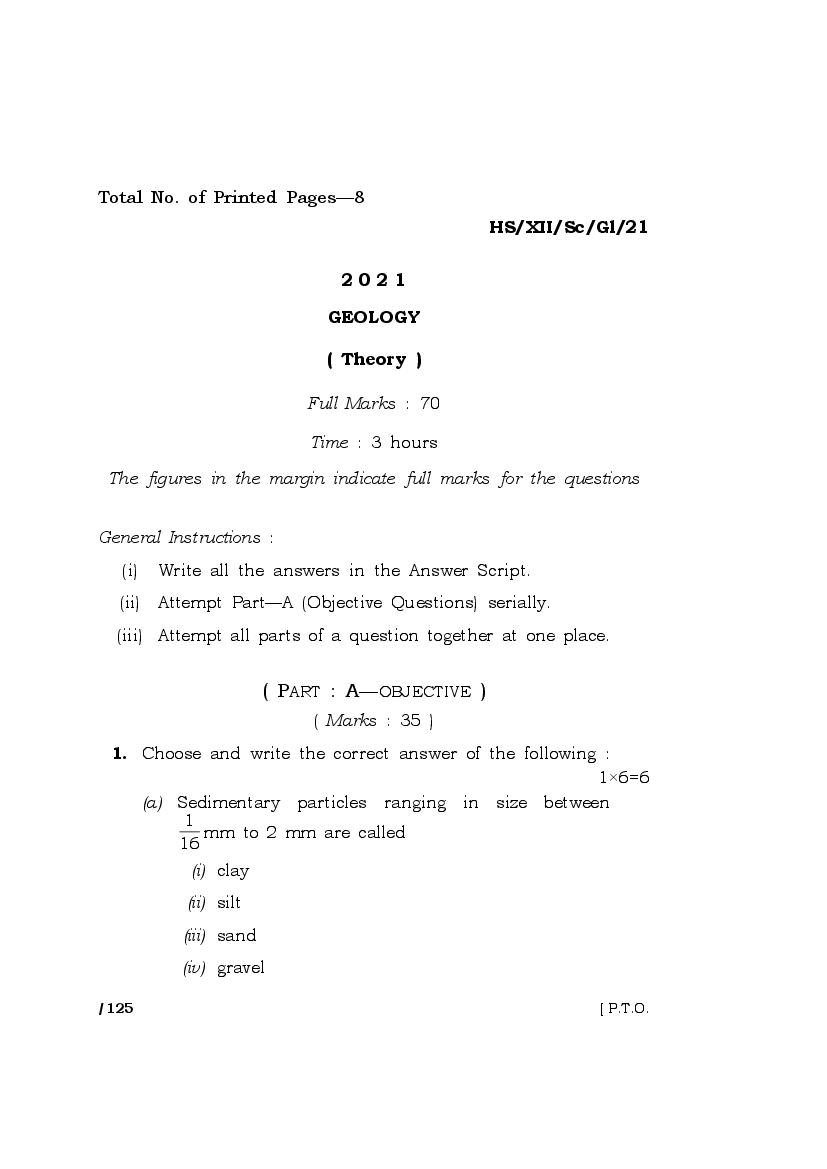
HS/XII/Sc/Gl/21
2021
GEOLOGY
( Theory )
Full Marks : 70
Time : 3 hours
The figures in the margin indicate full marks for the questions
General Instructions :
(i) Write all the answers in the Answer Script.
(ii) Attempt Part—A (Objective Questions) serially.
(iii) Attempt all parts of a question together at one place.
( PART : A—OBJECTIVE )
( Marks : 35 )
1. Choose and write the correct answer of the following :
1×6=6
(a) Sedimentary particles ranging in size between
1
mm to 2 mm are called
16
(i) clay
(ii) silt
(iii) sand
(iv) gravel
/125 [ P.T.O.
Page 2
(b) Fossils are found in
(i) igneous rocks
(ii) sedimentary rocks
(iii) metamorphic rocks
(iv) All of the above
(c) The correct sequence from older to younger in the
Tertiary rocks of Upper Assam is
(i) Barail—Tipam—Surma—Dupitila
(ii) Dihing—Dupitila—Tipam—Surma
(iii) Barail—Dupitila—Surma—Tipam
(iv) Barail—Surma—Tipam—Dupitila
(d) Coal deposits of Meghalaya are associated with the
(i) Tipam group
(ii) Barail group
(iii) Jaintia group
(iv) Surma group
HS/XII/Sc/Gl/21/125 [ Contd.
Page 3
(e) Brachiopods attach themselves to the substratum
with the help of
(i) beak
(ii) pedicle
(iii) teeth
(iv) ligament
(f) Ideally, an aquifer should possess
(i) high porosity
(ii) high permeability
(iii) high porosity and high permeability
(iv) low porosity and low permeability
2. State whether the following statements are ‘ True’
or ‘False’ : 1×6=6
(a) Sandstone is a clastic rock.
(b) The valves of a lamellibranch shell are equal in size.
(c) Closepet granite is associated with the Vindhyan
supergroup.
(d) Hematite is an ore of aluminium.
(e) Ground subsidence occurs due to landslides.
(f) Glossopteris is a plant fossil found in the Lower
Gondwana.
HS/XII/Sc/Gl/21/125 [ P.T.O.
Page 4
3. Fill in the blanks : 1×5=5
(a) In a graded bed, the particle size _____ upwards.
(b) Organisms with _____ parts are better preserved as
fossils.
(c) The Vindhyan supergroup is _____ in age than the
Dharwar supergroup.
(d) The metal content of an ore is called ______.
(e) _____ is the ease with which water or fluids move
through a rock or soil.
4. Express each of the following in 1 (one) word : 1×6=6
(a) Beds with extreme thickness of less than 1 cm
(b) The oldest Tertiary rocks in Upper Assam
(c) A process where the hard parts of an organism
converts into minerals or rock
(d) A number of individual beds with more or less
similar characteristics
(e) A liquid hydrocarbon
(f) A structure constructed to impound water, used for
various purposes
HS/XII/Sc/Gl/21/125 [ Contd.
Page 5
5. Match Column—A with Column—B and write the
corresponding numbers : 1×6=6
Column—A Column—B
(a) Littoral zone (i) Vindhyan supergroup
(b) Productus (ii) Magmatic process
(c) Diamond bearing (iii) Marine environment
conglomerates
(d) Placer deposits (iv) Porosity
(e) Hydrothermal deposit (v) Brachiopod
(f) Percentage of voids/ (vi) Dharwar supergroup
empty spaces in rocks
(vii) Mechanical concentration
(viii) Mixed environment
(ix) Permeability
(x) Lamellibranch
6. Write 1 (one) or 2 (two) line(s) on the following : 1×6=6
(a) Clastic sedimentary rocks
(b) Conditions for preservation of fossils
(c) Gangamopteris
(d) Uses of mica
(e) Confined aquifer
(f) Economic importance of Tertiary rocks of Upper
Assam
HS/XII/Sc/Gl/21/125 [ P.T.O.
Page 6
( PART : B—DESCRIPTIVE )
( Marks : 35 )
Answer five questions, selecting one from each Group
GROUP—A
( Sedimentology )
7. Name some common sedimentary structures and write
briefly on any two structures. 1+3+3=7
8. Write notes on any two of the following : 3½×2=7
(a) Transitional environment
(b) Non-clastic texture
(c) Neritic zone
GROUP—B
( Paleontology )
9. Describe the morphology of a typical brachiopod shell
with the help of neat labelled sketches. 5+2=7
10. Write notes on any two of the following : 3½×2=7
(a) Index fossils
(b) Dentitions in lamellibranch
(c) Important uses of fossils
HS/XII/Sc/Gl/21/125 [ Contd.
Page 7
GROUP—C
( Stratigraphy )
11. Write the stratigraphy of the Dharwar supergroup (after
Rama Rao) in a tabular form. Add brief petrographic
notes on each unit. 3+4=7
12. Write notes on any two of the following : 3½×2=7
(a) Jaintia group
(b) Haimanta group
(c) Semri group
GROUP—D
( Mineral and Energy Resources )
13. List the different magmatic processes of formation of
mineral deposits. Write briefly on any two of the
processes. 1+3+3=7
14. Write notes on any two of the following : 3½×2=7
(a) Origin of coal
(b) Placer deposits
(c) Chromite deposits in India
HS/XII/Sc/Gl/21/125 [ P.T.O.
Page 8
GROUP—E
( Engineering Geology, Groundwater, Environment
and Disaster Studies )
15. Give an account on the geological consideration in the
construction of dams. 7
16. Write notes on any two of the following : 3½×2=7
(a) Hydrologic cycle
(b) Remedial measures to control landslides
(c) Impact of underground mining on the environment
HS/XII/Sc/Gl/21/125 11-21—50
Document Details
| Board / Org | Meghalaya Board |
| Exam | Class 12 |
| Type | Question Paper |
| Pages | 8 |
| Updated | 30 Apr 2026 |