Bihar DCECE 2027 Sample Paper PE (Polytechnic Engineering)
Finished viewing? Save it for later —
Download Bihar DCECE 2027 Sample Paper PE (Polytechnic Engineering) (PDF · 15 pages)About Bihar DCECE 2027 Sample Paper PE (Polytechnic Engineering)
Bihar DCECE 2027 Sample Paper PE (Polytechnic Engineering) is available here for free download. Published by BCECEB for Bihar DCECE, this sample paper can be viewed online or downloaded as a PDF (15 pages). Candidates preparing for Bihar DCECE can use Bihar DCECE 2027 Sample Paper PE (Polytechnic Engineering) to understand the exam pattern, the type of questions asked, and the overall difficulty level.
Frequently Asked Questions
How can I download Bihar DCECE 2027 Sample Paper PE (Polytechnic Engineering)?
Open this page and click the Download button to save Bihar DCECE 2027 Sample Paper PE (Polytechnic Engineering) as a PDF. It is completely free on AglaSem Docs.
Is Bihar DCECE 2027 Sample Paper PE (Polytechnic Engineering) free to download?
Yes. Bihar DCECE 2027 Sample Paper PE (Polytechnic Engineering) can be viewed online and downloaded as a PDF free of cost on AglaSem Docs.
How many pages does Bihar DCECE 2027 Sample Paper PE (Polytechnic Engineering) have?
Bihar DCECE 2027 Sample Paper PE (Polytechnic Engineering) contains 15 pages, which you can read online or download together as a single PDF.
Where can I find more Bihar DCECE study material?
You can find more Bihar DCECE question papers, sample papers, syllabus, and answer keys on AglaSem Docs.
Bihar DCECE 2027 Sample Paper PE (Polytechnic Engineering) – Text
Read the full text of this sample paper below — useful to quickly search, copy and reference the content online without downloading the PDF.
📄 View text version (15 pages)
Page 1
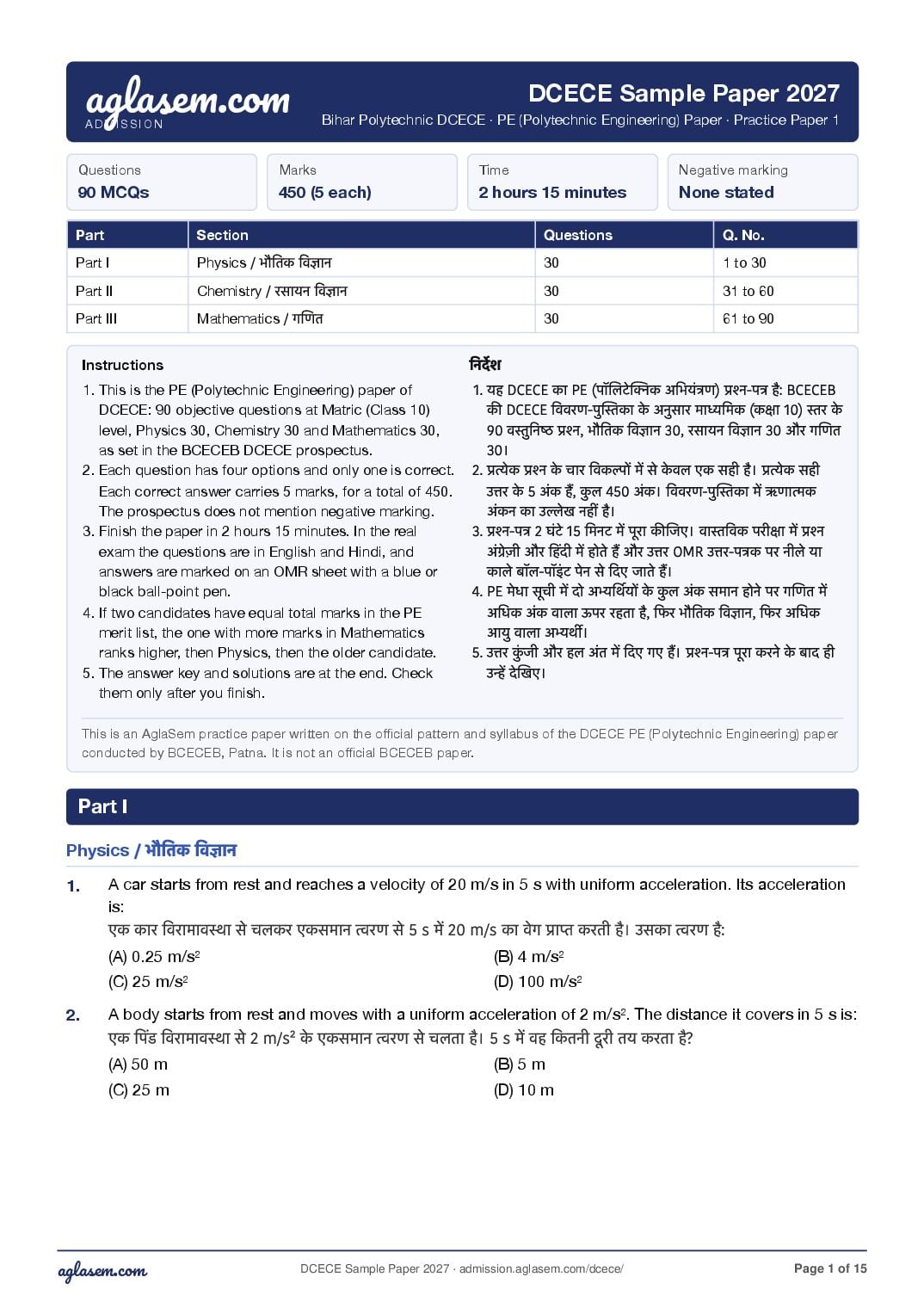
DCECE Sample Paper 2027
Bihar Polytechnic DCECE · PE (Polytechnic Engineering) Paper · Practice Paper 1
Questions Marks Time Negative marking
90 MCQs 450 (5 each) 2 hours 15 minutes None stated
Part Section Questions Q. No.
Part I Physics / भौतिक विज्ञान 30 1 to 30
Part II Chemistry / रसायन विज्ञान 30 31 to 60
Part III Mathematics / गणित 30 61 to 90
Instructions निर्देश
1. This is the PE (Polytechnic Engineering) paper of 1. यह DCECE का PE (पॉलिटेक्निक अभियंत्रण) प्रश्न-पत्र है: BCECEB
DCECE: 90 objective questions at Matric (Class 10) की DCECE विवरण-पुस्तिका के अनुसार माध्यमिक (कक्षा 10) स्तर के
level, Physics 30, Chemistry 30 and Mathematics 30, 90 वस्तुनिष्ठ प्रश्न, भौतिक विज्ञान 30, रसायन विज्ञान 30 और गणित
as set in the BCECEB DCECE prospectus. 30।
2. Each question has four options and only one is correct. 2. प्रत्येक प्रश्न के चार विकल्पों में से के वल एक सही है। प्रत्येक सही
Each correct answer carries 5 marks, for a total of 450. उत्तर के 5 अंक हैं, कु ल 450 अंक। विवरण-पुस्तिका में ऋणात्मक
The prospectus does not mention negative marking. अंकन का उल्लेख नहीं है।
3. Finish the paper in 2 hours 15 minutes. In the real 3. प्रश्न-पत्र 2 घंटे 15 मिनट में पूरा कीजिए। वास्तविक परीक्षा में प्रश्न
exam the questions are in English and Hindi, and अंग्रेज़ी और हिं दी में होते हैं और उत्तर OMR उत्तर-पत्रक पर नीले या
answers are marked on an OMR sheet with a blue or काले बॉल-पॉइं ट पेन से दिए जाते हैं।
black ball-point pen. 4. PE मेधा सूची में दो अभ्यर्थि यों के कु ल अंक समान होने पर गणित में
4. If two candidates have equal total marks in the PE अधिक अंक वाला ऊपर रहता है, फिर भौतिक विज्ञान, फिर अधिक
merit list, the one with more marks in Mathematics आयु वाला अभ्यर्थी।
ranks higher, then Physics, then the older candidate. 5. उत्तर कुं जी और हल अंत में दिए गए हैं। प्रश्न-पत्र पूरा करने के बाद ही
5. The answer key and solutions are at the end. Check उन्हें देखिए।
them only after you finish.
This is an AglaSem practice paper written on the official pattern and syllabus of the DCECE PE (Polytechnic Engineering) paper
conducted by BCECEB, Patna. It is not an official BCECEB paper.
Part I
Physics / भौतिक विज्ञान
1. A car starts from rest and reaches a velocity of 20 m/s in 5 s with uniform acceleration. Its acceleration
is:
एक कार विरामावस्था से चलकर एकसमान त्वरण से 5 s में 20 m/s का वेग प्राप्त करती है। उसका त्वरण है:
(A) 0.25 m/s² (B) 4 m/s²
(C) 25 m/s² (D) 100 m/s²
2. A body starts from rest and moves with a uniform acceleration of 2 m/s². The distance it covers in 5 s is:
एक पिं ड विरामावस्था से 2 m/s² के एकसमान त्वरण से चलता है। 5 s में वह कितनी दू री तय करता है?
(A) 50 m (B) 5 m
(C) 25 m (D) 10 m
DCECE Sample Paper 2027 · admission./dcece/ Page 1 of 15
Page 2
एक धावक 7 m त्रिज्या वाले वृत्ताकार पथ का ठीक एक चक्कर पूरा करता है। उसका विस्थापन है:
(A) 14 m (B) 22 m
(C) Zero (D) 44 m
शून्य
4. The tendency of a body to resist any change in its state of rest or of uniform motion is called:
किसी पिं ड की अपनी विराम अवस्था या एकसमान गति की अवस्था में परिवर्तन का विरोध करने की प्रवृत्ति कहलाती है:
(A) Friction (B) Impulse
घर्षण आवेग
(C) Momentum (D) Inertia
संवेग जड़त्व
5. What force is needed to give a body of mass 5 kg an acceleration of 4 m/s²?
5 kg द्रव्यमान के पिं ड में 4 m/s² का त्वरण उत्पन्न करने के लिए कितना बल चाहिए?
(A) 1.25 N (B) 9 N
(C) 0.8 N (D) 20 N
6. A bullet of mass 20 g is fired from a gun of mass 4 kg with a velocity of 400 m/s. The recoil velocity of
the gun is:
4 kg द्रव्यमान की बंदू क से 20 g की गोली 400 m/s के वेग से छोड़ी जाती है। बंदू क का प्रतिक्षेप वेग है:
(A) 0.5 m/s (B) 4 m/s
(C) 2 m/s (D) 20 m/s
7. The motion of a rocket is based on Newton's:
रॉके ट की गति न्यूटन के किस नियम पर आधारित है?
(A) Third law of motion (B) Law of gravitation
गति का तीसरा नियम गुरुत्वाकर्षण का नियम
(C) First law of motion (D) Second law of motion
गति का पहला नियम गति का दू सरा नियम
8. If the distance between two bodies is doubled, the gravitational force between them becomes:
यदि दो पिं डों के बीच की दू री दोगुनी कर दी जाए, तो उनके बीच गुरुत्वाकर्षण बल हो जाता है:
(A) Four times (B) Double
चार गुना दोगुना
(C) One-fourth (D) Half
एक-चौथाई आधा
9. The value of g on the Moon is about one-sixth of that on the Earth. What is the weight on the Moon of a
body of mass 10 kg? (g on Earth = 9.8 m/s²)
चंद्रमा पर g का मान पृथ्वी के मान का लगभग छठा भाग है। 10 kg द्रव्यमान के पिं ड का चंद्रमा पर भार कितना होगा? (पृथ्वी पर g =
9.8 m/s²)
(A) 98 N (B) 16.3 N
(C) 58.8 N (D) 10 N
10. An object floats on water when its density is:
कोई वस्तु पानी पर तब तैरती है जब उसका घनत्व:
(A) Less than that of water (B) Twice that of water
पानी के घनत्व से कम हो पानी के घनत्व का दोगुना हो
(C) More than that of water (D) Three times that of water
पानी के घनत्व से अधिक हो पानी के घनत्व का तीन गुना हो
DCECE Sample Paper 2027 · admission./dcece/ Page 2 of 15
Page 3
100 N का बल 0.5 m² क्षेत्रफल पर लंबवत लगता है। दाब है:
(A) 50 Pa (B) 200 Pa
(C) 0.005 Pa (D) 100.5 Pa
12. A porter carries a load on his head and walks on a level road. The work done by him against gravity on
the load is:
एक कु ली सिर पर बोझ रखकर समतल सड़क पर चलता है। बोझ पर गुरुत्व के विरुद्ध उसके द्वारा किया गया कार्य है:
(A) Zero (B) Positive
शून्य धनात्मक
(C) Very large (D) Negative
बहुत अधिक ऋणात्मक
13. If the velocity of a body is doubled, its kinetic energy becomes:
यदि किसी पिं ड का वेग दोगुना कर दिया जाए, तो उसकी गतिज ऊर्जा हो जाती है:
(A) Two times (B) Eight times
दोगुनी आठ गुनी
(C) Half (D) Four times
आधी चार गुनी
14. A boy of mass 50 kg runs up a staircase of height 15 m in 25 s. His power is: (g = 10 m/s²)
50 kg द्रव्यमान का एक लड़का 15 m ऊँ ची सीढ़ियाँ 25 s में चढ़ता है। उसकी शक्ति है: (g = 10 m/s²)
(A) 300 W (B) 30 W
(C) 7500 W (D) 750 W
15. 1 kWh is equal to:
1 kWh किसके बराबर होता है?
(A) 1000 J (B) 3.6 × 10⁵ J
(C) 3.6 × 10⁶ J (D) 3.6 × 10³ J
16. A sound wave has a frequency of 500 Hz and a wavelength of 0.68 m. Its speed is:
एक ध्वनि तरंग की आवृत्ति 500 Hz और तरंगदैर्घ्य 0.68 m है। उसकी चाल है:
(A) 500 m/s (B) 340 m/s
(C) 170 m/s (D) 680 m/s
17. Sound waves of frequency higher than 20,000 Hz are called:
20,000 Hz से अधिक आवृत्ति वाली ध्वनि तरंगें कहलाती हैं:
(A) Ultrasonic waves (B) Infrasonic waves
पराश्रव्य तरंगें अवश्रव्य तरंगें
(C) Audible waves (D) Radio waves
श्रव्य तरंगें रेडियो तरंगें
18. A person shouts near a cliff and hears the echo after 2 s. If the speed of sound is 340 m/s, the distance
of the cliff is:
एक व्यक्ति चट्टान के पास चिल्लाता है और 2 s बाद प्रतिध्वनि सुनता है। ध्वनि की चाल 340 m/s हो तो चट्टान की दू री है:
(A) 340 m (B) 170 m
(C) 1360 m (D) 680 m
DCECE Sample Paper 2027 · admission./dcece/ Page 3 of 15
Page 4
समतल दर्पण द्वारा बना प्रतिबिं ब होता है:
(A) Virtual, erect, magnified (B) Real, inverted, same size
आभासी, सीधा, आवर्धि त वास्तविक, उलटा, समान आकार का
(C) Real, erect, diminished (D) Virtual, erect, same size
वास्तविक, सीधा, छोटा आभासी, सीधा, समान आकार का
20. The radius of curvature of a spherical mirror is 30 cm. Its focal length is:
एक गोलीय दर्पण की वक्रता त्रिज्या 30 cm है। उसकी फोकस दू री है:
(A) 60 cm (B) 30 cm
(C) 15 cm (D) 7.5 cm
21. An object is placed 20 cm in front of a concave mirror of focal length 10 cm. The image is formed:
10 cm फोकस दू री वाले अवतल दर्पण के सामने 20 cm पर एक वस्तु रखी है। प्रतिबिं ब बनेगा:
(A) At infinity (B) 20 cm in front of the mirror
अनंत पर दर्पण के सामने 20 cm पर
(C) 20 cm behind the mirror (D) 10 cm in front of the mirror
दर्पण के पीछे 20 cm पर दर्पण के सामने 10 cm पर
22. The refractive index of glass is 1.5. If the speed of light in vacuum is 3 × 10⁸ m/s, its speed in glass is:
काँच का अपवर्तनांक 1.5 है। यदि निर्वात में प्रकाश की चाल 3 × 10⁸ m/s हो, तो काँच में उसकी चाल है:
(A) 3 × 10⁸ m/s (B) 1.5 × 10⁸ m/s
(C) 2 × 10⁸ m/s (D) 4.5 × 10⁸ m/s
23. The power of a convex lens of focal length 50 cm is:
50 cm फोकस दू री वाले उत्तल लेंस की क्षमता है:
(A) +50 D (B) +2 D
(C) −2 D (D) +0.5 D
24. Myopia (short-sightedness) is corrected by using a:
निकट-दृष्टि दोष (मायोपिया) को किसके उपयोग से ठीक किया जाता है?
(A) Convex lens (B) Concave lens
उत्तल लेंस अवतल लेंस
(C) Plane glass (D) Prism
समतल काँच प्रिज़्म
25. The blue colour of the clear sky is due to:
स्वच्छ आकाश का रंग नीला किस कारण दिखाई देता है?
(A) Total internal reflection (B) Reflection of light
पूर्ण आं तरिक परावर्तन प्रकाश का परावर्तन
(C) Dispersion of light (D) Scattering of light
प्रकाश का विक्षेपण प्रकाश का प्रकीर्णन
26. How many electrons make up a charge of 1 coulomb? (charge on an electron = 1.6 × 10⁻¹⁹ C)
1 कू लॉम आवेश कितने इलेक्ट्रॉनों से बनता है? (एक इलेक्ट्रॉन का आवेश = 1.6 × 10⁻¹⁹ C)
(A) 1.6 × 10⁻¹⁹ (B) 6.25 × 10¹⁸
(C) 1.6 × 10¹⁹ (D) 6.25 × 10¹⁶
27. Three resistors of 2 Ω, 3 Ω and 6 Ω are connected in parallel. Their equivalent resistance is:
2 Ω, 3 Ω और 6 Ω के तीन प्रतिरोधक समांतर क्रम में जुड़े हैं। उनका तुल्य प्रतिरोध है:
(A) 11 Ω (B) 6 Ω
(C) 1 Ω (D) 0.5 Ω
DCECE Sample Paper 2027 · admission./dcece/ Page 4 of 15
Page 5
एक विद्युत बल्ब पर 220 V, 100 W अंकित है। सामान्य रूप से जलते समय उसका प्रतिरोध है:
(A) 22000 Ω (B) 484 Ω
(C) 0.45 Ω (D) 2.2 Ω
29. The direction of the force on a current-carrying conductor placed in a magnetic field is given by:
चुंबकीय क्षेत्र में रखे धारावाही चालक पर लगने वाले बल की दिशा किससे ज्ञात होती है?
(A) Right-hand thumb rule (B) Fleming's right-hand rule
दक्षिण-हस्त अंगुष्ठ नियम फ्लेमिं ग का दक्षिणहस्त नियम
(C) Fleming's left-hand rule (D) Snell's law
फ्लेमिं ग का वामहस्त नियम स्नेल का नियम
30. Producing an electric current in a coil by changing the magnetic field linked with it is called:
किसी कुं डली से संबद्ध चुंबकीय क्षेत्र को बदलकर उसमें विद्युत धारा उत्पन्न करना कहलाता है:
(A) Electrolysis (B) Electric resistance
विद्युत अपघटन विद्युत प्रतिरोध
(C) Heating effect of current (D) Electromagnetic induction
विद्युत धारा का तापीय प्रभाव विद्युत चुंबकीय प्रेरण
Part II
Chemistry / रसायन विज्ञान
31. Which of the following is a compound?
इनमें से कौन-सा यौगिक है?
(A) Sea water (B) Water
समुद्री जल जल
(C) Brass (D) Air
पीतल वायु
32. The change of a solid directly into vapour without becoming a liquid is called:
किसी ठोस का द्रव बने बिना सीधे वाष्प में बदलना कहलाता है:
(A) Condensation (B) Fusion
संघनन गलन
(C) Sublimation (D) Evaporation
ऊर्ध्वपातन वाष्पन
33. Which of the following shows the Tyndall effect?
इनमें से कौन टिं डल प्रभाव दर्शाता है?
(A) Sugar solution (B) Starch solution
चीनी का विलयन स्टार्च का विलयन
(C) Salt solution (D) Copper sulphate solution
नमक का विलयन कॉपर सल्फे ट का विलयन
34. The molar mass of sulphuric acid (H₂SO₄) is: (H = 1, S = 32, O = 16)
सल्फ्यूरिक अम्ल (H₂SO₄) का मोलर द्रव्यमान है: (H = 1, S = 32, O = 16)
(A) 98 g/mol (B) 49 g/mol
(C) 96 g/mol (D) 100 g/mol
35. How many moles are present in 36 g of water? (H = 1, O = 16)
36 g जल में कितने मोल हैं? (H = 1, O = 16)
(A) 0.5 mol (B) 18 mol
(C) 2 mol (D) 36 mol
DCECE Sample Paper 2027 · admission./dcece/ Page 5 of 15
Page 6
0.5 मोल कार्बन डाइऑक्साइड में अणुओं की संख्या है:
(A) 3.011 × 10²² (B) 6.022 × 10²³
(C) 1.2044 × 10²⁴ (D) 3.011 × 10²³
37. An atom has atomic number 11 and mass number 23. The number of neutrons in it is:
एक परमाणु का परमाणु क्रमांक 11 और द्रव्यमान संख्या 23 है। उसमें न्यूट्रॉनों की संख्या है:
(A) 23 (B) 11
(C) 34 (D) 12
38. The electronic configuration of chlorine (atomic number 17) is:
क्लोरीन (परमाणु क्रमांक 17) का इलेक्ट्रॉनिक विन्यास है:
(A) 2, 7, 8 (B) 2, 8, 6, 1
(C) 8, 2, 7 (D) 2, 8, 7
39. Isotopes of an element have the same:
किसी तत्व के समस्थानिकों में समान होता है:
(A) Atomic mass (B) Atomic number
परमाणु द्रव्यमान परमाणु क्रमांक
(C) Number of neutrons (D) Mass number
न्यूट्रॉनों की संख्या द्रव्यमान संख्या
40. The nucleus of an atom was discovered through the alpha-particle scattering experiment by:
अल्फ़ा-कण प्रकीर्णन प्रयोग द्वारा परमाणु के नाभिक की खोज किसने की?
(A) John Dalton (B) Ernest Rutherford
जॉन डाल्टन अर्नेस्ट रदरफ़ोर्ड
(C) J.J. Thomson (D) Niels Bohr
जे.जे. थॉमसन नील्स बोर
41. In the balanced equation aFe + bH₂O → Fe₃O₄ + cH₂, the values of a, b and c are:
संतुलित समीकरण aFe + bH₂O → Fe₃O₄ + cH₂ में a, b और c के मान हैं:
(A) 3, 4, 2 (B) 3, 2, 4
(C) 3, 4, 4 (D) 1, 4, 4
42. CaO + H₂O → Ca(OH)₂ is an example of a:
CaO + H₂O → Ca(OH)₂ किसका उदाहरण है?
(A) Combination reaction (B) Displacement reaction
संयोजन अभिक्रिया विस्थापन अभिक्रिया
(C) Decomposition reaction (D) Double displacement reaction
वियोजन अभिक्रिया द्विविस्थापन अभिक्रिया
43. When an iron nail is dipped in copper sulphate solution, the blue colour of the solution fades because:
लोहे की कील को कॉपर सल्फे ट विलयन में डुबोने पर विलयन का नीला रंग फीका पड़ जाता है, क्योंकि:
(A) Sulphate ions turn into gas
सल्फे ट आयन गैस में बदल जाते हैं
(B) Water in it evaporates quickly
उसका पानी जल्दी वाष्पित हो जाता है
(C) Copper displaces iron from it
कॉपर उसमें से लोहे को विस्थापित कर देता है
(D) Iron displaces copper from it
लोहा उसमें से कॉपर को विस्थापित कर देता है
DCECE Sample Paper 2027 · admission./dcece/ Page 6 of 15
Page 7
अभिक्रिया CuO + H₂ → Cu + H₂O में ऑक्सीकृ त होने वाला पदार्थ है:
(A) H₂O (B) H₂
(C) CuO (D) Cu
45. Packets of chips are usually flushed with which gas to prevent rancidity?
विकृ तगंधिता (रैंसिडिटी) रोकने के लिए चिप्स के पैके ट में सामान्यतः कौन-सी गैस भरी जाती है?
(A) Nitrogen (B) Oxygen
नाइट्रोजन ऑक्सीजन
(C) Chlorine (D) Hydrogen
क्लोरीन हाइड्रोजन
46. A solution turns blue litmus paper red. Its pH is likely to be:
एक विलयन नीले लिटमस पत्र को लाल कर देता है। उसका pH होने की संभावना है:
(A) Exactly 14 (B) Above 7
ठीक 14 7 से अधिक
(C) Below 7 (D) Exactly 7
7 से कम ठीक 7
47. Which of the following is used as an antacid to relieve acidity in the stomach?
पेट की अम्लता दू र करने के लिए प्रतिअम्ल (एं टैसिड) के रूप में किसका उपयोग होता है?
(A) Calcium sulphate hemihydrate (B) Sodium chloride
कै ल्सियम सल्फे ट हेमीहाइड्रेट सोडियम क्लोराइड
(C) Hydrochloric acid (D) Magnesium hydroxide
हाइड्रोक्लोरिक अम्ल मैग्नीशियम हाइड्रॉक्साइड
48. The chemical formula of baking soda is:
बेकिं ग सोडा का रासायनिक सूत्र है:
(A) Na₂CO₃ (B) NaHCO₃
(C) Na₂CO₃·10H₂O (D) CaOCl₂
49. The chemical formula of Plaster of Paris is:
प्लास्टर ऑफ़ पेरिस का रासायनिक सूत्र है:
(A) CaSO₄·½H₂O (B) Ca(OH)₂
(C) CaCO₃ (D) CaSO₄·2H₂O
50. Zinc reacts with dilute sulphuric acid and the gas given off burns with a pop sound. The gas is:
जिं क तनु सल्फ्यूरिक अम्ल से अभिक्रिया करता है और निकलने वाली गैस 'पॉप' ध्वनि के साथ जलती है। यह गैस है:
(A) Oxygen (B) Hydrogen
ऑक्सीजन हाइड्रोजन
(C) Sulphur dioxide (D) Carbon dioxide
सल्फर डाइऑक्साइड कार्बन डाइऑक्साइड
51. Which metal is a liquid at room temperature?
कौन-सी धातु कमरे के ताप पर द्रव होती है?
(A) Aluminium (B) Mercury
ऐलुमिनियम पारा
(C) Tungsten (D) Sodium
टंगस्टन सोडियम
DCECE Sample Paper 2027 · admission./dcece/ Page 7 of 15
Page 8
कौन-सी धातु वायु और जल से तीव्र अभिक्रिया करती है, इसलिए उसे मिट्टी के तेल में रखा जाता है?
(A) Silver (B) Copper
सिल्वर कॉपर
(C) Sodium (D) Aluminium
सोडियम ऐलुमिनियम
53. Ionic compounds generally:
आयनिक यौगिक सामान्यतः:
(A) Conduct electricity when molten
गलित अवस्था में विद्युत का चालन करते हैं
(B) Dissolve easily in kerosene and petrol
मिट्टी के तेल और पेट्रोल में आसानी से घुलते हैं
(C) Have very low melting and boiling points
बहुत कम गलनांक और क्वथनांक वाले होते हैं
(D) Are formed by sharing electrons
इलेक्ट्रॉनों की साझेदारी से बनते हैं
54. Rusting of iron needs:
लोहे पर जंग लगने के लिए आवश्यक है:
(A) Oil and dry air together (B) Both air and water
तेल और शुष्क वायु साथ में वायु और जल दोनों
(C) Only boiled water (D) Only dry air
के वल उबला हुआ जल के वल शुष्क वायु
55. Brass is an alloy of:
पीतल किसकी मिश्रधातु है?
(A) Iron and carbon (B) Copper and zinc
आयरन और कार्बन कॉपर और जिं क
(C) Lead and tin (D) Copper and tin
लेड और टिन कॉपर और टिन
56. Ethanol (C₂H₅OH) contains which functional group?
एथेनॉल (C₂H₅OH) में कौन-सा प्रकार्यात्मक समूह है?
(A) Carboxylic acid (–COOH) (B) Aldehyde (–CHO)
कार्बोक्सिलिक अम्ल (–COOH) ऐल्डिहाइड (–CHO)
(C) Alcohol (–OH) (D) Ketone (>C=O)
ऐल्कोहॉल (–OH) कीटोन (>C=O)
57. Two consecutive members of a homologous series differ by:
किसी समजातीय श्रेणी के दो क्रमागत सदस्यों में अंतर होता है:
(A) –H₂ (2 u) (B) –C₂H₄– (28 u)
(C) –CH₃ (15 u) (D) –CH₂– (14 u)
58. The IUPAC name of CH₃COOH is:
CH₃COOH का IUPAC नाम है:
(A) Ethanol (B) Methanoic acid
एथेनॉल मेथेनॉइक अम्ल
(C) Propanoic acid (D) Ethanoic acid
प्रोपेनॉइक अम्ल एथेनॉइक अम्ल
DCECE Sample Paper 2027 · admission./dcece/ Page 8 of 15
Page 9
इनमें से कौन-सा असंतृप्त हाइड्रोकार्बन है?
(A) C₂H₄ (B) CH₄
(C) C₃H₈ (D) C₂H₆
60. Ethanoic acid reacts with ethanol in the presence of concentrated sulphuric acid to form a sweet-
smelling compound called:
सांद्र सल्फ्यूरिक अम्ल की उपस्थिति में एथेनॉइक अम्ल, एथेनॉल से अभिक्रिया करके मीठी गंध वाला यौगिक बनाता है, जिसे कहते हैं:
(A) A soap (B) A ketone
साबुन कीटोन
(C) An aldehyde (D) An ester
ऐल्डिहाइड एस्टर
Part III
Mathematics / गणित
61. If HCF(96, 404) = 4, then LCM(96, 404) is:
यदि HCF(96, 404) = 4 है, तो LCM(96, 404) है:
(A) 2424 (B) 4848
(C) 9696 (D) 38784
62. Which of the following is an irrational number?
इनमें से कौन-सी अपरिमेय संख्या है?
(A) 0.25 (B) √16
(C) 22/7 (D) √5
63. Which of the following rational numbers has a terminating decimal expansion?
इनमें से किस परिमेय संख्या का दशमलव प्रसार सांत (terminating) है?
(A) 17/6 (B) 13/3125
(C) 64/455 (D) 29/343
64. If α and β are the zeros of p(x) = x² − 5x + 6, then α + β and αβ are respectively:
यदि α और β बहुपद p(x) = x² − 5x + 6 के शून्यक हैं, तो α + β और αβ क्रमशः हैं:
(A) 5 and 6 (B) 5 and −6
5 और 6 5 और −6
(C) −5 and 6 (D) 6 and 5
−5 और 6 6 और 5
65. A quadratic polynomial whose sum of zeros is −3 and product of zeros is 2 is:
वह द्विघात बहुपद जिसके शून्यकों का योग −3 और गुणनफल 2 है:
(A) x² − 3x + 2 (B) x² + 3x + 2
(C) x² − 3x − 2 (D) x² + 2x − 3
DCECE Sample Paper 2027 · admission./dcece/ Page 9 of 15
Page 10
समीकरण युग्म 2x + 3y = 7 और 4x + 6y = 14 के बारे में सही कथन है:
(A) Exactly two distinct solutions
इसके ठीक दो भिन्न हल हैं
(B) Exactly one solution
इसका ठीक एक हल है
(C) Infinitely many solutions
इसके अपरिमित रूप से अनेक हल हैं
(D) No solution at any point
इसका कोई हल नहीं है
67. The solution of x + y = 14 and x − y = 4 is:
x + y = 14 और x − y = 4 का हल है:
(A) x = 10, y = 4 (B) x = 8, y = 6
(C) x = 9, y = 5 (D) x = 5, y = 9
68. For what value of k does the pair kx + 3y = 3 and 12x + ky = 6 have no solution?
k के किस मान के लिए समीकरण युग्म kx + 3y = 3 और 12x + ky = 6 का कोई हल नहीं है?
(A) 6 (B) ±6
(C) 4 (D) −6
69. The roots of the equation 2x² − 4x + 3 = 0 are:
समीकरण 2x² − 4x + 3 = 0 के मूल हैं:
(A) Not real (B) Real and equal
वास्तविक नहीं वास्तविक और समान
(C) Real and distinct (D) One of them zero
वास्तविक और भिन्न उनमें से एक शून्य
70. For what positive value of k does x² + kx + 9 = 0 have two equal roots?
k के किस धनात्मक मान के लिए x² + kx + 9 = 0 के दो समान मूल हैं?
(A) 36 (B) 9
(C) 3 (D) 6
71. The roots of x² − 3x − 10 = 0 are:
x² − 3x − 10 = 0 के मूल हैं:
(A) 2 and 5 (B) −5 and 2
2 और 5 −5 और 2
(C) 10 and −1 (D) 5 and −2
10 और −1 5 और −2
72. The 10th term of the AP 2, 7, 12, ... is:
समांतर श्रेढ़ी 2, 7, 12, ... का 10वाँ पद है:
(A) 45 (B) 50
(C) 47 (D) 52
73. The sum of the first 20 terms of the AP 1, 4, 7, ... is:
समांतर श्रेढ़ी 1, 4, 7, ... के प्रथम 20 पदों का योग है:
(A) 1180 (B) 610
(C) 590 (D) 580
DCECE Sample Paper 2027 · admission./dcece/ Page 10 of 15
Page 11
दो अंकों वाली कितनी संख्याएँ 3 से विभाज्य हैं?
(A) 30 (B) 29
(C) 33 (D) 31
75. In triangle ABC, DE ∥ BC with D on AB and E on AC. If AD = 2 cm, DB = 3 cm and AE = 4 cm, then EC
is:
त्रिभुज ABC में DE ∥ BC है, जहाँ D भुजा AB पर और E भुजा AC पर है। यदि AD = 2 cm, DB = 3 cm और AE = 4 cm है, तो
EC है:
(A) 6 cm (B) 5 cm
(C) 8 cm (D) 1.5 cm
76. Two similar triangles have corresponding sides in the ratio 2 : 3. The ratio of their areas is:
दो समरूप त्रिभुजों की संगत भुजाओं का अनुपात 2 : 3 है। उनके क्षेत्रफलों का अनुपात है:
(A) 2 : 3 (B) 3 : 2
(C) 8 : 27 (D) 4 : 9
77. A ladder 13 m long reaches a window 12 m above the ground. How far is the foot of the ladder from the
wall?
13 m लंबी एक सीढ़ी ज़मीन से 12 m ऊँ ची खिड़की तक पहुँचती है। सीढ़ी का पाद दीवार से कितनी दू र है?
(A) 1 m (B) 7 m
(C) 25 m (D) 5 m
78. The distance between the points (2, 3) and (5, 7) is:
बिं दुओं (2, 3) और (5, 7) के बीच की दू री है:
(A) 5 (B) √7
(C) 25 (D) 7
79. The point that divides the line segment joining (−1, 7) and (4, −3) in the ratio 2 : 3 is:
(−1, 7) और (4, −3) को मिलाने वाले रेखाखंड को 2 : 3 के अनुपात में विभाजित करने वाला बिं दु है:
(A) (1, −3) (B) (2, 2)
(C) (1, 3) (D) (3, 1)
80. The distance of the point (−6, 8) from the origin is:
बिं दु (−6, 8) की मूलबिं दु से दू री है:
(A) 14 (B) 10
(C) 100 (D) 2
81. If sin A = 3/5 and A is acute, then tan A is:
यदि sin A = 3/5 है और A न्यून कोण है, तो tan A है:
(A) 3/4 (B) 4/3
(C) 4/5 (D) 5/3
82. The value of sin 30° cos 60° + cos 30° sin 60° is:
sin 30° cos 60° + cos 30° sin 60° का मान है:
(A) 1 (B) 0
(C) √3/2 (D) 1/2
83. sin θ/(1 + cos θ) + (1 + cos θ)/sin θ is equal to:
sin θ/(1 + cos θ) + (1 + cos θ)/sin θ बराबर है:
(A) 2 cosec θ (B) 2 sec θ
(C) cosec θ (D) 2 sin θ
DCECE Sample Paper 2027 · admission./dcece/ Page 11 of 15
Page 12
the tower is:
किसी मीनार के पाद से 20 m दू र स्थित बिं दु से उसके शिखर का उन्नयन कोण 60° है। मीनार की ऊँ चाई है:
(A) 20/√3 m (B) 40 m
(C) 20√3 m (D) 10√3 m
85. The length of the tangent drawn from a point 13 cm away from the centre of a circle of radius 5 cm is:
5 cm त्रिज्या वाले वृत्त के कें द्र से 13 cm दू र स्थित बिं दु से खींची गई स्पर्श रेखा की लंबाई है:
(A) 18 cm (B) √194 cm
(C) 8 cm (D) 12 cm
86. The area of a sector of a circle of radius 14 cm with central angle 90° is: (π = 22/7)
14 cm त्रिज्या वाले वृत्त के उस त्रिज्यखंड का क्षेत्रफल क्या है, जिसका कें द्रीय कोण 90° है? (π = 22/7)
(A) 154 cm² (B) 44 cm²
(C) 77 cm² (D) 616 cm²
87. The volume of a sphere of radius 3 cm is:
3 cm त्रिज्या वाले गोले का आयतन है:
(A) 12π cm³ (B) 108π cm³
(C) 27π cm³ (D) 36π cm³
88. A solid metal cube of edge 6 cm is melted and recast into small cubes of edge 2 cm. How many small
cubes are formed?
6 cm किनारे वाले धातु के ठोस घन को पिघलाकर 2 cm किनारे वाले छोटे घन बनाए जाते हैं। कितने छोटे घन बनेंगे?
(A) 36 (B) 27
(C) 3 (D) 9
89. For a data set, the mean is 24 and the median is 26. Using the empirical relation, the mode is:
किन्हीं आँ कड़ों का माध्य 24 और माध्यक 26 है। आनुभविक संबंध से बहुलक है:
(A) 30 (B) 22
(C) 25 (D) 28
90. One card is drawn at random from a well-shuffled deck of 52 playing cards. The probability that it is a
red king is:
52 पत्तों की अच्छी तरह फें टी गई गड्डी में से यादृच्छया एक पत्ता निकाला जाता है। उसके लाल बादशाह होने की प्रायिकता है:
(A) 1/26 (B) 1/52
(C) 1/2 (D) 1/13
DCECE Sample Paper 2027 · admission./dcece/ Page 12 of 15
Page 13
1 B 2 C 3 C 4 D 5 D 6 C 7 A 8 C 9 B 10 A
11 B 12 A 13 D 14 A 15 C 16 B 17 A 18 A 19 D 20 C
21 B 22 C 23 B 24 B 25 D 26 B 27 C 28 B 29 C 30 D
31 B 32 C 33 B 34 A 35 C 36 D 37 D 38 D 39 B 40 B
41 C 42 A 43 D 44 B 45 A 46 C 47 D 48 B 49 A 50 B
51 B 52 C 53 A 54 B 55 B 56 C 57 D 58 D 59 A 60 D
61 C 62 D 63 B 64 A 65 B 66 C 67 C 68 D 69 A 70 D
71 D 72 C 73 C 74 A 75 A 76 D 77 D 78 A 79 C 80 B
81 A 82 A 83 A 84 C 85 D 86 A 87 D 88 B 89 A 90 A
Solutions
Physics / भौतिक विज्ञान
1. (B) a = (v − u)/t = (20 − 0)/5 = 4 m/s².
2. (C) s = ut + ½at² = 0 + ½ × 2 × 5² = 25 m.
3. (C) He returns to the starting point, so the displacement is zero, although the distance covered is 2πr = 44 m.
4. (D) This property is inertia (Newton's first law). Mass is the measure of inertia.
5. (D) F = ma = 5 × 4 = 20 N.
6. (C) By conservation of momentum, 4 × v = 0.02 × 400 = 8, so v = 2 m/s (opposite to the bullet).
7. (A) The rocket pushes hot gases backward (action) and the gases push the rocket forward (reaction).
8. (C) F ∝ 1/d². Doubling d makes F one-fourth.
9. (B) Weight on Earth = 10 × 9.8 = 98 N; on the Moon it is 98 ÷ 6 ≈ 16.3 N. The mass stays 10 kg.
10. (A) A body less dense than water displaces its own weight of water before it is fully immersed, so the buoyant force
balances its weight and it floats.
11. (B) Pressure = Force/Area = 100 ÷ 0.5 = 200 Pa.
12. (A) Gravity acts vertically while the displacement is horizontal; the angle is 90°, so W = Fs cos 90° = 0.
13. (D) KE = ½mv². Doubling v multiplies v² by 4.
14. (A) Work = mgh = 50 × 10 × 15 = 7500 J. Power = 7500 ÷ 25 = 300 W.
15. (C) 1 kWh = 1000 W × 3600 s = 3.6 × 10⁶ J.
16. (B) v = fλ = 500 × 0.68 = 340 m/s.
17. (A) Humans hear about 20 Hz to 20,000 Hz. Above this range is ultrasound; below 20 Hz is infrasound.
18. (A) Sound travels to the cliff and back: 2d = 340 × 2, so d = 340 m.
19. (D) A plane mirror forms a virtual, erect image of the same size, as far behind the mirror as the object is in front.
20. (C) f = R/2 = 30/2 = 15 cm.
21. (B) u = −20 cm, f = −10 cm: 1/v = 1/f − 1/u = −1/10 + 1/20 = −1/20, so v = −20 cm. The object is at C, so the image
is real, inverted and at C.
22. (C) v = c/n = (3 × 10⁸)/1.5 = 2 × 10⁸ m/s.
23. (B) P = 1/f (in metres) = 1/0.5 = +2 D. A convex lens has positive power.
24. (B) In myopia the image forms in front of the retina; a concave (diverging) lens of suitable power moves it back onto
the retina.
25. (D) Tiny particles in air scatter shorter (blue) wavelengths much more than red, so the sky looks blue.
26. (B) n = q/e = 1/(1.6 × 10⁻¹⁹) = 6.25 × 10¹⁸.
DCECE Sample Paper 2027 · admission./dcece/ Page 13 of 15
Page 14
28. (B) R = V²/P = (220 × 220)/100 = 484 Ω.
29. (C) Fleming's left-hand rule gives the force (motor rule). The right-hand rule gives induced current; the thumb rule
gives the field around a wire.
30. (D) A changing magnetic field through a coil induces a current in it (Faraday). This is the principle of the electric
generator.
Chemistry / रसायन विज्ञान
31. (B) Water (H₂O) has hydrogen and oxygen combined in a fixed ratio. Air, brass (an alloy) and sea water are
mixtures.
32. (C) Camphor, naphthalene and ammonium chloride sublime on heating.
33. (B) Starch in water forms a colloid whose particles scatter a beam of light. Salt, sugar and copper sulphate form
true solutions.
34. (A) 2(1) + 32 + 4(16) = 2 + 32 + 64 = 98 g/mol.
35. (C) Molar mass of H₂O = 18 g/mol; moles = 36 ÷ 18 = 2.
36. (D) Number = 0.5 × 6.022 × 10²³ = 3.011 × 10²³.
37. (D) Neutrons = mass number − atomic number = 23 − 11 = 12 (this is sodium).
38. (D) Shells K, L, M hold 2, 8 and the remaining 7 electrons, so Cl is 2, 8, 7 with valency 1.
39. (B) Isotopes have the same number of protons (atomic number) but different numbers of neutrons, so their mass
numbers differ.
40. (B) Rutherford's gold-foil experiment showed that the positive charge and nearly all the mass are in a tiny nucleus.
41. (C) Fe: a = 3. O: b = 4. H: 2b = 2c, so c = 4. Balanced: 3Fe + 4H₂O → Fe₃O₄ + 4H₂.
42. (A) Two reactants combine to form a single product. The reaction is also strongly exothermic.
43. (D) Iron is more reactive than copper: Fe + CuSO₄ → FeSO₄ (pale green) + Cu (brown deposit).
44. (B) H₂ gains oxygen to become H₂O, so it is oxidised; CuO loses oxygen and is reduced.
45. (A) Nitrogen is unreactive and keeps oxygen away, so the fats in chips are not oxidised.
46. (C) Acids turn blue litmus red, and acidic solutions have pH less than 7.
47. (D) Milk of magnesia, Mg(OH)₂, is a mild base that neutralises excess stomach acid.
48. (B) Baking soda is sodium hydrogencarbonate, NaHCO₃. Na₂CO₃·10H₂O is washing soda and CaOCl₂ is bleaching
powder.
49. (A) Plaster of Paris is calcium sulphate hemihydrate. CaSO₄·2H₂O is gypsum.
50. (B) Zn + H₂SO₄ → ZnSO₄ + H₂. Hydrogen burns with a pop sound near a flame.
51. (B) Mercury is the only metal that is liquid at room temperature.
52. (C) Sodium catches fire in air and reacts violently with water, so it is kept in kerosene.
53. (A) Ions become free to move in the molten state or in water, so ionic compounds then conduct. They have high
melting points and do not dissolve in kerosene.
54. (B) Iron rusts only when both oxygen (air) and moisture are present.
55. (B) Brass = copper + zinc. Bronze = copper + tin; steel = iron + carbon; solder = lead + tin.
56. (C) The –OH group attached to a carbon chain makes ethanol an alcohol.
57. (D) Each member differs from the next by one –CH₂– unit, that is 14 u in molecular mass.
58. (D) CH₃COOH has two carbon atoms and a –COOH group, so it is ethanoic acid (acetic acid).
ₙ ₙ ₙ ₙ
59. (A) C₂H₄ (ethene, C H₂ ) has a carbon–carbon double bond. The others are alkanes (C H₂ ₊₂) with single bonds
only.
60. (D) This is esterification: CH₃COOH + C₂H₅OH → CH₃COOC₂H₅ (ethyl ethanoate) + H₂O.
DCECE Sample Paper 2027 · admission./dcece/ Page 14 of 15
Page 15
61. (C) HCF × LCM = product of the numbers, so LCM = (96 × 404) ÷ 4 = 38784 ÷ 4 = 9696.
62. (D) √5 cannot be written as p/q. √16 = 4, 0.25 = 1/4 and 22/7 are rational.
63. (B) 3125 = 5⁵ has only the prime factor 5, so 13/3125 terminates. 6, 343 = 7³ and 455 = 5 × 7 × 13 have other prime
factors.
64. (A) α + β = −b/a = 5 and αβ = c/a = 6 (the zeros are 2 and 3).
65. (B) p(x) = x² − (sum)x + product = x² + 3x + 2 (zeros −1 and −2).
66. (C) a₁/a₂ = b₁/b₂ = c₁/c₂ = 1/2, so the lines coincide and there are infinitely many solutions.
67. (C) Adding: 2x = 18, x = 9; then y = 14 − 9 = 5.
68. (D) No solution needs k/12 = 3/k ≠ 3/6. k² = 36 gives k = ±6. For k = 6, 3/k = 1/2 = 3/6 (infinitely many solutions), so
k = −6.
69. (A) D = b² − 4ac = 16 − 24 = −8 < 0, so the equation has no real roots.
70. (D) Equal roots need D = k² − 36 = 0, so k = 6 (positive value).
71. (D) x² − 3x − 10 = (x − 5)(x + 2) = 0, so x = 5 or x = −2.
72. (C) a = 2, d = 5; a₁₀ = 2 + 9 × 5 = 47.
73. (C) S₂₀ = 20/2 × [2(1) + 19 × 3] = 10 × 59 = 590.
74. (A) They are 12, 15, ..., 99. n = (99 − 12)/3 + 1 = 30.
75. (A) By the basic proportionality theorem, AD/DB = AE/EC, so 2/3 = 4/EC and EC = 6 cm.
76. (D) The ratio of areas of similar triangles equals the square of the ratio of their sides: 2² : 3² = 4 : 9.
77. (D) By Pythagoras, distance = √(13² − 12²) = √(169 − 144) = √25 = 5 m.
78. (A) d = √[(5 − 2)² + (7 − 3)²] = √(9 + 16) = 5.
79. (C) x = (2 × 4 + 3 × (−1))/5 = 1; y = (2 × (−3) + 3 × 7)/5 = 3. The point is (1, 3).
80. (B) d = √(36 + 64) = √100 = 10.
81. (A) cos A = √(1 − 9/25) = 4/5, so tan A = (3/5) ÷ (4/5) = 3/4.
82. (A) (1/2)(1/2) + (√3/2)(√3/2) = 1/4 + 3/4 = 1. (It equals sin 90°.)
83. (A) LCM gives [sin²θ + 1 + 2cos θ + cos²θ]/[sin θ(1 + cos θ)] = 2(1 + cos θ)/[sin θ(1 + cos θ)] = 2/sin θ = 2 cosec θ.
84. (C) tan 60° = h/20, so h = 20√3 m (about 34.6 m).
85. (D) The tangent is perpendicular to the radius, so length = √(13² − 5²) = √144 = 12 cm.
86. (A) Area = (90/360) × (22/7) × 14 × 14 = (1/4) × 616 = 154 cm².
87. (D) V = (4/3)πr³ = (4/3)π × 27 = 36π cm³.
88. (B) Number = 6³ ÷ 2³ = 216 ÷ 8 = 27.
89. (A) Mode = 3 Median − 2 Mean = 3 × 26 − 2 × 24 = 78 − 48 = 30.
90. (A) There are 2 red kings (hearts and diamonds), so P = 2/52 = 1/26.
DCECE Sample Paper 2027 · admission./dcece/ Page 15 of 15
Document Details
| Board / Org | BCECEB |
| Exam | Bihar DCECE |
| Type | Sample Paper |
| Pages | 15 |
| Language | english |
| Updated | 27 Oct 2026 |