PU CET PG 2018 Question Paper MSc_HS__Biophysics_
Finished viewing? Save it for later —
Download PU CET PG 2018 Question Paper MSc_HS__Biophysics_ (PDF · 8 pages)About PU CET PG 2018 Question Paper MSc_HS__Biophysics_
PU CET PG 2018 Question Paper MSc_HS__Biophysics_ is available here for free download. Published by Panjab University for PU CET PG, this question paper can be viewed online or downloaded as a PDF (8 pages). Candidates preparing for PU CET PG can use PU CET PG 2018 Question Paper MSc_HS__Biophysics_ to understand the exam pattern, the type of questions asked, and the overall difficulty level.
Frequently Asked Questions
How can I download PU CET PG 2018 Question Paper MSc_HS__Biophysics_?
Open this page and click the Download button to save PU CET PG 2018 Question Paper MSc_HS__Biophysics_ as a PDF. It is completely free on AglaSem Docs.
Is PU CET PG 2018 Question Paper MSc_HS__Biophysics_ free to download?
Yes. PU CET PG 2018 Question Paper MSc_HS__Biophysics_ can be viewed online and downloaded as a PDF free of cost on AglaSem Docs.
How many pages does PU CET PG 2018 Question Paper MSc_HS__Biophysics_ have?
PU CET PG 2018 Question Paper MSc_HS__Biophysics_ contains 8 pages, which you can read online or download together as a single PDF.
Where can I find more PU CET PG study material?
You can find more PU CET PG question papers, sample papers, syllabus, and answer keys on AglaSem Docs.
PU CET PG 2018 Question Paper MSc_HS__Biophysics_ – Text
Read the full text of this question paper below — useful to quickly search, copy and reference the content online without downloading the PDF.
📄 View text version (8 pages)
Page 1
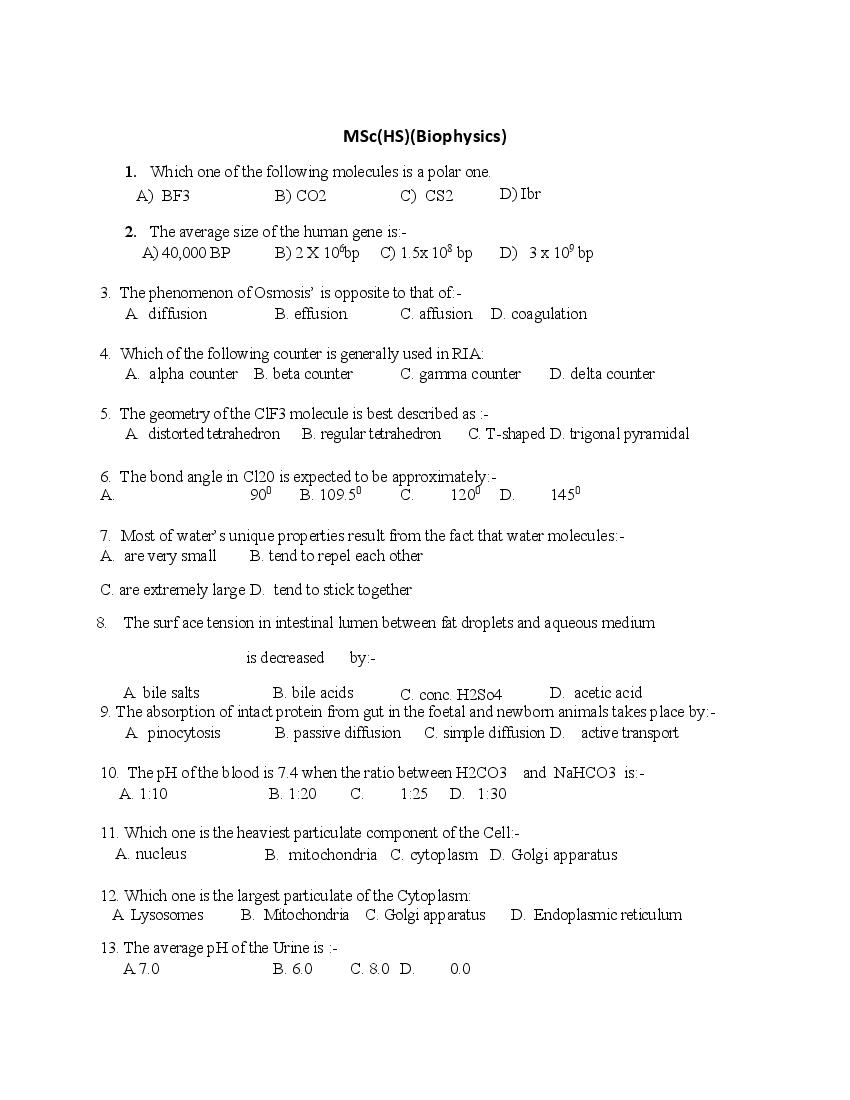
1. Which one of the following molecules is a polar one.
A) BF3 B) CO2 C) CS2 D) Ibr
2. The average size of the human gene is:-
A) 40,000 BP B) 2 X 10⁶bp C) 1.5x 10⁸ bp D) 3 x 10⁹ bp
3. The phenomenon of Osmosis’ is opposite to that of:-
A. diffusion B. effusion. C. affusion. D. coagulation
4. Which of the following counter is generally used in RIA:
A. alpha counter B. beta counter C. gamma counter D. delta counter
5. The geometry of the ClF3 molecule is best described as :-
A. distorted tetrahedron B. regular tetrahedron C. T-shaped D. trigonal pyramidal
6. The bond angle in Cl20 is expected to be approximately:-
A. 900 B. 109.50 C. 1200 D. 1450
7. Most of water’s unique properties result from the fact that water molecules:-
A. are very small B. tend to repel each other
C. are extremely large D. tend to stick together
8. The surf ace tension in intestinal lumen between fat droplets and aqueous medium
is decreased by:-
A. bile salts B. bile acids C. conc. H2So4 D. acetic acid
9. The absorption of intact protein from gut in the foetal and newborn animals takes place by:-
A. pinocytosis B. passive diffusion C. simple diffusion D. active transport
10. The pH of the blood is 7.4 when the ratio between H2CO3 and NaHCO3 is:-
A. 1:10 B. 1:20 C. 1:25 D. 1:30
11. Which one is the heaviest particulate component of the Cell:-
A. nucleus B. mitochondria C. cytoplasm D. Golgi apparatus
12. Which one is the largest particulate of the Cytoplasm:
A Lysosomes B. Mitochondria C. Golgi apparatus D. Endoplasmic reticulum
13. The average pH of the Urine is :-
A.7.0 B. 6.0 C. 8.0 D. 0.0
Page 2
A. 1 B. 2 C. 3 D. 4
15. Daily requirement of calcium for a normal adult human being is :-
A. 100 mg B. 800 mg C. 2g D. 4g
16. Normal total serum calcium level varies between :-
A. 4-5 mg B. 9-11 mg C. 15-20 mg D. 50-100 mg
17. The mineral present in the human body in larger amount than any other cation is :-
A. sodium B. calcium C. potassium D. iron
18. The normal concentration of magnesium in the whole blood is :-
A. 0-1 mg/100ml B. 1-2 mg/100ml C. 2-4 mg/100ml D. 4-8 mg/100ml
19. One jaule is the energy required to :-
A. Raise the temperature of 1g of water by 10C
B. Rise the temperature of 1 kg of water by 10C
C. Move a mass of 1 g by 1 cm distance by a force of 1 Newton
D. Move a mass of 1Kg by 1m distance by a force of 1 Newton
20. Organic compound of small molecular size is :-
A. urea B. uric acid C. creatinine D. phosphates
21. Organic substance of large molecular size is :-
A. starch B. insulin C. lipids D. protein
22. Fatly acids can be transported into and out of the cell membrane by :-
A. active transport B. facilitated transport C. diffusion D. Osmosis
23. A lipid bilayer is preamble to :-
A. urea B. fructose C. glucose D. potassium
24. The pH of the blood is maintained by :-
A. mineral salts B. globulins C. albumins D. haemoglobin
25. Which of the following is called a neutral stain :-
A. picric acid B. Giemsa C. neutral red D. malachite green
26. Active transport :-
A. releases energy B. requires energy C. produces energy D. produces toxic material
27. Na+/K+-ATPase along with ATP requires :-
Page 3
28. All of the following processes occur rapidly in the membrane lipid bilayer except :-
A. flexing of fatly acyl chains B. lateral diffusion of the phospholipids
C. transbilayer diffusion of phospholipids D. rotation of phospholipids around their long axes
29. The Golgi complex :-
A. synthesize proteins B. produces ATP
C. provides a pathway for transporting chemicals D. forms glycoprotein
30. Cellular proteins destined for secreation are sorted and packaged in the :-
A. lysosome B. endosomes C. endoplasmic reticulum D. trans Gogli
31. The following type of interactions is mainly responsible for aggregation of proteins in dilute
solutions :-
A. hydrogen bond B. hydrophilic interactions
C. disulphide bonds D. peptide bonds
32. Isotopes are atoms with the same number of:-
A. protons and varying number of neutrons
B. neutrons and varying number of protons
C. protons and varying number of electrons
D. electrons and varying number of neutrons
33. The following substances are cell inclusions except :-
A. melanin B. glycogen C. lipids D. centrosome
34. How many different kinds of proteins molecules are there in a typical cell :-
A. Four B. Twenty C. Hundreds D. Thousands
35. Which of the following statements about the protein secondary structure is correct:-
A. An α-helix is primarily stabilized by ionic interactions between the side
chains by the amino acids
B. β-sheet exists only in anti-parallel form
C. β-turn often contains proline
D. An ἁ-helix can be composed of more than one polypeptide chain
36. Which of the following statements about natural sterols is incorrect:-
A. Cholesterol is the most abundant sterol in animal tissue
B. All the carbon atoms of Cholesterol are derived from actyl CoA
C. β-Sitosterol is the most abundant plant sterol
D. dietary β-sterol and cholesterol are absorbed to about the same extent in the intestine of
normal human being
Page 4
A. Nucleotides such as ATP are used in the in-vitro synthesis of nucleic acids.
B. Nucleotides are composed of only pentose sugars and a nitrogenous
pyrimidine or purine base.
C. Nucleotides such as GTP replace ATP in the synthesis of RNA molecule
D. Nucleotides contain a deoxyribose sugar if they are components of RNA and a
ribose sugar if they are components of DNA.
38. The hyperchronic effect refer to:-
A. A change in the optical rotator dispersion (ORD) of a DNA solution upon heating.
B. A maximum rate of denaturation versus temperature for duplex DNA.
C. An increase in the absorbance of light at 260 mm when DNA-RNA hybrids are annealed
D. An increase in the absorbance of light at 260 mm upon denaturation of DNA.
39. Molecules are always moving and some molecules move faster than the other
which depends on:-
A. Polarity B. Heat C. Temperature D. Electronegativity
40. Which of the following factors favour strand separation in double standard DNA melting:-
A. Hydrogen bonding between bases.
B. Repulsion between phosphate groups.
C. Vander Waals interaction between bases.
D. High content of G+C.
41. Cholesterol is essential for normal membrane function because of:-
A. Cannot be made by higher organism e.g. mammals.
B. Spans the thickness of the bilayer.
C. Keeps membrane fluid.
D. Catalyza lipid flip-flop in the bilayer.
42. Disulphide bonds most often stabilize the native structure of:-
A. extracellular proteins B. dimeric proteins
C. intracellular proteins. D. multi subunit proteins
43. The helices in the amino acid super secondary structure are held together primarily by:
A. charge-charge interactions B. covalent cross links
D. favourable R-group interactions. D. main chain H bonding
44. The property of resonance as applied to protein structure is responsible for the :-
A. Prevention of the rotation about the alpha carbon.
B. Partial double bond character of the side chain alpha carbon bond.
C. Plannar nature of the peptide bond.
D. Ability of the cochlear cells to detect sound waves by mechanotransduction.
Page 5
A. Amino acids tend to be least soluble in water at their isoelectric point.
B. Sickle cell Hb and the normal Hb have same value of negative charge.
C. Amino acids are made visible on the chromatograms by treatment with ninhydrin.
D. The net charge on an amino acid is a function of the pH of the solution.
46. A solution with a pH of 2, as compared to a solution with pH 4:-
A. Is twice as acidic.
B. Is 100 times more acidic.
C. Is 1000 times more acidic.
D. Has two times more [OH-].
47. A buffer:-
A. Changes pH by a magnitude of 10.
B. Absorbs excess OH-.
C. Releases excess H+.
D. Is often a weak acid-base pair
48. Ice floats in water because:-
A. Its molecules are moving faster than in liquid water.
B. It is more disuse than liquid water.
C. Its H molecules bond to the water surface film
D. Its water molecules are further apart than in the liquid water
49. The smallest particle of water is:-
A. an atom B. a crystal C. an element D. a molecule.
50. Which of the following ranks the molecules in the correct order by size :-
A. water-sucrose-glucose-protein.
B. protein-water-glucose-sucrose.
C. water-protein-sucrose-glucose
D. protein-sucrose-glucose-water
51. Isotopes can be used in studies of metabolic pathways because :-
A. Their half-life allows a researcher to time an experiment.
B. They are more reactive.
C. The cell does not recognize the extra proteins in the nucleus, so isotopes are
readily used in metabolism.
D. Their location or quantity can be experimentally determined because of their radioactivity
52. A phosphate bond contains an energy:-
A. 7.8 kCal B. 8.8 kCal C. 10 kCal D. 11.7 kCal
Page 6
A. matrix of mitochondria B. cristae of mitochondria
C. lysosome D. outer wall of mitochondria
54. The power house of the cell is :-
A. nucleus B. ribosome C. peroxisome D. polysome
55. Oxidation of which substance in the body yields the most calories:-
A. glucose B. glycogen C. protein D. lipids
56. The most active site of protein synthesis:-
A. nucleus B. ribosome C. mitochondrion C. cell sap
57. The mitochondrial membrane contains a transportes for :-
A. NADH B. actyl CO-A C. GTPD. ATP
58. Which fact is true about the enzyme:-
A. They always increase the rate of reaction
B. They always decrease the rate of reaction
C. They do not disturb the equilibrium
D. They always carry irreversible reactions
59. Blocking the action of the enzyme through the blocking of its active site is :-
A. allosteric inhibition B. feedback inhibition
C. competitive inhibition D. non-competitive inhibition
60. Which one of the following is without co-enzyme activity :-
A. Vitamin-E B. Thiamine C. Biotin D.
Riboflavi
n
61. Specificity of an enzyme depends upon :
A. active site B. linear sequence
C. Km D. Turnover member
D. turnover
62. Abzymes are :-
A. Enzymes that are highly specific like antibodies
B. Antibodies that have catalytic activities
C. Are also referred to as zymogens
D. Enzymes that hydrolyze the antibodies
63. In non-competitive type of enzymatic inhibition:-
A. The Vmax decreases and Km remains unchanged
Page 7
C. Vmax and Km both decrease
D. Vmax decreases and Km increases
64. Immuno-fluoresence is a technique used for:-
A. Electron microscope B. Light microscope C. Confocal microscope
D. Light microscopy with a fluorescence microscope
65. Which one of the following enzymes can be described as:-
A. DNA dependent RNA polymerase B. DNA ligase III
C. DNA polymerase-III D. DNA polymerase-I
66. Genetic information of nuclear DNA is transmitted to the site of protein synthesis by:-
A. rRNA B. mRNA C. tRNA D. Polysomes
67. Infrared radiation spans which section of the electro-magnetic spectrum:-
A. 025-0.78 umλ B. 0.78-1000 um λ C. 1000-3000 um λ D. >3000 umλ
68. IR spectroscopy cannot be used for-
A. Determination of functional groups in an organic compound
B. Determination of molecular conformation and stereochemistry
C. Determination of molecular orientation
D. Determination of the mass of the compound precisely
69. X-ray diffraction is an analytical technique for examining:-
A. crystalline solid B. liquid C. powder D. gases
70. Visible lights wavelength ranges from:-
A. 0.39-0.77 mm B. 0.39-0.77 um C. 0.39-0.77nm D. 0.39-0.77 cm
71. Which of the following statements is false regarding the MRI seaming technique-
A. It is based on the magnetic resonance principle
B. It provides much greater contrast between the different soft tissues of the
body than computed tomography
C. It used no ionizing radiation and radioactive water and used a powerful magnetic
field to align the nuclear magnetization of (usually) hydrogen
atoms in water in the body
D. It is specially useful in neurological (brain), musculo-skeletal, cardiovascular and
oncological (cancer) imaging.
72. Optical fiber operates on the principle of:-
A. total internal reflectance B. Tyndall effect C. photoelectric effect D. laser technology
176
Page 8
monochromatic light:-
A. inelastic scattering B. elastic scattering C. plastic scattering D. neo elastic scattering
74. Circular dichroism (CD) is observed only when the molecule is:-
A. optically active B. planar C. in helix form D. in sheet form
75. Folding of any protein involved a sampling of all possible conformation available to it and
involves specific pathways. Amongst these stages which must occur during the folding of
proteins, which of the following statement regarding the protein folding is incorrect:-
A. The formation of elements of recognizable secondary structure (helices, sheets, turns etc.)
B. The collapse of the extended polypeptide chain to form a more compact state in
which the polar side chains are largely burried away from the solvent
C. The formation of the distinct long range interactions which characterize the native
tertiary structure and are a pre-requisite for the formation of specific binding and the
catalytic sites.
D. The association between the submits in the oligomeric proteins
177
Document Details
| Board / Org | Panjab University |
| Exam | PU CET PG |
| Type | Question Paper |
| Pages | 8 |
| Updated | 22 Jul 2026 |