Kerala SSLC Question Pool 2024 Chemistry
Finished viewing? Save it for later —
Download Kerala SSLC Question Pool 2024 Chemistry (PDF · 34 pages)About Kerala SSLC Question Pool 2024 Chemistry
Kerala SSLC Question Pool 2024 Chemistry is available here for free download. Published by Kerala Board for Class 10, this question bank can be viewed online or downloaded as a PDF (34 pages). Candidates preparing for Class 10 can use Kerala SSLC Question Pool 2024 Chemistry to understand the exam pattern, the type of questions asked, and the overall difficulty level.
Frequently Asked Questions
How can I download Kerala SSLC Question Pool 2024 Chemistry?
Open this page and click the Download button to save Kerala SSLC Question Pool 2024 Chemistry as a PDF. It is completely free on AglaSem Docs.
Is Kerala SSLC Question Pool 2024 Chemistry free to download?
Yes. Kerala SSLC Question Pool 2024 Chemistry can be viewed online and downloaded as a PDF free of cost on AglaSem Docs.
How many pages does Kerala SSLC Question Pool 2024 Chemistry have?
Kerala SSLC Question Pool 2024 Chemistry contains 34 pages, which you can read online or download together as a single PDF.
Where can I find more Class 10 study material?
You can find more Class 10 question papers, sample papers, syllabus, and answer keys on AglaSem Docs.
Kerala SSLC Question Pool 2024 Chemistry – Text
Read the full text of this question bank below — useful to quickly search, copy and reference the content online without downloading the PDF.
📄 View text version (34 pages)
Page 1
0123456789012123456789012345678901234567890121234567890123456789012345678901212345678901234567890123456789012123456789012345678901234567890121234567890123456789012345678901212345
0123456789012123456789012345678901234567890121234567890123456789012345678901212345678901234567890123456789012123456789012345678901234567890121234567890123456789012345678901212345
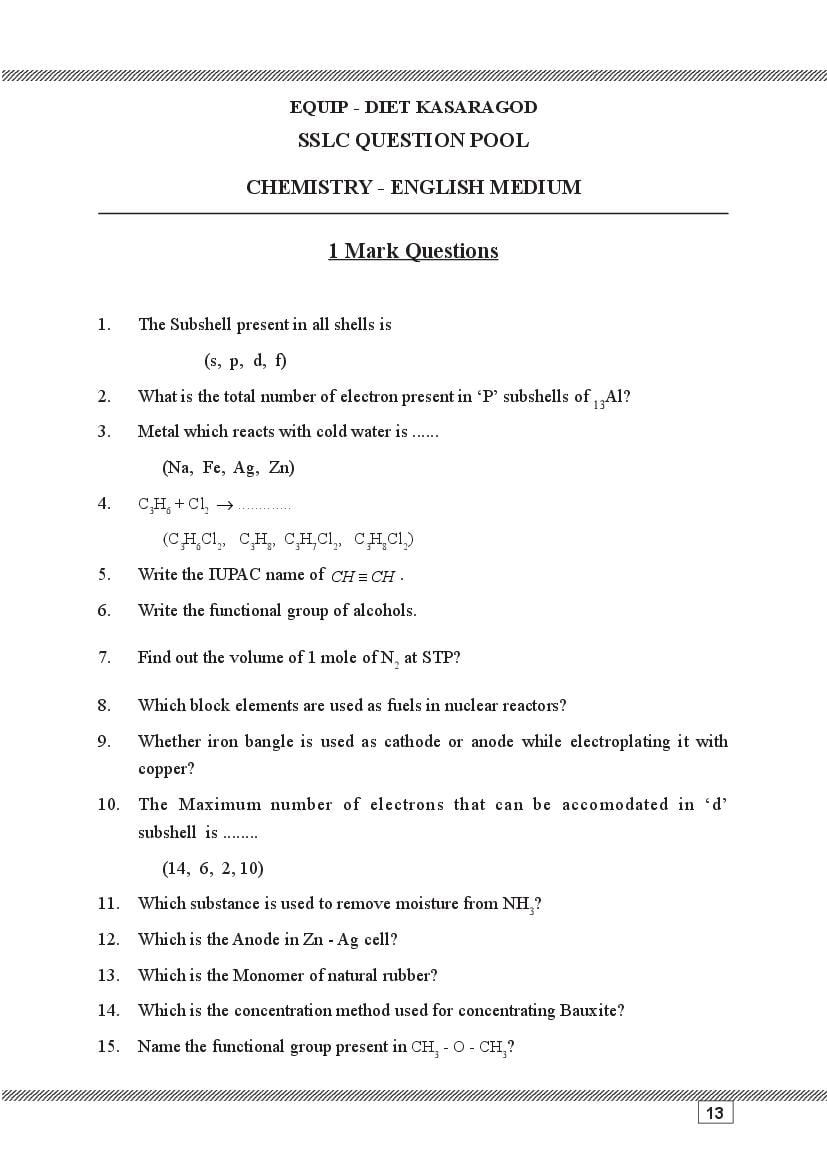
EQUIP - DIET KASARAGOD
SSLC QUESTION POOL
CHEMISTRY - ENGLISH MEDIUM
1 Mark Questions
1. The Subshell present in all shells is
(s, p, d, f)
2. What is the total number of electron present in ‘P’ subshells of 13Al?
3. Metal which reacts with cold water is ......
(Na, Fe, Ag, Zn)
4. C3H6 + Cl2 → .............
(C3H6Cl2, C3H8, C3H7Cl2, C3H8Cl2)
5. Write the IUPAC name of CH ≡ CH .
6. Write the functional group of alcohols.
7. Find out the volume of 1 mole of N2 at STP?
8. Which block elements are used as fuels in nuclear reactors?
9. Whether iron bangle is used as cathode or anode while electroplating it with
copper?
10. The Maximum number of electrons that can be accomodated in ‘d’
subshell is ........
(14, 6, 2, 10)
11. Which substance is used to remove moisture from NH3?
12. Which is the Anode in Zn - Ag cell?
13. Which is the Monomer of natural rubber?
14. Which is the concentration method used for concentrating Bauxite?
15. Name the functional group present in CH3 - O - CH3?
89012345678901212345678901234567890123456789012123456789012345678901234567890121234567890123456789012345678901212345678901234567890123456789012123456789012345678901234567890121234
89012345678901212345678901234567890123456789012123456789012345678901234567890121234567890123456789012345678901212345678901234567890123456789012123456789012345678901234567890121234
89012345678901212345678901234567890123456789012123456789012345678901234567890121234567890123456789012345678901212345678901234567890123456789012123456789012345678901234567890121234
13
Page 2
23456789012345678901234567890121234567890123456789012345678901212345678901234567890123456789012123456789012345678901234567890121234567890123456789012345678901212345678901234567890
23456789012345678901234567890121234567890123456789012345678901212345678901234567890123456789012123456789012345678901234567890121234567890123456789012345678901212345678901234567890
16. 5 - 8% Ethanoic acid is known as ............
17. Which property of Sulphuric acid is used in the preparation of SO2 and HCl?
18. What is the Oxidation state of Mn in MnO2?
(Hint. Oxidation state of Oxygen is -2)
19. Which one of the following subshells is not possible in an atom?
(1s, 2p, 4d, 3f)
20. Identify the law in which the relationship between volume and number of
molecules of a gas at constant temperature and pressure?
(Boyle’s law, Charle’s law, Avagadro’s law)
21. Tin stone (SnO2) is the ore of tin. Which is the magnetic impurity present in
tin stone?
22. Which of the following metal does not displace hydrogen from dilute acids?
(Sodium, Iron, Copper, Magnesium)
23. Name the non-metallic compound used as a refrigerant in ice plants.
24. PVC is a polymer commonly used for making pipes. What is the name of its
Monomer?
25. Elements used as catalysts in the refining of petroleum belongs to which block?
26. Name the process of the industrial prepation of Aluminium ?
27. Based on which process refining of metals like Copper and Gold is done?
28 3s, 4s subshells are given.Which subshell has more energy?
29. Which gas law shows the relation between volume and pressure at constant
temperature?
30. What is the general formula of Alkenes?
31. 6.022x10²³ is known as ...............
32. Name the industrial preparation of Sulphuric acid?
33. What is the energy change in Galvanic Cell?
34. What is the volume of one mole of any gas at STP known as?
35. What is the number of moles present in 44.8L of any gas at STP?
36. The electrode at which reduction takes place in an electrolytic cell is ...........
12345678901234567890123456789012123456789012345678901234567890121234567890123456789012345678901212345678901234567890123456789012123456789012345678901234567890121234567890123456789
12345678901234567890123456789012123456789012345678901234567890121234567890123456789012345678901212345678901234567890123456789012123456789012345678901234567890121234567890123456789
12345678901234567890123456789012123456789012345678901234567890121234567890123456789012345678901212345678901234567890123456789012123456789012345678901234567890121234567890123456789
14
Page 3
0123456789012123456789012345678901234567890121234567890123456789012345678901212345678901234567890123456789012123456789012345678901234567890121234567890123456789012345678901212345
0123456789012123456789012345678901234567890121234567890123456789012345678901212345678901234567890123456789012123456789012345678901234567890121234567890123456789012345678901212345
37. The maximum number of electrons occupied by ‘P’ subshell is ......
(14, 6, 10, 2)
38. Which is the mathematical expression of Boyl’s law from the given
expressions.
V V
(PV = constant, = constant, = constant)
T n
39. From the given elements, which one is less reactive?
(Na, Zn, Ag)
40. Calamine is the ore of ............
41. The density of ammonia is ......... compared to that air.
(Low / High)
42. Name the polymer used to line the inside of non-stick vessels.
43. In which block lanthanoid and actinoids belong?
44. Name the substance obtained by mixing methanol and ethanol to prevent from
mis use as beverage?
45. Which solution is used as electrolite for plating gold on an iron bangle?
46. Name the industrial preparation of NH3?
47. Write the subshell electronic configuration of O2- ion?
2 Mark Questions
48. The industrial preparation of H2SO4 is called Contact process.
a) Which substance is used as a catalyst here?
b) Name the compound formed after the dissolution of SO3 in H2SO4.
What is its molecular formula?
49. Some metals and ZnSO4 solution is given.
Ag Mg Cu
ZnSO4 ZnSO4 ZnSO4
(i) (ii) (iii)
89012345678901212345678901234567890123456789012123456789012345678901234567890121234567890123456789012345678901212345678901234567890123456789012123456789012345678901234567890121234
89012345678901212345678901234567890123456789012123456789012345678901234567890121234567890123456789012345678901212345678901234567890123456789012123456789012345678901234567890121234
89012345678901212345678901234567890123456789012123456789012345678901234567890121234567890123456789012345678901212345678901234567890123456789012123456789012345678901234567890121234
15
Page 4
23456789012345678901234567890121234567890123456789012345678901212345678901234567890123456789012123456789012345678901234567890121234567890123456789012345678901212345678901234567890
23456789012345678901234567890121234567890123456789012345678901212345678901234567890123456789012123456789012345678901234567890121234567890123456789012345678901212345678901234567890
a) In which beaker chemical reaction takes place? Why?
b) Write the chemical equation for the reaction?
50. ZZX 2 NH 3 + heat
N 2 + 3H 2 YZZ
Chemical equation for the preparation of Ammonia in Habour process is given
above. To get more Ammonia in this equilibrium,
a) What changes are to be done in the concentration of N2 and NH3?
b) At what temperature the yield will be more? Why?
51. Some Sugar is taken in a watch glass and concentrated Sulphuric acid is
added to it.
a) What changes occur?
b) Which property of Sulphuric acid is shown here?
52. Molecular mass of water is 18.
a) Find the number of moles in 180g water?
b) Find out the number of molecules present in it?
53. N2 + 3H2 YZZ
ZZX 2NH3 + heat
Write any two methods to increase the rate of forward reaction.
54. Alcohols are Hydrocarbons with - OH as functional group.
a) Name the alcohol used in Beverages.
b) Write the chemical equation for the industrial preparation of methanol.
55. Haematite (Fe2O3), Magnetite (Fe3O4) and Copper Pyrites (CuFeS2) are some
ores of metals.
a) Which ore is concentrated by froath floation process?
b) Which ore is concentrated by Magnetic separation?
56. A glass rod dipped in concentrated hydrochloric acid is shown inside a jar which
is filled with ammonia gas.
a) Write down your observation
b) NH3 + HCl → ...............
12345678901234567890123456789012123456789012345678901234567890121234567890123456789012345678901212345678901234567890123456789012123456789012345678901234567890121234567890123456789
12345678901234567890123456789012123456789012345678901234567890121234567890123456789012345678901212345678901234567890123456789012123456789012345678901234567890121234567890123456789
12345678901234567890123456789012123456789012345678901234567890121234567890123456789012345678901212345678901234567890123456789012123456789012345678901234567890121234567890123456789
16
Page 5
0123456789012123456789012345678901234567890121234567890123456789012345678901212345678901234567890123456789012123456789012345678901234567890121234567890123456789012345678901212345
0123456789012123456789012345678901234567890121234567890123456789012345678901212345678901234567890123456789012123456789012345678901234567890121234567890123456789012345678901212345
57. a) Which compound is added to Alumina during the electrolytical preparation
of Aluminium?
b) Explain why it is done?
58. Write answers for the given questions related to Zn - Cu Galvanic cell.
a) Which Metal is acting as anode
b) Write the Chemical equation for the reaction at anode?
59. A little Ammonium Chloride (NH4Cl), and Calcium hydroxide (Ca(OH)2) are
taken in a watch glass and mixed well.
a) Which gas is formed here?
b) Write its chemical nature? (Acidic / Basic)
60. a) Name the substance formed by the reaction of a carboxylic acid
with alcohol?
b) Write any one pecularity in their property?
61. Size of a balloon is increased on blowing.
a) On the basis of which gas low it can be explained?
b) State the law?
62. See the electronic configuration of an atom with atomic number 12
written by children.
A - 1s2 2s2 2p6 3s2
B - 1s2 2s2 2p6 2d2
Which one is correct? Why?
89012345678901212345678901234567890123456789012123456789012345678901234567890121234567890123456789012345678901212345678901234567890123456789012123456789012345678901234567890121234
89012345678901212345678901234567890123456789012123456789012345678901234567890121234567890123456789012345678901212345678901234567890123456789012123456789012345678901234567890121234
89012345678901212345678901234567890123456789012123456789012345678901234567890121234567890123456789012345678901212345678901234567890123456789012123456789012345678901234567890121234
17
Page 6
23456789012345678901234567890121234567890123456789012345678901212345678901234567890123456789012123456789012345678901234567890121234567890123456789012345678901212345678901234567890
23456789012345678901234567890121234567890123456789012345678901212345678901234567890123456789012123456789012345678901234567890121234567890123456789012345678901212345678901234567890
3 Mark Questions
63. The given table is based on a gas law.
P V PV
100 20 2000
50 40 2000
20 100 2000
a) Identify the gas law?
b) Write the Mathematical expression of this law?
c) Which law relates volume and temperature of gases?
64.
Zn
Cu
ZnSO4
CuSO4
A galvanic cell made of Cu and Zn is given above.
a) Identify the cathode and anode in the above cell?
b) Write the chemical equation for the reaction taking place at cathode?
c) Show the direction of flow of electrones?
65. The structure of an organic compound is given.
CH3 - CH2 - CH - CH2 - CH2 - CH2
CH2 CH3
CH2
CH3
a) How many carbon atos are present in the main chain of this compound?
12345678901234567890123456789012123456789012345678901234567890121234567890123456789012345678901212345678901234567890123456789012123456789012345678901234567890121234567890123456789
12345678901234567890123456789012123456789012345678901234567890121234567890123456789012345678901212345678901234567890123456789012123456789012345678901234567890121234567890123456789
12345678901234567890123456789012123456789012345678901234567890121234567890123456789012345678901212345678901234567890123456789012123456789012345678901234567890121234567890123456789
18
Page 7
0123456789012123456789012345678901234567890121234567890123456789012345678901212345678901234567890123456789012123456789012345678901234567890121234567890123456789012345678901212345
0123456789012123456789012345678901234567890121234567890123456789012345678901212345678901234567890123456789012123456789012345678901234567890121234567890123456789012345678901212345
b) Give the number of carbon at which the branch is seen?
c) Write the IUPAC name of this compound?
66. The element cromium with atomic number 24 is a d-block element. If so,
a) Write the complete subshell electronic configuration of this element?
b) Why does this atom show this type of difference in the electronic
configuration?
c) In which group and period this element belongs?
67. During the electrolysis of solution of NaCl,
a) Name the products obtained at cathode and anode?
b) Write the equation for the reaction at anode?
c) Which compound can be prepared using this process?
68. a) Find the Oxidation state of Fe in FeCl3 and write the subshell electronic
configuration of Fe3+ ion .
(Hint : Fe = 26)
b) Find out the group and period of Fe?
69. CH3 - CH2 - CH - CH3
CH3 - CH - CH3
a) Write the number of Carbon atoms in the main chain?
b) Name the branch?
c) Write the IUPAC name of the compound?
70. The extraction of iron from its ore is done in a blast furnace?
a) Which is the ore used here?
b) Which are the substance fed into the blast furnace?
c) Identify the gangue and flux here?
89012345678901212345678901234567890123456789012123456789012345678901234567890121234567890123456789012345678901212345678901234567890123456789012123456789012345678901234567890121234
89012345678901212345678901234567890123456789012123456789012345678901234567890121234567890123456789012345678901212345678901234567890123456789012123456789012345678901234567890121234
89012345678901212345678901234567890123456789012123456789012345678901234567890121234567890123456789012345678901212345678901234567890123456789012123456789012345678901234567890121234
19
Page 8
23456789012345678901234567890121234567890123456789012345678901212345678901234567890123456789012123456789012345678901234567890121234567890123456789012345678901212345678901234567890
23456789012345678901234567890121234567890123456789012345678901212345678901234567890123456789012123456789012345678901234567890121234567890123456789012345678901212345678901234567890
71. Complete the table related to a gas law.
Temperature (T) Volume (V)
300K 900L
(a) ____K 600L
450K (b) ____L
a) Write the values (a) and (b)?
b) Identify the gas law?
72. The following are the chemical equation representing the industrial
preparation of Ethanol.
A) C12 H22 O11 + H2O ⎯(⎯
A)
→ C6 H12 O6 + C6 H12 O6
Glucose Fructose
B) C6 H12 O6 ⎯(⎯
B)
→ C2H5OH + 2CO2
Ethanol
a) Identify the enzymes A and B? (1)
b) What is rectified spirit? (1)
c) What is power alcohol? (1)
73. The electronic configuration of the elements A, B, C, D are given below.
A - 1s2 2s2 2p6 3s2 3p4
B - 1s2 2s2 2p6 3s2
C - 1s2 2s2 2p6 3s2 3p5
D - 1s2 2s2 2p6 3s1
a) Which of these elements show +2 oxidation state?
b) Which element belongs to 17th group?
c) Which is the period number of the element A? What is the basis of your
findings?
(Symbols are not real)
12345678901234567890123456789012123456789012345678901234567890121234567890123456789012345678901212345678901234567890123456789012123456789012345678901234567890121234567890123456789
12345678901234567890123456789012123456789012345678901234567890121234567890123456789012345678901212345678901234567890123456789012123456789012345678901234567890121234567890123456789
12345678901234567890123456789012123456789012345678901234567890121234567890123456789012345678901212345678901234567890123456789012123456789012345678901234567890121234567890123456789
20
Page 9
0123456789012123456789012345678901234567890121234567890123456789012345678901212345678901234567890123456789012123456789012345678901234567890121234567890123456789012345678901212345
0123456789012123456789012345678901234567890121234567890123456789012345678901212345678901234567890123456789012123456789012345678901234567890121234567890123456789012345678901212345
74. Complete the table
Substance GMM Given No.of Number of
Mass Moles Molecules
Oxygen O2 32g 64g ....(a).... ....(b)....
(Molecular Mass = 32)
Ammonia (NH3) ....(c).... ....(d)... 3 3x6.022x1023
(Molecular Mass = 17)
Water (H2O) 18g 72g ....(e).... ....(f)...
(Molecular Mass = 18)
75. The features of an organic compound are given.
* It’s an alkane
* There are 6 Carbon atoms in the longest chain.
* There are Methyl radicals (1 each) on the 3rd & 4th carbon.
a) Write the structural formula of the compound? (2)
b) Write the IUPAC name of the compound? (1)
76. 5ml AgNO3 is taken in a test tube and a Copper rod is dipped in it.
a) Observe the change occuring with the copper rod? (1)
b) Complete the equation of the reaction? (2)
Cu + 2 AgNO3 → ............ + ............
77. Some reactions regarding the production of an alcohol are given below.
Invertase
C12 H22 O11 + H2O ⎯⎯
→ C6 H12 O6 + .......(A).......
Zymase
......(A)...... ⎯⎯
→ .....(B)...... + 2CO2
a) Identify A and B? (1)
b) Write the name of the ester formed when the product B reacts with
ethanoic acid? (1)
c) Write the Chemical equation for the formation of that ester. (1)
89012345678901212345678901234567890123456789012123456789012345678901234567890121234567890123456789012345678901212345678901234567890123456789012123456789012345678901234567890121234
89012345678901212345678901234567890123456789012123456789012345678901234567890121234567890123456789012345678901212345678901234567890123456789012123456789012345678901234567890121234
89012345678901212345678901234567890123456789012123456789012345678901234567890121234567890123456789012345678901212345678901234567890123456789012123456789012345678901234567890121234
21
Page 10
23456789012345678901234567890121234567890123456789012345678901212345678901234567890123456789012123456789012345678901234567890121234567890123456789012345678901212345678901234567890
23456789012345678901234567890121234567890123456789012345678901212345678901234567890123456789012123456789012345678901234567890121234567890123456789012345678901212345678901234567890
78. The Atomic number of element M is 17.
a) Write the complete sub shell electronic configuration of M?
b) In which block the element belongs to?
c) Write the molecular formula of the compound formed when it combines
with N, which belongs to 1st group? (Symbols are not real)
79. Answer the following questions related to the large scale preparation
of Iron (Fe)
a) Name the ore used in the Extraction of Iron?
b) Why is limestone added during this process?
c) Write the chemical formula of the slag removed from blast furnace?
80.
CH3 - CH - CH2 - CH2
CH3 CH3
Answer the following questions based on the hydrocarbon given above.
a) Write the number of Carbon atoms present in the longest chain?
b) Name branch in this compound?
c) Write the IUPAC name of this compound?
81. Combination of smaller molecules to form a very large chain like molecule is
called Polymerisation.
a) What are the smaller molecules taking part in this reactions called?
b) Which is the monomer unit of Polythene?
c) Give any one use of Polythene?
82. Chemical equations for the Industrial preparation of Sulphuric acid is given
S + O2 → SO2
V2O5
2SO2 + O2 YZZZ
ZZZZ Z 2SO3
X
SO3 + H2SO4 → H2S2O7
a) Name the compound H2S2O7 formed during this process?
12345678901234567890123456789012123456789012345678901234567890121234567890123456789012345678901212345678901234567890123456789012123456789012345678901234567890121234567890123456789
12345678901234567890123456789012123456789012345678901234567890121234567890123456789012345678901212345678901234567890123456789012123456789012345678901234567890121234567890123456789
12345678901234567890123456789012123456789012345678901234567890121234567890123456789012345678901212345678901234567890123456789012123456789012345678901234567890121234567890123456789
22
Page 11
0123456789012123456789012345678901234567890121234567890123456789012345678901212345678901234567890123456789012123456789012345678901234567890121234567890123456789012345678901212345
0123456789012123456789012345678901234567890121234567890123456789012345678901212345678901234567890123456789012123456789012345678901234567890121234567890123456789012345678901212345
b) In which other name this acid known as?
c) Name the products formed during the dehydration reaction of Sulphuric acid
with Sugar?
83. 85g of ammonia gas is stored at STP.
a) Calculated the number of molecules present in it?
b) Find out its volume
c) Find out the number of atoms present in this sample?
(Molecular mass of ammonia is 17)
84. Some metals and salt solutions are given.
MgSO4 solution, CuSO4 solution, AgNO3 solution
KNO3 solution, Pb rod Cu rod, Mg rod, Pb rod)
a) Select the substance required for the construction of galvanic cell?
b) Which metal is anode in the cell constructed?
c) Write the chemical equation for the reaction taking place at cathode?
85. Observe the graph of chemical reaction and answer the following questions.
Rate of reaction
A
C
B
time
a) What do ‘A’ and ‘B’ represent?
b) What do ‘C’ represent?
c) What happen to the rate of forward and backward reaction at ‘C’?
89012345678901212345678901234567890123456789012123456789012345678901234567890121234567890123456789012345678901212345678901234567890123456789012123456789012345678901234567890121234
89012345678901212345678901234567890123456789012123456789012345678901234567890121234567890123456789012345678901212345678901234567890123456789012123456789012345678901234567890121234
89012345678901212345678901234567890123456789012123456789012345678901234567890121234567890123456789012345678901212345678901234567890123456789012123456789012345678901234567890121234
23
Page 12
23456789012345678901234567890121234567890123456789012345678901212345678901234567890123456789012123456789012345678901234567890121234567890123456789012345678901212345678901234567890
23456789012345678901234567890121234567890123456789012345678901212345678901234567890123456789012123456789012345678901234567890121234567890123456789012345678901212345678901234567890
86. Chemical formula of some hydrocarbon chain are given.
C4H8, C2H6, C3H4, CH4, C5H10, C6H10
a) Which are alkenes?
b) Write the general molecular formula of alkane?
c) Write the molecular formula of an alkyne with 5 carbon atoms
from these?
87. During the electrolysis of NaCl,
a) Which substance is liberatd at anode?
b) Which is liberated at cathode?
c) Write the chemical equation for the reaction taking place at anode?
4 Mark Questions
88. Find out the isomer pairs from the given compounds and state which type of
isomerism is shown?
i) CH3 - CH2 - CH2 - OH
ii) CH3 - CH2 - CH2 - CH3
iii) CH3 - CH - CH3
Cl
iv) CH3 - CH2 - CH2 - Cl
v) CH3 - O - CH2 - CH3
vi) CH3 - CH2 - CH2
CH3
89. Complete the given table.
Nature of ore Method of concentration Example
Ore is denser ...(a).... Ore of Iron,
than impurity gold
....(b).... Magnetic separation Tin stone
....(c).... Froth floatation Sulphide
Soluble
Impurities Leaching .....(d)....
12345678901234567890123456789012123456789012345678901234567890121234567890123456789012345678901212345678901234567890123456789012123456789012345678901234567890121234567890123456789
12345678901234567890123456789012123456789012345678901234567890121234567890123456789012345678901212345678901234567890123456789012123456789012345678901234567890121234567890123456789
12345678901234567890123456789012123456789012345678901234567890121234567890123456789012345678901212345678901234567890123456789012123456789012345678901234567890121234567890123456789
24
Page 13
0123456789012123456789012345678901234567890121234567890123456789012345678901212345678901234567890123456789012123456789012345678901234567890121234567890123456789012345678901212345
0123456789012123456789012345678901234567890121234567890123456789012345678901212345678901234567890123456789012123456789012345678901234567890121234567890123456789012345678901212345
90. a) Write the complete subshell electronic configuration of 25Mn.
b) Find the oxidation state of Mn in MnO2?
c) Write the complete subshell electronic configuration of Mn2+ ion?
d) Write any one property of d-block elements?
91. Some terms related to the industrial preparation of ethanol is given.
a) Wash
b) Rectified spirit
c) Absolute alcohol
d) Power alcohol
Define the above terms.
92. A few drops of con.H2SO4 is dropped into sugar taken in a watch glass.
a) What is your observation?
b) Which property of H2SO4 is shown here?
c) Why isn’t H2SO4 used as a drying agent in the laboratory preparation
of NH3?
d) Name the acidic substance obtain by the reaction of this acid with NaCl?
93. a) Find out the Isomeric pair from those given below. (2)
i) CH3 - CH2 - CH2 - CH3
ii) CH3 - O - CH2 - CH3
iii) CH3 - CH - CH3
CH3
iv) CH3 - CH2 - CH2 - OH
b) Mention the type of Isomerism in each pair? (2)
94. Sub shell electronic configuration of an element is given below.
1s2 2s2 2p6 3s2 3p4
a) Write the atomic number of this element?
89012345678901212345678901234567890123456789012123456789012345678901234567890121234567890123456789012345678901212345678901234567890123456789012123456789012345678901234567890121234
89012345678901212345678901234567890123456789012123456789012345678901234567890121234567890123456789012345678901212345678901234567890123456789012123456789012345678901234567890121234
89012345678901212345678901234567890123456789012123456789012345678901234567890121234567890123456789012345678901212345678901234567890123456789012123456789012345678901234567890121234
25
Page 14
23456789012345678901234567890121234567890123456789012345678901212345678901234567890123456789012123456789012345678901234567890121234567890123456789012345678901212345678901234567890
23456789012345678901234567890121234567890123456789012345678901212345678901234567890123456789012123456789012345678901234567890121234567890123456789012345678901212345678901234567890
b) How many shells are present in this atom?
c) Which is the outermost shell?
d) Find the block and group in which this element belongs?
95. AgNO3 solution, MgSO4 solution, Ag rod, Mg ribbon are given.
a) Draw and label the figure of a Galvenic cell using these? (2)
b) Write the Chemical equation of the reactions at Anode and Cathode? (2)
96. During the electrolysis of NaCl solution.
a) Name the products formed at Anode and Cathode? (2)
b) Write the Chemical equation occurs at Anode? (1)
c) Which is the product remains in the solution. (1)
97. Select the pecularities of ‘f’ block elements from the given statements.
a) They are transition elements.
b) Electrons are added to the anti penultimate shells.
c) Most of them are arificial elements.
d) Electrons are added to the penultimate shells.
e) They include both actinoids and lanthanoids.
f) They form coloured compounds.
g) Used in Petroleum industry.
98. A portion of the periodic table is given below. The symbols given are not real.
A B
C D
2, 8, 7
a) Write the electronic configuration of B and C? (1)
b) Find the atomic number of A and C? (1)
c) Which elements have the same valency? What is their valency? (1)
12345678901234567890123456789012123456789012345678901234567890121234567890123456789012345678901212345678901234567890123456789012123456789012345678901234567890121234567890123456789
12345678901234567890123456789012123456789012345678901234567890121234567890123456789012345678901212345678901234567890123456789012123456789012345678901234567890121234567890123456789
12345678901234567890123456789012123456789012345678901234567890121234567890123456789012345678901212345678901234567890123456789012123456789012345678901234567890121234567890123456789
26
Page 15
0123456789012123456789012345678901234567890121234567890123456789012345678901212345678901234567890123456789012123456789012345678901234567890121234567890123456789012345678901212345
0123456789012123456789012345678901234567890121234567890123456789012345678901212345678901234567890123456789012123456789012345678901234567890121234567890123456789012345678901212345
d) The valency of the element X is 1. Write the chemical formulae of the
compound formed when the element X combines with A.
99. i) Complete the word web. (Atomic mass of Nitrogen is 14)
2 GAM ....(a)... Atoms
28g Nitrogen
gas
...(b)... GMM ....(c).... N2 Molecules
(ii) Write down the Avagadro number.
100. The picture of a Galvanic cell is given below.
Ag rod (Silver rod)
A
CuSO4 Solution
B
a) Identify A and B?
b) Give the direction of electron flow?
c) Write the chemical equation at the anode and cathod?
101. Iron is industrially prepared mainly from Haematite.
a) Which substance reduces haematite in the metallurgy of iron?
How is this reducing agent produced in furnace? (2)
b) Which is the main impurity found in haematite?
Which substance is used to remove this gangue? (2)
89012345678901212345678901234567890123456789012123456789012345678901234567890121234567890123456789012345678901212345678901234567890123456789012123456789012345678901234567890121234
89012345678901212345678901234567890123456789012123456789012345678901234567890121234567890123456789012345678901212345678901234567890123456789012123456789012345678901234567890121234
89012345678901212345678901234567890123456789012123456789012345678901234567890121234567890123456789012345678901212345678901234567890123456789012123456789012345678901234567890121234
27
Page 16
23456789012345678901234567890121234567890123456789012345678901212345678901234567890123456789012123456789012345678901234567890121234567890123456789012345678901212345678901234567890
23456789012345678901234567890121234567890123456789012345678901212345678901234567890123456789012123456789012345678901234567890121234567890123456789012345678901212345678901234567890
102. a) Analyse the given organic compounds and answer the following questions.
(i) CH3 - O - CH2 - CH3
(ii) CH3 - O - CH3
(iii) CH3 - CH2 - CH2 - OH
(iv) CH - CH - CH3
OH
a) Identify the isomer pairs. Write the type of isomerism observed in them?
b) Write the IUPAC name of the compound (i)?
103. 88g CO2 given in a sample
(Atomic mass C-12, O-16)
a) What is the number of moles of CO2 present in it?
b) What is the total number of atoms present in this sample?
c) Find out the numbers of molecules present in it?
d) What is the volume of this gas at STP?
104. Copper plays a very important role in our daily life.
a) Name one ore of Copper?
b) By which process Copper is refined?
c) Name the electrolyte used in this process?
d) Write the Chemical equation for the reaction taking place at Cathode?
105. Match the coloums B and C with coloumn A.
A B C
H2+I2 YZZ
ZZX 2HI Irreversible Reaction Products get converted
into reactants.
→ NaCl + H2O Reversible Reaction
NaOH + HCl ⎯⎯ Products are not get
converted into reactants.
106. Write the answers based on the electro plating of Iron bangle with gold.
a) Which is the electrolyte used here?
b) Identify the Cathode and Anode?
12345678901234567890123456789012123456789012345678901234567890121234567890123456789012345678901212345678901234567890123456789012123456789012345678901234567890121234567890123456789
12345678901234567890123456789012123456789012345678901234567890121234567890123456789012345678901212345678901234567890123456789012123456789012345678901234567890121234567890123456789
12345678901234567890123456789012123456789012345678901234567890121234567890123456789012345678901212345678901234567890123456789012123456789012345678901234567890121234567890123456789
28
Page 17
0123456789012123456789012345678901234567890121234567890123456789012345678901212345678901234567890123456789012123456789012345678901234567890121234567890123456789012345678901212345
0123456789012123456789012345678901234567890121234567890123456789012345678901212345678901234567890123456789012123456789012345678901234567890121234567890123456789012345678901212345
c) What happens to the gold ions reached on the bangle?
(Oxidation / reduction)
d) What happens to the gold plate?
(Oxidation / reduction)
107. Ethanol is a very important Solvent in Industry.
a) Name 8-10% solution of ethanol?
b) What is denatured spirit?
c) Write any two uses of ethanol?
d) Name the enzymes present in yeast during the process of Fermentation?
108. CH3 - CH2 - CH - CH2 - CH2 - CH3
CH2- CH3
a) Write the root name of the main chain?
b) Write the position of branch?
c) What is the name of the branch?
d) Write the IUPAC name of the compound?
109. Chemical reaction of certain hydrocarbon are given.
a) 2C4H10+13O2 → 8CO2 + 10H2O
b) CH3 - CH2 - CH2 + Cl2 → CH3 - CH2 - CH2Cl + HCl
c) CH3 - CH2 - CH = CH2 + H2 → CH3 - CH2 - CH2 - CH3
d) nCH2 = CH → CH2-CH
Cl Cl n
1) Which represents displacement reaction?
2) Which shows combustion?
3) Which shows polymerisation?
4) Draw the structure of teflon?
89012345678901212345678901234567890123456789012123456789012345678901234567890121234567890123456789012345678901212345678901234567890123456789012123456789012345678901234567890121234
89012345678901212345678901234567890123456789012123456789012345678901234567890121234567890123456789012345678901212345678901234567890123456789012123456789012345678901234567890121234
89012345678901212345678901234567890123456789012123456789012345678901234567890121234567890123456789012345678901212345678901234567890123456789012123456789012345678901234567890121234
29
Page 18
23456789012345678901234567890121234567890123456789012345678901212345678901234567890123456789012123456789012345678901234567890121234567890123456789012345678901212345678901234567890
23456789012345678901234567890121234567890123456789012345678901212345678901234567890123456789012123456789012345678901234567890121234567890123456789012345678901212345678901234567890
110. Complete the table given below.
Element Atomic Subshell electronic block group period
number configuration
Na 11 1s22s22p63s1 s 1 3
Cl 17 1s22s22p63s23p5 p ..(a).. 3
Mn 25 1s22s22p63s23p63d54s2 ..(b).. 7 4
Zn 30 1s22s22p63s23p63d104s2 d ...(c)... ...(d)...
111. Structure of some hydrocarbons are given.
1) CH3 - CH2 - O - CH3
2) CH3 - CH2 - CH2 - OH
3) CH3 - CH2 - CH2 - CH3
a) Write the position isomer of second compound?
b) Find out the functional isomer from them?
c) Write the chain isomer of compound (iii)?
d) Write the IUPAC name of first compound?
112. Find out a, b, c and d.
....(a).... GMM ....(b).... number of molecular
68g NH3
...(c)... Volume at STP ...(d).... number of moles
12345678901234567890123456789012123456789012345678901234567890121234567890123456789012345678901212345678901234567890123456789012123456789012345678901234567890121234567890123456789
12345678901234567890123456789012123456789012345678901234567890121234567890123456789012345678901212345678901234567890123456789012123456789012345678901234567890121234567890123456789
12345678901234567890123456789012123456789012345678901234567890121234567890123456789012345678901212345678901234567890123456789012123456789012345678901234567890121234567890123456789
30
Page 19
0123456789012123456789012345678901234567890121234567890123456789012345678901212345678901234567890123456789012123456789012345678901234567890121234567890123456789012345678901212345
0123456789012123456789012345678901234567890121234567890123456789012345678901212345678901234567890123456789012123456789012345678901234567890121234567890123456789012345678901212345
113. Some chemical equations based on the industrial preparation of iron is given.
i) CO2 + C → 2 CO
ii) Fe2O3 + 3CO → 2Fe + 3CO2
iii) CaCO3 → CaO + CO2
iv) CaO + SiO2 → CaSiO3
a) Which substance is acting as reducing agent during this process?
b) Write the chemical equation for the formation of slag?
c) Which reaction shows the reduction of iron ore?
d) Name the substances used in blast furnace?
e) Name the iron obtained from blast furnace?
114. Match the following
Reaction Type of reaction
CH4 + Cl2 → CH3Cl + HCl Addition
C4H10 → CH4 + C3H6 Combustion
CH4+2O2 → CO2 + 2H2O Polymarisation
nCH2 = CH2 → [CH2-CH2]n Displacement
CH ≡ CH+H2 → CH2 = CH2 Thermal decomposition
115. CH3 - COO - CH2 - CH3 is an ester.
a) Name the ester?
b) Which is acid and alcohol used to prepare this?
c) What is this type of reaction known as?
d) What the chemical equation for the reaction?
89012345678901212345678901234567890123456789012123456789012345678901234567890121234567890123456789012345678901212345678901234567890123456789012123456789012345678901234567890121234
89012345678901212345678901234567890123456789012123456789012345678901234567890121234567890123456789012345678901212345678901234567890123456789012123456789012345678901234567890121234
89012345678901212345678901234567890123456789012123456789012345678901234567890121234567890123456789012345678901212345678901234567890123456789012123456789012345678901234567890121234
31
Page 20
23456789012345678901234567890121234567890123456789012345678901212345678901234567890123456789012123456789012345678901234567890121234567890123456789012345678901212345678901234567890
23456789012345678901234567890121234567890123456789012345678901212345678901234567890123456789012123456789012345678901234567890121234567890123456789012345678901212345678901234567890
116. Write the answers of a, b, c, d and e of the following table. (5)
Substance GMM Given Mass No.of. Moles No.of Molecules
NO2 ....(a)...... 138g 3 .....(b)....
CO 28g 14g .....(c)..... ½x6.022x1023
HNO3 63g .....(d)..... 2 .....(e).....
117.a) Match the following (4)
Reactants Products Name of the reactions
(i) CH4+Cl2 [CH2 - CH2]n Thermal cracking
(ii) C2 H6 + O2 CH3Cl + HCl Polymerisation
(iii) nCH2=CH2 CH3-CH2-CH2-CH3
+ Combustion
CH3-CH = CH2
(iv) CH3-CH2-CH2-CH2-CH2-CH2-CH3 CO2 + H2O Substitution reaction
b) Which is the main component in LPG? (1)
118. The main chain of an alkane without branch is given.
C-C-C-C
a) Complete the structural formulae.
b) Write the IUPAC name of this compound?
c) -COOH is added as functional group to the first carbon?
If so,
i) Write the structural formulae of the compound?
ii) Write the IUPAC name of that compound?
d) What is the name of the compounds having -COOH as functional group?
119. The Subshell electronic configuration of 29Cu is given.
i) 1s2, 2s2, 2p6, 3s2, 3p6, 3d9, 4s2
ii) 1s2, 2s2, 2p6, 3s2, 3p6, 3d10, 4s1
12345678901234567890123456789012123456789012345678901234567890121234567890123456789012345678901212345678901234567890123456789012123456789012345678901234567890121234567890123456789
12345678901234567890123456789012123456789012345678901234567890121234567890123456789012345678901212345678901234567890123456789012123456789012345678901234567890121234567890123456789
12345678901234567890123456789012123456789012345678901234567890121234567890123456789012345678901212345678901234567890123456789012123456789012345678901234567890121234567890123456789
32
Page 21
0123456789012123456789012345678901234567890121234567890123456789012345678901212345678901234567890123456789012123456789012345678901234567890121234567890123456789012345678901212345
0123456789012123456789012345678901234567890121234567890123456789012345678901212345678901234567890123456789012123456789012345678901234567890121234567890123456789012345678901212345
a) Which is the correct subshell electronic configuration?
b) Justify your answer?
c) In which block the element belongs to?
d) Write any one property of elements of this block?
e) Write the group and period of this element?
120.. C2H4, C3H6, C4H8, ........ are members of a homologous series.
a) Name this homologes series?
b) Write the Chemical formula of the next member?
c) What is the general formula of these compounds?
d) Write the structure of C2H4?
e) Write the structural formula and IUPAC name of the compound formed
when C2H4 reacts with H2.
121. Chemical reaction in a blast furnace during the preparation of iron is given,
i) C + O2 → CO2 + heat
ii) CO2 + C + heat → CO
iii) Fe2O3 + 3CO → 2Fe + 3CO2
iv) CaCO3 + heat → CaO + CO2
v) CaO + SiO2 → CaSiO3
a) Which reaction shows the reduction of iron ore?
b) Which compound is acting as flux here?
c) Which shows the formation of slag?
d) Name the slag formed here?
e) Name the ore fed into blast furnace?
89012345678901212345678901234567890123456789012123456789012345678901234567890121234567890123456789012345678901212345678901234567890123456789012123456789012345678901234567890121234
89012345678901212345678901234567890123456789012123456789012345678901234567890121234567890123456789012345678901212345678901234567890123456789012123456789012345678901234567890121234
89012345678901212345678901234567890123456789012123456789012345678901234567890121234567890123456789012345678901212345678901234567890123456789012123456789012345678901234567890121234
33
Page 22
23456789012345678901234567890121234567890123456789012345678901212345678901234567890123456789012123456789012345678901234567890121234567890123456789012345678901212345678901234567890
23456789012345678901234567890121234567890123456789012345678901212345678901234567890123456789012123456789012345678901234567890121234567890123456789012345678901212345678901234567890
122. Match the name of the given compounds.
a) CH3 - CH2 - CH - CH3
CH3 Butan - 2 - ol
b) CH3
CH3 - C - CH3 Pent - 2 - ene
CH3
c) CH3 - CH2 - CH = CH - CH3 2 - Methyl butane
d) CH3 - CH2 - CH - CH3 Methoxy ethane
OH
e) CH3 - CH2 - O - CH3 2, 2 - Di Methyl propane
2 - Methyl pentane
Propan - 1 - ol
12345678901234567890123456789012123456789012345678901234567890121234567890123456789012345678901212345678901234567890123456789012123456789012345678901234567890121234567890123456789
12345678901234567890123456789012123456789012345678901234567890121234567890123456789012345678901212345678901234567890123456789012123456789012345678901234567890121234567890123456789
12345678901234567890123456789012123456789012345678901234567890121234567890123456789012345678901212345678901234567890123456789012123456789012345678901234567890121234567890123456789
34
Page 23
0123456789012123456789012345678901234567890121234567890123456789012345678901212345678901234567890123456789012123456789012345678901234567890121234567890123456789012345678901212345
0123456789012123456789012345678901234567890121234567890123456789012345678901212345678901234567890123456789012123456789012345678901234567890121234567890123456789012345678901212345
0123456789012123456789012345678901234567890121234567890123456789012345678901212345678901234567890123456789012123456789012345678901234567890121234567890123456789012345678901212345
EQUIP - DIET KASARAGOD
SSLC QUESTION POOL
CHEMISTRY - ENGLISH MEDIUM
Answer Key
1 Mark Question - Answers
1. s
2. 7
3. Na
4. C3H6Cl2
5. Ethyne
6. - OH
7. 22.4L
8. f
9. Cathode
10. 10
11. Calcium Oxide or CaO or quick lime
12. Zn or Zinc
13. Isoprene
14. Leaching
15. Alkoxy group
16. Vinegar
17. Drying Agent
18. +4
19. 3f
20. Avagadro’s Law
89012345678901212345678901234567890123456789012123456789012345678901234567890121234567890123456789012345678901212345678901234567890123456789012123456789012345678901234567890121234
89012345678901212345678901234567890123456789012123456789012345678901234567890121234567890123456789012345678901212345678901234567890123456789012123456789012345678901234567890121234
89012345678901212345678901234567890123456789012123456789012345678901234567890121234567890123456789012345678901212345678901234567890123456789012123456789012345678901234567890121234
35
Page 24
23456789012345678901234567890121234567890123456789012345678901212345678901234567890123456789012123456789012345678901234567890121234567890123456789012345678901212345678901234567890
23456789012345678901234567890121234567890123456789012345678901212345678901234567890123456789012123456789012345678901234567890121234567890123456789012345678901212345678901234567890
23456789012345678901234567890121234567890123456789012345678901212345678901234567890123456789012123456789012345678901234567890121234567890123456789012345678901212345678901234567890
21. Iron Tungstate
22. Copper
23. Ammonia
24. Vinyl Chloride
25. f Block
26. Hall-Heroult Process
27. Electrolysis
28. 4s
29. Boyel’s Law
30. Cn H2n
31. Avagadro Number
32. Contact Process
33. Chemical Energy ⎯⎯
→ Electrical Energy
34. Molar Volume (22.4L)
44.8
35. = 2 Mole
22.4
36. Cathode
37. 6
38. PV = Constant
39. Ag
40. Zinc
41. Low
42. Teflon
43. f - block
44. Methylated spirit
45. Mixture of sodium cynide and gold cyanid
46. Habour Process
47. 1s2 2s2 2p6
12345678901234567890123456789012123456789012345678901234567890121234567890123456789012345678901212345678901234567890123456789012123456789012345678901234567890121234567890123456789
12345678901234567890123456789012123456789012345678901234567890121234567890123456789012345678901212345678901234567890123456789012123456789012345678901234567890121234567890123456789
12345678901234567890123456789012123456789012345678901234567890121234567890123456789012345678901212345678901234567890123456789012123456789012345678901234567890121234567890123456789
36
Page 25
0123456789012123456789012345678901234567890121234567890123456789012345678901212345678901234567890123456789012123456789012345678901234567890121234567890123456789012345678901212345
0123456789012123456789012345678901234567890121234567890123456789012345678901212345678901234567890123456789012123456789012345678901234567890121234567890123456789012345678901212345
0123456789012123456789012345678901234567890121234567890123456789012345678901212345678901234567890123456789012123456789012345678901234567890121234567890123456789012345678901212345
2 Mark Question - Answers
48. a) V2O5 (Vanadium pentoxide)
Oleum H2S2O7
49. a) Beaker 2 - Mg is more reactive than Zn
b) Mg + ZnSO4 → MgSO4 + Zn
50. a) Increase the concentration of N2 or decrease concentration of NH3.
b) 4500C. The optimum temperature for this reaction to take place is 4500C.
51. a) black residue is formed
b) Dehydrating property
52. a) 10 b) 10xNA (10x6.022x1023)
53. Increase the concentration of H2 or N2; remove the NH3 formed from the system.
(Any two points)
54. a) Ethanol (Ethyl alcohol)
catalyst
b) CO + 2H2 → CH3OH
55. a) Copper Pyrites
b) Magnetite
56. a) Dense white fumes are forming
b) NH3 + HCl → NH4Cl
57. a) Cryolite
b) To decrease the melting point of Alumina and to increase the electrical conductivity.
58. a) Zn
e-
b) Zn ⎯⎯
→ Zn + 2
2+
59. a) Ammonia
b) Basic
60. a) Ester b) They are having smell of fruits or flowers
89012345678901212345678901234567890123456789012123456789012345678901234567890121234567890123456789012345678901212345678901234567890123456789012123456789012345678901234567890121234
89012345678901212345678901234567890123456789012123456789012345678901234567890121234567890123456789012345678901212345678901234567890123456789012123456789012345678901234567890121234
89012345678901212345678901234567890123456789012123456789012345678901234567890121234567890123456789012345678901212345678901234567890123456789012123456789012345678901234567890121234
37
Page 26
23456789012345678901234567890121234567890123456789012345678901212345678901234567890123456789012123456789012345678901234567890121234567890123456789012345678901212345678901234567890
23456789012345678901234567890121234567890123456789012345678901212345678901234567890123456789012123456789012345678901234567890121234567890123456789012345678901212345678901234567890
23456789012345678901234567890121234567890123456789012345678901212345678901234567890123456789012123456789012345678901234567890121234567890123456789012345678901212345678901234567890
61. a) Avagadro’s law
b) Statement of the law
62. A - 1s22s22p63s2 because 2 d subshell doesn’t exist.
3 Mark Question - Answers
63. a) Boyle’s law
1
b) PV = a constant, Pα
V
c) Charl’s Law
64. a) Zn - Anode, Cu - Cathode
b) Cu2++2e- → Cu
c) Zn → Cu
65. a) 8
b) 4th
c) 4 - Ethyl octane
66. a) 24 Cr - 1s2 2s2 2p6 3s2 3p6 4s1 3d5
b) Half filled sub shells are more stable than partially filled subshells.
c) Group 6, Period 4
67. a) Anode - Cl2, Cathode - H2
b) 2Cl → Cl2 + 2e-
c) NaOH (Sodium hydroxide)
68. +3, Fe3+ = 1s2 2s2 2p6 3s2 3p6 3d5
69. a) 5 b) Methyl c) 2, 3 - di methyl pentane
70. a) Haematite b) Haematite Ore, Limestone, Coke
c) Gangue → Silica (SiO2) Flux → CaO
12345678901234567890123456789012123456789012345678901234567890121234567890123456789012345678901212345678901234567890123456789012123456789012345678901234567890121234567890123456789
12345678901234567890123456789012123456789012345678901234567890121234567890123456789012345678901212345678901234567890123456789012123456789012345678901234567890121234567890123456789
12345678901234567890123456789012123456789012345678901234567890121234567890123456789012345678901212345678901234567890123456789012123456789012345678901234567890121234567890123456789
38
Page 27
0123456789012123456789012345678901234567890121234567890123456789012345678901212345678901234567890123456789012123456789012345678901234567890121234567890123456789012345678901212345
0123456789012123456789012345678901234567890121234567890123456789012345678901212345678901234567890123456789012123456789012345678901234567890121234567890123456789012345678901212345
0123456789012123456789012345678901234567890121234567890123456789012345678901212345678901234567890123456789012123456789012345678901234567890121234567890123456789012345678901212345
71. a) 200K b) 1350L c) Charl’s Law
72. a) A-Invertase, B - Zymase
b) 95.6% concentrated Ethanol is known as rectified spirit.
c) A mixture of absolute alcohol and petrol.
73. a) B
b) C
c) Periodic number 3. The period number is same as the shell number of shells present
in the atom.
74. a) 2
b) 2 x 6.022x1023
c) 17g
d) 51g
e) 4
f) 4 x 6.022x1023
75. a)
CH3 - CH2 - CH - CH - CH2 - CH3
CH3 CH3
b) 3, 4 - Dimethyl hexane
76. a) Silver gets deposited at the copper plate.
b) Cu + 2AgNO3 → Cu(NO3)2 + 2Ag
77. a) A - C6H12O6 B - CH3 - CH2 - OH (C2H5OH)
b) Ethyl ethanoate
c) CH3 - COOH + CH3 - CH2 - OH → CH3 - COO - CH2 - CH3 + H2O
Ethyl Ethanoate
78. a) 1s2, 2s2, 2p6, 3s2, 3p5
b) P block
c) NM
89012345678901212345678901234567890123456789012123456789012345678901234567890121234567890123456789012345678901212345678901234567890123456789012123456789012345678901234567890121234
89012345678901212345678901234567890123456789012123456789012345678901234567890121234567890123456789012345678901212345678901234567890123456789012123456789012345678901234567890121234
89012345678901212345678901234567890123456789012123456789012345678901234567890121234567890123456789012345678901212345678901234567890123456789012123456789012345678901234567890121234
39
Page 28
23456789012345678901234567890121234567890123456789012345678901212345678901234567890123456789012123456789012345678901234567890121234567890123456789012345678901212345678901234567890
23456789012345678901234567890121234567890123456789012345678901212345678901234567890123456789012123456789012345678901234567890121234567890123456789012345678901212345678901234567890
23456789012345678901234567890121234567890123456789012345678901212345678901234567890123456789012123456789012345678901234567890121234567890123456789012345678901212345678901234567890
79. a) Hematite
b) Remove Sand SiO2
c) Ca Si O3
80. a) 5
b) Methyl
c) 2-Methyl Pentane
81. a) Monomers
b) Ethene
c) Covers/Carry bags
82. a) Oleum
b) King of Chemicals
c) Carbon
83. a) 5 mole, 5x6.022x1023, 5NA
b) 5x22.4 / 112.0L
c) 4x5x6.022x1023
84. a) Mg/MgSO4 and Cu/CuSO4
b) Mg
c) Cu2++ 2e- → Cu
85. a) A - forward reaction B - backward reaction
b) Equilibrium
c) Both become equal
86. a) C5H10 , C4H8
b) CnH2n+2
c) C5H8
87. a) Cl2
b) Na
-
c) 2Cl → Cl2 + 2e-
12345678901234567890123456789012123456789012345678901234567890121234567890123456789012345678901212345678901234567890123456789012123456789012345678901234567890121234567890123456789
12345678901234567890123456789012123456789012345678901234567890121234567890123456789012345678901212345678901234567890123456789012123456789012345678901234567890121234567890123456789
12345678901234567890123456789012123456789012345678901234567890121234567890123456789012345678901212345678901234567890123456789012123456789012345678901234567890121234567890123456789
40
Page 29
0123456789012123456789012345678901234567890121234567890123456789012345678901212345678901234567890123456789012123456789012345678901234567890121234567890123456789012345678901212345
0123456789012123456789012345678901234567890121234567890123456789012345678901212345678901234567890123456789012123456789012345678901234567890121234567890123456789012345678901212345
0123456789012123456789012345678901234567890121234567890123456789012345678901212345678901234567890123456789012123456789012345678901234567890121234567890123456789012345678901212345
4 Mark Question - Answers
88. (i) and (v) are functional isomers
(iii) and (iv) are position isomers
89. a - Levigation
b - Ore or impurity is magnetic in nature
c - Ore is lighter
d - Bauxite
90. a) 25
Mn - 1s2 2s2 2p6 3s2 3p6 4s2 3d5
b) Mn+4 O2-2 / +4
c) Mn2+ - 1s2 2s2 2p6 3s2 3p6 3d5
d) d-block elements are metals.
91. a) 8-10% alcohol
b) 95.6% alcohol
c) 100% alcohol
d) Mixture of petrol and alcohol
92. a) It turns black
b) Dehydration
c) They react to form ammonium sulphate
d) HCl
93. a) ‘a’ and c, b and d
b) i and iii - Chain Isomerism
ii and iv - Functional Isomerism
94. a) -16 b) 3 c) Third (M) d) Block - P, Group 16
95. a) Mg-Ag Cell diagram and labelling
b) Anode - Mg → Mg2+ + 2e-
Cathode - Ag+1e- → Ag
89012345678901212345678901234567890123456789012123456789012345678901234567890121234567890123456789012345678901212345678901234567890123456789012123456789012345678901234567890121234
89012345678901212345678901234567890123456789012123456789012345678901234567890121234567890123456789012345678901212345678901234567890123456789012123456789012345678901234567890121234
89012345678901212345678901234567890123456789012123456789012345678901234567890121234567890123456789012345678901212345678901234567890123456789012123456789012345678901234567890121234
41
Page 30
23456789012345678901234567890121234567890123456789012345678901212345678901234567890123456789012123456789012345678901234567890121234567890123456789012345678901212345678901234567890
23456789012345678901234567890121234567890123456789012345678901212345678901234567890123456789012123456789012345678901234567890121234567890123456789012345678901212345678901234567890
23456789012345678901234567890121234567890123456789012345678901212345678901234567890123456789012123456789012345678901234567890121234567890123456789012345678901212345678901234567890
96. a) Anode - Cl2 gas b) H2 gas
-
b) 2Cl → Cl2 + 2e-
c) NaOH
97. b, c, e, g
98. a) B - 2, 7
C - 2, 8, 6
b) Atomic number of A - 8
Atomic number of C - 16
c) AC & BD
Valency of A & C - 2
Valency of B & D - 1
d) X2A
99. i) a) 2x6.022x1023 atoms
b) 1 GMM
c) 6.022x10²³ molecules
ii) 6.022 x 10²³
100. a) A - Copper rod
B - AgNO3 solution (Salt solution of Silver)
b) From Copper rode to Silver rod
c) Anode
Cu → Cu2+ + 2e-
Cathode
Ag+ + le- → Ag or 2Ag++2e- → 2Ag
101. a) Carbon monoxide
Coke(c) reacts with Oxygen and form CO2.
C + O2 → CO2
CO2 combines with more Carbon & produce CO
12345678901234567890123456789012123456789012345678901234567890121234567890123456789012345678901212345678901234567890123456789012123456789012345678901234567890121234567890123456789
12345678901234567890123456789012123456789012345678901234567890121234567890123456789012345678901212345678901234567890123456789012123456789012345678901234567890121234567890123456789
12345678901234567890123456789012123456789012345678901234567890121234567890123456789012345678901212345678901234567890123456789012123456789012345678901234567890121234567890123456789
42
Page 31
0123456789012123456789012345678901234567890121234567890123456789012345678901212345678901234567890123456789012123456789012345678901234567890121234567890123456789012345678901212345
0123456789012123456789012345678901234567890121234567890123456789012345678901212345678901234567890123456789012123456789012345678901234567890121234567890123456789012345678901212345
0123456789012123456789012345678901234567890121234567890123456789012345678901212345678901234567890123456789012123456789012345678901234567890121234567890123456789012345678901212345
b) Silica (Silicon dioxide - S1O2)
CaO (Calcium Oxide) is used to remove Silica.
102. i) Isomer pairs
CH3 - O - CH2 - CH3 & CH3 - CH2 - CH2 - OH
CH3 - O - CH2 - CH3 & CH3 - CH - CH3
OH
- Functional Isomerism
CH3 - CH2 - CH2 - OH & CH3 - CH - CH3
OH
- Position Isomerism
ii) Methoxy ethane
88
103. a) 2 mole ( 44 = 2 mole)
b) 3x2x6.022 x 1023 or 6 NA
c) 2x6.022x1023 Molecule 2 NA
d) 2x22.4 = 44.8L
104. a) Copper Pyritis/Cuprite
b) Electrolysis
c) Copper Sulphate
d) Cu2+ + 2e ⎯⎯
→ Cu
105.
A B C
H2+I2 YZZ
ZZX 2HI Reversible Reaction Products converts in to
Reactants
NaOH + HCl ⎯⎯
→ NaCl + H2O Irreversible Reaction Products not converts
in to Reactants
89012345678901212345678901234567890123456789012123456789012345678901234567890121234567890123456789012345678901212345678901234567890123456789012123456789012345678901234567890121234
89012345678901212345678901234567890123456789012123456789012345678901234567890121234567890123456789012345678901212345678901234567890123456789012123456789012345678901234567890121234
89012345678901212345678901234567890123456789012123456789012345678901234567890121234567890123456789012345678901212345678901234567890123456789012123456789012345678901234567890121234
43
Page 32
23456789012345678901234567890121234567890123456789012345678901212345678901234567890123456789012123456789012345678901234567890121234567890123456789012345678901212345678901234567890
23456789012345678901234567890121234567890123456789012345678901212345678901234567890123456789012123456789012345678901234567890121234567890123456789012345678901212345678901234567890
23456789012345678901234567890121234567890123456789012345678901212345678901234567890123456789012123456789012345678901234567890121234567890123456789012345678901212345678901234567890
106. a) Sodium Cyanide + Gold Cyanide
b) Cathode - Iron Bangle
Anode - Gold
c) Reduction
d) Oxidation
107. a) Wash
b) The poisonus mixture of methanol and ethanol to prevent the mis use of ethanol.
c) Paints, Varnish, Organic solvents.
d) Invertase, Zymase
108. a) hex
b) 3
c) Ethyl
d) 3 - Ethyl hexane
109. 1 - b
2-a
3-d
4. F F
C - C
F - F n
110. a) 17
b) ‘d’
c) 12
d) 4
111. a) CH3 - CH - CH3
OH
b) 1 and 2
12345678901234567890123456789012123456789012345678901234567890121234567890123456789012345678901212345678901234567890123456789012123456789012345678901234567890121234567890123456789
12345678901234567890123456789012123456789012345678901234567890121234567890123456789012345678901212345678901234567890123456789012123456789012345678901234567890121234567890123456789
12345678901234567890123456789012123456789012345678901234567890121234567890123456789012345678901212345678901234567890123456789012123456789012345678901234567890121234567890123456789
44
Page 33
0123456789012123456789012345678901234567890121234567890123456789012345678901212345678901234567890123456789012123456789012345678901234567890121234567890123456789012345678901212345
0123456789012123456789012345678901234567890121234567890123456789012345678901212345678901234567890123456789012123456789012345678901234567890121234567890123456789012345678901212345
0123456789012123456789012345678901234567890121234567890123456789012345678901212345678901234567890123456789012123456789012345678901234567890121234567890123456789012345678901212345
c) CH3 - CH - CH3
CH3
d) Methoxy ethane
112. a) 4 GMM b) 4x6.022x1023 c) 4 x 22.4 Ld) 4
113. a) CO
b) CaO + SiO2 → CaSiO3
c) Fe2O3 + 3CO2 → 2Fe + 3CO2
d) Haematite, Coke and lime stone
e) Pig iron
114. a) Displacement
b) Thermal Cracking
c) Combustion
d) Polymarisation
e) Addition
115. i) Ethyl ethanole
ii) Ethanol and Ethanoic acid
iii) Esterification reaction
iv) CH3 - CH2 OH + CH3 COOH → CH3 - COO - CH2 - CH3
116. a) 46
b) 3 x NA
c) ½
d) 126
e) 2x NA
89012345678901212345678901234567890123456789012123456789012345678901234567890121234567890123456789012345678901212345678901234567890123456789012123456789012345678901234567890121234
89012345678901212345678901234567890123456789012123456789012345678901234567890121234567890123456789012345678901212345678901234567890123456789012123456789012345678901234567890121234
89012345678901212345678901234567890123456789012123456789012345678901234567890121234567890123456789012345678901212345678901234567890123456789012123456789012345678901234567890121234
45
Page 34
23456789012345678901234567890121234567890123456789012345678901212345678901234567890123456789012123456789012345678901234567890121234567890123456789012345678901212345678901234567890
23456789012345678901234567890121234567890123456789012345678901212345678901234567890123456789012123456789012345678901234567890121234567890123456789012345678901212345678901234567890
23456789012345678901234567890121234567890123456789012345678901212345678901234567890123456789012123456789012345678901234567890121234567890123456789012345678901212345678901234567890
117. i) CH4 + Cl2 → CH3Cl + HCl - Substitution reaction
C2H6+O2 → CO2 + H2O - Combustion
nCH2 = CH2 → [CH2-CH2]n - Polymerisation
CH3 - CH2 - CH2 - CH2 - CH2 - CH2 - CH3 → CH3 - CH2 - CH2 - CH3 + CH3 + CH = CH2
Thermal cracking
ii) Butane
118. a) CH3 - CH2 - CH2 - CH3 (Butane)
b) Butane
c) CH3 - CH2 - CH2 - CH2 - COOH
Pentanoic acid
d) Carboxylic acids
119. a) 1s2, 2s2, 2p6, 3s2, 3p6, 3d10, 4s1
b) Half filled or full filled d-subshells shows more stable than the other electronic
configuration.
c) In d-block
d) * Produce coloured compounds
* Shows variable valency
e) Group 11, Period 4
120. a) Alkene
b) C5H10
c) Cn H2n
d) CH2 = CH2
e) CH2 = CH2 + H2 ⎯⎯
→ CH3 - CH3
IUPAC Name is Ethane.
121. a) iii) b) CaO c) v) d) CaSiO3 e) Hametite
122. a) 2 - Methyl Butane
b) 2, 2 - dimethyl propane
c) Pent - 2 - ene
d) Butan - 2 - ol
e) Methoxy ethane
12345678901234567890123456789012123456789012345678901234567890121234567890123456789012345678901212345678901234567890123456789012123456789012345678901234567890121234567890123456789
12345678901234567890123456789012123456789012345678901234567890121234567890123456789012345678901212345678901234567890123456789012123456789012345678901234567890121234567890123456789
12345678901234567890123456789012123456789012345678901234567890121234567890123456789012345678901212345678901234567890123456789012123456789012345678901234567890121234567890123456789
46
Document Details
| Board / Org | Kerala Board |
| Exam | Class 10 |
| Type | Question Bank |
| Pages | 34 |
| Updated | 22 Jul 2026 |