PU CET PG 2018 Question Paper MSc_HS__Geology_
Finished viewing? Save it for later —
Download PU CET PG 2018 Question Paper MSc_HS__Geology_ (PDF · 7 pages)About PU CET PG 2018 Question Paper MSc_HS__Geology_
PU CET PG 2018 Question Paper MSc_HS__Geology_ is available here for free download. Published by Panjab University for PU CET PG, this question paper can be viewed online or downloaded as a PDF (7 pages). Candidates preparing for PU CET PG can use PU CET PG 2018 Question Paper MSc_HS__Geology_ to understand the exam pattern, the type of questions asked, and the overall difficulty level.
Frequently Asked Questions
How can I download PU CET PG 2018 Question Paper MSc_HS__Geology_?
Open this page and click the Download button to save PU CET PG 2018 Question Paper MSc_HS__Geology_ as a PDF. It is completely free on AglaSem Docs.
Is PU CET PG 2018 Question Paper MSc_HS__Geology_ free to download?
Yes. PU CET PG 2018 Question Paper MSc_HS__Geology_ can be viewed online and downloaded as a PDF free of cost on AglaSem Docs.
How many pages does PU CET PG 2018 Question Paper MSc_HS__Geology_ have?
PU CET PG 2018 Question Paper MSc_HS__Geology_ contains 7 pages, which you can read online or download together as a single PDF.
Where can I find more PU CET PG study material?
You can find more PU CET PG question papers, sample papers, syllabus, and answer keys on AglaSem Docs.
PU CET PG 2018 Question Paper MSc_HS__Geology_ – Text
Read the full text of this question paper below — useful to quickly search, copy and reference the content online without downloading the PDF.
📄 View text version (7 pages)
Page 1
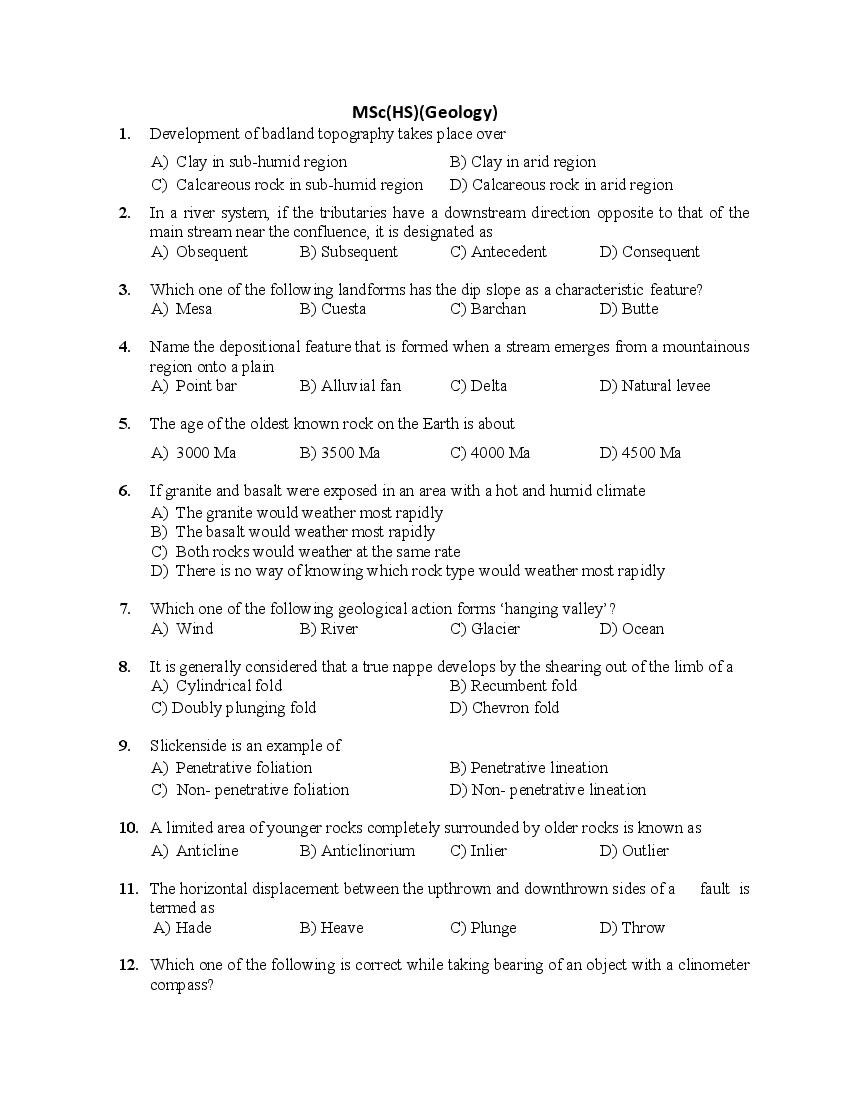
1. Development of badland topography takes place over
A) Clay in sub-humid region B) Clay in arid region
C) Calcareous rock in sub-humid region D) Calcareous rock in arid region
2. In a river system, if the tributaries have a downstream direction opposite to that of the
main stream near the confluence, it is designated as
A) Obsequent B) Subsequent C) Antecedent D) Consequent
3. Which one of the following landforms has the dip slope as a characteristic feature?
A) Mesa B) Cuesta C) Barchan D) Butte
4. Name the depositional feature that is formed when a stream emerges from a mountainous
region onto a plain
A) Point bar B) Alluvial fan C) Delta D) Natural levee
5. The age of the oldest known rock on the Earth is about
A) 3000 Ma B) 3500 Ma C) 4000 Ma D) 4500 Ma
6. If granite and basalt were exposed in an area with a hot and humid climate
A) The granite would weather most rapidly
B) The basalt would weather most rapidly
C) Both rocks would weather at the same rate
D) There is no way of knowing which rock type would weather most rapidly
7. Which one of the following geological action forms ‘hanging valley’?
A) Wind B) River C) Glacier D) Ocean
8. It is generally considered that a true nappe develops by the shearing out of the limb of a
A) Cylindrical fold B) Recumbent fold
C) Doubly plunging fold D) Chevron fold
9. Slickenside is an example of
A) Penetrative foliation B) Penetrative lineation
C) Non- penetrative foliation D) Non- penetrative lineation
10. A limited area of younger rocks completely surrounded by older rocks is known as
A) Anticline B) Anticlinorium C) Inlier D) Outlier
11. The horizontal displacement between the upthrown and downthrown sides of a fault is
termed as
A) Hade B) Heave C) Plunge D) Throw
12. Which one of the following is correct while taking bearing of an object with a clinometer
compass?
Page 2
B) Pointing N end of the magnetic needle towards the object
C) Pointing S end of the magnetic needle towards the object
D) Pointing E or W marked on the dial towards the object
13. Which one of the following crystal systems is with highest symmetry?
A) Monoclinic B) Tetragonal C) Orthorhombic D) Isometric
14. A crystal form having faces on only one side of a symmetry axis is called
A) Pseudomorphic B) Hemihedral C) Hemimorphic D) Holohedral
15. Miller indices contains
A) Neither fractions nor a common factor B) Both fraction and a common factor
C) Either fraction or a common factor D) Irrational numbers
16. What is the retardation given by a Mica plate?
A) Λ B) λ/2 C) λ/4 D) λ/8
17. Which of the following optical properties are observed in plane polarised light?
A) Colour, pleochroism and zoning
B) Colour, pleochroism and twinning
C) Colour, pleochroism and interference colours
D) Colour, pleochroism and relief
18. Which one of the following is not a variety of silica (SiO2)?
A) Blood stone B) Cristobalite C) Tridymite D) Peridot
19. When a ray of polarised light strikes a uniaxial mineral, it undergoes
A) Double refraction B) Absorption
C) Internal reflection D) Scattering
20. Which one of the following garnet contains calcium?
A) Pyrope B) Andradite C) Uvarovite D) Almandine
21. The mineral with two hardnesses is called
A) Andalusite B) Sillimanite C) Cordierite D) Disthene
22. The sequence of streaks in pyrite - chromite - hematite is
A) Brown-cherry red-black B) Brown-black-cherry red
C) Black-brown-cherry red D) Black-cherry red-brown
23. The most characteristic feature of talc is
A) Pearly lustre B) Poor cleavage
C) Conchoidal fracture D) Radiating form
Page 3
biotite and hornblende is known as
A) Syenite B) Granodiorite C) Trondhjemite D) Trachyte
25. The plutonic equivalent of phonolite is
A) Quartz syenite B) Nepheline syenite C) Quartz diorite D) Nepheline diorite
26. Minute worm-like intergrowth of quartz in sodic plagioclase is called
A) Myrmekite B) Graphic C) Perthitic D) Trachytic
27. A fine-grained igneous rocks consisting of about 40% plagioclase, 15% alkali feldspar,
30% quartz, 10% biotite and 5% amphibole is known as
A) Rhyolite B) Dacite C) Andesite D) Trachyte
28. The IUGS classification is essentially a
A) Modal classification B) Chemical classification
C) Textural classification D) Genetic classification
29. In Leucite-Silica binary system, incongruently melting intermediate compound is
A) NaAlSi3O8 B) NaAlSi2O6 C) KAlSi3O8 D) KAlSiO4
30. Which of the following represents a correct magmatic fractionation trend?
A) Basalt – Dacite – Trachyte – Rhyolite
B) Basalt– Andesite - Trachyte – Rhyolite
C) Basalt – Dacite – Andesite – Trachyte
D) Basalt – Andesite – Dacite – Trachyte
31. Which one of the following trace element pair will be enriched in a residual basaltic
magma after its fractional crystallisation of plagioclase and clinopyroxene?
A) Cr and Sr B) Ni and Sr C) Nb and Y D) Ni and Cr
32. Development of foliation in metamorphic rocks is mainly a function of
A) Fluids and pressure B) Fluids and temperature
C) Nonlithostatic stress and temperature D) Lithostatic stress and temperature
33. What is the correct sequence of appearance of minerals with increasing grade of
Barrovian type of metamorphism?
A) Staurolite - Kyanite – Biotite – Fibrolite
B) Staurolite - Kyanite – Fibrolite – Biotite
C) Biotite - Staurolite – Fibrolite – Kyanite
D) Biotite - Staurolite – Kyanite – Fibrolite
34. Which one of the following mineral assemblages is NOT possible in a contact pelitic
metamorphic rock?
Page 4
C) Cordierite and Sillimanite D) Andalusite and Sillimanite
35. Which one of the following rocks shows best development of crenulation cleavage?
A) Granulite B) Gneiss C) Quartzite D) Phyllite
36. Which one of the following facies belongs to higher grade of metamorphism?
A) Zeolite B) Albite-Epidote
C) Hornblende-Hornfels D) Pyroxene-Hornfels
37. Which one of the following sedimentary structure is NOT a tool mark?
A) Flute cast B) Prod cast C) Bounce cast D) Groove cast
38. Which one of the following environment is more suitable for the formation of
herringbone cross beds?
A) Aeolian B) Lacustrine C) Tidal D) Fluvial
39. Which one of the following sedimentary rock has a biochemical origin?
A) Coquina B) Travertine C) Shale D) Sandstone
40. What is the correct sequence of size of following sedimentary particles in a decreasing
order?
A) Gravel – Sand – Silt – Clay B) Gravel – Silt – Sand – Clay
C) Sand – Gravel – Clay – Silt D) Sand – Clay – Gravel – Silt
41. Which one of the following detrital constituents of sedimentary rocks is the best
provenance indicator?
A) Micas B) Feldspars C) Heavy minerals D) Rock fragments
42. A sandstone containing about 50% quartz, 35% feldspar, 5% biotite, 5% cement and
5% matrix would be
A) Quartz arenite B) Quartz wacke C) Arkosic wacke D) Arkose
43. To classify a stratigraphic unit as a ‘formation’, it must be
A) A sedimentary unit B) A metamorphic unit
C) An igneous unit D) Mappable
44. Which type of environment is indicated by a shale with fossils?
A) Glacial B) Dunes C) Swamp D) Corel reef
45. Which one of the following fossil characterised the Jurassic stratigraphy of Kutch?
A) Trilobites B) Graptolites C) Brachiopods D) Cephalopods
46. The age of Bagh Group is
Page 5
47. Which one of the following stratigraphic unit is NOT of Cenozoic in age
A) Subathu B) Kiato C) Tipam D) Pinjore
48. Which of the following geological units are separated by Eparchaean unconformity?
A) Late Archaean from Early Proterozoic
B) Early Archaean from Late Archaean
C) Late Proterozoic from Early Phanerozoic
D) Early Phanerozoic from Late Phanerozoic
49. Which one of the following stratigraphic unit is oldest?
A) Alwar Quartzite B) Bijaigarh Shale
C) Sargur Schist D) Kajrahat Limestone
50. Lower Gondwana flora in India consists of an assemblage of
A) Ptilophyllum-Otozamites B) Petrophyllum-Nilssonia
C) Vertebraria-Glossopteris D) Williamsonia-Neuropteris
51. Which of the following stratigraphic units is arranged in a correct stratigraphic order
beginning with the oldest first?
A) Semri-Kaimur-Rewa-Bhander B) Semri- Rewa-Kaimur-Bhander
C) Semri- Bhander- Kaimur-Rewa D) Semri- Bhander- Rewa- Kaimur
52. Which is the greatest expanse of time?
A) Period B) Era C) Epoch D) Eon
53. Theca is related to
A) Trilobite B) Brachiopod C) Gastropod D) Graptolite
54. The most useful fossils for matching layers of sedimentary rock that are separated by
large distances are called
A) Trace fossils B) Micro fossils C) Index fossils D) Extinct fossils
55. Which one of the following gastropods shows sinistral coiling?
A) Murex B) Physa C) Bellerophon D) Conus
56. The hinge line in Spirifer is
A) Straight and long B) Straight and short
C) Curved and long D) Curved and short
57. Which one of following are the dominant micro-organisms at abyssal ocean regions?
A) Ostracods B) Conodonts C) Diatoms D) Radiolarians
Page 6
A) Beginning of Pliocene B) End of Pliocene
C) Beginning of Pleistocene D) End of Pleistocene
59. Which one of the following is the most suitable clay mineral that is used in oil refining
and drilling?
A) Bentonite B) Fire clay C) Fuller’s earth D) Kaoline
60. In which one of the following industries, gypsum is commonly used?
A) Fertilizer B) Ceramics C) Refractory D) Abrasives
61. Which one of the following coal/lignite deposit is of Permian age?
A) Neyveli B) Palana C) Makum D) Raniganj
62. The barite deposits in India are located in
A) Amjhore B) Mangampet C) Jamsar D) Saladipura
63. The age of oil-bearing rock formation of Cambay basin is
A) Cretaceous-Eocene B) Eocene-Oligocene
C) Oligocene-Miocene D) Pliocene-Pleistocene
64. The Khetri copper deposits belong to
A) Aravalli Supergroup B) Delhi Supergroup
C) Marwar Supergroup D) Vindhyan Supergroup
65. The main Indian uranium mine is located at
A) Jabalpur B) Jaduguda C) Jhalawar D) Jamshedpur
66. Bauxite deposits are formed as a result of
A) Residual weathering B) Magmatic segregation
C) Supergene enrichment D) Hydrothermal process
67. The Sargipalli mine in Odisha is known for the ore deposit of
A) Gold B) Silver C) Lead D) Zinc
68. Chromite deposits result from
A) Late magmatic segregation B) Early magmatic segregation
C) Early magmatic injection D) Late magmatic injection
69. The convergent plate margin is the typical tectonic setting for
A) Porphyry copper B) Stratiform copper
C) Volcanogenic massive sulphides D) Iron formations
70. At water table of an aquifer
Page 7
B) Hydrostatic pressure < atmospheric pressure
C) Hydrostatic pressure >> atmospheric pressure
D) Hydrostatic pressure << atmospheric pressure
71. Which one of following can transmit water on a regional scale due to leakage, but is
NOT a source of sufficient water supply?
A) Aquifer B) Aquiclude C) Aquifuge D) Aquitard
72. Which one of the following is a correct statement?
A) Sandstone forms aquifer and sandy shale forms aquitard
B) Sandstone forms aquitard and sandy shale forms aquifer
C) Sandstone forms aquifer and sandy shale forms aquiclude
D) Sandstone forms aquiclude and sandy shale forms aquifer
73. Which one of the following natural inorganic constituent has a laxative effect when
dissolved in ground water at higher concentrations (600-1000 mg/L)?
A) Sodium B) Manganese C) Sulphate D) Iron
74. A horizontal entry into an underground mine is called
A) Shaft B) Adit C) Bench D) Pit
75. Which one of the following method is NOT used in coal mining?
A) Broadwall B) Longwall C) Room and pillar D) Bord and pillar
x-x-x
Document Details
| Board / Org | Panjab University |
| Exam | PU CET PG |
| Type | Question Paper |
| Pages | 7 |
| Updated | 22 Jul 2026 |