JKCET 2022 Syllabus
Finished viewing? Save it for later —
Download JKCET 2022 Syllabus (PDF · 12 pages)About JKCET 2022 Syllabus
JKCET 2022 Syllabus is available here for free download. Published by JKBOPEE for Jammu and Kashmir Common Entrance Test, this syllabus can be viewed online or downloaded as a PDF (12 pages). Candidates preparing for Jammu and Kashmir Common Entrance Test can use JKCET 2022 Syllabus to understand the exam pattern, the type of questions asked, and the overall difficulty level.
Frequently Asked Questions
How can I download JKCET 2022 Syllabus?
Open this page and click the Download button to save JKCET 2022 Syllabus as a PDF. It is completely free on AglaSem Docs.
Is JKCET 2022 Syllabus free to download?
Yes. JKCET 2022 Syllabus can be viewed online and downloaded as a PDF free of cost on AglaSem Docs.
How many pages does JKCET 2022 Syllabus have?
JKCET 2022 Syllabus contains 12 pages, which you can read online or download together as a single PDF.
Where can I find more Jammu and Kashmir Common Entrance Test study material?
You can find more Jammu and Kashmir Common Entrance Test question papers, sample papers, syllabus, and answer keys on AglaSem Docs.
JKCET 2022 Syllabus – Text
Read the full text of this syllabus below — useful to quickly search, copy and reference the content online without downloading the PDF.
📄 View text version (12 pages)
Page 1
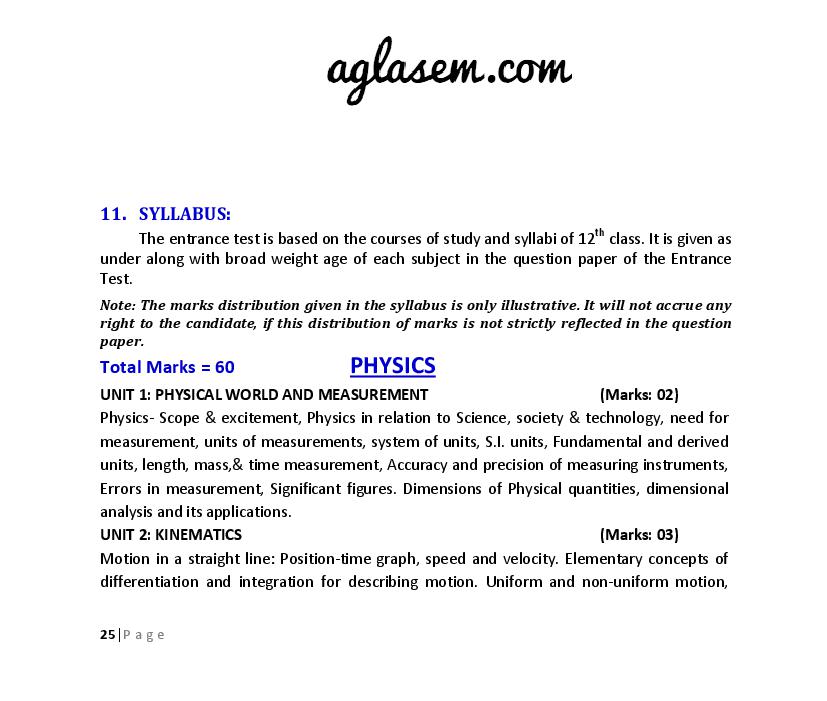
The entrance test is based on the courses of study and syllabi of 12th class. It is given as
under along with broad weight age of each subject in the question paper of the Entrance
Test.
Note: The marks distribution given in the syllabus is only illustrative. It will not accrue any
right to the candidate, if this distribution of marks is not strictly reflected in the question
paper.
Total Marks = 60 PHYSICS
UNIT 1: PHYSICAL WORLD AND MEASUREMENT (Marks: 02)
Physics- Scope & excitement, Physics in relation to Science, society & technology, need for
measurement, units of measurements, system of units, S.I. units, Fundamental and derived
units, length, mass,& time measurement, Accuracy and precision of measuring instruments,
Errors in measurement, Significant figures. Dimensions of Physical quantities, dimensional
analysis and its applications.
UNIT 2: KINEMATICS (Marks: 03)
Motion in a straight line: Position-time graph, speed and velocity. Elementary concepts of
differentiation and integration for describing motion. Uniform and non-uniform motion,
25|P a g e
Page 2
graph, position-time graphs, relations for uniformly accelerated motion, (graphical
treatment and calculus approach). Scalar and Vector quantities, position & displacement,
addition and subtraction of vectors, general Vector and notation, equality of vectors,
multiplication of vector by a real number, Relative Velocity. Scalar and Vector products of
two vectors with properties, Unit Vector, Resolution of a Vector in plane rectangular
components, scalar & vector product of two vectors & their properties, Motion in a plane,
Projectile Motion.
UNIT 3: LAWS OF MOTION (Marks: 02)
Concept of force and Inertia, Newton’s First Law of motion; Momentum and Newton’s
Second Law of motion, Impulse; Newton’s Third Law of motion. Law of conversation of
linear momentum and its applications, Equilibrium of concurrent forces. Friction, static and
kinetic friction, laws of friction, rolling friction.
Dynamics of uniform circular motion: Centripetal force and examples of circular motion
(vehicle on level circular road, vehicle on banked road.)
UNIT 4: WORK, ENERGY AND POWER (Marks: 02)
Concept of scalar products of vectors, Work done by a constant force and variable force;
kinetic energy, work energy theorem, power. Potential energy, Potential energy of spring,
conservative forces, conservation of mechanical energy (K.E. and P.E.), non-conservative
forces; Elastic and inelastic collisions in one and two dimensions.
UNIT 5: MOTION OF SYSTEM OF PARTICLES AND RIGID BODY (Marks: 02)
Centre of mass of a two-particle system, Centre of mass of a rigid body, centre of mass of
circular ring. disc. rod& sphere, Concepts of vector product of vectors: moment of a force,
torque, angular momentum, conservation of angular momentum with some examples.
Moment of inertia, radius of gyration. Values of moment of inertia for simple geometric
objects (no derivation), statement of parallel and perpendicular axes theorems and their
applications. Rigid body rotation and equations of rotational motion.
UNIT 6: GRAVITATION (Marks: 02)
The universal law of gravitation, Acceleration due to gravity and its variation with altitude,
depth and shape, Kepler’s laws of planetary motion. Gravitational potential; gravitational
potential energy, Escape velocity, Orbital velocity of satellite. Geo-stationary satellites,
inertial & gravitational mass.
UNIT 7: PROPERTIES OF BULK MATTER (Marks: 02)
Elastic behavior, Stress-strain relationship. Hooke’s Law, Young’s modulus, bulk modulus,
shear modulus of rigidity. Pressure due to a fluid column; Pascal’s law and its applications
(hydraulic lift and hydraulic brakes), effect of gravity on fluid pressure, Viscosity, Stokes’ law,
terminal velocity, streamline and turbulent flow, critical velocity, Reynolds number.
Bernoulli’s theorem and its applications Surface energy and surface tension, angle of
26|P a g e
Page 3
detergents, Heat, temperature, thermal expansion; specific heat, calorimetry; change of
state-latent heat. Heat transfer-conduction, convection and radiation, thermal conductivity,
Newton’s law of cooling.
UNIT 8: THERMODYNAMICS (Marks: 02)
Thermal equilibrium and definition of temperature (zeroth law of thermodynamics),.Heat
work and internal energy. First law of thermodynamics. Second law of thermodynamics:
reversible and irreversible processes. Heat engines and refrigerators (concept only)
UNIT 9: BEHAVIOUR OF PERFECT GAS AND KINETIC THEORY (Marks: 02)
Equation of state of a perfect gas, work done on compressing a gas. Kinetic theory of gases –
assumptions, concept of pressure. Expression for pressure exerted by gas, Kinetic energy
and temperature: rms speed of gas molecules; Degrees of freedom, Law of equipartition of
energy (Statement only) and applications to specific heat capacities of gases; concept of
Mean free path, Avagadro’s number.
UNIT 10: OSCILLATIONS AND WAVES (Marks: 04)
Periodic motion – Period, frequency, displacement as a function of time. Periodic functions.
Simple harmonic motion (S.H.M.) and its equation; phase; oscillations of a spring-restoring
force and force constant; energy in S.H.M. – kinetic and potential energies; Simple
pendulum-derivation of expression for its time period; Free, forced and damped oscillations(
qualitative ideas only), resonance. Wave motion. Longitudinal and transverse waves, speed
of a wave. Displacement relation for a progressive wave. Principle of superposition of waves,
reflection of waves, Standing waves in strings and organ pipes, fundamental mode and
harmonics, Beats, Doppler effect.
UNIT 11: ELECTROSTATICS (Marks: 04)
Electric charges: Conservation of charge, Coulomb’s law-forces between two point charges,
forces between multiple charges; superposition principle and continuous charge
distribution. Electric field: Electric field due to a point charge, Electric field lines, Electric
dipole, Electric field due to a dipole, Torque on a dipole in uniform electric field. Electric flux,
Statement of Gauss’s theorem and its applications to find field due to infinitely long straight
wire, uniformly charged infinite plane sheet and uniformly charged thin spherical shell (field
inside and outside). Electric potential, potential differences, electric potential due to a point
charge, a dipole and system of charges; Equipotential surfaces, Electrical potential energy of
a system of two point charges and of electric dipole in an electrostatic field. Conductors and
insulators, free charges & bound charges inside a conductor, Dielectrics and electric
polarization, capacitor and capacitance, combination of capacitors in series and in parallel,
capacitance of parallel plate capacitor with and without dielectric medium between the
plates, Energy stored in a capacitor. Van de Graff generator.
27|P a g e
Page 4
Electric current, flow of electric charges in a metallic conductor, Drift velocity, mobility &
their relation with electric current, Ohm’s law, Electrical resistance, V-I characteristics
(linear & non-linear), Electrical energy and power, Electrical resistivity and conductivity,
Carbon resistors, Colour code for carbon resistors; Temperature dependence of resistance,
Internal resistance of a cell, potential difference and e.m.f of a cell, combination of cells in
series and in parallel, elementary idea of secondary cells, Kirchhoff’s laws and their
applications. Wheatstone bridge, Metre bridge. Potentiometer – principle and its application
to measure the potential difference and for comparing e.m.f. of two cells; measurement of
internal resistance of a cell.
UNIT 13: MAGNETIC EFFECTS OF CURRENT AND MAGNETISM (Marks: 05)
Concept pf magnetic field, Oersted experiment, Biot – Savart law and its application to
current carrying circular loop. Ampere’s law and its applications to infinitely long current
carrying straight wire, straight and toroidal solenoids. Force on moving charge in uniform
magnetic and electric fields. Cyclotron. Force on a current-carrying conductor in a uniform
magnetic field. Force between two parallel current-carrying conductors-definition of
ampere. Torque experienced by a current loop in uniform magnetic field; Moving coil
galvanometer, its current sensitivity and conversion with examples. Current loop as a
magnetic dipole and its magnetic dipole moment, magnetic field intensity due to a magnetic
dipole(bar magnet) along its axis & perpendicular to its axis, torque on magnet, magnetic
field lines; Earth’s magnetic field and magnetic elements, Para-, dia- and ferro-magnetic
substances with examples. Electro magnets and factors affecting their strength, permanent
magnets.
UNIT 14: ELECTROMAGNETIC INDUCTION AND ALT. CURRENTS (Marks: 04)
Electromagnetic induction: Faraday’s law, induced emf and current; Lenz’s Law. Eddy
currents. Self and mutual inductance. Alternating currents, peak and rms value of
alternating current/voltage; reactance and impedance; LC oscillations (qualitative treatment
only) & LCR circuits series, resonance; power in AC circuits, wattles current. AC generators
and transformer.
UNIT 15: ELECTROMAGNETIC WAVES (Marks: 02)
Electromagnetic waves and their characteristics, Transverse nature of electromagnetic
waves. Electromagnetic spectrum (radio waves, microwaves, infrared, visible, ultraviolet, X-
rays, gamma rays) including elementary facts about their uses.
UNIT 16: OPTICS (Marks: 07)
Ray optics-Reflection of light, spherical mirrors, mirror formula, refraction of light-Total
internal reflection and its applications, optical fibres, Refraction at spherical surfaces,
lenses, thin lens formula, Lens-makers Formula, Newton relation : displacement method to
find position of images (conjugate points), Magnification, Power of a Lens. Combination of
28|P a g e
Page 5
Astronomical Telescope (reflecting and refracting) and their magnifying powers. Wave
optics: wave front and Huygens’ principle, reflection and refraction of plane wave at a plane
surface using wave fronts. Proofs of laws of reflection and refraction using Huygen’s
principle. Interferences, Young’s double slit experiment and expression for fringe width,
coherent sources and sustained interference of light. Diffraction due to a single slit, width of
central maximum. Resolving power of microscopes and astronomical telescopes,
Polarisation, plane polarized light; Brewster’s law, uses of plane polarized light and
Polaroid’s.
UNIT 17: DUAL NATURE OF MATTER AND RADIATION (Marks: 02)
Dual nature of radiation. Photo electric effect, Hertz and Lenard’s observations; Einstein’s
photoelectric equation; particle nature of light. Matter waves-wave nature of particle, de
Broglie relation. Davission-Germer experiment.
UNIT 18: ATOMS AND NUCLEI (Marks: 03)
Alpha-particle scattering experiment; Rutherford’s model of atom; Bohr’s model of atom,
energy levels, hydrogen spectrum, continuous & characteristics of X-rays, Composition and
size of nucleus, atomic masses, isotopes, isobars; isotones. Radioactivity-alpha, beta and
gamma particles/rays and their properties; radioactive decay law. Mass-energy relation,
mass defect; binding energy per nucleon and its variation with mass number, nuclear fission
and fusion.
UNIT 19: ELECTRONIC DEVICES (Marks: 04)
Quantitative ideas on Energy bands in solids, conductors, insulators and semiconductors.
Semiconductors; Semiconductor diode: I-V characteristics in forward and reverse bias; diode
as a rectifier; I-V characteristics of LED, photodiode, solar cell and Zener diode; Zener diode
as a voltage regulator. Junction transistor and its action, characteristics of a transistor;
transistor as an amplifier (common emitter configuration) and oscillator. Logic gates (OR,
AND, NOT) concept of NAND and NOR gates. Transistor as a switch.
UNIT 20: COMMUNICATION SYSTEM (Marks: 02)
Basic elements of communication system (block diagram only), Bandwidth of signals
(speech, TV and digital data); Bandwidth of Transmission medium, Propagation of
electromagnetic waves in the atmosphere, sky and space wave propagation. Need for
modulation: Production and detection of an amplitude modulated wave.
Total Marks = 60 CHEMISTRY
UNIT 1: CHEMICAL ARITHMETIC & ATOMIC STRUCTURE (Marks: 03)
Laws of chemical combination, Mole concept (numericals) Percentage composition,
Chemical reactions, Stoichiometry and calculations based on stoichiometry.
29|P a g e
Page 6
principle, Hund’s rule and Aufbau principle. Heisenberg’s uncertainty principle, de-Broglie
wave equation and its significance, electronic configurations of atoms.
UNIT 2: CHEMICAL EQUILIBRIUM (Marks: 04)
Law of mass action, Le-Chatelier’s principle, and its application to physical and chemical
equilibria. Ionisation of weak electrolytes (Ostwald’s dilution law),equilibrium constant,
Acids and bases: Acid base equilibria. Bronsted-Lowry and Lewis concept, of acids and bases.
Ionic product of water. pH and pOH scales, pKa&pKb values, Solubility product, Buffer
solutions Common ion effect, Hydrolysis of salts
UNIT 3: CHEMICAL KINETICS (Marks: 02)
Rate of chemical reaction, Average and instantaneous rate, Factors effecting rate of
reaction, Order and molecularity of reaction, Integrated rate equation and Half-life period
(for zero and first order) reaction, Activation energy and Arrhenius equation.
UNIT 4: SOLUTIONS (Marks: 02)
Vapour pressure, Raoult’s law, Ideal and Non-ideal solutions, Colligative properties.
Determination of molecular mass of non-volatile solutes through colligative properties.
Abnormal molecular masses and Van’t Hoff Factor, expression of concentration of solutions.
UNIT 5: CHEMICAL THERMODYNAMICS (Marks: 04)
Energy changes taking place during chemical reactions, Internal Energy and Enthalpy
changes, Enthalpy of combustion, Solution and Neutralization, and formation and
hyderation.
Hess’s Law (Numerical problems) Laws of thermodynamics-first, second & third, Concepts of
Entropy and Free energy, Spontaneity of a chemical reaction.
UNIT 6: REDOX REACTIONS AND ELECTROCHEMISTRY (Marks: 03)
Dependence of electrode and cell potential on concentration (Nernst Equation), Electrode
potential as a criteria for product formation in electrolysis. E.M.F. of Galvanic cell,
Relationship between free energy change and E.M.F. of a cell. Definition and units of
Equivalent, Molar and Specific conductivity.
UNIT 7: SOLID STATE & STATES OF MATTER (Marks: 04)
Boyle’s Law, Charle’s law, Dalton’s law of partial pressure, Graham’s law of diffusion of
gases, Avogadro law.
Causes of deviation from ideal behaviour, ideal gas equation and nature of ‘R’, Vander
Waal’s equation, surface tension and viscosity of liquids.
Crystalline and amorphous solids, Crystal lattice, Crystal types, Packing efficiency, calculation
of density of unit cell, Number of atoms per unit cell in a cubic cell. Co-ordination number,
Stoichiometric defects: Schottky, Frenkel and interstitial.
Properties of solids: Electrical, Magnetic & Dielectric.
UNIT 8: SURFACE CHEMISTRY (Marks: 02)
Freundlich Adsorption isotherm, preparation of colloidal solutions by physical and chemical
method.Electrical properties (cataphoresis, electroosmosis, coagulation and protective
colloids) Homogeneous and Heterogeneous Catalysis.
UNIT 9: PERIODIC PROPERTIES (Marks: 02)
30|P a g e
Page 7
Electron affinity, Electro negativity, Atomic and Ionic radii along the period and down the
group in the periodic table.
UNIT 10: CHEMICAL BONDING AND MOLECULAR STRUCTURE (Marks: 04)
Types of chemical bonds, Ionic & covalent bonds, Bond parameters, Quantum theory of
covalent bond, pi and sigma bonds, Hybridization involving s, p and d-orbitals, Dipole
moments and hydrogen bond.
VSEPR: Shapes of simple molecules ( H2O, NH3, SO2, CO2, PCl3, PCl5, CIF3, BF3, SF4, XeF2, XeF4).
Molecular orbital theory: Energy Levels and M.O. diagrams of H2, H2+,He2, O2+,O1-2,O22-& F2.
Bond order and its significance.
UNIT 11: CHEMISTRY OF REPRESENTATIVE ELEMENTS (Marks: 04)
S and P Block Elements: Electron configuration, Oxidation states and trends in various
properties like ionization energy, electron affinity, atomic radii, electro negativity and
diagonal relationship.
Alkali metals: Hydration of ions, action with ammonia, flame colouration, solubility of
hydroxides, carbonates and sulphates.
Alkaline Earth Metals: Solubility of carbonates, hydroxides and sulphates.
Boron Family: Structure of halides, relative acid strength of trihalides of boron.
Carbon family: Hydrides and oxides.
Nitrogen family: Oxides of Nitrogen and Phosphorous, reducing nature, basic strength and
boiling points of their halides.
Oxygen family: volatility, thermal stability, acid character, reducing character and bond
angles of their hydrides, oxyacids of sulphur.
Halogen family: Bond energy, colour and oxidizing power, boiling point, acid strength and
dipole moment, thermal stability, reducing power of hydracids, relative acidity and oxidizing
power of oxyacids of halogens.
UNIT 12: TRANSITION ELEMENTS INCLUDING LANTHANOIDES (Marks: 02)
Electron configuration, Oxidation states, Colour, and Magnetic properties of transition
elements,.
Oxides of Vanadium, Chromium and Manganese Alloys of Copper, Silver and Iron.
Metallurgy of Iron, Copper and Zinc.
UNIT 13: CO-ORDINATION CHEMISTRY (Marks: 04)
Introduction, Ligands, Co-ordination Number, IUPAC Nomenclature.
Bonding theories: Werner’s, VBT and CFT.
Isomerism in Co-ordination compounds (Ionization, Linkage, Hydrate, Geometrical and
Optical).
Applications of Co-ordination complexes in Biology, Medicine and Analytical Chemistry.
UNIT 14: NOMENCLATURE AND BASIC CONCEPTS IN ORGANIC CHEMISTRY (Marks: 03)
Nomenclature of organic compounds (monofunctional and polyfunctional groups),
inductive, eletromeric resonance and hyperconjugation effects, reaction intermediates,
carbocations, carbanions and free radicals with their general stability order, types of organic
31|P a g e
Page 8
of Huckel rule. Ortho, meta and para directing groups., electro & nucleophiles.
UNIT 15: HYDROCARBONS (Marks: 03)
Structural isomerism in alkanes, alkenes, alkynes and arenes, stereoisomerism: geometrical
and optical isomerism, chirality, origin of chirality, specific rotation, racemisation and
resolution, conformations in ethane and cyclohexane, relative configuration (D,L-
Nomenclature), absolute (R and S system of nomenclature).
UNIT 16: ORGANIC CHEMISTRY BASED ON FUNCTIONAL GROUP-I (Marks: 02)
Haloalkanes, haloarenes, alcohols and phenols: General methods of preparation and
properties. Choloroform and Iodoform.
UNIT 17: ORGANIC CHEMISTRY BASED ON FUNCTION GROUP-II (Marks: 03)
Ethers, Aldehydes, Ketones, Monocarboxylic acids:General methods of preparation and
properties. Derivatives of monocarboxylic acids like acid halides, acid anhydrides acid
amides and esters.
Acidic motive of carboxylic acids
UNIT 18: ORGANIC CHEMISTRY BASED ON FUNCTIONAL GROUP-III (Marks: 03)
Cyanides, Isocyanides, Nitrocompounds and Amines: General methods of preparation and
properties. Relative basic character of amines.
UNIT 19: MOLECULES OF LIFE (Marks: 03)
Carbohydrates: Definition, Classification, Mutarotation, Structure of Animo-acids, Peptides
and Proteins (Molish and ninhydrin tests). Classification and uses of vitamins. Chemicals in
medicine and health care, Dyes and drugs. Chemical reactions in atmosphere, ozone
depletion and its effects. Acid rain, Green House effect & Global warming.
UNIT 20: POLYMERS (Marks: 03)
Introduction, Classification, Methods of Polymerisation (Addition, Condensation, Free
Radical, Cationic & Anionic).
Natural & Synthetic Polymers: Polythene, Nylon, Polyster, Bakelite and Rubber.
Biodegradable and Non-Biodegradable Polymers.
Total Marks = 60 MATHEMATICS
UNIT 1: SETS, RELATIONS AND FUNCTIONS (Marks: 06)
Sets and their representation, finite and infinite sets, empty set subsets, subset of real
numbers especially intervals, power set, universal set. Venn diagram, union and intersection
of sets. Difference of sets, Compliment of a set. Ordered pairs, Cartesian product of sets,
number of elements in the Cartesian product of two finite sets.
Relations, Domain, co- domain and range of relation, types of relations, reflexive,
symmetric, transitive and equivalence relations.
32|P a g e
Page 9
of a function. One to one, onto functions. Real valued functions of the real variable;
constant, identity, polynomial, rational, modulus, signum and the greatest integer functions
with their graphs. Sum, difference, product and quotients of functions. Composition of
functions, inverse of a function, binary operations.
UNIT 2: COMPLEX NUMBER; LINEAR INEQUATION; LINEAR PROGRAMMING(Marks: 06)
Complex number: Conjugate of a complex number, modulus and amplitude (argument) of a
complex number, Argand’s plane and polar representation of complex numbers, algebraic
properties of complex numbers. Fundamental theorem of algebra, solution of Quadratic
equation in the complex number system. Square root of a complex number.
Linear in equation: Algebraic solution of linear inequalities in one variable and two
variables.
Linear programming: Introduction , definition of related terminology such as constraints,
objective function, optimization, different type of linear programming problem (L.P),
mathematical formulation of L.P problem, graphical method of solution for problems in two
variables, feasible and infeasible regions, feasible and infeasible solutions, optimal feasible
solutions.
UNIT 3: SEQUENCE AND SERIES, PERMUTATION AND COMBINATION & BINOMIAL
THEOREM (Marks: 06)
Sequence and series: Arithmetic progression (A.P), arithmetic mean (A.M), nth term, sum to
n-terms of an A.P, Geometric progression (G.P) , Geometric Mean (G.M), nth term, sum to n-
terms and sum to infinity of a G.P. Relation between A.M and G.M. Sum to n terms
of∑ 𝑛 , ∑ 𝑛 𝑎𝑛𝑑 ∑ 𝑛 .
Permutation and combination: Fundamental principle of counting, factorial n, permutations
P(n,r) and combinations C(n,r), simple applications.
Binomial Theorem: Binomial theorem for positive integral power general and middle terms
in the Binomial expansion. Pascal’s triangle and simple applications.
UNIT 4: TRIGONOMETRIC AND INVERSE TRIGONOMETRY FUNCTIONS (Marks: 06)
Positive and negative angles, measuring angles in radians and in degrees, Conversion from
one measure to another. Definition of trigonometric functions with the help of unit
circle.Periodicity of Trigonometric functions. Basic Trigonometric identities sin2x+cos2x=1 for
all Sign of x etc. Trigonometric functions and their graphs. Expressions for
sin(x y), cos(x y), tan(x y), cot(x y) , sum and product formulae.
Identities related to Sin2x, Cos2x, tan2x, Sin3x, Cos3x, and tan3x. General and principal
solutions of trigonometric equations of the type Sin x= Sin a, Cos x= Cos a , Tan x= Tan a.
Inverse trigonometric functions, range, domain, principal value branches. Graphs of inverse
trigonometric functions, elementary properties of inverse trigonometric functions
UNIT 5: MATRICES AND DETERMINANTS (Marks: 04)
Matrices, concepts, notation, order, equality, types of matrices, Zero matrix, transpose of
matrix, Symmetric and skew symmetric matrices. Addition, multiplication, scaler
33|P a g e
Page 10
multiplication of matrices. Non-commutativity of multiplication of matrices and existence of
non-zero matrices whose product is the zero matrix (order 2x2). Concept of elementary row
and column operation, Invertible matrices and uniqueness of inverse, if it exists.(Matrices
with real entries).
Determinants of square matrix (upto 3x3 matrices) properties of determinants, minors,
cofactors and applications of determinants in finding area of a triangle.Adjoint and inverse
of a square matrix. Consistency, inconsistency and number of solutions of system of linear
equations by examples, solving system of linear equations in two or three variables using
inverse of a matrix, Cramer rule & its applications.
UNIT 6: LIMIT, CONTINUITY AND DIFFERENTIATION (Marks: 08)
Concept of limit of a function. Theorems on Limits, Evaluation of limits using standard
results
Sinx xn an
lim , lim , lim → , lim → , lim 1 +
x 0 x x a x a →
log(1 + 𝑥) e −1
lim(1 + 𝑥) / , lim , lim ,
→ → 𝑥 → 𝑥
Continuity of a function at a point. Continuity of Sum, product and quotient of functions.
Derivative: definition of a derivative of a function, geometrical interpretation of the
derivative.
Derivative of sum, difference, product and quotient of two or more functions.
Derivative of algebraic and composite functions.
Derivative of trigonometric and inverse trigonometric functions.
Chain rule, derivative of implicit functions.
Derivative of logarithmic and exponential functions.
Logarithmic differentiation.
Derivative of functions expressed in parametric forms.
Second order derivatives.
Rolle’s and Lagrange’s Mean Value Theorem and their geometrical interpretation and
their simple applications.
Application of Derivative: rate of change, increasing and decreasing functions, tangents and
normals, approximation, maxima and minima (first derivative and second derivative test).
Simple problems.
UNIT 7: INTEGRATION AND DIFFERENTIAL EQUATIONS (Marks: 07)
Integration as inverse process of differentiation. Integration of variety of functions by
Substitution, by parts, by partial fractions. Simple integrals of the type:
𝑑𝑥 𝑑𝑥 𝑑𝑥
, , ,
𝑥 ±𝑎 𝑥 ±𝑎 √𝑎 − 𝑥
34|P a g e
Page 11
, , 𝑑𝑥 , 𝑑𝑥 ,
𝑎𝑥 + 𝑏𝑥 + 𝑐 √𝑎𝑥 + 𝑏𝑥 + 𝑐 𝑎𝑥 + 𝑏𝑥 + 𝑐 √𝑎𝑥 + 𝑏𝑥 + 𝑐
𝑎 ± 𝑥 . 𝑑𝑥, 𝑥 − 𝑎 . 𝑑𝑥,
𝑑𝑥 𝑑𝑥
𝑎𝑥 + 𝑏𝑥 + 𝑐 𝑑𝑥, , , (𝑝𝑥 + 𝑞) 𝑎𝑥 + 𝑏𝑥 + 𝑐𝑑𝑥
𝑎 + 𝑏 cos 𝑥 𝑎 + 𝑏 sin 𝑥
Definite integrals as a Limit of a sum. Fundamental Theorem of calculus.Basic properties of
definite integrals Evaluation of definite integrals.
Application of integrals: Application in finding the area under simple curves, especially lines.
Areas of circles, parabolas and ellipses (in standard form) Area under the curve y= Sinx, y=
Cosx, area between the above two curves.
Differential Equations: Definition, order and degree of a differential equation. General and
particular solutions of a differential equation. Formation of a differential equation whose
general solution is given. Solution of differentiation equation by method of separation of
variables. Solution of Homogeneous differential equation of first order and first degree.
Solution of linear differential equation of the type:
+ 𝑝𝑦 = 𝑞, where p and q are functions of x alone and
+ 𝑝𝑥 = 𝑞, where p and q are functions of y alone.
UNIT 8: STRAIGHT LINES AND CONIC SECTIONS (Marks: 05)
Distance between two points, section, slope of a line, angle between two lines, various
forms of equations of lines, point-slope form, intercept form, two point form, and normal
form. General equation of a line, distance of a point from a line. Conic Section: Sections of a
cone, circles, parabola, ellipse, hyperbola, a point, a straight line and a pair of intersecting
lines as a degenerated case of conic section. Standard equation of a circle, parabola, ellipse,
and hyperbola and their simple properties.
UNIT 9: STATISTICS AND PROBABILITY (Marks: 06)
STATISTICS Measure of dispersion, mean, deviation, variance and standard deviation of
ungrouped/ grouped data. Analysis of frequency distribution with equal means but different
variances.
PROBABILITY :Random Experiment: outcome, sample spaces.
Events: Mutually exclusive and exhaustive events. Axiomatic (set theoretic) probability,
probability of an event, probability of “Not” and “Or” events. Multiplication theorem on
probability, conditional probability, independent events, total probability, Baye’s theorem,
random variable and its probability, distribution, mean and variance of a random variable.
Repeated independent (Bernouli) trials and Binomial distribution.
UNIT 10: VECTORS AND THREE DIMENSIONAL GEOMETRY (Marks: 06)
Vectors and scalars, magnitude and direction of a vector Direction Cosines and ratios of a
vector. Types of vector, equal, zero, unit, parallel and collinear vectors. Position vector of a
point , negative of a vector, components of a vector, addition of vectors, Scalar
35|P a g e
Page 12
product of vectors, projection of a vector on a line. Vector (cross) product of vectors, Scalar
triple product. Coordinate axes and Coordinate planes in three dimensions of a point,
distance between two points and sectional formula.
STRAIGHT LINES AND SPACE Direction cosines and direction ratios of a line joining two
points. Cartesian and vector equation of a line (in various forms), coplanar and skew-lines,
shortest distance between two lines.
PLANES Cartesian and vector equation of a plane( in various forms). Distance of a point
from a plane.
Angle between:
i. Two lines
ii. Two planes.
iii. A line and a plane .
Document Details
| Board / Org | JKBOPEE |
| Exam | Jammu and Kashmir Common Entrance Test |
| Type | Syllabus |
| Pages | 12 |
| Language | english |
| Updated | 09 Jun 2026 |