NEET 2018 Question Paper (Marathi)
Finished viewing? Save it for later —
Download NEET 2018 Question Paper (Marathi) (PDF · 44 pages)About NEET 2018 Question Paper (Marathi)
NEET 2018 Question Paper (Marathi) is available here for free download. Published by NTA for NEET UG, this question paper can be viewed online or downloaded as a PDF (44 pages). Candidates preparing for NEET UG can use NEET 2018 Question Paper (Marathi) to understand the exam pattern, the type of questions asked, and the overall difficulty level.
Frequently Asked Questions
How can I download NEET 2018 Question Paper (Marathi)?
Open this page and click the Download button to save NEET 2018 Question Paper (Marathi) as a PDF. It is completely free on AglaSem Docs.
Is NEET 2018 Question Paper (Marathi) free to download?
Yes. NEET 2018 Question Paper (Marathi) can be viewed online and downloaded as a PDF free of cost on AglaSem Docs.
How many pages does NEET 2018 Question Paper (Marathi) have?
NEET 2018 Question Paper (Marathi) contains 44 pages, which you can read online or download together as a single PDF.
Where can I find more NEET UG study material?
You can find more NEET UG question papers, sample papers, syllabus, and answer keys on AglaSem Docs.
NEET 2018 Question Paper (Marathi) – Text
Read the full text of this question paper below — useful to quickly search, copy and reference the content online without downloading the PDF.
📄 View text version (44 pages)
Page 1
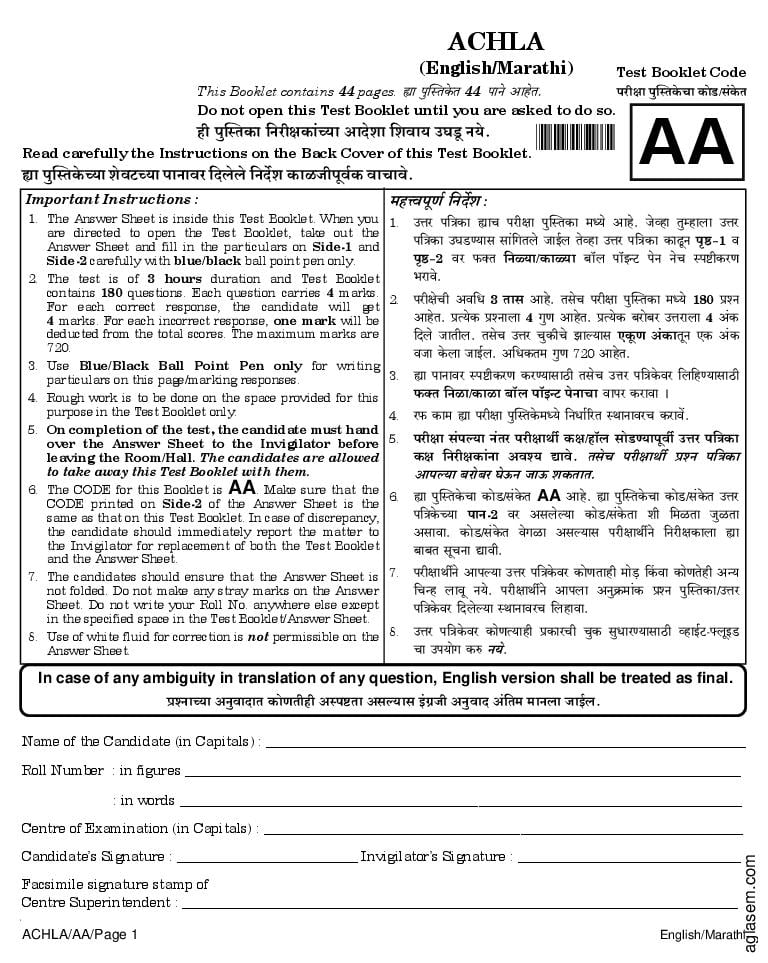
(English/Marathi) Test Booklet Code
This Booklet contains 44 pages. øm nwpñVHo$V 44 nmZo> AmhoV. narjm nwpñVHo$Mm H$moS>/g§Ho$V
AA
Do not open this Test Booklet until you are asked to do so.
hr nwpñVH$m {ZarjH$m§À`m AmXoem {edm` CKSy> Z`o.
Read carefully the Instructions on the Back Cover of this Test Booklet.
*0AAM*
øm nwpñVHo$À`m eodQ>À`m nmZmda {Xbobo {ZX}e H$miOrnyd©H$ dmMmdo.
Important Instructions : _hÎdnyU© {ZX}e :
1. The Answer Sheet is inside this Test Booklet. When you 1. CÎma n{ÌH$m ømM narjm nwpñVH$m _Ü`o Amho. Ooìhm Vwåhmbm CÎma
are directed to open the Test Booklet, take out the
Answer Sheet and fill in the particulars on Side-1 and n{ÌH$m CKS>Ê`mg gm§{JVbo OmB©b Voìhm CÎma n{ÌH$m H$mTy>Z n¥ð>-1 d
Side-2 carefully with blue/black ball point pen only. n¥ð>-2 da \$ŠV {Zù`m/H$mù`m ~m°b nm°BÝQ> noZ ZoM ñnï>rH$aU
2. The test is of 3 hours duration and Test Booklet ^amdo.
contains 180 questions. Each question carries 4 marks.
For each correct response, the candidate will get
2. narjoMr Ad{Y 3 Vmg Amho. VgoM narjm nwpñVH$m _Ü`o 180 àíZ
4 marks. For each incorrect response, one mark will be AmhoV. àË`oH$ àíZmbm 4 JwU AmhoV. àË`oH$ ~amo~a CÎmambm 4 A§H$
deducted from the total scores. The maximum marks are {Xbo OmVrb. VgoM CÎma MwH$rMo Pmë`mg EHy$U A§H$mVyZ EH$ A§H$
720. dOm Ho$bm OmB©b. A{YH$V_ JwU 720 AmhoV.
3. Use Blue/Black Ball Point Pen only for writing
particulars on this page/marking responses. 3. øm nmZmda ñnï>rH$aU H$aÊ`mgmR>r VgoM CÎma n{ÌHo$da {b{hÊ`mgmR>r
4. Rough work is to be done on the space provided for this \$ŠV {Zim/H$mim ~m°b nm°BÝQ> noZmMm dmna H$amdm &
purpose in the Test Booklet only. 4. a\$ H$m_ øm narjm nwpñVHo$_Ü`o {ZYm©[aV ñWmZmdaM H$amd|.
5. On completion of the test, the candidate must hand
over the Answer Sheet to the Invigilator before 5. narjm g§në`m Z§Va narjmWu H$j/hm°b gmoS>Ê`mnydu CÎma n{ÌH$m
leaving the Room/Hall. The candidates are allowed H$j {ZarjH$m§Zm Adí` Úmdo. VgoM narjmWu àíZ n{ÌH$m
to take away this Test Booklet with them. Amnë`m ~amo~a KoD$Z OmD$ eH$VmV.
6. The CODE for this Booklet is AA. Make sure that the
CODE printed on Side-2 of the Answer Sheet is the
6. øm nwpñVHo$Mm H$moS>/g§Ho$V AA Amho. øm nwpñVHo$Mm H$moS>/g§Ho$V CÎma
same as that on this Test Booklet. In case of discrepancy, n{ÌHo$À`m nmZ-2 da Agboë`m H$moS>/g§Ho$Vm er {_iVm OwiVm
the candidate should immediately report the matter to Agmdm. H$moS>/g§Ho$V doJim Agë`mg narjmWuZo {ZarjH$mbm øm
the Invigilator for replacement of both the Test Booklet ~m~V gyMZm Úmdr.
and the Answer Sheet.
7. The candidates should ensure that the Answer Sheet is 7. narjmWuZo Amnë`m CÎma n{ÌHo$da H$moUVmhr _mo‹S> qH$dm H$moUVohr AÝ`
not folded. Do not make any stray marks on the Answer {MÝh bmdy Z`o. narjmWuZo Amnbm AZwH«$_m§H$ àíZ nwpñVH$m/CÎma
Sheet. Do not write your Roll No. anywhere else except n{ÌHo$da {Xboë`m ñWmZmdaM {bhmdm.
in the specified space in the Test Booklet/Answer Sheet.
8. Use of white fluid for correction is not permissible on the 8. CÎma n{ÌHo$da H$moUË`mhr àH$maMr MwH$ gwYmaÊ`mgmR>r ìhmB©Q>-âbyBS>
Answer Sheet. Mm Cn`moJ H$é Z`o.
In case of any ambiguity in translation of any question, English version shall be treated as final.
àíZmÀ`m AZwdmXmV H$moUVrhr Añnï>Vm Agë`mg B§J«Or AZwdmX A§{V_ _mZbm OmB©b.
Name of the Candidate (in Capitals) : _____________________________________________________________________
Roll Number : in figures ________________________________________________________________________________
: in words _________________________________________________________________________________
Centre of Examination (in Capitals) : _____________________________________________________________________
Candidate’s Signature : __________________________ Invigilator’s Signature : ________________________________
Facsimile signature stamp of
Centre Superintendent : ________________________________________________________________________________
ACHLA/AA/Page 1 SPACE FOR ROUGH WORK English/Marathi
Page 2
its temperature (T), as shown in the graph. The Ë`mMo Vmn_mZ (T) ~XbVo. Ooìhm Vmo A øm pñWVrVyZ B øm
ratio of work done by the gas, to the heat
pñWVrV OmVmo Voìhm dm`wZo Ho$bobo H$m`© d Ë`mZo emofbobr
absorbed by it, when it undergoes a change from
state A to state B, is CîUVm `m§Mo JwUmoÎma ________ Amho.
1
1 (1)
(1) 3
3
2
2 (2)
(2) 3
3 2
2 (3)
(3) 5
5 2
(4)
2 7
(4)
7
2. The fundamental frequency in an open organ 2. Iwë`m ZirVrb _yb^yV dma§dmaVm ~§X ZirÀ`m {Vgè`m g§ZmXr
pipe is equal to the third harmonic of a closed ~amo~a Amho. Oa ~§X ZirMr bm§~r 20 cm Amho, Va Iwë`m
organ pipe. If the length of the closed organ pipe ZirMr bm§~r ________ Amho.
is 20 cm, the length of the open organ pipe is
(1) 12·5 cm
(1) 12·5 cm
(2) 8 cm
(2) 8 cm
(3) 13·2 cm
(3) 13·2 cm
(4) 16 cm (4) 16 cm
3. At what temperature will the rms speed of
3. H$moUË`m Vmn_mZmbm Am°ŠgrOZ aoUy§Mm dJ©_mÜ` dJ©_yi (rms)
oxygen molecules become just sufficient for
escaping from the Earth’s atmosphere ? doJ hm n¥ÏdrnmgyZ ~mhoa nS>Ê`mgmR>r C{MV nwaogm Amho ?
(Given : (Am°ŠgrOZ aoUyMo dñVw_mZ (m) = 2·76 10–26 kg,
–26 ~moëQ²>O_ZMm pñWam§H$ kB = 1·38 10–23 J K–1)
Mass of oxygen molecule (m) = 2·76 10 kg
–23 –1 4
Boltzmann’s constant kB = 1·38 10 JK ) (1) 5·016 10 K
4 4
(1) 5·016 10 K (2) 8·360 10 K
4 4
(2) 8·360 10 K (3) 2·508 10 K
4 4
(3) 2·508 10 K (4) 1·254 10 K
4
(4) 1·254 10 K
4. The efficiency of an ideal heat engine working 4. EH$ AmXe© Cî_m A{^`§Ì nmÊ`mÀ`m JmoR>U q~Xÿ d CËH$bZ q~Xÿ
between the freezing point and boiling point of `m_Ü`o H$m`© H$arV Amho, Va Ë`mÀ`r H$m`©j_Vm ________
water, is Amho.
(1) 6·25% (1) 6·25%
(2) 20% (2) 20%
(3) 26·8% (3) 26·8%
(4) 12·5% (4) 12·5%
ACHLA/AA/Page 2 SPACE FOR ROUGH WORK English/Marathi
Page 3
with rings of different colours for its AmoiIÊ`mgmR>r doJdoJù`m a§JmÀ`m H$S>çmIyU H$amd`mÀ`m
identification. The colour code sequence will be AmhoV. a§JmMo g§Ho$VmMm H«$_ ________ Agob.
(1) Yellow – Green – Violet – Gold (1) {ndim – {hadm – Om§^im – gmoZoar $
(2) Yellow – Violet – Orange – Silver (2) ${ndim – Om§^im – ZmatJr – M§Xoar
(3) Violet – Yellow – Orange – Silver (3) Om§^im –${ndim – ZmatJr – M§Xoar
(4) Green – Orange – Violet – Gold (4) {hadm – ZmatJr – Om§^im – gmoZoar
6. A set of ‘n’ equal resistors, of value ‘R’ each, are
6. EH$m ~°Q>arMm A§VJ©V amoY ‘R’ AgyZ {dÚwV Jm_H$ ~b ‘E’ Amho
connected in series to a battery of emf ‘E’ and
internal resistance ‘R’. The current drawn is I. d Ë`mg àË`oH$s ‘R’ qH$_VrMm ‘n’ amoY Agbobm g§M EH$garV
Now, the ‘n’ resistors are connected in parallel to OmoS>bobm Amho. Ë`mVyZ dmhUmar Ymam I Amho. AmVm Ë`mM
the same battery. Then the current drawn from ~°Q>arg ‘n’ amoY g_m§Va nÕVrZo OmoS>bo. Va AmVm Ë`mVyZ
battery becomes 10 I. The value of ‘n’ is ~°Q>arMm dmhUmar Ymam 10 I Amho. ‘n’ Mr qH$_V ________
(1) 20 Amho.
(2) 11 (1) 20
(3) 10 (2) 11
(4) 9 (3) 10
(4) 9
7. A battery consists of a variable number ‘n’ of
7. EH$m ~°Q>ar_Ü`o ‘n’ EdT>o ~XbUmao EH$gmaIo KQ> (àË`oH$mMm
identical cells (having internal resistance ‘r’
each) which are connected in series. The
A§VJ©V amoY ‘r’ Amho). EH$garV OmoS>bobr AmhoV. ~°Q>arMr Q>moHo$
terminals of the battery are short-circuited and EH$Ì OmoS>br d Ymam I _moObr. I d n _Yrb `mo½` g§~§Y
the current I is measured. Which of the graphs XmI{dUmam AmboI H$moUVm Amho ?
shows the correct relationship between I and n ?
ACHLA/AA/Page 3 SPACE FOR ROUGH WORK English/Marathi
Page 4
surface of a material of refractive index ‘’. At a AY«w{dV àH$me AmnmVr Amho. EH$m R>am{dH$ ‘i’ øm AmnmVr
particular angle of incidence ‘i’, it is found that H$moZmg Ago {Xgbo H$s namd{V©V d And{V©V {H$aU EH$_oH$mg
the reflected and refracted rays are b§~ê$n AmhoV. øm n[apñWVrV Imbrbn¡H$s H$moUVm n`m©`
perpendicular to each other. Which of the ~amo~a Amho ?
following options is correct for this situation ? 1
(1) i = sin–1
–1 1
(1) i = sin
(2) namd{V©V àH$me Y«wdrV Amho d Ë`mMm {dÚwV g{Xe
(2) Reflected light is polarised with its electric AmnmVr nmVirg b§~ê$n Amho
vector perpendicular to the plane of (3) namd{V©V àH$me Y«wdrV Amho d Ë`mMm {dÚwV g{Xe
incidence
AmnmVr nmVirg g_m§Va Amho
(3) Reflected light is polarised with its electric
1
vector parallel to the plane of incidence (4) i = tan–1
–1 1
(4) i = tan
9. `§JÀ`m XmoZ \$Q>tÀ`m à`moJmV, XmoZ \$Q>t_Yrb d ho A§Va
2 mm Amho, dmnaboë`m àH$memÀ`r Va§Jbm§~r ,
9. In Young’s double slit experiment the separation
5896 A Amho nS>Xm d \$Q>t_Yrb A§Va D, 100 cm Amho.
d between the slits is 2 mm, the wavelength of
Ago {Xgbo {H$ P„atÀ`r H$mo{Z` é§Xr 0·20 Amho. P„atÀ`r
the light used is 5896 Å and distance D between
H$mo{Z` é§Xr 0·21 n`ªV dmT>{dÊ`mgmR>r ( d D) gmaIoM
the screen and slits is 100 cm. It is found that the
AgVmZm) \$Q>t_Yrb A§Va ________ Zo ~Xb H$aUo Amdí`H$
angular width of the fringes is 0·20. To increase
Amho.
the fringe angular width to 0·21 (with same
and D) the separation between the slits needs to (1) 2·1 mm
be changed to
(2) 1·9 mm
(1) 2·1 mm
(3) 1·8 mm
(2) 1·9 mm
(4) 1·7 mm
(3) 1·8 mm
(4) 1·7 mm
10. IJmobr` AndV©Zr XÿaXeubm OmñV H$mo{Z` {dembZ d OmñV
H$mo{Z` {d`moOZ Agob, Ooìhm Ë`mMo dñVwq^JmgmR>r ________
10. An astronomical refracting telescope will have
Agob.
large angular magnification and high angular
resolution, when it has an objective lens of (1) OmñV Zm^r` bm§~r d OmñV ì`mg $
(1) large focal length and large diameter (2) OmñV Zm^r` bm§~r d H$_r ì`mg
(2) large focal length and small diameter (3) H$_r Zm^r` bm§~r d OmñV ì`mg
(3) small focal length and large diameter
(4) H$_r Zm^r` bm§~r d H$_r ì`mg
(4) small focal length and small diameter
ACHLA/AA/Page 4 SPACE FOR ROUGH WORK English/Marathi
Page 5
an electron in a Bohr orbit of the hydrogen atom, EHy$U CO}~amo~a JwUmoÎma __________ Amho.
is
(1) 2:–1
(1) 2:–1
(2) 1:–1
(2) 1:–1
(3) 1:1
(3) 1:1
(4) 1:–2
(4) 1:–2
12. m dñVw_mZmMm BboŠQ´>m°Z gwê$dmVrÀ`m V = V0 ^i ( V0 > 0)
12. An electron of mass m with an initial velocity
^
^ doJmZo E = E0 i (E0 = pñWa > 0) øm {dÚwV joÌmV
V = V0 i (V0 > 0) enters an electric field
^ t = 0 AgVmZm àdoe H$aVmo. Oa gwê$dmVrbm 0 {h Xo-~«mo½br
E = – E0 i (E0 = constant > 0) at t = 0. If 0 is
Va§Jbm§~r Amho, Va H$mb t AgVmZm Ë`mÀ`r Xo-~«mo½br
its de-Broglie wavelength initially, then its
Va§Jbm§~r __________ Amho.
de-Broglie wavelength at time t is
(1) 0 t
(1) 0 t
eE0
(2) 0 1 t
0 1
eE0 mV0
(2) t
mV0
0
(3)
0 eE0
(3) 1 t
eE0 mV0
1 t
mV0
(4) 0
(4) 0
13. For a radioactive material, half-life is
13. EH$m {H$aUmoËgmar nXmWm©gmR>r, AYm©`wH$mb 10 {_{ZQ>o Amho. Oa
10 minutes. If initially there are 600 number of
gwê$dmVrg VoWo 600 H|$ÐHo$ AmhoV, Va 450 H|$ÐH$m§Mo {dKQ>Z
nuclei, the time taken (in minutes) for the
disintegration of 450 nuclei is hmoÊ`mgmR>r ({_{ZQ>m§_Ü`o) bmJbobm H$mb __________ Amho.
(1) 30 (1) 30
(2) 10 (2) 10
(3) 20 (3) 20
(4) 15 (4) 15
14. When the light of frequency 2v0 (where v0 is
14. Ooìhm 2v0 (v0 {h AY:gr_m dma§dmaVm Amho) dma§dmaVoMm
threshold frequency), is incident on a metal
plate, the maximum velocity of electrons emitted àH$me YmVwÀ`m n{Å>Ho$da AmnmVr hmoVmo Voìhm ~mhoa nS>boë`m
is v1. When the frequency of the incident BboŠQ´>m°ZMm OmñVrVOmñV doJ v1 Amho. Ooìhm AmnmVr
radiation is increased to 5v0, the maximum àmaUm§À`r dma§dmaVm 5v0 n`ªV dmT>{dbr, Voìhm Ë`mM
velocity of electrons emitted from the same plate n{Å>Ho$dê$Z ~mhoa nS>boë`m BboŠQ´>m°ZMm OmñVrVOmñV doJ v2
is v2. The ratio of v1 to v2 is Amho. v1 d v2 Mo JwUmoÎma __________ Amho.
(1) 4:1
(1) 4:1
(2) 1:4
(2) 1:4
(3) 1:2
(3) 1:2
(4) 2:1
(4) 2:1
ACHLA/AA/Page 5 SPACE FOR ROUGH WORK English/Marathi
Page 6
voltage Vi is 20 V, VBE = 0 and VCE = 0. The 20 V, VBE = 0 d VCE = 0 Amho. IB, IC d `m§Mr qH$_V
values of IB, IC and are given by ____________ Aer {Xbr OmVo.
(1) IB = 20 A, IC = 5 mA, = 250
(1) IB = 20 A, IC = 5 mA, = 250
(2) IB = 25 A, IC = 5 mA, = 200
(2) IB = 25 A, IC = 5 mA, = 200
(3) IB = 40 A, IC = 10 mA, = 250
(3) IB = 40 A, IC = 10 mA, = 250
(4) IB = 40 A, IC = 5 mA, = 125
(4) IB = 40 A, IC = 5 mA, = 125
16. In a p-n junction diode, change in temperature
16. EH$m p-n g§{YñWmZ S>m`moS>_Ü`o, Vmn{dë`m_wio Vmn_mZmVrb
due to heating
~Xb
(1) does not affect resistance of p-n junction
(1) p-n g§{YñWmZmÀ`m amoYmda n[aUm_ H$aV Zmhr
(2) affects only forward resistance
(2) \$ŠV nwamoJm_r amoYmda n[aUm_ H$aVmo
(3) affects only reverse resistance
(3) \$ŠV à{VH«$_ amoYmda n[aUm_ H$aVmo
(4) affects the overall V – I characteristics of
p-n junction (4) p-n g§{YñWmZmÀ`m g§nyU© V – I bjUmda n[aUm_
H$aVmo
17. In the combination of the following gates the
output Y can be written in terms of inputs A and 17. Imbrb Ûmam§À`m g§`moJm_Ü`o, {Z{dpîQ> A d B À`m g§X^m©V
B as {ZînÞ Y __________ àH$mao {b{hVm `oB©b.
(1) A.B +A.B
(1) A.B +A.B
– – – –
(2) A. B + A .B (2) A. B + A .B
(3) A.B (3) A.B
(4) AB (4) AB
ACHLA/AA/Page 6 SPACE FOR ROUGH WORK English/Marathi
Page 7
18. An em wave is propagating in a medium with a 18. {dÚwV Mw§~H$s` Va§J _mÜ`_mVyZ V = V ^i doJmZo OmV Amho.
^
velocity V = V i . The instantaneous oscillating VËjUrH$ {dÚwV Mw§~H$s` Va§JmMo Xmobm`_mZ {dÚwV joÌ
electric field of this em wave is along +y axis. + y AjmÀ`m {XeoZo Amho.
Then the direction of oscillating magnetic field of Va {dÚwV Mw§~H$s` Va§JmMr Xmobm`_mZ Mw§~H$s` {Xem
the em wave will be along ________ Agob.
(1) – y direction (1) – y ${Xeo_Ü`o
(2) + z direction (2) + z {Xeo_Ü`o
(3) – z direction (3) – z {Xeo_Ü`o
(4) – x direction (4) – x {Xeo_Ü`o
19. The refractive index of the material of a prism is 19. bmobH$mÀ`m nXmWm©Mm AndV©Zm§H$ 2 d bmobH$mMm H$moZ 30
2 and the angle of the prism is 30. One of the
Amho. bmobH$mMm XmoÝhr n¡H$s EH$ AndV©Zr n¥îR>^mJmVrb ~mOwZo
two refracting surfaces of the prism is made a
{gëh>a bonZ H$ê$Z Amagm V`ma Ho$bm Amho. bmobH$mÀ`m
mirror inwards, by silver coating. A beam of
Xÿgè`m n¥îR>^mJmdê$Z AmV `oUmam EH$dUu àH$me {H$aUnw§O
monochromatic light entering the prism from the
other face will retrace its path (after reflection Ë`mMm _mJ© àË`mJ_Z H$aVmo ({gëh>a n¥îR>^mJmnmgyZ namdV©Z
from the silvered surface) if its angle of incidence Pmë`mZ§Va) Oa bmobH$mdarb AmnmVr H$moZ ________ Amho.
on the prism is (1) 30
(1) 30 (2) 45
(2) 45 (3) 60
(3) 60 (4) eyÝ`
(4) zero
20. 15 cm Zm^r` bm§~r Agboë`m A§Vd©H«$ AmaemnmgyZ 40 cm
20. An object is placed at a distance of 40 cm from a A§Vamda EH$ dñVw R>odbobr Amho. Oa Vr dñVw AmaemH$S>o
concave mirror of focal length 15 cm. If the object 20 cm A§VamZo hb{dbr, Va à{V_oMo {dñWmnZ ________
is displaced through a distance of 20 cm towards
Agob.
the mirror, the displacement of the image will be
(1) AmaemH$S>o 30 cm A§Vamda
(1) 30 cm towards the mirror
(2) AmaemnmgyZ 36 cm A§Vamda
(2) 36 cm away from the mirror
(3) AmaemnmgyZ 30 cm A§Vamda
(3) 30 cm away from the mirror
(4) AmaemH$S>o 36 cm A§Vamda
(4) 36 cm towards the mirror
21. Ooìhm ào[aÌmVrb Ymam 60 mA AgVo Voìhm EH$m R>am{dH$
21. The magnetic potential energy stored in a certain
inductor is 25 mJ, when the current in the
ào[aÌmVrb gmR>{dbobr Mw§~H$s` {d^d eŠVr 25 mJ Amho. øm
inductor is 60 mA. This inductor is of inductance
ào[aÌmÀ`r ào[aVVm ________ Amho.
(1) 1·389 H (1) 1·389 H
(2) 138·88 H (2) 138·88 H
(3) 0·138 H (3) 0·138 H
(4) 13·89 H (4) 13·89 H
ACHLA/AA/Page 7 SPACE FOR ROUGH WORK English/Marathi
Page 8
distance h in a uniform and vertically upward BboŠQ´>m°Z pñWa pñWVrnmgyZ h EdT>`m Cä`m A§VamVyZ nS>Vmo.
directed electric field E. The direction of electric AmVm {dÚwV joÌmÀ`r {Xem {déÕ Ho$br, Ë`mÀ`r qH$_V g_mZ
field is now reversed, keeping its magnitude the
R>oCZ. EH$ àmoQ>m°Z pñWa pñWVrnmgyZ gma»`mM h EdT>`m Cä`m
same. A proton is allowed to fall from rest in it
through the same vertical distance h. The time of
A§Vamdê$Z nS>bm. BboŠQ´>m°Z nS>Ê`mMm H$mi hm àmoQ>m°ZÀ`m
fall of the electron, in comparison to the time of nS>Ê`mÀ`m H$mimímr VwbZm Ho$br AgVm Vmo ________ Amho.
fall of the proton is (1) 10 nQ> OmñV $
(1) 10 times greater
(2) 5 nQ> OmñV
(2) 5 times greater
(3) bhmZ$
(3) smaller
(4) equal (4) gmaImM
23. The electrostatic force between the metal plates 23. C øm {d{dŠV g_m§Va nÅ>rÀ`m g§Ym[aÌmÀ`m YmVwÀ`m
of an isolated parallel plate capacitor C having a nÅ>`m§_Yrb {dÚwV-pñWVrH$ ~b, Q à^ma d A joÌ\$i
charge Q and area A, is
AgVmZm ________ Amho.
(1) proportional to the square root of the
distance between the plates. (1) $nÅ>`m§_Yrb A§VamÀ`m dJ©_wimg g_mZwnmVr
(2) linearly proportional to the distance
(2) nÅ>`m§_Yrb A§Vamg aofr` g_mZwnmVr
between the plates.
(3) independent of the distance between the (3) nÅ>`m§_Yrb A§Vamda Adb§~yZ Z amhUmao•
plates.
(4) nÅ>`m§_Yrb A§VamÀ`m ì`ñV à_mUmZwgma
(4) inversely proportional to the distance
between the plates.
24. EH$m H$mMoÀ`m ZirV g§ñn§Xr V`ma H$aÊ`mgmR>r EH$ ZmXH$mQ>m
24. A tuning fork is used to produce resonance in a dmnabm. øm ZirVrb hdoÀ`m ñV§^mMr C§Mr ~XbË`m XQ²>`mZo
glass tube. The length of the air column in this
AZw`mo{OV Amho. 27C øm ImobrÀ`m Vmn_mZmbm ñV§^mÀ`r
tube can be adjusted by a variable piston. At
room temperature of 27C two successive C§Mr 20 cm d 73 cm AgVmZm XmoZ nmR>monmR>Mo g§ñn§Xr V`ma
resonances are produced at 20 cm and 73 cm of Pmbo. ZmXH$mQ>çmÀ`r dma§dmaVm 320 Hz Amho, Va dm`wMr
column length. If the frequency of the tuning fork
Üd{ZMm doJ 27C bm ________ Amho.
is 320 Hz, the velocity of sound in air at 27C is
(1) 350 m/s (1) 350 m/s
(2) 339 m/s (2) 339 m/s
(3) 330 m/s
(3) 330 m/s
(4) 300 m/s
(4) 300 m/s
25. A pendulum is hung from the roof of a
sufficiently high building and is moving freely to 25. EH$m nwaoem C§M B_maVrÀ`m YVmnmgyZ EH$ XmobH$ Q>m§Jbobm Amho
and fro like a simple harmonic oscillator. The d Vmo nwT>o _mJo gab AmdV© XmobH$mà_mUo _wŠVnUo OmV Amho.
acceleration of the bob of the pendulum is
2 XmobH$mÀ`m Jmoù`mMo ËdaU 20 m/s2 ho _Ü`pñWVrnmgyZ 5 m
20 m/s at a distance of 5 m from the mean
position. The time period of oscillation is A§Vamda Amho. XmobZmMm H$mbI§S> H$mb ________ Amho.
(1) 2s (1) 2s
(2) s (2) s
(3) 2 s (3) 2 s
(4) 1s (4) 1s
ACHLA/AA/Page 8 SPACE FOR ROUGH WORK English/Marathi
Page 9
–1
0·5 kg m is lying horizontally on a smooth AgyZ Vmo JwiJwirV AmVZ àVbmda AmS>dm nS>bobm Amho d
inclined plane which makes an angle of 30 with àVb g_Vbmer 30 H$moZ H$aVo. Ooìhm Xm§S>çmVyZ Ymam OmVo
the horizontal. The rod is not allowed to slide
Voìhm Vmo Imbr KmgV`oC> eH$V Zmhr Ooìhm Mw§~H$s` joÌmMo
down by flowing a current through it when a
àdV©Z 0·25 T Cä`m {XeoV H$m`© H$aVo. Xm§S>m pñWa R>odÊ`mgmR>r
magnetic field of induction 0·25 T is acting on it
in the vertical direction. The current flowing in Ë`mVyZ OmUmar Ymam ________ Amho.
the rod to keep it stationary is (1) 14·76 A
(1) 14·76 A (2) 5·98 A
(2) 5·98 A (3) 7·14 A
(3) 7·14 A
(4) 11·32 A
(4) 11·32 A
27. EH$ ~marH$ à{VMw§~H$s` Xm§S>m {dÚwV Mw§~H$s` Y«wdm§À`m _Ü`o
27. A thin diamagnetic rod is placed vertically
C^m R>odbobm Amho. Ooìhm {dÚwV Mw§~H$mVrb Ymam ~§X Ho$br
between the poles of an electromagnet. When the
current in the electromagnet is switched on, then Voìhm à{VMw§~H$s` Xm§S>m g_Vb Mw§~H$s` joÌmV darb {XeoV
the diamagnetic rod is pushed up, out of the gaH$bm. Xm§S>m JwépËd` pñWVrO COm© {_i{dVmo. Ë`mgmR>r
horizontal magnetic field. Hence the rod gains bmJbobo H$m`© ________ nmgyZ {_iVo.
gravitational potential energy. The work (1) am°S> Mo b°{Q>g ñQ´>ŠMa (T>mMm)
required to do this comes from
(2) Mw§~H$s` joÌm$
(1) the lattice structure of the material of the
rod (3) YmaoÀ`m CX²J_mnmgyZ
(2) the magnetic field (4) ~XbË`m Mw§~H$s` joÌm_wio ào[aV Pmboë`m {dÚwV
(3) the current source joÌmnmgyZ
(4) the induced electric field due to the
changing magnetic field 28. CX²J_mMo {dÚwV Jm_H$ ~b V = 10 sin 314 t AgyZ Ë`m
28. An inductor 20 mH, a capacitor 100 F and a ~amo~a 20 mH Mo ào[aÌ, 100 F Mo g§Ym[aÌ d 50 Mm
resistor 50 are connected in series across a amoY EH$garV OmoS>bobo AmhoV. n[anWmVrb ZwH$gmZ Pmbobr
source of emf, V = 10 sin 314 t. The power loss in eŠVr ________ Amho.
the circuit is (1) 2·74 W
(1) 2·74 W
(2) 0·43 W
(2) 0·43 W
(3) 0·79 W
(3) 0·79 W
(4) 1·13 W
(4) 1·13 W
29. Mb Hw§$S>b J°ìhmZmo_rQ>aMr Ymam g§do{XVm 5 div/mA d
29. Current sensitivity of a moving coil galvanometer
is 5 div/mA and its voltage sensitivity (angular
ìhmoëQ>Vm g§do{XVm (EH$H$ ìhmoëQ>VogmR>r bmdbobo H$mo{Z`
deflection per unit voltage applied) is 20 div/V. {dMbZ) 20 div/V Amho. J°ìhmZmo_rQ>aMm amoY ________
The resistance of the galvanometer is Amho.
(1) 250 (1) 250
(2) 25 (2) 25
(3) 40 (3) 40
(4) 500 (4) 500
ACHLA/AA/Page 9 SPACE FOR ROUGH WORK English/Marathi
Page 10
frictionless track from a height h (as shown in Kf©U{dahrV _mJm©dê$Z KmgV `oV AgyZ (AmH¥$VrV
the figure) just completes a vertical circle of XmI{dë`mà_mUo) Vr AB = D ì`mg Agbobo C^o dVw©i$
diameter AB = D. The height h is equal to
nyU©H$aVo. C§Mr h {h ________ Amho.
7
(1) D 7
5 (1) D
5
(2) D
(2) D
3 3
(3) D (3) D
2 2
5 5
(4) D (4) D
4 4
31. Three objects, A : (a solid sphere), B : (a thin
31. VrZ dñVw, A : (^ard Jmoim), B : (~marH$ JmobmH$ma V~H$S>r)
circular disk) and C : (a circular ring), each have
the same mass M and radius R. They all spin
d C : (dVw©imH$ma H$S>r) àË`oH$mÀ`r {ÌÁ`m R AgyZ dñVw_mZ
with the same angular speed about their own M gmaIoM Amho. Vo gd© ñdV:À`m g_{_V[aË`m Ajm^modVr
symmetry axes. The amounts of work (W) gma»`mM øm H$mo{Z` doJmZo {\$aV AmhoV. Ë`m§Zm pñWa
required to bring them to rest, would satisfy the H$aÊ`mgmR>r bmJUmao H$m`© (W) ________ ho g§~§Y nyVu
relation H$aVmo.
(1) WB > WA > WC (1) WB > WA > WC
(2) WA > WB > WC (2) WA > WB > WC
(3) WC > WB > WA (3) WC > WB > WA
(4) WA > WC > WB (4) WA > WC > WB
32. A moving block having mass m, collides with
32. m dñVw_mZmMm J{V_mZ R>moH$im 4m dñVw_mZmÀ`m Xÿgè`m pñWa
another stationary block having mass 4m. The
R>moH$ù`mda AmnQ>Vmo. Q>ŠH$a Pmë`mZ§Va hbH$m R>moH$im pñWa
lighter block comes to rest after collision. When
the initial velocity of the lighter block is v, then hmoVmo. Ooìhm hbH$`m R>moH$ù`mMm gwê$dmVrMm doJ v Amho, Va
the value of coefficient of restitution (e) will be àË`dñWmZmÀ`m JwUm§H$m§Mr qH$_V (e) ________ Agob.
(1) 0·8 (1) 0·8
(2) 0·25
(2) 0·25
(3) 0·5
(4) 0·4 (3) 0·5
33. Which one of the following statements is (4) 0·4
incorrect ? 33. Imbrbn¡H$s H$moUVo {dYmZ MwH$sMo Amho ?
(1) Frictional force opposes the relative motion. (1) Kf©U ~b ho gmnoj JVrg {damoY H$aVo.
(2) Limiting value of static friction is directly
proportional to normal reaction. (2) pñW{VH$ Kf©UmMr _`m©{XV qH$_V àgm_mÝ` A{^{H«$`og
(3) Rolling friction is smaller than sliding g_mZwnmVr AgVo.
friction. (3) bmoQ>U Kf©U ho KgaU Kf©Umnojm H$_r Amho.
(4) Coefficient of sliding friction has
(4) KgaU Kf©UmMm JwUm§H$ hm bm§~rÀ`m {_Vrà_mUo Amho.
dimensions of length.
ACHLA/AA/Page 10 SPACE FOR ROUGH WORK English/Marathi
Page 11
horizontal plane surface under the influence of a
n¥îR>^mJmdê$Z EH$g_mZ {dÚwV joÌ E À`m à^mdmZo OmV
uniform electric field E . Due to the force q E ,
its velocity increases from 0 to 6 m/s in one Amho. q E øm ~bm_wio, {VMm doJ 0 nmgyZ 6 m/s n`ªV EH$m
second duration. At that instant the direction of goH§$XmV dmT>Vmo. Ë`m jUr joÌmMr {Xem {déÕ hmoVo. Ë`m
the field is reversed. The car continues to move joÌmÀ`m à^mdm_wio Vr JmS>r AOwZ XmoZ goH§$X nwT>o OmV ahmVo.
for two more seconds under the influence of this 0 Vo 3 goH§$Xm_Ü`o IoiÊ`mVrb JmS>rMm gamgar doJ d gamgar
field. The average velocity and the average speed Mmb ________ Amho.
of the toy car between 0 to 3 seconds are (1) 1 m/s, 3·5 m/s
(2) 1 m/s, 3 m/s
respectively
(3) 2 m/s, 4 m/s
(1) 1 m/s, 3·5 m/s (4) 1·5 m/s, 3 m/s
(2) 1 m/s, 3 m/s
(3) 2 m/s, 4 m/s 35. AmH¥$VrV XmI{dë`mà_mUo m dñVw_mZmMm R>moH$im AmZVr
(4) 1·5 m/s, 3 m/s Agboë`m JwiJwirV nmMa ABC øm AmZV nVbmda R>odbobm
35. A block of mass m is placed on a smooth inclined Amho. COì`m ~mOwbm nmMamg ‘a’ ËdaU {Xbobo Amho. nmMamda
wedge ABC of inclination as shown in the R>moH$im pñWa amhÊ`mgmR>r a d `m_Yrb g§~§Y ________
figure. The wedge is given an acceleration ‘a’
towards the right. The relation between a and Amho.
for the block to remain stationary on the wedge
is
(1) a = g cos
g
(2) a=
(1) a = g cos sin
g
(2) a= g
sin (3) a=
cosec
g
(3) a= (4) a = g tan
cosec
(4) a = g tan 36. ~b AmKyU© F = 4^i + 5 ^j – 6^k , (2, 0, – 3) da
^ ^ ^
36. The moment of the force, F = 4 i + 5 j – 6 k at (2, – 2, – 2) q~Xÿ^modVr Ago ________ {Xbobo Amho.
(2, 0, – 3), about the point (2, – 2, – 2), is given by ^ ^ ^
(1) – 7 i – 8 j – 4 k
^ ^ ^ ^ ^ ^
(1) – 7 i – 8 j – 4 k (2) – 4 i – j – 8 k
^ ^ ^ ^ ^ ^
(2) – 4 i – j – 8 k (3) – 8 i – 4 j – 7 k
^ ^ ^
^ ^ ^ (4) – 7 i – 4 j – 8 k
(3) – 8 i – 4 j – 7 k
37. 0·001 cm bKwÎm_ _mn Agboë`m ñH«w$ à_mnrZo EH$m
^ ^ ^ {dÚmÏ`m©Zo EH$m bhmZ pñQ>bÀ`m ~m°bMm ì`mg _moObm. _w»`
(4) – 7 i – 4 j – 8 k
37. A student measured the diameter of a small steel _mnZloUrdarb dmMZ 5 mm Amho d d¥Îmr` loUr
ball using a screw gauge of least count {d^mOZmdarb eyÝ` g§X^© nmVirÀ`m da 25 ì`m
0·001 cm. The main scale reading is 5 mm and
zero of circular scale division coincides with
{d^mOZm~amo~a g§nmVr hmoVo. Oa ñH«w$ à_mnrMr eyÝ`
25 divisions above the reference level. If screw MwH$ 0·004 cm Amho, Va ~m°bMm ~amo~a ì`mg ________
gauge has a zero error of – 0·004 cm, the correct Amho.
diameter of the ball is (1) 0·053 cm
(1) 0·053 cm
(2) 0·525 cm
(2) 0·525 cm
(3) 0·521 cm (3) 0·521 cm
(4) 0·529 cm (4) 0·529 cm
ACHLA/AA/Page 11 SPACE FOR ROUGH WORK English/Marathi
Page 12
symmetry axis in free space. The radius of the Ajm^modVr _wŠVnUo {\$aV Amho. dOZ VodT>oM R>oCZ Ë`m
sphere is increased keeping its mass same.
Jmoù`mMr {ÌÁ`m dmT>{dbr. Jmoù`mÀ`m ~m~VrV Imbrbn¡H$s
Which of the following physical quantities would
remain constant for the sphere ? H$moUVr ^m¡{VH$amer pñWa amhÿ eHo$b ?
(1) Rotational kinetic energy (1) KyU©Z J{VO COm©
(2) Moment of inertia (2) OS>Ëd AmKyU©
(3) Angular velocity
(3) H$mo{Z` doJ
(4) Angular momentum
(4) H$mo{Z` g§doJ
39. The kinetic energies of a planet in an elliptical
orbit about the Sun, at positions A, B and C are 39. EH$m J«hmMr gy`m©^modVrÀ`m {dd¥Îmr` H$joV A, B d C øm
KA, KB and KC, respectively. AC is the major pñWVrgmR>r AZwH«$_o KA, KB d KC EdT>r J{VO COm© Amho.
axis and SB is perpendicular to AC at the
position of the Sun S as shown in the figure.
AmH¥$VrV XmI{dë`mà_mUo AC hm XrK© H$j Amho d SB ho
Then AC bm b§~ê$n AgyZ gy`m©À`m S pñWVr n`ªV Amho. Va
(1) KB < KA < K C (1) KB < KA < K C
(2) KA > KB > K C (2) KA > KB > K C
(3) KA < KB < K C (3) KA < KB < K C
(4) KB > KA > K C (4) KB > KA > K C
40. If the mass of the Sun were ten times smaller 40. Oa gy`m©Mo dOZ qH$_VrZo XhmnQ> H$_r Agob d d¡ídrH$
and the universal gravitational constant were
JwépËd` pñWam§H$ XhmnQ> OmñV Agob, Va Imbrbn¡H$s H$moUVo
ten times larger in magnitude, which of the
following is not correct ?
~amo~a Zmhr ?
(1) Time period of a simple pendulum on the (1) n¥Ïdrda gmÜ`m XmobH$mMm H$mbI§S> H$mb H$_r hmoB©b.
Earth would decrease. (2) O_rZrda MmbUo Iwn AdKS> hmoB©b.
(2) Walking on the ground would become more
difficult. (3) nmdgmMo W|~ OmoamV nS>Vrb.
(3) Raindrops will fall faster. (4) n¥ÏdrÀ`m ‘g’ _Ü`o ~Xb hmoUma Zmhr.
(4) ‘g’ on the Earth will not change.
41. EH$ ^ard Jmoim bmoQ>U JVrV Amho, bmoQ>U JVr_Ü`o dñVwg
41. A solid sphere is in rolling motion. In rolling
EH$mMdoir ñWmZm§VaU J{VO COm© (Kt) d KyU©Z J{VO COm©
motion a body possesses translational kinetic
energy (Kt) as well as rotational kinetic energy (Kr) Amho. Jmoù`mgmR>r Kt : (Kt + Kr) ho JwUmoÎma ________
(Kr) simultaneously. The ratio Kt : (Kt + Kr) for Amho.
the sphere is (1) 10 : 7
(1) 10 : 7
(2) 5:7
(2) 5:7
(3) 7 : 10 (3) 7 : 10
(4) 2:5 (4) 2:5
ACHLA/AA/Page 12 SPACE FOR ROUGH WORK English/Marathi
Page 13
viscous liquid. As a result, heat is produced due ÐdmVyZ Imbr nS>Vmo. Ë`mMm n[aUm_ {dî`§Xr ~bm_wio Cî_m
to viscous force. The rate of production of heat V`ma hmoVmo. Ooìhm Jmoù`mg A§{V_ doJ àmßV hmoVmo Voìhm Cî_m
when the sphere attains its terminal velocity, is
V`ma hmoÊ`mMm Xa ________ bm g_mZwnmVr AgVmo.
proportional to
5
(1) r
5 (1) r
2 2
(2) r (2) r
3 3
(3) r (3) r
4 4
(4) r (4) r
43. The power radiated by a black body is P and it
43. H$mù`m dñVwZo CËgOuV Ho$bobr eŠVr P Amho d Vr 0
radiates maximum energy at wavelength, 0. If
Va§Jbm§~rg OmñVrVOmñV COm© ~mhoa Q>mH$Vo. Oa AmVm Ë`m
the temperature of the black body is now
3
H$mù`m dñVwMo Vmn_mZ ~Xbbo Ago {H$Vr AmVm
changed so that it radiates maximum energy at 4 0
3
wavelength , the power radiated by it Va§Jbm§~rg OmñVrVOmñV COm© ~mhoa Q>mH$Vo, Va CËgOuV eŠVr
4 0
becomes nP. The value of n is nP hmoVo. n À`r qH$_V ________ Amho.
256 256
(1) (1)
81 81
4 4
(2) (2)
3 3
3
3 (3)
(3) 4
4
81
81 (4)
(4) 256
256
44. Two wires are made of the same material and 44. XmoZ Vmam gma»`mM YmVwÀ`m V`ma Ho$ë`m AgyZ Ë`m§Mo
have the same volume. The first wire has AmH$ma_mZ gmaIoM Amho. n{hë`m VmaoMo H$mQ>N>oX joÌ\$i A
cross-sectional area A and the second wire has Amho d Xÿgè`m VmaoMo H$mQ>N>oX joÌ\$i 3A Amho. Oa F EdT>r
cross-sectional area 3A. If the length of the first
~b {H«$`m Ho$br Va n{hë`m VmaoÀ`r bm§~r l Zo dmT>Vo, Xÿgè`m
wire is increased by l on applying a force F,
how much force is needed to stretch the second
VmaoÀ`r bm§~r VodT>rM dmT>Ê`mgmR>r {H$Vr ~b bmJob ?
wire by the same amount ? (1) 4F
(1) 4 F (2) 6F
(2) 6 F (3) 9F
(3) 9 F (4) F
(4) F
45. 100C bm Agboë`m 0·1 g dOZmÀ`m nmÊ`mÀ`m Z_wÝ`mMm
45. A sample of 0·1 g of water at 100C and normal
5 –2
pressure (1·013 10 Nm ) requires 54 cal of
gm_mÝ` Xm~ (1·013 105 Nm–2) AgyZ Ë`mg 100C À`m
heat energy to convert to steam at 100C. If the dm\o$_Ü`o ê$nm§Va H$aÊ`mgmR>r 54 cal EdT>r Cî_m eŠVr bmJVo.
volume of the steam produced is 167·1 cc, the Oa V`ma Pmboë`m dm\o$Mo AmH$ma_mZ 167·1 cc Amho, Va
change in internal energy of the sample, is Z_wÝ`mÀ`m Am§VarH$ eŠVrVrb ~Xb ________ Amho.
(1) 42·2 J (1) 42·2 J
(2) 208·7 J (2) 208·7 J
(3) 104·3 J (3) 104·3 J
(4) 84·5 J (4) 84·5 J
ACHLA/AA/Page 13 SPACE FOR ROUGH WORK English/Marathi
Page 14
decreasing order of oxidation states is Amho
(1) HNO3, NH4Cl, NO, N2 (1) HNO3, NH4Cl, NO, N2
(2) HNO3, NO, NH4Cl, N2 (2) HNO3, NO, NH4Cl, N2
(3) HNO3, NO, N2, NH4Cl (3) HNO3, NO, N2, NH4Cl
(4) NH4Cl, N2, NO, HNO3 (4) NH4Cl, N2, NO, HNO3
47. Which one of the following elements is unable to 47. Imbrb H$moUVo _yë`Ðì` MF63 – Am`Z V`ma H$ê$ eH$V
3–
form MF6 ion ? Zmhr ?
(1) B (1) B
(2) Al (2) Al
(3) Ga (3) Ga
(4) In
(4) In
48. Considering Ellingham diagram, which of the
48. EqbJh°_ AmH¥${VMm g§X^© KoD$Z Imbrb H$moUË`m YmVyMo
following metals can be used to reduce alumina ?
(1) Mg A°ë`y{_Zm dmnê$Z jnU hmoD$ eHo$b ?
(2) Zn (1) Mg
(3) Fe (2) Zn
(4) Cu (3) Fe
49. The correct order of atomic radii in group 13 (4) Cu
elements is
49. 13-JQ>mVrb _ybÐì`m§Mm ~amo~a Agbobm AmpÊdH$ {ÌÁ`oMm
(1) B < Ga < Al < Tl < In
H«$_ Amho
(2) B < Al < Ga < In < Tl
(1) B < Ga < Al < Tl < In
(3) B < Al < In < Ga < Tl (2) B < Al < Ga < In < Tl
(4) B < Ga < Al < In < Tl (3) B < Al < In < Ga < Tl
50. Which of the following statements is not true for (4) B < Ga < Al < In < Tl
halogens ?
(1) All but fluorine show positive oxidation
50. h°bmoOÝg g§X^m©V Imbrb H$moUVo {dYmZ Iao Zmhr ?
states. (1) âbyAmo[aZ {edm` gd© YZ Am°pŠgS>Z pñWVr XmIdVmV.
(2) All are oxidizing agents. (2) gd© Am°pŠgS>rH$maHo$ AmhoV.
(3) All form monobasic oxyacids. (3) gd© EH$-Amåbm[a Am°pŠgA°{gS> V`ma H$aVmV.
(4) Chlorine has the highest electron-gain
enthalpy. (4) Šbmo[aZMr BboŠQ´>m°Z àmßVr EÝW°pën gdm©V OmñV Amho.
51. In the structure of ClF3, the number of lone pairs 51. ClF3 À`m g§aMZoVrb _Ü` AUyV (Cl) {d{dŠV BboŠQ´>m°Z
of electrons on central atom ‘Cl’ is `w½_mMr g§»`m Amho
(1) four (1) Mma
(2) two (2) XmoZ
(3) one (3) EH$
(4) three (4) {VZ
ACHLA/AA/Page 14 SPACE FOR ROUGH WORK English/Marathi
Page 15
following sequence of reactions : AmoiIm :
53. Which of the following compounds can form a 53. Imbrb H$moUVo g§`wJ pËñdQ>a Am`Z V`ma H$ê$ eH$Vo ?
zwitterion ?
(1) ~oÝPmoBH$ Amåb
(1) Benzoic acid
(2) A°{gQ>°{ZbmBS>>
(2) Acetanilide
(3) A°{Z{bZ $
(3) Aniline
(4) Glycine (4) ½bm`{gZ
ACHLA/AA/Page 15 SPACE FOR ROUGH WORK English/Marathi
Page 16
which of the following statements is incorrect ? {dYmZ ~amo~a Zmhr ?
(1) Examples are bakelite and melamine. (1) ~°Ho$bmB©Q> d _obm_mBZ hr CXmhaUo AmhoV.
(2) They are formed from bi- and tri-functional
(2) Vo {Û d {Ì {H«$`mË_H$ EH$dm[aH$m nmgyZ ~ZVo.
monomers.
(3) They contain covalent bonds between (3) doJdoJù`m aofr` ~hþdm[aH$ gmIù`m§_Yo ghg§`wOr ~§Y
various linear polymer chains. AmhoV.
(4) They contain strong covalent bonds in their (4) Ë`m§À`m ~hþdm[aH$ gmIù`m§_Yo VmH$X²dmZ ghg§`wOr ~§Y
polymer chains. AgVmV.
55. Nitration of aniline in strong acidic medium also
55. Vrd« Amåb _mÜ`_mV A°{Z{bZMo Zm`Q´>oeZ Ho$ë`mg
gives m-nitroaniline because
(1) In absence of substituents nitro group m-Zm`Q´>moA°{Z{bZ {_iVo
always goes to m-position. (1) BVa à{V`moOr (substituents) AZwnpñWVrV Zm`Q´>mo J«wn
(2) In electrophilic substitution reactions Zoh_r m-ñWmZmda OmVmo.
amino group is meta directive. (2) BboŠQ´>m°ZñZohr à{V`moOZ A{^{H«$`oV A_mBZmo JQ> àË`j
(3) In spite of substituents nitro group always _oQ>m {Xem Xe©{dVmo.
goes to only m-position.
(3) BVa à{V`moOr (substituents) AgyZhr Zm`Q´>mo JQ>
(4) In acidic (strong) medium aniline is present
as anilinium ion. Zoh_r, \$ŠV m-ñWmZmda OmVmo.
(4) VmH$X²dmZ Amåb _mÜ`_mV A°{Z{bZ ho A°{Z{b{ZA_
56. The difference between amylose and amylopectin
Am`Z ñdê$nmV AgVo.
is
(1) Amylopectin have 1 4 -linkage and 56. A°{_bmoO d A°{_bmonopŠQ>Z _Yrb \$aH$ Amho
1 6 -linkage
(1) A°{_bmonopŠQ>Z_Yo 1 4 -~§Y d 1 – 6 -~§Y AmhoV
(2) Amylose have 14 -linkage and
1 6 -linkage (2) A°{_bmoO_Yo 1 4 -~§Y d 1 6 -~§Y AmhoV
(3) Amylopectin have 1 4 -linkage and (3) A°{_bmonopŠQ>Z_Yo 1 4 -~§Y d 1 6 -~§Y
1 6 -linkage AmhoV
(4) Amylose is made up of glucose and (4) A°{_bmoO ho ½bwH$moO d J°b°H$Q>moO Zo V`ma Pmbobo Amho
galactose
57. A mixture of 2·3 g formic acid and 4·5 g oxalic 57. 2·3 g \$m°{_©H$ Amåb d 4·5 g Am°ŠP°{bH$ AmåbmÀ`m
acid is treated with conc. H2SO4. The evolved {_lUmMr {H«$`m conc. H2SO4 ~amo~a Ho$br. {ZH$mg Pmboë`m
gaseous mixture is passed through KOH pellets. dm`w§Mo {_lU KOH À`m Jmoù`m§VwZ nmR>{dbo. STP bm
Weight (in g) of the remaining product at STP Caboë`m CËnmXmMo dOZ (g) Agob
will be (1) 2·8
(1) 2·8 (2) 3·0
(2) 3·0 (3) 1·4
(3) 1·4 (4) 4·4
(4) 4·4
58. Imbrb H$moUVo Am°ŠgmB©S> ho A{YH$V_ Amåb (acidic)
58. Which of the following oxides is most acidic in
àH¥${VMo Amho ?
nature ?
(1) BaO (1) BaO
(2) BeO (2) BeO
(3) MgO (3) MgO
(4) CaO (4) CaO
ACHLA/AA/Page 16 SPACE FOR ROUGH WORK English/Marathi
Page 17
pollutant introduced into the atmosphere both {H«$`oZo dmVmdaUmV g_mZ àXþfU H$aV Zmhr ?
due to natural and human activity ?
(1) N2O
(1) N2O
(2) NO2
(2) NO2
(3) N2O5
(3) N2O5
(4) NO
(4) NO
60. A Mr à{H«$`m Na ~amo~a Ho$ë`mg B {_iVo d PCl5 ~amo~a
60. The compound A on treatment with Na gives B,
and with PCl5 gives C. B and C react together to
Ho$ë`mg C {_iVo. B d C `m§Mr EH$Ì {H«$`m Ho$ë`mg
give diethyl ether. A, B and C are in the order S>m`E{Wb BWa {_iVo. Va A, B d C ho AZwH«$_o AmhoV
(1) C2H5Cl, C2H6, C2H5OH (1) C2H5Cl, C2H6, C2H5OH
(2) C2H5OH, C2H5Cl, C2H5ONa
(2) C2H5OH, C2H5Cl, C2H5ONa
(3) C2H5OH, C2H6, C2H5Cl
(3) C2H5OH, C2H6, C2H5Cl
(4) C2H5OH, C2H5ONa, C2H5Cl
(4) C2H5OH, C2H5ONa, C2H5Cl
61. The compound C7H8 undergoes the following 61. C7H8 g§`wJ Imbrb A{^{H«$`m H$aVo :
reactions :
CËnmX ‘C’ Amho
The product ‘C’ is
(1) 3-~«mo_mo-2,4,6-{ÌŠbmoamoQ>moë`wBZ
(1) 3-bromo-2,4,6-trichlorotoluene
(2) o-~«mo_moQ>moë`wBZ
(2) o-bromotoluene
(3) m-~«mo_moQ>moë`wBZ
(3) m-bromotoluene
(4) p-~«mo_moQ>moë`wBZ
(4) p-bromotoluene
62. hm`S´>moH$m~©Z (A) ho ~«mo{_Z ~amo~a à{V`moOZ H$ê$Z ApëH$b
62. Hydrocarbon (A) reacts with bromine by
substitution to form an alkyl bromide which by
~«mo_mB©S> V`ma H$aVo, dwQ²>©P A{^{H«$`oZo Ë`mMo ê$nm§Va 4 H$m~©Z
Wurtz reaction is converted to gaseous AUy§nojm H$_r Agboë`m dm`wê$nr hm`S´>moH$m~©Z _Yo hmoVo.
hydrocarbon containing less than four carbon (A) Amho
atoms. (A) is
(1) CH3 – CH3
(1) CH3 – CH3
(2) CH2 = CH2 (2) CH2 = CH2
(3) CH CH (3) CH CH
(4) CH4 (4) CH4
ACHLA/AA/Page 17 SPACE FOR ROUGH WORK English/Marathi
Page 18
2 2
order of hybridisation sp , sp , sp, sp from left to AUw§_Yrb sp2, sp2, sp, sp Agm H«$_ XmI{dVmV ?
right atoms ?
(1) CH2 = CH – CH = CH2
(1) CH2 = CH – CH = CH2
(2) CH2 = CH – C CH
(2) CH2 = CH – C CH
(3) HC C – C CH
(3) HC C – C CH
(4) CH3 – CH = CH – CH3 (4) CH3 – CH = CH – CH3
64. Which of the following carbocations is expected to 64. Imbrb H$moUVo H$m~m}H°$Q>m`Z ho A{YH$V_ pñWa Ano{jV
be most stable ? Amho ?
65. – I à{V`moOr n[aUm_mg AZwgê$Z Imbrb H$moUVo ~amo~a
65. Which of the following is correct with respect to
– I effect of the substituents ? (R = alkyl)
Amho ? (R = ApëH$b)
(1) – NH2 > – OR > – F (1) – NH2 > – OR > – F
(2) – NR2 < – OR < – F (2) – NR2 < – OR < – F
(3) – NH2 < – OR < – F (3) – NH2 < – OR < – F
(4) – NR2 > – OR > – F (4) – NR2 > – OR > – F
ACHLA/AA/Page 18 SPACE FOR ROUGH WORK English/Marathi
Page 19
gh^mJ Agbobm BboŠQ´>m°ZñZohr Amho
the electrophile involved is
(1) S>m`Šbmoamo_o{Wb AZm`Z ( )
(1) dichloromethyl anion ( )
(2) \$m°{_©b H°$Q>m`Z ( CHO )
(2) formyl cation ( CHO )
(3) S>m`Šbmoamo_o{Wb H°$Q>m`Z ( CHCl 2 )
(3) dichloromethyl cation ( CHCl 2 )
(4) S>m`ŠbmoamoH$m{~©Z (:CCl2)
(4) dichlorocarbene (:CCl2)
67. H$m~m}pŠg{bH$ Amåbm§Mm CËH$bZ q~Xþ, hm VwbZmË_H$ aopÊd`
67. Carboxylic acids have higher boiling points than
dñVw_mZ Agboë`m ApëS>>hmB©S²>g, {H$Q>moÝg d AëH$mohmoëg nojm
aldehydes, ketones and even alcohols of
comparable molecular mass. It is due to their
OmñV Amho. Ë`mMo H$maU Vo
(1) more extensive association of carboxylic (1) ìh°Z S>a dm°ëgÀ`m AmH${f©V ~b Ûmam H$m~m}pŠg{bH$
acid via van der Waals force of attraction AmåbmMo OmñV {dñV¥V ghMaU Amho
(2) formation of carboxylate ion (2) H$m~m}pŠgboQ> Am`Z V`ma H$aVmV
(3) formation of intramolecular H-bonding (3) A§Va aopÊd` H-~§Y V`ma H$aVmV
(4) formation of intermolecular H-bonding (4) AÝ`moÝ` (Inter) aopÊd` H-~§Y V`ma H$aVmV
68. Compound A, C8H10O, is found to react with
68. g§`wJ A, C8H10O ho NaOI ~amo~a {H«$`m H$aVo Ago
NaOI (produced by reacting Y with NaOH) and
yields a yellow precipitate with characteristic AmT>bbo, (Y Mr à{H«$`m NaOH ~amo~a Ho$ë`mda V`ma
smell. Pmbobo) d {ndim bmj{UH$ dmg Agbobo AdjonU {_imbo.
A and Y are respectively A d Y ho AZwH«$_o AmhoV
ACHLA/AA/Page 19 SPACE FOR ROUGH WORK English/Marathi
Page 20
spin magnetic moments of the ions given in Am`Zm§À`m Am^«m_ Mw§~H$s` g§doJm ~amo~a Owidm d ~amo~a
Column II and assign the correct code : g§Ho$V Úm :
Column I Column II ñVå^ I ñVå^ II
3+ 3+
a. Co i. 8 B.M. a. Co i. 8 B.M.
3+ 3+
b. Cr ii. 35 B.M. b. Cr ii. 35 B.M.
3+ 3+
c. Fe iii. 3 B.M. c. Fe iii. 3 B.M.
2+ 2+
d. Ni iv. 24 B.M. d. Ni iv. 24 B.M.
v. 15 B.M. v. 15 B.M.
a b c d a b c d
(1) iv i ii iii (1) iv i ii iii
(2) i ii iii iv (2) i ii iii iv
(3) iv v ii i (3) iv v ii i
(4) iii v i ii (4) iii v i ii
70. Which one of the following ions exhibits
d-d transition and paramagnetism as well ? 70. Imbrb H$moUVo Am`Z d-d g§H«$_U d g_Mw§~H$Ëd XmoÝhrhr
–
(1) MnO 4 àX{e©V H$aVmV ?
–
2– (1) MnO 4
(2) Cr2O7
2–
2– (2) Cr2O7
(3) CrO 4
2–
2–
(3) CrO 4
(4) MnO 4
2–
(4) MnO 4
71. Iron carbonyl, Fe(CO)5 is
(1) trinuclear 71. Am`Z© H$m~m}{Zb Fe(CO)5 Amho
(2) mononuclear (1) {ÌH|${Ð`
(3) tetranuclear
(4) dinuclear (2) EH$H|${Ð`
(3) MmaH|${Ð`
72. The type of isomerism shown by the complex (4) {ÛH|${Ð`
[CoCl2(en)2] is
72. [CoCl2(en)2] ho O{Q>b _____ `màH$maMr g_gyÌVm XmIdVo.
(1) Ionization isomerism
(2) Coordination isomerism (1) Am`ZZ g_gyÌVm
(3) Geometrical isomerism (2) gh~ÕVm g_gyÌVm
(4) Linkage isomerism (3) ^y{_Vr` g_gyÌVm
73. The geometry and magnetic behaviour of the (4) ghb½ZVm g_gyÌVm
complex [Ni(CO)4] are 73. [Ni(CO)4] `m O{Q>bmMo ^y{_{V d Mw§~H$s` dV©Z Amho
(1) square planar geometry and paramagnetic (1) dJ©g_Vb ^y{_{V d g_Mw§~H$s`$
(2) tetrahedral geometry and diamagnetic (2) MVwîn¥îR>r` ^y{_{V d à{VMw§~H$s`
(3) square planar geometry and diamagnetic (3) dJ©g_Vb ^y{_{V d à{VMw§~H$s`
(4) tetrahedral geometry and paramagnetic (4) MVwîn¥îR>r` ^y{_{V d g_Mw§~H$s`
ACHLA/AA/Page 20 SPACE FOR ROUGH WORK English/Marathi
Page 21
different volumes of NaOH and HCl of different À`m {_lUmnmgyZ Imbrb ÐmdUo V`ma Ho$br AmhoV :
concentrations :
M M
M M a. 60 mL HCl + 40 mL NaOH
a. 60 mL HCl + 40 mL NaOH 10 10
10 10 M M
b. 55 mL HCl + 45 mL NaOH
M M 10 10
b. 55 mL HCl + 45 mL NaOH
10 10 M M
c. 75 mL HCl + 25 mL NaOH
M M 5 5
c. 75 mL HCl + 25 mL NaOH
5 5 M M
d. 100 mL HCl + 100 mL NaOH
M M 10 10
d. 100 mL HCl + 100 mL NaOH
10 10 darbn¡H$s H$moUmMo pH = 1 Agob ?
pH of which one of them will be equal to 1 ?
(1) d
(1) d
(2) a (2) a
(3) b (3) b
(4) c (4) c
75. On which of the following properties does the 75. Am`ZMr gmH$iU eŠVr Imbrb H$moUË`m JwUY_mªda Adb§~yZ
coagulating power of an ion depend ?
AgVo ?
(1) Both magnitude and sign of the charge on
the ion (1) Am`ZÀ`m à^mamdarb n[a_mU d {MÝh XmoÝhrda
(2) Size of the ion alone (2) EH$Q>çm Am`ZÀ`m AmH$mamda
(3) The magnitude of the charge on the ion
alone (3) EH$Q>çm Am`ZÀ`m à^mamÀ`m n[a_mUmda
(4) The sign of charge on the ion alone (4) EH$Q>çm Am`ZÀ`m à^mamÀ`m {MÝhmda
76. Given van der Waals constant for NH3, H2, O2 76. NH3, H2, O2 d CO2 Mo ìh°Z S>a dm°ëgMo pñWam§H$ AZwH«$_o
and CO2 are respectively 4·17, 0·244, 1·36 and
4·17, 0·244, 1·36 d 3·59 {Xbobo AmhoV. Imbrb H$moUVm
3·59, which one of the following gases is most
easily liquefied ?
dm`w A{YH$V_ ghOnUo Ð{dV hmoB©b ?
(1) O2 (1) O2
(2) H2 (2) H2
(3) NH3 (3) NH3
(4) CO2 (4) CO2
77. The solubility of BaSO4 in water is 77. 298 K Vmn_mZmg BaSO4 Mr nmÊ`mVrb ÐmdUr`Vm
–3 –1
2·42 10 gL at 298 K. The value of its 2·42 10–3 gL–1 Amho. Va ÐmdUr`Vm pñWam§H$mMr (Ksp)
solubility product (Ksp) will be
–1 qH$_V Agob
(Given molar mass of BaSO4 = 233 g mol )
({Xbobo Amho aopÊd` dñVw_mZ BaSO4 = 233 g mol–1)
–14 2 –2
(1) 1·08 10 mol L –14 2 –2
(1) 1·08 10 mol L
–12 2 –2
(2) 1·08 10 mol L –12 2 –2
(2) 1·08 10 mol L
–10 2 –2
(3) 1·08 10 mol L –10 2 –2
(3) 1·08 10 mol L
–8 2 –2
(4) 1·08 10 mol L –8 2 –2
(4) 1·08 10 mol L
ACHLA/AA/Page 21 SPACE FOR ROUGH WORK English/Marathi
Page 22
water maximum ? AgVrb ?
(1) 0·00224 L of water vapours at 1 atm and
273 K (1) 1 atm d 273 K bm 0·00224 L nmÊ`mMo ~mîn
(2) 0·18 g of water (2) 0·18 g nmUr
(3) 18 mL of water
–3 (3) 18 mL nmUr $
(4) 10 mol of water
(4) 10–3 mol nmUr
79. The correct difference between first- and
second-order reactions is that 79. àW_ d {ÛVr` H$mo{Q> A{^{H«$`oV ~amo~a Agbob \$aH$ Amho
(1) a first-order reaction can be catalyzed; a
(1) àW_ H$mo{Q> A{^{H«$`m hr CËào[aV hmoD$ eH$Vo ; {ÛVr`
second-order reaction cannot be catalyzed
(2) the half-life of a first-order reaction does not H$mo{Q> A{^{H«$`m hr CËào[aV hmoD$ eH$V Zmhr
depend on [A]0; the half-life of a (2) àW_ H$mo{Q> A{^{H«$`oMo AY© Am`wî` [A]0 da Adb§~yZ
second-order reaction does depend on [A]0 Zmhr; {ÛVr` H$mo{Q> A{^{H«$`oMo AY© Am`wî` [A]0 da
(3) the rate of a first-order reaction does not Adb§~yZ Amho
depend on reactant concentrations; the rate
of a second-order reaction does depend on (3) àW_ H$mo{Q> A{^{H«$`oMm Xa A{^H$maH$mÀ`m g§h{Vda
reactant concentrations Adb§~yZ Zmhr; {ÛVr` H$mo{Q> A{^{H«$`oMm Xa hm
(4) the rate of a first-order reaction does A{^H$maH$mÀ`m g§h{Vda Adb§~yZ Amho
depend on reactant concentrations; the rate
of a second-order reaction does not depend (4) àW_ H$mo{Q> A{^{H«$`oMm Xa A{^H$maH$mÀ`m g§h{Vda
on reactant concentrations Adb§~yZ Amho; {ÛVr` H$mo{Q> A{^{H«$`oMm Xa hm
80. Among CaH2, BeH2, BaH2, the order of ionic
A{^H$maH$mÀ`m g§h{Vda Adb§~yZ Zmhr
character is 80. CaH2, BeH2, BaH2 `mVrb Am`{ZH$ JwUmMm H«$_ Amho
(1) BeH2 < BaH2 < CaH2
(1) BeH2 < BaH2 < CaH2
(2) CaH2 < BeH2 < BaH2
(2) CaH2 < BeH2 < BaH2
(3) BeH2 < CaH2 < BaH2
(3) BeH2 < CaH2 < BaH2
(4) BaH2 < BeH2 < CaH2
(4) BaH2 < BeH2 < CaH2
81. Consider the change in oxidation state of
Bromine corresponding to different emf values as 81. Imbr {Xboë`m AmH¥${V _Yrb ~«mo{_ZÀ`m Am°pŠgS>Z pñWVrVrb
shown in the diagram below : g§~§{YV ~XbmMr doJdoJir emf _yë`o {Xbr AmhoV. Ë`mMm
{dMma H$am :
Then the species undergoing disproportionation
is Ag_ê$nm§VaU hmoUmar OmVr (species) Amho
(1) Br2
(1) Br2
(2) Br O 4– (2) Br O 4–
(3) Br O 3– (3) Br O 3–
(4) HBrO (4) HBrO
ACHLA/AA/Page 22 SPACE FOR ROUGH WORK English/Marathi
Page 23
82. For the redox reaction 82. Mn O 4– + C2 O42 + H Mn + CO2 + H2O
– + 2+
Mn O 4– + C2 O42 + H Mn + CO2 + H2O `m jnU A{^{H«$`ogmR>r g§Vw{bV g_rH$aUmVrb A{^H$maH$m§Mo
the correct coefficients of the reactants for the ~amo~a JwUm§H$ Amho
balanced equation are Mn O 4– C 2O 2 – H
+
4
+
Mn O 4– C 2O 2 – H
4 (1) 2 16 5
(1) 2 16 5 (2) 2 5 16
(2) 2 5 16
(3) 16 5 2
(3) 16 5 2
(4) 5 16 2
(4) 5 16 2
83. Which one of the following conditions will favour 83. A2 (g) + B2 (g) X2 (g) rH = – X kJ `m A{^{H«$`oV
maximum formation of the product in the
A{YH$V_ CËnmX V`ma hmoÊ`mgmR>rMr AZwHy$b pñW{V Amho
reaction,
(1) Cƒ Vmn_mZ d CÀM Xm~
A2 (g) + B2 (g)
X2 (g) rH = – X kJ ?
(1) High temperature and high pressure (2) H$_r Vmn_mZ d H$_r Xm~
(2) Low temperature and low pressure (3) H$_r Vmn_mZ d Cƒ Xm~
(3) Low temperature and high pressure (4) Cƒ Vmn_mZ d H$_r Xm~
(4) High temperature and low pressure
84. When initial concentration of the reactant is 84. A{^H$maH$mMr gwê$dmVrMr g§h{V XþßnQ> hmoVo, Ooìhm eyÝ`
doubled, the half-life period of a zero order A{^{H«$`m H$mo{Q>Mm AY© Am`wî`H$mb
reaction (1) {VßnQ> hmoVmo
(1) is tripled
(2) XþßnQ> hmoVmo
(2) is doubled
(3) AYm© hmoVmo
(3) is halved
(4) ~Xb hmoV Zmhr
(4) remains unchanged
85. The bond dissociation energies of X2, Y2 and XY 85. X2, Y2 d XY `m§À`m {dMaU CO}Mo JwUmoÎma Amho 1 : 0·5 : 1.
are in the ratio of 1 : 0·5 : 1. H for the formation
–1 XY V`ma hmoÊ`mgmR>r H = – 200 kJ mol–1 Amho. Va X2
of XY is – 200 kJ mol . The bond dissociation
energy of X2 will be Mr ~§Y {dMaU COm© Agob
–1 –1
(1) 800 kJ mol (1) 800 kJ mol
–1 –1
(2) 100 kJ mol (2) 100 kJ mol
–1 –1
(3) 200 kJ mol (3) 200 kJ mol
–1
(4) 400 kJ mol –1
(4) 400 kJ mol
86. The correction factor ‘a’ to the ideal gas equation
corresponds to 86. AmXe© dm`w g_rH$aUmVrb Xþê$ñVr JwUH$ ‘a’ ________ ~amo~a
(1) electric field present between the gas AZwê$n Amho.
molecules (1) dm`w aoU§w_Yrb Agbobo {dÚwV joÌ
(2) volume of the gas molecules
(2) dm`w aoUy§Mo AmH$ma_mZ
(3) density of the gas molecules
(3) dm`w aoUy§Mr KZVm
(4) forces of attraction between the gas
molecules (4) dm`w aoU§w_Yrb AmH$f©U ~b
ACHLA/AA/Page 23 SPACE FOR ROUGH WORK English/Marathi
Page 24
+ – –
CN , CN , NO and CN CN+, CN , NO d CN
Which one of these will have the highest bond `mn¡H$s H$moUmMr A{YH$V_ ~§Y H$mo{Q> Agob ?
order ? (1) CN
+
+
(1) CN –
– (2) CN
(2) CN
(3) NO
(3) NO
(4) CN (4) CN
88. Magnesium reacts with an element (X) to form 88. ‘X’ _ybÐì`m~amo~a _°½Zo{eA_Mr {H«$`m hmoD$Z Am`{ZH$ g§`wJ
an ionic compound. If the ground state electronic
2 2 3 V`ma hmoVo. Oa O{_Z pñWVrVrb X Mm BboŠQ´>m°{ZH$ Am{dÝ`mg
configuration of (X) is 1s 2s 2p , the simplest
1s2 2s2 2p3 Amho, Va g§`wJmMo gdm©V gmono gyÌ Amho
formula for this compound is
(1) Mg2X (1) Mg2X
(2) MgX2 (2) MgX2
(3) Mg2X3 (3) Mg2X3
(4) Mg3X2 (4) Mg3X2
89. Iron exhibits bcc structure at room temperature.
89. ImobrÀ`m Vmn_mZmg Am`Z© (bmoI§S>) bcc g§aMZm àX{e©V
Above 900C, it transforms to fcc structure. The
ratio of density of iron at room temperature to H$aVo. 900C À`m da Ë`mMo ê$nm§Va fcc g§aMZoV hmoVo. ImobrMo
that at 900C (assuming molar mass and atomic Vmn_mZ d 900C Mo Vmn_mZmMo bmoI§S>mÀ`m KZVoMo JwUmoÎma
radii of iron remains constant with temperature) (bmoI§S>mÀ`m aopÊd` dñVw_mZ d ApÊd` {ÌÁ`m Vmn_mZm~amo~a
is pñWa ahmVmV Ago J¥{hV Yam) Amho
3 3 3 3
(1) (1)
4 2 4 2
4 3 4 3
(2) (2)
3 2 3 2
3 3
(3) (3)
2 2
1 1
(4) (4)
2 2
90. Which one is a wrong statement ?
90. Imbrb H$moUVo {dYmZ MyH$sMo Amho ?
(1) The electronic configuration of N atom is
(1) N AUyMm BboŠQ´>m°{ZH$ Am{dÝ`mg
(2) An orbital is designated by three quantum Amho.
numbers while an electron in an atom is (2) H$j {VZ Šdm§Q>_ g§»`oZo Xe©{dbo Amho nU AUy_Yrb
designated by four quantum numbers. BboŠQ´>m°Z Mma Šdm§Q>_ g§»`oZo Xe©{dbo Amho.
(3) Total orbital angular momentum of electron (3) ‘s’ H$joVrb BboŠQ´>m°ZMr EHy$U H$jr` H$mo{Z` g§doJ eyÝ`
in ‘s’ orbital is equal to zero. Amho.
(4) The value of m for d z 2 is zero. (4) d z 2 gmR>r m Mr qH$_V eyÝ` Amho. $
ACHLA/AA/Page 24 SPACE FOR ROUGH WORK English/Marathi
Page 25
by (1) gm`H$g $
(1) Cycas (2) Zm°ñQ>m°H$
(2) Nostoc (3) {hado J§YH$ OrdmUy
(3) Green sulphur bacteria (4) H¡$am
(4) Chara
92. Double fertilization is 92. {Û\$bZ åhUOo $
(1) Fusion of two male gametes with one egg (1) XmoZ nw§`w½_H$m§Mm EH$m A§S>noer ~amo~a g§`moJ
(2) Fusion of one male gamete with two polar (2) EH$m nw§`w½_H$mMm XmoZ Y«wdH|$ÐH$m§er g§`moJ
nuclei (3) EH$m namJZirV XmoZ nw`w½_m§§Mm XmoZ {^Þ A§S>çm§er g§`moJ
(3) Fusion of two male gametes of a pollen tube
(4) g§`w½_ZVm Am{U {Ìg§`moJ
with two different eggs
(4) Syngamy and triple fusion
93. Imbrbn¡H$s H$moUVo PmS> nV§Jm gmo~V BVHo$ OdiMo g§~§Y
93. Which one of the following plants shows a very
amIVo H$s, XmoKm§Mohr OrdZ MH«$ EH$_oH$m§{edm` nyU© hmoV
close relationship with a species of moth, where
none of the two can complete its life cycle without
Zmhr ?
the other ? (1) Ho$i$
(1) Banana (2) `wŠH$m
(2) Yucca (3) hm`S´>rbm $
(3) Hydrilla (4) ìhm`mobm
(4) Viola
94. Pollen grains can be stored for several years in 94. namJH$Um§Zm ~è`mM dfm©H$[aVm g§J«{hV Ho$bo OmVo. Ë`m§Zm Ðmdr
liquid nitrogen having a temperature of Zm`Q´>moOZÀ`m øm Vmn_mZmV R>odVmV
(1) – 196C (1) – 196C
(2) – 80C (2) – 80C
(3) – 120C (3) – 120C
(4) – 160C (4) – 160C
95. Which of the following elements is responsible for 95. Imbrbn¡H$s H$moUVo _ybÐì` noet _Ü`o ñ\$s{V `mo½` pñWVrV
maintaining turgor in cells ?
R>odVmo ?
(1) Potassium
(1) nmoQ>°{e`_
(2) Sodium
(2) gmo{S>`_
(3) Magnesium
(3) _°½Zo{e`_
(4) Calcium
+
(4) H°$pëe`_
96. What is the role of NAD in cellular
respiration ? 96. noer ídgZmV NAD+ Mr ^y{_H$m H$m` Amho ?
(1) It is a nucleotide source for ATP synthesis. (1) Vmo ATP À`m g§íbofUmV Ý`wpŠbAmoQ>mB©S> òmoV Amho.
(2) It functions as an electron carrier. (2) Vmo BboŠQ´>m°Z dmhH$mMo H$m`© H$aVmo.
(3) It functions as an enzyme. (3) Vmo {dH$amMo H$m`© H$aVmo.
(4) It is the final electron acceptor for anaerobic (4) {dZm°pŠgídgZm _Yo, Ë`mV eodQ>Mm BboŠQ´>m°ZMo hñVm§VaU
respiration. hmoVo.
97. In which of the following forms is iron absorbed
by plants ? 97. dZñnVt_Yo bmoh H$moUË`m ñdê$nmV emofbo OmVo ?
(1) Free element (1) _wŠV _ybÐì`
(2) Ferrous (2) \o$ag
(3) Ferric (3) \o$[aH$
(4) Both ferric and ferrous (4) \o$[aH$ d \o$ag XmoÝhr
ACHLA/AA/Page 25 SPACE FOR ROUGH WORK English/Marathi
Page 26
vector for introducing a DNA fragment in human Imbrbn¡H$s H$moUVo ìhoŠQ>a gm_mÝ`V: dmnaVmV ?
lymphocytes ?
(1) \o$O
(1) phage
(2) Ti ßbmpñ_S>
(2) Ti plasmid
(3) aoQ´>moìhm`ag
(3) Retrovirus
(4) pBR 322
(4) pBR 322
99. Use of bioresources by multinational companies 99. ~hþamîQ´>r` H§$nÝ`m d g§ñWm§Mm, O¡d-òmoVm§Mm dmna Ë`m Xoem§Mo d
and organisations without authorisation from the VoWrb OZVoMr _mÝ`Vm (nadmZJr) Z KoÊ`mbm ho åhUVmV
concerned country and its people is called (1) O¡d-{dKQ>Z
(1) Biodegradation (2) O¡d-nm`agr
(2) Biopiracy
(3) ~m`moBZ\«$s¨O_|Q> (Bio-infringement)
(3) Bio-infringement
(4) O¡{dH$-emofU
(4) Bioexploitation
100. ^maVmV hr g§ñWm OZwH$ n[adV©Z àOm§VtMo gmXarH$aU H$aVmZm,
100. In India, the organisation responsible for
assessing the safety of introducing genetically Ë`m§Mm OZVoV gwa{jV dmna H$aÊ`mV `mdm, `mgmR>rMr VnmgUr
modified organisms for public use is H$aVo
(1) Research Committee on Genetic (1) [agM© H${_Q>r Am°Z OoZo{Q>H$ _°{ZnwboeZ (RCGM)
Manipulation (RCGM) (2) H$m°Ýgrb \$m°a gm`§Q>o\$sH$ A°ÝS> B§S>ñQ´>r`b [agM©
(2) Council for Scientific and Industrial
(CSIR)
Research (CSIR)
(3) B§{S>`Z H$m°Ýgrb Am°\$ _o{S>H$b [agM© (ICMR)
(3) Indian Council of Medical Research (ICMR)
(4) Genetic Engineering Appraisal Committee (4) OoZo{Q>H$ B§{O{Z`atJ A°àgb H${_Q>r (GEAC)
(GEAC)
101. øm nm°{b_aoO ûm¥§Ibm A{^{H«$`oVrb `mo½` nm`-`m AmhoV
101. The correct order of steps in Polymerase Chain (1) {dH¥$VZ, àgmaU, A{^nmVZ H$aUo
Reaction (PCR) is (2) A{^nmVZ H$aUo, àgmaU, {dH¥$VZ
(1) Denaturation, Extension, Annealing
(3) àgmaU, {dH¥$VZ, A{^nmVZ H$aUo,
(2) Annealing, Extension, Denaturation
(4) {dH¥$VZ, A{^nmVZ H$aUo, àgmaU
(3) Extension, Denaturation, Annealing
(4) Denaturation, Annealing, Extension 102. `mo½` OmoS>r {ZdS>m : $
102. Select the correct match : (1) Q>r.EM. _m°J©Z OrZdhZ
(1) T.H. Morgan – Transduction (2) F2 Aà^mdr nmbH$ {Ûg§H$a H«$m°g
(2) F2 Recessive parent – Dihybrid cross
(3) am`~moPmB_ Ý`wpŠbH$ Amåb
(3) Ribozyme – Nucleic acid
(4) G. Mendel – Transformation
(4) Or. _|S>ob ê$nm§VaU
103. A ‘new’ variety of rice was patented by a foreign 103. Vm§XimÀ`m ZdrZ OmVrMo EH$m {dXoer H§$nZrZo ñdm{_Ëd hŠH$
company, though such varieties have been KoVbo AmhoV, Ago Agbo Var hr OmV ^maVmV ~è`mM
present in India for a long time. This is related to H$mimnmgyZ Amho. ho Imbrbn¡H$s H$emgr g§~§{YV Amho ?
(1) Lerma Rojo (1) bo_m© amoOmo
(2) Sharbati Sonora
(2) ea~Vr gmoZmoam
(3) Co-667
(3) Co-667
(4) Basmati (4) ~mg_Vr
ACHLA/AA/Page 26 SPACE FOR ROUGH WORK English/Marathi
Page 27
matched ? (1) XO àH$maMo qbJ {ZYm©aU : ZmH$VmoS>m
(1) XO type sex : Grasshopper (2) ABO aŠVJQ> : ghà^mdr $
determination (3) dmQ>mÊ`mVrb _§S> g§íbofU : ~hþ{dY `w½_{dH$ën
(2) ABO blood grouping : Co-dominance (4) Q>r.EM. _m°J©Z : ghb½ZVm
(3) Starch synthesis in pea : Multiple alleles
105. `mo½` {dYmZ AmoiIm :
(4) T.H. Morgan : Linkage
(1) à{VboIZmV ñßbm`{gAmogmoågMm gh^mJ AgVmo.
105. Select the correct statement :
(1) Spliceosomes take part in translation. (2) nZoQ> Mm¡ag hm {~«Q>re emñÌkmZo ~Zdbm.
(2) Punnett square was developed by a British (3) \|$Š«brZ ñQ>mhb² ømZo ‘‘g§b½ZVm’’ hr g§H$ënZm _m§S>br.
scientist.
(3) Franklin Stahl coined the term ‘‘linkage’’. (4) Eg. Am°ëQ>_Z Zr ‘OrZdhZ’ Mm emoY bmdbm.
(4) Transduction was discovered by S. Altman.
106. AY© S>r.EZ.E. àVrH¥$VrMm àm`mo{JH$ nwamdm àW_V: H$emV
106. The experimental proof for semiconservative
replication of DNA was first shown in a XmI{dbm ?
(1) Plant (1) dZñnVr
(2) Bacterium (2) OrdmUy
(3) Fungus (3) ~waer
(4) Virus (4) {dfmUy
107. Which of the following flowers only once in its
life-time ? 107. Imbrbn¡H$s H$moUVr dZñnVr Am`wî`mV \$ŠV EH$XmM ~haVo ?
(1) Mango (1) Am§~m
(2) Jackfruit (2) \$Ug
(3) Bamboo species
(3) ~m§~y àOmVr
(4) Papaya
(4) nnB©
108. Offsets are produced by
(1) Parthenocarpy 108. ^yñV[aH$m `m nmgyZ ~ZVmV
(2) Mitotic divisions
(1) A{ZfoH$\$bZ
(3) Meiotic divisions
(2) gwÌr {d^mOZ
(4) Parthenogenesis
(3) AY©gwÌr {d^mOZ
109. Select the correct match :
(4) A{ZfoH$OZZ
(1) Matthew Meselson – Pisum sativum
and F. Stahl 109. `mo½` OmoS>r {ZdS>m :
(2) Alfred Hershey and – TMV (1) _°Ï`y _ogobgZ d E\$. ñQ>mhb² nm`g_ g¡Q>m`ìh_
Martha Chase
(2) A°ë\«o$S> hf} d _mWm© MoO Q>r.E_.ìhr. (T.M.V.)
(3) Alec Jeffreys – Streptococcus
(3) EboH$ O¡\«$sg ñQ´>oßQ>moH$moH$g Ý`w_moZr
pneumoniae
(4) \«|$Šdmg OoH$~ d O°Šdo _moZmoS> b¡H$ Amonoam°Z
(4) Francois Jacob and – Lac operon
Jacques Monod 110. Imbrbn¡H$s H$m` namJH$Um§Zm Ordmí_m§À`m ê$nmV g§J«{hV
110. Which of the following has proved helpful in H$aÊ`mg Cn`moJr Amho ?
preserving pollen as fossils ?
(1) Vobr` A§e
(1) Oil content
(2) goë`wbmogrH$ A§V:Mmob $
(2) Cellulosic intine
(3) namJ H§$Mw (nmobZH$sQ>)
(3) Pollenkitt
(4) ñnmoamonmoboZrZ
(4) Sporopollenin
ACHLA/AA/Page 27 SPACE FOR ROUGH WORK English/Marathi
Page 28
(1) Number of individuals leaving the habitat (1) A{Ydmg gmoSy>Z OmV Agboë`m gOrdm§Mr g§»`m
(2) Birth rate (2) OÝ_Xa
(3) Death rate
(3) _¥Ë`yXa
(4) Number of individuals entering a habitat
(4) A{YdmgmV àdoe H$aV Agboë`m gOrdm§Mr g§»`m
112. World Ozone Day is celebrated on
th 112. OmJ{VH$ AmoPmoZ {Xdg `m {Xder gmOam Ho$bm OmVmo
(1) 16 September
st (1) 16th gßQ>|~a
(2) 21 April
th (2) 21st Eàrb
(3) 5 June
nd (3) 5th OyZ
(4) 22 April
(4) 22nd Eàrb
113. Which of the following is a secondary pollutant ?
(1) SO2 113. Imbrbn¡H$s H$moUVm Xþæ`_ àXþfH$ Amho ?
(2) CO2 (1) SO2
(3) CO
(2) CO2
(4) O3
(3) CO
114. Niche is (4) O3
(1) the range of temperature that the organism
needs to live 114. gwñWmZ åhUOo
(2) the physical space where an organism lives (1) gOrdm§Zm OJÊ`mgmR>r bmJUmè`m Vmn_mZmMr ì`mßVr.
(3) all the biological factors in the organism’s
(2) gOrd Á`m àH$mao, A{YdmgmVrb ^m¡{VH$ pñWVtMm dmna
environment
H$aVmo.
(4) the functional role played by the organism
where it lives (3) gOrdm§À`m A{YdmgmVrb gd© O¡{dH$ KQ>H$.
(4) gOrdm§Mo A{YdmgmVrb CÔr{nV ^y{_H$m.
115. What type of ecological pyramid would be
obtained with the following data ? 115. Imbr {Xboë`m _m{hVrdê$Z, H$moUË`m àH$maMm nm[apñW{VH$s`
Secondary consumer : 120 g e§Hy$ V`ma hmoB©b ?
Primary consumer : 60 g {ÛVr` ^jH$ : 120 g
Primary producer : 10 g àW_ ^jH$ : 60 g
(1) Upright pyramid of numbers
àW_ CËnmXH$ : 10 g
(2) Pyramid of energy
(1) {Z_wiVm g§»`m e§Hy$
(3) Inverted pyramid of biomass
(2) COm© e§Hy$
(4) Upright pyramid of biomass
(3) CbQ>m O¡{dH$ dñVw_mZ e§Hy$
116. In stratosphere, which of the following elements (4) {Z_wiVm O¡{dH$ dñVw_mZ e§Hy$
acts as a catalyst in degradation of ozone and
release of molecular oxygen ? 116. ñQ´>°Q>mopñ\$Aa _Ü`o Imbrbn¡H$s H$moUVo _ybÐì` CËàoaH$ hmoD$Z
(1) Fe AmoPmoZ (O3) Mo AnKQ>Z H$ê$Z aoÊdr` O2 _wº$ H$aVmo ?
(2) Cl (1) Fe
(2) Cl
(3) Carbon
(3) H$m~©Z (Carbon)
(4) Oxygen
(4) Am°pŠgOZ (Oxygen)
ACHLA/AA/Page 28 SPACE FOR ROUGH WORK English/Marathi
Page 29
sugars are (1) H$m~m}Zrb Am{U \$m°ñ\o$Q>
(1) carbonyl and phosphate (2) H$m~m}Zrb Am{U {_WmBb
(3) hm`S´>m°Šgrb Am{U {_WmBb
(2) carbonyl and methyl
(4) H$m~m}Zrb Am{U hm`S´>m°Šgrb
(3) hydroxyl and methyl
118. Imbrbn¡H$s H$moU Am{XH|$ÐH$s ZmhrV ?
(4) carbonyl and hydroxyl
(1) Zm°ñQ>m°H$
118. Which among the following is not a prokaryote ? (2) _m`H$mo~°ŠQ>o[a`_
(1) Nostoc (3) g°H°$amo_m`gog
(2) Mycobacterium (4) Am°{gb°Q>mo[a`m
(3) Saccharomyces 119. Jm°ëJr g§Hw$bo `m _Ü`o ^mJ KoVmV
(4) Oscillatoria (1) OrdmUy§ _Ü`o ídgZ
119. The Golgi complex participates in (2) òmdr {nQ>rH$m§Mr {Z{_©Vr
(1) Respiration in bacteria (3) _oXmåbm§Mo {dKQ>Z
(2) Formation of secretory vesicles (4) A{_Zmo Amåbm§Mo g{H«$`rH$aU
(3) Fatty acid breakdown 120. àH$me g§íbofUm§V, àH$memdb§~r A{^{H«$`oV Imbrbn¡H$s H$m`
(4) Activation of amino acid CËnm{XV hmoV Zmhr ?
120. Which of the following is not a product of light (1) NADPH
reaction of photosynthesis ? (2) NADH
(1) NADPH (3) ATP
(2) NADH (4) Oxygen
121. H|$ÐH$s ~Ôb Imbrbn¡H$s H$m` ~amo~a Amho ?
(3) ATP
(4) Oxygen (1) ho {d^mOZmV VH©w$ (spindle) {Z_m©U H$aÊ`mV ^mJ
121. Which of the following is true for nucleolus ?
KoVmV.
(2) Ë`m§À`m aMZo^modVr nQ>b AgVo.
(1) It takes part in spindle formation.
(3) {d^mOZ hmoUmè`m noet_Ü`o _moR>çm AmH$mamMr H|$ÐH$s
(2) It is a membrane-bound structure.
(3) Larger nucleoli are present in dividing cells.
AgVmV.
(4) `oWo am`~moPmo_b Ama.EZ.E (RNA) Mo g§íbofU hmoVo.
(4) It is a site for active ribosomal RNA
synthesis. 122. nU©a§Y«mÀ`m CKS>Ê`mg d ~§X hmoÊ`mg øm§Zo H$mhr \$aH$ nS>V
122. Stomatal movement is not affected by
Zmhr ?
(1) O concentration (1) O2 Mr Vrd«Vm
2
(2)
àH$me
(2) Light
(3)
Vmn_mZ
(3) Temperature
(4)
CO2 Mr Vrd«Vm
(4) CO2 concentration
123. H$moUË`m àmdñWoV g_OmVtMr JwUgwÌo doJir hmoÊ`mg gwê$dmV
123. The stage during which separation of the paired
hmoVo ?
homologous chromosomes begins is
(1) AnJ{VH$Vm
(1) Diakinesis
(2) {ÛgwÌVm
(2) Diplotene
(3) ñWybgwÌVm
(3) Pachytene
(4) `w½_gwÌVm
(4) Zygotene
124. JdVmÀ`m nmZm§darb àa§Y« Ago AgVmV
124. Stomata in grass leaf are
(1) Am`VmH¥$VrMo
(1) Rectangular
(2) d¥ŠH$mÀ`m AmH$mamMo
(2) Kidney shaped
(3) S>§~obÀ`m AmH$mamMo
(3) Dumb-bell shaped
(4) g§nyQ>mÀ`m AmH$mamMo
(4) Barrel shaped
ACHLA/AA/Page 29 SPACE FOR ROUGH WORK English/Marathi
Page 30
produced by ~ZdVmV
(1) Phellogen (1) ËdjmOZ (Ëdjm EoYm)
(2) Vascular cambium (2) g§dhZr EoYm
(3) Apical meristems (3) AJ«ñW {d^mOr D$Vr
(4) Axillary meristems (4) H$jm {d^mOr D$Vr
126. Pneumatophores occur in 126. ídgZ_yio `m _Ü`o AT>iVmV
(1) Carnivorous plants (1) _m§g^jr dZñnVr
(2) Free-floating hydrophytes (2) Va§JUmar ObnmXno
(3) Halophytes (3) bdUmoX²{^Xo
(4) Submerged hydrophytes (4) {Z_½Z ObnmXno
127. Casparian strips occur in 127. H$mñnoar nQ²>Q>r ømV AmT>iVo
(1) Cortex (1) dëHw$Q>
(2) Pericycle (2) n[aa§^
(3) Epidermis (3) A{YM_©
(4) Endodermis (4) A§VíM_©
128. `m dZñnVt_Ü`o Iyn H$_r qH$dm A{O~mV Xþæ`_ ({ÛVr`) d¥Õr
128. Plants having little or no secondary growth are
(1) Conifers
ZgVo
(1)
H$moZr\$g©
(2) Deciduous angiosperms
(2)
Amd¥V~rOr
(3) Grasses
(3)
JdVo
(4) Cycads
(4)
gm`H°$S²>g
129. Sweet potato is a modified
129. aVmio ho n[adVuV
(1) Tap root
(1) gmoQ>_yi Amho
(2) Adventitious root
(2) AnñWm{ZH$ _yi Amho
(3) Stem
(3) ImoS> Amho
(4) Rhizome
(4) _ybñVå^ Amho
130. Which of the following statements is correct ? 130. Imbrbn¡H$s H$moUVo {dYmZ ~amo~a Amho ?
(1) Horsetails are gymnosperms. (1) hm°g©Q>ob (BŠdrgoQ>_) hr AZmd¥V~rOr AmhoV. $
(2) Selaginella is heterosporous, while Salvinia (2) {gb°OrZobm hm {df_~rOmUwH$ Amho Va gmbpìh{Z`m hm
is homosporous.
g_~rOmUwH$.
(3) Ovules are not enclosed by ovary wall in
(3) AZmd¥V~rOt_Ü`o ~rOm§S> A§S>me`mÀ`m {^{ÎmH$m§Zr
gymnosperms.
AÀN>m{XV Zmhr.
(4) Stems are usually unbranched in both
Cycas and Cedrus. (4) gm`H$g Am{U goS´>g _Ü`o ImoS> ~hþVoH$ doim Aem{I`
AgVo.
131. Select the wrong statement : 131. MyH$sMo {dYmZ AmoiIm :
(1) Pseudopodia are locomotory and feeding (1) ñnmoamoPmoAm§ _Ü`o Am^mgr nmX MbZ d AeZmÀ`m aMZm
structures in Sporozoans. AmhoV.
(2) Mushrooms belong to Basidiomycetes. (2) Amqi~r (_eê$_g²) `m ~°{g{S>`mo_m`goQ²>g _Ü`o
(3) Cell wall is present in members of Fungi AgVmV.
and Plantae. (3) H$dHo$ d dZñnVtÀ`m gXñ`m_Yo noer {^{ÎmH$m AgVmV.
(4) Mitochondria are the powerhouse of the cell (4) V§VyH${UH$m `m gd© g¥îQ>`m§_Ü`o {dO{Z{_©VrH|$Ðo AgVmV,
in all kingdoms except Monera. _moZoam gmoSy>Z.
ACHLA/AA/Page 30 SPACE FOR ROUGH WORK English/Marathi
Page 31
produced exogenously in (1) A°J°[aH$g
(1) Agaricus (2) AëQ>aZo[a`m
(2) Alternaria
(3) Ý`wamoñnmoam
(3) Neurospora
(4) g°H°$amo_m`gog
(4) Saccharomyces
133. ñVå^ I d ñVå^ II `m§À`m KQ>H$m§À`m `mo½` OmoS>çm bmdm :
133. Match the items given in Column I with those in
Column II and select the correct option given ñVå^ I ñVå^ II
below : a. ha~°[a`_ i. Aer OmJm OoWo n[aa{jV
Column I Column II dZñnVr d àmÊ`m§Mm g§J«h
a. Herbarium i. It is a place having a AgVmo.
collection of preserved b. ‘H$s’ ii. Aer `mXr Á`m_Ü`o
plants and animals. EImÚm ^mJmVrb OmVtMr
b. Key ii. A list that enumerates nÕVera _m§S>Ur H$ê$Z
methodically all the Ë`mV, Ë`m§Zm AmoiIVm
species found in an area `oB©b Ago WmoS>Š`mV
with brief description dU©ZmË_H$ _m{hVr.
aiding identification. c. g§J«hmb` iii. Aer OmJm OoWo dZñnVr
c. Museum iii. Is a place where dried and g§H$brV H$ê$Z, Ë`m§Zm
pressed plant specimens dmidyZ, Xm~yZ H$mJXmda
mounted on sheets are {MH$Q>dyZ R>odbo OmVo.
kept. d. H°$Q>°bmoJ iv. {d{^Þ {H«$`m§Mr AmoiI
d. Catalogue iv. A booklet containing a list H$aÊ`mg _XV H$aUmar
of characters and their àVrH$ {MÝhm§Mr gy{M VgoM
alternates which are Ë`m§Mo n`m©` øm§Mr
helpful in identification of nwpñVH$m.
various taxa.
a b c d
Imbrbn¡H$s H$moUVo ~amo~a Amho ?
(1) ii iv iii i a b c d
(2) iii ii i iv (1) ii iv iii i
(3) i iv iii ii (2) iii ii i iv
(4) iii iv i ii (3) i iv iii ii
134. Winged pollen grains are present in (4) iii iv i ii
(1) Mango 134. gnj namJH$U ømV AT>iVmV
(2) Cycas (1) Am§~m
(3) Mustard (2) gm`H$g
(4) Pinus (3) _mohar
(4) nm`Zg
135. Which one is wrongly matched ?
(1) Gemma cups – Marchantia 135. Imbrbn¡H$s H$moUVr A`mo½` OmoS>r Amho ?
(2) Biflagellate zoospores – Brown algae (1) _wHw$b MfHo$ – _maH°$Z{e`m
(3) Uniflagellate gametes – Polysiphonia (2) XmoZ H$em{^H$m Agbobo Mb~rOmUw – VnH$sar e¡dmb
(4) Unicellular organism – Chlorella (3) EH$ H$em{^H$m Agbobo `w½_H$ – nm°{bgm`\$mo{Z`m
(4) EH$ noer` Ord – Šbmoaobm
ACHLA/AA/Page 31 SPACE FOR ROUGH WORK English/Marathi
Page 32
represents the lung conditions in asthma and `mVrb \w$â\w$gm§Mr pñWVr AMyH$nUo Xe©{dVmo ?
emphysema, respectively ?
(1) Increased respiratory surface; (1) ídgZn¥îR>^mJmV dmT>, ídg{ZH$m§V Xmh
Inflammation of bronchioles (2) ídg{ZH$m§À`m g§»`oV dmT>, ídgZmÀ`m n¥îR>^mJmV dmT>$
(2) Increased number of bronchioles; Increased
respiratory surface (3) ídg{ZH$m§V Xmh, ídgZn¥îR>^mJmV KQ>
(3) Inflammation of bronchioles; Decreased (4) ídgZn¥îR>^mJmV KQ>, ídg{ZH$m§V Xmh
respiratory surface
(4) Decreased respiratory surface; 137. ñVå^ I Am{U ñVå^ II À`m OmoS>çm Owidm Am{U `mo½`
Inflammation of bronchioles
n`m©` {ZdS>m :
137. Match the items given in Column I with those in ñVå^ I ñVå^ II
Column II and select the correct option given
a. {ÌXb PS>n i. S>mdo AqbX Am{U S>mdo
below :
{Zb` `mXaå`mZ
Column I Column II
b. {ÛXb PS>n ii. COdo {Zb` Am{U \w$â\w$g
a. Tricuspid valve i. Between left atrium
and left ventricle
Y_Zr `mXaå`mZ
b. Bicuspid valve ii. Between right c. AY©M§ÐmH¥${V PS>n iii. COdo AqbX Am{U COdo
ventricle and {Zb` `mXaå`mZ
pulmonary artery a b c
c. Semilunar valve iii. Between right
(1) i ii iii
atrium and right
ventricle (2) i iii ii
a b c (3) iii i ii
(1) i ii iii
(2) i iii ii (4) ii i iii
(3) iii i ii
(4) ii i iii
138. ñVå^ I Am{U ñVå^ II À`m OmoS>çm Owidm Am{U `mo½`
138. Match the items given in Column I with those in n`m©` {ZdS>m :
Column II and select the correct option given
ñVå^ I ñVå^ II
below :
a. Q>m`S>b AmH$ma_mZ i. 2500 Vo 3000 mL
Column I Column II
a. Tidal volume i. 2500 – 3000 mL b. AmídgZ amIrd ii. 1100 Vo 1200 mL
b. Inspiratory Reserve ii. 1100 – 1200 mL AmH$ma_mZ
volume c. CÀN>dgZ² amIrd iii. 500 Vo 550 mL
c. Expiratory Reserve iii. 500 – 550 mL AmH$ma_mZ
volume d. iv. 1000 Vo 1100 mL
{eëbH$ AmH$ma_mZ
d. Residual volume iv. 1000 – 1100 mL
a b c d a b c d
(1) i iv ii iii (1) i iv ii iii
(2) iii i iv ii (2) iii i iv ii
(3) iii ii i iv (3) iii ii i iv
(4) iv iii ii i (4) iv iii ii i
ACHLA/AA/Page 32 SPACE FOR ROUGH WORK English/Marathi
Page 33
its place by
(1) n[aVm[aHo$g OmoS>boë`m nÅ>hrZ ñZm`y§_wio
(1) smooth muscles attached to the iris
(2) n[aVm[aHo$bm OmoS>boë`m ApñWaÁOy§_wio
(2) ligaments attached to the iris
(3) ligaments attached to the ciliary body (3) amo_H$qnS>mg OmoS>boë`m ApñWaÁOy§_wio
(4) smooth muscles attached to the ciliary body (4) amo_H$qnS>mg OmoS>boë`m nÅ>hrZ ñZm`y§_wio
140. Which of the following is an amino acid derived
hormone ? 140. Imbrbn¡H$s H$moUVo g§àoaH$ A{_ZmoAmåbmnmgyZ V`ma Pmbobo
(1) Estradiol
AgUo ?
(1) EñQ´>m{S>Amob
(2) Ecdysone
(2) EŠS>m`gmoZ
(3) Epinephrine
(3) E{nZo{\«$Z
(4) Estriol
(4) EñQ´>rAmob
141. Which of the following hormones can play a
significant role in osteoporosis ?
141. ApñWgw{faVo_Ü`o (Am°pñQ>Amonmoamogrg) H$moUË`m g§àoaH$m§Mr
(1) Estrogen and Parathyroid hormone
^y{_H$m _hËdnyU© AgUo ?
(2) Progesterone and Aldosterone
(1) BñQ´>moOZ Am{U n°amWm`am°BS> g§àoaH$
(3) Aldosterone and Prolactin
(4) Parathyroid hormone and Prolactin (2) àmoOoñQ>oam°Z Am{U AëS>moñQ>oam°Z
(3) AëS>moñQ>oam°Z Am{U àmob°pŠQ>Z
142. Which of the following structures or regions is
incorrectly paired with its function ? (4) n°amWm`am°BS> g§àoaH$ Am{U àmob°pŠQ>Z
(1) Hypothalamus : production of
releasing hormones 142. Imbrbn¡H$s H$moUË`m aMZoMr AWdm ^mJmMr Ë`mÀ`m H$m`m©er
and regulation of
temperature,
MyH$sMr OmoS>r Owi{dbr Amho ?
hunger and thirst.
(1) hm`nmoW°b°_g : òmdr g§àoaH$ V`ma H$aUo Am{U
(2) Limbic system : consists of fibre Vmn_mZ, ^yH$ Am{U VhmZ `m§Mo
tracts that
{Z`_Z H$aVmo &
interconnect
different regions of (2) qb{~H$ g§ñWm : _|XÿÀ`m {d{dY ^mJm§Zm OmoS>Umao V§V§y
brain; controls
movement.
AgVmV, hmbMmbtda {Z`§ÌU
R>odUo &
(3) Medulla oblongata : controls respiration
and cardiovascular (3) níM_pñVîH$nwÀN> : ídgZ Am{U öX`-aŠVdm{hÝ`m§À`m
reflexes.
(_oS>çwbm) AmdoJm§da {Z`§ÌU &
(4) Corpus callosum : band of fibers
(4) H$m°n©g H°$bmoP_ : _|XÿÀ`m S>mì`m Am{U COì`m
connecting left and
right cerebral JmobmYm©g OmoS>Umè`m V§VyMr
hemispheres.
nÅ>rH$m &
ACHLA/AA/Page 33 SPACE FOR ROUGH WORK English/Marathi
Page 34
from nmgyZ {_i{dVmV.
(1) mesoderm and trophoblast (1) _Ü`ñVa Am{U Q´>mo\$moãbmñQ>
(2) endoderm and mesoderm (2) A§VñVa Am{U _Ü`ñVa
(3) ectoderm and mesoderm
(3) ~møñVa Am{U _Ü`ñVa
(4) ectoderm and endoderm
(4) ~møñVa Am{U A§VñVa
144. Hormones secreted by the placenta to maintain
pregnancy are
144. J^m©dñWm gwpñWVrV R>odÊ`mgmR>r dmaoÛmao (Anam) òdbr OmUmar
(1) hCG, hPL, progestogens, estrogens
g§àoaHo$ ___________ hr AmhoV.
(2) hCG, hPL, estrogens, relaxin, oxytocin
(1) hCG, hPL, àmoOoñQ>moOoZ, BñQ´>moOZ
(3) hCG, hPL, progestogens, prolactin
(2) hCG, hPL, BñQ´>moOZ, [ab°pŠPZ, Am°pŠgQ>mo{gZ
(4) hCG, progestogens, estrogens,
(3) hCG, hPL, àmoOoñQ>moOoZ, àmob°pŠQ>Z
glucocorticoids
(4) hCG, àmoOoñQ>moOoZ, BñQ´>moOZ, ½bwH$moH$m°Q>uH$m°BS>g²
145. The difference between spermiogenesis and
spermiation is
(1) In spermiogenesis spermatozoa from sertoli 145. ewH«$noerOZZ Am{U ñn_uEeZ `mVrb \$aH$ Imbrbn¡H$s
cells are released into the cavity of H$moUVm ?
seminiferous tubules, while in spermiation (1) ewH«$noerOZZmV gQ>m}brnoet_Yrb ewH«$mUy
spermatozoa are formed. gwú_ewH«$ZbrHo$À`m nmoH$irV gmoS>bo OmVmV Va
(2) In spermiogenesis spermatozoa are formed, ñn_uEeZ_Ü`o ewH«$mUy V`ma hmoVmV.
while in spermiation spermatids are
(2) ewH«$noerOZZmV ewH«$mUy V`ma hmoVmV Va ñn_uEeZ_Ü`o
formed.
àewH«$noer V`ma hmoVmV.
(3) In spermiogenesis spermatids are formed,
(3) ewH«$noerOZZmV àewH«$noer V`ma hmoVmV Va
while in spermiation spermatozoa are
ñn_uEeZ_Ü`o ewH«$mUy V`ma hmoVmV.
formed.
(4) ewH«$noerOZZmV ewH«$mUy V`ma hmoVmV Va ñn_uEeZ_Ü`o
(4) In spermiogenesis spermatozoa are formed,
gQ>m}brnoet_Yrb ewH«$mUy gwú_ewH«$ZbrHo$À`m nmoH$irV
while in spermiation spermatozoa are
gmoS>bo OmVmV.
released from sertoli cells into the cavity of
seminiferous tubules. 146. ‘ghobr’ ho J^©{ZamoYH$ gmYZ
(1) ho EH$ IUD Amho.
146. The contraceptive ‘SAHELI’
(2) ñÌr`m§_Yrb BñQ´>moOZMr Vrd«Vm dmT>{dVo Am{U
(1) is an IUD.
A§S>moËgJm©bm amoIVo.
(2) increases the concentration of estrogen and
prevents ovulation in females. (3) BñQ´>moOZ J«mhH$noetZm J^m©e`mV AS>{dVo Ë`m_wio
(3) blocks estrogen receptors in the uterus, A§S>noetÀ`m amonUmbm AQ>H$md KmVbm OmVmo.
preventing eggs from getting implanted. (4) ho _¡WwZmoÎma dmnaÊ`mMo J^©{ZamoYH$ gmYZ Amho.
(4) is a post-coital contraceptive.
ACHLA/AA/Page 34 SPACE FOR ROUGH WORK English/Marathi
Page 35
(1) using pseudopodia for capturing prey H$moUË`m ~m~VrV {^Þ AgVmV ?
(2) having a contractile vacuole for removing (1) ^ú`mbm nH$S>Ê`mgmR>r N>X²_nmXmMm dmna
excess water
(2) A{V[aŠV nmUr H$mT>Ê`mgmR>r AmHw§$MZ nmoH$ir AgVo
(3) using flagella for locomotion
(3) hmbMmbrgmR>r H$em{^H$m§Mm dmna
(4) having two types of nuclei
(4) XmoZ àH$maMr H|$ÐHo$ AgVmV
148. Identify the vertebrate group of animals
characterized by crop and gizzard in its digestive 148. Amnë`m nMZg§ñWoV AÞg§M`r (H«$m°n) Am{U nofUr ({JPmS>©)
system. Agbobm n¥îR>d§er` àmÊ`m§Mm JQ> AmoiIm.
(1) Aves (1) njrdJ©
(2) Reptilia (2) g[ag¥n àmUr
(3) Amphibia (3) C^`Ma àmUr
(4) Osteichthyes (4) AñWr_Ëñ`
149. Which of the following features is used to identify 149. Za Pwai ho _mXr Pwaimnojm {^Þ Agë`mMo AmoiIÊ`mgmR>r
a male cockroach from a female cockroach ?
Imbrbn¡H$s H$moUË`m d¡{eîQ²>`mMm Cn`moJ Ho$bm OmVmo ?
(1) Forewings with darker tegmina
(1) nwT>rb n§Im§da JS>X H$dM AgUo
(2) Presence of caudal styles
(2) níMeyH$ AgUo
(3) Presence of a boat shaped sternum on the
th (3) ZCì`m CXaI§S>mer hmoS>rÀ`m AmH$mamMo CamopñW
9 abdominal segment
(sternum) AgUo
(4) Presence of anal cerci
(4) JwX nwÀN>àdY© AgUo
150. Which one of these animals is not a
150. Imbrbn¡H$s H$moUVm àmUr g_Vmnr Zmhr ?
homeotherm ?
(1) H°$_obg $
(1) Camelus
(2) {H$bmoZ
(2) Chelone
(3) _°H«$mong
(3) Macropus
(4) {gQ°Š`wbm
(4) Psittacula
151. Imbrbn¡H$s H$moUË`m àmÊ`m§V ê$nm§VaUmMr {H«$`m hmoV Zmhr ?
151. Which of the following animals does not undergo
metamorphosis ? (1) nV§J
(1) Moth (2) Q>çw{ZHo$Q>
(2) Tunicate (3) Jm§Sw>i
(3) Earthworm (4) Vmam_mgm
(4) Starfish
152. Imbrbn¡H$s H$moUVo Ord _hmgmJamVrb à_wI CËnmXH$ åhUyZ$
152. Which of the following organisms are known as AmoiIbo OmVmV ?
chief producers in the oceans ?
(1) gm`Zmo~°ŠQ>o[a`m
(1) Cyanobacteria
(2) S>m`°Q>_g²
(2) Diatoms
(3) S>m`Zmoâb°OoboQ>g²
(3) Dinoflagellates
(4) Euglenoids (4) `w½boZm°BS>g²
ACHLA/AA/Page 35 SPACE FOR ROUGH WORK English/Marathi
Page 36
interactions is widely used in medical science for OZg§»`oÀ`m H$moUË`m Am§Va{H«$`m§Mm _moR>çm à_mUmV Cn`moJ
the production of antibiotics ? Ho$bm OmVmo ?
(1) Parasitism (1) naOr{dVm
(2) ghmonH$m[aVm
(2) Mutualism
(3) gh^mo{OVm
(3) Commensalism
(4) ghdmg{dÀN>oX $
(4) Amensalism
154. All of the following are included in ‘Ex-situ 154. A{Ydmg ~mø (EŠg-grQy>) g§dY©Zm_Ü`o Imbrbn¡H$s H$moUVm
conservation’ except KQ>H$ dJiVm BVa gd© KQ>H$m§Mm g_mdoe hmoVmo ?
(1) Botanical gardens (1) dZñnVr CÚmZ
(2) Xodam`m
(2) Sacred groves
(3) dÝ`Ordm§Mo g\$mar CÚmZ
(3) Wildlife safari parks
(4) ~r`mUo ~±H$
(4) Seed banks
155. Match the items given in Column I with those in 155. ñVå^ I Am{U ñVå^ II _Yrb KQ>H$m§À`m OmoS>çm Owidm Am{U
Column II and select the correct option given AMyH$ n`m©` {ZdS>m :
below : ñVå^ I ñVå^ II
Column I Column II a. ~hþnmofU i. A{V{Zb {H$aUmoËgma-B
a. Eutrophication i. UV-B radiation
b. ñdÀN>Vogh O_rZ ^amd ii. O§JbVmoS>
b. Sanitary landfill ii. Deforestation
c. {h_A§YËd iii. nmofUmMr àV dmT>Uo
c. Snow blindness iii. Nutrient
enrichment d. Py_ bmJdS iv. H$Mè`mMr {dëhodmQ>
d. Jhum cultivation iv. Waste disposal
a b c d
a b c d
(1) iii iv i ii
(1) iii iv i ii (2) i iii iv ii
(2) i iii iv ii (3) ii i iii iv
(3) ii i iii iv (4) i ii iv iii
(4) i ii iv iii 156. XoemÀ`m dmT>Ë`m bmoH$g§»`oV
156. In a growing population of a country, (1) nwZéËnmXH$ Am{U nwZéËnmXH$nyd© ì`{Š§VMr g§»`m g_mZ
(1) reproductive and pre-reproductive AgVo.
individuals are equal in number.
(2) nwZéËnmXH$ ì`{ŠV `m CÎmanwZéËnmXH$ ì`{Š§Vnojm H$_r
(2) reproductive individuals are less than the
AgVmV.
post-reproductive individuals.
(3) nwZéËnmXH$nyd© ì`{ŠV `m nwZéËnmXH$ d`moJQ>mÀ`m
(3) pre-reproductive individuals are more than
the reproductive individuals.
ì`{Š§Vnojm A{YH$ AgVmV.
(4) nwZéËnmXH$nyd© ì`{ŠV `m nwZéËnmXH$ ì`{Š§Vnojm H$_r
(4) pre-reproductive individuals are less than
the reproductive individuals. AgVmV.
157. Which part of poppy plant is used to obtain the
157. IgIg `m dZñnVrÀ`m Hw$R>ë`m ^mJmMm Cn`moJ H$ê$Z
drug ‘‘Smack’’ ?
(1) Roots
‘‘ñ_°H$’’ ho Am¡fY {_i{dVmV ?
(1) _yio
(2) Latex
(2) MrH$
(3) Flowers (3) \w$bo
(4) Leaves (4) nmZo
ACHLA/AA/Page 36 SPACE FOR ROUGH WORK English/Marathi
Page 37
(1) an enhancer AmhoV ?
(2) structural genes (1) dY©H$ (EÝhmÝga)
(3) an operator
(2) aMZmË_H$ OZwHo$
(4) a promoter
(3) Am°naoQ>a
159. A woman has an X-linked condition on one of her (4) à_moQ>a
X chromosomes. This chromosome can be
inherited by 159. ñÌr _Yrb EH$m X JwUgyÌmda X-g§b½Z pñWVr Amho. ho JwUgyÌ
(1) Only grandchildren _________ Ûmao g§H«${_V hmody eH$Vo.
(2) Only sons (1) Ho$di ZmVy
(3) Only daughters (2) Ho$di _wbJo
(4) Both sons and daughters
(3) Ho$di _wbr
160. According to Hugo de Vries, the mechanism of (4) _wbJo Am{U _wbr XmoÝhrhr
evolution is
(1) Phenotypic variations 160. øwJmo {S> d«rOÀ`m _Vo CËH«$m§VrMr à{H«$`m hr ________ Amho.
(2) Saltation (1) em[aarH$ (\$sZmoQ>mBn) ~Xb
(3) Multiple step mutations (2) _moR>çm à_mUmV CËn[adV©Z
(4) Minor mutations (3) AZoH$ nm`è`m§Mo CËn[adV©Z Q>ß`m§Zr hmoUmao
(4) {H$aH$moi CËn[adV©Z
161. AGGTATCGCAT is a sequence from the coding
strand of a gene. What will be the corresponding
161. AGGTATCGCAT hr OZwH$mÀ`m H$moS>tJ Ym½`mnmgyZ
sequence of the transcribed mRNA ?
Ambobr ûm¥§Ibm Amho. à{VboIrV mRNA À`m g§~§{YV
(1) ACCUAUGCGAU
ûm¥§Ibm H$moUVr Agob ?
(2) UGGTUTCGCAT
(1) ACCUAUGCGAU
(3) AGGUAUCGCAU (2) UGGTUTCGCAT
(4) UCCAUAGCGUA (3) AGGUAUCGCAU
162. Match the items given in Column I with those in (4) UCCAUAGCGUA
Column II and select the correct option given
162. ñVå^ I Am{U ñVå^ II À`m OmoS>çm Owidm Am{U `mo½`
below :
Column I Column II
n`m©` {ZdS>m :
a. Proliferative Phase i. Breakdown of
ñVå^ I ñVå^ II
endometrial a. àMwamoX²^dr i. A§V: ËdMoÀ`m H$S>m§Mr
lining (àm°br\$aoQ>rìh) AdñWm jVr
b. Secretory Phase ii. Follicular Phase b. òmdr AdñWm ii. nwQ>H$ (\$m°brŠ`wba)
c. Menstruation iii. Luteal Phase AdñWm
a b c c. _m{gH$ òmd iii. nrV (ë`wQ>r`b) AdñWm
(1) ii iii i a b c
(2) i iii ii (1) ii iii i
(3) iii ii i (2) i iii ii
(4) iii i ii (3) iii ii i
(4) iii i ii
ACHLA/AA/Page 37 SPACE FOR ROUGH WORK English/Marathi
Page 38
Column II and select the correct option given n`m©` {ZdS>m :
below : ñVå^ I ñVå^ II
Column I Column II a. ½bm`H$mogw[a`m i. gm§Ü`m§_Ü`o `w[aH$ Amåb
a. Glycosuria i. Accumulation of uric
gmR>Uo
acid in joints b. JmCQ> ii. d¥ŠH$m_Ü`o
ñ\$Q>rH$_`jmam§Mm g_yh
b. Gout ii. Mass of crystallised
salts within the kidney c. d¥ŠH$H$U iii. ½bmo_oébg_Ü`o Xmh
c. Renal calculi iii. Inflammation in d. ½bmo_oéba Zo{\«$Q>rg iv. _yÌm_Ü`o eH©$am AgUo
glomeruli
d. Glomerular iv. Presence of glucose in a b c d
nephritis urine
(1) ii iii i iv
a b c d
(1) ii iii i iv (2) i ii iii iv
(2) i ii iii iv (3) iii ii iv i
(3) iii ii iv i
(4) iv i ii iii
(4) iv i ii iii
164. Match the items given in Column I with those in
Column II and select the correct option given
164. ñVå^ I Am{U ñVå^ II À`m OmoS>çm Owidm Am{U `mo½`
below :
n`m©` {ZdS>m :
Column I Column II
ñVå^ I ñVå^ II
(Function) (Part of Excretory (H$m`©) (CËgO©Z g§ñWoMm ^mJ)
System)
a. gyú_JmiU i. hoZboMo db`
a. Ultrafiltration i. Henle’s loop
b. _yÌmMr Vrd«Vm ii. _yÌdm{hZr
b. Concentration ii. Ureter
of urine c. _yÌmMo dhZ iii. _yÌme`
c. Transport of iii. Urinary bladder d. _yÌmMr gmR>dU iv. _mpën{P`Z ñV~H$
urine
v. AJ«db`
d. Storage of urine iv. Malpighian
corpuscle
a b c d
v. Proximal
convoluted tubule (1) v iv i ii
a b c d (2) iv i ii iii
(1) v iv i ii
(3) iv v ii iii
(2) iv i ii iii
(3) iv v ii iii (4) v iv i iii
(4) v iv i iii
ACHLA/AA/Page 38 SPACE FOR ROUGH WORK English/Marathi
Page 39
help in erythropoiesis ? AàË`jnUo _XV H$aVmV ?
(1) Goblet cells (1) Jm°ãboQ> noer
(2) Mucous cells
(2) íboî_ noer
(3) Chief cells
(3) Mr\$ noer
(4) Parietal cells
(4) nam`Q>b noer
166. Match the items given in Column I with those in
Column II and select the correct option given 166. ñVå^ I Am{U ñVå^ II À`m OmoS>çm Owidm Am{U `mo½`
below : n`m©` {ZdS>m :
Column I Column II ñVå^ I ñVå^ II
a. Fibrinogen i. Osmotic balance a. \$m`~«rZmoOoZ i. namgaUr` g§VwbZ
b. Globulin ii. Blood clotting b. ½bmoã`wbrZ ii. aŠV JmoR>Uo
c. Albumin iii. Defence mechanism c. Aëã`w_rZ iii. g§ajU à{H«$`m
a b c a b c
(1) i iii ii
(1) i iii ii
(2) i ii iii
(2) i ii iii
(3) iii ii i
(3) iii ii i
(4) ii iii i
(4) ii iii i
167. Which of the following is an occupational
respiratory disorder ? 167. Imbrbn¡H$s H$moUVm ì`dgm`mYm[aV ídgZ{dH$ma Amho ?
(1) Botulism (1) ~m°Qw>{bP_
(2) Silicosis (2) {gbrH$m°{gg
(3) Anthracis
(3) A±W«°{gg
(4) Emphysema
(4) Epå\$go_m
168. Calcium is important in skeletal muscle
contraction because it 168. H§$H$m{b` ñZm`y§_Ü`o AmHw§$MZmgmR>r H°$pëe`_ _hËdmMm AgVmo
(1) detaches the myosin head from the actin H$maU Vmo
filament. (1) _m`mogrZMo era A°pŠQ>ZÀ`m V§V§ynmgyZ doJio H$aVmo.
(2) activates the myosin ATPase by binding to
(2) _m`mo{gZ EQ>rnrEOer ~Õ hmodyZ Ë`mg {H«$`merb
it.
~ZdVmo.
(3) binds to troponin to remove the masking of
active sites on actin for myosin. (3) _m`mo{gZ gmR>r Q´>monmo{ZZbm ~m§YyZ A°pŠQ>ZMo gm{H«$`
AmdaU ~mOybm gmaVmo.
(4) prevents the formation of bonds between
the myosin cross bridges and the actin (4) _m`mo{gZ Am{U A°pŠQ>Z V§V§yXaå`mZ ~§Y {Z_m©U H$aÊ`mg
filament. _ÁOmd H$aVmo.
ACHLA/AA/Page 39 SPACE FOR ROUGH WORK English/Marathi
Page 40
(1) Nucleic acids and SER (1) H|$ÐH$Amåbo Am{U H${U{hZ Am§VaÐì`Om{bH$m
(2) DNA and RNA
(2) DNA Am{U RNA
(3) Proteins and lipids
(4) Free ribosomes and RER (3) à{WZo Am{U _oX
(4) _wŠV am`~mogmoåg Am{U H${UXma Am§VaÐì`Om{bH$m
170. Which of these statements is incorrect ?
(1) Glycolysis operates as long as it is supplied 170. Imbrbn¡H$s H$moUVo {dYmZ MyH$sMo Amho ?
with NAD that can pick up hydrogen atoms.
(1) hm`S´>moOZMo AUy AmoTy>Z KoUmè`m NAD Mm nwadR>m gwê$
(2) Glycolysis occurs in cytosol.
Agon`ªV ½bm`H$m°{b{gg hr {H«$`m hmoV amhVo.
(3) Enzymes of TCA cycle are present in
mitochondrial matrix. (2) gm`Q>mogmob_Ü`o ½bm`H$m°{b{gg hmoVo.
(4) Oxidative phosphorylation takes place in (3) TCA MH«$mMr {dH$ao _m`Q>moH$m±{S´>`mÀ`m AmYmaH$m_Ü`o
outer mitochondrial membrane. AgVmV.
(4) Am°pŠg-\$m°ñ\o$Q>Z _m`Q>moH$m±{S´>`mÀ`m ~mø AmdaUmV
171. Select the incorrect match :
KS>Vo.
(1) Submetacentric – L-shaped chromososmes
chromosomes
171. MyH$sMr OmoS>r {ZdS>m :
(2) Allosomes – Sex chromosomes
(1) CnH|$Ðr JwUgyÌo L-AmH$mamMr JwUgyÌo
(3) Lampbrush – Diplotene bivalents
chromosomes (2) A°bmogmoåg² qbJ JwUgyÌo
(4) Polytene – Oocytes of amphibians (3) b°ån~«e JwUgyÌo {S>ßbmoQ>rZ {Û~§Y
chromosomes (4) nm°brQ>rZ JwUgyÌo C^`Ma àmÊ`m§Vrb A§S>noer
172. Which of the following terms describe human 172. Imbrbn¡H$s H$moUË`m g§km _mZdr X§V{dÝ`mgmMo dU©Z
dentition ? H$aVmV ?
(1) Pleurodont, Monophyodont, Homodont (1) nmíd©X§V, EH$dmaX§V, g_X§V
(2) Thecodont, Diphyodont, Heterodont (2) JV©X§V, {ÛdmaX§V, Ag_X§V
(3) Thecodont, Diphyodont, Homodont (3) JV©X§V, {ÛdmaX§V, g_X§V
(4) Pleurodont, Diphyodont, Heterodont (4) nmíd©X§V, {ÛdmaX§V, Ag_X§V
173. Which of the following events does not occur in
173. H${UXma Am§VaÐì` Om{bHo$_Ü`o Imbrbn¡H$s H$m` hmoV Zmhr ?
rough endoplasmic reticulum ?
(1) g§Ho$VnoßQ>mBS>Mm ~§Y
(1) Cleavage of signal peptide
(2) à{WZm§Mo ½bm`H$mo{gboeZ
(2) Protein glycosylation
(3) à{WZm§Mr KS>r hmoUo
(3) Protein folding
(4) \$m°ñ\$mo{bnrS>Mo g§íbofU
(4) Phospholipid synthesis
174. Many ribosomes may associate with a single 174. AZoH$ V§VyH${UH$m (am`~mogmoåg²) EH$mM mRNA er g§~§{YV
mRNA to form multiple copies of a polypeptide Agy eH$VmV Am{U Ë`mÛmao EH$mnmR>monmR> nm°brnoßQ>mBS> ~§Ym§À`m
simultaneously. Such strings of ribosomes are àVr V`ma hmoVmV. am`~mogmoågÀ`m `m Ym½`m§Zm __________
termed as åhUVmV.
(1) Plastidome (1) ßbmpñQ>S>mo_
(2) Polyhedral bodies (2) nm°brhoS´>b ~m°S>rO²
(3) Polysome (3) nm°brgmo_
(4) Nucleosome (4) Ý`wpŠbAmogmo_
ACHLA/AA/Page 40 SPACE FOR ROUGH WORK English/Marathi
Page 41
pathogen cause chronic inflammation of gyú_Ordm_wio {bå\$ dm{hÝ`m§_Ü`o XrK©H$mbrZ Xmh hmoVmo ?
lymphatic vessels ? (1) db`H¥$_r ([a¨Jd_©) AmOma
(1) Ringworm disease (2) A°ñH°$[a`m{gg
(2) Ascariasis (3) Bbo\§${Q>`m{gg
(3) Elephantiasis (4) A{_{~`m{gg
(4) Amoebiasis
176. Imbrbn¡H$s H$moUVo CXmhaU ñd`§à{Vj_ amoJmMo Zmhr ?
176. Which of the following is not an autoimmune (1) AëPm`_aMm AmOma
disease ? (2) ê$_°Q>m°BS> A{W«Q>rg
(1) Alzheimer’s disease (3) gmo[a`°{gg
(2) Rheumatoid arthritis (4) pìhQ>rbrJmo
(3) Psoriasis
(4) Vitiligo 177. Angmar (S>m`ìhOªQ>) CËH«$m§VrÀ`m CXmhaUm§À`m g§Mm_Yrb
MyH$sMm n`m©` {ZdS>m :
177. Among the following sets of examples for
(1) dQ>dmKyi, _mZd Am{U {MÎ`mMm _|Xÿ $
divergent evolution, select the incorrect option :
(2) dQ>dmKyi, _mZd Am{U {MÎ`mMo öX`
(1) Brain of bat, man and cheetah
(3) _mZd, dQ>dmKyi Am{U {MÎ`mMr AJ« MbCnm§Jo
(2) Heart of bat, man and cheetah
(4) Am°ŠQ>mong, dQ>dmKyi Am{U _mZdmVrb S>moim
(3) Forelimbs of man, bat and cheetah
(4) Eye of octopus, bat and man 178. Imbrbn¡H$s H$emMr _mÌm dmT>Ë`mZo XÿYmMo XømV ê$nm§Va
178. Conversion of milk to curd improves its
hmoVmZm Ë`mMr nmofH$Vm dmT>Vo ?
(1) ~12 OrdZgËd
nutritional value by increasing the amount of
(1) Vitamin B12 (2) A OrdZgËd
(3) S> OrdZgËd
(2) Vitamin A
(4) B OrdZgËd
(3) Vitamin D
(4) Vitamin E 179. AZoH$ n¥îR>d§er` àmÊ`m§Vrb AJ« Mb Cnm§Jm§_Yrb hmS>m§À`m
179. The similarity of bone structure in the forelimbs aMZoVrb gmå` AgUo ho _________ Mo CXmhaU Amho.
of many vertebrates is an example of (1) g_{dH$mgr (H|$ÐrV) CËH«$m§Vr
(1) Convergent evolution (2) g_Y_uVm (A°Zmbm°Jr)
(2) Analogy (3) g_OmVVm (hmo_mobm°Jr)
(3) Homology (4) AZwHy$b {d{H$aU
(4) Adaptive radiation
180. Imbrbn¡H$s H$moUVo d¡{eîQ²>` _mZdmVrb ‘aŠVJQ>m§Mo g§H«$_U’ `m
180. Which of the following characteristics represent
‘Inheritance of blood groups’ in humans ?
g§H$ënZog Xe©{dVo ?
a. à^md
a. Dominance
b. gh-à^md
b. Co-dominance
c. ~hþ-`w½_{dH$ën (Abrb)
c. Multiple allele
d. AnyU© à^md
d. Incomplete dominance
e. ~hþOZwH$s` g§H«$_U
e. Polygenic inheritance
(1) b, d Am{U e
(1) b, d and e
(2) a, b Am{U c
(2) a, b and c
(3) b, c and e (3) b, c Am{U e
(4) a, c and e (4) a, c Am{U e
ACHLA/AA/Page 41 SPACE FOR ROUGH WORK English/Marathi
Page 42
ACHLA/AA/Page 42 SPACE FOR ROUGH WORK English/Marathi
Page 43
ACHLA/AA/Page 43 SPACE FOR ROUGH WORK English/Marathi
Page 44
1. Each candidate must show on demand his/her 1. àdoe H$mS>© {dMmaë`mg narjmWuZo {ZarjH$m§Zm
Admit Card to the Invigilator. Amnbo àdoe H$mS>© XmIdmdo.
2. No candidate, without special permission of 2. AYrjH$ qH$dm {ZarjH$mÀ`m {deof nadmZJr
the Superintendent or Invigilator, would
leave his/her seat.
{edm` H$moUË`mhr narjmWuZo Amnbo ñWmZ gmoSy>
Z`o.
3. The candidates should not leave the
Examination Hall without handing over their 3. CnpñWV {ZarjH$m§Zm Amnbr CÎma n{ÌH$m
Answer Sheet to the Invigilator on duty and {Xë`m{edm` VgoM CnpñWVr n{ÌHo$da hñVmja
sign the Attendance Sheet twice. Cases Ho$ë`m{edm` H$moUË`mhr narjmWuZo narjm hm°b gmoSy>
where a candidate has not signed the Z`o. Oa H$moUË`mhr narjmWuZo Xþgè`m doir
Attendance Sheet second time will be
deemed not to have handed over the
CnpñWVr nÌmda hñVmja Ho$bo Zmhr Va Ago
Answer Sheet and dealt with as an _mZbo OmB©b {H$ Ë`m§Zo CÎma n{ÌH$m {Xbr Zmhr
unfair means case. Am{U ho AZw{MV qH$dm MwH$sMo _mZbo OmB©b.
4. Use of Electronic/Manual Calculator is 4. BboŠQ´>m°{ZH$/hñVM{bV H$°bHw$boQ>a Mm Cn`moJ d{O©V
prohibited. Amho.
5. The candidates are governed by all Rules and 5. narjm hm°b _Ü`o narjmWuMo AmMaU narjmÀ`m
Regulations of the examination with regard to {Z`_mZwgma Agmdo. H$moUË`mhr AZw{MV gmYZm§Mm
their conduct in the Examination Hall. All
cases of unfair means will be dealt with as per
dmna Ho$ë`mg narjmÀ`m {Z`_mZwgma {ZU©` Ho$bm
Rules and Regulations of this examination. OmB©b.
6. No part of the Test Booklet and Answer Sheet 6. H$moUË`mhr n[apñW{VV narjm nwpñVH$m d CÎma
shall be detached under any circumstances. n[ÌHo$Mm H$moUVmhr ^mJ \$mSy> Z`o &
7. The candidates will write the Correct Test 7. narjm nwpñVH$m/CÎma n{ÌHo$V {Xboë`m narjm
Booklet Code as given in the Test nwpñVHo$Mm g§Ho$V (H$moS>) narjmWuZo ~amo~a
Booklet/Answer Sheet in the Attendance CnpñWVr-nÌm§ _Ü`o {bhmdm.
Sheet.
ACHLA/AA/Page 44 SPACE FOR ROUGH WORK English/Marathi
Document Details
| Board / Org | NTA |
| Exam | NEET UG |
| Type | Question Paper |
| Pages | 44 |
| Updated | 01 May 2026 |