MBOSE Class 11 Question Paper 2023 for Physics
Finished viewing? Save it for later —
Download MBOSE Class 11 Question Paper 2023 for Physics (PDF · 5 pages)About MBOSE Class 11 Question Paper 2023 for Physics
MBOSE Class 11 Question Paper 2023 for Physics is available here for free download. Published by Meghalaya Board for Class 11, this question paper can be viewed online or downloaded as a PDF (5 pages). Candidates preparing for Class 11 can use MBOSE Class 11 Question Paper 2023 for Physics to understand the exam pattern, the type of questions asked, and the overall difficulty level.
Frequently Asked Questions
How can I download MBOSE Class 11 Question Paper 2023 for Physics?
Open this page and click the Download button to save MBOSE Class 11 Question Paper 2023 for Physics as a PDF. It is completely free on AglaSem Docs.
Is MBOSE Class 11 Question Paper 2023 for Physics free to download?
Yes. MBOSE Class 11 Question Paper 2023 for Physics can be viewed online and downloaded as a PDF free of cost on AglaSem Docs.
How many pages does MBOSE Class 11 Question Paper 2023 for Physics have?
MBOSE Class 11 Question Paper 2023 for Physics contains 5 pages, which you can read online or download together as a single PDF.
Where can I find more Class 11 study material?
You can find more Class 11 question papers, sample papers, syllabus, and answer keys on AglaSem Docs.
MBOSE Class 11 Question Paper 2023 for Physics – Text
Read the full text of this question paper below — useful to quickly search, copy and reference the content online without downloading the PDF.
📄 View text version (5 pages)
Page 1
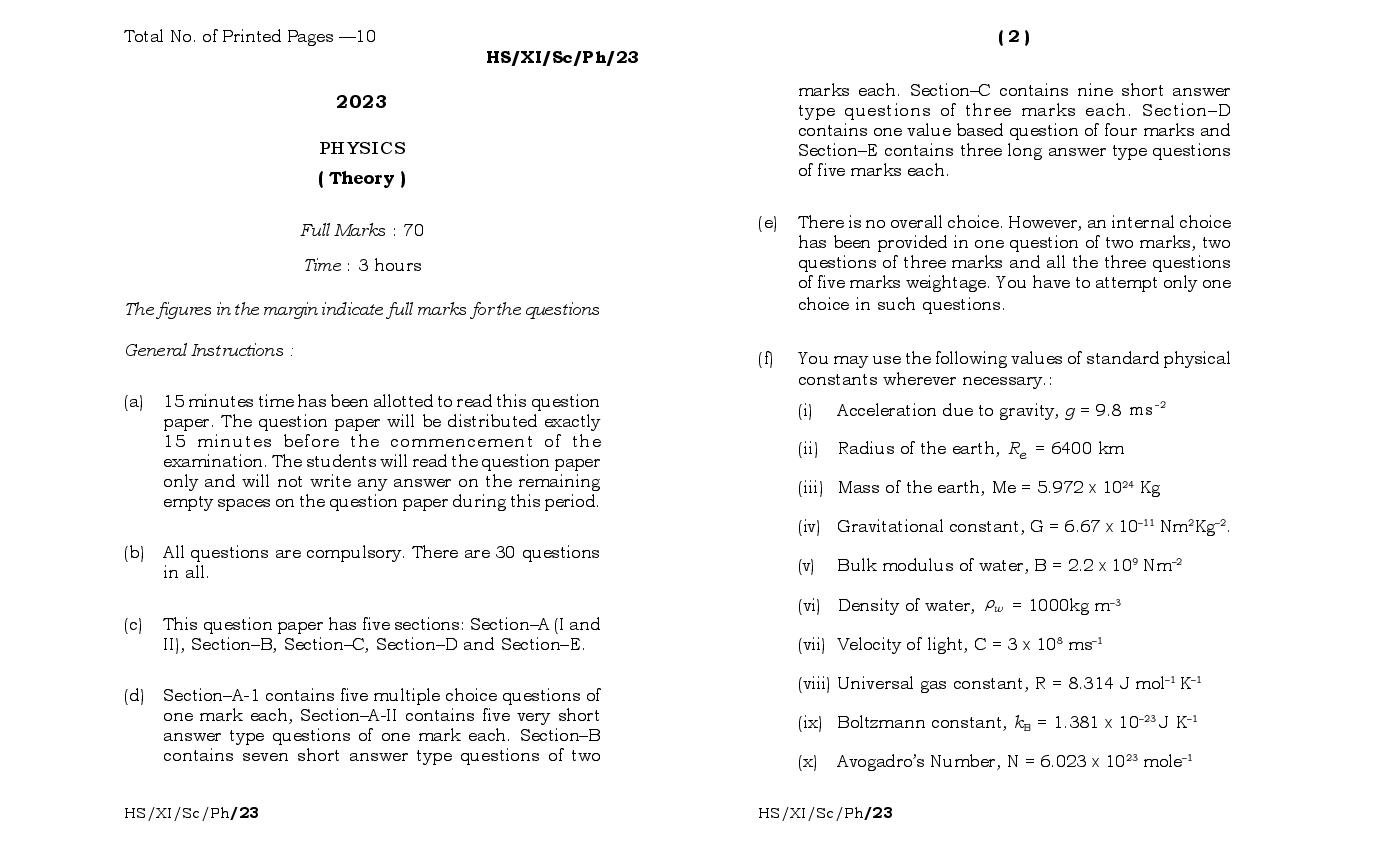
HS/XI/Sc/Ph/23
marks each. Section–C contains nine short answer
2023 type questions of three marks each. Section–D
contains one value based question of four marks and
PHYSICS Section–E contains three long answer type questions
( Theory ) of five marks each.
Full Marks : 70 (e) There is no overall choice. However, an internal choice
has been provided in one question of two marks, two
Time : 3 hours questions of three marks and all the three questions
of five marks weightage. You have to attempt only one
The figures in the margin indicate full marks for the questions choice in such questions.
General Instructions : (f) You may use the following values of standard physical
constants wherever necessary.:
(a) 15 minutes time has been allotted to read this question
(i) Acceleration due to gravity, g = 9.8 ms 2
paper. The question paper will be distributed exactly
15 minutes before the commencement of the (ii) Radius of the earth, Re = 6400 km
examination. The students will read the question paper
only and will not write any answer on the remaining (iii) Mass of the earth, Me = 5.972 x 1024 Kg
empty spaces on the question paper during this period.
(iv) Gravitational constant, G = 6.67 x 10⁻¹¹ Nm2Kg–2.
(b) All questions are compulsory. There are 30 questions
in all. (v) Bulk modulus of water, B = 2.2 x 10⁹ Nm–2
(vi) Density of water, w = 1000kg m–3
(c) This question paper has five sections: Section–A (I and
II), Section–B, Section–C, Section–D and Section–E. (vii) Velocity of light, C = 3 x 10⁸ ms–1
(viii) Universal gas constant, R = 8.314 J mol–1 K–1
(d) Section–A-1 contains five multiple choice questions of
one mark each, Section–A-II contains five very short (ix) Boltzmann constant, k B = 1.381 x 10⁻²³ J K–1
answer type questions of one mark each. Section–B
contains seven short answer type questions of two (x) Avogadro’s Number, N = 6.023 x 10²³ mole–1
HS/XI/Sc/Ph/23 HS/XI/Sc/Ph/23
Page 2
SECTION – A – I 4. The root mean square speed of the molecules of a gas
with molar mass M at absolute temperature T is
( Multiple choice questions ) 300 ms–1. If the molar mass is doubled and the absolute
temperature is halved, what will be the root mean
1. A structural steel rod of Young’s modulus 2.0 1011 N m–2 square speed of the molecules? 1
has a radius and length of 10 mm and 1m, respectively.
A 100 kN force stretches the rod along its length. The (a) 300 ms–1
stress is. 1 (b) 150 ms–1
(a) 3.18 108Nm–2 (c) 75 ms–1
(b) 3.18 109Nm–2 (d) 50 ms–1
(c) 3.18 1010Nm–2
(d) 3.18 106Nm–2
5. A device thate works on Bernoulli’s theorem is the 1
2. A circular disc has mass M and radius R. The moment (a) Voltmeter
of inertia about its diameter is 1
(b) Screw gauge
2
(a) MR
(c) Venturi-meter
(b) MR 2/2
(d) Spherometer.
(c) MR 2/4
(d) MR 2/6
SECTION – A–II
3. A body of mass 2 kg travels according to the law
x(t) pt qt 2 rt 3 , where p = 3 ms–1, q = 4ms–2 and ( Very short answer type questions )
r = 5ms–3. The force acting on the body at t = 2 seconds is 1
(a) 68N 6. Define Poisson’s ratio in solids. 1
(b) 134N
(c) 158N 7. State the law of equipartition of energy for a gas
system. 1
(d) 136N
HS/XI/Sc/Ph/23 HS/XI/Sc/Ph/23
Page 3
8. 5.74 g of a substance occupies 1.2 cm3. Express its 14. Either
density in proper significant figures. 1
Consider a simple pendulum having a bob attached
to a string that oscilates under the action of the force
of gravity. Suppose that the time period of oscillation
of the simple pendulum depends on its length (l), the
9. “When a vector A is multiplied by a negative number mass of the bob (m) and acceleration due to gravity (g).
”, What will you get? 1 Using the method of dimensions, derive the expression
for the time period. 2
Or
10. State second law of thermodynamics. Suppose the magnitude of the centripetal force (F)
1
that acts on an object moving uniformly in a circle
depends upon the mass (m), velocity ( ) of the object
and radius of the circle (r). Using the method of
dimensions, derive the expression for the force. 2
SECTION – B
( Short answer type questions ) 15. Using Newton’s second law of motion and calculus
method, show that the force ( F ) acting on an object
with constant mass (m) is related to the object’s
acceleration ( a ) as 2
11. Mention two properties of a conservative force. 2
a F
16. A force F when applied on a block, placed on a floor,
12. On an average a human heart is found to beat 75 times
at an angle of 60o to the direction of displacement of
in a minute. Calculate its frequency and period. 2 5m, performs 150J of work. Find the force applied.
What is the work done against? 1+1=2
13. State Pascal’s law for fluids. Name one application. 17. Explain why small drops of water are spherical in
1+1=2 shape. 2
HS/XI/Sc/Ph/23 HS/XI/Sc/Ph/23
Page 4
SECTION –– C
If A 4ˆ 3 ˆj and B ˆ ˆj , Calculate (i) A B ,
( Short answer type questions )
(ii) B A , (iii) A A and (iv) show that A B B A .
1 + 1 + 12 + 12 =3
18. A wave travelling along a string is described by
y(x,t) 0.005 sin ( 80.0 x 3.0t) , in which the numerical
constants are in SI units (0.005 m, 80.0 rad m–1 and 23. Write down Hooke’s law for elastic materials. The
3.0 rad s–1). Calculate 3 average depth of Indian Ocean is about 3000m.
Calculate the fractional compression of water at the
(a) wavelength of the wave
bottom of the ocean. 3
(b) frequency of the wave and
(c) displacement y(x,t) at a distance x = 30.0 cm and
time t = 20 seconds. 24. Either
Derive an expression for the kinetic energy of a rigid
body rotating with uniform angular velocity and
19. State Kepler’s laws of planetary motion. 3
hence define moment of inertia. 3
20. Define the terms: (i) isothermal process, (ii) isobaric Or
process, (iii) adiabatic process. 1+1+1=3 A particle of constant mass (m) undergoes rotational
motion due to an external torque ( ), show that
21. Consider an isolated system of two particles that will dL
,
collide once with each other at any time. Show that dt
the system obeys the law of conservation of linear
momentum. 3 where the symbols have their usual meanings.
Mention one condition that L will be constant. 3
22. Either
Calculate the magnitude and direction of the resultant
25. Obtain an expression for acceleration due to gravity
vector of P Q , where P ˆ 5 ˆj and Q 2ˆ 3 ˆj . 3
at a depth d below the surface of the earth. 3
Or
HS/XI/Sc/Ph/23 HS/XI/Sc/Ph/23
Page 5
26. When two bodies make a head-on elastic collision, show 29. Either
that the coefficient of restitution equals 1. 3
Show that the total mechanical energy of a particle
executing simple harmonic motion under a
SECTION –– D conservative force is independent of time. 5
( Value based question )
Or
27. In our daily lives, we come across three distinct modes Two identical sinusoidal waves have the same angular
of heat transfer: frequency, wavelength and amplitude but, their phase
Conduction, Convection and Radiation. difference is are travelling along a stretched string
in the positive direction of the x–axis. Using the
(i) From your experiences, explain with an example principle of superposition of waves, show the waves
the following mechanisms. will give rise to another sinusoidal wave. What happen
(a) Conduction 1 when ? 5
(b) Convection and 1
(c) Radiation 1 30. Either
(ii) What is meant by black body radiation? 1
(a) Define gravitational potential energy. 1
SECTION –– E (b) Derive an expression for the gravitational
potential energy of a body at any height h above
( Long answer type questions ) the surface of the earth. 4
Or
28. Either
Why the projectile only has constant downward (a) Derive an expression for the escape velocity of a
acceleration? Obtain the expressions for maximum body from the surface of the earth. 4
height and time of ascent or time of rise for a projectile.
1 + 4 =5 (b) Calculate the numerical value of escape velocity
Or of a satellite of mass 1000 kg from the surface of
the earth. Conclude your result. 1 + 1 = 1
Why do we need banking for a curved road? Obtain 2 2
an expression for maximum speed that a car can safely
travel on a curved road banked at an angle . 1 + 4 =5
HS/XI/Sc/Ph/23 HS/XI/Sc/Ph/23
Document Details
| Board / Org | Meghalaya Board |
| Exam | Class 11 |
| Type | Question Paper |
| Pages | 5 |
| Updated | 22 Jul 2026 |