DUET Question Paper 2019 for Ph.D (Biomedical Sciences)
Finished viewing? Save it for later —
Download DUET Question Paper 2019 for Ph.D (Biomedical Sciences) (PDF · 10 pages)About DUET Question Paper 2019 for Ph.D (Biomedical Sciences)
DUET Question Paper 2019 for Ph.D (Biomedical Sciences) is available here for free download. Published by NTA for DUET, this question paper can be viewed online or downloaded as a PDF (10 pages). Candidates preparing for DUET can use DUET Question Paper 2019 for Ph.D (Biomedical Sciences) to understand the exam pattern, the type of questions asked, and the overall difficulty level.
Frequently Asked Questions
How can I download DUET Question Paper 2019 for Ph.D (Biomedical Sciences)?
Open this page and click the Download button to save DUET Question Paper 2019 for Ph.D (Biomedical Sciences) as a PDF. It is completely free on AglaSem Docs.
Is DUET Question Paper 2019 for Ph.D (Biomedical Sciences) free to download?
Yes. DUET Question Paper 2019 for Ph.D (Biomedical Sciences) can be viewed online and downloaded as a PDF free of cost on AglaSem Docs.
How many pages does DUET Question Paper 2019 for Ph.D (Biomedical Sciences) have?
DUET Question Paper 2019 for Ph.D (Biomedical Sciences) contains 10 pages, which you can read online or download together as a single PDF.
Where can I find more DUET study material?
You can find more DUET question papers, sample papers, syllabus, and answer keys on AglaSem Docs.
DUET Question Paper 2019 for Ph.D (Biomedical Sciences) – Text
Read the full text of this question paper below — useful to quickly search, copy and reference the content online without downloading the PDF.
📄 View text version (10 pages)
Page 1
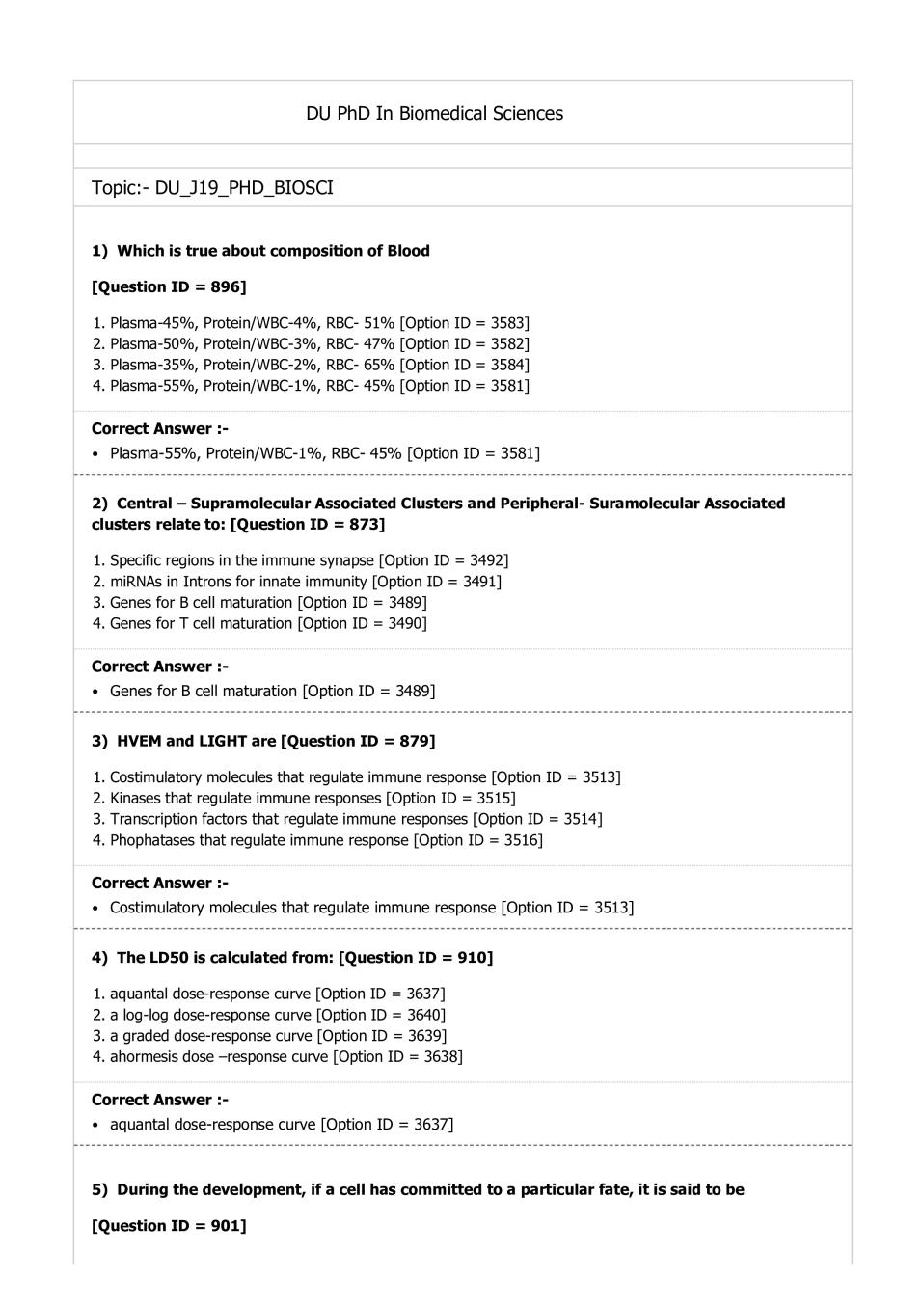
Topic:- DU_J19_PHD_BIOSCI
1) Which is true about composition of Blood
[Question ID = 896]
1. Plasma-45%, Protein/WBC-4%, RBC- 51% [Option ID = 3583]
2. Plasma-50%, Protein/WBC-3%, RBC- 47% [Option ID = 3582]
3. Plasma-35%, Protein/WBC-2%, RBC- 65% [Option ID = 3584]
4. Plasma-55%, Protein/WBC-1%, RBC- 45% [Option ID = 3581]
Plasma-55%, Protein/WBC-1%, RBC- 45% [Option ID = 3581]
2) Central – Supramolecular Associated Clusters and Peripheral- Suramolecular Associated
clusters relate to: [Question ID = 873]
1. Specific regions in the immune synapse [Option ID = 3492]
2. miRNAs in Introns for innate immunity [Option ID = 3491]
3. Genes for B cell maturation [Option ID = 3489]
4. Genes for T cell maturation [Option ID = 3490]
Genes for B cell maturation [Option ID = 3489]
3) HVEM and LIGHT are [Question ID = 879]
1. Costimulatory molecules that regulate immune response [Option ID = 3513]
2. Kinases that regulate immune responses [Option ID = 3515]
3. Transcription factors that regulate immune responses [Option ID = 3514]
4. Phophatases that regulate immune response [Option ID = 3516]
Costimulatory molecules that regulate immune response [Option ID = 3513]
4) The LD50 is calculated from: [Question ID = 910]
1. aquantal dose-response curve [Option ID = 3637]
2. a log-log dose-response curve [Option ID = 3640]
3. a graded dose-response curve [Option ID = 3639]
4. ahormesis dose –response curve [Option ID = 3638]
aquantal dose-response curve [Option ID = 3637]
5) During the development, if a cell has committed to a particular fate, it is said to be
[Question ID = 901]
Page 2
2. differentiated [Option ID = 3604]
3. Pluripotent [Option ID = 3601]
4. determined [Option ID = 3603]
Pluripotent [Option ID = 3601]
6) During isotonic contraction of a skeletal-muscle fibre the
[Question ID = 892]
1. Sarcomeres shorten and I bands shorten. [Option ID = 3568]
2. I bands shorten. [Option ID = 3567]
3. A bands shorten. [Option ID = 3566]
4. Sarcomeres shorten. [Option ID = 3565]
Sarcomeres shorten. [Option ID = 3565]
7) LDA is used as [Question ID = 890]
1. None of these [Option ID = 3560]
2. A dehydrating agent [Option ID = 3559]
3. An acid [Option ID = 3558]
4. A base [Option ID = 3557]
A base [Option ID = 3557]
8) Action of traditional NSAID's [Question ID = 906]
1. Do not inhibit COX-1 or COX-2 [Option ID = 3623]
2. Inhibit COX-1 [Option ID = 3621]
3. Both Inhibit COX-1 and Inhibit COX-2 [Option ID = 3624]
4. Inhibit COX-2 [Option ID = 3622]
Inhibit COX-1 [Option ID = 3621]
9) CD69 and Ki-67 are [Question ID = 876]
1. B cell activation markers [Option ID = 3502]
2. Macrophage activation marker [Option ID = 3504]
3. Dendritic cell activation markers [Option ID = 3503]
4. T cell activation markers [Option ID = 3501]
T cell activation markers [Option ID = 3501]
10) Chromosomes found in the salivary gland of Drosophila is [Question ID = 899]
1. Lampbrush [Option ID = 3593]
2. B-chromosomes. [Option ID = 3596]
3. Supernumerary [Option ID = 3595]
4. Polytene [Option ID = 3594]
Page 3
11) MAGE, PRAME and NY-ESO-1 are examples of [Question ID = 875]
1. Virulence factors of Staphylococcus aureus [Option ID = 3498]
2. B cell maturation marker [Option ID = 3500]
3. Tumor antigens [Option ID = 3499]
4. Allergens [Option ID = 3497]
Allergens [Option ID = 3497]
12) The completion of translocation requires the action of the factor _________________
[Question ID = 868]
1. EF-G [Option ID = 3470]
2. eIF2 [Option ID = 3471]
3. eIF4G [Option ID = 3472]
4. EF-Tu [Option ID = 3469]
EF-Tu [Option ID = 3469]
13) Erythropoietin secretion is stimulated by [Question ID = 897]
1. Low blood volume, Anemia, poor blood flow [Option ID = 3585]
2. Pulmonary diseases, hypererythremia, excess blood flow [Option ID = 3587]
3. Low blood volume, hypererythremia, pulmonary diseases [Option ID = 3588]
4. Low Hemoglobin, excess blood flow [Option ID = 3586]
Low blood volume, Anemia, poor blood flow [Option ID = 3585]
14) Some neurons in the vagus nerve terminate on sinoatrial (pacemaker) cells in the heart.
These neurons secrete acetylcholine, which ultimately results in a decreased heart rate. This is
an example of [Question ID = 891]
1. Exocrine Control [Option ID = 3562]
2. Hormonal Control [Option ID = 3564]
3. Endocrine Control [Option ID = 3563]
4. Neural Control [Option ID = 3561]
Neural Control [Option ID = 3561]
15) Plasmids are important to many bacteria because
[Question ID = 904]
1. Both (They can render bacteria drug resistant) and (They may carry genes that give their host a selective
advantage) [Option ID = 3616]
2. None of the above [Option ID = 3615]
3. They can render bacteria drug resistant. [Option ID = 3614]
4. They may carry genes that give their host a selective advantage [Option ID = 3613]
Page 4
16) In order for the lungs to function normally, the intrapleural pressure must [Question ID =
894]
1. alternate between being less than and greater than atmospheric pressure. [Option ID = 3575]
2. be lower than alveolar pressure. [Option ID = 3573]
3. change as the respiratory demands of the body change. [Option ID = 3576]
4. be between +5 and +10 mmHg above atmospheric pressure. [Option ID = 3574]
be lower than alveolar pressure. [Option ID = 3573]
17) Once the tRNA is aminoacylated, EF-Tu binds to the tRNA at the ____________ [Question
ID = 867]
1. Amino acid [Option ID = 3467]
2. 5’ end of the tRNA [Option ID = 3465]
3. Variable loop of tRNA [Option ID = 3468]
4. 3’ end of the tRNA [Option ID = 3466]
5’ end of the tRNA [Option ID = 3465]
18) The initial dorsal ventral axis in amphibian embryo is determined by [Question ID = 902]
1. the point of contact with uterus [Option ID = 3607]
2. genetics difference in the cells [Option ID = 3608]
3. the point of sperm entry [Option ID = 3605]
4. gravity [Option ID = 3606]
the point of sperm entry [Option ID = 3605]
19) Mendel’s principle of dominance stated that when an individual has a hybrid genotype, it will
only express thedominant trait in its phenotype. Which of the following types of inheritance do
not agree with this principle?
I) co-dominance
II) multiple alleles
III) incomplete dominance [Question ID = 898]
1. I and II only [Option ID = 3589]
2. I and III only [Option ID = 3591]
3. II and III only [Option ID = 3590]
4. I, II and III [Option ID = 3592]
I and II only [Option ID = 3589]
20) MICA and MICB are [Question ID = 871]
1. Mouse Incomplete C-Reactive Antigen A and B [Option ID = 3483]
2. Major Histocompatibility Complex molecules that regulate immunity [Option ID = 3481]
3. Micro- Interleukin Complex A and B [Option ID = 3484]
4. Memory Induced Complementary Antigen A and B [Option ID = 3482]
Page 5
21) The enzyme of E.coli that initiates the repair of double stranded DNA breaks by homologous
recombination ( base excision repair in DNA) [Question ID = 864]
1. DNA polymerase [Option ID = 3455]
2. RNA polymerase [Option ID = 3456]
3. DNA glycosylase [Option ID = 3453]
4. DNA ligase [Option ID = 3454]
DNA glycosylase [Option ID = 3453]
22) Drosophila has four pairs of chromosomes. How many linkage groups does it have [Question
ID = 900]
1. One more than the pairs of chromosomes [Option ID = 3600]
2. Eight [Option ID = 3597]
3. Four [Option ID = 3598]
4. One less than the pairs of chromosomes [Option ID = 3599]
Eight [Option ID = 3597]
23) Aniline reacts with 2 moles of Methylchloride to yield [Question ID = 888]
1. 2,4-Dimethylaniline [Option ID = 3552]
2. N,N-dimethylaniline [Option ID = 3549]
3. Toluene [Option ID = 3550]
4. 4-Methylaniline [Option ID = 3551]
N,N-dimethylaniline [Option ID = 3549]
24) What is bioavailability? [Question ID = 908]
1. The amount of available drug to be used for biological testing [Option ID = 3629]
2. The amount of drug that is biometrically excreted in your blood [Option ID = 3632]
3. The amount of blood that is available for transfusion [Option ID = 3631]
4. The amount of medication in your blood that is available to produce an effect [Option ID = 3630]
The amount of available drug to be used for biological testing [Option ID = 3629]
25) What is the function of the ω subunit of RNA polymerase? [Question ID = 865]
1. Subunit association [Option ID = 3457]
2. Cation binding [Option ID = 3460]
3. Promoter binding [Option ID = 3458]
4. Initiation and elongation [Option ID = 3459]
Subunit association [Option ID = 3457]
Page 6
1. is in bicarbonate ion. [Option ID = 3580]
2. is bound to hemoglobin. [Option ID = 3578]
3. is in carbonic acid. [Option ID = 3579]
4. is dissolved in the plasma. [Option ID = 3577]
is dissolved in the plasma. [Option ID = 3577]
27) At the end of each phase of cell cycle, cyclins activating Cdks in that phase are inactivated
irreversibly by [Question ID = 870]
1. Ubiquitinylation [Option ID = 3479]
2. Destabilizing by proteolysis in a proteasome [Option ID = 3480]
3. De-phosphorylation [Option ID = 3478]
4. Multiple phosphorylations [Option ID = 3477]
Multiple phosphorylations [Option ID = 3477]
28) Gram Positive bacteria [Question ID = 903]
1. Have one more membrane that helps retain the crystal violet stain [Option ID = 3609]
2. Have multiple layers of peptidoglycan that help retain the crystal violet stain [Option ID = 3610]
3. Have periplasmic space that trap the crystal violet [Option ID = 3612]
4. Have a thick capsule that traps the crystal violet stain [Option ID = 3611]
Have one more membrane that helps retain the crystal violet stain [Option ID = 3609]
29) The reaction of benzoic acid and sodium bicarbonate yields [Question ID = 887]
1. 1-Phenylethane [Option ID = 3548]
2. Benzaldehyde [Option ID = 3545]
3. Benzyne [Option ID = 3547]
4. Sodium benzoate [Option ID = 3546]
Benzaldehyde [Option ID = 3545]
30) The reaction of Lithium acetylide with n-Butyl bromide yields [Question ID = 886]
1. 1-Butyne [Option ID = 3544]
2. 1-Hexyne [Option ID = 3542]
3. 1-Heptyne [Option ID = 3543]
4. 1-Pentyne [Option ID = 3541]
1-Pentyne [Option ID = 3541]
31) The reaction of water with ethylene oxide yields in the presence of acid [Question ID = 882]
1. 1,2-Ethanediol [Option ID = 3525]
2. Ethanol [Option ID = 3526]
3. Acetaldehyde [Option ID = 3528]
Page 7
1,2-Ethanediol [Option ID = 3525]
32) Magnetosomes present in some bacteria [Question ID = 905]
1. Help cells attach to metal object [Option ID = 3617]
2. Help cells to orient in earth magnetic field [Option ID = 3620]
3. Help cells to float on the surface of fresh water bodies [Option ID = 3619]
4. help cells to magnetically attach to each other [Option ID = 3618]
Help cells attach to metal object [Option ID = 3617]
33) MAIT stands for: [Question ID = 872]
1. Mucosal Associated Invariant T cell [Option ID = 3486]
2. Micro-RNA Associated Inducible T cells [Option ID = 3488]
3. Minor antigen of Inducible T cell [Option ID = 3485]
4. Memory Associated islet cell [Option ID = 3487]
Minor antigen of Inducible T cell [Option ID = 3485]
34) MyD88, IRAK1 and IRAKM are molecules that belong to the: [Question ID = 878]
1. Toll like receptor induced signaling pathway [Option ID = 3512]
2. T cell receptor induced signaling pathway [Option ID = 3510]
3. EGF receptor induced signaling pathway [Option ID = 3511]
4. B cell receptor induced signaling pathway [Option ID = 3509]
B cell receptor induced signaling pathway [Option ID = 3509]
35) n-Butane reacts with Sulphur at 5600C to yield [Question ID = 889]
1. None of these [Option ID = 3556]
2. Dibutyldisulfide [Option ID = 3554]
3. Thiophene [Option ID = 3555]
4. Butane thiol [Option ID = 3553]
Butane thiol [Option ID = 3553]
36) T-bet and GATA are: [Question ID = 877]
1. Cytokines that regulate cell differentiation into plasma cells and memory cells, respectively [Option ID =
3507]
2. Transcription factors that promote T helper cell 2 and T helper cell 1 differentiation marker, respectively
[Option ID = 3506]
3. Transcription factors that promote T helper cell 1 and T helper cell 2 differentiation, respectively [Option ID
= 3505]
4. Proteins secreted by cytotoxic T cells that kill infected macrophages [Option ID = 3508]
Page 8
ID = 3505]
37) Potassium sparing diuretics have the primary effect upon which part of the kidney.
[Question ID = 911]
1. Collecting duct [Option ID = 3643]
2. Loop of Henle [Option ID = 3642]
3. Proximal convoluted tubule [Option ID = 3641]
4. Distal convoluted tubule [Option ID = 3644]
Proximal convoluted tubule [Option ID = 3641]
38) Atopic individuals are: [Question ID = 874]
1. Prone to allergy [Option ID = 3493]
2. Prone to autoimmunity [Option ID = 3494]
3. Tolerant to allergy [Option ID = 3495]
4. Tolerant to infection [Option ID = 3496]
Prone to allergy [Option ID = 3493]
39) A transition state of high energy is formed in the following reaction [Question ID = 883]
1. None of these [Option ID = 3532]
2. SN2 [Option ID = 3530]
3. SN1 [Option ID = 3529]
4. E1 [Option ID = 3531]
SN1 [Option ID = 3529]
40) Plasmid stability in cells is maintained by [Question ID = 880]
1. Par [Option ID = 3519]
2. Ori gene [Option ID = 3518]
3. RepA [Option ID = 3517]
4. Rop [Option ID = 3520]
RepA [Option ID = 3517]
41) Which of the following is a long-term side effect of amphetamine? [Question ID = 912]
1. hair loss [Option ID = 3646]
2. constipation [Option ID = 3647]
3. depression [Option ID = 3648]
4. Euphoria [Option ID = 3645]
Euphoria [Option ID = 3645]
42) Which of the following is an Antihistamine? [Question ID = 907]
Page 9
2. Pseudoephedrine [Option ID = 3626]
3. Glycopyrrolate [Option ID = 3627]
4. Epinephrin [Option ID = 3628]
Chlorpheniramine [Option ID = 3625]
43) Which of the following is the primary site of activity for the drug Warfarin? [Question ID =
909]
1. Liver [Option ID = 3634]
2. Kidney [Option ID = 3633]
3. Blood [Option ID = 3635]
4. Heart [Option ID = 3636]
Kidney [Option ID = 3633]
44) Which of the following is an Ubiquitin activating enzyme? [Question ID = 869]
1. E2 [Option ID = 3474]
2. E3 [Option ID = 3475]
3. E4 [Option ID = 3476]
4. E1 [Option ID = 3473]
E1 [Option ID = 3473]
45) For chronic myeloid leukemia one of the best chemotherapy drugs used is: [Question ID =
863]
1. Adriamycin [Option ID = 3451]
2. cisplatin [Option ID = 3452]
3. Bleomycin [Option ID = 3450]
4. Imatinib [Option ID = 3449]
Imatinib [Option ID = 3449]
46) According to the Frank-Starling mechanism of the heart, [Question ID = 893]
1. the intrinsic rate of the heart's pacemaker is 100 beats/min. [Option ID = 3570]
2. stroke volume increases with increased venous return. [Option ID = 3572]
3. the left ventricle ejects a larger volume of blood with each systole than the right ventricle. [Option ID =
3569]
4. cardiac output increases with increased heart rate. [Option ID = 3571]
the left ventricle ejects a larger volume of blood with each systole than the right ventricle. [Option ID =
3569]
47) DNA ligase [Question ID = 881]
1. Facilitate Phosphodiester bonds [Option ID = 3522]
2. Sythesizes DNA in 5’- 3’ direction [Option ID = 3521]
Page 10
4. Maintain plasmid supercoiling [Option ID = 3523]
Sythesizes DNA in 5’- 3’ direction [Option ID = 3521]
48) Formation of turbidity on reaction of a plant extract with Phosphomolybdic acid indicates
the presence of [Question ID = 885]
1. a phytosteroid [Option ID = 3538]
2. a triterpenoid [Option ID = 3540]
3. an alkaloid [Option ID = 3537]
4. a carboxylic acid [Option ID = 3539]
an alkaloid [Option ID = 3537]
49) Crystal violet is used [Question ID = 884]
1. as a Lewis base [Option ID = 3536]
2. to dye silk and wool [Option ID = 3534]
3. as an acid base indicator [Option ID = 3533]
4. for dehydration [Option ID = 3535]
as an acid base indicator [Option ID = 3533]
50) Four types of σ factors are known ,of them which one used during Nitrogen deficiency?
[Question ID = 866]
1. σ54 [Option ID = 3463]
2. σ32 [Option ID = 3462]
3. σ28 [Option ID = 3464]
4. σ70 [Option ID = 3461]
σ70 [Option ID = 3461]
Document Details
| Board / Org | NTA |
| Exam | DUET |
| Type | Question Paper |
| Pages | 10 |
| Updated | 30 Apr 2026 |