ISC Class 12 Syllabus 2027 Environmental Science
Finished viewing? Save it for later —
Download ISC Class 12 Syllabus 2027 Environmental Science (PDF · 9 pages)About ISC Class 12 Syllabus 2027 Environmental Science
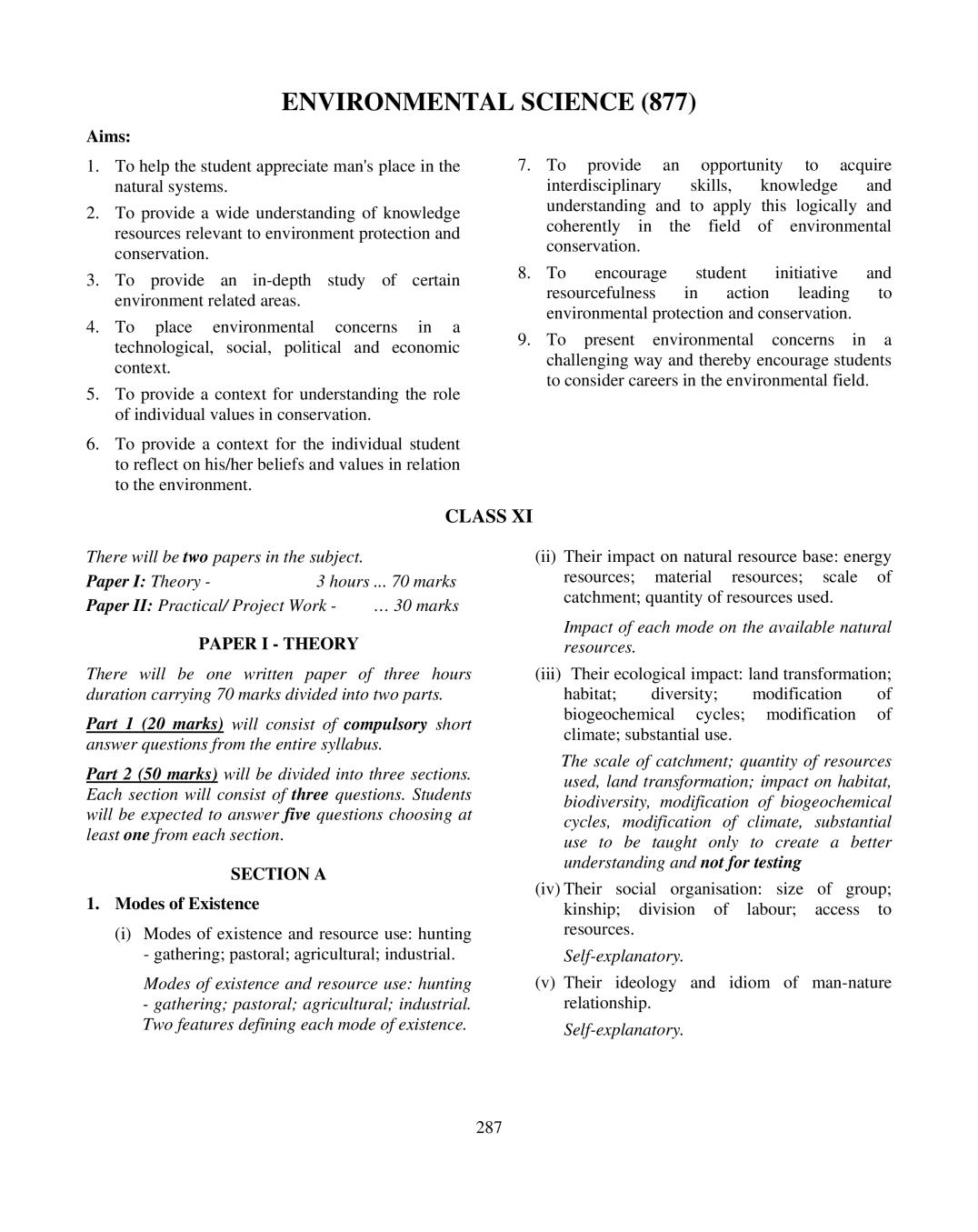
ISC Class 12 Syllabus 2027 Environmental Science is available here for free download. Published by CISCE for Class 12, this syllabus can be viewed online or downloaded as a PDF (9 pages). Candidates preparing for Class 12 can use ISC Class 12 Syllabus 2027 Environmental Science to understand the exam pattern, the type of questions asked, and the overall difficulty level.
Frequently Asked Questions
How can I download ISC Class 12 Syllabus 2027 Environmental Science?
Open this page and click the Download button to save ISC Class 12 Syllabus 2027 Environmental Science as a PDF. It is completely free on AglaSem Docs.
Is ISC Class 12 Syllabus 2027 Environmental Science free to download?
Yes. ISC Class 12 Syllabus 2027 Environmental Science can be viewed online and downloaded as a PDF free of cost on AglaSem Docs.
How many pages does ISC Class 12 Syllabus 2027 Environmental Science have?
ISC Class 12 Syllabus 2027 Environmental Science contains 9 pages, which you can read online or download together as a single PDF.
Where can I find more Class 12 study material?
You can find more Class 12 question papers, sample papers, syllabus, and answer keys on AglaSem Docs.
ISC Class 12 Syllabus 2027 Environmental Science – Text
Read the full text of this syllabus below — useful to quickly search, copy and reference the content online without downloading the PDF.
📄 View text version (9 pages)
Page 1
INDIAN SCHOOL CERTIFICATE
EXAMINATION
ENVIRONMENTAL
SCIENCE
(877)
Page 2
____________________________________________________________________________________________
© Copyright, Council for the Indian School Certificate Examinations
All rights reserved. The copyright to this publication and any part thereof solely vests in the Council for the Indian
School Certificate Examinations. This publication and no part thereof may be reproduced, transmitted, distributed or
stored in any manner whatsoever, without the prior written approval of the Council for the Indian School Certificate
Examinations.
Page 3
MISSION STATEMENT
The Council for the Indian School Certificate
Examinations is committed to serving the nation's
children, through high quality educational
endeavours, empowering them to contribute towards
a humane, just and pluralistic society, promoting
introspective living, by creating exciting learning
opportunities, with a commitment to excellence.
ETHOS OF CISCE
Trust and fair play.
Minimum monitoring.
Allowing schools to evolve their own niche.
Catering to the needs of the children.
Giving freedom to experiment with new ideas
and practices.
Diversity and plurality - the basic strength for
evolution of ideas.
Schools to motivate pupils towards the
cultivation of:
Excellence - The Indian and Global
experience.
Values - Spiritual and cultural - to be the bedrock
of the educational experience.
Schools to have an 'Indian Ethos', strong roots in
the national psyche and be sensitive to national
aspirations.
Page 4
There will be two papers in the subject: 2. Population and Conservation Ecology
Paper I: Theory - 3 hours... 70 marks
(i) Population dynamics: factors causing
Paper II: Practical/ Project Work - … 30 marks population change (birth, death, immigration
and emigration); relation between the factors;
age structure and its significance; population
PAPER I - THEORY pyramids; survivorship curves; three general
SECTION A shapes r and K strategies.
1. Human Beings and Nature Factors causing population change (birth,
death, immigration and emigration); relation
(i) Modern schools of ecological thought. between the factors; Age structure and its
(ii) Deep ecology (Gary Snyder, Earth First) vs. significance; Population Pyramids –
shallow ecology. interpretation and implications. Rate of
(iii) Stewardship of land (e.g. Wendell Berry). change of population – the three general
shapes of Survivorship Curves, r and K
(iv) Social ecology [Marxist environmentalism strategies and differences between the two.
and socialist ecology (Barry Commoner)].
(ii) Human populations (Malthusian model and
(v) Feminism. demographic transition).
(vi) Green Politics (e.g. Germany and England). Definition of Carrying Capacity; Malthusian
(vii) Sustainable Development. view: concept of ‘over-population’ and
shortage of resources; Questioning Malthus.
Modern schools of ecological thought; Population Growth vs. Disparate
definition and basic understanding of Deep Consumption of resources within and
Ecology as opposed to Shallow Ecology; amongst nations. Definition and
Stewardship, Social Ecology - Marxist understanding of Demographic Transition;
environmentalism and Socialist Ecology, Factors influencing demographic transition.
Eco feminism, Green political movements of
(iii) Population Regulation: growth without
Germany and England and Sustainable regulation (exponential); simple population
Development (basic concepts). regulation (logistic growth curve); factors
A brief look at the above in terms of regulating population size (space, food and
definition, origin, basic principles and water, territories, predators, weather and
environmental orientations. climate, parasite and diseases, disasters and
self-regulation).
Special reference to principles of Deep
Ecology (Gary Snyder) and Laws of Ecology Basic understanding of the Exponential
(Barry Commoner) growth curve (J – shaped) and Logistic
Gary Snyder, Barry Commoner, Wendell growth curve (S - shaped); Factors
Berry - a short biographical sketch regulating population size (space, food and
particularly with reference to their work on water, territories, predators, weather and
the environment. climate, parasite and diseases, disasters and
self-regulation).
Earth First – a brief understanding of the
organization’s ethos and work. (iv) Human population control: family planning;
education; economic growth; status of
World Wide Fund for Nature – organisation, women.
mission, strategy for conservation.
Strategies for human population control with
Greenpeace – organisation, mission emphasis on women’s empowerment.
statement, core values, objectives and (Details of methods of family planning not
strategy. required.)
7
Page 5
genetic erosion; loss of diversity; expanding
(i) Pollution monitoring.
agriculture; impound water; waste from
human societies; increasing human Primary and secondary pollutants.
consumption. Importance of monitoring air pollution
Only a brief understanding of the causes and including Ambient Air Quality Monitoring
consequences of threats to provisioning and (gaseous and particulate). Concept of carbon
regulatory functions of the ecosystem with credits and carbon trading in regulating
suitable examples. emissions. Causes for excessive vehicular
pollution and various steps taken to regulate
(vi) Conservation: importance; the critical state of pollution-emission standards for new
Indian forests; conflicts surrounding forested vehicles, implementation of CNG
areas - populations and tribals and their rights programme, inspection & maintenance
- tourism - poaching - roads - development programme for in-use vehicles, phasing
projects - dams; scientific forestry and its out of old commercial vehicles and
limitations; social forestry; the role of the promotion of public transport.
forest department; NGOs; joint forestry
management; wild life - sanctuaries, (ii) Monitoring the atmosphere: techniques.
conservation and management in India; Monitoring at emission source and of
Project Tiger as a case study in conservation. ambient air quality, criteria for monitoring
Definition of: Conservation, in situ and ex stations, types of stations, number of stations,
situ conservation. Importance of frequency of data collection, characteristics
Conservation. of ambient air sampling, basic consideration
In-situ conservation: Wildlife sanctuaries, for sampling (to be dealt with in brief).
National parks, Biosphere reserves Classification of techniques- manual and
(definition, objectives, features, advantages instrumental. Manual-Passive samplers,
and disadvantages). High Volume Samplers and Bubbler Systems.
Instrumental-photometric techniques-NDIR,
Ex-situ conservation: zoos, aquaria, plant Chemiluminescence - principle and use.
collection (objectives, features, advantages
and disadvantages). (iii) International and national air quality
standards.
Conflicts in managing and conserving
Forests: India’s forest cover, issues National Ambient Air Quality Monitoring
concerning people living in and around (NAAQM); the main functions of the Central
forests with particular reference to tribal Pollution Control Board and the State
rights; threats to forests: poaching, Pollution Control Board, objectives of air
developmental projects like roads and dams, quality standards, New name of NAAQM,
over exploitation of forest resources (direct National Air Monitoring Programme
and indirect). (NAMP) objectives of the NAMP.
The role of the forest department and NGOs Definition of air quality standards and
in managing forests. importance; National air quality standards
Some management measures: scientific for gases/particulate matter covered under
forestry, social forestry (various types of WHO guidelines.
social forestry), Joint Forestry Management (iv) Water testing: indicators of water quality.
(JFM), ecotourism.
Indicators (electrical conductivity, turbidity,
Definition, scope, advantages and pH, dissolved oxygen, faecal waste,
disadvantages of each of the above. temperature, hardness, nitrates and
Project Tiger as a case study in sulphates) the significance of each and their
conservation: Origin, aims, and objectives, interpretations. B.O.D. and C.O.D.,
successes, failures.
8
Page 6
understanding and not for testing) Village as the basis of development;
promotion of cottage industries and
(v) Soil testing: indicators of soil type and
intermediate technologies; focus on
quality and laboratory work.
employment.
Soil indicators- the characteristics of a good
The above to be contrasted with today’s
soil indicator, the three basic types of soil
paradigm of growth.
indicators- biological, physical and
chemical, two examples of each. The (iv) Urban environmental planning and
information provided by each of these types management: problems of sanitation; water
of indicators. Definitions, effects and management; transport; energy; air quality;
experiments to find out soil respiration, soil housing; constraints (economic, political) in
pH, soil aggregate, infiltration rate and tackling the problems; inapplicability of
simple methods of controlling each of these. solutions that have worked in the First World
and the need for indigenous approach to
SECTION B urban environment.
4. Third World Development A basic understanding of the following urban
(i) Urban-rural divide: urbanisation - push and environmental problems: problems of
pull factors; consequences on rural and urban sanitation, water management, transport,
sectors; future trends and projections. energy; air quality and housing.
Causes of migration - push and pull factors, Awareness of some indigenous solutions:
consequences on rural and urban areas and Rainwater harvesting, garbage segregation,
ways to reduce migration. Future trends and composting, energy from solid and liquid
projections. wastes, sewage management (dry toilets,
Decentralized Water Management System
(ii) A critical appraisal of conventional paradigm (DEWATS)
of development from the viewpoints of
sustainability, environmental impact and Features of new urbanism, goals of smart
equity. growth. The following examples of urban
planning and management from the third
Definition of Development. world to be studied:
An understanding that development has Bogota – Bolivia (Traffic Management);
become synonymous with growth. This
approach has the following impacts on the Cuba (Urban agriculture using organic
environment: (a) Ignoring negative methods);
environmental impacts; (b) Changing Curitiba – Brazil (Traffic planning and
patterns of resource use due to market urban renewal using innovative
pressures; (c) Overuse and measures);
exploitation of resources; (d) Diversion of Cochabamba – (Water management and
scarce resources to luxury goods; (e) protests against privatisation of water
Disparate access to resources; (f) supply)
Increasing wastes and pollution.
The above to be explained with suitable 5. Sustainable Agriculture
examples. (i) Traditional Agriculture in India: irrigation
systems; crop varieties; techniques for
(iii) A case study of Gandhian approach in terms
maintaining soil fertility; impact of
of its aims and processes.
colonialism; Indian agriculture at
Local self-governance – basic principles independence - food scarcity - food import -
behind village policy, Antoday, Sarvoday, need for increasing production - the need for
Panchayati Raj; local self-sufficiency, local land reform; green revolution - HYVs -
9
Page 7
projects (dams); critical appraisal of the farmers, community level and household
green revolution from the viewpoints of level food security).
agro-bio diversity; soil health; ecological Land reform – need, advantages, failures and
impact of pesticides; energy (petroleum and successes.
petrochemicals); ability to reach the poorer
sections of the rural communities; Elements of sustainable agriculture: Mixed
sustainability - need for sustainable farming, mixed cropping, inter-cropping,
agriculture - characteristics for sustainable crop rotation, use of sustainable practices of
agriculture; techniques of water soil and pest water soil and pest management for
management. improving soil fertility (organic fertilizers,
bio-fertilizers, green manure, with two
Definition of the following terms: traditional examples) and pest control (bio pesticides).
agriculture, natural farming, organic Integrated Pest Management (IPM); eating
agriculture, modern agriculture (use of local foods
hybrid seeds, high yielding varieties,
chemical fertilizers and pesticides), gene Management of agricultural produce:
revolution (genetically modified seeds) and Storage; Food preservation-different
sustainable agriculture. methods like use of low temperatures, high
temperatures, drying, canning, preservation
Irrigation systems: by salt and sugar. Transportation of Food.
Macro vs micro irrigation systems - canal Food processing - Definition, food
irrigation/dam as compared to sprinkler/ preservation, packaging, grading.
drip/ trickle drip/dug wells. Basic features,
advantages and disadvantages of each kind. Food adulteration and Food additives-
Traditional rainwater harvesting- tankas, definitions; types of adulteration, harmful
khadins, ahar, pynes, zings, johads and eris effects of adulteration.
(suitability of each type in the particular Quality Marks - ISI (Indian Standard
region). Institute); AGMARK (Agricultural
Features of pre-colonial agriculture in India: Marketing); FPO(Fruit Product Order) - a
growing for sustenance rather than market; brief explanation only.
multi-cropping, management of soil health, (ii) Food: the twin problems of production and
diversity in seed. access; food situation in the world; integrated
Colonial influence: punitive taxation, and sustainable approach to food security for
commercial crops for export and British the Third World. Food Security.
industry, devaluation of sustainable Meaning of Food Security, need for food
traditional practices. Bengal famine. security. The problems in attaining food
Comparative study of pre-colonial, colonial security - those of production, storage and
and post- colonial agriculture and their access. Integrated and sustainable approach
impact. to food security for the Third World
Green Revolution: Origin (food scarcity - including working for environmental
food import - need for increasing sustainability and social and economic
production). sustainability through land reform, credit
support to farmers, market support to
Basic principles of Green Revolution- farmers, inadequacies in the present
Development of High Yielding Varieties marketing system, ways to improve
(HYV); introduction of fertilizers and marketing system, improving access to food,
pesticides; mono cropping. ownership of seeds.
Environmental, social and economic impacts An understanding that national level food
-advantages and disadvantages (from the security may not translate into household
viewpoints of agro-bio diversity; soil health; and community level food security or long
ecological impact of pesticides; energy use;
10
Page 8
above factors are addressed. Main features natural resources, importance of preserving
of the Food Security Law 2013. and regenerating natural capital.
7. International Relations and the Environment
SECTION C
(i) Trans-national characteristics of
6. Environmental and Natural Resource environmental issues using case study of
Economics Amazonia, Trade in Wildlife and Ozone
(i) Definition: resources; scarcity and growth; Depletion.
natural resource accounting. Case study of Amazonia - causes for
Classification of natural resources - on the exploitation of forests, reasons for
basis of origin (abiotic and biotic), on the acceleration of deforestation, effects of
basis of renewability (renewable and non- government policies, ecological value of
renewable), on the basis of development rainforests and possible solutions to the
(potential and actual), on the basis of problem.
distribution (ubiquitous and localized); Case study of ivory trade in Africa - reasons
scarcity and growth, natural resource for flourishing trade of ivory in the past,
accounting. steps taken to curb the trade and the
Classification of resources as renewable and consequences of ban in trade.
non-renewable. Case study of ozone depletion - what is
Definition, basic principles, advantages and meant by ozone layer and how does it get
disadvantages of Physical accounting. depleted, (Chapman’s cycle), potential
(ii) GNP vs. other forms of measuring income. effects of ozone depletion, common ozone
depleting substances (halons, carbon
GDP, GNP – definitions, advantages and tetrachloride, CFCs, methyl chloroform,
disadvantages of using them as tools for methyl bromide and HCFCs) and their life
measuring growth. span in the atmosphere; Ozone hole; steps
(iii) Economic status and welfare (net economic taken to control ozone depletion.
welfare, nature capital, ecological capital, (ii) Impact of international politics, national
etc.) sovereignty and interest.
A broad overview of the purpose of (iii) International trade: a theoretical perspective;
environmental economics. free trade vs. protectionism; import barriers;
Definition and classification: Defensive domestic industry vs. free trade; transnational
expenditure (its classification); natural/ companies - a historical perspective
ecological capital. (colonialism and its lasting impact today);
trade between the first and the third world -
(iv) Externalities: cost benefit analysis (social, characteristics - terms of trade; India's
ecological). international trade - characteristics - major
Externalities – definition, kinds (positive and imports and exports - foreign exchange crises
- the export imperative and its impact on the
negative), impacts. environment; the case study of aquaculture in
Cost Benefit analysis - Definition, the India; diversion of scarce resource from
process in brief, advantages and production of subsistence needs to
disadvantages. commercial products; toxic waste trade -
extent and impact; Globalisation - trade
EPR (Extended Producer Responsibility) - regimes (WTO, GATT, IPR) and their
definition, examples, advantages. impact on third world.
(v) Natural capital regeneration. Definition, advantages and disadvantages of
What is natural capital? Kinds of natural globalization, free trade, protectionism.
capital; classification of ecosystem services, Transnational Companies (TNCs) –
causes of degradation (acid deposition, air definition; TNCs and environment – conflict
pollution, deforestation, loss of biodiversity of interest.
and emission of carbon dioxide), ecological
11
Page 9
the developed countries (with special WORK – 30 MARKS
reference to India) with regards to (FOR CLASSES XI &XII)
composition and terms of trade (export of
primary goods and import of finished goods The practical/project work carrying 30 marks needs
at higher cost- tapping of primary goods to be undertaken under the guidance of the teacher.
leading to environment degradation- open The project will be evaluated by a Visiting Examiner
cast mining, agriculture, aquaculture, etc.). (who has specific expertise in the content of the
project work) appointed locally and approved by
Case study of aquaculture in India to CISCE.
understand the impact of free trade.
The project work could take one of the five forms:
Economic allocation of scarce resources and
its impact on environment. 1. Address a current environmental problem
Toxic waste trade – definition, origin, factors (preferably at local or regional scale) and should
sustaining, impact on third world countries include problem identification and analysis, use
(example – health and environmental of secondary data as well as some collection of
impacts) and steps to mitigate it (Bamako primary data, design of solution, documentation
and Basel Conventions). of the entire process in the form of a solution
proposal.
GATT – the organization and its
metamorphosis into WTO. 2. Design and conduct an environment impact
assessment. The candidates may use secondary
Principles and functions of WTO: creating a data, demonstrate their capacity to collect and
level playing field for international trade analyse primary data by incorporating some
through MFN (Most Favoured Nation), NT primary data collected and use it in a few sectors
(National Treatment) and reduction of import of their work.
barriers - tariff and non tariff barriers and
trading to comparative advantages. 3. Systematic monitoring of an aspect of the local
environment over a period of at least six months.
Full forms of and areas addressed in the
The candidate must use quantitative techniques
WTO GATT, TRIPS, TRIMS, Agreement on
of monitoring, sampling scientifically. The data
Agriculture (AOA). A brief understanding of
collected must be interpreted and presented in the
how these agreements impacted India’s
report.
trade, food security, economic well-being,
environmental sustainability. 4. Field work and training in an environmental
Definition of IPR and its categories: organisation (NGOs, Industrial Pollution Control
copyrights, patents, trademarks, industrial Firms, Testing Laboratories, etc.) for a period of
design rights, geographical indicators and not less than one month. This work should be
trade secrets. focused on one area in the syllabus. The
candidate will produce a paper on the area of
A brief understanding of each of the above his/her work and training which will include
categories. his/her experience and the special expertise that
(iv) International aid: agencies; advantages; she/he has acquired.
limitations; need for re-orienting aid; aid vs. 5. Conduct a study on the density and population of
self-reliance. plants growing in a particular area using the
International aid – advantages and quadral method.
disadvantages; Types of Aid: Tied and NOTE: No question paper for Practical work will
Untied Aid - advantages and limitations of be set by CISCE.
each.
12
Document Details
| Board / Org | CISCE |
| Exam | Class 12 |
| Type | Syllabus |
| Pages | 9 |
| Updated | 04 Aug 2026 |