MBOSE Class 11 Question Paper 2023 for Political Science
Finished viewing? Save it for later —
Download MBOSE Class 11 Question Paper 2023 for Political Science (PDF · 5 pages)About MBOSE Class 11 Question Paper 2023 for Political Science
MBOSE Class 11 Question Paper 2023 for Political Science is available here for free download. Published by Meghalaya Board for Class 11, this question paper can be viewed online or downloaded as a PDF (5 pages). Candidates preparing for Class 11 can use MBOSE Class 11 Question Paper 2023 for Political Science to understand the exam pattern, the type of questions asked, and the overall difficulty level.
Frequently Asked Questions
How can I download MBOSE Class 11 Question Paper 2023 for Political Science?
Open this page and click the Download button to save MBOSE Class 11 Question Paper 2023 for Political Science as a PDF. It is completely free on AglaSem Docs.
Is MBOSE Class 11 Question Paper 2023 for Political Science free to download?
Yes. MBOSE Class 11 Question Paper 2023 for Political Science can be viewed online and downloaded as a PDF free of cost on AglaSem Docs.
How many pages does MBOSE Class 11 Question Paper 2023 for Political Science have?
MBOSE Class 11 Question Paper 2023 for Political Science contains 5 pages, which you can read online or download together as a single PDF.
Where can I find more Class 11 study material?
You can find more Class 11 question papers, sample papers, syllabus, and answer keys on AglaSem Docs.
MBOSE Class 11 Question Paper 2023 for Political Science – Text
Read the full text of this question paper below — useful to quickly search, copy and reference the content online without downloading the PDF.
📄 View text version (5 pages)
Page 1
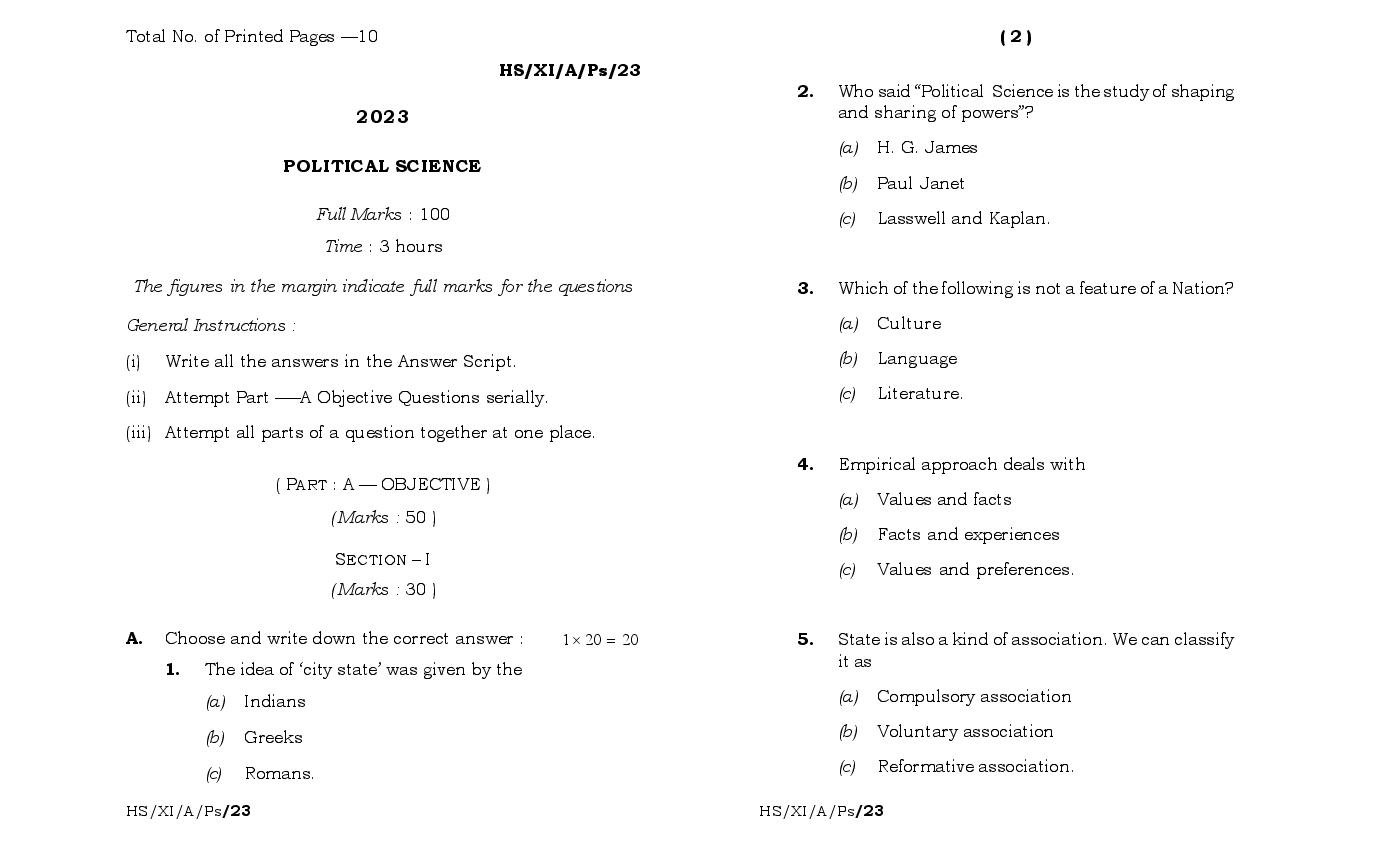
HS/XI/A/Ps/23
2. Who said “Political Science is the study of shaping
2023 and sharing of powers”?
(a) H. G. James
POLITICAL SCIENCE
(b) Paul Janet
Full Marks : 100 (c) Lasswell and Kaplan.
Time : 3 hours
The figures in the margin indicate full marks for the questions 3. Which of the following is not a feature of a Nation?
General Instructions : (a) Culture
(i) Write all the answers in the Answer Script. (b) Language
(ii) Attempt Part –––A Objective Questions serially. (c) Literature.
(iii) Attempt all parts of a question together at one place.
4. Empirical approach deals with
( PART : A –– OBJECTIVE )
(a) Values and facts
( Marks : 50 )
(b) Facts and experiences
SECTION – I
(c) Values and preferences.
( Marks : 30 )
A. Choose and write down the correct answer : 1 20 20 5. State is also a kind of association. We can classify
it as
1. The idea of ‘city state’ was given by the
(a) Indians (a) Compulsory association
(b) Greeks (b) Voluntary association
(c) Romans. (c) Reformative association.
HS/XI/A/Ps/23 HS/XI/A/Ps/23
Page 2
6. Political parties are essential for the success of 10. Sovereign power in a democracy rests with the
(a) Monarchy (a) People
(b) Dictatorship (b) Government
(c) Democracy. (c) Constitution.
7. Which of the following does not fall within the 11. Head of the state in a Presidential government
category of pressure groups? enjoys
(a) Business Groups (a) Nominal powers
(b) Legislator’s Group (b) Real powers
(c) Trade Unions. (c) Both nominal and real powers.
8. An Interest Group is formed by people who have 12. Generally one party system can be found in
(a) Common interest (a) Democratic countries
(b) Distinct interest (b) Monarchical system
(c) Sectional interest. (c) Totalitarian states.
9. Which organ of the government is known as the 13. The words ‘Socialist’ and ‘Secular’ were added to
guardian of the Constitution? the Constitution by the
(a) Legislature (a) 42nd amendment 1976
(b) Executive (b) 43rd amendment 1977
(c) Judiciary. (c) 44th amendment 1978
HS/XI/A/Ps/23 HS/XI/A/Ps/23
Page 3
14. In case of a clash between the Union law and 18. The Chief Justice and other judges of the High
State law relating to the Concurrent list Court are appointed by
(a) Union law prevails (a) The President
(b) State law prevails (b) The Chief Justice of India
(c) The Parliament.
(c) Both laws stand cancelled.
19. In which of the following states was Panchayati
15. The President of the Constituent Assembly was Raj first introduced?
(a) Dr. B. R. Ambedkar (a) Bihar and Arunachal Pradesh
(b) Rajasthan and Andhra Pradesh
(b) Dr. Rajendra Prasad
(c) Gujarat and West Bengal.
(c) Jawaharlal Nehru.
20. Who is the Official Executive Head of the
Municipal Corporation?
16. The size of the State Council of Ministers is
decided by
(a) Mayor
(a) The President
(b) Municipal Commissioner
(b) The Governor
(c) Member of District Council.
(c) The Chief Minister.
B. Write whether the following statements are True or
17. The Contingency Fund of the state remains at False 110 10
the disposal of the
(a) Chief Minister 1. Political Science is an exact science.
(b) Governor
2. When State co-exist with Nation a strong national
(c) Prime Minister feeling is created.
HS/XI/A/Ps/23 HS/XI/A/Ps/23
Page 4
3. The objectives of pressure groups and political 2. Give two distinctions between State and Nation. 2
parties are the same.
3. Write down two characteristics of political parties. 2
4. To maintain law and order is an important
function of the executive organ of the government.
4. Mention any two types of Executive. 2
5. Indirect Democracy is also known as
Representative Democracy.
5. Give two characteristics of Unitary Government. 2
6. There is dual citizenship in India.
6. What is dictatorship form of government? 2
7. Residuary powers belong to the state government.
7. Why is India called a secular state? 2
8. The judges of High Court can be removed on
grounds of proved misbehaviour and incapacity. 8. What is the composition of the Legislative
Council? 2
9. The Speaker of the Legislative Assembly is
appointed by the Chief Minister.
9. Mention two discretionary powers of the
10. The term ‘Mite’ means good or evil spirit. Governor. 2
10. What are the qualifications required for
SECTION –– II appointment as judges of State High Court? 2
( Marks : 20 )
11. What is Local Self - Government? 2
Answer the following questions in Two or Three
sentences each (Choose any ten) 2 10 20
1. Mention two differences between State and 12. What are the sources of income of the Khasi
Association. 2 Chief ? 2
HS/XI/A/Ps/23 HS/XI/A/Ps/23
Page 5
(PART : B –– DESCRIPTIVE ) (d) Conditions for the independence of Judiciary. 5
( Marks : 50 ) (e) Characteristics of Presidential government. 5
GROUP –– A
GROUP : B
POLITICAL THEORY
The Indian Constitution and Political System in Operation
Answer any three questions 10 3 30 Answer any two of the following questions : 10 2 20
1. Define Political Science. Discuss its nature and scope.
7. Enumerate the salient features of the Indian
2 + 8 = 10
Constitution. 10
2. What is Public Opinion? Explain the agencies of Public
Opinion. 2 + 8 = 10 8. Explain the main features of Indian Federalism. 10
3. Identify the types of Legislature. Enumerate the
functions of the Legislature. 9. Describe the composition, powers and functions of the
2 + 8 = 10
State Council of Ministers. 2 + 8 = 10
4. What is Parliamentary Government? Discuss its main
features. 3 + 7 = 10 10. Write short notes on any two of the following : 5 2 10
(a) Sources of the Indian Constitution. 5
5. Explain the merits and demerits of Federal
Government. 10 (b) Position of the Chief Minister. 5
6. Write short notes on any two of the following :- 5 2 10 (c) Legislative powers of the Legislative Assembly. 5
(a) Two elements of the State. 5 (d) Functions of the District Council. 5
(b) Differences between political parties and pressure
(e) Any one Traditional Political Institutions in
groups. 5 Meghalaya. 5
(c) Demerits of multi-party system. 5
HS/XI/A/Ps/23 HS/XI/A/Ps/23
Document Details
| Board / Org | Meghalaya Board |
| Exam | Class 11 |
| Type | Question Paper |
| Pages | 5 |
| Updated | 22 Jul 2026 |