MBOSE Class 11 Question Paper 2023 for Psychology
Finished viewing? Save it for later —
Download MBOSE Class 11 Question Paper 2023 for Psychology (PDF · 3 pages)About MBOSE Class 11 Question Paper 2023 for Psychology
MBOSE Class 11 Question Paper 2023 for Psychology is available here for free download. Published by Meghalaya Board for Class 11, this question paper can be viewed online or downloaded as a PDF (3 pages). Candidates preparing for Class 11 can use MBOSE Class 11 Question Paper 2023 for Psychology to understand the exam pattern, the type of questions asked, and the overall difficulty level.
Frequently Asked Questions
How can I download MBOSE Class 11 Question Paper 2023 for Psychology?
Open this page and click the Download button to save MBOSE Class 11 Question Paper 2023 for Psychology as a PDF. It is completely free on AglaSem Docs.
Is MBOSE Class 11 Question Paper 2023 for Psychology free to download?
Yes. MBOSE Class 11 Question Paper 2023 for Psychology can be viewed online and downloaded as a PDF free of cost on AglaSem Docs.
How many pages does MBOSE Class 11 Question Paper 2023 for Psychology have?
MBOSE Class 11 Question Paper 2023 for Psychology contains 3 pages, which you can read online or download together as a single PDF.
Where can I find more Class 11 study material?
You can find more Class 11 question papers, sample papers, syllabus, and answer keys on AglaSem Docs.
MBOSE Class 11 Question Paper 2023 for Psychology – Text
Read the full text of this question paper below — useful to quickly search, copy and reference the content online without downloading the PDF.
📄 View text version (3 pages)
Page 1
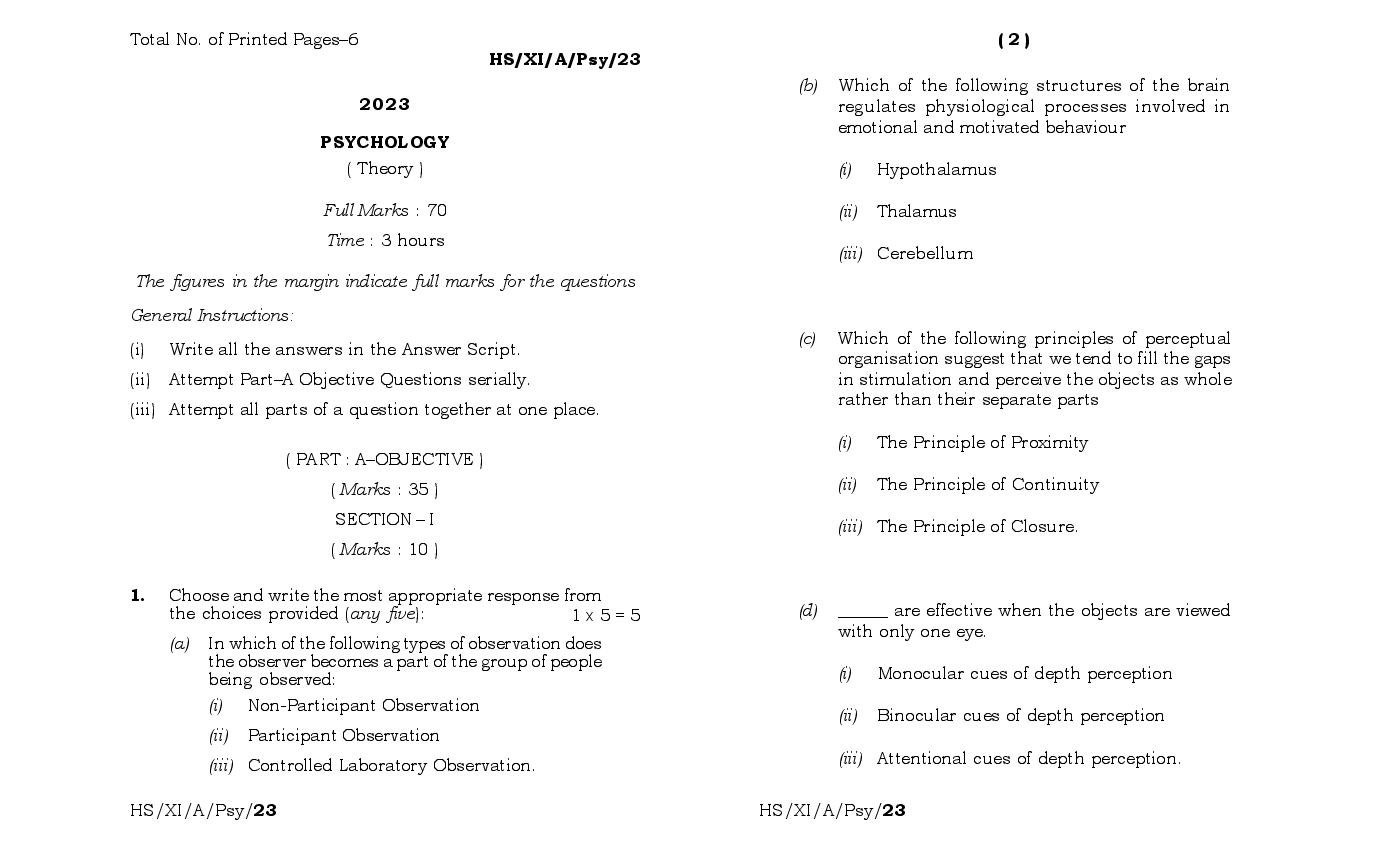
HS/XI/A/Psy/23
(b) Which of the following structures of the brain
2023 regulates physiological processes involved in
emotional and motivated behaviour
PSYCHOLOGY
( Theory ) (i) Hypothalamus
Full Marks : 70 (ii) Thalamus
Time : 3 hours
(iii) Cerebellum
The figures in the margin indicate full marks for the questions
General Instructions:
(c) Which of the following principles of perceptual
(i) Write all the answers in the Answer Script.
organisation suggest that we tend to fill the gaps
(ii) Attempt Part–A Objective Questions serially. in stimulation and perceive the objects as whole
rather than their separate parts
(iii) Attempt all parts of a question together at one place.
(i) The Principle of Proximity
( PART : A–OBJECTIVE )
( Marks : 35 ) (ii) The Principle of Continuity
SECTION – I (iii) The Principle of Closure.
1. Choose and write the most appropriate response from
the choices provided (any five): 1x5=5 (d) ______ are effective when the objects are viewed
with only one eye.
(a) In which of the following types of observation does
the observer becomes a part of the group of people
being observed: (i) Monocular cues of depth perception
(i) Non-Participant Observation
(ii) Binocular cues of depth perception
(ii) Participant Observation
(iii) Controlled Laboratory Observation. (iii) Attentional cues of depth perception.
HS/XI/A/Psy/23 HS/XI/A/Psy/23
Page 2
(e) It is a tendency of a person to solve problems by SECTION – II
following already tried mental operations or steps
(i) Mental set
3. Answer the following questions in one or two sentences
(ii) Motivation only . (Any five). 2 x 5 = 10
(iii) Problem solving. (a) What is Environmental Psychology?
(b) What is Psychology?
(f) Hunger, thirst and sex are ______ (c) What are illusions?
(i) Psychosocial Motives (d) What is problem solving?
(ii) Biological Motives (e) What is Emotion?
(iii) Acquired Motives.
(f) What is Motivation?
(g) What is Approach-approach conflict?
2. State whether the following statements are True or
False. 1x5=5
SECTION – III
(a) Experiments are generally conducted to establish
cause-effect relationship. ( Marks : 15 )
(b) Motion parallax is a binocular cue of depth
perception. 4. Answer the following questions in three or four
sentences only (any five). 3 x 5 = 15
(c) The principles of learning can be applied in child
(a) What is observation? Distinguish between
rearing.
naturalistic and controlled observation.
(d) Retrieval is the second stage of memory.
(b) Give any three reasons for smoking and drug use
(e) J. P. Guilford proposed three types of thinking. among adolescents.
HS/XI/A/Psy/23 HS/XI/A/Psy/23
Page 3
(c) Differentiate between continuous reinforcement (e) Distinguishing features of learning.
and partial reinforcement.
(f) Observational learning.
(d) What are the different methods used in studying
(g) Mnemonics for improving memory.
Verbal Learning.
(h) Maslow’s Hierarchy of Needs.
(e) What is short-term memory? How long are
information held in short-term memory?
(f) Who made the first systematic attempt to 6. Answer the following questions in 200 words
understand the nature of forgetting? What are (any three): 5 x 3 = 15
the two main causes of forgetting.
(a) Briefly explain how Philosophy, Medicine and
(g) Distinguish between convergent and divergent Computer Science is link to the field of
thinking. psychology.
(b) Name the four lobes of the Cerebral Cortex. What
functions do they perform.
PART B – DESCRIPTIVE (c) Briefly explain how parents, peer groups and
schools influences children’s social development.
( Marks : 35 )
(d) Give a brief account of the evolution of
5. Write short notes on any 5 (five) of the following. Psychology.
4 x 5 = 20
(a) Goals of Scientific Enquiry.
(b) Ethical principles (any two) in the conduct of
psychological enquiry.
(c) Factors that influence the formation of identity
during adolescence.
(d) Selective Attention theory by Broadbent (1956)
and Triesman (1962).
HS/XI/A/Psy/23 HS/XI/A/Psy/23
Document Details
| Board / Org | Meghalaya Board |
| Exam | Class 11 |
| Type | Question Paper |
| Pages | 3 |
| Updated | 22 Jul 2026 |