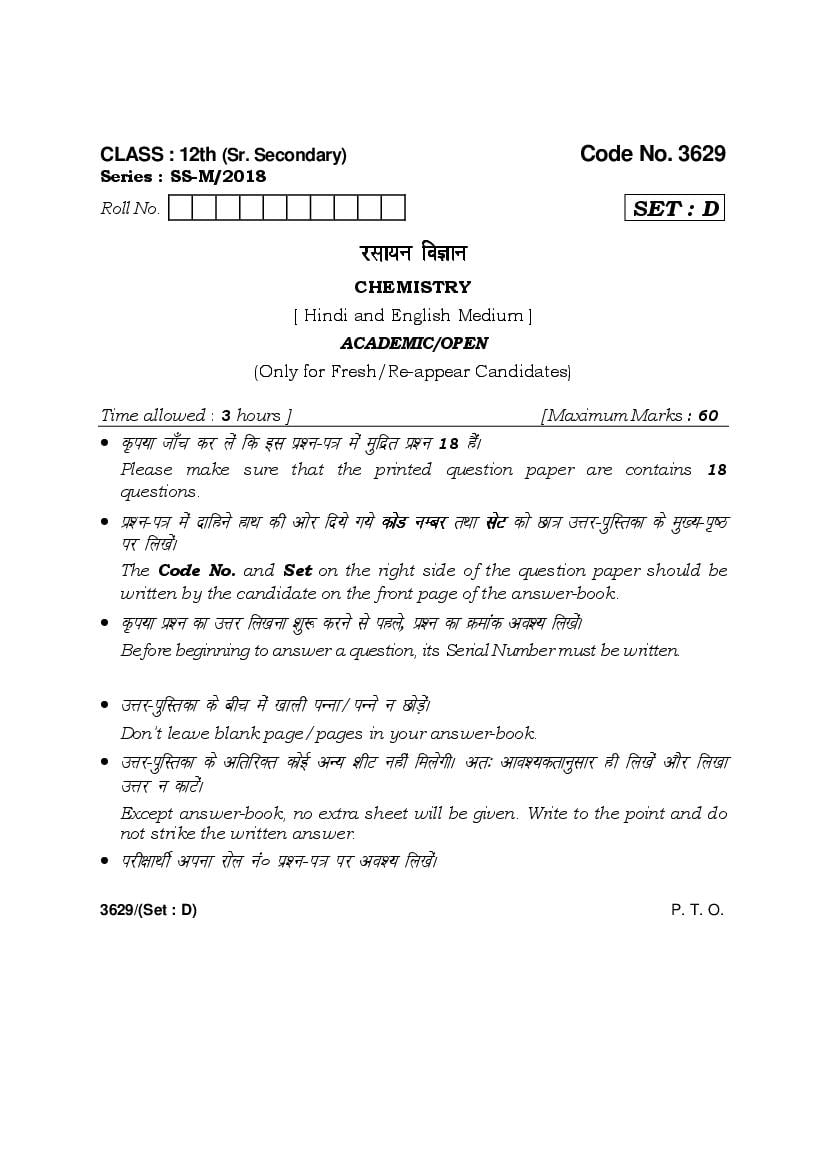
HBSE Class 12 Chemistry Question Paper 2018 Set D
Finished viewing? Save it for later —
Download HBSE Class 12 Chemistry Question Paper 2018 Set D (PDF · 13 pages)About HBSE Class 12 Chemistry Question Paper 2018 Set D
HBSE Class 12 Chemistry Question Paper 2018 Set D is available here for free download. Published by Haryana Board for Class 12, this question paper can be viewed online or downloaded as a PDF (13 pages). Candidates preparing for Class 12 can use HBSE Class 12 Chemistry Question Paper 2018 Set D to understand the exam pattern, the type of questions asked, and the overall difficulty level.
Frequently Asked Questions
How can I download HBSE Class 12 Chemistry Question Paper 2018 Set D?
Open this page and click the Download button to save HBSE Class 12 Chemistry Question Paper 2018 Set D as a PDF. It is completely free on AglaSem Docs.
Is HBSE Class 12 Chemistry Question Paper 2018 Set D free to download?
Yes. HBSE Class 12 Chemistry Question Paper 2018 Set D can be viewed online and downloaded as a PDF free of cost on AglaSem Docs.
How many pages does HBSE Class 12 Chemistry Question Paper 2018 Set D have?
HBSE Class 12 Chemistry Question Paper 2018 Set D contains 13 pages, which you can read online or download together as a single PDF.
Where can I find more Class 12 study material?
You can find more Class 12 question papers, sample papers, syllabus, and answer keys on AglaSem Docs.
HBSE Class 12 Chemistry Question Paper 2018 Set D – Text
Read the full text of this question paper below — useful to quickly search, copy and reference the content online without downloading the PDF.
📄 View text version (13 pages)
Page 1
Series : SS-M/2018
Roll No. SET : D
jlk;u foKku
CHEMISTRY
[ Hindi and English Medium ]
ACADEMIC/OPEN
(Only for Fresh/Re-appear Candidates)
Time allowed : 3 hours ] [ Maximum Marks : 60
• d`i;k tk¡p dj ysa fd bl iz'u-i= esa eqfnzr iz'u 18 gSaA
Please make sure that the printed question paper are contains 18
questions.
• iz'u-i= esa nkfgus gkFk dh vksj fn;s x;s dksM uEcj rFkk lsV dks Nk= mÙkj-iqfLrdk ds eq[;-i`"B
ij fy[ksaA
The Code No. and Set on the right side of the question paper should be
written by the candidate on the front page of the answer-book.
• d`i;k iz'u dk mÙkj fy[kuk 'kq: djus ls igys] iz'u dk Øekad vo'; fy[ksaA
Before beginning to answer a question, its Serial Number must be written.
• mÙkj-iqfLrdk ds chp esa [kkyh iUuk / iUus u NksMsa+A
Don’t leave blank page / pages in your answer-book.
• mÙkj-iqfLrdk ds vfrfjDr dksbZ vU; 'khV ugha feysxhA vr% vko';drkuqlkj gh fy[ksa vkSj fy[kk
mÙkj u dkVsaA
Except answer-book, no extra sheet will be given. Write to the point and do
not strike the written answer.
• ijh{kkFkhZ viuk jksy ua0 iz'u-i= ij vo'; fy[ksaA
3629/(Set : D) P. T. O.
Page 2
Candidates must write their Roll Number on the question paper.
• d`i;k iz'uksa dk mÙkj nsus lss iwoZ ;g lqfuf'pr dj ysa fd iz'u-i= iw.kZ o lgh gS] ijh{kk ds
mijkUr bl lEcU/k esa dksbZ Hkh nkok Lohdkj ugha fd;k tk;sxkA
Before answering the question, ensure that you have been supplied the
correct and complete question paper, no claim in this regard, will be
entertained after examination.
lkekU; funs
funsZ'k %
(i) LkHkh iz'u vfuok;Z gSaA
(ii) izR;sd iz'u ds vad mlds lkeus n'kkZ, x, gSaA
(iii) ç'u la[;k 1 esa ckjg (i - xii) cgqfodYih; iz'u gSAa izR;sd 1 vad dk gSA ftuds lgh
mÙkj viuh mÙkj&iqfLrdk esa fy[kus gSaA
(iv) ç'u la[;k 2 ls 10 rd vfry?kq mÙkjh; ç'u gSaA çR;sd 2 vadksa dk gSA izR;sd iz'u
dk mÙkj yxHkx 30 'kCnksa esa nhft,A
(v) ç'u la[;k 11 ls 15 rd y?kq mÙkjh; ç'u gSaA çR;sd ç'u 3 vadksa dk gSA izR;sd iz'u
dk mÙkj yxHkx 40 'kCnksa esa nhft,A
(vi) ç'u la[;k 16 ls 18 rd nh?kZ mÙkjh; ç'u gSaA çR;sd ç'u 5 vadksa dk gSA izR;sd
iz'u dk mÙkj yxHkx 70 'kCnksa esa nhft,A
(vii) iz'u-i= esa lexz :i ls dksbZ fodYi ugha gSA rFkkfi 5 vadksa okys lHkh nh?kZ mÙkjh;
iz'uksa esa vkarfjd p;u iznku fd;k x;k gSA ,sls iz'uksa esa ls vkidks dsoy ,d gh iz'u
djuk gSA
General Instructions :
(i) All questions are compulsory.
(ii) Marks for each question are indicated against it.
(iii) Question Number 1 consists of twelve (i-xii) multiple choice questions
carrying 1 mark each. Candidates have to write the correct answer
in their answer-book.
3629/(Set : D)
Page 3
(iv) Question Numbers 2 to 10 are very short answer type questions of 2
marks each. Answer these in about 30 words each.
(v) Question Numbers 11 to 15 are short answer type questions of 3
marks each. Answer these in about 40 words each.
(vi) Question Numbers 16 to 18 are long answer type questions of 5
marks each. Answer these in about 70 words each.
(vii) There is no over all choice. However, internal choice is given in all
long answer type questions of 5 marks each. You have to attempt
only one of the given choice in such questions.
1. (i) izFke dksfV dh vfHkfØ;k dh v)Zvk;q fuHkZj djrh gS % 1
(A) vfHkdkjdksa dh lkUnzrk ij
(B) mRiknksa dh lkUnzrk ij
(C) vfHkfØ;k osx fLFkjkad ij
(D) dksbZ Hkh ugha
Halflife period of a first order reaction depends upon :
(A) Concentration of reactants
(B) Concentration of products
(C) Rate constant of reaction
(D) None of these
(ii) fuEu esa ls dkSu-lk lcls izcy vEy gS \ 1
3629/(Set : D) P. T. O.
Page 4
(A) HClO (B) HClO 3
(C) HClO 4 (D) HClO 2
In the following strongest acid is :
(A) HClO (B) HClO 3
(C) HClO 4 (D) HClO 2
(iii) fuEufyf[kr esa ls dkSu jaxhu gS \ 1
(A) Cu2Cl 2 (B) [Sc (H 2O )6 ] 3+
(C) [Zn (H 2O )6 ]2+ (D) [Ti (H 2O )6 ]3+
Which one is coloured ?
(A) Cu2Cl 2 (B) [Sc (H 2O )6 ] 3+
(C) [Zn (H 2O )6 ]2+ (D) [Ti (H 2O )6 ]3+
(iv) leijklkjh foy;uksa esa leku gksrk gS % 1
(A) lkanzrk (B) ijklj.k nkc
(C) i`"Bh; ruko (D) ';kurk
Isotonic solutions are the solutions having same :
(A) Concentration (B) Osmotic pressure
(C) Surface tension (D) Viscosity
3629/(Set : D)
Page 5
(v) izFke dksfV dh vfHkfØ;k ds osx fLFkjkad dh bdkbZ gS % 1
(A) le; −1 (B) lkUnzrk −1 le; −1
(C) lkUnzrk 2 le; −2 (D) dksbZ Hkh ugha
The units of rate constant for first order reaction is :
(A) Time −1
(B) Concentration −1 Time −1
(C) Concentration2 Time–2
(D) None of these
(vi) 'kq) ty dh eksyyrk gS % 1
(A) 20 (B) 18
(C) 10 (D) 55.5
The molality of pure water is :
(A) 20 (B) 18
(C) 10 (D) 55.5
Cl
(vii)
SO3H ;kSfxd dk IUPAC uke fyf[k,A 1
Cl
Write IUPAC name of Compound.
SO3H
CHCl2
3629/(Set : D) P. T. O.
Page 6
H 2O
(viii) vfHkfØ;k esa → P , mRikn P gS % 1
373 K
CHO
CH3
(A) (B)
CHCl2
CH2OH
(C) (D) OH
H 2O
In the following reaction, product P is
CHCl → P:
2 373 K
CHO
CH3
(A) (B)
CHCl2
CH2OH
(C) (D) OH
(ix) [Co (NH 3 )4Cl2 ]NO2 o [Co (NH 3 )4ClNO2 ]Cl dkSu- ls leko;oh gS \
1
(A) vk;uu (B) c/kuh
(C) izdkf'kd (D) T;kfefr
Which type of Isomerism present in [Co (NH 3 )4Cl2 ]NO2 and
[Co (NH 3 )4ClNO2 ]Cl :
(A) Ionic (B) Linkage
3629/(Set : D)
Page 7
(C) Optical (D) Geometrical
(x) vfHkfØ;k dks iwjk dhft, % 1
373K
C 2H 5OC 2H 5 + 2HI
→
Completes the reaction :
373K
C 2H 5OC 2H 5 + 2HI
→
(xi) fuEufyf[kr ;kSfxdksa dks muds vEy lkeF;Z ds c<+rs Øe esa fyf[k, %
1
(A) CH 3OH (B) C 2H 5OH
(C) QhukWy (D) p - ukbVªksQhukWy
Arrange the following in order of increasing their Acidic strength :
(A) CH 3OH (B) C 2H 5OH
(C) Phenol (D) p - Nitrophenol
(xii) fuEufyf[kr esa ls fdl ldqay vk;u ds /kkrq dh vkWDlhdj.k voLFkk 'kwU; gS \
1
(A) [Cr (H 2O )6 ] 3+ (B) [CuCl 4 ]2−
(C) [Fe (CO )5 ] (D) [Fe (CN )6 ]3−
In the following in which metal of complex ion has zero oxidation
number ?
3629/(Set : D) P. T. O.
Page 8
(A) [Cr (H 2O )6 ] 3+
(B) [CuCl 4 ] 2−
(C) [Fe (CO )5 ] (D) [Fe (CN )6 ]3−
2. izfrtSfod fdls dgrs gSa \ nks mnkgj.k nhft,A 2
What is meant by the term antibiotics ? Give two examples.
3. X vkSj Y feydj cus ;kSfxd ds fØLVy dh ?kuh; lajpuk esa X ?ku ds dksuksa ij o Y lHkh
Qydksa ds dsUnz ij mifLFkr gSA ;kSfxd dk lw= Kkr dhft,A 2
A cubic unit cell made up of X and Y elements. If X present on the
corners of the cube and Y are present on centers of faces, of cube then
find formula of the compound.
4. v/kZpkyd D;k gksrs gSa \ bUgsa fdl izdkj oxhZÑr fd;k tkrk gS \ 2
What are semiconductors ? How are they classified ?
5. fuEu inksa dks ifjHkkf"kr dhft, % 2
(i) okUV gkWQ xq.kkad
(ii) eksyjrk
Define the following terms :
(i) Van't Hoff factor
(ii) Molarity
6. lfØ;.k ÅtkZ dk egÙo le>kb,A 2
3629/(Set : D)
Page 9
Explain the importance of Activation Energy.
7. ukbykWu 6, 6 o ukbykWu - 6 cgqydksa esa foHksn le>kb,A 2
Explain the difference between polymer nylon 6,6 and nylon 6.
8. b±/ku lsy fdls dgrs gS \ ,d mi;ksx fyf[k,A 2
Define fuel cell ? Give one use.
9. fuEu lsy dk E o MF Kkr dhft, % 2
Cu |Cu 2+ Ag + | Ag
;fn E o Cu 2+ Cu = +0.34V
E o Ag / Ag + = −.80 V gSA
Calculate E o MF of the following cell :
Cu |Cu 2+ Ag + | Ag
Given is E o Cu 2+ Cu = +0.34V
E o Ag / Ag + = −.80 V
10. ,FkkWDlh,Fksu ty esa ?kqyu'khy gSA le>kb,A 2
How do you account for the miscibility of Ethoxy ethane in water ?
3629/(Set : D) P. T. O.
Page 10
11. α -Xywdksl vkSj β -Xywdksl esa fo'ks"kr% D;k varj gS \ Xywdksl dh ik;jSuksl lajpuk ls D;k
rkRi;Z gS \ 3
What is essentially the difference between α - glucose and β -glucose ?
What is meant by pyronose structure of glucose ?
12. izfrLFkkiu vfHkfØ;kvksa dh SN 1 vkSj SN 2 fØ;kfof/k;ksa ds chp vki dSls varj djsaxsa \
izR;sd izdkj dk ,d-,d mnkgj.k nhft,A 3
How would you differentiates between S 1 and SN 2 Mechanisms of
N
substitutions reactions ? Give one example of each.
13. fVUMy izHkko dh foospuk dhft,A 3
Discuss the Tyndall effect.
14. fuEu dks Li"V dhft, % 3
(i) ,yqehuk ds oS|qr vi?kVu esa Øk;ksykbV dk dk;Z
(ii) fudy /kkrq ds ifj"dj.k esa CO (dkcZu eksuksvkWDlkbM) dk dk;Z
Explain the role of :
(i) Cryolite in the electrolytic reduction of alumina
(ii) Carbon monoxide in the purification of nickel.
15. fuEufyf[kr vfHkfØ;kvksa ds fy, jklk;fud lehdj.k nsdj fyf[k,A 3
(i) xkVjeku vfHkfØ;k
3629/(Set : D)
Page 11
(ii) dkfcZy,sehu vfHkfØ;k
(iii) veksuhvi?kVu
Give chemical equations for the following reactions :
(i) Gatterman Reaction
(ii) Carbylamine reaction
(iii) Ammonolysis
16. fuEufyf[kr dh O;k[;k dhft, %
(a) NH 3 dh vis{kk BiH 3 ,d izcy vipk;d gSA 3
(b) mRÑ"V xSls vf/kdrj vfØ; gSa] D;ksa \ 2
Explain the following :
(a) BiH 3 is a stronger reducing agent as compare of NH 3 .
(b) Noble gases are mostly inert, why ?
vFkok
OR
(a) vkWDlhtu ds vlkekU; xq.kksa dh O;k[;k dhft,A 3
(b) PH 3 dh DoFkukad NH 3 ls de gS] Li"V dhft,A 2
(a) Explain the Anamalous properties of Oxygen.
(b) PH 3 has lower boiling point than NH 3 , Explain.
17. (a) vEyh; K 2Cr2O7 fuEu ls vfHkfØ;k djsxk rks D;k gksxk \ 3
3629/(Set : D) P. T. O.
Page 12
(i) H 2S
(ii) KI
(iii) FeSO 4
(b) laØe.k /kkrq,¡ varjkdk'kh ;kSfxd cukrh gS] Li"V dhft,A 2
(a) What happens when acidified K 2Cr2O 7 is reacted with ?
(i) H 2S
(ii) KI
(iii) FeSO 4
(b) Transition Metals are form Interstitial compounds Explain.
vFkok
OR
ik¡¡p mi;ksxksa dh foospuk dhft,A
d-,oa f-Cykd rÙoksa ds ik 5
Discuss five uses of d and f-block elements.
18. (a) fuEufyf[kr vEyksa dks vEyrk dh rqyuk dhft,A 3
(i) CH 3COOH
(ii) HCOOH
(iii) C 6H 5COOH
(b) fuEu vfHkfØ;kvksa ds eq[; mRikn fyf[k, % 2
CO , HCl
(i) →
Anhyd . AlCl 3
COCl
3629/(Set : D)
Page 13
H2
(ii) →
Pd − BaSO 4
(a) Compare the acidic strength of following acids :
(i) CH 3COOH
(ii) HCOOH
(iii) C 6H 5COOH
(b) Write the major products in the following reactions :
CO , HCl
(i) →
Anhyd . AlCl 3
COCl
H2
(ii) →
Pd − BaSO 4
vFkok
OR
fuEu dk o.kZu dhft, % 11 +2+11
2 2
(i) oksYQ-fd'uj vip;u
(ii) Økl ,sYMksy la?kuu
(iii) LVhQsu vfHkfØ;k
Describe the following :
(i) Wolff-Kishner reduction
(ii) Cross Aldol condensation
(iii) Stephen reaction
S
3629/(Set : D) P. T. O.
Document Details
| Board / Org | Haryana Board |
| Exam | Class 12 |
| Type | Question Paper |
| Pages | 13 |
| Updated | 22 Jul 2026 |