MBOSE Class 11 Question Paper 2023 for Sociology
Finished viewing? Save it for later —
Download MBOSE Class 11 Question Paper 2023 for Sociology (PDF · 4 pages)About MBOSE Class 11 Question Paper 2023 for Sociology
MBOSE Class 11 Question Paper 2023 for Sociology is available here for free download. Published by Meghalaya Board for Class 11, this question paper can be viewed online or downloaded as a PDF (4 pages). Candidates preparing for Class 11 can use MBOSE Class 11 Question Paper 2023 for Sociology to understand the exam pattern, the type of questions asked, and the overall difficulty level.
Frequently Asked Questions
How can I download MBOSE Class 11 Question Paper 2023 for Sociology?
Open this page and click the Download button to save MBOSE Class 11 Question Paper 2023 for Sociology as a PDF. It is completely free on AglaSem Docs.
Is MBOSE Class 11 Question Paper 2023 for Sociology free to download?
Yes. MBOSE Class 11 Question Paper 2023 for Sociology can be viewed online and downloaded as a PDF free of cost on AglaSem Docs.
How many pages does MBOSE Class 11 Question Paper 2023 for Sociology have?
MBOSE Class 11 Question Paper 2023 for Sociology contains 4 pages, which you can read online or download together as a single PDF.
Where can I find more Class 11 study material?
You can find more Class 11 question papers, sample papers, syllabus, and answer keys on AglaSem Docs.
MBOSE Class 11 Question Paper 2023 for Sociology – Text
Read the full text of this question paper below — useful to quickly search, copy and reference the content online without downloading the PDF.
📄 View text version (4 pages)
Page 1
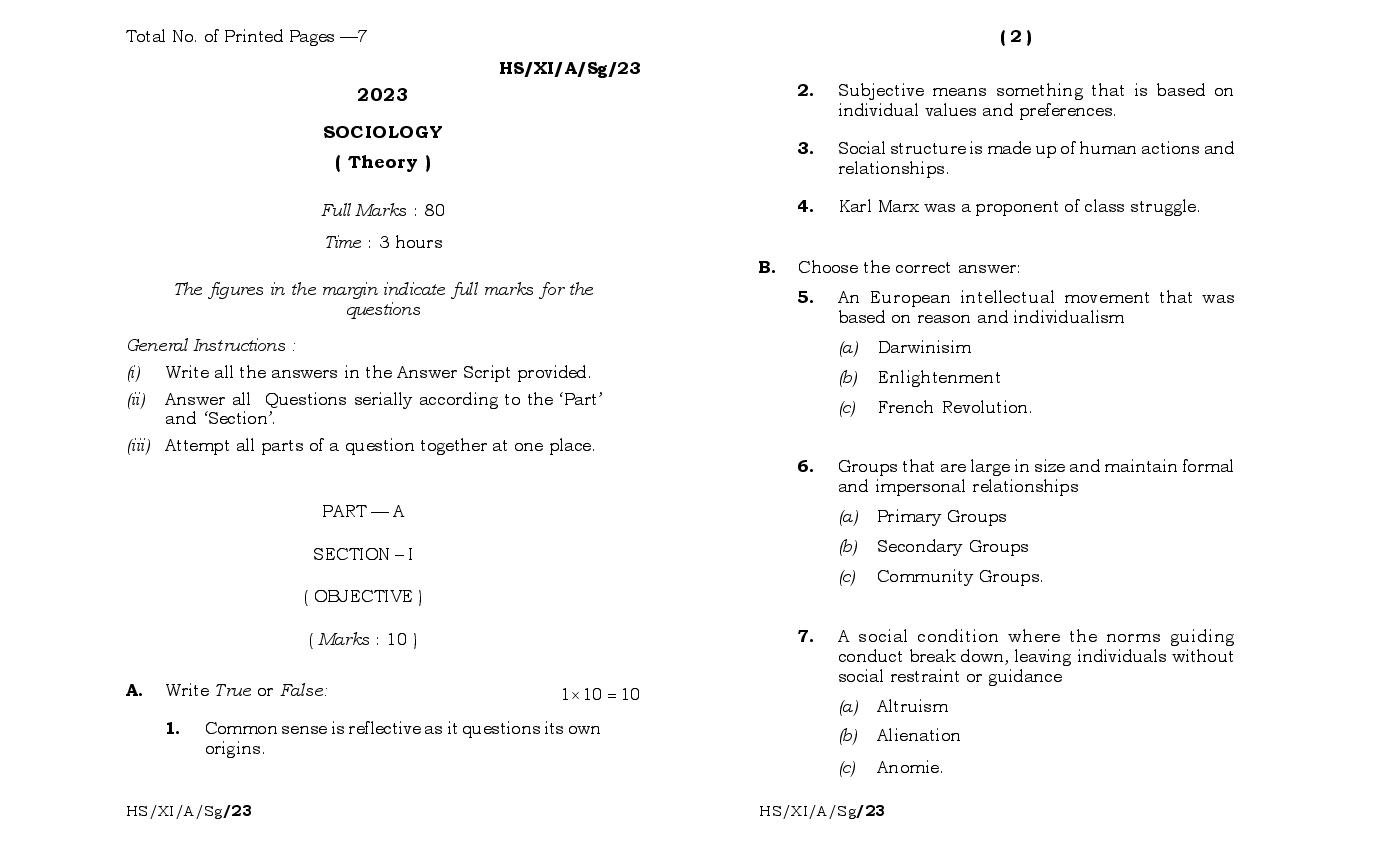
2023 2. Subjective means something that is based on
individual values and preferences.
SOCIOLOGY
3. Social structure is made up of human actions and
( Theory ) relationships.
Full Marks : 80 4. Karl Marx was a proponent of class struggle.
Time : 3 hours
B. Choose the correct answer:
The figures in the margin indicate full marks for the 5. An European intellectual movement that was
questions based on reason and individualism
General Instructions : (a) Darwinisim
(i) Write all the answers in the Answer Script provided. (b) Enlightenment
(ii) Answer all Questions serially according to the ‘Part’ (c) French Revolution.
and ‘Section’.
(iii) Attempt all parts of a question together at one place.
6. Groups that are large in size and maintain formal
and impersonal relationships
PART –– A (a) Primary Groups
SECTION – I (b) Secondary Groups
(c) Community Groups.
( OBJECTIVE )
( Marks : 10 ) 7. A social condition where the norms guiding
conduct break down, leaving individuals without
social restraint or guidance
A. Write True or False: 1 10 10
(a) Altruism
1. Common sense is reflective as it questions its own (b) Alienation
origins.
(c) Anomie.
HS/XI/A/Sg/23 HS/XI/A/Sg/23
Page 2
C. Fill in the blanks. 5. What is organic solidarity?
8. Authority is that form of power which is accepted
6. What is alienation according to Marx?
as .
7. Define structural change.
9. refers to understanding how we make
sense of all the information coming to us from 8. What are dominant castes?
our environment.
9. What were the main ideals of the French Revolution?
10. denotes the web of physical and
biological systems and processes of which humans
are one element. SECTION – I I I
( SHORT ANSWER )
SECTION – I I
( Marks : 28 )
( VERY SHORT ANSWER )
Answer the following questions in not more
( Marks : 18 ) than six sentences each. 4 7 28
Answer the following questions in not more than five 1. (a) Write on the relationship between Sociology and
sentences each. 2 9 18 History.
Or
(b) What is the difference between status and role?
1. What is ‘deviance’?
2. What is a family? 2. (a) How is ethnocentrism different from
cosmopolitanism?
3. What is law? Or
(b) What is the difference between polygyny and
4. What is an interview? polyandry?
HS/XI/A/Sg/23 HS/XI/A/Sg/23
Page 3
3. (a) Write on peer groups as an agency of socialisation. PART –– B
Or
( DESCRIPTIVE )
(b) What are the characteristics of religion?
( Marks : 24 )
Answer the following questions : 6 4 24
4. (a) What do you understand by Division of Labour?
Or
1. (a) What is a social group? What are the main
(b) What is social order?
characteristics of a social group?
Or
5. (a) What a note on slums. (b) Write a note on the Interview method.
Or
(b) What is gentrification?
2. (a) What are the main features of bureaucracy?
Or
6. (a) What is global warming? (b) Explain caste according to G. S. Ghurye.
Or
(b) Write a note on violence
3. (a) Write on the changes brought about by
technology and economy in society.
7. (a) What are social facts? Or
Or (b) Discuss the concept of village according to
(b) Write on the forms of social control. Srinivas.
HS/XI/A/Sg/23 HS/XI/A/Sg/23
Page 4
4. Read the following passage carefully and answer the
questions given below:
Most modern societies must also depend on some
form of power or coercion to ensure that institutions
and individuals conform to established social norms.
Power is usually defined as the ability to make others
do what you want regardless of what they themselves
want. When a relationship of power is stable and
settled, and the parties involved have become
accustomed to their relative positions, we have a
situation of domination. If a social entity (a person,
institution or group) is routinely or habitually in a
position of power, it is said to be dominant. In normal
times, dominant institutions, groups or individuals
exercise a decisive influence on society. It is not as
though they are never challenged, but this happens
only in abnormal or extraordinary times. Even though
it implies that people are being forced to do things
they don’t necessarily want to do, domination in normal
times can be quite smooth, in the sense of appearing
to be without friction or tension.
(i) What does most societies depend on? 1
(ii) How is power defined? 1
(iii) When do we have a situation of dominance? 1
(iv) What do dominant institutions exercise? 1
(v) When is dominance challenged? 1
(vi) How does dominance appear in normal times? 1
Document Details
| Board / Org | Meghalaya Board |
| Exam | Class 11 |
| Type | Question Paper |
| Pages | 4 |
| Updated | 22 Jul 2026 |