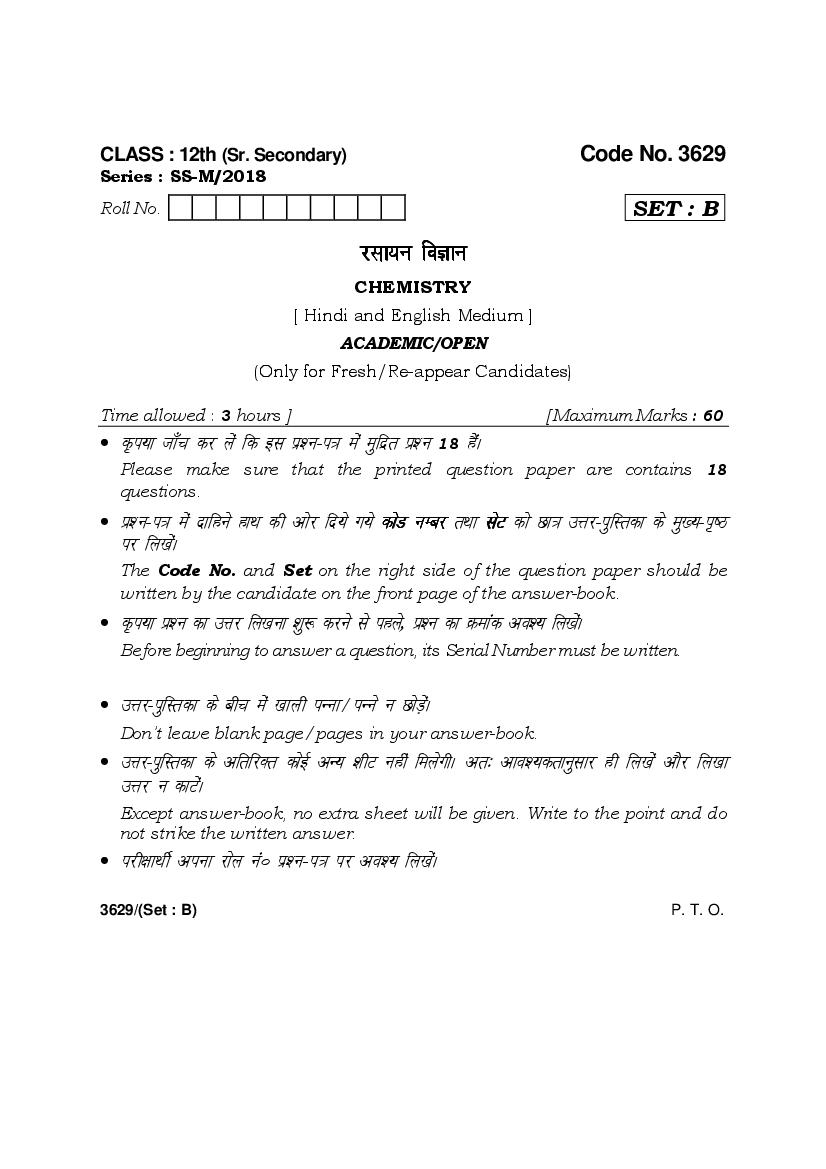
HBSE Class 12 Chemistry Question Paper 2018 Set B
Finished viewing? Save it for later —
Download HBSE Class 12 Chemistry Question Paper 2018 Set B (PDF · 13 pages)About HBSE Class 12 Chemistry Question Paper 2018 Set B
HBSE Class 12 Chemistry Question Paper 2018 Set B is available here for free download. Published by Haryana Board for Class 12, this question paper can be viewed online or downloaded as a PDF (13 pages). Candidates preparing for Class 12 can use HBSE Class 12 Chemistry Question Paper 2018 Set B to understand the exam pattern, the type of questions asked, and the overall difficulty level.
Frequently Asked Questions
How can I download HBSE Class 12 Chemistry Question Paper 2018 Set B?
Open this page and click the Download button to save HBSE Class 12 Chemistry Question Paper 2018 Set B as a PDF. It is completely free on AglaSem Docs.
Is HBSE Class 12 Chemistry Question Paper 2018 Set B free to download?
Yes. HBSE Class 12 Chemistry Question Paper 2018 Set B can be viewed online and downloaded as a PDF free of cost on AglaSem Docs.
How many pages does HBSE Class 12 Chemistry Question Paper 2018 Set B have?
HBSE Class 12 Chemistry Question Paper 2018 Set B contains 13 pages, which you can read online or download together as a single PDF.
Where can I find more Class 12 study material?
You can find more Class 12 question papers, sample papers, syllabus, and answer keys on AglaSem Docs.
HBSE Class 12 Chemistry Question Paper 2018 Set B – Text
Read the full text of this question paper below — useful to quickly search, copy and reference the content online without downloading the PDF.
📄 View text version (13 pages)
Page 1
Series : SS-M/2018
Roll No. SET : B
jlk;u foKku
CHEMISTRY
[ Hindi and English Medium ]
ACADEMIC/OPEN
(Only for Fresh/Re-appear Candidates)
Time allowed : 3 hours ] [ Maximum Marks : 60
• d`i;k tk¡p dj ysa fd bl iz'u-i= esa eqfnzr iz'u 18 gSaA
Please make sure that the printed question paper are contains 18
questions.
• iz'u-i= esa nkfgus gkFk dh vksj fn;s x;s dksM uEcj rFkk lsV dks Nk= mÙkj-iqfLrdk ds eq[;-i`"B
ij fy[ksaA
The Code No. and Set on the right side of the question paper should be
written by the candidate on the front page of the answer-book.
• d`i;k iz'u dk mÙkj fy[kuk 'kq: djus ls igys] iz'u dk Øekad vo'; fy[ksaA
Before beginning to answer a question, its Serial Number must be written.
• mÙkj-iqfLrdk ds chp esa [kkyh iUuk / iUus u NksMsa+A
Don’t leave blank page / pages in your answer-book.
• mÙkj-iqfLrdk ds vfrfjDr dksbZ vU; 'khV ugha feysxhA vr% vko';drkuqlkj gh fy[ksa vkSj fy[kk
mÙkj u dkVsaA
Except answer-book, no extra sheet will be given. Write to the point and do
not strike the written answer.
• ijh{kkFkhZ viuk jksy ua0 iz'u-i= ij vo'; fy[ksaA
3629/(Set : B) P. T. O.
Page 2
Candidates must write their Roll Number on the question paper.
• d`i;k iz'uksa dk mÙkj nsus lss iwoZ ;g lqfuf'pr dj ysa fd iz'u-i= iw.kZ o lgh gS] ijh{kk ds
mijkUr bl lEcU/k esa dksbZ Hkh nkok Lohdkj ugha fd;k tk;sxkA
Before answering the question, ensure that you have been supplied the
correct and complete question paper, no claim in this regard, will be
entertained after examination.
lkekU; funsZ'k %
(i) LkHkh iz'u vfuok;Z gSaA
(ii) izR;sd iz'u ds vad mlds lkeus n'kkZ, x, gSaA
(iii) ç'u la[;k 1 esa ckjg (i - xii) cgqfodYih; iz'u gSAa izR;sd 1 vad dk gSA ftuds lgh
mÙkj viuh mÙkj&iqfLrdk esa fy[kus gSaA
(iv) ç'u la[;k 2 ls 10 rd vfry?kq mÙkjh; ç'u gSaA çR;sd 2 vadksa dk gSA izR;sd iz'u
dk mÙkj yxHkx 30 'kCnksa esa nhft,A
(v) ç'u la[;k 11 ls 15 rd y?kq mÙkjh; ç'u gSaA çR;sd ç'u 3 vadksa dk gSA izR;sd iz'u
dk mÙkj yxHkx 40 'kCnksa esa nhft,A
(vi) ç'u la[;k 16 ls 18 rd nh?kZ mÙkjh; ç'u gSaA çR;sd ç'u 5 vadksa dk gSA izR;sd
iz'u dk mÙkj yxHkx 70 'kCnksa esa nhft,A
(vii) iz'u-i= esa lexz :i ls dksbZ fodYi ugha gSA rFkkfi 5 vadksa okys lHkh nh?kZ mÙkjh;
iz'uksa esa vkarfjd p;u iznku fd;k x;k gSA ,sls iz'uksa esa ls vkidks dsoy ,d gh iz'u
djuk gSA
General Instructions :
(i) All questions are compulsory.
(ii) Marks for each question are indicated against it.
(iii) Question Number 1 consists of twelve (i-xii) multiple choice questions
carrying 1 mark each. Candidates have to write the correct answer
in their answer-book.
3629/(Set : B)
Page 3
(iv) Question Numbers 2 to 10 are very short answer type questions of 2
marks each. Answer these in about 30 words each.
(v) Question Numbers 11 to 15 are short answer type questions of 3
marks each. Answer these in about 40 words each.
(vi) Question Numbers 16 to 18 are long answer type questions of 5
marks each. Answer these in about 70 words each.
(vii) There is no over all choice. However, internal choice is given in all
long answer type questions of 5 marks each. You have to attempt
only one of the given choice in such questions.
1. (i) dkSu lk foVkfeu ty esa foys; gS \ 1
(A) foVkfeu D (B) foVkfeu K
(C) foVkfeu E (D) foVkfeu B
Which Vitamin is soluble in water ?
(A) Vitamin D (B) Vitamin K
(C) Vitamin E (D) Vitamin B
(ii) ,d eksy MnO 4− dks Mn 2+ esa vipf;r djus ds fy, fdrus QSjkMs (F) dh
vko';drk gksxh \ 1
(A) 5F (B) 2F
(C) 1F (D) 7F
−
Number of Faradays (F) required to reduce 1 mole of MnO 4 into
Mn 2+ .
3629/(Set : B) P. T. O.
Page 4
(A) 5F (B) 2F
(C) 1F (D) 7F
(iii) fuEufyf[kr osx fLFkjkad ls vfHkfØ;k dh dksfV Kkr dhft,A
−4
K = 2.6 × 10 L Mol S −1 −1
% 1
(A) izFke (B) 'kwU;
(C) f}rh; (D) dksbZ Hkh ugha
Identify the order of Reaction from the given rate
constant K = 2.6 × 10 −4 L Mol −1S −1 :
(A) First (B) Zero
(C) Second (D) None of these
(iv) eksyj pkydrk dh bdkbZ gS % 1
(A) ohm −1 m 2 mol −1
(B) ohm m 2 mol −1
(C) ohm −1 m 2 mol
(D) ohm −2 m 2 mol −1
The units of molor conductivity are :
(A) ohm −1 m 2 mol −1
(B) ohm m 2 mol −1
(C) ohm −1 m 2 mol
3629/(Set : B)
Page 5
−2 2 −1
(D) ohm m mol
(v) fuEufyf[kr esa ls f}{kkjdh; vEy dkSu-lk gS \ 1
(A) H 3PO 4 (B) H 3PO3
(C) H 3PO2 (D) HClO 4
In the following which is dibasic acid ?
(A) H 3PO 4 (B) H 3PO3
(C) H 3PO2 (D) HClO 4
(vi) fuEufyf[kr esa izcyre vEy dkSu gS \ 1
(A) CH 3CH 2COOH (B) CH 3COOH
(C) C 6H 5COOH (D) C 6H 5CH 2COOH
In the following strongest acid is :
(A) CH 3CH 2COOH (B) CH 3COOH
(C) C 6H 5COOH (D) C 6H 5CH 2COOH
(vii) (CH 3CH 2 )2 NCH 3 ;kSfxd dk IUPAC uke fyf[k,A 1
Write IUPAC name of the compound (CH 3CH 2 )2 NCH 3 .
(viii) fuEu ,sfYdy gSykbMksa esa lcls de DoFkukad fdldk gksxk \ 1
(A) C 2H 5F (B) C 2H 5 I
(C) C 2H 5Cl (D) C 2H 5Br
In the given Alkyl halides which one has minimum boiling point ?
3629/(Set : B) P. T. O.
Page 6
(A) C 2H 5F (B) C 2H 5 I
(C) C 2H 5Cl (D) C 2H 5Br
(ix) fuEufyf[kr dks {kkjdh; izkcY; ds c<+rs Øe esa fyf[k, % 1
C 2H 5NH 2 , C 6H 5NH 2, (C 2H 5 )2 NH vkSj C 6H 5CH 2NH 2
Write the increasing of strongest basicity of the following :
C 2H 5NH 2 , C 6H 5NH 2, (C 2H 5 )2 NH and C 6H 5CH 2NH 2
H / Ni
(x) CH 3C ≡ N 2 → P, P D;k gS \ 1
(A) CH 3CH 2NC (B) CH 3CH 2NH 2
(C) CH 3NHCH 3 (D) CH 3NH 2
H / Ni
CH 3C ≡ N 2 → P, P will be ?
(A) CH 3CH 2NC (B) CH 3CH 2NH 2
(C) CH 3NHCH 3 (D) CH 3NH 2
(xi) fuEu esa ls dkSu-lk {kkjd RNA esa gS vkSj DNA esa ugha \
1
(A) ;wjsfly (B) lkbVkslhu
(C) Xokuhu (D) Fkk;ehu
Which base is present in RNA but not in DNA ?
(A) Uracil (B) Cytosine
(C) Guanine (D) Thymine
3629/(Set : B)
Page 7
(xii) jDr ds FkDds teus ds fy, dkSu lk foVkfeu gksrk gS \ 1
(A) foVkfeu B1 (B) foVkfeu D
(C) foVkfeu K (D) foVkfeu C
The Vitamin responsible for the coagulation of blood is :
(A) Vitamin B1 (B) Vitamin D
(C) Vitamin K (D) Vitamin C
2. czkWM LisDVªe izfrthok.kq vkS"k/k D;k gSa \ bldk ,d mnkgj.k dhft,A 2
What are broad spectrum drugs ? Give one example.
3. n -izdkj vkSj p - izdkj ds v/kZpkydksa ds vuqiz;ksx fyf[k,A 2
Give applications of n-type and p-type semiconductors.
4. fuEufyf[kr dh ifjHkk"kk nhft, %
(a) gsujh fu;e
(b) jkmYV fu;e 2
Define the following :
(a) Henry's Law
(b) Raoult's law
5. izfrpqcdRo o yksgpqEcdRo inkFkksZ dks ifjHkkf"kr dhft,A 2
Define Diamagnetic and Ferromagnetic substance.
3629/(Set : B) P. T. O.
Page 8
6. la{kkj.k fdls dgrs gSa \ bldh jksdFkke ds fy, nks mik; fyf[k, A 2
What is Corrosion ? Give two methods to prevent if.
7. C;wuk-N o C;quk-S ds ,dydksa ds e/; vUrj fyf[k,A 2
Differentiate between the monomers of Buna-N and Buna-S.
8. QhukWy] ,sFksuky ls vf/kd vEyh; gS] le>kb,A 2
Phenol is more acidic than Ethanol, explain.
9. ;fn 5.6 xzke KOH, 500 feyh0 foy;u esa ?kqyk gks] rks foy;u dh eksyjrk Kkr dhft,A
2
If 5.6 gm of KOH dissolved in 500 ml of solution, then what will the
molarity of the solution.
10. fuEufyf[kr dk :ikarj dSls djsaxs \ 2
(i) izksihu → izksisu – 2 – vkWy
(ii) csfUty DyksjkbM → csfUty ,sYdksgkWy
How would you convert the following :
(i) Propene to propan–2 –Ol
(ii) Benzyl Chloride to Benzyl alcohol.
11. fuEufyf[kr milgla;kstu ;kSfxdksa ds IUPAC uke fyf[k, % 3
(i) [Co (NH 3 )5 Br ]SO4
(ii) K 3 [Fe (CN )6 ]
(iii) [
K 3 Cr (C 2O 4 )3 ]
3629/(Set : B)
Page 9
Write IUPAC names of following coordinate compounds :
(i) [Co (NH 3 )5 Br ]SO4
(ii) K 3 [Fe (CN )6 ]
(iii) [
K 3 Cr (C 2O 4 )3 ]
12. v;Ldksa ds lkanz.k ds fy, Qsu Iyou fo/kh dh foospuk dhft,A 3
Discuss froth floatation process for the concentration of ores.
13. fuEufyf[kr ds lkFk QhukWy dh vfHkfØ;k ds fy, lehdj.k fyf[k, % 3
(i) Br2 ty
(ii) CHCl3 + NaOH
(iii) Na 2Cr2O7 + lkUnz H 2SO 4
Write the Equations for the reaction of phenol with the following :
(i) Br2 Water
(ii) CHCl3 + NaOH
(iii) Na 2Cr2O7 + Conc . H 2SO 4
14. fuEu inksa dks ifjHkkf"kr dhft, % 3
3629/(Set : B) P. T. O.
Page 10
(i) vfHkfØ;k dh v/kkZ;q
(ii) la?kuu vko`fÙk
(iii) lfØ;.k ÅtkZ
Define the following terms :
(i) Half life period of reaction
(ii) Condensation frequency
(iii) Activation energy
15. czkmuh xfr dh foospuk dhft,A 3
Discuss the Brownian movement.
16. fuEu dk o.kZu dhft, % 21 ×2=5
2
(i) LVhQsu vfHkfØ;k
(ii) jkstsueqaM vip;u
Describe the following :
(i) Stephen reaction
(ii) Rosenmund reduction
vFkok
OR
csUthu dks fuEufyf[kr esa ifjofrZr dhft, % 1+2+2=5
(i) cSUtSfYMgkbM
3629/(Set : B)
Page 11
(ii) Qsfuy,slhfVd vEy
(iii) esfFky csUtks,V
Convert benzene into :
(i) Benzaldehyde
(ii) Phenyl acetic acid
(iii) Methyl benzoate
17. (a) fuEu v.kqvksa dh lajpuk,¡ jsf[kr dhft, % 2 + 2 + 1 = 5
(i) XeF2
(ii) BrF3
(b) 'osr QkLQksjl vkSj yky QkLQksjl dh lajpuk dk vUrj fyf[k,A
(c) H 2O , H 2S , H 2Te o H 2Sc dks c<+rh gqbZ vEyrk vuqlkj O;ofLFkr dhft,A
(a) Draw the structures of the following :
(i) XeF2
(ii) BrF3
(b) Write the structural difference between white phosphorus and red
phosphorus.
(c) H 2O , H 2S , H 2Te and H 2Sc Arrange these in increasing their
acidic character.
vFkok
OR
fuEu ds vk/kkj ewy dkj.k fyf[k, % 2+2+1
3629/(Set : B) P. T. O.
Page 12
(i) PH 3 dh vis{kk NH 3 vf/kd izcy {kkj gSA
(ii) F2 dh cU/k fo;kstu ÅtkZ Cl 2 dh cU/k fo;kstu ÅtkZ ls de gksrh gSA
(iii) AsH 3 , NH 3 , PH 3 o BiH 3 dks c<+rs gq, DoFkukad ds vuqlkj O;ofLFkr dhft,A
Account for the following :
(i) NH 3 is a stronger base than PH 3 .
(ii) Bond dissociation energy of F2 is less than that of Cl 2 .
(iii) AsH 3 , NH 3 , PH 3 p and BiH 3 Arrange these in order of increasing
their boiling points.
18. ikSVsf'k;e ijesaxusV cukus dk o.kZu dhft,A vEyh; KMnO4 fuEu ds lkFk fdl izdkj
vfHkfØ;k djsxk] vk;fud lehdj.k fyf[k,A 5
(i) SO2
(ii) vkWDlSfyd vEy
(iii) FeSO 4
Describe the preparation of potassium permanganate. How does
acidified KMnO4 solution react with :
(i) SO2
(ii) Oxalic acid
(iii) FeSO 4
Write ionic equations for these reactions.
vFkok
OR
(a) bysDVªkWfud foU;kl fyf[k, % 3
2+
(i) Fe
3629/(Set : B)
Page 13
(ii) Cr
(iii) Mn 2+
(b) laØe.k /kkrq vrajkdk'kh ;kSfxd D;ksa cukrs gSa \ 2
(a) Write Electronic configurations of :
(i) Fe 2+
(ii) Cr
(iii) Mn 2+
(b) Why transition metals form interstitial compounds ?
S
3629/(Set : B) P. T. O.
Document Details
| Board / Org | Haryana Board |
| Exam | Class 12 |
| Type | Question Paper |
| Pages | 13 |
| Updated | 22 Jul 2026 |