MBOSE Class 12 Question Paper 2020 for Geology
Finished viewing? Save it for later —
Download MBOSE Class 12 Question Paper 2020 for Geology (PDF · 8 pages)About MBOSE Class 12 Question Paper 2020 for Geology
MBOSE Class 12 Question Paper 2020 for Geology is available here for free download. Published by Meghalaya Board for Class 12, this question paper can be viewed online or downloaded as a PDF (8 pages). Candidates preparing for Class 12 can use MBOSE Class 12 Question Paper 2020 for Geology to understand the exam pattern, the type of questions asked, and the overall difficulty level.
Frequently Asked Questions
How can I download MBOSE Class 12 Question Paper 2020 for Geology?
Open this page and click the Download button to save MBOSE Class 12 Question Paper 2020 for Geology as a PDF. It is completely free on AglaSem Docs.
Is MBOSE Class 12 Question Paper 2020 for Geology free to download?
Yes. MBOSE Class 12 Question Paper 2020 for Geology can be viewed online and downloaded as a PDF free of cost on AglaSem Docs.
How many pages does MBOSE Class 12 Question Paper 2020 for Geology have?
MBOSE Class 12 Question Paper 2020 for Geology contains 8 pages, which you can read online or download together as a single PDF.
Where can I find more Class 12 study material?
You can find more Class 12 question papers, sample papers, syllabus, and answer keys on AglaSem Docs.
MBOSE Class 12 Question Paper 2020 for Geology – Text
Read the full text of this question paper below — useful to quickly search, copy and reference the content online without downloading the PDF.
📄 View text version (8 pages)
Page 1
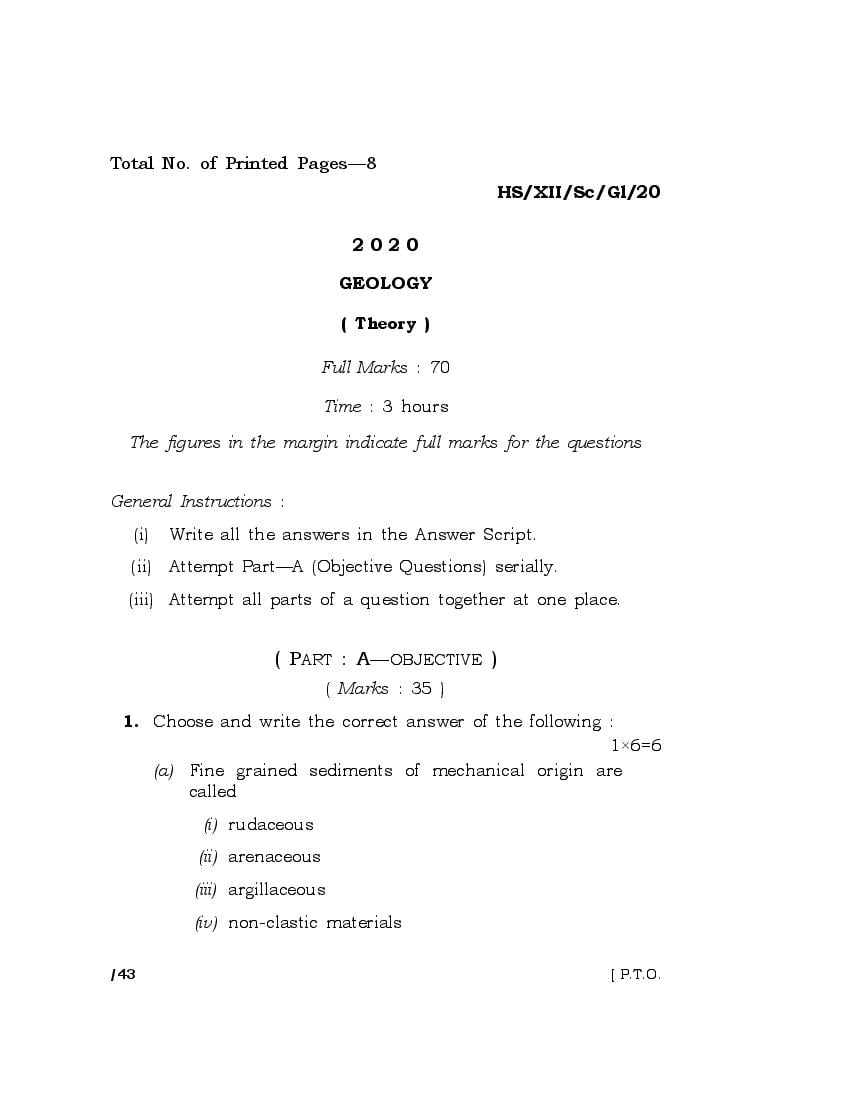
HS/XII/Sc/Gl/20
2020
GEOLOGY
( Theory )
Full Marks : 70
Time : 3 hours
The figures in the margin indicate full marks for the questions
General Instructions :
(i) Write all the answers in the Answer Script.
(ii) Attempt Part—A (Objective Questions) serially.
(iii) Attempt all parts of a question together at one place.
( PART : A—OBJECTIVE )
( Marks : 35 )
1. Choose and write the correct answer of the following :
1×6=6
(a) Fine grained sediments of mechanical origin are
called
(i) rudaceous
(ii) arenaceous
(iii) argillaceous
(iv) non-clastic materials
/43 [ P.T.O.
Page 2
(b) Pick the odd one out from the following.
(i) Brachiopod
(ii) Lamellibranch
(iii) Gastropod
(iv) Cephalopod
(c) Daonella shales belong to
(i) Vindhyan supergroup
(ii) Paleozoic rocks of spiti
(iii) Tertiary rocks of Upper Assam
(iv) Cretaceous rocks of Meghalaya
(d) The Khetri Belt in Rajasthan is famous for the
occurrence of economic deposits of
(i) iron
(ii) copper
(iii) chromite
(iv) mica
HS/XII/Sc/Gl/20/43 [ Contd.
Page 3
(e) The main or primary cause of landslide is
(i) nature of material
(ii) water
(iii) deforestation
(iv) earthquake
(f) Ore deposits that form after the formation of the
enclosing rocks are
(i) syngenetic
(ii) epigenetic
(iii) exogenetic
(iv) endogenetic
2. State whether the following sentences are ‘True’
or ‘False’ : 1×6=6
(a) Limestone is a non-clastic rock.
(b) Lamellibranchs are bivalved and the two valves are
called the ventral and dorsal valves.
(c) Gondwana rocks are also observed in Meghalaya.
(d) Oxidation and supergene enrichment leads to the
formation of sulphide ore deposits.
(e) Unconformity is a structural trap for petroleum.
(f) Dolomites and marbles are good foundation rocks
for dams.
HS/XII/Sc/Gl/20/43 [ P.T.O.
Page 4
3. Fill in the blanks : 1×6=6
(a) In stratigraphic studies, fossils are of great help
in _____.
(b) Secondary beds at an angle to the main bedding
planes are called _____ beds.
(c) Nickel, chromium and platinum are _____ magmatic
deposits.
(d) Salt domes are ______ traps for petroleum.
(e) Solution of fossils leaves a _____ in the rock.
(f) Acidic water from coal mines with high
concentration of metals is defined as _____.
4. Express each of the following in 1 (one) word : 1×5=5
(a) A natural phenomenon that leads to the loss of
property and death of humans
(b) A solid stratified rock composed mainly of
carbonized plants
(c) Swimming organism on the top layer of oceans
(d) A cloud of gases, dusts and icy particles in space
(e) Description of stratified rocks on the basis of rock
characters
HS/XII/Sc/Gl/20/43 [ Contd.
Page 5
5. Match Column—A with Column—B and write the
corresponding numbers : 1×6=6
Column—A Column—B
(a) Residual deposits (i) late magmatic deposits
(b) Haimanta (ii) landslides
(c) Residual magma (iii) petroleum
(d) Shear stress (iv) sedimentary processes
(e) Organic life (v) Dharwar
(f) Permeability (vi) ease of flow
(vii) dams
(viii) late magmatic bodies
(ix) Paleozoic of spiti
6. Write 1 (one) or 2 (two) line(s) on the following : 1×6=6
(a) Bedding
(b) Correlation
(c) Ore and tenor
(d) Water table
(e) Bauxite
(f) Ptillophylum
HS/XII/Sc/Gl/20/43 [ P.T.O.
Page 6
( PART : B—DESCRIPTIVE )
( Marks : 35 )
Answer five questions, selecting one from each Group
GROUP—A
( Sedimentology )
7. Highlight the sub-environments of the marine
environment. 7
8. Write notes on any two of the following : 3½×2=7
(a) Non-clastic sedimentary rocks
(b) Transportation and deposition of sediments
(c) Size and shape of sediments
GROUP—B
( Paleontology )
9. Outline the morphology of a typical cephalopod shell.
Draw neat sketches. 7
10. Write notes on any two of the following : 3½×2=7
(a) Lower Gondwana flora
(b) Differences between brachiopod and lamellibranch
shells
(c) Any three modes of preservation of fossils
HS/XII/Sc/Gl/20/43 [ Contd.
Page 7
GROUP—C
( Stratigraphy )
11. Write the stratigraphy of the Vindhyan supergroup in
tabular form with brief petrographic notes on each rock
unit. 7
12. Write notes on any two of the following : 3½×2=7
(a) Barail group
(b) Khasi group
(c) Igneous intrusives into the Dharwar supergroup
GROUP—D
( Mineral and Energy Resources )
13. Outline the origin and migration of petroleum. Write
briefly on the types of structural traps for petroleum with
sketches. 2+5=7
14. Write notes on any two of the following : 3½×2=7
(a) Types of coal
(b) Distribution of chromite deposits in India
(c) Metasomatic ore deposits
HS/XII/Sc/Gl/20/43 [ P.T.O.
Page 8
GROUP—E
( Engineering Geology, Groundwater, Environment
and Disaster Studies )
15. Write an essay on the impact of mining on the
environment. 7
16. Write notes on any two of the following : 3½×2=7
(a) Aquifer and its types
(b) Landslides
(c) Favorable geological condition for a dam site
HS/XII/Sc/Gl/20/43 20K—
Document Details
| Board / Org | Meghalaya Board |
| Exam | Class 12 |
| Type | Question Paper |
| Pages | 8 |
| Updated | 30 Apr 2026 |