MBOSE Class 12 Question Paper 2020 for Bio Botany
Finished viewing? Save it for later —
Download MBOSE Class 12 Question Paper 2020 for Bio Botany (PDF · 4 pages)About MBOSE Class 12 Question Paper 2020 for Bio Botany
MBOSE Class 12 Question Paper 2020 for Bio Botany is available here for free download. Published by Meghalaya Board for Class 12, this question paper can be viewed online or downloaded as a PDF (4 pages). Candidates preparing for Class 12 can use MBOSE Class 12 Question Paper 2020 for Bio Botany to understand the exam pattern, the type of questions asked, and the overall difficulty level.
Frequently Asked Questions
How can I download MBOSE Class 12 Question Paper 2020 for Bio Botany?
Open this page and click the Download button to save MBOSE Class 12 Question Paper 2020 for Bio Botany as a PDF. It is completely free on AglaSem Docs.
Is MBOSE Class 12 Question Paper 2020 for Bio Botany free to download?
Yes. MBOSE Class 12 Question Paper 2020 for Bio Botany can be viewed online and downloaded as a PDF free of cost on AglaSem Docs.
How many pages does MBOSE Class 12 Question Paper 2020 for Bio Botany have?
MBOSE Class 12 Question Paper 2020 for Bio Botany contains 4 pages, which you can read online or download together as a single PDF.
Where can I find more Class 12 study material?
You can find more Class 12 question papers, sample papers, syllabus, and answer keys on AglaSem Docs.
MBOSE Class 12 Question Paper 2020 for Bio Botany – Text
Read the full text of this question paper below — useful to quickly search, copy and reference the content online without downloading the PDF.
📄 View text version (4 pages)
Page 1
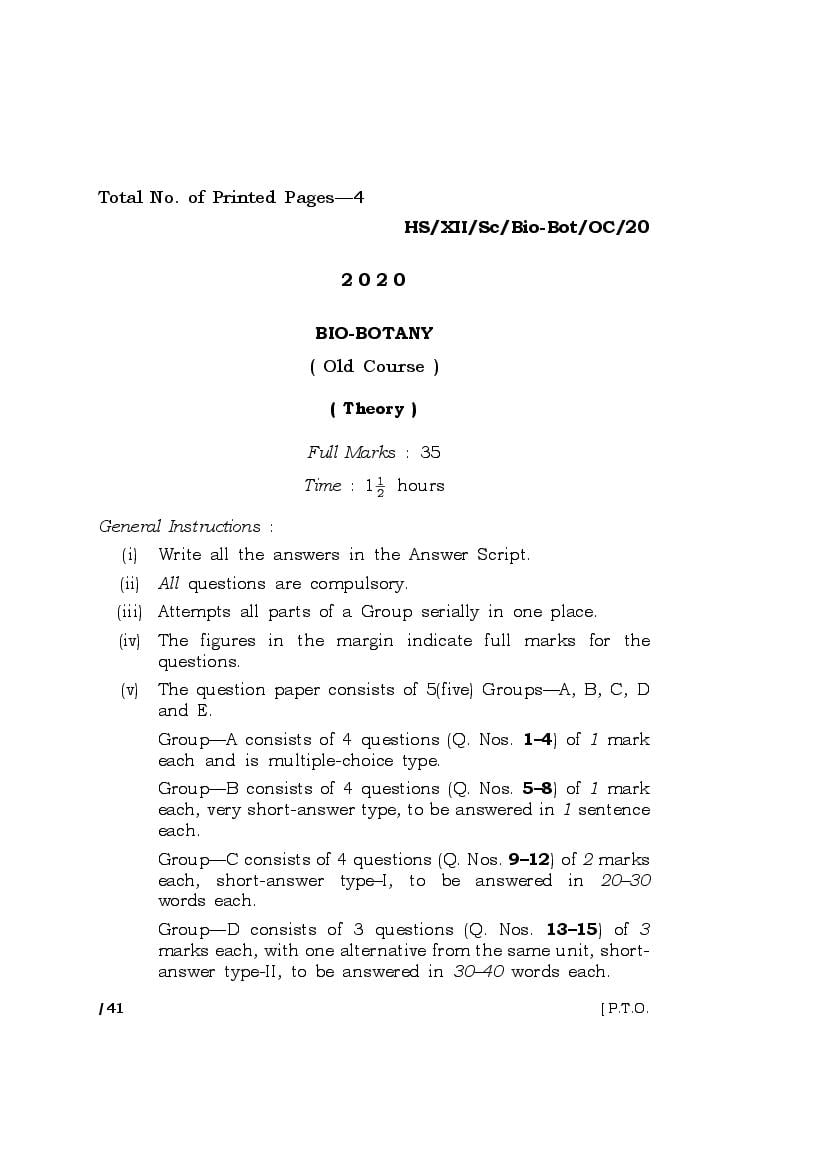
HS/XII/Sc/Bio-Bot/OC/20
2020
BIO-BOTANY
( Old Course )
( Theory )
Full Marks : 35
Time : 1 12 hours
General Instructions :
(i) Write all the answers in the Answer Script.
(ii) All questions are compulsory.
(iii) Attempts all parts of a Group serially in one place.
(iv) The figures in the margin indicate full marks for the
questions.
(v) The question paper consists of 5(five) Groups—A, B, C, D
and E.
Group—A consists of 4 questions (Q. Nos. 1–4) of 1 mark
each and is multiple-choice type.
Group—B consists of 4 questions (Q. Nos. 5–8) of 1 mark
each, very short-answer type, to be answered in 1 sentence
each.
Group—C consists of 4 questions (Q. Nos. 9–12) of 2 marks
each, short-answer type–I, to be answered in 20–30
words each.
Group—D consists of 3 questions (Q. Nos. 13–15) of 3
marks each, with one alternative from the same unit, short-
answer type-II, to be answered in 30–40 words each.
/41 [ P.T.O.
Page 2
Group—E consists of 2 questions (Q. Nos. 16 and 17) of
5 marks each, with one alternative for each question, long-
answer type, to be answered in 70–80 words each.
GROUP—A
Choose and write the correct answer for the following : 1×4=4
1. A small opening at the apex of the integument is called
(a) nucellus
(b) funiculus
(c) hilum
(d) micropyle
2. The phenotypic ratio in complementary gene interaction
is
(a) 9 : 3 : 3 : 1
(b) 1 : 2 : 1
(c) 9 : 7
(d) 3 : 1
3. Butyric acid is produced by which bacterium?
(a) Clostridium
(b) Saccharomyces
(c) Penicillium
(d) Lactobacillus
HS/XII/Sc/Bio-Bot/OC/20/41 [ Contd.
Page 3
4. The term, ‘ecology’ was coined by
(a) H. Reiter
(b) E. Munch
(c) A. G. Tansley
(d) Ernst Haeckel
GROUP—B
1
5. Write two advantages of cross-pollination. 2 ×2=1
6. Define epistasis. 1
7. Give the full form of LAB. 1
8. Define explant. 1
GROUP—C
9. Who discovered penicillin? Name the species from which
penicillin is obtained. 1+1=2
10. Mention the four components of soil. 2
11. What are genetically modified crops? Give examples.
1+1=2
12. Define hybridization. Name the different types of
hybridization. 1+1=2
HS/XII/Sc/Bio-Bot/OC/20/41 [ P.T.O.
Page 4
GROUP—D
13. Explain double fertilization with suitable diagrams. 2+1=3
Or
Give the characteristic features of anemophilous flowers. 3
14. List the functions of chromosomes. 3
15. What is single-cell protein? Explain how single-cell
protein is used in therapeutic and natural medicine.
1+2=3
GROUP—E
16. Describe briefly the stages of primary succession in a
hydrosere. 5
Or
Define population. Explain briefly the characteristics of
population. 1+4=5
17. Describe the mechanism of DNA replication with
suitable diagrams. 4+1=5
Or
Describe any five characteristics of genetic code. 5
HS/XII/Sc/Bio-Bot/OC/20/41 20K—1130
Document Details
| Board / Org | Meghalaya Board |
| Exam | Class 12 |
| Type | Question Paper |
| Pages | 4 |
| Updated | 30 Apr 2026 |